A Nebulous and Ancient Notion

First business: I will be at Denver comicon, for sure tomorrow and Saturday (I have very strong doubts I will be able to do it Sunday, considering where I’m starting from in terms of exhaustion.)  The family isn’t going because we’re in the middle of three moves (one for us, one for each of the kids.)  I wouldn’t go if it weren’t MY job.  I’d postpone it till next year.  BUT as is, I’ll be there.  Come see me at the Wordfire Booth.  If I find them, I’ll have souvernir-fishTM to give away.  Also, again supposing I find them, T-shirts and some posters for the DST series.

Okay, business out of the way: In one of the closed groups I frequent on FB, someone said we live in weird times, when gender (or sex), concept with clearly definable biological roots is considered mutable on the say so of an individual, while race, a concept biologically so nebulous as to defy definition, is considered immutable, binding and part of you forever and ever, supposed to inform even your political opinions.

I think I understand both of them.  Kind of.  Well, I understand the first one.

For many years, human sexual definition was tied inescapably with the reproductive role.  And before you say anything, yeah, that is still the way we make babies, though thanks to assisted reproduction technologies, that is become a little wobbly and will become more so in the future.

But our ROLES — i.e. what we do vs. the new generation — have already become largely unmoored from reproductive “sex”.  This is for various reasons, mostly because of the pill AND the (by and large) defeat of infant mortality which make child bearing and child rearing relatively unimportant in comparison to careers or marriages or even hobbies.  Yeah, I know it seems like a long time, particularly if you’re in the middle of it, but at most child rearing, unless you’re one of the rare families that have more than a couple, three children, takes up maybe a third of your productive lifetime.  Less, if you average it, because we’re … not reproducing.  I mean, the main reason you haven’t seen a precipitous drop  in population is that we’re not dying as early as we used to.  BUT of my close friends group, I’m fertile fanny with 2 kids.  I have a friend who has ONE kid, and the rest are childless.  We bought this house from a childless couple.  The couple who bought our house had ONE teen daughter.

Child rearing just takes up less and less mind space in our society, and as such it’s not so much a case of “mamma bear” or mamma anything.  (btw, a post for another time but the strangest experiment our society is engaged in is the outsourcing of raising an entire generation to under-educated strangers who don’t have the power to punish the children.)

As such people have a vague and queasy idea that sex roles, and sex itself as part of humanity’s make-up is changing faster than they understand, and try to see sex roles as immutable and “the can must match the contents.”  When it doesn’t they convince themselves they have sexual disphoria, instead of simply being atypical or very atypical males or females.  Because averages are statistical, not flesh and blood.

This doesn’t apply to the people uncomfortable enough in their bodies and informed enough to undergo surgery.  Even though the surgery we have amounts to butchery, if people undergo it, I’ll treat them as what they wish to be, and I’ll respect their choice.

OTOH the people who think they have gender that changes every other day?  PFUI.  I suppose one can’t help a degree of Aspergers above a certain IQ, but seriously, if you’re that smart you should realize that what it says on the can about gender roles is the merest suggestion.

At any rate, the exception to people who have undergone surgery notwithstanding (and that not resting on a biological basis, but on a psychological basis and being a matter of respecting someone else’s accommodations to survive in reality) sex is simple.  If you’re XX you’re female.  If you’re XY you’re male.  The rate of people who are some stranger mix is very, very rare.  And that chromosomal make up DOES influence everything from your upper body strength (it was a shock to me to find out that my kids at fourteen were not only stronger, but exponentially stronger than I was as an in-shape forty something.  They hadn’t even stopped growing) to your mental pathways, some of it started by hormones in uterus.

Now all of this means bloody nothing to the individual (except that physical strength thing.  Women can sort of, if they devote their lives to it, reach the lower edges of male strength.  BUT what the heck, we have the endurance they lack, and a lot more resistance to/ability to endure pain.) Some women “think more” like men and some men “think more” like women.  In aggregate the two sides process very differently.  All men would be ADHD women including the freakish ability to concentrate when needed, and all women can multitask better than men.  (Something favored by evolution I suppose, since picking berries AND watching the toddler is how our foremothers survived.  Those whose toddler was eaten didn’t get to be our foremothers.)

Still, in biological terms, sex is easy.  You’re either xx or xy and the in-betweens are misfires.  People with physical OR psychological mismatches of the true kind (the kind that is actually helped by the operation) are very few.  So the current drive to convince every kid that his problems are rooted in really being an x trapped in a y body are at best insane and at worse (in terms of species) suicidal.  And people who think they change genders on their say so, with no surgery, no hormonal treatments, because the wind blows from the East and it’s Thursday have been sold a bill of goods.

Then there’s race.  We’ve all become obsessed with race one way or another, and i’m glaring (what you’d think I’d be staring out indifferently?  Why?) at a future in which we’re all race obsessed socialists.  It’s just the races we emphasize that change.

That obsession with race was always part of socialism, at least if the examples quoted by George Watson in The Lost Literature of Socialism are correct.

Despite being internationalists, traditional socialists were also white supremacists  (What a vat of charming) and thought the other races should be killed for “racial hygiene.”

What changed in the last half of the twentieth century is that they found all their experiments in first world countries, all their attempts to bring about a proletarian revolution were foiled by human progress and human disinterest in envy as a cardian virtue.

The left-socialists then turned to the third world, which you might term the eternally dispossessed, as the source of that revolution and at any rate realized threatening the first world with the third gave them power, always their main objective.

Then the right-socialists (well, they SAY they’re right) decided that if white people were treated as second class citizens by the intelligentsia and clerisy, it was time to reverse the tables.

So, yeah, I do — sort of — understand the current obsession with race.

There is more to it, too.  The world is being changed by tech too fast for any of us to adapt, even those of us whose metier it is to meditate on technological change.

When that happens humanity as a whole sort of experiences a regression in psychological terms.  And it’s very easy both to understand and to embrace race as a form of organization, because humans are tribal and creatures of bands.  In the small band, every human looked alike.  Not looking alike was a stranger and thus possible (extreme.  Our ancestors ate each other, and not in a fun way) danger.

But the problem is race as race doesn’t really exist.  We won’t go into Hispanic or Latino, which even our government thinks is a cultural group, not a genetic one.  (Though there are genes for people who are not just of Latin upbringing but of Latin body-type.  One of which is for weight explosion when faced with easily available food. But that’s sub-racial “genetic grouping.”)

Sure there are people who are very dark, and that might coincide with very curly hair, etc.  BUT here’s the thing, the external appearance genes have very little to do with temperament or intelligence or other genes.  They even have bloody nothing to do with ancestry.  I’ve known two pale blonds with majority-African blood.  I once heard it said that African Americans (appropriate term in this case) are racially what’s known as “caucasians.”  I don’t know if that’s true, but I know that’s how Africans think of them.

Even in racially based states, there are difficulties telling race.  I remember being in South Africa when they found an abandoned baby girl.  A crisis ensued as they had no clue what family to place her with/where she should live.  BUT not even hair follicle analysis could give them an answer to this little girl’s race.  (I left before it was resolved.)

The fact that race is a mirage, as cultural as it is physical, at least in being perceived as a certain race, makes it very dangerous in any society, but particularly a SOCIALIST society (as most societies now are, to an extent or another.  And this is about to get worse looking at the two potential presidents.)

You see, socialism sees people as widgets.  It tries to fit them into a vision that can’t possibly work long term.

If it’s race fixated, when it fails, it will start going after various racial groups.  It already has when socialism failed in the Western world.  Now some people seem to think a socialism of whites, yeah, that will work.

It won’t.  And then come the distinctions between whites and the searching through people’s DNA tests.  This is one of the reasons I haven’t tested, though I suspect like Larry Correia I’ll test mostly or a lot of British, because… North of Portugal.  If you know the history of the area, this will make perfect sense.  Heck, our kings were plantagenets because of marriages.

And yet the North of Portugal — in passing — is as Latin as the rest of the country.  Oh, sure, we’re quieter and more reserved than most Latins.  (No, really.) But the culture is the same.  BECAUSE it’s culture not race that informs how large groups behave.

One of the commenters said that my post on how Venezuela was different from the US was an obvious “against mass immigration from Latin countries” post.  That surprised me because it’s not WHY I wrote it, but then I thought of course it is.  I am against mass immigration from ANYWHERE.  Import enough people fast enough and you change the CULTURE.  This is particularly true if first generation immigrants are surrounded by “their people” and feel no pressure to learn the language or the culture of their adopted country.

This leads to balkanization and cultural change.  And if you’re — like us — a country of ideology, that will kill you as dead as mass murder.

I see no hope for it now, but what I see for the future, as our only hope, is for us to become again a country of belief and contract.

The alternative is to chase that phantom race on the way to socialism, which no race is pure enough to achieve, and to end up defining race in narrower and narrower groups.  Eventually we’ll arrive at the “celtic” race again, and have “more than 20% Irish ancestry makes you non white.” And won’t that be fun.

But it’s all right, right?  It’s “scientific socialism” and “race hygiene.”

Here we go again.


Writing the Right Characters – By Rhiain

Writing the Right Characters – By Rhiain

Recently, a tiresome bit of pablum has circulated online in various articles by well-meaning individuals, whose main complaint seems to be that it’s not possible for white authors to write novels with “Person of Color” main characters.

The most recent reiteration of this complaint is a June 6 Tor/Forge post by one A.J. Hartley, titled “Writing POC While White”, in which Hartley tries and fails to explain why white writers do a poor job of writing non-white main characters, and why they should apparently avoid this trap whenever possible. To whit, he says:

Portraying disempowered Otherness on the page is still possible even if you don’t know it (in your gut) as lived experience. You can research it. You can talk to other people about it. Hell, you can see it in the news every day. But writing a POC character when you aren’t one yourself is not the same as writing a profession you know nothing about—plumbing, say—which you can fake your way through by watching a few How To videos on YouTube. In the end, all you can do is try to do it with sensitivity and respect, but—and this is more important—be ready to listen to those better qualified to assess what you’ve done when they tell you you’ve got it wrong. Again, meaning well isn’t enough, and the road to hell really is paved with good intentions.

Keep in mind that Hartley begins this article by explaining what countries’ histories and political systems he drew from in the course of the worldbuilding process for his own novel, “Steeplejack.” From there, he attempts to elucidate further on his reasoning, such as it is, by alluding to his own non-white family within anecdotes about his run-ins with well-meaning folks who make some racist assumptions about his non-white wife and son.

Hartley fails to defend the premise of his article for the following reasons:

He assumes that white authors don’t already know how to write non-white characters. He says, “Too often writers play upon stereotypes and white notions of what it means to be a POC” without providing evidence of this claim. He goes on to add, “Conversely, and almost as problematic to my mind, many writers assume that race/ethnicity is irrelevant, so characters can be written as white and then (like the awful colorizing of old movies) given a superficial tint.”

Honestly, does anyone find this claim to be even remotely true? Hartley makes assumptions about other authors that reflects poorly on how he views their writing processes versus his own. How can he know or even imagine that the next writer, whomever that may be, will not invest time and effort to construct a believable protagonist that his or her audience will not equate to, oh, let’s see, Empress Teresa? (Here I will interject to add a disclaimer of “Don’t Ask, Don’t Tell.” Oh, and proceed at your own risk regarding this can of worms.) Hartley might find this difficult to believe, but accomplished authors who know how to create characters their audiences can relate to do exist. And some of those characters are black! Cue the smelling salts, Henrietta!

Next, Hartley confuses the fictional universe within a work with the real world. He says,

Race is a real and meaningful part of who we are, so writing a racially-neutral character and then giving them dark skin or an “ethnic-sounding” name doesn’t allow that character to reflect upon the social realities that shaped their sense of self, particularly how they have been treated by the greater, imperfect world.

Let us note that every fictional universe is exclusive to its creator, who shapes it to reflect whatever he or she wants it to be. It might or might not contain shades of realism, it might or might not be populated by humans, it might or might not be a believable universe. This, however, doesn’t change the fact that it’s fiction.

The main reason why I continually find the complaint that white writers cannot realistically write “POC” main characters is this – hopefully – temporary amnesia on the part of the complainees. When reading fiction, who expects any reasonable creator of a fictional universe to mirror our world country to country, culture to culture, species to species? Why do people agitate for more representation of diversity in fiction when fiction’s main job is to serve as escapism from the current stresses of the real world? Do these folks want us to become stressed by the fiction we read? Heaven forbid this is their goal!

Finally, and most importantly, it’s the height of arrogance to claim certain writers cannot write certain characters because of the characters’ skin color. We would like to think that, in our acclaimed post-racial America, this object lesson would have already been imparted and ingrained into our collective psyche. Everyday there’s a poor schlob being judged because he, a white man, dared to slip into the persona of a fictional person who may have been created with tentacles, extra appendages, or lavender-colored scales to speak with another fictional person who’s human. How dare he! How does he know what xir’s had to deal with in xir’s society? How dare he force xir to converse with a human! What’s this universe coming to?

It is in this vein that some of the feverish condemnation of JK Rowling for writing about Native American wizard culture can be found, because she didn’t consult experts of historically-sourced Native American culture before recently creating the fictional version in the Harry Potter universe for her fans to discover. Some of the aggrieved even went so far to say that Rowling should not have bothered to write on the fictional Native American wizards, because their society and culture was portrayed inaccurately by its creator.

Consider the implications of this accusation, please: some arrogant “POC” experts on Native American culture essentially told one of the bestselling authors of our time to stick to writing non-POC characters in the fictional universe she’d created. Never mind that some of the characters that already inhabited the Harry Potter universe were non-white and had existed long before these pea-brained, brown-tinted glass-wearing individuals could write a coherent sentence.

We might laugh and consider the entire situation to be ludicrous. We might shake our heads and wonder aloud how people like the aforementioned aggrieved parties exist.

But exist they do, and their influence on writing fiction is pervasive and ever present.

To say that I disagree with Hartley’s assertions in his article is an understatement. They’re ill-conceived and there’s scant evidence to back them. The premise is poorly developed and easily dissected by a “POC” who finds it distasteful and irrational to use race and skin color as attempts to dissuade a writer from creating characters utterly different from himself. I would even say that the term “Person of Color” is unnecessary in discussing character development for its racist connotations. Which makes Hartley’s conclusion all the more amusing:

But I also think that writing about race (and all the other “isms”) is important because all people have a stake in these conversations, and we need to find ways to discuss such things which break down that sense of our culture as fundamentally siloed, divided, and fractious.

Indeed, Mr. Hartley. My first suggestion is to ditch this “POC” verbiage. You do yourself and your loved ones a disservice by including it here. It is by itself divisive in the worst way and not at all constructive to the discussion of character creation and development.

My second suggestion is to continue improving your writing so that “characters can be written as white and then…given a superficial tint” gives way to “write the right character for your story,” which becomes your primary focus so far as your characters are concerned. You do yourself no favors by assuming that a character is written as white by default. You can’t confirm that this is true for other writers, nor can you know what their writing processes are that could possibly lead you to this flawed conclusion, so why keep assuming this?

My third suggestion is to read between the lines in your fiction. Other writers incorporate non-white characters in their fiction as necessary on a regular basis. This doesn’t require an agonizingly presumptuous article telling white writers that this is a new required tool in their box of writing tips and tricks. Does that olive-skinned character serve a purpose to advance your plot? Does that Schlebian (a lobster-looking species I just made up) function in a useful way as a foil or antagonist for your main character, whatever skin color she may be?

The treatment by this “greater, imperfect world” may inform your life’s experiences and worldview, but don’t let it taint your fiction.

On Reading Women

The first author name I remember — my then as now suffering from this peculiarity in which I only remember names of authors I like and only usually after the second book that knocks my socks off (there are exceptions, F. Paul Wilson being one of them.  Never forgot his name after reading Hosts.) — is Enid Blyton.

I never read her really young books, Noddy and the like.  I suffered from the issues of a kid raised amid adults, in that I skipped picture books altogether.  I think I figured out how to read from my brother reading me Disney comics.  I remember the story (the seven haunts) that I re-built from picture cues to what he’d read, then took the words apart to get the phonetics.  This I concealed from everyone, because if they got wind I could read one of my principal pleasures — having someone read to me — would be over.

By first grade, though, the sham was up and I was reading mostly Enid Blyton.  My brother is almost ten years older than I and I think by then he had just stopped re-reading those books even for nostalgia, so there were all these “kid mysteries.”  They’re — if I have it right, since I never read the American versions — a little different from Hardy Boys and Nancy Drew in that the kids are more free ranging, less organized, and the adventures — one of my favorite series was “of adventure” as in Sea of Adventure, Valley of Adventure, etc — can range all the way to the Greek Islands.

Anyway, almost every kid I knew of my generation and the older on grew up on Enid Blyton.  (If you go searching for her books, please be careful.  The recent editions have been abominably “updated” to put in the new tech.  In itself this might have been inoffensive — it wouldn’t be, because note that it’s impossible to make some plots work around cell phones, but — but they also took the time to infuse it with a whole lot of new political correctness which totally robs the books of charm.) Boys and girls, and I don’t remember anyone making a big deal of the fact that the boys were reading a female writer.  Or the fact that she was THE female writer that dominated YA.

It wasn’t until I was in my early teens that friends introduced me to her boarding school stories which are more… well… imagine Harry Potter with all girls and without the magic, but also very feminine, for a given definition of feminine, which is neither the frills and pink we imagine for tradition, nor the current idea of feminine.  The boarding schools had girls who behaved like boys and wanted to be called by boys’ names, who were tough athletes, and some who were absolutely feminine.  The first btw was not taken as any form of transexuality but simply as an expression of a sort of female persona.  Girls who were very masculine and fond of masculine pasttimes (Sports, dogs, horses) grew up to be the horsey women we all know from British upper class.  The sturdy country women of Agatha Christie’s books, who have no time for nonsense, wear tough boots and tweed, and concern themselves with horses, dogs and gardening (which was not considered a contradiction) could have come (and probably often did) from those young women.  Yeah, there was also “veiled lesbianism” I suppose, though I think nowadays we read that a lot into places where the older times simply read same-sex friendship.  I went to an all girl school and while there were a lot of crushes, they were a sort of romantic friendship that had no physical expression except in very, very, very rare cases.  (And one of the cases caught in flagrant was also the first to marry — a man — and have kids in the class, so I think she just liked sex.)

Anyway, the boarding school books are more a “Harry Potter for girls” and while I’d still recommend it to anyone who has daughters, the boys might fling it away in disgust. (Or not.)

I recommend all of her books, even if they might handicap you in modern American society.  You see, they inculcate a certain kind of … Britishness.  Fairplay and don’t brag, and take your lumps without a whimper.  And also, look after those who can’t look after themselves and who are “yours” somehow, and fulfill your obligations.  Don’t rat. Don’t snitch.  And she inculcates all this without SAYING it or preaching.  The characters might say it, and they certainly show it in their attitudes, but there’s no easy pre-packaged moral at the end of the story.  (The might handicap you: if you go into a profession that requires self-promotion in the present day US, that “don’t brag” is almost disabling. Ask Dave Freer and I.)

But, you’ll say, why would anyone question a YA author being female?  Aren’t women, after all, the guardians of childhood.

Yeah, sure.  BUT. And the BUT is really important.  BUT we are living in a time where it’s believed we must have women writing about women for women to read, and men writing about men for men to read.  Note Enid Blyton was read by both sexes with very little compunction.  (Even the boarding school adventures, and even when one was way too old for them.  I.e. my brother read them on the sly when I was reading them.  I know. He sucked at remembering exactly where I’d left the book.)

At around nine or ten, on a summer day when I had nothing else to read and my best friend, from whom I borrowed books, was on a month long vacation, I started reading mysteries.  It’s kind of weird it took so long, since dad read them voraciously and they were all over the house.  But you see THE Portuguese mystery imprint was Vampire.  And I hated horror movies/books.  (Still do.  I don’t see a lot of value in scaring myself.  Life is scary enough. By this I mean what is now called Grimdark, of course, not horrible situations in which people triumph.)  But I was bored enough to overcome it.  My first book was Fer de Lance by Rex Stout.  (Which weirdly I THINK was also Robert’s first mystery book.)

I don’t remember consciously discovering Agatha Christie but I think I found her after hearing someone say that trying to figure out something or other was like “trying to figure out a mystery by Agatha Christie.”

By the time I was 13 she was my favorite mystery writer and somewhere in Portugal I have a complete set of her works, and somewhere here I have a complete set of her works.

I read Agatha Christie the same way I read Rex Stout and Erle Stanley Gardner, and way too many others I can’t now remember, until I came to the states and discovered Ellis Peters and a dozen others.  I never paid any particular attention, I’ll be honest, to whether my writer was male or female.  Oh, sure, there was a flavor.  I can’t imagine Agatha Christie being written by a man unless he were PROFOUNDLY gay and lived the sort of life gay guys sometimes lived in English villages at the turn of the century.  Her novels like the boarding school stories of Enid Blyton are intensely feminine in a difficult-to-pin way.  I think this is why the bien pensant, particularly leftist ones hate her.  They want to extol females, but only females who behave like men, and she is the antithesis of that.  It is easy to see from her thrillers (my LORD they were bad) that she didn’t really “get” international politics or world affairs at the visceral level some of us do.  They just didn’t matter to her.  However, whatever the critics say, she had an unerring eye for the “private wound” and the private motive, too.  She knew what made normal people, living normal, daily lives tick.  I often find myself telling my husband “As Agatha Christie would say” about something one of our friends or acquaintances did.  I think this makes the intelligentsia uncomfortable too.  So many of them are so small in their private lives, if you know what I mean.

Then I fell into science fiction at 11 or so.  I confess my first reads were male: Simak, Heinlein, Asimov.  But that was mostly because it was what fell under my fingers first.  I later came to have female favorites, too, though none of the ones most people like, which tend to annoy me, in some cases because of my very different background.  The only one coming to mind right now that I read before I got married and still in Portuguese was Anne McCaffrey, but I know there were… oh, yeah, Ursula Le Guin, too (I was hit or miss with her.  Some books I loved, some went for the wall at speed) and Joan Vinge.

Later on, some women achieved the pantheon of honor of “I’ll buy in hard cover” including Diana Wynne Jones and for a good long while Mercedes Lackey and Connie Willis and others, though you’ll forgive my “moving and my brain is mush” for not conjuring their names.  Buying in hard cover is sort of a medal of honor for a writer, when the reader is a young mother with kids who needs shoes.  (Need shoes all the time.  Robert’s feet finally stopped growing at 17e, thank heavens after Amazon started selling shoes and allowed us to order weird sizes, otherwise we’d have had to have them specially made.  As is, each pair costs a small fortune.)

At the same time as the people above, I was also buying in hard cover in sf/f Pratchett and F. Paul Wilson. And a lot of guys and women in mystery.

So, what is this all about?

It is about the fact I’m tired of getting fan letters saying “I finally read your books, having hesitated long and hard to start.  Forgive me, but the fact that you’re female made me doubtful.”

Ah, yeah, that.  And then I became conscious of an hesitation to pick up female-written books, myself.

I, who am a female writing books, and who have been formed as a reader by a veritable battalion of writing females, suddenly subjecting to greater scrutiny books by females, and asking friends “is she okay?” before starting a new female author.

Why?  Oh, not because of what is between the author’s legs.  No, that never interested me, before or since.  What makes me hesitate is the mush that younger females have had their heads filled with, often from primary education.

One of the first warnings of this was when a young college student joined our writers’ group.  (She is now a bestselling author.)  Her education had been exquisite and expensive, and yet…

And yet she believed things like that there had been great women fighters in the middle ages, and the men had suppressed all memory of them.  Or that my best friend and I didn’t have college degrees (both of us had Masters) because we were stay at home moms.

I don’t judge her too harshly on these beliefs.  It’s really hard to examine the things that adults told us when we were very young.  Note how until recently I believed my cousin Dulce had died because I refused to share my bread and butter with her.  (I suspect being rebuked, then hearing she’d died got conflated in my mind.)  And that wasn’t even an intentional guilt trip.

But I find myself reading about women as they never were, women without agency oppressed by a far  more coordinated patriarchy than any male I know could manage, let alone a group of males.  I find myself reading about men as they never were, too, men who are all plotting and evil and powerful or else cringing ball-less cowards.  And then there is the Marxism that afflicts the younger, “well educated” ones.  And the preaching.  Oh, my LORD, I never took well to preaching, even in religious books.

So, I hesitate before picking up new women writers.  Though I do pick them up.  I even tolerate a fair amount of feminism and left wing ideology if it’s so well wrapped in the story it doesn’t pop me out of it.  Most of the women and some of the men above are/were definitely on the left, but they can tell a story, and that’s all I care about.

Which brings us to this push to “read mo’e women” and the idea that people don’t read women out of some kind of sexism.

We were reading women just fine before.  We got our message across just before these advocates started helping us before.

All the screams to “read women” and about the inequity of men being read do is make people pause and think “If I buy this woman, is she going to spend most of the book preaching instead of telling a story.”

And this affects the sales of those who preach as well as the sales of people like me, and Sabrina, and Amanda, and Kate, and and and…

Yeah, there are reasons more men reach the top of the profession than women.  One of them is legacy.  The crawl through the profession is slow, and if more men were published before the seventies, more men will be luminaries now.

There are others, the same reasons that form the “glass ceiling.”  From myself I can tell you any number of us spend ten to twenty years in our most productive time, mostly looking after the kiddies and/or the house.  This is because at that time and that place this is the best economic strategy since our husbands make more than an uncertain artistic career.  (And some men — I could name them — were stay at home husbands and paid the same price.  It’s just it’s easier due to society expectations, for women to make that choice than for men.  That’s changing, though.) Most women don’t even start trying to be published until after the kids leave, which necessarily curtails that slow crawl.  Me?  I’m crazy so I started earlier, but it did affect how much attention I gave to the work and therefore the quality.

There are inequities.  Sure.  Life is inequities.  “All men are created equal” before the law, but thank heavens we’re not a population of clones.  So, even had I been a little richer and able to afford a nanny 10 hours a week, life would be very different.

However the way to compensate for that is not to scream at readers for reading the male authors they enjoy.  The way to do it is in fact, if you have money or can start a foundation, to give promising women writers scholarships for child care.  Or not.  Perhaps striving refines us.

Perhaps we just need to read the people we enjoy and stop posturing as defenders of the under-read.

Because in the end, all the activists are managing is to make it harder for women to become established professionals.

Which might, very well, be what they want.  A permanent injustice is permanent fodder for activists after all.

As for me, I’ll continue writing as a writer, and hoping you read me as a writer, and not for what is between my legs.  I don’t write with that.  I’m not that talented.  And though my books will sometimes be very feminine in the way Agatha Christie’s are, Agatha had millions of male fans and still does.

What is fiction for, but allowing you to spend time in that permanent solitary lock up behind someone else’s eyes?  And isn’t the more different the better in that case?

I will continue to read as widely as I can and give all authors a fair chance.


You Ain’t Got No Class

Sorry this is so incredibly late.  Some of my reasons are perfectly legitimate. Yesterday I was extensively possessed by Mobia, muse of furniture moving.  (Actually there is a method to that madness, since we need to clear passageways for the second wave of movers coming to bring stuff in on Wednesday.  Right now passageways are choked with book boxes inexplicably marked for my office and brought to it, instead of downstairs to the library.  I was also entering my office by vaulting — at my age! — over a small table intended to hold derpy and my printer — which I badly need — so that had to change.) So right now my office if 90% set up, including the little constellation of handblown witchballs hanging from the ceiling.)  This work lasted till one in the morning, when I collapsed more or less unconscious, which means I woke up at seven thirty, i.e. about an hour later than normal.  This part is legitimate.

The less legitimate delay is that, instead of rushing to my office to dash off a blog, its being trash day, I did the litter boxes and changed them to fresh sand, putting the old sand out with the trash, then prepared dinner for tonight, since we’re planning to go to the other house and work this afternoon and neither my purse nor my waistline can afford for me to go out to eat yet again.  (Seriously, why do you always gain weight on restaurant meals? Even when you eat less than at home?)

The less legitimate delay is that while having a second cup of coffee I got captured by The Lost Literature of Socialism by George Watson.  I think it was one of you reprobates who made me aware of this book, and I’ve read — and looked up references — on the first third (it’s a short book) while putting dinner in crockpot and while having coffee.

One of the thing Watson says which would probably make heads spin in current day US particularly the heads of casual (read un-informed) socialists and school teachers, is that socialism at its inception was often a conservative ideology.  Conservative here is used in the sense of preserving a society of different ranks, as opposed to the radical egalitarianism of the French Revolution.

At its inception, socialism was often wedded to the idea that the majority of men are made to obey their “superiors” who will plan things so that those too stupid to care for themselves (it’s implied) will not actually starve/be poor/whatever.  Thus the whole idea of scientific governance.  Also the idea that “concern for the poor” could involve killing them wholesale.  Apparently H. G. Wells advocated killing all the “inferior races.”  (Note he’s not being given the Lovecraft treatment by today’s progressives.  Apparently using the term “socialist” for oneself is a magical shielf even for DEAD white supremacists.  Also note that the alt.right would be more properly named the OLD Right.  Antediluvian in fact.) Because scientifically they are a drain on society.  Apparently the old socialists objected to Hitler calling himself a socialist on the grounds that his corporatism violated the tenets of socialism (more than seems to us, since socialism was a philosophy of the old noblemen in OPPOSITION to the noveau rich and the new preponderance of commerce) but they never objected to his racialist theories.

There is much there to chew on, little of it a shock or surprise to me, because I grew up in Europe where the sons and daughter of the “best” families are invariably socialists, since they believe they are entitled to tell other people how to live and it is their proud duty to stick their noses in your biddiness for your own good, of course.

The parlance of care for the poor and such seems to have emerged later, to appease people who didn’t believe in nobility anymore, and to make those of privileged upbringing (as most socialists are) feel less guilty.

Being of the belief that no one is born with the right to hurt people or take their stuff (even if it’s in the name of helping/giving to other people) I stand in stark opposition to people who think that if only they can fashion the proper saddle, it is their birthright to ride the rest of us like ponies.

This is meat for one or several posts.  But the thing that struck me was the part on class.

There are these moments where even I, who have tried to self-consciously extirpate Marxism (for a port-manteau since some of the concepts predated Marx, although it took that aspergers bugger to make it rigid and totally contrary to reality and also simple enough to enthrall the simple minds of pseudo intellectuals) from my thought, keep using ideas and terms from it without much thought.

Take class — please.  I have no use for it — as a concept.

What it started with was “estate” which instead of a house and land (linguistic drift there) in the middle ages meant something like “what you were born to do”  or “Your place and mission in life.”

In the Middle Ages, as we all know, there were three estates: those who fought, those who prayed and those who worked.  Of course what we all know has holes you can drive an eighteen wheeler through, and anyone who studies any era more deeply finds a multitude more estates.

My understanding is that even in the middle middle ages there would be many people who didn’t fit into these three neat pigeonholes.  There were those who tinkered, those who influenced kings, those who did the accounting, and those who traded.

I’ll let suburbanbanshee pronounce on it, if she’s in the mood.  BUT until then, the fact is that at least at a distance, that is the most closely that profession and status matched.  If you were born in the class that fought, you weren’t going to get any guff from those who worked, because, tada, you had a sword and knew how to use it.

Then there was the black plague, which made labor scarce and, in a brutal simplification, precipitated the industrial revolution in its first, most timid phase.  And then status, occupation and power all became scrambled.

Several novelists have captured several states of the newly rich commercial class supplanting the old “those who fought” class. To a certain extent the revolutions since the French have been an attempt of the clerics to displace the old nobility.  (Insert here your favorite linguistic joke about cleric coming from clerk, and our new secular religions of multiculturalism and environmentalism.)

But the fact is that since the very beginning of the industrial revolution (what we’d call cottage industry and a little bit of commerce) profession and status and power have all become unmoored of each other and flapping loose and twining whichever way.

You’ll say that they are not entirely loose, that there is no way that dirty, manual labor will ever command status and/or power.  Brother!  Have you tried to find/hire a decent handyman? If I’d actually had a hint of the future, instead of going to college, I’d have apprenticed with my granddad and would now be cleaning up as a furniture maker.  (Actually I knew someone who made a one-piece, antique reproduction, by old methods, with handtools, a year.  That took him about 3 months, and he got 60k for it in the mid-eighties.  He had 9 months to do whatever he pleased afterwards.  I SHOULD have learned to use granddad’s tools and inherited them.)

They were already going that way and it was fairly obvious when Marx tried to pin it to the classes of his day, which is why he became obsessed with ownership of the means of production.  (Also, never having run a business, he had no idea it was actual work/risk.)

But that applies even less in our day.  For instance, if you take that definition, my entire profession just moved from laborers to capitalists, at least in theory, since we now can own all the means of production involved in getting our product to the public.

So by the mid 20th century, “Marxists” were instead pinning classes to economic strata which seemed to the uninformed to be a good way to track status and power.

It wasn’t.  It probably never was.  It is, I suppose, expected that materialists would think that money is the source of all blessings, as well as the root of all evil, but I grew up with grandma, whose actual income in money probably qualified her as a pauper, but who made and grew most of what she needed and was accorded Granny Aching like respect in the village, thereby proving you can have status without money.  As for power… Note the reference to Granny Aching… or Granny Weatherwax.  There is power that doesn’t derive from the government and the power of a matriarch can be both near limitless and terrifying.

I was in 9th or 10th grade when a friend newly struck with the Marxist bug tried to explain to me that it was unfair that my family was of an upper class.  I ended up tying her in knots chasing “class” since neither by the traditional Marxist definition nor my income was my “class” any higher than hers. Her father made more money than mine, and both our fathers worked in other people’s factories.

So she devolved to something like “Well, your family is more refined.”  Which in a way was true, but not in origins, as mom grew up in something that was only not qualified as a slum because Portuguese refused to admit it was one.  If it were and now, it would be called “the hood” and there as now here then as now, you clutched your purse and minded yourself, because it was a dangerous area.  It’s just that my parents both tried to cultivate the bourgeois virtues of cleanliness, thrift, delayed gratification and industriousness to which mom (in a perpetual war with my uncle’s arranged-marriage wealthy (for the village!) bride) added airs of refinement which extended well beyond our income, because mom was an artist at heart (probably still is.))

This was the origin of her resentment of our “upper class” but she didn’t seem to get it was something that could neither be redistributed NOR was being held back from her family if only they chose to apply it.

Since then I’ve found she was the vanguard of all socialists.  Nowadays they routinely try to give people the rewards of bourgeois virtues in the belief that the virtues will then follow, in a sort of putting the material cart in front of the ethical horse and being shocked the cart doesn’t pull.

In America this is even more complicated, since no one quite agrees on markers of class/status and power.

One of you at one time said high class in America was having matching glasses, in which case my family falls in and out of high class as a set gets mostly broken, we discard most of the remains and buy a new one.  This might very well be true.  Our rulers (you wish they were our leaders, but no) seem to think status is tied to home ownership so they try to redistribute that, leading to the real estate crisis of 08.

I think the best thing is to assume that America, being a country of Odds, ain’t got no class.  Classes don’t apply much of anywhere, out of Marx’s Aspergers imagination, but they SURELY don’t apply here.

We’re not a classless society, of course.  We are still monkeys (oh, apes?  Ain’t you la-dee-dah) and therefore we need status.  But we find our status in our own groups, and in our own way.  I was very shocked to find that Phillip Jose Farmer (love is World of Tiers, hate Riverworld) someone I revered as a kid was working a convenience store.  To me he was high status.  Now I am sometimes shocked at being treated as though I were high class even when we’re struggling to make ends meet while putting the kids through college.

Because status and respect is where you find it and in what you do.  It’s easy (well, not for me, but) to have a ton of money and no status.  We all know the “brother in law of someone rich” syndrome.  It means nothing.  That guy might be accorded respect to his face because who needs trouble, but everyone laughs when his back is turned.  In the same way in some circles, someone with neither wealth nor power will be treated as royalty, because we know what they did/do and the influence they wielded upon our lives.

America definitely has people who have a lot of class, but in terms of divisions between the people where everyone is as much of a widget as even noblemen and peasants of the Middle Ages could be interchangeable (which was never much) we ain’t got no class.  And we like it that way.  As long as we can slap back into line those who think laws are for the little people, we’ll do fine.


A Quick Note

I really hope to put a post later.  The problem is I expected that yesterday too, but one trip to the old house turned into five, finishing at 9 pm.

The movers are making their second and might be last moving day on Wednesday.  Before then we need to pack, sort, donate, etc.  It’s not so much the stuff we unpacked (very little.)  It’s the stuff that’s semi-sorted, as we’ve been sorting and culling possessions for two months.

And then (yeah, he won.  With arguments.  We won too, in a way.  One year, and then he either moves in or finds a way to support himself.) splitting households from younger son to whom I HAD to point out he’d need sheets.  And towels.

So, everything is a little upside down.  Give me some room.  I would very much like write on the nature of money, on the nature of equality, on the nature (yeah, I know) of the difference between male and female writers, where it concerns the reader.

Right now I can’t.  But there will be pie in the sky by and by.

Optimism and Despair

Some time ago some people did a study and decided that people who were mildly depressed had a better grip on their circumstances and chances than those who were optimistic.

Note two things there, the first being MILDLY depressed and the second being THEIR chances and circumstances.  I.e. when you are evaluating your own life, you are, arguably, in possession of more facts than people looking in from the outside.  You know your spouse, children, whoever is around your immediate surroundings, and therefore can relate to what they are likely to do.

I’m often accused of wild optimism in this blog, something I find ALMOST bitterly funny, since a) I’m a depressive by nature (possibly by brain wiring since it runs in my paternal family) and the best, most stable of my states is “mildly depressed.”  When I fall off the horse and become profoundly depressed it’s a whole different ball of wax.  b) I am not telling you there will be pie in the sky by and by, only that we have a long struggle ahead to get this country back on the path of liberty and that since the enemies of individual freedom took a 100 years to bury us, we have to give it as least a good fifty years and work steadily at it without attempting to burn it down after twenty or so, because we didn’t yet get everything we want and our liberty pony TM has hoof rot.

I will confess right up front my bias in this.  I think Americans — natural born Americans, who have never experienced the upheavals the rest of the world has been through — delight in imagining doom is to come upon them any minute.  I’ve seen it on TV and in papers since I moved here. “Economic crash coming any minute” seems to be a thread in our news, a thread that comes up again and again and again.  (And before you say we’re in an economic crash now — not even.  We’re in the economic doldrums.  It is, I think, an unacknowledged depression and pretty severe, but let’s be real, okay?  The structure hasn’t disappeared, children aren’t scrounging for food in garbage bins.  There’s still food on the shelves, and all of us (well, all of me, she says ruefully) could afford to be somewhat leaner.  Now part of what is insulating us is that we have a great wealth of both capital and people.  there’s a great deal of ruin in a country, and more in this one than in the average one.

Because my book to listen to while unpacking is Expanded Universe (A little creepy, really.  Is there any corner of my brain the man didn’t burrow into?  I don’t remember reading this book, it’s not in my regular re-reading rotation and I first read it when I came to the US, so how is it possible that the style and the ideas… are way too close for comfort? But I’m not guilty, yer honor.  I maintain we simply share the same writing bandwidth.  Whatever is beaming the books to the brains of receptive writers has aimed the same beam at both of us.  And I’m not crazy.  Well, not more so than your average writer.) And I got to listen to that same “doom, gloom, the end is coming soon” in quite a few essays.  Now the man had a good reason for it, because he lived through the transition to the atomic bomb, but still…

I think honestly that the idea of a total collapse is an American tall tale, a campfire scary-comforting story, of the sort you tell yourself to appreciate the light of the fire and the warmth of your tent more.  I think it’s all “the world economy will collapse and then the jackalopes will eat us.”

I could be wrong.  I’ve named the circumstances in which I could go wrong.  Major disasters, major attacks on most of the country, that could change our civilization beyond repair, though the amount of damage that would make us regress to early stone age is unbelievable.

But what if the rest of the world goes that way?  The rest of the world will go that way.  Partly because of their own choices, because socialism seemed like such a bright idea.  Partly because of our choices, because socialism is rendering us unable to give them the assistance we have, in keeping the little cocoon of their illusions going.

So, if the world collapses, won’t we? Well, no.  See aftermath of World War II.  We managed.  We muddled along.  We did all right.

But that is not the main point of this essay.  Yesterday I understood the reason so many of you think I’m optimistic, when someone said our trajectory would be exactly the same as Venezuela.

Look, I rolled my eyes so hard SOMEONE needs to find them before the cats play with them.

Americans in a way were ripe to fall for the multiculti lie, i.e. “all cultures are alike, except ours is uniquely bad.”  Not your fault in many ways.  the size of the country, our relative strength, the fact we’re innovators, makes travel abroad more of a luxury and less of a vital interest for most people.  And when most people do travel it is to meet with peers abroad, or to England, which is a whole country of peers.

Comparing our issues to Venezuela is Laugh-Snort inducing to anyone who knows the two countries.  Yes, yes, richest country, blah, blah, blah.

Where it breaks down is the culture.  Like most Latin countries the Venezuelan society is sharply divided between rich and poor and the rich are far more ostentatious than ours, and the poor are UNIMAGINABLY poor, by American standards.  But it goes way beyond that.  If you think we have race problems, you haven’t looked at theirs.  It tangled up their revolution which was not at all like the US one.  Beyond that there is… not so much a culture of manana but this “inexactness” that is a curse of Latin cultures (I’d like to know why, and suspect it came with the moors.  I mean the Romans were fricking engineers and legalistic to the hilt, both of which require exactness.) I joke I spent most of my teen years standing on street corners — reading sf books — because in Portugal “we’ll meet at three” could mean four. Or five. Or six or, in extreme circumstances, seven.  Because I’m an Odd and neurotic I suffered from a fear of being late, so I would manage to be there an hour early and…

There are other cultural quirks, too, some of them cataloged by Heinlein in Tramp Royale.  You CAN work for your money, in a Latin Country, but you’re not supposed to let them see you work.  That class thing.  At the top of the class structure is “old money” who never worked a day for their money and never will.  And that’s the image people aspire to project.

If you don’t see the differences between that and the American cultural mythos; if you don’t understand how they’d lead to very different types of collapse, you might want to ease up on the “doom, gloom, the end is coming soon.”  Because you’re not in possession of all the factors.

Look, I’m not saying it will be easy or simple.  I’m not saying some areas won’t have the devil’s own time.  (You know the areas.  Most of them are having a hell of time now.) I’m not saying that anything will be handed to us.

We’re heading into rough times, when we’ll have to fight hand over hand to keep our freedoms and claw back a little more. BUT if we resist the fatal tendency to give up and burn it all down in a gigantic temper tantrum, we MIGHT yet bring this through.  Our children might not live in freedom, but our grandchildren might.

If this is wild optimism, let it be so.

Sursum Corda.  We’ll get ‘er done.


Winter IS coming

I’m not stealing this from a series I neither read or watch.  I am echoing it from many discussions recently in which the phrase is used like a short code for “things are gonna get rough.”

Yesterday I was at village inn (don’t judge me.  Our very rare violation of no-carbs, no-sweets is in the minor form of no sugar apple pie about once every two months.  On Wednesday, of course.  Which is how I realized it was Wednesday.  Sorry I didn’t do MGC guys.  Things are still confusing.) and a group of women I’d say ten years older than I, (but I’m bad at judging so probably my age) were discussing how bad things have been going over the last eight years.  (It wasn’t said, but I got a strong feeling they’re voting for Hillary anyway.)  And then they said “We need to get used to this.  It’s the new normal.”

There was in their words a feel of “we’ve lived so well so long” and of the Marxist fallacy that making us poorer makes the rest of the world richer, and being decent people they accept their fate with resignation, because, really, would you want to be responsible for starving children in Africa?

Only the starving children in Africa are the victims of their own (mostly socialist, though there’s a few tribal nationalists) corruptocrats, and our own (mostly socialist, though there’s also tribal nationalists of various stripes) corruptocrats making us poor won’t make them rich or even better off.  Arguably the stuff the first world sends them is already responsible for economic malformations that makes their best and brightest work for NGOs as chauffeurs instead of working in something useful to their country.

And as for “the new normal,” the advantage of being half a century old is that I’ve seen this movie before, and the laugh lines aren’t any funnier the second time around.

My own host parents who were Democrats (generational democrats.  We still have them) were sure that the malaise wasn’t Carter’s fault and that Carter’s heart was pure.  He meant the best.  Reagan was going to plunge us in a war.  As for the economy, I mean, do what?  It was the way it was going, all over the world.  The new normal. (They eventually voted for Reagan in no small part because there might have been a campaigning mole in their house… ahem.)

It’s funny how Reagan made the economy work again, and suddenly we were all doing better.  Well enough to last through a Democrat and a Democrat light, two terms each.

But people get used to the slide down.  As I’ve said before, sliding down is easy.  If it’s gradual enough, we resent the first few cuts, then sort of get used to it.  After a while we start viewing it as virtuous to make do with less, to become “frugal” and proficient in things we never needed to do before.  There is a pride in that, of course, and people should be proud of their survival skills. In Portugal where delivered bread had been a thing for years, people were very proud of making their own bread during a bakers’ strike.  I’m still proud of them.  Better than bitching and moaning and doing without.

However, learning to do new things, getting used to going down easy and coping is the slow slide down. You can go a long way that way, and not sparkle rebellion.  People are amazingly good at adapting.  They forget there was ever anything different.  Or if not forget it existed, they forget how nice it was.  They find excuses.  “we’re more self-sufficient now” or “we’re running out of raw materials” and “overpopulation.” (the later two were very popular in the seventies.)  I suspect the new one is (rolls eyes) “climate change.”  Like massive overpopulation this imaginary animal can be blamed for everything those in power want to do, and because it’s nebulous (how over must overpopulation be before it counts.  Last I heard we could all live snugly in a state (not one of the big ones) at NYC densities.  And people live in NYC on purpose.) it can be described as anything needed at the time.  I mean the latest thing I heard blamed on “climate change” was unemployment.  Yeah.

The thing is that the slide down easy has worked for other countries in large measure because of the US.  In many ways the US is the economic pillar holding up the world.  We’ve all heard when the US sneezes the rest of the world gets pneumonia.  Having lived through 99.9% of the seventies abroad, I’m here to tell you it’s true, very true.

But what happens when the pillar gets socialist termites?  What happens when snaity goes mad?  What happens when the salt of the Earth loses it flavor?

You know what happens.  And all of us, at the back of our head are feeling it.  Hence, the sentence “Winter is coming” cropping up everywhere, despite the summers of recovery (six? Seven?  How many now) and the cooked numbers, and GDP reports that would make the former soviet union proud (they never managed that much misinformation even with a captive press, while ours are captive on purpose, presstitutes who will spread their leggy lies for anyone with sufficient lefty credentials.  Heinlein was right.  You can’t imprison a free man.  But if you get inside a man’s head, he’s already not free.  You need no force to coerce him. Just sweeter journalistic gigs, more money, and the happiness of knowing they’re “the good people.”)

But winter is coming.  Partly because we’ve lived so well so long.  Because through the Reagan years and the years that followed people were told how much better off they’d have been if Jimmah had got a second term, if we had stayed the course.  He only needed some time for his policies to work, see.  And Reagan destroyed it, which is why by the time we got to GWB things were failing and and and…

So we’re trying to cure the ills of socialism with more socialism.  And we know where that ends.  And because of who we are in the world, we’re taking the world with us.

Winter is coming.

Things to remember:

Winter is not endless – it might seem so, and this time it might outlast me, and most of you, but it is not endless.  In the depths of winter, work towards spring.  In any way you can, keep building, keep the idea of freedom alive.

Winter is not total – Again, I don’t believe in total collapses.  Can they happen?  Oh, sure.  Like ice ages happen.  There are ways.  We could get hit with a nuke, or a lot of nukes, all over the world, which could, as Heinlein pointed out decades ago, catapult us to the stone age in most places.  BUT barring that, collapse is just uncomfortable, annoying, restrictive, with occasional bouts of violence (less occasional if your area is particularly… ah… vibrantly endowed with people who have been taught the man is hiding the ‘stash.)  And because America is starting much higher than the rest of the world, collapse here no matter how bad will be better than anywhere else in the world, unless you’re very very very rich in the rest of the world.

Winter is not dead – Our government might be doing its best to encase us in a coat of snow, but beneath the snow growth and activity continue, ready to explode when the environment allows it.  This is why after the ice ages more or less the same plants came back.

So. Continue working.  Stay true to what true liberty is.  Remember that what these people are doing in curing socialism with socialism is no part of America.  It is an European thing, where both sides of the “political spectrum” are socialist.  (In the ROJIVYV, their colour stops at red. You can have any color you want provided it’s pink, red or crimson.) Remember the constitution even when honored in the breach.  Remember we are the fruits of a radical experiment, and in radical experiments there are set backs.  Work.  Believe. Create. Form community.  Teach your children well.

In the end we win, they lose, winter or no winter, but that’s no reason to be unprepared when winter is coming.


Cats -Dave Freer

Cats -Dave Freer

“Like herding cats” (we approve of people who don’t herd).

I grew up on “The cat that walked by himself (and all places are alike to him – well not really, but that the cat’s story and he’s sticking to it.)  We’re cat people and dog people – three cats and three dogs we moved through quarantine from South Africa to Australia, and it cost around $26K which, although I managed to raise 11K from selling SAVE THE DRAGONS for it, came close to bankrupting us. There were good reason – from the animals points of view to not re-homing them (they were all in some way ‘problem’ animals – problems we’d dealt with, problems finding people and situations suitable for would be difficult.) I take responsibility seriously, and we’re in a two way bargain. They give me their unquestioning love and trust, and I in turn try to deserve that.

Well, with the dogs anyway. With the cats it’s a lot more complicated. It may be the same thing but they’re not letting on…

Because they’re cats.  Quite what goes on in the head of a fluff-ball kitty – with claws, teeth and spitting fury when necessary (or sometimes when they just feel like it) is mystery to science, and they’re working on keeping it that way.  There is a theory that says if we ever succeed in translating cat-to-human, most of it comes down to ‘give me Tuna or die, puny human.’  Or “sniff. The quality of staff these degenerate days, really. I had to wait for you to open that door.  Ten whole microseconds it was! I will shred living-room for your temerity. Can’t get good help anymore.” Or “Sit still. I am sleeping.”

Still there are definite catlike (and doglike… and sheeplike) attributes to some humans – particularly in the ‘cat that walked by himself’ sense – which is to say substantive resistance to running with the pack, just on principle. Catlike people are, I feel, naturally contrary, even when being sheeplike would seem a better deal. We do not ‘belong’ easily and there is always a streak of wildness in us. Yes, a cat will seem to be fitting in (or at least have fitted you to pattern of service) for years… and then…

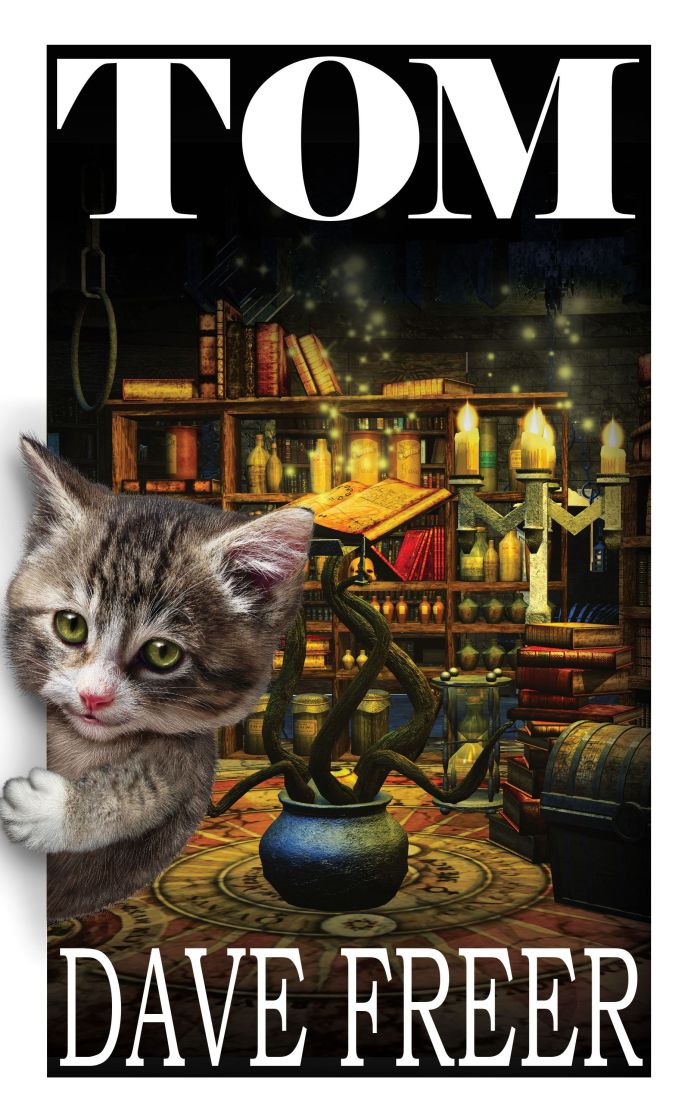
I’ve used my attempt at understanding a cat’s point of view – having been in feline service for most of my life (including having been one cat’s adopted kitten. She used to wash my hair every night) to write several stories from cat point of view. The latest of these (based on a couple of shorts I wrote years ago) is TOM – a novel based on the idea of a curmudgeonly old magician having failed to find or keep a solitary human famulus (a combination of servant and assistant. A step down from an apprentice – and you thought that was the bottom. Learn. There is always lower down and worse off).

This was always going to be a hard path.  Cats have no natural skills at service, unlike dogs, and definitely think it worth escaping from, or avoiding, while still being fed. Humans are domesticated and trained, not the other way around.   Tom is very unimpressed by the arrangement.


Tom woke. Not instantly, alert and ready to run, as he usually did. A feral kitten that didn’t, was soon dead. Instead Tom awoke… clumsily. In bits, as it were, but knowing that something was very, very wrong. He did what any cat would do under the circumstances – he sprang to his feet, in one single bound, claws out, ears back, hissing defiance, ready to flee.

Well, that was what he set out to do. What he actually did was to go from lying down to falling over in many separate disasters, starting with his front legs betraying him and him landing with his chin on the floor. He failed to stick his claws out. His ears refused to do what they should, his hiss was more of ‘squark’, fit for a bird! His hind legs were just too big and clumsy…

Only his tail felt right. And it felt ‘right’ by being dead straight up, with the hair on it fluffed, as it did when things were really, really, bad.

It happened to be true, too. Twisting awkwardly and peering at it, Tom could see his tail, tabby, fluffed and straight. That part of him was right and what it should be. The rest of him was not. His fur had fallen out. And his body was just obscenely wrong. “Wrong, wrong, wrong!” he yowled.

That sounded wrong too.

A human mouth was just terrible to howl out of. No better than a human body for springing and fleeing.

He still did his panicky, angry best.

It didn’t help him get out of the stone-walled room. He head-butted the wooden door, but that didn’t help, it just hurt his head. The noise he was making had just about the same effect. So, after a few minutes, he did what any sensible cat would do: lay down and thought about it, while giving himself a wash. His tongue couldn’t reach the bits of him that badly needed that washing. What a stupid, useless body this was. He came up with no other answers right then, but a great many questions.

A while later the door opened. Tom spun to his feet… well, he fell over trying to do that, rediscovering that he was not a cat any more.

It was the scrawny old human, in his dirty star-and-moon spangled robe. He spoke… but what he said was not ‘Scat!’ or ‘Damned cat!’ or even ‘I’ll kill yer, yer little fleabag!’ . As Tom wasn’t sure what he meant, he decided on trying a cautious mew, while keeping a sharp eye out for the first chance to escape.

All that happened was that the human made the same noises again. And Tom gave him the same reply. The human shook his head and muttered to himself. Then he scratched his beard, and raised his stick. Tom did his best to retreat. He knew what sticks meant, even if he had no idea what the human meant. The stone-walled corner of the room limited his ability to flee. But the old human merely touched him with his stick, while rattling off a string of words…

And then he said: “I have work for you to do, idle boy. Stop lying around, dress yourself and get down to the kitchen!”

Amazing! The old human had just touched him with that stick and now the human spoke perfect cat…And then it came to Tom that there weren’t even words in cat for ‘dress yourself.’ He tried to meow plaintively, in shock at this new horror. It came out as “Mwhaat’s happened to me?” which was not what he set out to say, even if it was what he wanted to know.

He got an answer. “I need a new famulus. You’re it.”

Tom knew he shouldn’t have understood what a ‘famulus’ was. But he did, even if the idea of him, a cat, being an attendant, a servant… was nearly as horrifying as finding himself in this body. “Let me go! I’m a cat,” he protested, despite the fact that having looked at himself, he obviously wasn’t.

The old human snorted. “You’re a boy, now. I left your tail on though. That’ll stop you running off. They’ll kill you out there if they see it. Now, get on with it, boy. I want my supper, and there’s pots needing to be scrubbed.” And with that he turned and walked out of the room.

No matter what the human said, Tom was desperate to escape. Even though his mind was still whirling with all this newness and horror, that idea was still his uppermost thought. He looked at the doorway, at the retreating back of the human, as the door swung closed. The latch clicked. Tom stared at it in horror. To a cat that was confinement. And then it came to him slowly… It wasn’t to a human. He’d seen them open doors.


Ah yes. A cat with thumbs.

Cry Havoc, and let loose the… well, can-openers.

Tom learns to be a human, while of course, remaining at least a little a tom cat.  I had a lot of fun with this book – it’s a gentle satire making a jest of many of fantasy’s tropes and political correctnesses. A cat would make less sense of those than we do.

Of course any self-respecting curmudgeonly magician has suitable supply of fiendish foes, an unreliable magic carpet (requires a jump start from the tower-top) and has appropriate accoutrements for a cat to cope with – a raven-familiar, an evil haunted skull of the late housekeeper, a vicious and ambulatory cheese, magically changing architecture, and demonically possessed chamber pot. To add to Tom’s complications there’s a missing and cursed princess and the wickedest witch in the West.

But a cat will remain a cat, even if he has been transformed into a boy. Independent, sometimes loyal, sometimes fierce. Thinking human ways strange, and that humans had beeter change to fit in with him. Oh, and rather cute, but don’t mention it to him. It would affront his dignity.
Tom-Cover

In Between

The office is almost done. The bedroom is half unpacked. We have a fridge, but I need to go and remove all the protective plastic from everywhere. Village Inn will be disappointed.  They quite counted us as breakfast regulars by now.  (I don’t have milk for my coffee and if I drink it black, the acid tears up my stomach.)

The cats are still locked up.  Will be dealing with them momentarily, after I set up the boxes.  Havelock is sure there’s been some terrible mistake and keeps trying to explain.  Greebo is sure he’s displeased the most high (me) and has stopped eating.

We still don’t know where younger son is going to live.  He doesn’t like the longer drive.  I don’t like (or think we can afford) his living alone.  We’re… negotiating.  Given that this is the kid who takes after me from the top of his little horns to the bottoms of his little woofkins that he don’t got, our negotiations are somewhat like the old talks between the US and the USSR when tensions were running high and both sides playing hardball.

The arms are better.  You could now mistake the eczema for a bad sunburn. I need to go get the meds that should be in the supermarket pharmacy.

It’s a friend’s birthday and we have to figure out how to take him out to dinner, one of those tradition things.

I found my speakers, now if I find the old ones I can give them to younger son.  I found my manuscripts to edit.  If I hustle today, tomorrow I should be able to keep normal working hours.

Reminding me that (to paraphrase Heinlein) Denver though metropolis is still a western town, its cowboy boots polished but still there under the glitz, the table next to ours at breakfast was taken up with cattle ranchers, talking acreages and breeds.  Perhaps it’s stock show week.  I haven’t looked lately, as I was only aware of when it was when it interfered with our ability to get a place to stay for the weekend.

It’s kind of interesting.  As science fiction authors we tend to try to create “coherent” societies, all at the same level of development.  Real life isn’t like that.  In real life, you have cattle ranchers and computer programmers all crammed in to the same place, to grab a quick breakfast on the way to their own pursuits.

And since I’ve entered the realm of random musings, I’m listening to one of those audio books that are 90% conspiracy theory.  (Why, you ask?  Well, because it was cheap and is tangentially related to a project I’m working on as soon as DR is in.)  I love the way the reader of the book (which is about secret histories) reads the book with a hint of malice and madness that makes me think of spit flecked microphones.  One of the things hilarious about it, is that he seems to be confused about where the right and left stand on things.  For instance, he thinks those who oppose the idea that other people might have lived in the territory of the US before the Amerindians are “the right wing imperialists,” instead of tribes bent on their theories of creation being respected by everyone else.  He’s also the worst kind of equivalence seeking multi-culturalist, and thinks the myth of the Noble Savage is “Right wing.”

In the middle of his rather mad rambles he goes on about how capitalism is incompatible with democratic notions of equality.  I have absolutely no clue what system he thinks would be compatible with such.  Communism?  What about the planners and komissars, comrade?

I find capitalism, in dignity, very compatible with equality.  Take the men who delivered our fridge this morning.  I didn’t consider them — nor would it occur to me to consider them — my inferiors.  Surely, I wouldn’t ask one of them to help me with the novel, but truth be told, I’d die if I were asked to carry a refrigerator.  And society would come to a half without people like them faster than without people like me.  OTOH without people like me, a society of people like them might (note I said MIGHT) well stagnate and never be capable of adapting.  Without people like my husband and sons, more than likely, it would come to a grinding halt and technology would deteriorate and back slide.

Specialization is not inequality.  Specialization is freedom of choice.

Sure, sure, I agree with Heinlein that specialization is for insects, but that’s in another sense.  I believe in developing my capabilities in areas other than writing and skull sweat.  I know how to build furniture and could do a decent job from found materials, even if the result would be rather like that crate-furniture that used to be popular in the eighties with families with small kids. I can dig a furrow (by hand) and I’m passably good at growing potatoes (everything else tends to fall victim to the brown thumb.) If pushed I could wash clothes by hand.  I can throw a lopsided pot, and can probably fire it unevenly in a kiln of my own devising.  More to the point, I can sew and knit (badly) and crochet, passably.  In what’s more likely to be needed in our society, I can take raw materials and with a day’s work transform it into a feast for 100 for minimal investment and in such a way they’ll never know it wasn’t catered. (More than 100.  I have run hospitality suites.  At a profit.)

That type of specialization is for insects, and human beings, though better at one thing, should know how to turn their hands to other things, in a pinch.

BUT society rewards being really uncommonly good at ONE thing.  That’s the virtue of capitalism.  Sure, I can build my own furniture.  Or I can write a novel and buy it.  And if I work more at writing novels, I become better at that and can help support more furniture makers (instead of refinishing antiques, which is what I do right now.)

All of which brings us to capitalism and equality.  The men who delivered the fridge are free to choose to do so, or to go to school and learn to be plumbers, or to stay home and turn their hands to writing novels.  It is no part of my concern which they do.   Well, if they write novels about fridge deliverers who solve mysteries, that’d be fun.  Not fun enough to force them to do it, though.

In the long run, given who they are and what they want out of life (me, to husband yesterday “You realize we’d need a much smaller house if all we did after work was chill out and watch TV, instead of your doing the writing and the music, and my doing the art thing, and…”) what they want to do, what makes them happy (that pursuit of happiness thing) they are free to find the occupation and entertainment that suits THEIR needs.  I don’t care.

In a communitarian system, though, be it a small seemingly idyllic tribe community or a large immiserated country.  (Or a small immiserated island country, for that matter) what other people’s occupation and their use of their time and resources is of vital interest to me.  If they don’t do their part in the plan, then everything falls apart.  Heck, even if they do their part in the plan, depending on how many thumbs the planner had when he threw the societal “pot” together.

In a communitarian system, so long as humans are humans and not hive creatures, there HAVE to be planners making sure someone is delivering the fridges and someone is writing the novels.  And because these have to be assigned according to the needs of the community, the individual suitability and preference don’t matter.

Which explains why those large, small and tribal communities tend to live on dirt and bugs.

I never understood the appeal of “equality” since I’m an odd, and I’m never going to be equal to much of anything or anyone.  And I don’t think equality should be the goal of any society.  Decent living standards and something approaching the ability to choose, and respect or at least non-interference with what other people choose to do that doesn’t hurt you, should.

Capitalism — understood as free trade — is liberty.  Communism is for insects.

Good Morning Blog

This post is coming at you from a new evil lair of evil, high up on the Rocky Mountains, so new that the dungeons still have that fresh paint smell and the only blood stains are where the carpenter hit himself with the hammer.

Okay, the house is not actually new, but it’s the first house we’ve lived in since 1989 that was built AFTER World War II, so it seems new to me.

We don’t have a fridge till tomorrow, only half of our stuff is here, the rest being still at the other house (that move is scheduled for the 14th) and my entire worldly possessions are in boxes somewhere.  BUT the auto-immune attack is receding and the cats are doing well, and I can hear the birds singing.  We’re going to be all right.  I think.

Actually our possessions are not all in boxes, exactly.  Faced with unpacking the kitchen or the office, I chose the office, so about 2/3 of it is set up, including opening boxes I hadn’t seen since we moved from our house in downtown Colorado Springs.  A lot of “Oh, so there you are.” and “Ah, I wondered where you’d gotten to.”  We’ve found ALL the batteries, which is good, but not my computer speakers, which means I can’t give younger son his beat up one back yet.

Needless to say we haven’t unpacked or set up the library yet, but older son came for a visit and climbed the library ladder to feel powerful (or something.)  THAT job  will probably take us to winter, since what’s going up is largely my research library, so instead of JUST organizing it alphabetically I’ll have to do it by subject.

Priorities right now are setting up the office then the bedroom and kitchen.  After that I can prioritize the writing again and unpack an hour or two a day.

I’m hoping the house will be livable by Denver comicon (I’m attending.)  Right now, depending on older son’s schedule, we should be going to Portugal right after Liberty con (which I’m also attending, unless his schedule throws a snag and we have to go to Portugal at the beginning of July.)

Apparently this area’s fire works will be visible from our back porch (we hear) which means after we get the back porch repaired and we’re settled in (i.e. next year) the Hoyt’s 4th of July party will resume after a 15 year hiatus.

Okay, now I go wake up the husband, to see if he feels well enough to go to work (he shouldn’t. He really did something heinous to his back.  But you know men.)  And then I’ll go shower, dress, scrounge some breakfast and finish setting up the office.  IF I shake a leg I should be able to write tonight.  I want to send Darkship Revenge in ASAP, and I didn’t forget I owe everyone Royal Blood, and Eternal Blood, and then The Brave and The Free, and somewhere along the line DRAGONS.

But I also want to finish the first chapter of Guardian and send to Larry for approval/editing/ohmygoshno,yougotJulieallwrong.  And there’s another secret project I can’t discuss (but you’ll like) which I need to finish in the next couple of months.

So.  I go. Time enough to sleep in the grave.  Forgive if my posting is irregular in the next week or two. New house internet service and all.

I’ll go and do all the things, now.