Housekeeping

This post is extraordinarily, ridiculously late.

I had to get up very early for a conference (well, the conference itself was at 9:30 my time, and so not that early, but here’s the thing… I had to find the headphone and mike, both of which were packed three moves ago.  I managed it just in time, but I was grumpy and weird, because I went to bed close to 2 am and got up at six thirty.  So I went back to bed after the conference.

All this lateness brings us to another thing I’m very late at, and that’s fulfilling my promises to my subscribers.  Yeah, it was the worst possible of times, as I was getting ill, and then spent a year and a half moving recreationally.  It was veddy, veddy bad. And since the move halfway through last year, I’ve not had access to my publishing email, so I haven’t even answered queries.

Is this going to change? Yes, it is, but very slowly.  I’ll make it up to you guys who have subscribed, even those who have now dropped it, and I will do as much as I can by the end of the year.

BUT one thing I’ve proved conclusively: I’m not good at doing things every week, nor shipping physical things.  Look, the problem is this: my life is jam packed, and will be probably till the kids leave payroll/are totally off our hands in three years or so.  That means I’m dealing with at least one emergency at any given time. Throw another one in, and everything comes to a halt.

So… if you look to your right, the subscription button is gone.  Again, I’ll make it up as much as possible to those who subscribed, and if you’re a subscriber who doesn’t feel the need to cancel the subscription, much appreciated.  (See where kids are still on our payroll, largely, for another three years.)

However, before April, when most subscriptions end, I’ll have something else started.  Honestly, it will probably be a serial on Patreon, I just want to finish it before I start that program.

Until then, if you feel like supporting the blog itself, the button is still up there.

I will continue to do posts.  I will continue the freebie Grant Jefferson in Portugal serial.  At some point there will be Rogue Magic (probably before the end of the year) finished and sent to everyone who ever donated.  There will be t-shirts and stuff also before the end of the year.

But we’ve just (mostly) unpacked, and anything that calls for not-usual equipment takes forever and I’m trying VERY hard not to promise I’ll do things immediately, right away or very fast.  I’m late on six books, three to Baen and three Indie and those come first.

I’d still like to apologize for not fulfilling promises, and I’d promise I’ll get to it.  My subscribers got me through some very, very bad times, and I owe them big.

That’s the housekeeping.  Well, other than to say I’ll try to have Grant a day over this weekend, and that there will be guest posts as I REALLY must finish Darkship Revenge.

Sorry for the not-really-a-post.  I’ll try to write one tomorrow.

Solar, Space, and Geomagnetic Weather, Part III By Stephanie Osborn

*My apologies to Stephanie AND the readers on putting this up so late.  I meant to cue it yesterday, but it was one of those nights one minute I was at the computer and the other I was in bed and asleep, with no memory of anything in between. Probably because I’d been up since four am.- SAH*

Solar, Space, and Geomagnetic Weather, Part III

By Stephanie Osborn

http://www.stephanie-osborn.com

“Interstellar Woman of Mystery”

Rocket Scientist and Novelist


So we’ve talked about coronal holes, the solar wind, solar cycles, sunspots, flares, and Coronal Mass Ejections (CMEs). Now, mind, of all of those, there are really only two that can reach us. One is the solar wind, and any enhanced wind streams from those coronal holes. And the other is a CME.

(That said, the X-rays from a solar flare can and do reach us and cause their own problems. We’ll touch more on that when we cover NOAA’s solar/geomagnetic weather indices.)

Just what effects do coronal hole wind streams and CMEs have on Earth?

Now, we’ve talked several times about a bar magnet, with its field lines traced out by iron filings on a piece of paper. And we all know that that is a nice, symmetric image.

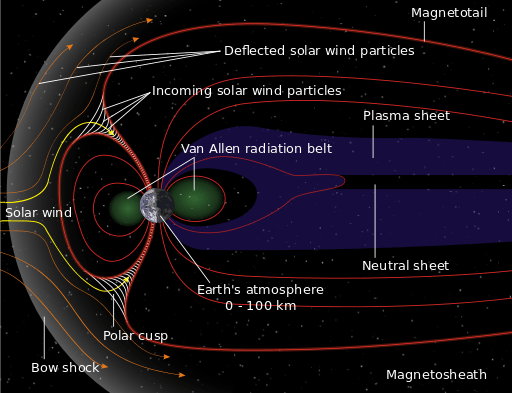
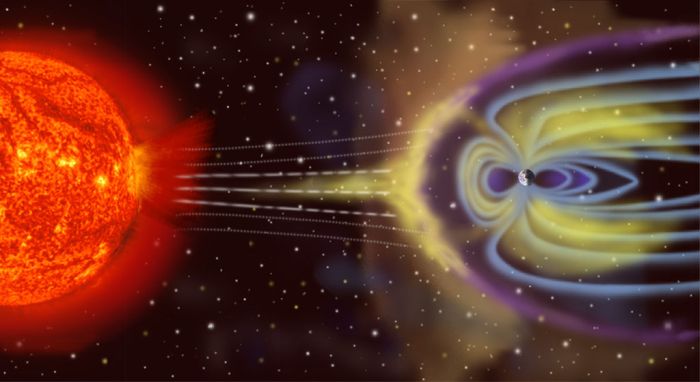
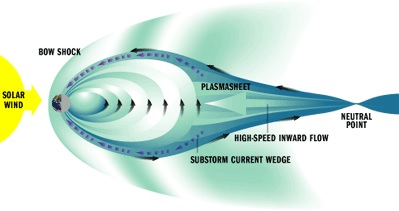
But the Earth’s magnetic field (aka magnetosphere aka geomagnetic field) is not nice and symmetric. This is because the solar wind is pushing on it. So the side toward the Sun has a “bow shock” and is compressed, and the side away from the Sun is stretched out into a tail. Like this:

fishtail


Here’s a little more close-up detail:

Van Allen

Note the Van Allen radiation belt in this image. All those charged particles can get caught up into our mag field and cause higher levels of radiation. They ping back and forth between our North and South poles and eventually enter the upper layers of the atmosphere. We’ll talk more about that in a minute. The more charged particles hit our magnetosphere, the more get caught in the Van Allen Belts (VAB), and the more apt we are to have atmospheric effects. So an enhanced solar wind stream (EWS) from a coronal hole can generate some interesting phenomena.

But the granddaddy of those phenomena is caused by a coronal mass ejection hitting Earth. Because those suckers are (relatively) dense and VERY energized. And it might look something like this:

notoscale

[NOT TO SCALE.]

[No. It’s not. Really.]

Worse…remember how flares are the detonations caused by “magnetic reattachment”? Well, if a CME is powerful enough, it can put so much stress on the magnetotail (that part stretched off to the right in these images) that it can snap off, and reattach closer to Earth! The energy feedback from THAT can get pretty powerful, too!

How energetic IS all this stuff?

Well, these events can actually raise the temperature of the outer layers of the Earth’s atmosphere (the thermosphere, aptly named) sufficient to cause it to expand. This affects us, because that increases drag on satellites and spacecraft, and can cause the orbits of satellites to decay and re-enter well before they were intended. This is really bad if it’s something important, like a weather satellite during hurricane season. After all, if the people of Galveston had had weather satellites in 1900, the city could have been evacuated well before it got hit, because they would have known it was coming for days. If we DON’T have weather satellites because we’ve lost ‘em to increased atmospheric drag, we might as well go back to those days, as far as weather prediction is concerned. Ditto communications satellites. Don’t even mention GPS.

It affects manned spacecraft, too. Shuttle and Station did and do, respectively, have problems maintaining orbital altitude when all this causes the atmosphere to swell. Stationkeeping maneuvers/burns must occur more often. A spacecraft in Low Earth Orbit (LEO) that is not being maintained with active stationkeeping IS going to come down sooner or later. Probably sooner.

Disruption of the Earth’s magnetic field can be a problem. It can disrupt radio communication (including cell phones) rather severely. It can damage satellites that remain in orbit. It can generate “induced current” in any lengthy conductor. Let’s pause for a moment and talk about that.

Induced current is a way of using magnetic fields to generate electricity. Remember how I said, back in part I, that the “current” of plasma created by the Sun’s rotation on its axis generated a magnetic field? The reverse is also true. A moving magnetic field can generate an electrical current in any conductor placed within the field. So the disruption of the geomagnetic field constitutes a “moving” magnetic field and will induce electrical currents in everything from power lines to pipes and conduits.

When these truly huge induced currents hit things like transformers and circuit breakers and power stations, they can quickly overload them. This, in turn, can (and has) cause(d) blackouts and brownouts, particularly in parts of the country/world where the power grid is not robust enough to handle significant surges. (Given that most large substation transformers are still hand-built, and have a lead time of months between determining need and installation, that could be a real problem.)

Long pipelines, like the Alaskan Pipeline, can be affected as well. In fact corrosion is occurring at a higher rate than expected because its northerly location exposes it to such induced currents all the time (remember that the ends of a bar magnet’s field are open). And there are plenty of those.

Here’s a map created by Samuel Bailey (sam.bailus@gmail.com) of gas pipelines just in the EU and Russia, for Wikipedia. And all of these will develop induced currents.

natural gas pipelines

Here’s another map of the natural gas pipelines just in the continental USA.

gas pipelines usa


Around the world, long-span pipelines carry water, oil, natural gas, ammonia, alcohol fuels, and in places, hydrogen. Some of these could cause problems with induced currents.

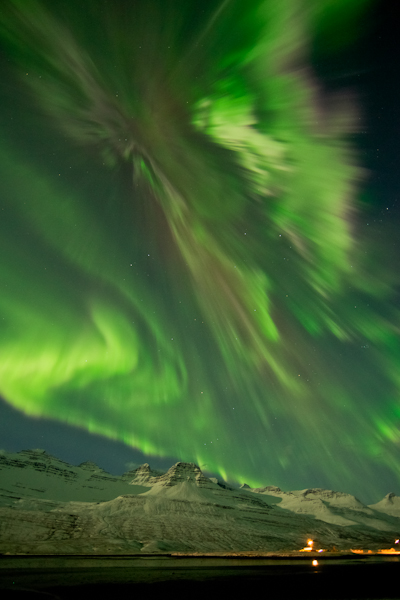
And this same moving magnetic field that induces currents in conductive manmade structures also causes the aurorae.

aurorae


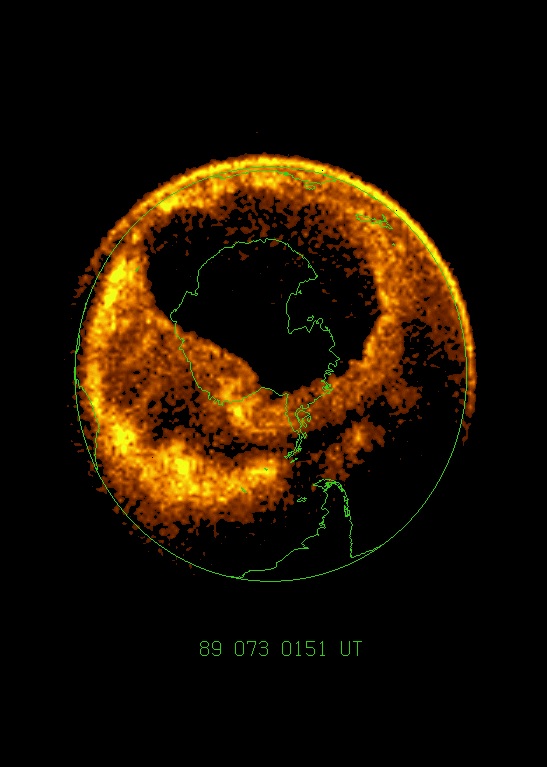
Most of you reading this have heard of the Northern Lights, properly termed the Aurora Borealis, and many may have seen them; but there are also the Southern Lights, the Aurora Australis. The Aurora Australis is much harder to see, because there is considerably less land mass in the Southern Hemisphere in a position TO see them — only Antarctica, extreme southern Australia, the extreme southern tip of South America, and perhaps New Zealand. These are actually ovals that circle the magnetic poles of Earth (and most other planets with magnetic fields, by the way. They’ve been photographed on Jupiter). Here’s an image of a particularly strong auroral oval that occurred around the South Pole in 1989.

south pole 1989


They happen where the charged particles that have been caught up from the solar wind or CME into the geomagnetic field follow the field lines down into the atmosphere. The gas molecules become excited into a higher energy state, then discharge that extra energy as light. This is very similar — in fact, essentially the same — as a fluorescent light bulb, only natural and not contained. The colors are determined mostly by the main gas that is fluorescing. Carbon dioxide produces white light; nitrogen, pink or red; oxygen, green or blue. (It can also generate ozone.)

Now, having talked about all of this radiation that an increased solar wind and coronal mass ejections pump into our Earth’s system in general, and the fact that there are more of these things when there are more sunspots, when do you think the Sun is sending out more energy, Solar Max, or Solar Min? Yup, despite the logic of sunspots being cooler, the Sun actually sends out more energy during Solar Max, when there are the most sunspots.


~Stephanie Osborn

http://www.stephanie-osborn.com

Comet Tales blog/Osborn Cosmic Weather Report: http://stephanie-osborn.blogspot.com/


A Very Diverse Cake

I keep reading things — not just books, but reactions to world events, or stuff about what people think will happen in the near future — and thinking there is a problem of scale.

And by a problem of scale, I don’t mean the stuff that forms inside your drains, though for all I know that too.

What I mean is that most of the world have not a clue about how big the world is, either geographically or culturally.

Blame it on the monkey brains.  We were designed to know maybe 100 people, and to range over a few miles as our territory. We were not designed to take in something the size of the globe or cultures more different than those people there over the hill, who like to wear their kilt draped the wrong way.

That this is a particular problem of the globalists shouldn’t surprise us.  After all, anyone who gets the brilliant idea they can somehow “change the world” or “lead the world” or anything of the kind, has to have a very funny idea of the world.

But what is almost unbearably funny is that the people who insist on “Diversity” by which they mean “different skin colors and identifiably different “cutesy habits” (different clothes/worship/food, that kind of thing) are the people who really have no idea of the scale of diversity in our world.

Take the transgendered youtube star who went to the United Arab Emirates to shop.  Waits till the readers stop laughing.  Yeah, that.  You’d have to have a heart of stone not to roll on the floor laughing at her rather pathetic tweets.  You see, she got detained at passport control and sent back after her significant other came to collect her.  Tweets included the picture of Abu Dhabi with “what a beautiful city rendered ugly by intolerance.”  AND “this just shows how much we need change.”

Uh…

One wonders if this person ever figured out that being sent back with tail figuratively between her legs was better than either of the two alternatives available to gay and transgender people in observant Muslim countries.  It seems to me — maybe I’m a sissy — that risking ending up hanging from a crane or thrown from the top of a building would be a really bad thing to do for great shopping.  No?

And then there is “change”. I’m personally not sure what the heck she means by this, unless it’s fifty cents for the phone call to be rescued from the border guards.

What change does she think she can effect on a religion hundreds of years old?  Does she think that if she lectures the Muslims they’ll see the error of their ways?  I’d say I want a front line seat and popcorn, but I don’t really like seeing dismemberment  Not Roman enough for THAT.

So, what the hell is “change” other than she thinks vaguely and fluffylly that if Americans and Canadians (she’s Canadian though I suspect she lives in the US) are even more accepting of transgender and gays this will make the rest of the world fall in line.

There are so many things wrong with this idea that I’d have to write books to show how wrong it is.

BUT let’s start with the fact that people in other countries have their own cultures, by which I don’t mean they have cute outfits and eat interesting things, but they have their own systems of thought, their own religion, they own systems of education and transmission of knowledge, going back many centuries.  Sure they will take American gadgets and wear American clothes, but the hardware in the head is less flexible than that. And that’s where the real CULTURE and the real issues are.  People will not change their minds because they’re lectured by Westerners, or told they’re terrible people.  Nor should they, in most cases.  Not because some aspects of non-Western culture aren’t absolutely bloody awful and are in fact holding them back, but because recent history seems to show you can break entire cultures.  Push them too far too fast and they lose interest in living.  Look at most of the western countries and their birth rates for what I mean.  The fact that this affects Japan too definitely seems to show you can “break a culture.”

Change, real change, comes in response to living conditions/technology, and while it can be influenced by words/deeds (Christianity transformed the west) it takes a LONG time.

But the people who shriek about “diversity” all day long view the world as sort of their own backyard written large.  The problem of scale is such, that not only do they not realize that other countries/places are different, they don’t realize that different subcultures in their own culture are different.

I remember a friend telling me that multi-culti was knocked out of his young skull when he got a job as a construction worker for the summer.  Marxism too.  He said if revolution came from the proletariat, the resulting society would view wife beating as a sort of little hobby, on the side, nothing bad, just a little indulgence on Saturday night.  (Mind you this was not in the US.  The US working class is by and large better than this.)  And all those prejudices against other races/sexual orientations/etc?  Yeah, the working class had no problems with those.  Only a privileged twit like Marx could think that the working class all over the world wanted to unite.  They tend to be rather more nationalistic than their “betters” after all. More all sorts of ists too.  It’s what works at their level, and virtue signaling buys them nothing.

Some of my friends yesterday got in an argument with an uber feminist on FB and one of them expressed the desire she could be sent to live with Isis for a month, and then she’d stop talking about micro aggressions.

But it doesn’t need even that.  Outside the very privileged top of society, feminism doesn’t get the traction it gets in the US ANYWHERE ELSE IN THE WORLD.  Not even in England. In fact every other country in the world is far more “ist” than the US, because being “ist” (racist, sexist and homophobic[ist for completism]) is the way things are done.  I find it mildly amusing whenever gay friends think that the US is worse than Europe “because of all the religious stuff.”  Uh.  No.  The US is more tolerant than Europe because we’re richer and more vast and we can ignore that which annoys us more easily.  In Europe they live in each other’s pockets on what is for us tight resources.  They have no “give” and cohesion and conformity is enforced, which means if you stick out, you get it.  Not publicly and certainly not if you’re a tourist, but if you live there among the people you’ll find you don’t need to hunt for microaggressions.

And before people from Europe say it isn’t so — you don’t know.  Anymore than Americans do who’ve never lived there as locals.  You don’t know how much LESS of the racism and sexism and homophobia there is in the US than in your area.  Hint, what you see in our movies and read in our papers is the greatest bullshit around.  Those PRACTICALLY don’t exist in the US, for any functional purpose.  I mean, sure, people might think women are inferior, or might hate gays, but unlike the internet sites colonized by the alt.right (and how many of those are Russian agent accounts no one knows) people expressing such feelings (actual hostility not imaginary micro-aggressions) are likely to be laughed at or mocked.  Not so in Europe.

And then there’s the more tan areas of Europe, and what we’ll term the first world minus a quarter.

I’m not ragging on my birthplace.  It has some admirable qualities.  But if you think that it is more tolerant or laid back than the US you haven’t lived there.  Sexism is internalized at such a level people don’t see it.  They give lip service to women having jobs, etc, but those women still have to be “good housewives” no matter what their job is.  Men still get the choice seats in cars (be fair, they are so tiny most men have to sit up front to fit, but it has become internalized, too), men still take pride of place without a thoughts.  No, not everywhere, not in every family.  BUT at a cultural level, it exists at a point that feminists here would have a heart attack.  Again no time to look for micro aggressions, you’re too busy working through the macro ones.

But here is the thing that these people forget: They’re not AGGRESSIONS.  They’re just culture.  When a man as a matter of course takes the best seat, he’s not making a comment on YOU.  Hell, he’s not making a comment at all.  He’s just doing something so deeply ingrained that he didn’t think about it.  If you think that’s enough to make it so that you can’t succeed or that you need to run around saying you live in a patriarchal or male-supremacist society, let me tell you, cupcake, you wouldn’t have succeed anyway.

The fact that all my teachers expected boys to be better than I didn’t make it impossible for me to do better and rub their faces in the dirt.  It just made it more amusing to do so.  The same would have applied to jobs, I’m sure.

The way to deal with institutionalized discrimination is to disprove it.  THAT is the way to change things, too.  Overtime, if people of x group who is assumed to be lazy and stupid prove they are excellent and high achievers, the culture changes to accumulate the new fact.

Is it fair to have to work against expectation?  Well, there you have me cupcake.  It certainly ISN’T fair.  You know what else isn’t fair?  Being born mortal, in a body that starts falling apart at around 40.  If you were expecting fair, you were born in the wrong world.  In this world we don’t have fair or ideal.  We have what works, and what doesn’t.

Working really hard to show prejudice is wrong WORKS.  It takes a few generations and is unfair as hell to the people who do it, but overtime the culture changes. At least if it’s a healthy culture that doesn’t kill you just for being different.

What doesn’t work is whining about how men don’t get out of your way when you’re walking (what are you? The Roman emperor?  I’m sure if you play chicken they WILL get out of the way, unless they too are in a novel-writing funk.  Which is when I’ve walked into people, male and female both.)

And if you go around saying bullshit like we live in a white supremacist society, you’re just going to cause me to laugh till my head falls off.  Because I’ve been in one white supremacist society and guess what they didn’t have: lawsuits for discrimination; set asides for minorities; etc.  In fact their laws de facto discriminated against people based on their skin color.

Running into the occasional asshole (look, I tan, and younger son tans much more than I.  If you think we don’t run into assholes on a regular basis you’re nuts) who thinks you’re inferior, or tells you to go back to Mexico/Africa/the desert, is not a supremacist society.  It’s a DIVERSE society, where people are allowed to think any damn crazy thing they want to.  Some people in a diverse society WILL be assholes.  It’s not a crime, as such.  And some assholes obsess on race, or sex, or sexual orientation.  Don’t make no difference which or how.  They’re just ASSHOLES.

The thing to do with assholes is not to embrace them to your chest as a precious that proves you can’t get ahead because everyone is against you.  It’s to go “oh, asshole” and move on.

That is ultimately the point.  Sure there are micro and macro aggressions in society.  They exist for everyone, yes, including white males (because some are ugly, and some are poor, and some are overweight and none of them is perfect and someone will find a reason to pick on them too.)   It’s part of living in the world and not in paradise.

The diversity you claim to love comes with the ability to be many different varieties of asshole.

Assholes don’t keep you from achieving your goals.  They just annoy you.  This is not the same thing.  Yes, even if they’re employers or co-workers.  They might make you have to (inconveniently) find another job, but in a free market society there’s always more than one company that makes the same thing.

If you find that you are tied up in a pool of hate, and can’t achieve anything, it’s not the society, cupcake.  It’s you.  Obsessing about how people discriminate against you for x or y has become your reason to live, a form of OCD that comes with the bonus of never having to admit you failed/didn’t try hard enough, and never having to make any effort to do anything.

You’re not living in a white supremacy or a patriarchy or any of the bullshit you’ve been telling yourself.  (I can give you places to go to experience those, if you wish.)  You’re living inside your head, and you’ve allowed it to become a really bad place.

I have a friend who is male and very short.  He said for many years he obsessed on the few funny remarks people made about it, and spent time imagining other remarks that were never voice.  And he was miserable, and couldn’t function.

I found the same as an immigrant.  Yep, one of my jobs blatantly discriminated against me.  Yep, other people probably thought things about me that made no sense.  BUT I only started achieving when I stopped obsessing on what they might be thinking/saying behind my back and decided that biggoted or not, they were assholes, and the best course of action was to ignore them and do what I wanted to do.

Since then I haven’t found that discrimination impairs my life at all.  My friend reports similar results.

Get out of your corner and stop collecting grievances.  Embrace true diversity, which includes many, many kinds of assholes.

Free yourself, and then let’s worry about the real problem cultures.  Like the ones where women, gays (and yes) other races and religions are at risk for their lives.

The rest is just stupid little games for silly little girls, even those who happen to be male.


Art and Science by Cedar Sanderson

Art and Science by Cedar Sanderson

Monday, I went back to school. I’m at the point where it’s all downhill from here, and I’m looking forward to wrapping it up. The first day of a semester, I’ve learned after 4 years of this, is usually sitting in classrooms having a syllabus read to us. Personally, I’ve usually reviewed it if the class was published online… and done the homework. I was scaring my highschool-age daughters by informing them that in college, you often have homework before the classes start. This doesn’t bother me, but I’m a non-traditional student.

I’m non-traditional, I’ve learned, in many ways. I’m pursuing a science degree (with a ridiculously long name. Let’s just say I recently made a judge raise her eyebrow and comment that it sounds impressive) but I am also an author and an artist. Now, once upon a time this wasn’t necessarily thought of as unusual. Although I’m not sure we can consider Leonardo DaVinci in any way normal (and no, I am NOT comparing myself to him!) science and art did walk hand in hand. Cameras were unknown, and the ability to sketch accurately was a necessity if you were trying to describe a specimen and give a visual of it.

Now? My classmates think I’m very odd indeed to be put out over the loss of an art class this semester. One of them was telling me how he’d taken art history because it was ‘good with girls’ and he could take dates to the art museum and impress them. I shook my head at him, laughed, and pointed out what I wanted was hands-on instruction, so I could learn to paint. I’d have managed it, except for some reason the school decided that Biochemistry students for some degrees didn’t need a lab, so they shut the second day option down… and I have to take Biochem. Art is a personal preference.

Now, this is my drive, to take the art classes for sanity, but I’ve discovered that my science classmates just don’t take art classes. My art classmates look at me like I have a second head when I talk about Bioinformatics or Analytical Chemistry, shudder, and say they are happy not to have to deal with anything that hard. Meanwhile I sit there and wonder when the two got separated.

It certainly seems that in schools as young as elementary ages, you either are on the STEM track, or the arts track, or the sports track… when my son was telling his teacher about how much he loved to read, and wanted to take band, and chorus, my husband was worried that in our small, redneck town, he’d get teased for his preferences (so far, he’s not had a peep from his new friends and he’s part of a happy study group that meets at the local library almost daily). I can’t help but wonder if this sort of tribalism has always been there, or if this is something new that has sprung up since the advent of the modern school system.

It’s not that you can’t be good at both art and science. I’m not a great artist, but with daily practice I’ve improved muchly. I’m left suspecting that it’s the myth of the talent. I hear “oh, wow, you are so talented! I can’t even draw stick figures!” all the time from classmates when I’m sketching in class (and other people when I’m sketching in public). The truth is that at one point, I couldn’t even draw a respectable stick figure. Heck, being able to draw a stick figure doesn’t bar you from being an artist, look at Randall Monroe and XKCD. What I did, was apply science to art. Look, in science you experiment, document, and the gold standard is reproducibility. In art, you can do the same. For me it was sparked by Mona Brookes’ Drawing with Children, a book I got to start teaching my children to draw. Her method is to break the drawings down into shapes, lines, dots, and so forth. I realized that I could manage that. In the Observational Drawing class I took in college, it was again not about ‘feeling’ the art in some way, tapping into an inborn sense of what art should be (snort. Hah! Ahem…) but it was about measurements, angles, and teaching the student to look, really look.

And it’s that part of art that makes me think we have lost a great deal by separating our art and science students into separate tribes. The artist’s eye is trained to ‘see’ at a greater level of detail than most of the rest of us. They are also taught to look, and look again. Simply snapping a photo isn’t enough to imprint onto the brain the specimen you are observing; when you have drawn it, you really know it.

Art isn’t something you are born with magic in your hands, to be able to create without effort. It’s a lot of work, and requires training. I can remember being told as a girl that you either had an art brain, or a science brain. While I do know that there is a lot of difference between the creativity necessary to create original art, and the dedication of the scientist to performing the same task over and over, jotting each result down as you do it… I don’t think that isolating the scientist from the artist is a good thing. The spark of creativity that is necessary for art, the imagination the writer brings to fiction, those are vital to the science world, if the science is to proceed beyond the paths of the known into the possible and mists of ‘what if?’ and ‘what happens if this goes on?’ and that’s where science fiction is born. Or perhaps the science fiction artist. I was creating a piece the other day, working on a scene set on an alien landscape, and contemplating the nature of light while I painted ship’s exhaust and the muzzle blasts from a mecha. If the light isn’t the Sun’s light, and the air is full of particulates, what do you get?

Science, and Art, meant to be together. It might get me funny looks, but I’ll finish my year of daily artworks, and I’ll be the better for it. I already am, some 240 days into the challenge. I’ll never be a great artist. But I will be a better one and it’s teaching me a lot. Maybe not as much as Molecular Biology, Biochemistry, Invertebrate Zoology, or Botany, but at least I can sketch specimens, molecules, and so forth to convey my meaning in a legible manner!


Dark Fate 4

*FIRST AND VERY IMPORTANTLY, THIS IS NOT CANON.  THIS IS COMPLETELY UNSANCTIONED (okay, not completely.  Larry said I could do this for you guys without his ripping my head off) MHI FANFIC.
Good, now that we got that out of the way, why am I doing this?  Both Grant and Fado Negro (Portuguese Monster Hunters) have minuscule parts in Guardian, the MHI book I’m collaborating with Larry Correia on.  However, obviously the Portugal of Monster Hunter is not the real Portugal (Really, no arcane creatures come stumbling out of the undergrowth there.  If there were arcane creatures, the country would be chock-a-block in them, when you take in account the continuous human occupation since… well, forever.)  And this story gives me more of an opportunity to firm the worldbuilding.  (Yes, it would be MUCH easier to do this with a notebook and noting things down, but that’s not how my mind works, d*mn it.)
Okay, that’s the rational excuse.  The real reason is that d*mn Grant Jefferson won’t leave me alone.  (Always had a thing for men from Patrician New England families.  Ask my husband.)  So I’m torturing him.  Also Guardian won’t come out until I do this more or less at same time (I’ll be sending first chapter of that to Larry soon.)
Will this ever be a book?  Don’t know.  First Guardian will get delivered.  Then, this being finished, I throw it at Larry.  And then it’s his SOLE DECISION. (Which means, don’t you monkeys hassle him.)  It’s his world and his character.  I’m just grateful he lets me play in it in Guardian and here for your amusement.*

First chapter is here.

Second Chapter is here

Third Chapter is here (edited because I was out of it last Monday.)

IV

So, I was trapped in my room with a Lamia.  I’d just done my best to kill her, and she’d self-regenerated.  And I was out of options.

As she moved, startlingly fast towards me, I jumped on top of the bed and to the other side, trying to slow her down.  I ran in ever broader circles, trying to make it out the door, because I had the vague idea that in the hallway I might find something else to kill her with.  Of course, she also might get to attack other people, and of course I’d try to stop her doing so, but clearly I needed more space and greater ability to act.

Panic and tiredness got hold of my mind, and I must have lost it, because I caught myself babbling the most inane crap ever, “Ah ah, what a Lamia story!  Come on, Madam, are you Lamia?  Now I Lamia down to sleep.”  As I spoke, I detached a fire extinguisher from the wall and flung it at her  head.  She ducked, and it hit the wall hard, making a dent in the plaster.  Man, it’s a good thing I’d made a lot of money in my years with MHI, because this bill was going to hurt.

Let’s assume that Lamias were like every other vampire.  It had to be staked through the heart, but it had to be with wood.  I tried to find wood, but I wasn’t sure that either the desk or the bed was wood. They were that kind of painted and antiqued stuff that might be wood, or it might be papier mache or fancy painted plastic, for that matter.  For all I knew it was plaster.  Didn’t anyone think of the needs of tourists who must kill vampires?

I presumed garlic didn’t work — not that I had any — but if it were an Italian vampire, certainly it would like garlic.

I got to the door, and turned to open it and there she was.  Right on me, coils around my lower body, inhumanely beautiful face, next to mine, mouth opening.  “I have lawyers.” I said.  My father had described his third wife much like this lamia, and this must be some memory of hearing him talk when I was five or so.  Predictably it had no effect.  She smiled.  Or it looked like she was going to smile, but her mouth kept opening and opening, till it was round, and surrounded by needle-like teeth.

I squeezed myself against the door so hard that I might be two-dimensional, while with one hand behind me I tried to open the door, and with my other hand, I reached to my left, blindly looking for something to stop her killing me.

And all through it, the coils kept tightening around me, till it felt like she’d break me in two, with the pressure on my waist.  I felt as though lights were going on and off behind my eyes, and I was sure I was hallucinating, because I kept hearing fireworks.

The only thing my hand found was a serpent tail, waving at my head height.

I seized hold of it and pulled on it, while I rolled my head this way and that against the door, trying not to let her bite me.  I could feel her scrabbling at my mind, too, telling met his was the best way and that really, my entire life I’d wanted to be devoured by a woman-serpent thing.  Honestly, if it weren’t for the fact that by the time I was ten my father was on his tenth wife, and that I’d learned to distrust women if not in my cradle shortly after, I would probably have fallen for it.

Instead, I grabbed the serpent tail hard and pulled.  The first pull was easy, and then it seemed to realize it was being pulled and tried to pull the other way.  I pulled with all the strength and despair of someone who is being sliced in half by a supernatural creature.  Sweat fell into my eyes.  It felt like I was going to pass out.  In fact, I probably did, but kept pulling anyway, until I shoved the tail, completely, into the lamia’s own open mouth.

She bit down, perhaps by reflex.  There was a sound like an unending female scream.  As it toppled away from me, I pulled under and away from it, opened the door and got to the hallway.  My legs probably were broken, or at least they felt like I was walking with swords up my thighs, but I didn’t have time for that now.

I had a vague memory of seeing a glass case with “Break only in case of emergency” and a firehose and a fire ax behind it.

The fireax was needed in these old buildings because the partitions between rooms weren’t wallboard, and if the hallway was in flames, you might have to escape by hacking your way into the next room and the one after that.

I was fairly sure this was an emergency.  I shoved my elbow at the glass as hard as I could, and was almost amazed to see it shatter into the particles that safety glass breaks into.  I felt weak as a kitten and half expected it to do nothing.

When I turned, ax in hand, the Lamia had got its tail out of its mouth and got out of my room.  It made for me.  I swung the ax.  It hit her neck and went in like knife through butter, slicing her head off her shoulders.  I half expected it not to work, but her head fell, right enough.  Blood got all over everything.

I grabbed the head off the floor, and flung it to the end of the hallways.  Regenerate that, bitch. Then I thought I should make it harder for her.

I was axing the tenth portion off the tail when I heard someone behind me, “Sir, Sir, what are you doing?”

I turned around, blood spattered and with a maniacal grin on my face.  “I want to lodge a complaint,” I said.  “Your reception committee was too slithery.”

The person who’d talked was Portuguese and young and looked like some sort of valet.  He stared at me and looked down at the ax.  I could hear the ax drip blood on the floor and I was not about to let go of the ax, because you never knew precisely what the nice room service guy might really be.

He looked behind me.  “That…” he said.  “That was a lady.”

“Not hardly pal.  Not unless your ladies are half serpent,” I heard myself snarl, and then, not caring what he thought, not caring if he’d just had his world shattered by seeing a legendary monster, not even caring if he thought I was some kind of mass murderer and called the police, I turned on my heel and went back to my room.

If I was going to be arrested, I was, by damn, going to be arrested clean and shaved and feeling like a human being.

I left the ax propped in a corner of the marble-and-tile bathroom, while I washed.  The water was kind of low on pressure, but it was warm and there was a lot of it, and it kept pouring over me, washing away all the red, all down the drain.

Some of the red was probably mine, judging from the places that hurt, particularly that place behind my ear, but I really didn’t care.  The shampoo smelled of wisteria, and so did the soap, which stung on a lot of my skin, but took even more of the red off.

Towels were abundant, white and thick.  I dried myself thoroughly before risking a look in the mirror.

If someone had drawn my portrait right then it would be called a study in blue and purple.  There were bruises forming across my forehead, across my chin, and around my neck.  The wound beside and behind my ear looked like someone had stabbed me with a circle of sharp needles.  It itched.  I got some disinfectant cream from my luggage — of course I always traveled with a first aid kit — and slathered it there, and also on an open gash down my arm and in a place around my waist where it looked like someone had attached a lot of suction cups with nails in the center.  Rusty nails.

All of it stung, which I didn’t remember the cream doing in the past.  I contemplated using band-aids, but it would take like ten of them for my neck, and if I used gauze I would look like a bad remake of The Mummy Wakes.

Instead, shaved, and  dressed.  Putting on a clean shirt felt good, as did the nicely cut suit.  I looked at myself in the mirror again, and looked almost like myself.

There had been no thumps, no one frantically knocking at the door.  As I put my used clothes into the laundry bag, wondering if this hotel performed miracles or if I’d have to buy an off-the-rack suit while in town, I half expected the words, “The police have this room surrounded.”  Instead there was a sound from the hallway that sounded much like a vacuum.

I put my socks and shoes on, in case someone really wanted to arrest me, because I didn’t want to be arrested barefoot, then opened the door.  Someone had taken out of the pieces of cuisinarted lamia, and there were three women in the hallway running carpet cleaners.

I opened my mouth, closed it, closed the door, too, and realized the phone was jumping around atop the marble-top of the dresser producing a sound not unlike a low-level growl.  I didn’t remember tossing the phone on the dresser top, but obviously I had.  It must have been all bloodied at the time, too, because it had left little dropplets and then a trail of blood as it buzzed along the marble.

I grabbed it, answered,  “Hello,” I said.  And thinking of the female voice on the phone before, I added, “who are you?”

The growl from the other end told me all I needed to know.  Whoever the other voice had been, this was Agent Franks, and he was not happy with me.
 

The Promo, My Friend by Free Range Oyster

The Promo, My Friend by Free Range Oyster

Dwight R. Decker

A Moon of Their Own

Is it a theme park or a model railroad? Or a mad billionaire’s ultimate self-indulgence?

It’s the year 2037. Sixty thousand miles out in space orbits the asteroid called Vesper, Earth’s new second moon and the private property of the richest man in history. No one knows what he has been building there, but suddenly the future of the human race depends on finding out – and fast.

For fifteen-year-old Ronn Evans, what begins as another ordinary day in school winds up very differently when he and his cousins are all but kidnapped by their own government to be sent into space. To their amazement, they learn that they are the only ones who can get inside the mysterious asteroid to see what has gone terribly wrong.

There are other players in the game and time is running out. Will the cousins ever see Earth again?

J.M. Ney-Grimm

Livli’s Gift

Livli heals challenging injuries among the pilgrims to Kaunis-spa. Its magical hot spring gives her an edge, but Livli achieves spectacular cures mainly because she refuses to fail.

A born pioneer, she hopes to match her new ways for banishing hurt with new ways of living. But the sisters of Kaunis-lodge fear rapid change. What precious things might they lose while tossing old inconveniences?

Livli pushes forward the new, and one influential foe pushes back. Kaunis-home will keep its revered traditions, even if Livli loses everything she values.

Everything… and the one thing she absolutely cannot lose.

Livli seeks an answer in the oldest lore of her people, something so ancient, it’s new. But mere resolve against failure meets an immoveable counter force this time. Victory requires more.

Marriage, memory and mishapprehensions

This is late mostly because we ran errands this morning, and it was more convenient to run them before I sat down.

While I was in Portugal my dad was telling me tales of his youth, including that he used to be the letter writer for men who wanted to ask women to go out.

You see, in a highly segregated society, where “going out together” was a formal thing and only done after the man had met the woman’s parents and asked permission, the process as I understand it went something like this: the man saw the woman somewhere, perhaps several times, and thought that she was someone he would like to date, if not to marry.  (A lot of them leaped to thinking she was someone they wanted to marry because people will be people.)  He would then approach her, normally via a common friend.  If they had no friends in common, the man would discern where she lived and send as persuasive a letter as he could, asking her to allow him to come over, meet her parents and take her out on a date.  (First dates tended to be something lame and public, like walking up the street together, in full view of the entire village.  Parties and the like came after you were sure and you were an established couple.)

My dad, a poet with a massive vocabulary, was often co-opted into writing these letters, translating his friends’ simple sentiments into high flung stuff with literary allusions.  This was all the more important since if the parents were impressed it would be easier for them to give consent.

So he told me on Sunday morning he held “letter writing time” in the field next to my grandmother’s.  (This was part of a convoluted story about how he had had to dumb down a letter FOUR TIMES before his friend the construction worker got an answer from this woman he was struck with, who finally agreed to meet him.  The higher-dialect letters actually had scared her.)  And he said “You don’t remember, I’m sure, that there was a stone ledge near the top of that wall.”  And I said, “Of course I remember. My brother took me there, when I was very little, to watch the oxen draw water.”  My dad was both pleased and amazed I remembered since the ox-drawn watering system was replaced by a mechanical one when I was five or six.  But my brother taking me out, with his friends, to watch this was a high mark in my days.

Yes, this will tell you how deprived of excitement our days were, I guess, that watching oxen go round and round while they drew the water had, I guess, been a pastime of village youths for generations.

It occurs to me that as we get older it’s a enormous relief to find someone who shares our memory, particularly of something more out of the usual.  So many of our friends have died or lost their memory or simply gone elsewhere and broken ties, that we’re left sitting there going “What in heck?  Did this ever happen?  Am I misremembering?”  This is particularly true, as I said, of something unusual, like for instance the other day I posted in a private group a picture of my mom’s family and someone said “those are huge soup bowls.”  I had to say “Tea bowls.”  Tea was drunk in bowls we’d think more appropriate for soup.  Not in the higher classes, mind.  My best friend who was impoverished high class loved coming to my house and having tea in a bowl because her family wouldn’t allow it.

It’s one of those things, because until the person asked, I, myself, now after 30 years of using cups and mugs for tea had completely forgotten those huge bowls we used to use.  Even mom now uses a cup.  Fortunately there is photographic evidence of the bowls.

You memory automatically gentrifies your past to match your present, I think.

Beyond that, the idea that people wrote letters to ask someone to date struck me as almost unbearably charming.  And at the same time, under the rubric of the past being another country, I wonder what historians who find those letters in family mementos will think.  Dad had well above average education, definitely above average intelligence and a natural love for words and playing with words.  He wrote letters for his friends who were farmers and farm hands, construction workers, and various other sorts of skilled and unskilled manual trades.  Would an historian, finding these letters exquisitely copied in good hand think that everyone back then had a huge vocabulary and easy classical references?  I mean there were books of “letters” which furnished patterns on “How to ask a young lady out” but my dad’s are obviously not of those, and if they don’t find the original in my dad’s handwriting (which any half smart swain would have eliminated long before it came to marriage) what will historians think?  “There were literary giants among the people in those days, self taught and amazing?”

The other thing that struck me is the thing that I used to envy my parents for and that I suspect my kids would too if they knew it.  It’s an Odd thing, I think.

I would have preferred that form of dating to what prevailed in my day, where you could have gone out with a guy a dozen times, and maybe kissed and all, and you still had no idea if you were his girlfriend or “just friends.”  In fact, most of the time men took advantage of this to lengthen the “just friends” phase as long as possible and play the field.

Because knowing when you’d crossed that or the “fiance” threshold was a thing of penumbras and emanations and of reading someone else’s expressions and intentions, it often ended in tears (not for me.  I found the whole thing annoying and tended to long-distance relationships, where you HAD to know.)

It occurs to me in the old system there were all sorts of protections built in, and not just for us odds.  First of all the process of asking someone out was public and involved the whole family, and the first dates involved the neighborhood watching you.  The knowing what phase you were at also prevented most (not all.  People lie) broken hearts.

I’m not saying “olden days were better” I’m saying they were easier to read and I often wished they’d been like that in my youth, as do my kids, who have a hellish time figuring out when a girl is throwing herself at their (usually just one of them, but…  Although there was this one…) heads.

And now that I’ve rambled all over the page, I’m going to take myself to clean the house, so I can write. :)  It’s almost unpacked, so I should be able to actually do a weekly cleaning proper.

Have a good weekend.  I’ll try to torture Grant some tomorrow.

Solar, Space, and Geomagnetic Weather, Part II – By Stephanie Osborn

Solar, Space, and Geomagnetic Weather, Part II

By Stephanie Osborn

http://www.stephanie-osborn.com

“Interstellar Woman of Mystery”

Rocket Scientist and Novelist


Last time, we talked about the corona, the solar wind, the solar magnetic field, coronal holes, and solar cycles. But wait! There’s more!

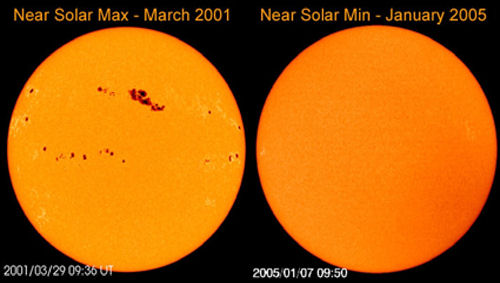
At Solar Max, there’s a lot of activity. Lots of sunspots, lots of flares and other kinds of eruptions. The coronal holes move away from the Sun’s poles and group in with the sunspots, spewing high-speed solar particles out into the plane of the solar system.

At the end of every 11-year cycle, the magnetic orientation of the spots…flips. Yeah, you heard right — this is one of the few times when the old trope about “reversing the polarity” is actually the correct answer. The end that was North becomes South, and the end that was South becomes North. MORE, the ENTIRE solar magnetic field ALSO flips! (This got very complex this last time; it wasn’t as fast and simple. It took nearly six months, and for a time our Sun had something like FOUR South poles, and NO North poles. Yeah, stellar magnetics gets crazy.) It takes a whole ‘nother cycle to get back to the way it started out. So that’s a second solar cycle, the 22-year cycle.

As the solar cycle winds down from Max to Min, the process starts all over. New magnetic snarls form deep in the Sun near the new poles, and gradually move to the surface and drift toward the equator. But while this is occurring, the photosphere tends to get quiet.

newsolarmax


As the sunspots start to reach the photosphere again, the Sun starts ramping back up from Solar Minimum to Solar Maximum, and another active period accompanying a pole flip. Over and over and over, every eleven years on average.

In addition there are longer cycles that we are still working on figuring out, because they’re tens to hundreds of years long, and it’s hard to get data that goes far enough back to chart those. However, a recent development called the double-dynamo model (we’ll talk more about it later) is helping to explain those.

Now, sunspots look dark not because they’re cold, but because they’re just a bit cooler than the surrounding plasma of the photosphere (which is the visible “surface” of the Sun). If the photosphere is about 5,800°K (~10,500°F), then the sunspots are about 3,000-4,500°K (4,900-7,600°F). Still plenty hot enough to fry your bacon, but still several thousand degrees cooler than their surroundings. They can be teeny-tiny (relatively speaking, of course) or they can be huge things (80,000km/50,000mi — not too shabby when you consider the Earth is about 13,000km/8,000mi diameter), big enough to be seen by the naked eye. (But don’t do that — we like having eyesight. If you really want to observe the Sun, the best way is to get a telescope, aim it at the Sun, and hold a sheet of white cardboard behind the eyepiece. Adjust the distance until you get an image of the Sun projected on the cardboard. This is a cool way to watch solar eclipses, too. If you don’t have a telescope, grab a shoebox, punch a small hole in one end, turn it upside down and point the hole at the Sun, then tilt the thing around until you get a small image inside the opposite end of the box.) Sunspots aren’t really dark at all; they just APPEAR dark because of the contrast with the surrounding hotter, brighter photosphere.

So you might reasonably expect that during a solar max the Sun would be cooler, and send less energy out into space, right? Well, at first glance you might think so, but that isn’t really how it works.

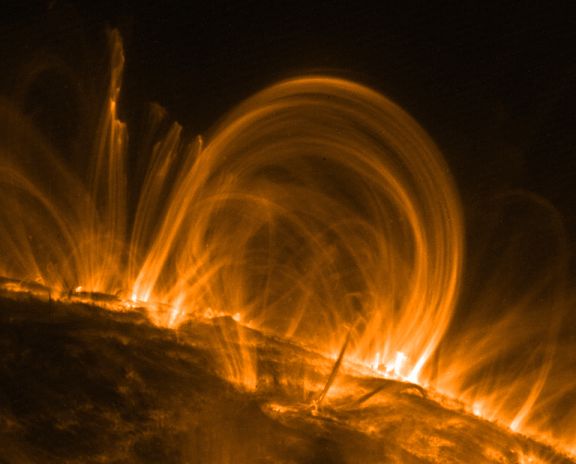
Remember, a sunspot is a big magnetic snarl. And the plasma around it follows the lines in that snarl. So we get all those great big loops — prominences and flares and things like that.

greatbigloops


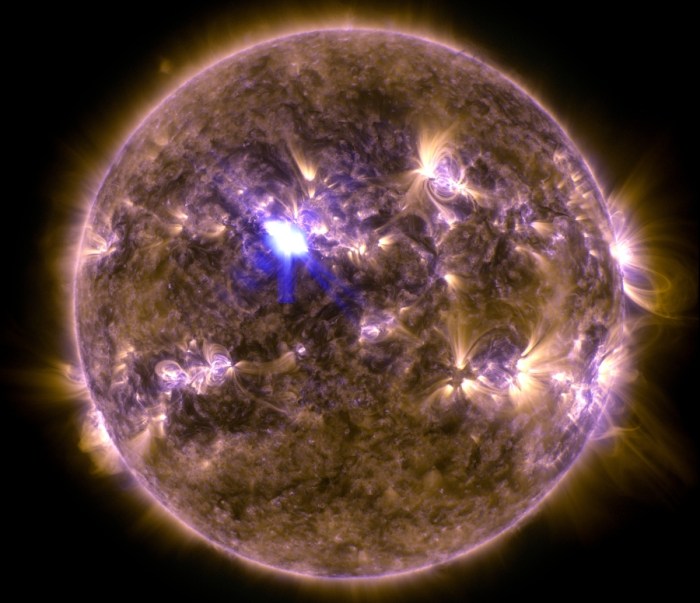
Occasionally, like a snarl in your hair, the lines break — but unlike your hair, they reattach, producing really spectacular flares. The bright blue-white spot in this next solar image is a flare.

flare

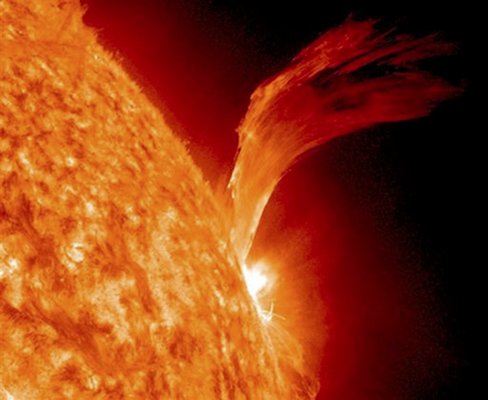
Up close, it can look something like the next image. (Also let me take this opportunity to point out that the images I’m using are taken in various spectral regions, but almost none of them are taken in visible light, and all of them use “false-color” schemes to enhance detail. Remember what I said about finding the right ways to see the details of what’s happening? Different spectral regions — certain parts of the visible, infrared, ultraviolet, x-ray, and more — are ways to do that, because the particular frequency emitted is determined by the element — or the energy/temperature — of the particle emitting the photon.)

mass ejections


And then there are the CMEs. Coronal Mass Ejections. In the image above, the white light is the flare, and the orange and red “flame” coming off it is a prominence becoming a CME. Below is a video of a “filament” aka prominence lifting off to become a CME.


https://youtu.be/XFyKnqhSn5s


I’m never quite sure how to best anthropomorphize a CME. Are they solar belches, or sneezes? Suffice it to say that all of that magnetic field mess around the sunspot group causes some sort of explosion. (No, we don’t know exactly why. We do know it’s really, really complicated, and involves something called magnetic reattachment — where those mag field lines break and then reattach to another one closer by.) And it is like a giant nuclear bomb, blowing a big bubble of plasma away from the Sun at high speeds. If the flare is the bomb’s explosion, the CME is the mushroom cloud.

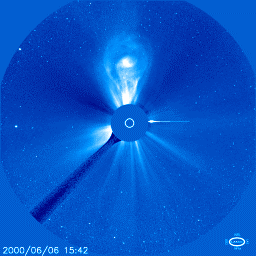
See the big blue blob above the Sun in this image? That’s a CME screaming off the Sun.

lightbulb


So between the coronal holes increasing both the speed and density of the solar wind, and these CMEs exploding into the solar system, the most active time for the Sun is in fact Solar Max, and that is when it’s pumping more energy into the solar system, not less.


~Stephanie Osborn

http://www.stephanie-osborn.com

Comet Tales blog/Osborn Cosmic Weather Report: http://stephanie-osborn.blogspot.com/


The Kiss of Death

As someone who is now past fifty, I have like many of you been witness to lingering deaths.  In fact, thanks to modern medicine most deaths are now lingering deaths.  Even when the tumor/disease is found too late and we’re assured the person is not long for this world, the death drags on.  Actually for a while it often seems as though it’s not death at all, as though the person will recover, as though everything is going to be fine.

Death, the final process, the final blow, tends to happen in a devastating, sudden conflagration so that even if the person had been dying for years, you truly don’t expect it. So it’s a shock, even when it isn’t.

Institutions and industries, particularly those that have been helpful and useful for years have the same “death process” at least from everything I can discover in history.

Let’s say something or other rendered an institution or industry irrelevant.  Let’s talk about oh, not the buggy whip about which I know nothing, but candle making.  And more specifically candle making in Portugal.

Once electricity came in, the candle industry was of course doomed.  But it did not vanish over night.  We are living in a time of such rapid change that it’s justifiable to image that change as say the change between VCRs and DVD players.  Over a few years, VCR tapes disappeared, save in dusty stacks in thrift stores.

But when something has existed and been useful for generations, the change is not that fast.  People had no particular emotional attachment to VCR tapes, at least that I know of.  (People have emotional attachments to the weirdest things.)  There was no time for a generation to grow up and become attached to vcr tapes as the way to watch movies.  My own kids remember it only because their best friend Jake put a banana in a VCR which henceforward acted possessed.  (The VCR, not Jake.  Though Jake had his moments.  Weirdly, from being an unpredictable hellion, he grew up into one of the nicest, most self-possessed young men I know.)

Candles were different.  I think electrical light came into Portugal as it did to most of Europe in the 20s or thirties.  (Maybe earlier.  I have no exact date.  My mom, born in 1935 (hopefully I have that right.  I might be doing what my kids do who routinely think I was born in the seventies.  She’s 81 at any rate.) ) still did her work by the light of an oil lamp when she was very young.  A lot of our neighbors in the mid-sixties and later still used candles and oil lamps.  I remember the candles, strung up like pale fish, to the side of the general store when I was very little.  I remember people buying bottles of lamp oil.  I have vivid memories of trimming oil lamps, and cleaning them, with my (older) cousin Natalia who was raised with us, but that could be because we were going through an extended period of blackouts. Or it’s possible that just like initially grandma’s house only had piped in water in the kitchen, it also only had light in the kitchen and that light in the upstairs bedrooms came later. I don’t believe so, though, as one of my earliest memories is of lying in bed in my parents’ shotgun apartment, cut out of the house’s ground floor, and listening to the electrical light “sing” above me.

Speaking of blackouts, they were fairly common in summer, when simply having all the lights on later overwhelmed the net.  We all kept candles and sometimes oil lamps on hand, so we could weather those times.  This lasted well into the seventies.  Because my parents hated the amount of candles my brother and I ran through reading till late, blackouts became our exercise program.  We used to walk up and down the village under the summer moon, until they’d tired us sufficiently we wouldn’t go through more than a candle each before bed.

By the eighties, the blackouts were less frequent and candles and candle sticks were getting difficult to find.

Is it dead yet?

Who knows?  I’d bet the candle industry in Portugal is a shadow of its former self.  I don’t know if it has revived yet into the scented-candles-and-aromatherapy niche it now occupies in the US.

For the purpose of what it was, though, the main purveyor of light to households, it is dead.  Yes, sure, people still have candlelit dinners and still talk of the romantic feel of candle light.  BUT no one seriously builds a house without electrical light and plans on using only candles and oil lamps.

Why I’m talking about this: when I was at Kris and Dean’s self publishing workshop back in 2011 I was shocked to hear them say that they expected the traditional markets to survive “at least in some form.” I heard that they were hiring more employees and were healthier than ever, partly through the ability to bring out their massive backlist in ebook at practically no expense.  You might make a dollar a book per year, but if you have half a million books that you have the rights to, well!

I was shocked, but it made perfect sense.  I had never thought of it that way, is all.

Two or three years later I was hearing from friends that trad publishing, at least in our field, having lost the ability to “push” new books the way they used to was tottering so badly and had so many lawsuits against each of the companies that editors were afraid of coming to work one morning and finding the entrance padlocked by either creditors or the IRS.

I thought that was weird, but as no one mentioned the only publishing house I was interested in, which so far as anyone knows has never played shell games with its accounting, I went back to doing work for that house (Baen for the uninitiated) and indie stuff and ignoring what was going on.

Several things have intruded in my conscience recently.  Over the last month, about half a dozen people have told me they don’t expect that traditional publishing, other than Baen is long for this world, and in the groups where I lurk unnoticed, as I have for years, people talk of how tiny their advances are.  Let’s just say the objection to Baen was always that they didn’t have as big pockets as the other houses, but these days my own decidedly mid-lister advances are looking remarkably plump.  As for the other houses, what I heard a couple of years ago seems to apply “If you were getting advances of more than 100k, up to the millions, you’re now making 50k a book.  If you were making 50k, you’re making 10k.  If you were making 10k you’re unemployed.)

Other things I’ve noticed, STRICTLY as a consumer, is that since they won their victory to be able to price the way they want against Amazon (Phyrrus would be proud) they’ve also been talking about how ebook sales are falling straight down.  This is not the experience of any indie I know.  What I think they’ve done is price themselves out of the market.

Then there is the fact that they no longer own those “millions” of properties that were making a dollar each a year.  Most authors I know with long backlists are, after considerable strife, getting their stuff back.  The series I’m currently reading (historical mystery) suffers a sharp divide around book 11, where it goes from being on KULL and reasonably priced to being $14 per book, the likes of which, no matter how much I enjoy the series, I WILL NOT pay.

At the same time the author has started an indie series, in the same time and place with a different detective.  I’m seeing this an awful lot, particularly for historical mysteries.

Science fiction, weirdly, is being slower about its authors establishing dual careers, and I think I know why.  Most (not nearly all) of the people still working in the field are prestige-and-favor clients, who do it for … well, prestige, while their real work is as university professors or whatever.  The midlisters who write to sell have already fled to either Baen (a lot of them) or to indie.  And us at Baen feel fat and sassy enough not to try to do dual (okay, except me.  I’m crazy.  Also indie pays me 50% again more.  I’m not leaving Baen unless they fire me, but you know, I like money.)

This morning it occurred to me this all fits perfectly well into the picture of “lingering death”, including the reports that “I’m not dead, I think I’ll go for a walk.”

The systemic weaknesses of traditional publishing (except for Baen) including the lack of a strong editorial choice that respects the fan base, bloated workforce and prestigious address expenses are ultimately not survivable, not in the days when anyone can start a publisher in their garage or publish themselves for that matter.

The atmosphere of cap-in-hand that still surrounds editors and publishers for the big houses, driven by supplicants who want to be traditionally published for prestige and credits-as-a-professor prevent their seeing that the iceberg is in fact dead ahead.

So instead of veering off, they’re rearranging the deck chairs and saying they feel quite well and will go for a walk (if you pardon mixing the images.)

What does this mean?  Does this affect me at all, when I’m mostly indie and baen?

Oh, it does affect me.  The toppling of the traditional part of the field will have huge repercussions in cons and workshops and also in what comes after in terms of publicity and what success means for a writer.  Not all of these consequences (perhaps not most of them) are good even for me.  When a huge building topples, it always affects things in ways that are hard to predict, and not all of those are known knowns.  Most of them are unknown unknowns.

It seems at this point, however long traditional publishing as a model we know lingers, it WILL topple.  Probably suddenly and terribly.

Kris and Dean were right, in the same way that the candle industry didn’t disappear.  It subsists in the scented candles, candles for candlelit dinners, etc.  And the publishing industry will probably survive as bespoke goods for the fans extraordinarily successful writers.  But I think its passing from the world as anything else is not far off.

No matter what happens, the process always drags, until everything collapses suddenly.  And it will still hit us as unexpected.

And we still don’t know what will happen.  We don’t even know what questions to ask, to estimate how far the ripples of the collapse will go.

Which is another reason to push out some indie (honestly, life is settling at last, though still a mess.  I’m looking at Christmas for “mostly settled”) and to dip into other genres and to stay flexible.

The way to survive is to move and think in new ways.  It’s hard but it’s doable.

Hold on to the sides of the boat.  The water is about to get rough.  But the storm in this as in everything else is survivable.

Work and think.

How Do You Know?

Yeah, yeah, I know, it’s in his kiss.  That is the easy one.

In the last two weeks I’ve got two people saying something like “but she says you shouldn’t believe established historical facts that everybody knows, and she doesn’t present any proof, and I think this means she is–”  One said “an ideologue” and the other implied mad or perhaps Stalin.  It was in the comments here, but I don’t feel like looking at it.

I’m not telling you everything you ever heard is a lie — for one I have no idea what you’ve heard — I’m telling you “How do you know?”

The things that offended people in both posts are things I have reason were not quite as advertised by modern Marxist historians and the romantic socialist novelists they believe piously.  I wasn’t saying it was an outright lie, but I was saying “I have reason to believe this isn’t so.”

In this case it was the whole thing of people getting condemned to death or transportation for stealing a loaf of bread.  It might (maybe) have happened in ancien regime France.  In Victorian England?  Oh, my sore toes.  Yeah, some people — resident Aussie on FB immediately chimed in to tell me people WERE transported for stealing a loaf of bread because they were starving — might have that on their conviction record, but one of my amusements (look, pal, I don’t judge YOU) is reading and watching stuff about the underbelly of Victorian London.  Yeah, people stole bread.  They stole a lot of things.  And those people transported for stealing bread probably had A LOT more serious things in their past, but they couldn’t be nailed for those.  (Kind of like Al Capone was nailed for tax evasion.)  Because — stands to reason — in a society where policing is so tight that stealing bread gets you transported, there wouldn’t be the thriving underworld of whores, pickpockets, con artists and yes outright murderers that existed then.

Of course, the person who answered here thought I was saying Victorian England was some sort of paradise (rolls eyes.)

I remember the first time I realized that the things everyone knew and the things we were taught COULD NOT LOGICALLY BE SO.

Look, I, like you, heard about how terrible the aftermath of WWI was, and how broke people were right after, and how they were moving to cities and living in tenements.  It wasn’t until I was reading a book about the between the war period in England that I realized they were telling me TWO stories which couldn’t both have happened.  In the part about the common folk, they were telling me how much poorer they were than before the war.  In the part about the great families, they were telling me how the huge rise of the middle class and the building of suburbs had hurt them, and how the newly rich common folk no longer wanted to be servants.

That was one of those “wait a minute.”  Sure I was taught both things in school, but you know you write down the bullet point for the test, and that’s it.  Now I was going “Who the heck wrote these narratives and why doesn’t anyone question them?”

The truth, btw, from going to primary sources is closer to the second.  And the people who wrote the narrative were the unseated noblemen, who did not like all these noveau rich but who wanted to justify their disgust by showing how it hurt the poor.  (It did increase the underclass somewhat, not because of economic conditions, but because a lot of men don’t integrate well after war, and well, WWI was something special by way of trauma.)

There are tons of these when you start poking.  For instance the idea that the industrial revolution was unremittingly bad for the poor/people.  Looking at China and India and such places right now, all I can do is roll my eyes.

Yeah, sure, the conditions of the early industrial revolution were appalling.  And yet people crowded to the cities to take these jobs.  What the historians never ask themselves is “How much worse was what they were escaping from?” We know that in India and China and other recently industrialized countries.

Sure the countryside has relatively clean air and more open space, but there are still real famines, and the work was unremitting and brutal and yes, little children worked too (says the daughter of middle class in a rural community whose first “job” was weeding the onion patch at five.  And I was a pampered moppet.  Kids my age from farming families had what we’d call full time jobs.  Factory jobs at least had a stopping time.)

The idea that the industrial revolution was awful comes from upper class historians who could see the little kids twisted by working in the mills but who never consorted closely enough with the rural poor to see the misery behind raising baah lambs and the pretty pretty flowers.

Yeah.  So the past isn’t written in stone.  And it’s not a conspiracy.  Not precisely a conspiracy.  Yeah, sure, the Marxists influenced a lot of modern history with their ideas, but that is not necessarily conspiring.  They view the world a certain way and it influences how they view the past too.

I know it makes people uncomfortable to question the past, particularly when that past is enshrined not just in their history classes but in great emotive fiction (the whole thing with the loaf of bread.)

HOWEVER the past is always changing.  In my own time I’ve heard the invasion of Rome be changed to “well, the immigrants just kept getting in and eventually overwhelmed Rome.”  And I have seen the dark ages change into the vaguely chiaro escuro ages and the latest exploration of the period show that what caused the dark ages was the Muslim expansion cutting off trade routes. And a lot of other revisions, as things are looked at a different way.

One of them, which I know to be true from modern revolutions and studying them (modern meaning from around the eighteenth century) is that the uprisings happen not when things are at their darkest, but when they’re starting to get better; not under the horrible tyrant, but under his more liberal successor.

People REALLY have trouble with this, particularly writers.  Which is why most revolutions in writing and theater are portrayed absolutely wrong.

The same wrongness goes for wars.  I’m fairly convinced nowadays kids are taught wars go on until America decides to stop fighting, and then the other side also stops because they’re nice people, or something.  I don’t even want to imagine what distortions that will cause in future fiction and action.

So — is my questioning of the past proof that I’m an ideologue or maaaaaad, maaaaaaad I tell you?

Are you joking?

I know I am a little… enthusiastic on libertarian ideals and that I can lose sense of proportion.

But I question history because between history and the media all of us have been sold several packs of lies.

Western civilization is dying, partly, of self-loathing.  Understanding the other side of the “atrocious things our ancestors did” and that other people’s ancestors did the same or worse is the only way back to health.

And questioning what you were told — and all you know about the past you were TOLD unless you happen to have a time machine — is healthy and sane.  Why would you think people studying the past have no agenda?  Think of how the Sad Puppy movement is characterized on Wikipedia.  Now imagine it was in the past and you didn’t know anything about it.

Trust but verify.  And always try to find primary sources.  The results might surprise you.

This is important because, to quote RAH “A generation that doesn’t know history has no past.  And no future.”  And a generation that knows wrong, distorted and tendentious history is no better off.

About the past as about the present, think for yourselves and dig.

It’s the only path to truth.