Hard and Soft

Back many years ago, when number 1 son was born (on COBRA) we were left with something like eighteen thousand dollars to pay off, and no job.  Worse, not only didn’t Dan have a job (okay, he did, but his job didn’t pay him.  Yes, we should have sued, but we were young and stupid.) but I also had been sidelined by pre-eclampsia for almost a year and therefore had lost all my free lance translation clients.  (Also I wasn’t in my right mind.  I don’t know if it was pre-eclampsia after effects or post partum depression, which I also did have, but I had real trouble figuring out tough problems like “the clasp on this little baby garment came off, how do I get it back on?”  I’ll note I packed that garment without a clasp and three years later when I unpacked it the only thing I couldn’t figure out is why that had been such a tough problem.  So I probably wouldn’t have been all that good at translation.)

During this time we went to Portugal.  My parents paid, they wanted to meet the baby.

While there, when I tried to explain the bind we were in (as in, why we’d probably have to move, and why we might lose our house, and why–) I always got the same thing “If you were here the birth would have been free, and employers can not just pay you because they don’t feel like it.  Are you sure you don’t want to stay?”

I couldn’t explain it, and I couldn’t put it into words.  This was before my own personal political awakening, and the afternoon when things suddenly made sense and linked to each other, and I had a reason for my feelings.  What they said made sense.  If we’d lived there life would be a lot safer and a lot softer.  We’d not have debts except perhaps a house (which is what we strive for.  And that I intend to pay off as we conquer the health cr*p and I can fully write.  Also, when we are not paying for the boys any longer.  So, two years.) What’s more, beyond the government programs, we’d have the support of an extended “tribe” of family who would take a lot of the sting off being young and poor.  When we were buying sofas at thrift stores, my brother was just getting my mom’s old ones for free, when she changed furniture.

But even though we considered working there for a while, until we were back on our feet, I didn’t want my son to grow up there.  And I couldn’t explain why.

Relatives and friends told me that the US system was unjust.  I mean, when you’re unemployed it’s the last possible time you can afford the exorbitant premiums of cobra (From Dan’s last job.  The one he was in not only didn’t pay, it also didn’t pay insurance) for practically no coverage.  Wasn’t it much better that the state picked up everything, and you had no worries.

It was only years later, when the crunch passed, that I started glimpsing why it wasn’t a better thing to live in the soft state of being taken care of.

We paid off that debt in two years, you see, even though it was half of Dan’s annual income.  We just lived really cheaply, mostly off rice and vegetables with a little bit of meat to flavor it.  (And that went to Robert after he started eating.)  And then in another year we saved enough for a down payment. And Dan got another job, and I started trying to get published.  By the time #2 son came along, we weren’t rich, but we were rich enough to splurge on things like flavored coffee once in a while. Yeah, I still bought 3 turkeys on the sales after thanksgiving, when they were $10 and dismembered them and we ate them for months disguised as various things (I have it on good authority most of the veal scalopini served in restaurants is actually turkey breast) but we weren’t starving.

Now we’re a little crazy in how tough we are on ourselves to get debts paid.  And I’m not holding us up as some sort of an example, because it’s rather obvious when it comes to money we’re not all there (for instance, we have no consumer credit.  None.  Which means there is no piece of furniture in this house that was bought new, and there very rarely are any clothes we buy new, too.)

But the thing is, after that point, is when I stopped being afraid.  I’m still not absolutely sure we’re adults as adults are supposed to be, mind, but I’m fairly sure we can survive financially, even if we can’t help the boys as much as we’d like to (but that might be good too, as it prevents them getting sidelined by degrees in line fishing and underwater basket weaving.)

These days I don’t discuss our system with my relatives very much.  There is very little point, because they’ll never see the advantage of a “Hard” system versus a “Soft” system.  You see, they never went through the tight point and emerged into daylight on the other side.

The point is not just that if you pay for your own health care, yeah, it can suck hairy goat, but you at least get to choose what you want, and how far you’re willing to go into debt.  Other than the fact that it was probably doctor’s error in giving me too much pitosin to stimulate labor (an error that could happen there too) it’s quite possible that Robert or I or both wouldn’t have lived through that.  Sure, the original doctor was terrible and gave me too much pitosin, then refused to believe the contractions had stopped.  But given that error, the monitoring of the baby and the emergency caesarean were very, very good.  Though even they weren’t sure they could save us both, they did.

Our medical preparation is double the time and far more rigorous than in most countries with socialized medicine.  But also, the doctor is ultimately a professional who can be ruined and sidelined by a law suit.  Government employees in socialized systems are immune from that.  The system is soft for them too.  Which means it might not be worth the hassle of fighting to save both mother and baby, when the overwhelming chance is one of them will die.

But that’s not all.  It’s that going through those periods of extreme need and extreme struggle molds you, and gives you strength to go through other things, and even to seek trouble, in order to reach a worthwhile goal.  I don’t know if without those three years of extreme privation, I’d have stuck with it through the series of kicks in the teeth that were my early attempts at getting published (and that my career often turns into.)  But the habit of clenching my teeth and facing the storm was there, and I could fall into it again.

The problem with soft systems is that they’re against everything man was molded to be by evolution.  We’re built on a scavenging ape.  That means we thrive on strife.  If a scavenging species has too much to eat, it stops “working.”  This is because as pre-human and early human, if you went out hunting while you had a half mammoth rotting in the cave, you’d have no advantage, and you’d only deplete game and make it impossible to live in that area in the future.

Knowing that you’re not going through a tight time (we never came close to starving, though we once found ourselves outside a soup kitchen, considering going in.  But the people going in were so obviously worse off than us, that we went to bed hungry and then the next morning figured out some way to buy food [no, I no longer remember what] or, that is a 50 lb bag of rice and bulk frozen veggies.) ties right into that ancient brain glitch that says “plenty of mammoth, rest now.”

But the thing is man doesn’t live by food alone.  There is pride and sense of purpose in a job or even an occupation like ours.  Sure, life with someone else (or someone else’s taxes) looking after you is softer, and easier.  But in the end, you never reach for what could be.  You’re not even aware it’s possible.

I completely understand how not just our welfare but our subsidized class can resent those better off than they are.  To them it is a sort of sorcery.  A lot of them assume it is either because you were born better off, or because you know some secret they don’t know.  Half the nonsense of micro-aggressions and institutional discrimination comes from this sense that there’s something they don’t QUITE grasp, that they can’t quite figure out; some secret to success that’s being kept away from them.  And if you multiply that by millions, you understand why so many countries envy and resent and hate the US.  It’s because despite our “Hard” system which is SELF-EVIDENTLY worse for people, we produce more, we invent more, we innovate more.  And they can’t figure out why, so it must be some horrible trick/hegemony/colonialism/whatever the Marxists are yapping about nowadays.

Only it isn’t.  It’s just relatively (compared to the rest of the world) free individuals, striving to do the best they can in any way they can, because very few of us have anything to catch us if we fall.  That’s it.  That’s the whole of the secret and the magic trick.

Heinlein said you shouldn’t ruin your children by making their lives too easy.  The same goes double and writ large for your citizens.

Sure, we’re human, and out of charity, we will help those who have fallen and can’t get up.  But that should be a temporary thing, until they find their feet again.

Too much hardness can kill, and no one is suggesting throwing widows and orphans out into a snow storm.  But too much softness can smother, and keep you in a life of dependency and depression that is, in many ways, worse than death.


Rainbows and unicorn farts – by William Lehman

Rainbows and unicorn farts – by William Lehman

I get the free download of the New York Times. Why? Well, because I am not about to give those idiots any of my money, but it is worthwhile to keep up on what my political opponents say/believe.  Every once in a while it leaves me with dents in my walls, and corresponding bumps in my head, because face palms just aren’t enough for the stupid. One catastrophically stupid article I expect, (and am almost never disappointed) but two or more, well…  Today was one of those days.

Let’s start with an article on Graduation rates being up, but the product being unsatisfactory… http://www.nytimes.com/2015/12/27/us/as-graduation-rates-rise-experts-fear-standards-have-fallen.html?emc=edit_th_20151227&nl=todaysheadlines&nlid=28200476  Look these folks obviously thought Garrison Keiller’s radio program was a f*cking documentary. You remember Lake Wobegone, “where all of the children are above average?”  We have been pushing for a one hundred percent graduation rate for over two decades.  We’ve got it up to 85% or so, and guess what?  Surprise surprise! The quality of the education went down! WOW.

People haven’t changed, we’re not suddenly producing wunder kindin from the Third Reich. The level of intelligence on average is probably unchangeable. Now that completely ruins the narrative that the left shills, but it’s sadly so. The article would lead you to believe that “we don’t understand why the quality has gone down, it’s complex, and there’s a lot of variables”. Hell, anyone with a basic understanding of economics and statistics understands why the damn quality has gone down! (yes, I realize that leaves out most of the left) The only way to make more of the kids graduate is to lower the standards or raise the average IQ, and we covered that second option already. Eventually buried way deep in the article they do admit that the requirements to graduate have been lowered, and the quality of work required has dropped. Well, this is bad enough as it is, but now that they have spent the last two or three decades (and in fairness it’s been going on for more like five) trying to give everyone a high school education, the stupid bastards want to give everyone a college education.  Guess what Bozo? (yeah I’m looking at you Bernie) if everyone has a Bachelors’, they’re going to be worth exactly what a High School Diploma is worth now!  (IE you practically have to have one just to be employable at the minimum wage level) and for good reason.

This isn’t a eugenics thing; brilliant minds have come out of families in the ghettos, from parents who are frankly below the average line.  This isn’t even a suggestion that we go the route of Europe (oh yes, that wonderful place we keep getting told about by the left? That place that gets held up every time a debate is brought up on taxes, or socialism, or guns, or… Yeah that place, where in third or fourth grade you’re given a test that will determine if you are allowed to become educated, or if you’re destined for a factory job somewhere. [Sarah’s note- while I went through this system, fourth grade to determine if you go on, then 9th to determine if you get to go on and attempt to enter college or will just be taught a skilled trade, I don’t think this is true in at least half of Europe now.  MIGHT still go on in easier form in Germany and England – the 9th, not the 4th grade cut off – but Europe has caught the everyone has to finish high school, too.  Partly because people no longer leave 4th grade literate and numerate])  There have been late bloomers, there have been kids that just didn’t get it, until suddenly in fifth, or seventh, or… the light bulb comes on.  Those kids get failed by the European system, and that is a problem.  This is merely an observation that 1) if you give everyone something, it means nothing, 2) if you never expect someone to grow up, you’ll probably get your wish (if everyone is required or expected to go to college, you just extended adolescence for another four years) 3) maybe, just maybe, even a high school diploma may be too high an expectation for the entire population.  Hell, in the years prior to and post Second world war, a sixth grade education was very employable.  Of course a sixth grade education in 1945 was probably the equivalent of a ATA today.

Now, on to the second stupid: They tell us “a Fearful Congress Sits Out the War Against ISIS”   http://www.nytimes.com/2015/12/27/opinion/sunday/a-fearful-congress-sits-out-the-war-against-isis.html?emc=edit_th_20151227&nl=todaysheadlines&nlid=28200476 This is an oped piece by the editorial board of the NYT, that basically says “it’s congresses fault that the President is overstepping his bounds, and assuming powers in excess of what is permitted by the constitution.  If they would just do what he wants, he wouldn’t be tempted to do it without permission.”

EXCUSE ME? Now I guess I shouldn’t be surprised that the sort of mind that can wrap their heads around the first issue I brought up, can come to this conclusion, but still… The very concept that the overreach by the President is caused by congress not acting to give him the resolution he wants, is a microcosm of what ails the political left.  It’s never the fault of the person who did something wrong, because actions and responsibility are completely divorced.

Here’s a thought NYT, how about you make the case for war (you’ve done it before Gods know, cough Spanish American War, Cough) and make the case for congress approving an actual declaration of war!  Not yet another ‘use of force authorization’ with no defined goals, no exit plan, and by exit plan, I mean we have to either plan on a war and occupation for as long as it’s determined to be needed… Like oh say Germany and Japan where we still have troops, or a “punitive expedition” like Teddy R was such a fan of, were we go in, kill everyone that is causing trouble, or looks like they are thinking of causing trouble, then leave with a “if you start causing me trouble again, I’ll be back to kill a lot more of you”.  And separately, you hold the asshole in office responsible for acting without congressional authorization in violation of the constitution, like you have many other presidents over the years. Oh wait, I forgot, you have a different standard for politicians on the left, than you do for politicians on the right.  So shit that caused you apoplexy when Ronald Reagan did it, is congresses fault today…

The thing that really depresses me on this, when I think about it and look at it, is this sort of thinking seems to be in the majority today, even on the right.  Folks, get your heads out of your fourth point of contact. If it’s wrong when your opponent does it, it’s wrong when your friend does it.  If it seems to violate basic math, it probably does, and unless you are working in the sort of field where discovery of loopholes in the math and physics (cold fusion?) are at least possible, you should figure that the Gods of the copy book headings are going to get pissed and seek revenge if you ignore them.

Good

Yesterday on one of the Facebook groups I attend, I came across a post by one of the Puppy Kickers, (echoed by someone in the group in exasperation) which went something like “Neo nazis want books that are less about conscious feminism and diversity.  So did the Sad Puppies.  Are the Sad Puppies ashamed of themselves now?”

I don’t need to spend much time on the argument itself, and frankly, the person who made it is not a stupid man, and he should be ashamed of making such a stupid comparison.  This argumentum ad similar tastes is ridiculous.  Say, didn’t Hitler love dogs?  And wasn’t he a conscious vegetarian?  So, are dog lovers and vegetarians ashamed, yet? Mao (probably) loved Chinese food.  Are all Chinese food lovers ashamed? Che Guevara, one of history’s most disgusting mass murderers (in that he preferred to club children and puppies to death himself) wore a beard.  Are all beard wearers ashamed now?

In the discussion someone said “But most people prefer non-preachy fiction, so why would the fact even neo-nazis prefer it something against SP?”  And someone else mentioned that people like the poster who made that argument above (I’m not naming him, because at times he has flashes of sanity and I’m hoping he realizes his argument is insane.) might not consider anything that ISN’T consciously feminist/diversity preaching GOOD.

This argument interests me far more, because it gets to the roots of what we consider “Good” which I think is what is at the basis of the split in science fiction.  Their position is not without … defense.  In fact it is the traditionalist position in literature. And our position is a bit of a rebellion, a very much “Aristo, aristo a la lanterne” position, a populist and revolutionary stance, if you prefer.

We’ll dispose before we go on of the fact that yes, the neo-nazis probably oppose feminism and diversity in science fiction because they oppose it EVERYWHERE.  My position (I can’t speak for all of Sad Puppies, since we’re a lose and non dogmatic (ah ah) movement, and what we agree on is that literature should be a ludic endeavor (more on that later) is that I agree with the “motte” part of the feminist argument which is that women should have the same opportunities at pursuit of happiness as men, and not with their bailey argument, in which they find sexism under every rock and are, in the end, in revolt against being a woman. Nature is neither equal nor egalitarian and attempts to make it so have filled countless graves. Women are not statistical incidences nor somehow flawed males.  Every woman is an individual.  I believe in equality before the law for female and male individuals, and after that each of us must make his/her own way through life and find out what we’re good at and what we love doing.  I owe no loyalty to anyone just because she too has a vagina, and no one is my natural enemy because he has a penis.  Insofar as the self-conscious feminism in books is of the “woe to me for I have a vagina and I’m oppressed” variety, the book dents the wall.  But I have never had a problem with strong female characters, particularly those that ring true.  And I know what strong women are like, since most of the female ancestresses I was privileged to meet were of the “I am not oppressed; the bastard hasn’t been born who could oppress me” variety, and that in a genuinely sexist society.

As for diversity — meh — diversity of what?  I have no issues with characters of various hues, though I often forget to mention what color my characters are because it fails to interest me to any marked degree.  I like characters from different backgrounds and with different modes of thought, because that’s just good writing and interesting fiction.  Like most science fiction and fantasy (and even mystery) readers I’m drawn to different settings and different cultures, because again that’s just interesting.

I am not interested in arguments about how all these cultures have been victimized by the west.  (Oh, sure, to an extent it is true.  Africa wouldn’t be the mess it is, if our “intellectuals” had exported socialism and fixed pie economics.  But it would probably still be a mess, due to the evil of tribalism.  And that is not something we exported but arguably something our ancestors escaped if the out-of-Africa hypothesis is true.)  I am not interested in economic arguments where you somehow injure a place by buying its products, because that’s fixed pie, Marxist and (but I repeat myself) stupid.  And I’m not interested in stories about how the poor victim gets up, is victimized and goes to bed being a victim.  (This was 90% of the books my kids were assigned in school.)  You don’t need to raise our awareness that victims exist.  Anyone who has survived middle school knows that.  And we’re all of us victimized enough that we’re far more interested in the story (often a fantasy, but still heartwarming) of the victim overcoming oppression. That is more likely to give us strength to go on another day.

And this gets us back to what “good books” are.

Once upon a time, in the beginning of the present literary culture, what was considered “good literature” was that which bore the signs that its author had an excellent classical education.

Part of the reason this was important is that books were expensive, and while — because we’re human — a lot of them would have a ludic undertone, such as the stories of Arthur, they were also supposed to serve a greater purpose, so you could justify buying the d*mn book.  Even onto Shakespeare’s time there was supposed to be an educational purpose, yeah, even to the plays that made the groundlings throw their greasy caps in the air in joy.  So things were advertised as “the most piteous and instructive tragedy” etc.  For enlightenment see the end of Romeo and Juliet.

Now both the legends of Arthur and Shakespeare were not “high literature” (no really) and therefore wouldn’t have references to classical antiquity.  Marlowe, otoh, who was far better educated than Shakespeare couldn’t help himself and not only wove classical references (and took the themes of his plays from classical stories) but also is said to have written stage instructions in Latin (which the actors crossed out and wrote above, at least according to one of the biographies I read.)

You can find marks of this “I had a good classical education” in the classical references that hit you out of nowhere in nineteenth and even early twentieth century books.

There was a (justifiable) rebellion against this in the early twentieth century.  Probably as a result of World War One, which was viewed as a madness of the elites, people sought “authentic” experiences to write about, and for a little while, because let’s face it, they were rebelling against a literature that never existed, where everything was noble and good (no, not even Victorian literature was like that.  That’s why novels were considered bad influences) this devolved to, as Agatha Christie speaking through her Miss Marple characterized it  unpleasant people doing unpleasant things in the most unbelievable of ways.

But nature abhors a vacuum, and so does intellectual snobbery. Partly because these novels weren’t any fun and people didn’t want to read them, they needed the shelter or academia to “empower” the authors and tell them they were ever so much better than their stuffy predecessors.

And the Academia, by the middle twentieth century was thoroughly infested with Marxist thought (though often not called by that name.)  There was a time there, between the end of World War One and the end of World War Two where the new hotness to show how educated you were was pseudo-Freudianism.  And even if Freud hadn’t by now been thoroughly discredited, what these people thought of as psychological was something even Freud wouldn’t recognize.  If you come across one of these, you’ll be caught up between a desire to throw the book against the nearest wall and laughing to hard to do it.

But for the last sixty or seventy years, the way to signal your “hotness” sorry, your “good literary credentials” was to preach Marxism, in whatever incarnation it took at the time.  A lot of it started with the oppressed proletarian, and now it’s devolved to the rather bastardized version of Marxism taught in our best colleges (which like the Freudianism mentioned above, would give Marx himself kitten fits.)  The proletariat having proved less than amenable to revolution, the true revolutionary force is sought in far distant places, in people oppressed by colonialism, and in that most rare and obscure of creatures, the oppressed woman.  (There are oppressed women aplenty, just as there are oppressed men aplenty.  And some women might be hated because they are women. Most of those are abroad, though, and our feminists can neither mention them nor help them, as that would be “colonialism” and also little brownz peoplez are always right and their culture is precious.  There are some women in our midst who are oppressed theoretically for being women.  What they’re really oppressed for is being themselves and the sort of people who allow it, since the law is on their side in escaping oppression, and there are plenty of groups to help them.  But never mind.)

Because Marxism like the puritans (with whom it shares a number o characteristics and in fact it’s not amazing the same families who were once puritans now fall into Marxism) believed that humans should be USEFUL, rather than simply being — and trust me, I was raised this way and one of the motos inscribed in one of my notebooks for high school was “The important thing is not to be happy but to be useful” — even though books are cheap enough to justify spending money on them simply to “enjoy”, people feel guilty about simply “enjoying” a story.  So a book must be “good for something” and advance the causes that are pushed in the best educational establishments: Equality (of results), Diversity (of skin color) and Feminism (of the all men oppress women by existing, because penis, variety.)

Which means to excellently educated people, including those who don’t consciously buy into the Marxist vision, finding these “markers” in a book makes the book “good.”  The most piteous tragedy of the oppressed woman is instructional and therefore can be enjoyed, and in fact MUST be enjoyed, even if you doze multiple times in the course of reading it, and end up downing three pots of coffee just to finish the novel… and even if you sometimes don’t finish the novel.  You know these are novels your literature professors would approve of, and therefore are sure it is a “good” book.

This vision collides at a fundamental level with that most of the Sad Puppies supporters have.  THAT vision is that reading is a ludic endeavor.  It exists to be enjoyed.  We are not interested in whether it advances the cause of social progress, the cause of social retrogress or no cause at all.  We don’t believe that the purpose of literature is to be useful, but to be enjoyed.

We think “good” in a novel or story depends on how deeply it moves us, how much it stays with us, what impact it has on us and our life.

We don’t count heads, or try to figure out if every woman, including the walk in in the third chapter is a “well rounded” character.  We couldn’t care less.  We just care that characters speak to us, and the plot makes us experience something that moves us, and stays with us.

Btw, unlike the other side (and possibly because the other side needs SOMETHING to make their academic-status-pushing books bearable) we don’t even care if the characters look (or think) like us.

I’ve been doing a tour of early science fiction, and yes, most of the characters are men, and many of them are in the hard sciences.  And yet, I fell in love with these books as a young girl in Portugal.  The characters didn’t look like me, and their culture was not like the culture I lived in — and why should this matter in science fiction, a literature of the strange? — but they were identifiably human, and like me they longed for adventure, interesting scientific developments, and human expansion.

A lot of these books are even confidently socialist or communist, having been written by communist or socialist authors.

But the books take very few pauses to preach.  The writers’ beliefs are just baked into the world building and how people react.  THAT doesn’t disturb me.

I’ve also recently come across some books (mostly indie) who do the “preaching and useful” thing, but do it from the right.  I’ve found my distaste of Piers Plowman type stories is not confined to those that push feminism and diversity. Those that mock people who push feminism and diversity with just as heavy a hand as those people use, also meet the wall with force.

This is because my main purpose in reading is ludic.  My interest in story is that it allows me to experience something out of the scope of my days.  My interest in reading over movies or games, is that it allows me to be INSIDE someone else’s head for a while.  It allows me to escape the space behind the eyes.  Now I have nothing against the space behind my eyes, but I think it’s interesting to “be” someone else now and then.  I also think it makes me a more rounded and better person in the long run, but that’s not why I read books that allow me to “escape.”  I do it, because the books are enjoyable and I enjoy them.  It is the reason I started reading for pleasure.

I knew the other side had issues with this, when the feminists started complaining about “escapism” in both books and games, and insisting that we should do these things for some reason that had nothing to do with entertainment, but more with “raising consciousness” which is modern for “being morally educated.”

They assume that because we don’t want to be preached at we must oppose the aims of the preaching, instead of our viewing books as completely different objects than they do.

We won’t change them, of course.

However, with Marx now entering his final phase of discomfirmation as a prophet, and with our universities teethering on the verge of irrelevancy, certainly for all non-stem disciplines, we will need a new theory of literary criticism.

Yes, I know it couldn’t matter less to the rest of us, but to the extent literature is an academic subject and that it is even important to study, insofar as it’s part of the history of western thought, there needs to be a theory by which academics can identify what is “good” and those interested in academic acclaim might put such markers in their stories.

I propose we go back to the Greeks.  A good literary work makes you experience Catharsis.  I’d add a good literary work speaks to people across the generations and sometimes across difficulty of changed language.

If you combine those two, you get a work that can be enjoyed at a pure ludic level too.  What this means is basically that good works can be enjoyed.

And while I’m sure that even mass murderers and thieves can enjoy literature at this level, I’m not ashamed to enjoy it, nor do I think it associates me with them, except to the extent I’m human.

Liking good stories is a human thing, that has been going on since we’ve been human (and maybe before according to some stuff I’ve read.)

I’m not now, nor have I ever been ashamed of being human.

Expecting Someone Taller

There will be regular as sane as they get around here, posts next week, and a couple of guest posts, but this weekend I’m drowning.  I was already running way behind on both work and house stuff, and then I lost a week to stupid doctor’s tricks.

I can’t write posts when my head is full of to-do lists.

There are stories I want to write for you guys, and will.  But not today.

And all through this, I keep thinking of the way adults managed things when I was little and thinking “I expected to be more grown up by now.”

From what I have managed to ascertain all of us freeze, internally, at some age between 8 and twelve. I don’t mean we stop growing, but in our hearts that’s the age we still think we are.

And when I think of that, the world is much better than we have any right to expect, when it’s run by a bunch of kids pretending to be adults.

And now I go pretend to be adult some more, because I have promises to keep.  And miles to go before I sleep.

Assorted Stuff

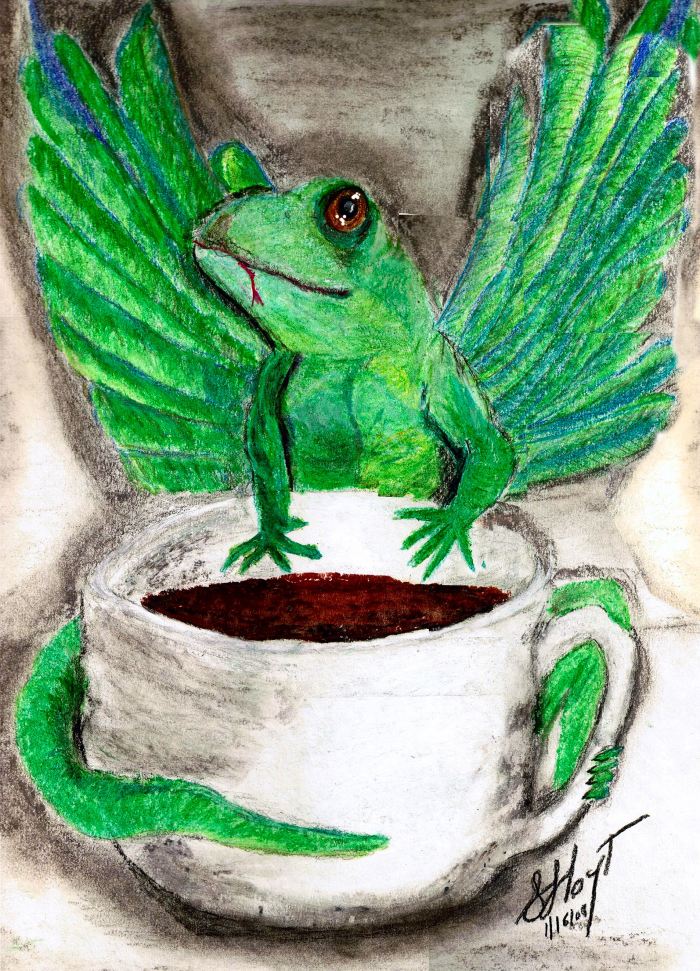
Some months ago, I posted my art here and one or more of you expressed interest in prints of this:

cupofjoe

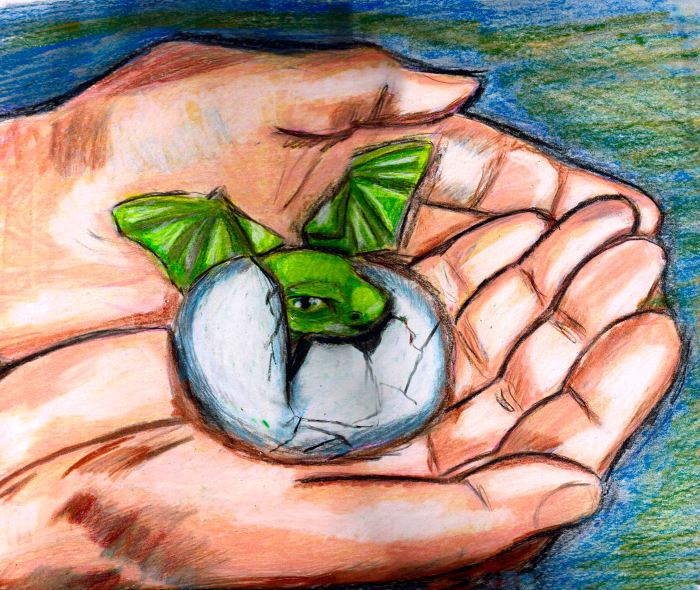
In the Mad Unpacking I recently came across a roll of prints, which I know has that. It might also have this one:dragoninhandsAnd I’m fairly sure it has this one:
magician'sbrat

I’m also almost sure I can find the prints fairly easily (as in, I think they’re in the closet in my craft room, which I need to finish unpacking today.) If you’re interested in prints of those, email me at my first two initials last name at the mail of heat. I am assembling stuff to send to fans next week, and will be happy to send you those, no charge, under “Sarah is so happy to be out of the hospital.”

And because I’m too lazy to write a post today (okay, it’s not laziness, so much as it’s complicated. I spent the week running down to the Springs to various doctors appointments. The house is a howling mess, my book is late, and I’m feeling pressured and cranky. Oh, yeah, and we’re the only house on the street not decorated. I don’t intend to make a production but we should light SOMETHING to who willing. Also, it would be good to get decorations up before Christmas eve this year.)

Now I have my art computer set up, and I have a tablet to draw on, (I happen to know I’m getting a bunch of drawing stuff for Christmas.) I haven’t scanned in the things I’ve done with pencils (which are also unpacked) mostly because, actually like those above, they’re fairly raw. I’ve regressed in three years without access to art stuff.

The electronic stuff is fairly raw also, but this is the latest, done in the evenings, when my mind is too fried to think in words:

conqueror

It’s called “Conqueror” and yes, I need to futz with stuff, mostly her boots/feet… unless of course futzing makes it worse, which it has so far.

If you’re wondering it’s not my story.  It’s apparently Amanda Green’s.  I was just drawing a scene in my head.  This was done with Corel Painter, virtual pastels.

Okay, now I go clean, zoom, like lightening, so I can write.

Emergent

I guess I should start this with a health and doings report, like that Elizabethan woman’s diary.  I bought it (It’s something something, the diary of an Elizabethan gentlewoman) because I was working the Shakespeare times, and I wanted a sense for how people lived day to day.  In a less individualistic time there are very few autobiographies and those might not be representative.  So I bought this book.  And then I read half of it in disbelief and skimmed the rest.

I can’t remember who the woman was. (I have different “tapes” for the different time periods and universes I work in.  (DVDs I should say and even that outdated, but I think of them as tapes, which shows my age.)  When I’m not working in them, I remember nothing, except fuzzy details.  Before I dive back in, I do a skim and reacquaint myself, and then I have names, dates, details at my fingertips.  Part of what disturbed me, back when the thyroid was very bad is that the skim wouldn’t stick.  Never mind, that’s getting better, though not back to normal.) Anyway, whoever the woman is, she lost something like two husbands and three sons to treason, was in danger herself, but most of her diary is the same entry “Prayed, wrought.”

Most of my life is about the same, except I’m not so good about praying.

Anyway, the health — after that extended preamble — and this itself is a preamble to my real point, but since this is a blog and not an editorial, I sort of assume you mugs want to know.  Because you’re family.

I said when I fell it was just my body being my body and I was vaguely annoyed at being dragged to emergency.  I was right.  Yes, there were several anomalies caught in the hours right after the sincope, (sp?) but it didn’t last.  Everything smoothed out, and when I went to my pcp on Wednesday for a follow up and to book the MRI everything was text book.  I now have an appointment with the cardiologist for the week before Christmas, which rather baffles me, since the conclusion of every exam done is that my heart is perhaps too normal.

Then again, this is not my first rodeo.  When I said “this is just my body, being my body” I as talking from a deep experience of something weird happening and then going to doctors’ offices to be told “you’ll never die from this.”  All sorts of specialists, from heart to blood have told me “Well, we don’t know what happened, but your xyz is so normal/on the good end of the curve, you’ll never die from this.”  Let’s call them appointments to confirm my immortality.  I’ll never die from any of these things.

And yet my body throws weird wobblies, before it rights itself.  The thing is it rights itself.  You have to understand, through my childhood, being born too premature and then catching everything, and with the auto-immune ever present (I mentioned to my husband that I wonder if I would be the same person if my eczema throughout all of my childhood didn’t present on the face (eyelids, and around the mouth.  Also my neck.)  I was a not-ugly child and I naturally like people, but having them recoil from you as if you were a horror-show freak (which is what I looked like) pushed me to both introversion and suspicion of others) anyway — no one could have predicted I would live.  And no one fully understands how.  So “It’s just my body being my body” will have to cover a lot of this.

I’m now waiting on results from the MRI.  The good news is I have a brain, which you guys will laugh at, but the thing is, given the early birth, several episodes of low blood ox because asthma and other stuff, and at least to major concussions mean I thought my brain as a shriveled little thing the size of a walnut.  BUT we have to wait to know more.  Of course I hope the delay means it’s nothing much, but that didn’t apply to the growth in my uterus, the biopsy also done around this time.  It’s just Christmas being Christmas and people being on vacation.  So.  We wait. But we really don’t expect anything earth-shattering.  This is just one of those things.  Partly they feel given the horror that is my auto-immune (Though between the thyroid and the prednisone — which damn it  made me gain weight I can’t afford to gain — This is the first time my arms are sore-free in… 15 years?) they want to check for stuff like MS, which I have no symptoms of.

Meanwhile I have new glasses and this was the first time, and I mean FIRST including the first pair of glasses I had, that I put them on and went “Oh,” in sheer relief.  That double vision up and down which I was not conscious of, until the exams forced me to notice it, must really have been wearing.  I felt like my eye muscles unclenched for the first time in probably a year.  The upshot is I can see the screen, which had become a matter of guesswork, and I don’t feel exhausted after writing for an hour.  So that’s the good news.

After this extended prologue, let’s get into “emergent.”

This morning I was thinking how, except for minor details, my brother and I divided our genetic inheritance according to the two families we “come from.”  Alvarim takes after mom’s family and has heart trouble hyper tension and the other physical issues of the family, including early baldness.  Mom’s family has other stuff like paranoia and epilepsy, and bi-polar.  (He might or might not have the last — treated — as mom does.  We don’t delve deeply on that stuff on the phone.)  And I take after dad’s side.  I’m darker too, as they are, (following the idea that Marques comes from a word meaning Moor, though I doubt they actually were.  The genealogical poking I’ve done points at Sephardic Jews.  Of course, the appearance is much the same.) And I have low blood pressure, low heart rate, a tendency to hypotension, and stomach trouble, and the endemic depression of that family line.

The exception seems to be the way our minds work.  My brother is smarter than I, and certainly conventionally smarter than I.  He had an eidetic memory once, when mine was only ever “near eidetic” and he could muster an understanding of fields I couldn’t attempt.  OTOH my brain moves by “erratic brilliance” like mom’s side.  He’s way smarter than I, but he’s predictable.  I’m not.  I will be dumb as rocks until suddenly a blinding insight hits, and then I will outpace experts in some field I’ve just been poking at.

It’s not quantifiable or predictable, which makes it difficult for employers.  It is however okay for someone who works for herself in a pseudo-artistic field.  And sometimes it serves me very well by wielding up something a regular brain could not have come up with in years of patient and sane plodding.

I was thinking of this this morning, and from my erratic mind I jumped to the culture and what is happening in the world.

I follow Richard Fernandez on facebook.  If I never did anything else on facebook, that would be worth it.  He is not just an enormously smart man, but one whose head makes sense to me.  There are people I can tell are very smart, and even right, but my mind can’t bend the way theirs does, and I have to get to the same place by different routes.  He’s not one of those.  He will think of things I never thought of, and then I read it and go “Oh, I should have seen.”

Lately he’s been on a …. not a tear, a mental pathway about black swans and the meaning of what is going on in the world right now, and whether it means a rejection of the progressive project.

I think it does, though not consciously.  People haven’t thought things through yet.  They just know what they know, and what their gut tells them is that all this stuff that’s been pushed on us from above is wrong.  Just wrong.  IOW the pendulum swings and having swung…

It remains to be seen whether they throw the baby out with the bathwater, or if they take bathwater and baby and make something so new, so different that none of us thought about it before.  I’m starting to get a feeling that’s it.

Part of what Richard has been saying is that you can’t predict “emergent.”  The black swan will fly suddenly, when you least expect it.

You can predict emergent even less if you’ve blinded yourself by taking over news and replacing real reporting with “narrative.”  You’re not getting what you need to to predict what is happening.

Thing is, none of us are, because you need to read the western press by ignoring the type and reading the lacunae between the lines to get even a sense of what is really there.  In a way the reporters, taught in schools pushing Marxist theory, aren’t even SEEING what’s really there.  They never remove the narrative glasses to see the world or attempt to see the world at it is.

And yet, Marx is dead.  Marx was always a cult, and cults only withstand so many rounds of disconfirmation before they fall apart (read When Prophecy Fails.)  Though on the way there, the proselytizing fervor becomes greater, as we saw after the fall of the USSR.

And yet, Marx is still dead.  And we as a culture (which means much longer than individuals) will deal with it over the next few decades maybe even to the end of this century and past the end of my life (immortal or not, I’m fairly sure I don’t last anohter 80 years.)

What emerges next we don’t know, and our information organs having been corrupted by Marxism, can’t help.  All we can do is work towards a better future.

Which brings me to a comment on one of Richard’s FB posts in which a man, I presume well intentioned, wailed that we need to figure out what we’re going to do when automation replaces 90% of the jobs.

I gave a snippy reply, because I’m still me, and you guys know my opinion (if not look back through posts.  Yes, I probably should label them, but if you use the search string “With folded hands” you’ll get hits.) I don’t think automation can or will replace 90% of the jobs AS WE KNOW THEM NOW.  Sorry, left, you can’t blame the unemployment on automation.  It didn’t advance that much in 8 years.

But beyond that, automation can’t replace 90% — or really much — of the jobs as we will know them, as they EMERGE in the new world.

One of the things that never ceases to amaze me about the left is what I’d call “Sh*t sentimentality” and a crazy desire for the past.  Growing up, they made me read jobs about how bad some jobs were: cleaning lady, assembly line, miner, server.  BUT now they’re wailing that those jobs will vanish.

There are two keys to this: first, they are truly contemptuous of their fellow men.  The modern leftist is not a worker, nor a man of the people, he is an intellectual, someone who did very well in the indoctrination factories we call schools.  This encourages him to think anyone who doesn’t think like him is stupid, but more importantly, it encourages him to think anyone who doesn’t do well and mind-and-pen tasks is stupid.  I know.  I would have succumbed to that temptation if I hadn’t grown up in a village, where there weren’t enough people to insulate me from contact with people in manual professions who, sure, thought I was nuts reading as much as I did, but who could think faster and better than I in non-intellectual/abstract subjects.

And the second is that the left, thinking they’re smarter, think they have an obligation to “look after” the less intellectually fortunate.  Which is why they are all bent out of shape about these sh*t jobs disappearing.  I mean, yeah, they suck, but how can the left/bureaucrats come up with new jobs to replace the lost ones?  How will they look after the unemployed?  And how can we not care that technology is killing jobs????  How can we not want to beef up the welfare state to look after these poor people too stupid to do anything else?  We’re monsters, I tell you, monsters.

Their anguish is real, even if truly bizarre.  It is a result of their personality type and their education, and it would be unkind to laugh.  You also have to have a heart of stone not to laugh like an hyena.

The thing is the government/bureaucrats/intellectuals have never created jobs.  Humans are clever apes, even those who aren’t into juggling abstract concepts (some are cleverer than those who do juggle abstract concepts.  You can get lost in the pretty pictures in your head.)  We’ve survived changing environments before, even environments WE changed.  We survived the discovery of fire, we’ve survived metal weapons (will no one think of the plight of the flint chippers?  They didn’t even have an all-wise government to tell them what to do next or give them mammoth-meat welfare.)  We’ve survived the industrial revolution and the replacement of jobs, wholesale.

My bet is on humans.  We’ll continue to survive.  We do not need wise bureaucrats to look after 90% of us or hold our hands in the transition.  We ask only one thing of those who think they need to invent the future: LET GO.  Remove your “caring hands” from the throat of the future.  You’re killing it.  Leave it alone and it will emerge, on its own.

And it might very well be better than anything you can imagine.  Sure, it can be worse too, though by and large, human civilization can be defined as “things get better for the common man” despite some truly horrible interludes.

Let go.  Things might come out better or worse.  The only thing I can promise you is that they’ll be weirder than you can imagine.  Which is the point.

No one made you the gods of humanity, and now I think about it our antropomorphic gods were continuously surprised by us, too.

Let go your fear, your anxiety, your sense of superiority over the common man.  Let people be and do in their own self-interest.

We’ll be all right.

Flavors of History – Alma Boykin

                                    Flavors of History – Alma Boykin


In the beginning there was vanilla, and it was . . .

OK, correction. In the beginning there was olive oil on flat bread with goat cheese, better known as Herodotus. He really does deserve the title of the Father of History, in the sense that he did research, interviewed people who had traveled, and made clear what he knew to be fact, what he had been told was fact, and what he suspected was conjecture. As far as Western history goes, he is the first general historian, and we might say the first social historian, since he wrote about unusual people way over there and what they did. He could also count as an anthropologist, back before the two sides parted company. In China, I’d count Sima Chin as the first historian who was not simply compiling king lists or writing on oracle bones. He is a political historian and intellectual historian, writing about monarchs and the good and bad things they did and if they accorded with his preferred philosophy. No, he wasn’t “objective” but back then historians weren’t supposed to be.

The next major Western historian was Thucydides, a military and political historian. In fact, political and military history dominated the field for quite a while, if you focus outside the Christian Church. People who could write tended to be churchmen and/or affiliated with royal or princely courts. The most important things going on involved ruling, challenges to ruling, inheritance, and how good the patron was. As a result, we tend to find pious descriptions of saintly monarchs (Alfred the Great) interspersed with descriptions of battles and marriages and offspring, or accounts of how horrible the previous monarch was and how G-d, in His mercy and grace, allowed the current claimant to the throne to overcome the bad monarch and replace him. Buried within the accounts, we find nuggets of what moderns consider history.

During the early middle ages (say, 1100s – 1300s or so) we find a lot more national histories written. These are descriptions of the long history of the Bohemians, or Magyars, or Britons (although the English and Welsh started early with Gerald of Wales and the Venerable Bede tracing things back to the Trojan War). The goal was to show how long a nation had been in the land, and how noble and dignified their ancestry was, thus locking in their claims to territory and respect from other, less worthy peoples and rulers. This is when the Magyars staked their claim to Pannonia based on descent from wandering ancestors related to the Huns and farther back, to the sons of a princess and an eagle. The Bohemians didn’t go quite that far, settling on a princess in the 600s or so (pre-Magyar and German) and a plowman. The Kieven Primary Chronicle dates to this period, skipping the mythology for the most part.

Until the 19th Century history focused on what we call today political and military history, with some diplomatic history wrapped in, and historical biography. When people grumble about “history is just dead kings and battles” they are thinking of this sort of writing. But the people writing histories were not interested in “objective” history. They were recording events in order to support a certain side, or to justify certain actions, or to explain why their side won (or lost). And the most important things to the literate people who were not businessmen and women, or clergy, were politics and wars. Politics and wars shaped everything in the world of the nobility and upper classes, international trade and diplomacy, and even some religious matters, so that’s what you wrote about. And that’s what interested the people who had enough extra money to hire scribes to write family histories and accounts of events. A few individuals wrote diaries and detailed accounts of events that they participated in, like Samuel Pepys (most famously), a latter-day version of the old monastic chronicles, but they were not writing history per se and did not claim to be.

Then along came the professional historians, first Gibbon, and then most importantly Leopold Von Ranke, who ordered his students to go into the archives and government documents and write down things as they really happened, no favoritism or glossing. And political history, diplomatic history, and nibbles of economic history appeared in the form of trade histories. The American diplomat George Perkins Marsh wrote the first environmental history in the 1890s, with the book Man and Nature where he compared the descriptions of the Classical world with what he observed as an ambassador, and described what he thought had happened and why. After WWI people began turning away from the older kinds of history, looking below the level of monarchs and ministries, to see what had been going on in departments, counties, parishes, and villages. The French in particular started combing through local records, digging up anything they could find and trying to make sense of it. Called the Annals’ School because of the title of the journal where the first of their work appeared, the French also began looking at the longue durre, the extended stretch of history of places and peoples.

After WWII, with the surge of new people coming into the universities and more access to archives and new tools to analyze things, history either exploded or shattered, depending on how you view things. Political and military history still led the field in terms of respect and number of practitioners, as the box on my office floor containing the full paperback set of Samuel Elliott Morrison’s history of the US Navy in WWII can attest. Governments still funded historical writing. But economic history emerged as an official specialty, and environmental history, women’s history, Marxist and labour history that looked back at the working classes, and peasants and slaves and serfs to tell their story (E. P. Thompson most famously), religious history that didn’t focus on the development of theology or advance a pro-denominational thesis, corporate history and industrial histories, much better histories of non-Western places with South Asia, China, Japan, and so on developing their own standards and patterns and conventions, geographically focused histories such as American West or Borderlands, and new takes on older writings. Medicine developed its own history that lapped into social and political history. Military history shifted from how battles were won and lost into the daily experiences of soldiers, and of civilians around the soldiers, to histories of logistics and supply, how warfare affected society and shaped culture (see Victor Davis Hanson’s early work), and war-on-the ground like John Keegan’s Face of Battle.

Historians also began nibbling, then gulping, the tools of other fields. We crunched numbers and developed Cliometrics, history based on statistical analysis that could be amazingly useful when it worked and miserable to read when it didn’t. We pestered the archaeologists and the Dark Ages turned into Late Antiquity as more and more continuity appeared in the historical and archaeological record, plagues, invasions, and the climatic downturn in the 500s-600s notwithstanding. We harassed geographers (OK, we’ve been doing that since Herodotus), plagued engineers, annoyed ecologists and foresters and naturalists, irked physicists and chemists, “borrowed” from archaeology and linguistics and hydrology and anyone else who forgot to lock up their journals and research notes, and came up with some wonderful results. And some not so wonderful results.

Today, late 2016, you can find a historian looking under pretty much any rock you mention. Music historians, art historians, historians of ideas, environmental historians, historians of sex (not as exciting as it sounds), historians who write about people and animals, historians of water, or fire (Stephen Pyne and yes, that is his real name. He was predestined to go into fire science and pyrohistory). Is this good or bad? It can lead to some pretty dead-end research, because the PhD requirement is to either find something new, or refute something old. Classics and political history especially have grown some pretty esoteric-to-questionable branches, in my opinion. But it also means that anything is fair game for anyone, and you can find works about all sorts of fascinating and odd and intriguing and “that is so cool!” things and peoples and places.

Of course, I’m the poster bad example for someone who could not focus in graduate school and who still refuses to specialize to the extent required by academic standards. So you might not want to follow my lead.

Dear Evil Space Princess

Don’t even ask, but some of you have decided to send me questions.  I find them amusing, so I will answer them.

Dear Evil Space Princess, {or Lackeys(or minions)} I would like to conquer my patch of the galaxy but I am not sure what to wear to a conquest? Any suggestions? Sincerely, Evil in Training.

Dear in Training:

If you are asking what you should personally wear, the normal attire for going on a war of conquest is black.  Black makes you look intimidating, is slimming, and, as a useful side effect it can hide blood splatter.  You know how hard it is to carry clean clothing along when your vanguard outstrips your supply lines.  And while that whole “I wash my clothes in the blood of my enemies” is very impressive, it does tend to make it look slovenly and like you’re strapped for clothes (and soap) by the end of it.

Now, if you wish to dress your minions, we encourage you to spare on clothes for the cannon fodder.  For the brutes who are just supposed to be killed, try either a loincloth or some simple whole body thing, depending on the level of technology.  Look, the stuff is just going to get shredded.  Don’t over think it.

For the troops after the cannon fodder, the actual trained marksmen in whatever level of weaponry, you should get the best protective clothing you can.  It might be just quilted wool, or it might be some super-high-tech material, but it should be the best you can afford.  Trained warriors are expensive.  Try to spare them.

The same applies to your inner guards, who should be as well protected and armed as possible.

On the other hand, your inner, largely ornamental guard, should be dressed to impress.  Depending on your preference, we recommend leather loin cloths and oiled bodies for the males, and oiled bodies and leather bikinis for females.

No one really should wear chainmail bikinis, as they heat too fast in the sun, and pinch delicate areas, but if you really feel a need to use chainmail bikinis for your minions, remember to have them lined in some quilted material.

It’s all very well to torture your minions for a purpose, but to make them wear chainmail bikinis for no reason is just evil.

Dear Evil Space Princess.
My fat black Manx cat SugarBelly insists on sitting in the place which makes it most difficult for me to write. For example, right now, she is sitting slightly off to the right of the keypad, and keeps reaching out her paws to move my hands away so she can sit on QWERTY and friends. She also likes to sit on the mouse, or sometimes on my left wrist.
If I moved to PagoPago, do you think she would find me?
Sincerely,
She’s Not My Type of Cat

Dear Not My Type of Cat

She’s a cat.  She might follow you to PagoPago, or she might start pretending to ignore you tomorrow and never acknowledge your existence again.

The purview of the Beautiful but Evil Space Princess extends to many worlds and planets, but never to cats.

It is not for us to understand superior aliens like cats.

Dear Beautiful but Evil Space Princess:

Is it better to kill off your brothers and sisters or leave them alive to take the blame later? – A Fellow Evil Lord of Evil

Dear Fellow,

I am unorthodox in this.  I believe you should kill them all.  As useful as it is to have someone to blame, it seems they are always destined to take the throne, and then they upend your entire legend.

Forget keeping them in the evil and insurmountable fortress.  Some cute maiden or willing knight will get them out.  Just kill them.

Richard the Third, the original evil overlord of evil had the right idea.  Kill and bury brothers and sisters, nephews and nieces and anyone who can contest your power.  In the end, when you’re long dead, they’ll find their bones, but even then some soft head will insist you weren’t the one who killed them.

Dear BBESP, Every time I capture the hero, I get this overwhelming urge to spill the entire plan, including the way out. How can I stop myself from giving it all away? Sincerely, Evil Underlord who can’t quite make the big leagues

Dear Under,

Oh, Sweetie.  This is a compulsion written into you by the author.  You must use aversion therapy.  Have one of your underlings dress up as the hero, and when you start spilling things, force yourself to do something really distasteful.  I don’t know, pet a puppy or give sweets to children or something, until you break the compulsion.

It’s all right.  If you manage to cure yourself, you can blend the puppies into a nice smoothie afterwards and it will make you feel much better.

I have not yet begun to conquer the world, let alone the solar system, but the planning stages are going well, at least. However, I do have one question: At what point in the process should I start assembling my harem? “At the end” might mean I’m decrepit and old and in no shape to enjoy it, but too early might make it a distraction. What other factors should be considered?

Asking for a friend.

Dear Friend,

This is a difficult question.

One would recommend you assemble your harem as soon as possible, because after all, one of the best perks of being an evil overlord is getting to play.  Isn’t it written “All evil and no play makes the overlord really annoyed?”

On the other hand one of the side effects of harems are descendants, and people tend to feel a certain reluctance to kill their own children.  The problem is that, inevitably, the more sons you have the higher the chance one of them will be a blessed hero destined to bring down your evil reign.  And truly, once they get the Author on their side there is nothing you can do.

So unless you are willing to ruthlessly kill your own spawn, we recommend you staff your harem with non-fertile aliens or forego this idea of a harem altogether and get your jollies out of torturing your enemies like a normal evil overlord.

Dear Beautiful But Evil Space Princess:

At what rate should one kill henchmen for incompetence to achieve the maximum of discourager pour les autres for the minimum of wasted salary and training budget?

Sincerely,

Keeps Running Out Of Henchmen Around Rigel

Dear Rigel,

You don’t kill your actual henchmen.  Yes, I know it’s satisfying and lets out all that pent up aggression, but I recommend investing in holographic virtual reality minions that you can kill with maximum show and gore, without wasting the actual talent.

Dear Beautiful But Evil Space Princess:

What booby traps do you prefer, and do they need any modifications to work in zero gravity? – Confused in Space

Dear Confused,

I prefer my boobie traps in lace.  Black lace, of course. For zero gravity it is advisable to have the more enveloping and less elastic type of boobie traps, otherwise the boobies will be all out of shape by the time you return to Earth.

I am very much against underwires, for the same reason I am against chainmail bikinis.  Hard metallic objects don’t belong near your boobies.


And that is all I have time for this week.  Tune in next week for more “Ask the Beautiful but Evil Space Princess.”  It is the duty of successful evil to train incipient evil, after all.

Together, we can terrorize the galaxy for many years to come.

Narratives

You know that whole “not of bread alone.”  It is true.  Man is not a creature of food and water, of enough oxygen and taking another breath.

Sure you can get humans to that state.  It usuallya takes something like a prison camp, or the vast prison camp that are places like the former soviet union or present day North Korea.  You can get humans to where they wake up every morning and their only goal is to live another day.  They’ll betray anyone, break any law or taboo, eat anything, do anything to survive one more day.  But even in that situation it is not as simple as it sounds.

Man is a creature of story.

We are not, alas, just animals living in the moment (actually we’re not sure animals just live in the moment.  Neurological studies, at least, seem to indicate cats and dogs have memories, ideations and hopes.  And we know elephants do.) We’re creatures of thought as much as of body and our thought needs to have a shape and a direction, too.

Even in prisoner camps — one of the things I read, like I read stories of revolution both successful and failed, and biographies of tyrants, is biographies of people who were reduced to the most extreme conditions and how they survived.  No, I don’t know why.  Shut up — people do have narratives.  What type of narrative they have often determines if they survive.  And it’s not a matter of “positive narratives survive.”  Humans aren’t that simple.  It’s more if you think you’re serving some purpose with your life, you will survive everything.  Some of the successful narratives are “in the end the communists/nazis/this person who kidnapped me and held me in a box under his bed fro seven years” win, “but I can spite them/him by living another hour, another day, and by d*mn and h*ll, I’m going to do it.”

More down to Earth and in normal everyday circumstances, humans live by story.  You might think you don’t have a story in your head, but you do.  It can be as simple as “I’m a really good dad” to “I’m one of the righteous, headed for salvation.”  The narrative in your head will inform how you make big and small choices from “do I give up seeing the movie to play with my kid?” to “Do I buy the big house, or save the money and give it to the poor?” to just about everything.

The story is not just about who you are.  It’s also about what kind of place the world is, and what other people are like.

If you’re the sort of person who thinks that most people, however annoying, are basically decent, just trying to live their lives, it will inform your choices, and your own narrative in a far different way, than if you think every human being who ever lived is a sh*tweasel, and that a not inconsiderable number of them are out to get you personally.  Or that they will be dishonest if given the slightest chance.

It informs your politics.  If you think most average, normal humans are basically despicable, you will crave a big government that will keep “them sonsofdogs” under control, so they can’t hurt/steal from the “good people” like you.  This view requires you to have in your head a natural aristocracy, the “good people” who are like you and don’t have ill intents and can, therefore, be trusted with power.

People who think people are basically decent, though they can respond to incentives not to be, and so we try to keep people free to be as decent as they can be, and not to short-circuit them into being evil.

A lot of our views of the world are informed, not just by news and stories of the real world, but by our entertainment, the religion and legends of our culture, the protocols of our society.

If you expect everyone to be decent, your public holidays and the way you keep your property will be different.  In Portugal where private property isn’t as secure (partly through an history of invasions that got ingrained in the deep consciousness) tall walls surround properties and you don’t leave outside anything you don’t want to walk away.  In the states, in most places, we leave whatever outside in our un-walled properties, secure in the belief it will stay there.

Lately — no, I mean that, more so than in the past — our public narrative has disturbed me.  It is clear from even sitcoms that the writers for television don’t expect anyone to be decent or honest.  They behave as if the average human being is just waiting to become monsters if not watched/if you aren’t vigilant/if laws don’t hold them in check, etc.  Even “heroes” will commit adultery and behave like weasels away from their area of heroism.

These are not just bad narratives, they are objectively wrong narratives.  Even in places like NK or Cuba, good and decency flourish, sometimes as a single grace note, sometimes against all odds.

The thing is that people model themselves on the narrative.  If the societal narrative is “nobody’s clean” you’re going to get more evil.

Also people model what they expect.  If you haven’t discovered The Room by Tommy Wasseau (arguably the worst movie ever made) google something like “what is wrong with The Room” but the narrative of The Room (trust me, I’m not spoiling anything) is a respected, hardworking man who is betrayed by everyone and kills himself. It was written, directed and acted in by an immigrant and in the book about it by one of his co-stars (groan) it is mentioned that the co-star got the odd idea that the guy making the movie thought the main character was “living the dream” even with everyone betraying him, and it ending up in death.

I’ve seen this.  I lived/grew up abroad.  People think that the US is corrupt, horrible, but they still want to live here.  That is because subconsciously, since most of their narrative is imported from the US, they have internalized that “story” as “the way things should be.”

Long ago I came to the conclusion that people raised in the dystopian/rusty future SF of the sixties and seventies thought that the future was supposed to be that way, and got annoyed/upset when it deviated.  A lot of the community’s hatred of Reagan was that he wasn’t heading that way and they got dissonance.  They had to identify him as crazy and also come up with ways that his future would be worse.  Had to.  Because the narrative in their heads demanded it.

A great part of the left meltdown after the election is the narrative being broken.  They thought from now on, it would only be their side in control.  We were the rump of the resistance, old people who “just need to die.”  That in SF/F this was said by a woman who is all of ten years my Junior tells you how much this is a crazy narrative in their heads.  They thought that history had an arrow, and they were “on the right” (left) “side.”

They will now be concocting stories to fit the narrative, to explain how they’re still on the right side, even if they lose.

How successful that rebuild will be depends on how much respite they get.

But for us the important part is this: the world our kids inherit is more dependent on story than on facts on the ground.  Story shapes the future.  It can’t completely shape it, against the facts, but it can shape it more than you’d think from the outside.

We need stories in which humans are decent and in which the future can be exciting/interesting and prosperous WITHOUT being either poliannish or boring.

Some of these got through even when the gatekeepers were trying to enforce their bleak vision, but now we are largely free of them.  (Okay, not totally, they still have the big megaphone, but given their cluelessness, it’s a matter of time.)

You know what to do. Go create a narrative for a society of freedom and human happiness.  You can do it.  If you don’t write, you can always read and review, can’t you?  And you can reward good shows and avoid those that aren’t.  And you can discuss worldviews in shows with other people?

Go forth and work.  Be not afraid, and create a future in which fear is less and less warranted.

The Light And The Darkness — reprise

It occurred to me yesterday that my issues with accepting care and being taken care of are sort of a microcosmos of a societal thing.

I came out of the hospital to full Holiday swing around me (I’m not doing much swinging, since Robert brought me home halfway through an attempted grocery shopping trip and told me not to go out of sight of his father.  Not sure yet what is wrong, but I definitely flagged halfway through the trip.  Possibly because it was so cold and for whatever reason my blood pressure remains too low) and to the usual scolds.

What usual scolds?  Oh, you know.  “It’s the commercialism” and “Why are we wasting energy on lights?” and….

This is a subset of the normal scolds.  You know the ones I mean.  The people who tell you that you should use a square of toilet paper only, or (like the particularly disgusting actress) that you should wash and reuse toilet paper.  (EW).  The people who go on about how much electricity we use, and how much water, and how we’re awful for using all this stuff.

Beyond the fact the people who bitch about this never follow through with it, and live lives of unimaginable luxury (by and large) compared to the rest of us, this bizarre call to repent of our wasteful ways seems misguided in more ways than one.  Particularly when the same people then complain about hungry children or whatever.

So, a few thoughts on this:

The world is not zero sum.  If someone is having snickers bars for breakfast, it doesn’t mean someone else needs to go hungry.  In fact, thanks to the magic of the free market, the opposite is likely to be true.  If you’re having snickers bars (or lobster) for breakfast, your demand for these things will make them cheaper for everyone else, and make it less like that someone else starves.

A belief in zero sum economics and distributing finite wealth has created real famines and filled real graves.  The free market only fills the sort of theoretical grave where we’re told that “opportunities are lost” or we should mind “our privilege” or that we shouldn’t be happy because we don’t live in an utopia.  I’m quite willing to dance on the grave of the redistributionists hopes.  It is real graves, with real people that I dislike.

Using human ingenuity to its outmost to make a buck has led to the most comfortable and well fed citizenry in the world.  Yes, I know, it would be better if we only ate things in colors that appear in nature, and if the stuff we ate were recognizable to our great grandmothers.  However, if our biggest problem is that our poor don’t always make the wisest food choices, our ancestors would laugh at our whining.  As they should. Humans seem to like weird colored food in bizarre shapes and textures.  But hey, we’re living longer than ever, and maybe it’s time to relax and accept it.

Speaking of which: Unfettered humans are often crass and tastless, and yes, something should be done about those horrible sweaters your mother in law sends you.

And yet, Christmas is by and large a vast outpouring of love of others.  Look, I never even know what I want, though this year I asked for two specific art ad ons, coming to about $50, but I love spending time and money finding the stuff my guys want/need.  It’s an altruistic holiday, in which we delight in making others happy, and it supports commerce and the economy?  That by itself might be the American triffecta.  Look, sure, I could make gifts out of pine cones and spit, and they’d be deeply meaningful and stuff.  Maybe.  But in the end it would be  still pinecones and spit, and more importantly, the economy would tank, since the market for pinecones is kind of depressed.

My household should probably moderate how many lights we leave on all the time.  Rumors I’m afraid of the dark are… perfectly correct.  However, let me tell you that there is no virtue in darkness.  It just makes you crave light more.

And overall light is what distinguishes us from willing savages like North Korea.  Wherever light glows, there human spirit thrives.

Those who wish to preach mortification of the flesh, be it in food and drink, in clothing, in gift giving or in light usage: do it yourself.

Self-discipline and control can be beneficial when exerted by oneself on one’s own behalf, or in the service of a greater religious vision.

But we will not turn off the lights and freeze in the dark in the service of sanctimonious scolds.

We will shine the light and shame the darkness.  And we will not be ashamed.