This, That And The Other

So, today is my day to promote, again over at Mad Genius Club * , which makes me feel rather on the spot. Since we last talked, I’ve sold a short story (An Answer From The North which will come out in Courts of The Fey, edited by Russell Davis.) Wrote another which I’m in the process of cleaning up (hopefully) for acceptance. I delivered a book – A Fatal Stain – to Prime Crime. I’m hoping to get the sample chapters for that up this weekend. The samples for the other two are here. And I had a few things come out with Naked reader.

First, I want to call your attention to Death Of A Musketeer. Excerpts are here. The trailer video is here.

There is also A Touch of Night, written by Sofie Skapski and myself. The reason we wrote this – Pride, Prejudice and dragons, oh my – is that my Magical British Empire Series wasn’t selling, so we did this to use the world. For fun. An unedited and shorter version is out at austen.com. Of course, the minute we’d written it, the MBE sold to Bantam Spectra.

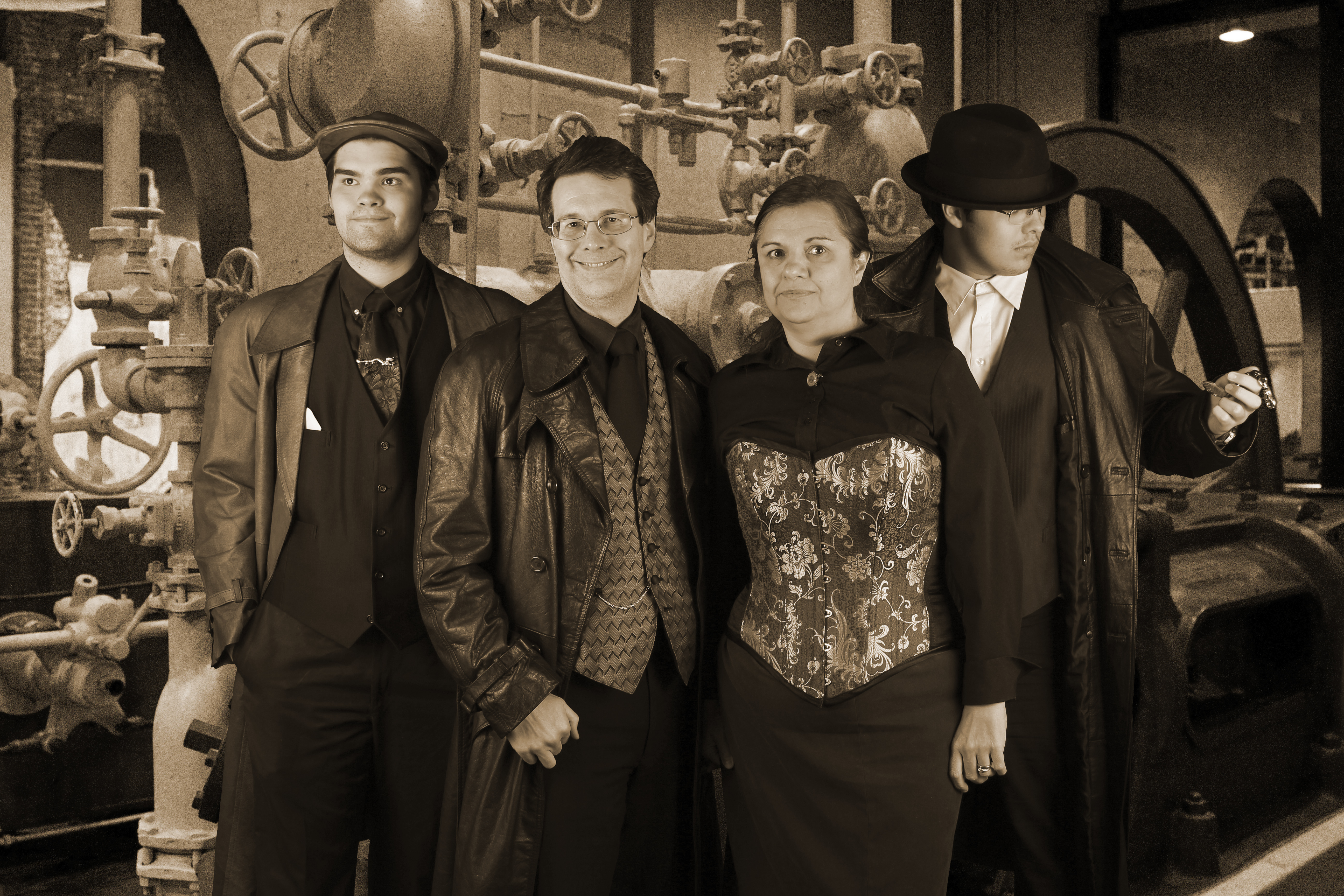
I have also attended a steam punk con. Yeah, that’s what the picture is all about. It was surprisingly fun. First, possibly because I hadn’t dressed up in years. Second because though it took place on a college campus – though, you say? Though, I reply – the attendees were all bright, engaging and interested young people who actually seemed to read for fun. Why is it “though”? Because with notable exceptions, a lot of young sf fandom seems to be more media and games based. My excuse to be there, of course, was having written the Magical British Empire Trilogy. Samples for which are here. It is a chase for the eye of the goddess in a magical land in which the industrial revolution is underfoot in a way you’ve never seen before, and all shape shifters are illegal and subjected to being killed on sight.

And right now I’m working on finishing Darkship Renegades, which is the sequel to Darkship Thieves. Excerpts for Darkship Thieves live here. Darkship Renegades starts this way:

Out Of The Frying Pan

I was a princess from Earth and he was a rogue spaceman from a mythical world. He saved my life three times. I rescued him from a fate worse than death.
We married and lived happily ever after.
Ever after comes with an expiration date these days. We’d been married less than year when Kit got shot in the head.

And if you’re totally at loose ends, let me remind you I give away some short stories and even a collection. If you haven’t tried the short stories, read them or download them here. As for the collection, please visit the Baen Free Library and look for my name. Happy reading.

And now, ladies and gentlemen, and the occasional dragon (thought I wouldn’t see you, lurking there at the back, uh?) have a good weekend. I shall go imbibe massive quantities of caffeine and work.

(The Picture is courtesy http://Fantascenes.net )

* Any Genius contained in this website can only be evaluated subjectively.  Failure to find genius cannot be held against the posters, their legitimately constituted representatives, or their illegitimately conceived charaters.  This concept was test driven by professionals on a closed course.  Your milleage may vary.  Don’t try to be a genius at home.  Death or injury might result.  According to Hoyt and Mad Genius Club shall be held harmless in case of explosion, launch into orbit or transformation into dragon.

Stupid Things I believed When I Started Writing #5

This is perhaps the most stupid thing I believed but it is also the one most beginner writers think it’s the absolute truth. Perhaps not consciously, but at the back of their minds, it’s how they operate.

I used to believe that writing was like those amusement rides that have a stick with “you must be this tall to ride.” I thought there was a bar that said “You must be this good to be published.”

So I worked really hard and I got mad when I wasn’t accepted.

Do I mean that there aren’t any standards, that they accept just about anything. Well, listen here, chum, there are days… But mostly, yeah, they have standards. Mostly you have to be above a certain bar before you can get published.

The difference is this… Just because you clear the bar doesn’t mean you’ll be published. You have to hit the editor on the right day, with the right thing. He/she has to have the right opening for it. Your book might be the most brilliant thing since the lightbulb. It might be the most commercial thing since someone started a lively trade in stone axes. BUT if the editor doesn’t think so, you still won’t sell. And editors are only great gods of perception in their own minds. In the real world they’re human like everyone else. I know. I used to be an editor, for a while, and I didn’t get handed any superpowers.

When you get rejected, the reason could be as trivial as the editor feeling women who wear red dresses are disgusting, and your character wears a red dress in the first scene. Or it could be as complex as their publishing schedule. Or it could be you didn’t make the mark. But it rarely is JUST that last.

Publishing is not an exam. It’s not “pass, you’re in.” Being accepted by publishers means their vote of confidence that you’ll make them money.

How does that make you feel better? It probably doesn’t. Now you know you need craft AND luck, and if you’re like me and started making baby bonnets babies would mutate to have no heads. BUT all the same, it’s good to be aware of how things work. And maybe it will prevent you sending letters to editors saying “How dare you not accept my story? It fits your guidelines and it’s good enough.”

(No, I never sent a letter like that. But I got some when I was a small press editor. A few dozen.)

Writer Purgatory

You Might Be a Writer IF

– The only thing worse than a book going disastrously wrong is a book going extraordinarily well.

Seriously. Darkship Renegade JUST pours out. So what is taking me so long? I keep stopping and trying to find holes.

This was actually explained to me long ago at the Oregon Writers Workshop. When a book is “right” and your voice for it is “right” you feel like you’re not doing any work at all and therefore it must be wrong.

So, now my greatest trouble is to stop rewriting things to death. What they told me (do I know if it’s true? No I don’t) is that when you’re completely in the voice you don’t think you’re employing any techniques or craft. But the reader will still see it, because it’s still there. It’s just you’re so completely immersed and it is so much YOU that you can’t see it. It would be like stopping in the middle of doing something you do everyday like driving and going “wow, I sure drive well. Look how I took that turn.” Or for me going “Fold that omelet, fold it!”

Yet, for a writer like me who always considered herself a creature of craft, not of art or genius this feeling is enough to drive one insane.

You might also be a writer if

– while you’re writing, the character of the next book in the series seems to loom over your shoulder (yes, I KNOW he’s not really there. I’m not gone as far as physical hallucinations) demanding you get done with this thing because his book IS the good one.

Of course the fact that I’m dealing with Lucius Maximilian Dante (by the grace of… well, not Himself above) Good Man Keeva probably makes it worse.

Note to self – do NOT write homicidal b*stards, even when they’re on the good side and it’s a story of redemption.

So, pity me as I go back to work.

Listening to Voices


Lately I’ve become a consumer of audio books. I’ve done this before, years ago, when I was working on getting a house ready for sale. Mind you, I’ve always read while cleaning or cooking, but it’s pretty hard to read while painting, hence the audio books.

The latest spree isn’t painting related (though it could be soon. I mean, all of this house needs painting, but I’m waiting for summer.) I’ve just taken up long walks, and audio books help.

It has also caused some strange shifts in my reading habits, as I’ve discovered that just like reading authors in Portuguese then in English isn’t the same. I don’t know if it’s extraordinary translators or simply ideas more suited to being expressed in one language than the other, but I loved some authors in Portuguese that I can’t read in English and vice-versa.

So, that’s the first:

1- not all my favorite authors translate well to audio books. Though so far I’ve found I’ve got a greater tolerance for books in audio than in reading. Some language issues that bother me in reading sound a lot more plausible in voice. I think that this is because hearing things spoken makes them somehow more real than reading them. Hearing is believing. (In this it might help to know I grew up with radio news, as opposed to TV news, so maybe I’m conditioned to consider spoken things “true” I guess.)

1a) I cannot listen to F. Paul Wilson’s Repairman Jack series, one of my absolutely favorite series, and one of the very few I buy in hardcover. Mind you, I can’t listen to horror, either, but I don’t read horror. Repairman Jack is a thriller with horrific elements. I can read it fine. In fact, when it comes out I usually read it in the evening/night. So why can’t I listen to it? I dream about it. In detail. Graphically.

There is a second find:

2 – I’m more likely to get subtexts in a book listening to it read.

Well, either that or I simply don’t function well while reading and washing dishes, and making sure the book doesn’t fall in the water. But Terry Pratchett, for instance, is infinitely “richer” in audio books.

Third:

3- I’m more likely to catch the voice of the book while listening to it audio. I mean, I’m more likely to start speaking and writing like that book. This means I CANNOT listen to Georgette Heyer while writing space opera. Otherwise, my space people will be going “Handsomely over the bricks, my dear. What can you possibly signify?” OTOH once I caught this mechanism, it makes it easier to stay on voice. I listen to the book with the closest “feel” to what I’m trying to write.

But the fourth and most awesome discovery is that I feel MUCH closer to the writer’s personality when I listen to books than when I read them. I can feel the person, there as it were. And the realization suddenly hits me:

4- I’m listening to the author tell a story. When these are the voices of a dead author – like Heinlein – or even an author who was much younger when he wrote something – like Pratchett’s early work – it feels like the narrator captured a moment in time and brought it to me, still alive an pulsing.

To my mind that’s a form of magic.

So, what are your experiences with audio books? (I don’t ask about movies, because we all know what they do.) Any fun anecdotes? (Oh, yeah, like the time the kids came in and I was – years ago. Got books from library, so had to go with what they had – painting and listening to a Nora Robert’s ahem scene. To this day they talk about me listening to porn.) HOW do you feel about audio books? Are they – to you – a legitimate translation of the story? Or do they feel somehow wrong, and like a completely different thing? And is it just me who reacts differently to the same book, read versus narrated?

*crossposted at Mad Genius Club*

Recognition and Accolades

When I was a very young author, knee high to a short story, I read something in a magazine that gave me a new perspective on the profession. I don’t even remember which magazine or who wrote it, whether an editor, a writer or what. But I do remember the sense of what I read.

It went something like this: We all yearn for recognition for our art. We long to be told we’ve done well when we think we’ve conquered a new challenge, surmounted a new peak of craft, we want that applause, that clap on the back, that “well done, you.”

Rid yourself of that hope now. It will hurt less. Most of the time the writing life resembles nothing so much as a series of kick in the teeth.

I read that and I believed it, and readied myself and put on my mouth guard. Which is a good thing, because for the last fifteen years, it’s got kicked a lot.

If you stay in this job, if you continue improving, it is despite and perhaps sometimes because of those kicks in the teeth – more than the crowd behind you, cheering. You pour out your heart and soul onto the paper, you study new techniques, and if you’re lucky you get back a standard rejection. If you’re not lucky you get back a rejection slip someone spent hours crafting in order to pick just the right wounding phrase. (You think I’m joking. One of these that I got ran to four pages and included the sentence “flipping voices like a cook flipping flap jacks at a greasy spoon.” Which a) is not a phrase that comes naturally to anyone and b) since the book had nothing to do with diners and wasn’t set in the present, was a bit of a stretch.) And after you’re published, the kicks don’t stop. People speculate on your motives when you created your characters, they make broad leaps of reasoning to attribute odd vices to you and – more importantly – if you succeed in hiding all your hard work and make your product smooth and clean, they dismiss you as a ‘light’ read and assume it’s easy to write like that.

Does it get easier to put up with that? No. But you do get used to it. Or you develop ways to cope with it. (Lately I’ve had to change mine, as ice-cream is off my diet.)

The people who only want praise stay forever in their local writers’ groups, or only showing the work to their family and friends. They don’t experience this kind of pain. They can continue telling themselves that they are unsung geniuses. But they’ll never be read by most people.

The rest of us, the ones who want to grow and improve, and most of all, the ones who want to be read by the wider world where try as you might, you can’t avoid some people hating your work, forge on.

But it is not – it is never, unless you grow very old at a position of semi-prominence – a walk in the park. It is not chilled champagne and canapes.

Still sometimes – very rarely – like the sun breaking through clouds, you do get a pat on the back. This happened to me yesterday when I got notification I was a finalist for the Prometheus Award.

It happens to be one of those awards that I dreamed about when I was knee high to a short story.

Of course I’d love to win – though I don’t expect it, considering the competition – but hokey though it sounds, it is an honor just to be nominated.

And now I’ll go sit in that little ray of sunshine and finish Darkship Renegades, shall I?

Loving For Money

Part of my issue when discussing writing or trying to teach people who are just breaking in is explaining to them things change when writing is your job.

At the conference last weekend, for instance, I ran into someone who said if she wasn’t passionate enough about the current book to stay on track, she just abandoned it, and that was okay with her.

Maybe it is. Though how passionate you are about your work, never seems to be a measure of how good it is. There are at least four books where I had my arm twisted into writing them which are, by the numbers, some of my more successful work. (One of them is the only one that paid four-figures of royalties.) It’s more that at the intersection of your writing and your emotional state, that stopped being what you want ot concentrate on.

However, for me, the most daunting issue is all the other stuff I have to do. I rarely go cold on a book – and not on the current ones, for sure, since they WANT to be written – but after the storm, I feel guilty I’m not doing clean up. And then there’s other stuff, like laundry. (There’s always laundry, of course, but let’s say one of the cats got nervous at the wind. On Robert’s bed.) And our yard needs to be rearranged and replanted.

So… how does any writing get done?

Well, I have to get myself (back into) the frame of mind where writing is work. If I had an outside the house job, I couldn’t stay home and not work because of the laundry and the yard. So I can’t stop working for those now.

Weirdly, it’s harder to get myself in the “this is a job” frame of mind because I AM enjoying the current novels. It’s sort of like being paid to hang out on the beach sipping martinis.

But, hey, it’s a dirty job, but someone has to do it. I er… suffer so you don’t have to. And you get to enjoy the fruits of my er… suffering.

Has California fallen into the sea?

Is Denver now waterfront property?  If not, does anyone care to explain the 80 to 90 mph winds around the house, shaking the two upper floors for about three hours in the middle of last night?  No?  No, I can’t either.

What I know is that I’ve lived through cyclones and hurricanes and this was one of the scariest wind events TM I lived thorugh — comparing pretty well to Hurricane Hugo in North Carolina.

Given that, we came through with incredible luck.  As far as we can tell no roof damage and no windows broken.  Branches fell off our trees but none of them on the three cars we had parked outside, or even on the neighbor’s car parked under our tree.  The total damage is a glass “screen” door beaten to pieces, (pieces removed from frame, glass to be replaced as soon as I can make it to store) a small-tree-sized-branch dropped from a tree (inches from neighbor’s car) and a four foot section of our fence.

Branch is cut, bits disposed of, driveway swept clean.  Fence and door to be repaired this week.

And now I’m going to go shower and try to write, feeling the luckiest woman alive.

A Tale Of Two Worlds

Most of us who work by the word know there is a world inside your head and a world outside your head.

Other people might not be aware of this. I don’t know. In case they’re not aware, let me explain: You carry an image of the world inside your head. It might be pretty close to the real world, or it might be wildly different. It is never exactly the same.

The world inside your head is shaped not just by your individual experiences, but by everything you read or saw on tv. Humans are creatures of story. The world outside our eyes is often chaotic and meaningless, but inside our head we assign cause and effect that are – or at least try to be – coherent and causal. When we lose the plot, it’s called schizophrenia or various other kinds of mental illness.

But because the plot threads we pick are influenced by who we are, they’re never exactly the same as others. Needless to say those with inner worlds more closely related to the outer world do better in life, so there would seem to be evolutionary pressure that way.

A lot of what politicians and polemicists do is “sell a plot.”

This works for authors too, but first the author needs to find the outer world. Okay, it’s not every author. I’ve met a remarkable number, even in science fiction and fantasy who have very normal, not to say conventional world views. What doesn’t come directly from their eyes comes from mass media, almost unaltered.

It might surprise people to know that these people do better commercially. They might have tons of fallacies in their work (Dan Brown!) but their fallacies accord with the mass-media-culture and either echo it or extend it in a way most people are sure is plausible.

If I hear one more person say how creative J. K. Rowling is and how strange her idea for a magic school is, I’m going to do something everyone will regret. Harry Potter is an amalgam of ideas and stories that have been out for decades. No, not plagiarism. But school for magic is a cliche in my world. And of course her “setting” and even her plotting was just a new spin on Enid Blyton’s boarding school adventures.

Am I disparaging her? Oh, heck no. The books are enjoyable and at least the first three very well written. She totally deserved her success. But wildly creative she’s not.

The wildly creative ones tend to have odd ball thoughts and beliefs that might be accurate but aren’t perceived as such by the population at large.

I’m talking here of people I mentor. Those who are most creative and most out there, often have no clue how to communicate with the people on the other side of their eyes.

And what you believe and think about a lot influences what interests you enough to write about it. Imagine two intersecting circles. A wanna-be writers inner circle of what he likes to write about might be cabbage growing, sex with penguins, and spaceships. Surely you see the only place this intersects the “normal reader” mind is cabbage growing… er… I mean spaceships.

Often there is no intersection. When I edited a small press magazine, i.e. when I was young and stupid, I often got exquisitely written stories about stuff even the author’s mom couldn’t care about. Worse, often this stuff was so bizarre as to make me want brain bleach.

Techniques for writing can be taught. Changing your mind so you can communicate to the public at large, otoh, is far more difficult. And it’s something a mentor can at best nudge not do.

Some people are so fractured it would take a mental health specialist to manage it.

OTOH there are authors who managed it beautifully. Read For Us The Living and then The Moon Is a Harsh Mistress and you’ll see the process I’m talking about.

Myself, I’ve been working on it, though being myself it’s backward and sideways. It’s more like I have to give myself permission to write about what I really want to write. I only managed it in the last three books. (Daring Finds, to an extent. Think of it as my sillier self and Darkship Thieves.)

But since writing is communication, this is as important as the “right word.”

Out of Ideas

Yeah, I know.  I know you won’t believe me.  But … I just don’t have any more ideas to write.  I sit here and think and think and nothing new occurs to me.  I’ve sent untold self addressed stamped envelopes to Hayes Kansas and they all come back with blank pages inside.  And since I only write Men’s Adventure and YA (but not together) it’s very hard to come up with ideas.

Also, sad to say, but my career as a cat herder pays way better.  I heard that my friend Dave Freer is moving to NYC. In that spirit I’m leaving Dan, sending the kids to the  Wee Tykes orphanage and moving to the wilderness.  I’m thinking outer Mongolia (depends on where I can find a marxist free love lesbian commune that will take me, of course) where I’ll rough it by living in a yurt and subsisting on boiled grass.

I am off to herd cats (or at least heard cats.  Hard not to hear them when they’re rampaging through the house breaking things.)

THAT’s Not Funny!

One of the things that annoys the living daylights out of me are reviewers or even elder writers who think that humor is somehow a lesser form of the fiction writing art. They act as if any fool can write humor.

To an extent they are of course right. Any fool can write humor just like any fool can write tragedy. The thing comes down ultimately not to whether you can write something. Assuming you know how to form letters, have a crayon and some smoothed-out wrapping paper and can stop from drooling on your handy work, you can write anything you very well please. The question is, can one write it a way anyone else will enjoy it? And there, I submit, humor has a lower rate of success than practically any other mode of fiction writing.

I think that – or at least the fact I believe that – is why I came to humor late. In fact, years ago when Mike Resnick invited me to one of the This Is My Funniest collections, my choice was between mildly amusing and very silly, as I had exactly two published short stories that were sort of funny. (Elvis Died For Your Sins was eventually chosen.) I still don’t do much humor in short stories, or at least I haven’t so far. Of course, the Daring Finds mysteries are funny, and almost all my novels have humor in them – dosage varying.

If you’re a beginner go for horror – particularly graphic horror. Why? Because it’s easy. When I’m very tired, that’s where I go. And look, I don’t even read the stuff. I just write it. This is because, in the exact same way a novel is more forgiving than a short story, a horror story is always more forgiving than humor. If the mood gets a little wobbly, you just throw in another awful event, lovingly and detailedly described, and voila, you’re back on track. While in humor if the mood gets off track, you might have trouble getting a smile off your next funny bit – and you might shock the reader by trying to get it.

Also, every novel calls for serious stuff. The lightest and fluffiest of novelistic vol au vents requires some suspense, some anxiety, some struggle. How do you work that in with humor. (Carefully, that’s how!) Get the wrong mix in there and you either have a formless giggle-fest or you lost the funny in the serious.

Worse,  do humor the wrong way and you come across as a smug twit making in jokes that your readers don’t get.

I didn’t realize this until I was trapped (long story) in the reading of a self published author years ago. She was reading what she clearly thought was a very funny passage, and giggling to herself all the time. I honestly don’t know which was more infuriating: the fact that we didn’t know any of these characters so their lines were at best “meh” or that she would stop and explain “you see, that’s funny because she’s his wife.” I think one thing we can all agree on is that if you have to explain a joke, you already lost.

Mind you, I’m well aware that the author was reading from something like chapter 24 and it was the second book of a series. By the time you got there, it’s entirely possibly you’d find this sequence hilarious. Maybe. But the fact that the writer didn’t seem to realize it wouldn’t be funny out of context gave me pause. And it made me realize how difficult humor truly is. Fail to “plant the seeds”, to foreshadow the humor, and what you have are two guys talking to each other about something you don’t understand, and laughing. After a while – though you know it’s silly – you start feeling the joke is on you. That the writer is DELIBERATELY keeping you out of it. And before you know it, you’re mad at the writer and at the book.

I can’t teach you to write humor. You can learn, but it will take some study. Before I could write it, I could make people crack up at parties and dinner, and when I finally started writing it, I used some of the same techniques. I will now share some of these, and hopefully you’ll be able to analyze say Pratchett (who does humor tons better than I do) and figure it out the rest of the way.

So… a few rules.

1- Make either your premiss hilarious and your narration deadpan, or your premiss absolutely straightforward, but the narration or the way the character approaches the problem, totally zany. If you try to do both of them “funny” it won’t improve the effect. On the contrary, it will dilute it. If you write both of them seriously… well…

2 – Make sure the joke is not aimed at anyone. Jokes are like weapons. Even if you know the person doesn’t mean to kill you, you feel vaguely discomfitted as it sways your way. So, try to have your character either make fun of him/herself or have the joke be on the main character. (This is totally a personal preference, but I hate the humiliation humor that Hollywood engages in so often, you know, someone is tricked or cajoled into some premiss that will eventually embarrass him mortally when the big reveal comes. As the premiss piles deception on deception and the character makes more of a fool of himself, I start cringing. So, it is not what I mean by this. More that your character doesn’t take himself/herself TOO seriously. Take Dyce’s continuous assurance that organic food can kill you because it doesn’t have enough preservatives. Of course she knows better, as does the audience. But she’s broke, can’t afford organic, and, let’s face it, much of it tastes like cardboard. So she’s making fun of her situation and the fact she is not able to convince herself to eat the stuff. The same with her pretending the phone conspires against her. She’s mildly exasperated by the fact that she can never find the phone, so she pretends it’s sentient.)

3- Don’t have your characters laugh. This is the corollary of “don’t let your characters cry.” If you build up the emotional pressure and don’t let your characters cry, then the reader does, because someone has to. In the same way, if you build up the insanity and your characters don’t laugh, the reader has to. At the same time, if your characters laugh all the time and the jokes misfire… well… do you remember old sitcoms with laugh tracks? Remember when the jokes were utterly lame, but you still heard people laugh? Remember wanting to punch the tv? (Okay, maybe that was only me. But it still annoyed most people.)

4 – Build on it. Or in other words, foreshadow, foreshadow, foreshadow. I often plant a “thread” of humor in a short story. For instance, in the beginning of A Fatal Stain, it’s like every one can read Dyce’s thoughts. That’s not true, of course, but she starts thinking it, and then every time someone guesses what she was thinking (and which is usually pretty outlandish) it builds on the joke and it gets funnier and funnier. Pratchett is the master of this. For homework, read one of his books – which one doesn’t signify – and analyze every time a funny “thread” pops up and how it was built.

5- Try a little tenderness. Look, this humor thing has changed over the centuries. Dumas could have Porthos be dumb and encouraged his readers to feel superior to and laugh at him. These days, when reading is a more… selective amusement, people don’t want to read about dumb characters and there’s something icky about making fun of a man’s natural limitations. But if instead you make him have issues with words, though very smart in other ways, you can have fun showing his complex thoughts getting short-circuited on the way to the mouth. My best friend as a kid was SEVERELY dyslexic, as opposed to mildly dyslexic as I am, and I watched this process many times. You feel sorry for the person, but it’s still somewhat funny, because you know what they’re thinking and what comes out and how people will react to what comes out.  I don’t often use dyslexic characters, but I do use characters who are flustered, embarrassed or in love. So… try a little tenderness. Show the human side of your funny character. Nobby is Pratchett’s funniest – and most repulsive – character, but he’s not wholly despicable. Yeah, he’s a petty thief, etc, but when the chips are down, he comes through and helps save others. Also, as we learn of his background, we see how he got to be as he is and we feel sympathy towards him. The point is, if we’re going to laugh with someone, it’s easier if we like him.

6- Above all, don’t take yourself too seriously. No matter how funny you get, Pratchett will be funnier. (Kind of like in space opera, no matter how good you get, Heinlein did it better. Also, earlier.  At least for the type of space opera I aspire to doing.) So, figure out the mechanics and enjoy the ride. And then everyone will have fun.