The Flaws In Detail

It occurs to me that when creating characters, most people get in trouble because they heard somewhere they must give their character a flaw and almost randomly decide to throw a flaw in. These “flaws” are almost always either totally out of place, so you end up with a superman who likes to kick puppies, a charity coordinator who likes to drive while drunk (though he never hits anyone) and a starship captain who picks his nose.

And to all this – if not utterly put off – the reader says “Wait, what?”

Sometimes you decide you don’t want your character’s flaws to be merely cosmetic of “something minor” and you get even worse – the great inventor who beats up women for fun, say. And then your reader goes “Ew.”

Stop whining and wringing your hands and saying “but they told me the character couldn’t be perfect.” To begin with the only reason they told you that is because you were Mary Sueing it, weren’t you, having a character who was a reflection of yourself and who could go into your world and fix everything without any effort. Yeah. I knew you were. Here, have my handkerchief. Almost everyone does that to begin with.

The thing is, if you’re not trying to keep your character perfect and if you make sure that he can’t solve things without hardly moving a finger, and if you give him real problems to face, his “flaws” will show, because you’re not perfect, so unless you rig the game, you can’t create perfect.

However, if you still can’t see it, I’ll give you a hint: most of us have the flaws of our virtues and have flaws in proportion to our virtues. Take Athena in Darkship Thieves – she’s brave and strong, it’s what kept her alive. She’s also unreasoningly violent. Or take Heinlein’s Friday (someone was convinced that’s where I got Athena, or that the themes were similar. They weren’t. She had to deal with ‘not being human’ but that was a SHORT part of the book, because for most of it she doesn’t know. Friday does.) Friday is inhumanely perfect. Her flaw is that she knows she’s not human. Take Jarl Ingemar also from Darkships, with whom I’m dealing in the current book (don’t ask.) His virtue is that he’s possibly the greatest genius the world ever created. The flaw is that he regards everyone else as lesser beings even if he tries to fight against it.

Alternately, your characters can have the flaws of their upbringing. Tom, in the Shifters series, was kicked out of the house at sixteen. He knows what it’s like to be lone and friendless so he compulsively rescues strays of various kinds. And if you think that isn’t a flaw, you’ve never done it. Let alone those that will metaphorically bite your hand, you could endanger yourself and those you love by extending charity and help against all rational advice.

Alternately, still, they can have the flaws of their situation, which is often the problem. Say, a character in a Stalinist society will have to engage in double thinking, with all the stains this leaves in the psyche. He might be engaged in a great work – say, revolution – and have to turn someone else in to live just another day.

Anyway – flaws work like that. And then they seem integral to the character and not a sprink from the “flaw shaker” whether the character needs them or not.

Questions? Comments? Rotten oranges?

The Writer Answers

*Somehow when doing this last night, I cut out most of the post both here and at Mad Genius Club, where this is crossposted.  I’m doing it again as a new post, so notifications go up, etc.*

Partly because I wasn’t sure what to write about, and partly because I think we keep trying to do articles on specialized points while there is a vast under-store of ignorance there that we aren’t even scratching, (mostly because today I got yet another nice email from a nice young man asking me to help him get published) I figured I’d ask my fans what I should be answering.

However, a funny thing happened on the way to certainties. I find that in casting my eyes over most of the entries, most of them are things I’d have answered unwaveringly a year or two ago but of whose answer I’m not absolutely sure now. Because ebooks are changing the way business is done, I can give you the “official” – i.e. this is how I did it/would have done it till recently – answer, then the answer I SUSPECT is true now. The caveat for those is please remember I broke in THIRTEEN years ago, and the new realities of the market are not something I’ve experienced first hand. I might know a little more than you, but only because I read blogs and listen to friends. I don’t know for sure.

I’ll use the questioner’s name for the question, then OA for official Answer then BG for Best Guess.

SS:To agent, or not to agent? And, if yes, *how* to agent?
What the heck is a “query”, and how does one go about concocting such a beastie?

OA: You have to have an agent to get published with a big publishing house. I suggest writing a query for your best novel (no one agents short stories). Then ask published writers for recommendations to agents and/or snoop on authors blogs to figure out who their agents are. Read the agents’ descriptions for fit with your work. Before sending queries to your picked ten or so, check preditors and editors to make sure you didn’t pick skunks. Send out. If one replies, then send out whatever they ask for, no more no less. Do not send out proposals or manuscripts to more than one agent at once. Wait for an answer. If the agent offers to represent you, watch very carefully to see how enthusiastic they are. You want an agent who LOVES your work.

A Query is a lot like the blurb in the back of a book, with a difference, you actually tell the agent/editor how it ends.

BG: Someone I respect greatly in the field just said it’s stupid to have an agent these days, that in the current publishing climate an agent gets you nothing. I don’t fully understand her angle unless she’s counting out all of big publishing, but she’s not the first much-more-established-writer than I that I heard it from, and when she says stuff like that, I wonder.

JD: Contracts: What’s fair? What’s a Trap? How far to trust your agent?

OA: At the most basic, contracts should establish that money flows to the writer. Anything requiring you to pay is unacceptable. Beyond that, there are many things that are traps, things that you should be able to figure out with common sense: contracts that get the rights to all your characters, or where you transfer copyright to the publisher. (This might be all right for SOME short stories, like using other people’s characters per invite. NEVER for a novel, unless it’s a media tie-in.) Other clauses to watch for will say things like, you can’t work for anyone else until your story is PUBLISHED. Since you can’t control the date of publication this could tie you up forever. Sometimes they just say you can’t work for anyone else period. Anything like that, run very fast. And if your agent tells you it’s okay, run from agent, too.


CDC: Keeping track of query letter and sent manuscript submissions and responses.

OA: I haven’t done this in very, very long. It’s far more important for short stories, when it climbs into the dozens. But I suggest a spreadsheet program, or else one of many specialized programs available. I’m blanking on names, can someone in the audience help. I’m thinking of Write Again. Not sure if that’s true.

MB:

Alpha readers, beta readers, writing groups, and all that. I just had someone fretting about “losing their ideas” if they participate in a writing group — I told them they were more likely to never find their ideas if they didn’t participate. But… there’s that running fear that somehow talking to people will ruin you, somehow?

OA: You need reality checkers. I’ve covered writing groups in several columns, and the importance of finding a writer group that works for you. If a writer group isn’t doable, at least find two critique partners you can trust and trade manuscripts.

No, you’re not going to have your ideas stolen. And no, no one can change your writing style, or at least not permanently. It is human to influence each other, but life also influences you. To grow you have to change and you don’t live in an hermetically sealed bag.

https://www.facebook.com/profile.php?id=100000928766185SS: In the absence of a co-conspirator with remarkably pointy shoes, how to recognize when one has reached the point of “polishing the cannonball”, as we called it in the Navy, and firing off a submission rather than endlessly re-reading and re-revising …

OA: Ah. I do this too and I went through long years without co-conspirators. It’s hard. My advice is that when you feel like you’re adding more errors than you’re removing (you find the subplot you just added in doesn’t mesh with an earlier one, for instance) or when you feel you’re being particularly clever (no, seriously, this is usually a symptom) or when you go above 200k words, it’s time to let go. Otherwise, establish an arbitrary number of passes, say, five. After five passes it leaves the house. (I can only do three or I kitchen sink it – I throw in EVERYTHING plus the kitchen sink.)

BG: If you’re going to self-publish as is an option this day, hire a trusted copy editor. I don’t care how good you are, you’ll drive yourself insane proofing and stuff will still escape you.

OP: As a former wannabe writer, I’m more interested in the business aspects. They are more relevant to my life. Your opinion of the right mix between paid writing and freebies that hook people in, for example.

OA: in general business “coverage” – I was told that you should quit your day job when you were selling fifty percent of everything you sent out. I’ve been there for years but if I had a day job I wouldn’t quit it. I’d guess right now, with the uncertainty, you’d have to be closer to eighty percent. Also, I would advise something I’m just now implementing: have multiple income streams, say novels and short stories and articles and whatever else you can get. If one of them can be regular pay, like a paid blog, that will give you some security. As for mix between paid and free – the freebies I give away that are fiction are usually already-published things. There’s also blogging and mine for my three base blogs (my own, my group blog and the other group blog) are still mostly free, but I’m starting to branch out into paid blog articles. Look, you need the exposure, it’s all there is to it, but if you find it taking most or even half of your time, you’ll have to cut back. Only you can find your balance.

EM – ebooks. Are ebooks merely paper books transformed to electrons? (like the early TV shows were just televised plays) or is there more potential in this medium? Hyperlinks, embedded video, embed sound effects,…..what else?

BG: I don’t know. I find that a book is a book is a book. Once you put in hyperlinks and embedded video, you’re running the risk of people not coming back to the story. Maybe my opinion is influenced by all those examples I’ve seen of this sucking badly. However, I still think a book is a book. But things that can improve the book while just a book are available in e – like the ability to search for a character name/word. That can really help when you want to go back and check on something.

https://www.facebook.com/sanford.begley SB – How about baby steps for the very beginning writer, such as how to find someone who can say “you’ve got potential” or ” was that suppose to read like bad Twain?”

OA: I find that “potential” or “talent” is one of the worst lies writers buy into. We have a great desire to write and we want to believe it’s somehow meant to be. Look, the only thing I’ve found “natural talent” or “potential” good for is to give you some things “for free.” In my case it’s characters. I understand Dave Freer got plot for free. The rest we had to work for. What most laymen will tell you is that “you have potential” based on LANGUAGE. Language is easy. It’s the story telling that’s difficult. I am telling you now that if you really want to write, and are willing to study how to, including grammar and expression, you have enough talent. How to find critiquers, OTOH is a problem. Ask at your local library if there’s a writers’ group and then screen them for experience, right field, etc. Alternately, grab a few friends you know are readers and make them read your stuff. (Paying in chocolate works!) This has the advantage that you presumably know your friends’ idiosyncracies.

AKD: Years ago, I had an agent who convinced me to write a truly appalling cover letter cum proposal letter (yes, same document). Which was mailed to every publisher in the world, and was rejected. I parted ways with the agent, but I still have great faith in the series that was rejected. However, I can’t even bring myself to do anything with it, because I’m convinced that it was so appallingly presented that my letter is still be laughed about in the publishers’ offices. Should I just kill the whole idea? Change my name?

Okay. Breathe. First of all 99% of the submissions or queries sent in by a low-status agent don’t even get read. I’m assuming this was not an A lister with offices in NYC, so, chances of it having been read at all are zero. Second, even if it was read, if you got back a standard rejection, it was read by an under-editor or an intern. These stay at the houses a maximum of a year, according to my experience. The chances of anyone now at publishing offices knowing or remembering this letter are zero. Honestly, if you’d done slush, you’d realize what it takes to be memorable in the bad category: death threats, live animals, body parts and nude pictures MIGHT do it. A bad query is as unmemorable as a oh, hum face in a crowd. Don’t change your name. Don’t kill the idea. Just send it out again

BG: or, alternately, publish it yourself on Kindle. *At this point, for certain genres this might be a better way to break in.*


RE: not just tell, SHOW it, if he’s a nose picker have him do it in a scene where it’s funny or inappropriate while being given instructions or mission orders and all he can think about (along with the reader) is where to put the booger.

OA: Okay, this was part of a longer ramble on a different suggestion for another post, I know, but I MUST insist RE go on over to my blog and read the post called Ick. This is an example of something memorable to have the character do that… serves no purpose and makes me instantly go “ick” and fling the book away. Unless you’re writing “gross out horror” for which the market is very limited, you can’t get away with having the VILLAIN do this, much less the hero. Remember your character is supposed to be someone we want to spend time with (if only to see him coming to a bad end.) Evil might fascinate. Gross will just make us look away.


The Glamour, The Glitz, The Cat Boxes


I love getting emails from fans that seem to imply that I live in a rarified atmosphere, touched only by genius and inspiration. You know, I’ll get an email that says something like “Pardon me for disturbing you in what I’m sure is the contemplation of your next novel, but I wondered if you’d possibly consider telling me which cons you’re attending this year, so that I might come and bask in your glory.” (Okay, I made up the basking in glory thing. A girl can dream.)

It’s not that I don’t understand how they feel. Reading William Patterson’s biography of Heinlein is interesting — among other things — because of realizing how the writing happened AROUND the man’s life. This is definitely not how I imagined someone like Heinlein writing which is stupid because of course he was just a writer, like the rest of us.

In the same way, my writing happens not only around life challenges – illnesses, extended family issues, house moves, trading of cars – but against the tow of a shallow but strong current: cat boxes, kids’ school projects, cat illnesses, kitchen cleaning, grocery shopping, etc.

In fact, whoever is writing my story has such a perverse sense of humor that the type of letter I quote is bound to happen the day the cat boxes (litter robot, ask for them by name) broke down; D’Artagnan cat informed me of this by peeing on my pillow, so I’ve spent most of the morning cleaning and resetting the boxes, and I’ll come down to find this in my inbox.

But while these are normal challenges in life that anyone can expect – I’m sure those of you who have honest jobs also have to work around life-challenges and cleaning – there are other challenges which exist only for the benefit of people who work at home, and PARTICULARLY writers who are, by and large, people who work at home doing work other people don’t understand or don’t view as work and whose monetary rewards are – for the normal writer – vastly overblown in popular imagination.

It might interest you to know, for instance, that in my rarified, not to mention amazing state, I have cut the acquaintance of several old friends because “I’m too good for them.” Or perhaps even better “I’m too rich to associate with them.” What? You missed the private jet and the bodyguards at the last con? (No, no, the two tall guys in black and sunglasses are my sons. They only guard me because I cook their food.)

Yes, people absolutely believe this. One of them it might possibly be because she’s insane, since for several years we couldn’t get in touch with her due to the fact she’d neglected to give us her new phone number. But in the meantime, before we managed to trace her down again, she saw my book in the store, and therefore she KNOWS this is why we stopped talking to her. Because I’m famous and she’s not. (Actually, given her job, probably more people know her by name and face than know me or most writers. But never mind.)

Another few friends have dropped our acquaintance and one complained to my son (!) because I clearly didn’t want to talk to her and she was beneath me. What brought this about? Well… You see, these people know I work at home, and therefore call whenever the fancy hits them. The calls asking me to go to lunch or something like that are one thing (though less disruptive via email, which, btw, is what other writers use for this type of invite.) HOWEVER the “favorite” calls are the ones where people “just want to talk” or even – and I love this concern, truly – they’re “worried about” my “health” and think I need a break. Because calling me when I’m on the final stretch of a novel and holding all the little pieces in my head that need to be slotted in at JUST the right time is a great way to help me relax and feel better. If I then don’t answer or cut the conversation short a few times, they decide I hate them and don’t want to be friends.

I don’t know if this happens to everyone. I know my male friends seem to be under the impression I can just say “I’m working” and people will cower away into respectful silence. Perhaps it’s a male-female thing. Or perhaps I’m just a wuss.

However, for your edification, this is how my day normally goes. Get up at around six and do email and blog (unless interruptions delay that.) Shower and make sure the guys eat before going to classes and that sort of thing, the later usually while reading the news (You wouldn’t BELIEVE what the world gets up to while I sleep) and pushing enough caffeine to get the brain functional.

Answer email from my friends and get on AIM with my assistant, to see if there are any fires (either personal or professional) that need putting out RIGHT then. (Emailing me late night so I get it in morning, or late afternoon so I get it in evening are best, btw.)

By this time I’m usually awake enough to give a bleary eye to my calendar and make a face. Then I sit at keyboard again, update my status on facebook, start reading the latest work, at least one chapter back to figure out the subtle cues in the text that are never even in the most elaborately written plot outline. At this moment someone comes in or calls. Either my husband forgot something that needs to be dealt with right then, my younger son has late-start and is roaming the upper floor looking for something, or my older son has an important test and – understandably – would like to talk before it. Or vice versa on the sons.

Depending on the interruption – some of these will last till lunch – I then try to resume work. Even if the interruption took only five minutes, it completely popped me out of what I was doing. So I have to return to the beginning.

At this point something random and odd happens. I can’t really tell you every one of them, because they’re usually stupid. Take yesterday’s – PLEASE – when I started getting calls every five minutes. If you’re saying “Don’t answer” well… I didn’t for a while. But it was annoying listening to the phone ring, so I looked at the number and noticed they were all different. Was I being prank-called by the world’s most annoying telemarketers? The next call I grabbed and the person on the other side kept cutting out. It was something like this. “Hello… ick… ock…dook, information…ick…kik…te…pop.” I yelled into phone that he was cutting out and his response was more indignant kik kik kik. Okay… so… I hung up. A few minutes later, phone rings, same phone number, different voice. (Because, yeah, it’s my problem with his VOICE.) “We want some information about the house you have for rent.” “WHAT?” “We want to know about the house you’ve advertised for rent.” “I don’t have a house for rent!” “But there’s a sign in front of it, and your number on Craigslist.” (Yes, I checked the front of the house. It’s been weeks since I looked there. I use the back door and I’m trying to avoid the lawn.) “No, you have the wrong number. I never advertised any house for rent.” Pause and a deeply suspicious “Oh!” Hangup.

Rinse and repeat with the next three callers, at which point someone must have got hold of the guy who put up the add and who clearly transposed digits or whatever. Calls stop. Bliss is relative.

At this point it’s eleven and my assistant – who knows my rhythms – pings me on AIM about an upcoming project, and btw, do I remember I have a short story overdue? No, of course I don’t. I DO remember I have two novels and an article overdue, though.

Get notepad and research books and go downstairs to eat something while trying to get short story which is only vague in my head, to gel. While I’m down there, clean kitchen and try to figure out why we’re plagued with ants and what I can do about them without killing the cats. Put two loads of wash in.

Come back up and write beginning of short. Then write it again because it doesn’t work. Husband gets home, having – somehow – failed to find our son in the usual spot for pickup from school. Two minutes later, kid calls wondering why he’s been standing around for forty minutes and no one has picked him up. (Was he there? Eh. He’s a teen. Who knows.) Get in car and drive out to get him, because my husband is back at work and kid needs to study. Come back home through a starting storm. Make coffee. Talk to older son, who just came in, about the plotting for the vampire story. Remember I haven’t exercised yet (and I have to, every day, or my knee starts hurting.) Go for walk which older son joins in. Under the rain. Fun talk. Get back home and it’s … five pm? How did that happen? Set table, warm leftovers, get everyone to eat. Start dishwasher. Go back up to computer and find I can’t concentrate. Answer emails. Talk with a couple of friends. Update facebook status. Take short story to bed with me and do a very little work on, still not getting it to gel.

Now, yesterday was an unusually bad day. Usually there in the middle, I do get two to three hours uninterrupted writing time. If you’re saying in answer to this that I need an office, you’re absolutely right. However as of now, I don’t make enough for an office. Also frankly what has compensated for the low er… compensation of the work is the fact I can set my own hours – in theory. I hate routine and going to an office nine to five would be interesting for about a week and then drive me murderous.

Again, remember that yesterday was unusually bad, but still, working from home shouldn’t be this difficult. The kids should stay out of the way more. (And an office wouldn’t solve this. They’d just call me on the cell.) But you have to understand that for most of their formative years I was writing but not getting paid. This meant that if they came in I dropped everything to see what they wanted – because of course the kids were more important than a job that didn’t pay and might never do so. This formed some bad habits that I suspect will only fade when they move out and maybe not then.

However, the kids and Dan are in a way entitled to cut up my day. Heck, I’ve been known to call Dan at work because I can’t find something that he should know where it is. It’s the claims of family.

It’s just that normally I get the added joy of friends, distant relatives and total strangers – my favorite was the neighbor who couldn’t believe I didn’t know what car she drove (and therefore just tell her she’d been blocking my driveway for two days instead of calling the police so I could move my car to go grocery shopping) because “you work from home. You see me all the time. You could have knocked at my door” (My office is at the other end of the house, and the times I might have nodded at her on the way to-from her car, while I was taking trash out or feeding the outdoor cat, I was probably deep in plot.) – thinking “well, you’re home, you have time.” Or even “You’re home and you need me to give you a break from your boring, boring job.”

If this sounds like a long, extended griping session, it is that. Yesterday truly was a very frustrating day. But it is also a plea for understanding. If you’re a friend or even a friendly fan, and it seems like I’m ignoring you, chances are I’m just so far behind on work as not to know which end is up anymore. If I promised to read something for you – a very rare occurrence, btw – and keep forgetting it, don’t hesitate to remind me about once a week. You’re not getting to be a bother, it’s just keeping you and your concern from sinking away out of sight.

Understand that the parts of the schedule I try to keep on top of are my writing first (because it has deadlines) and then my family. The rest gets shoved around wherever it fits, and if I keep putting of something or not answering a question, it’s probably gotten lost in the debris between litter box cleaning. I do try to make notes to myself, but nine times out of ten I lose them.

And if you’re an old friend, the chances of my having dropped you because you don’t fit my new, glamorous lifestyle are exactly zero. If I’ve sounded evasive last three times you called, chances are that I was either very late or you coincidentally always call at a bad time. (I used to joke with my friend Rebecca Lickiss about this. Back in the day when we were neither of us paid for writing and both of us had toddlers, we used to call each other and plot over the phone [mostly books. Occasionally, world domination.] She had the ODDEST timing. It never failed, the phone would ring the moment I lifted my toilet lid and was about to sit down. I accused her of having wired her phone into my toilet lid.)

I very much doubt – though who knows – that even if I hit J K Rowling levels of success I’d be cutting out friendships as not “worthy” of me. Writing is something I do, and hopefully something I do well. It’s not something I am. The all too solid flesh must carry on and live in the world in between books. For one, what else would I mine for the absurd events in the refinishing mysteries?

And now excuse me, Euclid cat just threw up next to my desk. I’d best clean it before it dries.
What Dreams May Come

I often have prophetic dreams. Yes, I know what you’re saying, there on the other side of the screen: “ooookay, another crazy writer.” And yet, it’s true. I often dream things that are going to happen, in some way – though the details can be horribly fuzzy or even wrong, the main thrust of the dream will be right.

I’m not going to claim it’s any kind of supernatural – I’d much rather it weren’t, in fact. I prefer to think it is the result of clues too subtle for my conscious mind to process, but clear to my subconscious. The only thing that doesn’t fit in this is when I dream of someone I haven’t heard from in years, and I wake up and the phone rings, and it’s that person. That gives me the idea that the universe is somehow a mechanism where these things are connected in a way we don’t perceive yet and perhaps can’t consciously. I like that too. It makes it a cool science fictional universe. “My friend thought of me, and the butterfly flapped its wings, and…”

Most of my prophetic dreams are about such exciting things as “an old friend will call you.” Or perhaps even MORE exciting things such as “tomorrow, you will see a mushroom on the side of this tree” or even MORE exciting such as “at a future date, you’ll cook steak and your younger kid will REALLY like it.” I mean, they don’t even rise to the “you’ll meet a tall, handsome stranger” level. They tend to be very short for one. You know, if I dreamed of a worldwide war, I’d probably dream the two minutes between waking up and turning on the TV with the sounds in the background either thunder or artillery.

Sometimes they give away a little more. Two of them stand out in memory because they relate to writing. In one I was reading a magazine with my story on it. This took place at an awards banquet. That last was spurious wishful thinking. The story, already written, did in fact sell a week later. (Plaudit Cives) It was my first short story sold.  (Well, first to be published.  By that time I’d sold Thirst four times, but it only saw light of day on the FIFTH.)

Then there are any number of them where I’m signing stories I haven’t written, and then I wake and don’t know what the stories were, so I forget the title.

However, one of them will be of interest to any fan of the Shifters’ series.

I’ve told this at a number of conventions, so you might have heard it. In 03 my first series had finally died and I’d broken up with my third agent. I hadn’t managed to sell any science fiction novels, which some of you know is where my heart and soul is. (No, I’m not saying I don’t like writing mystery and fantasy. If I didn’t I wouldn’t write them. I’m saying I fell in love with SF first and that like any first love this makes it special. Also, IMHO this makes my writing style even in mystery and fantasy “a little science fictional”.) Everywhere I turned, I got told “Fantasy outsells science fiction twenty to one” and I felt I’d never sell sf. Even in short stories my sales record for sf was half what it was for anything else. So… I felt adrift and a little lost. I got the contract to write Plain Jane under a house name, and while that’s easy for me, it wasn’t something I wanted to do a lot of. One book every few years was plenty. I wondered if I’d ever publish anything in fantastic literature again. Heck, I wondered if I’d ever publish under my own name.

And then I dreamed I was at a signing at the Mission Palms in Tempe, Arizona. This might be an incidental detail, since we’d just been there for a World Fantasy. I also dreamed my kids were in college, and grown (which seven years ago they definitely weren’t) and we were congratulating ourselves in getting everyone into the con, because at least one of them had flown from somewhere else I got a feeling in the East. (One is now in pre-med and living at home to cut costs, the other in a highschool-college dual program, also living at home.) At the time the younger was in elementary school.

Anyway, in this dream, I was sitting at the table and this woman came up with a HUGE box of my books. Now at the time I’d published exactly three books, so… OTOH this was a scene I’d often seen, sitting next to Dave Drake or other bestseller friends, so I figured it was filler. Still OTOH (I can haz as many hands as I wantz, thank you!) the dream had THAT feeling which can better be described as: In prophetic dreams I’m my dream self, but also my dreaming self. There’s the one who does and the one who watches.

As the fan started pulling books out of the box and putting them on the table, my dream self said, “Wow, you have everything, even the Shakespeare series.”

And she said “Yeah, I discovered you with your shifter series, and I went and bought everything you ever wrote.”

Now, at this point my dreaming self perked up her ears. I’d never written anything with – I presumed – shape shifters. As the fan enthused about the genius of setting an urban fantasy around a diner, and handed me the book I got a horrible shock. And I mean horrible. If you’ve seen the hard cover of Draw One In The Dark, you’ll understand. (And if you know that when he selected that cover Jim Baen was probably already suffering from the issues that killed him a few weeks later, you’ll understand even better.) And my dream-self said “Oh, good LORD you found one of the horrible cover hardcovers!”

The fan said something like, “Oh, yeah. It was hard, because once the series went bestseller those got even more expensive, but I’d heard you talk about it, and I wanted it.”

At which point my dreaming self went “best seller?” and under the guise of fidgeting while talking to fan, looked the book over thoroughly, noted Baen on the spine, and read first two pages and the back.

Now, I’ll not the series hasn’t gone bestseller – YET – perhaps it never will and that was a spurious detail. OTOH for reasons I have no space or time to explain, it was odd selling it to Baen at all. (For one my agent had other ideas at the time, but her hand got forced by circumstances.) The HORRIBLE cover was a second, bizarre coincidence. As was the fact that the publisher didn’t kill the series after the dismal showing that cover induced. So, maybe it will hit bestseller yet, who knows? It would seem to require a reprint of the first book, but that might change as digital books take over.

Meanwhile the answer for why I wrote the George and Kyrie and Tom and will continue to write them as long as the publisher buys them is “Because they’re dreams, and they need a chance.”

Working For The Beer Money

I grew up in an odd time, in a very odd place. In practicality this means my reading had to suffer through two disparate but essentially the same blights.

When I grew up most of the books considered suitable for a young girl my age (what Regency Romances would consider a young girl of quality) dripped in Catholic and/or quasi-Victorian morality. No story could pass without beating home the “point” of the story. This annoyed me even in stories I otherwise liked. My brief and intense fascination with fairy tales for example led to reading all of the Countess of Segur – however I kept rolling my eyes at her heavy handed morality lessons.

I don’t remember if the Countess of Segur’s books (I wonder if I can now download them somewhere for free?) had that most ridiculous of bits at the end – the clarifying moral – it went something like this “Moral of the story: if you don’t do onto others as you wish it were done onto you, you will come to no good.”

These often caused me to fling books against walls.

And then the Portuguese revolution happened and the ethos of the sixties hit Portugal only one decade later.

Understand, my dears, by then I was so totally hardened against these didactic lessons in my books that it took me about -7 seconds to identify the new morals. Less than that to start spoofing it in the essays that guaranteed me As in school. I’m still rather proud – as far as one can be of a piece on cleaning ladies that I think my teacher slept clutching for several years, she was that fond of it. It was about the poor exploited cleaning lady who had to clean other people’s dirty houses, and how her knees hurt and she was illiterate and… I didn’t mention the fact I actually knew a few cleaning ladies who – in the seventies job crunch – were college graduates. Or that the good ones could clean a house in a couple of hours, clean five houses a day, probably not pay taxes (they were paid in folding money) and lived much better than my family (which I grant you was in deep financial trouble at the time.)

[Still later much too long after this, only least in the last few years, I’ve learned that doing that sort of thing is easy but makes it hard to live with myself. Perhaps it is the onset of middle age, but I’m simply not willing to play that game anymore.]

So, what does that have to do with anything? Well… The thing is those “morals” never left most books. I know why. At least until very recently, if you wanted to even get published, you had to make certain “identifying noises” to let the publishers know you were on their side. This is usually the fashionable/academic side, since that’s what gets identified as “smart” and most editors/publishers are liberal arts graduates.

If you are rolling your eyes at me, try this experiment – go read my book, Darkship Thieves, and have the main character be a male. You’ll never sell it (even if you adjust the romance <G>). No, I’m absolutely serious – I tried. For thirteen years. I got told my main character was a psychopath. If you have an action adventure character with er… marked character flaws, you can sell the character as a she, not as a he. This is by no means the only trope one has to put in. I know for a fact, without being told – I’m a liberal arts graduate, thank you – that if I want to sell the book about the overthrow of a murderous religion, it best be a patriarchal one, not a matriarchal one. The other things are so ingrained, I can’t even list them, but I’ll know if I’m about to break them. (Baen is the exception for this, btw.)

So, what is this in the name of? Well, you know my theory of writing doesn’t include sending messages. For that, there’s western union.

That said, there’s always some message in books. Sometimes it’s dictated by the logic of the books. Sometimes it’s the authors’ own opinions leaking in – we’re human and we write with our lives and experience, so that will come in in world building etc.

Weirdly I don’t resent even messages I violently disagree with if the story is good enough and the development logical.

What I do resent is unoriginality, the lack of any new thought attached to old tropes. (Another thing I resent is establishment darlings preening themselves on talking truth to power – sweeties, if your publisher is one of the big ones, is behind you all the way, and started you off with enough push to have a print run in the tens of thousands, you have my congratulations and a little bit of envy, but you CANNOT have the anti-establishment mantle. Sorry, no.) I hate “boring”. And I resent long breaks in books to explain to me how caring/intelligent/politically correct you are. Oh, please. Tell the story and get out of your own way. If you must put politics/social thought in, do what Heinlein did in the earlier books, and sweep it under the rug or make it part of the story.

As for authors’ opinions OUTSIDE their books – by and large, unless they become a form of literary tourettes that leaks into the novels – I couldn’t care about it one way or another. (If one of my favorite authors doesn’t write for Nation, she should. Which is fine, provided she doesn’t write THAT in her books.) I might (do) make fun of them as I make fun of a lot of other people’s opinions particularly when those border on religion (is it not written “One man’s religion is another man’s belly laugh”? Why, yes it is, by Heinlein, I think.) But then I make fun of everything including myself, because if I don’t laugh I’ll start to cry and no one wants that.

I’ll say as Phillip K. Dick is rumored to have said of Heinlein – and as I say of Phillip K. Dick – I don’t agree with a single thing he’s ever written, but I enjoy his novels. (And sometimes I can even go so far as to say – “I don’t agree with a single thing he’s ever written, or ever thought, but I love him as a person.” – which describes half my friendships.)

It is no secret to anyone that Darkship Thieves is a finalist for the Prometheus award, which is given to books of a certain political bend. I’m not going to say I put ANY political bend in there on purpose, but I’m also not going to apologize if it is there.

I’m only going to say the book is, first of all, a story. If it makes you think about the future, relations between men and women and – eventually, maybe, sort of – politics and economics, good. But I wrote it, as Heinlein said of his books “to entertain.” I’m competing with your beer money and I hope it – and the sequel – will be worth at least a six pack.

(And now I’m going to see if I can find the Countess of Segur’s books online.  Or maybe not.  No work would get done.)

Unrelated Update — Those of you who read Footprints in Your Heart about my fan/friend John aka Saint Basset in my conference being in hospital and needing prayers and thoughts — he’s home and much better, though still ill.  Thank you.

Ick!

Something that comes up with regularity in my critique sessions with my occasional, spatially divergent writers’ group is something we call “the ick factor.” It is also – speaking of slush :) – one of the things that often throws me out of a new author’s work. Often permanently.

To begin with let’s establish a ground from which we can discuss this. You see, it is a misconception to say we work with words. We don’t. That’s sort of like saying a painter is someone who covers canvas with other materials. Words are our base material. Like canvas – and paint, for that matter, they can be used for many things that have nothing whatsoever to do with our job.

You use words to ask someone to marry you, you use words to communicate at work, and you use words to order a pizza. None of which is a novel – though they can be part of a novel – or, probably a short story. (Though asking someone to marry you can be a short, sharp shower of… story. See the first proposal in the Pride and Prejudice mini series for instructions on how to make THAT happen.)

No, what we actually use to construct our stories is emotions. You could describe a short work, like a short story, as a tight presentation of strong emotion which will stimulate the reader to think on the subject/situation you chose to illuminate. (This is not a matter of “sending a message” just that short stories are rather pointless if they don’t leave behind a form of intellectual after taste that causes the reader to think or feel something long after.) A novel on the other hand is a sustained emotional roller coaster which amuses or distracts the reader and which might leave behind one or several impressions and thoughts.

Beginner writers, no matter what age, are very much like beginner artists, who never got to dabble with finger paints. At that stage it is easier to work with strong contrasting colors. Even in pastel, one of my most successful projects was working with three colors only: black, white and ox blood red. If you try to use more subtle tones, when just learning, you have a tendency to shade it finer and finer till the whole thing is an indistinct mess. (I’m stuck in this point.) In fact, you could say that past basic competency the painter’s great struggle is learning contrast so the picture emerges from the canvas as what it’s supposed to be, not just “blobs of somewhat related colors.”

It is the same way for writers, really. One of my more common critiques when reading someone’s beginning work is “it’s pleasant enough, but you don’t have a story. You have a series of incidents.” That is because people are trying to write as life happens, and life has no coherent narrative. Narrative is what we impose on it. In the same way if painters try to paint “true to life” and forget that they’re doing three dimensions in a two-dimensional medium, they end up with “muddle.”

But like beginning painters, most beginning writers, consciously or not, reach for the primary colors: anger, fear, grief, joy, laughter and, yes, ick.

Beginners – not all of them, I started with a novel – tend to start with a short story, because they figure it’s easier to sustain the mood through three or four pages than 200 (this is correct. But it’s also far more difficult to make the mood relevant.) And they reach for the big, big emotions, because those are more relatable to for them, and therefore they imagine they can make them more relatable to the reader. I think this is often why new writers have to be “inspired”. I.e., they have to feel that emotion to be able to write. This is not a reliable way to do it, but then they are beginners and sometimes it works.

However, sometimes they don’t have those emotions on hand, but they still want the readers to feel SOMETHING. One emotion some reach for is humor and if they’re of a natural comedic bend, they can pull it off. (Humor is however much harder to sell. First because of fact that not all senses of humor are alike and the gap is harder to bridge than in other emotions. You could say everyone cries the same way but everyone laughs differently. But more importantly, I suspect my friend Kate Paulk is correct and most of the entertainment field has been taken over at the managerial/promotional level by minor demons and, as Umberto Eco taught us, the devil does not laugh.)

The other common emotion that newbies reach for, and which is much more universal than humor is … disgust. We all have basic ick factors: excrement and bodily functions; rotting flesh; gross (I mean that literally) anatomy. To paraphrase Pratchett, we all know there are green wobbly bits in there somewhere and none of us, frankly, wants to think about them too much.

Disgust, if combined with another driver, can be a powerful way to pull a reader into a story. For a combination of “Oh, my G-d, I don’t want to look but I can’t look away” consider my friend Larry Correia’s Monster Hunter International. The beginning hit my ick factor so often that I’d have flung it across the room – except that at the same time he was dragging me along way too fast on the pace of the book and the question of whether his character would survive. It’s a beginning like a punch in the gut. You want to step away, but you can’t, and by the time you realize the guy survived you’re bonded to him for good and will stay with him come hell or high water for however many books.

So, it’s not like I don’t understand the temptation. I do. But I almost feel like Larry should have little stickers on the beginning of that book saying something like “this experiment was carried on by an expert. Don’t try this at home.”

The more average use of disgust is to have a oh, hum story where someone is being showered in a long, blunt shower of sh*t – literally. Or a story in which the big point is that ah ah “They’re zombies. They’re rotting. They smell.” Um… mkay. But if you actually succeed in making the reader feel disgust in those circumstances and if the audience you’re writing for is not into – Thanks again, Kate – what Kate Paulk calls “the meaty skull with reptiles” type of art, then… well… you’re going to make the reader ill and the book will get thrown against the wall.

Keeping the reader horrified but reading on involves being at the level of expertise where you at least know a hook when it bites you in the nose. Preferably you’re at the point where you perfectly balance ick and pull, because that’s irresistible. If you must have too much of one, have too much of the hook, because everyone’s ick factor is different and if yours is set high, you’ll lose more than half the readers.

Take the beginning of a novel by a talented but utterly clueless beginner that I read in the last month. We have rather standard fantasy tropes, but murkily discussed in a way that really doesn’t make it very clear what the world is and/or what exactly is happening or why the characters are doing what they are.

There are several mistakes in there already, of course, but the wordage is pleasant enough and you go along on the principle that “this can be edited into sharpness.”

Except that on page three you hit one of those icks, relating to “things that one shouldn’t visualize ANYONE eating.” If you manage to swallow hastily and go past it, three pages later the author starts throwing excrement-related humor all over the page and the book goes against the wall. Hard.

Now, I know the psychological mechanism behind this train wreck. The author knows, at some level that the story doesn’t grab enough. Probably because the author knows that both world and characters are so imprecise and hazy as to be a muddle (or as my painting teach called it “mud”) on the canvas. There’s nothing there to grab the reader. And so instinctively and – trust me – blindly the author reaches for the things that evoke a reaction in the author because… (Duh! #winning!) they can’t fail to do so in the reader.

And the author is absolutely right. It evokes a reaction. You gag, you go “ew” and throw it against the wall.

Now you can’t make a coherent book without the big emotions. Well, at least if you’re not trying for literary post modernist. And no matter what you’re using, some people will be “icked” by it. But don’t rely on the big emotions – PARTICULARLY DISGUST – to carry you through. Think of them as garlic. Some people like a lot of garlic, some people like a little, but if all you can taste in your dish is garlic only a very small percentage of people will read it.

And if the other emotions are garlic, the ick factor is three-alarm pepper. While some people want to have their mouth set on fire and most people can tolerate a pinch of the stuff, your greatest audience will be somewhere between. The more you shovel it in, and the fewer other appeals the story has, the more audience you’ll lose.

The ick factor is not a cure all for insufficient skills in fact it should be locked in your tool box until you are competent with the other tools.

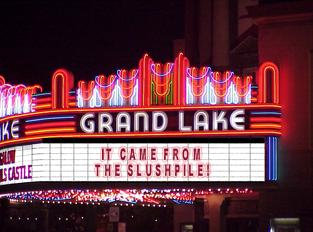
It Came From The Slush Pile

I’ve beat up on editors for unprofessional behavior towards writers, and I’ve beat up on writers for being wussies about rejections. Today, girls and boys, dragons and butterflies, we’re going to look into everyone’s favorite punching bag… The slush pile.

Or rather, we’re not just going to look into the slush pile. We’re going to look into beginning writers and why they really, really – really, really, really – need a second opinion. And not just from their dog or girlfriend. Particularly in these days when anyone can just throw their work on Amazon or self-publish for nothing. Because you run a risk of making a really big – not to say huge – mistake if you do it without vetting.

There is a peculiar arrogance to a beginner writer, a particular certainty that their work is the best thing since sliced bread, peanut butter and the invention of the rotto tiller – the sort of brass faced “read me, I’m wonderful” that nine times out of ten means this person can barely string a sentence together, has half a dozen words in the first paragraph that don’t mean what he thinks they mean, and is either playing with a world/idea that has been done to the point of nausea or most of the world is still in their heads and what’s on the page is a disjointed mess.

Conversely, the beginner writer who slips their work at me reluctantly and only after I asked to see it is, nine times out of ten either already publishable or very close to it.

I thought this was a peculiar curse of publishing, which makes the current system – dependent on self-confidence and self promoting – a peculiarly counterproductive one. But it turns out it’s actually the curse of any task whose completion doesn’t show immediate and concrete results, at least according to this article: http://www.damninteresting.com/unskilled-and-unaware-of-it

For those of you unwilling to click through, the idea behind that article – which is research supported – is that the less skilled you are at a task susceptible of personal evaluation (i.e., not whether you mowed the lawn or not) the more likely you are to think you are extremely competent at it.

The thesis is that until you gain basic competence you don’t see your own errors. I have to say I have found this to be true for myself at any variety of crafts (from crochet to embroidery) as well as at art and writing. It is not till I learn SOMETHING about the tasks that I start seeing all the errors I made in the early projects that, when I did them, seemed perfect.

Apparently this correlates to the four stages of competence theory, which can be summarized as follows, in progression:

1- Unconscious Incompetence

The individual does not understand or know how to do something and does not necessarily recognize the deficit.

2 – Conscious Incompetence

Though the individual does not understand or know how to do something, he or she does recognize the deficit.

3 – Conscious Competence

The individual understands or knows how to do something. However, demonstrating the skill or knowledge requires concentration.

4 – Unconscious Competence

The individual has had so much practice with a skill that it has become “second nature” and can be performed easily. He or she may be able to teach it to others, depending upon how and when it was learned.

These four stages correlate completely not only with my writing, or my progression in art – where I am, at best, in stage 2 – but with such tasks as fine-chopping an onion without either cutting myself or being excruciatingly slow.

Unfortunately confidence seems to move in inverse progression through the set. People in the stage of unconscious competence, often assume that they’re not very good at all because they still see how much further they have to go. This unfortunately means that if you get to stage four without showing your work to anyone, you’re not going to have the courage after that.

It also means that slush piles might drive most if not all editors insane. I’ve read some of these and the sheer volume of unadulterated, imaginably bad… Raw sewage that hits those is almost unbelievable. A lot of it is literally incomprehensible. And then there’s any number that’s just understandable enough to be repulsive.

Oh, come on, Sarah, you’re saying. Surely writing doesn’t fall to incompetent-but-unaware. I mean, people have been reading their whole lives, so they know what makes a book/story.

Uh… yeah, theoretically. But the problem is when it’s your book/story you have to be playing chess on both sides – to learn to be both the writer and the reader, and not to read into your stuff more (or sometimes – ick, trust me – less) than you put in. Until you get there you’re often unconscious incompetent. Very, very incompetent.

Unfortunately this is also, often, the bane of writers groups, because there is an effect associated with that. As you’re going through the stages (as the first article mentions) you’re not capable of evaluating anyone who is above you. This means unconscious incompetent will rate down conscious competent who will accept it because he/she underrates him/herself. This is one of the reasons I’m STRONGLY against anonymous or semi-anonymous, large online critique groups: after a while a certain tyranny of hte unconscious incompetent rules and destroys anyone who might have had a shot. Writers groups should be small and personal and you should be able to evaluate the person’s opinions in relation to where the person is on the writing journey.

And then you won’t risk letting your little monster into the wild, trailing excess adjectives, incoherent sentences and unresolved plots and making half of the readers scream “Oh, no, it came from the slush pile!”

Do you see yourself in those stages at all, or is it just me? Do you see the stages in others? How do you think this affects self-promotion ability? And do you have any slush horror stories to share? (I brought some slush-tentacles, if pressed to share mine.)

*Crossposted at Mad Genius Club*

Learning To Dance

Years ago when I met Jerry Pournelle, I got him talking – I know this will shock all of my faithful readers – about Heinlein. He mentioned I live in the town where Heinlein lived for a long time. I knew that. I’d even ferreted out the true address, because the one in Grumbles From The Grave is wrong.

In fact, the house has been up for sale twice, but the price grazing the half million is much too rich for our blood. The house is near the Broadmoor, in one of the most exclusive neighborhoods in town. I don’t think I’m giving too much away and at least the last owners had grown resigned to leading people through the house on impromptu tours. (I think they took down the distinctive number pictured in Grumbles, though, which is how I found it, one happy Spring morning, while driving the preschooler and the toddler to the zoo. (And I regret to report it my dears, but I made a total and absolute fool of myself, getting out of the car and standing on the road, touching the mailbox and crying. Yeah, okay, I’m a deranged fan as well as a writer. Though I’m happy to say I’m way too shy to EVER be a stalker. Also to stalk most of the people I’m that nutty on I’d need a time-travel machine or a ouija board.)

I confess I’d never thought very deeply about the location of the house, or its cost. I knew, having read Grumbles, that it had been built from scratch to their specifications, and since it was nigh to the only five star resort hotel in town, I assumed it was expensive even when built. I mean, the EARLIEST I remember being aware of such a thing as advances or how writers got paid (I think before that I had a nebulous idea writers were employees, hired by a company and put on salary to turn out x number of books a year – which, btw, might NOT be a bad model, if they’re going to be as bad as they are at tracking sales. Some of us would probably take write for hire for a book a year for a minimum of x and x years, provided we could write our own stuff on the side. Some of us have kids and obligations. More on this later.) was a notice in a Portuguese paper that Heinlein had got eight million dollars advance for Friday. So… expensive resort hotel… about right.

But Jerry said part of the reason they bought where they did was that the housing/land/living was cheap in Colorado Springs at the time. You see, the money didn’t come until much later than that. Until then they lived from book to book. They made do…

This is a continuous discussion at every con. The older writers complain about how bourgeois we’ve all become, and in fact there is something to be said about that, except I’m writing that article – hopefully – for publication. Meanwhile the truth is more than bourgeois, we’ve gotten older. People rarely break into the field in their twenties, anymore, or if they do they’re treated as darlings and have no worries. I’m one o the younger sf/f writers at any gathering, and I can see fifty nearing at speed. At our age we have families and obligations and we’re starting to think in terms of “how am I going to live in old age.”

I don’t know anyone under fifty who expects social security to pay them much, if anything at all. I view that money as being poured down a hole. If you think you’ll see a dime from it, you’re a far more hopeful person than I. It’s demographics. There is no lock box. There is no fund. There is a new generation paying for the older. Which works great if the new generation is bigger than the retiring one. AND all of them are employed and… Uh… you see the issue right? (Don’t blame me, I tried to have eleven children.) The way the market as been, both for me as a writer – yeah, I broke in in the quarter of 9/11 – and for my husband in tech, we have some money set by, in retirement funds we can’t touch, which would see us… through a year, I think. IF we’re extremely lucky.

Suffice it to say neither of us expects to retire. I intend to work as long as I can work, at writing, if writing will continue paying (something that as of now is up in the air, but being very stubborn and a battler I have hopes of figuring out a way) after the upheavals publishing is going through. At something else, if I have to. I can refinish furniture. I’m a decent seamstress. If all else fails I can teach and tutor in languages.

Dan, likewise, intends to die with his hands on the keyboard. How is somewhat of a puzzle too, since most companies these days actively discriminate against you once you hit fifty. (Yeah, I think it’s against the law too, but there’s always ways.) However we’ll figure it out.

But this type of life requires minimizing your living expenses, paying off the house, keeping things as cheap as possible.

And sometimes I feel guilty for having taken this path at all. You see, when we were twenty (it was just yesterday, I swear) it seemed so simple. I was going to write until I had a bestseller, which would happen with my first book (more on the lack of understanding of your own incompetence when you start out later) of course, and then I’d support Dan while he got his music going. Sometimes I think I should have gone back to school and gotten my AMERICAN teaching certificate, so that we’d have been a two income family all along. (I have a Portuguese teaching certificate but I wasn’t even allowed to take certification exams in the states. My diploma, from one of the oldest universities in Europe wasn’t accepted because the bureaucracy had never heard of it.)

But then I look at our friends who did what my husband arguably did, to keep a roof over our heads. They traded in their artistic dreams, their dreams of success at the thing they loved best for a steady income… Which for my generation hasn’t been all that steady.

Dan’s career in tech through the tech bubble and the turmoil of contracting has hardly been a sinecure.

With all that – lest I seem to be whining – we’re probably in better shape than 80% of our generation. Even if we’re eating into our savings at a prodigious rate.

What is this all about, you ask? Well… Yesterday I was talking to my older son who is in pre-med and we were discussing the uncertainties attending their future, and it occurred to me, truly, that there is no safe option. In the years of accelerating technological change we’re facing, there is no career you can enter and be safe forever and ever.

Everywhere I turn, even my dentist, talks about tech that will end his job as he knows it.

So what is my advice to you bright hopefuls setting out on the glory road of writing?

1- If that’s what you really want to do and are willing to starve for it, do it. Trading in on a “real” career won’t keep you any safer. (A caveat is since I don’t approve of living off other people, be they your parents or the taxpayers, get a part time job to support your writing habit. But treat it as a way to support your writing habit, not as a career. There is a difference.)

2 – Don’t expect a bestseller right away. I know, the world cowers before your brilliance. Or at least your cat and your boyfriend cower before your brilliance, which is why, my dear, we’ve told you to stop using soap with glitter in it. BUT weirdly and more than ever now, brilliance alone isn’t enough. Luck and above all persistence come in. Be prepared to be persistent. What this means in practical terms is that you MIGHT need that part time job and a place to live other than mom and dad’s basement. Beware you might be in your late thirties by the time you even break in. This seems to be the median age for breaking in now. (Though that might change with digital self-publishing.)

3 – Once you made the decision, keep on keeping on. I wasted ten years, writing a novel then going back to work full time, then writing another novel, ensuring both my skills and knowledge of the field grew VERY slowly.

4- Through realities out of our control – demographics; the pace of technological change; other factors that would be posts in themselves – most of us now under fifty will spend the rest of our lives in times of high uncertainty, aka “interesting times.” So there is no safe place to hide. In publishing or anywhere else, you’re going to fall on your face very often. The question is “how fast can you get up?”

Over my computer I have to signs pinned. One says “Success is how high you bounce when you hit the bottom.” (General George S. Patton.) It went up in 2003, when the failure of my first series seemed to ensure I’d never again be published. The second went up a few years later, when I lived in fear of trying new genres and new styles because… what would people think of me? And what if I failed. But then I realized I’d already failed once by playing it as safe as I could. And I saw other people failing around me all the time, for the same reason. That sign says “If you must walk on thin ice, you might as well learn to dance.”

All publishing is FOREVER thin ice. It was when Heinlein was publishing. It is now. Like all the arts it will probably always be. The other professions are just moving towards us.

So, as you stand there, on your thin ice and take a little experimental step, think on this:

5 – One day you will die, as every human will. Maybe you’re lucky. Maybe death will come suddenly, with no time for regrets or second thoughts. Most people are not that lucky these days, though. There are sometimes years of laying in bed, unable to do much but think over the past.

In that final and terrible time, what will weigh most on you? That you never had a corporate career? Never took expensive vacations? Never got to be a great: doctor, engineer, salesman, cook? If any of these is true, go and pursue those. If you love anything more than writing, go in peace – and whistle as you go, you’re a free person.

But if you’re going to lay there, on your death bed, regretting the worlds and characters that will die with you, unknown to the rest of humanity, come back here and sit down, you’re my brother or my sister even if I never met you. Arrange your life so you can live while creating. And set your nose to the grindstone.