The Last, Forlorn Hope

Today I’m going out – on the forlorn last hope of an office-ish. It’s too complex to explain, but if this works, I’ll have an office three/four times a week. We’ll see, right?

Unfortunately for this to work, I must go in with my husband, this morning, on his schedule, and frankly I’m not awake enough to write a coherent post yet. So you’ll have to make do with an incoherent one…

It occurred to me after people started babbling that that dream would actually fit in rather well in the novel Witchfinder, only the devices wouldn’t exactly be i-pads.

Go read this: http://kriswrites.com/2011/06/29/the-business-rusch-you-are-not-alone/

She didn’t have my input on that conversation, but I’ve had it at least three times in the last two years. Reading it, I realized that I – indeed – wasn’t alone. And that maybe it’s not my fault.

What she says near the end, though, about being able to think and write what you want: I’ve been slowly making that transition for the last three years, realizing that if the publishers won’t take it, I can publish it myself. It’s very freeing.

Yes, I’m worried sick about the traditional part of my career, but on the other hand…

This is hard to explain but three years ago I was living in a pit of black despair. I’d have an idea and be all hot on it, and want to write it NOW. Send it out. Take a year or a year and a half till it was due at the publishers. (I sold ALMOST everything, but…) So I was continuously writing things that I was forced to write THAT month, not necessarily things I wanted to write that month. And the hot new ideas cooled in proposal form and…

I know it sounds like whining, but after book, after book, after book written under forced deadline at a time when my head wasn’t in that series, it felt like aversion therapy. Which is why I took the last year off and wrote Sword and Blood, which is completely different from everything I wrote before (or since.)

That seemed to fix the horrors, and now I enjoy writing again. If I can stop worrying about the traditional part of my career and money, maybe I can even finally finish Darkship Renegades and send it to Toni, then finish the other almost-done space opera and ditto, and meanwhile start the subscription thing.  And then write all the things I set aside because agents/editors were less than enthusiastic about them — or at least write those that are still alive and clammoring.  (Witchfinder is one of those.)

Speaking of the subscription thing – any shorts you people would particularly like to see? I’ll put them in the idea-archive.

And now, I’m going to see a man about an office.

I’m At Almack’s Tweeting On My iphone

I’ve known for some time that I’m a sort of snob. Sorry kids. No, I don’t particularly like it either. I like to think of myself as one of the people and common as muck.

And I’ll grant you, I don’t stand on ceremony for pretty much anything; I don’t believe birth or money or credentials grant you any sort of superiority (note I said credentials, not knowledge or experience); I have no clue of how to do what my mom used to call “give yourself to your respect” which I think meant acting like I was very important and people should bow to me; I can enjoy a greasy spoon as well as a gourmet restaurant (if each is good of its kind.) I have friends of all classes and most occupations (okay, I use them for sources. Sue me.) I was the devoted apprentice of my carpenter grandfathers. No handyman comes to the house without my standing around looking at how they do it, and talking with them – and yeah, I can talk to them and make them feel like they have special knowledge (which they do) and I don’t, so they’re worthy of my respect. (Yes, I also get info out of them for books. Sue me.) And most of the time, I wear jeans and t-shirts and don’t even insist on jeans of any particular make.

But I’ve confronted the fact that I’m a snob when it comes to entertainment LONG ago. I think about ten years ago, when we first had money to buy movies, and I got, let’s see, the Jane Austen mini series, the whole series of brother Cadfael mysteries and a lot of documentaries. It’s not that I don’t enjoy other, more popular movies, but what I WANTED was that. Most of the music I buy is classical. Most of the books I buy are non-fiction historical.

It’s not that I LOOK for refined entertainment, it’s that in whatever venue I enter, I immediately become one of those annoying purists. It’s like it’s in the DNA or something.

Take when I joined Austen fandom. Within weeks, I was sure that all these contemporary retellings of P &P were just wrong, and I was mentally crossing off authors who were blatantly a-historical in the historical mode. And all the time feeling guilty, because it meant I was a snob.

I’m the sort of person who, if she became a graffiti artist, would immediately intuit the “classical” form of the genre and be able to speak, nose in air, about how these young taggers just aren’t doing it right.

It’s a curse, I tell you, particularly when, for reasons of being very busy, very tired and very out of it, I’ve been chain-reading regencies. Why?

Well, most regencies are not that bad, truly. I mean, yeah, they have people behave in a more modern manner than they should, but most of the time they do “explain” it. They have a girl who was an only daughter and whose father treated her as a boy, so she reads more “modern” to us. Or they have people who are “enlightened” due to events in their lives. But they stay KIND OF within the parameters of the time. Some more than others. Heyer was, of course, the master at bridging then with now without making then seem alien, but it’s hard for mere humans to replicate the feats of genius.

But every once in a while, you come across a regency where, other than wearing period clothes (and most of the time not much of them) not only the main characters but EVERYONE behaves as though they were TRULY moderns.

When a girl in the regency told her father she’d sleep with whomever she wanted, and she doesn’t intend to ever get married, because she’ll get a job and support herself or when the prince regent makes a young woman post mistress of England, you KNOW – you KNOW – that there is a strong disturbance in the force.

I put those books aside very quickly, but apparently my inner snob disapproves and decides to punish me.

Last night I dreamed I was at Almack’s, the assembly rooms par excellence of regency England. Everyone was in period garb and being very proper. And then a row of debutantes up against the wall, took out their iphones and started tweeting….

I wake up screaming.

Cover Her Face, Mine Eyes Dazzle*

Recently, through a series of unconnected incidents, including discussing the cover for my upcoming Sword And Blood (as Sarah Marques, from Prime Books) I became aware that not only are covers still important, but what’s a “good cover” has changed dramatically over the last few years.

Or perhaps it isn’t a good cover that has changed but my perception of a good cover.

When I first sold my Shakespeare Fantasies, my idea for the cover was that it would show a young Shakespeare meeting a lady in the forest. It might have done well. Instead I got what many small presses are resorting to these days: out of copyright art from Sandis, utterly nondescript, even if gorgeous.

This probably would have been salvageable, if the cover said ANYTHING about “fantasy” or even “Fiction.” But it didn’t. Rumor has it that it was supposed to have the big marketing plan that is limited if one restricts the audience to “those who read fantasy.” Anyway, speaking of slips betwix the cup and the lip, that got lost… somehow. So what bookstores were faced with was this book called Ill Met By Moonlight (Until M. Lackey reused the title, the only book by that name was a WWII non fiction, btw) with a classical painting on the cover.

Children, that book got shelved EVERYWHERE except… where it was meant to be. From Art to Shakespeare Biography to Theater, the book went everywhere… and no one could find it.

This was when I learned that a cover was not just a piece of art to put on the outside of the book and make it pretty – it wasn’t even, at any level – an attempt to represent what was in the book. Rather, it worked like those drawings on the outside of packages to grab the attention of the distracted shopper. (Those can misfire too. Once in Germany I spent my precious last money on a container of lard, thinking it was ice-cream. Yeah, I knew German – two years – but not enough. I saw the word “creamy” and the drawing looked like ice-cream.)

If you’re selling, say, crackers… do you have a drawing of a beautiful, laughing baby? Why? You might have that in teething biscuits, mind, but it best have a large biscuit superimposed. Trust me, as an often distracted shopper, I often grab the wrong thing because I forget to read. However, even if the best thing about your teething biscuits are oat flakes, do you have a drawing of a bowl of oatmeal too? Well… no, that would confuse people. Particularly if it’s the only thing you have.

For books this is even more tricky. You have to look at it, pretend it’s not yours and analyze what it says. The cover from Prime, on first iteration, had a sword with a big polished shield behind, ghostly wings coming out of the shield, and a chain around the top. There was also some dark stuff that might be lace, but what I got was the type of cover that should grace a title called “the Sword of the Conqueror.” With Sword in the title, nine out of ten people would look at it and go “military fantasy” or “historical military” and never even notice the black lace. After I talked to the editor, it came back with a heart where the shield had been, which signals “romantic fantasy” and perhaps even “vampire”. I hope. The black lace seems more obvious and serves notice the book has… not exactly uncomplicated sex within its pages.

I will tell you in all earnestness, though, even two years ago, I’d have been appalled at the cover. It’s too simple, too Symbol filled, with too few human figures. But now we’re in an age of ebooks, and in a thumbnail, the sword, the heart and the chains will be very visible, and perhaps lead people to click on it, which will then reveal the wings and the lace. I think it will work.

Frankly, even the debacle that was my Shakespeare series didn’t fully open my eyes — the second book shows a woman in historical costume wandering the streets of London carrying a lantern. Very pretty. However, there’s not even a flying fairy to give the idea that this is not an historical romance. And btw, in the book, they used mage lights, which might have served as more of a warning. The third does have centaurs – in the distance. So tiny you could barely see them. Behind the large woman, holding a lantern.

Note that NONE of these said “this is fantasy with fairies and Shakespeare. You’d think it would be easy, right? Have the iconic Shakespeare image somewhere, even if you prettify him and youngify him. Have an elf or a fairy, or something. Nope.

Strangely, the people who bought the book, unless they’d read a review, weren’t looking for fantasy or Shakespeare. It took years for word of mouth to get started, and by then the book was out of print, and I was getting no royalties, though for a while (until two years ago) boxes of the book were apparently discovered in the publisher’s warehouses and thrown into circulation. (Yeah.)

Fast forward to my first book with Baen. I don’t know what Jim was thinking, except that he was very ill at the time, which is the only possible excuse fo the cover of Draw One In The Dark – the hard cover cover – which managed to go one better on the first Shakespeare cover. Not only didn’t it have almost anything to do with the book, but it signaled all wrong as to genre and style and, oh, yeah, it was repulsive to look at.

Children, while a pretty cover won’t sell a book, a horrible-looking cover, no matter if it is accurate, won’t sell your books. (The exception will be some zombie anthologies.) I mean, if you wouldn’t want to be in the same room with that picture on the wall… it’s not a good cover. It has to draw the reader forth.

The cover has been described as “A zombie with an udder fetish.” For reasons semi explicable, he stands in front of a castle. For reasons even less explicable, the castle is called The Athens. The only element that rings true are the dragons behind the castle… but they are… uh… strange looking.

In the context of the castle, the dragons and the zombie, what you think is “uh… historical fantasy with dragons. VERY dark fantasy. Possibly set in Athens.” Actually, the story is light urban fantasy with shape shifters set in a diner.

Because the book cover is executed at middle-school skill, you will also – probably – assume it’s a YA. A… uh… horror YA.

I was VERY happy when the cover was changed for the paperback, and I’m still grateful to Toni for changing it. She got me Tom Kidd, an artist I love, too. The cover shows a city street and a Chinese dragon. It’s not quite… I mean, it still looks dark and all. But it is a nice cover as opposed to a “Good gracious, what’s that?”

For the sequel, Gentleman Takes A chance, the cover shows the diner on which the plot centers, and on the roof of it a dragon, a panther and a lion. It looks nice and inviting.

Being a writer, I just thought “well, they’re both scenes from the book.” And “Nice.” And it didn’t hit me that the covers weren’t doing their job until I was at a convention with Ilona Gordon, (half of Ilona Andrews) and we were signing at the same table. She picked up my books and said “What are they?” I said “Urban fantasy” and she said “I’d never have guessed.” And proceeded to instruct me on urban fantasy covers. They always have a hot girl or sometimes a hot guy, with a tattoo or a weapon or a hint of danger. Yes, it gets monotonous, but in the quick-signage game it works like a dream. People who like urban fantasy will pick it up immediately, and give it a chance.

(BTW, my instincts were right even if I knew nothing, because what I wanted for the first cover was something that resembled Tattoo by Boris Valejo and for the second, I had the vague idea of a woman in a short skirt, leaning against a lamppost in noir style, while a saber tooth jumps at her. Ah, well, maybe for the third book. And no, I don’t blame Toni for the mis-signaling on the covers. I didn’t know any better, and I DO read UF, which Baen isn’t known for – well, okay, not traditional UF.)

My Magical British Empire series, again lovely covers. But except for the details (a ship flying in, a flying building and a dragon) they could be travelogues, rather than historic fantasy with a hint of steampunk (i.e. magical machinery is big in the stories.) What could they have done to show that? I don’t know. I’m not a cover artist. Perhaps put goggles on the dragon? (G)

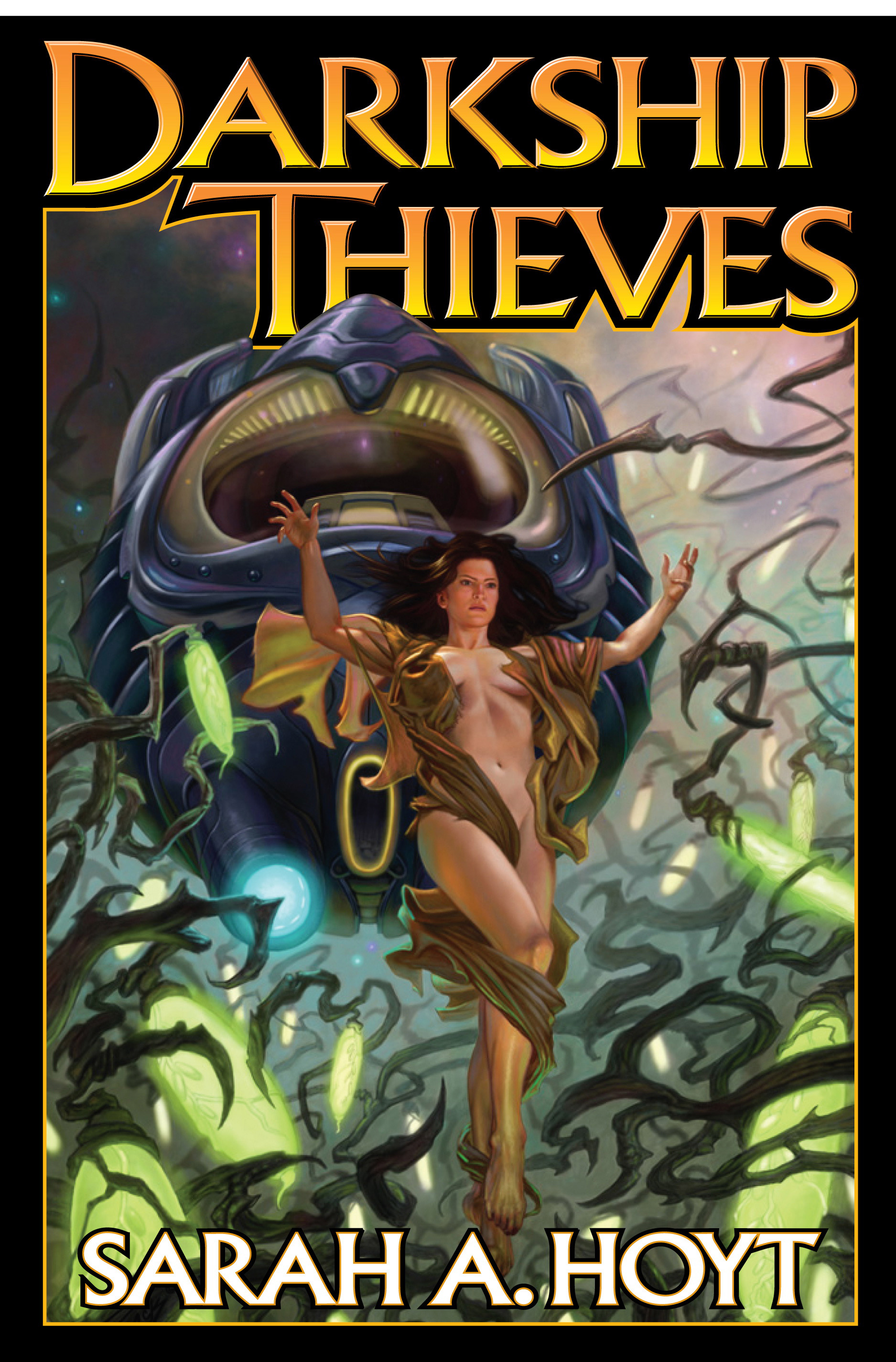
Frankly, the cover I like best, so far, is the Darkship Thieves cover. It doesn’t show a scene from the novel, but it evokes the novel beautifully. First there’s Athena, unclothed and looking like she’s quite sufficient onto herself. behind her is a spaceship and the powerpods twine around her. It has a “Heinlein” feel, says science fiction, and says it’s about a woman. The “sexy” bit suggests romance, which the book does have. Forget that the scene isn’t anywhere near the book (you can’t walk naked in space, okay. No, not even Thena) it’s perfect signage.

And now you know, I think, why romance always has some beautiful half clothed woman in period clothing/not and often being held by a brawny man (but not always.) Because the signage says “Romance” and that’s all. After that people go with title and blurb. SOMETIMES they will also go with “how nice is the cover” which hints at how good the company thought the book was. But that’s all. I can pick out regency romances based on clothing alone. (And do.)

So, how has that changed for the net? I’m seeing a lot more – even in Romance – of just partial shots of a woman in luscious clothing, or a brawny man supporting her. In the seventies and even recently, it would show man, woman, their faces, the ducal mansion, a horse, a butterfly and three kittens. (I’m exaggerating, but look up the covers at smart bitches.) Now it’s tightly focused and uncluttered. Why? Ebooks. Thumbnails.

One of the small publishers, who is trying to go with the “scene from the book” approach has a woman sitting on a buckboard wagon. From the position, in the thumbnail, it looks like she’s doing what bears do in the woods. Okay, it got me to click on it. For all the wrong reasons.

Take the cover for Death Of A Musketeer with Naked Reader. If it were still the market we had two years ago, I’d hate that cover. It’s just a hand, with a frilly glove, holding a sword.

I’ll grant you that mystery covers are in general more sparse (unless it’s funny mystery. No, don’t ask.) but that, on a shelf says “historical book on swords. Non fiction.” On an ebook it says “Hand, sword. What? Oh, Death – ah, mystery – of a musketeer, ah historical mystery. Okay. maybe I’ll download sample!” In other words, for a book I expect to sell MOSTLY in electronic format, it’s perfect.

Do I have a handle on this? Well, no. Cover artists and designers make a living from this. I wouldn’t take over their craft anymore than I would expect them to take over mine. Do they backfire? Sure. They’re human. The problem is, until recently everything depended on the cover. Now, it sort of does. The cover needs to signal the right genre, the right feel, and be intriguing enough for people to pick up the book. It also has to be clear in black and white, which is all the kindle (still by far the largest ebook platform) displays.

This seems to be leading to clear/concise signage and just enough visual interest to encourage download.

What are you feelings, both on cover and on how it’s changing?

*Yes, I HAVE been reading Agatha Christie’s Sleeping murder, again.

Crossposted at Mad Genius Club

The Sum Of Their Parts

One of the things that fascinates me about the world we live in – a world so dominated by media and “reportage of real events” is the often complete divorce of reality and things people “know.”

Let me put this another way – when I was a kid, I would get up in the morning, go out back, tell what the weather was. The facts that mattered for my day: whether grandma would allow me to go get rabbit grass with her; how the cats were doing; if the fish monger had come, were all things I could ascertain. From those I deduced certain patterns, like, I could go grass-gathering with grandma if it weren’t raining. I could count on the fish monger on Tuesday. From that I could extrapolate larger patterns.

This is how our ancestors gathered information, I think, plus the elders of the tribe would say something like “Don’t pull tail of sleeping lion.” In every generation someone would, and it would get its reward, and they’d KNOW it was true.

Unfortunately we live in a complex and rich enough society that this is no longer true. Most of our perceptions of how things work come at two or three removes, starting with the school where the teachers get their perceptions from the people who taught him who often got them from some theorist who had a lovely idea that he didn’t allow facts to clutter.

And then there’s narrativium. Some concepts just work great for stories, even though they’re false. Like, the idea that criminals are victims or suffer from low self esteem. It allows for such a climatic turn around on the book.

The problem is we read it over and over again, and at some level start believing it. And then we try to apply it in reality, and it fails, and we keep trying. (Lack of self esteem creates neurotics and paranoiacs, not criminals.)

The other myth is team work. My own experience with group work is that in very rare occasions when each person takes the part of the project they’re best in and each of them is very good at it, it’s a thing of beauty. Most of the time, it’s sharing of ignorance and kowtowing to the biggest personality, not necessarily the best knowledge/ability.

But my son, Robert Hoyt, says it so much better than I could and relates it all back to writing, too:

Teamwork – by Robert Hoyt

As I made breakfast this morning, I was thinking about the nature of a team. More specifically, I was thinking about how teams are applied, or more to the point, misapplied, in fiction.

I’ll be honest, up front. Most everything people typically say about teams has always sounded entirely wrong to me. The idea that the whole is greater than the sum of its parts has an application, I’ll admit that. But for me, it isn’t here.

I say that because every team is dependent on the individual worth of the members. And the maximum amount of talent any one individual in the team has is, for all intents and purposes, the maximum amount of talent the team has in that area. One million dime-a-dozen modern artists, even united in such an efficient way that they could all have input without trampling each other, would still never touch a single Van Gogh or Da Vinci. All they can do is magnify their lack of ability to eleven.

I’m not saying that a team has equal effectiveness in dealing with something as each individual member of the team sent out one at a time. But that doesn’t say a thing about the strength of a team. The function of the team in this instance is rearranging existent strengths so they coincide. It is akin to parallel processing. It is not that any of the functions I called became any better because I spun them off to separate threads and calculated them simultaneously. The overall result is better because I arranged the functions themselves to do everything at the same time.

I realize this is a generalization, of course. Certainly, it depends on what the team’s goal is. Where each team member must act to maintain the safety of every other team member, and thus input from all the individuals is necessary for maximal efficiency of one individual, I understand how many would feel that the team is a source of strength. On the other hand, that requires qualification. The fact that they are in a team is not adding strength, it is distributing a task each member would otherwise have to devote a larger amount of mental space to across all the members. It thus frees up strength that would otherwise have been inefficiently used, because the task has been made partially redundant. Contrary to nearly every 80s underdog sports film, working effectively as a team will not remedy your problems if no one in the team has the necessary skill.

It was this thought, in turn, that lead me to the nature of a team in writing. It is often said that a team is a team because each of the people involved have a common goal. But that does not mean they all believe the goal worthwhile, necessarily, nor does it imply that they have common motives in seeking the goal. People may work towards a common goal because they were forced to, because they have no reason not to, because they had no other goal at the time, or because the goal is better than the alternative to achieving it.

With that comes the distinct theoretical possibility that every single member of a team is seeking a similar goal for different reasons. On the surface that may seem so obvious it doesn’t even bear mentioning, so let me illustrate the meaning of that a little further with an example.

In the Wizard of Oz, you might be tempted to say that there are four different motivations driving the main characters to seek the assistance of the wizard. If you think about it, however, you’ll realize there are actually two, at most. Despite the different manifestations, the tin man, the scarecrow, and the lion are all driven by a conscious desire to fulfill some personality defect from the beginning. Dorothy is a little more complicated. She is more or less an archetypical Campbellian hero, and her express quest is to return home. In order to do that, however, she must complete her secret quest, which is, like the others, to overcome a personal lack. In this case, it is something that she demonstrated at the beginning of the book but is unwilling to even recognize: she is prone to running away from her problems rather than facing them. In some sense (and probably this is why I’ve never liked the story much), her awkward traveling companions are far more self-aware than she is. On the other hand, her quest is distinguished from the others because the trait she seeks she must actively develop, while the others already have the traits they desire and lack only awareness.

But in reality, the extreme unity of purpose in the Wizard of Oz is very much an exception. Especially because different team members cultivate different skills and, often, have different personalities that drove them to cultivate those skills, the idea that they would all have a common motivation in seeking a goal is almost absurd.

Again, to provide an example, even something as bland as a typical RPG quest to destroy a great evil can entice a plethora of heroes with myriad motivations. A person may seek to destroy a great evil because it hurts other people, and they therefore are morally opposed. A similar motivation that leads to a totally different dynamic is the person who does it because it has hurt them, or someone they love, and they are seeking revenge. It could be threatening to cause them harm, and they are going on the defensive. Or perhaps the evil is hoarding something valuable, and someone is along because they want a cut. Maybe a person is fighting because another person is fighting, and they have an intrinsic trust of that person and their judgment. Or perhaps the motivation is much larger, and the character’s problem is political, or philosophical. A character may even fight because the great evil is unwanted competition. And the list goes on.

All these motivations could be paired with an infinite array of different characters and personalities. The personal challenges that characters face along the way, and their ultimate quests, will vary according to these factors and many others. And here I’m admittedly taking a page from Dwight V. Swain: these goals may be real or imagined, and it is not necessarily the case – indeed, it is very rarely the case – that this is the true problem they must face. Almost any other goal could be the true obstacle they must overcome to complete their quest, otherwise known as their “secret” goal. A hero may be using his righteous anger at evil in general to mask the desire for revenge to a personal slight.

With that in mind, I’ll admit to a low tolerance for a team of cookie cutter heroes off to save the world because they all dislike evil. My problem with it, and the whole reason I’m writing this article, is that it treats a team as a character, rather than as a group of characters. Not only does it read as strange and two dimensional, but it ignores a world of possibilities for character interactions as characters debate and discuss the relative merits of their personal motivations, or bump heads because these motivations lead to different approaches to solving obstacles.

That’s why, certainly from a writing standpoint, I ultimately feel justified in asserting that a good team is not the fodder of Nike ads. A good team is not made by people with the same motivations all taking the same preset approaches. A good team is not a character in its own right that supersedes all the personalities that constitute it. A good team is, at its heart, an organization of individuals who all have distinct and valuable contributions, and needs to be treated as such. The best teams are groups of characters that bring different motivations, and therefore approaches and values, to a problem. This both provides the philosophical meat of a story and simultaneously prevents redundancy among characters, making the contributions of each character more necessary. And that helps keep your story interesting, as well as giving your reader something to think about when they finish reading.

So can a team be greater than the sum of its parts? Well, yes and no. The ability to bring different strengths and weaknesses will get all the characters farther than any individual could have gone. In that sense, the team is more than the sum of its parts. But in order to make it more meaningful than a predetermined “Chekov’s Team”, the team can’t start that way. A team has to start as slightly less than the sum of its parts. They are more interesting, their success is more meaningful, and the individual character growth more believable, when there is always the tiniest bit of friction between the characters and who they are.

In other words, for a team to be greater than the sum of its parts, all the parts have to be a little too big to begin with. By the end of the story, when they’ve all had their rough edges knocked off by each other, every character will be exactly as big as they can possibly be while still remaining in a team. In the end, that will make them a stronger and more capable team than a team of like-minded yes men who set off on a quest together. And thus, they will be better able to take advantage of those benefits a team provides.

Crossposted at Classical Values.


Thoughts on Money and Freedom

I have a piece on collaboration/group work my son sent me, which I’ll be putting up later, but for now I’m faced with the old dilema of having to put up something while my mind is definitely not in blog-post mode.

I’m still battling the weird feeling that my body is trying to get sick: a scratching at the back of the throat, a feeling that there’s weakness under the strength. I suspect I need a serious long-term physical work up, and I’ll try to get that as soon as I dig out from under deadlines, G-d willing round about November or so? Meanwhile, I take some zinc and soldier on.

This morning I woke up late – see that trying to get sick thing – and didn’t want to get up at all, but life rarely affords that type of indulgence. I went for the usual 3 mile walk (If I can get another ten pounds down, I’ll start running again. Right now I’m afraid to damage the knee I injured years ago) came home, had breakfast, and answered email. I’m now sitting here with a cup of tea trying to collect thoughts which are all hanging out Thena and Kit as they get the heck out of dodge – I mean Eden – in a gambit to both save Eden from itself and, possibly, save Kit from a fate worse than death. So, the following are random and stray thoughts:

– listening to Starman Jones  – another I thought was JUST a short story – during my walk, two things struck me: the fact that “guilds” are hereditary and that the man at the top of the guild is effectively an aristrocrat concerned most of all with position. This struck me as oddly prophetic, but not surprising since it’s the way human societies go, given enough time. Also, the fact that Heinlein states the market will find a way around laws and restrictions. Where there’s demand, there will be supply. You can distort it and twist it but not stop it. I have only recently realized that and it is something to think about. If you assume you can’t stop whatever the market is – drugs, risky surgery, or more mundane things like luxury goods – you can only twist it, the law of unwanted consequences SHOULD stop most laws from being written, if people in power gave it any thought. Do they? I fail to see any evidence.

– on the funny side, somehow the Darkship universe partakes bits of even Heinlein books I never read.  There are genetics that have nothing to do with DNA (as Pratchett would say.)

– related, in the sense of “supply-demand”, and also in the sense of entrenched “power” becoming a de-facto aristocracy and, like all such, slow to respond to technological change: Watching the traditional publishing world implode is both horrifying/terrifying and exhilarating. It’s horrifying because I always expected, having paid my dues, to have a staid career and, as it were, grow old in my quarters. This doesn’t seem to be in the cards. OTOH swimming for your life is a very … Invigorating experience, and can’t fail to make me feel younger. Also, it opens up a whole panoply of options that I never even thought about before. Prognosis: guarded. Further prognosis: I’ve got a million to one chance of emerging out of this with a paying career, even as the publishing houses self-destruct spectacularly. In other words, to quote Terry Pratchett, by the laws of narrativium, it’s a sure thing.

– I still like working at home too much, so I’m not sure of the advisability of an office. But I have to make this work, somehow, because I think over the next sixteen months or so, I need to write more than I’ve ever written before. Wish me luck.

The Moorings of the World

Yesterday, I heard that Martin H. Grenberg, publisher of Tekno books, had died. 

It was not entirely unexpected, as he had been in failing health for a while, but it was still a shock.  Given that he was born in 41, we could have expected to have him with us another fifteen years or so.

I don’t have many personal meeting stories to share.  I met him in person twice, at cons.  More often than that, I spoke to him on the phone, usually about some project he thought I’d be perfect for.

I can’t even claim to have written as much for him as most of my colleagues.  But he and tekno were known for one thing: in a profession where everything is insecure, they provided a security blanket.  If you absolutely needed fast money for your mortgage or rent, you let someone at Tekno know, and they’d try to find a place for you in their myriad anthologies.

In 2003, when my career crashed and burned at the same time we were paying on two mortgages, I sent up the alarm and over the next year between anthologies and other projects, Tekno contributed markedly to our roof over head and food on the table.  (The rest being supplied in an advance by Jim Baen who paid the full thing up front instead of in three parts because he knew I needed it.)  Most of our income comes from my husband, but that was tapped out just keeping mortgages paid and the utilities and other pesky things, and left us at the mercy of emergencies and disasters — which always happen.

Also, long before I was published, I was addicted to Tekno anthologies.  I’d buy them before plane rides, because I figured even if I hated one or two stories, I was likely to like the rest.  (This tended to hold true.)  And because they were grouped on themes, I could choose a theme I wanted to read or had some interest in.  Dinosaurs, say.  Or mermaids.  Trying to figure out how the author would weave the theme in added interest, too.  They kept me from becoming suicidally bored on long flights.

Martin Greenberg was a kindly figure in the field, one of those that those of my generation tended to look up to as a fixture, someone who would always be there.

One by one they’re passing away and leaving the world tilting on its foundations.  It happens in every generation, but it is in its nature that it feels new each time.

In time, replacements will come — probably different in the fast-changing publishing world — and time will move on.  But that doesn’t diminish who they were and what they did for the time they were here.

Ave Atque Vale, Marty — the world was made better by having you in it.

Schreibensraum

The title is sort of an answer to my being a bit freaked out recently. You know how no matter how much you love a writer and go out of his way to read all of his/her work, something always escapes you, like the last chocolate hiding in the corner of the box under the wrappers.

Well, I realized last year I’d never read Time For The Stars, partly because I thought it was the title of an essay on traveling space. I knew there was a book about twins but it never connected with the title.

So, because I find it easier LISTENING to the juveniles than reading them (it’s the language. For listening, I require less polish.) I’ve been listening to the novel.

I have no idea when it was written. It had to be after WWII, right? Maybe it was just before. At any rate every time I hear “Project lebensraum” I CRINGE. I’m sure it didn’t then have the Nazi associations it evokes now, but all the same, it’s an irritant in the story.

That explains the title and I can now introduce you to Project Schreibensraum.

I must start by confessing I’m baffled. As most of you know I have an office in the home. It’s a nice office. Do the boys interrupt? The boys ALWAYS interrupted and the interruptions are NOW much fewer. Yeah, cats climb on keyboard, but that can’t be helped.

I’ve always had an office in the house, and normally it doesn’t hinder me laying down words at a keyboard. As I said, I used to do 3 to four books a year, with two kids under eight in the house.

So… we moved here… And the first thing I noticed was that doing anything, even proposals, was like lifting a heavy weight. I’ve changed my office all over the house. (Weirdly, what worked best was down in the living room, and if I get desperate enough, I’ll try that again.) It just gets worse. I can’t seem to concentrate and finish anything in the house. The last three books I finished I either went to a hotel or to Texas for the final push.

This would be weird enough if it only involved me – hormones, maybe? – but my sons and husband complained of the same thing, particularly in the last year, when it’s become worse.

I have no explanation. Every house has an atmosphere, of course, but it should not be resistant to moving furniture around, etc. It SHOULD change. But the “wet blanket over the mind” feel only gets worse, ever. And it’s not just for writing. I need to sort out things for a garage sale, and that’s not happening either. And it took me three years to paint my bathroom which desperately needed it. I need to fix the fence from the windstorm two months ago, and that hasn’t happened either. So…

No explanation, but I can’t go on like this, so I decided to look for an office. And realized I’m a very odd – but by no means alone – client for that sort of thing. I want something very small. Just me, writing. I don’t need a secretary or phone answering. Net would be nice. And I want it cheap. REALLY cheap. I also want it within two miles of me, because if I have to get in a car and drive at morning rush hour it won’t happen.

So, yesterday I had appointments to see three offices. The first one is in one of those “corporate towers” and is A LITTLE pricey. For that money I could rent a small apartment nearby and heck, I might prefer that. I could go there a week a month and not be gone every day, which I hate. Anyway, it’s moot. The cheaper offices which were a windowless one for 300 and the window one for 500 – which I refer to as a little pricey – are not available till the last quarter of the year.

Then I went to look at an office closer to me. Very nice. Very quiet building. The walk there is actually pleasant. The room is clean, updated electrical, etc. $300 including utilities and all. Ideal, but… NO window. It might be perfectly fine, mind you. I don’t know. But I normally require daylight. And I’d have to take it for a minimum of 6 months, and what if it doesn’t work at all?

So, third office – in a Victorian. Nice floor, high ceilings. Window. Appointment for 4:45, but they also have a sign on the door. I get there on the dot. Another woman is there. She walked up the stairs after seeing sign. I access room. Outdated electrical, $220 total each month but I’ll take a risk. “Okay I take it.” No, I couldn’t have it. The other woman got there a minute earlier, and she wanted it. Did they tell me it was First Come First Serve? In which case I’d have been there at four? No, no they didn’t.

So, now I’m divided. There’s this office for rent for months now, $350, 500 sq feet, two office suites. Part of me wants to know why it hasn’t rented yet. And part of me is going “It’s a little too high and MUCH too large. I don’t NEED that much room. Perhaps I can sublet it?” And part of me is resistant to working out of the house at all.  I like being here.  I like having the cats around.  I like when my husband telecommutes and we can have lunch together.  BUT I seem unable to get much of anything done IN the house.

Just absolutely not sure what to do.

I’m OFFENDED!

Yesterday in comments, John brought up the fact I’ve got some very bad comments on Amazon, on the Magical British Empire Trilogy, from people who think I used every possible (and some impossible) politically correct stereotype.

I know about the comments, though the last time I even heard of them was more than a year ago, and I haven’t looked at the comments since. Part of this is because there is very little point in doing so – it only upsets me, which is what the commenters intend.

More interesting is whether there truly is a point to their comments – did I set out to write a politically correct work and kow tow to all the sacred cows?

Come on guys, you know me. Even if I agree with a stereotype, I feel vaguely uncomfortable using it in writing. In fact, even when I meet a stereotype in real life, it annoys me because come on… art should be deeper than that. It’s only afterwards that I think “Oh, wait.”  Like, the dry cleaners I take my clothes to: Asian, works insane hours, does alterations quickly and cheaply, exchanges ls and rs.  I love his work, but I feel so guilty that he’s actually like that: as though I made him up. I’d never write him like that!

So, why do these people think I use every possible stereotype? And that the only villains are white people? Well, the reason is threefold – one, I was then absolutely restricted to the traditional book market (one of the reasons I’m looking forward to maybe an upending, is the end of that gridlock, which in turn will open up greater creative license.  See 18th century French painting and their “one correct way to produce art” and the period after) which means that anything that blatantly went against the grain would simply not sell.

Does that mean I sold out? Uh… guys, if I ever sell out, it will be for a lot more than 12k a book. And I COULD sell out if I wanted to. I understand the mind set of publishers – we had largely the same education.  I simply can’t do it — though I berate myself — and look at myself in the mirror.

This brings us to reasons two and three – they think I use every possible stereotype because they’ve read SO MANY books that do, that they’re oversensitive. (Like, if the roulette keeps landing on red squares, you come to expect it, even when there’s no reason to.) From the moment they expect it, they then interpret everything as a stereotype.

As for the villains, no. I can honestly say all the books have bad people of all races. (And good people of all races.)

It will probably be easier to understand this if I explain how the (first) book came about.

I spent a lot of time in my childhood reading “explorer’s diaries” true and false both. For a while when I was six, I thought “native” meant “savage” which tells you the tenor of my reading.  For the longest time my family called me “the native” because of explaining at the table that I was feeling very native.  Meaning savage.

Then I discovered science fiction. And then…  Oh, twenty years later – I don’t remember what sparked it, but I think it’s the book about the sepoy rebellion called Our Bones Are Scattered – I started reading books about Africa and India and China during the Victorian age. (BTW The Washing Of The Spears is an excellent book.)

I don’t know if I’ve mentioned this before, but the beginning of ideating a story is often a craving to read “more of this.”  So I read  lot of these books.  All I could buy and all our library carried.

After a time I started realizing something. Here I must break off and point out that I never believed Europeans have some sort of genetic predisposition to colonialism. This is something that other peoples tell themselves and as a lullaby to put themselves to sleep or as a just-so story to feel virtuous. The problem is we’re not that genetically different. Humans are humans are humans. (Yes, I read the 10000 year explosion, or whatever it’s called, but I remain unconvinced.) All humans and humanoids for that matter (all other higher mammals too) are “colonizers.” As Heinlein – and Dave Freer – have pointed out, the rule of life is expand your territory or die out.

So, how come Europeans colonized the rest of the world and not the other way around? In reading The Washing Of The Spears I realized I was seeing a pattern, the same pattern I’d read in the colonization of the Americas or any other non-European land.

It wasn’t Europeans’ “superior civilization” or even their superior weapons. What gave them the edge and allowed them to colonize, rather than be colonized, was their overcoming tribalism.

When I posted about this at Classical Values, a year or more ago, M. Simon pointed out that started with the Egyptians. Perhaps it did. I’m not versed enough in Egypt to know that. I know Greece was still to a large extent tribal. But Rome wasn’t, which is what allowed the formation of the empire. And the Roman non-tribalism extended to Western Nations and became part of their DNA, encouraged by the Jewish-Christian idea of the brotherhood of all humans.

Why would this give Europeans an edge? Well, because it allowed ALL of Europe to react to a slight to ONE European group. And Europe had another innovation – fast communications: newspapers, telegraphs, etc.

This came up against one of the techniques of tribal warfare as has been practiced forever, or at least since we can discover/interpret records. When a part of another tribe moves to your territory and tries to colonize, you kill them all, preferably in a horrifying way. Best case scenario, when the rest of the tribe finds out, they look at how gruesome the killings were and decide you’re not to be trifled with. Worst case scenario, you get a tribal war, which you might win.

Over and over again, this worked. Until the Europeans.

Descend on some small European settlement and kill everyone in horrifying ways, and the Europeans decide you’re evil. And with their communications and their large nation states, they annihilate you, or come close to, and then rule you, because you’re too savage to live on your own. (If you read the colonization stories, this was usually how it went. Greed was there, of course, but didn’t play as much of a part as certain Disney movies make it sound.)

So… I set about to illustrate this, and also our… complex relationship with the colonized lands. (“Our” being western culture, though Portugal is… er… a little different. But it WAS a colonizing power. The first, in fact.) I set it in a parallel world, and I made the magic of Europe be unified (yes, I made Charlemagne and Queen Victoria the villains. Has it occurred to anyone I don’t much like hereditary rulers?) And the magic of the rest of the world fragmented and therefore unable to oppose European magic. Much of the story is attempts to unify the rest of the magic, or to unify the world under one ruler.

Did I set about to use a character from every race? Uh… no. I wanted to use characters from three tribes, in Africa, because I wanted to illustrate how different tribal culture can be. I made reference more than once to tribal warfare (the Zulus arrived in South Africa just ahead of the Caucasians. And, oh, yeah, their wars of expansion were horribly bloody.) Yes, I also made reference to the atrocities of the Congo – because they happened, and did you think Europeans were wonderful by virtue of their blood?

Yes, the first book has an Anglo-Indian main character. I needed her to have a chip on her shoulder and also a magic that had been incomprehensible to other Europeans. Since Magic in that world is inherited/genetic, I gave her a double heritage.

Yes, the main villain in the first book – not the others – is European. That was a story-necessity. He needed to mean SOMETHING to the main male character. Also, to be honest, how many times in the twentieth century have Europeans (Eastern, mostly) gone to Africa, promising freedom and national unity and wanting only power, under the cover of their “ideology.” Look up the history of the Russians (and Cubans) in the old Portuguese colonies, sometime. What seemed like a native uprising was really just the old USSR expansionist tactics. So I used a similar device in Heart of Light…

Things I’m upset that all the detractors missed:

Emily feels discriminated against for her dark skin. Do you EVER see any of the characters think she’s less than beautiful? Yeah, I’m sure her step mother and maybe some girls at her school made her feel isolated and like an outsider. So?  There’s a reason for hte stories about stepmothers and anyone who read “boarding school stories” knows conformity was the order there.

Peter says a lot of politically correct nonsense. Peter is a member of a (left-wing) anarchist group that would have destroyed the world if it got its way.  Does it sound like I’m putting myself in him and speaking through his mouth?  Well, gee, thank you so much.

Nigel is perfectly willing to fall in love with Nassira, despite her skin color – Nassira, OTOH, has issues considering people of OTHER TRIBES as full equals, much less a white man.  Does this make her a bad person?  No, she’s from a very insular culture.  They all are.

In the second book – mostly because I was tired of reading a lot of nonsense while researching it – Sofie brings up the problem of what she is: part European, part Indian, belonging to India for generations. When they achieve liberty, is it right to kick her out? Why?

In the third book, at the very end, Nigel’s very proper parents are EFFECTIVELY color-blind. (Did it happen in Victorian England? A few times, recorded in history and biography.)

Yes, there is a gay couple in the second book. It’s necessary for plot reasons. I actually had that character as a “villain” but that made him too cartoonish. Having him act and decide things on the basis of impulses he’s denying made the book far more interesting. (Read got him and everyone else in trouble and peril.)  Note BOTH members of the gay couple have to leave their cultures at the end, though the cause of their being despised by each culture is different.

Should I go on? The books are as close to unbiased as I could make them. Yes, the story says some hard truths about what happened in Congo and some awful stuff about the arrow war and terrible stuff about the native cultures, too. Yeah, it points out humans are humans and all fallible.

Pardon me, but it is a hobby horse of mine that there is no such thing as a noble savage and no such thing as hereditary guilt. If you want to be mad at me for that, be my guest.

But don’t be my guest because you take things I put in the mouth of characters as my opinion. Look at the character first.

Yes, I know you’re flinching from the expected slap, but it does not excuse you not engaging your brain.

If readers are that offense-prone, maybe they should read only things certified to agree with them?

And now, ladies and gentlemen, I’m late to look at an office to rent. I’ll be back.

Shhh. I’m Working

*Have some compassion for the writer working with two teen males — #2 son and best friend — in the house, engaged in a gaming session to last 48h and forgive me for giving you a snippet I’ve given before.  This is from the beginning of Darkship Renegade, the sequel to Darkship Thieves aka, the work in progress (again, at last.).*


Out Of The Frying Pan

I was a princess from Earth and he was a rogue spaceman from a mythical world. He saved my life three times. I rescued him from a fate worse than death.

We married and lived happily ever after.

Ever after comes with an expiration date these days. We’d been married less than year when Kit got shot in the head.

I knew we were in trouble as soon as I got my answer from Eden. It’s entirely possible that Kit knew it before. Eden is his native world. He knows its quirks, its traditions and its habits in a way I couldn’t after living there close to a year. In a way I probably wouldn’t if I lived there fifty years.

We’d called out as soon as we came within link distance. It had to be done. Eden is a hollowed out asteroid. Humans live on the inside. More, it is an asteroid colonized by a persecuted people who wanted to make their existence this close to Earth as inconspicuous as possible.

Kit has said you could land on the surface of the asteroid that contained Eden and not know that there was a thriving civilization inside. I don’t know if it’s true. Never tried it and I learned long ago not to take anyone’s word for anything. Even a trustworthy person can be mistaken. But I was fairly sure that unless the people inside extended a landing tube to us, we would never be able to get in. Whatever sealed the entrances to the landing areas didn’t even show to visual or radar scanning, so I doubted we could hop around in our space suits and pry the tunnels open. Whoever said knock and it shall be opened hadn’t tried to enter Eden.

Which was good. It made Eden very safe. And bad. Because in the circumstances we’d brought on ourselves, it meant we had to convince Eden to let us in, or we’d be left on the outside with only the resources of the Cathouse at our disposal. And though the Cathouse was a great ship, or at least a great ship for its age and mechanical condition, we didn’t have enough food to see us back to Earth or to the water-mining colonies of Proxima and Ultima Thule. We certainly didn’t have enough to live on indefinitely. So, no matter how much trouble we were in, and even though Eden might shoot us out of the sky, we had to tell them we were here. And we had to ask permission to land.

My heart was beating somewhere between my esophagus and my mouth as we did the final approach to Eden. And don’t tell me that’s a physiological impossibility. I know what I felt. Given just a little more nervousness, my heart would jump out of my mouth and flop around the instrument panel like a fish.

But I looked composed and calm because there was no point disquieting Kit, whose fingers danced on the keyboard with the practice of the many years he’d been trained to and flown in and out of Eden.

I took a deep breath and told myself that these were not the last moments of my life, and Kit reached for my hand and squeezed it, hard, while his other hand pressed the com link start. “Cat Christopher Bartolomeu Sinistra and Nav Athena Hera Sinistra, piloting the Cathouse on behalf of the energy board. I request permission to land.”

There was a silence from the other side, long enough for my heart to almost stop. Eden didn’t have to let us in. As a world Eden was so paranoid that if it had been a single person it would have been living in a compound with secure entrances, keeping multiple weapons trained on each entrance, and have an option all arranged so that if all else failed and his enemies got in, he could blow himself and them to kingdom come. Only, Eden was not pathological. Paranoia is a perfectly well adapted reaction to everyone being out to get you.

I swallowed hard and told myself that if Eden didn’t want us, we’d find our way elsewhere. Even then I knew I was bluffing. And all that kept me from shaking was the impression of Kit’s mind, warm and amused.

Not words. We could mind-talk, an ability bio engineered into pilot and navigator couples in his world and engineered into me for a completely different purpose. But when there were no words, there was occasionally a feeling, and sometimes a feeling was all you needed. Whether the feeling was real or projected, I didn’t know. There was a deeper level of mind-touch at which it was impossible to lie, but we didn’t engage in it normally. It’s not good for sanity to be unable to remember which body goes with which mind.

I managed a half smile in Kit’s general direction, as the voice of Eden’s Dock Control crackled over the link: “The Cathouse is more than six weeks late. It has been entered in the roll of losses. Cat Christopher Sinistra and Nav Athena Sinistra are dead.”

“Not really,” I told him, while my heart hammered wildly and I felt almost boneless with relief. I hate bureaucracy as much as anyone else, but not nearly as much as I hate exploding. That they were talking instead of burning us was a very good sign. “Only late.”

“You cannot be late. You only had fuel for a four month trip. Three weeks later you’d be out of reserves and dead. You–”

“We were down on Earth,” I said and grinned, a grin he couldn’t see but might just sense from the tone of my voice.

For three centuries, before my arrival here, Eden had managed to hide its existence from Earth so well that, despite a few hundred trips each month to steal powerpods from the biological solar energy collectors orbiting the Earth, they had become mythical down there: the Darkship Thieves, like fairies and elves and gnomes were talked about but never glimpsed. For all those centuries, the instructions had been for any ship captured by Earth to destroy itself. We’d not only not destroyed ourselves but Kit had surrendered to Earth in order to save my life. I understood, since I’d been in his mind at the time, that it was the only thing he could do. I also understood how Eden would view it.

“What?” the Controller asked.

Kit cleared his throat. I could see him reflected in the almost completely dark screens in front of him: his eyes bioengineered for piloting in total darkness looked like cat eyes, glimmering green and very wide open, in worry. His calico-colored hair, a mutation caused by the same virus that had given him the eyes, super-human coordination and speed of movement, contrasted with his normally pale skin, which had gone yet paler. Without his modifications Kit would have been a redhead, so his skin was normally that shade of pale that can turn unhealthy-looking at the slightest disturbance. Now he looked white and grey, like spoiled milk. It was the only sign of fear, or even worry, he gave. His voice sounded firm and clear, “Nav Sinistra had radiation poisoning and we stopped on Earth for regen treatment.”

“You stopped on Earth for treatment?”

I swallowed hard, to prevent having to grope from my heart somewhere on the control board. “Well, it wasn’t that simple, but yes,” Kit said. “I’ll be glad to tell you the whole story after we land.”

“You’d better, Cat.” He pronounced Kit’s rank as an insult. The term “pilot” had long since become “cat” in Eden, due to the modifications of pilots of darkships making them look feline. ” And you’d better make it convincing. This is most irregular.”

“Controller,” I said. “We must land. Kit’s family is expecting us.” Kit’s birth family, the DeNovos were socially influential and powerful in the very limited community of Eden. And his sister Kath would probably have been a force to be reckoned with in any size society. It was a good thing she’d been born in Eden, because if it had been on Earth, she’d probably now be sole supreme ruler of the whole world. This was slightly more difficult to achieve on Eden which had no rulers of any sort, much less supreme ones.

Another silence and the Dock Controller’s voice sounded dour as it came back, “Navigator Sinistra, if you delayed your collection run for personal reasons, you have to know that the Energy board will fine you for the delay in supply, and all the boards will want to interview you for potential breaches of security. Also–”

“I know, Controller. Now, could you give us a dock number, please? Before I go crazy and just give my Cat instructions to dash at Eden in the area of the landing control station. We earthworms tend to be so temperamental”

Kit chuckled aloud, then stopped with an intake of breath. The impression from him was amused, but also scared, the amused trying to cover and hide the scared and not quite managing it.

“Dock fifty five, but I want you to know that I shall have armed hushers ready and that you will be examined for any evidence of undue influence and that–”

I flicked the comlink off. A sleeve-like structure extruded from Eden and Kit piloted us into it, then leaned back as dock controls took over the navigation. His foot skimmed along the floor next to him, flicking up the lever that turned off our artificial gravity now that we were covered by Eden’s. Not that keeping it on would give us double the gs, but I understood one could interfere with the other and cause some really interesting effects.

It wasn’t until our ship was settling into one of the landing bays, that he released the seatbelt that crisscrossed his chest, and, without letting go of my hand, got up and said, “You know, you really shouldn’t have taunted the controller.”

I knew. I knew lots of things. It seemed like from the first moment of my existence, my life had been hemmed with rules.

I was born the daughter – the only daughter – of Good Man Sinistra, one of fifty men who controlled the near-endless land and resources of Earth. As such I’d been told not to taunt and not to hit as long as I could remember. My parents, my nannies, the heads of various boarding schools, the commanders of various military academies, and the psychological medtechs that ran several rest homes, sanatoriums and mental institutions, had all told me I had an aggression problem and must control my impulses.

Perhaps I should, but I had a strong feeling that if I had then I wouldn’t be alive. Nor would Kit.

And I suspected Kit knew it too. Hence his very mild reproach and the warm squeeze on my hand as we walked down the spiraling corridor that led to the airlocks of our ship, then waited for each of them to cycle in turn, before the very last door contracted open.

We were in one of the cavernous, circular bays that admitted ships to Eden. It must be an out of the way bay, not normally used, because there was none of the cargo evaluating and price-calculating machinery you saw in the newer bays, like the one in which we’d landed in when returning from our last trip.

What there was, instead, was a large group of young men, all armed, all aiming directly at us.

To the other side and a little behind the young men stood two older men, a dark haired one and a blond one.

The dark haired one was the dock controller. At least, he wore the grey uniform of the position, and he had that harassed, frustrated look of someone who was sure he’d been born to better things, but who found himself confined to an inglorious desk job day after day, month after month with nothing more interesting to do than give coordinates to landing ships.

The blond was something else altogether different. To begin with he didn’t wear any uniform, but a well cut black suit consisting of something much like an Elizabethan doublet and leg-outlining pants, all of it either covering a lean and muscular body or tailored to give that impression. The fabric shimmered with the dull shine of real silk and conveyed an unavoidable sense of wealth and sensuousness. The face, above the suit, was sharp and vaguely threatening. He looked like a young Julius Caesar or at least a Julius Caesar from a world where people didn’t lose their hair unless they chose to.

It was the blond man who spoke, and so his words had far more force than if they’d been spoken by a mere bureaucrat. “Cat Christopher Bartolomeu Sinistra,” he said, each syllable dropped in place like an essential part of exacting machinery. “You are under arrest for treason against Eden.”

The Story Is The Thing

Recently I’ve been reading a series of romances by Lisa Kleypas. It is hard to overstate how BADLY I disagree with her every opinion. This woman goes out of her way to include at least one favored minority in every book; she’s convinced that if every civilized person refused to fight there would be peace and one of her characters actually said that “violence never solved anything.” Okay, her character was in the Regency, so I couldn’t say “Ja, Ja whol, wunderbar” but even so I wanted to introduce him to a Heinlein character who would answer with “Go tell it to the city fathers of Carthage.”

So why in heavens name have I been reading her?

Because the preaching is discrete, subtle, and ignore-able. She doesn’t stop in the middle of the book to preach ad nauseum. And her wrongheadedness seems to be limited to macro issues. Her portrayal of eccentric and loveable characters and of the way these characters react to each other and the world reacts to them is spot on and therefore engaging. And she knows how to plot which is not always a given in romance. (Or anything else.)

Reading her characters is like talking to your old aunt whom you adore, but who is sure that the world would be a better place if we all wore tinfoil hats, and is sure we were colonized by aliens from alpha centauri. Even though you think she’s nuts, her beliefs are by and large harmless and you still enjoy her company the rest of the time. She’s not going to convince you, but you’ll have tea together and have fun and as long as her tinfoil hat is set at a rakish angle, all will be well with the world.

I can tolerate dissent of a more serious kind, in authors I love. Which is a good thing, because if I couldn’t I might have to part with some of my favorites in science fiction.

I started reading science fiction with either Clifford Simak or Heinlein.

No, I don’t remember which. I have a vague memory that I read Have Space Suit, Will Travel at eight or so. But if I did, I didn’t identify it as Science Fiction. That first, conscious science fiction book was Out Of Their Minds by Clifford Simak. (Have Space Suit would not have struck me as SF because the family was a lot like mine. You probably don’t want to ask. My son told me the other day that Athena is like a grown up Peewee. I told him no, it was a grown up me. He asked what the difference was.) I don’t remember my second SF book, but it was one of those turgid the US is a backwater compared to the USSR near-futures not uncommon (or sensible) in the seventies. The third was A Canticle For Leibowitz, still one of my favorite re-reads.

After that I was off. And because I was at the mercy of my brother, who was borrowing from a friend, I read practically anything with SF on the spine. Later on, on my own, I bought everything that said “SF” which accounts for my having read a lot of VERY BAD French romantic space opera, Pierre Barbet, and a French magazine called Panspermia. (I bought it because I thought it was devoted to the theories of Fred Hoyle. Let’s say it… er… er… er… um… wasn’t. There were illustrations. I wrapped it [plain brown wrapper] and gave it to my nine-years-older brother. He was grateful. Er. I think.)

But the two writers I kept coming to, again and again, were Heinlein and Clifford Simak. Both of them offend/ed in different ways.

I was never – I think – conventionally Portuguese (for one I found the iron clad ‘how to behave rules’ stifling.) But I was in many ways conventionally educated European (I can still pretend to be. Most of the time I don’t bother, though. Life is WAY too short.)

Some things Heinlein said offended me and scared me at first encounter, and I don’t remember when I came around to believe in them: the advantages of an armed society, for instance, or that taxation is not inherently right and proper. But I kept reading his stories because I loved them.

Most of what Simak said seemed right to me at the time, from his idyllic depiction of a world with falling population (yes, there is a post called Malthus Is Dead coming soon <G> Heinlein was wrong on THAT too) to his belief that the USSR and the US were basically covalent, to his belief that the future would be imposed top-down in a command economy. Oh, also the idea that only humans understood war or waged it.

All of these were conventional ideas that I thought were fine. Now most of them offend me. Some because they are ultimately evil – like the idea that a falling population is GOOD. That comes from the idea that resources are finite and that humans exist only to have resources divided among them – drains, not producers and not creators. However, at the end of that chain of thought lies eugenics, a decision of who deserves to live and a campaign against “useless eaters.” If you don’t think that’s evil, you’re not in my head. (For which you should possibly be grateful.) And now we know that primates and a lot of other mammals wage war. As for the equivalence between the US and the USSR – no. Just no. There are books you can read on what went on there. Oh, we’re not perfect. What nation is? But there is no comparison.

However, I can still read Simak, in the same way that I continued reading Heinlein even when he offended me.

Why?

Because despite the flaws I saw, or thought I saw in their scaffolding, their macro world building, their close-in world building was fine. Who could not identify with the man who for the first time can talk with his dog, mind to mind? Who could not feel an all-too-human tenderness for the robot pope? And who would not like Kip and Peewee? Or the cat named Petronius?

On the micro level, the characters acted like people you could know and love, even if they didn’t think as you do. How many of us have friends who are a chorus of “yes people”?

Except perhaps editors. I’ve railed about this before. I don’t know when I realized I was reading the same story – or at least the same assumptions – in science fiction, over and over again. All of a sudden our field, the most oddball field of all, was bowing not only to “established science” (gone were all the thrilling stories about humans really coming from the stars or weirder places) but also to political correctness (no? Try selling a genuinely evil female pagan, in a Christian society. TRY it. To a non-Christian house. No, I’ve never written that, but my recent book with very Catholic mythus had issues selling at all. Even though Pagans had equal status.)

My brother told me that he recently asked about Portuguese translations of new science fiction and was told that “young people don’t read SF, they watch movies/series.” He and the publisher (in Portugal) were baffled by this, but I can tell you why. It’s because series like Stargate still can be completely irreverent with “established science”… and less politically correct. And the fact that movies/tv are less politically correct should give you pause.

This ties in with Dave’s post because for the longest time there have been things you can’t do or say in science fiction. And by and large they’re not the ones that the people in power in NYC think are “countercultural” or “daring” or “Speaking truth to power.” You see, the poor dears don’t realize that in this microcosmos they ARE the power.

They do realize that their tastes aren’t universal – perhaps not even majority – because Baen, the smallest of the main houses, with the smallest budget and discriminated against by bookstores for their content, has made a living of their TRULY countercultural (for SF culture) publishing for decades and created as many if not more bestsellers than the other guys. For that, NYC hates them and reviles them and distributors and bookstore managers discriminate against them.

I don’t know what they think they’re doing.

Editor after editor has told me his/her job is to educate public taste – but they’re missing something. Well, two somethings. First, no, their job is to sell books. (The fact they don’t get this explains a lot of the issues in the book business.) Second, you can’t educate people who won’t read you. And you can’t control, btw, who will read you but roll their eyes at your beliefs or read you and eventually come to agree with you. My relationship with Heinlein and Simak proves that. (And BTW, I still like Simak enough I wanted to call my second son Clifford. My husband said over his dead body, so that’s that.) Heck, I still like Left Hand Of Darkness, though I can honestly say that Ursula Le Guin and I have never agreed on a single thing (okay, maybe she also likes chocolate. I’ve never asked.)

But your – and the editor’s if you have one – main job is to get the books in the public’s hands, and to provide entertainment which will keep the public coming back for entertainment. The message is secondary and will never be delivered if you’re not read. Also, you can say “I won’t let people write/read this” (like clinging, spineless women) but you can’t make them stop existing. And you can’t make people stop wanting to read about them. The most you can do is cut yourself off from readers by boring them with the same fundamental assumptions over and over again, and no dissenting voices.

And look, bub, if your cause is THAT important, surely you can donate the filthy lucre you’ll make from people who don’t agree with you buying your books. SURELY that counts for something?

So… I am looking in some wonder and hope towards the self-publishing that might allow the public to finally find the SF they want to read, sf that’s evaluated for its ability to entertain, not its ability to preach. Perhaps there’s a great revival of sf ahead?

What I would like? I’d like to read about how humans really came from the stars (Oh, come on, any SF writer worth his salt can get around what is known with enough handwavium to make that happen.) I’d like to read about humans colonizing alien species and this being good for them. I’d like to read about truly evil aliens and GOOD humans. I’d like to read about disciplined, strong men who don’t need women to save them.

What would you like to read that’s not being provided by the current publishing establishment? What are the chances of its being written? What do you read that offends you but is still a good story?

*crossposted at Mad Genius Club*