Fine Old Cannibals

(Forgive the length of this, I’m mid-rewrite and trying to edit an antho, too, which is way overdue, and I don’t have the time to make it brief.)

What prompted this – proximally – was Joe Konrath’s very funny analysis of the Hachette memo and my older son’s reaction to it, which was “they’re all feeding on the poor, underpaid writer, and they don’t understand they’re driving most writers to despair, block or just plain starvation.”

He’s right.  That goes without saying.  That goes right into the “they don’t know how angry the average writer is.” (They also don’t understand how tired, how sick, how poor the average writer is.)  But wait, there’s more.

The other side of this was Dean Smith’s article about “what industry treats its suppliers this way?” talking about getting a form rejection two years after sending in a query,  (btw, Dean, I once got a form rejection, SIX YEARS AFTER ASKING FOR GUIDELINES.  No, not submitting.  JUST asking for guidelines.  Well respected house, too) and blaming writers (in part) for letting the publishers get away with this.  I agree, and I don’t, because, wait, there’s more.

This week I heard of an agency which didn’t use to have an agency clause coming up with a new and improved agency clause that not only gives them part of your income on that property forever, (yes, even after it goes out of print and the writer himself resells it again) but also with a clause I’ve never even heard of, which requires writers to pay 15% of his or her income should the writer self-publish.

That people are signing this feeds into Dean’s “because writers let them”, but I’m going to bring out the extenuating circumstances.

Writers let them because most writers still don’t realize they have any alternative.  And because for years – decades? – now, writers have not just been used to this treatment, but they’ve known they had to take it, because the alternative was not working.

It started with the basic setup of the field.  Every writers’ group, every conference, every single older pro told you you had to act professionally and behave like a professional.  This was true.  It was essential for survival in the field.  I think every writer who was trying to make this a full time job was also aware of how ridiculous it was.  And every writer lost a little bit of self-respect every time he acquiesced to this ridiculous game of pretense.

Okay, you don’t think it was ridiculous?  Let me put it to you this way: you get a new job.  You’re required to show up on time.  You’re required to do absolutely everything pertaining to the job to the best of your ability, on time and while looking good.  But the job, while taking up 40 hours a week will pay you five thousand dollars a year or, if you’re very lucky, ten thousand.  Oh, yeah, to keep this job, you’re required to go to conferences and events at your own expense and on what should be your downtime.  When you complain you get told the door is there.  And you get laughed at for expecting to make a living at this because, well, no one does.  You can always get a real job on the side.  If you’re like me, you survive by doing three or four of these jobs at once, but most people can’t.  And meanwhile, all the time, if anything at all goes wrong on this job, you get blamed, even if it was their machinery that failed.

How ridiculous is that?  And how ridiculous is it that not just the publishers, but the other pros and all the fans enforced this “you’re a writer, you have to act like a professional.”

The publishers enforced this because, of course, it served their interests.  Also, for them, it was a job and they were professionals (they made far more than ten thousand a year, mind.  And they made far more on each book, too.)  Fellow pros told you this, because you had to.  It falls under “it’s the only game in town.”  Also, you didn’t talk about it.  The code against discussing advances and pressures was strong, and if you griped at all it was only with your closest friends.  To do it elsewhere risked it getting back to the publisher and destroying your income source, such as it was.  As for the fans – most of them have no clue.  Again, writers don’t talk – or up till now didn’t talk about this.  What fans heard about were people like Stephen King and J. K. Rowling.  And while they might be aware that people like me don’t have that kind of dough, or that they hear about those cases because they’re exceptional, so they imagine people like me make whatever they consider average money per book – probably anything ranging from $30 000 to 100 000 depending on what they think is average money for a white collar profession.  I know way back in the eighties, when I was just a fan, I thought books paid about $20000 a book.  I was already wrong, then.  They paid $5000 to $10000.  They still pay $5000 to $10 000.

Someone complained before because I called the old, traditional publishers  a cartel.  I got the same old tired speech one always gets about “wanna be writers” that don’t make it in this field, and how in every artistic field only a very few at the top make a living.

Bullshit.  What’s more, bullshit with more bullshit sprinkles on top.  Pardon the language.  Yes, most of the “wanna be writers” in this field don’t make it.  We once sat down and estimated – back of the envelope – the percentage of novels that get accepted.  We had several major editors and authors around a table at a con, so we had rough numbers.  I think the percentage we came up with was that 3% of the novels ever get accepted at any level, including the “pays in copies” level.  IF we’re going with pro level add a zero to that.  Three in a thousand, maybe. Most wanna be writers write more than one novel, of course, so let’s say that five percent of wanna be writers ever get a novel accepted.  That’s ninety five writers who either give up or write novel after novel and never get anything sold.  (And yes, most of these will be painfully bad.  But not all.  Sometimes it’s a matter of really ‘not fitting our requirements’ and given the time it takes to read anything, and the fact we were told to submit to one house at a time, it’s quite possible to write five novels and have them all “rejected” without ever being read.)

So much for the “wanna bes.”  Now let’s take the beginning professionals under the old model.  They’re taking 5k advances, (or I hear now the average is 3k advances.)  BUT they get a chance at the big time, right?  And it’s based on how good and how marketable their writing is, right?  And the more books they write, the more chance they have at breaking out, right?

Ah!  No.  To begin with most of those beginners crash and burn in two years, due to nothing but publisher error: bad covers, bad marketing, just total lack of interest.  The sane ones, too, realize they’re being treated like cr*p and walk away to do something more pleasant, like, say, sell their bodies on the street.

Those who remain?  MOST of them – because if you’re one of the ‘cool kids’ and picked out of the crowd for extraordinary promotion and special treatment, usually due to the fact you know someone or the publisher finds something about you (not your book) “exciting” or “sexy, you’re picked out on the first book.  And usually (only one exception I know of) you didn’t get the beginner advance – will write book after book after book for something between 5 and 10k a book.

Now, an exercise for the class – we are told, over and over again that publishers lose money on these 5 and 10 books.  Mind you what they use to back this up is that the writer often doesn’t “earn out” and start earning royalties on their book, meaning the advance is never paid off.  Here’s the thing though – most writers only accrue between 6 and 8% royalties on each book.  Normally on the book’s discounted price.  So, if you bought a book for $12 on Amazon, you just gave the writer the princely sum of 75 c for that book.  (And likely the writer paid 15% of that to an agent.)

Yes, yes, the publisher used to have to pay a certain sum to produce and distribute the book.  But look, economies of scale and all, it normally wasn’t that much.  The fantastic sum of something like 100k per paperback book (not per unit, in aggregate)  is floated around and young writers believe it, but the rest of us aren’t that dumb.  Yeah, I’ve seen the list of prices for other artists’ and professional services that go into producing your book, and I find it astonishing that the only one that’s paid less than the average writer is the copy editor.  And it’s not that much less, by the way.  Yes, I am even willing to believe that it was once upon a time very expensive to produce a paper book.  Say, thirty years ago.  But hey, I was a small press publisher once, and I can tell you, the expense per book decreases with the number of books printed, even if they’re not the same thing, and print on demand technology really made all this much cheaper.  I think 100k always – ALWAYS – included things like publicity, which midlisters got nothing of, the price of a high-paid receptionist to bring the chief editor coffee, offices in downtown Manhattan, etc.  Now, even if you throw that in, you’d have to also include personal massage and the chief editor’s starbucks bill to reach half that sum.

And then, whether the book “earns out” the authors advance or not, I’ll point out it strains even my eager and credulous spirit to believe that they would keep buying book after book after book after book, if the publisher weren’t earning what they put into the book and a considerable markup besides.  (Hint, I’ve done the math, and yes, they are.)

We put up with it.  We put up with it because we had to.  Did publishers en mass blacklist you, or get together and conspire against you?  They didn’t have to.  It was a very small industry and without them you couldn’t get on shelves for enough people to see you to buy you.  They all got together at coffee shops, a bars, at parties.  A word in the right ear about your being “difficult to work with” – true or not.  I watched a high powered agent destroy a promising career with this sort of innuendo, and it wasn’t even true – and you’d find all doors closed.  After all, they had – they thought – unlimited supplies (and they never got that one writer wasn’t like the other, btw) so why put themselves out for what might turn out to be an unpleasant experience.

So, let’s say you’re as stubborn as I am, and by dint of working yourself into the ground, you managed to make a living from the salt mines – what kind of things did you put up with, while smiling and looking professional?

We’ll pass on the accidental, casual messes: the horribly inappropriate covers, for instance (and no, I’m not talking about Baen.  Actually Baen is much better than average on all this, including tolerating a certain amount of back talk.  Baen was the only house EVER to admit to me THEY messed up – the cover of Draw One In The Dark – and to make up for it by giving me a new cover and, oh, yeah, by buying more books, even though that one did crater due to cover), or bringing books out four months apart, without the slightest effort at getting them on the shelves, or insisting I change stupid things in the books, thereby making them less marketable.  Almost all these offenses are non-intentional and big companies drop the ball sometimes.  My husband used to work for large corporations and he ran into the equivalent, often.

No, when I think back, under “soul killing” what comes to mind was an event nine years ago.  Out of the blue, my publisher, who had NEVER done any promotion for me, calls and tells me they’ve booked – and paid – for me to attend a conference across the country.  Do I want to stay two extra nights?  They’ll pay for them.

This was roughly the equivalent of a fairy godmother materializing in your living room and offering to turn your pumpkin into a carriage.  So, why am I complaining?  Oh, you just wait.

First, even if I’d been inclined to take a two three day vacation without my husband (I wasn’t) there was a small problem.  I was told of this a month in advance and, oh, yeah, the night I was required to be there (panel early morning) was my fortieth birthday, for which we’d planned (duh!) a celebration.  Worse, my son’s eighth birthday was five days later, and we’d already invited kids to a big party at our house.  A party for which I was doing most of the work, of course (remember how much I get paid.)

Still it was a nice idea, and of course companies require this of employees too (though as I’ve said, they pay somewhat better.)  And heck, maybe they were finally doing something for my books.  Also, saying no wasn’t an option, if I ever wanted to work in this here town again.

So I went.  I had my doubts, mind you, because this was a conference for middle school English teachers, and the books that my publisher wanted me to promote were my… Shakespeare series.  A series that’s written in a language that half of my college-graduate friends say it’s “too difficult.”  I’m not sure about that, but it sure as shooting is too difficult for a middle schooler.  Yeah, okay, my older son read them at 12.  BUT he also read Roman history for fun when he was 6.

However, the best was yet to come.  I sat on this panel with twelve other writers all of whom had books actually appropriate to and marketed to middle schoolers or their teachers, and something became obvious: I was the only one who’d been sent without promotional materials.  (I was also the only one whose book included oral sex on the kitchen table, but the publisher might not know that.)  Everyone else had PUBLISHER PROVIDED (must emphasize this) brochures, hand outs, book marks and coupons for discounts on the books at all major retailers.

On the way out of the panel I went by my publisher’s booth, which was giving out “samples” to the teachers.  I’d been instructed to, so I could sign stock.  Guess what?  Yeah, I know you’re surprised.  Not only had they no stock, but they had NO IDEA I was there or why (I was starting to wonder about that second one myself.)

But wait, there’s more.  I got home – flew back immediately after that, so I could do preparations for the kid’s party – dead tired, and I found out that WHILE I WAS GONE notices had arrived in the mail telling me that series – yes, the series whose promotion was so important that I HAD to be sent out of town on my fortieth birthday (and yes, I told them that when they first told me) – had been taken out of print about a week before my trip.  Because, yes, those letters had been mailed before I went.

Screwup?  Sure.  BUT note that I NEVER got so much as a “I’m sorry” from the people who organized this screwup, even a passing and grudging one.  Note also that they probably to this day say “we gave you all this publicity and it never took off.”  In fact, that was probably the entire purpose of the trip.

So, did I complain and move on?  Move on where?  Well, sure, I started working for other companies.  (Months later, I got Baen, which I’m still happy to work with.)  BUT it was the same industry and I still had to be nice and “grateful” for the “promotion opportunity.”  (Which might have been marginally useful if I HAD at the time written anything else that might be suitable for middle schoolers.  Heck, technically I still haven’t, not suitable for teachers of middle schoolers, at least.)

And that’s the explanation for Dean’s oft repeated “writers are stupid” and “writers let them.”  He came in twenty (?) years before I did, when the field was not as monolithic, so he never got the spirit beaten out of him as badly.

HOWEVER now we have alternatives.  Oh, sure, everyone tells you that indie publishing doesn’t pay much, but look, it’s a game of numbers, and numbers I can do.  I was trained for this (at the end of the publishing whip.)  And there are a few others, like me, who have seen the open gate and are running for the hills.

And this is where I come upon another point of disagreement with Dean Smith.  I could be wrong.  I might very well be.  Horrible man for being right, Dean is.  Makes an habit of it.  But I don’t think I’m wrong.  I think he’s not seeing the whole picture partly because writing divides by “generations” (they’ve nothing to do with age, but with when you broke in.)  I don’t think he knows how bad it got for my generation, and therefore he doesn’t know how STUPID publishers have got and how convinced of their own infallibility.

He says publishers are making an extraordinary amount of money in ebooks, and this is of course true, even though they hobble them with all sorts of price increases and delays in publishing.  He says they’ll do very well in the future.

This is where I cough and raise my hand and point out cannibalism is a horrible vice and once it infests a society that society is, in fact, doomed.  It might subsist for a while, though there are checks on that (which I will explain later) but the minute an alternative opens up, either through new lands opening for colonization or through invasion, that society is doomed.  If publishing were a tribe, it would have gone cannibal years ago.  EVERYONE in the chain feeds on the writer.

The check on this process is built in.   Not only are there only so many writers, but these writers can only produce so much and – more importantly – can only produce so much at a certain level.  What I mean by that is that not all writers are interchangeable.  For the last twenty years or so, the two-books-and-out rule has burned any number of what could be major talent – talent the publisher had done nothing to develop and which was handed to the publisher fully formed and for free.  Sure, there’s talent the publishers could develop, out there in the weeds, but publishers are neither designed nor know how to do that.  Again, see what I said above.  They think they’re dealing with an unlimited supply of writers, and that a writer is exactly like the other.  It’s all on how you market them, after all.  And their experience has borne it out, to an extent, because when you have a monopoly on getting books on the shelf, how many are on the shelf does make a huge difference on what even sells.  Let me put it this way, if the reader can only choose from Mr. Cr*p and Ms. Slightly less Cr*ppy, Ms. Slightly is going to be a bestseller, because some of us have a wicked reading habit and WILL read, unless it becomes unbearable.  In recent years, my standard for adding someone to my “buy” list was “Doesn’t make the throw book at the wall more than once.”

But, what’s that?  Can you hear Dylan?  Yes, the times they are achanging.  And as I said, some of us are making a break for the hills.  Not many yet.  I’d estimate the number of midlisters who weren’t dropped and are choosing to go indie at something like 2%.  However, I’d bet you we are some of the highest-producing mi-listers (which is why indie at this point makes sense for us.)

I suspect it is already affecting the publisher’s bottom line.  Either that, or they’ve grown so dumb and full of themselves (because no one could talk back) that they’re trying increasingly crazier stuff in contracts, so we can’t run away.  Agents… poor bastards, agents.  We won’t even go into that.  They’re screwed, they know they’re screwed and the only thing I hold against them is that those who are putting out the idiot clauses aren’t choosing to go down with their honor and dignity.  It might be all they have left in the end.

BUT there’s an indicator that Dean, by moving in different circles, is in no position to see, but I am.  Publishers are starting to court the “no hopers.”  What are the “no hopers”?  They’re a group of wanna bes who are usually more assiduous than the pros in going to cons and in promoting, even before they sell.  You see them at con after con and if you’re a newbie or someone like me who is known to mentor, you get to know half a dozen closely and personally.  Most of them are nice, nice people.  You wonder why they aren’t selling.  And then you read them.  Let’s just say for most of these people, there’s only time to either work on writing or work on selling yourself (most newbies strike a balance.) And most of these people are unreadable.

Now, despite my name for them, some always moved out of this circle and into “published” or even “pro”.  Miracles happen and a lot of these people had not inconsiderable talent.  Given a good writers’ group, or a good mentor and a willingness to learn, some became publishable or even good.

But now the publishers are courting them en masse.  Now, I can see what Dean would say “Well, Sarah, these books will be in print forever, and they don’t have to be good to sell a minimum per year.  Since almost all of this minimum goes into the publisher’s pocket, publishers will be doing very well.”

Maybe.  Perhaps.  But I don’t think so.  This is sort of like saying “we lose money on every sale, but we make it up in volume.”

Dean is not taking in account the reader.  Right now, there’s still a certain amount of fast-diminishing stigma attached to indie.  But if what the publishers are rustling up, in their absolute belief in their infallibility, are the “no hopers” that stigma will flip.  After all, any no-hopers who are doing well enough will be making a break for indie, themselves.

So, traditional publishers will make a lot of money for the next five/ten years, after which they’ll become the market equivalent of Publish America’s offerings.  How many people voluntarily want to read Atlanta Nights over and over again?  Okay, fine, but how many English speakers?

Cannibal societies never prosper.  For one, it’s hard to be really loyal while you’re afraid you’ll be lunch.  Oh, sure, you’ll be nice to the chef, because you want to be the one eaten last.  That is, until you see the possibility of getting away and surviving on your own.  Once enough of the eaten get that, the chef is likely to end up with an apple in his mouth.  Or elsewhere.

Me?  I’m for the hills.  You?  Don’t be eaten.
Anthologies and bit more of the Austen fanfic

So I got up really late.

Before I give you the last bit of the Austen Fanfic, (before I do new stuff not up on DWG) let me do a public service announcement:

I have collections of short stories up at Amazon, smashwords & Barnes and Noble for $2.99 a piece.

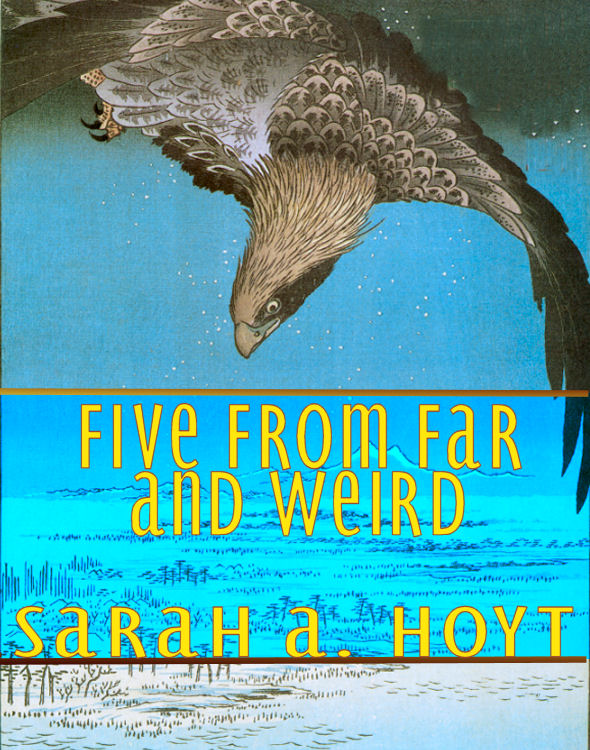
Five From Far And Weird

it contains  the short stories

A Grain Of Salt – When a Man wakes up in Chinese hell accused of defaulting on his tomb payment, he must wonder — and does — what has been going on since he died.  More than he can guess, it turns out.

Scraps Of Fog

The ghost of a Portuguese King comes to lead a girl to her own happiness.  I’ve been away from Portugal for so long, I think at this point this is a Portugal that exists only in my mind.  So, consider it as such.  As for the legend of Don Sebastian, that was one of the first I ever learned, though his being helper to the lovelorn never came into it.

The Girl With The Golden Lute

A girl, a mysterious pilgrim, crusaders, a curse…  This too is  based on a Portuguese legend, though I don’t think time-travel was ever considered.  Oh, I’m fairly sure I messed up Portuguese geography here.  Never mind, roll with it.  I was sick for geography (all of it.)

Magician’s Throne

There is a magical league that extends across all universes, including ours.  Here the place of magical gathering is a coffee shop called Magician’s Throne.  The story concerns a quest for the Arthur — i.e. the true king — and it badly wants to be a novel (with more characters, etc.)  I’m not sure.  As is it’s funny and short.

Dragon’s Blood

When an errant knight’s son goes looking to make his fortune in dragon’s blood, he ends up finding something quite different instead.  Quest fantasy with a twist.

Five Far Futures

contains

We Span The Night

This story was part of a challenge to write  a future diner.  I always loved Simak’s stories of sentient diners, and this one is an homage.

With Unconfined Wings

You’ve heard of warrior monks?  Well, the Nun’s of St. Lucia of The Spaceways are the distaff side.  They go to the frontier planets, deliver babies, comfort the dying, look after the poor and shoot the evil doers when needed.  Eventually there will be a series of stories about this.  RIGHT NOW it’s my bestseller by magnitudes, of the shorts and collections with Goldport Press.

To Learn To Forget

This is a combination of what happens to our minds if we hyper-age beyond what any human has ever done, combined with “in a space traveling future where we need every human, to what length will we go to rehabilitate criminals?”

Castor

This one is set in Athena’s (Darkship Thieves) universe about three hundred years earlier, just before the turmoils.  It’s one of my favorites, even if it’s a “war story.”

Yearning To Breathe Free

You know how you always hear the aliens are coming to tell us how to live our lives, etc?  What if it’s all wrong?  What if in all the universes only we came up with the idea of personal freedom and value to sentient life.  And what if we get flooded with REAL illegal aliens?

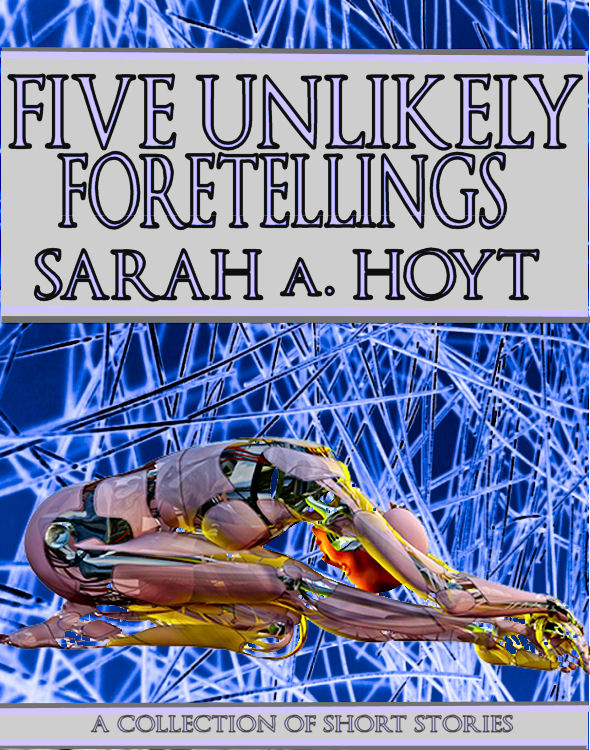
Five Unlikely Foretellings

Well, what can I say?  When I was trying to gather my stories in a rational way, I decided to do a collection of my most unlikely stories.

This one contains:

HOT

a retrovirus creates shape shifters.  A detective-shifter solves crimes in shifter community.

CREATED HE THEM

I got a call out of the blue from an editor friend.  She had a hole in an intelligent design anthology and wanted a story.  It was, of course, a mine field, but I tried to make it non-offensive.  It’s all about the next big thing.

ALL WHO ARE THIRSTY

And since we’re picking on religion…  What if we are the only people in the universe who have religion, and aliens are coming here for their fix?  I thought “Who would this bother the most?”  So I have an atheist working in a New Age Store.  (Evil grin.)

LOST

Would we know if there were aliens among us?  Let’s suppose they’re aliens in the same way star gate posited (this was written before.  It was one of my first short stories, somewhere in the late eighties.) They’re humans from parallel worlds.  How would we know?

TRADE WINDS

Carthage won the war with Rome.  Yes, the future DOES seem rosy, but kindly remember it’s from pov of a Carthage apologist.  OTOH, they DO have space travel.  (Sigh.)

And here’s the end of the Austen Fanfic, yeah, it’s short.  After this, I’ll just post the link to the beginning, then continue it on Saturdays.  The previous chapters are here and for those who read A Touch of Night, NO, I do NOT have a thing with rhubarb — what of it? :

“Come and look, Lizzy,” Lydia said, erupting into her older sister’s room, where she’d been talking with Jane, trying to understand the very odd events of the evening. “Come and look. Such a sight to see out of my bedroom window, you’ll never believe it.”

Lizzy traded a look with Jane. Jane had been telling her how much she’d loved Mr. Bingley, how he’d confessed to her that he was the man riding through the fields at night. That Jane didn’t seem to see anything wrong in riding about the fields in the moonlight in antiquated dress – that Jane could not seem to care that there was something very peculiar about these people – made Lizzy amazed.

And now she fully expected to see Mr. Bingley and Mr. Darcy riding through the fields on the other side of the house. But she didn’t want Lydia to suspect it, so she spoke, instead, in a light hearted tone, “What will I never believe, Lydia? Did the pig get out and ravage the rhubarb?”

“No, no,” Lydia said. A well-grown girl of fifteen, in her nightgown, her dark braids half-loosened, she turned around smiling and half dancing. “It is a detachment of red coats!”

Lizzy and Jane exchanged a look, and Lizzy said. “Impossible. There are none–”

But Lydia pointed at her open window, at which their sisters Kitty and Mary were leaning, looking down… At the fields, through which a detachment of red coats were riding. Not that it made any sense, Lizzy thought, because they were not hussars, and should they not be walking, and not riding upon such beautiful, glimmering horses?

But that they were soldiers could not be denied, and that their coats were red, it was impossible to deny also.

However, leaning from the window, it was easy to see this was no normal detachment, such as was often quartered in English towns. For one, they weren’t in the habit of issuing silver bridles for their horses, she thought – particularly not silver bridles festooned with countless little bells which made a merry sound in the summer air. And for another, even if a company of human soldiers might proceed singing, Lizzy doubted that their song would be so beguiling, such a perfect harmony with voices that seemed to be like light woven into the blue night.

Even their movement seemed to spark. And their leader, a tall man, with glimmering blond hair, and features that were more perfect than Mr. Bingley’s or Mr. Darcy, looked majestic and poised. Like the statue of a great leader come to life.

“Oh, look,” Kitty said. “They are riding straight at our house.”

Too late, Lizzy realized they were all clustered at the window in their nightgowns, looking down at a battalion, like common hussies. “Step back, step back,” she told her sisters, in a confusion of embarrassment. “Step back. Oh, Lord, they’ve seen us, they’ve seen us.”

The cavalcade had halted behind its leader, who had stopped almost beneath the window, and who removed his hat, which looked more like a coronet than a hat, and bowed, then smiled upward. “The fairest of them all,” he said.

He kissed something, then flung it. Lizzy’s hand shot out to hold it, before she knew what she was about. It wasn’t till after her hand had caught a green stem, till her thumb had got lanced by a treacherous torn, that she realized what she was holding was a glimmering rose, gold as the sunshine of a perfect afternoon.

Witchfinder — Free Novel — Chapter 12

UPDATE:  A SLIGHTLY EDITED AND PRETTIED UP COMPILATION OF ALL CHAPTERS UP TO A WEEK OLD IS HERE

*This is the Fantasy novel I’m posting here for free, one chapter every Friday.  I’ve been posting director’s commentary at the end of chapters, but I think it detracts from the experience, so I’ll do that on Sunday, instead, for the previous chapter.  If your conscience troubles you getting something for free, do hit the donate button on the right side and down.  Anyone donating more than $6 will get a non-drm electronic copy of Witchfinder in its final version, when it’s published.  This also allows us to buy the very expensive food that Euclid (upon whom Pythagoras, aka Peesgrass of the refinishing mysteries is based) seems to need.  And, oh, yeah, the cover sucks, but I haven’t had time for a new one.

Oh, this is in pre-earc format, meaning you’ll find the occasional spelling mistake and sentence that makes no sense.  It’s not exactly first draft, but it’s not at the level I’d send to a publisher, yet.*

For first chapter, look here

For eleventh chapter, look here

For tenth chapter, look here

Lady In The Lake

Seraphim sat in his sofa, wrapped in a dressing gown which made no more than a pretense of keeping out the cold, but did so magnificently, in shimmering green silk with a pattern of flying dragons.  He’d asked for his cane with the silver top.  But even such an obvious means of support hadn’t convinced Gabriel to let Seraphim get up and be about his business.

No, instead, Seraphim had to sit on the sofa, his hands atop the dragon-head top of the cane, his mind trying to follow, by sound, the very strange events in his household this evening and, more difficult, trying to make sense of them.

And Gabriel…  Gabriel had entered what Seraphim, with the cruelty of an older brother, even if he was in fact the younger, had been known to call his housekeeper mode.  He had marshaled the housemades to remake the bed, he’d got someone to bring in a bowl of sweet and magically harmonious pot-pouri to disguise the stench of burnt feathers and scorched broth.

He’d threatened to have more broth brought in too, but Seraphim had negotiated that distressing sentence down to a glass of cold milk, which he supposed must be making its way from the kitchens.

And Gabriel had set the gardeners down in the lake, with crystal balls affixed at the end of lanterns.  The attack had come from near the lake, or at least the would be assassin had been found near it.

Seraphim should have thought, as Gabriel obviously had, that any body of water that large, around which serious magic was made, would have recorded the sequence of events and the strength of the attacks.  And since it would come to a high court, the least Seraphim could do was make sure that there were crystal balls imprinted with whatever had been recorded in the water, to present to his majesty when the time came.

But Seraphim hadn’t thought of it, and Gabriel had, which was probably why Gabriel was the one to whom word was brought of whatever the new disturbance was.

The first sense of it the duke had was a shiver across the surface of his magic, as though someone had opened a portal between words nearby.  But it could not be a full portal between worlds.  It was something more attenuated and lighter.

Then there had come a knock at the door, and Gabriel opening it and mumbling something to a man outside, who mumbled something in response.  And then Gabriel started to close the door, and Seraphim had had just about enough.

“Penny, open the damn door and let the man speak to me.”  He understood well enough – perhaps better than other people in the household – Gabriel’s penchant for taking charge, for being useful.  He remembered – and wondered if anyone else did – what Gabriel had looked like when he’d been brought in, as Seraphim had then thought, as Seraphim’s birthday gift.

Though older than Seraphim, and obviously very similar to the heir of the Ainslings, Gabriel had looked gaunt almost to infirmity, his face had been bruised and he’d appeared terrified.  As though he’d been threatened with something even worse than the hunger and the violence he’d endured so far.  Seraphim had seen the look on Gabriel’s face as he encountered each of the features of life at the Darkwater estate: regular food, toys, a warm and secure bed.  He remembered Gabriel’s delight at the roaring fires in the hearths that first winter, his amazed joy at the sweetness of fruit in winter.  And he knew Gabriel tried to make himself useful, because at the back of his mind, somehow, he still thought the Ainslings would send him back where they’d found him.

He’d been afraid of being sent back after that bad business in Cambridge too, though if Darkwater had been asked – he hadn’t – Gabriel had been more sinned against than sinning, and the fault lay with that damned Merlin fellow, who hadn’t lasted much longer before crossing over to the dark arts, either.

But as much as Seraphim loved and understood his half brother, this was the outside of enough and he would not stand for it.  He would not be treated as a cross between an excitable maiden aunt and an invalid grandfather in his own house, “Penn,” he said, in a warning tone, as Gabriel hesitated, his hand on the door.  “Let the man in, I said.”

The man came in.  He was one of the older gardeners, and Seraphim felt peevish annoyance that he couldn’t remember his name and that Gabriel probably knew it by heart.

The man wore a crushed felt hat, a dingy coat, and pants that were obviously worn while working, judging by the clothes of dirt adhering to them.  To this was joined an overall dampness, and scraps of what might be aquatic plants here and there.  He removed the felt hat – he should have done so on entering the house, of course, but even in a duchal house, the garden personnel was sometimes insufficiently educated in manners.  Clasping it in his hands and turning it over and over as he approached Seraphim, he bowed, “As I was telling Mr. Penn, sir, it is the lady in the lake, and a right mess she caused with our recording of the magic sir.”

This speech caused Seraphim to wonder if the reason they were treating him as a doddering and senile grandfather was that he had, in fact, gone around the bend.  Because none of this made sense.  He had to admit ignorance, of course, but he admitted it in the most haughty manner he could conjured.  “What are you speaking of?” he asked.  “I do not have the pleasure of understanding you.”

“The lady in the lake,” the man said, as though the matter were obvious.

“Unless she brought a sword with her, then it is unlikely it is the lady in the lake as such,” Seraphim said.  “And even if she brought a sword with her, she would have to be an impostor, as I’m sure Arthur’s sword is still where it resides, in the royal armory.  So, kindly explain.”

Gabriel huffed.  It wasn’t very audible, and the gardener probably missed it, or else, if he heard it he would have thought nothing of it.  But Seraphim heard it clear as day and knew exactly what it meant: that “huff” was Gabriel’s way of telling Seraphim to stop terrorizing the servants and being hard to please, and close upon it, Gabriel lost what patience he’d tried to summon.

As the gardener continued to twirl his execrable hat in his filthy hands, and stammer something that never amounted to a full word, Gabriel interrupted, “if it please your grace, what Marson is trying to tell you is that a woman fell into the lake, as they were using the magic recorders.”

“Fell from where?” Seraphim asked, turning his inquisitive glance on Seraphim.  “The trees?  And is she a woman or is she–”

“She is Miss Helena Felix,” Gabriel hastened, cutting what he presumed – truthfully – was Seraphim’s question about the magical nature of the intruder.

“Ah,” Seraphim said.  “The capable Miss Helena.  She stayed behind, then, while I was ill?”  He was trying to imagine what Gabriel must have told his mother to justify such a thing.  Good heavens, by now he might very well be engaged to the woman.  He started to open his mouth, then closed it, because he remembered suddenly that he didn’t even know if he was in fact engaged to Honoria.  He had to get Gabriel alone and ask him a few home questions without being attacked by maniacs with bolts and spells.

“No.  It appears she found occasion to come to us again, though,” Gabriel said.  “Marson has taken her to the housekeeper’s rooms, to change out of her soaked clothes and get a cup of tea, while they finish the recording in the garden.  And he’s given orders that the gentleman who … ah… got unfortunately killed by the bolt you sent out in self defense be put in the ice house, till royal officers can take charge of–”

“No,” Seraphim said.  And looked at Gabriel’s surprised face.  “No.  I must see them both.”

Gabriel’s eyebrows shot up.  “Both?  Miss Felix and–?”

“The dead man,” he said, and continued.  “Penn, if you please send one of the housemaids to tell Miss Felix I require her presence immediately.  And Marson, kindly have four under-gardeners carry the deceased gentleman up.”

“What?” the gardener said, clearly shocked.  “To your grace’s room?”

Seraphim allowed himself a smile.  “If I were feeling more myself,” he said.  “I’d go down and look at the corpse myself.  As is, though, I don’t feel up to taking the flights of stairs down, yet.  And the description I was given of his being a gentleman of average features, with dark hair, and richly dressed, you must understand it tells me very little about who he might be or whether I know him.  As such, I’ll thank you to bring him up.  You can carry him down again, and fast enough.”

“Yes, sir,” Marson said, but left with the sort of haste that betrayed his suspicions about Seraphim’s sanity.  His haste did not escape Gabriel.  As both the maids and the gardener left, he closed the door softly and turned to Seraphim, “I hope you’re satisfied, Duke.  Your servants will now think you have gone irrational, or perhaps that you intend to dabble in necromancy.”  But it was obvious it was just a joke, and, his face sobering, Gabriel told Seraphim, quickly, everything that had passed between the time of his coming back from the pyramids and the present.

“And you claimed Miss Felix was your fiancé?”

“You see how important it was to know what your mother knows about me?”

Seraphim sighed.  “Knows, nothing.  Understands, I suspect near all.  You know she always detects you in falsehood.”

“Perhaps,” Gabriel said, trying to appear unconcerned, but he bit the corner of his upper lip, something he only did when he was concerned.  He opened his mouth as though to say something, but at that moment there was a knock, and on Seraphim calling “come,” the door was opened by two maids who curtseyed then stood one on either side of the door, looking like statues.  In between them, a woman walked in.

She wasn’t ugly, Seraphim realized, now that he saw her without either anger or fear distorting her features.   She looked concerned, she was soaked to the skin, her hair clinging to her head like a dark bonnet.  And she was wearing a voluminous grey blanket draped over whatever clothes she’d worn when she’d fallen in the pond.  But through it all, it was obvious her features were good, and that she had grace and poise worthy of a princess.

Miss Felix made that blanket seem like a trailing royal cloak, as she walked in to stand a few steps from him and curtseyed.  “I was told your grace wanted to see me,” she said.

“I did,” he said.  “I would like to know how you came to fall in my pond.  I presume it was not simply a matter of leaning too far over a branch.”

Miss Felix looked over her shoulder at the maids by the door, then back at him.  Seraphim nodded.  “I believe, madam, he said, that inconvenient though they are, your chaperones must stay.  You can’t be in a room alone with two men.”

She looked impatient.  He’d swear she rolled her eyes, and he could not reconcile her air of obvious quality with this unconcern or ignorance of the social rules.  “Very well,” she said, at last speaking in an undertone.  “But the thing is, your Grace, that I don’t know what to tell you.  To own the truth, the secret I could tell is not mine, and on it depends the life of someone whom I once thought–” She stopped.  “No.  On my silence depends the life of someone who might have his deffects of character, but who, I’m sure, has done nothing to deserve death.”

Which, of course, was when the second knock on the door sounded, and on Seraphim authorizing entrance, as Nell stepped a little to the side and turned to look, Mr. Marson came in, leading four strapping boys, who carried, between them, a pallet on which was a form covered in a blanket.

The pallet was lowered in front of Seraphim, and the blanket pulled back at the same time a lantern was brought near that he might better examine the face of the deceased.

Seraphim saw a face that looked wholly unknown, and much as had been described to him: dark hair, regular features, a certain appearance of gentility.

And then Helena Felix leaned forward towards the corpse and gasped.  “Antoine!” she said.  She sounded more shocked than saddened.  “It is Antoine.”

Before Seraphim could ask her what she meant, and who Antoine might be, he heard running steps and someone burst in through the door, without asking.  It was his sister Caroline, her dress rumpled, her hair in a mess.  She curtseyed hastily, and looked around as if shocked at the mass of people in the room.  Her gaze raked the corpse on the floor, but she seemed not to be at all surprised, more annoyed, as though all these people were here for the purpose of annoying her.

“Seraphim,” she said, in a scolding tone.  “Seraphim, it is the most unlucky thing for you to have everyone here, because you must come with me right away.”

“Caroline,” he said, and was about to scold her on her lack of manners.  He had no time.

“Yes, yes,” she said.  “I know I’m being very shocking, and it’s all very bad, but Seraphim, we think Michael was taken by the elves.  They left a changeling in his place.”

Mr. Shakespeare Is A Whirligig

Psst, guys.  Can we talk about the English Language?

Yeah, I know it’s your native language, and I am very grateful that you allow me to use it, really.  I love the heck out of it, finding it far more bendy than Portuguese, the language I first learned, or even French or German or any of the languages I learned after.

The truth is that before I fell in love with the US, before I fell in love with my husband, I fell in love with the English language.  By the time I’d studied it for two years, I was thinking in English.  Sometimes even out of class.

Oh, I’m not going to say I don’t make stupid mistakes in it, most of them due to what I’ll call “auto-complete” fingers and “Sound typing.”  What this means is that often I type in the first letter of a word and my fingers auto-complete the rest.  For instance, going over Darkship Renegade for the tenth time or so (I swear) I noticed the sentence “The first time he’d killed me” – yeah.  Yes, it should be “kissed” and don’t even ask me why my fingers think kill is more likely than kiss in the stuff I write, okay?  I don’t want to know.  As for sound typing, this manuscript is awash in way instead of weigh (and, weirdly, vice-versa) and more distressingly, because my accent is worse in typing than in speaking (yes, I know) leave instead of live.

Mind you, I know the difference between all of those words, and it would not occur to me to confuse them in the cold light of day.  It’s just while I’m following a thread of emotion or concentrating on describing a scene, the fingers go on their own and they’re remarkably dumb fingers.  And of course, I’m the world’s worst proofreader for my own stuff, unless it’s about ten years old.

I also have some genuine English As Second Language mistakes – most of these relate to never knowing if something is on or in (stop giggling you!) because English uses those in idiosyncratic ways.  Also I’m never sure idiomatically when to use “the” or the possessive.  Like… “She moved the chair” or “she moved her chair” I can usually figure out the nuances of, but if you get to body parts…  Is it “He moved the arm that had been restraining me” or “He moved his arm that had been restraining me”?  (Yes, I know that’s the world’s most awkward phrase.  It’s six am, I’m uncaffeinated and I was kept awake an hour in the night by some teen who stood in the middle of the street and yelled crazy stuff.  – No, not my teens.  I checked.  I counted them.  Why?  Because they sleep walk, and sleep-shouting wouldn’t be past them.  But they were both snug in their beds.  Probably not with visions of sugarplums, but I’m not swearing to anything.)

So, okay, I’m not without sin, and I’m not throwing stones, but listen here, lately y’all have been torturing this poor language, and I don’t like it.

When I taught English before I got married, I made a little cardboard model of a coffin, which I mounted on an axle, suspended between two supports, kind of like when you spit-roast something.  Then I put a handle on the top.  Then I told my students this was William Shakespeare’s coffin.
When my students butchered the language in particularly egregious ways, I used to grab that handle and give them the visual of Shakespeare spinning in his grave.  (What?  Well, they all gave me gifts and stuff when I quit to get married, so they must have LIKED me, right?)

Ya’ll routinely do stuff to the language that would grant a half turn on that handle.  Half turn because I figure it’s your auto-complete fingers.  Or perhaps your sound typing.

So, I’m not going to beat you about the face and head over things like alter instead of altar.  I will confess that it drives me beyond nuts, because of the image.  For some reason when I read alter I see the table at the veterinarian clinic.  If this is in a story I’m judging and on the first paragraph, you’re going to have to work hard to remove that image from my mind.  Just remember, if what you mean is altar — an elevated place or structure, as a mound or platform, at which religious rites are performed or on which sacrifices are offered to gods or ancestors – you shouldn’t be able to put ation in front of it and have a real word.

In the same way I’ve grown resigned to y’all using capitol instead of capital.  Yeah, it’s annoying, but I figure it’s because you have a capitol in your capital, and against that a mere ex-English-teacher cannot stand.  Remember capital is where government is, and therefore it’s spelled with to as, because it’s a as in a*s.

But then there’s the stuff you guys do that no human being should to a language which hasn’t done them any harm.  You take words and make them mean the opposite of what they should mean.  And this is when I reach for the handle of the coffin to make it spin.

Take, for instance descendants.  According to dictionary.com which, before you ask, is in fact RIGHT, it means:  a person or animal that is descended from a specific ancestor; an offspring.

PLEASE read that and memorize it.  Please stop telling me stuff like “my descendant in the twelfth century was an earl” because I’m a science fiction writer, and when you say stuff like that I immediately see time travel and it causes terrible disorientation.  The word you’re looking for is ANCESTOR (a person from whom one is descended; forebear; progenitor.)  If you need a way to remember this, please keep in mind that many cultures practice ancestor worship, while we might be the only one, in certain sectors of society where people have one single kid far too late, that is on the edge of descendant worship.

And while being on edge – yes, my darlings?  What?  Look, I’m female and I’ll be fifty next year.  I think at this point, if we could weaponize me, the world would tremble.  So listen – note I did not write that we’re on the precipice of descendant worship (though in this case it might be, in a moral sense, apposite.)

So, why didn’t I say that?  All the hip people say that.  Yesterday, some serious article, quoting some serious economist informed me that we’re not yet on the precipice of job creation.  The odd thing is that he didn’t mean this was good news.  A president who shall remain unnamed because I was preparing to send rescue parties to the earthquakes around Stratford-Upon-Avon told us we were on the edge of a precipice of achievement.  (Okay, then, he might have meant what he said.  I’m so not going there.)  And tons of other, exquisitely educated individuals among you have started using this.  STOP it, just STOP it.

Since then I’ve seen this usage crop up everywhere and I’m getting REALLY tired of it.  Yes, it’s a long word and it sounds learned.  But if you feel like using it, please remember according to dictionary.com, which is somewhat unclear, precipice is: 1. a cliff with a vertical, nearly vertical, or overhanging face. 2.a situation of great peril: on the precipice of war.

Number two gives you the clue for how number one is meant.  You guys are thinking of it as when people are riding in old west movies and come across a wall where the terrain goes up, right?  Well… blame it on old dictionary.com.   But the second gives you a clue to how they actually mean it.  It’s more like the coyote in Road Runner cartoons.  He’s running on the road, runs off the edge, and then realizes he’s running in mid-air and phuit, down he goes, a huge distance.  That, without the sound effects or coyote is a precipice.

So, trust me, you don’t want to be on the precipice of great achievement.  And you certainly don’t want to be on the precipice of job creation (though we sort of are.)

Stop saying that.  Or not.  I hear that Great Britain has hooked Shakespeare’s coffin into the electrical grid.  It’s powering London.

Play It Again Sam

For years I’ve assumed I had a problem writing sequels.  Part of the reason to drive my poor publisher insane by redoing a book at the last possible moment, which I’m doing with Darkship Renegades comes from this.  I feel Darkship Renegades is inferior to Darkship Thieves, and I’m trying to fix that.  I felt the same way about Gentleman Takes a Chance towards Draw One In The Dark, and having read both recently, I think this is true, for various reasons (partly because I was SO depressed while writing GTAC, but that’s something else.)

It’s not a marked difference, mind, I just thought the sequel didn’t quite hit the right note.  This might be subjective and predicated partly on the fact that I THOUGHT I wasn’t good at sequels.

Why am I saying “thought” as though this were somehow illusory?

Because I realized, when Iw as discussing this with someone today that in fact I can write sequels just fine for some of my books – to wit the mysteries.  I never wrung my hands and went “I don’t know how I can write a sequel to Death of A Musketeer.”  It was baked in before I wrote the first book: these are mysteries, each focusing on one of the characters.  Same with the Refinishing mysteries.

I think the difference is that my fantasies and science fiction start from the character, while the mysteries are “plot books.”  They start from the plot inward.  This is not to say that Darkship Thieves is not plot driven – of course it is, also – or that the musketeer mysteries don’t focus on character – of course they do, to an extent.

But it’s where the primary force is, and how the book presents itself to me.  Athena came to me, in Darkship Thieves, as this seriously messed up chick, by the end of the book she’s almost functional, and though I planned on a sequel, it’s weird to be in the head of a “calmer” Athena.  With the first shifter books, Draw One In The Dark, Tom was SO severely messed up that when I got him settled at the end, it seemed almost nasty to disturb him for a second book.

And yet, you know and I know, if you love a book you need to go back.  You want to go back, as a reader.

So… how to reconcile that?

Well, first, I rid myself of the idea I can’t write sequels.  I think part of the reason for this feeling is that my first series, the sequel got so severely messed around with by agent that I got convinced I couldn’t do it.

Once rid of that idea, I think I need to give myself permission for writing the sequel different from the first book.  Because there’s a built in it should be “the same.”

And then, at least with Darkship Renegade, I need not to be depressed <Grin> – I say this because it’s so much easier to see where I “stuttered” in narration due to depression.  I mean, I’m dragging around the creeping crud, and I’m still able to see this much clearer now I’m not depressed.

AND when possible (if the Earth Revolution series comes to pass, for instance, but also for other books/series) I need to set up the sequels so they have different characters – at least when the book is intensely character driven.  This is often used in Romance, for that reason.

For instance, in Noah’s Boy the Shifter series starts pivoting slowly away from Kyrie and Tom.  Oh, they’re still there.  The George is still the center of the action.  And the next two books, Bowl of Red and POSSIBLY Balloon Juice center around their relationship as much as the other plot, but the other plot starts pivoting away from them and towards the other people: Rafiel first, then Conan and THEIR relationships, so that Kyrie and Tom become only one of the legs of the series, as it were, still there, still important but not the fulcrum.

Again, this is done a lot in Romance, because of the “compelling character problem” that drives the plot, and it will – I think – work well for other series too.

What do you think?  Do the readers always want the same plot/book with different names?  Or do you want characters who grow in different ways?  And how would those of you who are not primarily romance readers feel about the “moving among a group of characters” thing?

Hearing Trumpets

Years ago, during one of the Oregon WRITING (as opposed to publishing) workshops Kris kept complaining everything we sent in had “occluded” voice.  I know what she means.  It’s like when I do a painting, then scan it in, and something goes wrong.  All my vibrant colors go faded, like they’ve been under the sun a long time.

To remedy this she had us do a very odd exercise, which I’m not going to explain, but let’s just say it took us WAY out of our comfort zone.

When reading it, she said it was like spending the whole week hearing tin whistles and now there were trumpets.

This is kind of what I feel like with A Few Good Men vs. Darkship Thieves (or Darkship Renegades.)  Which is why I’ve done something unprecedented and asked my publisher to stop mid-read on DSR and let me fix it.  Most of what I’m fixing is the end, mind, but I’m also redoing the first five pages, and doing a thorough clean up in the middle.  Because after all my fights with that book, this is a matter of “I was blind, but now I see.”

Now, this might happen anytime you let a book rest for a few years, but I didn’t, of course.  It was only a couple of months.  And I’d tried that before, which is why it’s so late.

So, what changed?  The transformative (no other explanation) experience of writing AFGM.
Why was it transformative?  I’ve been thinking about that, because of course, I want to replicate it.

I think for me – and mind you, this is JUST for me.  You’re a different person – these are the main factors:

1 – I wrote it on spec, not under contract.

I’ve suspected for a LONG time this was a problem for me, and have in fact discussed it with Toni at Baen (My long-suffering, very patient publisher mentioned above.)  No, this is not something I’d choose to be like, if I’d got a choice.  Writing things to contract is better because you have security.  Much better.  Except that my mind locks into “It’s due and I don’t want to do it.”  Possibly it’s my issues with authority.  Possibly it’s that I’m broken, but I think it’s more and less than that.  Yeah, if it’s due it becomes “homework” – I remember when I had an history test ALL I wanted to read was physics and vice-versa.  BUT the other part of it is that if it’s not sold, there’s no one looking over my shoulder.  I don’t subconsciously try to prod the book in “a direction the publisher will like” or stop myself if it goes away from that.  This allows me to experience the book, to live it, to make it truly mine.  Hence, the trumpets as opposed to tin whistles.

2 – I knew if it didn’t sell I could bring it out myself
This too is important because before I tried to write things out of contract and they just died halfway through, normally when I went “Oh, no, this will never sell, why am I wasting time.  So, this again frees me to create the way I WANT to.

3 – I wrote it when it wanted to be written.  Oh, I made it wait while I delivered DSR and the mystery, so the first fifty pages were there.  But then I pushed the other three due books aside and let it come through.  And it did.  Poured.  At the rate it wanted to.  I can honestly say the most apt phrases in the book I don’t remember writing.  (Not the most beautiful, I don’t write for beautiful language) but the one sthat completely capture it.  Once or twice while reading over AFGM I went “I wrote that?”  So…

So, what to do going forward?  I shall see if publisher is willing to work with letting me just do books on spec – she’ll probably get them faster, to be honest, if I’m not fighting myself.

And, once contracts ARE finished, I’m going to let popcorn kittens have their way, with only one rule: must finish one book before picking up next one.

My guess is the trumpets will sound loudly.  I’ll let you know if I turn out to be wrong.

Letting the Urge Pass

I’ve been neglecting my drawing… pretty much this last year.  Between figuring out what was wrong with publishing (TM) and working on the new process to get words in front of readers, and the year of the great travels (okay, they weren’t great.  But they were continuous, at least a week and often two out of the house from May to September) I didn’t take any courses and I haven’t devoted much time to drawing since the New Year’s vacation almost a year ago now.  An afternoon here and there, but not much finished and no concerted effort.

This morning, as I sat at the breakfast table waiting for tea to kick my nervous system into a semblance of consciousness, I looked out at the large tree in front of the kitchen window and I thought with the cold morning light and the bits of snow it would be interesting to draw.

I didn’t do it, and I’m still craving it.  But drawing would involve finding my drawing kit (weirdly not on the desk with the pastels, I looked.  I need a different desk where I can organize things) and possibly three to four hours making small changes before I have a halfway functional sketch.  And today I HAVE to finish editing Darkship Renegades and a ton of other stuff, and I’m still recovering from whatever this crud was.  I keep creeping halfway to wellness then falling down again.

But as I got up to put the tea cup in the sink, thinking “I’ll get to work on writing.  The urge to draw will pass” I remembered a conversation with my dad about three years ago.  My dad’s first degree is in art, but he had to do commercial art and then engineering, to put food on the table.  (Pesky tables, always needing food.)  I think he was always a little disappointed that we didn’t have an inclination for art, or that I did, but gave it up at 14 to concentrate on writing.  So, I was showing him my drawings and explaining that after I got concussion 9 years ago, I got an almost unbearable urge to draw, so I went and took art lessons, and started drawing in my copious spare time.  (And no, I have no idea how severe concussion does that.  You figure it.)  And he said “If you ignore it long enough, the urge passes.  Now it’s gone.”

And you know, the way he said it, it was the saddest thing in the world.  He used to talk about pursuing art and his poetry in retirement, but he says now (of course, he retired at eighty) he just doesn’t have the drive anymore.

And then as I was coming up the stairs, I was thinking I treated my writing like that for years, too.  There was college to finish.  And then – even with my husband’s support of my writing – there was work, and then kids.

I probably would never have pushed seriously – a short story a year is NOT serious, even if one submits it and works hard at it – except I ended up in the hospital with near-lethal pneumonia (11 days in icu) fifteen years ago now.  The doctors thought I was going to die.  I thought I was going to die.  My husband was the only one who thought otherwise, and, as you see, he’s a very forceful man.

Anyway, lying there, contemplating the probability of death in the next few days, I thought of what I regretted most.  Of course, at the time the boys were four and one, and I was almost frantic with worry about them.  My husband is a wonderful father, but he’d have to work, which would leave the kids in the position I most didn’t want, in the position I’d promised myself we wouldn’t put them in when we were going through near-endless infertility treatments: being raised by hired strangers.  I worried, and felt very regretful that they probably wouldn’t even remember me.  I worried about our finances too, since these were the hardscrabble days, and while I was home I earned my pay in how I shopped, and buying furniture really cheap (used) then refinishing it (furnishing a whole house for about $500 and having it look decent is possible) or even making stuff.  Without me, the family lifestyle would tumble down several notches.

BUT hard behind that worry was worry about my writing.  I had all these started novels.  And written novels.  I had worlds and characters in my head no one else had read.  They would die with me.

For some reason this was as unbearable as the thought of orphan kids.  Which is why as soon as I recovered, I returned to writing with a vengeance and started treating it as a serious endeavor.

Have I sometimes wished I hadn’t?  Sometimes, in the last four/five years.  BUT now it’s starting to come back to what it’s supposed to do, and the rewards (trust me) outweigh all that.

So, what is this post about?  Am I telling you to do it before the urge passes?  I don’t know.  I’m not living your life.  For instance, I’m not going back downstairs to draw the tree, because I DO have editing to do.  I will however make a decision, going into the new year, of taking at least a couple of classes and trying (my best) to give a couple of hours to drawing or painting every week.  Because even though it will never be my main work, it is something that seems to help the writing (and vice-versa.)  And because I think the urge is precious.  And I don’t want it to go away.

The Structure of A Short Story

I’ve lately been reading a lot of my own stuff, which is one of those things you shouldn’t do while sober, particularly if said stuff is more than a couple of years old.  (Read your own stuff, I mean.  Of course you should read mine because you know, I was born amazing.  Also because, frankly, I have NO idea what ya’ll will like… or not)

It’s actually a great setup because they don’t read like mine, so I can copyedit to the limits of my admitedly not detail-oriented ability but they still feel enough like mine that I see EVERY flaw as though under a magnifying glass.

Did I say that’s a great setup?  Well it is, if your goal is to clean the stories up.  For the writer’s ego, which in my case is so collapsed most of the time it might as well be a blackhole, it is a disaster, but never mind that.  I think I have enough rational detachment not to roll up in ball and cry at how bad stuff is.

I did come up with what seems to be a few idiosyncrasies that bear noticing, such as my penchant to have people attacked in their sleep and/or the shower; my penchant to have any woman who plays a musical instrument be pure evil (the men tend to be sweet, though.  Go figure); my penchant to destroy the Natural History Museum, etc.  At least give me props, though, for no longer stalking Kit Marlowe.  It takes effort, but… Stalking a dead man is just evil.  Also, he probably didn’t swing that way. (Actually hard to tell, as Elizabethan England was more… fluid.  But Marlowe is as close to an indication of leaning [or falling over] as we have.)

However, reading these many short stories in a row gave me indications of several things, like “Short stories, I was doing them wrong” – or not wrong, but now I can see how I truncated things to fit within word limit.  You see, I’m a VERY lazy person and I hate doing work for free.  BUT it turns out that when unfettered – the few stories I wrote since realizing I could go indie with them – I tend to 10 to 15k words, not 6.

On the other hand it also gave me a clear idea of how I – note I said I, I’m not telling you everyone should do this! – structure a short story.  I thought it might be of interest to the writers among you.  So, here’s what I’ve discovered.

1- First line or two, introduce the most startling or grabby thing about your characters/setting/situation.

2 – Use the rest of the paragraph to lay out character/setting/ and most of all problem.  You might want to lead with problem as that brings out the most interesting things about your idea.  (If your idea isn’t interesting, WHY are you writing it?)

3 – Next few pages –Develop the present situation which your character is caught.  This situation is usually not the main problem, and you should have at least one try/fail before getting character out of the PRESENT situation.  About 1/4 of the way through the story, have the character realize what the REAL problem is.

4 – Initiate try/fails to solve the main problem.

5- Around middle of the story have character realize he was going about obtaining goal the wrong way or that his/her assumptions were oh, soooo wrong.

6- Activate cunning plan.  (This normally doesn’t involve a turnip, on account of not being a Black Adder story.)

7 – Try fail sequences set up about 3/4 through the story.

8 – Black moment about 1/8th from the end.

9 – resolution and usually not much of what my husband calls a cigarette moment, because it’s a short.

There are exceptions to this, but this seems to be my basic structure, and I probably could outline a short (if needed – might be, I’m out of practice for shorts) by going in and filling in the events at each of those points for whatever the story is.

And now, having got up indecently late (getting over re-crudescence) I’m going to get coffee.

Freezing in Colorado and Austen Fanfic installment

Sorry to be ridiculously late posting this but after an early wake up to get #2 son to an event on this snowy morning, we got back in bed to stay warm.  I have been reading a stack of books on being young in England just before WWI — not sure where this is leading yet.  It’s one of those cravings.  Some glimmer of a mystery series, maybe, but when I don’t know since there are all sorts of popcorn kittens ahead of it.  We shall see.

Meanwhile, despite being cold I couldn’t stand being in bed anymore, and besides I have copyedits on Sword and Blood (under pen name Sarah Marques) to go over, I have Darkship Renegade to do a last pass to (I have a theory that now that I’m no longer depressed I can clean it up a bit — might be wrong, who knows?  But I had a sense of the voice being slightly askew on that one, I just couldn’t fix it.  We’ll see if I can now.  BTW this might be imagination, as I felt the same way about Darkship Thieves, but four years after writing it reads fine.) and it needs to be at Toni’s and done by Sunday evening.  There’s also a Musketeer Vampire world novella to finish.  Oh, and the trademark “Kitten and Dragon Christmas Card” to draw.  So.  No rest for the wicked.  I’m up and about to go fight the coffeemaker, then get dressed in something warm so I can work.

I should go to the thrift store and see if I can find something for an art desk that allows me to use the monitor for models, but this MIGHT wait till next weekend because I don’t know about y’all but I don’t feel like carrying heavy furniture in light snow.

Now below is the continuing installment of Between The Night And The Morrow.

Through the flawless palace of fairykind Prince Darcy came striding, his spurs striking the glimmering floors in rhythm with his angry footfalls, his mouth set in a tight line, his eyes flashing the fire of displeasure.

If he were asked, he could not even say what had first disturbed him. The way Miss Elizabeth Titania Bennet so adroitly set the spells of enchantment upon him, or the way she’d let her middle name slide out so smoothly, so uncaring. Worse, he couldn’t tell if the fact that his anger was not directed at her had more to do with the fact that she had bespelled him, or the fact that he’d been lied to by his king and grandfather.

He and Bingley, aye, and Carola, also, had ridden their fairy steeds from the mortal world and through the magical forests of the night, on the way back to the hill, and he was vaguely aware that Bingley had tried to talk to him, that Carola might have tried to gentle him. He had some confused memory of her hand on his arm, trying to call him from his black mood, but he had not talked. And he’d not stopped. He’d spurred his horse on, and now he drove himself on, ignoring the courtiers that bowed and the ladies that curtseyed, and even Georgiana who said, “Fitzwilliam!” – his childhood name.

And now that he thought about it, it struck the ear as a very unlikely name for a fairy prince, a Lord of the elves. And now that he thought about it, he felt his teeth grinding upon each other, even as he heard his sister’s agitated steps speed up to catch up with him.

In vain, as he’d reached the doors of the throne room, smooth, polished doors being opened for him by two tall elves with the dark hair of the southern peoples, the marble countenance of those brought up in the king’s service. The King! Prince Darcy’s grandfather, who had much to explain!

He sat in the throne, in his full majesty, Titania beside him, the lady for whom Miss Bennet was named, and Darcy snorted at it, and approached far too close to the throne before he remembered to halt and bow. And even then he would never have done it if the guards at the foot of the throne stairs hadn’t moved, in a sudden slide, as though to block his attack. He wondered what his face must show – and what his magic flare – if they’d react thus to a prince of the blood.

“Darcy!” the king said, a tone of surprise in his voice, but he did not ask what happened, nor demand that Darcy give a report, as he doubtless would normally do. Instead, he stared at Darcy, his mouth a little open, his eyebrows rising. And Titania, his lady, leaned into him and clutched his muscular arm with her delicate hand which appeared to be gloved in spider web woven entirely of silver. But she said naught.

“Your majesty,” Darcy said, after what felt like a very long time, in which he strived to find his voice. And then, because he felt as though he needed to remind himself of these honors, as much as he needed to remind the one he addressed, “Sovereign of the high court of the elves, Commander of the magical isles, King of the storm and the lightening, Emperor of the Air,” he took a deep breath. He saw his grandfather start to half rise from the throne with alarm and wondered how oddly his voice must ring. “Whyfore did you lie to me?”

The king opened his mouth, then closed it, then opened it again. His wife’s hand squeezed his arm, visibly. “I?” he said. “Lie?”

Darcy inclined his head, not only in respect, but because he’d prefer to look at his highly polished boots, and the silver spurs shining on them, than at his grandfather’s face, right then. What he read there, he was afraid, would lead him to commit some folly. “You, your majesty, lied to me, your own kinsman, you liegeman, as you sent me out to brave the mortal world.”

The king said nothing. Perhaps it was better that he did not speak, Darcy thought, and looking up, he found that the king was looking at him, his expression indecipherable. “You lied to me, your majesty, when you said that the Bennet girls were descended from your majesty.”

“But–” the king said, and looked genuinely puzzled. “But… they are!”

“Oh, aye, and that they might be, but you know, as well as you know the uncounted years of your unnumbered life, that there are ways to lie which have nothing to do with words. You led me to believe… you led me to assume… that these girls were the result of an… an encounter with a mortal. Nothing more.”

The king again didn’t answer. Darcy fancied that he looked paler. “When in fact, your majesty…” he cleared his throat. “Both your majesties know that this cannot be true. That these girls are, in fact, descended from both of you. That my grandmother is these girls’ ancestor as surely as you are… grandfather.”

The magic the king tried to throw at Darcy was so clumsily aimed that Darcy had time to see it coming and to block it. He realized it was supposed to compel him to keep his mouth shut, at the same time that his grandfather must have realized it had missed. He brought his silvery eyebrows down over his eyes. He glared at the assembled company, and then down at Darcy, “This is not the place, son,” he said, using a word and a tone he rarely if ever employed to his grandson. “If you feel yourself injured, if you wish to discuss this, you must come with me. Into my private chambers.”

Darcy closed his hands tight with rage. “I wish we’d speak before the court.”

The king’s eyebrows went up, in disbelief. “Is this your challenge then, grandson? Do you intend to rule this kingdom tonight?” He spoke with incredulity, and his wife’s hand squeezed his arm tighter, and she whispered something in his ear.

It was the look on their faces, which should have been anger, but was not, that brought Darcy to his senses, in a sudden, cold awakening, as though he’d been doused in freezing rain. He knew that sometimes, in the smaller hills under his grandfather’s command elf lords fought their heirs – or their rivals – for the domain. He’d never heard of its happening in the halls of the high king. But then there was a lot he’d never heard of happening. And he realized, in a crash of sobriety that didn’t set his anger in flight but made him rise above it as though it belonged to someone quite different, that if it came to that – if he challenged his grandfather – he would lose. And then what would be left for him, but that mortal world, and those flawed creatures out there? And all while the traitor rounded, seeking to destroy all of fairyland. No.

No time for family quarrels. He forced his hands to open and inclined his head. “Your majesty commands,” he said.

He saw Titania’s hand unclench from Oberon’s arm, as both king and queen rose, and the court fluttered out of the way, and the chamberers moved, fast, with torches and lanterns to light the way along the glimmering hallway, and throw open the door to Oberon’s private chambers.


Witchfinder #FreeNovel, chapter 11

UPDATE:  A SLIGHTLY EDITED AND PRETTIED UP COMPILATION OF ALL CHAPTERS UP TO A WEEK OLD IS HERE

*This is chapter ELEVEN (can’t count) of witchfinder, the Fantasy novel I’m posting here for free, one chapter every Friday.  I’ve been posting director’s commentary at the end of chapters, but I think it detracts from the experience, so I’ll do that on Sunday, instead, for the previous chapter.  If your conscience troubles you getting something for free, do hit the donate button on the right side and down.  Anyone donating more than $6 will get a non-drm electronic copy of Witchfinder in its final version, when it’s published.  This also allows us to buy the very expensive food that Euclid (upon whom Pythagoras, aka Peesgrass of the refinishing mysteries is based) seems to need.  And, oh, yeah, the cover sucks, but I haven’t had time for a new one.

Oh, this is in pre-earc format, meaning you’ll find the occasional spelling mistake and sentence that makes no sense.  It’s not exactly first draft, but it’s not at the level I’d send to a publisher, yet.*

For first chapter, look here

For tenth chapter, look here

The Spider And The Web

Nell woke up.  She woke up with no consciousness of having been asleep, or any time having disappeared.

It was rather like waking or dreaming she’d wakened, and not being sure which.  Had she slept before, when she’d imagined herself in the sunlit park with Sydell?  Or did she sleep now?

Now she was in the same park, but it was the dead of night, and the park was deserted.  Strangely, it was winter too, though it had not been cold when she’d been there during the day.  Now there was frost on the trees – or at least something white frosted the branches.  The lake stood motionless like a mirror.  There was no sound, either, though the park was not that large and from where she stood she should be able to hear the noise of carriages trundling through the night, or at least the noise of swans splashing in the lake.  Any noise.  Anything, even the rustle of leaves or grass blades.

Instead, everything was very quiet.  It felt as if she were trapped in one of those dreams where silence has a physical presence and can envelop all.

She took a step forward, and that too was like walking in a dream. *I don’t like it* she thought, but the truth was that she didn’t have to like it.  She didn’t have to give consent to it.

“I am asleep,” she said, but the words came to her oddly, and she knew she wasn’t.  Each step she took seemed to weight too much and take too long, and she walked all the way to the edge of the lake, slowly, very slowly.  Every step seemed to take a million years.  Each moment was unnaturally prorogued.

“I must think,” she told herself.  “I must think where I am and how I came to be here, and what I must do.”

“Sydell.  I met with Sydell and he rifled through my mind and took from it all the matters pertaining to Seraphim Darkwater and to whatever it is he’s doing with the other worlds.  All of it.”  And that was bad and she knew it was bad, but she didn’t count on the surge of panic that followed those words, on the feeling that there was more in her mind than pertained to the fate of two very nice, but let’s face it, somewhat hapless young men who had broken the law in pursuit of justice as they saw it.  No, there was more there.  Enough, she thought, that could tilt the universe on its axis and make the world a very dangerous place indeed.  Antoine had told her–

But when she tried to pursue what Antoine had told her, it receded before her mind, and she couldn’t pin it down.  Something about her mind and its memories.  Something about locking them from prying eyes.  “But you should have taught me how to do it, Antoine,” she said, talking to the still air, the silent night, the cold-frosted trees standing, their pale branches gleaming in the moonlight like lost souls begging for mercy.  “Because without you, my mind has got rifled through and picked, and whatever Sydell found in it caused him to send me to–”

To send her where?  She’d reached the edge of the lake and looking down she saw the water.  It was water, but it was unreally smooth, like a mirror, so smooth that it might well be solid, like glass calm and unreflective.

And from a place a long time ago, when she’d been just a young computer programer, who seemed to have fallen into a fantasy novel and in love with a powerful wizard, she heard Antoine’s voice talking.  “Sleeping Beauty,” he said.  “Why do you think she slept a hundred years?  And never woke?  And never tried to fight her enchantment?  Why do you think all those around her slept?  The brambles never grew.  That is a silly invention in your world.  And no mice nested in the cupboard, no rat nibbled the sleepers.  Do you know why?  There are worlds in between the worlds that exist anew each ticking of the clock.  Each time the clock ticks, reality hesitates and wavers, as many possible futures rush in and solidify into one.  Just one present.  Unending futures.  From such unending worlds, though a magical accident, the multiverse’s many worlds were created.  But in each of these worlds, the infinity of futures coalesces to just one second of present.

“And between those many futures and the solidified present lies a unit of time.  It’s so brief that in it your heart would not have the time to beat once.  It is so long that, to someone caught in it, it will last forever and the future will never arrive.

“A strong enough magician can spin another human – usually just one.  One shudders at the thought of what it would take to really spin an entire castle and all its inhabitants into that space.

“– into that time.  That time between future and present.  That time that will never be present nor future nor past, but a place apart from time.  In them no one dies, though it could be said no one really lives, ever.  And you can stay forever, imprisoned.  Alone.”

Alone, Nell thought, looking at the water still like glass.  Alone.

But there was a way out.  There had to be.  Sleeping beauty had come back.  The prince had kissed her.  But that would need a prince, would it not.

“So I’m out of luck, since all I have is a duke.” she thought and wanted to laugh, which is how she knew she was really tired and really scared, because laughter was inappropriate in here.  Laughter had no place in this land where nothing would change and where she would be a prisoner forever.

No.  No.  there had to be a prince and a kiss.  There had to be a way of attracting him.

The problem of Earth, she thought, and the problem of growing up on Earth was that one never got the to learn how to get out of these kind of situations.  If you could believe the people of Avalonis, the Earth and Avalonis, and the hundreds of other earths had all spun from the same unified Earth.

The theory of when it had spun apart varied, and some maintained it had happened well before human history begun, and others that it was as recent as a few hundred years ago.  Yet others, saner, thought that it had taken place at different times for different worlds.

But all of them believed they’d all come from common stock and had common legends.  And that these legends, perforce, came from similar events, or encoded similar knowledge.  And by and large that was true in Avalonis, where one could learn from the perils of Cinderella – although mostly what one learned, at least according to Antoine, was not to perform love-spells involving one’s own father and a nice-seeming neighbor lady, when one was a very young and inexperienced witch.  And as for Little Riding Hood, that charming cautionary tale had prevented many a young girl from giving her pet dog characteristics of her human playmates in order to have him better play house.

But Nell didn’t think that anyone had ever told her what the real meaning of Sleeping Beauty was.  And in the world in which she’d been so fortunate as to grow up, the best known version said that she should send blue birds or something of the sort to call Prince Charming to come and get her out of this bind.

She snorted loudly.  So much for Prince Charming.  If he only answered to dial-a-blue-bird she’d be lost in here forever, and he’d never know where she’d gone.  Because, after all, nothing moved here.  No bluebirds.  No wind.  Not even air.  And she only remained alive because she couldn’t die.

But she could move, her mind protested.   She was an intelligent being and she could move, even though the rest of this world might be locked between past and future, never being present.  And if she still had the ability to think and to move, then the only thing that she could use to call someone to her rescue was … her own mind.

Part of her wanted to rebel and to say that she needed no one for rescue; that she was a self sufficient woman; that she’d been taught to rescue herself.  But the old legends didn’t work that way.  They were older than mankind and certainly older than any vestige of self-determination, than any idea of females being embarrassed for being beholden to a male.  The legends, and the puzzles they encoded went all the way back to the beginning, when a human without a tribe was lost, and when a tribe was often just a man, a woman and their offspring.  In those times, in that place, you needed the rest of them to rescue you.

That meant… that meant, she thought, that if she had bonded with someone, preferably someone male, she would be able to now call her to him by magical means, and he would break through the frozen stillness of this nowhere place and rescue her.

But she had never bonded with anyone.  Well, not that way.

“Perhaps Antoine,” she said, aloud, and tried to take it seriously, but she knew it wasn’t.  Antoine was just a dream.  He had been the dream of a young girl – the extraordinary, enchanting wizard who existed even though all the laws of the world said he shouldn’t.  But lately, just as they landed in Avalonis, she’d started to wonder if he was truly all she’d thought, if he was as powerful, as urbane, as learned, but most of all if he was as good as she’d willingly dreamed him.

She didn’t know the answer to that.  She still didn’t.  But she knew that having doubts had severed the connection between them.  If there had ever been a connection.  Now when she tried to reach for Antoine’s essence, for his magical strength, she felt nothing.

It was like pulling at one end of a rope, which was supposed to be tied to solid rock, and instead feeling the rope come up, all of a sudden, slack and too light.  It was like taking a step in the dark and finding nothing under one’s foot.

Antoine would not work.

Gabriel, perhaps?  Gabriel Penn had seemed a good solid man.  She’d liked his strength and his persistence, and his refusal to let his half-brother die.  Given what the society was, and the difference in their positions, she could only imagine how many slights and insults Gabriel must have endured, and yet he was willing to risk it all for the legitimate heir.

Yes, he could be a rock in times of trouble, and though she’d not perceived any attraction from him to her, he had told the duchess they were engaged.  Perhaps that was a sign of a wish he dared not express?

She looked at the lake, in the frozen not quite light of the not quite night.  It wasn’t she realized, that it was nighttime here, but more that the light that was here had solidified like water.  It was light on the trees, not snow.  And yet she felt colder just thinking about it.

Her mind, gently, carefully, quested in the direction of Gabriel Penn, thinking of him and of the power she’d perceived from him, and trying to establish a connection.  Even if the connection was no more than a vague interest from him, that and her good will ought to establish a bond strong enough to–

To what?  To have him ride up to her rescue?  No.  She didn’t think so.  She suspected it was more that establishing a bond would make it possible for her to pull herself up to where he was, to drag herself from this frozen never-was to the present.  Wherever he was and whatever he was doing, as embarrassing as it might be, at least it was somewhere alive.

Her questing mind met with something.  It wasn’t like looking for Antoine and finding nothing where his mind and power should be.  Gabriel was a solid presence in her magical quest, taking up a solid portion of her magical map.  But when she tried to pull up, to pull to him, to feel him – her mind careened into a blank wall.

No, not a wall, a gate.  She could see it in her mind’s eye – tall and made of something hard and cold.  Metal, or perhaps stone.  And locked.

For a moment she thought of shaking the gate, of rattling it, but realized it was less than forlorn hope.  The gate dwarfed her and loomed over her, and there was nothing in her human form that could open that.  From beyond it came a disturbing song, in a language she couldn’t understand.

She had the impression quite suddenly that the real Gabriel Penn was someone quite different, quite other than the servants he appeared to be.  It was nonsense, but…  She felt him as almost an alien being, someone she couldn’t hope to comprehend.

That left…  She gritted her teeth and through her mind passed in review the many people she had met in her time in Avalonis.  Most of her meetings with men were less than inconsequential.  Other than Sydell she’d had no constant male contact.  And Sydell had sent her here.  She was sure of it.

So that left…  Seraphim.  What possible contact could he have with her?  Well, he’d risked his life to save her.  But he’d risked his life, too, to save the lion boy, and yet she didn’t think that he had any interest in lions.  Or in boys, for that matter.

But he was kind and he was – if she guessed his character properly – hard put to resist the claims of someone in need.  And she was in need.  So, if not with her attraction, she could forge a bind with her need.

Thinking of her great need and that without him she would be locked in here forever, worse than a ghost, neither dead nor alive, till she went slowly mad in an eternity of solitude, she reached for the power she’d seen as Seraphim Darkwater’s.  At the same time she called the duke’s aristocratic profile, his laughing green eyes to her mind.

For a moment it felt like she’d met with the same wall that surrounded Gabriel, only if Nell had to picture this one she’d picture it as those brambles grown around Sleeping Beauty’s castle.  A profusion of defensive thorns, things to keep others away.

“But I need help,” she said, and cringed to say it, and yet – desperate – pushed her need at him, forcing him to see that without him, she was barred from life forever.

Whatever was holding her broke so suddenly that she had the impression of being picked up and lifted, then thrown bodily into the water.

She started to sink, under the weight of her skirts and petticoats, then managed to paddle enough to keep herself afloat as she struggled to remove the water-logged petticoats before they pulled her under.  As she did, details sank in – the murmur of the wind in trees around this lake, and something else.  The lake was full of boats, the boats filled with men who looked like gardeners or stable boys and who carried a lantern a piece.  Each boat held two men, one of whom rowed while the other stood, other holding the lantern aloft and trying to look into the murky depths of the lake.

There were two boats making for her as fast as the men rowing could make it.  The man with the lantern called from the nearest one, “It is not him.  Not the young master.”

“Who is it then?” the standing man from the other nearest boat called.”

“It’s a lady,” the nearest man called.  “Someone tell His Grace there’s a lady in the trout pond”