May You Write Interesting Books 3

I’m writing this as a series.  When it’s done I’ll compile it, clean it up and put it up for download in a few formats, for something like $3.99.  Might throw it on Amazon, too, if it looks worth it. Needless to say if you want to hit the donate button instead, and make a note on the paypal field
that it’s for May You Write Interesting Books, I’ll send you a copy when cleaned/compiled.  Oh, btw, I’ll also be taking suggestions for other seminars on writing.  I’ve considered doing something like a “self directed workshop” with suggested exercises you can do on your own or with your writing group.

Jump In The Middle

Wouldn’t you know it?  The minute I start talking about ridding the beginning of your book of boring, everyone jumps in to tell me about In Media Res, which is starting in the middle of the story, of course.

I’m rather proud of having invented this concept myself in or around fourth grade.  Not that this prevented me from failing at using it several times when I should have, as a fledgeling writer.  In fourth grade I had very important reasons to invent it.  You see, student composition in Portugal was prefaced with the words “Once upon a time” in the same way that some invariable law of nature makes every folk song be prefaced with a long, plaintive note, and for the same reason (Pratchett being the one who figured out the reason for folk songs) – to give anyone within hearshot/reading shot a chance to get clear away.  Having figured this, I thought I’d ambush my teacher by starting in the middle of the story, so she was totally wrapped in it by the time she thought to get away.

The degree of success of the technique varied, by which I mean it might have worked had my spelling been even mildly understandable, my punctuation following any degree of rationality and had I not dropped more blots than shaped letters.  (I did tell you I wrote with a quill in elementary school, right?  No, not joking.  It was believed permanent ink pens or heaven forbid, ball point pens would forever ruin our caligraphy.  I wasn’t allowed to use a permanent ink pen until I was in fifth grade.  Yes, I was brought up in Elizabethan England and next door to Hades, why?)

Anyway – coff – resuming the thread of our interrupted thought, here it goes: though your prose might not be (I hope it isn’t) as bad as mine at ten, the principle still applies.  Beyond the fact that most of what you would drop into a long disquisition on the world, your character’s back story or whatever else you think is needed to get on with this, is in fact totally unecessary and probably the greatest soporiphic ever written (since war and peace) there is the fact that it gives your reader time to get away.

In an ideal world (and now I sound like Scott Edelman’s rejections when he edited SF age) your reader would be so invested in your book when he starts reading that nothing, not even your including a dictionary for your invented language, can make him/her give up and go find some thing more interesting to do.

In the real world, people not only have computer games and movies that they can turn to, which require far less effort, not to mention books that don’t require them to memorize stuff, but they have real lives.  I read for entertainment by preference (meaning a movie or game needs to be amazing to get my attention) but I – and everyone else I know between the ages of thirty and sixty or later – am insanely busy.

Time spent with a book is either snatched as a guilty pleasure, which only happens for people on my “drop everything and read” list, (and these days, often, note even for them, which is why I LISTENED to the latest Pratchett rather than read him, because I could do so while walking) or is read while I’m doing under stuff, ranging from cooking to ironing.

This means if by the end of the first page I’m not riveted to the story, the character or the situation, your chances of my reading the full book are getting slimmer.  By the end of the tenth page, if all you’ve dropped on me is back story and worldbuilding (UNLESS you do it in a very amusing way) I’m going to wonder off in search of something more fun, or just give my full attention to the task at hand, instead.

So, start in media res, that is, in the middle of the action.  This doesn’t mean necessarilly starting in the middle of the story (though it often does.)  For an example of starting at the beginning in media res read Larry Correia’s Monster Hunter International.

And if you’re going to say “But Larry doesn’t have to build the world before that.  He starts in our world, when his character first becomes aware that it is not as ordinary and non-supernatural as he’s been led to believe.”  This is true.  And a lot of other books that start in media res have this exception built in.  Perhaps most of them.

But not all of them, and certainly not any science fiction book set more than a few years in the future or any science fiction book set in a parallel universe.  Or any fantasy book set in a parallel universe, for that matter.  (I’m sure I could do it better now, but if you stumble on a copy of my Soul of Fire, read it.  It starts in the middle of the action, in a world with a completely different history, and I never stop to explain it, though I give you a line here and there.  Also, Soul of Fire is the middle book, but if I did my job right – I think I did – you don’t need the first or the last book to follow along.

Of course, I recommend that all of you – even those who thinks the man has cooties – find a copy of Robert A. Heinlein’s Friday and read the first five or six pages for the consummate in media res start in a world that’s as different from ours as humanly possible and a character who is very different.  Again, he never stops to explain, but everything is there to build your picture as you go along.

I also often hear C J Cherryh’s Alien series cited as an example of this.  I’m passing it along for free, which is the price I got it at.  Myself, I could never get into it, so her technique for drawing you in failed with at least one reader.  But I’m a lazy reader and not willing to work even medium-hard.  Your milleage may and clearly does vary, considering how many people give this series as an example.

To bring together an article that feels rather scattered (and I apologize, and yes, this is one of those that will get edited before being collected) let’s take the plus factors of a media-res start:

1 – It drops you in the middle of the action.  If your action is riveting enough, we will stick around even if we only understand part of what is going on.  Don’t believe me?  Have you ever experienced a rubber-necking induced back up?  Yeah, when people see an accident, or some interesting enough event, they’ll look on.  Part of the attraction is speculating about what happened.  Same with your book.

2- It doesn’t give people an excuse to run away.  Oh, you can get away with glossaries, long prologues or even business meetings if you are an established writer.  You’ve delivered for the reader in the past, and the reader will give you time and space now to establish your world and start booking.  But as a newby, anything that seems like work will get your book set down and more or less forgotten.

3 – It might make you realize you only need minimal info anyway.  This type of mind game is important, since you’re essentially pretending to be the reader you tell the story to.  So if you’re stuck in “but there’s so much more to that world” you might not figure out how NOT to put it all in.

Disadvantages, or things you have to work around:

1 – But I don’t like flash backs!
Sometimes when you start in media res you need a flash back to bring you back to the point you started at.  And many people with good reason dislike flashbacks.
Now, the reason most people dislike flashbacks is that those tend to be LONG detours from the story, and a concentrated dose of the boring.

Most of the time flash backs are not needed (see below.) IF they are needed there are ways to do it that are not heart-stopping dull.  I had to do a flashback in Darkship Renegade, because trying to Heinlein it distorted the narrative and made it dull.  So…  What I did – and recommend – is: make it sassy.  Or angsty of course, or whatever your character voice is.  Thena is sassy (and homicidal) so that’s what the flashback is.  Also, make it short.  I recap the RELEVANT parts of Darkship Thieves in a page and a half double spaced.  You don’t need to know as much as you think you do, and besides I still want people to buy Darkship Thieves, with no undue spoilers.  (And for my betas, no, that is NOT the version you read.  That is what ate the first five days of this month.)

Another common use of flashbacks is to make the story a circle which if done badly reads like the entire novel is a boring flash back.  Start at the climax battle (not AFTER, particularly if your hero loses!  And yes, I made that mistake too.  See Pre-Minoan fantasy) and wind the narrative around to take us there again at the end.  This stops being a problem if you don’t spoiler yourself with the starting scene AND if – like Heinlein – your story involves something like coming of age that requires starting with a young protagonist.  The media-res start allows you to indicate this will NOT be YA, and then you start with the young protagonist.  Normally I don’t recommend these for novels, unless you are very, very good.  Perhaps I’m biased, though, since the only time I did it, I did EVERYTHING wrong.

2 – But then how will the reader know my wonderful world?
Keep in mind your reader only needs to know those parts of your world that allow him/her to interact with the characters/understand the action.  For instance, with Darkship Thieves, half the people got the “future history” it’s based on just about bass ackwards.  Does this mean they didn’t enjoy the story?  Well, no.  Most of them became rabid fans.  Do I care if they think the seacities came about because of Climate Change?  Pffff.  No.  Why should I?  As they read more in the series they’ll change their minds.  Or not.  Do I care?

3 – But then I’ll have characters acting in fog, doing things for reasons no one understands.

No, you won’t.  There’s this thing called Heinleining.  Think of it as “just in time” supply for details.  For examples see beginning of Friday, Puppet Masters or The Door Into Summer.  In fact, I recommend you get a note pad and read over those while making note of the things you’re being “told” without stopping the narrative.  Alternately, try Pol Anderson’s Operation Chaos.

4 – But my world is too complicated!

Yeah?  Well, again, read Operation Chaos.  Again, your reader doesn’t need to know everything about your world to follow the story.  He might need it to appreciate how much of a genius you are, but if you don’t get them to read this book and the next and the next, and the next, then you won’t ever be a “sung” genius.  So, don’t bore them, okay?

5 – But I AM an unsung genius!

Good for you.  From living with one of those, this probably means you have absolutely no clue how normal people work (well, our own pet genius is getting better, but it took very careful upbringing) so if you wish to write only for people like you, carry on.  If not, consider writing for normal people who are the vast majority.  Unless, of course, you’re in this for the accolades and not the cash.  In which case I hope you’re the right age, ethnicity and political color all of which are needed to be considered a “genius” these days.  If not, again, learn to entertain.

Tomorrow we’ll take on “when you absolutely DO have to give them the info” ways to make that info less boring, including but not limited to: dissension, disaster & danger, pope in the swimming pool, the ironic narrator, etc.

I’m blogging today  over at Mad Genius Club.  Different post.  Celebrating the Solstice.  Drop by for doughnuts and coffee!

May You Write Interesting Books 2

*Yes, I AM keeping holiday hours.  All the guys are home on vacation.  DEAL.*

I’m writing this as a series.  When it’s done I’ll compile it, clean it up and put it up for download in a few formats, for something like $3.99.  Might throw it on Amazon, too, if it looks worth it. Needless to say if you want to hit the donate button instead, and make a note on the paypal field
that it’s for May You Write Interesting Books, I’ll send you a copy when cleaned/compiled.  Oh, btw, I’ll also be taking suggestions for other seminars on writing.  I’ve considered doing something like a “self directed workshop” with suggested exercises you can do on your own or with your writing group.

It’s Dead Jim

So, you finally finished you magnum opus, with a thousand elephants, flawless world building, characters that are so real and raw that it makes your throat close up with unshed tears every time you think about it.  You have proofread it till the wax melts in your ears when you read the beginning paragraph.  You give it to your first readers (you do have first readers, right?  If not hit some random first readers on the head, drag them to your evil lair and subject them to your experiments.  A piranha tank helps. They learn right fast when it’s becoming good first readers or being skeletonized.  Just saying.)  You wait with baited *1 breath (we really need to talk about your three earthworms everything morning habit) and…

And they all come back and tell you “I couldn’t get past the first fifty pages, I kept falling asleep.”  Or worse, they don’t tell you anything.  There’s been an epidemic of sudden hair hygiene among your first readers, and shampoo consumption is through the roof; everyone’s aunt Minnie felt very sociable, suddenly; they all suffered mysterious medical ailments involving sleeping sickness.  Etc.

Now you’re sitting there, at the kitchen table, looking at all 1200 printed manuscript pages (yeah, this is autobiographical, deal) crying into your coffee and wondering if you’ll ever have what it takes to write with the big boys and girls and – this being science fiction – all the people who have to look in their pants every morning to figure out which one they are (notthatthereisanythingwrongwiththat, and let the one of you who is without oddness cast the first stone.)

Don’t worry about it.  We’ve all been there.  I’d be willing to bet you cash money that Shakespeare, at some point, knocked on Marlowe’s door and went “I read my first lines at the Mermaid last night and everyone fell asleep.  Oh, no, what do I do now?  Will I ever be a writer?  I mean, one who doesn’t put audiences to sleep?”  (To which Marlowe answered, “What you need is more boys and tobacco” but that’s besides the point.)

Sure you will.  Let’s get you fixed up.  First, stop crying into your coffee.  It makes it taste terrible.  Unless you’re drinking Folgers decaf, in which case anything might be an improvement.  Now, dry your tears and listen up.

If you’re putting your audiences to sleep that quickly, you are starting that book wrong.  Look, I’ve been there.  I occasionally still am.  This is bound to happen PARTICULARLY with well-researched/thought out books.  When you have an entire world in your head, particularly if it’s truly an original world that you can’t figure out from having read a thousand like books, you feel like you need to level set the character first.  To an extent this is true, of course.  To another – oh, bother – you’re overthinking it.

The “oh bother” above is that I just realized this post will be at least two posts.  Never mind.  Carry on.  Not your fault or your problem.

I’ve been where you are, and I’ve started books with fifty page infodumps.  Nowadays when I do that one or the other of the critique coven will hit me hard on the nose with the 2×4 with the rusty nails.

If you’re tempted to do this, consider the following:

1- How much does your reader need to know on page one?

Okay, so your entire world runs on “magic” that is actually the effect of an alien symbion, who melds with a certain type of person, and who can be fed via blood sacrifice (the alien, not the person.  Well, the person too, but my characters prefer their flesh cooked.) Over the years a religion, full of symbolism and ritual, with gods that are the equivalent of animal avatars has grown around this, and the entire social system revolves around it.  Then there’s the history and the mad king and… (Stop laughing.  That’s the pre-minoan fantasy.  Shut up now.)

Does your reader need to know all this in the first chapter?  It might seem to you like he does, because then you can tell the story without worrying about bringing the narrative to a stop to explain.  But if you do it right, you won’t anyway.  And if you start with the infodumpus, they’ll never get to the action.  REMEMBER that they don’t HAVE to read your book.  It’s supposed to be fun.  (If you can get a school to assign your book, that’s all up, of course.  Be as boring as you wish, then.)

All I needed to start that book was two of the main characters sacrificing a bull, the evocation of the supernatural “other” they both host, the reason they’re doing it (scrying.)  The rest gets explained along the way, or rather, explains itself.  Like, when the main character heals a dying prince with the help of his symbion.

Part of the psychological mechanism to make that transition involves:

2 – How much do you need to control what your reader sees?  Oh, sure, you know, you have a picture in your head, and you want the reader to see the same picture, but is it NEEDED?  Does it matter, if it involves nothing in the plot, if your character is a ravishing blonde or a plucky brunette?  Yeah, most of us feel the need to make sure that AT LEAST our readers see our main character properly, but is it NEEDED?

My friend Becky (Rebecca Lickiss) in her excellent Eccentric Circles  never describes the POV character.  This doesn’t in any way detract from enjoyment of the book.  Daphne de Maurier never NAMES the POV character of Rebecca – this is still one of my favorite books.

But if you feel a need to describe your character, do it.  Just do it quickly then jump out of the way (I do so) but consider, seriously consider how much description do you need?

Do the readers need to know the kitchen floor is linoleum (unless you’re setting the scene in a particular time) or will “the yellow floor” do?

If you’re like me, you like to form a picture in the reader’s mind, but does that picture need to be the exact same as in yours?

In this beta readers (UNTRAINED ones – remember the piranhas) are often a bane, because they think their job is to find something wrong, and therefore keep coming across things “you never explained.”  These are things no reader in their right mind would need explained or even notice are missing.  The mind just fills out the details missing.  BUT the beta reader looking for something to say in order to sound useful and intelligent will tell you things like “In the lifeboat bay, you never say what color the lifeboats are!”  Or “You don’t say how the lifeboat opens” or even “you don’t explain why it’s cheap to have these, but they can’t be more sophisticated.”  ALL of these were betas on DST when I was so young and stupid (conditions that often occur concurrently) that I TOOK them.  The result was twenty pages of bloat per ten pages of the existing Darkship Thieves, and a book that could kill people with boredom.  Before I sold it (thirteen years later!) I removed all that crap and went back to first version, then applied what I had learned since.

Be very careful on “do the readers need to know this?” or “Am I the boss of the readers?”  Remember, your purpose is to entertain.  If in their mind your deformed redheaded dwarf is a seven foot Adonis with black hair, perhaps they need that to stay with the book?  Mention it once, but don’t insist every reader remember it.  UNLESS it’s essential to the plot.  (As is in the one case I’m thinking of.)

Okay.  More tomorrow.  For now, meditate on what your reader REALLY needs to know.  And remember you’re not allowed to give quizzes.  Also, stock up on piranhas.

*1 this word intentionally misspelled because the author finds it funny.  Stay your criticism of the writer’s spelling.  Feel free to let loose with your criticism of the author’s sense of humor.  Be aware that you answer WILL be “thp.”

May You Write Interesting Books, part 1

I’m writing this as a series.  When it’s done I’ll compile it, clean it up and put it up for download in a few formats, for something like $3.99.  Might throw it on Amazon, too, if it looks worth it. Needless to say if you want to hit the donate button instead, and make a note on the paypal field
that it’s for May You Write Interesting Books, I’ll send you a copy when cleaned/compiled.  Oh, btw, I’ll also be taking suggestions for other seminars on writing.  I’ve considered doing something like a “self directed workshop” with suggested exercises you can do on your own or with your writing group.

Part One

This is prompted by a lot of my acquaintances who are beginning writers telling me the most common comment (or feared comment) on their writing is that it is boring.

I’ve been hesitant to do any series on writing, because I’ve realized half of the how-to-write books on my shelf are obsolete.  They were designed to guide a beginner into the safe harbor of a publishing establishment that no longer exists.

I’m not saying traditional publishing will go away, mind you.  I don’t think it will, though undoubtedly a lot of houses will.  I’m saying that it will go away in any form we understand and particularly in any form understood five/ten years ago when these books were written.

I don’t know what the entry ritual into traditional publishing will be in the future, but I doubt it will have anything to do with running the gauntlet of slush at a publishing house (which hasn’t existed in most of them for decades) or agency that marked the passage from newby to pro in my day.   Since a lot of those books had to do with getting past the prejudices and foibles of first readers or the editors who supervised them.  And that has all gone away as if it had never been, burned up before our eyes, leaving us with a new Earth and a new Heaven.

Poetic language aside, I realized being boring is still a cardinal sin.  Whether you’re trying to convince an editorial house that you’re the next coming of J. K. Rowling, or throwing your story on Amazon for the reading public to buy – or not – if your readers collapse in a heap of snores by paragraph two, you’re not going to make a sale.  And if your readers come to the end of your story and say “that’s all very well, but” you’ll either not make a traditional sale or you’ll find that the readers don’t go to Amazon and search frantically for your next offering.  Both are bad.

So, we’ll start by defining boring, shall we.  There are at least three types of boring when it comes to books (there are probably many more but for the purposes of this seminar, we’ll go with three) all of which have different cures.  I’ll define the different kinds of boring, then the cures.  Then I’ll take them in order one by one.  This is as much for your benefit as for mine, as I’m writing this the week before Christmas and am unlikely to keep any sort of structure in this if I don’t do so.

1 –
Diagnosis – Stone Cold Boring – this work is so boring that you’d chew your limb to get away from it.  By the third paragraph, you feel if you’re forced to keep reading it, you’re going to collapse and sleep like Sleeping Beauty for a hundred years or so, until revived with the kiss of a good thriller.

Reason for the affliction – most of the time this is just not knowing how to start a book.  You have all this information and proceed as though you were teaching elementary subjects to a class of slow children.  You can practically hear the pencils scratching on paper and smell that school room smell.  (Or the planners opening at a business meeting.)

Treatment – Start elsewhere, learn to Heinlein details, flashbacks are your friends, don’t be afraid to show yourself. [I’ll take on HOW to do these starting tomorrow.]

2- Diagnosis – The Boring Is In The Middle

This is a book that starts promisingly, and you’re going along fine, and then you hit the middle.  If you’re a reader, you know exactly what I’m talking about.  This is the point at which you remember you forgot to call your dentist.  Or that you really should put a new load of laundry in.  Or even that perhaps you should start cooking.  The book gets put down, face down, open, so you can return to it easily.  (Don’t do this if you own a kindle.)  Only you never do.  Three days later, when you’ve started reading another book, you come across this and frown distractedly, before closing it and putting it in the donation box.

Reason for the affliction – usually I call this “something happenitis.”  It come from three reasons.  Either you didn’t plot well enough that the events in the middle are inevitable; you plotted well enough but you shoved all the character development/slower bits to the middle; you seriously overextended the story trying to meet some imaginary length “requirement.”

Treatment – learn to plot (yes, I’ll explain); hot it up (make your slower bits more interesting.  And yes, I’ll still explain.); write it the length it needs to be (I’ll explain this as far as I can.  But some of it is learning to feel how long is long enough.)

3- Diagnosis – It Is ONLY Mostly Boring

This is a book you read cover to cover, but when you put it down you go “well, that’s nice.”  You don’t go “Uh, this rocked my world.”  You don’t even go “this was good enough I want to read the next one.”  No.  You just go “this was painless.  I can live with it.”  Which means that you will NOT look for the next book by the author.  Particularly in the new market place this can be death on sales.  In fact, you might not remember the author’s name even if you are at lose ends and want to look for it.

Reason for the affliction – There are at least three reasons for this.  One, you’re writing someone else’s book (by which I don’t mean you’re a plagiarist, but only that you’re not that interested in this book.  It’s not your hot subject/character/topic/plot.) something that’s quite common when trying to break into the traditionals.  You’ve been told books of “x” type sell and you’re trying your best to write that book.  But your heart isn’t in it.  It can be quite competent, mind, but blah.  (Not that writing to order is always that.  I pretty much got told to write the refinishing mysteries.  I just made them mine.)  Two, you like the genre so much and took so many elements from it that your book should be packaged in a white container with a barcode and sold as generic.  Three, the topic, character, subject, plot are so intensely yours and cut so much to your heart you’re protecting yourself by not putting it on the page.  (I spent years doing this and The Brave And The Free was shelved until I could take enough of a deep breath to get into it again, which I’m doing now in my copious spare time.) A variant of three, of course of course, you think it’s obvious so it’s mostly in your head.

Treatment – One -There must be fifty ways to leave that book, and write what you want to.  (More about that, which will imply going into the new new market again.  Two – make it yours.  Come up with an interesting twist.  Yes, I’ll explain this.  Three – Open a vein and bleed on the page.  I’ll explain psychological tricks to do this.  Variant – how to determine if it’s too much in your head, and what to do about it.  (This necessitates a trusted helper, usually, unfortunately.)

I shall pick the topic up again tomorrow.

Pimping Your Friends

For fun and money.

Well, okay, I lie on the money, though hopefully it is money for them.

When my husband first started working for MCI (not now, of course) and we moved to Colorado Springs, we were under a mountain of debt.  This is because we came off unemployment and paid on two houses (then a house and an apartment) for a year and a half.  We had twenty thousand dollars in unsecured debt and no savings.  We paid the debt off in two years.  Yes, part of it was due to squeezing each dime so hard it squealed.  (We also gained massive weight by living on Russian Peasant Diet, but never mind.)  Meat, if we bought it, would go to flavor the stew and then for Robert.

But we got a considerable help paying off the debt when we discovered that if he recommended a friend who got hired, he got a bonus (I don’t remember how much.  Maybe $500?)  Well, we knew tons of unemployed and underemployed people in the Carolinas.  And every time Dan got one of these bonuses he would go, “I feel so guilty.  Like I’m selling my friends.”

Of course it doesn’t apply, since I’m not getting a bonus (looks pleadingly at friends, particularly older son) and though I have an interest in Naked Reader Press, it is so far from paying off initial investment this hardly counts.

However, Naked Reader has some books out I would like to make you fine ladies, gents and smiling dragons aware of.  No disparagement on the other Naked Reader books, and you should totally go nuts on their catalogue, but I’m highlighting some, for various reasons which I’ll try to give in the text.

First up, ConVent, (that link goes to Naked reader, this one to Amazon, this one to Barnes and Noble) by Kate Paulk.  Kate first wrote this as a fun thing for the bar.  It was then more… well…  She involved almost everyone at Baen, often in unflattering ways – hey, I’m a succubus, so cry me a river – but when it became obvious it wouldn’t be a Baen book, and if it were it would get her burned at the stake, she made some changes.

So, what it is – It is the story of a vampire who attends SF conventions.  Oooh, exciting, right?  Well, actually, yes.  First of all, Jim is the daddy of all sarcastic, biting (pardon the pun) vampires.  And of course, your average SF con has a lot to be sarcastic about – though it’s done with the sort of touch that means he’s one of us, not a stranger sneering at our foibles.  Second, while she extended the “authors” present to be from every house, and also blended them, so you’ll never know who is who – because they’re not a person, but several in one – there is still a feel of roman a clef to it, and it’s like looking through a keyhole at the closed parties and gossip of the sf authors circuit.  The only people left un-blended were those who gave Kate’s permission to use them, so you can probably identify without much strain my family and a few other characters from Baen’s bar (often as victims.  Virgin sacrifices, to be exact.  And some of them will make you swallow your tongue at the idea of their being virgins.)

Third, there are murders, and character growth, and…  Try it.  If you liked Zombies of the Gene Pool and Bimbos of the Death Sun, you’ll love this. When a vampire, a werewolf, an undercover angel and his succubus squeeze are the good guys, you know it will be a fun ride.  And oh, yeah, yours truly did the cover.  Don’t sneer too much, I had an afternoon to do it, after the lined-up cover had to be pulled for copyright issues (the artist’s, not ours.  Someone was selling as theirs art that… wasn’t.)  But though it’s damning with faint praise, it could be MUCH worse.

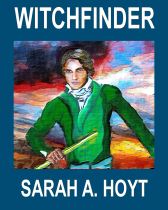
Next up, a very different type of book: Nocturnal Origins, by Amanda Green.  (Amazon here, Barnes and Noble here) (Yes, that cover sucks.  It sucks more than my cover for Witchfinder, and I am trying to persuade Amanda to let me draw a new cover.  Yes, again, that’s sad, when I’m better, but can the peanut gallery pile on, please?) I don’t know how many of you out there are both mystery fans and urban fantasy fans.  Yeah, I know the urban fantasies often pretend to be mysteries, but you know and I know it’s not true.  Not in most cases.  I read both genres, and I should know.

Nocturnal Origins on the other hand, is the real deal.  Part of the reason Amanda chose to go with Naked Reader, though she had interest from at least one traditional publishing house is that she thought that the traditional houses would have clue zero what to do with it, and she is probably right.

I mean, take your accurate procedural (and right now I’m blanking on the procedural writers I like, though Jill McGown is always a good one) and blend it with an urban fantasy involving werewolves and other shape shifters, all with solid world building and well-though-out rivalries, and that’s what Origins is.

MacKenzie Santos has a problem.  Since a brutal attack that left her dead, she’s been well, it starts with alive, right?  Not that she’s complaining, but she’s really not supposed to be alive, and for a woman with an organized mind, the incongruency bothers her.  And then she starts shifting shapes into a Jaguar…  And her life is completely upended.  The book is both a journey of self-discovery, as she becomes used to her body’s foibles, and discovery that there are more like her around.  Then there is the rivalry between the Pures and the Lycans – i.e. between hereditary shifters and made ones – and a series of gruesome murders by an out of control shifter.

Poor Mac is up a creek without a paddle, and if she had a paddle, she wouldn’t be able to hold it, since her shifted form has no thumbs.  Of course, she’s not going down without a massive and interesting fight.  Consider Amazon gift options, if you’re giving a brand new kindle to that Urban Fantasy or Police Procedural buff on your list.

Then there is Cat’s Paw  (amazon and barnes and noble).  This hits close to home, being by my son, Robert Anson Hoyt.  Those of you who’ve read Robert’s Christmas Serial, or, for those of you with a flexible mind, his ultra bowl reports, won’t be surprised to know that this book is seriously weird.  I mean, seriously.

It came about because before we sold our old house Robert and I had to build a balcony.  Uh… like this, the roofers who were supposed to LIFT the balcony and repair the front porch roof under it, and whom we hired specifically because they said they could do that, instead hacked it to pieces and threw it on the front lawn.  The offer on the house, of course, included a functional balcony.  So, that fine August, Dan and I bought wood, Robert – then thirteen – and I got our tools and off we went to the house we’d left, to build a balcony.  Dan, Marshall and our friend Charles joined us in the evening but (though I no longer remember WHY) Robert and I were the only ones who had our days free.  And Robert’s price for helping was for me to help him plot this novel that had been bothering him.  Picture us in short sleeve and caps, under the August sun, sawing and using nail guns (nail gun, yeah!) and plotting furiously.

His conceit was this: there is an entire fantasy world within our world.  It involves magic.  We know nothing about it, because only cats do.

You know the metaphor about the bird who sharpens its beak on the mountain?  And when the mountain is worn down, the universe will end?  Yeah, well…  The mountain is down to where one last beak-swipe will finish it.  The bird, Happy, is getting ready to do the deed.  Its ancient opponents and guardians of the universe, the cat royal family, are all dead.  The universe is as good as gone.

Enter Fluffy, the world’s smartest dumb blond, pregnant with the litter of the last prince, and Tom, a drunken cat, raised in a dumpster behind the bar and a Heinlein hero on his father’s side and, oh, yeah, Guinevere, a well-read cat who lives in a library and named himself – he thinks – after an Arthurian hero.  IF ConVent has the least likely set of heros, these are the next unlikeliest team.

Yeah, okay, the cats drink tea and use weapons, but for heaven’s sake, these are magical cats.  If you’re not gagging at that, you really have no business gagging at the implement-using.  Perhaps they gave themselves opposable thumbs.  Besides, in context, it makes perfect sense.  Try it.  Go on.  You KNOW you want to.

And by way of insanity we come to B. Quick.  (Amazon and Barnes And Noble) B. Quick is a cozy mystery.  Full disclosure, its characters are gay males.  Well, the voice character and the love interest are.  If this bothers you, read no further.

It’s probably the only cozy mystery that ever started with the VERY unlikely hero saving someone out of a raging river.  The unlikely hero is drunkard with a college professoring problem.  Bill Yates is soooo far down the slope of despondency and self-doubt that on a good day he can sort of see a glimmer up there.

A great part of the fun involved in this mystery (and the next, Quicksand, which I had the dubious honor of helping edit – dubious because C.S. Laurel is a friend, and being a friend feels entitled to fighting me over every precious word (argh) ) is that you get to live for a while in Bill’s mind.  Bill’s mind is the sort that, having rescued a blond out of the waters decides that throwing him in was the work of the Society for The Elimination of Good Looking Blonds.  He has the sort of mind that imagines there are kraken (and possibly submarines) in a Colorado river.  He has the sort of mind that lives crosswise to the world, and makes the intersection either funny or tragic, and often both.  Often at the same time.

Throw in a politically correct faculty, a rapacious ex-wife, a confused would-be rival to the love interest, and life gets really interesting really fast.

Now, go forth and take a look at these fine books.  Me, I’m going to go feed my guys breakfast and then I’m going to write a book review.

If you guys like this sort of thing, I might pimp some more of my friends in the future.  (The problem is putting fishnet stockings on the guys.  Yeah, even Cliff bitches about it.)

Of course I’m not pimping Dave Freer.  You guys don’t need that, right?  If you haven’t read Dave Freer DO.  Run, don’t walk.  Buy him in every form, by every publisher.  He’s simply, after Pratchett, the best author working in our field today.  And, unlike Pratchett, he needs a lot more recognition.  So read, pass around, recommend, send money in small unmarked coins (to him, not to me, you sillies.  Well, to me too, if you insist.  But to him FIRST.)

Go have fun.

Between The Night And The Morrow — Austen Fanfic

Look here for the beginning of this story:
VI

Oberon’s private chambers were vast and glimmering.  Silver columns supported a distant shimmering ceiling, deep blue like the summer sky and sprinkled with golden stars.  Here and there, near the ceiling there was movement of golden winged fairies and around the silver columns, the sparkling furniture, other movement showed where other elves and fairies lurked, ready to attend to the king’s needs.

But Oberon opened his mouth, and bellowed, in the tone that made the thunder halt mid clap and brought frozen rain onto the most brilliant summer sky, “Out.  Out, everyone of you.”

For a moment, for just a moment, nothing happened, then, from every nook and cranny of the room, from behind furniture and column, from up the ceiling and walls, fairies came pouring, running in mindless terror towards the door of the room.

It seemed to Prince Darcy that the wind of their passage left him chilled and he retained no more than a vague impression of wing, of fleet foot, of golden hair.  One elf dropped a small gold harp, which tinkled to the floor in discordant tones.  He dove for it and got it just as the throng of his fellows was past, but this was enough to earn him another , “Out!” from Oberon, and the elf was gone so fast it seemed a miracle his golden hair didn’t catch fire.

Oberon stalked after them and slammed the door himself, leaving his chamberers on the other side.  Then he turned on Darcy, “That you should presume,” he said.  “That you should presume to question me, and in my throne room, too, in my assembly, that you should question me about mine and your grandmother’s private affairs.  That you dare confront me.  Do you think, then, Darcy, that you have the power to face me, should I choose to crush you.”

Darcy should have been – perhaps was expected to be – as frightened as those elves who had gone skittering out the door.  But he was not.

He could feel the not inconsiderable magic that his grandfather poured fourth with his speech, of course, in an attempt to make everyone in his path cower.  But Darcy had enough magic of his own to block that, and instead to hear to the king’s speech as words, and to look into Oberon’s eyes and see there…  What?  Fright surely, and something else, a sense of horrible loss, Darcy thought.  But loss at what?
“You will speak to me,” Darcy said.  “Because I must know.  That you told me, in all the storied years of your existence, you had one child only, my mother, and my mother died in childbirth, one of the few deaths that can blight our kind.  And therefore I am your heir and Georgiana after me.  I know you’ve had other children both of you, separately,” he said, as Oberon started to open his mouth.  “I am not so foolish as to think you hold to human fidelity.  Not when you live nearly forever.  BUT in those years, you had only one child the two of you.

“You told me so and so I believed.  But now I come across a woman who is descended from both of you.  So, unless my mother had a child before she died, a child with a mortal man…”  He paused.  “But I understood she never lived that long, and this young lady is descended from one of your descendants centuries ago.”  He looked up and saw that the pain was stronger than ever in the king’s eyes.  “I will not be fobbed off,” he said.  “I will not be condescended to.  I know one does not shout at kings, and yet I did.  I know one does not question kings and yet I must.  Can’t you see, grandfather, that if I must fight the traitor in the world, I must know as much as the traitor knows and more.  And it is clear to me the traitor knows more.  He said…  He gave as one of his reasons for deserting that fairykind was overtaken with half-bloods.  Grandfather,” he said.  And in his mind was those memories that had assailed him while dancing with the Bennet girl.  Till now he hadn’t thought of it in words, but now he realized what it must mean.  “Grandfather, it was not just Carolus Bingley he spoke of was it?”

The king’s lips compressed tight.  The king growled a half barked, “No,” and then added, “That he would dare, the impudent pup, as though he had it in him to comment on what his betters–”

“He dares, grandfather.  And I must know.  What does he speak of?”

Now Oberon stopped and looked at him.  “It will hurt you.  I would go a long way not to hurt you.”

And Titania clasped Oberon’s arm, and said, “And yet, I think we must tell him.  And also telling him, perhaps, my lord, will help prevent the same from happening yet again.”

“The same?” Darcy asked.

Oberon sighed.  He started pacing the room, his hands clasped behind his back.  “You know we’ve lived for millennia.”

“Yes Grandfather.”

“We are not as fertile as the mortals, and it stands to reason,” Oberon said.  “Since compared to us they’re like the mayfly, born only to die before the day is through.  If they had children only when we do, then their entire race would have died aborning.”  He sighed.  “But we do have children, and over the centuries, your grandmother and I have had six children.  Six princes and princesses of fairyland.”

“Six?!”
“And yet we have no heir.  Because lo, every time one of them comes of age, he comes in contact with human kind.”  Again Oberon sighed.  “I cannot tell you that I never felt the attraction of the mortal.  They live shortened lives, and therefore are they full of fire and passion, which we lack.  But they are not of us, and I do not understand why all of our children have chosen mortal love over immortality.  Leaving me without an heir.”

“Leaving us without descendants.  In fairyland.”

Darcy felt as though his legs had suddenly turned to water.  One thing was to think, another to know.  And he’d only thought vaguely and at the edge of his mind that perhaps his father was a mortal, while for years, for his whole life – the memory of being a child in the mortal world intruded and he amended – near his whole life, he’d known he was a pure blood.  A prince of fairyland spun of air and magic.  Now he found he too had coarse mortal stuff in him.  He backed onto a dainty chair, and dropped into it, heavily, as his legs gave out.  And hoping against hope, he asked, “My mother?”

“Your mother fell in love with George Darcy, a gentleman of private means who owned a property in what the mortals call Derbyshire.  Nothing to compare to my estates, nothing…  I don’t know what she saw in him, but she started haunting his lands when he was no more than a lad, and by the by she gave up her estate and her powers to marry him.  And she had two children.  And she died of birthing Georgiana.”  He took a deep breath.  “We’ve gone through this in the past and seen our beloved children go out into the world of mortals and die, and have children that die.  We could not bear it.  And so, we sent our agents to collect you and Georgiana and bring you home to us, where you could be brought up as your own kind and where you could still learn to use your magic, while young.”

Darcy sat a long time, as he absorbed this relation.  His head hurt, an unaccustomed weakness.  Didn’t only mortals heads hurt?  Was it his mortal half that hurt?  He felt tears prickle at his eyes and elves didn’t cry.  Not really.  He felt cold and hot by degrees, and totally unlike himself, only he could not remember what himself was.

From his lips, in a voice that was not like his own at all, came strangled words.  “Alas.  My entire life has been a lie.”

Free Novel — Witchfinder, chatper 13

UPDATE:  A SLIGHTLY EDITED AND PRETTIED UP COMPILATION OF ALL CHAPTERS UP TO A WEEK OLD IS HERE

*This is the Fantasy novel I’m posting here for free, one chapter every Friday.  I’ve been posting director’s commentary at the end of chapters, but I think it detracts from the experience, so I’ll do that on Sunday, instead, for the previous chapter.  If your conscience troubles you getting something for free, do hit the donate button on the right side and down.  Anyone donating more than $6 will get a non-drm electronic copy of Witchfinder in its final version, when it’s published.   And, oh, yeah, the cover sucks, but I haven’t had time for a new one.

Oh, this is in pre-earc format, meaning you’ll find the occasional spelling mistake and sentence that makes no sense.  It’s not exactly first draft, but it’s not at the level I’d send to a publisher, yet.*

For first chapter, look here

For 12th chapter, look here

Changeling

Nell clutched the blanket tightly around herself and wondered what madness she’d fallen into.  The entire night – indeed, the entire time since her interview with Sydell had acquired a feeling of unreality.

She had to be dreaming.  Antoine could not be dead, lying cold and pale on the floor, on that makeshift pallet, staring at the ceiling with unseeing eyes.  Antoine had been…

In her mind she remembered the first time she’d seen him, dressed in jeans and a pale blue t-shirt and looking very much like a twenty something year old computer repairman.  Which was what he’d said he was, that first time he’d taken her out for coffee.  But then there had come the hints that not all was as it seemed, you have great power he’d told her, and, by the time he’d shown her how to open a portal, by the time he’d given her a glimpse of other worlds, it had become obvious to her that he didn’t mean this as a metaphor.

Perhaps the dream started then, she thought.  Perhaps if she closed her eyes and believed really hard, she’d wake up back at her desk, in front of a computer running some routine.

“Caroline,” Darkwater said.  He spoke very softly, his voice all the more terrifying for seeming so unnaturally calm.  “What do you mean by a changeling?”

Nell didn’t want to know what he’d been doing, or what had been happening in this household since she was last year.  It was clear to her that though Seraphim had recovered from his near-brush with death – or at least this time Gabriel Penn didn’t seem to be making desperate attempts at reviving his half-brother, he still looked near death.  He was pale, his green eyes surrounded by dark circles, his lips looking dry and colorless.  And the aura of magic around him looked faded.

This was all the more puzzling since Nell gathered that more than a day had passed since she’d been here.  His power should have recovered more, unless–

Unless something else had happened to make him lose strength.  She remembered the talk by the lake, about how someone had attempted against Seraphim’s life.

The gardeners, the under-gardeners, and for all she knew the stable boys, all those men who had been on those boats, in the lake, had been – if what she understood of their talk was right – trying to record the event, so that Seraphim would not be condemned for murder.  But that meant that he had been attacked by Antoine.  Or at least he thought he had.

She felt vaguely sick.  She didn’t know when she’d stopped being in love with Antoine, but she’d never suspected him– No, that was not true, either, over the last months she’d suspected him of perfidy often enough.  She simply had never been sure enough of it to consider doing anything that would endanger his life.  It seemed like a very foolish thing to condemn a man to death simply because he might not have been straightforward with her, or because he had deceived her by telling her he loved her.

But she had suspected he had lied to her, and more.  First, because it seemed very unlikely that he’d come to Earth in search of her power, her aura of power, as he called it, guided through different worlds by the call of it.  Since she’d been in Avallonis, Nell had gathered that her power was indeed strong, and indeed large.  But to call someone between worlds?  That didn’t even make sense.  Even the stronger magicians, even with scrying powers, had to be looking for something specific before they homed in on a pattern among universes.  Simply having a strong pattern didn’t call anyone.

Second because she’d seen for herself that Antoine was strong and accomplished, and knew his way across the multi universe.  And if that was true, how could he be so foolish as to transport into Avallonis without a care, and let himself be caught in Sydell’s trap.

No, there was more there than he’d told Nell.  He had come here for some reason, and if it hadn’t been to fall into the trap, still it had to be for some reason more important than that he found the world fascinating and wanted to show it to Nell.

But still– But still Nell didn’t think that Antoine deserved to die, and now, she couldn’t think or believe that Antoine was an assassin.  Myriad ideas combated in her mind.  What if this weren’t real Antoine, but a clever simulacrum?  What if this was all designed to make her break and tell all to Darkwater?

Except Darkwater wasn’t even looking at her, but at the intense dark haired young woman, who looked so much like the Dowager Duchess.  “How do you know it’s a changeling, Caroline, and not simply Michael in a trance?”

The girl they called Caroline shook her head.  Her hands pleated nervously at the skirt of her robe.  “It’s not Michael,” she said.  “It can’t be.  Even in a trance he would wake up when I came in.  He would react to my magic.  Seraphim, he is all pale and his eyes are blank, and he looks… well, he looks more perfect than any normal human can look.  And …  And…”  Her voice rose in a wail of distress.  “Mama says it is a changeling.”

After her outburst, she took a deep breath and exhaled forcefully, and thrust her head and chest a little forward, as though she expected her brother to challenge her.  Darkwater didn’t challenge her.  He opened his mouth then closed it, then opened it again to say, in a voice that was little more than a whisper, “Mama?”  He looked up and to the side, to where Gabriel Penn stood beside the sofa, seemingly keeping guard over his wounded master.  The two men exchanged a glance that contained in it volumes of information Nell would give something to acquire.  Both of them looked grave, and whatever wordless communication between them, it didn’t dispel their fears, as both looked even more worried after it.

“One moment, Caroline,” Seraphim said.  “I will come with you, in a moment.”  He glared over his shoulder at Gabriel’s exclamation, and Nell could see Gabriel making an effort to prevent himself from further outburst.

Darwater turned away from his half-brother, and to the two men with the pallet on which Antoine lay.  “Take him to the cold room,” he said.  “We must notify the coroner of the death.  Send Jem, on a fast horse.  Tell him I will be available for interviewing no later than tomorrow afternoon.”  He looked back at his sister, “And now, Caroline, I shall come with you.”

“Your grace,” Gabriel said.  “You are not well enough to–”

“There are duties,” Seraphim said, ostensibly talking to no one in particular.  “Which one cannot delegate, no matter how tired or ill one is.”  He made an attempt to rise, supporting himself on his cane, then turned to look at Gabriel.  “Give me your arm, Penn.  I believe my strength is not equal to what I’d like it to be.”

His strength was not in fact equal to much of anything, Nell said, as she noticed how Gabriel Penn not only allowed the Duke to hold onto his arm to rise, but put his arm around the Duke’s waist to support him.  How ill was the duke, and why?  Had he really sent the killing bolt that killed Antoine?  She shivered at the idea, and, as the gentlemen who’d brought Antoine’s corpse in prepared to take him out again, she realized she’d been forgotten.

The Duke and Penn were following Caroline Darkwater out of the room and Nell thought she could stay here, until Darkwater had solved whatever problem had now visited his house, and came back to his room, and remembered Nell existed.  Or she could go with Antoine’s body and keep up some sort of vigil in the cold room – perhaps try to discover if that truly was Antoine’s corpse or some contrivance that looked like it.  Or…  Or she could follow Darkwater and Gabriel Penn and find out what had happened to the Duke’s younger brother and what else might be behind the turmoil in this household.

She pulled her blanket tighter about herself.  It truly didn’t make her any warmer, because her hair was dripping wet.  But it made her feel somehow more protected.  And then she started behind the Duke and his half-brother, as though she had every right to follow them.

The gardeners were waiting, with Antoine’s body, but she thought that the maids, stationed on either side of the door might stop her.  So she threw her head back and looked very haughty indeed as she went by them.

The maids didn’t move.  They didn’t even look at her as she walked past.  She’d have suspected magic, only she’d learned in Avallonis the value of a good pretense and a good display of arrogance surpassed all logic.

The maids didn’t even follow as she walked after the Darkwaters and Penn down a long, marble-paved hallway.  Really, the one thing about this world that kept astonishing her was how the houses of the noblemen looked more magnificent than anything she’d ever seen on Earth.  Take the way the hallway ceiling arched above, painted a deep blue and sprinkled with gold stars.  It was like something out a theatrical set, rather than something you’d find in real life.

It would testify in favor of this being a dream, except that in dreams one’s feet didn’t ache with cold and slosh in shoes that felt like they’d fall apart every time she took a step.  And in dreams it was very rare for one’s hair to drip down ones back in a disconsolate, icy dribble.

They walked down the hallway, then up a curving staircase, then down another hallway.  As Nell tried to orient herself, she realized they were going towards the southern wing of the house, and, from what she remembered of the house’s exterior – which wasn’t much as she’d only ever seen it from the back, while approaching it, the other two times she’d magically transported into and out of it – to a little tower that protruded out of it at that corner.

She knew she was right when, ignoring the hallway to the southern wing, Seraphim, instead, opened the door to the tower.

The Darkwaters, followed by the quite disregarded Nell, entered a huge, circular room.  The tower might look small from the outside, but that was, Nell judged, because it was dwarfed by the other elements of the massive Darkwater house.  Inside, the tower was one vast room.  Vast enough that on Earth it could have passed as the lobby of a very large hotel.  Its architecture too resembled something one might find in a hotel lobby, being largely unimpeded: just one vast circular space, going up far more than one story to–

For a moment Nell looked up, disbelieving because it seemed to her as though the tower had no roof, but, instead, were open to velvety dark summer night sky, with naught but a golden spider web of some sort, between them and the night.  Then she realized the golden spider web was a framework for glass, and that the tower was one vast observatory or perhaps some sort of conservatory.  And that roof had to be held together with magic, because with the technology of this world there was no way to keep that much glass up with so little metal.

Then she looked down and realized that there was more magic at work here than the roof.  The space might be free of architectural abstractions, but it was filled with machines, and … contraptions, for which Nell had no name.

In the way of this world, these machines, no matter how utilitarian they tried to look, were made of polished brass and leather and wood, and their rounded shapes couldn’t help but looking pleasing.  And they were animated.  Arms moved, gears turned.  Something that looked like a giant telescope pointed at the ceiling, gyrated slowly on a frame, clicking gently in a steady rhythm, while a mechanical arm attached to it wrote steadily with a quill on paper.

In the middle of all this, perched on what looked remarkably like a high barstool made of brass, sat a young man, probably Caroline’s age or a little younger.  He was so young, one might still be able to call him pretty without offending too badly.  He looked like a version of Darkwater, or perhaps of Gabriel Penn, made of clay that had yet to harden, or like a sketch of one of them done hastily and left too smooth and soft.

He didn’t turn to look as the party approached.  The Dowager Duchess, who stood next to him, looking at him, intently, as though he were an object that must be puzzled out, did turn to look at them.  “Seraphim!” she said.  Then she hastened towards them, hands extended.  “You shouldn’t have come.  Indeed, you look very ill.  And there is nothing you can do here, you see.  Michael has been taken.  They’ve left this in his place.”

“Mama, are you sure–” Seraphim said, and stopped.

Nell was sure he had stopped because, like her, if he unfocused his eyes and brought his mage sight to bear, he could see that the thing on the stool was not and had never been a human adolescent.  It was more akin to an animated sculpture made of ice, or perhaps intersecting nodes of light and power.  Something that could only impersonate a human for those with no mage-sight.

Changeling.  That was a thing the elves did, wasn’t it?  Was this creature an elf then?  Or merely a construct the elves had left behind?

A Very Personal And Localized Insanity

UPDATE: answers at bottom.

It is said that friendship is forged of a fund of common jokes that might be QUITE opaque to strangers.  If this is true, my family is very friendly with each other, as we by and large all like the same books, movies, comics and various other things and have collected the same fund of jokes.

1- Tonight my older son told me he dreamed he was in a restaurant and couldn’t find the egress.  To which I told him, “Of course not, you don’t eat _____    _______ .  I think they’re on the protected species list.”

2 -The correct reply to a family member saying “I’ll have something light on a cracker” is “Like for, for instance, this ________  ______”

3 – “Lacking in practice, Monsieur D’Artagnan had a most extensive _____”

4 – When someone in my family says “this is called bad luck” they’re referring to ___________

5 -Beware of strong drink because?

6- And without garlic they taste like?

7 -If you tell someone at the table that you’re under a geas, the correct answer is “Funny, I don’t see any __________”

8 – While I might have a certificate saying I’m sane, WHO has a character saying he’s human?  (And should my younger son have one?)

9 – “Bzzz Bzzzzzzzz” is a quote from which famous poet?
The appropriate answer to “I now understand English?” is?

10 – From whence comes my husband’s favorite response when, usually late at night and in a snowstorm, the rest of the family decides we MUST go to Denver and have dinner at Pete’s Kitchen?   The response is “And yet, I am unmoved.”

11 – When your computer breaks down and you’re an SF geek, regardless of your religion, the appropriate response is “Saint ______________   ora pro nobis.”

12 – When my husband says “Mrs. Hoyt, Life holds few distinctions, but I can say here sit two of the geekiest boys in the US” he’s referring to?

13 – Hint, it is the same thing I’m referring to when I’m tired and trying to convince my husband to go to Denver for a weekend, and say “I want to go to BRIGHTON!”  (Usually followed by “And yet, I am unmoved.”)

14- If it weren’t nailed to its perch it would be?

15 -“Lord,” groaned Don Camillo, clasping hands and looking up at the crucifix, “My hands are made for blessing but ____  ____ ____”

16 – A truly easy one: “he is only mostly ______”

17 – Also, when speaking about my politics in conjunction with my career, quasi ante, when it all had to go through the establishment, my kids were likely to break into which which Monty Python skit?

18 – AND for bonus points, and those of you who have read Kate Paulk’s ConVent, when I’m shopping for clothes and my older son tells me, “No, mom, no DEMON wear” what am I trying to buy?

1-female eagles (Pratchett)

2 – wild boar (Asterix)

3 – theory

4 – Throughout history, poverty is the normal condition of man. Advances which permit this norm to be exceeded — here and there, now and then — are the work of an extremely small minority, frequently despised, often condemned, and almost always opposed by all right-thinking people. Whenever this tiny minority is kept from creating, or (as sometimes happens) is driven out of a society, the people then slip back into abject poverty.
This is known as “bad luck.  (Robert A. Heinlein.)

5- It can make you shoot at tax collectors.  And miss. (Robert A. Heinlein.)

6 – snails (Pratchett.  I shall wear Midnight.)

7- Beth got it close.  “I don’t see any geese around here.”  (Pratchett)

8 – Speaker has it, it is Pratchett.  Nobby has a certificate saying he’s human.

9 – Shakespeare (Hamlet.)  Right up there with “Now, die, die, die, die,” from Midsummer’s Night Dream

10 – Pride and Prejudice by Jane Austen, though in the A & E mini-series format.

11 – Saint Leibowitz, ora pro nobis.  (Canticle for Leibowitz.  He was the patron saint of gadgets.)

12 – Pride and Prejudice.

13 – Pride and Prejudice again.

14- pushing up daisies.  (The dead parrot skit, Monty Python.

15 – but not my feet.  (The Little World Of Don Camillo, Giovanni Guareschi.)

16- Speaker has it again “mostly dead.”  (The Princess Bride.)

17 – The albatross skit.

18 – Oddly no, Drak.  You see, demons have no fashion sense and whey they try to dress fashionably, their taste gravitates to sequins and spangles.

Everybody Knows

“There were so many people you just had to meet, without your clothes.” Leonard Cohen

The title of this blog post (and the tag line) were suggested by my older son, as we were talking about how fast, how strangely, and how unbelievably the “truths of a publishing career” are being overturned.

Mind you, this sort of state is “normal” in the society we live in.  I suppose once upon a time it wasn’t?  I mean, I suppose back in the middle ages, you actually knew what was truly approved and disapproved of by the establishment, and it stayed like that a good long time.  Oh, no doubt there were unspokens and double reverses, but it – in the end – was fairly easy to follow the game and everyone knew the score.  (Of course, not knowing it or mouthing off a little too early in the change of guard could get you killed.  Quite possibly what happened to Christopher Marlowe.  Even though he lived in the renaissance and, of course, in a time of great change, what with the religious “in” side flipping every few years.)

My adult life has been more of a theater of the absurd, when it comes to being in and out of favor with the establishment.  For instance, when I first came to the States, as an exchange student, my brother carefully went through my books and tapes, in case I had a communist in the lot (not many.  Couple of French musicians) because we all KNEW communist books/songs weren’t allowed in the US and the establishment was strongly anti-communist. …  While when I arrived here I found a sort of chic fellow-traveler-ism prevailed amid the intellectual and the upper classes.  I could not only have proclaimed myself a communist without being in trouble – I would have been lionized.  In fact, a certain amount of moral equivalency was necessary at the end of the cold war to be considered “smart” and intellectual.  (And in many circles it still is because of the abject dereliction of duty of our press and historians and publishing establishment in reporting the true realities of soviet life.  Never mind.  This is NOT about politics, but about what is perceived and what really is.)

Leaving politics aside we get to publishing, which is what this is about.

Part of the reason this happens is because humans are designed to fit in to a group.  They tend to establish their group credentials in adolescence, and after that have difficulty perceiving if things have changed.  This is why in every human society there’s always been an “old guard.”  And that changes very slowly.  In the modern era, say, since printing became cheap, people are “educated” by a generation too far.  We read “children’s classics” which inculcate us with the perceived groups and cliques of a generation past.  The same for movies and TV.  This explains why often you talk to people who seem to think “establishment” and “anti-establishment” are frozen circa the 1950s.

This is how come writers think they’re being edgy and “countercultural” or “speaking truth to power” while advocating such things as female liberation, religious dissent or sexual freedom: all of which are the stuffiest and most approved-of notions in publishing.  In fact, if you’re advocating any of those, YOU ARE the establishment.  Advocating the opposite might cost you your career, or worse.

We’re simply not adapted to a society where things upend in between generations.  It’s startling and a shock, and eh, leads to very funny commercials where someone informs an old boomer he is “The Man.”  While there have been generation gulfs and cultural contrasts in generation handoffs for centuries, they’re usually not as stark as now.

Part of what causes this is the acceleration of tech innovation, which is hitting all groups, more or less, and has now come home to beat up on writing as a field.

With the advent of e-readers and the subsequent burgeoning of ebooks, and the possibility of a living, if not a fortune, from indie publishing (so far I have only shorts out, but I’ve made more this month from my shorts than my novel royalties.  Something to think on) our world is not only upending, it is twirling round like a windmill in a hurricane.

So.  It’s not so much a matter of “people perceive things as they were fifty years ago.”  That is, at least, usual for humans.  It’s more of “people perceive things as they were everywhere from fifty years to last month and they’re ALL outdated already.”  Even I, who have been trying to retool my mind to this since … oh, June or so, am having trouble adapting to what’s actually happening instead of what I’ve known “was happening” since I started in the field.  I mean, there are sooo many little adjustments, and so many things I never thought would change, and other things I didn’t even realize I thought until I came up against the hard fact that “this is not so anymore” and then I realized it had been so.  This is not an exhaustive list, but simply what occurred to me as I type.

First, what I thought was set in stone, and has now changed:

1 – Self publishing is always a bad idea and will taint your name forever.  Ah! Ah ah ah ah ah ah ah!  Ask that to Amanda Hocking, or for that matter to Larry Correia whose first book was self published.

2 – The real money, the real recognition and the real professionalism is with the big houses.  Again, we’ve had enough professionals now making a very good living and get recognition and professionalism through independent publishing in ebooks.

Second, what most people still think is so, but… not so much

1 – you’ll get guidance and your talent will be developed by a big publishing house.  Pardon me while I laugh with multiple exclamation points!  Not for the last couple of decades.  The closest you’ll get to this is Baen and they’re not really “big.”

2 – If you write a great book, you’ll have a great career in traditional publishing.  Uh. uh.  Yeah, IF you have the right connections, the right look, the right… yeah.  AND if you’re lucky, even with all that.

3 – If you’re insecure, you should always go with traditional publishing, because you’ll get the affirmation you need.  You’ll know you’re good if they take you.  (Uh, uh.  sure thing.  Only, uh… be ready for the series of kicks in the teeth that come from being treated as disposable.)

The less obvious, which I’ve come to terms with

1 – One no longer needs to lay low for fear of saying something that will offend the establishment.  For one, they have troubles of their own and are unlikely to have time to beat you.

2 – Where it used to be (see the Leonard Cohen quote) that you couldn’t talk back of even defend yourself (yes, Dean W Smith said we should demand our professional dignity, but up until recently, those of us who came up in the last ten years simply couldn’t.  I saw people being shut out for objecting to mistreatment.  EVEN when they were patently right.  NOW you can complain.  And you should.  You’re not an indentured servant in a company town.  You’re a professional.  Ask to be treated as such.

3 – I don’t
Have to take a contract with a clause I can’t stand.

I don’t have to make nice to editors or writers I detest (the good side of this?  If I’m nice to you, you know I like you. Possibly quite a lot, since by disposition I don’t go out of my way to make nice.)

I don’t have to put a book in the drawer because no one will buy it.

I don’t have to write proposals and send them out.

I don’t have to write books I don’t want to write.

I don’t have to twist my books to make them acceptable to someone.

4 – I can

I can now write books from the heart.

I can make a living (probably) writing exactly what I want to.

I can slant my writing exactly as I wish.

I can bitch when I get a bad edit; bad cover; bad marketing.

I can try other routes and other options.

And I can fail, but fail on my own terms.

And the ones I’m having trouble twisting my mind into accepting

1 – I don’t need to aim for the “big” novel, where big is defined by what will do well in traditional publishing.  (Or what people think will do well.)  Instead, my progression can be individual and to what I consider “good.” The ladder to success is now a staircase, and it’s my staircase and I can climb it sideways, if I wish to.

2 – I don’t need to tell anyone if I decide to write under a closed pen name.

3 – I don’t need to travel to cons when I don’t want to, to meet editors or agents.  (I will travel to cons I like.  And I will sometimes go to cons to meet fans.  That’s different, though.)

4 – Contacts with peers are as important as contacts with those ahead and in power over you.  Because the road is being forged as we walk it, having a group along to point out the pits with stakes at the bottom and to tell us when the lion is lurking behind the trees is a good thing.

So, is everything beautiful in the garden?  No.  Note my “I think” before things like making a living.  I think I can.  I think this will work.  BUT things are changing so fast and so completely no one knows where they’ll be in a year or two.  Heck, in a month or two.

However, for now, and unless some catastrophic event intervenes, the direction seems to be for more freedom for the writer, and more ability to forge our own path.

And it’s a beautiful feeling.

The Three Hanky Dance

Or how to make your readers cry floods of tears.

Yeah, as if I know that.  Well, I can give you a lot of tips and hints, but in the end I find that though readers do cry at some of my scenes, they also cry at scenes that I never intended as crying points.  However, I’ll try to give you a few tips I’ve hard-earned along the way.

1 – Don’t be afraid to tug on the heart strings.  Believe it or not, readers are not in general reading your shining prose for sparkling language, historical information or a fiendish puzzle.  Oh, some of them might be, but think on it.  The books you remember are not the ones that taught you something or where you learned a new word.  At least not the FICTION books that you remember.  For that you read non-fiction or, for the puzzle, play games.

As someone noted in my comments, a novel is an emotional experience.  (A short story too.)  It’s the closest you can come to experiencing someone else’s life.  (Yes, more than movies.  There you just SEE someone else’s life.)  I suspect as the stigma and brownie points of being seen with a book fade away, you’re going to see more novels succeed that go, unabashedly, for the highs and lows of emotion.

So, don’t be afraid of those.  Set out deliberately to create the situations that will test man’s souls (or women’s.  Or small fuzzy animals.  Or dinos.)  I recommend you study deeply upon Shakespeare, who never forgot to take the viewer’s heart and TWIST.  When does Romeo kill Juliet’s cousin?  Why, while she’s waiting to consummate their marriage, of course.  And does she find out about it before Romeo comes in?  Oh, yeah, of course.  For that matter when is Romeo forced into a duel with her cousin?  Why, as he comes from church, from marrying her.  Study Shakespeare, he never let the trying things undone.

2 – Don’t cringe at corny.  This one is hard for me, because I come from a stiff-upper-lip tradition.  We’re very good at reading emotion in a lifted eyebrow, an upturned lip, or even a silence.  But remember the objects in the mirror effect of writing on the page.  It’s amped down a bit.  You won’t feel it as strongly as if you saw it in real life.

My husband recently was reading a story where the culmination of it was that the man this woman had finally fallen in love with was the same one who’d sent her comforting postcards when she was a litle orphan with no one to love her.  AND after that lip-trembling revelation, the author piled on with something like “So, you see, you’ve always been mine to look after.”  My husband’s reaction was “I could see her tugging at my heart strings, but it still worked.”

Shakespeare is also a good guide here.  Does Lear just carry his dead daughter or whatever?  No, he laments and his lament is heart rendering.  Corny it up.

3 – Pile it on.  With a shovel.  Your character just lost his entire family and remains unbroken?  Have his faithful dog crawl out of the wreckage of his house (brief moment of joy) only to expire at his feet.  Go on.  I DARE you.

4 – Never let a death go to waste.  No matter how minor a character you’re killing, make them important/valuable or hapless before you kill them.  Make their death unexpected, unfair, just plain cruel.  Clifford Simak made me cry floods of tears over the death of a stray dog, simply by having him cross the street, wagging his tail, happy-doggy to go lie in a patch of sunlight, before a ray tears him apart.  It made me cry because the dog had been all happy, hadn’t been expecting death and it was UNFAIR.  I.e. the death had nothing to do with him, but was an alien invasion.  He couldn’t have avoided it, and he’d been so HAPPY.

5 – Have your character’s noblest act be misunderstood and punished.  The instinct of fairness is very deep in humans.  A situation like that WILL make us cry.

6 – Sock them with a happy ending when they least expect it.  The hero that crawls out of the blazing inferno is such a cliche because it works.  But you don’t need that, or even a coming back from the dead.  Just anything unexpected and suddenly good, after relentless struggle, will break your reader’s defenses and the floods are likely to come.

And that is the sum of what I know.  Sometimes it doesn’t work.  And sometimes what you don’t expect does work.

Go forth and make them wring their hankies.

A Tsunami Of Bath Sets

I swear this is about publishing, so bear with me.

A quick post, as I slept very badly (for reasons having nothing to do with anything emotional.  Just one of those nights.)

I hate having people give me gifts.  I’ve mentioned this before, right?  Oh, not everyone.  There are exceptions.  My husband, for instance, is one of those supernaturally good gift-givers.  His gifts to me have ranged from a little glass owl to two pounds of cold cuts, and in each case they were exactly what I wanted.

On the other hand, the man has an ace in the hole – he can always give me a red rose and I melt.  So… hard to go wrong.

There have been other superb gifts throughout my life, but most gifts fall in the category of the ones this guy blames on (and might be) Aspergers.  Even when people know me – I think – relatively well, I find myself looking at something that , at best, I wouldn’t have looked at twice in the store, and feeling like I failed a test.  Why feeling like I failed a test?  Because… what did I do or say to give them the impression that I…  Etc.  When people don’t know me it can be worse.

I’ve found, for instance, that people latch onto something about me – not just in gift giving – and they seem to think that’s all of me.  Like, conferences STILL put me (sometimes exclusively) on the “Shakespeare panels” or create them just for me, because they think it will please me.  Do I like Shakespeare?  Sure.  It was one of my favorite things in college.  To be honest, though, partly it was to escape reading the more modern stuff.  Also, the study of his biography is fascinating.  But I also enjoyed Jane Austen, I love Dumas and I did my master thesis on Flannery O’Connor.  None of which, btw, compares to my obsessions with Heinlein, Simak, Pratchett, or even Rex Stout, Christie or Ellis Peters (And we won’t mention the Lord Meren series which I wish the author would self-publish and finish.)  So, you know, it’s not like Shakespeare is the all consuming light of my days.  And as for my trilogy on Shakespeare, well, it was in another publishing “country” and besides the series is dead.  I might go back to it, but it’s about as relevant to my work life as Dumas and arguably less so than Heinlein.

So, you see why I have issues with receiving gifts?  Not that I’m any better at giving them.  Gifts I give fall into three categories: the gifts I KNOW the person needs.  This is usually only my closest friends and relatives.  Like, say, I know one of the kids needs new slippers.  Then there’s the gifts I think people will like.  Again, I’m only good at these if I know you REALLY well.  Like, we’ve been friends for years with someone and know that this particular sparkly or that particular statuette is just right, or perhaps JUST ties in with something they’re writing.  Or I know the type of chocolate they love.  That sort of thing.  Of course, it also helps if the person has a prominent hobby-interest that consumes their free time.  Like knitting, or cooking or something.  A lot of people do, but writers and my family tend to be more eclectic.  After that there are “broad category gifts.”  These work best for kids.  If you buy a set of blocks, chances are a two year old will find a way to play with them.  But after adolescence it becomes iffy.

I’ve never fallen into the “give someone something you want.”  Well, not since I was ten and gave my brother the complete book of dinosaurs because that’s what I wanted.  (He’s ten years older and was in college, in engineering.)

I’ve always assumed these gift dysfunctions, both giving and receiving, were peculiar to me, however, studies show that in fact, about 80% of gifts people receive fall into that “OMG, what am I going to do with this?” category.  I think this is why there’s this rise of near-generic gift sets: bath sets with nice-smelling soap and cute towels.  Or coffee sets, with mugs and a couple of generic-brews and biscoitti.  That sort of thing.  (And I shudder to think how many times the non-food ones [one hopes] change hands before finding someone who really, really wanted them.)

Which brings us to the publishing industry.  I TOLD you we’d get there.

I will grant you that I’m not the best informed on the history of the business workings of our field.  However, from reading biographies about the pulp days, it seems to me there were various niches.  People who liked a certain kind of horror tended to read the output of a certain publisher, say.  Same for sf and f.  The closest we have to that is Analog, which could be called “science fiction for geeks.”  (Guilty as charged.)  And Baen which could be called “We’re okay with character, we like science/history accurate, but no plot no sale.”  And that’s fine, too.

But both Baen and Analog have had fairly clear personal directions and hand-offs, while the rest of the field has been a fest of mergers, short-lived under editors (short lived in position, mind, not saying anything about lifespan) and such.

And the selections of the other editorial houses has been much like the result of getting gifts from strangers.  I mean, most publishers these days have under-readers who are (beyond overworked and stressed) not of the field.  They might have edited romance last week, they’re editing sf/f today. Most of them have never been to a con.  They don’t know us.  And then, it’s not just editors.  In the major conglomerates these days, you can’t buy a book without “buy in” from the sales persons.  And then after that, the sales people/distributors decide what they’ll push.  To the extent that bookstores still get any say, they decide what to unpack or not.  And most of the time, these people are not of us.

This seems particularly important for sf/f, but mind you, mystery readers have their quirks too.  Romance is more of a broad church and might be easier to serve, or at least it has well known niches, which is kind of like a giftee having a hobby.

So, the kind of books that keep getting “push” and which used to be hits just by virtue of distribution – since both publishing and bookstores became conglomerates – were:

1 – the generic – i.e.  “Spaceships/dragons, decent grammar.  Those sf geeks will love it.”

2 – the repetitive – i.e. “It’s just like that Rowling chick we published last year and they loved that.”

3- catering to hobbies – i.e. “Well, I know tons of people like knitting.  Let’s do knitting mysteries.”

4 – catering to fads – “there’s that series on TV about chicks, sex and shoes, let’s do all our mysteries about chicks, sex and shoes.”

5 – catering to general categories “this book will appeal to all the sexually frustrated middle aged housewives.”

6 – and finally “what I would like to read” – which works great, if you are a graduate from an Ivy League school about twenty five years old and interested in impressing people with how high brow you are.  For the rest of us?  Not so much.

And this is my answer to the “tsunami of crap” – crap by whose definition?  Why do you think what’s crap to you is crap to other people?  I tell you kids, reading romance has been an education and no, I’m not being snarky.  More romance is competently written than sf or mystery, I hate to tell you.  But because I’m a stranger to the field, I’ll pick a lot by the stuff that says on the covers.  Like “Bestselling author.”  And, OMG.  Some of those books don’t rise to the level of “crap” to me, just on the historical errors.  (Yes, I have a very specialized form of insanity.  Why do you ask?)  BUT they’re mega bestsellers, whose numbers would make an sf/f writer faint.

So… qui flusheth the crap?  Who decides?  WHY would you want someone to decide for you?  Look, given my obsession with dinosaurs, give me a book on sentient dinosaurs, and I’ll forgive a multitude of sins.  Are there enough of me for someone to make a living off it?  Probably.  Enough for a major house to make a profit when they have to print, distribute the book and MORE IMPORTANTLY convince the bookstores to carry the books?  Probably not.

It might interest you to know that the same study on how inefficient people buying gifts for others were, also discovered that people buying for themselves were nearly 100% efficient.  So, now that technology allows us to buy for ourselves, why shouldn’t we?  And why shouldn’t we write/publish what we want to?  Yeah, okay, that falls under giving people the gift you want.  But look, you’re not that unique and you’re facing a VERY LARGE potential pool of book readers.  (If I had a thousand brothers, say, and I gave each one the book on Dinos, it’s guaranteed that a few – maybe even a hundred – would have loved it.)  You’re NOT that unique.  So write for the people you know best – those a lot like yourself.  And chances are you’ll be rewarded.  Doubly, because you’ll be writing for enough people to make you rich, and because you’ll write what you want to.

And please don’t come back and say “but what about the books written in crayon and drool?”  What, you think that doesn’t get published now?  I remember a bestseller in the eighties that was bought even though it came to the publisher written in crayon on wrapping paper, and yes, I read it, there must have been drool on the edges, and probably obscene drawings.  Publisher thought it was “refreshing.”

There is no OBJECTIVE standard for what’s crap in literature.  If you think there is, you bought what they sold you in lit classes.  And it wasn’t worth what you paid for it.

The standard for good is “what sells” in ANY form of entertainment.  Might not be to your taste, but clearly it entertains other people.  So, what business is it of yours.

And as for the famed tsunami, having experienced “Mega bookstore and not a book to buy” many, many times, I tell you “I’ve seen the tsunami, and it’s traditionally published.”  Doubtless it will be indie published, too, as far as I’m concerned.  But I’ll just hie my way among it, picking up from the muck those things that are diamonds to me.  Now, you shut up and do likewise.