Posting will be late tomorrow

For various reasons, including that after eight years in the house we thought we should unpack.  So, I’ve been organizing the house from the basement up & decluttering the downstairs, as well as trying to finish three books.  (You’re going to ask.  I know.  Please don’t.)

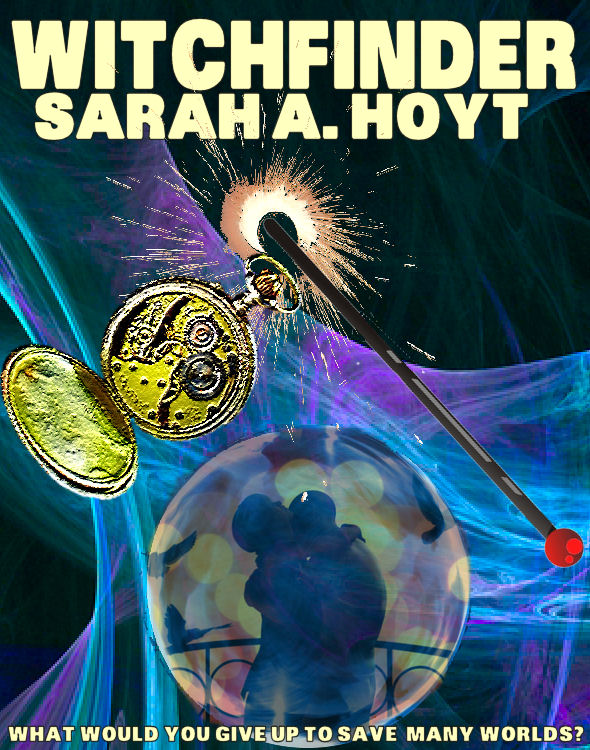
So I intend to sleep late and post late.  Live with it.  Witchfinder might not be out till Sunday…

What’s The Big Idea 4

Making It Your Very Own

Unless you’re a pure pantser – and if you are you should read my friend Kate Paulk’s Pantser’s Guide over at Mad Genius Club – and even if you are (in which case, sure as shooting you’ll need to face this when you come around to revising), sometime between first glimmer of an idea and writing that story you’ll have to admit that it’s a tale told many times.

I usually get my ideas from a character who intrudes into my mind with enough force and determination that I can’t banish him or her.  And yet as individual as that character is, it’s impossible for me, as much as I read, not to see the character’s pedigree.  Lucius in A Few Good Men obviously has a good dose of genetic material from The Count of Montecristo.  In fact, I make an allusion to it in the first chapter or so.

And it’s impossible for me to send Athena into space without knowing she has a good dose of Friday who, in turn, had a good dose of Candide, of course.

It happens with other people’s work, too.  I can’t really watch Fiddler On The Roof without thinking of Pride and Prejudice.

I’m not saying any of these books have the same plot, or even the same theme.  (I tried years ago to write a book with the revenge-plot.  It didn’t come off well.  But Lucius, like the main character of Count [I’m blanking on the name.  Live with it.  Not enough Caffeine] had years in prison to discover his true self.  And he was educated while in prison.  And while Athena finds out she’s human in the end, she didn’t know she wasn’t human at the beginning – the theme of the book being a ‘yes, but’ to Heinlein’s idea that someone raised to think of herself as not human would be flawed and need to learn the natural human.  Thena was just very badly raised, which had the effect of making her, to some extent truly not human.)

So, sooner or later you’ll find that either your character, your theme or your plot has echoes of other books.  You might be choosing a story Or you might have finished a book that looks vaguely like a cabbage – since lately I’ve done a bit of pantsing, this has happened more than once – with leaves going off in all directions, and be trying to figure out a pattern to superimpose on it in rewrite.  In which case you’ll run across the disturbing truth (A truth universally acknowledged, you might say) that there are only so many patterns.

How do you make a millionth time told tale your own?  Don’t say “you don’t” because of course people do.

Well, remember when I commented on “being yourself outloud?”   There is a post on that somewhere around here, but I can never find anything in this here place.

Taking a pattern and making it your own involves looking at the story – or the pattern – dispassionately and deciding what parts of it you like and which you don’t.  This is useful for people who get their inspiration from stories.  By which I don’t mean you read the latest short story by Big Name Author and go “I’ll write one just like it” – though you might do.  I’d think it’s silly, but you might.  It’s more taking, say, a legend or a fairytale, and saying “how could I write this as a contemporary romance with underwater adventurers?”  Or listening to a song about heartbreak and thinking “How could I write this as a story about robots?”  Or…  You see what I mean?

So, let’s say you just found a character, a story or a plot wandering about the street, lonely and forlorn.  You’ve checked the tags and it is yours to adopt.  How do you go about house breaking it, feeding it, petting it and making it your very own?

1- Take a dispassionate look at the material that your material has the DNA of.  This is kind of like looking at the parents of the puppy you want to adopt.  And you do it more or less for the same reasons.  Which characteristics do you want to keep and which do you want to change?  (If you want to keep everything, we submit you might be a copyist not a writer.  Take calligraphy lessons.)

2 – At a first cut, see which parts are yours to write.  Which parts could you write convincingly, with or without a lot of research.  Take Starship Troopers.  I could never write that book because my head doesn’t work in a military fashion.  I can write war but from the POV of a “lay” character pulled into it, only.  So, while I love the book, if I were to write something about a war against a ruthless enemy… Oh, wait, I intend to.  It’s called – dang it, it won’t let me change it – Winter Prince, and my main character, Lucky, is a prince’s bodyguard and therefore outside the chain of command.  Also, her work is more with getting the guy who CAN defend the world in place than with going out and fighting the aliens herself.  Because much as I like the other story, it’s nor mine to write.

3 – Second cut – look, really look at the story or pattern or theme or character.  Do you agree with the underlying assumptions that went into creating it?  Don’t assume you do just because you like the author or the author’s view on the world.  For instance, as much as I love Heinlein, was raised by him and feel completely weird admitting this, I have a major source of disagreement with Heinlein’s way of viewing human population as inevitably expanding.  (Looks up.  Sees no thunderbolt, lets breath out.)  Part of this si because I grew up seeing those predictions fail.  Part of it is because I don’t think that’s how HUMANS work.  Part of it is that I think an expanding population would be PREFERABLE but that’s something else.

The thing is that if you take that assumption out of his world building, you realize a lot of his future topples down, leaving a place to build a different future history.  I’m sure there are other “assumptions” built into the stories you love that you know ain’t so, not in the cool light of day.  Once you remove those and substitute your own, you’ll find things are already quite different.

4 – Third cut – if you’re going to admit to your story’s DNA you can either choose to make it as different as possible (i.e. change names, change place names, etc) or leave in allusions in names, place names and/or a reference to trained rats in the first chapter.  I find readers prefer the second approach.  IF you are taking it from a recent story, though, I’d remove anything that might be considered too close.  Partly because of course you might get sued, but more importantly because if you are too explicit, you’re comparing yourself to this author.  I don’t know about you, brother, but I ain’t no Jane Austen.

5 – Now that you’ve cut all the things you don’t agree with/can’t fit in/don’t like/aren’t yours/are too proprietary, you can start building.
The first step of the build is “what does your story necessitate by virtue of its peculiarities?”  For instance, Pride and Prejudice underwater where Mr. Darcy is the king of an underwater realm would have to overcome the fact that Lizzy can’t breathe water.  This will necessitate at least a mention, if not a whole subplot.  For them to be together, there has to be a way for her to breathe underwater.  What does achieving that entail?

6 – You meant to say something with this story.  By which I don’t mean send a “message” because then there’s Western Union.  But, just like a painting captures a certain fall of light, a story captures some element of your view/thought about the world, even if it’s just exploring True Love (and explaining that it’s Mostly Dead.)  Make sure that’s in, either in the outline or in your editing of the book.  If an important part of your theme is that kindness is a good thing, make sure your character doesn’t pull wings off flies for no reason, even if this was part of the theme you stol– used.

7 – If you’re already published and you have fans, make sure you include things you know they’ll like.  These are called in the trade “reader cookies” and they can be a certain character, or the way a character behaves (Thena and ballet, for instance.)  Or even a certain place (at this point my readers get very happy if anything is set in Goldport and the characters eat at the George, for instance.)  Sprinkle those liberally, then adjust the plot to fit.

8 – Do the final polish, either on the novel or on the outline.  Make sure that the way you altered the theme/story is still functional.  Make sure it all works together.  Call this the dress rehearsal.

9 – Proof that pudding – pass it to betas, and see if they say “I see where you got THIS.”  (A lot of my betas know when I’m walking in Heinlein’s footsteps, but they don’t accuse me of stealing, which is good as most of the time, his DNA in my stories is not conscious.)  If they don’t come back and tell you it’s too close for comfort, or even “I’ve read this somewhere before” congratulations, you’ve succeeded.  That story is now your own.

Tomorrow: Very Big And Very Small (Also Witchfinder.)

What’s The Big Idea 3

You Don’t Know Where That Idea Has Been

We come at ideas many ways.  Probably the least likely, the least useful, is the person who accosts us and says something like “I’ve always had an idea for a story, you can have my idea for free.”

These ideas usually fall into three categories:

The concepts, which have been done so many times that they will induce sleep on any editor at first glimpse.

The more developed concept plus pattern which are still fairly familiar, and would take more effort than most of us are willing to expend to turn into something worth reading.

And finally the fully completed story idea which would take a certain turn of mind to make moving or interesting or whatever the aim of it might be.

For instance, the last time it happened to me was a lady a little older than I, on finding I was a writer of science fiction and fantasy telling me that she’d always had this idea for a story and I could use it, for free, (this offered with a big, magnanimous smile, by the way.)  It’s about this woman, you see, whose daughter has died.  And this weird shop opens in the neighborhood, and on the window is a doll like her daughter used to have, and so the woman goes in, and there, behind the counter is… her daughter all grown up.

Not only was this proffered with the generous “for free” stipulation, but with the sort of smile of a queen conferring a boon on a peasant.  She was sure, you see, this idea would make a brilliant story, a story so fantastic, in fact, that it would make my name forever.

What she was in fact giving me, though – supposing I was fool enough to pick it up, which, thank you, I’m not – was an episode of Twilight Zone, complete with shock unexplained ending.  And at that, to make a decent episode it would need some hint of an explanation in the leadup to the end and, to make it emotionally satisfying, the woman would have had to have something to do with her daughter’s death either or purpose or accidentally (which would make the ending either terrifying or redeeming.)

Look, I’m not disputing that Ray Bradbury could take that bare skeleton, add very little, and make you sob like a baby at the end.  I’m not Ray Bradbury.  I can’t even imitate him with any degree of consistency.  The roads of science fiction are strewn with the literary corpses of those who thought they were Ray Bradbury.  Also, if it comes to that, even supposing I did it perfectly, it would be just a short story.  Even if it should win the Hugo (unlikely, as there’s a lot more that goes into that than “a good story”) it would not make my career.

However, my experience with this lady is neither unusual nor to be honest that different from what goes on in the minds of beginner writers.  I think, frankly, that these people who maniacally try to give us ideas whenever we turn around, are just would-be writers who are to scared to write the story, or who have tried and failed.

Which means, if you’re a beginner writer and you get this fully formed idea, examine it.  Try to figure out where it came from.  There is a chance what you’re remembering (as I’m sure the lady above was) is a confused hodge podge of a television show or a story you read long ago.

Does this mean that this is a bad idea?  Or that you’re plagearizing?

No.  Under the “there are no new ideas” when you reduce an idea to pattern/concept you’re pretty close to the universal. And when you don’t even remember where you saw the thing, it is likely to be like that.

I have a friend who lives in fear of being inspired by anyone’s stories.  He’s convinced this is plagiarism.  In fact one of his best short stories was written based on a song, and he’s convinced that this is plagiarism.  It’s not.  Well, not unless it is a story-song and you use every event in the song.  Then it’s a little close for comfort.  But if it’s just that you were inspired by a verse, or you interpreted the song as meaning a story, well, go on with you and write it.

We do get inspiration from other stories, which doesn’t make ours unoriginal.  It is a good thing to be aware of those stories.  To be aware in fact of where our idea has been.

I’ll confess I don’t try very hard for short stories.  As long as I’m sure I’m not echoing another person’s story point by point, I don’t care.  I rarely get fully fledged ideas.  When I get them, they’re usually so odd, and based on a dream or something like it, that it’s unlikely anyone ever thought of them.  And if I DO get a story idea I know it’s based on a story I read it’s usually a dialogue thing, where my story is going “Oh, no.  You’ve got it all wrong.”  Or “Yes, but” to another’s.  I.e., I normally know where it’s been.

But if you’re doing a novel, you might as well research where the idea has been so you know what you want to avoid and what you want to emphasize.  I’ve grown resigned to the idea, for instance, that my science fiction will echo Heinlein to some extent.  This is not on purpose most of the time, it’s just the result of having been raised IN his books.  You form an idea of what the future is going to be when you’re very young, and no matter how irrational it seems as an adult, bits of it leak into writing.  (Irrational?  Vibro.  Freshers… that sort of thing.)  This is why I must read Heinlein regularly, to overlay rational interpretation in what my subconscious spews up as “futuristic.”  This way if I steal, I steal with malice aforethought and not blindly and whatever happens to be laying around.  Look at it this way, to quote Heinlein “If you’re going to steal, steal from the best” and not just that, but steal the best from the best.  If you’re going to break into the palace, steal the chandelier, not the light bulbs.

And lest it be thought I am advising plagiarism, I’m not.

My friend above who is afraid that he’ll commit plagiarism unwittingly is also very fond of doing the sort of critique that starts with “You can’t possibly send this out.  Everyone will know you stole it from the 1928 play by I Iz Unknown.  You plagiarized it!”
Of course, nine times out of ten (and often iffy on the tenth) I’ve never read I Iz Unknown and never heard of his “famous” play from 1920.  Leaving that aside, when I manage to pry the “why it’s plagiarism” out of my friend (this normally involves plyers) what I get is “It’s also about a man who lost something essential to himself and is looking for it in a senseless universe.”

In other words, what he thinks I stole is one of those universal, fleshless patterns which can fit a thousand stories, and no one would ever attach to a particular one, unless they have convinced themselves that any resemblance between stories is plagiarism.  In which case they’ve paralyzed themselves and can’t write at all.

We’re again up against that “All ideas have been used a million times and are therefore free” (not true) and “I must avoid all resemblance with another creative work or I’m a dirty rotten plagiarist” (also not true.)

Confused?  Don’t be.

Most ideas, even complete ideas, reduced to their bare bones have indeed been done countless times.  If you want to play you have to admit you’re not so startlingly original that you’re going to come up with one that’s completely new.  That said, in most cases you should avoid stepping into someone else’s world too much, because then you murky up (shut up.  I’m a writer.  I can make up expressions) your legal position.

Look, take my series of short stories in which I recreate either mythological stories or mythological beings in science fiction in the future, with bio-engineering and technology.  Has this been done in the past?  Sure it has.  But I made it mine by fitting it into my future history.  The stories: Ariadne’s Skein, Castor, Neptune’s Orphans, and Ganymede fit into the time before and up to the turmoils.  Most of them deal with “What’s human” and what should we do with biological creatures who are humans except for having extra abilities and being grown in vats.  Of course they also deal with slavery, chattel, human perception of the extraordinary outliers, etc.

Let’s say you read Neptune’s Orphans (boys bioengineered to be mermen, who were created for use in war and are then almost killed by their creators, who want to hide that they were made at all) and you think “Oh, no, they should have been killed.  That’s how it should be.  Keep the human genome pure.”

Well, it’s your option to do a story that’s “yes, but.” Or even “hell, no, you got it wrong.”  The thing is in doing that story you’ll have to have some elements of mine, obviously.  For instance, you’ll need bioengineered humans.  Wait, that’s all you need.  You really don’t need that they be aquatic, though I suppose that’s an option you could use.  What you couldn’t/shouldn’t use are the other elements of future history: the war between the seacities and the land states, for instance, as a framing device.  The entire mule issue.  (Weirdly, despite the name, I was not in fact making an allusion to Asimov’s mule.  For whatever reason Foundation is one of those works I’ve read a hundred times and can never remember anything from.  “Mule” came from the fact that they look human but can’t reproduce.  I grew up in a farming village.  The word came naturally as a derogatory term, though I suppose to be exact they should have been cross-bred with another species.  So, clearly I’m not saying you can’t write the word.  I’m saying you can’t have mules be what they are in my world.)

If I were writing it, I’d boil it to the essentials: should humans created by humans in labs, with some special innate power other humans don’t have be allowed to survive?  And if I were doing it as an “answer” I’d do it deliberately as different in set up from the one I was “answering” as possible.

And that would be fine.

Now, say you read my story and you go off and write a story about mythological creatures, created in a lab and living through one of the Greek myths…  Is that plagiarism?  Probably not, unless you steal the specific story and framing device.  Is it a new idea?  Well, hell no.  And, particularly if you’re submitting to an editor who’s read me (I know, I know.  But there are a few) it will leave a bad taste in the mouth.

At worst, you’ll get rejected because the editor won’t be sure how much you took and will be leery of getting in the middle of it.  At best, you’ll become known as a “derivative” writer.

And, of course, if you publish on your own, if you’re in the habit of doing this, the best you can hope for is a “Yeah, he’s pleasant, but never had an original idea in his life.”

So, in these indie days more than ever – know where that idea has been.  And wipe its little nose before you love it and make it your own.

Next up: Making It Your Very Own.

What’s The Big Idea? 2

That Idea Isn’t Yours

Years ago, when I thought my official career was over, I had a phone call from a friend who was contracted to write a thriller which he could not do because of health problems.  He offered me half his advance if I would write it.  (Mimicking styles is one of my many skills – snort.)

This is when I disappointed myself.  I could not do it.  Fortunately, because I was an experienced writer, I knew I could not do it.  It was not a matter of trying and falling on my face.  I knew the particular source of tension/plotting in the story was something that not only left me cold but annoyed me faintly.  You see, it was a “corridors of power” sort of thriller set in Washington DC.  It required the inherent belief that making a law alters reality and has no unintended consequences.

I lacked that base belief, and therefore could not believe in the plot.

Could I write the book, in the sense of writing each of the scenes?  Sure I could.  Could I write the book in the sense of the words being right?  Sure I could.  But, again, as an experienced writer I knew that no matter what I did to it that story would feel hollow.  It would never be right.  I couldn’t feel it and therefore I would betray a reader who expected feeling as well as sense in the story, in a thousand little different ways.  The… rhythms of it would be wrong.  The cookies the reader expects as reward would not be there.  It would in fact be a very bad book.  And I couldn’t do that to my friend.  Not knowingly.  So I said no, as much as I needed the money (at the time we were paying two mortgages as our former house hadn’t sold yet) I couldn’t possibly write that.  (This by the way is also why I’ve never done any writing for hire – save the book about Jane Seymour and even that was difficult, as much as I live part time in Tudor England, seems like – because I’m not a great TV or movie watcher, and therefore I would never FEEL the universe as people who are fans enough to buy books set in it.  I could totally have written a novel in Galaxy Quest universe, mind you, but no one ever asked – sigh.)

But the odd thing, and the reason I had experience enough to know what I could and couldn’t write, is that you can have ideas that aren’t our own to write.  Well, at least every writer I know can, though it’s entirely possible that this only happens when a bunch of writers get together and are shooting the cr– er… breeze together.  Or, as we call it around the house, dinner time.

You get a bunch of writers together and we start talking about stuff and the conversation can easily range from economics to the painting styles of the sixteenth century, and next thing you know someone goes “That would make a great story.”

Sometimes the words just came out of your own mouth, and it might even be a story you’d like to write, but when you try to write it, it just… falls.

What do I mean by that?  If the words come out of your mouth, wouldn’t it be something you can write?  Not necessarily.

Given enough incentive – or liquor – I could have come up with Target Santa, for instance.  (No, I didn’t.  My son did.  I didn’t even know he was writing it till I saw the first episode written out.)  I could have come up with it but I could never have written it.

Why not?  Well, because that sort of sustained relentless action is not my thing.  I can write action as well as the next person, but then other stuff must happen to ratchet up the action or the prize, and then action again.  There is a rhythm to the way I write.  And at least for now, that isn’t it.  (It can change over time.)  Also, my sense of humor is quite different.

Or take Dave Freer’s stories, which are subtle and layered.  I’m about as subtle as an ax through the head.  If I tried to do what he does I’d sprain my brain cells and bog down in chapter one.

I do in fact have three or four novels started which I’ll never finish, because they’re not mine to write and that became obvious by chapter three.  I’d still love to read them if someone better at it writes them, but I can’t.  (Both of them are convoluted and interior and the narrator of the first is an opium addict.  It requires painting with a far smaller brush than I even know how to use.  I like splashing the yellows and reds on the canvas, lets face it.)

So how do you know which stories aren’t yours to write?  Well, most of the time you have to actually try it out.  If you’ve started the story and the feel of it is wrong, and you can’t bring it to feel right no matter how much you twist it, it might not be your story.  Set it aside for a few years.  In a few years, it might have become your story.  Or not.  Or you might have a better understanding why you couldn’t write it.  Or not.

Insisting on writing a story that patently isn’t theirs to write because they’re stubborn and take it as a challenge is one of the easiest ways for someone to run aground and never really have a career.

Note I’ll never write from inside the head of an outright STUPID character.  I can be close – Dyce is a total dits, but she’s more impaired in her sense of reality than dumb – but I can’t DO THAT.  Because to an extent I don’t believe in stupid people.  Yes, I know they exist, but I’m surprised every time I come across them.

I’ll also never write a lesbian character.  Well, not from inside her head.  No offense to my lesbian friends – you know who you are – but heck, I have trouble believing that men REALLY are attracted to women (took me a while.  I’m almost sure it’s true now, which is why I can write romance, which was impossible 20 years ago.)  The idea of women being attracted to women SIMPLY won’t fit in the reptilian brain.  Don’t get in a huff.  I KNOW it’s true, intellectually.  I just can’t believe it at the basic, primitive level required to feel it and write it.  And therefore I can’t write it.  I don’t have any issues with whoever people love or whatever does it for them – I just can’t write it convincingly.

There are other things I can’t write, as I’ve pointed out above.  And if you think that a good guide to this are “things I don’t like reading”, that would be wrong.   There are things I enjoy reading that I can’t write.  I love F. Paul Wilson’s Repairman Jack, but I couldn’t possibly write it, even if I labored at it for a hundred years.

As I said, the best way to learn what is and isn’t your idea to use is to try a lot of them.  (This is where writing short stories is useful.)  After a while you come to realize some stories will never be part of you, and not being part of you cannot be written to any degree of competence.

Mind you, if they offer you a lot of money and you know they’re not going to require a GOOD book – say the next megamillion dollar movie release wants you to write the novelization for a million dollars – go for it.  If you can.  I probably couldn’t because it would break me TRYING to write it.

So, try a lot of stories, develop a feel for which aren’t yours to tell.  And if a story feels wrong and you just can’t get into it while writing it, and it’s taken an unreasonable amount of time, unless you’re contracted to do it already, set it aside and come back to it in days or months or years.

It might be you approached it wrong.  Or perhaps that idea isn’t yours to write.

Up next: You don’t know where that idea has been.

New Collection Up

On amazon.  I know it’s a little more expensive, but hey two of the stories in it Neptune’s Orphans and High Stakes are 2.99 and 1.99, with the collection at 4.99 you’re getting three short stories for free.

Non DRM of course and weighing in at 35000 words.  (Yes, RES I’m now selling stories by weight <G>)

What’s The Big Idea?

Ideas, I’ve Had A Few

This is the first of another series (Hey, what’s the big idea!) which, if it generates enough interest will be turned into an ebook when it’s done (the other series is being fixed up expanded and edited for ebookdom.)

Doing this finds a solution between my not wanting to stop blogging and feeling guilty because I’m writing stuff that can’t be sold.  I do take suggestions for other series on aspects of writing (or reading) in comments or email.

To start with let’s establish that though ideas are not the main material writers work with ( Not unless you write non-fiction or the type of hard sf or puzzle-based mystery that might as well be non-fiction.  There is a market for that, of course, but it is not the largest market, nor the one most writers work.  People who want to use their brain in a pleasurable way now have a lot more outlets, like puzzle games.) they are essential to a writers’ work.  (The essential material of the writers’ art is emotion.  More on that later.)

My mom used to make clothes and it’s easiest for me to explain the place of ideas in terms of dress making.  An idea is the first glimmer of a project.  “I know,” you say.  “I shall make a hat for my cat.”  (Most ideas are, I shall add, about that sensible.  The first thing to do when you get that first glimmer of a thought is to sit down till the urge passes.  If the urge doesn’t pass, then you might have something worth working with.)

But though we call this “an idea” it’s not.  Not in the sense of having something you can make a story from.  Not yet.  (Though most newbies try, which is why most newbies write “stories” under two thousand words.)

So, let’s start at the beginning.

Let’s define story idea first.

1- A concept is not an idea

When people tell you things like “I have an idea for a story,” or “there are no new ideas for stories” they are not actually talking about a story idea.  They are talking about a concept.  Concepts are the very first glimmer of an idea and they’re usually fairly general. (No, boy meets girl isn’t even a concept.  It’s a pattern.  We’ll talk about those later.)  To give some examples a school for magic users is a concept.  A rogue who has never fallen in love is a concept.  A body in a very respectable house where no one knows the victim is a concept.

In our example, a hat for the cat is a concept.  Or a shirt is a concept.  A dress is a concept.

A lot of writers say “you can’t steal an idea, because there are no new ideas.”  Most of the time – 99% of the time – they’re not talking about ideas but about concepts.  Unfortunately their words give cover to not-particularly-clueless newbies who then proceed to come within a whisker’s edge of plagiarism.

It’s like clothing.  There are no new “ideas” in clothing, either.  Heck, “skirts for me” well… talk to Scottish men.  “Hats for cats” talk to your local masochist society.

BUT saying “There are no new ideas in clothing” won’t get you out of trouble if you copy a designer’s dress and sell it as the real thing.  So, keep that in mind.

2 – An idea is not a pattern.

What do I mean by pattern?  Well, my mom made her own patterns.  I suspect, mutatis mutandi, I tend to also.  But that doesn’t mean you don’t start with a pattern off the shelf.  You want to make a dress, so you find a pattern for the sort of dress you want – say, a tailored dress.  And then you bring it out, you cut it, and you start thinking about how to change it.  Some changes are inevitable, like making it the right size, but then, you know, say you want it to look like you have a bigger bosom or a smaller waist.  There are ways to do that.  And you go to work.  The pattern is the general shape of your concept, and it also, usually, is not startlingly original.

In the same way, say you have a concept for a romance “They are in this place and can’t get out, and this guy who never fell in love starts feeling for this girl.”  You then look for a pattern and find that boy meets girl, boy loses girl, boy finds girl again will apply to your story.  That is a pattern.  Then you squint and start making changes so it will fit your situation.

Attempts to mess with the pattern to make them “totally new and startling” are usually unsatisfactory.  For instance, I can’t imagine anything more annoying than finding a dress where the bottom is sewn almost shut, so that you can barely shove your legs through and when you have, you can’t move.  There are few things you can do to alter the PATTERN of a dress and still have it functional.  Romances where in the end the boy and girl (which in this case means people of any age, of course) don’t end up together aren’t clever.  They’re annoying.  Or literary.  Oh, wait, I already said annoying.

Also, they’re not really new.  Literary is just a different pattern.  It’s like making a cover for a lawn chair, then selling it as a dress.  (I once wore a pillowcase as a dress, but that’s something else.)

Patterns can be applied to many concepts and settings and characters.  A lot of us who write fanfic or who did something for a fanfic antho and were rejected know about “filing serial numbers” and writing the concept/pattern in a different setting with different characters, so we can sell it.

3 – Ideas are highly individual.
An idea – an actual fully realized idea, of the sort you can sit down and write a story from – are highly individual.  Not all of them have been written and you bet your behind they are copy-rightable and they can be stolen.

There is nothing more annoying in a writers’ group – particularly one full of newbies – than the person who heard “there are no new ideas” and therefore proceeds to write watered down carbon copies of other people’s ideas or even of famous stories.  You can’t call them to task because they start repeating “There are no new ideas” like some form of tourettes.

And this isn’t true because ideas are highly personal, highly modified combinations of concept/pattern/alterations.  As such they are well-nigh unique.

Take the dress concept, and the pattern.  Now add in fabric of your choice, throw in strategic slashes on the skirt, put in a belt that closes off center, just THERE.  See what I mean? If you see another woman (or a woman) wearing the same exact dress, she sure as shooting stole it.  Impossible for it to be otherwise.  The fact that she did her own stitching (different wording) or the fabric is thinner doesn’t mean it’s not plagiarism.  An executable idea is NOT free.

This is why though you can take a story and file the serial numbers and publish it, there has to be a story there.  Yes, you can have a spaceship that goes out to explore different new worlds.  You can even have a captain who is rakish and a lady’s man and a first officer who is stodgy and rational.  But if you lift a star trek episode wholesale, you’ll also need to lift the back story.  (You really can’t have say, the Pon- Farr story without the background of Vulcans, Spock’s own background, Kirk’s unlikely friendship with him, etc. WITHOUT stealing the entire setup for the universe.  Or rather you can, but it will have no resonance.)  There ARE ways to steal ideas without stealing them and without getting people annoyed at you.  That will be covered but it’s advanced lessons.

Next up: That Idea Isn’t Yours.  (And that’s not plagiarism, but how you can’t write a concept/pattern that is not “yours” – i.e. doesn’t fit you.)

Between The Night And the Morrow

This is the current Jane Austen fanfic which I’m continuing on Saturdays.  For past chapters, look here.  And for the immediate last chapter look two Saturdays back, before the holidays rudely interrupted by flight of fancy.  This Jane Austen fanfic thing is becoming quite fashionable, but rest assured that unlike “respected authors” this mere word-hack is not using Miss Austen’s work to score political or gender points.  Instead, I’m content to add elves, shake well and see what ensues.  (sigh)  I’ll never be a darling of the literary establishment. .

“Lizzy?” Jane asked.  “Are you well?”

“Very well, Jane,” Elizabeth said, but even the voice in which she said it seemed odd to herself, as though it came from someone else and some place else, faraway.  She was sitting in her room looking at the rose that the elf? Magical being? Had thrown her while she was at her window last night.

When she’d woken, from a restless sleep interwoven with nightmares, she’d thought it was all a dream, but there was the rose, shining gold and seeming full of life and vitality.  Like a living thing, she thought, as she caressed the petals.

She could sense Jane looming over her shoulders, she could sense Jane’s concern and her slight pause in breath as though hesitating.  “Only,” Elizabeth’s gentle sister said, at last.  “Only you’ve been here looking at that rose for ever so long.  And you aren’t dressed to go out.”

“Go out?” Lizzy asked.

“To my Aunt Phillips, remember?  There is a militia come to town and Aunt Phillips is holding a card party and musical evening, to allow local girls to get to know the officers.  Very handsome of her I call it, since she does not have any daughters of her own to find husbands for.”

“And perhaps that’s why she does it,” Lizzy said.

“Lizzy!  I’m sure she does it out of the kindness of her heart.  Or a genuine liking for people.”

And Lizzy, who did indeed think her aunt did things out of a genuine liking for people, or perhaps an earnest desire to be the center of attention, found herself at a loss as to why she’d said what she’d said, and in such a malicious and spiteful tone, too.  What was wrong with her?

She shook herself.  “I’d quite forgot,” she said.  “I shall make haste to dress.”

Later she wouldn’t be able to say what she’d thrown on, in her haste to be out the door, but it didn’t signify since when they got there all the people attending were quite the usual, except for a few officers far too young to have any interest in her or she in him.  Between those young officers and Lydia and Kitty, they’d convinced Mary to play a dance tune and were making quite a spectacle of themselves.

And then he walked in.  He was quite the most handsome man she had ever beheld.  No.  Beautiful.  He was beautiful.  Moonlight-blond hair and eyes of the same hue, which did not seem possible or natural, and a mobile, expressive countenance, graced with a mouth disposed to smile.  All this atop a tall, well-shaped male body.

And as soon as he entered the room, his eyes sough her and found her.  His smile became more pronounced and she remembered.  He was the man on the horse, throwing her the rose.

**************

“No, there can be no question of bringing them into fairyland,” Oberon snapped at Darcy, as though Darcy’s question were beneath contempt.  “Now that I’ve examined them better I can tell you that they have not that essential part of fairyland that will allow them to survive among us and be happy.  Oh, they have magic right enough, but not sufficient for them to be able to function as one of us.  And they will not function either as the humans who live among us, forever unaware of the magic currents around them.  Therefore it will be like seeing water within their reach and never drinking.  The human mind is not made for that.  they would go mad in short order.”

“But then what can you want me to do?”

“I want you to protect them,” Oberon said, his voice echoing thunderous.  “I want you to keep them from falling to the rebel’s schemes, Darcy.  If the rebel gets hold of them, or even one of them, they have enough magic and a link to my blood to allow him to strike magically straight at the heart of fairyland, and take out myself and your grandmother too, in one single attack.”

“But…” Darcy said, slowly.  “Aren’t you afraid that I too will somehow be seduced to the mortal world, as my mother was?”  He didn’t know why he asked it, unless it were for the wishful feelings brought up in his mind by the remembrance of what he now knew was his childhood in the mortal world.

Titania laughed and Oberon gave him an indulgent smile.  “Not you, Darcy,” he said.  “Of all our descendants you’re the one most proud of the blood of fairyland.  I know we can trust in you and be sure you’ll remain loyal.  Carola will see to it, too.  No.  Our only concern is that you warn these girls before the traitor has one of them wholly in his power.

Power Company, Furnace Repairman, Lasers

You’d think I’d have learned not to tempt fate by now, right?  So, I sat down at nine to do another short chapter on Witchfinder.  The doorbell rang.  It was the furnace repairman who was supposed to come at noon, but had an opening sooner.  No sooner was he done than the power company turned off our power for three hours for “grid upgrades.”  By this time I’d lost my mind and decided to clean the basement which I’ve been putting off for eight years.  Now I’m covered in dust, I think there’s a spider on my back, and I never gave you your extra chapter.  But hey, I got the basement to where I can finish tomorrow early.

Now, I’m going to shower and spray insecticide on my back.  (Not really.  Stop worrying)

Oh, and “lasers” is my older son’s current all-purpose excuse.  “Why did you take my highlighter” “Because lasers” or “Why haven’t you taken the trash out yet?”  “Because, because, because… lasers!”  So, my excuse for no further chapter is LASERS!

Witchfinder — Free novel — chapter 16

*This is the Fantasy novel I’m posting here for free, one chapter every Friday.   If your conscience troubles you getting something for free, do hit the donate button on the right side and down.  Anyone donating more than $6 will get a non-drm electronic copy of Witchfinder in its final version, when it’s published.
There is a compilation of previous chapters here and I will compile each new chapter there, a week after I post.  When the novel is completed and about to be edited the compilation page will probably be deleted.

Oh, this is in pre-arc format, meaning you’ll find the occasional spelling mistake and sentence that makes no sense.  It’s not exactly first draft, but it’s not at the level I’d send to a publisher, yet

And yeah, today’s chapter is on the short side.  I’ll post the next one by noon, unless something intervenes.*

For previous chapters, look here:  https://accordingtohoyt.com/witchfinder/

Bump In The Night
“You should be asleep,” Penny said.  And Seraphim knew that it was true.
He sat on the bed that had been freshly made and changed.  The smell of burnt feathers and the broth used to quench the fire was gone from the air.

And Penny, with bright efficiency, closed curtains and did other things.  He probably thinks I can’t see his magical work, Seraphim said.  That I don’t see him erasing the greasy feel of dark magic in the air, effacing any residual bad smell and making the entire room feel safe and secure.

It should be safe and secure too.  Penny knew his arcana, and at any rate he’d as much power as Seraphim, if of a different bend.  He could not secure the entire house, but surely, now that he was aware of danger he could secure this room.

But something still nagged at Seraphim, a sense of something gone very wrong, something unwinding, something…  Something he couldn’t quite pinpoint.  Making a stab at his feeling of uneasiness, he told Penny, “I’m not sure I can sleep, with Michael gone.”  And realized he was being uncharacteristically open.  It was not normal of him to talk about his missing brother.  To think about it, surely, and to mind his disappearance, of course, and to be restless in his longing to find Michael and save him.  But not to talk about it.  Seraphim had learned long before he became head of the family that too many people depended on him – as opposed to his volatile father – to allow him to show weakness or excessive concern.  He managed to discipline his face and say, “I beg your pardon, Penny.  I must be more tired than I realized.”

Penny nodded.  “What is amazing is that you’re not dead,” he said.  “As for Michael, we’ll find him,” Penny looked, in turn, very tired.  “There are certain things I can do.  And my mother might know something I can use as leverage to discover what has become of Michael, but most of all…”  He pressed his lips close.  “There is such a thing as single combat, and if it’s needed I will challenge my uncle.”  He closed his mouth again, his eyes flashing menace, and Seraphim was shocked to hear his own mouth pronounce, “Would you want it, Penny?  The throne of fairyland?”

Penny’s chuckle surprised them both.  At least it surprised Seraphim and it was followed by such a startled expression on Penny’s face that it would have been funny under other circumstances.  He smiled, after the surprise, and shook his head.  “You were not attending,” he said.  “There is this thing you mor– That people who have never visited fairyland or never lived there, and who have no elven blood in their veins, think, this idea that all fairyland is is enchantment and beauty and effortless magic.  You know that fairykind does not work the land, and does not make machines, and none of the contrivances of everyday life for a human, and you assume that it must be beautiful in the land of fairies, where no one ever need work, where nothing ever need decay, where no one ever grows old.

“To me it seemed like a cruel joke from the beginning, to hear it talked of as the isles of the blessed or the summer land.  It is beautiful, perhaps, as a naked sword can be beautiful in the sunlight, but it is…”  He hesitated.  He stood by the window where he had just drawn the windows closed, and now he turned to face Seraphim, and Seraphim noted how harsh Penny’s eyes looked, and how glittering, like the eyes of a man suffering from a fever.  “I can’t describe it, but if you can imagine a very sweet poison, or a very beautiful torturer’s chamber, you’ll be closer to understanding fairyland than most who never experienced it.  King?  I’d rather live forever among humans, cast off.  I’d rather be a beggar in London than a king in fairyland.”  He shook his head and took a deep breath, and Seraphim got the impression that he was disciplining his expression and his emotions to the realm of what was acceptable.  “Rest, Seraphim.  Tomorrow will be time enough to worry and to try to find Michael.  And that will be hard enough if you’re well.  With you ill and weak, it is hopeless.  And I know you know your duty to family and house too well to allow yourself the uncertainty and despair that will render you useless to them.  Someone is trying to kill you – and possibly me.  The fairyland is somehow enmeshed in these plans, and I forebear to guess on which side, though I doubt it’s mine.  And Michael is missing.  I thought, at first, that all of this, including getting you trapped in the betweener was just a side-result of our activities in other worlds. I thought someone, perhaps the Others that we’ve detected in those worlds, had tried to eliminate us and stop our bothersome rescues.  But now I think it’s much more than that – something so big that the borders of it seem to reach everywhere, and the tangle at its heart seems too huge and convoluted to make sense.  Still there is sense in it, and we will find it.”

He came over to the bed and reached for the mage light on Seraphim’s bedside table.  It extinguished at his touch, but then, as though thinking better of it, he brought it back to a dim glow, just enough to see the contours of the room.  Seraphim didn’t comment, but he had not kept his magelight on, even this low, since the age of ten at least.  So why would Penny think Seraphim wished it on now?  Or perhaps Penny was trying to assuage his own fears.  He turned to Seraphim now, “And the woman, Miss Felix, is mixed in it somehow?”
“On whose side?” Seraphim asked.
Penny shrugged.  “Well, she knew the man who tried to kill you,” he said.  “But perhaps we shouldn’t hold that by itself against her.  After all…”  He shook his head.  “I sense no harm for her.  And no fairy magic, before you ask.”

Seraphim wasn’t going to ask, but now that Penny had said it, he couldn’t get it out of his head.  He looked at his half-brother as he turned and said, “Well enough, now, I too must get my rest, and then we’ll see what we can do tomorrow in the light of day.  I’ve put wards in place.  Call me if you need anything.”  And then he was gone, which was good because for a moment Seraphim had feared that Penny meant to sit up all night by his bed, ensuring that another attack didn’t find Seraphim.

And I might very well not be able to sleep with him in the room, Seraphim said, and felt guilty about it.  He didn’t remember when he’d first found out that Penny had elf blood.  Not that first day surely, and not the second.  He suspected he’d discovered it either by listening to servant gossip – years ago, before they’d come to know Penny well, all the servants had been a little afraid of him – or by Penny himself telling him about it.  It felt as though Seraphim had always known it, though surely that wasn’t true, since at the very first he’d thought Penny was his full brother, brought into the family as a gift to him.  All of which showed Seraphim’s understanding of human reproduction had been both lacking and fanciful.  But all the same, he felt as if he’d always known that Penny was part fey.

And yet, in his heart, he’d never thought of Penny as anything but his brother.  Oh, his valet too, he supposed, particularly as they’d got older and had to learn to act their respective positions in public.  But most of all his brother and his friend.

So what had changed, now, that Penny’s presence in his room while he slept would feel less reassuring that vaguely threatening.  Was it all due to Seraphim’s memory of the chant in inhuman words?  Or was it…  Yes, it was Gabriel’s sudden slip of tongue, his almost referring to “mortals” to signify those unlike him, his talking about you as opposed to himself.  As though he didn’t consider himself human.  Wasn’t he?  Was Gabriel Penn some form of immortal?

And what did he mean by telling Seraphim – who’d never thought of it before – that Miss Felix didn’t have the blood of fairykind.  Seraphim didn’t like that preemptive denial.  Was it true?  Or was it part of that “me” and “you” that Penny suddenly seemed to divide the world into?

Oh, Seraphim believed Penny about the throne of fairyland.  At least he thought he did.  There had been too much loathing in Penny’s voice to be false.  But would he feel the same way about a creature like himself, half human and lost in the world of humans?  And was Miss Felix such?  There was something odd about her magic, Avalon born but learned by utterly alien means not even normal in any civilized world.

Seraphim stifled a groan as he sat up in bed.  He knew he was about to do something he’d regret.  He regretted it already, in fact, and yet it must be done. His silver-headed cane was resting against the bedside table.

He grasped the head and rose with the aid of the cane.  Getting on his feet was more difficult, but he managed it.  Putting on his dressing gown was only difficult because he must hold onto the bed with one hand or the other.

One of the advantages of having known Penny since they were both very young is that Seraphim knew exactly where Penny would have placed the spell that told him if Seraphim tried to leave the room.  And also that, having learned the earliest spells together, Seraphim knew Penny’s magical habits and how to disarm his traps.  At least he was fairly sure that if an alarm went out to Penny telling him his  magical alarm had been rendered ineffective, it would be delayed.

He walked down the hallway as fast as he could.  He must go to Miss Felix.  Somehow, it all hinged on her.  The world had been rational before her path crossed his.

Being The Evil Overlord

Guest post by Kate Paulk

(This is a past post by Kate Paulk on MGC.  Kate is letting me run this today as I’m kind of out of it. [I blame antibiotics.].  She has some excellent insight on writing EVIL, which trust me, is very difficult.  Check out Kate’s books on Amazon, or her posts at MGC where she’s doing The Extreme Pantser’s Guide.)

 
This is a piece on writing the Evil Overlord from the Evil Overlord’s point of view – specifically, a character who is not merely opposed to the hero’s goals, but is actively, deliberately evil. This is a heck of a lot more difficult than you’d think, not least because many of us were raised in an environment where no-one truly believes in evil.

Unfortunately, there’s no shortage of examples of people who not only know damn well that what they’re doing is evil, they choose to do it anyway. Usually the emergence of someone like this is accompanied by flurries of excuses ranging from the banal – “His mother dressed him funny” – to the bewildered – “But… he seemed so normal.” That, or the all-purpose, “He’s insane” comes out, allowing people to slide back into comfortable normality and forget that yes, evil really does exist. After all, there are plenty of insane people, and plenty of people whose mother dressed them funny, and even insane people whose mother dressed them funny, and very few of them are evil.

Mostly, they’re rational, normal-seeming people, with one exception: I have never yet seen evidence of a truly evil person who does not consider his (or her, although so far most of them have been male) desires and needs more important than anyone or anything else.

Okay, so having got the generalities down – I’m not going into psychological diagnoses, since the goal is to write someone like this convincingly, not perform remote psychology – how do you write someone like this? What are their motivations, their goals?

In a word, power.

Everything I have seen and read indicates that an evil person always wants some kind of power. This doesn’t necessarily mean political power, but it always means the ability to control what people do. For the purposes of this post, I’m going to work with the fantasy standard of the Evil Overlord ruling a large chunk of the landscape and trying to get hold of the rest. I’ll even throw in all the usual cliches: the dark beasts that ravage the countryside, the armies of ferocious monsters, the works.

Okay, so. You can’t convincingly write someone’s point of view unless you understand how they think, and you can’t do that without becoming them, in a sense – which is why I describe it as channeling the character. This is why some authors can do a wonderful build-up with a shadowy, distant evil, but as soon as said evil is brought into the open, it turns out to be a nonentity that leaves readers wondering why people spent so much of the book frightened of it. It’s also why others never bring the evil on-stage at all, or simply opt not to have evil.

If you need the Evil Overlord, though, here are some ways to make him convincingly evil. First, you need to decide whether he’s a pragmatist or an idealist. Yes, evil can be idealist. There is no rule that says ideals have to be good: as a rough guide, if it claims that any group of humanity is in any way inherently of less worth than any other group of humanity, it’s probably not a good one (this is distinct from the achievements or actions of those groups – it’s talking about the value of people as fellow human beings and nothing more or less). From “People with blue eyes are less human than people with brown eyes”, the steps to “People with blue eyes aren’t really human” and from there to “talking animals”, “beasts”, and finally, “need to be exterminated” aren’t really all that large. (reference http://pajamasmedia.com/richardfernandez/2010/03/29/the-man-in-the-mirror/)

An idealist Evil Overlord is likely to be utterly certain that his purpose in life is to guide people to the Truth, even if he has to kill them to do it. His Truth will include a perfect world, and an enemy group that isn’t really human. It doesn’t matter what the enemy group is: there has to be one to provide an external unifying force and a reason why the world isn’t already perfect. Usually he will portray himself as an almost godlike figure leading the chosen few to paradise – and in fantasy, he may well be a godlike figure.

If he is able to empathize with others – which is possible – he will empathize with them no more than normal people empathize with animals, at best. Regardless, he will take intense, sometimes even sexual pleasure in the knowledge that their lives are entirely in his control. Their knowledge that he controls them and that they have no escape merely increases his pleasure. Should they fail to worship him appropriately, he will lash out with what seems disproportionate rage: disagreement, however mild, brings the same response. His will and his alone is the only thing that matters. If reality fails to meet his expectations, then reality is at fault, and must be changed to match his desires. Killing hundreds, thousands, or even millions of people is at best a minor inconvenience – because he is the only person that matters. Everyone else is by definition of lesser value, and therefore expendable.

The true believer Evil Overlord is often intensely driven, using his kingdom as a proxy for his own status. Nothing less than conquest of everyone and everything that dares not to worship him will satisfy him – and probably not even that, although there aren’t any examples of anyone getting quite that far to extrapolate from.

It’s not possible to coexist with him: the mere existence of something outside his control and his ideals is sufficient reason to destroy it. No matter what ethical framework he uses, it does not apply to the enemy – and anything he does not control is the enemy. To the true believer Evil Overlord, “If you’re not with me, you’re against me,” is the cry of the wuss. His belief is “If you don’t worship me, I have to destroy you.”

He won’t think much, if at all, of his family. Every real-world case of this I’m aware of the family includes an absent father, a disinterested or marginalized mother, and minimal input or abuse from the rest of any extended family. That doesn’t mean that everyone with this background will become an Evil Overlord – it does mean that the character flaws typical of a true believer Evil Overlord are not mitigated in any way. I know people who have had to remind their children that just because other people are stupid (these are children whose intelligence is literally unmeasurable – while IQ is a reasonable ‘rule of thumb’ measure of computing capacity and strengths in particular processing areas (spatial vs verbal vs logic and so forth), the IQ of someone who aces the test is unmeasurable. Someone who almost aces it is also off the chart – they aren’t accurate more than a couple of standard deviations off the test norm, so when a 13 year old aces or nearly aces a test normed so that most adults will correctly answer approximately 25% of the questions, well… You might get one or two of those in a generation, and as far as that kid is concerned, everyone else in the world is dumb. If the kid is also short on empathy, you’ve got the makings of everyone’s nightmare, the genius Evil Overlord. Fortunately, most people at that level don’t want anything to do with other people – they’re like Leonard of Quirm and will be perfectly happy with unlimited time and space to play with ideas) doesn’t mean they aren’t human.

If he’s married, chances are it’s mostly a marriage of convenience or politics, and any children he has are mostly raised by his wife (obviously if the Evil Overlord is an Evil Overlady, it’s her children raised by her husband – it’s just that almost all the examples in fiction and life are male). He will probably see them more as symbols and tools for his goals than as people to love, and if they disagree with him, he will see that as betrayal, and act accordingly.

He will be reasonably intelligent and perceptive – able to see the weaknesses of the people around him and use them to advance himself and his cause (though the true believer Evil Overlord says otherwise it’s always in that order). Often the cause he follows will be something that has broad appeal, particularly to those without power when he begins his campaign. No matter which society you look at, those who have power are always a small minority. Something that attracts even a moderate percentage of everyone else will be able to topple or white-ant the ruling system, especially when led by an Evil Overlord who doesn’t care who he sacrifices in the process. They can always become martyrs to inspire the next generation and remind them how much they owe to him.

Perhaps the biggest flaw of this kind of Evil Overlord (who is probably more difficult to portray well than the pragmatic sort who will use any ideology needed to gain and keep power) is that he can’t understand why anyone would disagree with him. He knows that he’s doing evil things but his goal justifies that – so any disagreement with him must be disagreement with his goal which is, to him, by-definition-good. Anything is justified in pursuit of it, so anything that is in the way must be The Enemy and destroyed. He thinks in broad sweeps of generalization: in his world there are no individuals other than he himself.

Is there enough to portray a believable true believer Evil Overlord yet? It’s not a task for the faint-hearted. Writing them from the inside means thinking like them, albeit for a limited time, and that always leaves me feeling like I need to shower from the inside out. I’m still not sure whether I feel dirtier because being in the Evil Overlord’s mind doesn’t sicken and disgust me, or because I’ve been in the Evil Overlord’s mind. It’s a dark place to be.

Of course, me being me and having the hotline to evil bastard central in my head, a lot of my heroes tend to true believer Evil Overlord types with enough overrides that they don’t or won’t take that last step to true evil, and hover just this side of it in what turns into a quest for redemption. This may be why I can write the ones who are evil.

I’d give examples of well-written true-believer Evil Overlords, but right now I can’t actually think of any. I can’t even think of any good examples of the pragmatic type. Pratchett has quite a few characters who come close, like Lord Hong (pragmatic) and of course Lord Vetinari (also pragmatic and oddly likeable, which kind of disqualifies him). Who can give examples of really well written evil characters who take point of view?