Meet Lars Walker

*I “met” Lars Walker on line about 8 years ago, when it seemed that we’d both been sidelined forever by the establishment.  We took different strategies to reviving our career with different results (to be honest my strategy might only have worked for a semi-hysterical compulsive writer with a typing speed fo 220 words a minute.)  But now, as these things go, the field has changed and our strategies are converging.  Kindly welcome Lars Walker who wishes to speak to you about his indie book.*

When I set out to write my latest novel, Troll Valley, I raised my umbrella (metaphorically speaking) in a lightning storm.

I’d made up my mind, putting it bluntly, to write a semiautobiographical novel.

Now before you make a note never to go near Troll Valley ($2.99 on Amazon for the Kindle, Nook available for the same price at lulu.com) let me hasten to add that the main character’s life isn’t actually much like mine at all. For one thing, he (his name is Chris Anderson) was born about 40 years before I was. The facts of his life are different, but he thinks and feels like me.

For instance.

Today I took my snow blower to the shop for repairs. Actually, I’d been trying to take it in for three days. The first day, they were closed. The second day they closed the office one hour before the closing time I’d been given (I got there about three minutes too late and stood mouthing bad words in the cold). Today I planned to leave work a little early, to make sure I got there in plenty of time. Instead I got stuck in an interminable meeting. But I managed to make it in under the wire, and to persuade the friendly service professionals that I was worthy to give them my money.

I’m a fairly petty man, and I let petty things bother me. With each disappointment, I felt a growing conviction that the universe was confounding me, that God was yanking my chain. (If we have a heavy snow before I get the machine back, I may become mad, bad, and dangerous to know).

Now this is always a stupid attitude, but it’s especially stupid in an author. Because we, of all people, know—from experience in constructing plots—that obstacles and setbacks are not given to us to frustrate us, but in order to raise the stakes and make our final resolutions more significant and satisfying.

Chris Anderson’s weakness as a main character in Troll Valley is precisely that he’s like me. He’s not a born fighter. He faces every challenge with the conviction that he’s already lost.

Any author will tell you that that’s a terrible design for a character. Pick up any beginner’s book on writing fiction and you’ll read that you have to create a main character who’s plucky, who never gives up.

This is consistent with the essential nature of Story (which I believe to be a moral exercise). Stories are accounts of people facing adversity, trying to fix it, failing, and trying again and again— in fact making things worse— until a) they overcome and achieve victory, or b) they fail in some significant way.

But what if the obstacle (as in Chris’s case) is the character’s own cowardice? What if the only thing he has to fear is, in fact, fear itself?

I think there’s a story there too.

I think I can create a character who learns to handle problems better than I actually have in my real life.

Here’s a secret. You don’t have to be as good as your characters. Show me an author, I’ll show you a hypocrite. We all know stories of writers of romances whose relationships are like a series of arson fires. We know of adventure writers who rarely leave the house. We even know of science fiction writers who flunked physics.

Faking it is OK.

In fact, faking it is what we do.

That’s why it’s called fiction.

The Cat Ate My Jane Austen Fanfic

Yes, it is a theme these days, but I’ve actually figured out what’s wrong with me.  Somehow, I got a raging ear infection.  I don’t know why but I get these very often — more often than my kids did, when they were babies.  So, I’m sleeping rather a lot more than I normally do and not much writing — or anything — is getting done.

I’ll get antibiotics from doctor Monday morning.  Meanwhile, I shall make with anti-inflammatories.  So pardon me while I snooze.

Free Novel Witchfinder 18

*This is the Fantasy novel I’m posting here for free, one chapter every Friday.   If your conscience troubles you getting something for free, do hit the donate button on the right side and down.  Anyone donating more than $6 will get a non-drm electronic copy of Witchfinder in its final version, when it’s published.
There is a compilation of previous chapters here and I will compile each new chapter there, a week after I post.  When the novel is completed and about to be edited the compilation page will probably be deleted.

Oh, this is in pre-arc format, meaning you’ll find the occasional spelling mistake and sentence that makes no sense.  It’s not exactly first draft, but it’s not at the level I’d send to a publisher, yet.*

For previous chapters, look here:  https://accordingtohoyt.com/witchfinder/

A Strange Land
(Sorry this is so late.  The problem is not so much writing chapters in advance.  It is writing chapters in advance, while I’m trying to answer editorial letter on DSR and finish Noah’s boy and Blood Royale.  Oh, yeah, also put up my back list with Goldport, and make sure the younger kid applies to colleges.  Add the flu on top of that, and it all collapses.  But I’m on top of it.  Practically.  Virtually.  Almost. Anyway, hope you enjoy, will try to make it longer next time.)
It was an alley, Nell realized, as she took a deep breath.  An alley bordered by tall brick buildings, which could be an alley anywhere in Avallon, or – for that matter – in any large city on Earth.  But the structure at the end of the alley was not something she’d ever seen either in Avallon or Earth.  It was purple – bright purple – and it looked like it was made of glass.   It was also roughly egg shaped, with a hole on top and an odd sheen to it.

Her first instinct was to think of it as a dumpster, but if so, these people kept the cleanest dumpsters in any of the worlds she’d visited while out with Antoine.

And on the heels of that, she tried to think of all the worlds she’d visited with Antoine.  And not to think of anything else – anything else – relating to Antoine.  Like, for instance, she truly didn’t want to think of his livid skin, his staring eyes, his … No, she wouldn’t think of it.  Or of what type of horrible spell could make a man walk and talk when he was – when he should be – by all rights dead. Much less what kind of trap this might be.

At any rate, speaking of livid skin and staring eyes, she found that Seraphim too could fit that description.  He was wearing a dressing gown.  A very pretty dressing gown, she thought, though she suspected on Earth most men would be worried about wearing something that bright and silky.  Never mind.  She knew Avalon tastes, and for Avalon tastes, it was a very refined dressing gown indeed.  He was also barefoot.  And he was clutching the loveliest black-cane-with-dragon-head.

This looked completely out of place in what seemed to be a largish city in the middle of the day, but she put that out of her mind, because, really, how did she know what people here wore.  One of the worlds she’d visited with Antoine, before coming to Avalon, had been apparently a nudist colony.  Puzzling, since England in that time was really no warmer than England in any other time.  And in another they seemed to wear vast rolls of shag carpet.  For all she knew, in this world, men dressed for business in ankle length white shirts topped with resplendent silk dressing gowns, and always carried a cane.

What worried her more was the fact that Seraphim looked distinctly unwell.  *No, really, let me think about this.  In the space of a few days, he got wounded, then he got attacked with a mage gun, and almost died, or came so close to it that the ressurection spell had to be used.  And then, not only did Antoine…  Antoine…* She took a deep breath. *Not only did someone attack him again, but he had to perform magic to defend himself.  And to defend me.  And then he was dropped head first into a weird world.  He should look completely chipper and well!*

“Your Grace,” she said.  “Your Grace?”  His eyes were trying to close, and she could hear noise coming from the head of the alley, a long way away.  The kind of noise people would make if they were looking for two oddly dressed people who might be refugees from a mental hospital, and possibly dangerous.

“Seraphim?”  This got her a little more response than *Your Grace* in that his eyes fluttered and he could be seen to visibly make an effort to wake up.  But he sagged against the brick wall and made an odd sound like a sigh.  And from the entrance of the alley came voices in an oddly accented English.

No accent could disguise the fact that someone said, “Is this where the witches went?” nor the tone in which someone else answered that perhaps they should call the police.

So, they were looking for witches, presumably the two of them.  And Nell didn’t think it was to wish them luck and give them a box of chocolates.  If she had to guess this was one of those worlds where witchcraft was forbidden for whatever reason.

She and Antoine hadn’t actually come across many of those.  Possibly because Antoine knew the general lay of the land and what kind of worlds would be best to avoid.  They’d come across worlds like Earth, where magic was disbelieved, ignored or not used, but not too many worlds where it was forbidden, much less under penalty of death.  And when they came across one by accident, Antoine got them out very quickly.  But Nell had heard of them, aplenty, particularly in Avalon literature.

It seemed that the policy that Avalon much not interfere in other worlds, to the point of letting witches and wizards be killed in other worlds, was new.  Or at least literature from a century or so ago talked about lots of rescues and daring do in other worlds.

Seraphim Darkwater sagged further and started sliding down the wall and she realized he had lost consciousness.  At the same time, from the mouth of the alley came a voice saying, “Here, Gnarr, I’m glad you got the authorities.  We’ll now get those witches, right and proper.”

She put out an arm to hold the Duke up and realized that the man was, in fact, very heavy, and that she wasn’t going to be able to carry him.  Hell, she couldn’t even drag him behind the shiny purple thing.  The best she could do was magic them somewhere.  But where?  And what if she got them somewhere worse?

There would be no time to open a magic portal to take them out of this world.  Besides, she had a strong feeling whatever the magic used to bring them here had been designed so they couldn’t return.  She still made a half hearted feel in that direction, but the betweener felt as though shut tight.

In a panic, as voices came closer, she thought she should simply use the coordinates of her room in Avalon and take them to the equivalent location in this world.  From there, she could take them elsewhere.  How much worse could it get?

Blindly, her eyes closed, her arm aching from supporting the Duke, she heard someone say “Come on out and give yourself up and it will go–”

And she thought of the coordinates and pushed.

Magic flared like fire all around her. The purple thing at the back of the alley seemed to explode.  And then she was falling head first into a body of water.

She had time to think *Not again* before she kicked up with her legs and came to the surface for a deep breath, which was when she realized that Seraphim hadn’t surfaced.

Diving back down, she saw the bright dressing gown and dove for it.  Grabbing it by the back, she dragged him to the surface, thanking the buoyancy of the water that allowed her to tow a weight considerably greater than her own.

Even so, and even after she managed to get his head above water and, hopefully breathing, it took all her strength and concentration to drag him to the edge of the water.  Fortunately it was not very far, or she’d never have been able to do it.  Even more fortunately, the river – she didn’t remember when she’d determined it was a river, but she was sure of it by the time she was pulling Seraphim out of the water – had a gradual, soft-sand bank, and she could drag Seraphim up it by stages by sitting on the sand and holding him up and pulling as she shuffled up the beach.  Had the river had steep banks or even rocky ones, the Duke would have drowned.

As it was, when she dragged him all the way out, so only his feet remained in the water, and his body lay stretched on the sand like a great beached whale, she wasn’t so sure he hadn’t drowned.  She was very tired, granted, and he was very wet, and also – she thought – very ill.  He’d been very ill even before falling into the water.  But shouldn’t his chest be moving?

She felt the side of his neck, looking for a pulse, and couldn’t find it.  His lips had a faint blueish tinge.  She put her hand on top of his mouth and couldn’t feel him breathing.  A hand pushed between the folds of his dressing gown felt no hint of a heartbeat.

Her mage sight, brought to bear with much difficulty, seemed to show a faint glow of life and magic around him, but that often subsisted at that level for a few moments after the person had stopped breathing.

*If I had a mirror,* she thought. *I would be able to tell if he was breathing.* Her own laughter startled her, as she thought that if she had the right machines, she would be able to tell if he had brain activity too.

She could use the ressurection spell.  Arguably she should.  But what if he were already dead?  She risked making him like Antoine.

The tear that fell on his already-soaked hair surprised her because she didn’t realize she was crying.  She put up a hasty hand to wipe at her eyes, and in that moment, his eyes fluttered open and he looked at her in shock.  He coughed, once, twice, then blinked.  “Why…”  He cleared his throat.  “Why are you crying?”

“I’m not crying,” she said, hearing the tears in her own voice and not sure why she was crying, unless it was tiredness and relief.  And then she added, as justification.  “You were dead.”

“I was?” he said, surprised.  And blinked again.  “I don’t think I was?  Unless, of course…”  He took a deep breath.  “No.  This is not the result of a resurrection spell.  I’m not a reanimated corpse.”  He took a deep breath.  “No.  I see what it is.  I… I went to your room, and then…”  His eyes widened so far they looked like they were going to split.  “There was a trap,” he said.

“Yes,” she said, soberly.  “That much I’d already realized.”

He dragged himself up to sitting, though he swayed a little with fatigue.  He looked at her as if she were a long way away and he had trouble focusing at that distance.  “I drank an awful lot of that river,” he said.

“I know,” she said.  “I dragged you out as best I could.”

“Thank you,” he said, but his expression remained distant, as if trying to think through a very difficult problem.  “Miss Felix, please tell me that there wasn’t a magic detector at the end of that alley.”

“Magic–”

“Vast purple crystal egg?  Detects magic being performed in the vicinity and imprints the pattern so the authorities can look for it.”

She nodded, dumbly, and his eyes widened more, which shouldn’t have been possible.  Then he said something that sounded like “Muffin” which apparently was a bad swear word, because he immediately looked abashed, “I apologize.  I’m sorry.  I should never– Only…  It’s the world of the priest-kings, see.  The Priest Kings of Okkar.”

“Is that bad?” she asked.  “Do they sacrifice magic users as they do in pyramids?”

“No,” Seraphim said.  “They only execute anyone with magic who isn’t related to the royal family.”

You Will Get Your Witchfinder

Tomorrow evening.  It might become a normal thing on Fridays.  Reason — I spend Thursday doing my normal writing.  Trying to cram the chapter in the evening leads to my forgetting plot points and will make it a b*tch to edit.  And, you know, part of the conceit is that I’m writing this just before I post.  So… late afternoon my time, which is evening most of y’alls.

The other reason is that I’m battling the flu or whatever this is, which means it takes me forever to do anything.  For instance, I’ve spent now a week editing a 20 page story.

But You MUST Send A SASE

But You Have To Send A SASE

Most writers don’t have problems coming up with ideas.

Correction.  Most working writers, who have trained themselves to come up with ideas and write them don’t have problems coming up with ideas.

Some of us are unusually blessed – if you can call it that – living with (three – groan) other writers and/or being friends with a bunch of them.  There is just something that happens when writers are shooting the breeze over dinner or coffee – or in this house sometimes breakfast –  and someone says something and the other one says “Oh, yeah, that would be a great story.”

But even writers not thoroughly steeped in a writing community usually have no problem whatsoever coming up with ideas that fit their simple needs.

In my entire writing life I’ve met exactly one working author who said that she only had so many ideas.  I can’t remember her name – we were on a panel at Fencon two years ago – and she clearly disregarded my instructions that she call me for an idea a day. … People are so odd.

However, in the bad old days which – SOPA and PIPA permitting – are passing from this world, there were reasons you sometimes had to come up with an idea suddenly.  One of these reasons were the DAW anthologies edited by the late Marty Greenberg.  If – like me – you’d cultivated a reputation for delivering a story fast and well, you would periodically get a phone call that went something like this “Sarah, I have a hole in my newest antho about X, when can you get a story to me?”  The time allotted ranged from two weeks to two hours – and for the two hours one, yes, I was aware I was the third-string, another rapid-writer having failed.  OTOH they paid well and the check cleared, so my pride could at least be well fed while being wounded.

The problem with these phone calls, of course, is that you don’t always have the right idea on command.  Even calling all your buddies might fail to give you a story about … oh, intelligent mice.  (No, to my knowledge they never did that.  But they could have.)

Yes, there are techniques to call up ideas.  However half of you are shaking your heads and going “Why are you bothering us with that, you foolish woman?  Don’t you know we now don’t need to write on command?”

Well, children, listen up – from what I can tell from mine and other experiences in indie publishing, there definitely is a premium on writing fast and well.  Volume of production, volume of things on line, increases the chances that EVERYTHING you have up will sell more.  So, say you are a novel a year, no deviation, gal.  Each of those novels will make more, if you write two a year.  More than that though, you’ll make more if you write a novel and ten short stories, say.  (Come on, a short story a month, with two months off?  Why can’t you do that?)

And while, like everyone else, I prefer the “organic” means of dreaming the story, which in my case usually involve some long, very boring bit of house work, like washing dishes or ironing piles of clothing (you knew there was a reason my guys wear button-downs, right?) or taking long walks (weirdly this works best with long walks under the rain.  Given I live in Colorado, in the new age of indie pubs, it might pay to move.) there is the fact that ideas don’t always come on command.  In fact, sometimes you go through a dry spell and they don’t want to come at all.

This is when you have to do something to spark them.  Now, mind you, these methods are all for the “spark” not the idea itself.  And if you’re a beginner writer chances are about half of these won’t be anything you can use.  Not your type of thing, in other words.  BUT they’ve all worked for me at a time or another.

First there are the traditional ones: go over, in your mind, some classical movies or stories.  You know, there have been several writers who’ve done versions of the Odyssey in Space.  More than that, consider taking, say, Gone With The Wind, boil the plot down and make it a science fiction story.  Or a ghost story.  Or…  I know one of the best SF shorts I ever read, the author credited the idea on A Man With No Name.  Having watched the movies, I don’t see it, but hey!  Same can be done for one of your favorite songs, particularly a song you liked when you were young.  Consider how those lyrics could hint at a story if they were written by someone living in a space habitat or in the asteroids or in fairyland or…  Try it.  What do you have to lose?

Then there are more artificial means.  My favorite one of these was the “come up with a sentence to start the story.”  It works best if you get a friend to do this, as the sentence is likely to be outrageous.  One of the ones in our writers’ group was “Step away from the feather boa.”  Another was “The best part is the dragon spit.”  (Though that one was from someone mishearing the REAL challenge.)

A variant of this are the words that aren’t necessarily the first sentence, like “Venusian Hooker Shoes.”

This one usually works pretty well for me, I think, because it leaves me a free rein otherwise.

The next one to work for me is the dictionary and three words.  You open the dictionary, pick three words randomly, and integrate those three words in a story as themes or characters or problems.  You’re allowed to discard two, because sometimes your subconscious has a sense of humor.  Like the day I got rubber stroke and whip.  No, don’t go there.  It just wasn’t fit for the type of things I DO write.

The last one doesn’t really work well for me – this is where you have lists either randomly generated or – as Rebecca Lickiss and I (who are probably less than sane) spent a week doing in little slips of paper.  We went over the dictionary and divided every word that would fit as Protagonist Setting or Problem.  Then we printed them.  Cut in slips of paper about the size of a fortune cookie fortune.  Put a set into each gallon-size ziploc: Character, Setting and Problem.  A person needing a story would draw a slip from each (well shaken) bag.  I wonder where those bags have gone to?  Probably in the boxes in the attic.  Anyway, I’m sure given some time any of you computer people could also create a program to do this automatically.

This one doesn’t work really well for me, even given the chance to fudge like, if your problem is “hunger” it can be “hunger for travel” or if your character is “flea” it might just be his nickname.  I think it doesn’t work as well because it’s harder to force the character to talk in my own head.  Though it’s been known to happen, so don’t count it out.

I regret to inform you that the method I joke about at cons “I get my ideas from Hays, Kansas, but I have to send a SASE” is not true.

Next up – take the germ and grow it.

The Pushback Has Come

  When any government, or any church for that matter, undertakes to say to its subjects, “This you may not read, this you must not see, this you are forbidden to know,” the end result is tyranny and oppression, no matter how holy the motives. Mighty little force is needed to control a man whose mind has been hoodwinked; contrariwise, no amount of force can control a free man, a man whose mind is free. No, not the rack, not fission bombs, not anything — you can’t conquer a free man; the most you can do is kill him. Robert A. Heinlein

The Pushback

If you’ve never heard of SOPA or PIPA, I’m jealous of you.  And if you’ve never heard of SOPA or PIPA – two very bad ideas making their way through the US Senate, you’re asleep even as the people in power try to strip your rights from you.  And I can’t let you sleep anymore.  So, pardon me, this is going to edge into politics.  Live with it.

So, what are SOPA and PIPA?  Over the last two/three election cycles, not to mention over the last fifteen to eighteen years it has become clear that the mainstream media has competition and they can no longer have everything the way they wish.  I have greeted the fact that people have other sources of news with relief, but I knew the pushback would come.  Politicians – and the main stream media – have a lot invested in shaping narrative.  I expected something like SOPA and PIPA.

Unfortunately these two bad ideas walking are far worse than that.  Not only do they strike at my right – at your right – to post presidential goofs or speeches that show the larcenous nature of representatives, but they also strike at my right to make a living with no reference to gatekeepers and people who will certify that I’m allowed to speak.  … or write.  If these two bills pass, your right to post your own work on Amazon (or anywhere else) is done for.

Don’t believe me?  Read here: http://pjmedia.com/blog/sopa-and-protect-ip-a-line-by-line-analysis-of-the-bills-we-must-kill/ This was written by a friend of mine, who read the bill so others didn’t have to.  It is not as bad as I thought.  It is, in fact, FAR WORSE.

Note that being ACCUSED of having copyright material in your book is enough to shut down the SITE offering it.  Can Amazon certify that no one who posts there has stolen anything?  Of course not.  And we’ve already heard of people who put up – without permission – compilations of other people’s work.  Under SOPA or PIPA that would be enough to shut Amazon down, instead of – as should be – going after the culprits.  Worse, I (and every other writer alive) have been accused at times of plagiarizing, or even “copying” other works.  The accusations are usually just stupid and made by people who don’t realize you can use the same title, a similar plot line, or even terms used by another author without plagiarizing (yes, if you use them all at the same time, there MIGHT be a problem, but I mean one or the other per work.)  One of these people setting up a complaint would be enough to shut up a site carrying indie work, while it’s “investigated” (and when are these investigations, done?  Particularly as there would be thousands if not millions) by our benevolent regulators.

You know what that means – it means that before you put anything up, you’d have to have it “certified” as not infringing copyright by some sort of gatekeeper – say, publishers.  Who could also, of course, “ensure” that you had the “right” quality and opinions and … everything they’ve been doing for decades.  This would give them the chance to “educate” the reading public again – and aren’t you readers looking forward to this?

Yes, there’s been – remarkably bipartisan – complaints about this, but, as Bill Reader posts in the linked article above, it’s perfectly possible that the intention was ALWAYS for SOPA to fail and PIPA to go through, doing essentially the same.  Also, Lamar Smith, whom Glenn Reynolds pithily identifies as R-Hollywood, has vowed to get PIPA through.

Guys, make no mistake.  First, our representatives are too disconnected from the online world to fully know what they’re doing.  Frankly, almost anyone over forty who is not actively involved in  a field that calls for net-savvy is.  So, they have this vague idea that “people need protection” and are blundering where angels fear to tread.  Second, they are receiving donations from Hollywood and I WOULD BET the publishing industry too, and being told they have to do something.  Third, these bills give them maximum power over what you see, what you read and ultimately what you think.

Making them understand they can’t get away with this is like making sure an alcoholic won’t drink from a bottle in front of him.  It can be done, but it will take a lot of effort and possibly force.  Oh, yeah, and eternal vigilance.

You shouldn’t even be surprised.  Dave Freer and I told you for months that the pushback would come.  And it has come.  Why should you be surprised?

I’ll add only – to those of you who’ve read my space opera – that something like this – in case you didn’t notice that the internet as such doesn’t exist in that future – was predicated into the future history that creates the regime of the Good Men, with their manipulation of the truth.  I won’t claim any particular foresight, because it didn’t take any.  For tyranny to survive, the ability of people to speak MUST be abridged if not outright stopped.

This is not a partisan issue, it is an issue of the future and its enemies.  Contact your representative and stop the enemies of the future.  And then vote out anyone who sponsors or in other ways supports this monstrosity.

What’s The Big Idea 5

*Guys sorry I didn’t post till now.  I seem to have caught the flu. (argh).  Hopefully the post makes sense.  I’m now going to nap.*

Very Big, Very Small

When I was a kid, the part of Alice In Wonderland that both fascinated me and disturbed me was the eat this to get big, eat this to get small thing.

Little did I know that when I grew up and became a writer, I would run into the same idea.  Almost as soon as I broke in, agents and editors started telling me that I needed to make my books “big”.  The bible on making books big was Writing The Blockbuster by Albert Zuckerman, the iconic founder of Writers House Agency.  Perhaps it still is.  If you are trying to sell to the big houses and go the traditional route, the book is definitely worth reading, re-reading and taking notes on.

Others have written variants on these books, of course, and they all read to me like diluted versions, but then I’m a well known intellectual snob when it comes to studying difficult material.  At any rate, the entire concept of writing “the big book” and “writing the blockbuster” became massive in the oughts.

This is not a coincidence since the oughts is when the publishing houses and the bookstores perfected their control over what the public got to see and, therefore, got to buy.  To put it bluntly, the only route to a bestseller was to do exactly what the publishers thought would make a bestseller.  Then you got push and it would do well.

Theoretically, of course.  A lot of things were “big” and still didn’t get push.

I’m doing the book a disservice, but what it boils down to is a “big” book contains big ideas, ideas beyond the story it encompasses.

If you’re scratching your head and saying practically any book contains that, even if the idea is “love conquers all”, you’re absolutely right.  BUT and this is important, the ideas had to be those the publishers viewed as “big.”  For instance, in my third Shakespeare book, whose ideas I’d define, if anything as “a man may smile and smile and be a villain” critics detected the “big” idea that I despised racism.  (Rolls eyes.)  True, as far as that goes, but it is an incidental and small point of world building – it is however the “big idea” they could identify… i.e. the one that tied in with their own ideas.

This obsession with the “big book” which eventually became a condition of the agents sending the d*mn thing out at all, gave us romances in which every regency female is a proto-feminist.  It gave us mysteries in which an important person’s life ALWAYS has to be at stake.  It gave us… nonsense.

Did this help the books sell?  Well, it helped them sell to the publisher, and – insofar as the publisher decided to put push behind it – could help it sell to the public.  Now, all these variables are questionable, since, after all, your book could become a stealth hit on Amazon even if your publisher doesn’t put it on shelves – even in traditional format.

So, if you’re going indie, does the story “size” matter?  Do you have to put what NYC publishers recognize as big ideas in it?  Does it have to involve people of importance, historic or otherwise?

I don’t know.  I’m one of those people who reads anything, “big” and “small.”  OTOH would Da Vinci’s Code have sold as well if it were “The Code of Guido, the renaissance accountant?”  Probably not.  The fact that Da Vinci name recognition called people’s attention should not be underestimated.  So, if you’re selling something with an historic tie, making it have some relation even if peripheral to a famous person – famous enough to be recognized by most of the public – might help.

Considerations of this nature help if you have a formless idea.  Say I wanted to write a book about someone usurping the throne.  I could use a king in Portugal, but no one in the States knows or cares enough about Portugal (In fact I’m using a dynastic Portuguese squabble as the basis for the partly finished fantasy book To The Dragons.  Yeah, yeah, hey, let me kick the flu and resume writing.  I will try to get to it this year, I promise.)  But if I use the war of the roses, I clue in the vast majority of the historical-story-reading public in the US.  If you have a choice with your idea, please take that in account.  I’m not saying you shouldn’t.

OTOH let’s say the story you WANT to write, the one that’s pounding down the doors, is a small, private story: a cozy mystery with murder in a family circle or a house party.  Should you force your idea to become bigger so it will sell better?

If you’re going indie, please don’t do that.  (If you’re not, I’m not informed of the benefits of playing to the audience, right now.)  There is nothing more infuriating than a tightly woven mystery with understandable private motives and suddenly, out of the blue, the government did it, or the mafia did it, or… There is nothing worse than a romance that becomes social commentary halfway through.

Keep things plausible.  Stick to the scale you do have.  And if people don’t like it because it’s too small or too big, well, that’s life.  Some people prefer one or the other.  (I have a slight preference for small, since I have a slight preference for internal moves, as a reader.)  But if they don’t like it because the “big idea” is shoveled in with a trowel and doesn’t fit – that is your problem!  Don’t let it be your problem.  Suit your idea to the story you’re telling and beware making it really big or really small when in fact it’s just proper sized.

Witchfinder Free Novel Chapter 17

*This is the Fantasy novel I’m posting here for free, one chapter every Friday.   If your conscience troubles you getting something for free, do hit the donate button on the right side and down.  Anyone donating more than $6 will get a non-drm electronic copy of Witchfinder in its final version, when it’s published.
There is a compilation of previous chapters here and I will compile each new chapter there, a week after I post.  When the novel is completed and about to be edited the compilation page will probably be deleted.

Oh, this is in pre-arc format, meaning you’ll find the occasional spelling mistake and sentence that makes no sense.  It’s not exactly first draft, but it’s not at the level I’d send to a publisher, yet.*

For previous chapters, look here:  https://accordingtohoyt.com/witchfinder/
Trapped

“Antoine,” Seraphim heard, as he approached Miss Felix’s room.  He heard it clear as day, sounding through the closed door, and he stopped, swaying a little as he balanced on his feet and his silver headed cane, and looking at the door in puzzlement.

She’d said the same word – ad used the same tone – when she’d seen the corpse.  Seraphim wrinkled his forehead.  Was she talking about the corpse?

The next words “Oh, Antoine, no,” made him wonder if she was lamenting the corpse’s death.  Stupid if so.  Well, perhaps he was not in the position to judge.  He’d never been in love.  At least, he didn’t think so.  There had been that cook’s assistant when he was twelve, but he rather thought that his interest in her had been predicated more on the currants that she had it within her power to dispense than on her own, very young and charmless, person.

However, he’d seen in his time, how men – and possibly women too – could become utter fools over love, or what they believed was love.  Even Gabriel Penn, one of the people Seraphim knew best in all the world, had thrown over his academic career and the possibility of making his independent way in magic or law for the sake of love.

But at that moment words echoed through the thick oak door which might be related to love, but were not related to mourning a dead lover, “No, Antoine.  Stop.  You cannot do that.”  The last words were a scream, and there was real terror behind them.

Seraphim didn’t think he could use enough magic to unlock the door.  Not in his present weakened condition.  And he didn’t think he could put his shoulder to the door, either.  He opened his mouth to call for help, but – this far, in the guest area of the house – he doubted anyone would hear him.  Oh, of course when they had a house party they staffed this part of the house, but not when it was merely a guest and an unexpected one at that.  There would be a bell in the room, but–

He put a hand to the doorknob.  To his surprise, it opened at his touch.  He threw it open, and stepped into the room before he realized he was staring at the back of a man, who loomed large, standing up, and cornering Miss Felix, who, in the corner of the room, held her fingers crossed in a gesture of aversion.

“Step away from the lady,” he yelled, even as he thought that corpses were not supposed to be wandering the house in the night.  The man was dead.  Seraphim had made sure of that.  The magical bolt he’d thrown at the creature would have felled anyone with even a particle of magical talent.  And the man had magical talent.  Had to have it, else he’d not have been able to attack Seraphim.

So, this man, Antoine, had to be dead.  And dead men didn’t walk, except in the fantasies of sickly old maiden aunts.  Or unless, of course someone had used the resurrection spell.  And that would mean someone in Seraphim’s house.  And it would mean, of course, that Antoine, whoever he was, would still be dead, just an animated corpse.

The idea made Seraphim’s hair stand on end.  The man? Corpse? Hadn’t reacted to his shout.  Animated corpses were notoriously hard to deter.  As Seraphim watched, the creature took one step closer to Miss Felix, whose whole face had drained of color, and whose eyes looked too wide as she looked up, in sheer terror.

Seraphim grabbed the nearest object – one of the decorative vases atop a nearby table – and threw it with force at the creature’s head.  The creature started to turn and Miss Felix ducked under its arm, and ran towards Seraphim.  “I’m so glad,” she said.  It was almost a scream.  “Oh, thank you,” as she grasped his arm and almost toppled him with the force of her terror.  “He’s dead, you know.  Quick.  Let us–”

Before she could say what he should let them do, the creature who’d been threatening her had spun around, and Seraphim grabbed for his cane, and took in breath, horrified.  There was no doubt that Antoine was dead.  He looked exactly the same as he had while lying on the pallet which the gardeners had carried up from near the lake.  His face was pale and immobile, his lips drained of color.  His eyes, as far as they were open, showed only a sliver of white.  There was no expression to the slack features.

Seraphim pushed Miss Felix behind him, with barely a qualm as he remembered she seemed to have objections to being protected.  “Stay,” he said.  “What was he– it doing to make you scream?”

“Chasing me,” she said.  She must be mad with terror, because she made no effort to assert her ability to care for herself.  “Trying to corner me.  He should not be alive.  Why is he alive?”

“Someone must have made a resurrection spell,” Seraphim said, as the creature shambled towards them.  “Someone in the house.”  The idea was alien and obscene.  “Stay behind me,” he said.  “I won’t let it hurt you.  You must remember he is not your friend.”  He had no idea how he would not let it hurt her, considering that he felt as week as a newborn kitten.  But, he thought, though it was true that only the man who’d done the resurrection spell could undo it, it was also true he should be able to set a small magical restraining spell and stop this creature from coming closer.  Once enclosed in a magical cocoon, it would be unable to follow Helena Felix, and Seraphim should be able to question her about how this situation came about.  More, he should be able to find out who, in his house, had dared use an illegal spell to rewaken someone who’d tried to kill Seraphim.  And if Seraphim couldn’t, Penny could for sure.

The thought of the circumstances under which Penny had last been involved with resurrection spells made Seraphim hesitate, but he shook his head at his own foolishness.  Gabriel Penn might have been a fool for love.  Gabriel Penn might be an idiot when it came to loyalty and friendship, even, but the one thing Gabriel Penn wasn’t was a traitor to Seraphim.  Half elf, perhaps, capable of his own designs and his opinions that would shock the polite world, almost certainly.  Too smart for his own good, assuredly.  But Gabriel Penn would not betray the Darkwaters.

The creature shambled towards them, and Seraphim put out his left arm, to keep Helena Felix behind him, while he raised his right hand that held the silver-tipped cane, and, using it as a magical wand to concentrate his power said the first words of the cocoon spell, “Miras, enax–”

He got no further.  The animated corpse facing him stopped at the first wound of the words, the first feeling of the power leaving Seraphim’s body and flying forth.  But that was only in the first second.  A breath later, there was a feeling as though a line that linked Seraphim to the corpse had gone taunt.

Later, neither he nor Helena could decide exactly what had happened.  Each of them had different accounts, and both accounts were impossible.  Seraphim remembered – he doubted he could ever forget – the thing’s eyes opening fully and sparkling as though there were a fire lit behind them.  Its mouth too opened, wide, wide, wider, impossibly wide, till they’d fallen into it, he and Helena both.

And that made no sense at all, because in his memory, either the corpse had grown very large, or they’d grown very small, both of which were impossible, and then he and Helena had stumbled together, falling into that dark vortex of a mouth, falling, falling, head over heels, like flying leaves or tumbling sticks, falling, falling, falling, falling, in darkness and cold.

He was so shocked it took him a moment to recognize the in-betweener and by that time they were past it, and dropped, head first into light and music and sound flailing and screaming.

As they landed on the ground, hard, he was aware of people all around and something ahead of him.  He blinked… an elephant?

It was all the time he had before someone screamed, pointing at them.  He was not sure where they were, or what had happened, but he knew one thing: in nine out of ten worlds, what they’d just done, falling out of seeming nothing, in a public place, was enough to warrant their death.

Barely able to stand, feeling as though the entire world had fallen on him, he stood.  His mind in turmoil, not knowing where they were or how they come to be there, he reached back and grabbed Helena Felix’s wrist, and pulled.

He ran away from the elephant, away from the press of people, and into the first dark space his blurry and stinging eyes could find.     In Darkness And Despair

Gabriel Penn sat up at the feeling that his spell had been disrupted.  He’d left an alarm spell in Seraphim’s room, and it was supposed to trip and wake him if Seraphim left the room.

What he felt instead was the sensation that the spell had been tampered with, and that muffled and distant.  Which meant whoever had interfered with his magic alarms had done it in such a way, and with such sure knowledge of how Gabriel set spells that he could disable it and delay Gabriel sensing it had been disabled.

Because Gabriel’s magic was an amalgam of the human magic he’d learned in Cambridge and that elven magic he’d learned when very young at his mother’s knee, only one of the human magicians in this house knew it well enough to disable it and to muffle the realization it had been disabled.  Seraphim.

Cursing under his breath, Gabriel reached for his dressing gown, which he’d flung across the foot of the bed before laying down.  He slipped it on by touch, then said the one word that brought the magelight on the bedside to full glow.  It illuminated the full extent of his room – a tiny servant’s room containing a narrow single bed, the trunk he’d taken to Cambridge and brought back again, and which contained all of his clothes, and a desk, pushed up against the wall and piled high with papers.  From the mess on the desk he extracted his magic wand.  He rarely used it these days, but he had a bad feeling over this whole situation – a persentiment of disaster, he thought, and he didn’t like these feelings.  Given his origin and avocation they tended to be all too accurate.

Holding the mage light – fully lit – in one hand, and the magic wand in the other, he opened his room door and, not bothering to close it, pelted down the hallway and up the stairs towards Seraphim’s room.  He muttered under his breath, continuously, a word that would have shocked the ladies of the house very much if they’d heard it.  It would to be honest, probably have shocked them, too, to see him running down the hallway in an ill-tied dressing gown over his underwear, which was all he’d worn to bed.

It didn’t matter.  He’d rather shock them, or them the female servants, than have the feeling of dread in his mind be justified.

He ran up the stairs, two steps at a time, and down the hallway.  But Seraphim’s room was empty, the door open, the magic spell broken.

Gabriel stood in the hallway, his heart beating so loudly he could barely hear himself think.  And then he felt it, coming from the guest wing, where they’d lodged Miss Felix: magic. A big discharge of magic.

He started running again, mindlessly, pleading with some nameless divinity to let him be wrong.  Just this once, please let him be wrong.

But before he reached the room, he knew he wasn’t.  He felt the magical discharge of a trap going off, the pull and suck of a vortex opening between worlds – a portal not activated by the people thrown into it.

And turning a corner, he saw Seraphim and Helena Felix being sucked into a maw of darkness.

As the magical fog and darkness dissipated, he realized what was left behind was perhaps even worse than having lost your legitimate brother, the duke, to a magical trap that had taken him who knew where.

In the middle of the guest room stood an animated corpse.

“Shit,” Gabriel Penn said, loudly and emphatically.  And raised his wand.
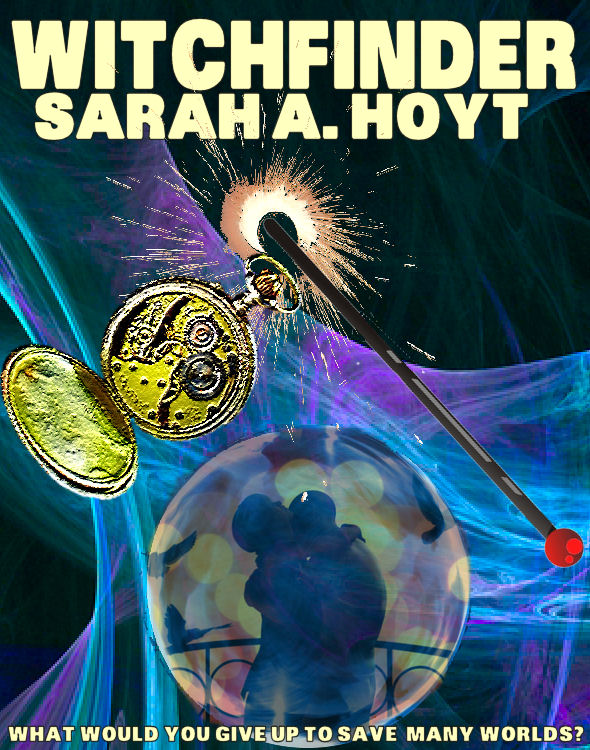
I’m Sorry

I’m trying to write the next chapter of Witchfinder — actually edit — and though I know what is happening, it’s just not gelling.  Nor is anything else.

I think between the writing pace, the very busy holiday season AND the major cleanup, I’m a bit scorched, if not burned out.

I am therefore taking a leave of absence from this blog till Monday, when I’ll be back.  I’ll make it up to you re: the free fiction.  However, not today and not tomorrow.  I’m going to convince my husband to take me to molest dinos and maybe a long walk in the park where he threatens ducks with roasting them. (It’s a hobby.)

Since I’m not really “burned out” just tired, a day and a half away should be enough.

Wish me luck and decompression.