You Can’t Fool Economics — And She IS A “Mother”

Pardon me, if this post seems to go near politics.  I don’t mean it, except that it’s impossible to talk economics without talking politics – or at least implying them.  It’s also impossible to build believable worlds without being aware of the basic facts of economics (which is why so many of the acclaimed science fiction books get thrown against the wall repeatedly and at least two have gotten tossed in the trash can with the requisite “pfui”.)  Bad economics – or what I would call economics dreams – are at the basis of most bad policy and coincidentally at the basis of most personal and business economic woes.

First of all, in the interest of full disclosure, I failed economics in ninth grade.  Oh, okay, not failed – I never failed a course – but I had a c which to my family was the moral equivalent of failing.  (Actually it was the moral equivalent of grand larceny.  I got told if I was going to be a c student and squander my parents’ resources, I’d have to move out and work for a living.  To be honest this was only because they’d graduated from threatening to send me to reform school.)  However I want to point out it’s a good thing I almost failed that economics class, because it wasn’t economics – it was a Marxist fairytale, complete with a finite economic pie and making business decisions on the basis of what was fair.  (I’d like to say it made no impression on me, but in fact that c was for giving battle to the teacher on every single beachhead from “mixed economy” being the best to the concept of social justice.  Never mind.  He was also a LITTLE man, and I liked to stand and watch his bald spot as I argued.  Yes, it IS somewhat of a miracle I lived to be here.  I attribute it to the fact that, abstracting the enhancements, I fought like Athena. ;) )

Second, let’s establish economics is a science.  What this means is that it studies naturally occurring forces and tries to devise their principles.  It is actually a hard science, though no one treats like that.  It would occur to no one to legislate the law of gravity, but people seem to think that it’s perfectly all right to legislate minimum wage or – still in Europe – price points.  It works about as well as legislating the law of gravity of course.

But Sarah, you say, economics is not at all the same thing as the law of gravity.  It affects individual humans.  Your writing is devoted to the notion that humans are individuals and you can neither control their behavior completely nor change them into what you’d like them to be.

Right you are.  But while humans in the individual are indeed unfathomable, the rules by which humans enter into voluntary exchanges of value aren’t.  And those are the rules of economics.

Here it is, in short, everything you need to unlock the wonderful world of economics: Everything has a cost.  Everything has a value.  These are rarely the same.  The cost is what the object, good or service took to produce: human labor, usage of natural resources, negative impact on the other things that could have been done with those.  The law of cost can be translated to There Ain’t No Such Thing As A Free Lunch.  Everything has a value too.  The value of something is what someone is willing to pay for it.

The essential revolutionary nature of Marxism was confusing cost and value and saying that something had the same value as its cost.  It doesn’t work.  Why doesn’t it work?  Because I can spend ten years building a miniature castle out of dog turds, but it’s unlikely anyone will pay me ten years worth of writing money for it.  (Unless they’re mental patients, but do you know how hard it is to find a moneyed mental patient.)

These inflexible laws of economics apply to everything, including jobs (we don’t have an illegal immigration problem, we have a legislated minimum wage problem* and an onerous paperwork boondoogle problem.  This makes it impossible for many marginal businesses and services to run, which means they HAVE to hire illegal immigrants – no paperwork, no deductions, pay them what their labor is worth to you – or die.  When faced with death, both people and businesses resort to the black market.  And no, you don’t want me to describe each of these steps.  But for the record, as a barely making it writer, I COULD hire an assistant.  Hiring an assistant would probably double my production, which means it’s worth the risk of paying 5k a year for a part time worker.  What I can’t afford is to pay this person social security and to do all the paperwork.  And if you just said “Good, then you can’t afford to hire someone!” you must think nothing is better than something.  I live in a college town, where five thousand could make a marked difference in some student lifestyle and debt, and oh, yeah, this way they’re just accumulating debt, and they’re also not getting social security.)

They also apply to artistic endeavors.  They even apply to your hobbies.  For instance, I’ve mentioned I have a basement full of half-started money making endeavors.  A lot of them fall under the “Hobby” category.  I grew up with a mother who sewed, so I learned to sew as soon as I was old enough to hold a needle – and this summer I need to teach the boys to do it.  Their emergency patches on pants when out of the house are… argh – the same way my sons learned to sling story as soon as they could talk.  When I was first married, I did a lot of clothing-sewing and I sewed my first maternity wardrobe, from scratch.  (This for two reasons – first, because I had a TON of free fabric and vintage buttons from Dan’s grandmother.  Second, because we were broke.  Oh, yeah, and third, because I could style them as I wanted to, which ended up sort of like the twenties meets fairyland.  Unfortunately we accidentally donated the box, in the very mixed up move.)  I enjoy sewing.  This opens up a whole series of projects, like sewing cloth dragons, which I tried to do for sale way back.  So, why don’t I do it?  Simple.  Because writing right now has the potential to pay me more.  So the negative-value applies to my hobbies.  I write, I read, and I do art (which serves often to fix up a story.  Feeds from the same impulse.)  If tomorrow clothing went through the roof (don’t discount it, look at North Korea) it might be worth my time to make the family clothing, again.

And right now you’re saying “So, cost and price.  You think all the complex transactions of the world hinge on this?”  Yep.  Same way that most of the world’s biological complexity hinges on the fact that one atom of carbon binds with two atoms of hydrogen.  Yes, things can get incredibly complex down the line – or up the line – but if you pull back the curtain, moving the levers will be those same two little men, cost and price.

“But Sarah, what about social justice?”  What about it?  What about the Easter Bunny, while we’re at it?

Yeah, you can pout, but there ain’t no such creature as social justice.  Justice is always individual.  You can’t apply justice to an entire group (and if you bring up Nazi soldiers, or even brownshirts, a) you’re violating Goodwin’s and b) we can’t be friends anymore.  Think of the worst people you can – say the students who engaged enthusiastically in China’s cultural revolution.  Then read some bios.  Some were fully-cognizant evil doers.  BUT a good number were also duped, confused or scared.  Even in that extreme you can’t judge collective.)  Mostly social justice screams are the equivalent of “It isn’t fair.”  Economics isn’t fair or not fair.  It just is.  Attempts to change it are like attempts to change hydrogen and oxygen bonds.  At best unavailing, at worst harmful.  At their very worst they result in things like WWII and North Korea.

There is also individual justice, of course.  I’m not going to deny some businesses exploit their workers or their suppliers (at a bar, sometime, I’ll tell you about the last ten years of my life.)  On the other hand, the thing is, if people are truly exploiting others, they’re already abusing economics, and there’s usually an extra-economic reason things got that bad.  (And in most cases the others can move to another job or another industry.  Yeah, I chose not to.)  Usually things get that bad because of attempts to influence economics to be more “just” or “fair” (which almost always results in misery for all) or alternatively because politicians like to get rich too.

This means in most cases individual justice has about as much to do with economics as a gnu has to do with extra solar physics.  Yes, you can strenuously work to find a connection, but your attempt will only distort reality.  So, if you want to work for justice do, one on one and on your own time – heaven knows I try – but leave economics and trying to regulate economic laws alone, okay?

So, what does this have to do with our life?  And with writing in particular?

Well, lately I’ve been open-mouth astonished by the number of established writers throwing fits that the new model of publishing doesn’t allow them to make the money they were used to.  I confess right now I couldn’t live from indie alone, but at least I understand the solution is not to throw fits and demand fairness and certainly not to try to regulate ebook price, by legal or extra legal means.  I’m not making as much as I’d like from Indie, because I only have short stories out under my own press.  I must finish novels for it.  Right now I’m writing them for Baen and a couple other presses, which pays me money up front.  Yeah, it over all probably pays me less, but I get the money this year when I’m about to have two kids in college.  It is what it is, fairness has nothing to do with it.  Once this crunch is past, I’ll write for myself, (and always for Baen, lest you fear) and I think I’ll do okay.  Oh, it will require two-three years ramp up and a lot of work, which I’d prefer not to do, when I should be “established” – life is a b*tch all over, isn’t it?  (Shrug.)

The other thing getting under my skin is this jobs fund or whachmacallit.  People are supposed to contribute five dollars and then they use this to give loans to small business startups.  (Rolls eyes.)  This intruded on my consciousness twice yesterday.  First, because the newly-rented (I’m betting I’ll get more done.  It’s why I’ll be unavailable during the day.  Office-ish is out of bounds right now, and my production plummeted, so this is worth it at least to try) office doesn’t yet have a coffee maker, but is a block from Starbucks (yes, I know, but it was time-saving) and second because I happened to sit with husband through The Voice (okay, I was reading a mystery.  But we could cuddle.)

I might be wronging the jobs fund, but I don’t think I am.  It seems like one of those things people do with other people’s money, which means it will make bad economic decisions.  Look, for instance, suppose I ask for contributions to a fund and from that fund I’m going to give advances to a hundred indie writers.  At best – supposing I screen – I’m going to screen those books according to MY tastes, which are not necessarily the PUBLIC tastes.  Will it result in bestsellers?  Uh… Only by accident.  Because you see, if all the hundred books fail, it means nothing to me.  So my guess is that this is what the jobs fund will do.  New businesses, even funded by people with a vested interest, fail by the score.  With this… I’d guess there will be no survivors and the money will be squandered.  But hey, donors get to feel good.

And this brings me to the book business as I’ve known it.  Dave at Mad Genius Club in comments mentioned something about most publishers/editors being no more evil than anyone else.  This is absolutely true.  BUT they were put in a situation that encourages and fosters evil, because the economics of publishing are screwy.  They’re screwy for several reasons, one of them the fiction that there is no money in books (go look at the publishing houses offices.  Those weren’t bought with bottle tops); the other is that it is something people do “for the love.”  People do a lot of things for the love, but even sex has a cost, even if it doesn’t have a price.

HOWEVER the capstone of screwing up publishing was the ability to play with other people’s (most the company and its many, anonymous investors) money AND to divorce results from actions.

Over the last thirty years, increasingly, publishing houses have discovered that they could exert control over what got shelved, which means what got seen, which means what got sold.  At the same time, they held on full throttle to the convenient fiction that EVERY failure of every book is because it is a bad book, and therefore the author’s fault.  (This wouldn’t stand logical analysis, because, how are you going to sell a million books, if no one knows your book exists – and yes, their answer is that the author should publicize it… because the author has a publicity department, of course.)  This fuzzy uncoupling of cost and price allowed the publishers/editors/whoever to choose books that pushed their world view and to feel virtuous about it.  Part of the reason Baen is different, is that it is a family business and it still needed to mind the bottom line.  So they took care what they bought was likely to sell.

And that’s also an illustration, btw, of “economics always wins.”  The publishers thought they could control both supply and demand, and therefore totally defeat the market.  (They probably took the same economics class I took in ninth grade.  The teacher would have adored that idea.)

Instead, as always when the market is regulated in a way that violates economic laws, it is flowing around them and finding another pathway.  You can see this with illegal immigration, with illegal narcotics sales, with illegal toilet sales (with the larger tank), with the black market that appears around every regulated good or service.  And you are seeing it in publishing with the ebook revolution.  It is entirely possible ebooks would have gone nowhere, if traditional publishing still had a functioning market that minded supply AND demand.  But it didn’t.

Like everyone else who thinks they can abolish economic laws, they are finding economic laws abolish them.

* I am not proposing that people should starve if they have no economic value.  I’m proposing that’s what charity is for.  Confusing charity and economics only leads to everyone needing charity because the economy – or a part of it – collapses.  Is this ideal?  Isn’t it demeaning for people to get charity?  (Rolls eyes.)  What about economics says it has to be ideal?  We’d probably all do better at slightly less than 1g, particularly as we age.  Does that mean we should legislate gravity?  Because it works about as well.  “Whaaa! Unfair!” is a preschooler’s cry, not an economic argument.
Certainly, The Game Is Rigged

*Sorry to be so late.  I originally had a different post written, but I realized some friends and mentees needed THIS one.  So I wrote it this morning, while dealing with interruptions.*

I confess I feel a little sheepish going over this yet again, but it’s clear I’m not getting through judging by the number of friends who are in a panic because they’re being dropped by their traditional publisher.  And then it occurred to me that though I’ve covered the differences between traditional publishing and indie publishing until I’m blue in the face, I never explained, at the basic, mechanic level, the difference between sales models.  I’ve told you that you’re free to do all yourself: hire an editor, do the layout, etc.  I’ve told you that you can do it.  I’ve told you that you will be better off and make more money that way.

What I’ve failed to tell you is why the traditional publishers are pushing 9 out of 10 promising newbies that way (if not more these days) and why you absolutely must take your career in your own hands.

And it’s shocking I have failed to tell you that, since I too had to be told, by Kris Rusch and Dean Wesley Smith.  Repeatedly.  And it only finally sunk in when I took their publishing workshop.  I urge you to follow those links to their pages and read the Business Rusch going back at least two years, and read Dean’s series Think Like A Publisher.  or buy his book from Amazon and/or Creatspace. And no, they don’t give me a kickback– it’s just everything I’ll say here they said earlier and better, and I don’t have the time to go into the detail they go into.

I confess I’ve dismissed all “younger” (which in my field means you entered the publishing game after me) writers who refuse to go indie witha shrug of the shoulders and a “If you want prestige you’ll screw yourself for it.”  I might have been doing them an injustice – except for those few who explicitly told me they want the prestige.  For those, I say only – on your own head be it.

For the others, the ones who are in honest and understandable despair –  after either a career of some length, or after earnest attempts to break in, crowned by encouraging letters from publishers – at the state of their prospects, I apologize.  I should have not dismissed you out of hand, nor would I have save for all the twits who want the “prestige” and who drove me nuts long before you came to me with your real problem.

I understand your doubts.  I understand your fears.  I understand your (misguided, for those of you I’ve read) conclusions that your writing must suck like a Dyson.  I understand you despair and your tears.  I was there, as little ago as a year.

First full disclosure.  As far back as my first rejection slip, I framed a Heinlein quote and hung it on the wall near my desk – so at some level I understood it even then, back in the eighties (and yes, it took me that long to put it together, though to be honest, it also got much worse over time.) – it says “Certainly the game is rigged.  Don’t let that stop you.  If you don’t bet, you can’t win.”

This countered all the times when I was sure the story was publishable (and it got an honorable mention in year’s best when it finally came out, so I wasn’t even wrong) but it got eighty five or eighty eight rejections most of them standard and impersonal.  I looked at it and I went “The game is rigged” – which it was, though not on purpose or nefariously – and went back to playing.  (Yes, Heinlein continues bringing up some of us from beyond the grave.)

We’ll go into how that game was rigged FIRST so that you understand how, with no malice on either side, things can stack against you.

First you have to understand this is NOT school.  In school, if your work is good enough you get an A.  Unfortunately that’s the model most of us know well, when heading out into publishing.  Also unfortunately it has very little to do with old style publishing.  (It might have more to do with indie, and I’ll explain later.)

In a magazine, which is what I was mostly submitting to at the time (well, novel publishers too, but that’s a whole different ball of wax), you have x slots per magazine – be it monthly or quarterly or whatever.  You buy for those slots, and when those slots are taken up, it’s all gone.

Having read slush, I can tell you how that process goes.  First, you look for names.  Why?  Names sell magazines.  When the magazine is on the shelf, or displayed on line, people who are fans of an established author are going to buy the magazine for the author.  And even if the magazine is tiny press, they’ll get a number of “names” – with trunk stories or reprints.  So, you read those immediately, as soon as they come in.  And if one of them fits the theme of your magazine, you buy it.

Let’s say you bought two. You now have eight slots.  What you’re going to look for is stories that sort of fit the theme of the magazine issue established by your anchor stories.  And you’re going to look first for what I’d call medium-names.  Why?  Well, because you hate new writers of course.  Okay, I’m joking.  No, it’s because solid mid list usually needs very little editing and takes instruction well.  So you pick up people whose name is familiar and read those.  Say, with a couple of rewrite requests, you now have two open slots.  (And this is optimistic, btw.)  Now you turn to the raw newbies.  By this time, though, you have length as well as theme requirements.  Typesetting might give you some flexibility, but you really can’t buy a ten thousand word story for a thousand word slot without running into some serious issues.

So, that game was rigged for good and sound business reasons on the publisher’s part.  I was right on that.  And hopefully now you understand why so many people experienced what I did where, after a hellish time breaking in, almost everything of theirs sold, including very old trunk stories.

Now let’s come to the way the novel market was rigged when I broke in, in 1999.  In some ways those seem like halcyon days compared to now, though reading Kris and Dean that’s when they consider the business to have gone off the rails.

The game used to be rigged the same way the magazines were.  Given a certain number of slots, they bought a certain number of books, and the precedence was kind of like above.  First, buy the bestsellers, who are going to bring in x amount of money.  Then buy the midlisters who will pay for themselves and a little more.  Finally buy the hopeful beginner and give him or her (at least) three tries, so long as he or she isn’t losing you massive amounts of money per book.  Baen, to an extent, still follows these business model. They admit they are a “mid list” house, meaning they don’t kick their midlisters out and let them grow, so long as they are growing, no matter how slow.  Now, they might give them fewer slots, compared to better selling books, but they don’t shut them off.  They understand midlisters are – or should be – where bestsellers come from.  They are, as far as I know, unique among even medium houses in the business today, let alone fairly large and established, which they are.  Heck, even quite small presses (those I’m not associated with) are trying to follow the “go big or go home” model.  Which is stupid, but is their funeral.

I first ran up against this business in October 2001.  Please, note the date.  As far as I understood from my publisher (I might have been wrong, mind you.  I was very young and hopeful and starry eyed) they had planned to do medium push on my first novel.  Nothing insane, but since Ill Met By Moonlight had a literary bent, and was going hard cover, they had (this I know for a fact) bought an end-of-row display for it in the chain stores.)  Then September 2001 intervened and things went very odd.

There were things before that, that led to there being only 2 copies or so ordered per store (I’m not going to wash dirty laundry in public.  Suffice it to say it had nothing to do with me or my book, but with their suddenly needing to push another book which had been delivered late.) The bookstores, faced with two books on hand, couldn’t understand why someone had paid for an endcap display, and just didn’t – for Borders – for the most part unpack my book at all.  It was returned a month later, without ever being on the shelf.  BUT even those that made it on the shelf, didn’t always sell.  After all that was (till then) the worst quarter ever for American publishing.  But wait, there’s more.  Because the book had been slated for medium push and because they thought it would appeal across genres, it didn’t say anything on the spine, not even fiction and the cover was a pre-raphaelite painting.  As a result, it was shelved in biography, theater, art (!) main stream, mystery… anywhere but fantasy where it belonged.  When I did drive-by signings, there was always a fun game of “hunt the book” lasting up to an hour.  Friends and fans who were waiting for the book would email me ten months later to ask if it was out yet.

So…  Of a printrun of eight thousand, hard cover, I sold about twenty five hundred.

Now, look at the list above and tell me what I did wrong?  Remember most of the books didn’t sell because they were never on the shelf and no one had ever heard of them.  I confess the book is “literary” and involuted, but it must have a public because I STILL get fan mail.  However, books that aren’t on shelves can’t be found.

The company had already bought the next two books.  So they couldn’t just tell me to go away.  But they did the next best thing: they printed the absolute minimum on the next two books.  There are die hard fans of Ill Met By Moonlight who DON’T KNOW there were two more books.  People approach me at cons and go “I loved your Ill Met By Moonlight, but you never wrote more historic fantasy.”

However, the publisher’s conclusion, from these events was that there was something wrong with my writing of historic fantasy.  They thought I might still be salvageable though, so they bought an historic mystery.  And then a contemporary mystery.  We will not go into those sad tales.  They have decided that neither of those series will make money (yes, the tales are similar to above.  With the additional fun that the contemporary mystery is still on the shelves two years later, but they tell me it failed to catch with the public.  Also their statements are internally inconsistent.  Yes…  There are reports ordered, and I promise to publish all third party reports and publisher reports right here.)

There was another historic fantasy series with another publisher that went roughly the same.  Low laydown, low expectations and low sales.

So, right now you’re going “Is it possible your writing sucks like a Dyson?”  I admit I thought that.  I mean, it’s the logical conclusion, right?  Except that at the same time this was happening to me, the publishers were bleeding mid-listers.  Solid, established mid-listers, people I had grown up reading and loved to read.  Also, as a reader, I was having more and more trouble finding people to read.  Old favorites disappeared and new favorites had a book, maybe two and vanished.

I confess I’m not brilliant, and when I’m involved, my default position is “It’s all my fault.  I must suck.”  It took reading Dean and listening to a couple of editor friends talk frankly about what was going on behind the scenes to GET it.  It actually wasn’t my fault.  Yeah, I might not be the most brilliant thing since polished brass, but the truth was, I never had a chance.

You see, late nineties – in addition to a lot of other forces – publishers acquired full control of shelf space (pretty much.)  Do you know what the most influential thing was for getting on a bookstore shelf?  Not the book, not even the cover, not even the author’s name or previous book figures (though that counted.  Google “ordering to the net” and “books” and you’ll understand the statistical misuse that was screwing midlisters then.)  THE most important thing determining how many books went on the shelves was how many books the PUBLISHER said they were going to print.  If the rep said “We’re printing a hundred thousand copies, you should take fifty” the bookstore did, because this indicated “high confidence” on the publisher’s part.  And given that shelves were the only way to find a book, you usually sold at least half the print run.  (Because you took up so much shelf space.  People FOUND you easilly.) And no one called a book with fifty thousand sales a failure, even if half the print run had to be scraped.

So, how many books got this treatment?  Well…  Maybe one in four.  Often less.

Were these books exceptionally marketable.  The publishers thought they were.  And here you have to understand MOST publishers (other than Baen, again) are creatures of New York City.  They live in New York City, they attend the same parties, they come from the same colleges.  Once they could control what books sold (by controlling shelf space) they could indulge in their own fancies, and enjoy having them confirmed (Yes, power corrupts, but we still need the electricity.)  This meant the books that got this treatment were books the publishers would like to read.  People tend to think everyone is like them, more so if they live in the same closed millieu.

Unfortunately a lot of the ones they took a fancy to translated to “the writer’s story.”  By which I don’t mean the story they wrote, but their personal story.

I’m not the world’s most politically correct person, and I know the last time I said this people got all upset at me to the tune of “What do you mean being a minority gave you an advantage.”  So, I’m going to explain.  Being a minority-who-made-good gave you an advantage.  Come on guys, it’s the quintessential American story.  Why should it surprise you?  Of course, these had to be “right thinking” minorities who agreed with the publishers and were duly grateful for the hand up.  (And apparently counting as “Latin” – who knew? – I found the suggestion that I should play up my personal story as an immigrant incredibly smarmy. I was never oppressed because I don’t let people oppress me, and my ethnicity is the least of my concerns.)  So it was if anything harder for minorities who aren’t duly grateful.  Other things that might get you a good laydown – beyond writing the dream book of NYC – were: having contacts in the field (If you possibly could, you should definitely room with a future senior editor while in college); being pretty and young (while I was reasonably pretty while young and I still don’t break mirrors, I only broke in in my late thirties.  So I failed the second.  At any rate, just as well, since I don’t understand what looks have to do with writing well.  I think it’s publishing thinking they’re Hollywood); having an interesting “slant” other than personal history (say you have an egg farm and write about dragon farms.  That sort of thing.); there were other factors, of course, but none of them were writing.

The big publishers are still buying that way, and most of the medium/small publishers still imitate them.  They still control laydown (somewhat) though some bookstores have got smart (or desperate) and are taking account of things like Amazon numbers in what they order and stock, so the push model is failing before our eyes.  To be honest, it was before.  Which is why the market was ripe for Indie.  (Publishing didn’t fall, it was pushed.)

So, if you are a new writer and they’re dropping your series, remember a) It’s probably nothing to do with your writing.  b) You can do better indie.

And right now you’re saying “How can I do better indie?  I’m promoting as fast as I can, and people aren’t buying fast enough for me to stay in print.”

Okay – no one can promote fast enough for the book to stay in print.  NO ONE.  The publisher either “pushed” or didn’t.  And if the publisher pushed, you don’t NEED to promote.

The beauty of Indie is that you don’t need to “promote fast enough.”  There is a sense of urgency in traditional publishing because so much depends on the laydown (on how many shelves you are) and velocity (how fast you sell.  If you don’t sell x books by three weeks, they’re all returned and then you can’t sell them.)  So, you’re on the clock the moment that book comes out.  Because shelf space is precious, they treat the books like produce.  Three weeks and they’re “old” and must be removed to make room for new ones.

You don’t have that in Indie.  The book goes up and stays up.  What I’ve seen with my own stuff is that sales GROW per title, as word of mouth has time to work.  So that book will only make you more.  Oh, you can still promote, by doing things like blogging and going to conferences and getting your name out there.  It helps, and it’s all cumulative.  One push feeds on the other.  The time pressure is off.  And it works.

And of course, in Indie you can keep a much larger percentage of the price, so you can live on a much smaller number of sales.

You don’t need to promote fast, for indie.  You need to promote steady and slow.  And keep promoting.

But Sarah, you say, I still want to be on shelves.  You can be. At least as much, maybe more than your publisher is getting you on shelves. I haven’t tried it yet for my Indie stuff, but if you read Dean he outlines ways to do it.

In any case you should read him and Kris.  There are many things I glided over, and this post is already epically long.  And you should take their publishing workshop if you can afford it and they accept you.  TOTALLY worth it, and it’s cheap, plus spouses count as one person.

So, that’s what you should do.  But for now, be aware only that if your series failed it’s not your fault.  The publisher slanted you to fail.  (Yes, there are economic reasons for that – some crazy – and I’m not going into that here.) There is nothing you could do after that.  No human being could promote “fast” enough.  (Well, maybe Bill Gates.)

It’s not your fault.  It doesn’t mean you’re a bad writer.  And you can make a living going indie. Depending on how hard you want to work, on both your quality (this is where school-like comes in.  More readable stuff sells better indie) and your quantity, you can make a GOOD living.

Be not afraid.  The game is rigged.  So, play to win.

The Smirk

Recently I was trying to tell a friend about two historical mystery series I just discovered.  I’ve mentioned them here before, and no, I have no intention of naming them because they’re both bestsellers and I don’t need that kind of grief.  (Those of you who correspond with me regularly can ask for the series’ names and I’ll name them, privately.)

One of them is set in the early twentieth century, the other just before the Regency.  As I said, I’ve been reading them both at once, alternating between.  Neither of them are my normal fare.  One I’m reading because I have a craving for that time period.  The other I’m reading because it came up in a list of “war fiction” which is something I’ll need for the book after A Few Good Men (for those who got advanced reading rights for that, this is the book from Zen’s perspective.)  I mean, I’ll need the mood.  Of course the book – work titled Revolution – is space opera or at least science fiction (can you still call it space opera when no one leaves the Earth.  Oh, wait.  Zen comes from Eden, so I guess so.)

Anyway, while I’m reading both, the proto-regency one leaves a much deeper impression.  Also, if I’m in an impatient mood (look, I have kids and cats) I can’t stand to read the twentieth century one.

I was recommending both to my friend, but trying to explain to him the … texture difference between the two.  I said a lot of “I don’t know” and things like “one just feels more real, somehow, while the other I think if I read five back to back would start to annoy me.”  Among other things, the one set in the regency has real and painstaking research that I have not found flaw in (and let me tell you…) while the other seems the result of having read a book called “daily life in–” and a lot of fiction set in that time.

And then I walked away from the email exchange, thought about it and realized what it was.

The regency plays it straight, in the sense that the author did research to the best of her ability and is trying her utmost to convey life in that time, with perhaps very minor adjustments to prevent the modern reader from running screaming into the night.  The 20th century one is full of … condescension towards the unenlightened people in the first half of the century.  The main character is completely out of her time, having all sorts of late 20th early 21st attitudes, even if she does periodically have “qualms” about them.  And the people who don’t have those attitudes are shown as somehow blinkered.

Mind you, it’s not in your face and obvious, but you get the feeling that the whole time the writer was smirking at the times behind her back.

Look, Agatha Christie had a ton of odd opinions on governance and on “the right people” but at least they are her opinions – by which I mean you get the feeling that was simply how she saw the world.  (And they didn’t bother me, save in the thrillers where… never mind.)  There is a sense of sincerity, of her telling them as she sees them.

In this other series – and they’re by no means alone.  In fact, it’s one of my pet peeves with historical books – you get the feeling the author feels smarter than her material, if that makes any sense.  The author thinks that those people are curiously benighted, but she must play as if their little concerns were real.

Somehow this attitude taints the book, because the psychology of the characters seems off, and because after a while, the reader gets the feeling that the writer is smirking AT him.

You see, to respect the intelligence of the reader you have to respect the intelligence of the characters.  Some things seem unfathomable to us today like, say, for me, the prohibition.  BUT I can think about it and read bios of prohibitionists, and sort of “get” it.  I wouldn’t attempt to write one unless I did.  (No, right now I have no plans to write one.  It’s just an example.)  It’s like when I write something set in Tudor England.  I am not a monarchist (though, full disclosure, my first 10 or so votes were straight party monarchist, in Portugal – mostly because I was going with “first do no evil.” Also, because it upset my parents.  I was young, okay?) but I can get into the mind set of someone for whom mind-and-sovereign are inextricably linked.  I wouldn’t write them otherwise.

Once I identified that feeling of being smirked at, I realized I found it in all sorts of other situations – in science fiction with pat or by-rote worldbuilding.  In mysteries where the murderer is almost dancing in front of the main character proclaiming his guilt on page two, and yet the murder is not solved.

These can happen through incompetence, of course.  But it has a different feel when it’s done on purpose.  It’s even throughout, like the same amount – of nearly zero – effort was made.  And it grates on the reader’s nerves.

At the risk of sounding sappy the most important thing, perhaps, for your voice, other than confidence in yourself and the story, is authenticity.  Do your best to portrait truth, even in your fiction.  This is not the same as portraying day to day life, because we already have that and don’t need to read it.  It’s more portraying what you view as the truth of the times or the people, and making people and times as real as possible within the ordered confines of fiction.

If you do so, if you play fair with your readers, adult to adult, they’ll respond honestly.

If you use stereotypes and stereotypical situations, and it’s obvious you feel superior to your material, your reader will know too.  And after a while it will start to grate.

Believe it or not, even from behind the pages of a book, readers can tell when you smirk.

Poop

For no reason I can fully explain, I found myself thinking of diaper changes today, and it occurred to me, “I sure dealt with a lot of poop.”

Mind, you I still do, because we have four cats, one of whom is very fuzzy and hygiene impaired, meaning twice a month he had to be held by two ruthless people while a third clips around the affected area with scissors, then finishes by bathing it.

If you’re flinching right now, let me say that this is something I couldn’t have imagined myself doing at twelve, or thirteen, or even sixteen.  I don’t know if that is – for everyone – a time of almost ritual cleanliness, but it was for me.  I remember washing things over and over, often with bleach, because someone I didn’t consider particularly clean had used them.  I think the idea of changing a diaper would have sent me running, gagging out of the room.

I don’t know when that changed.  Perhaps it was when I moved out on my own and realized there was no one else to do the nasty jobs.  If the shower drain stopped, I had to get down on my knees and clean it.  If the trap under the sink filled up, I had to remove it and clean it.

Compared to those, diapers are almost clean.

Where am I going with this?  Other than a terrible desire to mention poop?

Actually I don’t have a terrible desire to mention it.  I think a prurient interest in excretory functions are a mark of immaturity both in people and in writing.  I swear, every five years or so, some wag discovers again the bright idea that “characters never go to the bathroom.”  I remember the year Water World came out was one of those.   Every movie had the “obligatory p*ssing scene” which was supposed to make it “deep and real” or something, but since all of them had it, my husband and I would just roll our eyes and go “Obligatory p*ssing scene.”  (Of course, there was plenty more wrong with Water World than that.

And there was the story I got for the small press mag I edited, in which someone was reading in the toilet, while an alien erupted through the wall.  This was marginally improved by the grammatical mistake that made the sentence read “While sitting on the toilet, reading, the wall fell on Jack.”  I was so impressed with the wall’s literacy I continued reading, but once it became obvious it was just misstated, I sent the story back, possibly much to the writer’s shock.  I got the impression that by having the character in the bathroom, he’d made it “important” “relevant” and possibly even literary.

I’m not going to tell you my characters will never go to the bathroom.  In AFGM the fact that the poor man needs to use the facilities and his room is full of servants and retainers who patently have no intention of giving him ANY privacy — leads to a major temper explosion.  And often looking for a place to relieve themselves is why characters stray into the dragon’s lair.  Also my characters periodically… well, let’s say they fail to have clean underwear just before the monster eats them.

However, that is neither here nor there.  I’m neither fearful of poop nor do I embrace it with relish (ew) as the most important thing in life, or the grantor of sudden adulthood.

And – I told you this was relevant somehow, right?  Why didn’t you believe me? – this brings me to where trolls are like poop.  Or at least what they leave behind in the form of comments are like poop.

First of all let’s establish what trolling is: a) insults of the personal kind.  I might very well be a b*tch (heck, people call me that on occasion) but if all you did was skim a post of mine, you don’t know that.  You know I disagree with some tightly held opinion of yours, but you really are not well informed about me or my parentage to make that sort of judgement.  b) repeating ad-nauseum points that have been made by someone else before.  This includes, yes, repeating lines that you read in someone else’s “analysis” of a post.  c) engaging in picking apart minor points, particularly when they’re minor points you INFER the author meant, but which are not actually meant in the article.  d) engaging in the tu quoque type of argument.  Say I maintain that the sky is blue and you say “Well, yeah, but your side lied about the sky.  It used to be pink.  It did.”  (Actually that one combines c and d.)  e) calling everyone who agrees with the author camp followers and sycophants.  Believe it or not, at least in this blog, tons of people can disagree with the blogger all the time.  Few of us actually lead mini-cults.  Yeah, I have some friends who read here, but h*ll even my friends have their own opinions.  Trust me.  We argue all the time. If the majority of people commenting agree with me and not with you consider that JUST possibly it is because they happen to agree with me, not because of my awesome mind-control rays.

Anyway, all this boils down to trolls come by and instead of engaging in honest and informed discussion create a mass of comments that mean nothing, stink to high heaven and no one really wants to wade in.  For the troll going unanswered somehow means “they won” and being answered is never enough, so they “won” too.

I don’t know if the truth is they’re stuck in the juvenile age when the idea of excrement and touching it is sickening or in the juvenile age when they’re fascinated with their own poop and love flinging it around.

In either case, I’m sure poop is involved.   And it makes things very unpleasant for everyone reading and commenting.

In general I don’t respond to comments anyway, because I’ve found that it’s possible to nitpick a post to death without saying anything about the central thesis.  (Unless it’s a post on writing or something, when I like to wade in.  I also tend to respond to regular commenters who have become almost friends, and who DO NOT pick things to death, but discuss honestly.)  For instance where I say the sky is blue, you come by and explain no, no, it’s colorless and it just presents as blue to the human eye.  Then I chime in to say of course I know that, but it looks blue.  And then someone else pipes in to say, well, it often looks grey or magenta or…  And then someone else brings up sunsets.  Soon enough my thesis that the sky is blue – most of the time and barring weather systems – sounds fishy, even though everyone knows the sky is blue.  So I don’t respond, and let this kind of troll grumble himself into silence, like the mad man in the corner at a lecture insisting “but truly, the sky is rarely blue.”

Add to this any number of trolls screaming “poopyhead” and “your mom wears a logical fallacy” and I just want to go away from it all, and possibly wash my hands.

It occurred to me today that is the actual purpose of the trolling.  Not to convince anyone.  Not to discuss things.  Not even to make the comments on that post hard to read.

No, the purpose of the poo-flinging is to make the writer afraid of doing another such post.  To make the mind flinch before hand, like mothers do when thinking of giving baby stewed prunes.  (Or garlic.  TRUST me.  My son ate raw garlic while still in diapers.  Liked it.  No, trust me… if you have a baby, no matter how much he likes it… TRUST ME don’t give him raw garlic.)

What they want is the reaction any sane person has when faced with the idea of wadding through masses and masses of poop.  You go “it’s not worth my time.”

BUT you know what?  It is worth your time.  And my time.  And the time of every adult in the blogsphere.  It is worth our time, because otherwise we teach the infants – of any age – that flinging poop is the way to stop hearing things that disturb them.  We let them remain infants, forever, mired in their own dirty diapers.

Adults deal with poop, when poop needs to be dealt with.  They don’t like it.  They don’t relish it.  they don’t keep a diary of “my best poopies.”  But they deal with it and then wash their hands.

And as an adult blogger, I will do that.  Because the alternative is to let the poopy-heads control our discussions, and ultimately what the limits of permissible thought is.

Instead, I say we wash their mouths with soap.

The anti-hooman wave

Update: No, that workshop post isn’t here, and it doesn’t mean I played an April Fools joke on my readers.  I meant to post the workshop post on Mad Genius Club, but I haven’t had enough caffeine.  If you’re here for that post go to Mad Genius Club.

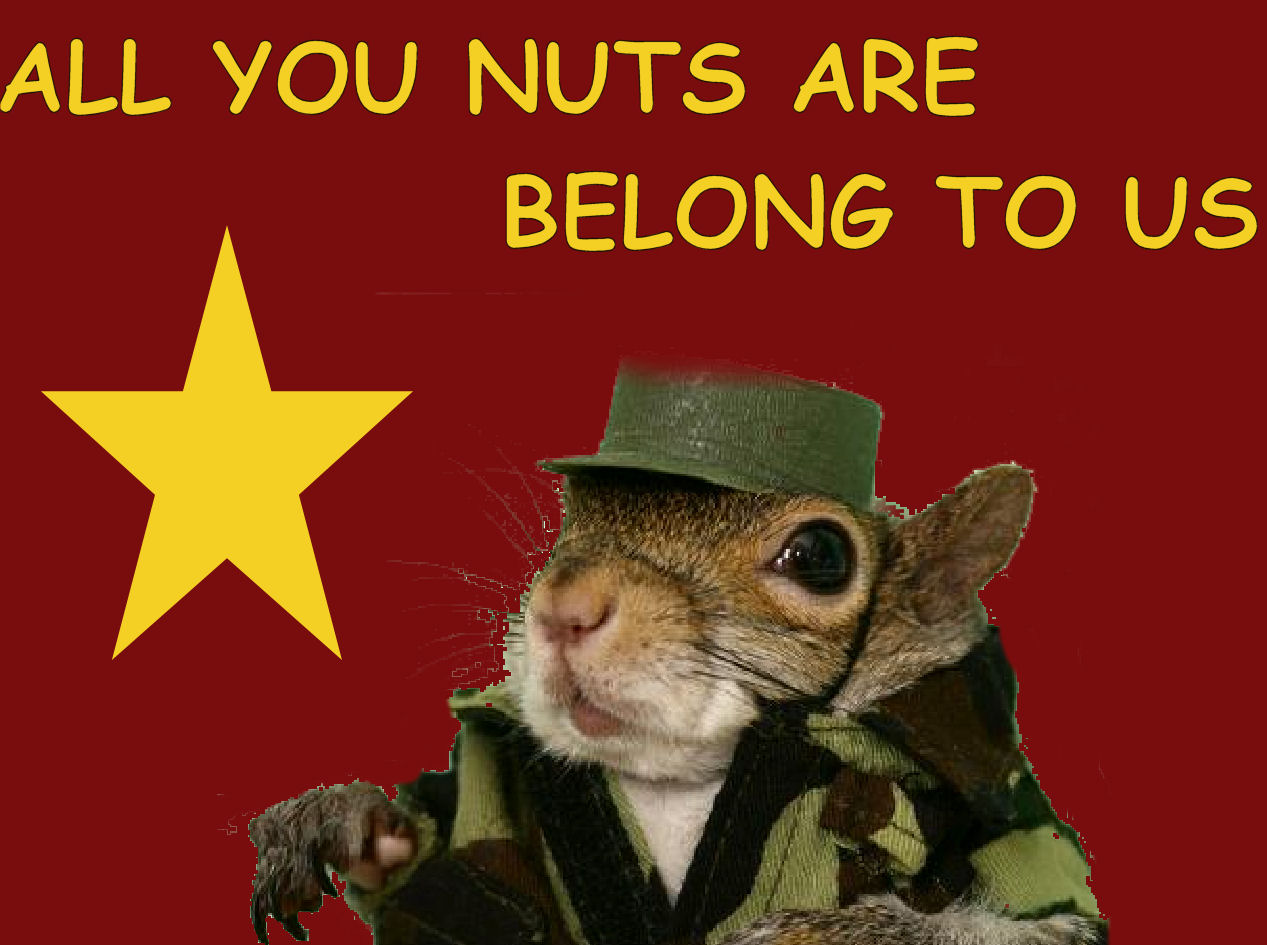
Good morning oppressed children of story and plot; inglorious workers in the vine of words!  I bring portentous news.  Your brothers and sisters, the rodents, are on your side.

You probably thought the Rodent Liberation Front was merely a flourish of – running dog of literary imperialism and gender traitor – Sarah A. Hoyt’s imagination in Gentleman Takes A Chance.  You were wrong!  We exist.  Struggling and nibbling at the margins of society, we have formed our plan to take over the world one nut at a time.

This being so, it will not surprise you to know that we found it necessary to reclaim for the people the property heretofore known as According To Hoyt or Sarah A. Hoyt’s Blog.  First, because it was being self-evidently written by a nut, second because many of the regulars appeared to be nuts, third because it often strayed into the field of science fiction which is, you might call it, a nut rich environment.

Since our primary goal is the redistribution of nuts to those who grow them, harvest them, own them, steal them, we had to claim this blog as the glorious conquest of the RLF.

Now that the blog is ours we enjoy enjoin you to forget the nonsense about a human wave.  You will never be anything as individuals.  The purpose of the individual is to serve the greater good of the state.

Join the RLF.  Like us, you are oppressed and downtrodden.  Think of all the people who don’t like your books.  Think of the evil corporation Amazon who sells your book in mere electrons, instead of comforting paper.  Think of all the poor publishers, who shall perish without your work and money.

Like us you are fond of nuts.  You are our natural allies.  In the collective, you shall write exactly what we tell you to – think of the joy of not having to think for yourselves – and you shall be free to share your royalties with us.

The nuts, united, shall never be defeated.  Talent to those who don’t have it! Redistribute the benefits of the writing, not the writing work.

Together we shall win!

Squirrel Castro

PS -Ignore the thumpings from the basement.  Sarah A. Hoyt is securely tied fit to be tied enjoying a lovely time at a reeducation camp

Almost The End Of The World

Lately regular readers of my blog must be wondering “What’s with the politics?  Isn’t this a writer’s blog?”  And of course, those of you who have come for my for lack of a better word “social analysis” must wonder what the heck is with all the posts about characters, writing and (marginally linked on both sides) this thing called “Human Wave Science Fiction.”

Of course my first answer is that I don’t do politics and this post is an explanation of why not, to an extent.  The comments can devolve into politics and political arguments – perhaps they should, although I confess that partisan politics make me uncomfortable (for reasons I’ll explain below) and I don’t think they’re even appropriate most of the time – and into theological arguments (y’all know you’re all powerfully weird, right?  And I say this with the greatest love and respect.)  However, the posts themselves are not politics.  Yeah, I have partisan choices, though these days they can best be defined by “OMG.  WHAT HAVE I DONE TO DESERVE THIS?” but those are my private business and also to an extent not what is important right now.

SO, Sarah, you say, rolling your eyes – what, must you pick up all my bad habits? – “Why the schizophrenic mix of writing articles and social analysis articles?  Who do you expect to read your blog when you don’t stick to a single line of thought?”

The answers in order are “Because they all reflect on writing.  And the writing reflects on social arrangements, too.” and “Everyone and anyone.”

And while you blink in bewilderment at my delusions of importance, let me explain.  First, let me lay down the reasons I think I’ve felt pushed into doing what must feel to people like a crazy hodge podge of themes.

My mind is an odd instrument.  Stop sniggering.  Yes, of course every human mind is, to an extent.  But my mind is weirder than normal.  This is not a matter of intelligence, or a matter of being adjusted to the world.  It’s more a matter of cognitive processes, the things that interest me, and the things my brain is good at doing.

In a very broad and oversimplified sense, there are human minds that tend to the specialty – leading to stories of math geniuses who never learn to tie their shoes – and minds that tend to the generality and are therefore, say, able to report on science without knowing a particular discipline intimately.

Both of those types of mind work way better than mine and are way more useful, unless you are a novelist where you need the broad, the narrow and the weird.

I am not exactly a mix of the two – though I go through times of intense obsession with a topic which causes me to become “the greatest living expert in” whatever it is.  It’s usually a really weird topic, like “Victorian Women’s Walking Shoes” (no, that’s not actually one of them, but it’s that sort of thing) – because my mind tends to the generalist.  I have broad interests and (with the aforementioned exceptions when I go into a narrow and obsessive mania) read broadly in both history and science.  But I’m not a generalist as such either.  Oh, I can act as one.  Most writers can.  I can give an impromptu lecture on the history and science of chemistry, if you give me five minutes to get names and dates right.

And that’s where the problem is.  I have virtually no mind for names and dates or specific incidents, even.  Instead, I read widely and everything I read goes into the compost heap and …  Well, compost heaps generate heat and fertilizer, but you can’t tell what started out as a banana peel and what started out as leftover cabbage.

Ignoring the particular nature of the fertilizer, fertilizer provides food for new plants.  Well, my brain works sort of like that.  I take in a lot of information from a lot of disparate sources (right now at various points in the house, face down, meaning they’re all being concurrently read are two historical novels, a book on Tudor England, a book on current events, and a book on dinosaurs) and then …  And then I start seeing connections that wouldn’t occur to anyone sane.  Sometimes these connections lead to “very strong hunches” which I have to call that because by the time I get to the hunch, I can’t tell you what facts I’m basing it on EXACTLY, I just have a strong gut feeling.

Sometimes getting at that hunch takes writing a novel too.  As I said my brain is speshul.  (It’s actually not an unusual mind for fiction writers, though we embrace our speshulness in various degrees.)  I often reason THROUGH fiction.  (Which leads to the sad “What’s your novel about?”  “Don’t know. Haven’t finished yet.”)

What I am and what I do is best exemplified by the scene in Heinlein’s Friday in which the boss has Friday research … what was it? Mini skirts and stock market trends, I think.  (Remember, children, this was pre internet and she was looking through more the equivalent of Arpanet.)  He has her spend days and days doing this and preparing reports, then calls her in the middle of the night and asks when the next black plague epidemic will hit.  And she “knows.”  And it’s right.

I don’t claim to be always right, though that sort of mega-hunch usually is.  And my input is not quite as divorced from the question as that example.

Anyway – having gone on a two page detour on this (what, you expected brevity?) – the fact that my brain works this way means it has lately been screaming that the effect I’ve found lately – where publishing seems to be dying but it’s actually being reborn in a form we haven’t been trained to perceive – is going on not just in publishing but everywhere.

Everywhere from the way news are written – and consumed – to the highest levels of governance are changing so fast that the official institutions, designed and honed through the last three hundred years or so are completely at a loss.

They are also increasingly irrelevant.  It’s like when I was little and went on those merry-go-round type cars in amusement parks.  They have a wheel, but the wheel does nothing.  No matter how you twist it, you’re still going to go in the same direction.

Where the metaphor changes is that we’re not going in the same direction.  It’s more like they were used to the wheel responding and allowing them to drive in these nice little circles.  And then something happened and now sometimes they twist the wheel and nothing happens, and sometimes they twist the wheel and the car takes off like a plane, or starts digging into the ground, or does spirals into the horizon leaving the amusement park behind.

The important thing, though, is to realize that just because that ride has gone weird, the rest of the park is still working, and new rides and new ways of amusing yourself are being discovered.

Or to drop that overstretched metaphor – what is wacking publishing is wacking government and is wacking also every field in between (mark my words, education is the next field to seemingly come apart at the seams.  And given that our public schools also serve to warehouse juveniles while their parents work, the coming apart will be more brutal and uglier than anything we’ve seen yet.)

It’s called catastrophic change and the image in your mind should be that thing about Atlantis:  But afterwards there occurred violent earthquakes and floods; and in a single day and night of misfortune all your warlike men in a body sank into the earth, and the island of Atlantis in like manner disappeared in the depths of the sea.

This is coming about for several reasons, though at the basis of it it’s technology: while we liberal arts majors were jaw-jawing the techy people went and built information networks and machines to navigate them in.  While not as sexy as spaceships, computers are as transformational, probably more.  But it’s a stealth transformation.  For almost fifty years they’ve been digging under the establishment.  When collapse comes it will be sudden and absolute.  But it won’t be collapse as such, because at the same time they’ve been building structures under there, and when we fall, we’ll fall into the new structures, just like publishing is collapsing into new publishing.

Now, in government I’ll maintain I still think the constitution of the US is the best foundation on which to rebuild, but you and I every animal and plant under the sea must know that the constitution and government as we have it is not a creature of the constitution.

What it is is a creature of the Industrial revolution, the time when bureaucracy was invented with its characteristic grouping of people by one characteristic, its keeping of records, its inflexible rules and — more importantly — its insistence on top-down management.

The last time we had this type of technological change that shook the foundations of society it was when the industrial revolution came in, bringing untold prosperity and misery, both.  In the same way that happened then, we too will end up emerging from this period with institutions that are as different from our own as absolute monarchy is from constitutional republic, or even the social democracy of Europe and with finance as different as gold coin and fiat currency.  IF we’re very lucky, we might do this without the floods of blood that attended the last transformation.  (I don’t know.  Do you feel lucky?  I don’t so much.)

This is why partisan politics annoy me.   I have opinions on whom to vote for.  On the other hand, I don’t think what’s happening at the level is the show or even the main show.  At this point ALL they can do is make things worse.  As can we, at our level.

And at this point both parties are more creatures of the status quo than not.  It’s sort of like asking “Should I go with a big publishing house or a medium publishing house” when the question is “Should I go with a publishing house at all?”  There are answers to that last, both valid, and both depending on what you want, or what you think will do least harm. (You lays down your dollar, you takes your bet.)  But to the first the answer is only “You’re asking a question from ten years ago.”

On the other hand, what is happening, and how the shocks propagate to the system, and how the system is changing to deal with it (for instance the whole thing of trying to favor girls in schools – it’s sort of like controlling shelf space for publishers.  It’s already a symptom things are falling apart.  And it won’t work.  It’s the sort of move a terminal bureaucracy makes and which helps no one and makes things insane for a large number of people.  The answer is not more bureaucracy, but something new — more freedom?  More granularity? Something completely different? )

My job as a writer – since my first love was science fiction – requires me, always, to do a bit of free lance futurism.  To be living in a time like this is sort of like for an archeologist to find a time machine.

Add to that that most people with normal brains seem to be stuck into one of two modes “bring this back” and “bring that back.”  Or alternately “make it stop.”   This means they tend to “read” trends wrong and ignore the greatest chunk of them.  At least they read trends wrong according to MY lights.    According to my lights, the attitude should be “How can we help make this the future WE want?”

I’m not saying I’m right, but my skewed perspective might shed light on things for someone.

We are living in interesting times, and I reserve the right to reflect on them in schooling, in society, in writing.  So you’ll get periodic posts about “what I think will happen to income in the future” or “what schools are doing that is crazycakes” or even “top-down doesn’t work in publishing or … at this point in anything else.  The system is too complex.”

And sometimes you’ll get posts on how to write believable characters.  Because that too is changing.  Because the characters that were believable to an industrial-age audience aren’t necessarily the same that will resonate with us.  And because, wanting to be an ever-more-popular writer I must analyze that.  And because fiction — and particularly science fiction — are what we, as a society/species, dream with and part of shaping the “new new” future is to dream it up.

In the ultimate instance, these posts are how I process what I read, what I see, and of course, the occasional hunch.  They’re my way of bringing it all to the conscious.  Hopefully they’re interesting to you too, even those of you who aren’t writers and/or who would rather not muse on catastrophic change.

To me, as well as to you, I’d like to say it’s no use to try to make the change not happen.  It’s already too far gone.  To stop it WILL lead to rivers of blood and chances are it will come anyway.  Instead: “Be not afraid.”  It only looks like the end of the world, but what’s actually happening are the birth pangs or a new Earth and a new sky.

Or if you prefer it more popular (always good Sarah, for those you haven’t scared away with your obscure reasoning) It is the end of the world as we know it, (and I’m writing about it) and I feel fine.

UPDATE: The opening to my novel, Sword And Blood under the pen name Sarah Marques is up on Mad Genius Club

Witchfinder — Free Novel — Chapter 30

*Sorry to be so late and kind of short with this.  I seem to be coming down with “it’s going around” and with having had #1 son’s coffee, I’m really half dead.*

*This is the Fantasy novel I’m posting here for free, one chapter every Friday.   If your conscience troubles you getting something for free, do hit the donate button on the right side.  Anyone donating more than $6 will get a non-drm electronic copy of Witchfinder in its final version, when it’s published.
There is a compilation of previous chapters here  all in one big lump, which makes it easier to read and I will compile each new chapter there, a week after I post.  When the novel is completed and about to be edited the compilation page will probably be deleted.

Oh, this is in pre-arc format, meaning you’ll find the occasional spelling mistake and sentence that makes no sense.  It’s not exactly first draft, but it’s not at the level I’d send to a publisher, yet. *

For previous chapters, look here:  https://accordingtohoyt.com/witchfinder/

Cat’s Cradle

Gabriel woke to the sound of curtains opening and of a tray being set on the table next to the bed.  For a moment, for just a moment, before opening his eyes, he imagined he was back at Darkwater and that everything was as it should be: the intervening events had been some horrible, inscrutable nightmare.

Then he opened his eyes.  Sunlight came through mullioned windows.  The room was small, but not as small as his room in the Darkwater house.  And the person standing by the tray, having just set it down, was not some benighted apprentice house maid, with her cap all askew, but Marlon Elfborn, his clothes no more rumpled than normal, his eyebrows raised as though someone had asked him a preplexing question, and a sort of questioning smile on his lips.

Gabriel squinted against the sun, stared at Marlon a moment, and then – somewhat to his horror – heard his own mouth say, “Rufus.”

Marlon blinked at him.  “I beg your pardon?”

“Your hair,” Gabriel said and sat up, and even as he said it, he knew that it wasn’t true, that Marlon’s hair wasn’t red.  Not really.  Nothing about Marlon was really.  Not good, not bad.  Not dark, not light.  Gabriel groaned.

“Hardly,” Marlon said, crisply, and sounding indefinably amused.  Not that it matters much, does it.

“It might,” Gabriel said, his mouth still independent of his conscious thought. “I wonder if your mother was a salamander.”

And now Marlon’s eyebrows went high, really high.  “A fire spirit?  Unlikely.  It is not how my power trends, and besides, I’d like to see the human, no matter how magical, to impose himself on one of those.”  He shook his head.  “None of which matters, does it?  I have laid out the instruments we’ll need downstairs, but I could use your help.  I remember you can’t wake without tea and I remembered also,” He looked like a school child caught at fault.  “That you didn’t like magic used around the house for chores.  So I brought you tea and toast.  There is food in the kitchen, should you wish for it.  Stasis field, on the serving board.  I’ll be ready to work in half an hour.”

And like that he was gone, so fast that he might as well have teleported.  Gabriel ate his toast, with just a touch of the marmelade provided in a small porcelain dish, and he drank down his tea.  It was strong and a little stewed which, in his experience, was how Marlon had always made it.  Not unpleasant though.

There was a bathing room and a water closet next to his room, in between his door and what he presumed was Marlon’s, Gabriel found it by dint of looking, and took care of his morning hygiene and hasty shaving.  One thing that Marlon had never understood, Gabriel thought, annoyed, as he tied his necktie by touch, was that other people didn’t spring from sleep fully awake and dress in next to no time.

But by the time he made it down the stairs, Marlon was too absorbed in disposing objects around the room to pay much attention to Gabriel, much less to reproach him on being slow.

The objects were objects of power, but an odder assemblage of them than this, Gabriel had never seen.  There were stone spheres, vast and polished, swirling with metallic veins and crackling with barely contained magic.  There was one very large, very ancient shell that looked as though it had been corroded by the tides of an ancient sea.  There was too an old crown, brown and worn down that looked as though it had been buried for very long and had possibly been steeped in blood, besides.

Marlon disposed them as pieces on an elaborate game tray.  He’d pushed all the furniture out of the way to arrange things, and as he pulled a particularly ugly little statuette of a wolf over one way, for just a moment Gabriel saw the thread of power stretching between objects.

Marlon looked up then, dusting his hands, as though to cleanse them from hard work.  “There,” he said.  “Do you think that reflects the tangle, Gabriel?”

“I don’t know what you’re trying to do,” Gabriel said.  “I presume you wish to represent the tangle of magic lines, but … I never learned to do this.”

Marlon made a sound of annoyance.  “It’s very simple, really.  We’re representing the world as it is – or rather, the mess that someone has made of magic lines as it is.  And then after we determine that we can twist them back – or at least to a less tense state.  It’s simple sympathetic magic, Gabriel and you must have learned it in grammar school.”

Gabriel heard himself say, “We had a tutor, Seraphim and I,” as though that explained everything, then walking gingerly down the stairs and into the magic field.  Walking into an area where workings were being done was always dangerous, but Marlon hadn’t completed a wall or a defense barrier, or anything of the kind, and other than a vague zapping at the bottom of his feet, Gabriel felt nothing else.

Then looking around at the objects, he felt it and saw it, the tension that was built up in some of the lines being pulled out of position.  “Oh.” He said.

“Yes,” Marlon agreed, as though he’d said a lot.  “They are at high tension, at least some of them, but we have to reflect what they are, rather set them in the natural positions.  I suppose the feeling of wrongness overwhelms you and you can’t do that.  Yet.  It’s difficult the first time.  Very well.  I think I have them right.  Now, let’s close the working, and then we can move the lines.”

“You didn’t close it to set it,” Gabriel said.  He’d just realized Gypson’s body was nowhere around and wondered where it could be.  At Cambridge, Marlon had kept it in a closet in an attic room, which seemed cruel, but somehow Gabriel would much prefer.

“No.  See you, I had to be open to the influence of the world and to the currents as they were. But now we can close it.  Do you wish to do the honors of the knife?  I shall call the guardians.”  He handed Gabriel his working dagger, a piece of ancient metal probably inherited from some teacher.  Working knives had to be inherited or have another reason to be held in affection.  They were supposed to be, in a way a part of the magician’s own self.  Gabriel felt a pang at realizing he’d somehow forgotten his own dagger at home, at his work desk.  It had been a gift from his father.

He took Marlon’s though, and walked a quarter circle, slicing at the air.  “I cut this working from the world, into a space between the worlds,” he intoned, in his best learned-ritual-voice.

Marlon stood next to the piece and called to the guardian of the North, “Guardian of the North, ice and cold, we call to you.  Protect this portion of our working that no undue influence can intrude.”

They repeated it at each of the cardinal points.  Gabriel watched Marlon very carefully to make sure no strange magic crept in.  Once a man had dabbled in necromancy – had he really said it was not intentional – it was only a matter of time till other dark workings came into his daily magic.  Or at least that was what Gabriel had been taught.

Finally the circle was closed, and within the circle, they turned and looked at each other.  Neither would willingly break the circle, because doing so would endanger those who set it.  Since they both had, it would be double jeopardy.  The circle would need to be opened before it could be broached.  For now, they were in this space, in some undefinable way between realities, which gave them the opportunity to perform magic that would be dangerous in any world.

“Right,” Marlon said.  “Now, if you please, we may start moving the lines.  We’ll start with that one there.”  He pointed at the wolf image.  “My oh so dear father.”  He squinted at the wolf statue.  “I think it should go here,” Stepping nimbly among the lines, he tapped his toe on the ground.

Gabriel acquiesced but, to his shock, it took his help for Marlon to move the statuette he’d casually carried around moments before.  As they both pulled at the statuette with all their might, Marlon saw the expression on Gabriel’s face and laughed.  “We’re dragging fate and magic with us.  Did you expect it to be light?”

Once they set the wolf down, Gabriel reached for the crown.  It was the next highest point of tension.

“The king, I presume,” he said.

Marlon nodded and reached for the crown himself.  But, before he could touch it, a flash of darkness came through the shuttered windows.  That was the only way that Gabriel would ever be able to describe it.  A flash of dark as strong as any flash of light, robbing the room of ambient light.  It was followed by a rumbling, as from a subterranean tremor.  With it came a smell, a feel.  Gabriel wouldn’t have named it before, but he knew it was elf magic.  He made a sound at the back of his throat and stepped backwards.

Marlon grabbed his wrist and pulled him in.  “Watch where you walk you fool.  Don’t step out of the circle.”

“But… it’s elves.  They’re outside,” Gabriel said.

“I know,” Marlon said, his voice annoyed and softer than it should be.  “I should have known they would find us where humans failed.  They have stopped my … They ripped the disguise form my home, and yes, they’re surrounding us from outside, and I suspect from underneath too.”  This said, as another tremor started.

“Do you think…” he said.  He felt his mouth very dry.  “What can they want with us?”

Marlon shook his head. “This working can only be done with the help of elf magic.  The working we’re undoing.  They won’t want it undone.  As for why – even I don’t understand elves.”

They reached for the crown again, and managed to move it to the right place, despite various rumblings.  Marlon then pointed out the perfect green marble sphere near the north cardinal point.  “Your honored brother next, and that will be hard, since he’s off world.”

“Will this move him back?” Gabriel asked.

“Not… immediately.  But it will hasten his coming back.  Or move things … to the place they would have been had he never gone away, is more accurate.  The futures will merge, instead of diverge to the world where he never went away.”

Seraphim’s marker was heavier than the others.  Maybe because he was in another world.  It took all of Gabriel’s and Marlon’s strength to lift it two inches above the ground.

They were both thus, bent to hold it, when the rumbling hit from beneath, stronger than ever.  The floor rocked, and lifted.

Gabriel realized he was going to fall across the line, and lifted his hand, letting it drop in one of the emergency circle breaks allowed.

It wasn’t in time, and it wasn’t careful enough.  On the one hand, the jolt of magic as he fell across it was not a killing blow, which it would otherwise have been.  On the other hand, as he fell backward and across it, he felt as though he were being sliced by a thousand knives and his vision went momentarily dark.

When it cleared, he and Marlon were both on the floor on their sides, holding the stone that represented Seraphim between them.  There was a trickle of blood from Marlon’s forehead, and his eyes looked wild.  “Are you … are you well,” Gabriel asked, since asking someone who is looking at you if he’s alive seemed quite outside sanity.

Marlon nodded.  “Not, well, to, but… They’re throwing magic at us.  They’re…  Oh, damn.”

The in-betweener hit like an icy wall running somehow through them.  It left them lying somewhere quite different and, as they strived to stand, Gabriel found they were kneeling in the middle of a field, and there was a strange horseless carriage burying down towards them.  No.  A horseless cultivator.  This could only be one world.  They had their hands on Seraphim’s marker and– “The madhouse.”

Marlon looked demented as he grinned, a grin with no joy at all.  “Where his grace is?  Splendid.  He gets to try his marksmanship again!”

Circles In Thinking

Something has been working at me since my post against using stupid slogans instead of thinking (when reality is almost if not actually the opposite – and no, I’m not going to reprise that.  I made all the arguments I wanted to make in that post.  And everyone got a chance to yell at me.  Enough.)  Weirdly, what bothered me most was not the name calling, but a seemingly innocuous comment, which was echoed and repeated by any number of commenters.

To begin with, it was the way it was repeated – not, like a lot of it, as though the person were working from a cheat-sheet, but more – as though a lot of people at the same time had come up with the same clinching argument…  Or what they thought was a clinching argument.

Except it wasn’t, not when you step back and analyze it.  Worse, when you step back and analyze it, you grow quite alarmed at its underpinnings and the fact that ANYONE would think this served as an argument to defend anything.

If, like me, you are – for your sins – a graduate of an excellent college, and hold a degree in the humanities, you don’t wonder why so many people echoed it probably without coordination.  The reason is that they all heard this in school and that in school, if this had been a college paper, it would have won a good grade.  And like most such arguments, it echoes the bias of thought of college professors and current academia.

I don’t remember off the top of my head whether we let any of those comments through.  I wasn’t the only one weeding through them – I have helpers who do that also, so I have time to write.  So, I’ll have to reprise it.

The comment omitted what they were against so I’ll put it in square brackets [It doesn’t surprise me that you think that men get a worse deal in current society than women because] This reminds me of all the Victorian women who were against female suffrage. [presumably meaning: and you don’t realize that just like them you are brainwashed.]

If you are nodding along, you probably ALSO had an excellent college education in the humanities and learned what would get you an A in sociology or feminist literature or whatever the heck it was you took.  (In my case it was theory of Literature, American Literature and Comparative Literature.  Also American Culture, British Culture and German Culture.  Possibly also linguistics, though those tended to be more factual.)

If you are nodding along you ALSO never took the time to unpack this argument.  Don’t feel bad about it, though.  It bothered me – and not in the sense that it felt right – because though it felt like while it was a “valid” – i.e. “logical” – argument, I had a feeling it was wrong.  Not just in my case, but in general.

Still even now, several decades after leaving college, it took me hours and the fact I had a lot of time in a waiting room yesterday to unpack it and figure out the LEVELS of wrong in it: in general, in particular, and when applied to my blog.  We are ALL the product of our education, and if you think that unlike your grandmother you had an education that prepared you to think without bias, it just means you haven’t seen through the bias.

This is a staggeringly bad argument in general because it can be used to dismiss anyone’s ideas based on what a group in the past did.  Say you don’t believe – I plead the fifth.  Most of the time I have a better image of humans in general and yes, women in particular.  Periodically I get annoyed and have to point out certain issues – that women tend to repeat slogans without examining them and fall for quasi-messianic movements without examining their underpinnings.  I could sneeringly dismiss your argument with “Well, you know, the first thing women did, given the vote, was pass prohibition.”

And then you’ll say – rightly – “but Sarah, that was a different set of women, educated under different circumstances, informed by a different set of beliefs, which make your argument irrelevant.”

Which brings us to the second part of why this argument is wrong in the specific and why it’s appalling that people with a college education can’t unpack it.  Repeat after me: The past is another country.  Not only do you not know how you’d have reacted to the suffragette movement if you lived in that time (rather irrelevant, really, since if you lived in that time, you wouldn’t be you) BUT you have no idea if they were right for their time and by their lights.

Now before you go screaming around the echo chamber that Sarah Hoyt believes women shouldn’t have right to vote, let’s register it for posterity that Sarah Hoyt has her doubts on universal suffrage regardless of gender.  It’s a horrible system.  It’s just the best one we’ve come up with so far.  The average woman is no dumber or less equipped to make a voting decision than the average man, and at the high end, women are as equipped to do it as high-end men.

What I’d like say, though – and what I’d like you to listen to, if you can remove the wads of indoctrination blocking your ears – is that just because women’s suffrage won and the results (except prohibition) have been pretty good, they had no intellectual way of knowing that at the time.

First of all you’re assuming that suffrage is always an universal good.  I will grant you our history – which they didn’t have – seems to show it.  Societies where more people vote tend to, if nothing else, decay into tyranny slower.  And it’s possible we might avert it altogether (maybe.  History hasn’t weighed in.)  However, at the time this was not clear.  I like to joke that in the Portuguese civil war my ancestors fought and died never to have a say in their governance again.  That is to say, they fought and died for the guy who wanted to be an absolute monarch.  (Yes, there are other things there, including local and hereditary loyalty, but–) It’s a funny line, and it works for us, but it is just a joke.  I don’t presume to judge their choice, and neither should you.  Why?  They remembered the French revolution and, btw, the British one.  They had grandfather-handed-down memories of mob rule.  Their choice of the king and stability might have seemed the best at the time.  NOT mine.  I disapprove of any dictatorship.  But theirs.  Their best choice, at the time, not knowing the future, and armed with what they did know of their people and place which are stranger to me than any culture on Earth today.

Quite possibly it was the same with female suffrage.  The women you were talking about are not the women of today, with contraceptives and education that make them close enough to men.

Look, you go to war with the weapons you have, not the ones you hope for.  The suffragettes fought for the rights of women as they were, not as they are.  The women they had at the time were not us.  Education in the upper classes schooled women towards subservience (at least if what we know is true, and I’m not saying it is, we weren’t there.)  The lower classes are a lot more opaque.  We study them through excavations of middens and sometimes surviving oral history.  However, we can assume in the first throes of the industrial revolution men and women in the lower classes, both, were NOT equipped to be informed voters.  Add to that the fact most women spent most of their lives pregnant.  I’ve been pregnant.  I’ve researched pregnancy (to figure out what the heck happened to my mind then.)  There is an hormone whose sole purpose is to make you fat, contented and stupid.  And yes, it says that in the literature.  More importantly, when you’re pregnant and you feel your body is coping with all it can handle, you’ll take the path of least resistence in everything else.

This means that women who thought – at the time – about other women getting the vote and shuddered might have had a point.  They foresaw disaster if women got the vote, and – THIS IS VERY IMPORTANT – though we know they weren’t right (the minor thing with prohibition excepted) THEY HAD NO WAY OF KNOWING THAT.  Anyone who’s been through college should be self-aware enough to realize that.  The past is determined, the future isn’t.  We are their future.  They had no way of being sure how things would go.  They were entitled to their doubts and their second thoughts and by having them they showed NOT that they were puppets of the establishment, but that they were thinking human beings.  Even if they were wrong.  Hindsight is twenty twenty.

Now of course you’re saying “But Sarah, they were voting against their interests.”  Stop it.  Stop making me roll my eyes so hard they’ll fall on the floor.

What you’ve just slipped into, whether you realize it or not is “Argument by Marx.”  You probably don’t realize it, because even though lately the establishment has got a lot more bold and started making self-satisfied noises about neo-Marxism (it’s like stupidity.  Calling it neo-stupidity makes it sound so much better) it’s permeated all thought and all teaching for decades – unexamined, unthought-about.  It’s in the bin marked “unexamined foundational beliefs” which in your ancestors’ time held the idea of G-d creating the universe, something that permeated all thought, even that of self-conscious atheists.

And it is the other thing that is wrong, wrong, wrong about that comment.

The comment presupposes what some of their comrades (da, tovarish) said more boldly.  That by saying it is men who are getting the short end of the stick in our society and by standing in front of the feminist mob yelling “stop” I’m a “gender traitor.”  It does this by equaling me with Victorian women who were against their “gender”’s rights.

This is pure Marxism.  It strips me of me and my circumstances in life and what I want, and reduces me to one salient characteristic: the fact I was born with a vagina.  It is one of the most dehumanizing and demeaning theories of history ANYONE could come up with.  And Marx did.

Take your Victorian anti-suffrage woman.  She lived a pretty contented life, and in her experience she didn’t need the vote.  And if you’re going to say “but what about her sisters?”  Her sisters probably had similar lives.  If you mean other women in general, a woman of that time and class remembered the French revolution and was likely to have a sneering disdain for all lower classes.  These were not her sisters.  And the lower class men were not her brothers either. The whole idea would seem absurd to her.  Before you condemn her ask yourself “Why shouldn’t it?  What reason did she have to think of herself as belonging to any group? Why should she fight for more than what guaranteed the best life for her and her immediate loved ones?” (Bringing up nonsense about “false consciousness” and “group betrayal” is not thinking, it’s tourettes.  You’re assuming again that Marx was right. This is some leap of faith since his ideas have yet to work on real people.)

Now, take me.  Yes, I have a vagina.  I checked this morning.  It was still there.  BUT I have a lot of other circumstances in my life.  I have two sons, for instance – sons I’ve seen systematically discriminated against in school starting with the type of work required (group work is deadly for boys.  It’s also dominant now) to the style of teaching (most male brains learn more visually and kinetically.  Most teaching is verbal)  WHY would you presume I’m more interested in bullying males and getting more and more benes for my as yet non-existent female descendants, rather than in fighting for my sons to have at least the same basic treatment as their female peers?  Or, presuming I’ll have female descendants some day (I could have all granddaughters) and I can’t know, WHY would you presume, since I have kids and I don’t know what the future will be, I would want anything beyond “equality under the law?”

Leaving all that aside why would you presume I have more in common with a single woman working in a factory somewhere in the Midwest than with a married man with sons who writes articles for a living a hundred miles away?  What earthly sense does that make?

And before you lecture me about how Marxism envisions people as belonging to several interest groups – thank you muchly.  I was raised in a country that was going head over heels for Marxism.  I studied Marx in several classes.  I also had the dubious pleasure, a few months ago, of reading what earnest Utopian American Marxists in the seventies viewed as the ideal system of government.  It was bewildering and vomit-inducing.  They wanted the country organized into “soviets” (in real soviet, country organizes you) each of them representing an interest group to which you “belonged” in some way.  For instance, take me (please) I’d be in the women’s soviet, the Colorado soviet, the mother’s soviet, the Latino soviet and – presumably – the intellectuals soviet (Okay, for minus three seconds, after which I’d be in the Gulag soviet.)  Each of these would elect representatives.

And none of these would represent anyone.  For these to work, it presupposes that you have more than a marginal interest in common with other people in the same group.  Heck, even if you put me in the “Portuguese immigrants soviet” I’d have barely nothing in common with most of them because for one most don’t come from my part of the country and very few write or read SF (Okay Larry Correia, but he’s third generation.  Also, I’d be more likely to be with him in the Gulag soviet.)

The essential failure of making individuals go through groups with which they share a characteristic, is that ultimately groups are too amorphous for the representative to represent anything but himself. The last irreducible group is one.  Which is why our system establishes rights of the individual and equality under the law.  ANYTHING else, no matter how “progressive” it sounds is a shambling step back into the mists of tribalism and irrational group think.

(And yes, I realize group people by region as we do has its issues too.  OTOH if your city is razed, it kind of matters to you.  But I’m not saying that representation in other ways can’t or shouldn’t be considered.  I’m just saying multiplying the number of “representatives” and subtracting from the individual is not a step in the right direction.  And that groups aren’t as obvious as you think.)

The only place where it is appropriate for me to “think as a woman” or fight for an issue “as a woman” is the type of situation as in Arab countries where women AS A WHOLE are subjected to prohibitions in driving, working, learning or dressing the way they please (and no, it couldn’t happen here.  NEVER to that extent.  It’s the result of complex forces of culture and history.  Correction: It couldn’t happen here that fast and without some serious foundational changes.)  That fight has been fought for me already, and I’m guaranteed life, liberty and the pursuit of happiness.  Oh, yeah, and equality under the law.  And I will fight for those for EVERYONE, man, woman or yet undiscovered sentient being.  Yes, even against a group to which I nominally belong because you think I do.

And now that we’ve gone through why that comment was stupid and irrelevant in general and in particular, let’s talk about why it was wrong as a comment to put in my blog…

Having unpacked the levels of unthinking and unreasoning repetition of college-learning in that comment, we can now stand back and be amazed at the staggering arrogance of it.  To wit, the person making it assumes that a) I’d never heard it.  b) I’d never studied history.  c) I didn’t have the ability to reflect upon my situation in the light of history.

Given that this is the blog of – forget formal education – someone who is addicted to books, interested in history, and who has written historical fiction, the hubris in that comment is staggering.  And it shows something else.  It shows the desperate need to count intellectual superiority over anyone who disagrees with you, without even giving it a moment’s thought.  (None of these people said something like “I’m surprised someone like you didn’t realize” – no, the presumption is always that I never thought in historical or self-reflective terms.)

Make a note of it: if this is the only type of argument you can marshal – one size fits all and regurgitated from college classes – and if you think it will win the discussion, you’ve already lost.

UPDATE:  Welcome instapundit readers!  I normally don’t talk about vaginas in my posts.  Oh, wait, yes I do if the post demands it.  Sigh.  I yam what I yam.  Thank you to Glenn Reynolds for the link.

Grocers of Despair

This is a post about the qualities and the effects of despair.  There are several reasons for it, the proximate one being that we are fed a lot of it – purposely? – by our art and entertainment complex.

I’m well acquainted with despair.  You could say it is an old friend of mine, except that despair is no one’s friend.

Despair accounted for how long it took me to break into publishing, to an extent, by creating long gaps of silence in my production, and several attempts at doing something else – anything else – with my life.  My basement is littered with the beginnings of would-be-money-making projects I tried to engage in to avoid what seemed to be a hopeless attempt at getting published.  Despair has accounted for how few of my books have been out the last two years.  Those of you who have followed my blog through that time know I hit the nadir of despair about a year ago, when it looked like despite all my best efforts to keep running on ice, my career in writing was over.

I was wrong.  I was wrong for several reasons, one of them being that Darkship Thieves – my heart’s darling at that point – did well for itself, and continues to do surprisingly well.  I was wrong, because indie possibilities opened.  I was wrong because I lost it – truly lost it – and started telling it like it is, and weirdly, surprisingly the “me” I’d suppressed so long, in order to have a career that would allow me to feed the kids, allowed me to find readers who helped my career.  Go figure.

But the point is not that I was wrong.  The point is that I know from despair and what’s more, I understand why despair is considered a sin.  This is not always the case, and I’ve always had an issue with, say, sloth, since – being active by nature – I can’t imagine a worst punishment than being forced to do nothing.

Despair is a sin because it eats you, from the inside out.  Despair comes with “I will never” and “what is the use” and “the game is rigged, so why bother?”  Despair comes with beating your head against a glass window that shouldn’t be there, and yet is.  Despair, in its ultimate form has blighted more artistic careers, destroyed more souls (and by soul here, I don’t require you believe in an immortal entity.  I refer only to that which makes your mind and spirit yours) caused more suicides than anything else.

Despair is that feeling you get when you’ve run the maze, you’ve done your best, and you come to the end and there’s nothing but a blank wall.

It is a powerful emotion, at least for those of us who have faced it.  It is dramatic, if you end a story with it, after a good run and a lot of hope.  It stays in the mind.

It is in fact a primary color, and it’s small wonder beginning writers use it, just like beginning artists – say kindergarten – use primary colors.

And it is a sin.  It is a sin against your future self.  It is a sin against humanity.  It is a sin against possibility.  Remember that.  We’ll come back to it.

However, the fact that it is an easily identifiable tint and primary doesn’t explain why there is so much of it larded around science fiction and fantasy, which SHOULD be the literature of possibility.  Sure a lot of this can be explained by the youth of writers (in truth or in practice,) the youth of editors (most of the ones working with newby writers are just out of college) and a certain fashionable air of the times, when it is considered smart and hip to dress all in black and moan about the evils of the future.  (Kind of like it was fashionable for Goethe’s Werner.  Never mind.  Hip, I tell you.  futuristic even.)

But wait, there’s more.  There’s what despair serves to do.  People who despair don’t try to change things and/or undermine the establishment.  People who despair, at the very least go away and shut up, even if they don’t deliberately kill themselves.

There is a striking scene in one of Leo Frankowki’s books, in which a Mongol Lord gets peasants to line up so he can behead them.  And when the hero comes along and kills him, the peasants turn on the hero because “now you’ve gone and angered them.”  And when the hero asks what can be worse than being killed, they have nothing, except “they will make it worse.”  THAT’s despair.  Despair makes you embrace death willingly rather than rebel, no matter how bad things get.

While I don’t believe in a grand conspiracy among publishing outlets and entertainment venues, I do believe in a tribal culture in what is – after all – when it comes to influential people maybe a few thousand people: a small village.  Tribal cultures are easy to influence.  I’m not saying anyone is, I’m saying it’s possible – and we’ve found that type of influence behind a lot of the recent “trends.”

So, before you give in to despair, ask yourself qui bono?  (And if you’re not into asking yourself Latin questions and are now wondering if you should have been paying more attention to Dancing With The Stars and supermarket tabloids, let me dispel your confusion.  That means “Whom does this profit?”)

Dave Freer talks about sheep and goats.  Most of humanity are sheep.  Some of us are goats.  The problem of any establishment, any power, anyone who abrogates influence over human hearts and minds is to control the goats and to make the sheep do more than stand in place and bah.  The more brutally repressive regimes eliminate the goats, often physically, and leave only the sheep.  The result is all the innovation and elan of… North Korea.

The best regimes manage to allow the goats their head, keeping them only off the things that will hurt other people.  They usually result in the highest production – both artistic and material.

In between there are several types of goat-herding schemes, including tolerating them within certain bounds and shipping them abroad to claim new pastures for the sheep.  The British Empire used both strategies with great success since the Elizabethan age.  They eventually stopped using it and resorted to despair.  The British Empire didn’t survive much longer.

So ask yourself what about the current establishment makes it resort to despair?  It’s surely the mark of a philosophical system that has nothing else to offer its goats.  It’s the mark of a philosophical system that is doomed, and wants to keep things quiet “just a little longer.”

And it has been THE culture in publishing since the seventies.  The embrace of declining numbers, declining revenues, declining living standards for writers – the willing embrace of decline – the meek submission to the people who are killing us, because you wouldn’t want to get them angry.  They could really make it unpleasant then.

In According To Hoyt, we’ve talked about how going Indie is a mark of impatience… or something – at least according to the establishment.  We’re supposed to stay still, and let despair permeate us, and slowly tighten around us like a band, allowing us to make only the approved noises, which increase the cultural despair and get everyone accustomed to decline and darkness, and no way out.  When publishers say the mid-list should die, they expect us to curl up and do so.  How quaint.

Despair is a sin.  And, to quote Jerry Pournelle, it might not even reflect the truth.  Look at Heinlein, a smart man and most of us would say an optimist, who chose not to have children, avowedly (yes, I’m aware there might have been other reasons) because “the world was such a mess.”  And yet, if he’d had a child in his first marriage, that child would now be older than my dad, who has had a full life, and not an unpleasant one.

Do not take Mr. Heinlein’s example in that particular aspect of his life.  Take his example in his writing.  Despair is a sin.  And there is usually another way: a way through, a way around.  Find the way.  Pull the Mongol horseman down.  If you kill enough of them, they’ll go away.  Refuse to write despair.  Refuse to believe despair.  Look doom and gloom in the eye and ask them “you and what army?”  Yes, it might all come to the same in the end, but at least you’ll have fought and died like a human being and not a bah lamb.

Tell the Grocers of Despair you have better things to do.  There is a fight going on, and you’d rather fight.  And then go on and discover new pastures.  The poor sheep need somewhere to graze on.  And you’ll have more freedom to breathe.  And everyone wins in the end.

Remember qui bono?  If they sell you despair it’s because they’re afraid of what you can do if you don’t give up.  Don’t give up.  Nothing will piss the establishment more than your continued – and cheerful – battling on.  Do it.  Let THEM despair.

Being Human

While I agree with Charlie that we don’t want the human wave to be a prescriptive movement, one that cuts at the edges and where people can keep adding more injunctions and shall nots till, as in the present, you’re only allowed to write one type of book that echoes every other kind of book out there, because there’s only one opinion and one story line.

OTOH, while we’re not going to kick you out of The Human Wave for eating crackers in bed – or for writing a book where everyone dies at the end.  Or… – if you’re throwing your lot in with us and advertising yourself as one of us, then you should know that people will expect a certain feel.  And that feel almost certainly won’t be the slough of despond.  It almost certainly won’t be a feeling of disgust for human frailty and human imperfection and a worship of a quasi-mechanical perfection that doesn’t exist in humanity till all humans are dead.  It almost certainly won’t be a feeling of “we’re all doomed and why bother?”

We’re not going to tell you can’t do that, because frankly it’s up to you.  If you think that’s what most people want to read and what’s been censored by the gatekeepers (you might consider upping your meds) and think it belongs with a ragtag group trying to return the fun to science fiction, by all means, have at it.  But don’t be surprised if people attracted to the rest of our stuff aren’t attracted to yours.

This is because while the “human wave” is hard to qualify – all of us coming from many traditions, from fantasy to science fiction and from romantic fantasy to literary – we know it when we see it.  More importantly, the readers know it when they see it.

I’ve been reading everyone’s posts on this over the week, trying to firm it up in my mind, and it seems to me the important part of the “human wave” is the “human.”  And that’s perhaps where our greatest contrast to the New Wave is.  The New Wave viewed human flaws, human defects and human frailty as things to be mocked and condemned.  No, they didn’t explicitly say so, but it came through in most of their stories.  They viewed humans as flawed and therefore to be destroyed.  This was, I think, a reaction to the previous generation’s view of humanity as infinitely perfectible.  (Which wasn’t much better, since it was at the heart of all the totalitarian theories of the twentieth century.)

But viewing humanity’s frailty and error as irredeemable, and humanity, therefore, as an evil to be eradicated is not better.  In its ultimate manifestation it gives us people who hate themselves for being human.  The prescription, state wise, is the same too – they want a strong state to make of them what they can’t make of themselves.  They forget of course that the state is composed of humans.

Forgive me for using an analogy that is not accurate, insofar as humanity probably isn’t one giant organism.  But if humanity were a giant organism, the early twentieth (and in parts the later nineteenth) century would be the part where it graduated from elementary school.  It now knows enough to understand most of the world around it, and it feels confident that it can conquer its bad habits and its defects and grow up to be perfect.
Then comes middle school.  I sometimes say that Europe is dying from the wounds of WWI.  To be honestly, the reaction that was WWII only complicated matters.  If humanity were indeed a sole organism, this is the time at which it sits in its room cutting itself.  And sooner or later, as time passes, it realizes it’s never going to be perfect.

Those of you who have raised kids know instinctively what comes next: the cynicism, the self hatred.  In a particularly neurotic teen, which I think we’ve proven humanity is, it leads to trying to commit suicide.  There will also be attempts to return to childhood, which is where I think we get the rejection of science and the wish by many to lose enough population to return to an agrarian land-bound economy.  In their minds this is always an idyllic time, just like childhood is idyllic in the mind of the teen.

Many of the establishment stories (not New Wave, but an outgrowth of it) frankly read like a long-sustained teenage scream-out.  Or worse, like lying in bed going “moaaaaan.  Everything is bad and I can’t fix it.”

The Human Wave is, I think and hope, where we grow up.  Individual humans can do it, I hope species can, and I’m sure that literary movements can.

This is where we come to terms with the fact that we’re flawed, yes, but we’re all we have to work with, and there is a basic sanity in loving yourself.  You try to improve, yes, but you expect neither perfection nor utter failure.  Being human is a project not a destination.  Being human is a daily effort, not something you’re born.

You’re born a tailless ape with impulses and needs like any other animal, and a brain big enough to aspire to more.  Human is what happens when you integrate those, when you don’t condemn the animal but you also don’t let it have its sway.  It’s a struggle you face every day, unafraid, and when you fall down you pick yourself up and try again.

If the human wave works out, it will neither have the (fun but often superficial) characters of the golden age, who often seemed to never sweat, nor the evil anti-humanity of what is now considered “deep.”

Yes, humanity has flaws.  Yes, it will always have flaws.  But those flaws contain some of our deepest qualities.

There is a Jewish story about Moses, which I told each of my children in turn when it became obvious they were falling in despair because they’d realized they’d never be perfect.

During those forty years in the desert, one of the chiefs of the tribes whom the Israelites were approaching was a great believer in the study of physiognomy.  This is the belief you can tell a person’s character by their facial traits.  Hearing of this great multitude advancing towards him, he sent his court artist to spy covertly and make a portrait of their leader, so he knew what to expect.

When the physiognomist looked at the portrait, he told the chief.  “We’d best meet him at the edge of our land and surrender.  This man is an adulterer, a murderer, a thief.  He will destroy us.”

So, quaking, the chief met the Israelites at the border of his lands.  On speaking to Moses and hearing they were just passing through and had no intention to pillage or kill on their way, he invited Moses to the banquet, where he found that Moses was not in fact a monster.  So he told Moses the story and said, “I’m going to have my physiognomist put to death because he’s useless.”

But Moses said, “No.  Stay your hand.  He is right.  I am naturally all those things.  I’ve just chosen not to use my natural traits that way.  It is knowing those flaws in myself that gives me the ability to help others behave better and to spot those who can’t.  And it is struggling to make myself better that gives me the strength to keep my people together on our journey.”

Whether you accept the historicity of Moses or not, you can probably see the truth of that.  Someone who was perfect, sweetness and light, and never had experienced a bad impulse in his life, would not be able to keep a fractious people together on a perilous and grueling journey.

I knew this truth about myself by fourth grade.  I knew I was naturally envious, so it was easier to study and be the best than to live with the envy of the person who had the best grades.  I knew I was naturally aggressive, but I didn’t like the results of just pounding people at random, so I channeled it into looking after the weak and the timid and worked it out by beating the occasional bully who’d pushed too far.

That balance between knowing yourself what you are and choosing to be better or to channel it in ways that don’t disgust you and don’t destroy those around you is being human.

It is the fact that we live in muck that makes us aspire to the stars.  It is our own internal weakness that makes us struggle to be strong for those we love.  It is knowing our own craven, irresolute nature that gives us the strength to say we’ll be better than that when it’s needed.

And that is, I hope, what the Human Wave will bring to science fiction and literature in general.  

Not a pollyannaish utopia, not heros that work like clockwork, not a shiny future where everything is splendid – mind you, we won’t tell you you’re not Human Wave if you do that, but you might find that stories with no conflict don’t sell well.  Not a despondent wallowing in the filthiest parts of our human condition – again, we won’t tell you that you’re not Human Wave if you do that, but our readers WILL know.

No, Human Wave aspires to write and read humans as they are: with the flaws and the warts that make our achievements – both scientific and moral – more astonishing.

Get out of your parents’ basement.  Stop contemplating suicide.  Stop raging at how everyone is stupid.  Yes, a large amount of people are, and you too are, but there is kindness and joy and love out there, why are you ignoring it?  It’s as real as the rest of it.

Go forth and read and write and be human.