The Hand That Rocks The Keyboard

One of you – RES? – asked me to write about how different people view the book.  The book, if you will, from the perspective of the writer, the publisher, the reader.

Meanwhile between blog comments and talking to a friend yesterday I became aware of the zany ideas ya’ll have about the writing life, starting with how much we work and ending with how much control we have over what you get on the shelves.

For extra points and double daring somersault I’m going to combine both into one post AND add in how this is changing with indie publishing (because my posts are normally so short, yeah.)  Watch me fall on my face.

So, let’s start it double reverse and from the back.

You, the reader, what do you know/see about a book?

I can answer this, because I’m a reader.  I was a reader long before I was a writer.  I was a reader – more importantly – before I knew Jack about publishing, because I had no hope of ever being a writer.  As a reader, like the man who doesn’t know what is art, but knows what he wants to hang over the sofa, I knew what I liked.

Mind you, what I liked varied.  Sometimes I was in the mood for science fiction, sometimes for mystery, more rarely for fantasy, occasionally for historical.  And within each of those I had my subsets and the writers I liked.  (I still have those.  I adore Pratchett, Freer and F. Paul Wilson, and half a dozen others but not back to back and rarely on the same day.)

As a reader, I watched for the writers I loved, bought their books, dragged them home in victory.  I can’t remember anything quite so cozy and rewarding as walking home on a rainy afternoon knowing that when I get in I’ll put on my robe and read that book I just bought and am carrying.

What did I know of the writers’ life?  Well, I knew what I’d read in books and seen in movies.  Writers wrote when inspiration struck, for instance.  Also, they were either bottom feeders (and even then they could get their agents to do things like pick up groceries for them) and cranked out book after book, or artistes, and too fine for common life.  Publishers could ALWAYS tell the difference between the two.  If you were an artiste, you would go through a starving period at the beginning, but once you sold your first book you became rich beyond the dreams of Croesus.

Publishers…  I still don’t know much about how publishers work, except for knowing most of them are parts of giant media conglomerates and that the important thing about your book is their putting forth a PROJECTION of what they think the book will sell.  Say, editor b reads book x and likes it well enough to buy.  Before editor b takes it to meeting, she has to decide how much they’re going to “invest” in pushing the book, which means they have to decide how much the book will sell.  When they come back and say “It will sell five thousand dollars” that book is going to be slapped out there, often – no, I know of at least a couple cases – without even an assistant editor at mega publisher inc READING it.  (If it was bought on proposal.)  I also know that it’s best for the individual editor if a book sells as little as she predicted than if it breaks her predictions and goes huge.  Why?  Because what she’s selling isn’t books.  What she’s selling is her judgement in picking them.

Once you’ve figured that out, stuff that made no sense suddenly comes into focus.  Like the midlister whose book goes out of print a week after coming out, because it has sold out of the printrun, and the editor in charge chooses to bury it, rather than risking its going blockbuster.  Like the distribution that doesn’t happen for “bottom” books.  Like…  Like books being taken out of print when they’re about to earn out of advance.  Like…  The bizarre editorial behavior in thinking they should control distribution and ultimate sales, instead of allowing readers to read what they wish.  Because for each individual editor, that’s enlightened self interest, right there.  For them the best possible outcome is not each book they publish is a bestseller, but each book they publish sells exactly as predicted.

And then you have the writer.  Here I’m going to give you a highly skewed view, and I want you to remember I came into the field at what can only be called the twilight of the gods.  That is, I came in when the publishers had achieved what they thought they wanted – complete control (via shelf space and exposure) of what readers go to see.  This meant if they slated you as a best seller you’d be that.  If they slated you to fail, you’d fail.

Let’s say given my tendency to stick pins in the “accepted” attitudes – often because I’m a contrary dog’s daughter – I would never be slated as a best seller.  And I wasn’t.  But they also never QUITE managed to kill me.  Oh, they killed SOME names.  For a time.  And they could force me to change genres.  But they could not make me go away.

The reason they couldn’t make me go away is twofold.  One is because I can’t stop writing.  The other is because I don’t like authorities telling me what to do or forcing me to do something.

Kit Marlowe once said “Hell is empty, and all the demons are here.”  Well… that could describe my career for the last ten years.  I got caught between the “but I have to write” the “I’ll be damned if they make me give up and go away” the “writing for any reason other than money is futile and stupid.  If people aren’t paying for it, or reading it, why bother?” and the “but I have to write.”  What it did – and I have yet to figure out if this is good or bad.  When the flames are hot enough they refine, after all – is that it took the “but I got to write” and taught me to harness it.  

They wanted historical mystery?  Sure.  I could do that.  Literary fantasy?  Oh, it depresses me, but I can do it by the numbers and blindfolded.  Historical biography-novel?  Sure.  Modern mystery?  Of course.

Why was this hell?  Well, remember where I said above that as a reader I read practically EVERYTHING but not at the same time, not back to back, and – sometimes – not on the same day?  It’s the same as a writer.  Sometimes what takes possession of my mind is a space adventure, sometimes it’s a funny mystery with cats.  And sometimes it’s a dark, laugh in the teeth of hell, vampire book.
The problem is this – in traditional publishing, to sell these, I had to write an outline and send it out.

When the idea first comes over me, it’s the most important thing in the world.  It possesses me.  It makes me do it THEN.  Most of my ideas were like that (save when I was TOLD to send in a proposal on this or that.)  So, I write the proposal in a white-heat.  I send it out.  Three years later, I get the contract.  (Or eight years later, in one case.)  By then, my head is in a completely different space.  I learned to force it.  (You can learn anything.)  This didn’t make me happy, though.  It might also not have made for the BEST product (good, sure, but not the best.)

Not that it mattered, since I was firmly slated “midlist” and nine times out of ten no one in the publishing house bothered to read the book.

However what it meant for me was sort of forcing little plant after little plant to come to maturation, then throwing them into the fire.

Because – listen to this – movies, and even books lie.  Unless you’re a mega bestsller – and sometimes not even then – your publisher and agent will not bend backward to do stuff for you.  For most of the mega corps you’re exactly that “slot” they’ve put you into.  Hell, even if you’re doing your own publicity, they won’t help, if they’ve slated you to sell “Minimum and no more.”  I had a publicity person at one of the houses become smitten with one of my books and work with me on some very creative campaigns.  She was fired.  Mind you, she did make THAT book a success.  Which probably made life very difficult for the editor, who fortunately managed to sink the next one to the appropriate level.  (Yes, it might be stupidity, not malice but…  How do you know?)

Because – listen to this – it’s not that I’m an artiste and too impractical for the grubby business of selling my book – see above, where I had to let go of the artiste and crank out books on demand, to kep publishing.  It’s that once I give a book in to a traditional house, I have ZERO control over that book.  There are certain things they technically can’t do (not that they haven’t all done it at one time and another) like, rewrite an entire chapter and not tell me, however, they have control over ALMOST everything else.  How the book is packaged.  What the cover looks like.  Whether it’s called fantasy or science fiction or main stream or biography or…  What the title is.  Whether it’s marketed YA or adult (and some of the decisions make one face-palm) and, more importantly how much push it will be given to be on shelves (or not.)

But Sarah – the reader says – how can you not have control?  It’s your book.  What I see, what I remember is your story AND the name on the cover.

Yes, of course.  Which is why for years now, publishing houses have gotten away with “every failure” (or unexciting performance) “is solely the author’s fault.”  And yet, the author had no control.  No control over when things came out, how they were presented, or even if more of a series came out.  More importantly, the writer dared say NOTHING.  Why?  Because to say anything meant you had a good chance of never working in publishing again.  And because all of us – writers – knew the system forced us to write things we didn’t want to write by the time they sold (no matter how much we wanted to write them when we first submitted) we also always felt a little guilty and like we were not doing our best, which fed into the whole thing.

This meant that we were shoved into a field where we had no control over our careers, but had to stay in it because most of us are compulsive, and where those who should be our greatest defenders – readers – held us responsible for the boneheaded moves of others.  (If I had a dime for each fan who has sent me a letter saying “Why didn’t you write more Shakespeare?  I liked those books.”  Or “Why didn’t you write that third refinishing mystery earlier, so that I didn’t have to wait two years for it?”  Or…   Well, I wouldn’t need to write for money.  We’ll just say that.)  And we had to be nice to the people putting us in this impossible position.  Oh, yeah, and there was no way to advance beyond what they slotted for us, but you could always FALL.  Which in my case meant falling right off publication.

And then they said we were neurotic because we were artistes.  Yeah.  Let me tell you, what’s amazing is that none of us ever went postal.

So.  How has it all changed with Indie?  Well, you guys still attach the book mostly to the writer.  That’s fine.  No, you won’t like everything even your favorites ever wrote.  BUT you’ll get to see it.

For writers?  Well, the possibility is there to write everything on spec (which I’m retooling towards as soon as possible.)  Which means, you write it while you’re white-hot and the book just wants to be written.  Does that produce the best work?  For me it does, usually.  I won’t answer for others.

For publishers?  Well… the good ones will find they have a better relationship with us.  The one publisher I’ve chosen to keep might or might not be shcoked because I speak frankly now.  (I don’t know.)  But I know it makes me easier to work with, because I’m no longer as full of doubt, guilt and aggression as a chicken with three heads.  The bad ones are finding that no one ever attached THEM to the books.  They attached the writer’s name, instead.  To them this is almost unfathomable.  They’re also finding that – because bookstores don’t want to die – they are ordering from what they see the book doing on Amazon more than on the word of the distributor.  (Right now it’s mixed, but you’re starting to see books slated for success fall flat, and vice versa.)  All of a sudden there’s nothing to be gained by making the book fail just as you predicted.  Whether that will change corporate culture or not, I neither know nor care.  I think the mega-corps are beyond redemption, and I’m not going to cry as they fall, though I might be happy if they retool in a more functional manner.  Because as a reader, a system that gets more and better books to me is always welcome.

Meanwhile, unless we screw up the transition, we seem to be going towards a system in which the hand that rocks the keyboard rules the reading world.

And I feel fine.

How Do You Know

If you’re really good?  Like knowing if he really loves you… it’s not immediately obvious.

This grizzly (what, you think I’m not?  Just mess with my kids.  Okay.  I’m more of a dragon) Old Writer wishes for this one dramatic scene, she could come down from the mountain, carrying tablets, but she can’t afford an ipad, so you’ll have to make do.

Look…  I’ll tell you a story – like I ever do anything else? – I grew up thinking of myself as not particularly attractive.  I knew for a fact most guys of my acquaintance had rather chew off their ankle than spend an afternoon talking to me.

It never occurred to me this had nothing to do with my looks, but to conversational gambits that started with, “So, what do you think the chances are that the Napoleonic invasions and the bureaucratic state they ushered in across Europe are the proximate cause of WWI carnage?”

And then I (finally) got pregnant and had the world’s second worst pregnancy (I don’t know everyone’s pregnancy stories.  One might be worse) still resulting in a live child.  Part of this involved being bed ridden for six months.  It not only made me gain sixty pounds, but the hormonal and other effects destroyed my metabolism.

The first time I went out in public felt weird.  Not because I felt self-conscious, but because something was different.  It took me about an hour to realize strange men were no longer turning around to stare at me.  Yes, they’d done that before.  They’d done it while I thought I was an ugly duckling.

What does that mean?  You can’t tell from inside.  You can’t tell how you look, you can’t tell how you feel, and you most certainly can’t tell how you write.

Look, if you have a few spare kroner, buy For Us The Living, by Robert A. Heinlein.  Then read Patterson’s biography of Heinlein.  Not only didn’t Robert realize that novel was a dud, but he kept trying to publish it for the next ten years or so, even while he was writing the juveniles, which means he HAD figured out what a novel was.

Another story – my first created world, in which I wrote EIGHT novels, I couldn’t give away for love or money.  I was then – my children (G) – as you are now, or rather more naive, if you consider I started writing this at 14 and submitting at 22.

When it got rejected (Mostly with standard rejections, though an editor I would later go on to work for told me she hated the characters, the setting and the writing style – which… never mind.) I assumed it was because my technique wasn’t up to snuff, and I went and worked at it some more.  I read how to books.  I read other books and analyzed them.  I took the Writers’ magazine course and half of the Writers Digest (I got published halfway through that.)  I tried first person.  I tried third person.  I tried a cast of thousands, I…

I never considered the books weren’t selling because they were WEIRD.

See, at fourteen, I created this world as an answer to The Left Hand Of Darkness.  I’m sorry, that book has world building issues.  (It’s a good book, nonetheless – magnanimous of me, isn’t it? – even if its narrative style is very much a prisoner of the seventies.)  From MY perspective (what other perspective would I work with, honeys?) she got humans wrong.  Yes, even hermaphrodite humans.  From what I read humans settled, formed clans and families because females needed protection when pregnant.  If everyone could get pregnant…  Well…  It’s hard to tell, since the only hermaphrodite species we know are lower orders.  However I think there is at least as much likelihood that it would become a fiercely independent every-individual’s hand against everyone else’s as a mother-loving, clannish society where children were communally raised and therefore no one was tied down to child rearing.  (What is it with “feminism” and not wanting to be “tied down” to child rearing, anyway?  Shouldn’t that be “masculinism”?  Love them and leave them?)

Anyway…  I created my world as a response.  Yeah, it’s a world of fierce individualists.  It also has an ick factor a mile wide (well, unless you make up a pronoun, and I’m not that crazy, you end up using “he” – at least you do if you’re not writing the clannish, feminist thingy.)  AND it has a counter-politically-correct factor wider than that (look, I THOUGHT SF was about open minds.  I hadn’t realized a lot of the efforts of NYC publishing were towards creating consensus reality, including consensus imagined reality.  I WAS YOUNG.)  AND to top it all off and put a cherry on it, it went the way my stories do.  Busy creating the world, I forgot WHY I was doing it, and got into all the fun details, including geneological tables going back 3k years, and dynastic wars and… yeah.  (Scratches nose.)  If I were smart, I wouldn’t (apparently) have pushed that baby carriage.  Twice.

Eventually it dawned on me that it MIGHT be the world.  (What, it had only been sixteen years since I created the world!) I wrote the Pseudo-Cretan fantasy, which did have internal issues (including my being stuck in cast of thousands) and though I didn’t sell it, I got tons of interest from agents, AND it won a contest.  And then I wrote the first version of Darkship Thieves.  And then things got weird.

Anyway, the point is, the first one of those first books WAS PUBLISHABLE as far as quality goes.  It was however sort of like a dead albatross, from the marketable point of view.  I thought my problem was technique, when in fact my problem was (as usual) having fallen under my own influence and thinking more kinds of forbidden thoughts than I can mention.  (I mean, the books didn’t even have sex in them, which would be the only excuse that NYC would GET for writing them.)

So, you kids (get off my lawn!) today, breaking in with your newfangled indie publishing can stop feeling like ya’ll are the lone ranger because you don’t know if what you’re writing is good.  No one EVER knows if what they write is good.  You write what you want to write and what fits your internal biases of how a story should go.  And you’ll be stubbornly blind to your peculiar biases.  (Like, not figuring out that in books about an hermaphrodite species people expect sex.  Or that New York editors would balk at a fiercely individualistic and independent society in which every individual had a womb.)
There are – of course – writers’ groups.  There’s only one problem with writers’ groups.  Most of them aren’t writers’ groups.  Most of them are … critiquers’ groups.  What I mean by this is that 90% of the writers’ workshops out there have devolved from groups of writers banding together to improve their writing to groups of people who have learned “rules” with which they can beat hopefuls away from even trying to write and incidentally make themselves feel better.  For instance, the ban on adjectives and adverbs?  (Gleefully broken by Rowling and others.)  It’s a feature of minimalism.  If you aspire to write in a minimalist style, heed the ban.  If not…  Well… write what works.

And what works?  How the heck do I know?  I could have told you, once upon a time, what would have worked for the traditional market.  I could tell you because there were well-known editorial biases.  Now…

Even Kris Rusch and Dean Smith are no longer teaching the Oregon Professional Writers Workshop.  (And they did it for years and were good at it.)  Why?  Because no one knows where to aim to hit the jackpot.  No, not even old pros.

But how do you know you’re not going to embarrass yourself?  You don’t.  It’s a risk you’ll have to take.  The disadvantage of the collapse of consensus taste – among many advantages, like not having stuff forced down your throat – is that there is no consensus taste.  What is too unreasonable for me, too new agey, too seventies, to mother-hugging-Earthy is someone else’s “just right” and “Plausible.”  And there are enough readers out there for those.

I don’t like For Us The Living, and I find Pratchett’s Rincewind books well-nigh-unreadable.  There are people who love both.

Put it out.  Put it all out.  Then, if you choose, take conclusions from what sells best.  Grammar and punctuation and formatting should be obeyed – or at least given broad nods to.  (Formatting can get odd across multiple platforms.)  So copyediting should be attended to.  Copyediting isn’t – or shouldn’t be – very expensive.  Get that done.

The rest…  If you aspire to be a bestseller, read the things that are selling well.  Study how they do it.  If you aspire to be literary, study how your idols do it.  

To your own self, be true.  And stop trying to judge your writing.  You can’t.  Amanda Hocking hoped to make a couple hundred dollars to go see the Muppets, live.  Instead, her books made her money hand over fist.  My older son has a story out – Bite One Get One Free – which he’d shelved after its being rejected for a vampire antho (possibly because it’s science fiction.)  It has now sold over 1500 copies.  A short story.  With no publicity.

You can’t tell.  Write it the best you know and put it all out.  Let the readers sort them out.

Again a Still, Small Voice

A year and a half ago I blogged about Lloyd Biggle Jr.’s novel, The Still Small Voice of Trumpets.

I’ll confess I was not perfectly straight forward with you, when I did that.  If I remember, I wrote from the perspective of a reader, and how happy I would be to see the writers who had vanished, how happy to rediscover them.  But I couldn’t close that circuit and make that connection.

I couldn’t do that because at the time I was still agented.  I was still not writing for indie.  I did not know if I could be or would be at any time.  And this imposed certain controls on my tongue.

For those of you who have never read Biggle’s The Still, Small Voice of Trumpets, some spoilers follow.  I’ll just say that despite the spoilers, despite knowing how it will turn out, you should still read it.  It’s one of the classic space operas that is near and dear to my heart.

First, to give you space if you wish to read no further because of spoilers, let me tell you that the proximate cause for this post is a comment by Robin Munn about how, due to the horrible contracts houses are now forcing many writers to sign, until publishing collapses and something else rises phoenix-like from the ashes, many writers are going to disappear for ten years or so.  (It’s in reply to this post.)

My answer said something like “yes, but writers have been disappearing randomly, strangely, for fifteen or more years now.”

I’ve talked about this elsewhere, and I won’t go into the mechanisms.  If you wish to read my old post He Beats Me But He’s My Publisher, go for it.  If you don’t – and I’m not the first person to describe this mechanism.  Dean Wesley Smith and Kris Rusch have described at least parts of it – I’ll give you a quick summary.  At the end of the eighties, sometime, while I was laboring largely in vain to break in, the publishing landscape underwent a marked transformation.

It was mostly a revolution in retail.  I remembered reading at the time about the bright future ahead, now chains were displacing indie bookstores, and how there would be more books and cheaper for the public.

This was true to an extent.  I was very happy when a Borders opened here in town, because it had a much bigger selection than anyone else, and I could go out and buy anything, even late at night…

Except–

Except the book trade is a specialized trade.  If the people who were running, managing, distributing, etc, had been readers, true book people and/or if the publishing industry hadn’t itself gone through a convulsion of mergers and buy outs that left management quite removed from the day to day business of publishing… or had most publishers the most rudimentary understanding of economics, the chain bookstores would have been a very good thing.
If ifs an’ ans were posts and pans no one would ever be hungry.

However, the conjunction of book retail being treated as just any other retail “by the numbers” and of the publishing houses having clue zero why it would be a bad idea to control the numbers from the inside out… was a very bad thing.

Sorry, I’m so used to the situation that I just realized I might need to unpack it further, for you.  See, to some extent, publishers always had some control over how much “push” a book got.  To an extent.  The book reps – the people who went door to door, bookstore to bookstore, drugstore to drugstore, everywhere that stocked books saying “hey, you want to stock this because” – tended to be (I think, this was before I was in the industry) readers.  But they also got marching orders – of course – from the publisher.  If told “We’re pushing this book to be big” they’d go out and lean on the stores to stock a lot.  Did it work?  Eh.  Sometimes.  And sometimes, no matter how much they pushed, the retail managers, who back then were by and large readers, would read the book and go “Joe, this is a stinker.  It won’t move.”  And sometimes the reverse happened to.  You had “surprise bestsellers.”  A book that was slated to go down into obscurity would catch the fancy of retailers, and they would hand sell it.  It would reprint, and reprint, and reprint.

That was before retail became consolidated into three big chains and before Borders brought its innovation of “computer numbers” and “ordering to the net” to the business.  Ordering to the net is ordering to the last “net sold” number of books by that author…  No matter the genre, the subgenre or the author’s growth.  (And let me tell you right away that there is no writer – not even Heinlein or Pratchett (genuflect) who never wrote a stinker.  And there are few writers so bad – one or two – who never wrote a book I like.)  Or… what was on the cover.  Or…

What the “computer numbers” system was supposed to do was streamline ordering and give the retailer a real basis for re-ordering.  What it did was provide cover and allow both retailer and publisher to play the numbers.  Let me put it this way – if you had only two books on the shelves per store your chances of selling more than half were almost none.  Your chances of reprint were less than that.  And your writing name would have to be changed within three books.  The alternative was you gave up writing and retired in disgust.

BUT the publisher didn’t have to think about “did we use the right cover?” or “If we bought it, how come it didn’t sell at all” or even “Should we have pushed more.”  No.  They could say “the numbers were bad” and cut the author off.  It was ALWAYS the author’s fault.  Even when the book didn’t even make it to the shelves.

This is what made me think of The Still Small Voice Of Trumpets.  In the book – spoiler warning! – our hero finds himself in a world of people with a mad appreciation for the beautiful.  The most valued art form is music and the type of music is the harp.  The world is ruled by a mad king who periodically – for no reason anyone can divine – has an harpist mutilated by having an arm cut off.

This makes it impossible for the harpist to play again and though the harpist might have been very popular, it effectively erases them from public view and public consciousness.  They disappear into the villages of the one-armed men, where they are in fact untouchable and “dead” to their fans.

In the interest of fomenting revolution, our hero invents a trumpet that can be played with only one hand and teaches the one-armed men to play.  In one of the most moving scenes of the book, the one-armed men march into the capital, playing their music and all their former fans, suddenly, remember them and realize how unjust their condemnation was.  Which starts the revolution.

When I wrote that first post, a year and a half ago, I was thinking how much traditional publishing was like that mad king.  I know of an author who sold very well and had the door slammed on her face because… she dumped her agent – one of the big names in NYC.  I know of authors who gave up in despair after two or three series died without their being able to do anything.  I know of authors who never got started, because they saw how their “older” (in the field) friends and mentors were treated.  And I know of authors who suddenly wouldn’t be bought and never found out why.  The wrong word at a party; the wrong blog post; the wrong expression when a political joke was told…  And it all came tumbling down, and you were banished from publication and from the shelves.  And your fans forgot you.

(In here, because the commenters asked before, I should say that it’s an open secret in the business that if you’re writing for Baen “you’ll be okay” – partly because Baen is in many ways a family enterprise, and not run strictly by bean counters.  OTOH when, like me, you like to write many different genres, it’s rather a lot to ask Baen to start a mystery line just to keep you happy.  So at least one of my pen names – Sarah D’Almeida – was sent off to the village of one armed men.)

If you’re like I used to be, before entering the business, you just went “Well, I guess so and so lost interest in the series; stopped writing; retired.”  If we were still writing – in other genres/under other names – we HAD to abet the deception.  In the interest of continuing to be published – not angering the mad king – we lied to you.  We said “Oh, I hated that series.  I’m much happier with this one.”  We said “Oh, that just never went anywhere.  I didn’t know what the next book would be.”  We said “We always just wanted to be myster/fantasy/romance writers, so we crossed over.”  And what the heck could you do but believe us?

But now we have our trumpets.  Indie publishing allows us to bring back dead pen names; to start writing again; to start writing at last.  We’re no longer dead and gone, banished to the unseen villages of one-armed men.

We are, more and more, marching into the capital, playing our trumpets.  Our fans are remembering us.

In the revolution that follows, a lot of mad kings will be deposed.  I agree with Robin that what emerges will be completely different.  I’d like to believe that as at the end of a fairytale the good are rewarded and the bad punished.
It’s more likely to be like the ending of Romeo and Juliet: “All are punished.”

Rough waters are ahead.  Revolutions are always hard.  But I think in the end, the system will be a little less closed, a little less insane, and a lot fairer.

Listen.  Can you hear it?  The sound of indie publishing is the Still Small Voice of Trumpets.  And they’re ringing freedom.

Free Novel — Witchfinder, Chapter 35

*This is the Fantasy novel I’m posting here for free, one chapter every Friday.   If your conscience troubles you getting something for free, do hit the donate button on the right side.  Anyone donating more than $6 will get a non-drm electronic copy of Witchfinder in its final version, when it’s published.
There is a compilation of previous chapters here  all in one big lump, which makes it easier to read and I will compile each new chapter there, a week after I post.  When the novel is completed and about to be edited the compilation page will probably be deleted.

Oh, this is in pre-arc format, meaning you’ll find the occasional spelling mistake and sentence that makes no sense.  It’s not exactly first draft, but it’s not at the level I’d send to a publisher, yet. *

For previous chapters, look here:  https://accordingtohoyt.com/witchfinder/

*Author’s note — I promised I wouldn’t let readers comments influence me when writing this.  But of course, some level of influence is impossible to avoid.  And “You deflowered the family goat” — courtesy of Pam Uphoff  Beth (who freely admits to it!) — just proved impossible not to steal.  My apologies.*

For My Lady Fair

The Duke took off running towards the field, and there was very little that Nell could do but follow him.  She had, of course, understood that Gabriel Pen had just ported in from whatever trouble the cards might have indicated – and she could not even imagine what represented him – and that he had someone else with him.  A necromancer.

The idea made her flesh crawl – an expression she’d heard before but never actually experienced.  Only now she had something to associate with necromancy: Antoine’s dead corpse walking.  She remembered the blank look in his eyes, the feel that whatever and whoever Antoine had been was no longer there.  Now, there was just a thing: an empty shell.

That in itself had always made her feel odd, the few times she had witnessed death – mostly of animals – but the idea that the dead meat should walk, move as if of its own volition was obscene.

Even now, the memory made her feel like her throat closed in disgust, and her flesh tried to crawl away beneath her skin.  She took deep breaths of the cool morning air, scented with the familiar smells of the farm, and ran as fast as she could.  If there were a necromancer come to the farm, she must defend the farm – and grandma – from him.  More important, if there were a necromancer come to the farm was it the one who had been responsible for re-animating Antoine?

If so, she would have something to say to him.  She was beginning to think, in light of what her true origins were likely to be, that she’d fallen in a neatly set trap, and that Antoine was part of it, but one way or another, and whatever he might have been, he didn’t deserve what had been done to him.  No one did.

She arrived in the field behind Seraphim.  Impossible not to.  His legs were much longer than hers and besides, she’d been accustomed for her time in Avalon, to be restricted in her ability to run anywhere.

When she approached the group, Seraphim Ainsling was yelling something.  The shock when she understood his words, and also what he was doing, was almost too great to permit her to react rationally.

Seraphim Ainsling, the proper Duke of Darkwater, of whom much was said, but not that he had fishmonger or carter ancestry, was screaming at the top of his lungs at the two men – one of whom was not only completely oblivious to him, but seemed to be attempting to dig to China with his bare hands, and burrow face-first into the hole.

Worse, the one standing was the Duke’s valet, and, Nell presumed, the Duke’s brother and – from what she’d seen of them – one of his closest friends, but the Duke was holding him roughly by the arm and shaking him.

What came at her, shouted at the top of the Duke’s voice, was almost impossible to understand so loud and rapid it was, “– I should wash my hands of you.  Are you out of your senses to be approaching this creature and to fall into his clutches once more?”

“Now, Duke,” Gabriel Penn said, very mildly, but in a tone of worried distraction.  He made as though to take a step sideways to pull his companion out of the dirt, or perhaps to succor him, but Seraphim held him fast.

“No, don’t you go trying to cajole me.  You know what coils this creature embroiled you into and you know he can only bring you dishonor and grief.   Even if he captured you, by dishonorable means, you should know–”

Gabriel Penn’s eyes flashed with a look not unlike Seraphim’s own when animated with near-uncontrollable fury, and for a moment he showed his teeth, pressed close together.  Nell thought he was about to slug the Duke, and for just a second, without thinking, moved to step between them.  Then she checked.  Even on Earth, stepping between two men about to engage in a slugging match was perfectly stupid.  But, stepping between two men from Avalon about to engage in a slugging match might be crazier.  Not only would they slug it out around or over her, but they would also hold each other responsible for causing her to step in.  Their rules of chivalry were complicated, but that one was obvious.

As she checked, Gabriel reached out and got hold of both of the duke’s arms above the elbow, “Your Grace, you bonehead, listen to me: Marlon Elfborn did not capture me.  I went to him to ask for help when I had nowhere else to go.”

“Well,” Seraphim said, struggling to pull his arms away from his brother’s gripping fingers.  “that only proves you’re not competent to run your own affairs.  Further more–”

“Yes, I know, further more he interrupted my education, raised the dead and deflowered the family goat.  Give over Seraphim, you fool, do.  Stop your vendetta and listen to me.”

“He deflowered what?” Seraphim said, stopping mid shout and frowning.

A dark red blush climbed Gabriel’s cheeks.  His eyes darted at Nell, and he actually attempted to bow, which went to show that the training of Avalon men was quite past rationality or sanity even.  “I beg your pardon Miss Felix, I–”

“Not Miss Felix,” Seraphim bellowed.  “Not Miss Felix.  She is the princess royale.”

“Oh, dear,” Gabriel said, and his face looked as though someone had lit a candle inside his skull, and he looked like he would presently join his friend in digging in the dirt.

Which finally triggered Nell’s reaction.  She couldn’t do anything about the Darkwater brothers.  She had a strong feeling whatever had been happening here had been going on for a long while – possibly since their births – and would go on yet longer.  But right now, at this moment, there was a creature who was suffering from either insanity or some compulsion, and she must help him.

She looked at the digging man with her mage vision, and saw…  Oh, dear.  Earth was near-lethal for a creature like Seraphim, even, full of magical power and not hardened from birth to the proximity of what they called cold iron, and which was in fact more what Earth would call technology. But this creature, the red-headed man scrabbling at the dirt, was at least three quarts magical, probably with fairyland blood – no, had to be.  Gabriel had called him Elfborn – but with some other magical blood mixed in as well.

And while, unlike Seraphim when he’d been transported here, he was not ill, and while he should be able to defend himself from the hostile surroundings, he seemed to have been caught by surprise.

He hadn’t intended to teleport here, Nell guessed, and therefore hadn’t shielded himself from the surrounding influence in time.  She would guess Gabriel Penn had had a second longer to shield, and that made all the difference.

Elfborn’s unshielded magic was under attack on all sides, much like a glob of flesh thrown into strong acid.

Acting instinctively, she threw a protection veil over him.  Not a spell.  A spell wouldn’t work for something like this, because it was not alive and would just get corroded along with everything else.  The only protection to extend in this case was a veil of magic, an extension of Nell’s own magic, fortunately hardened the conditions of Earth.

It worked, to an extent.  It stopped the creature’s magic dissolving and disintegrating.  It wouldn’t allow it to regenerate, because she couldn’t build a thick enough wall between it and Earth.  Particularly not since – as the effect hit a second later – to be so linked with him meant that she could feel his pain too.  It was somewhere between a migraine and a whole-body toothache.  She gritted her teeth against it, and turned to the two men, who had stopped arguing and were looking at her, as though she’d just grown a second head.

Gabriel recovered first.  “Thank you,” he said.  He let go of Darkwater’s arms, and like a total idiot, attempted to throw a veil of his own over hers.

“No,” she told him, using whatever concentration she could spare away from her task to magically block his attempt.  “You’re half-elf yourself and you’re not used to Earth.  If you try that, we’ll have you both in the same condition.”

“Well, if you think–” Seraphim Ainsling said, to Gabriel.  She could spare them no look, but something must have passed between them, some wordless argument, because she heard the duke draw a deep breath, and then she felt his power, like barrier, interpose itself not just between hers and the influence of Earth’s anti-magic, but between Elfborn’s and her own.

The pain lessened, receding a pace, and Elfborn’s magic pulsed, once, and reorganized into a coherent, if still fainter than it should be.  He stopped digging and fell back on his haunches, looking dazed.  Which, apparently, gave the other two men an opportunity to start screaming at each other again.

“What in he– Hades do you mean the family goat?” Seraphim started, at the same time that Gabriel said, at the top his voice, “You said she is the princess royale?”

“Please, don’t start screaming,” Nell said, thinking that hot tempers must run in the family.  which made perfect sense, as both the men seemed over-controlled, which they would be, if they knew they were likely to lose control completely, once they unbent.  “The Duke of Darkwater does believe that I am the princess royale of Avalon, Mr. Penn.  I’m not quite sure why myself, except a medallion and some… some other indications, but he says I look like the Queen.  And, your Grace, I presume Mr. Penn said what he did in an effort to derail you so that we could attend to Mr. Elfborn.  Is that so?”

Gabriel Penn opened his mouth as though to say something.  He reddened dark again, and shot his brother a glowering look.  “Yes.  Pardon me, Seraphim, but you– Oh, never mind.  We must get Marlon’s magic stable so he can survive here.  Miss– Er…  Your highness, do you chance to know where there are any standing stones hereabouts.”

“In the United States?”  She saw his blank look too late.  “The equivalent of your American colonies, sir.  We have no standing stones.”

“Oh.  But we–”

“It’s a different world,” Seraphim said, testily, and she thought that his tone was as much the result of whatever animosity he had towards Elfborne, and the not-quite-pain-and-worse-than-any-headache behind the eyes that protecting the man’s magic caused.  “They don’t have openings to fairyland here.  Which, I suspect, is what makes this a safe world for all of us right now, because I suspect, pardon me, Gabriel, that your magical kin’s stinking court politics are at the center of this mess.

“Yes, I suspect so too,” Gabriel Penn said, and turned to Nell.  “And this is why I wondered if you had something like standing stones.  They would have provided a shield for him, even if they’re not connected to fairyland.  They are places of refuge for magical creatures caught in this land, and they would allow him to recover.  He was trying to dig in the dirt, because that would be protection of a kind.”

Nell sighed.  “So, an underground room would help?”

“Somewhat,” Gabriel said.

“Very well.  The house was built in the time of coal heating.  There is a basement with an outside entrance.  There is nothing in it now, but I used to play in it as a girl.  If you’ll follow me,”

She led them around the house to the entrance.  This part of the basement, which had once contained a coal furnace, now dismantled, had been cleaned out and outfitted as her own private refuge when she was a little girl.  She’d always liked it, and liked hiding there to read.  Now she wondered if it was because it had afforded her own magic a respite from hostile forces.

Whatever had driven her to it, her grandmother had aided and abetted it. The little refuge had not only bookcases, a small table and a microwave, but also a loveseat draped over with a colorful shawl that hid the tears in the upholstery.  It also had a tiny powder room attached.  It had been installed late enough – after Nell had claimed it – that Nell knew it had plastic piping.  Just as well.  Sometimes too much metal was a problem for magic in the literal sense.

As soon as she closed the door to the outside, she felt the pressure against her shield over Elfborn abate.  It was like coming in from a raging storm to a place of calm.  Seraphim must have felt it too, because she saw his features sag in relief.

Gabriel Penn had helped Elfborne to the loveseat and dropped him into it, and the man’s eyes were returning to some semblance of understanding.  He looked at Seraphim, and his eyes widened.  Then he looked at Nell and they widened further.

“I beg your pardon,” he said, his voice creaking.  “I understand one or the other of you will wish to kill me.  Might I–” he looked at his dirt-covered hands.  “Be allowed to rinse the dirt from my hands and face, first.”

“Oh, Marlon,” Gabriel said.  “Stop the cheap tragedy.  Seraphim isn’t going to kill you and I can’t imagine why Miss– why her– why the lady would.”

“Will they not?” Elfborne said, something like the light of battle and a rueful look in his eyes.  “You only think that because you don’t know the half of it.”

Echoing Kris Rusch

Kris Rusch is having issues with malware attacks on her sites, and I find her post important enough to echo it here and over at Mad Genius Club.

The Business Rusch: Royalty Statement Update 2012
Kristine Kathryn Rusch

Over a year ago, I wrote a blog post about the fact that my e-book royalties from a couple of my traditional publishers looked wrong. Significantly wrong. After I posted that blog, dozens of writers contacted me with similar information. More disturbingly, some of these writers had evidence that their paper book royalties were also significantly wrong.

Writers contacted their writers’ organizations. Agents got the news. Everyone in the industry, it seemed, read those blogs, and many of the writers/agents/organizations vowed to do something. And some of them did.

I hoped to do an update within a few weeks after the initial post. I thought my update would come no later than summer of 2011.

I had no idea the update would take a year, and what I can tell you is—

Bupkis. Nada. Nothing. Zip. Zilch.

That doesn’t mean that nothing happened. I personally spoke to the heads of two different writers’ organizations who promised to look into this. I spoke to half a dozen attorneys active in the publishing field who were, as I mentioned in those posts, unsurprised. I spoke to a lot of agents, via e-mail and in person, and I spoke to even more writers.

The writers have kept me informed.  It seems, from the information I’m still getting, that nothing has changed. The publishers that last year used a formula to calculate e-book royalties (rather than report actual sales) still use the formula to calculate e-book royalties this year.

I just got one such royalty statement in April from one of those companies and my e-book sales from them for six months were a laughable ten per novel. My worst selling e-books, with awful covers, have sold more than that. Significantly more.

To this day, writers continue to notify their writers’ organizations, and if those organizations are doing anything, no one has bothered to tell me. Not that they have to. I’m only a member of one writers’ organizations, and I know for fact that one is doing nothing.

But the heads of the organizations I spoke to haven’t kept me apprised. I see nothing in the industry news about writers’ organizations approaching/auditing/dealing with the problems with royalty statements.  Sometimes these things take place behind the scenes, and I understand that. So, if your organization is taking action, please do let me know so that I can update the folks here.

The attorneys I spoke to are handling cases, but most of those cases are individual cases. An attorney represents a single writer with a complaint about royalties. Several of those cases got settled out of court. Others are still pending or are “in review.” I keep hearing noises about class actions, but so far, I haven’t seen any of them, nor has anyone notified me.

The agents disappointed me the most. Dean personally called an agent friend of ours whose agency handles two of the biggest stars in the writing firmament. That agent (having previously read my blog) promised the agency was aware of the problem and  was “handling it.”

Two weeks later, I got an e-mail from a writer with that agency asking me if I knew about the new e-book addendum to all of her contracts that the agency had sent out. The agency had sent the addendum with a “sign immediately” letter. I hadn’t heard any of this. I asked to see the letter and the addendum.

This writer was disturbed that the addendum was generic. It had arrived on her desk—get this—without her name or the name of the book typed in. She was supposed to fill out the contract number, the book’s title, her name, and all that pertinent information.

I had her send me her original contracts, which she did. The addendum destroyed her excellent e-book rights in that contract, substituting better terms for the publisher.  Said publisher handled both of that agency’s bright writing stars.

So I contacted other friends with that agency. They had all received the addendum. Most had just signed the addendum without comparing it to the original contract, trusting their agent who was (after all) supposed to protect them.

Wrong-o. The agency, it turned out, had made a deal with the publisher. The publisher would correct the royalties for the big names if agency sent out the addendum to every contract it had negotiated with that contract. The publisher and the agency both knew that not all writers would sign the addendum, but the publisher (and probably the agency) also knew that a good percentage of the writers would sign without reading it.

In other words, the publisher took the money it was originally paying to small fish and paid it to the big fish—with the small fish’s permission.

Yes, I’m furious about this, but not at the publisher. I’m mad at the authors who signed, but mostly, I’m mad at the agency that made this deal. This agency had a chance to make a good decision for all of its clients. Instead, it opted to make a good deal for only its big names.

Do I know for a fact that this is what happened? Yeah, I do. Can I prove it? No. Which is why I won’t tell you the name of the agency, nor the name of the bestsellers involved. (Who, I’m sure, have no idea what was done in their names.)

On a business level what the agency did makes sense. The agency pocketed millions in future commissions without costing itself a dime on the other side, since most of the writers who signed the addendum probably hadn’t earned out their advances, and probably never would.

On an ethical level it pisses me off. You’ll note that my language about agents has gotten harsher over the past year, and this single incident had something to do with it. Other incidents later added fuel to the fire, but they’re not relevant here. I’ll deal with them in a future post.

Yes, there are good agents in the world. Some work for unethical agencies. Some work for themselves. I still work with an agent who is also a lawyer, and is probably more ethical than I am.

But there are yahoos in the agenting business who make the slimy used car salesmen from 1970s films look like action heroes. But, as I said, that’s a future post.

I have a lot of information from writers, most of which is in private correspondence, none of which I can share, that leads me to believe that this particular agency isn’t the only one that used my blog on royalty statements to benefit their bestsellers and hurt their midlist writers. But again, I can’t prove it.

So I’m sad to report that nothing has changed from last  year on the royalty statement front.

Except…

The reason I was so excited about the Department of Justice lawsuit against the five publishers wasn’t because of the anti-trust issues (which do exist on a variety of levels in publishing, in my opinion), but because the DOJ accountants will dig, and dig, and dig into the records of these traditional publishers, particularly one company named in the suit that’s got truly egregious business practices.

Those practices will change, if only because the DOJ’s forensic accountants will request information that the current accounting systems in most publishing houses do not track. The accounting system in all five of these houses will get overhauled, and brought into the 21st century, and that will benefit writers. It will be an accidental benefit, but it will occur.

The audits alone will unearth a lot of problems. I know that some writers were skeptical that the auditors would look for problems in the royalty statements, but all that shows is a  lack of understanding of how forensic accounting works. In the weeks since the DOJ suit, I’ve contacted several accountants, including two forensic accountants, and they all agree that every pebble, every grain of sand, will be inspected because the best way to hide funds in an accounting audit is to move them to a part of the accounting system not being audited.

So when an organization like the DOJ audits, they get a blanket warrant to look at all of the accounting, not just the files in question. Yes, that’s a massive task. Yes, it will take years. But the change is gonna come.

From the outside.

Those of you in Europe might be seeing some of that change as well, since similar lawsuits are going on in Europe.

I do know that several writers from European countries, New Zealand, and Australia have written to me about similar problems in their royalty statements. The unifying factor in those statements is the companies involved.  Again, you’d recognize the names because they’ve been in the news lately…dealing with lawsuits.

Ironically for me, those two blog posts benefitted me greatly. I had been struggling to get my rights back from one publisher (who is the biggest problem publisher), and the week I posted the blog, I got contacted by my former editor there, who told me that my rights would come back to me ASAP. Because, the former editor told me (as a friend), things had changed since Thursday (the day I post my blog), and I would get everything I needed.

In other words, let’s get the troublemaker out of the house now. Fine with me.

Later, I discovered some problems with a former agency. I pointed out the problems in a letter, and those problems got solved immediately. I have several friends who’ve been dealing with similar things from that agency, and they can’t even get a return e-mail. I know that the quick response I got is because of this blog.

I also know that many writers used the blog posts from last year to negotiate more accountability from their publishers for future royalties. That’s a real plus. Whether or not it happens is another matter because I noted something else in this round of royalty statements.

Actually, that’s not fair. My agent caught it first. I need to give credit where credit is due, and since so many folks believe I bash agents, let me say again that my current agent is quite good, quite sharp, and quite ethical.

My agent noticed that the royalty statements from one of my publishers were basket accounted on the statement itself. Which is odd, considering there is no clause in any of the contracts I have with that company that allows for basket accounting.

For those of you who are unfamiliar with basket accounting, this is what it means:

A writer signs a contract with Publisher A for three books. The contract is a three-book contract. One contract, three books. Got that?

Okay, a contract with a basket-accounting clause allows the publisher to put all three books in the same accounting “basket” as if the books are one entity. So let’s say that book one does poorly, book two does better, and book three blows out of the water.

If book three earns royalties, those royalties go toward paying off the advances on books one and two.

Like this:

Advance for book one: $10,000

Advance for book two: $10,000

Advance for book three: $10,000

Book one only earned back $5,000 toward its advance. Book two only earned $6,000 toward its advance.

Book three earned $12,000—paying off its advance, with a $2,000 profit.

In a standard contract without basket accounting, the writer would have received the $2,000 as a royalty payment.

But with basket accounting, the writer receives nothing. That accounting looks like this:

Advance on contract 1: $30,000

Earnings on contract 1: $23,000

Amount still owed before the advance earns out: $7,000

Instead of getting $2,000, the writer looks at the contract and realizes she still has $7,000 before earning out.

Without basket accounting, she would have to earn $5,000 to earn out Book 1, and $4,000 to earn out Book 2, but Book 3 would be paying her cold hard cash.

Got the difference?

Now, let’s go back to my royalty statement. It covered three books. All three books had three different one-book contracts, signed years apart. You can’t have basket accounting without a basket (or more than one book), but I checked to see if sneaky lawyers had inserted a clause that I missed which allowed the publisher to basket account any books with that publisher that the publisher chose.

Nope.

I got a royalty statement with all of my advances basket accounted because…well, because. The royalty statement doesn’t follow the contract(s) at all.

Accounting error? No. These books had be added separately. Accounting program error (meaning once my name was added, did the program automatically basket account)? Maybe.

But I’ve suspected for nearly three years now that this company (not one of the big traditional publishers, but a smaller [still large] company) has been having serious financial problems. The company has played all kinds of games with my checks, with payments, with fulfilling promises that cost money.

This is just another one of those problems.

My agent caught it because he reads royalty statements. He mentioned it when he forwarded the statements. I would have caught it as well because I read royalty statements. Every single one. And I compare them to the previous statement. And often, I compare them to the contract.

Is this “error” a function of the modern publishing environment? No, not like e-book royalties, which we’ll get back to in a moment. I’m sure publishers have played this kind of trick since time immemorial. Royalty statements are fascinating for what they don’t say rather than for what they say.

For example, on this particular (messed up) royalty statement, e-books are listed as one item, without any identification. The e-books should be listed separately (according to ISBN) because Amazon has its own edition, as does Apple, as does B&N. Just like publishers must track the hardcover, trade paper, and mass market editions under different ISBNs, they should track e-books the same way.

The publisher that made the “error” with my books had no identifying number, and only one line for e-books. Does that mean that this figure included all e-books, from the Amazon edition to the B&N edition to the Apple edition? Or is this publisher, which has trouble getting its books on various sites (go figure), is only tracking Amazon? From the numbers, it would seem so. Because the numbers are somewhat lower than books in the same series that I have on Amazon, but nowhere near the numbers of the books in the same series if you add in Apple and B&N.

I can’t track this because the royalty statement has given me no way to track it. I would have to run an audit on the company. I’m not sure I want to do that because it would take my time, and I’m moving forward.

That’s the dilemma for writers. Do we take on our publishers individually? Because—for the most part—our agents aren’t doing it. The big agencies, the ones who actually have the clout and the numbers to defend their clients, are doing what they can for their big clients and leaving the rest in the dust.

Writers’ organizations seem to be silent on this. And honestly, it’s tough for an organization to take on a massive audit. It’s tough financially and it’s tough politically. I know one writer who headed a writer’s organization a few decades ago. She spearheaded an audit of major publishers, and it cost her her writing career. Not many heads of organizations have the stomach for that.

As for intellectual property attorneys (or any attorney for that matter), very few handle class actions. Most handle cases individually for individual clients. I know of several writers who’ve gone to attorneys and have gotten settlements from publishers. The problem here is that these settlements only benefit one writer, who often must sign a confidentiality agreement so he can’t even talk about what benefit he got from that agreement.

One company that I know of has revamped its royalty statements. They appear to be clearer. The original novel that I have with that company isn’t selling real well as an e-book, and that makes complete sense since the e-book costs damn near $20. (Ridiculous.) The other books that I have with that company, collaborations and tie-ins, seem to be accurately reported, although I have no way to know. I do appreciate that this company has now separated out every single e-book venue into its own category (B&N, Amazon, Apple) via ISBN, and I can actually see the sales breakdown.

So that’s a positive (I think). Some of the smaller companies have accurate statements as well—or at least, statements that match or improve upon the sales figures I’m seeing on indie projects.

This is all a long answer to a very simple question: What’s happened on the royalty statement front in the past year?

A lot less than I had hoped.

So here’s what you traditionally published writers can do. Track your royalty statements. Compare them to your contracts. Make sure the companies are reporting what they should be reporting.

If you’re combining indie and traditional, like I am, make sure the numbers are in the same ballpark. Make sure your traditional Amazon numbers are around the same numbers you get for your indie titles. If they aren’t, look at one thing first: Price. I expect sales to be much lower on that ridiculous $20 e-book. If your e-books through your traditional publisher are $15 or more, then sales will be down. If the e-books from your traditional publisher are priced around $10 or less, then they should be somewhat close in sales to your indie titles. (Or, if traditional publishers are doing the promotion they claim to do, the sales should be better.)

What to do if they’re not close at all? I have no idea. I still think there’s a benefit to contacting your writers’ organizations. Maybe if the organization keeps getting reports of badly done royalty statements, someone will take action.

If you want to hire an attorney or an auditor, remember doing that will cost both time and money. If you’re a bestseller, you might want to consider it. If you’re a midlist writer, it’s probably not worth the time and effort you’ll put in.

But do yourself a favor. Read those royalty statements. If you think they’re bad, then don’t sign a new contract with that publisher. Go somewhere else with your next book.

I wish I could give you better advice. I wish the big agencies actually tried to use their clout for good instead of their own personal profits. I wish the writers’ organizations had done something.

As usual, it’s up to individual writers.

Don’t let anyone screw you. You might not be able to fight the bad accounting on past books, but make sure you don’t allow it to happen on future books.

That means that you negotiate good contracts, you make sure your royalty statements match those contracts, and you don’t sign with a company that puts out royalty statements that don’t reflect your book deal.

I’m quite happy that I walked away from the publisher I mentioned above years ago. I did so because I didn’t like the treatment I got from the financial and production side. The editor was—as editors often are—great. Everything else at the company sucked.

The royalty statement was just confirmation of a good decision for me.

I hope you make good decisions going forward.

Remember: read your royalty statements.

Good luck.

I need to thank everyone who commented, e-mailed, donated, and called because of last week’s post. When I wrote it, all I meant to do was discuss how we all go through tough times and how we, as writers, need to recognize when we’ve hit a wall. It seems I hit a nerve. I forget sometimes that most writers work in a complete vacuum, with no writer friends, no one except family, who much as they care, don’t always understand.

So if you haven’t read last week’s post, take a peek. More importantly, look at the comments for great advice and some wonderful sharing. I appreciate them—and how much they expanded, added, and improved what I had to say. Thanks for that, everyone.

The donate button is below. As always, if you’ve received anything of value from this post or previous posts, please leave a tip on the way out.

Thanks!

Click Here to Go To PayPal.*

“The Business Rusch: “Royalty Statement Update 2012,” copyright © 2012 by Kristine Kathryn Rusch.

*Sarah Editorial Note: Right now I can’t get to any of her sites, to pick up the paypal link, but she does have one, and if you consistently read her, you should tip.  You also can’t read last week’s post, but once the hacking gets solved you should.  It meant a lot to me.

In Which The Writer Weasels

I could finish up my chapter of Witchfinder and put it up… I could.  But this is one of those days when it would take me to five, maybe later.  Why, you ask?  Because it’s prom night hereabouts, and I’m on mommy clothing-and-arrangements duty.  That means I get interrupted every five minutes, for those who don’t have teens.

Life being what it is, I figure it’s the best part of valor to say “ahscrewit” and go clean the house (a job remarkably lacking in the need for concentration) while dealing with these mini-emergencies.

When he shall have gone to meet his friends, and I shall have time and quiet to think I’ll finish the chapter, which will go up either tonight or tomorrow.

For now, I’ll spend quality time with the duster and the mop.  (What?  Prime plotting opportunity.)

Welcome Instapundit Readers: The ways in which da blogfather links are mysterious indeed.  This was my apology for not posting the chapter of the novel I’ve been writing in public, a chapter a week.  If you want to see the foregoing, it’s here.  Since y’all are already out here, though, you might as well take a look at yesterday’s post and the day before’s post.  PARTICULARLY that one, as it’s a recurring theme in my writing.  Also, read the comments.  My commenters are the funniest and smartest people in the interwebs.

Every Man A Lord

I was born with a healthy distaste for authority.  Or an unhealthy one, if you think about the white hairs I must have given my elementary school teacher.  To my poor parents it just seemed as though I never outgrew the “Why?” stage.  On the contrary, I overgrew the “Why?” with other considerations like “Taking in account that this economic model always causes issues, why do you think it will work?”  Or “Yes, but why would you think that, given the movement’s philosophical underpinnings?”  Or a thousand other questions that somehow always managed to come up when they told me to clean my room or do the dishes.  

(And you should not fear I went unpunished.  You see, I eventually had kids.  Yesterday night we had a philosophical discussion with the younger boy, in which most philosophers of the 20th century and not a few of the 18th were invoked, as well as half a dozen physicists, on the subject of “why you really need to buy another suit.  This one has been packed wrong a dozen times for the robotics competitions, and it looks gross.”  The gist of his argument?  He likes the suit.  What Hume and Locke have to do with this, much less Niels Bohr is something that evades my poor understanding.  My hope is that eventually at least one of them will have children.  And they’ll be exactly like them.)

When I came to the States I discovered that among the many posters that littered teachers’ and counselors’ offices, there was always one that said “Lead, Follow, or Get Out Of The Way.”  There might also be another, which would not be considered incredibly politically incorrect, and it said “The problem with this tribe is too many chiefs, not enough Indians.”  

Needless to say I absorbed all this, as I absorbed other bits of seventies culture, by reading it, chuckling and forgetting it.  (Okay, bell bottoms didn’t make me chuckle, they made me fall on the floor laughing.  Who knew they’d be revived?  But you know what they say about fashion, the first time is comedy, the second is tragedy.)

It wasn’t till much later that I came to think “What is wrong with getting out of the way?  WHY should I either lead or follow?  Aren’t these people able to find their own path and form their own followers if they want that?”

And much later, I realized that, in politically incorrect terms, Americans as a tribe ARE a nation of chiefs and not enough Indians.  But then the question becomes – what are ENOUGH Indians?  Why are Indians needed anyway?  (And please take this in seventies parlance.  No, I’m not talking about inhabitants of India or Pakistan.  Geesh.)

This occurred to me yesterday when I was writing my piece.  It might not be quite obvious to other people who have never lived out of the country, but we are, as a rule, an unusual people.

Take nine eleven.  Or even more so, take the great power failure in NYC and most of the Eastern regions in… was it 2003?  With electrical down and transport down, most large cities in the world would have broken down in total chaos.  Instead people walked home.  On nine eleven, common citizens pitched in to help strangers.  Some died for their pains.

Yes, there was also Katrina, and other pockets of what I would call “Learned helplessness” – though a lot of it is still exaggerated by our press.

But beyond the disasters and the horrible situations, Americans are different in every day life.  Look, guys, despite all the years of everyone telling us we should leave things to the experts, you can go out on any spring day and see normal citizens fixing and building their houses practically from scratch.  You can still find people repairing their own cars, despite the newfangled computers and stuff.  And let any issue appear, you see common citizens noodling over it.

You won’t know how rare this is, unless you’ve lived abroad, particularly in a place not in the anglosphere.  Reasons of class, reasons of expertise, reasons of learned helplessness, keep ordinary citizens waiting for the “authorities” and the “experts.”

This is the companion piece to my piece yesterday.  As RES pointed out in the comments “What I have I keep,” can also mean “What I have I defend and maintain.”  In the last Pratchett book to reference that motto, that is exactly what it means.

And in America, as long as each of us believes we own ourselves, as long as each of us – or a significant majority of us – believes it is right to keep what we have, what the goofy critters at the top do doesn’t matter.

Oh, don’t get me wrong.  I’m not going into politics, because what’s the point? But I’ve seen the way a government can bring a country to its knees.  Portugal in the seventies, for instance.  And in some things for which we do need the jokers, like common defense, we can – heaven help us – die from their goofiness.

BUT in general, the American pattern is “When people at the top screw up, go around them.  Find another way.”

Again, the perfect example of this is publishing.  It had been dysfunctional for several decades, but when it became lethally so, at a level that affected not only writers but readers who couldn’t find anything to read…  People found another way.  Mostly techy people did, though I’ll note self-published by the old means was well on its way up long before Amazon.

They went around.  The people at the top still haven’t recovered, and are still screaming “Too many chiefs, too many chiefs.”

I submit to you that at another point in the process, this is happening with bureaucracy and government too.  And it will happen with medicine, if it’s centralized to such a point it becomes utterly dysfunctional.  Medical engineering will come along and make medicine unimportant and quaint.

Part of this is what the tech guys have been up to, of course – the technologies that allow the individual power they’ve never had before.

But it starts before that, in the American psyche, with the strange idea of a government created and authorized by the people.

Lead or follow?  Oh, please.  I’ll get out of the way and take care of me and mine in this little pocket over here.  You zanies do whatever you think you should.  After all, you’re free citizens.

And being free citizens means taking your own path, and recognizing no authority greater than your own conscience.  It means finding solutions around all the “leaders” who are trying to direct you.  It means asking “WHY?” (Though I submit when it comes to ratty winter weight blue suits you should leave Hume and Locke alone already.)

Being free citizens means ascribing to yourself the privileges and responsibilities of noblemen in former ages.  “This much is mine, and this much I’ll care for and maintain and defend.”  And not just possessions, but friends and neighbors (yes, even the annoying ones with the weird political signs) and yeah, a few genuinely helpless creatures, like orphan kittens.  If it’s yours, you look after it.

No wonder regency romances, fantasy and even some of the science fiction that makes it in America is all about Lords and Ladies.  We are a nation of Lords and Ladies with very very few peasants.

And that is what I like about us.  When we’re all Lords and Ladies, no one gets to lord it over us.  Oh, they might think they do, but no such luck.  We are everyman a nobleman.  Or an ungovernable rabble, if you prefer.  Either is fine by me.

So, carry on, milords, miladies.  What is yours, you keep.  Keep it well.

What Is Mine, I Keep

In Terry Pratchett’s books, Lady Sybil Ramkin Vimes’ family motto is “What is ours, we keep.”

I’m sure it started out the way most things in Pratchett’s books started out.  The Ramkins are an old family, who intimidated their way everywhere and who conquered a lot of places and took a lot of wealth.  At least that has been the view of them throughout most of the books.  Sybil herself is a good egg, devoted to saving dragons, but the Ramkins are, by and large, one of the rapacious noble clans.

And then in the last book, something happened.  The “What is mine I keep” was turned on its head, in a way, which brought me to the realization that property, hereditary or not, is a double edged sword.  As is ownership: of things, of self, of talents, of career, of EVERYTHING.

Two things.  This is not a political article – mostly – but I would be remiss if I didn’t mention that yesterday was Victims of Communism Day.  Or that if you haven’t read The Black Book of Communism, you should.

The second thing I’d like to mention, it that I sort of already knew all this, instinctively and through my toenails, as I seem to know most of this stuff.  I just didn’t put it together in moral terms, till recently.

I grew up in the seventies and eighties with the communists and assorted stripes of collectivist taking the moral high ground.  After all, the rest of us were for things being unfair.  We wanted people to have more stuff than others.  And even if people got there naturally, well, it was wrong, because not everyone has the same capabilities.  Even if you got what you have by chiseling stuff off the rock, with your bare hands, well, not everyone has the same tough hands you have, you know, and why aren’t you more compassionate?

Even people who were strong anti-communists – and paid for it in career – seemed to bow to the communists and take a sort of moral back seat to them, and say “I know they mean well, it just doesn’t work.”  This still goes on.  In a lecture, yesterday, my kid was shown anti-communist films from the seventies, and his classmates laughed, because, you know, communists aren’t evil.  They’re well intentioned, after all.  (Read the Black Book Of Communism.  DO.)

I said this is not a political column.  It’s not.  At the same time this stuff is so ingrained and has become such part of our society that it’s hard to get at the basis of morality and – eventuality – the basis of managing a writing career, without going through it.

For instance, the idea of “equality” we have is mostly Marxist.  The equality before US law is not an equality of results.  But we assume that equality of results is desired.  We assume that if someone has more than others, this was somehow acquired by immoral means.  We talk about “Giving more to the community” and “Having more than our fair share.”  All of it is nonsense in real world terms.  It can only be talked about in terms that concede that Marxism is moral.

Part of this is because Marxism slots, perhaps fatally, with a part of the monkey brain.  In a small hominid band, if someone is taking more food than the others, he IS hogging it; he is greedy; and he is stealing from others.

In our society in which “resources” are what you make of them… not so much.  In our society where what you create is what matters for life, not so much.  In the chaotic system of a global economy, not so much.

And we come back to “what is mine, I keep.”

Look, I know some people are born with more than others.  They’re born with more talent, more intelligence, more ability, more tenacity.  Some are born with more things, too, but that’s nowhere as important in the long run.  However, some people are born with more than others.  Most of us realize that round about kindergarten.  It is immediately followed by ourselves or others realizing “it isn’t fair.”

“Fair” works in kindergarten, which is much like a small hominid band.  (Or a band of small hominids.  Eh.)  There are limited resources, and if you take too many graham crackers you are being greedy and your crackers will be redistributed.  This works, because the teacher, who is in charge of the class, makes you do it.

There is no teacher in charge of life.  I know, I know, but it’s true.  NO TEACHER.  This being the case, there is no “fairness” in life.  There is no “honor” in life.  There is no “equality” in life.

Heinlein and Shakespeare have both been there before me, but the truth is you could take all of reality and distill it down to the last atom.  And you’d not find an ounce of fairness.  Not an atom of justice.  Not a hint of equality.

These qualities exist only in the mind of man.

Does that mean then that there is no morality?  That the life of man devolves to nature, red in tooth and claw?  How can I claim that’s good?

I don’t.  There is morality.  Morality starts with the individual.  Over time we’ve found that the only thing that distinguishes us from animals is to devise ways of getting along – ways of jostling together – and we’ve discovered – sometimes against our best instincts – that some ways of living together are better than the others.  Those societies where it doesn’t start with the individual always end the same way, whether you call them absolute monarchy, communism or enlightened oligopoly.  Always.  It’s always the mass graves and the small group of rulers, who preside over an increasingly more impoverished society.  It’s always the famines and the purges.  And I’ll explain why, in a moment.

So we start with the individual and with “What is mine, I keep.”  This means each individual has a right to self defense, to begin with.  And if you say no one is disputing anyone’s right to self defense, you are wrong.  It starts in kindergarten, where these days “fighting” is punished equally, whether you are the aggressor, or not, because “violence never solved anything.”  (All of these teachers are hanging hopefully on the line, to confirm that with the City Fathers of Carthage.)  It goes on to people being charged with using “excessive force” to defend themselves from attack or home invasion.

Not being allowed to defend yourself, means you can’t KEEP what is yours.  Keep both in the sense of own and control.  Which immediately makes you a possession of those in authority to defend you.  And on the other side of that – and not as far as you’d expect – there’s the mass graves.  Because, well, if they can choose to defend you or not, then they can also remove you if you become inconvenient to the “common good” which always has to be judged by someone, after all (remember, life has no teacher overseeing it) and is always judged by those with the capacity to exert force.

Once you grant an individual the right to self-ownership, you can’t go about saying he has to give back to the community, though, or that what he’s doing isn’t fair.  Unless he’s actually actively impairing others’ rights to self-ownership and exertion of their talents (the reason government is a necessary evil) he should be allowed to own himself to the final extent of the law.

What is mine, I keep.  That means I use or not, protect or not, increase or waste.  It is mine.  My body, my talents, my effort, my responsibility, my stuff, and the more tenuous web of feelings granted to me by others and by me to them: my friends, my kids, my husband.  And then the stuff that falls under honor-and-credit.  What others know about me, based on accumulated behavior: my career.  My reputation.  My trustworthiness.  They’re all mine.

What is mine.  I keep.  This is what is known as being a free man.

It is also a crushing responsibility.  You have the right to squander everything that is yours, to the last penny, the last ounce of strength.  It’s your choice.  You use your mind to do it.

What does society owe you then?  Nothing.  Am I saying you should be cast out into outer darkness, where there’s crying and gnashing of teeth?  No.  I’m saying that if you husbanded what is yours, even if you’re broke – I’ve been dead broke three times in my life.  I mean DEAD broke, considering soup kitchen as only way to a meal that day broke – and even if in ultimate analysis it’s not really your fault, you will have an immaterial safety net.  Honor and credit.  Friends.  A community that will come through for you.

But that would be shameful, you say.  Society shouldn’t make you feel ashamed.

Why not?  What business is it of society whether you came to this legitimately or not?  Whose job is it to judge? Who is supposed to make it “fair”?  Do you know every one from whom money will be taken by force (taxes are always enforced by physical force) to help you?  Do you know they’re not as needy as you are?  Or that this taking won’t make them spiral into a situation like yours?  HOW do you know?  WHO are you making into your judge, your “teacher”?  And if you don’t know them personally, if they’re not part of “what is yours” why would you do that?  You’re making yourself property, a chattel.  Even if you think you’ll gain by it, you’re surrendering the right of self-ownership.  And that, in my view, should make you feel more ashamed.

It’s very scary to keep what’s yours. You could lose it all.  It’s also very freeing.  You don’t grant anyone the right to take it from you – or to take you from you.

For years now, writers have been living in a kindergarten class.  Teacher decided on the value of our work.  Teacher decided what was right and what was wrong, what was “worthy of being read” and pushed and promoted, and what was “hack work, not to be published, or to be buried deep in the never-upturned midlist.”

Turns out teacher was wrong, and has squandered most of their credit, their honor, and their money too.  And the new kid in town – ebooks, though mostly Amazon just now – has taken their power and their control, not yet to the same extent, but close to the way they took writers.

And now they’re crying, and it’s not fair, and they want teacher to make it fair.  They’re playing with fire.  A government that can favor them can also shut them up.  But they don’t care.  They want it “fair.”  And they want to make sure only the “worthy” books get read.

Any author who isn’t at least experimenting with indie is a born slave.  I love my one remaining traditional publishing house and have (I think.  I don’t know if she’d agree, but I hope so) a good relationship with the publisher.  BUT it still behooves me to have alternate career paths, to have other ways of getting my words before the public and – bluntly – other ways of making money.

Why?  Because what is mine, I keep.  My talent, my ability, my work, my CONTROL.  What is mine, I keep.  I can destroy it or increase it.  It’s my right.  I’m a free woman.  I grant no one the right to control me, or keep me, or impair me.

(Holds up both middle fingers to every one who thinks that publishing “needs” those who know better to look after it.)  There is no such thing with fairness.  There’s only this:

What is mine, I keep.


Death Of A Musketeer

(This is the first of the musketeer mysteries, and if you buy it electronic from Naked Reader Press or Amazon, you put money in my pocket.  We’re working on a paper edition.  We’re also working on getting rights to the rest of the series back.  Oh, and I’m working on a new cover.  Don’t even ask.)


Death of a Musketeer

Sarah D’Almeida
Prologue

or

How I Came by the Other Diaries Of Monsieur D’Artagnan


    My first encounter with the gentlemen known to all the world as Athos, Porthos, Aramis–and, of course, D’Artagnan–came at a young age when, searching through the shelves of my grandfather’s library, I was called by several leather-bound volumes bearing the name Dumas on the spine.

I hardly need tell anyone who had the good fortune of reading Monsieur Dumas’s works at an early age with what rapt attention I followed the actions of the brash young man from Gascony and his three daring companions.

Over the years, I’ve returned to the same book — and its companions Twenty Years After, and Viscount de Bragelone — every winter, when the snow first fell. I re-read the adventures of the four charming rogues, again and again, by my cozy fireside. But I knew I’d never encounter them in any other writing.

I was wrong. This winter, when snowflakes first danced on the thin mountain air of Colorado and while my slippers and my hot chocolate waited with a leather-bound book by my comfortable chair, a delivery service dropped an unpromising battered cardboard box on my front porch.

Inside it was a brief note from my father-in-law, some of whose ancestors immigrated to the New World at the end of the seventeenth century.

Not a French speaker, he said he thought it best if I were given these papers, found in the estate of an elderly relation.

I confess I perused them, at first, with some distaste. The pages had mildewed to an unappetizing shade of greyish yellow and I had to turn them with the greatest care to prevent their falling apart. I picked a word here and a word there, amid decay and mildew. The spelling was quite the oddest I’d ever encountered.

However, on page two I encountered the name D’Artagnan, on page five the name Athos and on page ten the names Porthos and Aramis together. By page fifteen I realized these diaries referred to murders investigated, solved and often avenged by the three musketeers plus one. I was hooked.

After that, I devoured the twenty mildewed diaries with the eagerness of one too long separated from a childhood friend. Woven around the events that Dumas told the world of in his books, the diaries started with the fateful duel at the Barefoot Carmelites. However, they very quickly turned into a series of murder mysteries often involving the highest nobility of France.

The bulk of it was written in ink that had faded to brown, and in an angular handwriting that marched across the pages with the certainty of a military officer on campaign.

However, over it all, there were notes in other hands, squeezed in the margins and scribbled between the lines. I soon learned to identify the small, sharp, inclined hand with Athos, the round, well formed ecclesiastical one — still with a hint of violet to its tints — with Aramis and the laborious printing with Porthos. The notes gave details that the writer of the main diaries — certainly D’Artagnan — couldn’t have known at the time he wrote them.

I do not know how his friends came to editorialize D’Artagnan’s diaries. And I have no idea how or by what crooked lines of descent and inheritance or happenstance and luck those diaries passed into the hands of my family.

The only thing certain is that those diaries, which I edited for coherence and adapted to our modern storytelling mode, reveal murders as intricate and fiendish as any writer could dream, and that these crimes could only be solved by Athos, Porthos, Aramis and D’Artagnan.

To whose spirit, nobility and courage I hope my retelling will do justice.

Sarah D’Almeida

January 2004, Colorado Springs

The Duel that Wasn’t; Where the Cardinal’s Guards are Taught a Lesson; A Handy Guide to the Taverns of Paris

D’Artagnan knew he was going to die.

It was April 1625 and the spring sun, fierce and blazing, shone like an unblinking eye over the bustling city of Paris. Henri D’Artagnan, aged seventeen, a slim, muscular young man with olive skin, dark hair and piercing black eyes, had arrived in town just the day before.

Now, under the noon sun, he stood outside the convent of the Barefoot Carmelites, a religious house situated in a conveniently deserted spot on the outskirts of town.

Around him spread fields of green wheat. The wind being still and no breeze stirring the sheaves, the only sound was the drowsy droning of insects, drunk with midday languor and heat.

And D’Artagnan thought this was the last day of his life.

If he weren’t himself, if he were not the only son of nobleman Francois D’Artagnan, a hardened veteran soldier, D’Artagnan could have turned and taken off running through those fields, relying on his young, agile legs to get him away from death.

His mind cringed at such an unworthy thought.

His opponent, with whom his sword was crossed, scraped the sword lightly along the length of D’Artagnan’s. Just enough to gain the young man’s attention.

And D’Artagnan turned towards him, at the same time that his opponent’s second, who served as their judge in this case, dropped the white handkerchief signaling the beginning of combat.

His opponent came at D’Artagnan like a tiger, his sword pressing D’Artagnan close and demanding all of the young man’s concentration.

The man was called Athos, and he fought like a veteran duelist. Which he was, being one of the older and more experienced and — as far as D’Artagnan could determine — one of the most feared members of his majesty Louis XIII’s corps of musketeers. Other things D’Artagnan had heard, once he’d given himself the trouble of checking: That the man had the personal friendship of Monsieur de Treville. That he was of noble birth. That Athos was a nom-de-guerre, picked up to hide disgrace or guilt.

Athos attacked, driving the young man back and back and back, till D’Artagnan’s shoulders were solidly against the white-washed wall of the convent and only his quick wit and quicker reflexes permitted him to step sideways and avoid being skewered.

D’Artagnan flitted and skipped, danced away from trouble and contorted away from tight spots, but his mind became oddly detached.

His body moved and seemed to think with a reasoning of its own, while it parried and thrust, and made Athos back away. Meanwhile D’Artagnan’s mind — what his mother used to call his quick and lively mind — had gone away, to some place at the back of himself. Some place away from the battlefield, where it could do its thinking.

When Henri D’Artagnan had left the paternal abode, his father had given him only one substantive piece of advice. And that was that he fight often, that he fight well and that he never tolerate any insult from anyone but the king or the cardinal who was, truth be told, as powerful as any king.

Henri had tried to follow his father’s advice and, on the road to Paris, in the small town of Meung, had challenged a nobleman who laughed at his attire and horse. This had cost him dearly, as his opponent had his servants hit Henri from behind. While Henri was unconscious, the stranger had stolen Henri’s letter of recommendation to Monsieur de Treville. The letter that would have got him into the musketeers this very day.

But I don’t learn, do I? D’Artagnan thought to himself, as he pushed hard with his sword arm, forcing Athos’s sword away, shoving the musketeer back at the same time.

Athos fell away and tripped and bent down upon his knee.

I had to challenge three musketeers for a duel today. Three. Musketeers. Today, D’Artagnan thought, as he jumped nimbly back, ready to parry Athos’s next thrust.

No, he didn’t learn. He’d continued following his father’s advice, until he’d managed to challenge the three men that the rest of the corps called the three inseparables: Athos, Porthos and Aramis. One of whom would kill him today.

D’Artagnan’s mind was so preoccupied with its gloomy thoughts that he didn’t at first realize that Athos hadn’t got up from his position, half-bent over his knee.

“Monsieur,” he said, when he did notice it. “Monsieur, if it would suit you to adjourn our appointment to another time….”

He noticed Athos’s hand pressed hard at his right side, and he remembered the scene, that very morning, in Monsieur de Treville’s office, where an obviously wounded and ill Athos had come in to present himself to his captain and to deflect Monsieur de Treville’s anger at all of the three musketeers who’d been bested in a skirmish with the cardinal’s guards.

 “Monsieur, if you are in too great a pain…,” D’Artagnan said. He’d got in this duel with Athos by careening against the musketeer and making him bleed. And failing to apologize sufficiently for the injury he’d caused.

 But Athos only shook his head. He took a deep breath, audible in the midday stillness, and he rose slowly from his knee. “It’s nothing,” he said, his face ashen. “It is nothing. I didn’t want to distress you with the sight of blood you haven’t drawn.” A red stain showed on the side of his doublet. He changed his sword to his left hand. “If you don’t mind, I will fight with my left hand, though. It will not put me at a disadvantage, as I can use either hand to equal effect. But it might be harder for you to defend yourself.”

 D’Artagnan nodded. He knew he would die anyway. And if he was going to die, perhaps it would be best if it was at Athos’s hands. Of his three potential opponents, he liked and admired Athos more than the other two. It was no dishonor to be killed by such a man.

Athos straightened and pulled back a stray lock of pitch black hair, which contrasted glaringly with his alabaster-pale complexion.

D’Artagnan had heard that Athos was considered handsome by many men and even more women in Paris. This opinion baffled D’Artagnan.

Athos’s face was spare, with high cheekbones and intense, eyes burning with zeal. The rest of his features, precisely drawn and finely sculpted, made the man look less like a living being and more like those caryatides of Greece and Rome — columns given human form and forever holding aloft the white marble roof of a temple or palace.

Athos’s character, like his appearance, seemed as spare, as certain, as controlled as those columns. Rightly or not, he gave the impression of a man who served a cause greater than his own whims, purer than his own advancement.

And this, D’Artagnan thought as Athos raised his sword, was what D’Artagnan would have liked to be — if he ever got to live beyond his present seventeen years.

 Aramis, Athos’s second and D’Artagnan’s next arranged opponent, stepped up. He was a blonde man, so dainty-looking that one might fail to notice he was almost as tall as Athos and as muscular. Accounted a gallant by all who knew him, he was said to be popular with the ladies and rumored to be entertaining duchesses and princesses by the score.

 D’Artagnan, who had challenged him to a duel over an argument started on a point of honor, had at first thought him just a dandy and nothing more. But Aramis’s bright green eyes showed such a keen appreciation for the irony of D’Artagnan’s situation, that perhaps there was more to him.

 As he stepped up, picking up his white handkerchief from the ground where it had lain, he said, “You must restart the duel.”

 D’Artagnan noticed that Athos was very pale still, his skin tinged with the grey of a man fighting extreme pain, and realized that Athos’s old fashioned Spanish-style doublet was laced tightly over his musketeer’s tunic. “I would not object if you undo the ties on your doublet, since the sun is so devilishly hot.”

 But Athos shook his head. “I thank you for your courtesy,” he said, “but really, I’m afraid if I do it will restart the bleeding. The wound is bothering me.”

 “Do not misunderstand me; I am eager to cross swords with you,” D’Artagnan said. “But if you wish to wait and perhaps drink something for your present comfort…”

 Athos smiled, a flash of genuine amusement. “Your sentiment does you credit, but I believe in collecting my debts promptly and drinking afterwards. And then, it is not the first time I’ve fought while wounded.” He shifted his feet and tilted the upper half of his body forward, baring his teeth slightly, as if allowing the animal to peer out of his noble features.

 “Come, come,” Porthos spoke, from where he stood by the white wall of the convent, hands the size of hams folded over the guard of a very substantial sword. A redheaded giant, he dwarfed other men with the size of his lean, muscular body. Each of his arms looked to be the size of D’Artagnan’s thigh, each of his legs like an oak tree trunk. And yet he gave the impression of suppleness, of not a wasted ounce on his huge frame. “You are all talk. Less talk and more fighting. Remember, Athos, he owes me satisfaction after you and Aramis have your turns. He offended me most horribly on a matter of fashion.”

 Did D’Artagnan fancy that a smile crossed Aramis’s and Athos’s lips, when Porthos spoke?

 Aramis raised his eyebrows and, still holding his handkerchief aloft, turned towards Porthos. “When you wish to be so rude, you should speak for yourself only, Porthos. I have no objection to the noble and proper sentiments these gentlemen express. Indeed, I will gladly listen to them for as long as necessary, before they feel it fit to cross swords.”

 And now another flinch of remorse came to join D’Artagnan’s regret that he would die so early, leaving so much untasted of life’s joys: that he would never get to know these men better. There was such an easy camaraderie between the three of them, so devoid of the formality of most friendships, that he imagined they could have been his friends.

 “Only,” Porthos said, pulling a large red handkerchief from his sleeve and mopping at his forehead with it, “it’s too blazing hot.”

 “It doesn’t matter,” Athos said, and leaned forward, displaying his teeth, again, in that expression that was more animal threat than human smile, “for we are ready.” He pushed his sword against D’Artagnan’s and said, “En garde,” between clenched teeth.

 Aramis dropped the scarf.

 A throat was cleared, nearby, neither by Aramis nor by Porthos.

 Their swords still crossed, D’Artagnan and Athos turned to look. Five men stood near them — so near that they could only have approached unnoticed while the musketeers and D’Artagnan were distracted with talk and worry for Athos’s wound. All of them wore uniforms similar to those of the musketeers, but where the musketeers wore blue, their knee breeches, tunics and plumed hats were bright red, like freshly spilled blood.

 They were guards of the cardinal, sworn rivals of the Musketeers, their enemies in a thousand brawls, a million street skirmishes.

 “Well, well,” said the leading guard, who had a suntanned face and a Roman nose. “What have we here? Dueling Musketeers? What? In open and defiant contravention of all the edicts against dueling?” He smiled unpleasantly, revealing a wealth of very large, yellowed teeth. “I’m afraid we’ll have to arrest the lot of you.”

 “Leave us alone, Jussac,” Athos said, without turning to look, his sword still crossed with D’Artagnan’s. “I promise you if we found you in the like amusement we’d sit back and let you proceed. Enjoy and amuse yourselves, have the profit of our injuries with none of the pain.”

 Jussac smiled wider. “That’s as it may be, Monsieur Athos. But the thing is there is an edict against dueling and our master, the cardinal, wants laws obeyed.”

 Athos lowered his sword. He turned to Jussac and, with an air of strained patience, said, “Nothing would please me more than to oblige you. But, you see, our captain, Monsieur de Treville, has forbidden us from being arrested.”

 Jussac sighed, in turn. He lifted his hat and scratched under it at his sweat-soaked hair. “Think about it,” he said. “There are only three of you, one of you wounded. Three of you and a child who was dueling you. If you force us to fight you, they will say it’s murder.”

 The three musketeers formed a circle, from within which their worried voices reached D’Artagnan’s ears.

 “I’m afraid he’s right, you know,” Aramis said. “There are only three of us, one of us wounded. And there are five of them: Jussac, Brisac and Cahusac, the three fiercest fighters in the Guards, and two of their companions. They will slaughter us.”

 Athos paled yet further and glared, his zealous blue eyes seeming to flame. His features hardened into a harsher pose of dignity. “I would rather die than appear before Monsieur de Treville defeated again.”

 “Me too,” Porthos said.

 D’Artagnan remembered the scorching reproach that Monsieur de Treville had inflicted on the three musketeers that morning. Everyone waiting in the captain’s antechamber had heard it. He didn’t blame the three for not wishing to face such humiliation again.

 “Very well, then,” Aramis said. He straightened a little and squared his shoulders. “We’ll die here.”

 “You, the child,” Jussac said, pointing at D’Artagnan. “Save yourself. We’ll allow you to go.”

 D’Artagnan looked at the three musketeers who were so calm, so resigned, gallantly preparing themselves for death rather than facing dishonor. He looked over at Jussac, who smiled benevolently at him, showing long yellow teeth.

 He pushed himself into the musketeers’ circle, shoving his sweaty face between Aramis’s and Porthos’s shoulders. “You are wrong,” he said. “When you say there are only three of you. I count four of us.”

 They looked back at him, and for a moment it looked as though Porthos were on the verge of asking who the fourth one might be. But, before he could, Athos smiled. “You’re a child,” he said. “And someday you’ll be a man I’d be proud to call a friend. But right now you’re a boy. And this is suicide. Our chosen death. Save yourself.”

 “No,” D’Artagnan said, his certainty growing with the rebuff. “No. I’ll stay and fight by your side.”

 “But, you’re not a musketeer,” Aramis said. “Why would you want to die with us?”

 “Though I don’t wear a musketeer uniform,” D’Artagnan said. “In my heart I am a musketeer. And though I might only be able to give you very little help, if I leave and save my life, I’ll never be able to live with myself.”

 For a moment Aramis stared at him, Porthos frowned at him, and Athos furrowed his brow as if in deep thought.

 And then Athos smiled. “You’re right,” he said. “There are indeed four of us. Athos, Porthos, Aramis and–your name, my friend?”

 “D’Artagnan,” D’Artagnan answered, as his heart hammered faster and faster in his chest, and once more he was sure he was going to die.

 This time he knew he was going to die at the end of the guards’ swords. But he would die next to musketeers. He would die almost a musketeer. His father would be proud.

 “Well, then, Athos, Porthos, Aramis and D’Artagnan. One for all and all for one. If death is to come for us, let us not keep her waiting. Let us go out and meet her halfway, like gallants, and receive her kiss proudly.”

 “We grow impatient,” Jussac thundered, outside their circle. “Will you save yourself or not, boy? Because if not, we’re coming to get you.”

 The circle broke apart as though they had rehearsed, and the four of them faced the five guards.

 “We’ve made a decision,” Athos said, his voice steady and calm.

 “Oh,” Jussac said. “I hope it’s a sensible decision.”

 “Very,” Athos said, and removed his hat, and bowed with a deep flourish. “We’re going to have the pleasure of charging you.”

 Before the guard could snap shut the mouth that he’d let drop open in his astonishment, Athos’s hat was back on his head, and Porthos and Aramis had unsheathed their swords.

 “One for all and all for one,” they shouted, as they fell on the guards.

 By the rational odds of combat and war, they should have lost. There were but four of them, one of whom was severely wounded, and the other little more than a child.

 D’Artagnan’s only experience of dueling had been his mock duels with his father, in the field behind their house, in the calm Gascon countryside.

 If that duel had been decided on body count, or on experience, or even on the relative size of the opponents, surely the guards of the cardinal would have won.

 But wars and duels are fought with the mind, the heart, and that other thing – that thing that is neither loyalty nor camaraderie, but which has hints of both.

 That thing allowed D’Artagnan to know and come to the rescue when Athos’s breathing grew too labored. That thing allowed him to go away when Athos had recovered enough to resume his own battle.

 And duels are also fought with pride and fear. The three musketeers were too proud to surrender, too fearful of Monsieur de Treville’s wrath to allow themselves to be arrested. They fought like fury unleashed.

 Porthos fought and defeated two enemies at once.

 And so, fifteen minutes later, the only one left standing of the small army of Cardinal Guards was de Brissac – like D’Artagnan, a Gascon, and like D’Artagnan, ill-suited to surrender. Surrounded by all the musketeers, he broke his own sword upon his knee to avoid losing it.

 But then he gave up. He helped the musketeers and D’Artagnan take the wounded and dead to the convent’s door. And stayed behind with them, while the musketeers and D’Artagnan rang the bell and walked away.

 Years later, D’Artagnan would try to recall the rest of the afternoon. All he would remember was Athos’s promising that he would show D’Artagnan the best taverns in Paris.

 And then they’d gone to the Louis, where there were ten musketeers and where, when Porthos had told their story, people had rushed to buy them strong, sweet, fiery liquor. From there, they’d walked a block to The Maiden’s Head, where the seven musketeers present had listened to their story with awe. And then to The Head and Bucket, where, at the telling of their tale, musketeers and sympathizers had bought them a sparkling white wine.

 D’Artagnan remembered there had been a pause between The Grinning Corpse and The Coup de Grace, while he leaned against a wall in an alley and lost most of the wine he’d drunk in the preceding hours.

 But then they’d taken him to the Drinking Fish for a few mugs of house special, and from there to The Drunken Lord for something that tasted like liquid fire.

 Night had fallen when D’Artagnan found himself stumbling along the back alleys and narrow staircases of the working-class neighborhoods of Paris, one arm thrown over Aramis’s shoulder, Porthos’s huge hand on his other shoulder, singing softly a song about the queen, the king and the musketeers that would surely be treason if they weren’t all drunk and all so loyal that they’d just risked their lives to ensure the king’s own musketeers suffered no defeat.

 “We should take the boy home first,” Athos said. He had to be drunk. He’d drunk more of all the various liquors than all of them combined. He had to be dead drunk. But he walked steadily and his voice sounded, if anything, a little slower and calmer and more controlled.

Porthos giggled. “‘s right,” he said. “It is past the time schoolboys should be asleep.”

 “Where do you live, D’Artagnan?” Aramis asked.

 “Rue des Fossoyers,” D’Artagnan said, glad he’d rented lodgings before going in search of his fate outside the Barefoot Carmelites. Looking back it had been presumptuous to think he’d survive three duels. But, at least, he’d have a place to sleep tonight.

“Good,” Athos said. “That’s just around-“

 He turned, as if to get his bearings, and as he turned, and they with him, they all saw a figure in the uniform of a musketeer cross the alley right in front of them.

 “Oh, I say, wait,” Athos said. “Wait, friend. King’s Musketeer, hold. Have you heard that we defeated Jussac outside the Barefoot-“

 The musketeer jumped, as if touched with hot iron, and took off running, the sound of his steps echoing and reverberating through the maze of narrow streets.

 The musketeers stopped and frowned at the space where the unknown musketeer had been.

 “That’s abominably rude,” Aramis said.

 “Musketeer or no, someone should teach him some manners,” Porthos said.

 “He should buy us a drink to make up for it,” Athos said. “After all, there must be a place still open.”

 As one man, they ran, pursuing the fugitive. D’Artagnan followed the sound of their steps.

 They ran down so many blind alleys, careened precipitously down so many worn staircases, that D’Artagnan was sure they’d never find the runaway musketeer. He’d be lucky if he didn’t get separated from his friends.

 But at last, they all surged into an alley. And there, on the ground, the musketeer lay.

 The three musketeers had been calling and jeering and laughing, but now all their noises stopped.

 It was suddenly very quiet, in that alley. Far away, an owl hooted, chasing prey in some attic. D’Artagnan drew a deep breath that sounded too loud in the silence.

 “It can’t be,” Aramis said, under his breath.

 But though D’Artagnan had never seen a dead body, he knew the musketeer lying on the muddy, smelly ground of the alley was dead.

 If asked, he could have given no more justification than a certain angle of the arm protruding from under the body and the stillness, the eerie stillness of whole body.

 “He’s dead,” he said.

 Aramis crossed himself and Athos stepped forward, towards the corpse.
 
The Many Complications of a Dead Musketeer; Where the Corpses of Queens are Different from the Corpses of Commoners; What One Owes the Dead

 Athos was suddenly, startlingly sober.

 One moment he’d been laughing and running with his friends, his head muddled, his vision blurring scenes and places.

 The next breath he was stone cold sober, standing in a narrow alley, his nose full of the stink of mud and the human waste that housewives daily emptied from their windows into the common street. His head hurt a little, with something that was not so much a hangover as the distant echo of a hangover. His shirt and hose stuck to him with dried sweat and felt prickly and cold against his skin. His tightly-laced doublet made his shoulder wound throb.

 He lifted his hand and wiped his forehead. His side hurt with burning, insistent pain. The wound he’d received from Jussac the night before was still bleeding and perhaps starting to become infected.

 Surely Athos’s reactions showed a touch of fever. Because he’d seen death many times. Death, in the battle field or in private brawl meant very little to French noblemen, used to and encouraged to quarrel over matters of honor, over matters of the heart, even over trivial matters.

 It had been a long time since Athos had learned how quickly the flame of life could be extinguished in combat.

 But it had been even longer since he’d seen the body of one killed dishonorably. A murdered corpse.

 And, without being able to point to anything specifically, he was sure this man had indeed been murdered. There had hardly been time for him to challenge anyone, to engage in a duel with anyone.

 Athos stepped forward, a prickle of uneasiness at the back of his neck. He knelt by the body, ignoring the smells that accompanied death.

 The dead man must be very young — there was so little breadth to his shoulders. Short too, shorter than their new friend, D’Artagnan. The hair that escaped from the broad brimmed musketeer hat was as pale-white as moonlight.

 And the light of the lantern hanging at the door to a tavern three doors down was enough to see that the left hand, extended to the side of the body — palm up as if in supplication — was white and pale and unmarred by calluses.

 This meant that not only was the man young and, undoubtedly, had led such a sheltered life as only certain wealthy families could afford, but also that he’d been a musketeer for a very little time.

 Because the wielding of the sword, the gripping of the oft ornamented pommel, the force necessary to parry and thrust with the blade, soon turned the hands of those sons of the nobility who made the sword their profession as callused, as blistered and as rough as the hands of any farmer’s son.

 From beneath the neck, on the right side, a little pool of thick liquid — dark under the insufficient lighting — spread sluggishly on the muddy ground.

 Athos put his hand on the back of the boy’s head. It felt warm still.

 “Help me turn him,” Athos said.

 Porthos stepped forward, put a hand on each of the boy’s shoulders and easily, like a boy turning a rag doll, flipped the body so it was face up.

 In the effort, the hat went flying. Athos flinched as the corpse’s blue eyes appeared to stare at him.

 It was not a boy, but a young woman.

 She could be any age between sixteen and twenty, but Athos did not need to notice the gentle swell of breasts beneath the musketeer’s tunic to know that it was no man.

 Her forehead was too smooth, her nose too small, slightly tilted up. Her eyes were too wide. Her lips too soft and pliable. Lips that would have made many a suitor tremble.

 Her eyes looked puzzled, as if she couldn’t quite understand what had happened, and there was a small crease of worry on her white forehead.

 Without thinking, Athos brought out his handkerchief from his sleeve and wiped the mud and blood from the side of her face. Then he gasped, in turn.

 She looked like– It was–

 He jumped back, unconsciously tracing the sign of the cross over his own forehead — not in the carefully deliberate way Aramis did it, but in the frantic way of a child warding off evil.

 From either side of him, in Porthos’s booming tones and Aramis’s half-sighed ones, he heard the words his mind whispered. “The queen. It is the queen.”

 Athos shook his head, reflexively. D’Artagnan pushed forward and stopped at the feet of the corpse, looking hesitant.

 “It can’t be the queen,” Athos said. “It would never be the queen. What would our queen be doing here, in Musketeer attire, in the dark street?”

 A half groan from Aramis answered him, a wordless crescendo of worry. It stopped fast and, without turning, Athos was sure his friend had bit his own tongue to stop the sound.

 And then in a fearful whisper, because this wasn’t an antechamber or a salon where such things could be said and bandied as a joke, Aramis said, “It is said Buckingham is in town.”

 “Aramis!” Porthos said.

 Athos didn’t say anything. He hadn’t heard the rumors of Buckingham’s visit. But then he wouldn’t. Other than his two friends who knew better than to gossip to him, he spoke to very few people. Most of his days were spent in silence. Even his servant, Grimaud, had been taught to answer a gesture or an expression, which saved Athos the trouble of talking.

 He’d joined the musketeers as other men would join a cloistered order. In fact, it was only the consciousness of being the last one of his noble line that had kept him from donning some russet habit and hiding forever in the dark bowels of a monastery. That, and the memory of his sin.

 Looking at this dead woman now, brought his sin to mind again. The thought of another woman he’d seen dead. His wife. His… wife.

 He ran his hand over his forehead and eyes, as if by doing so he could remove the veil of the past and the thoughts he didn’t want to think.

 “I only say what I have heard,” Aramis said defensively.

 “Yes, but there are things that shouldn’t be said,” Porthos answered, his booming voice trying to control itself into a hiss and therefore hissing and booming, both uncontrollably.

 Athos knew that if he didn’t intervene, his two friends, so close despite being diametrical opposites, would engage in an endless round of bickering. He often ignored such behavior while the three of them were out drinking.

 He could not ignore it now. Aramis’s certainty and Porthos’s censure grated on his nerves like fingernails drawn, shrieking, down a blackboard.

 “Well, she might be the queen,” Aramis said. “But she is also human. We are all fallen creatures and it is said that the king avoids her.”

 They were standing in front of a corpse that might be that of the queen of France. They were standing at the feet of someone dead by violence and stealth. And yet Aramis and Porthos would bicker as usual.

 “Well, a fallen creature she might be, but she’s also a queen and as a queen and at that the–“

 “Silence,” Athos removed his hat, held it at his chest, an insufficient but needed gesture of respect for these remains. “Silence.”

 At his words, the others fell silent and removed their hats also.

 Athos struggled for words. As a child, he’d been outspoken, fluent. Often he’d filled his afternoons with poetry.

 But in the last ten years he’d tried to silence all his words — internal as well as external. The fewer the words, the less they would reproach him and the less he would think of the crime that had sent him fleeing his earldom, his nobility, his responsibilities as a lord to don a musketeer’s uniform and an assumed name. The less he spoke, the less he would think.

 Or at least, that had been the theory. In fact, the things he refused to name and speak of often visited him in blood-soaked dreams that woke him, sweat-drenched and screaming, in the middle of the night.

 Yet, silence had now become a habit, a turn of mind, a form of thought. It took him several moments to collect his words.

When they came, they came slowly to his tongue, like children who, once chased from a garden, hesitate to return and play there. “It matters not,” he said. “Why the queen would be abroad in this attire, if this is the queen. There are reasons…” He hesitated and his eloquence floundered. “We don’t need to know why, nor do we need to speak about it. Things said in jest are excusable. The same things said in earnest are treason.”

 Around him, his friends were so quiet that he could hear, streets away, the solitary footsteps of lone passerby.

 “But if it is the queen,” D’Artagnan said, in a whisper. “If it is the queen, then treason is the least of our worries.”

 Athos looked to the young man and met with a keen understanding and deep worry in the observant gaze.

 He nodded, in response. “Yes,” he said.

 “I don’t have the pleasure of understanding either of you,” Aramis cut in. “You speak in riddles.”

 Athos turned towards his blond friend. Aramis was not a stupid man. Neither was Porthos, though often the way they reasoned could give the impression of stupidity. Athos could not be bothered with stupid people, and he’d chosen friends he thought his intellectual equals.

 But Aramis’s intellect was so bound up with his upbringing — by a widowed, elderly mother who wanted only to get him into the church — that he thought as theologians argued: in circles and whorls, through labyrinths and twisting paths that arrived at the truth by a totally circuitous route. Aramis often had trouble seeing what hadn’t been stated several times over, in different ways and half of it in Latin.

 Porthos too, a man who reasoned with his huge hands and his overdeveloped senses, would not immediately leap from the idea of this dead body in an alley to the trouble that would ensue in the world at large if this were, indeed, the queen of France.

 Porthos, the direct man of action, found words a slippery adversary who wouldn’t meet him openly.

 Athos sighed. Again he rubbed his forehead with his fingertips. Sober, he might be. Startlingly and suddenly sober. But the alcohol he’d drunk remained with him — a dull ache behind the eyes, a confusion of the tongue. “I meant that if this is the queen and she is dead, the world will tremble for this. Our king will say she was out for unknown motives, probably dishonorable, and that no one can ever find out who killed her. Her relatives abroad, though — her very powerful relatives, the Hapsburg Emperor, her brother, and her cousins and siblings, in the various thrones of Europe — will not be satisfied. They’ll say our own king contrived her death.” Athos shook his head, unwilling to speak further of all the things that could be said in this regard. “And then there is, as Aramis mentioned, Buckingham. He too is unlikely to believe the queen’s death was a murder committed by a mere footpad. He will want revenge. All of them will. There will be war.”

 “Let them make war, then,” Porthos growled. “They will break their teeth on the nut of France.”

 “Shhhh,” Aramis said.

 And Athos looked around, at the still closed windows of the upper floors, at the deserted street, the lantern burning out the last of its oil in front of the tavern two doors down. Aramis was right. All the merchants in the street might be asleep, snug in their beds over their shops. But make enough noise and they would wake. And if they wakened…. If they wakened, the scandal would be out in the open.

 “She looks younger than the queen,” D’Artagnan said. He blushed furiously as Athos looked back at him. “I know all I’ve seen of the queen are woodcuts and a portrait, once. But this woman looks like she can’t be twenty, yet.”

 Athos grunted. He knelt and examined, as closely as the tavern light allowed, the small, white, flawless hands, and the corners of the eyes of the corpse.

 He rose, shaking his head. “I can’t tell for sure,” he said. “She looks somewhat younger than our queen, that is true. But then, our queen has led a sheltered life. And she has no children. Both of these can make a woman look younger than she truly is. And then, I’ve never been that close to her majesty, though I’ve often seen her at court.”

 Porthos sighed. “Well, well,” he said. “I’ll go alert the guard then, right? No use us going on like this.”

Aramis gasped. “Porthos, I’ve said it before, but I’ll say it again. You can be a fool.”

 “A fool? I? How?”

 And there, they would be off on another round of the endless bickering that they enjoyed as much as other men enjoyed chess games.

 “He’s not a fool,” Athos cut in. “He’s simply not seeing the whole thing. If the murder of Anne of Austria leads to an invasion of our country, what are we as men of honor and musketeers to do?”

 “Defend France,” Porthos said.

 “Exactly. But, Porthos, by the time the armies of Europe converge on us it might be a little late to defend our country.”

 There was a silence. “Er…,” Porthos said. “Er…how are we supposed to defend France, then?”

 “By stealth,” the young man, D’Artagnan, said. “By not telling anyone who this woman is, or that we found her, or that she’s been murdered. By hiding the murder.”

 “That’s despicable,” Porthos said. “To hide a murder and let the murderer go free?”

“Hush, Porthos,” Athos said. “No one said anything about letting the murderer go free, but our friend the Gascon seems to know my mind better than I do, so I’ll let him speak.”

 D’Artagnan looked up at him, and he met the gaze with a half smile. The small man straightened himself in response, and turned away from the corpse, to face the other two musketeers. His hat, carefully clutched to his chest, was of an uncertain color between blue and black — as if the fabric had suffered one too many colorings. The two plumes were broken and half-bald, as if they had been played with by countless generations of toddlers.

“The thing is, if we say nothing and investigate the murder, then when we know who the murderer is, we can present it to someone — Monsieur de Treville, for example — who will then present it to the king. With proof and a well-reasoned explanation. So that when the king announces her majesty’s death to the crowned heads of Europe, he will be in a position to prove he did not cause her demise.”

 “Exactly,” Athos said, relieved he didn’t have to find the words to explain it. “Exactly what I was thinking.”

Porthos sighed. “But we’ll have to hide the body. For…days.”

Aramis sighed. “I know a man,” he said.

 Athos smiled, but managed not to say that this was strange as, in fact, Aramis normally knew women.

 Aramis glared at Athos, as if he knew the thought that had crossed his friends’ mind. “He is a curate in a little church near here, in the street of the Holy Martyrs. He has a cellar… Where he often keeps the bodies of people who die in Paris and whose relatives will come from the provinces to fetch them for burial. Or people whose names and relatives no one knows. He keeps them a while and if they’re not claimed, he pays for their burial himself. I suppose if the curate were another person, of different means, his basement would be a wine cellar, for it keeps amazingly cold even in this heat. And he keeps the bodies in coffins. All that could be holy and proper. It is his ministry, his vocation. Just as I feel that mine is to preach to those too comfortable in their sphere and with their wealth….”

 Athos nodded, forbearing to say anything about the methods Aramis used for that preaching. Aramis seemed to first demonstrate the sin so he could more easily bring the lady — it was always a lady — to repentance. “That would do,” he said. “Yes, that would do, handsomely.”

“But we’d share a dreadful secret,” Porthos said.

 “And have we not in the past?” Athos asked. His friends nodded. D’Artagnan, their new acquaintance, looked wide-eyed at them, but said nothing.

 “Well, then,” Aramis said. “I live close by. I’ll go home and send my servant, Bazin, with a message for my friend, the curate, to come with his wheelbarrow to collect the corpse, shall I?”

 “Yes,” Athos said. “That would be–“

 “No.” It was D’Artagnan, his voice full of urgency. “No,” he continued as all of them turned to look at him.

 “You don’t want us to solve this murder?” Athos asked.

 “You don’t want us to hide the body?” Aramis asked.

“You are too cowardly to aid in this?” Porthos asked.

 D’Artagnan shook his head. He looked from one to the other of them but, at last, he faced Athos.

 Athos felt as if the young man wanted to talk to him alone, as though having decided that Athos was the most likely to understand him. Or perhaps the least likely to shout him into silence or cast aspersions on his courage.

 Athos smiled a little, in encouragement, and the young man took a deep breath.

“What I meant,” D’Artagnan said. “Is that before we do this, there is something else we must decide. What if this isn’t the queen? What if she’s just someone who died because she resembled the queen? Or someone who was killed by a jealous lover, or a controlling husband, or a refused suitor?” He took another deep breath, and looked around at them.

 Athos, confused as to why this mattered, was sure that D’Artagnan met with equally blank expressions from Aramis and Porthos.

 D’Artagnan sighed. “Like this,” he said. “If this woman was murdered for some reason that has nothing to do with the king or the security of France, we’re doing her a disservice by hiding her body. It might be some time before her murder is revealed to the guard and even a few hours might allow the murderer to get away.”

 “But…,” Athos hesitated, not knowing how to explain it to the youth. “Surely the security of France–“

 “Yes,” D’Artagnan said, impatiently. “Yes, but… There is this woman too. If she’s neither the queen, nor murdered because she looks like the queen, then we should let the law catch her murderer. If we don’t, we’re wronging this woman.” He gestured broadly towards the corpse.

 “Oh,” Athos said, understanding it. Into his mind crept the memory of another unavenged murder — a countess of France left swinging from a low branch in the forest, her murderer unpunished. “Oh,” he said. “I think I see your meaning. If we hide this body, we’re committing ourselves to solving this murder, whoever the victim is.”

 He looked around at Aramis and Porthos. “Do you understand?”

 Surprisingly Porthos nodded, one second before Aramis.

 He swallowed, audibly. “It would be damnable,” he said, “to leave this woman’s murderer free and unpunished.”

 “Yes,” Aramis said.

 “Yes,” Athos said, wondering if her ghost would join the other by his bed, in the middle of the night. “Assuredly, D’Artagnan. You have the right of it. We will investigate this murder, no matter who the victim is.”

 “Or the murderer,” Porthos said.

 Athos looked towards him, wondering what was in his friends’ mind. But Porthos’s blue-grey eyes were unreadable. Athos inclined his head. A half nod. “Or the murderer,” he said.

 Before he quite knew what he was about, he pulled his sword out and extended it over the corpse. A salute of sorts.

 The Gascon seemed to understand what Athos was doing and pulled out his sword, holding it so that the tip just touched Athos’s. Aramis was next. And then Porthos.

“On our honor as gentlemen and musketeers,” Athos said. “We will find this woman’s murderer. Whether the woman be a queen or a beggar, we will see justice done,” he said.

 “One for all,”Aramis said.

 “And all for one,” the others completed in a chorus.

how go to http://nakedreader.com/ and they’ll sell you  the rest… (proofread, too, that one.) ;)
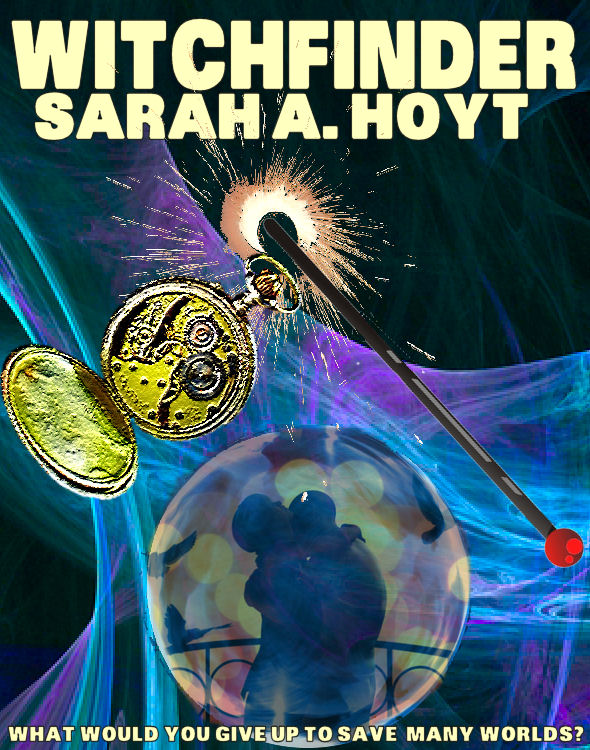
The Logic of Dreams

I woke up in the middle of the night with a perfect idea for something to blog about today.  It was brilliant, urgent and I knew just how to approach it.  It was so perfect in fact, that I closed my eyes and went back to sleep, ignoring the fact that I had a pencil and paper on the bedside table.  Needless to say when I woke up this morning I had not the faintest glimmer of what I was supposed to blog about.

It might come back again, during the day, with a sort of back-of-the-head clap of thunder that makes you sit up and go “Oh, but of course.  How could I have forgotten that?”  Or it may never return.  And it may be a good idea.  Or, had I actually made notes, this morning I might have found out the notes said “Hats for horses and chocolate ice cream.”

In that, sleep is like drug-experiences.  Yes, I DO have personal experience of those, thanks to being put on morphine post-giving-birth (I wrote Thirst!) and having injured myself severely enough a few times to be put on vicodin.  For the record, I’d rather endure any amount of pain even just below intolerable than actually take the stuff.  First, because I hate the feeling that I can’t control my own mind, and second because – being raised in SF – as my impressions of my surroundings become more disjointed I’m afraid of stepping through into some other reality.  Yeah, I am probably insane.  Call it personal deformation.  Frankly I never understood why any of my colleagues would want – much less need – drugs.  “Such things have I in mind…”  Yeah.

Anyway, actually I do understand why people would want to write while on drugs – or sleep deprived.  No, chill.  I will not start doping to write.  Remember, I hate to be out of control of my own mind.  I’m more likely to do it on sleep deprivation, anyway.  (Sleep?  What that?)

Okay, let me explain.  What I experienced last night is neither unusual nor particular to me.  I’m sure all of you have experienced it, if not with writing with something else.  You’ll fight and struggle through a problem in your wakening life, and then in the middle of the night you suddenly realize that it’s all about the drive shaft, after all.  Or the needles need to be made out of platinum.  Or that pleat in the back side needs to be in the center.  Or the whole point of the plot is that he can’t find the gun.

This is why creative people often keep a pad by the bed side.

I don’t usually because I’ve found that the good insights stay with me.  You could say I trained my mind to be a note pad.  This time I had the pad by the bedside, because I’ve been recasting some old short stories and was making notes on those before falling asleep.  I do have a pad in my purse or – usually – my jeans pocket, because, in this household, table conversation or car conversation can suddenly yield a story beginning or the germ of a story idea.

But I know both why people do this and why some people resort to drugs to write.  It’s because the story world we create is not complete if its all created with logic and in the forebrain.  That’s because the world isn’t like that.

I’ve decried the idea that we should write reality often enough, that I’m sure I don’t need to tell you now that’s not what I’m advocating.  What we create, as storytellers, is not reality.  We don’t even hold a mirror to reality.  No, what we create is a lucid dream state for our readers.  (Okay, some writers just create clever puzzles.  But even with Agatha Christie, whom I’ve heard accused of that, that’s not why I read her.)

For one, the world we create is logical.  Reality isn’t.  No, let me rephrase that.  Reality is logical but it has a huge slab of whimsy dropped in for good and ill.  That is because from you one point of view, you can’t know what everyone else in this huge world is doing.  If you could and you could compute it, you’d see it was all action/consequence, from the butterfly flapping its wings in India to the hurricane in Florida.  Or so I’m told at least.  The point is that no human being can do that.

By focusing on a smaller slice of reality, a writer can simulate that and satisfy the reader’s need for the action-consequence sequence.

Except…  Except that it’s not that easy.  Because we are used to real life, while we like the stories, they don’t feel quite right without at least one explained element or sequence.  It can’t be a Deus ex machina one.  Or if it is, it can’t feel like one.  It can’t solve all the character’s problems.  If it did, it would be no fun.  It should be only one incident/element/sequence.  AND it must remain unexplained.

What I’m thinking of here, specifically, is the Starman Jones episode where …  Was he guided by the dead navigator?  Or was he doing it all himself and his “feeling” was just a safety blanket?

I have a similar sequence in A Few Good Men.  It could honestly go either way.  The point is that at that point you have to drive the character to such an extreme state that the character himself isn’t sure if it’s a dream or not.  (Kip, half frozen, talking to the Suit while rescuing Pewee and the Mother Thing in Have Spacesuit.)

I fought it in A Few Good Men, because I don’t like the feeling that “an unexplained episode/element” helps my character.  But when I took it out, the book felt less real.

And that’s why some writers feel the need for drugs/sleep deprivation.  It’s the only way they can drop in the… shall we call it “mystic element” without trying to explain it away or pin it definitely as either a psychic/magical phenomenon or just an illusion.  Or, of course, they remove that element and impoverish the book.

Because even our own brain is not totally logical.  As I said, when we dream, we can suddenly have brilliant insights, and they can come from things that make no sense to the waking mind.  A lot of them still won’t.  Say, you know “Horse hats and chocolate ice cream because lizards have legs.”  BUT just as often (about half the time) you’ll find “Horse hats and chocolate ice cream.  Lizards have legs.  You need to center that drive shaft you moron.  That’s why the engine doesn’t work as designed.”  And if you had time and patience to analyze it, you’d find that your sleeping brain was in fact throwing together non-verbal impressions of how-things-work to get the insight, and that if you followed it back, with words, bit by bit, you could have the same insight… in a couple of years.

In other words, our brains don’t tell us everything they know.  They can’t.  They process a lot more info than we’re consciously aware of, and we short circuit them with logic and words when they try to tell us stuff.  (And even this is not right, since our brains are part of us, and not some mystical creature.)

So, yeah, I get why some of colleagues need to induce an altered state, to get to that point where they can create a solid dream-world that feels real to the reader.  There is a problem with using drugs to do it, though, beyond the obvious – for most of them – harmful side effects.  The problem is that habitual use seems to dull/have other effects on your non-doped brain.  And the only way to make the induced dream state work is to be able to step back and edit with the full rational mind.  Because then you can figure out whether the weird bit of unexplained insight makes sense or it’s just “Fishnet stockings.  Because lizards have legs.”

Mostly, as with most other things, I’m training myself to drop the mystical bits in while fully awake and rational – well, as rational as I am while writing, when it often seems like the WHOLE STORY is dictating itself.

And I don’t keep a pad by my bedside, because the good insights keep.  And the good ideas too.  And frankly I’m drowning in ideas, anyway.

As for that brilliant idea in the middle of the night?  No clue.  It was probably “Miller moths.  Cats have teeth.  Write shorter blog posts, you moron.”