The Peeves Of Pets

Someone suggested I write about my pets’ peeves.  I’ll do a more “real” post later, but for now…

The main peeve of my pets is that they’re not single cats.  This applies particularly to Havelock (Vetinary) and D’Artagnan (Inappropriate licking boy) who look somewhat like stuffed animals and, in Havey’s case, squeak like them, but who are indeed alpha males bent on world domination.  (Particularly D’Artagnan who is evil and who, one of these days, will wake up and decide to invade Poland or something worse.)

I don’t write aliens, not really, because I think it’s impossible to write convincing aliens that can be read by humans – I think.  It’s also entirely possible I don’t write them because none of them has assaulted me and demanded I write his story, yet.  BUT if I wrote aliens, I’d write these very adorable, plush-animal like critters whose snarling battles set the galaxy on fire.

Not that the cats have managed to do that.  We’ve had the foresight to make sure we didn’t get cats with opposable thumbs so to the best of my knowledge they haven’t created any portable nuclear weapons, much less built rockets to take them off world.  Of course I could be wrong.  I haven’t looked in the corner behind the litter boxes in a while.

Then there is Miranda-cat doyenne of cats, pushing thirteen.  She’s a tortoise shell Cornish Rex and like one of those whipcord thin dowagers, forever looking down their roman noses with disapproving auteur.  She thinks the boys (she’s the only girl) are silly, and she can’t imagine why we keep them, but she also can’t demean herself by getting into battles with them.  Though she does beat Havey up periodically.  As far as we can tell, she does it because he goes around being young, which, you’ll agree, is an offense that calls to the heavens for revenge.  Mind you, she might also be upset because he’s very dumb.  This isn’t fair.  He didn’t mean to be dumb.  But there it is, he’s dumb, and Miranda, who is an evil genius, can’t help but resent stupidity.  For one, it gives people a bad idea of her species.

And last there is Euclid.  He’s big and black and odd.  It’s possible the reason he pulls out all the hair in his legs is that he has allergies.  The anti-allergy stuff is helping…  A little.  BUT nothing can explain the bouts of walking stiff-legged around the house screaming “NARP”.  The only time he meows he SAYS “meow.”  We think that’s because Havey taught him.  Havey has the same problem.  His natural sound is a squeak.

Here’s the funny thing – even in writing about these aliens in our midst – it’s impossible not to think of them in human terms.  Like random dots on a wall will become a face in the human mind, cats become at least partially human.  How much of it is acculturation on their part, and how much humanizing on ours?  Who knows?  Who can tell?  I bet our relationship with alien-aliens might be the same (they have to be close enough to us for us to recognize them as sentient anyway – or at least the type of sentience we can communicate with.)  Which means if there are aliens out there, and we ever meet them, there’s a good chance the humans-in-a-fuzzy-suit writers are the ones who have it right… Or at least closest to how it will be perceived.

Scary, isn’t it?

Although I’m fairly sure even cat-aliens wouldn’t do what Havey and D’Artagnan do in their fights.  I mean, what if the first thing we know about an alien presence is that strange mildew starts growing on the moon, due to rival cats peeing on it to mark their territory?

Can You Hear Me Singing?

What is voice?

Put your hands down.  I don’t mean that, and you know it very well.  In that sense I got a voice, and it’s bad.

This is the thing, everyone knows what voice is in a singer, or even a speaker.  You hear it.  It comes through.  You know who is singing-speaking.  Unless you hear very badly or the connection is awful, you don’t need to have your spouse tell you “Hi honey, it’s me.”  You know.

To an extent voice in writing is similar.  I don’t know when I became aware of it, but I can’t have been much more than eleven or twelve.  I think the first “voice” I identified was Clifford Simak’s.  I’d picked up a collection without looking at names and halfway through a story I went “Hey, this is familiar.”  It is also almost impossible to read Heinlein without recognizing him.  There is a tone to his writing.

I don’t agree, btw, that he has only one character, either in the juveniles or in the grown-ups.  I think in Number of the Beast he was making a joke about being accused of it.  There is no mistaking Kip for the main character of Star Man Jones.

But there is a TYPE of character Heinlein has – a type of character that, btw, makes him the essential American SF writer – he writes underdogs who make good.  Rags to riches.  Little boys – or girls – that could, against all odds, come whichever army.

However, that’s not voice.  That’s style.  Heinlein’s voice was a quirky, conversational tone, that made even long explanations of back history or how things work seem palatable.  It was liberally peppered with slang some of which I recognize as early twentieth century and some of which might very well have been his own creation, who knows?

Simak’s tone is more leisurely and somehow has an undertone of pensiveness.

Bradbury’s voice cannot be described.  It’s wildly poetic, but there’s more than that, and you’ll know it when you see it.

In the same way that a lot of writers can use British humor, but the mordant bend over again over the joke and give it just one more one liner, is pure Pratchett.

So what is voice?  How do you know when you’re writing full-voice or in the voice you should write?

I once bought a book on voice.  It advised me to cut out all modifiers and all extraneous words.  While that might have been the AUTHOR’S voice, it sure as heck wasn’t mine.  Or at least not mine for every possible book. Now, I would advise cutting out “practically” and “almost” and “just about” and other “begs” unless in dialogue.  This includes “seems” “appears” “Possibly” unless you’re in the characters head because all of those make you sound diffident which, as we’ll see below, is a bad thing.

So, how do you know voice, and how do you know if you’re writing in the right voice?

I don’t know.  It’s a mystery.  But I’ll give you the three clues I have, and which seem to work.

First, Kris (Rusch)  and Dean (Wesley Smith) once told me you won’t know if you’re writing in your true voice, and your true voice will seem blah to you.  Why?  Because that’s natural to you.  So it won’t seem like anything special.  You’ll just write.  It will be fast, it will seem too easy.  And it will be your true voice.

Second, once at a conference panel, Dave Weber said “The important thing in voice is confidence.  You can feel the confidence with which the writer is writing the world.  For the time you’re reading, you should feel like the writer is an authority not to be questioned.  The problems should only occur to you afterwards.”  I’ve found he’s right.  If you have no confidence, you should fake it while writing.

Third, Pratchett said, “The secret to success is to be yourself as hard as you can.”

So the best advice I can give you, for voice, is to write it as yourself, as hard as you can and to have absolute confidence in your ability to do it.  I know this is harder than it sounds – trust me, I know – but you must trust yourself and the way you tell a story, and then write it as much like yourself as you can.

The funny thing is you won’t be able to see it for some years, but if you leave it sitting, then come back and read it, you’ll see it.  It will be like clarion calls.  And your readers will hear it too.

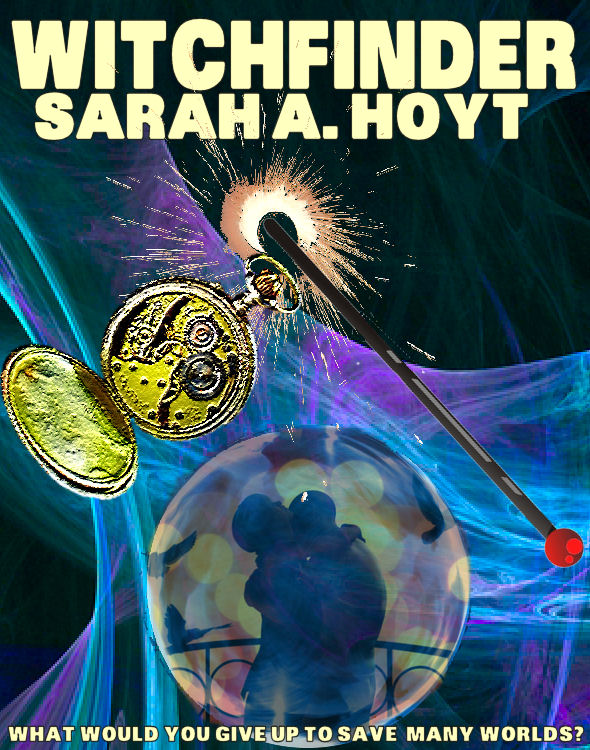
Witchfinder, Free Novel, Chapter 46

*Sorry this is so short.  We’re preparing for the older kid’s 21st birthday tomorrow.*

*This is the Fantasy novel I’m posting here for free, one chapter every Friday.   If your conscience troubles you getting something for free, do hit the donate button on the right side.  Anyone donating more than $6 will get a non-drm electronic copy of Witchfinder in its final version, when it’s published.
There is a compilation of previous chapters here  all in one big lump, which makes it easier to read and I will compile each new chapter there, a week after I post.  When the novel is completed and about to be edited the compilation page will probably be deleted.

Oh, this is in pre-arc format, meaning you’ll find the occasional spelling mistake and sentence that makes no sense.  It’s not exactly first draft, but it’s not at the level I’d send to a publisher, yet. *

A Matter Of Duty

Nell felt the magic from upstairs.  It rang in her ears as something only a little less loud than the explosion that had left the room downstairs coated in glittering bits of magical dust, and which had forcibly bent the foundation of the house and thrown a grown man across the garden.

This explosion was more subdued, and came, inescapably, from the upstairs.  But it was still loud.  She was on her feet, from the kitchen table where she and Grandma had just sat down to continue – now changed – the talk the explosion had interrupted.

Grandma had just said, “You are an adult, and your own woman.  I can’t tell you what to do.”  Which of course, meant that Nell was too young to cross the street without someone holding her hand and that Grandma was very well about to tell her what to do, when this second explosion came.

On her feet, running towards the stairs, Nell realized, halfway up, that it had not been an explosion but an implosion – not a boom but a paff, as something vanished, something else flowed in to take its place.  And it couldn’t be just the disappearance of a man, or even two.  No, something large had gone to cause that sound.

She slowed her steps over the unstable part of the house.  She heard Grandma behind her, but it didn’t bear stopping, not now.  

The door to the room they’d given to Seraphim – had Duke ever been housed in such a ramshackle and casual way – was standing open and creacking softly through and fro as though caught in a strong wind.

It did not surprise Nell, as she reached the doorway, that the room was empty – of at least that it was empty of the two men.  The furniture remained there, in its proper places – but she didn’t go in further than the doorway because a few inches in front of her nose, filling the entire space of the room, what looked like fiery dustmotes flew, sparkling and dancing.  She blinked at them recognizing the markers of a very powerful spell, a shell-spell.

Someone or something had set a spell on this entire room, a spell that filled the room to the inner wall.  Those spells were usually only built for important reasons, for a place where someone must do something.  It was a compulsion spell on place, not person.  And it was difficult to set, and could only be set by someone present.

That didn’t disturb her as much as the feeling – as she watched the motes of light slowly fade – that she knew very well who had set this.  There should not be a taste to magic, but there was:  feel and a sense of the hand that had created a spell.  It was akin to recognizing the hand that had formed letters, or the hand that had mixed a recipe.

She could not point to anything exactly, but she’d been near the man, and watched him create spells, and the spell created here was unmistakably Sydell’s.

How could Sydell have come here?  How gained access.  True, she and Seraphim had been over the fields in the morning, talking while she showed him the places of her childhood.  Where grandma might have been was anyone’s guess, but this place was defended and guarded.  Grandma had done so from Nell’s earliest days.  Certainly she would not let anyone near who might be a danger.  And Sydell had given off vibrations of danger from the moment Nell had met him.

She squinted around the room, without going in.  The spell should be spent, and in fact, the glitter of it was dying by the moment, but you could never be sure.  The spell had been set to cause someone to do something, and once someone had done something, it had slowly faded.  That much was certain, that much not a problem to imagine.  It was also no great stretch to know what the spell had caused the men to do.  The two of them – or more likely Seraphim, carrying Gabriel along – had transported out of here in haste, probably somewhere the compulsion told them to go.  That much was sure.

But if that had been the whole of it, there were other ways of doing it, subtler or stronger, all the way up to whatever had happened to Marlon.  This was something else, something more targeted.  No one did a full shell spell unless there were a sequence of actions they wanted someone to perform.  They were strong enough that often actions caused by them were repeated by the victim’s ghost for eternity.  It was said they were responsible for half the hauntings in Avalon.

She looked around the room.  The spells were by definition dark and proscribed magic, since they robbed the victim of choice.  They were often set to cause someone to do murder, but not only couldn’t she imagine the men murdering each other – there was limit to what even a shell spell could cause you to do – but she couldn’t see any blood stains on the floor.  And there hadn’t been enough time, since Gabriel had come up for one strong and healthy man to strangle the other or vice versa.  No.  That was not what the compulsion had been.  Then what?

Perhaps what had been intended had been precisely that the men should transport out.  She suspected on Earth it might be hard for someone of Avalon to physically seize and transport someone out.  And the Darkwaters were both very powerful.

But something more there would be.  Something to take along, perhaps?  She looked around the room again, this time for belongings.  Seraphim had arrived in this world in his dressing gown, now much mended and tattered, a pair of underwear which had made her grandmother marvel at the cunning arrangement of tying ribbons and grin in amusement at the lace with which people of Avalon bedecked all small clothes of the gentry, male and female.

The only other thing he’d brought, in the pocket of his gown, was his father’s pocket watch, which she’d understood had some magic properties and which he and Gabriel used in their rescue missions.

She looked towards the dressing table where the watch had been, and it was gone.

And she stood there realizing the enormity of this: the two men whom Sydell had been trying to entrap from the very beginning; the men who’d been spied on, coerced, and finally accused falsely of murder so that the Duke’s property could be impounded, had left this house carrying the one thing that Seraphim had brought into it, beyond his clothes.  They’d left under strong compulsion set by the same person who’d been spying and conspiring against them.

The realization dawned and could no longer be avoided that the whole plot against them had been to seize this watch.  Everything: their destroyed lives the upended routines and livelihoods of all of Seraphim’s retainers had been to get their hands on this pocket watch.

But that meant, surely, that the watch was not a normal watch.  Petty thieves and burglars were not that hard to get in Avalon, and she was something of the kind in a much superior package – or had been while she was involved in Sydell’s schemes.  And she’d never been told to find it and seize it.  So the watch must have anti-theft spells built into it, and probably could only follow someone of Darkwater name.  And so this entire monstrous plot had been hatched to get hands on it.

She took a deep breath, blinked.  And carefully, she thought the one word: idiots.

And then a sentence assembled in her head, as if someone else were thinking it, only the someone else was also her.  She said it, in a whisper, as it came to her, “This has gone far enough.”

She found she was out of the doorway, into the halway, and across tot he sound part of the house, where her room stood.  “This has gone far enough.”

Grandma came in as she was packing her clothes in the sturdy backpack she’d used for her youthful travels, before college.  Not many clothes, but a change of underwear, a t-shirt, another pair of jeans, her first aid kit.

And wouldn’t you know it, Grandma said again, and in exactly the same voice, “I will not tell you what to do, you’re an adult.”

Of course, that meant she was about to tell Nell what to do, and she did.

“All the intruders are gone,” Grandma said.  “It is all to no point for you to go chasing after them like a mad woman.  You’re back home.  I had never expected you to come back, but now you’re home.  What need do you have to go involve yourself in the affairs of a world with which we have nothing to do.”

“Not now,” Nell said, knowing Grandma would understand, as she did when Nell was very young, that what Nell meant was “no lecture now.”  Then she added, “Can you get me a couple of bottles of water and a package of crackers or cookies?  I might need to go into fairyland.”

Grandma’s eyes grew huge.  “Nell,” she said.

“I have to go.  I’m responsible,” Nell said.

“You are not responsible.  He is a grown man and from another culture, and I know what time traveling romances say, but– ”

“No.  Not that.  I didn’t mean I’m responsible for Seraphim.  Seraphim is in trouble, yes.  I might be to blame for it, yes, for things I’ve done to bring this about, but that is not it.  And romance doesn’t enter into it.  Oh, I…  I might…  I have feelings for him, but that is besides the point,” she added, as Grandma had been about to add that Nell was half-gone in love with the man.  “He’s not for me, on Earth or on Avalon.  On Avalon because if I go there, I’ll be the princess and my marrying a matter of public policy and planning.  On Earth because he could never come here and just be happy with me, and that is part of the reason I must go in and fix this.  Seraphim is not just Seraphim, he is the Duke of Darkwater and the head of the second most magical house in the realm.  Whether he lives or dies, and whether he’s tainted by scandal or not, affects not just him, not just his family, but people who work for him, people who depend on him and everyone who interacts with them.  Who holds power over his house affects even more, as they’re one of the houses responsible for the security of the royal family.  The man is not a man, he’s an institution, one of the threads that holds up the state-tapestry of Avalon.  That I must save, restore, and make sure it’s in his hands and not in much worse ones, and– ”

“And?” Grandma said.

“And I must go back for the same reason,” she said.  “Whoever has used evil magic to remove the Darkwaters from here, is also the person – or one of the people – who removed me from my birth parents.  They want power, and it is essential they not get it.  They are not good people.”

Grandma had looked old, then, really old.  Nell realized that this was when Grandma had accepted Nell would be gone again, and for good.  It didn’t matter that Nell had realized it at the same time.

Nell took off her clothes and threw on her prom dress which, fortunately modest, could pass for an afternoon gown in Avalon, even if an odd one.  

When Grandma came back with a box of ritz and two bottles of water, Nell asked, “Was anyone here, today, in this room.”

“Only the ducting man,” Grandma said.  “He came to clean the ducts, like he does every fall.”

“Was he… the same man?”

“Yep, Andrew, from the air conditioning place.”

Nell only nodded.  No reason to complicate the picture or make Grandma aware of what had happened.  She knew Andrew.  Had known him for years.  Either he’d been replaced, not an easy thing to do, or…

But she shut her mind to that thought, and instead kissed Grandma gently on the cheek and told her, “I’ll be back,” without saying it would be for only a little while.

Then Nell hefted her backpack, stood in the middle of her room, and built her transport spell.  

The cold of the in-betweener singed her for only a moment.  And then she was on the other side.  But she didn’t know where the other side was.  She stood on a hill, overlooking a desolate plain, and yet it was hard to see clearly for a sort of grey, amorphous fog.

From somewhere at the bottom of the hill came a gloating voice, male, and awful, making her skin crawl, “So my darling nephew has come back!”

And then there was the snarling of dogs and the high pitched scream of a young girl.  Nell ran towards the disturbance.      


That’s No Lady, That’s My Luck

Like most professions where you have absolutely no control over the outcome of your efforts, writers are very superstitious people.

What do I mean by no control?  Don’t I understand that people can write a better book and therefore have a better outcome?

Well, maybe now with indie – I don’t know, I haven’t done enough to know if that’s true – but in traditional?  Pull up a barstool and let’s talk.  My third musketeer’s mystery book is exponentially better than the first two.  Even the publisher agreed with that.  BUT they gave it exactly the same cover as the first except for details you had to focus on, like the inset picture, and even in that the look was similar, and so it almost didn’t sell.  Or Draw One In The Dark, hardcover… buddy, I didn’t want to be in the same room with that cover.  It was the very best book I’d written to date, but it didn’t go anywhere.

And there are a ton of other factors – other than cover – that are vital for how well it sells and which I have no control over.  For instance, there’s the time it’s published.  January is the absolute suckiest month to bring out a book you expect to do well.  October isn’t much better.  Why?  Because in January people just got socked with the Christmas bills and they’re holding tight to their money.  In October, they’re starting to think holidays and being more careful with money.  The best times are summer or spring.  Also, does the book come out in hard cover?  Half the people don’t buy trade.  Also, what is the print run and how much push will this book get from the reps to the books stores.  No control.  None.  I hand in the book and that’s it.

But Sarah, you say, it’s still possible for a book to have everything against it and make it if it’s very, very good.  Not everything.  I mean Darkship Thieves had a ton against it, but it had a wonderful cover, and that carried it.  I was also lucky to get reviews in a few romance blogs.  But when you get everything against you – and it’s easier than you think – even the most wonderful book won’t fly.  People can’t buy it if they don’t know you exist.  And if you’re not already selling some amount, people won’t LOOK for your book on Amazon.  (Hence the promos we engage in.)

Look, it wasn’t so long ago that Terry Pratchett – a mega bestseller in the UK – was selling about what I sell in the US.  How come?  Cover, push, print run, time of publication.  He changed editor and agent and suddenly, overnight, was also a mega bestseller in the US.  That is how important those factors are over which the writer has no control.

Now, even if you get all factors going for you, if the book sucks, it will tell over time.  We all know – naming no names – people who were pushed and pushed and sold three or four books and then the fourth or fifth tanked badly because most people who’d bought the first couple of books on hype had READ them by the time the third/fourth came out.

But still, a huge part of the book’s success is RIGHT out of your hands.  And writers become superstitious.

It’s a form of going insane that avoids actually going completely buggaboo crazy, the type of crazy where they come and lock you up.

I’m as sane as the next woman, mind (and the next woman is my friend Kate who takes interesting medications.) and I know where the superstitions, the rituals, the weird taboos come from: they are part of one convincing oneself that he can control what one can’t control.  Again, part of keeping oneself sane.

The writing-rituals I know of personally range from “in a certain room, at a certain time” to “I can’t wear the color blue” or “I can’t answer the phone till it rings three times” to much weirder things.  There is a story, possibly apocryphal, of a writer who was convinced he could write only by the light of a certain lightbulb.  And he knew the lightbulb was magical, because he’d had it for years and it never went out.

Then his marriage went bad, and on leaving, his wife revealed how she’d changed that lightbulb every week so that it would never go out.

He didn’t write for two years.

Now, I don’t have real rituals or taboos.  What I have observed though is that my luck tends to run in cycles.  If I’m stuck in a really bad cycle, everything will go wrong, not just in writing: appliances break, trees fall, my writing sucks, books crash, etc.

My way of breaking this is perfectly rational: I make a radical change for a while.  Usually this means a vacation to Denver.  

Why perfectly rational?  Because to the extent luck is influenced by my mood: I might not see the opportunities, I might miss good things that could happen if I just did something; and I know that a run of luck like that makes me depressed which means I can’t write and I can barely function.  Taking a vacation – usually two days, sometimes even just one – resets my internal clock and even if the “luck” doesn’t change makes me more capable of coping with it.

Of course, the fact that every time I eat at Pete’s Kitchen in Denver AND TALK WRITING I sell a book also doesn’t hurt.  What?  No, I swear.  It’s like magic.  In fact my friend Rebecca Lickiss tried it, and it worked for her as well.  So, it’s proven.

It’s not superstition.  It’s science!  Because unlike all those other mugs, I don’t have any weird rituals and I’m so rational you find my picture under rational in the dictionary.

Now, excuse me, I have to go dust my glass floats before I write.  If I write while they’re dusty, the stuff just doesn’t sell.

In Full Glory Reflected

More years ago than I would like to admit, my dad’s sister was visiting from Venuzuela Venezuela [You always spell countries as you first learned them, and in my case I learned it wrong. Ed. note: spell check, woman, spell check.] (of all places) and said something that truly puzzled me.

Now, I think I’ve spoken of this before: I come from a family of immigrants.   Odd immigrants, as most Portuguese are sent from the home country because they’re starving or lack the skills to make it.  Our family tends to go rather because we have wandering feet and are called by something out there, or just the desire to know what is out there.  In every generation it seems to hit about half the children – a calculus my brother and I prove true, because there are exactly two of us.

Some of those who leave come back, though not all, and that too is odd for Portuguese immigrants, who tend to all plan on returning home in their old age.  The last one in my father’s line who came back – after spending most of his working life in South Africa, Brazil and Venezuela was my grandfather.

My – now late – aunt, his daughter was visiting I THINK in the seventies, when a lot of other family – cousins, and second cousins, and great uncles – were coming back from various troubled places in the world, sometimes with only the shirt on their backs.  I think my grandmother (who stayed home while grandad traveled, though they wrote to each other every single day) was trying to entice her only daughter back and she said something like “I hear it’s bad over there.”  And my aunt said, “I prefer it bad there than good here.”  (Though, mind, it was nowhere as bad as it is under Chavez, but one must presume she still preferred it, because she died there four [?] years ago.  And her children still live there.)

At the time I was a kid and this was utterly puzzling to me.  Why would you prefer to go far away from home, somewhere where things were supposedly “bad”?

I suppose if I went back this year, they could say the same about the US.  In fact, mom and dad have at various times said just that, in a concerned tone, “why don’t you come back to where you have family that can help, now that things are bad?”  (Yes, I know, things are bad in Portugal, too, but honestly they’re used to it.  The country has TECHNICALLY been bankrupt for close on 900 years.)

They don’t ask it very seriously or very often, because they know the answer.  What called me away from home was more than restlessness, or a feeling that I must go somewhere.  What called me was rather the feeling that my home was always here, waiting for me.

Long before I first set foot in the US I had read the Constitution and the Declaration of Independence, and I knew by heart the words to the Star Spangled Banner, which I still can’t sing without choking up.  (And not just because I’m mid-range-deaf and the world’s worst singer.)

Another point of reference in the journey was the day I overheard mom tell a friend she was very worried about me (I was about fourteen I think) “because she thinks the world should work ethically and according to principles.”

If I had to describe what called me to America it was that: I was drawn by the idea of a nation formed on principles rather than a commonality of blood, and by the principles on which it was funded – life, liberty, the pursuit of happiness, and equality under the law as the means to procure them.

Now, is America truly, throughout the ages, the shining city upon the hill?  Well, no.  America is created by humans (whether solely by humans is something you may take up with that peculiar set of my characters who call themselves Usaians and who – in my future society – maintain that America is part of a divine plan and if lost will return.  They got very loud in my head when I typed that America was solely human.  I am not, at this moment, prepared to argue with them) and maintained by humans.  Humans are fallible.  We can all point to times when we fell short of our funding ideals.  But the ideals remained, and we – the majority of us, for the loonies like the poor shall be with us until the last days – agree they’re something to aim for.  They are our reason for existing, the reason we are Americans.

“Bad” over here is still a “bad” in which most people believe in human rights.  It is better than the “good” in most places.  Most of you – most of us – will agree we’re going through a rough spot.  But I believe in this brotherhood of principle that is stronger than any brotherhood of shared genes.  And I believe we, my brothers and sisters in liberty, shall emerge from all this, perhaps a little battered but not defeated.  I believe we’ll endure and continue to be a beacon to the nations, and to provide a home for those who – like me – are Americans tragically born to foreign parents.

My other aunt – mom’s next-younger sister – who lived for many years in France tried to tell me before I got married that I should convince Dan to move to Portugal instead, because “no matter how many years you live there, you’ll always be a foreigner, and you’ll know it, and they’ll know it.”

I’m not going to deny that at first things seemed very odd – but they were the processes of daily life, not the essence of the nation.  The essence of the nation – how people work and how people relate – has always seemed if not perfectly rational, at least perfectly “like home.”

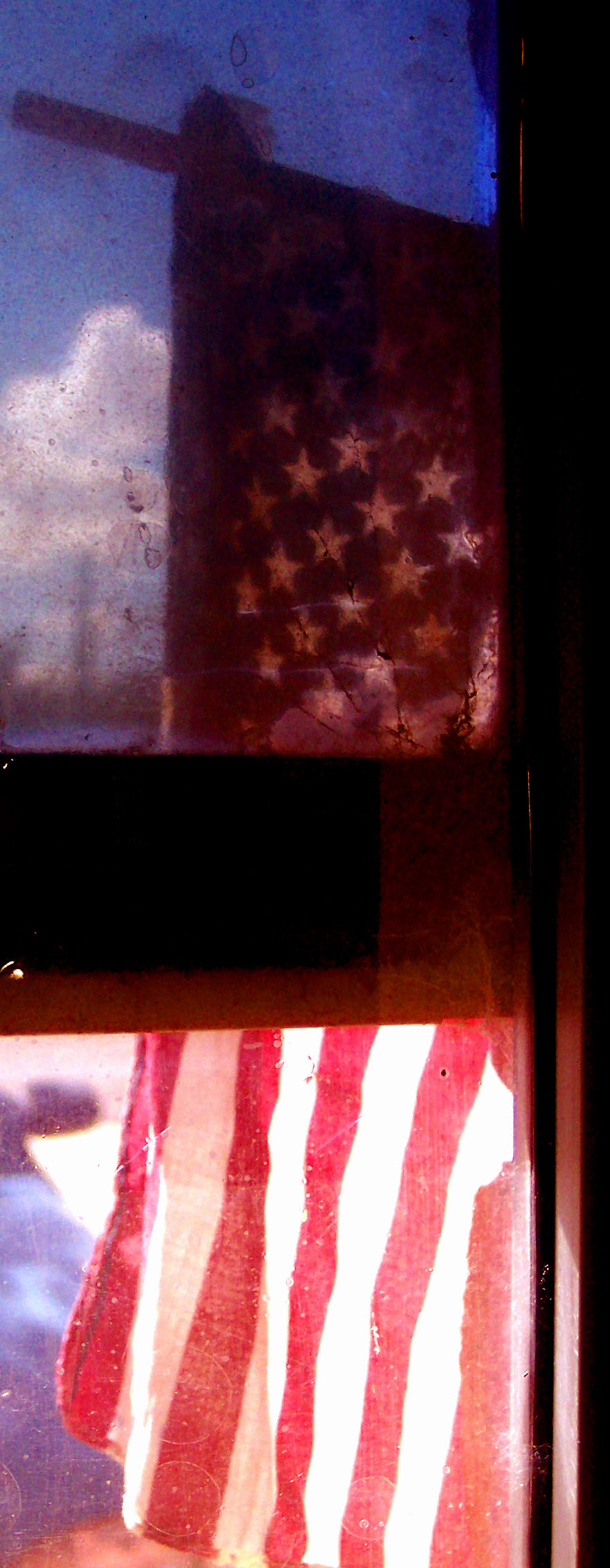
The first time I came back after having acquired permanent residency, I almost kissed the gentleman at passport control at JFK, who looked at the green card and said “Welcome home.”  (I’m actually very sure I hugged him, much to his shock.  Imagine doing that now, in an airport.)  And the day I got citizenship (still have the flag) I felt that for the first time I TRULY belonged somewhere.

That is because of the difference between France, where – more often now in the default – race and land are still the fundamentals of the country and the United States, where common belief in a radical credo (if you don’t think the US Constitution is not radical, you need to read it again, with a fresh glance) is the reason for citizenship.

On this strange fourth of July – for Colorado – in which we can’t have fireworks or cookouts (but we can gather around the piano and sing the Battle Hymn of the Republic.  Yeah, if your glass shatters that was me hitting a note disastrously off-key.) I’d like to give a moment of thanks to the men and women who formed this country and held it vital and strong through good times and bad (and the times we’d rather not even think about); I’d like to give a moment of thanks to all who died to keep the country independent and free; and I’d like to thank all of you, born-Americans for having allowed me to become one of you.

I’ll be here, in my corner, dissolving into tears at the closing lines “O say does that star-spangled banner yet wave,O’er the land of the free and the home of the brave?”

    (Also blogging — different post — at Mad Genius Club)

Get On Your Habit And Write

I was asked about making a new start in writing, when you’ve taken a break – voluntary or not.

You still want to write.  You still have ideas.  You are still really a writer, but something happened to break the daily habit of sitting at the keyboard and pounding out words.

That is an habit, and one that has to be built and enforced.  I found this early, even before I had kids or cats.  

While I’m not one of those writers who enjoys having written, but not the process of writing – I could never write as fast as I do if I didn’t have fun doing it – writing doesn’t always go smoothly, particularly in the beginning, when it’s all guess work.  You know just enough to know you’re screwing up, but not enough to know how to fix it, and you get frustrated and wander off to bake carrot cake (this figured heavily in my newlywed days, because my husband likes carrot cake, so it got me instant reward.)  Then you remember that the kitchen floor should be scrubbed.  Oh, and did you ever send a thank you note to aunt Emma?  And what about that trivet you were knitting?  And next thing you know, not just a day but a week or a month has slid by, your story remains undone and stuck, and you haven’t learned enough to get past the hump that sent you baking carrot cake instead of writing.

I refer to this process as rotating the cat.  You’re doing stuff, but after a while it’s not stuff that needs to be done, or that anyone will notice.  You’ve just fallen into a routine of doing little stuff.  
I spent years like this.  When I say it took me almost sixteen years to really break in, it’s hard to contemplate how many of those years were like this.  Oh, when I broke in I had sixty short stories and eight novels fully written, plus any number of fits and starts – so I got stuff done… but not nearly as much as I could have.

Of course in those years, a lot of it was through my being discouraged.  I thought I’d never get published, and after all what I did for the family counted for a lot more, right?  If these words were never to be read?  And there’s some explanation, too.  For six years of that time, I was going through infertility treatment.  Those of you who’ve done this, know what havoc it can play with your hormones, which in turn make concentration something that happens to other people.  I was pregnant for eighteen more of those months – nineteen, really, younger boy was almost a month late.  And with the first pregnancy, I had pre-eclampsia, which meant that I couldn’t do much.  My wonderful husband bought me my first laptop then (yes, it was massive) but sitting up sent me to the hospital, and while something like a netbook, now, might allow me to work, working reclined wasn’t possible.  Also, embroidery sent me to the hospital once.  It was too exciting for me.  And I had toddlers in the house for almost six years straight.  

But explanations aren’t excuses.  Yes, I spent years when the only work that could get done had to get done when the boys were napping.  And years fitting in my writing time in the two hours the younger kid went to pre-school.  That’s fine.  But there were still weeks, months, and at least a couple of years of rotating the cat.

And then I figured out what was happening.  The cycle went something like this: something happened to drive me away from writing – hitting a snag on a novel, or sixty rejections in one day, or… something – and I got into a cycle of rotating the cat.  That broke the habit of writing every day.  Then I got in this weird process akin to insomnia, when you want to sleep but your eyes remain stubbornly open.

It’s not that you lack inspiration.  You really want to write.  You have the story idea.  The words even run through your mind.  You just can’t sit down and do it.  The debris that flowed in to fill your day while you were mute is now everywhere and you don’t have the time to write.  Or the mental space.  Or if you have both, you just can’t sit that long and just type.

You’ve lost the habit.  And habit is a great part of any daily routine.

Now, what always happened to me is that one of the “door blowers” – one of those ideas/inspirations that blow the doors off everything else and MAKE me write them – would come along, grab me by the hair and MAKE me work, and by the end of it, I had the habit again.  

I’m sure this happens to a lot of people, but it’s an unreliable process.  Door-blowers, at least for me, come around once every three or four years, not every time something breaks my habit.  So I had to learn to get around it without the Door-blowers.  You have to, if you’re going to have a career in writing.  Unless you’re a big name and the publishers love you, you can’t do a book every three to five years and sustain a career.  I doubt you can do it in indie, even.  People will forget your name.  They won’t look for you.  (Heck, for various reasons, I’m pushing this with Darkships, which is why I need to start promoting again before Darkship Renegades comes out.)

The best thing is not to break the habit.  You know what they say about the best.  You can’t always have it.  Even I still break the habit regularly.  Take the last two months (please.)  Between kid’s graduation, wildfires, illness, I’ve written cold nothing.

The problem is that – writing four different series, etc. and dealing with the house, and being everyone’s scheduler in chief – my best days were completely packed, even without adding in the indie publishing stuff with its extra duties.  THEN add in an “emergency” or anything unusual – like transitioning a kid to college – and one of the balls has to drop and, out of long habit and also because it’s the most susceptible to my state of mind, that’s usually the writing ball.

So, let’s suppose the same happened to you and you’re out of the habit of writing.  How do you get back into it?

I have several tricks, but in the end there’s only one thing that works: brute force.  You have to make yourself get into the habit again.  I sometimes feel like I’m two people: one a truant kid and the other a stern mother.  The mother chases the kid all over until finally she makes her sit down and write.

Yeah, you’re going to have to force yourself.  You’re going to have to block out a time and a place and set yourself a goal.  “From eight to noon I write, no matter if the roof falls on me, or how many times I’m interrupted.”  Or “I’m going to write two thousand words, no matter how bad they are.”  And then you stick to it.

If you’re whining that you don’t have enough will power – no one does.  You have to grow it.  Failing once is not an excuse to continue failing.  You have to keep on it.

On the other hand, there are some tricks.  Not many, and they all still require will power, but some:

1 – set a time and a place and do your writing there, ALL the time.  Habit can work FOR you as well as against.  Make that a place where you don’t do anything else: no games, no reading the news (my own bete noir), no household accounting.  Set up a desk or a corner or even part of the rarely used dining room table for WRITING ONLY and every day at 2 or 3 or whatever, sit there and write for two hours.  (At least when forming the habit, try not to take more than one day off on the weekend.)

2 – If at first your fail – don’t absolve yourself from doing it.  Do it tomorrow.

3 – Reward yourself.  My reward for finishing a novel – regardless of whether it sells – is a handblown glass float/witchball.  Which is why a galaxy of them hangs from my celing at my office.  They were on my “if we have enough time” evac list.  I.e. after cats, documents and computers were in the car, if I had ten minutes, come in and save the glass floats by throwing them into a box.  (They’re sturdier than it sounds.)  But I know writers whose reward is another song or CD, or a day off in their favorite area, or even going out to dinner.  (THAT depends on what your metabolism is, of course.)  I know one writer who rewards himself with a single malt.  Just make it something really special – after you finish a short or a novel, or whatever.

4 – if you’ve tried all this and nothing is working, break your current routine.   The problem is not that you don’t have a routine, but that you have a BAD routine.  I’ve been known to go to a hotel for three our four days and just write.  That usually means when I come back home I can write again.  If that’s not possible, due to money or time constraints, just REALLY break your routine.  Take a laptop to a nearby park.  Start waking up at three in the morning to write.  Just do something your internal clock isn’t expecting.  (Nobody expects the sneaky writer!)

Depending on how long the habit has been broken, it might take you a while to get it back on.  As with horse riding (which I’ve never done, but I hear this) it’s best if you get RIGHT back on again and try not to fall of.

When You Hate The Baby

Not literally the baby, though I have always been fond of the passage in Agatha Christie’s The Moving Finger where Megan says cats eat the babies they don’t like, and she wishes that humans would do the same because it would be more honest.  No, I don’t approve of eating babies.  But when I read it first I was a rather unhappy teenager and that sentiment felt very true (if not a  good or sane idea.)  Actually, I like that entire character because I was a lot like her, though at a much earlier age, and of course the romantic subplot is the perfect Cinderella story.

Which brings me past my usual nattering and to the main point of this post.  How come I can still love the same books I loved at 12 – Christie, Heinlein, Simak, etc – and be unable to read anything of mine more than five years old without cringing?

It makes no sense, does it?  A good story is a good story and good writing is good writing, and I’m not even one of those people who think that there’s only one way for writing to be good: I read romance and hard science fiction and non fiction and everything around it.  So even if my writing has changed, it shouldn’t make me cringe.

Mind you, most writers are perfectly capable of maintaining in their heads, at the same time the notion that their stuff is the worst dreck that pixels ever died for, and the best piece of writing since Shakespeare went to his just reward.  It’s one of the many things we don’t tend to talk about to non-writers in case they decide that whether it results in stories or not, our condition is serious and we need treatment.

However, sometimes, the scales of “hate” tip deeper, and for me it can happen in a variety of circumstances.

Sometimes I “hate” a book of mine as soon as I finish it, because of the writing process.  Heart of Light, for instance, suffers from having been started eight years before it was finished, which means when I came to finish it, not only the wording and the plot I’d planned, but also the various ideas embedded in the novel belonged to a younger and much more naive writer.  But the book had sold, and I needed the money – particularly since it was a trilogy – so I wrote it.

Have I noticed it selling worse, or any other problems of the kind?  Other than reviewers accusing me of anti-white racism – what happens is necessary for the story arc.  Also, I’d never have SOLD it otherwise, in the publishing world as it was then – it didn’t do any worse – and might have done slightly better – than books I loved a lot more.  I have a bad tendency to recommend people just read Soul of Fire first, but that’s because that was one of those books that turned out unexpectedly well.  (Or at least I think so, but I haven’t cracked it open in 7 years.)

Then there are in-mid-stride books: books written when I felt as though my technique, style and… well, the way I DO writing, was changing.  This is an odd feeling, impossible to describe well enough that someone who never felt it will understand, but possibly recognizeable to those of you who have felt it.

You develop habits – ways of doing things – in writing, the same way you develop habits in everything else.  I tend to try to become aware of those habits, so that I don’t let them become short-cuts that someone not used to my writing will not “get”.  

Now, for instance, when I was very little, my mom lived in a shotgun apartment with no running water inside.  You had to cart the water for washing up from the outside faucet.  Doing dishes was a three-part process: warm up the water.  Fill one basin with about 1/3 of the water and detergent.  Fill the other basin with the other third of the water.  Start the dishes with glasses and other non-greasy things and end with the cooking pans.

When I was seven we moved to a perfectly modern house (except for not having built in heating, but no Portuguese house of the time did.) and she had hot and cold running water.  Yet, except for heating the water on the stove, she did dishes exactly the same way.  Not only did she disapprove of the way I did dishes – under the running water, though I did use cold-only for rinsing, but some of our greatest fights were over it.  And it took till I got married and left the house for her to start doing it that way.  (And for those who are parents and are thinking “the water bill” – our water came from a well.  It’s actually bought-water now, because the well got polluted by a nearby factory, BUT now she does dishes under-running-water.  It was a process thing.)

Now imagine the same thing going on but just within the writer.  There’s the way I’ve always done things – written action or plotted a novel – and then there’s the way that wants to impose itself now.  And it’s telling me it’s more hygienic and faster, and I’m threatening to ground it until it’s thirty.

It’s the oddest feeling, like you’re not sure which leg to move next.  These books can be surprisingly good and break you through to a new level of sales.  BUT they’ll always feel like there’s something odd about them, that you could fix if you could just go back and re-do it.  Don’t do that.  Those books might not be quite as good as their younger brothers will be, but they often have a unique charm of their own.  Gentleman Takes A Chance is one of those for me, and I had to be calmed down to actually send the poor, long overdue thing out – but I re-read it (to try to recapture the feel for Noah’s Boy) and it reads clean and funny and quite decent.

And then there are the books that are unfortunate enough to be decent enough books for which you did the best you could…  Written just before a book that’s a major breakthrough in your style and ability.  Maybe you guys will get lucky and your development will be gradual.  My development is saltational.  I’ll poke around at a certain level for months or years, then suddenly the style/voice/ feel – my internal feel of what makes a good novel – will change in the space of weeks (and usually mid book.)  This means, one book later – sometimes mere weeks – you can look back and feel like the “book before last” was trash.  

This is not “real” and it won’t affect the readers that way, mostly because they won’t be reading your books backwards.  Even if they do, they won’t hold it against you that one book is better than the other.  I’m completely capable of reading Pratchett’s Night Watch and then the early Rincewind books, and I don’t think Pratchett was a total idiot with Rincewind.  Rincewind was good enough (given the limitations of a plot based on running away), Night Watch is better.  I don’t know if Pratchett would be one of my favorite writers if he’d never gone past Rincewind – probably.  I was scouring bookshelves for him even then – but I’m glad he’s moved past that.

So that feeling you have that you should have done better in book-before-last?  It’s all in your head.  Yeah, you can do better now, but it doesn’t mean you could do better then.  And you couldn’t have written the last book if you’d never written the book before last.

Then there are books you hate because something in the editing – the way you changed it on an editor’s suggestion (and I’ve done that too) – makes the book feel wrong.  Look, if it feels wrong there is a chance it is, no matter how much more “technically perfect” the book is with the change.  go read Kris Rusch’s post last week on perfect in writing and the definitions of perfect, and if you realize a change bothers you that much, consider not doing it.  Explain to the editor how it makes you feel.  A good one will “get” it.

When I was a teen I had a ton of pen pals all over the world – partly to practice English, partly to expand my social circle – and one thing the instructions these services sent you – and which I learned was true really quickly – is that the mood you’re in communicates itself to the letter, even though you don’t realize it.  So when I was fuming at something else and wrote a letter, the pen pal would write back “hey!  What did I do to make you mad?”  No matter how polite and nice I thought I was.

I’ve seen a similar process with books.  Not to the same extent, since they’re not written in one hour or so, so your mood will vary.  BUT a similar process nonetheless.  So, if you’re doing edits you resent (even if logically you feel you shouldn’t) this will communicate itself to the book, and the readers will pick up on it.

And finally there are the books you wrote years ago.  Dean Wesley Smith says never to re-read your writing.  Or as he put it “Why would you?  You know what’s in it.”

He’s admirably right but when, like me, you’re juggling three or four series with very different settings and feels, it becomes necessary to read the last book, sometimes written years before, to remember the minor details and try to get back in the style.

And when you do, you’ll cringe.  Even Darkship Thieves makes me cringe now.  But you know, part of it is not how bad it is.  A lot of it I think is this: Writing is, as someone said in the comments, an act of mental and moral strip tease.  If you’re a natural introvert, you have to brave yourself to go out there and take your clothes off.  And you have to do it – you have to reach the part that you cringe from – for the book to be good (trust me on this.)  You can do it and run at it, and get it done.  BUT then years later when you review the experience, it’s impossible not to cringe.

Most of what made me cringe in DST was “OMG, this is so dramatic.  Why am I not keeping a stiff upper lip?”  And “Did I have to have that happen?  Good heavens this man is always getting injured.  What will people think?”
Yes, there will also be wording – particularly for me, who am still and forever in the ongoing process of forging three dialects of English into my own unique mess – that feels unnatural and contrived and things you’d have smoothed, but be aware most readers don’t ever notice that unless it’s bad enough to stop them cold.  Most of that stuff doesn’t even come close.

BUT most of what you’ll be cringing at was how much you “revealed” of how your mind worked at the time.

Don’t cringe.  And don’t read your stuff if you don’t need to.  Dean Wesley Smith might be right on that.

You know, you’ll still need to strip your clothes tomorrow (and tomorrow, and tomorrow) – reviewing how you took them off last time will do nothing but make you self conscious and stop you cold.  And you still need to achieve that same level of “nakedness” or the book will be no good.

So what do you do when you hate the baby?  No idea.  Didn’t hate either of mine.  I did hate one of my cats as a kitten – for good an sufficient – but I raised him the best I could and he grew up to be a magnificent b*stard, still evil, but also still missed now when he’s been gone 11 years.

So what do you do when you hate the book?  Nothing.  Particularly if it’s selling well enough.  You learn that your perspective is NOT the reader’s perspective, you learn that you’re not the writer you were when you wrote it, and you forge ahead as best you can.

The past is not only another country, your past self is a foreigner into whose mind and works you do not have the right to meddle.  Impossible to recapture, and far easier to make a mess of it.

Finish the book, send it out or put it up and then write the next one.  And let it go.  Even book-children grow up and leave the nest.  And you shouldn’t call them back.

What the heck do I write about?

I don’t like doing open threads — partly because they tend to crash the hits on the blog, partly because  it feels like I failed in my commitment to write a post a day, which is why you guys check this every day, right.

However — possibly because we’re still in a recovering city, possibly because our utility company is like that — I’ve been without power for most of the early morning.  Because the batteries have cr*pped ou–  er… gone off on all the laptops, I couldn’t even write a blog post to put up as soon as it came up.

And now, I don’t feel like it.  I just don’t.  Also, whatever idea I had for a post seems to have vanished in the mists, leaving only “What the heck do I write about?”

So, I’m throwing this out there for you.  Because last month was crazy, between health and local issues, I’m coming up completely dry on what to write during the week.  (And usually I have AT LEAST) a list of possible topics for the week, to guide me, in case (fifty percent of the time) I don’t write the post before bed and must face it in the cold light of morning, unwashed and uncaffeinated.

So, give me suggestions for things to write about next week.  (And please no “What kind of ice-cream do you like?”  Last I checked I wasn’t (alas) Miss America or (thank heavens) a favored presidential candidate.)

I’ll be by to answer and engage (and tease, and annoy you) in between the stuff-that-must-get-done-before-Monday-morning.

In Praise Of Broken

If I had a dime for every time I’ve read that “every baby should be planned” and that “every puppy should be wanted” and that “everyone should have a fulfilling occupation” I’d have too many dimes to be contained in the universe.  But the question is: would every dime be shiny?

What are you getting at Sarah?

What I am getting at is that many people seem to have completely lost track of the distinction between ideal and actual.  Let me spell it out for you: ideal exists only as a perfect thing in your mind.  Like the battle plan not surviving contact with the enemy, it will never survive contact with reality.

That perfectly planned child will suddenly become unplanned when it turns out to be a girl, rather than a boy, or a boy rather than a girl.  Or when he/she turns out to have a personality completely different from what his parents’ expected.  While IQ might be broadly inheritable, at least in components (mostly from the mother, interestingly enough) the way it’s expressed isn’t necessarily.  So you’ll have the bookish parents with the mechanically gifted child, or vice-versa.  Planned?  Who told you you could plan a chaotic system?  It’s sort of like planning your day tomorrow – you’d best have three layers of plans in case it rains, in case a wildfire comes through, in case it’s fine and beautiful.  And even then, it will find a way to surprise you.

And the puppy who was so wanted?  The family that adopted him will get sick and have to give him away.  They’ll unexpectedly lose their jobs.  The puppy will turn out to have a condition that’s not fatal but is a life-long drain and expense.  Or something else will happen you can’t predict.

But, Sarah, you say, shouldn’t we PLAN for the ideal?  Then we just adapt to less than ideal.

It depends on the plan.  There is a type of positive planning, in which you leave the route open to the wonder of the broken (yes, I’ll explain) and the negative planning, where you won’t take anything less than absolute perfection.  The negative planning is usually what you get when government bureucrats or do-gooding busybodies get involved.

It concentrates on NOT LETTING the less than ideal happen.  These are the people who think you should be licensed to have children, after you pass classes that say you’re an ideal parent in THEIR WAY.  The people who think every unplanned baby should be aborted or killed up to three months after birth (you only think I’m joking.)  These are the people who post on craigslist screaming at people giving away puppies and kittens that they are terrible people and should have had their animal spayed.

Let’s leave aside for a moment the fact that I think overpopulation is lies, damn lies and statistics and that in fact the current worldwide crisis is caused by population ALREADY falling.  (I confess the evidence is circumstantial and thin, but there is some and – more importantly – the evidence on the other side is dubious and suffers from wrong-process.)  That’s the subject for a whole post and one I don’t have the energy to write right now.  Let’s leave aside the fact that I think our obsession with spaying and neutering in fact can act (is acting?) as a sort of reverse selective breeding, pushing cats and dogs back to non-domesticated (no?  We keep the cutest/friendliest from reproducing.)  And also that in some areas of the country – here – you either buy a breed dog, adopt a dog who turned out less than ideal for someone else, or … adopt a puppy imported from elsewhere.  In Colorado puppies seem to come from Texas.  But in some places they come from abroad.  Cats are more abundant because… they’re cats and harder to catch and confine.

Let’s instead look at the other side of the coin, and why negative planning for the ideal and temper tantrums at people who don’t follow your version of ideal, are stupid: because broken plans and broken ideals often come as a blessing.

Sorry to use the religious term, but I don’t know how else to express it.  Sometimes the crisis-unplanned turns out to be the best thing you ever got.

Right after our cat Pete died, we found ourselves adopting Euclid because otherwise he was going to be euthanized because he had an uri and our humane society euthanizes those, so it doesn’t spread throughout the pens.  We had about twenty minutes in which to decide.  We had – G-d knows – enough cats.  But he would have died otherwise.  We adopted him.

Yes, Euclid is broken in interesting ways.  My son calls him a feline Woody Allen.  Only Woody Allen isn’t into extreme body modification, while Euclid chews off his leg hair and gives himself a poodle cut.  Also, some right b*stard trained Euclid to fabric before we got him, which is why we can’t have rugs on our floors, not till Euclid departs this vale of tears. (On the good side, Euclid doesn’t show any propensity to love on adopted daughters.  Of course, he doesn’t have any.  Um…)

But in the days after 9/11, when it seemed I could not stop crying, he was the cat who came and loved on me.  He’s the one who sits on you when you’re sick or worried, and purrs and reassures you all is well in the world.  And sometimes that purr is your only connection to happiness.

Or let’s look at how many not only unplanned but disastrously unplanned children go on and make the world a better place.  Right now it’s early morning and only Leonardo DaVinci – unplanned, illegitimate, broken in interesting ways – comes to mind, but I know there are scores of others.  (Yes, there’s also people like Hitler – but there is no indication that it was the fact they were unplanned that sent him spinning towards evil.)

A friend who had a terrible childhood once told me that she supported abortion unconditionally, because it would have been much better to be aborted than to be abused.  What she was missing was that her parents would never have aborted her.  She WAS planned and needed in the family: as a scape goat.  The kids that get aborted in that type of calculus are the ones whose parents are afraid they can’t give them the very best – just like the animals who get spayed are those whose owners fear that they can’t find good enough homes for the litters – not those that are born to be mistreated.

Part of this, I think, is that our life has become so good compared to that of our ancestors that we think we can push it just a little further and make it ideal.

Every baby will be wanted!  Every pet will be loved!  And there shall be no more tears and suffering!

Never works.  Ever.  There will always be people who need a kid as a scape goat.  And even if you certified parents there will be parents who are fine young, and then get some illness or some other problem and – there you have it.  Less than ideal.  And before you say “but then the kids can be taken away” think of strangers evaluating and deciding family life from the outside.

I was a disastrously unplanned child, born premature with all the problems that implies.  I had the world’s sickliest childhood.  Mom has health problems that make her less than an ideal parent.  (She knows this.  She never wanted children.  She ended up with two of us by accident.)  Were there rough patches?  Oh, sure.  Aren’t there in everyone’s life?  But my family has a shared sense of humor, which helped.  And I got to live and write, and marry and have kids of my own.  Would it be better if I never existed because I wasn’t wanted?  Or even because I would, of necessity, always be at least partly broken?

Some of the best pets I’ve had have been mutts or even feral babies whom I tamed.  Right now we have Havey-cat whom we found on a mini-golf course, starved and covered in grease, and with a broken tail.  He now presents and behaves as a Turkish van.  Is he?  At least partially, probably.  But he’s not less loved because he came to us when we were maxed out on cats and definitely not in the market for one who is a fuzz machine (we’re all mildly allergic to cats.)  And he is, again, one of those animals who can lift your mood, because he’s a born clown and still kitten-like after three years.

Oh, yeah, and through no fault of anyone, I never fit in Portugal.  But my askew childhood and youth – difficult as they were in living them – resulted in my falling in love with a stranger from a strange land, and finding home that way.

Will some percentage of children you give up for adoption be abused?  Inevitable.  A controlling system can’t prevent that.  No system can.  What it can do is keep children trapped in foster care or convince people to abort rather than put the kids up for adoption.  Will some percentage of kittens given away end up as snake food?  Inevitable.  No system can prevent that.  I doubt it’s as many as we’ve been led to believe, though.  Most cats throughout history have been pets and not snake food.  Most humans are predisposed to at least not mistreat pets.  Call it co-evolution.

Look at your lives: really look.  Could you have planned everything that happened?  Would your ideal life have been REALLY better?

Take my career: did I intend to have my first trilogy tank, trapping me in ten years of midlist hell?  Well, no.  But let’s imagine it had succeeded.  I’d now be stuck in the “literary fantasy” niche, which btw pays lousily and where they expect only one book every two years.  Worse, I found by my third book that while I can do it and even enjoy it to an extent, if I do nothing but I become horribly depressed.

But the trilogy failed, and I was broke, and we were paying on two houses and I was fixing the “old” house for slae, and I couldn’t find a day job.  Then Jim Baen offered me money.  Then Berkley paid me to write Plain Jane.  My heart was broken, I didn’t want to write anymore.  The dream was gone.

But I needed money, and so I wrote, and even through the hell of six-books-a-year the dream came back.  And now I’m facing the chance for a better career than I hoped for AND I have the skills of incredible amounts of practice under pressure.

Would I have chosen this route?  No.  Was it rough as heck at times?  Yep.  Would I wish it undone?  No.  I wouldn’t wish any of the books unwritten.  I wouldn’t wish what I learned unlearned.

There is no perfect upbringing – for man or beast.  There is no ideal situation that can’t be reversed.  There isn’t any reason to believe that wanted – animals or humans – are better.  There isn’t any reason to believe the most peaceful places or eras are better.  Yes, the fourteenth century was a terrible time, but it gave us the renaissance and, eventually, the enlightenment.

Taking the broken and doing the best we can with it is all we can do.

And sometimes it’s much better than the ideal could have been.

Free Novel Witchfinder, Chapter 45

*This is the Fantasy novel I’m posting here for free, one chapter every Friday.   If your conscience troubles you getting something for free, do hit the donate button on the right side.  Anyone donating more than $6 will get a non-drm electronic copy of Witchfinder in its final version, when it’s published.
There is a compilation of previous chapters here  all in one big lump, which makes it easier to read and I will compile each new chapter there, a week after I post.  When the novel is completed and about to be edited the compilation page will probably be deleted.

Oh, this is in pre-arc format, meaning you’ll find the occasional spelling mistake and sentence that makes no sense.  It’s not exactly first draft, but it’s not at the level I’d send to a publisher, yet. *

Losing It
Seraphim came out of the basement with Nell, into the dark, soft night air.  There was a smell that reminded him of when he went to the Darkwaters’ home farm: rich soil and plants and something indefinable that said living things were growing all around.
He took a deep breath of the air.  There was something different too, something he couldn’t define.  He thought it was because this place was in the North American colonies.  Though Seraphim had always meant to see them some day, it required money.  Inside the world traveling to a different continent was hampered by matters of magic that made any jump across water difficult.  So it had to be done the old way, by ships, or the new way by carpetships, and either kind cost money and, more importantly time, which the head of his family could ill spare.
“You’re very quiet,” Nell said.  And he wanted to think of her as the royal princess, not the least because that would establish their positions firmly and help him discipline his mind and heart.  But somehow, slim in those jeans that he could never think were women’s attire, she seemed whimsical and young.  At some level, she reminded him of the Shakespeare boys playing girls playing boys.  Not that there was anything boyish about her rounded figure – or that he wanted it to be – but he thought she looked like a young girl trying to pass as a boy, a child playing comedy.

Hard to associate that with the court, and high birth and the pomp and circumstance of the occasions in which he’d met the royal family.
He said, in a contained voice, “Well, you’ll agree that there is an awful lot to think about?”

“Doubtless,” she said, but now she’d turned out to look at him.  In the dark, illuminated only by residual light from the windows of the house, and the far more distant moon, her face looked like something glimpsed on a crystal ball, when the image was just solidifying: there was the pure line of the jaw, the straight nose, her dark eyes looking up at him, anxiously, and her lips, a little quirked, as though demanding he account for whatever thoughts or plans he might have.  She frowned at him, gathering those straight dark eyebrows over her nose.  “But you’re too silent.  I wonder–” She paused, as if she’d cut her own thought off.  “Is it their arrival?”  She gestured with her head towards the basement.

The trained response, “madame, I don’t have the pleasure of understanding you” was upon his tongue, but he swallowed it, and instead said, trying to use the informal, almost familiar tone he’d been using with her before, “I’m not sure what you mean?”

“You’ve been easy with me,” she said.  “And not the duke, as you were recovering.  I wondered, you know, because I’ve always seen you– That is, I get the feeling there are two of you, the duke and who you really are.  And I think you’ve been yourself while you’ve been alone with me in the world.  I suspect it’s someone only your family knows, and probably not all of them.  Now you’re the duke again.  You’ve gone elsewhere, closed yourself off.  I can’t read your thoughts in your expressions.  Is it because they arrived?  Surely it must be Mr. Elfborn’s arrival, because your brother… he’d know you.”  But she hesitated a little when she said it.

And Seraphim realized that she was right.  After thinking about what he hadn’t done and what he must do, out there, in the underground room, he’d come to believe he must indeed act as the Duke of Darkwater and the head of his family.  He cleared his throat.  “No, it’s just…”  He took a deep breath.  “I realized I’ve been a fool, letting myself get pushed around by circumstance, and never, never doint anything to find what is at the bottom of all this.  I’m a witchfinder.  That’s what my father called what we do.  We find the witches and the shape shifters before those who would harm them do. And here, like an idiot, after all this time rescuing people from just the sort of thing that has been visited on me and my family, I’ve let myself be caught in a trap, and I never tried to fight it.”

She narrowed her eyes at him.  “To give you your due, Your Grace, you were wounded and only half conscious through most of it.”  Then she smiled, taking the sting from the formal address.  “Not that you’d ever accept it, would you?  I think you’re one of those who drives yourself harder than anyone else could drive you.”

He made his features impassive, because if he didn’t he was going to tell her just how hard it had been, just how early things had fallen on his shoulders.  Instead he said, “Father was never truly reliable.  I think I– No.  perhaps I do him an injustice.  At least half of his persona was to hide his work as witchfinder.  But there might be more to it.  I think his personality– He was very sociable, very… very joyful and full of life.  The problem is that he was neither cut out to be duke nor to be a father.  Oh, he was a good man, I think, in a way, in the sense he cared for those in the family, and he was forgiving of weakness, which he would be.  But he was not…  Good at sustained effort.  I think I took over the accounts at fourteen.  Just watching the money flow out.  And the loans Father took for carriages and horses and clothing…”  He shook his head again.  “And gifts for his mistresses.  I remember being very puzzled at all the jewels he bought, when mother never wore hardly any jewels.”  He shrugged.  “So you see, someone has to drive me hard.  I have to be reliable, and I have to be dependable, because there are people depending on me.  If I let myself go, I could easily become like my father.  I’ve let myself go in this whole matter, and look what a mess I made.”
“I don’t think you could become like your father,” she said, and her voice was soft, looking up at him.  “Truly, I don’t.  Not if you mean his being irresponsible and letting go of things enough to hurt his family and let his duty devolve on you.  I do think you could be easier, and take more joy in life, but I think you’re also afraid of it.  You shouldn’t be.  The duke is well enough, and I’m sure he’s a fine man.  But I rather liked Mr. Ainsling these few days, getting confused about how to use stoves, and struggling with safety razors.”

“You like me incompetent?” he said, only half teasing.

“No.  I like that you can laugh at yourself when things go severely awry.”

He’d never be able to justify it.  There was no justification.  He was the worst of cads, the lowest of rakes, the most profoundly dishonorable of men.  But what was flesh and blood to do, when he she stood on her tip toes, and put her hands on his shoulders, and kissed him?

It would have been well enough, he thought, after all, if she’d just kissed his lips.

Or just kissed his cheek.  But the thing was, first she kissed his cheek, an hesitant peck and quite appropriate even between cousins as distant as they were.  So he relaxed a little, as she looked up at him, her eyes dark and deep in the moonlight.
She said, in a little raspy voice, “Don’t go indulging in any heroics, please?  Not without me, at least.”

He laughed a little at her rider, thinking that if he was going into danger, risking taking the royal princess along was like dragging a tasty lamb with him, while going to hunt wild wolves.  He was still laughing when she said, “Oh, I like you like that,” and stood on tiptoes and kissed his lips.

It was akward.  Odd, his lips still being parted in laughter and his being caught by surprise.  He’d kissed women before, albeit not many.  He’d kissed Honoria, very properly, when she’d accepted his proposal.  This was all different and difficult.  But when her lips touched his, his body had ideas of its own and before Seraphim could make use of his not inconsiderable will power, his arms had surrounded her gracile form, enveloping her, and pulling her against him so hard that she let out a little squeak.  Even that didn’t stop him, nor hitting her nose by accident as he drew her closer.  His lips still found hers, and her lips were warm, with just a little edge of cold from its having been colder in the basement room.
She tasted of vanilla and tea, and when their mouths met, it was not as though they were exploring, but as though they’d kissed already a thousand times, and now he’d come home, he’d found his proper place, and kissing Nell was where he was supposed to be, and what he was supposed to do, lifting her off her feet by the strength of his arms and feeling her heart beat frantic against him – or his heart beating madly against her.  It was as though they were not separate anymore but one.  More, it was as though they were always supposed to be one.

And then the light came on, sudden and harsh.

They jumped apart so quickly that it felt to Seraphim, much as being lifted out of a full dream into the awakening light of day.  He stood where he’d been, or a few feet away, cover his mouth with the back of his hand, at the same time wanting to preserve the sensation of the kiss, and to hide it from other eyes, as though the kiss were a physical thing, there to be discovered, and turning in startled alarm to see…  Nell’s grandmother in the doorway.

“Are they settled,” she asked.  “Did you solve the problem?  Who are they?”

And Nell, looking ruffled, her hair all on end, saying, “yes, yes.  They’re the duke’s half brother and… and a friend.  I’ll tell you all about it,” and starting to walk towards the door.

Seraphim was going to burn in hell.  He was going to burn in hell for taking advantage of an innocent, which she was.  Oh, he had few illusions about her relationship with Antoine, but that had been different.  She had thought herself a woman of Earth then, and the rules were different.  The same could be said for her lack of shock at Gabriel’s and Marlon’s relationship.  Seraphim hadn’t yet decided if he liked that or hated it.  After all, a wife who didn’t swoon at the meniton of the more carnal parts of existence might be very useful when it came to discussing things men dealt with every day.  It might even keep a man from straying if his wife was his best friend, and if he could discuss everything with her.

But there he stopped short, because that was where he’d earned hell.  He was thinking of Nell and wife in the same breath.  But she was not his wife.  She could not be his wife.  She would not be his wife, even if he got his heart’s desire.  Future queens don’t marry penniless dukes.  They can’t, particularly not in days when the health of the kingdom is at stake.  PARTICULARLY not when the queens have been raised abroad and therefore must be more perfect and unimpeachable than ever normal princesses were.  Any idea of love between him and Nell was forlorn and he should never have encouraged it – and to give him his due her kiss had taken him completely by surprise.  She must already have perfected the princely art of showing nothing in her face of what she felt.  Either that or, of course, she was quite oblivious to the arts of flirting in Avalon and therefore had neglected to give him the right signals.  He considered that a moment, then nodded.  Most of what she did, normally, would brand her a desperate hussy in Avalon.  Only she had not behaved that way in Avalon.  But one thing was knowing what to avoid, and another what to show to ensnare someone.  And that last, he’d bet, she knew not.  And it was as well, since the marriage of future queens was not a matter of romancing, but a matter of state craft.

All this came across his mind, as Nell went towards the door, up the creaking porch steps.  He was ready when she turned back to look over her shoulder at him and said, hesitantly, “Seraphim?  Are you–”

“I need to go up to my room for a moment,” Seraphim said, and it was even true, curse Earth clothing.  He needed time to compose his mind and calm his racing heart, before he could face Nel and her grandmother, and answer any questions the older lady might have – no, would have, if he had grown to know her inquisitive nature, and he had.

He walked past them, up the stairs quickly, refusing to look and see if Nell’s grandmother was staring narrowly at him, though he suspected she was.  He tried not to hear their conversation either, though some of the words reached him.  Fortunately they made next to no sense.  He didn’t think that Marlon and Gabriel were particularly happy – and what did their state of euphoria have to do with anything?  Or be said with such a tone as though it explained anything.
Down the hallway, into his room, and Seraphim closed the door, then took deep breaths.  No, forget going back down and explaining things.  If he saw Nell again, he might lose control of himself yet again.  It was the oddest thing.  He’d never even felt like losing control with Honoria.  No, perhaps that was not strange, since Honoria was an arranged match.  A match he’d thought his father wanted.  But he’d not felt like losing control with that opera dancer that he’d met while he was still at Eton, and whom he was sure was a prime article of virtue.  Oh, he’d kissed her, and he’d have done more, if he’d had more money and not been a callow school boy whom she indulged in a kiss for a lark only.  But he’d not felt as if he were plunging into the ocean, and over his head, and not in control of events.

Seeing Nell again might not be a good idea.

And then there was the crazed Earth code.  Nell would think she was supposed to go and brave danger alongside him, missing the fact that by being female she was more exposed, more vulnerable, and despite how much she might have worked for Sydell – Sydell was definitely on the list of people that Seraphim would like a long talk with – not as equipped for magical battle as she might think.  And yet if Seraphim gave her half a chance, she’d insist on doing as much as he did.  If not more.

His breath was now calm, and his mind clearer.  He looked around the room.  He couldn’t take more appropriate clothes, because he had none.  In a way, his very clothes would proclaim he’d been out of world, but he couldn’t go gallivanting around Avalon in a dressing gown, either.  He’d take what he had on, and steal beg or borrow more appropriate attire once he got there.  If he read the situation aright, he was already so deep in trouble that he would hardly get in more.

He considered the pocket watch that had been his father’s, and bit at the tip of his tongue.  He was starting to think there was some spell or tracking attached to that watch.  For a year it had told him whom to rescue – at least if he used other instruments for more precise tracking.  But recently it had sent him on wild goose chases or led him to traps.  He thought someone must have sneaked in a spell beneath the reliable shell of the watch.  How anyone could do that, who didn’t have Darkwater blood – the watch being wrapped up in the family and the blood – he didn’t know.  Then again, if the rumors about papa were even half true, Gabriel was just the only half brother who lived with the family – not the only one, or even rare.  No, Darkwater blood might not be an obstacle, and magic didn’t distinguish between legitimate and not.  Only human law did that.

He pursed his lips, then thought that here, in this house, in the heart of a world most magicians couldn’t brave, the watch would be safe enough.  He’d leave it here, and come back for it.

It was going to be hard enough to transport without taking a possible tracking device along with him.

Carefully, he built his spell.  It was doubly difficult because he was transporting from the madhouse, and because he must keep it from the notice of the other magic users in the house.

Slowly, carefully, he stacked the symbols and the thoughts, the links and the power.  Sometimes he felt as though he were trying to move a mountain.

By the time it was ready, his shirt was glued to him with sweat.

He closed his eyes and stepped into the portal.  It seemed to him at the same moment an explosion shook him, but when he stepped from inbetween, he was in an Avalon street – or rather in an alley which felt and smelled like London.
Just ahead of him, someone turned to look at him, and for a moment he thought it was Honoria.  Same pale blond hair, same oval face.  But then he realized that the face facing him, in total astonishment, was male.

And as the person tried to focus his eyes, with visible effort which – judging from the smell coming from him was due to gin – Seraphim recognized him.
“Damme, Darkwater,” Honoria’s immediately older brother Jonathan said.  “Where did you come from like that and scare a man like that?  And why are you wearing such odd togs?”