Holding Pattern

When I was little there were two tv channels – this was in Portugal, not pre-history though I’ll grant you the difference was often less than clear – one that ran lunch time then evening, and then one that ran evening only.  The evening-only channel was considered the highbrow one, where they had “Lone professor discusses history and shows diagrams” type of programs. (Yes, that one was my favorite.  You’ll just have to deal with it.)

Anyway, tv transmission was unreliable even when there weren’t any revolutions on (Portuguese revolutionaries had found a manual somewhere from South America and had it firmly implanted in their minds “Ride into town on tanks.  Take over TV and radio stations.”  Wonder how that would be modified in the age of blogs, not that there are many in Portugal.  I’m picturing US revolutionaries going “Ride into town, take over instapundit.”  Um… would explain what has happened to a blog or two I used to follow.)

Sometimes you’d rush home at lunch to see cartoons (that’s what played at lunch.  Usually the old, good, Merry Melodies.) and there would be a holding pattern on the TV – this geometric stuff and a note that said “We’re experiencing technical difficulties.  This program will resume in a moment.”

Yesterday, all day, I felt as if my head was doing exactly that.  It seemed normal, but when I tried to use it, I got the holding pattern.  There is a level of sick where someone could tell you “Your hair is on fire” and you’d just say “Oh, okay, but right now I need to sleep.”  You’re simply not processing input in normal, human ways.  That’s what yesterday was like.  I have a vague memory of my older son trying to get me to help with something and after he had repeated the info three times I had to tell him I understood each individual word, I just couldn’t remember them long enough to make sense.

So I went to bed at around 7:30 pm and got up a few minutes ago, and as you can see I feel better.  At least my head is better – my chest is still awfully congested.

Now before everyone says “You keep getting sick” – yep.  I do.  And while some of it might be controllable (believe it or not upping my vitamin content helped.  This could be worse.  It was ten years ago.)  And yep, guilty as charged on burning the candle at both ends, but I’m afraid until the kids leave the house that’s just what will happen, because I still have duties in the household, which I can’t offload as I promise I will when it’s just two of us, and I’m still the household’s day planner, keeping twenty or so things in my head at all times.  Also I worry a lot, because these are worrying times (If you can tell me how to stop doing that, I’d love to know.)  BUT most of all, my tendency to get sick a lot has been with me since birth because I was born severely premature.  It does stuff to your immune system, probably forever.  Frankly, it’s a minor miracle that my parents pulled me off through childhood, in an unheated house with no modern facilities whatsoever and with medical services spotty.  If I had no other reason to be grateful to them, that one would do it: the nights they spent awake, listening to me breathe and wondering if it was time to knock on the door of the neighbor across the street so they could take me to the hospital for the oxygen tent. (he had a van.  One of very few cars in the village.  He never complained about his impromptu ambulance duty either.  Spare a prayer for him, if you can.  He died of Alzheimer’s a few years ago.)

That and my getting older are probably the greatest factors in “why Sarah keeps getting sick.”  I’m sorry, it’s one of those things – I’d much have preferred to be born full term, with a full complement of anti-bodies and a health of steel.  Of course, if I had, there wouldn’t have been all those weeks in bed, in a room that didn’t even have a window, when I had to make up stories to keep myself amused.  So… I might be an engineer (which was my second choice) or a teacher and never have written a word.

You don’t get the reality you wanted.  You just try to get the best that’s available.

That said this winter seems to be a doozy for strangely strong viruses.  It’s not just me.  Everyone I know has been knocked on their can by a succession of illnesses: flu, stomach flu and now respiratory whatsit.  Most of my friends are down with it right now – and some of them are in other states.  Though the possibility that all of Colorado is suffering from smoke inhalation and that this is an exceptionally dry winter isn’t helping, has occurred to me.

Even through my illnesses, I’m normally more productive than I was this last year.

Of course, there is always the possibility that Noah’s Boy is cursed – don’t laugh.  Some stuff is.  For instance, whenever I pick up The Shakespeare Gambit (the one with Eric Flint) to work on, my basement floods with sewage.  If that book is to be finished, I’ll have to do it at a hotel.  It’s part of the plan after NB is in, mind.  If so, I’ll have to bully through despite being sick.  What I’ve found is that once the book is delivered, the curse doesn’t show.

I couldn’t do it, of course, while I was sitting there looking at the holding pattern in my brain, but my mind is clear today.  Things have moved to my bronchi.  Of course, the big deal now is to prevent it from becoming pneumonia.

So, I’m going to be working through the three different versions (beginning is one, middle another, end another) of Noah’s Boy I have and trying to weld it into a coherent whole.  I dreamed it, so I know how it needs to go.

I had planned to have it all done by yesterday evening.  Well, actually I had planned to have it done by the end of November.  The best laid plans of writers get interrupted by the holding-pattern-of-the-mind.

Unless the mind gets taken over by totally lost revolutionaries, though, I’m going to do my best to get this thing finished.  One thing is to get sick, another is to allow your body to get away with interfering in your life too much.

And if the mind gets taken over by revolutionaries—

“Don’t touch your controls.  This mind has been taken over by the Rodent Liberation Front.  Instructions will be issued shortly on how to stay safe through this emergency.”


Culture War On A Shoe String

Yesterday one of Instapundit’s readers sent in a bleg asking how one could fight the culture war if one weren’t capable of buying a tv station or two.  Glenn asked for ideas and of course I sent in something, but the more I thought about it, the more I thought there was a need for a whole post on it.  Because while buying TV stations might be useful, it is also in a way fighting the last war.  Oh, I don’t oppose it.  To some extent it is needed.  But only to some extent.

When it comes to a central point of diffusion of information, a central, coordinated message, and techniques to marginalize and shut up anyone who dissents, we’ve already lost.  They’ve been crawling through the institutions for generations, and we’ve been working, and feeding our families and cooking and cleaning and keeping the world spinning.  They’ve been trained to think everything is political.  We’ve been working under the assumption that you don’t talk politics or religion in polite company.  It’s not a fair fight, and they have a huge advantage.

It wouldn’t hurt to nibble into that advantage with two or three well-placed mass media efforts, but don’t delude yourself.  Nibbling is all you will manage, and besides, I don’t know about you but I just went through all my pockets for change, and I don’t think anyone will sell me a tv station for $50.  (How glorious it would be, though.  The REAL sci fi channel.  Now with more real.)

So what can you do?  Supposing you didn’t come up with much more change than I did?  Should you sit down and die?

Oh, please!  Look, these cult-of-personality socialist regimens never last anyway.  Seventy years or so, in the long sweep of history is the time of a good sneeze.  They don’t last because they’re parasitic and can’t keep themselves going.  Someone has to make the stuff to be stolen.  Given a vast war machine, you can keep going for a while – but not forever.  And the indoctrination only works until the real world smacks you in the face.  Sooner or later, the peeling paint on the façade becomes really obvious.  Yes, you can brain wash people – it never lasts forever.

The Soviet Union,  at the height of its power, felt threatened by people with typewriters because they could copy/distribute stuff more efficiently, and couldn’t be controlled.  Faxes made them p*ss themselves in fear.

Our current wanna bes are nowhere near the control the Soviet Union had.  And we have the internet.  Look upon our might, yeh central planners and despair!

So – here’s how to fight a culture war on a shoe string, a culture war in which you – yes, you – too can make a contribution.

First:

Remove the mote in your own eye.

Before you get all huffy on me, let me tell you that there is one there.  You’re seeing reality through the lens of a media and entertainment which has been designed for years by the people who were crawling through the institutions.  So…  To begin with…

1        – Inform yourself.  What I mean by this is that you should study history and science and anything else you can get your hands on to figure out what the reality REALLY is of the things that you think you know the truth on.  This can be done, yes, by reading history books (and others) published in the late nineteenth century.  But be prepared for the fact that these too had their bias.  I’m not going to tell you that the left is right when it says Western culture is uniquely bad.  They’re wrong.  Western culture is human.  But if you believe everything those nineteenth century (and before) texts say you’ll buy into a lot of stuff about eugenics and the uniqueness of the mighty bestriding superior western civilization.  Don’t.  Just don’t.  Keep in mind that our forefathers were human, just was we are.  Even the founders – great intellects, men of vision – were just human and had their failings.  Which doesn’t mean we should throw the baby out with the bath water.  But you must be informed and well informed before you can fight the disinformation.

2-      Look to what is being taught to your kids.  Yes, I do realize that a lot of you can’t and don’t have the resources to bring the kids home to homeschool.  We did it for a year, it cost us eleven thousand dollars, and then we sent him back to the public school because we don’t have eleven thousand dollars wiggle room in our budget.  And I don’t have four hours wiggle room per day.  Now, my kid might have been uniquely demanding due to the circumstances, but I have homeschooling friends and I know how hard it is.

So… Do what you can.  Look through their books.  Did you know that the history books being used in schools are created on the basis of Howard Zinn’s ridiculous, inaccurate and Oikophobic A People’s History Of The United States?  They are.  And his arguments aren’t very hard to puncture, either.  Inform yourself and inform your kids.

DO NOT trust them to come out all right through the schools, they won’t.  It’s got MUCH worse since what you remember.  (Even religious schools, these days are teaching some form of liberation theology.)  If you don’t guide them, the best you can hope for is that they will eventually open their eyes.  But there will be a rough time first.  Most of all, though, give your kids books.  Make sure they can read – I mean really read.  Yes, I know the schools will tell you they teach phonics.  They don’t.  If your kid is trying to guess at a word, that’s not phonics.  (My kids got so used to the bellow of “Sound it out.  No whole word cr*p” that they’d start trying to “guess” and cringe.)

Make sure your kids read well enough to read for pleasure.  This is a level above “reading well enough to pass exams and do well in school.”  For boys and girls who act like boys, comics help bridge the gap when they need complex plots but are not yet reading well enough for them.  I highly recommend the OLDER Disney comics.  Yes, there is some social stuff there, but it’s negligible, and not coherently presented.  Best of all, they’re cheap if you find them used – and you usually do – in the dollar bin of the comic bookstores.  Best of all, if you are an sf-nal family, it will introduce the kids to concepts such as Atlantis and Easter Island and such.

3        – Both of these endeavors will change your perception and you’ll find yourself huffing at sitcoms you used to enjoy.   This is good.  Most of the politics are snuck into stuff like that (hence the directive that came down for more plots about healthcare in sitcoms and episodic dramas) and if you’re not aware of them they’ll insidiously color the way you see the world.  It’s brilliant to sneak them into entertainment because if you complain, you’re a sour puss.  But at this point they’re not even subtle, and you’ll start seeing them if you look: cardboard “conservative” characters who are anything but and who can’t defend their positions.  “Dangerous” tea partiers.  Liberating yourself through having indiscriminate sex and stuff.  The government as a fount of goodness.  It’s all there.  And it’s there on purpose.

4        – Mini-galt without tears.  For those of the mass entertainment you still enjoy (and there are some where I swear the creators are channeling beliefs they don’t even understand) buy used, borrow from the library, and in general starve the beast.  Yes, Hollywood is willing to sacrifice (SOME) profit to ideals, but when it really pinches, they’ll drop principle so fast it will make your head spin.

5        – Do try not to be a cartoon conservative.  I am religious, and I have religious friends.  HOWEVER I try to make my arguments from reasonable povs.  If all you do is scream “repent” people who don’t believe as you do will tune you out.  Worse, people who don’t believe as you do will think that the portrayal of conservatives in the media is accurate.

There is a reason for the “render onto Caesar.”  There is a reason, too, why G-d fought the Israelites tooth and nail on their nifty idea of having kings.  Religion is a fine thing, (if it’s a religion that enjoins you to be good to your fellow man at least) and you shouldn’t be ashamed of being religious.  You should also hold yourself to the higher standards of what you believe.

But when religion becomes public power, you get religion corrupted by all-too-human considerations and power for lust and wealth.  BE a good person.  Live your ideals.  But don’t try to legislate your ideas of “holy” unless you can justify them rationally.  (And there are some positions you CAN justify rationally.  I’m not getting into the debates you can’t win, but you know very well what they are.) You’ll never get even half the people to agree with you.  For reference see Europe and the wars of religion.

Second:

So, now you’ve informed yourself.  What do you do with it?  All of this is very passive and turned inward.  How do you change the culture from there?

1-      Write.  Write informed history articles/non fiction books; write blog posts; write fiction; write entertainment.  Do it cheerfully.  Be a happy warrior.  You might think that there is no room in the blogsphere for yet another blog, and the first few days with your hits at less than a hundred will make you want to give it up.  Don’t.

Meditate on a pebble thrown into a massive lake.  The ripples go out.  Trust me on this.  One more voice always helps.

If you can consider doing humor and snark.  Heinlein said something like “We laugh because it hurts too much to cry.”  Take that to heart.  The left is very, very funny.  And at least the soft left (most of them) are in only because “all the smart people believe this.”  This is the result of the long crawl, and the way to fight it is to point out how abysmally idiotic a philosophy that judges you as though everyone in a group were the same is.  How it’s stupid that “this time we’ll do it right” after that philosophy has left 100 million dead around the globe.  And how abysmally dumb it is to think you can create a paradise with fallible humans.

And the best way to do that is often to point and laugh.  Channel your inner middle-schooler.

2-      If you are thus able, create games.  Create comics and art too.  Show that we are cool and informed and FUN  Don’t get preachy, just write from the point of what you believe.  The rest will flow.

Do you-tube videos.  Write a song.  Make hilarious recipe-videos with conservative commentary.  Do a talk show for you-tube with your best buddies.

Third:

But Sarah, you say, I couldn’t draw or make a game, or even write a daily/weekly blog anymore than I could fly.  What is wrong with you?  It might be easier for me to get a billion and buy a TV station.

1-      Okay.  Maybe so.  But look to the talents you do have.  CAN you create technical stuff?  We need better software that allows us to create professional-looking games and comics – and books.  Think of the ebook.  Think of all the apps people write.  All of them bypass the gatekeepers and make a mockery of the left’s long-crawl through the institutions.

If you build a better game engine, they will come.  Better animation engines so even total putzes like me can make short animated movies won’t hurt either.  Look at the success of Simon’s cat.  It can be done.

2        – Teach others to do what you know how to do: whether it’s historical research or ebook formatting, or writing a game engine, or writing a game, or writing a novel.  Infect as many people who are interested as possible with your knowledge.  Remember, if everyone in the USSR had had a fax, the regime would have fallen so fast it would have left a(n even bigger) dent on the pavement.  Our goal is to get a metaphorical fax into every hand.

The crawl through the institutions suits the personality and aims of the left.  They are disciplined, submit to a centralized purpose declared by someone else, and obey their leaders.  If we try to fight them at their game, we will lose.  The individualists always (somehow) fail to organize.

My stuff above is just suggestions.  I want you to start thinking along the lines of what YOU – yes you – can do.  And then go out there, and create glorious chaos.  Be everywhere and be funny, witty, prepared and fascinating.

You’re all we have.  And we have them surrounded.


Shock Therapy

I’ve been reading an awful lot about England in the twenties.  Part of this is to feed the elephant child, who, for the time being, is fascinated with the period between the wars and then World War II.

Part of this is that I’m working – at last – fairly steadily on the overdue novel, which means I don’t have emotional space left for fiction.  No, I can’t explain it, but fiction demands from me a level of emotional engagement, both to write and read, that non-fiction doesn’t.  So when I’m working on fiction, particularly when I reach the stage where I’m pulling everything together, I simply don’t have emotional space left to read fiction.  This is when I read non fiction as it falls under the hand, or according to some craving.  (And when I’m emotionally exhausted, I default to reading ONLY about dinosaurs.)

The current craving is England mostly between the wars (though some WWI also, and eventually WWII.)  If this works, once the long overdue novel is done and Through Fire – the sequel to A Few Good Men, from the POV of Zenobia (Zen) Siena – also, I intend to run a kickstarter for an historical mystery project.

As I’ve said before I’d like to write… Agatha Christie fan fiction. I have sort of a character at the back of my mind, and a setting – right after armistice.  In fact, the first book would be called A Death In Victory.

Agatha Christie fanfic is not exactly what it is, of course – for one most of her novels remain under copyright..  I don’t intend to use her characters or her settings – exactly – simply to set the characters in the same time period, in the same general middle/upper-middle class and to – and this is very important, because none of the books currently doing this dares do such a thing (and though they’re somewhat successful on Agatha-Christie-fandom-fumes, none of them has been as successful as she was, either)– have her snide solidity of common sense behind the character’s motivations.

What do I mean by snide common sense?  How can common sense be snide for heaven’s sake?

In our current day and age, common sense can be almost startlingly subversive.  Agatha Christie, possibly the best selling author over the longest time period ever, is derided by the bien pensants just like Heinlein is, although their politics, their way of life and the feeling of their works are almost – note the almost – completely different.

Sometime ago I read an article by one of the literati lamenting his tendency while drunk to order Agatha Christie books which he called “drunk dialing Agatha Christie.”  I confess that I thought better of his drunk self than his sober one, who referred to Agatha Christie’s “hackneyed plots and wooden characters” making this compulsive mystery reader wonder if he’d read any of the more recent “wonders of the age” and acclaimed darlings.

But of course he wouldn’t recognize today’s hackneyed plots because he would consider them daring.

And here we come to what’s bothering me this morning.

I’ve come to the conclusion what annoys today’s critics and fashionable readers about both Christie and Heinlein is the same thing.  Though they bought, somewhat into the ethos of their time, both of them were stubborn enough or talented enough to make good members of the choir.

Oh, please don’t misunderstand me.  Christie was in many ways a thoroughly conventional woman.  All you have to do is read her thrillers, in which the political understanding sounds like undigested drawing room conversation, or even the treatment of communists in her books, who are viewed as something only idiots are scared of.  She was, in many ways, an echo of the bien-pensant of her day.  But with that, she had a certain amount of horse sense.  Perhaps she got it from her grandmother who, in my reading of Christie’s autobiography, left a very Miss-Marplish impression.

In her own space, among her own people, of her own class, she could make her own observations.  And the observations she made are not the kind of thing the bien pensant like to believe.  Take some of the current mysteries set in her time: every woman longs for liberation; every young man was made a pacifist by the war, or else suffers from a retro-projected Vietnam Vet syndrome as portrayed in movies of the seventies and eighties (and apparently exceedingly rare in reality.)

This allows Christie to look at the fashionable nightclub crawling women and divine beneath the fashionable dissipation a longing for domesticity.  It allows her to treat the upper class communists as poseurs.  And it reaches beneath to show that the bright young things were much like everyone else since the beginning of time: they wanted to partner, succeed and reproduce.

This is Christie’s unforgivable crime as far as todays cognoscenti are concerned.  Had she spent her time bemoaning the horribleness of proletarian living, the oppression of women, the unique racism and evilness of western culture, she’d be required reading in schools today.  (And not nearly as popular, but that’s something else.)

Heinlein’s crime is to an extent similar.  No one could accuse Heinlein of  being conventional—but a lot of what he did then has become conventional wisdom now, from self-consciously having varied ethnicities in his books, to tweaking conventional morality and religion.  His goal was – I think – to make people uncomfortable and to make them think.

But like Agatha Christie he had a certain practical horse sense, come, I think, from growing up in a family that lived, financially, close to the bone.

He might enjoy goring sacred cows, but like Christie he had no doubt that sacred cows or not, Western culture (and in his case American culture in particular) was the most prosperous and advanced in existence, the one that had the best chance of propelling man forward to a destiny among the stars.  He also dared have women who liked men and wanted to have children (in his defense, at the time that didn’t even rise to the level of a sacred cow, it was simply an observation of human nature and biological fact.)  He also had the nerve to claim that Western Culture was worth fighting for.

So, despite everything they would otherwise agree with him on, the cognoscenti rage at Heinlein as they rage at Christie and call him names and more or less shame people into not reading him – because if they did read him, they might find out that he’s none of those things and find within his writings that thing that intellectuals today can’t face: hope for the future and a belief in the basic ability of the individual to live his own life within Western Culture.

Because I’ve been reading about the twenties, and about what was going on culturally then, I’ve come to the conclusion the reason that people who want to appear educated and “smart” object so much to authors like this is that these authors pull you out of the recursive loop that has caught Western society “high brow culture” for almost a hundred years.

Look – we do know that cultures are like individuals in one thing: they can get shocked and fall into neurotic behaviors.  Only the culture is not a very bright individual.  In fact, in perception of where it came from and where it’s going it’s probably comparable to a six year old child, misinformed, confused, and horribly emotional.  This is true – particularly these days, when we are so widespread our information gathering is done by a very few people, and when we are largely illiterate (look, our level of people who read for pleasure is exactly the same as in Shakespeare’s day) and so most of our entertainment – in movies and games – forms our view of history and where we came from.  And those are controlled by a view of history that has been disproven, is a-historical, and is in fact formed by the shock-reaction to World War I.

World War I was terrible, and for many reasons, including the prevalence of pictures and news, the fratricide/civil-war quality of it, the massive number of casualties.  It shocked an entire generation into … writing an awful lot about it, and into trying to tear down the pillars of civilization, believing that Western Civilization (and not human nature, itself) was what had brought about the carnage and the waste.

Do I need to tell you they were wrong?  That they were wrong in turning against Judeo Christianity and Western civ, and capitalism, and industrialization?

Yes, to an extent those, by bringing about an affluent and organized society made it possible for the carnage to reach the levels it did.  BUT it didn’t create the conditions that brought the carnage about.  And tearing it down certainly doesn’t stop that type of carnage.  In fact, the horrors of World War One have been bested man on man, terror on terror, shock on shock, by China’s Cultural revolution, Stalin’s purges and the soggy blood-soaked piles of corpses from the societies who rejected Judeo-Christianity (it has become fashionable to ignore the fact that Hitler was, in fact, a pagan, who promoted a pagan ethos with a vengeance.  Just as it’s become fashionable to ignore that he was a socialist) and western civilization (no, worshipping mythical Arians or “the proletariat” is no part of western civilization.  It is part of the tear down) and family structures (have you read The Communist Manifesto?)

None of this has penetrated our cultural/literary/thought scene, though.  There all of this is still counter-cultural and a little shocking.  If you mention Stalin’s purges, they’re tell you capitalism is worse, man, because it kills your soul…  or something.

The idea of tearing down Western Civ continues, even though there is remarkably little to tear down.  The “speaking truth to power” still fits the 20s definition of being sexually daring, verbally shocking, and saying bad things about the west…  even though everyone in power now are people who believe and say exactly the same things.

Like a child shocked by WWI and having both externalized the blame – Listen to a six year old, sometime “I didn’t break the vase.  It was the cat.”  Same thing “I didn’t cause death and carnage.  It was capitalism and old white men.” – and misattributed it – states looking for resources and expanding their power through bureaucratic means was more important than competition for raw materials, whatever you heard in school – the idiot child that is Western civ continues rampaging through her room, tearing everything that made it comfortable and useful and a good place, and throwing it out the window.

No, of course I’m not saying everything about the early twentieth century was perfect.  Yes, of course greater participation of women in both politics and work, a break down of social barriers and greater racial integration are a good thing.  They’re also unique in the world today.  Other than Western civilization and countries influenced by it, the evils of racism, sexism and rigid class (and tribe) structure are, if anything even more hardened than they were before.

That I’m saying is that Western civilization AND capitalism (particularly the greater affluence created by it) are what brought about the erosion of those ancient evils to which ALL OF HUMANITY is prey.

Blaming Capitalism or affluence or industrialization for those evils is like blaming the cat for removing the scones from the oven and eating them – with jam and cream, mind you.  (Yes, younger kid did that.  He seemed absolutely convinced it was true, too.  He was four.)

And invoking to resist these evils the untamed primitive (No?  “Smash capitalism” and well… OWS in general) which IS the found of these evils is not only insane, it is counterproductive.

It is also where our culture has been for the last twenty years, caught in a recursive loop where everything – such as the collectivist massacres and poverty around the world – that doesn’t fit the narrative is swept under the rug, and “shocking” things that shock no one are continuously hurled Tourette’s-like at the one civilization that COULD have been shocked by WWI or seen anything wrong with death on that scale.  (Hint, other cultures BRAG of how many they kill/how many of them are killed in war.)

Which is why people like Christie and Heinlein are reviled.  Because if you read them you might get the idea that well… there were people wanting to smash capitalism back in the twenties, and that they were poseurs and a little ridiculous.  Or that women CAN be competent, brilliant and still wish to create a new generation of humans.

And then, where would we be?

I’m not a psychiatrist, but I looked up what to do for someone who is caught in a neurotic recursive loop of counterproductive behaviors.  Apparently one of the ways to fix this is to correct the misapprehension and projection at the heart of the loop.

So, I say – break the cycle.  Speak real truth to power.  Write of war and evil, sure, but as human ills, and not as the result of the unique badness of Western Civilization (or civilization) or capitalism, or affluence, or industrialization.  Dare point out that while humanity has had savages aplenty, few of them were noble.  Dare point out that while civilized man can be conventional, conventional behavior is often decent and moral and better for everyone.

Smash fake intellectualism.  Speak truth to power.  Dare write of individuals who can and do control their destiny and make things better (or at least try to.)

Administer shock therapy.

Write Human Wave.

If you’re good at it, soon all the “right thinking people” will hate you.  What more could you want?

Update: Welcome Instapundit readers and thank you to Glenn Reynolds for the link.
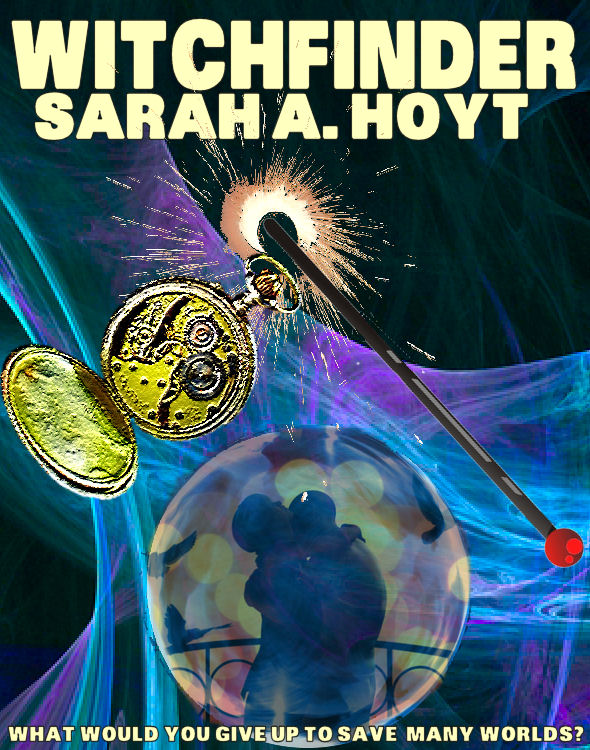
Witchfinder, Free Novel, Chapter 71

*This is the Fantasy novel I’m posting here for free, one chapter every Friday.   If your conscience troubles you getting something for free, do hit the donate button on the right side.  Anyone donating more than $6 will get a non-drm electronic copy of Witchfinder in its final version, when it’s published.
There is a compilation of previous chapters here  all in one big lump, which makes it easier to read and I will compile each new chapter there, a week after I post.  When the novel is completed and about to be edited the compilation page will probably be deleted.

Oh, this is in pre-arc format, meaning you’ll find the occasional spelling mistake and sentence that makes no sense.  It’s not exactly first draft, but it’s not at the level I’d send to a publisher, yet. *

The Duke’s Trial

There was blood on the floor, and Seraphim was dimly aware it was his blood, come from wounds suffered in combat with the dragon.  In the same dim, distant way, he was aware that his body hurt.  There was a claw through the shoulder, and the dragon’s teeth had grazed his thigh.  There were other wounds too.  Seraphim didn’t remember them all, and didn’t think he had the strength to tally them.

It was enough that every part of him hurt, and hurt more when it moved.  The hand he lifted, holding the fragment of the dryad’s cage might have been held down by weights.  The legs that supported his body might have lost all strength.  And pain screamed along his every nerve ending.  It was enough that he felt more tired than he’d ever felt, so tired it took all his will power to stay standing and awake.

Blood soaked his clothes, ran to the floor, and became slippery underfoot.  He was cold.  It seemed to him the cave had grown dimmer.  He knew it couldn’t be true, and assumed this meant he was dying.

For some reason the thought didn’t disturb him as much as it should.  Perhaps because he lacked the strength to be disturbed.  He wanted to close his eyes and to be done with all this.

And through it all there remained the dim but certain awareness that not only had he barely injured his foe, but that his foe was enjoying this.

If the dragon wanted, Seraphim knew, he could have ended Seraphim’s life long ago.  Instead, he chose to prolong it, like a cat playing with an injured mouse.

Seraphim could understand the behavior in cats.  Instinct dictated it.  Perhaps it dictated it in dragons too.  They knew so little about the creatures of fairyland.

Those that strayed into the ordered world of Avalon, they chose rather to immure and to make behave by human rules.  Gabriel—

The thought of Gabriel brought a sharp pain in his mind, joining the physical ones.  Perhaps it was true what Sidell said, that Gabriel had been the cause of Seraphim’s magical strength and most of his ability.  Perhaps it was true that without Gabriel, Seraphim would never have been able to evade the prohibition spells and go to other worlds, and rescue people.  Perhaps – as Sidell now said, his voice echoing funny in Seraphim’s ears, while the dragon sprawled, smiling like a cat, across his pile of treasure – “You know, milord, it really was always your unacknowledged half brother doing all the work, and allowing you to preen and strut like the useless peacock you are.”

But it wasn’t that which upset Seraphim and caused the deep-ache in his – for lack of a better word – soul.  It didn’t matter if he’d appeared ridiculous to Gabriel, or, indeed, to the world at large.  What mattered was that he could not slay the dragon.  And without slaying the dragon, he couldn’t leave here.  And without leaving here, he couldn’t help Gabriel.

He’d been aware from a very early age that his father – hero to others, as he’d later been revealed – was not a responsible head of the family, and not capable of protecting them.

And so, Seraphim had joined with his mother in protecting both the family and their reputation: the ill fated duel on Gabriel’s behalf had been part of that.  As had been the paying of fees and removing of entanglements from his father’s name, and making sure that whatever else he or the family went without there was money for the younger ones’ school fees.

But now – he remembered – Marlon had told him that Gabriel was fighting for his life, and if Seraphim knew the stakes involved, it was a terrifying enough fight – but Seraphim could not help him.  Seraphim would die here, alone, and, more importantly, forsworn.  His brother would die, alone, thinking Seraphim had left him to die.  Thinking he was indeed unacknowledged and unaccepted.

The dragon head came in for a bite, and as it opened, Seraphim reached into the half open mouth and cut it across the tongue.  The teeth closed around his arm so hard that Seraphim screamed.

From the shadows came the scurry he’d heard before.  Seraphim dismissed it.  It might very well be nothing more than the illusion of his dying ears.

The pain in his wrist was such that it was all he could do not to scream, and there was blood dripping between the dragon’s jaws.  Mine or his? Seraphim thought, but it didn’t seem to matter.  There was blood dripping down his forehead, across his eyebrows.  He didn’t remember getting cut there, but obviously he had.  The dropplets of blood that managed to make it into his eyes left a red curtain before his vision.

The dragon smiled across the arm he had captured, and let go.  For some reason, seeing that his arm was still attached, with deep puncture marks across his forearm, but attached, seemed to make the wound hurt more.

“There is nothing you can do, duke.  There was nothing you could ever do.”

Seraphim tried, though he barely had strength left, to throw a spell-net at the dragon, but nothing came of it.  Some sort of shield stopped it, before Seraphim could even see what it was, and with it went the last of Seraphim’s magical strength.

“Your magic is now gone,” the dragon said.  “And you were never a physical match for me.  Say you surrender and I might let you live… a while longer.”

Seraphim gritted his teeth.  He thought, yes, if he lived longer he might have a chance, but he remembered the bodies, the skeletons around him, naked, eaten.  No.  There would be no hope.  Besides, he would live with the knowledge he’d let his family be destroyed.

“No,” he said between his teeth, and lurched forward.  And tripped on something that made a horrible metallic clatter.

He noticed, without much thought, that the dragon looked alarmed, then he looked down and saw a glimmer, a—a sword.  It was gold and had cabalistic symbols on the handle, and Seraphim had a feeling someone – was someone alive in this horrible place, besides him and his foe ? – had taken it from the pile of treasure and slid it across the ground at him.

All of this took a moment, and then he was – despite the screams of his body – grabbing the sword, and running – running, though he was sure he’d die of the effort – at the dragon, and plunging the sword to the hilt in the dragon’s chest.

Of course, given the relative size, a sword was more like a dagger, and the plunging of it into the dragon’s chest brought only a scream of rage, but then…

But then Seraphim realized that the magical shield of the dragon seemed to be down, that the dragon was scrabbling ineffectively at the sword hilt with his claws, as though he couldn’t quite grasp it.

Of course, it’s spelled, Seraphim thought.  It is a magical sword.

At the same moment in his mind was the magical tutor his mother had hired when he was very young saying, “If you ever have to strike at a dragon, plunge the dagger into his eye.”

So he grabbed at the sword hilt, pulled it out and, feeling as though he was using strength he didn’t in fact have, plunged it into the dragon’s eye.

There was a scream – horrible and loud, and the huge body trashed around.  In a spasm, a claw caught Seraphim across the middle, tearing his clothes and sending him flying, to hit his head against the wall, after which merciful darkness fell.

He woke with Gabriel looming over him, saying, “Wake up, milord.  Wake up.  We must out of here.”

Gabriel must have run mad to call him milord in these circumstances, Seraphim thought, but what he said was the first words on his mind, “You are alive then.  Good.”

A hollow laughter escaped the man, and suddenly Seraphim realized it couldn’t be Gabriel, because the accent was quite wrong, and while Gabriel might be mad enough to call Seraphim milord, he would not fake an accent in these circumstances.  Particularly an accent that sounded remarkably like Nell’s.

“You could say I’m alive, milord.  Though many times I wished I weren’t.  Come milord, we must get out of here.”

Seraphim was suddenly aware that the ground was shaking and that pieces of rock seemed to be raining on them from above.  Looking up, he saw that the ceiling had cracks and fissures and the rocks falling on them were pieces of it.

“It’s caving in,” he said.

“Yes, milord.  Up.  Come.”  The man was reaching for Seraphim, trying to make him stand, but Seraphim felt he couldn’t.

“You go,” he said.  “Save yourself.  I am done for.”


How To Sell Anything ONCE


I followed one of the insty’s links called something like “How to sell comics in the twenty first century,” and found myself wrinkling my eyebrow in confusion (one of the reasons I’m developing the WTF [yes, winning the future] wrinkles on my forehead.)

I’m not going to dispute Glenn’s ideas that the comic book reader has changed.  This is by and large true, partly, I think, because more adults are not literate enough to enjoy a story without the support of pictures.  No, I’m NOT casting aspersions on all comic book readers.  I read them myself – it’s a mood thing – but it used to be considered déclassé past a certain age. Then whole word reading came in (that far back, yes) and people found it easier to “guess the right word” with the support of pictures.  So THAT barrier was broken as more adults never “graduated” past comics and therefore comics had to develop more adult themes and ideas and more complex plots.  Which in turn made them more palatable to MORE adults, including those who read other stuff.  Now comic book readers are likely to be voracious readers of other stuff as well, and usually twenties or older.

At least this is my view of how it came about, though I’ll concede it’s entirely possible it has to do with us becoming more visually wired due to visual entertainment from an early age and/or with fewer kids reading comics at one point – due to more entertainment available – and the creators moving to more adult stuff.

In itself, this is a good thing.  Story is story, and any way it’s delivered it’s a good thing for us story-creators.  And there is no inherent reason WHY comics should equal childhood.  It was just a cultural thing, once upon a time.

So, I’m not going to dispute that the average comic book reader has aged and therefore is more likely to wish to read serious themes and titillating ones, like sex.

But when I followed the article – I confess to curiosity – I found that this was not actually what they were talking about.

What they were talking about was “Shock value.”  I.e. they insisted that you know, sex sells – not in the sense of having sexual plots, but in the sense that revealing a long-running character is gay will sell out that issue.  Race sells they say, because people are more racially aware or whatever.  But what they actually mean is that rebooting a character (or bringing an alternate universe one in) with difference race will sell out the issue.  And – this was the giveaway – death sells.  Kill a major character, and you’ll sell out the issue.

(Sarah gives her world weary sigh.)  They take each of these in isolation and THINK people are mostly interested in sex, death and… race?  Okay, I could buy sex and death, as eternal themes, but no human being in the United States in the twenty first century, who is not a raving lunatic, wants to read about race for entertainment.

They might want to buy the race issue to show they’re enlightened, they might want to be seen reading it, but my guess is they actually buy it for collecting.

The same with the death issues – which as I said is the giveaway since it doesn’t have the politically-correct charge of the other two – because the death is… a death and not really in general an examination of the metaphysics or human ways of dealing with death, the ONLY reason people would buy it would be… collectors.

So, what problem do I have with this?  It sells out the issue, right?

Yes, indeed.  And I’m going to tell you the problem I have with it – it is that the publishers are drawing the exactly wrong conclusions from it, and also that continuing to do this does in fact slowly diminish their REGULAR audience.

They think that “hip people want us to bring in more racially diverse characters” that by itself might be true, though probably better with new characters, guys. “and characters of different orientations” also probably true with new characters TO AN EXTENT, and they want us to kill off more long running characters.  So, we’ll do that more.

Because apparently comic book publishers, like other book publishers have zero concept of market research and of core audience versus sporadic audience.  They’re looking in other words, at unscrubbed numbers.  In unscrubbed numbers these “shock issues” sell everything else under the table.  So they do more of them.

I ran the article by younger son, who, being intensely visual, used to be a bit of a comic fiend.  I got rolled eyes and “Yes, they’ve done this so much I no longer buy any of the long running series – they take so much retconning to bring stuff in line.”

Younger son is what you could call a long-term comic reader.  Before they – apparently – disgusted him by creating so many timelines and alternate selves no one can develop an interest (they’re just going to do something else/undo it, he says.  There is no emotional connection) he used to spend all his spare money at the comic bookstore.  They could count on him to buy x amount of comics a month.

I bet there is a core readership like him per comic book series.  (I used to love Superman, but that was long ago and in another country.)

Of course that readership is not as massive as the number of collectors and not-comic-readers who’ll come out and get a “breaking! Spider man latino-black” issue to “save for the grandkids.”

But it is a steady readership and one, moreover, likely to pass the bug to their kids and grandkids.

The alternate sales format is these “shock” issues that destroy line continuity and make the core readership wander off.

So that comic article should have been entitled “How to sell anything, once.”

The problem I have with it is the same problem I have with the publisher’s sales model.  They too tend to go after the big-big thing.  With print-no pictures publishers most of their publications not being episodic – comics are – it’s not so much a matter of “shock, violating probability” as a matter of pushing something they DECIDE should sell until it’s everywhere.

An example would be The DaVinci code.  Yeah, they could sell it massively and sell all his previous books to an extent, but it palled quickly (partly because of the clone bandwagon thing – which comics are inclined to, also “more gender issues!”  “More race!”) because well…  It’s just one thing, and it brought in – because of the massive publicity – people who normally don’t read for entertainment and in fact, probably, never read those books, just bought them because everyone was talking about them.

Twilight is a little different as, as I’ve said before, the author seems to have a direct line into “sickish” pre-adolescent teen-girl fantasies.  Ditto with Harry Potter, which – for other reasons – stood on its own, though I suspect there the numbers were also inflated through massive publicity and its being a YA book.  I mean, we discovered them while they were still England-only and ordered from overseas, but my kids eventually had a copy in each format, plus a box set, courtesy of relatives shopping for xmas/birthdays and going “oh, look, they like to read, and this book is everywhere.”  I’d bet there were on average three copies sold per kid under 15.

It is this lack of distinction between core-audience and occasional-mega-seller-audience that is killing publishing.  They think they should capture that occasional audience every time.  It can’t happen and the pursuit of it has destroyed things that used to be normal, like the slow-build mid-list career.  Now you either are selected for greatness, or you get fired, as far as most publishing houses are concerned.

And as with comics, what it’s doing is causing a slow down-trend in baseline sales.  In science fiction I HEAR a print run of 70k used to get you fired.  Now 7k is not bad and will keep you working (even if not at spectacular advances.)

In comics, I understand that descent has been much, much faster (I think because it’s an episodic medium so continuity violations are both more profitable “I have to get the one where superman dies” and more disruptive when you keep doing them.)  It still outsells print – I think – but I’ve heard grumbles from all my comic-writing friends that “it’s not what it was ten years ago.”

This is not because sex or death have stopped selling (and thoughtful treatments with non-continuity characters might do very well indeed with the core audience) or that race and gender don’t sell – again, in the right place, those could do very well.

The problem is the short-sighted pursuit of gimmicks at the expense of long-term audience building.  The result is always predictable.  And, apparently, always a surprise.

Perhaps if the core audience for comics/genre fiction was PUBLISHERS these gimmicks would keep succeeding.  At least doing the same thing over and over again and expecting a different result seems to be how they function.

And this is why, ultimately, indie and houses that act like indie (in the sense of cultivating the long audience instead of the gimmick) like, say, Baen will eat big publishers’ lunch.  They don’t have the resources, they don’t have the money for massive publicity that will put a book in every person’s hands across the land.  G-d knows they can slip up (both indies and houses that act like indie) on production or proofing.  It’s part of doing more with less.

BUT they’re cultivating readers and are in touch with readers, not with non-readers who want a quick rush.

In the era of the long tail, ironically, big publishers are going for the “big, big hit” that even non-readers’ buy.  And are missing out on the “million steady sellers that build an audience for other like books and which, in aggregate, make a boatload of money.”

What can’t go on, won’t.  And outdated business models will get replaced by more efficient, nimbler ones.

The future is ours.

Protecting Amazon From Itself

This is not an article against Amazon.  While Amazon is a big company, and like all big companies it can do stupid things, in the twelve? Thirteen? Years, I’ve been a customer, I’ve found their customer service is exemplary and they really do bend over backwards to help the customer.  As an indie publisher, I’m also more grateful than I can say for the chance to make some money on my back list.

In a way this is a post to head off the inevitable conspiracy theories.

But…

But the one thing you can say about Amazon is that when they put their foot in it, they sink it into the entire bucket without hesitation.  I still have libertarian minded friends who will not touch kindle because of the thing with 1984.  I find their reaction excessive, but I do understand it.  If you’re going to reach into someone’s kindle and remove a book, MUST it be 1984?  Really, kindle?

Well, the one I stumbled onto tonight is almost at that level of utter and complete cluelessness.  It’s going to give fodder to all the kindle conspiracists TM along the lines of “oh, now they sucked you in and they’re going to killlllll indies.”  This is a stupid reaction, because if Amazon wanted to kill indies, it would be more subtle.

No, this piece of brilliance is clearly some programmer’s bright idea.  IOW it’s a software solution to a publishing problem.

I’m sure you’ve heard – as have I – about the utter scum that take parts of other people’s books, (usually the free part) slam them into “collections” and put them out there, making money off other people’s words.  I don’t like them anymore than Amazon does.  Amazon decided to do something about that.  So far so good.

It’s possible too since our kind and enlightened ruler has been signing SOPA piecemeal as executive orders, that this move by Amazon is an attempt to comply with our new laws-by-fiat.  There are indications that way but who can keep up with the flurry of executive orders?

So, for whatever reason, the heads of Amazon decided they needed to detect when all or part of a “book” – which for Amazon can be a short story – is part of another “book” by a different publisher.  On detecting these, they pull them off the market and put them in draft, then send you a little note, asking you to confirm your rights by… publishing them again.

Since, for those not in the know, there is already a checkbox on the KDP form saying “I have the right to publish this book” this is basically a “are you really sure you have the right.”  I doubt it would stop any determined scammer, but never mind that.  It does, I suppose, provide Amazon with a legal fig leaf (which leads me to believe it is a way of appeasing the leviathan.)

Where this is a complete, warm bucket of fail is that they apparently don’t have anyone – not a single person among their team of managers or publishers – who has any experience with publishing contracts.  PARTICULARLY with anthology/magazine publishing contracts.

Just someone with mid-list level experience of being in anthologies could tell them that the anthologies (and mags) buy exclusive rights for exactly a year.  After that they still have the right to sell the anthology, but you have the right to resell the story and/or publish it individually yourself.

They had called out exactly five of my stories, which leads me to believe the other 80% or so that are still in anthologies will be called out shortly.  Which means I’ll have to go in and republish these every night for the foreseeable future.  I’m going to hope very hard that they at least have some sort of “stop bot” once the stories have gone through this again, otherwise the whole thing could get exceedingly tedious.

At the moment I MIGHT have 40 properties out (I haven’t counted lately.)  This is the tip of the iceberg of 200 plus, over a hundred of which have been published electronically by someone else and are still available as part of an anthology.  (It says so in the table of contents!  At least for most of them – sometimes I forget.)

Now think on this – it’s not just me.  It’s most published authors who were/are regulars in various anthologies.  EVERY ONE OF US, every story that’s out, they’re pulling to draft and asking us to go in and republish them to confirm we have the rights.  Let that sink in.  I know people who have HUNDREDS of backlog stories out.  And who then package them in various anthologies.

Beyond all of us, there are… all the reprint anthologies, including but not limited to the year’s best, and “best of” done by different publishers.  Robots are going to find common content in all of those and take them to draft.  (Which I suspect also takes them off the kindles of people who bought them.)

Stand back and contemplate the massive fail and all the conspiracy theorists screams of “Amazon is eeeeeevil.”

I’m used to stupid from conspiracy theorists.  I’m used to stupid from traditional publishers.  Needless to say, I’m used to stupid from governments.

I’m not used to this level of utter stupid from Amazon (though lately their inability to distinguish paid-for or hate reviews with simply having a writer who is also a reader and reviews the occasional book, has bordered on this level of stupid.  At least it’s the same TYPE of stupid – a software and general solution for a localized problem.)

If it is, as I suspect, a legal fig leaf to deal with the eternal flood of executive orders, wouldn’t it be easier to have an extra line on your publishing forms saying “This work was published before – with a place to fill in the name of the book in which it was published – or is being sold as part of – place to fill in – but I have the rights to publish it”?  And to send an email to your client saying “Please confirm via email that such and such and such and such and such and such books despite being part of contents of other books are yours to publish” for all the stuff previously published?

And if it’s not a legal fig leaf, what is the point, PRECISELY?  Do you think that people who don’t scruple to sell other people’s words without contract will balk at re-publishing them?  Why?

It’s not as if by republishing we’re showing you we have the rights to do this.  Neither you nor us have the time to deal with all the contracts under which these stories were originally published.

Let’s face it, yes, we hate those leeches who scam other people’s works as much as you do.  BUT – as with pirates – the number is really quite small and tends to take care of itself.

So… you fashioned a net to catch them that INSTEAD is going to catch hundreds of thousands of legitimate publishers – a public relations debacle that could be avoided by tapping the shoulder of any of us who are traditionally published and saying “Hey, how come your story is part of more than one collection and also indie” to which we’d say “Well, after a year, in standard contracts, the anthology buy is non exclusive.”

And then you could have put an extra line in your publishing form.  Granted, it wouldn’t involve software and cool bots.

Look, guys, I’m married to someone who does software.  He’s also a writer, so in this case he’d notice.  But in general, the mind-set is quite different.

Cool bots are cool bots.  They interact weirdly though with as byzantine a system as publishing, many of whose rules were old by the time the NINETEENTH century was new.

I wish Amazon well.  It’s been a boon for me, both as a reader and a writer.  We now own every model of kindle ever made in this house, and the money we spend on books is second only to the money our Victorian eats in utilities.  But… guys, as a friend – and I’m a friend – do try to ask writers a question or two before you let the zany software guys spend your money on programs that will only annoy people.  We’re cheap.  Heck, many of us would answer your questions for free.  A team of us can’t be that hard to assemble.  Take anyone with a lot of published stuff with traditional publishers who ALSO has a bunch of indie stuff.  Ten or fifteen of us should be enough to answer your questions if you run these “brilliant” ideas by us before you implement them.

And meanwhile, this new thing?  Drop it. When it comes to catching the real bad guys it’s as stupid as airports asking everyone to pinky swear they’re not terrorists, the infant in a pram and the guy in a terrorist vest alike.

It’s a lot of trouble and it solves nothing.

.

Ducking In

So, this morning while I was exercising, about ten minutes in, the phone rang.  Suffice it to say the rather important surgery someone in the house (not me) is scheduled to have “has to be moved” to a week later.  Right.  This is the second time this has happened – and because of the recovery period and other commitments, that date just became impossible.  Since this has never happened before this year (and we’ve dealt a lot with this group before) I’m going to guess it’s Affordable Care Act influencing things, or as we call it around here #Obamacaregames.

We’re still dealing with that, which I don’t recall being what I asked for for the new year “More bureaucratic cr*p” please.

Because my nose was acting up, I washed the filters for the heating system (they’re reusable.)  While doing it, I realized the whole-house humidifier is leaking, so we need to call repairmen.

I put the filters in the tub to dry and evil cat (D’Artagnan) peed on them so they had to be washed again.  Also, someone forgot to turn the hissy motion detector cans on again after we took the tree down, so I’ll need to wash the sofa covers…

This is more nibbling by ducks, in that it’s now almost eleven and I’m sitting down for the first time today to actually write a blog and hopefully to work on Noah’s Boy afterwards.

I had something or other to write about today, but I’ll be d*mned if I remember it.

This can’t go on.  It just can’t.  The books must be written.  Yes, day to day life still must be lived, but I fail to see why “emergencies” need to take up two or three hours every day, and leave me so tired I can’t do preventive stuff so that more stuff breaks.  (And before someone asks about the rest of the family, they too are dealing with their own ducks.)

This pattern of life is disturbingly familiar.

While I was in Portugal two years ago, I was absolutely astonished at how long doing anything takes.  Part of it is stuff like insane traffic where you simply can’t obey the rules and get anywhere.  But also, everything from official business to “just” retail takes forever.  Everyone works to the clock, see, and since everyone is working to the clock and doing the minimum possible while still getting paid, everything takes forever, and the client/patient/customer is petitioner, hat in hand, while even the most lowly of retail clerks is a “figure of authority” since he can make your buying experience impossible.  (Part of this is cultural, but part of this is simply that there is no point.  You’re not going to go anywhere from your position in retail, and you’re not ever going to get rich anyway.  So you pretend to work, and they pretend to pay you.)

Add in – and this is probably not the fault of the regime, though I wouldn’t bet – a culture that requires (at least for the older generation) three cooked meals every day, and if you’re a woman at home, you’re either cooking, or washing up or if you’re in an office, male or female, you’re taking a break to eat.  In the two or three hours you actually have free in the afternoon, you’re trying to transact business that should, in a normal course of events, where people’s goal is to do the stuff as quickly as possible, take no more than a few minutes.

Dealing with doctors at least is becoming like that here, as is dealing with any type of officialdom.  The rot hasn’t fully percolated.  I can still run into a store, find what I want, buy it and run out (which in case you wonder is my ideal shopping experience.  I’m an unnatural woman.)  Stores in general still stock what the customers want (Oh, yeah, I remembered what I was writing about – the “how comics get sold” article.  Well, it shall happen tomorrow) instead of “What we can find easily and let them stew.”

My guess from seeing my kids’ generation which truly don’t expect to go anywhere or do anything, is that this will get worse as they take over the lower levels of retail.

And I don’t like it.  Yes, I know, capitalism is unfair and unjust and eeeeeeeevil, and the best thing is to legislate that everyone has to have the same guaranteed job and get the same guaranteed pay.

If humans were ants or drones, this would even be true.  Humans aren’t.

The unfair part of capitalism is exactly what makes it work.  Capitalism favors those who are good at doing something and pushes them to do more.  I know that a lot of the people our colleges are pushing out think this means what the successful ones, under capitalism, are good at is sitting around twirling their moustache and committing fraud.  Actually I think the amount of fraud has increased the more we teach the finite pie model of economics in our colleges.  When you’re taught all the rich are thieves, you get on with thieving.

That’s not capitalism.  That is the same old “I steal because I can” that has been going on since the first tribe raided the neighboring guys and took all their stuff.

Under capitalism, you get paid for services/goods.  You compete with others providing the same services/goods.

The end result is excellent service and excellent goods, as cheaply/efficiently as they can be provided.  Yes, sometimes someone gets by with inferior goods/services, if cheap enough, but there’s a bottom to that, as several discount airlines found.

We used to understand that.  We did.  We used to teach supply and demand.  We used to understand that forcing someone to work for nothing was slavery.  We used to understand that paying someone for not working is theft (and counterproductive.  You get more of what you pay for.  Always.)

Then we got teacher’s colleges filling teachers’ heads with nonsense (among other things that they were special snowflakes by virtue of being teachers and that they were ALL underpaid.)  And the teachers’ dutifully filled the kids’ heads with nonsense.  I knew it was bad news when “mandatory volunteer hours” came in.  “You have to do x number to graduate.”  This is nonsense.  If it’s mandatory it’s not volunteer.  My sister-in-law who is a teacher informed us it was to teach the kids to care.  Because you know, nothing, but nothing teaches caring like being forced to work (shoddily) at something you don’t give a d*mn about.  This is why slaves cared soooo much.  (Sorry, I think the sarcasm meter is breaking.)

So – carry on.  In the unjust capitalist future (and capitalism will always be blamed, even if socialism is in full control.  Trust me.  I’ve been there) you can’t get anywhere or do anything, because the man holds you down.  (This is actually true if the man if some senseless bureaucrat.)  So you do as little as possible and you try to make everyone else’s life as impossible as possible.

Because, unlike teachers’ fantasies, this is how slavery actually works: you do as little as possible as shoddily as possible because what’s the point?  If capitalism encourages efficiency and speed, all types of slavery — including socialism and mandatory volunteerism — encourage slow and sloppy.

I don’t know about you, but I’ve had about enough of it.  I’ve endured ducks nibbling me to death for a year, but I TRULY have run out of patience now.  I’m about ready to make duck soup.

UPDATE: Post on editing and quality control for Indie writers over at Mad Genius Club

Ritual and Habit

*This was supposed to post at six a.m.  I was so with it when I scheduled it, that I scheduled for next DECEMBER 1st.  Sigh.*

Humans are creatures of ritual.  It is perhaps a function of being social animals.  Rituals, whether they be religious or just “this is the way we do things” help bind roving bands after all.  You’re not going to run off with the band next door, even if they do get more mammoth meat per head.  You know they don’t even celebrate the solstice the way it’s supposed to, and what would you want to do with barbarians like that?  Why THEY don’t hang the mammoth fur at the cave entrance to scare away the spirits of the mammoth killed during the year.

Once, when younger son was very young and I was trying to figure out what was wrong with him (turned out nothing much.  Apparently selective mutism is not unusual in upper IQ kids, particularly boys, and some sensory issues, which apparently are not unusual for large-headed boys.)  Because his pre-school teacher was convinced he was autistic, I read a lot of books on autism.  Like most books on education, kids’ problems and such, there were so truly bizarre hints and advice.  One of them was that your child might be autistic if he/she wanted things done the same way every day.

Now, I don’t know about you guys, but up till about age six, every child I’ve known wanted things done in exactly the same way.  If they sat at a place at table, once, they must sit at the same place everyday for the rest of the time you spend in that house.  It’s just in the nature of the kid.  Having learned something, they decide that this way they learned is “the proper way.”

Of course, it’s entirely possible every child I ever saw, growing up, was autistic.  (Rolls eyes.)

I remember a feeling of shock at the most stupid things as a kid, when I went over to friends’ houses.  Like, they cut their bread slantwise, or they heated the water for tea in a kettle not a pot.

Adults aren’t much better.  Not even adults like me who theoretically hate routine so much they are unfit for the sort of repetitive honest work mostly people do.  Okay, not unfit, I can do it.  I just hate it with a purple passion, which is why I’ve always been attracted to the sort of job where everyday is at least slightly different: translating, teaching, writing.

But within the difference, there is a frame work of “same.”  I tend to wake at a certain time, exercise, have the same thing for breakfast (soft boiled egg and tea) write this blog, then deal with correspondence, then write.  If my day is thrown off because I wake up late, or because I have to get a kid out of the house exceptionally early or alternately, because husband and kids are all home all day, it will throw the whole writing thing off, too.

It is because we’re creatures of habit that things like New Years matter so much.  My mom, when she was feeling exceptionally grumpy and not like doing anything on new year’s eve, would grumble that it was just a day and it was just the number on the year that changed.

Of course that’s right.  The sun comes up the same way and goes down the same way in the new year and we, alas, are still us.

But it is because of that that this inflection point is important.  Because, you see, it gives us an excuse.

It’s very hard to change suddenly.  It’s even very hard to change rapidly.  Things tend to change very slowly, as the song goes, if they ever change at all.

I’m a big believer in inflection points, for change I’m trying to make.  So I believe in using things like my birthday, or new years to say “I will do things differently after this.” And try to stick to it.  Does it work?  With varying success.  It helps if I also do something physical to my surroundings, to make things different.

The most successful inflection points are, for instance, when I move to a new house.  Because I have no habits associated with that room, the way the light slants through that window, that sofa in that place, I can change everything and start anew.

But sometimes just turning my office around, changing the bookcases or their contents, adding a desk for self publishing is enough to make me have the will power to resist habit.

This year I haven’t had the time (or perhaps the will power?) to change the entire office.  It needs it, but when I go through I’m going to cull books out into storage or sale, and such, and well… I’m not ready for it yet.

I did however clean the room and clear all the accumulated old piles of paper.  More might happen – or not – tomorrow.

Truth is, this year, I’m not trying for any great changes.  It’s not “I’m going to stop writing x” (or, “I’m going to stop writing”.)  It’s not “I’m going to try to do y less or more.”

This year, I’d like to be able to concentrate more, but that might take an office with an actual door.  For now, I’m going to try to read blogs and news on a different computer, so I’m not tempted to stray over there during the day.  And I’m going to try to do all my publishing on alternate weekends, so I can spend the other weekend vegging.  I don’t know if I can veg, but I remember being a teen and waking up and having nothing to do all day.  I don’t know if I can recapture that (and it was never every day) but I’m willing to give it a spin.  Maybe then I’ll get sick less.  Who knows?

Happy New Year, and may all your changes be for the best.

Out With The Old

When I was a kid, Summer Solstice (just about – there might be some day’s slippage) was celebrated as St. John’s.

This is, to put it mildly, a very odd festival where I come from.  For one, huge bonfires are built everywhere, and jumping over the bonfires together seems to have some resonance of marriage – or did, once upon a time.  For another, possibly because there is so much contact with England, some bits of the Guy Fawkes thing have bled through.  To wit, for St. John’s kids build nativities outside (This is not so much nativity, as entire scenes.  Some of us, born ambitious, would include mountains covered in moss to represent the entire hillside, and have also artesian water works. )  There are houses and things for this as well as the traditional figures of the nativity.  These are not the same figures or sets used at Christmas, but very cheaply modeled either red clay or plaster figurines.  Think of it as part railroad modeling and part nativity.  (Only I don’t think anyone ever had trains.  They were too expensive, toy trains, when I was a kid, to be left outside.  But the building of miniatural landscapes was there.)  In front of that nativity, you put a tin for tips (and no, the language doesn’t lend itself to “here’s a tip, kid, don’t go into architecture.”)  IF the adults didn’t pay attention (and here is the resemblance to Guy Fawke’s festival) you ran around with the statue of St. John clutched in your hand, yelling “A penny for the saint.”  (Well, more fortunate kids did.  I was informed by mom that it was not proper and we were NOT that badly off.  Meh.)

So, why am I talking about this on New Year’s eve?

Because it wasn’t until I started reading on myth (and I still do wonder how much of this was based on older rituals, how much cross-cultural contamination, how much bleed from Christmas (the nativity almost for sure) and how much “yes.”) that I realized the bonfires, and the burning of everything old was a way of clearing the slate, as it were, to start anew.

It must have worked like a charm in the village because all of us saved all the old cr*p that would burn (and burning, in those innocent days, was how we disposed of almost everything that wouldn’t rot) throughout the year, and the pile in the middle of the plaza (don’t go imagining anything very grand.  It was a huge beaten dirt expanse where two streets met) in front of grandma’s house, could climb to astonishing heights.  Or maybe it only seemed that way to me, when I was very, very small.  I do know that sometimes people were worried about the flames reaching the electrical wires, though.

Of course, most of the people in the village were so proper that I think the biggest shock in my life was when there was an earthquake and everyone ran out, realizing that the neighbors didn’t actually sleep in their full day clothes.

So there was none of that pagan singing and dancing.  Sometimes there was some singing, desultory, and sideways, but absolutely no dancing and certainly not of that fire-jumping stuff.  The kids played around as usual, glad to be allowed to stay up late, and the young people flirted, but the adults mostly treated it as a village social, standing around and talking.  (Weirdly, there was also conversation about some of the cr*p we were burning.  “Oh, that box of chocolates was good.  I wonder if uncle so and so will give us a new one this year.”  That sort of thing.)

And then everyone went and had a cup of coffee with milk (please don’t ask.  That and toast were traditional St. John’s food. There were songs about it.  No, I’m sure that wasn’t a survival of the Celtic rites.  Almost for sure.  Probably.  Not in this universe.) and went to bed after midnight, feeling very daring.  The next day life started up in the normal way, maybe with everyone a little slower and more morose due to the late night.  (Children, in the village we didn’t go to bed with the chickens.  The chickens wondered what was wrong with us we went to bed so early, normally.)  But something had changed.  After St. John’s we shifted to “summer mode.”

Well, we don’t do St. John’s here, and I live in Colorado.  As dry as it is, if I tried to burn anything at all, let alone the accumulated debris of an entire year, the police would be at my door before I was done making a pile of stuff.

Also, we don’t live in innocent times.  That box that contained the chocolates probably is full of carcinogenic dyes and will kill the wild life in a five mile circle, if we so much as hold it too long in a hot place.

But what remains is the memory that what we celebrated was a survival of a “new year’s” ritual, in the sense that it was an inflection point in the year.

We humans tend to hold on to all sorts of cr*p long after it’s no longer useful.  It’s the nature of the beast.  Habits, thoughts, ways of doing things that aren’t working, but are comfy and worn.

And then there is that illusory thing “luck.”  This year, in general has been “bad luck.”  Not terrible, but a sort of grinding annoyance and little things going wrong.  “Getting nibbled to death by ducks.”  Almost all of my friends had that sort of year, though some – overachievers – have topped it off with worse: job losses, major illnesses, or broken relationships.

Part of it is the economy, of course, throwing a pall over everything, but I’m almost sure that the economy can’t be blamed for the wild fires, the two bouts of death flu followed by the small bouts of minor flu and all the other “little stuff” – car break downs, flooded basement, etc — that made this year very bad for me to work in.

As much as we don’t want to believe in luck, we all do.  And as much as we don’t believe in luck, we all know sometimes it changes, and some things make it change.  It used to be if I was having a really bad run of luck, we’d go to Denver for the day, bum around, go out to eat, and then things would change.  (Sometimes they still do.)  Maybe all that changed was my mood, but things certainly went better after.

These rituals, these habits, these things, exist because life seems to work like that.  It doesn’t make any sense (which means I resent it) but life does seem to follow this type of thing.

So… just in case it works, and because the last year we were nibbled to death by ducks, let’s send the old year off with a bang (for me this means staying up past midnight.  I’m fairly sure the chickens still think I’m too early a bed-goer) and blowing on a little noise maker, then having a few teaspoons of champagne (it’s carby, you know?) with the kids, but hey, we all do what we can, right?

And mentally, I’ll be burning the flu, and the basement flood, and all the appliances that broke, and the car troubles.

Yes, of course the new year could be worse, but we won’t let it.  We’re going to change our luck for the better.

In the new year, there will be jobs and love and prosperity, even if we have to fight city hall to get it.

May all our fights be joyous, may all our troubles be so tiny we don’t notice it, may our health be as good as it can be, may there be enough money for everything we need, and a little left over for what we want, and may we be productive and merry in the new year.  May our luck change for the better tonight.


Straining The Quality Of Mercy

We live in very odd times.  A conversation with a friend who has a Pit bull dog, yesterday, led to his saying casually of course he couldn’t have a pit bull in Denver.  I was aware of this, but had never given it any thought.  Mostly I come across it on Craigslist as people who MUST move to Denver are getting rid of their dogs so they can move.

And here we come to my experience with the dogs.  Like everyone else – though this happens mostly on TV it leaks to real life as well – I’ve seen pit bulls tied in front of houses I wouldn’t approach anyway – though the last time that happened was seven years ago when I got lost walking the kids back from middle school, so it might be a trend that’s passing away.

Yes, those pit bulls look like terrible dangers and generally scary.  But then the houses the dogs were tied in front of looked scary too, an indicative of the people who lived there.

Then there are the Pit bulls I still meet.  The office I rented at the end had only one other office rented, which means I didn’t feel very safe.  Perhaps the people in the front office didn’t either, because the owner brought in his Pit bull, who was a sweet, slobbery dog, very well behaved.  Other Pits I meet while walking or at stores, are exceptionally well behaved.

This is, of course, because they’re high dominance dogs, naturally.  And if you are a responsible owner who has a high dominance dog, you TRAIN that dog until it’s one of the best mannered creatures around and far safer in public than most humans.

Yes, of course if you are stupid and you get a Pit and raise it the way most people seem to raise their kids – by indulging their every whim and never setting limits or consequences, you’ll end up with a feral beast.  People who raise their kids that way do too – and yes, I know a lot of the left thinks the solution for this is to outlaw kids.  But people who raise their animals – or kids – that way would only be safe with stuffed dolls.

(Yes, I know Pits were bred to fight.  So were your ancestors.  Take a powder.)

This connected in my brain with the whole outrage over the Connecticut shootings and how we absolutely, imperatively must outlaw private ownership of guns because… shuddup, do it for the children.

As though criminals care whether something they do is illegal or not, and as though crazy people can’t come up with other ways to cause massive damage: less survivable ways.  Need one remind everyone that the first World Trade Center bombing was achieved by fertilizer.

Perhaps they intend to outlaw manure?  (Maybe that’s the aim of the Carbon Laws.)

Yes, guns are horribly dangerous.  They’re not the only thing that’s horribly dangerous, though.  I know several gun owners who could arm entire small countries, and when I visit them I feel SAFER there because I know if SOMEONE unsafe were to attack for whatever reason or none at all, they have the armament to protect us.

Forbidding the owning of guns doesn’t ban the danger because the danger is always in the human mind.  We’re a curious monkey, and some of the things we’re curious about are very, very dangerous.  As Terry Pratchett put it, if you put a button in the most distant cave in the world and painted a sign to put next to it saying “Pressing this button will end the world” the paint wouldn’t have time to dry before someone pushed it.  Worse, they’d push it not to destroy the world, but to see what it would do.

And yes, I know of the several bans to keep people from eating/playing with/drinking whatever they want, but the one that totally makes my jaw drop is forbidding all peanut products in schools and planes because of people’s allergies.  Yes, I’ve heard that just being in a room with peanuts can start the allergy.  Can I say bullhockey?  People with that violent an allergy wouldn’t be able to be on a plane, period – people like us travel with nuts.  We have to, because it’s the only portable thing we can eat on a plane.  Sometimes they’re peanuts.  We have yet to kill anyone.  And since the airlines do not search everyone for peanuts, I’m going to assume this is bullhockey.  Because if peanuts ANYWHERE on the plane were that dangerous, they would search people.

Yes, I can see where rubbing peanuts on someone might be an issue.  I’ve known people that allergic.  BUT most people are allergic to EATING peanuts.  So… we’re banning peanuts in public because… some people might not be able to help themselves and might gobble down stuff that could kill them?  Um…  As someone who can’t eat carbs, in the few flights that have lunch (usually bread-stuff) or snacks (pretzels) this affects me adversely.  Note, however, that I don’t fall, helpless-victim like on the pretzels or bread, because they’re in the same space with me.

And no, banning peanut butter from schools isn’t justified because these are kids.  These kids are in school.  That means by definition they are house-broken and capable of following instructions.  “Don’t eat that because it will kill you” should be a hard and fast one.  I mean, when I was a kid we were turned out to play outdoors at three or four, and there were a list of things we couldn’t do because they WOULD kill us (like run out in front of cars.  Drink bleach, etc.)  Weirdly all of us failed to DO those things just because we could.  (Yes, there are mentally handicapped children in the schools, but those have assigned teacher-aides, so the point is moot.)

What these three cases have in common is a curious mental confusion about what is what and where responsibility lays.

And some of this was part of the great liberal project (real liberals, the kind I identify with) started in the seventeenth century.  In a time of swift and sudden penalties, that took no extenuating circumstances into account, and which were unimaginably harsher than we can think of (torture being a normal method for extracting confessions for such crimes as pickpocketing) real liberals brought in a more nuanced justice and a weighing in of causes and consequences.  If someone steals a loaf of bread for his starving children, it’s not in any way the same crime as stealing a horse to resell in the next village.  (Okay, some judges took that into account, in England at least, but it was a big on the discretion and didn’t always happen.)

The problem is that what real liberals started, insane liberals finished.  The end game of this project in law can be seen all over Europe where murderers are condemned to some time in jail (in Portugal it was less than ten years at one point.  We used to joke about dragging the people I wanted to off to Portugal, because I was willing to pay that penalty) because there’s always “extenuating circumstances” and where even in safe neighborhoods like my parents’ people live in fear of criminals breaking in.

Here the end run of that system by and large was the seventies – at least in criminal law – and we’ve been walking it back to some extent ever since.

On the other hand, the same thinking has gone from the law to everyday life.  No one is responsible for anything, because there’s always explanations and reasons and “I couldn’t help myself.”

In many cases this is even true – probably.  I am forever in shock by how many of my kids’ classmates seem to be well… feral.  No one ever bothered to teach them to control their impulses or to think rationally about what they have and what they need and how to get there.

The end result is minds that confuse feelings with thoughts (the corollary of “if it feels good, do it” turns out to be “if it doesn’t feel good don’t do it” even if the momentary discomfort is needed for future happiness.) wants with needs and who can see nothing further than instant gratification.

I submit to you NOTHING can make society – or the world – safe for those people.  In the end they either learn otherwise (painfully) or they die.  On the way they cause untold misery.  BUT the more you try to protect them from the induced stupidity of their own upbringing, the more misery you cause to people how had nothing to do with it.

Worse, you place the blame on the wrong THINGS – or animals – and not where it belongs: in the people who choose to use the things or animals to create harm  (or choose to do nothing and let animals cause harm.)

We want to excuse everyone and think everyone good at heart… and maybe this is true to an extent.  Everyone certainly has good potential.  But those that choose to do good can also do harm.  And yes, sometimes they can do harm without meaning to – but it’s still their choice.

When you remove that, you’re putting the blame on things and creatures who can’t choose.  And you’re restricting the choices of everyone.

To absolve the guilty you must ALWAYS blame the innocent, even if it’s innocent THINGS.  And that mis-placing of blame will always result not just in curtailed liberty, but in greater pain for everyone in the long run and in a society that rolls over and begs for tyrants to save it from itself.

The monkey mind that chooses to press the button that says “end the world” can also choose NOT to do it.  But for that, it must be able to think through causes and consequences.  And to be taught that, we must start by putting the blame where it belongs.  And we must understand that mercy, like all other admirable qualities, has dark twins called indulgence and misplaced blame.  Even virtues aren’t free and we must always be aware of their costs.  TANSTAAFL.