Thinking In Post-its


Yesterday I got incensed on the Art Creates Community thing.  It’s been appearing on more and more bumperstickers around here, and makes me roll my eyes.

I identified this with the sixties, even though – to my knowledge at least – this one is recent, simply because it seemed a characteristic of the sixties (perhaps due to the mass media of the time) to push ideas as slogans.  These slogans, everywhere from t-shirts to bumperstickers, got repeated so much (particularly at my young and unsuspecting generation) that they got accepted by the majority, totally unexamined as “everyone knows.”

You know, “Make love, not war.”  Why?  What about one prevents the other?  In most cases, people make love AND war.  If you believe the legendary works of the Greeks, people go to war because of making love – or even closer at hand, if you read a lot of WWI and WWII set or written fiction, you get the idea people went to war to impress girls.

Of course it was an excuse to stay at home and do hippie chicks, instead of obeying the draft, while managing to abrogate to yourself the mantel of virtue.  “Hey man, I chose to make love not war.”  Of course, they were actually making sex not war, and most such men – like all weasels – treated women very badly.  BUT the slogan hid a multitude of sins.

Then there’s – please gag me – “What if they gave a war and no one came?”  I swear I want to print response stickers to put underneath that say “Well then the war comes to you.”  The same with “What if schools everything they wanted, and the army had to hold a bake sale to buy a bomber” – which makes me want to say “well, I hope the school enjoys having its *ss bombed.”  Or “It all ends with sending ill-equipped children to the front to die.”

The problem with post-it thinking is that it hooks into humans social nature, i.e. wanting to be in with everyone.  And while it’s easy to come up with totally ridiculous sayings that SEEM well meaning and that people put on their cars, t-shirts, websites to seem virtuous, it’s much harder to make a cogent argument in that space.  And it’s impossible to counter a slogan someone embraced to be “in” with logical thinking.

Take “No blood for oil.”  Tell someone that’s the stupidest thing you ever heard/saw and they ask you “Do you think people should die for oil?”  Well… no.  No one should die without heating too.  And no one should die in famines.

The problem is the operating word there is “should” which is the language of desire, not the language of reality, which uses “would” and “could.”

No one should die for oil – which btw, was not even close to what the war in Iraq was about, as proven by the fact being simon-pure we didn’t take the oil – but as the country shouldering world peace (I’m not going to get into a discussion on whether we should or not.  Pax Americana is a globalist project and I’m not a globalist.  OTOH I believe we should be well defended and bellicose enough no one even looks at one of our citizens crosseyed.) we have to ensure enough stability that oil isn’t used as a tool of terrorism (that works) and that the prices don’t spike so much (that works too!) that poor people at home are dying from LACK of oil.

But ignore that energy is the basis of our economy.  Ignore that oil is the main part of our economy. Think of it as shiny black liquid, and “No blood for oil” is obvious.  It’s also vapid, childish, and wrong and avoids discussions of “How were we to maintain world stability without going into the Middle East.”  Which is the entire purpose of it, because half the people the “Should” side gets to back them would get bored and wonder away when you start discussing comparative strategic advantages of going in elsewhere or of not going in and just bombing the heck out of the place, or–  They don’t want the details.  They want to sound thoughtful and caring.  “Make love, not war.”  “No blood for oil”  Look, what good people they are.  They don’t want anyone to die.  No one “Should” die.  Forget that this is impossible, and that they have the median IQ of a half brick.  They have their slogan, and it shows they’re GOOD.  And they’re willing to die for this half-baked slogan.  Because that makes them saints or something.

In that context, “Art Creates Community” is a bland and innocuous slogan.  Mostly I see it in cars when I go to art classes.

However, I’ve reached the point when, frankly, any and all postit thinking drives me batsh*t insane and makes me start jumping up and down and screaming.  (Yesterday at the con someone told me that I couldn’t be Latin – she was sure I’d grown up in the Soviet Union and she thought that was a good thing.  Children, I was so tired I skittered away from THAT fast – because you know, I’m so laid back, and cerebral.  Ah!  I’m just PRIVATE.  I don’t roam the corridors of a con screaming.  I roam the corridors in my HOUSE screaming.)

Let’s examine the slogan – it’s absolute true at face value.  There’s a community of people who form friendships and networking and interests around the museum and the art school.  So, Art Creates Community.

Only, the bumper stickers have a line under it from some government fund that underwrites them AND art.

Um…  Look, my writers’ group, when I had one, created community.  We helped each other through illnesses and financial distress.  But we had no government funding.  Did we need government funding?  Well, we subsisted ten years without it, and in that time most of us transitioned to professional status.  So…

The thing is that ANY shared interest creates community.  I have friends who know tons of people in their gun-collectors/gun-manufacturers/gun-dealers community because, well, they go to the same shows, and they get to know each other.

So, Guns Create Community (a well defended one.)  I say the city government should finance guns.  No?  Why not.  They create community.

And, as a commenter noted, churches create strong communities.  Should city government finance churches?  Why not?

ANY shared interest creates community.  Gaming Creates Community.  Should the city subsidize that?  Why not?

And don’t tell me sometimes good art needs public support.  For the love of Keemchee, the Soviet Union or Nazi Germany supported all sorts of art.  When the government supports art you get gigantic statues of Mao Tse Tung, (Or gigantic statues of Martin Luther King looking like Mao Tse Tung.)  And please, don’t bring up the Italian Renaissance.  That was different.  The patrons were individuals who just happened to be massively rich.

The best art done with government patronage was Shakespeare, and frankly those are the worst of his plays (which his having learned to write for the people first, still aren’t too bad.)

So do I think we “shouldn’t” support art?  Well, I do think a city government so far in debt that they can’t keep all the street lights on AND stop a popular inter-city bus CAN’T support art.  That is the language of reality.  It has nothing to do with should.  It has to do with could and the fact that there ain’t no such thing as a free lunch.  You take money from one side, it’s gone.  You don’t have it for the other.

So don’t I think we SHOULD support art?  That’s neither here or there.  I am an artist myself – very beginner – as well as a writer, which some people would consider an artist.

Do I think every artist should have enough to live on and pursue his or her art?  Sure thing.  In an ideal world, in which soup rains from the sky, clothes grow on trees and a two-bedroom home sprouts after the rains like a mushroom.

But that’s not the world we live in.  A world in which if you pay for soup you can’t pay for art is the world we live in.  A world in which if the government finances art, it can’t finance lighting the streets is the world we live in.

Now, I happen to think that worrying about the daily bread and having only a little time to do art sharpens the art and gives it a human touch.  (But then, of course, too much worry can kill it.  We’re human.  It’s all imperfect.)

But even if I didn’t believe that, I still would have to say that while I think EVERYONE should have enough money to pursue whatever art or hobby they wish, I don’t think it’s possible to make it so that everyone CAN.  I also think everyone should live forever.  I don’t think everyone CAN (or anyone, right now.)  I think it SHOULD rain soup.  I don’t think the government should at great expense send helicopters overhead to dispense soup.

Art Creates Community.  Guns Create Community.  Religion Creates Community.  Make your community self sufficient.  There ain’t no such thing as a free lunch and no one SHOULD be compelled to pay for yours.

Ignore that long enough, stick to post-it thinking, and the gods of the copybook headings come to tell you that if you will have art on the streets, you can’t have lights.  And then no one can come and look at the art in the evening without being mugged.

Or… you could think past post-its.


Defeating The Great Depression

Weirdly this is not an history post.

Right now a lot of us have fallen into a great depression.  The economy, the politics (also known as teh stupid at a national (and state, and local, and epic) level (take my city for instance.  They are turning off the lights in every cross street to save money, BUT they are still filling downtown with great, mostly without redeeming value, (yes, there are exceptions, but not many) piles of metal for “art on the streets.”  Because, art is more important than the safety of lighted streets, and “art creates community” or something – will the Sixties never lie down?  They’ve always been dead.)  Our kids are coming of age, and there’s no economy for them to step into.  We’re most of us holding on to the edge of a job that might or might not be there in a year – or a month.  Everyone is holding their breath.  Something has to give, but no one knows what.

We wait and we wait, and we can’t talk to anyone, and no one will talk about anything that’s really worrying them in public (though we do, in private, with a bottle of wine and some time.) And we get depressed, because what we believe, what we do, what we are, what we want, and simple stuff that could be one to make the economy better is obvious, but nothing gets done.  Or teh stupid grows deeper.

There is a certain Weimar republic weirdness.  People talk around and over things.  People smile a lot.  Even cons that used to be acrimonious, no one talks of anything important.  (Well, except me, when someone said money was a measure of labor.  You guys know what it does to me.)  We’re all being overnice with each other as though we were all accident victims and slightly dazed.

The people who still have jobs are working too hard.  The people who don’t are wondering if they ever will again.  (Some think they won’t because they bought the with-folded-hands-crap.)  Those of us who drink are wondering if we can afford as much as we need.  Those who don’t drink often act drunk through sheer exhaustion.

But mostly, mostly, we each one of us feels powerless, lost, as though what we are, what we think, what we want, all the plans we had for ourselves and kids and our careers, and our friends, and our retirement, count for absolutely nothing.

It is not good for man – or woman – to feel alone.  It is no great shakes for man – or woman – to feel powerless and irrelevant.

I can’t tell you what to do, personally.  I’m not you.  I’m finding my own way out of the grey goo, into some semblance of normalcy.

Either things will get better or they won’t.  Either the worst will happen, or it won’t.  You can’t do anything about it, but you don’t want to give your life over to a wasteland for however long.  We hear history moves faster now, but history is still not that fast.  The collective thought and feeling are a slow thing to move and change.

And meanwhile… well, in Venetia Heyer makes some reference to the years the locust ate.  This is of course a reference to the Bible.  But it is also a weirdly resonant phrase.  The character is referring to his years spent in wenching and gambling, not building a life, a family, an estate.

I hate to tell you this, but if you’re going to waste years, wenching (what is the distaff equivalent?  Roguing?) and gambling are better than grey goo-ing.  In another, smaller scale, I let the locust eat the years I was struggling to break in.  I’d lose hope, and spend months, years, spinning in place, doing nothing.

It serves nothing.  It helps nothing.  So whether you’re overworked, underworked, or completely lost in some hopeless routine, let me share what has helped.  Because one way or another, either this will end well or badly, and in either case you’re going to need to be alert, prepared, and not so depressed you can’t move.

Prepare for the worst, hope for the best and – to quote Heinlein – keep your clothes and weapons where you can find them in the dark.  Metaphorically, at least.

I’m not going to tell you how to prepare for physical survival.  It would be stupid.  There are far better informed people.  I do wish womeone who can’t eat carbs – for reasons other than diet – would have a list, though, since our storage is whimsical, to put it mildly.

What I’m going to tell you is how to keep yourself from being a depressed pile of mush, in the meanwhile.  Because – trust me, I’m by nature a depressive, and I KNOW – if you are a depressed pile of mush, you won’t think clearly in an emergency; you won’t react quickly in a life threatening situation; you won’t take advantage of something getting unexpectedly better; and you WON’T survive, no matter how many plans you’ve made.

So, this is what has been working for me – your results may vary.


1-      Control.

Years ago, in the throes of burnout, I bought a book on how to get out of burnout.

They identified three causes of the burnout: overwork; lack of control; hopelessness.  They said countering just one of those could get you out of a burnout spin.

I don’t know where the book is, but I think it’s in one of the massive “to sell” bins, because it was to my purpose nothing.  At the time, I couldn’t take control of my career, I could do nothing about working less (not if I wanted career to continue) and I’d pretty much lost all hope of my career experiencing any progress (I think the year I had six book releases and NOT ONE made it to bookshelves in CO was the time I figured that out.)


In a way we’re there.  And of course, we can’t do anything substantive about those three things.  But there is something we can do on a minor scale.  You can control yourself and your surroundings, and make some improvements.


a)      Eat well, exercise, try to get in shape (I recommend Charlie Martin’s 13 weeks program.)  Try to be the healthiest you can be.  Depression – at least in me – tends to translate into sweet-cravings and couch-potatoing.  Counter that part.  Control your body.  It will pay off.

b)      Clean and organize your surroundings.  No, I’m not being mommy.  Look, there is a psychological effect from living in a mess, and you don’t need it.  And being able to find a book, a reference, a tool when needed is an inestimable good.  The other advantage of these two is that most of the time they will tire you out, so you can stop running in the hamster wheel of the mind and sleep at night.


2-      Hope

Whether you’re unemployed or employed, you need to feel like you have something you can do to help in the future.

I’ve said here before the future is not one job, not one occupation, but multiple streams of income.  Yes, I know, if you’re already overworked you’re going to throw things at me (it’s okay.  I’m really good at ducking) because there SIMPLY isn’t the time or… the “give.”  But there is, if you find it.  And it can help you.  During the worst time in my writing career, I picked up art.  As income it hasn’t come-in yet.  (But it could, if I organized better.  Something that I’m working on.)  But as something to learn – something that I could feel I was making progress in and it was volitional, it’s inestimable.

Writing six books a year was eating me alive, so I added art classes and time to draw, and I felt better.  It makes no sense, but it worked.

Given the times we live in, and that the future is uncertain, I’d advise you to pick a hobby that can double as a money-making thing, preferably one you can do on your own/contract/fre lance.

I don’t know what your talents are.  My family is NOT normal – you knew that, right? – so yesterday we spent time picking courses off a catalog, and the gamut went from history to music, to art, to storytelling.  Activities and skills people are working on in my circle range from editing to handy-manning (shut up you!) to building computers from discards, to writing indie, to art, to all sorts of what used to be called womanly crafts.  Embroidery, crochet, knitting, calculus, statistics, piano, languages, programming, baking, backyard gardening…  All of these will almost for sure have a value and allow you to make at least some money.  All of them are absorbing enough to keep the mind from the down spiral.

Pick one and master it.


3-      Rest

This will seem insane, considering the stuff above, but listen to me.  One thing I learned in the burnout years was that I couldn’t rest simply by doing nothing.  Doing nothing was an opportunity for the locust to come gnawing at the edges of how hopeless my situation was.

The mini-vacations my family does – Denver, mostly, for three days or so – worked (kind of.  Family time does, because I like the guys) but it didn’t LAST.  Instead of a vacation a year or so, I found myself needing a vacation every month, which, of course, interferes with mini-galt, and also with the fact that we were (and are) fairly broke.

So, here’s my advice:


a)      Plan your escape.  Look, there’s mini-galt and being broke and stuff.  But then there’s holding yourself to such an arid and work-laden schedule that makes you feel life is a never ending slog.  It means that sooner or later you will break out, and then it will be worse for the finances (and you.)  There will be the “ARGH, can’t take it,” and a ticket to an expensive show you don’t even want to see that much; or dinner out somewhere expensive, or…

Here, we follow Heinlein again (genuflects.)  “Budget luxuries FIRST.”  Luxuries can be anything from planning an afternoon a week lollywagging in front of the tv or games (hint, do NOT go with other people’s idea of fun, even your nearest and dearest.  My husband likes sitcoms, but they drive me up the wall.  My kids love minecraft.  I think it would leave me more tired than just working.)  The fact you plan it, and it has limits, stops it from turning into endless escape and then into grey goo because you’re doing nothing and you know it.  Say “Saturday at two to five, I’m going to do THIS” and then that’s fun.  Sometimes your escape can be an hour a day “when I come home from my too-demanding job, I’ll take a bubble bath/read a book/watch a stupid show.” Don’t be ashamed of what you do to escape.  It will probably be stupid.  It doesn’t matter if it works. My busiest and most stressful year in school was made better by a truly spectacularly dumb Brazilian soap.  For whatever reason it worked for me, and it was on at seven when I got home.  My parents ate before me, so I’d take my dinner to the TV room, and watch the soap for an hour, after which I was ready to face reality (and homework.)

b- Plan some bigger escape too.  Budget it.  Eat pancakes if you must, for three weeks (or vegetable soup, in my family’s case) but take that mini-vacation for three days once a quarter.  Or go hiking in the wilderness for two days, if you’re that kind of wild and wooly.  Or drive to see something you always wanted to see and lacked the time/funds to.  Or buy a season ticket to the symphony (this is my own personal dream.  We can’t afford it, but I’m trying to figure out how to do it.)

If you have a family, the “big escape” should involve ALL of you.  Something you all like to do, if at all possible.  This a) is cheaper.  b) it gives everyone something to look forward to “another three weeks, and I finish this, and we go to Denver and go museum hopping.  Wheee.”  And the kids/husband are going “another three weeks, and…”  c) it helps reconnect with those you love.  Part of the issue with depression is that after a while you feel as though everyone around you is miles and miles away.  Having fun together, DOES help reconnect.

c – Merest escapism.  This was mentioned above, but I want it to have its own place, because it’s not something that needs to be part of scheduled time off, or that needs to be very expensive.

It has become fashionable to sneer at escapist entertainment.  This is nonsense.  It is part of the whole utilitarian view of human as a unit in society, a cog in the wheel.

If you’re reading this blog, chances are you read.  In the middle of “better reads” feel free to have the utter escapist novel.  For me, weirdly, when I was really depressed this involved revisiting the trashy reads of my younger years, mainly Enid Blyton.  But it can mean reading category Harlequin or pulp SF – don’t be afraid to do it.  The only criteria is “does it make me bubbly-happy inside?”

Again, you need to limit its time, or nothing else will get done, but if you read before bed, make every third read something that makes you happy, even if (particularly if) it has no redeeming qualities whatsoever.

And if you’re a writer – speaking for myself – write a bubbly-silly story or short novel every once in a while.  It will both (hopefully) give you some money  (and sharpen your mad indie skills, if you’re not going that way yet) and I’ve found (don’t think it’s just me) it helps with the escape.  I too can escape into the silly stuff.

Games, movies – all of this comes in escapist flavor.  Make escapism part of your plan.  Limit it, of course, or nothing else will get done.  When you’re depressed you obsess on things, and if escapism is all you do, it’s kind of like living on Cheetos.  After a while you get sick of it, and it doesn’t nourish you either.  But as part of your “make self feel better” a little won’t hurt you.

And now you’re going “Sarah, if I do all this, I’ll be stumbling-tired and nothing will get done.”

No, you won’t.  A lot of this is planning ahead, which will increase your sense of being in control of your life and your future.  And some of it – cleaning, organizing, exercising – can be combined.  BUT most of all, by pulling yourself out of the Great Depression, you WILL rest better in the time you have, and work better when you can.

Learning a skill might be only an hour a week, but you’d be amazed the difference an hour a week makes after a year.  Exercising might be fifteen minutes a day, but it too makes a difference.  And your escape might be reading ten pages before bed, but you’ll sleep better for it.

My specific strategies might not work for everyone, but something like it will.  Give it a try.  This great depression is communicating itself to everyone, all around – and it is no use to anyone.

Don’t sit down under it.  You have so many years – don’t let the locust eat them.


Plot Perseverance and Plodding

Lessons learned from writing a novel very slow.

Most of you know I write pretty fast – three months on a book (first draft) is slow – but most of you don’t know why I do it.  Also,  I’ve taken a year and a couple of months to write a book before Witchfinder but the process was completely different.  Normally when a book takes me that long to write, it is because – like poor Noah’s Boy – it keeps getting interrupted by more urgent stuff.  (In Noah’s Boy case, this was mostly health.  It occurs to me, mostly because Stephen Green talked about his health issues and people thanked him that I must at some point do a post about the weird intersection of hormones and writing in me, because other female writers might have the same problems, or develop them as they age.  But it wasn’t all health.  In the middle there, after I got rights back to Draw One In The Dark and Gentleman Takes a Chance and before I’d done – or thought of doing – anything with them, Baen decided to re-issue them after all.  This meant that I had a chance to do some revision (the first book badly needed it, just on wording.  It was written while I was recovering from concussion, something that brings up all the English dialects I ever learned, so it went from British one paragraph, South African the next, [my grandfather spent 20 years in South Africa and he was one of the first people I practiced English with, when I started learning] then shaded to the Midwest, then settled in Colorad.  It was unsettling for me to read) but it had a drop-dead in early December, so everything had to stop while I pursued that.  BTW, that’s good news about DOITD and GTAC.)

That is a slightly different process and while it suffers from some of the same symptoms, like for instance plot skew, it’s not so much plot drift as picking up on it again and realizing I can’t do it as outlined.  When I pick up months or years later, I’m not THAT writer, anymore.

So, first let’s dispose of the reason I try to write fast and without stopping once I’ve started a project – because I’m handicapped.  Actually honest-to-goodness measurable brain issue.

For years I’ve told everyone that I test profoundly handicapped on visual IQ tests, and this is true, but the reason I test that way isn’t necessarily visual intelligence per se.  I can visualize stuff and work from that visualization, as has been proven since I started doing art.  No, my problem, which also affects word puzzles of the acrostic kind and definitely affects number puzzles is that I’m almost completely incapable of visualizing PATTERNS.

This is a very specific kind of intelligence, as we found when we had the younger kid tested, because he has no limit to it (as in, they ran out of sets.)  He sees patterns and codes better than anything else.  This is the sort of person they throw seeming senseless messages at and the person discerns the code.

Well, he has it, and I’m totally lacking in it.  (Curiously, this is the reason he preferred non fiction to fiction for a long time.  He saw the “pattern” very early, and could see how it would end.  Now he’s learned to read for other reasons.)

This is why I came into the field with fully alive characters and had the hardest time in the world figuring plots.  My first published novel, I stole the plot from Tam Lin and sprinkled it with Shakespeare, and hoped it would work.  (Not coincidentally, what I’m trying to figure out in art right now is composition.  This is not un-akin, in its first groping efforts to a blind man trying to figure color.)

Well, as we d*mn well know, even a deaf person can learn to sing, and after twenty years of groping and practicing – and a heck of a lot more time reading plots – I can see the “plot shape” of a book.  It’s nothing as formal as an outline (though I outline, also, often the plot shape is cleaner than what I outline which tends to get pulled about by characters, which means I have to fix it in post.)  It is more literally a pattern-shape in my mind.

The problem is that I lose that hard-won pattern if I get distracted (and this is why I hated selling on outline, when I had to, with a purple frothing passion.) or if it takes too long to complete.

For those of you who crochet or do some other handy work, imagine that you can see the work in your head, but not write it down, because THAT changes it – and you have to finish the project before the pattern in your head changes, which it will, very gradually.

Ideally, I write a first draft in three weeks, because then the pattern is set, and I can work around it to clean it and make it clearer.

Now, I might be completely wrong on this, but while I am handicapped (probably having to do with the circumstances of my birth) I don’t think I’m alone in struggling with patterns/plots.  In fact, I know at least one other published author in the field who has almost exactly my issue.  (I’ve never asked her about the circumstances of her birth, which could confirm or deny the brain-issue hypothesis.)  And a lot of women writers in general have issues with the “plot thing” just like men have issues with the “character thing” – this is generalized and, yes, possibly sexist, but I could give you reasons both innate and training why it is so.  However, like any other generalized statement, it applies only to statistics and not real people, so chill.  There are outliers, on both ends.  There are people like Dave Freer who are good at both plot AND characters.  (We would hates him, my preshious, but he’s such a nice guy we can’tz.)

And, again, I might be completely wrong on this, since I’ve never been anyone else, but most writers seem to write novels more like I wrote Witchfinder (though usually not writing only Fridays – though some do) than like I write my normal novels, so a disquisition on what I learned from the experience might help someone, or at least make you stare in a kind of fascinated horror.

1-      Plot.  Oh.  My.

I started out with a more detailed plot than I normally do, because I KNEW it was going to need to be there, to back me on the days I came up empty.  Most of you have tweaked to the fact that Gabriel Penn stepped out of his role and took center stage.

What most of you don’t know is that almost every other character did too, and that the novel took a violent wrenching turn from where it had been meant to go.

While Nell was always meant to be the lost princess, this was not supposed to come out for five or six novels, during which time she and Seraphim would develop a partnership saving unfortunates in worlds where magic or shifting was deadly.

Yes, ladies and gentlemen, what I’d meant the plot to be was one of those that could be easily serialized under “adventure and rescue” with a set of characters who changed/grew/revealed SLOWLY over time.  A type of series more like Nero Wolfe than like my Magical British Empire set.  Seraphim was supposed to take center stage in this, and the adventure was supposed to solve the mystery of his father’s death and set him fully as Witchfinder for the future.  In the end, Nell was supposed to return to Earth, but they would have a tentative thing going.  Yeah.  That worked.  Head>desk.

How it happened – faced with writing this under the gun, and while busy with other books/stories, or plodding through health issues, I found that I had to write what I could write that week.  This forced me to be way more pantser than I normally am.  The pattern dissolved and I had to go with whatever thread of feeling/character was strongest at the time, because that’s what speaks to me most clearly.  So the d*mn thing because a group-novel with all hands in, Gabriel Penn revealed supernatural origins (to be honest I THINK this would have happened over an episodic scene, anyway, and Nell took the bit between her teeth, and Seraphim’s family… well… you saw.)

2 – Perseverance

I think in fifteen months, I missed ten “regular posts.”  This in a year that was worse than usual for hormonal oscillation and just several rounds of “crud.”  Posts got done through cons, vacations, illnesses and minor (or a couple of major) personal disasters.

I’m not absolutely sure what this means, except to tell you that it can be done, no matter how busy you are or how insane things get.

I was writing Fridays only and often managed less than a thousand words (though sometimes seven thousand would just flow. And sometimes I wrote another day of the week.)

The final count comes to 150 thousand words, which is not at all shabby output for a pro writer per year, and this was my VERY part time work.

You can do it.  Full time job is NOT an excuse.  Block off Saturday afternoons or something.  If you want to do it, it’s possible.

3 – Plodding

One of the things I know I’m going to have to correct is that the novel would fall in these iterative loops.  I’ve observed this before in things like fan fic that are posted episodically.  You have an episode due, and you’re simply NOT up to a great effort, you post a chapter in which something happens, but not something that will majorly affect the plot.  This can give an effect of loop-de-loops, though I later used some of those as foreshadowing for major stuff.

If you’re forced to write like that, don’t worry.  First, it might not be as iterative as you think (I don’t know.  I haven’t read it yet, might prove far less so than I thought) and if it is you can fix it in post.  It’s more important to keep your date with writing than to make sure you baked it a cake (as it were.)

Now, where do I from here, now the first version of the novels is finished, “in the public eye” as it were?

The first thing is to let it sit for a couple of weeks – which is easy, because I have a ton and a half of stuff I need to catch up on, including a short story for Baen, a couple of novellas for Goldport, and some other commitments, as well as reconnecting with my family (the problem having been Noah’s Boy, btw, not WF.)

I’d really like to get a day or two for bothering dinos in there too – but we’ll see how money is since driving to Denver involves gas and then there’s at least one meal at Pete’s, of course.

I have already entered the difficult-book-is-finished cleaning phase and it’s about half done.

This is good too, because it creates a mental distance.  Until I do other stuff and fill my brain with other characters, WF will be there, in the background.  I want it gone, so I can read it with fresh eyes.

I’m guessing I’ll find a lot of iterative loops in the book that will need to either be removed or smoothed out.  I know I’ll find a lot of “pointers” at things that ended up no happening.  For instance, in the beginning, I was going to give a lot of weight to his rescues, so…  They will still be there, in the sequels (though not all – or perhaps most) sequels are from Seraphim’s or Nell’s POV, so there still needs to be a hint of other worlds.  Besides, this is set in the same universe as the Magical British Empire which legally is now in my hands (getting the company to GET that they must cease and desist might take a little longer) which means I can now give hints of that, and integrate the two “world builds” – which probably means I need a new name for the d*mn thing too (the universe, not the novel.)

The thing is, I DON’T KNOW if I’ll find iterative loops.  When I’ve had to re-read my work years later, I’ve often found that what was in there was not at all what I thought was in there.  Like, in the YA, I THOUGHT I’d kept my politics under wraps.  That worked.  Not.

But that’s one of the things I MIGHT have to do. The other thing is to foreshadow the stepping-forward of minor characters.  The Honorable Jonathan Blythe will need foreshadowing since I think the next book in this world is his.  Gabriel will need foreshadowing.  So will the prophecy.  His mother might have to make a couple other appearances.  The rest will need to get smoothed out.

Basically, I’ll have to add foreshadowing, remove foreshadowing, and then go in and weigh events properly, to draw the eye to the right points.  I might leave in stuff that won’t come to fruition till later in the series, but it needs to recede to the background.

This is not so different from what I do in normal books – only in those I have the guidance of the original plot, which in this case has been well and truly trampled and can’t be counted on at all.  (Or to quote RES in a different contest, I got it drunk, took it out in the woods, and I shived that b*tch good and proper.  The original plot is DEAD and buried.  So I need to reconstruct a plot from what I do have.  I don’t know how much will be grave digging and Frankenstein and how much is a little baby plot under all that.)

I’ll note with amusement that this is one of the problems they warn you might run into when you do the National Novel Writing Month (which I stopped doing because it seems to be a jinx thing) hence one of the normal encouragements in those circumstances “no plot, no problem.”  I.e., you can fix it in post.

For now these are all the thoughts I have, and they’ve rambled as much as that poor zombie plot.  I’ll keep you posted as I dig the grave and hook up the electrodes.

In the end, I’ll have a functional novel — I promised it, so it will happen — but in between there will be a ton of learning.  Maybe we should all change our process now and then, if nothing else — like learning a foreign language to help with your own — to see our own process more clearly.

Witchfinder– Free Novel — Finis

*This is the end of the Fantasy novel I’ve been posting here for free, one chapter every Friday.   If your conscience troubles you getting something for free, do hit the donate button on the right side.  Anyone donating more than $6 will get a non-drm electronic copy of Witchfinder in its final version, when it’s published.
There is a compilation of previous chapters here  all in one big lump, but there are some chapters missing, notably the last few.

Oh, this is in pre-arc format, meaning you’ll find the occasional spelling mistake and sentence that makes no sense.  It’s not exactly first draft, but it’s not at the level I’d send to a publisher, yet. *

Fire and Flood


After the Dragon flame came and seared away…  Caroline didn’t know what.  She felt that for a moment she saw the whole royal nursery illuminated from the inside, like the words of the scripture about the day of judgement when the secrets of every heart shall be laid bare.

She herself was not affected.  She’d come through dragon fire once, and she felt like there was nothing left to burn, and she turned to Akakios and saw him, for a moment just as he was, young man and centaur both and something else, something that might be his soul – something shining and…  Something she belonged to.

It was hard to put in words that which was not designed for words, not even those spoken only in the mind.  She reached back her hand, in the flood of fire, and found his hand reaching for hers, warm and alive and very human.

And in the next moment the dragon turned on the sobbing woman who’d been – perhaps still was – Seraphim’s fiancé, and concentrated the fire on her.

Honoria screamed and fell to the ground on her knees.  Just as inside Akakios, Caroline had seen his true essence, Honoria’s looked smaller, and sad, and defensless – at least for a moment.  And then that seemed to shrivel away and leave nothing…

The dragon looked at her with a pittying look, and then it shifted.  Where it had been there was a woman, the woman that Caroline had helped in the glade.  But her eyes were even sadder, now, and she looked around and then fixed on Caroline, “You,” she said.  “You are kind.  Get someone to minister to this unfortunate.  She is bearing the child of a dragon, and she is not whole.”

The dragon shifted again, “But now I must go,” she said.  “The new king will require my attendance.”

Caroline had barely the time to blink, and the dragon was gone, not through the window, but transported.  Honoria remained on the floor, crying, and Caroline wondered with horror whether her being asked to look after Honoria – and her child?  Caroline blushed at the thought – meant that Seraphim would have to marry Honoria after all.  How else could Caroline be expected to look after the woman, if they were not to be related.

But she didn’t want Honoria to marry Seraphim.  If she was pregnant, then she must have behaved – as mama would say – like a very abandoned female, and with Sidell, yet, who seemed to be at the heart of all this.

She didn’t even know if Seraphim was alive, and she feared very much that Seraphim would consider it his duty, too, to look after Honoria and her baby, though it were none of his.  But her heart turned within her.  She didn’t even know if Seraphim were still alive.  He’d been transported with Sidell-who-was-a-dragon.  Where would he be now?


A Time To Choose

Marlon would never be able to tell exactly what had happened as the dryad who was his mother transported him out of the room.

There was a time of infinite slowing, it seemed, when he saw life from the heart of a tree, a creature almost immortal – and full immortal in fairyland – straining years through the measure of growth rings and sunlight, viewing humans as nothing but passing, ephemeral creatures, the kind you could ignore.  They wouldn’t be around very long.

His human senses, such as he retained, offered him a mingled green view, a passing scenary of centuries, of buildings being erected and collapsing, and none of it mattering very much.

The tree he was – he thought after a while that what was really happening was that he was sharing his mother’s memories – was in the center of a grove, surrounded by brothers, and sisters, just like it.  He felt their thoughts, as slow as his – hers? – and just as close as his own.  They were one, that grove of trees.  Just enough individuality to be unique, but enough community that it was like being one of a group of twins, with that communication it was said twins had, where they could guess each other’s thoughts.

He felt the love and joy of the creatures around.  And he thought how cruel, how inhumane of his father to have separated his mother from this for more than two decades.

It wasn’t that a human could have withstood such magical, solitary confinement well, but that a dryad couldn’t stand it at all.  They weren’t meant to be alone, but to live in a grove, roots entwined, a small part of a living whole.

And then the voice came, like a dream, “This too you could have, my son.  This too you could choose.”

He stood still, within her consciousness.  He felt the bark – as it were – form upon his body, as his outstretched arms became branches.

It should have felt terrifying, but it didn’t.  It was more the feeling of coming into your own house, of closing the door after yourself, of entering a space where you were safe and nothing could harm you.

But that wasn’t true, was it?  He stirred, and felt as if the bark upon him cracked.  He felt his mother’s mind, rushing to still the panic, but the panic wouldn’t subside.

His mother had been safe, like this, covered in bark, in a woodland glade, but the dragon had reached in and despoiled her, and taken her away to enclose in an evil spell, animating it and giving it strength.  He wouldn’t be safe.

“The dragon could do so with the connivance of the king,” she said.  “But there will be a new king now.”

But the dragon within Marlon was now alive and awake.  Or if not the dragon – he didn’t think he, himself, could actually turn into a dragon.  But there was dragon in him.  And no wonder all his life he’d been caught between two natures, never sure what he was or what to do, both the dragon and the tree that burns, both the rooted communal being and the individual who longed to nest upon cold treasure.

But if he became the tree, wouldn’t the dragon rebel?

And the human too?

And then he felt his power rushing back to him.

He’d given his power to Gabriel, for his final fight.  If the power returned to him, it could only mean one thing: Gabriel was dead.

Bark and quietness went flying, and the sacred stillness of the grove, as Marlon screamed, “No,” and his scream shattered the illusion and left him – cold and alone – in the middle of a whirlwind of magic.


Rings on her Fingers

Nell, in the space she was in, in which she was not Nell at all, pulled up all the defenders of the land, waking long dead warriors from their graves and bringing up the force of the land against the intruder.

Suddenly she felt a force join hers, and a polite voice she knew well say, “This too I shall take from you princess.  I shall manage my own.”

She recognized Gabriel Penn’s voice, and in the next second, the forces of fairyland were pulled back, the land of Avalon was left without intruders, but more, she felt as though suckers had been attached to places of power, and were now being detached.

“My predecessor,” the exquisitely polite voice said in her mind.  “Was not strong enough to hold fairyland, and he let it become a parasite upon other times and other places.  I will not continue that practice.”

The feeding lines pulled back from all the places where they had been attached, and the magic of the land surged, luminous and clear and pure, so much magic.

In the center of it, Nell let it wash over her like a cleaning tide.

Once it was past, once the blinding light of it was gone, she pulled at the severed ends of the magic that had once knit land and king, the magic severed by Sidell’s crime and Sidell’s dark magic.

In a land in which the king is part of the magic of the land, and part of the heart of it, it shouldn’t be possible for an intruder to come between and to turn the king deaf to the land and the land against the king.

That it had happened at all had required unusual perfidy and dark treason, and a man endowed with the magic of two worlds.

Nell pulled back the threads that had gone into fairyland, through Sidell’s dragon-nature, and knit together the ends of the king and land.

For a moment, she was caught in the middle, as the land surged to its rightful sovereign, like a child long separated from its parents.

And then suddenly, with the surprise of something you know it’s coming, but which has been so long in arriving that you think will never now come through, the burden was lifted from Nell’s shoulders, the land from her mind.

The spinning around her of wishes and wants not her own, of places and beings that were, for a moment, like a part of herself, left her shaking.  It was a relief, but the sort of relief one feels when a long illness ends in a quiet death.

She reeled under the blow of the withdrawal of power, and she, who had been multiple and ubiquitous, was suddenly just Nell, in a small body, and all too human.

She was also, she realized, in the royal palace.  At least the hallway in which she found herself looked like an engraving she’d seen in a book about the royal palace of Avalon.

Facing her was an elderly couple.  Though they were dressed like the upper class of Avalon, it took her a moment to realize they were the king and Queen.

Kings were, after all, supposed to be on thrones, and surrounded by majesty and might. Not in a hallway, looking surprised, and clutching at the hand of their equally-surprised looking wife.

But the majesty hit Nell immediately afterwards.  She knew the power she had held, all too briefly, belonged by right to this man.  She could feel him – even at the same time that he was just a middle aged man, in a restrained dark suit, being the land, and keeping all the places of power flowing through himself and to the land, defending all magical borders, clearing all magical snags, keeping the land in good order.

And he did it without letting his emotions affect it, without letting his real life intrude.  She’d never be able to do it.  Never.

She realized she’d said all this aloud, when the man’s tired face – how tired he looked.  No, how ravaged, like the land that has endured the scouring wave of a tsunami will look ravaged and stripped of life and joy – essayed a small smile.  “You learn,” he said.  “You learn.  And I didn’t do so well myself, daughter?” the last was said tentatively, as a question.

Nell swallowed.  She felt the grime of the cave on her hands.  She knew her hair was a mess.  She was wearing jeans, which must seem very odd to Avalon eyes.

She was facing the king.  And she didn’t feel in the least princess-like.

“I’m not going to force you to take the crown, you know?” the king said.  “I’m not even going to force you to stay in Avalon. The land would be better for you, but God willing there will be time for me to train another successor.  There are some cousins—”

For a moment there was immense relief.  It was like having the land lifted from her shoulders.  There was freedom.  The door was open.

Nell could leave.  She could go to Earth.  She could go back to her normal life.  She’d had her adventure, as grand, as important as anything she could have dreamed of within the pages of a fantasy novel.  She’d had Antoine, who turned out not to be a villain at all, but a noble centaur prince, sacrificing himself for his kind. And if he’d also tried to attach the heiress to the throne to him, who could blame him.  He was a prince.  Giving up a throne for a throne, and a position of power for a position of power seemed only fair.

She had met Seraphim, and she’d known he could love her, and she could love him.  She’d seen palaces and hovels and strange worlds most humans couldn’t even dream.

Now she could go home, and settle into life at the farm, the life she’d thought she’d have when she was a little girl.

It was a relief, a great freedom, an inestimable gift.  She had adventure, and now she could have her life back.

She opened her mouth to speak, only then she caught sight of her mother.  She couldn’t be anyone else – she looked like Nell herself, only aged, both by time and by a broken grief.

Catching her mother’s gaze, Nell knew the Queen had mourned the daughter she’d lost, the daughter she wasn’t allowed to search for.  She read in those eyes the loneliness of years, when the Queen had tried to imagine how her child was growing up and how – the longing of the empty arms to hold the child she’d held all too briefly.

And now in them she read the resignation to let Nell go, if Nell must go, and a sort of sadness for the future she would also miss.

She looked back at her father and beneath the regal look, she caught the same fear, the same pain. The king and queen Nell could have refused.  The throne she could have ignored.  But not the longing in her parents eyes.  They’d missed her growing up years, but they might yet see their grandchildren grow up.  Would, for sure, see them grow up if nature allowed, because princesses don’t decide their own marriage.

Farm and normal life vanished.  She was the princess of Avalon, and one day she would carry on her shoulders the burden her father now carried.  And her son or daughter would carry it after her.  She was not Nell, herself, alone, but a link in an immutable chain, forged before her birth and extending well into the future.

Slowly, slowly, she sank to her knees.  She inclined her head.  “Sire,” she said.  “Father.  I would like to be allowed to resume the duties I should have had, and to learn to carry your burden one day.”

There was a moment of silence, and then, to her shock, to her trembling surprise, the king and queen were pulling her up, hugging her, being human and warm and parents.  The Queen was crying, convulsively, a seemingly-unstoppable spasm.

“My dear,” the king said at last.  “Amelie.  There is nothing left to cry for.”

“I know,” the Queen said.  “But sometimes we cry for joy.”  From her sleeve, she took a handkerchief and dabbed at her face then, with what seemed to Nell as near-miraculous self-control, she took a deep breath, and the crying stopped.  She smiled tremulously at Nell.  There was a smudge on her cheek where Nell had kissed her, and Nell’s handprint was on the king’s shoulder.

The King and Queen looked at each other and didn’t seem to notice.

And then the Queen called out, “Come and bring my daughter some suitable clothes, and prepare a bath for her.  The princess our daughter has come home.”


Duke and Duke

The man on the tomb woke up and sat up, and Seraphim realized that while it was his father, it was his father as he’d never before seen him.  He’d supposedly died only a year ago, but his hair was all white, and his face lined.  Yet, his eyes had the same carefree, roguish shine Seraphim remembered.

And Seraphim’s mother looked up.  It was her, who’d stood by the tomb.

“Your father guided me here,” she said.  “When I was lost in the paths of fairyland.  His projection… his spirit, found me and brought me here, where his body was.  Here, where he could keep me safe.”

“His… Body?” Seraphim said approaching.

Into his half-unbelieving ears, his father poured a tale of how the old king had kidnapped him, to use his magic as fuel for fairyland.  “He left a changeling to die in my place, an aged fey in my form.”

“But why?” Seraphim said, striving not to show that in fact this was the final blow.  He’d had pride stripped from him, and love too – because he knew better than to think he could aspire to Nell – and now his title, the title he’d resented but strived to deserve, was taken from him too.

And the heart could not stand it.  But it had to stand it. This too he would endure.  This too he would survive.  His father was the duke, and Seraphim would return to being a dutiful son.  It wasn’t as though he had illusions about the Duke’s ability to actually perform his duties.  It wouldn’t do.  No.  The Duke would be the Duke, and Seraphim would retreat to the obscurity of managing everything – at least what papa didn’t squander.  The Duke would, Seraphim supposed, resume his duties as witchfinder.  And Seraphim would have the estate management and the books to balance.  And in the fullness of time he’d find some nice, steady girl to marry – with Papa’s consent – and produce children for the succession.

It was what would have given him great joy, even a year ago. But now… Now he’d have to do it alone, without Gabriel’s supporting presence.  And he’d have to learn again the quiet ways of keeping papa in check.

He looked at his mother, saw her looking at his father, realized that – despite all his faults, his roguish inability to keep himself to her only – she loved him.  She was glad he was alive.  Seraphim ought to be glad for her.

But Seraphim’s father was looking at the young man with Seraphim, and Seraphim realized it must seem very odd, since they were both mostly naked and looked like they’d crawled through a furnace.  He opened his mouth to explain.  “This is Raphael.  I don’t know his sur—”

“His surname is Ainsling.  I met his mother on Earth,” Seraphim’s father said.  “Barbara, before I met you.  I was trying to forget—”  There was a pause.  “His mother died giving birth, and his aunt took him to raise.  I have… visited.  But he disappeared.  Two years ago.  We thought–”

The young man nodded.  “I was lured with, of all things, a job advertisement.  Sidell…”

“Ah,” the duke said.  “Ah.”  Into the silence poured all the horrors that Seraphim could well imagine, of two years in that cave.  He’d never ask the man – his older brother? – what it took to survive, in that place where so many were now skeletons.  There were things you can’t want to know, even if someone else had to live through them.  And besides, Seraphim’s all too vivid imagination told him he didn’t want to know.

The angel names given his children was something he must get out of Papa and soon, though it might not mean anymore than a personal eccentricity.  But right then there was something more pressing, “You’re older than I,” Seraphim said, in a controlled voice.  “That means you’re the heir.”

“Not for all the tea in China,” the man said.

“Nonsense, Seraphim,” the duke said.  “His mother wouldn’t marry me…  And then I met your mother.”

Seraphim was going to ask more – about Raphael’s mother and who she was and, giving the man’s resemblance to both himself and Gabriel, whether his mother too had looked like the fairy princess who’d captured the duke’s heart.  But all sound stopped on his lips.

A centaur had galloped up, and now crouched upon its front knees, in the way centaurs did, that passed for bowing.  “The king of fairyland,” he proclaimed.  “Wants to speak to all of you.”


A Moth To the Sun

Marlon found himself, suddenly, in an immense white hall.  Confused he looked up.  Shocked, he said, “Gabriel!”

Gabriel sat on the throne of fairyland, a throne of crystal and light.  And yet, he wore the clothes he’d worn as the servant of the Darkwaters – a somber suit of good stuff, nothing too expensive, but respectable enough – and looked just like the old Gabriel.

He might have been the incoming student, sitting quietly in Marlon’s lecture, so many years ago.  Oh, older, perhaps, but the same cursed green eyes that had looked up at Marlon’s with an odd sort of hopelessness, now looked down at him from the throne.

Gabriel smiled, a smile that looked sadder than his eyes, and said his real name, in the Elven tongue, in liquid syllables that the human tongue couldn’t hope to pronounce, then added, “But you may call me Gabriel.”  The sad smile again.  A deep breath.  “You saved me.  By giving me your magic, unquestioningly, at the right time.  You saved me, and you let the prophecy happen.  In exchange, I can give you—”  Another deep breath, and those despairing eyes gazing into his.  “I can offer you a title in fairyland.  Pick what you want.  Duke or Marquis, or what you wish.  Only… Only stay, Marlon.  Stay in fairyland and be of us.”

Marlon looked up.  The ice-looking throne, and Gabriel upon it, looking as he always had.  And then he saw the trap.  There were always traps in fairyland.  One had to watch for them.  And to expect plain dealing from its king, was akin to expecting dryness from a rain storm.  “Gabriel,” Marlon said.

Gabriel looked as he’d always done, but he wasn’t.  He’d pulled his majesty back into himself, to appear inoffensive and mortal.  He had chosen his old clothes to lull Marlon into believing nothing had changed.  But Marlon’s magical eyes could see the tendrils of power infiltrating and expanding everything, twisting and writhing through all that was fairyland, which was to say the heart of magic, slowly expanding through all the universes.

The power, so immense, on that throne, was not something that Marlon’s all too mortal mind could even comprehend.

If he stayed, if he continued to love the small part of it that was Gabriel, Marlon would be consumed as surely as completely as a moth in love with the sun.

He felt as though his heart were being pulled from his living body, but he had once already tried to hold on to a love that could no longer be, and through it created a living hell for what remained of the man he’d loved.  He bit at his lower lip, a quick glance of pain, to recall himself to reality.  “I can’t, sire.  I can’t milord.  I am not wholly of fairyland, and I have duties.  For if you are here my natural father must be death, and I must – I believe I am the last of the line.”

He felt as though something snapped.  Gabriel had been holding on to one last forlorn hope, Marlon realized, and, being the king of fairyland, hadn’t been able to prevent himself from holding out one last enchantment, a magical trap to convince Marlon to fall in on the side the king wanted.

A long silence, and then Gabriel laughed, a laugh that sounded surprisingly like his old laugh, but which echoed in strange harmonics that resonated with the magical parts of himself.  “I should have let you keep the slave spell on me, my friend,” he said, softly, amusement and sadness mingling in his voice.  “Then they couldn’t force me to be what I must be.  It cost me more than you can guess, to give up that mortal life—”

He was silent again, and when he spoke again, it was with the force, the majesty of the sovereign of fairyland, “Go then from us, Lord Sidell.  Yours is an old and respected title.  May you bring it the honor it should have had.  We shall speak with our brother the mortal king of Avalon to end your exile and give you what is due to you.”

And like that, Marlon was alone in his lodgings.  In the corner lay something.  He didn’t need to look closely to know that what remained of Ayden Gypson had also left him.

There was relief in it, of course, and joy too, for Ayden’s sake, but he’d never known he could feel so thoroughly, so unutterably alone.


Paying Dues

Seraphim found himself before the throne of fairyland.  It was hard to tell exactly what the room looked like.  It seemed to extend in all directions, and be full of people, but if you turned your head, all you saw was white marble pavement extending till forever.

Gabriel sat on the throne, only it was not Gabriel.  Not the brother that Seraphim had known, the friend he’d shared his adventures with.  Instead, it was something … not human.  There was the human there, but submerged, like the dark shadow at the center of a light.

Dark wasn’t exactly right, either, since Gabriel seemed to be attired in something that might well be woven crystal and light.  And yet, his expressions were the ones that Seraphim knew.

There was gladness and relief at seeing them, at knowing they were alive and well.  There was amusement and affection in his look at his father, and affection and slight sorrow in his look at Seraphim, and a look at Raphel that told Seraphim that Gabriel at least knew very well what the man had had to do to survive in the dragon’s den, and didn’t like it any better than Seraphim liked his own imaginings.

They stood staring at Gabriel.  Belatedly it occurred to Seraphim, they ought to bow, but then Gabriel was speaking to their father.  “Father,” Gabriel extended something.  It was a small circular silver object, and it took Seraphim a moment to realize it was his father’s pocket watch.  “It might have kept you from being killed,” Gabriel said.  “But might I say it is a bad place to keep a soul?  I would take it now into yourself, sir, and trust on more mundane protections.”

And their father, who had never in his life looked embarrassed, now managed it.  He said, “Well, with Sidell on the prowl…  Well…”

“It was almost captured several times,” Gabriel said.  “And then it was lost and it took me all my power to retrieve it from where it was fallen.  Take it, sir.  The rest of us carry our souls with us, and you might find, it helps you act more human, more humanely, than you have done.”

Like that, and while their father did something with the watch, he turned to Seraphim, “You will resume your duties, brother,” he said.  “And I have not forgotten how difficult those were, because of the lack of funds.”  There was a gesture, and then, from the dark, something that was no more than a sketch of light – with wings? – put a large trunk in front of Seraphim.  “Those, my brother, are for you, and for the education of the young ones, Caroline and Michael, and I assume the education of prince Akakios, too, who barred himself from our world through his choices.  You will have to provide for him, and I’m providing for you.”

“Fairygold?” Seraphim asked.

A laugh that was much like the old Gabriel’s.  “No.  We do know, in our long lives, of gold that was buried and forgotten.  That’s all this is.  It will be transported with you, when you go.  May you use it in health and for your house’s honor, Duke.”

Seraphim blinked.  “I am not—”  He started, but didn’t finish. There was the sense of his mother’s arm, clutching at his father’s, the sense of something that wouldn’t be said, but that his parents had talked about long before he’d seen them again.

“Ah, I have no intention of resuming the position,” his father said.  “Just reversing the succession.  Parliament.  A whole lot of bother.”  He cleared his throat.  “Your mother and I… That is, I have identities and lives and… sometimes property in other worlds, and I only strayed because your mother couldn’t go with me, and now—”

“I shall make paths through fairyland free to you,” Gabriel said.  “So you can cross wherever you wish to go.”

Seraphim thought, suddenly, that he was the most despicably inconsistent of creatures.  He’d thought he wanted his title and his responsibility back.  He’d thought—

But now it fell on his shoulders like a crushing burden, he realized even the gold at his feet was not enough to make up for the pain in his heart, for the loss of Nell.  And that the duke of Darkwater could even less afford to break decorum than Seraphim Ainsling could.

Gabriel had turned to the other man, “And you my friend, when you arrive at your place, on Earth, you shall find in it those bits of the dragon treasure that will be of use in your land.  Go from us, and strive to forget the years the dragon ate.”

Raphael disappeared, and Seraphim’s father, his arm around his wife, turned as though to go, and Seraphims aid, “Wait.  Why the angelic names?”

The duke looked puzzled.  “I thought they would protect you.  I thought you’d need it.”

“Likely,” Gabriel said, amused, as the old duke and the duchess vanished.

“I wonder,” Seraphim said.  “If there is a Uriel somewhere.”

“I wouldn’t bet against it,” Gabriel said.

“I am going to miss you,” Seraphim said.

“I will miss you too,” Gabriel said.  “As much as I can miss anything.  As much I can remember, brother.”

Like that, Seraphim found himself standing in the middle of his bedroom, in the closed-up house at Darkwater.  There was a very large trunk at his feet, which he was sure was full of gold – gold that couldn’t begin to compensate for the loss of a mother, or a love, or even a brother.

But the Duke of Darkwater didn’t cry.  He presumed now, with Sidell’s plot unraveled, he was no longer hunted.  He must get his servants back, and his family.  And he must see to Akakios’ settlement and education.  And he must see to Caroline’s education too.  And Michael’s.  And he must, in the fullness of time, pick a bride.

The duke of Darkwater had a lot to do.  Crying was the one thing he couldn’t give time to.


Breakfast In Family


“I don’t understand,” Caroline said, pettishly, over the breakfast table.  “Why I must go to boarding school.  Or why Michael must go to a different boarding school.”

Perusing the paper in front of him, with unseeing eyes, Seraphim said, “Because there are no schools that take both boys and girls.  Because now that mama is no longer with us, you must learn things of deportment and dress which I am simply not qualified to teach you.  Because you will eventually be presented and have to maintain your status, so that you can marry Akakios when he comes of age.”

“I don’t understand either,” Caroline said.  “Why the king made Akakios a duke.  He is a prince.”

“Of centaurs, which don’t exist in our world.  The prophecy bars him from fairyland, and he can’t turn into a centaur here.  So, we are paying for his education and the king has made some sort of exchange with fairyland, which has created him an earldom.  You will be well provided for.”

“I don’t want to be well provided for if it means going to school and only seeing all of you on holidays.”

Seraphim didn’t answer.  His eyes were fixed on a picture in the front page of the paper.

“And I don’t understand either,” Caroline said.  “Why Nell must marry the nasty prince of Lombardy.  And I don’t care if everyone thinks it’s so romantic.  It’s not.  I saw at her coronation as princess, how she looked at you.  And I saw how she looked at you when you were officially created the King’s Witchfinder.  It isn’t right for people to marry people they don’t love.”

“Sometimes,” Seraphim said.  “It is their duty.”  He had tried to do his duty.  He’d offered to marry Honoria.  It had only got Jon to laugh in his face and say “For a mad woman, clean out of her head, who needs to be led around by her hand, and have everything done like a toddler, my sister attracts a lot of marriage proposals.”

“A lot of—”

“I saw Sidell this morning,” Jonathan said.  And to Seraphim’s face.  “The son.  The one we knew as Marlon Elfborn.  I understand he was your brother’s—”  For a horrible moment, Seraphim feared that Jon was about to say something graphic that involved the word “tup”, but he seemed to be a different Jonathan, these days.  “Well, never mind that.  He offered for Honoria, and I accepted.”

“But—”

“My dear Seraphim,” Jonathan said.  “The child she carries is his half brother.  He feels obliged to look after her and the child.  And it is succession for him.  And unlike you, he will not feel the need of a woman for his present comfort.”  He grinned, the impish grin of the old Jonathan Blythe, even though he sat in his office, and wore a mourning armband for his father, who had blown out his brains in this same office.  “My dear Seraphim!  He made me the most stiff-lipped speech, about his duty and how one isn’t put in this world only for one’s own pleasure.”  A deep sigh.  “He could have been you.  As though I didn’t have duty enough in my own life.  It is all very depressing.”

It was all very depressing.  If Seraphim had been allowed to marry Honoria, at least he would have had an excuse for how barren and empty his life was.  Duty and more duty.  It was all duty.


A visitor

Lord Sidell sat in his office, looking out the window over his lands.  From where he sat there was a copse of trees visible, turned all the autumnal colors.

He got up and paced to the window.  His son – well, the one the world would always know as his son – had been born yesterday, a healthy lad, more human than Marlon himself and perhaps more stable, since there was nothing of dryad in him, and the dragon was very little.

Marlon had felt it incumbent upon him to keep the child from the homes for magical orphans, to keep him from opobrium and shame.  He would be brought up as the legitimate son of the son, and he would grow with an adoptive father who would, Marlon thought, be very able to love him, despite everything.

It would be interesting to see a child growing up, to teach him to fish, to read him books.

For now, there was a nanny hired, because the little tyke’s mother wasn’t capable, even, of looking after herself.

He’d been told she would not last long, and he mourned that.  Though she was a shell of a woman, his duty to her, the supervising of her nurses, the daily visit to her chambers, in which he reassured her that all was well and she was safe, were anchors in his life.

Now the child and having the child raised as normal, as average as possible for someone with dragon blood must be his anchor.  The one anchor he wanted he could not have.

He had this: the title he never wanted, the lands he never coveted, the child he hadn’t sired.  On his grounds, too, he had Ayden’s grave.  He knew no essence of Ayden remained behind, but he visited the grave in the evenings, and it gave him the solace of memory of a time not so duty-bound.

He heard a sound behind him, the clearing of a throat, and turned around, sure it was his butler, Miller, with some minor point of household etiquette.

Instead, he found himself looking at familiar features, familiar dark, curly hair, familiar green eyes.  He looked wholly human, though he was wearing clothes a little better than those expected of a servant.

“Gabriel,” he said.  And then, “Is it really you?  How is it possible?”

“It is really me,” he said, and there were almost no magical echoes in his voice.  “Not for long.  A few hours.  Now and then.  But once you learn to control it… I can be me.  On Earth, I can be me.  Now and then.  For a few hours.  If you would—”

A long time later, Marlon said, “You’re not going to do something foolish and pretend to age along with me, are you?  Because it won’t fadge, my dear.  I’d know.  And it would be worse than—”

“You won’t age very fast,” Gabriel said.  “You have too much fey blood for that.”

“No.  But I will age faster than the eternal king of fairyland.”

Gabriel sighed.  “Yes.  And no, I won’t pretend.”

Marlon squeezed his hand.  It felt warm and alive and human, and a little calloused, as it had been.  “Good,” he said.  “Good.”


For Love

She couldn’t take it.  She couldn’t endure it.  One more official portrait with Louis Hess, the Prince of Lombardy, and she was going to go completely insane.

Nell could take the lessons in magic, the lessons in managing a kingdom, even the lessons in deportment and attire, but she could not endure pretending to be in love with someone while her heart was breaking for Seraphim.  Not that there was anything wrong with Louis.  At least not that she knew.

“I wasn’t in love with your papa when we married,” her mother told her, while they looked over the wedding clothes, one more time, on the eve of the wedding.

Nell sighed.  Her mom looked up at her, and Nell had the impression there was laughter behind her eyes, though she looked grave.  “But I wasn’t in love with anyone else, either.  And I’ve seen the way you look at Darkwater.”

Nell made a dismissive gesture.

“The thing,” her mother said.  “Your marriage to the prince of Lombardy was decided before you disappeared and your father couldn’t stop it or go back on his word.”

“I know, Mother.  We’ve been over this.”

“Yes, well.”  Her mother smiled.  She went to a corner and came back with a valise.  “Look, your father can’t break the contract, but it doesn’t mean it can’t be broken.  And once it’s broken, it can’t be put back together.  We’ve made arrangements…”  The smile turned into a grin.  “We’ve not waited and prayed to get our daughter back all these years to see her made unhappy.  Go, Nell, seek your happiness.  We will be ready to pardon when all is done.”


In The Night

“Milord, there is a gentleman wishing to speak to you,” the footman told Seraphim, who looked up from the ledger he’d been frowning at, without seeing it for hours.  The room was too quiet.  The house was too quiet, now that he lived here alone. And there was no shortage of money and—

And Nell was to be married tomorrow, and forever out of his reach.  Not that she’d ever been in it.

“Yes?” he said welcoming this distraction.

“He is at the door, with a carriage.”

“What?”

“He says the princess royal has had a horrible accident, and she wants to see you, she wants you at her bed side before she—”

“Nell!” Seraphim said.  This was worse than the idea of her marrying.  He got dressed in his coat, and his hat, he got his cane, all in a rushed dream.  He ran down the stairs.

The young man waiting at the bottom was vaguely familiar as one of the king’s secretaries, which surprised him, since he was wearing a driving cape, and the attire of a coachman.  But he supposed even in extremis, the royal family must keep these things private.

“She asked that you come, your Grace,” he said.

“Of course.  Of course,” Seraphim said, plunging into the open door of the carriage.

The carriage was dark.  There was no lamp lit inside, as there would be normally, but he was too panicked to worry, and then, when he thought to worry, his eyes had started to adapt, and the carriage was bowling along at a fantastic speed over cobblestoned roads, rocking so hard he was afraid it might tip.

But his eyes had started adapting, and he could see, sitting opposite him, very pale, very composed, Nell in a traveling dress and hat.

“Nell!” he said.  “What is the meaning of this?”

“We’re getting married,” She said.  “There is a priest waiting to marry us at Canterbury, in the dead of night.”

“What?  But–  Nell, you can’t be eloping with me!”

“I’m not.  I’m kidnapping you and marrying you.”  Her little face was very serious.

“But… my dear… your duty…”

“I will do my duty,” she said.  “But mama said it is no part of my duty to sacrifice my heart for an old treaty.”

“Lombardy will take offense.”

“Well, then let them.”  She looked at Seraphim very seriously.  “We’ll send Jonathan Blythe to them.  They’ll end up believing this was all their own idea.”

Seraphim opened his mouth, closed it.  He thought of his lonely study, his lonely life.  “My dear, we can’t, we—”

“Seraphim Ainsling – if you don’t want to marry me, tell me now, and I will order the carriage turned around.”

He opened his mouth.  He closed it.  “You know very well I can’t tell you that.”

“Very well.  We have an hour before we get to the chapel.”  She smiled at him.  “And it’s a very long time since you last kissed me.”
 

I PROMISE

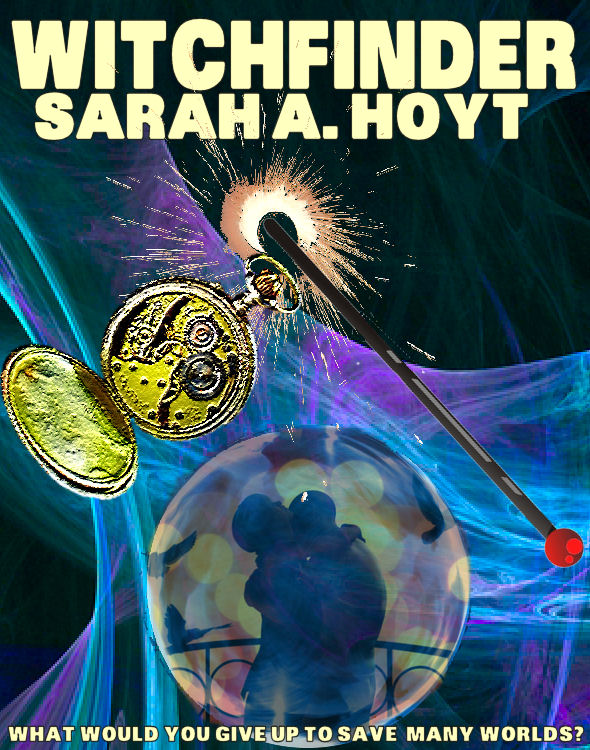
To finish Witchfinder tomorrow, but right now I’m going to bed.  For the record, today I cleaned my office.  It will tell those of you who read me how long it’s been since the last time I REALLY cleaned (defined as going through drawers and shelves (though not all of them.  I still haven’t tackled DESK) that I threw away my chapter notes for Heart of Light.  (These are the type of notes that are so cryptic no one else would get them.  Stuff like “Make sure she holds the shoe” that only make sense in the heat of the novel.  In case you think I threw away priceless documents.  My husband won’t let me throw away page proofs, for instance, because he thinks some fan someday might be thrilled to have them.  (These are all at least five years old.  They’re now all electronic.)

I’m Not The World’s Laziest Writer

I am not the world’s laziest person.  I think.  It’s hard to tell.  But at any rate, I am capable of endless cat rotation; postponement of unpleasant chores; rebellion against what needs doing and general lollywagging and time wasting on a scale unseen since really lazy t-Rexes walked the Earth and lay about under fruit trees, eating the occasional apple that fell into their mouth, and eventually dying of starvation.

I’m not even the world’s laziest writer.  I know, because Dean W. Smith SAYS he is that, and I refuse to arm wrestle him for the title.  He’d win.  I’d sulk.  No one would like that.

And if you’re going “Woman, you do a daily blog, you write however many projects a year, you…

Yeah, so does Dean.  Actually he writes more, and runs businesses and … yeah.  But both of us feel lazy, because both of us know how much time we waste playing mah jong (well, that’s me.  I have no clue what he does) or obsessing about stuff that’s not related to work.

What we do accomplish is in bursts of sudden activity, usually lasting no more than a few days, sometimes a few minutes, in a sea of cat rotation.

I used to describe writing the Musketeer books (which granted, not only were under contract, but which from book three on I knew the publisher was dropping on the floor) as “First I chase myself around.  Then I make myself sit down and then I force myself to write.  This usually involves weeks of chasing, then weeks of staring at the keyboard and refusing to write, before I manage to force myself to write.”

Of course, while I was chasing myself around, I couldn’t allow myself to do anything else even remotely interesting (in this context laundry is interesting.  So is cooking) so the family started complaining about the conspicuous lack of socks and the house grew fuzz.

To an extent, it’s still the same, except no project is that bad anymore – and yes, for the ones of you who are fans – I AM looking forward to continuing the series (I should have the copyright back by March!) and I DID enjoy writing the books, but it was the equivalent of handing your baby to the sacrifice, which made it harder and harder to finish books.

However, with Noah’s boy, because I blocked on the end, and with the year before that, when I was ill so often, I’ve gone into the mode I went in normally after finishing a difficult book.  It’s called “must clean.”  In my defense, the house needs it.  I’ve been doing maintenance cleaning for months, and the name for maintenance cleaning is “things get messy slower.” For instance, I can’t find any books, and there’s bizarre stuff on my shelves.  (How bizarre?  Games the kids outgrew ten years ago.  Yes, someone was cleaning his room!)

Anyway – this long to say, I am still lazy, it’s just that people are lazy in different ways.

See, laziness was an evolutionarily favored trait for millennia.  You caught mammoth, you ate for days.  You didn’t run around killing more mammoths, because who would eat them?  And why would you want to use the energy?  And besides, if you deplete the mammoth population, you’ll have to walk miles for next mammoth.  You get the point.

For the last ten thousand years or so more industrious people have done better – some places.  My mom still talked about the people she grew up with (not a GOOD part of the country, or the region, or the town) the women made soup on Monday, it lasted the whole week.  The more industrious swept once a day.  The more cleanly ones did wash one day a week.  The rest of the time, they sat around, watching the kids and gossiping.

If you planted and reaped, as opposed to walking about picking what the land gave, you had a more continuous supply of food, which meant more kids who survived to reproduce (though perhaps not longer life for you.  That’s in dispute.)  If you left the land where you had a season off, and went to the city and got a job in a factory, you did even better (dirty and backbreaking as those jobs were by our lights, they did provide a better living than the land in the country, which is why the industrial revolution TOOK and is taking in a lot of the world, still.  Yes, I know.  The Marxists think it was the enclosures driving peasants to the city, “disposed” and ready to be exploited.  I’m not saying that didn’t happen, in some times and places, however, as we’re seeing in third world countries now, mostly the peasants drive THEMSELVES (or more likely walk) to the city and take up the better paying work, rather than starve staring at the south end of a north bound mule.)

And if you bought into social pressure about those outmoded bourgeois virtues and kept your house and children clean, you were more likely to raise them to adulthood and eventually have grandkids.

Where am I going with this?

Our state – all modern states – seem to be confused about which comes first the cart or the horse (possibly because they ARE the North Bound Mule – or its South End.)

They talk about the “causes of poverty” and the fact that poor people “collapse under a mountain of misfortune, and therefore can’t dig out.”  They THINK by subsidizing people, they’ll give them the get up and go.

This is one of those nice theories, and it applies to a lot of us, of course.  I’ve been poor.  I’ve been so broke, and so depressed that I couldn’t think of the way to dig out.  (Heck, half the time I couldn’t think of the way to dress myself or shower, or get out of bed before one pm – though post-partum depression might have been in effect there.)

What they forget is that in the long run, the people who are lazy like me – or Dean! – are still a minority.  Evolutionarily, regardless of what has happened since there have been villages, and since humans figured out how to smoke meat (you have to shred it very fine, you need special papers, and it never burns very well.  OTOH it contains no nicotine) and store grain, the majority of people are still programmed to not work unless it’s strictly needed.

Even we, driven though we might be (d*mn you, voices in head, d*mn you.  Also, mom’s training me to live in a house where you could eat off the floors.  The storage room floors, even) those of us who manage to exert some strictly not needed (for eating) activity, like learning a skilled profession or keeping a clean house, or producing stuff on contract, KNOW how much time we waste.  Hence the “I’m the laziest” competition.

Because wasting time, playing around, the dolce fa niente is humanity’s default mode.  And doing no more than we consider strictly needed was a survival mechanism for YEARS.

Right now, I’d bet 90% of the homes in America would make our ancestors weep.  And I’m not even including mine, though if my mom came to visit, I’d need six months lead time just to get it to “she won’t kill me too badly.”  Yeah, part of this is that we’re all so much more massively busy.  But another part is that no one is enforcing the cleaning standard anymore.  Cleanliness in the house is no longer a “must be” to be “respectable.”

We’ve dethroned the bourgeoisie, and its virtues with its faults.  There are no neighbors coming into our house to pry and see if we waxed the floors.  And so, we don’t wax the floors.  We don’t throw away the old mail, we don’t straighten the books – etc.  The neighbors who come in have also forgotten this, so it just doesn’t get done.

No, this is not an ode to housekeeping. Trust me, most of the time, I dust because otherwise I get ill, being allergic to dust and inclined to respiratory issues.

It is however, a way that absent pressure – in this case social pressure – humans default to not doing it.

The same goes for work-work, of course.

And this is a problem, because in the future we’re all contractors.  (Okay not all, but probably a higher number than ever before.)  This means we’ll (all of us, in general) will have to learn to work without someone cracking the whip.

Most of us know that.  Most of us in the skilled professions had to learn that – but evolutionarily speaking, the rest of the world simply doesn’t have the drive.

Then there’s minimum wage, minimum payments, indefinite welfare with no work requirements.

Are these helpful to the poor?  Well, in the – what? – seventy years since the war on poverty was started, the only victories have come from innovation in the market place, and therefore more widespread prosperity.  NOT from the welfare state and its copiously flowing teat.

Oh, yes, of course you know a success story or two.  J. K. Rowling comes to mind – though in another country – but we tell each other those stories because they ARE extraordinary.  They are also, people we’re “likely to know” – i.e. the skilled, those working in artistic professions, those who might be “the laziest x in the world” but only because they see where their drive falls short compared to what they wish to do.

It doesn’t take in account the majority of NORMAL humanity which doesn’t do more than it NEEDS to, because that would be stupid.

THOSE people, sanely, take the minimum and stay put and do the things we all do when we have time – or are playing hooky: they play games, watch TV and socialize.

So, in the end, “a hand up” turns into endless dependence and a dysfunctional way of life passed on to the kids, who in their turn simply don’t KNOW how to do more than needed.  (And before you tell me welfare is no picnic – remember we’re talking by evolutionary standards.  Life in a sleeping bag on the streets of NYC is better than what your nomadic ancestors could command with continuous industriousness.  Life in a project is better than most kings in the middle ages had.  It’s more sanitary and you have better food and clothing.   REMEMBER what part of the brain is deciding “this is enough.”  It’s NOT the part that craves a late model car or a meal in a five star restaurant.)

Which means that any “hand up” would benefit from local knowledge – i.e. people who will watch the people receiving the aid, and let these people know they are watched, so they feel social pressure to make something of themselves.

It also means that the idea of “help without judgment and without limit” might be exactly backward, and the idea that “giving enough to bring this person to middle class standards” would get the person to actually live a middle class life.

Or, of course, I could be full of it.  I’m just going on my own experience – which is all any of us can go on – of both being very poor and being very lazy.

If we’d got enough money to live on, handed to us, so we didn’t have to worry about where the next load of groceries would come from, would I have got off my expanding duff (potatoes are cheap.  Unfortunately they also expand the duff.  It expanded a lot through what could be ironically called the “lean years.”) and made the serious effort to figure out how to write a novel someone else might want to read?  Would I have made the even more considerable effort of figuring out how publishing worked, so I could get published?

Or would we still be living in Columbia, SC, in a rented house, on a budget that would break if I bought an extra paperback book?

I don’t know.  I might not be the world’s laziest writer, I might not be the world’s laziest person.  But I’m close enough.

And now excuse me – I have a floor to wax – the shade of my grandmother is frowning at me.  And after that I have some chapters of WF to write, because I have a bunch of hungry blog commenters.  Still after that I have a YA to fix/edit so I can publish it and help pay the kids’ tuition.

Would I do it, if I didn’t have any of those?  I don’t know.  But I very much doubt it.  I think I’d spend the day re-reading Heinlein and Christie and playing mah jong.


Witchfinder — Free Novel — Chapter 76

*I am reliably informed I miscounted chapters and this should be 76.  Sigh.  I’m taking it on faith.  And yes, I know, I’m doing it in dribs and drabs.  Yes, the end is very near, but after Noah’s Boy I find I can only do a very little a day, and the mind has fixated on — of all things — house cleaning.  So there is floor waxing, may the Lord have mercy on us all.  However, I’ll try to keep these daily as much as possible, so you don’t starve.*

*This is the Fantasy novel I’m posting here for free, one chapter every Friday.   If your conscience troubles you getting something for free, do hit the donate button on the right side.  Anyone donating more than $6 will get a non-drm electronic copy of Witchfinder in its final version, when it’s published.
There is a compilation of previous chapters here  all in one big lump, which makes it easier to read and I will compile each new chapter there, a week after I post.  When the novel is completed and about to be edited the compilation page will probably be deleted.

Oh, this is in pre-arc format, meaning you’ll find the occasional spelling mistake and sentence that makes no sense.  It’s not exactly first draft, but it’s not at the level I’d send to a publisher, yet. *

King and Kingdom


It was dark and dank, and smelly.  Gabriel’s first thought was that he was within a rat’s warren, or another such passage, built by creatures who, by night, live from the bounty of humanity’s building.

All Gabriel’s wishing this way didn’t work, and though he ordered with all his kingly might, he realized it would not go away.  Dark, and dank, and suffocating, the twisting paths led, by crooked paths like the random weavings of worm upon wood ever downward, ever tighter.

“I can’t wish it away” he thought, because this is the true thing.  This is what is beneath all the spun sugar, all the mechanical soldiers, all the cloying, false sweetness was just that, false.  This is what underlay fairyland, a narrow complex of tunnels getting every smaller, ever tighter, like something a creature would spin while getting away from light and from life, and perhaps from sanity.

The tunnels got progressively narrower, and their surface had a weathered look, which puzzled Gabriel, because what was there to weather them here, deep in the heart of a magical kingdom and away from everything that might touch them.  There was no rain in fairyland, no currents of deep rivers.

No, Fairlyland was all a thing of the mind.

Shortly, the tunnels got so narrow that Gabriel was walking them hunched forward, his head bent.  They smelt of rats.  It was a smell Gabriel knew well from his wretched childhood, a smell that made the hairs rise up at the back of his head, that made the bile rise up at the back of his throat.

He felt as though he were back there, in the narrow rented lodgings, lying in the dark, covered by the thin coverlet that somehow seemed to make one feel colder and to confer no comfort, waiting for the sound of feet behind the soffit, for the smell of rats, for the horrid feeling of their feet running across you.

Once, during a cold winter night, a rat had bit him on his toe, and it had taken forever to heal.

But there could be no smell of rats here, and yet when Gabriel tried to banish it, he couldn’t.  There was nothing there but the smell of rats and the narrow tunnels, and everything that was powerful in him told him these could not be altered because they were the true thing.

It took him a while – and by this time he was on hands and knees, for him to realize why this was the true thing.  The smell of rats was how his mind translated poverty.  And fairyland was poor.  Fairyland had defaulted, to Gabriel, to its ultimate existence without disguise: poor, narrow, ever tightening and ever more convoluted.  A dark place, spinning every tighter.

It came to him that when it was so tight it would barely fit him would be when he would find the present monarch.  It came to him that his teacher had been right.  Fairyland was a parasite among the worlds, floating free, and sucking life and magic out of everything it touched.

How could he want to be the monarch of such a thing?  How could anyone but a madman want to rule a parasite-land.

But no.  An instinctive recoil, a knowledge deeper than was possible to have from his lifetime, spoke to Gabriel out of the depths of racial memory.  This was what fairyland was now, yes, because it had a madman at its center, a madman who had been ruling it for centuries, and who had spun off all his own magic, so that he need now feed off other worlds and off unfortunates kidnapped for the purpose.  Like Michael had been.  Raphael’s stomach lurched at the knowledge that there had been many others, adults and children alike, who had been used for this purpose, and who had not been rescued until they were but dry husks, sucked dry of magic and life.

And at the same time the king had needed to suck dry the magic of other worlds – which was where his mad pact with Sidell came in.  If Sidell were king, he’d promised the king that he could have the choice of magic from Avalon, until there were no true magic left there.

Gabriel shook his head.  It was not supposed to be like that.  He knew, knew with his whole being.  There had been other kings and things had been different then.

When a strong king stood at the center of fairyland, he generated magic that fed the whole land and which in turn fed magic to every world that connected into it.

Gabriel, now crawling into the very narrow, very deep darkness at the heart of fairyland, thought “But that would mean you wouldn’t be you, any longer.  It would be an organic thing.  Humans call it king, but it isn’t, not really.  Generator, perhaps.  Or… or servant.”  The thought of how many years he had been a servant came and went in his mind without protest.  He hadn’t liked it, but it was far better than his years of hunger, his years of despair.

And then he thought that this would be worse.  Not servant, servant, but a service that reached into your mind, into your heart, into your very being.

He’d stood by the side of ballrooms and watched the couples, and kept an outwardly respectful appearance while keeping his own thoughts, while meditating on the shortcomings of the people around him, while finding their folly funny.

This indenture would allow no such relief.  Once he became fairyland’s … ruler for lack of a better word, he’d have to keep on with it.  Everything he did, everything he thought would reflect itself upon the land.

Any love, such as mortals knew love, that he might have, would have to restrain itself to time away from fairyland, and those would have to be very brief, very limited moments, or else, fairyland would feel his absence and reach out for someone else – for something else that would feed its magic.

Gabriel knew of a certainty, suddenly, that there had also been other dark kings before.  Here at the heart of fairyland, the instinctive knowledge of fairyland’s history was impossible to avoid.  The land knew, and knowing, communicated itself to him.  There had been other kings, worse even than this one, kings who had forced the land to reach outward and enslave humans to its will, and demand human sacrifice to feed itself.

There had also been kings who’d send their beings forth to kill and commit mayhem, to harvest life to feed fairyland.

Fortunately Gabriel had had a very moral upbringing, despite his father’s failings and his mother’s irregularities.  The thought passed through his mind, and made him smile, but it was followed by the thought there was nothing fortunate about it.  He wouldn’t be able to convince himself that it was right and just to leave fairyland to gratify his whims, or even his dreams, for long enough to cause it to go out of control.  His uncle had left fairyland in pursuit of his obsessions.  That those obsessions were judged by humans to be vile made no difference at all to what they did to the land.  Gabriel’s own dreams might be considered by some to be vile, also, but—

A thought of an almost discarded – almost but for their renewed acquaintance – youthful dream of living in Marlon’s lodgings, of growing old with him, in the quiet house filled with books, now that the ghost-lover was gone, came and went.  He thought of Marlon, at sixty, that flame-bright hair gone pale, sitting by the fire, reading, and then released the thought.

It would likely never have been like that for them, anyway.  And at any rate, Gabriel knew better.  You couldn’t just not do your duty and collect all the rewards of doing your duty.  He couldn’t simply wish that fairyland were healed and not step into the role of king.  He was the only one who could heal fairyland, and anything worth having was worth paying for.

Anything that big was worth dying for.

He was now crawling through a tunnel so narrow that he could barely breathe.  It couldn’t go on much longer.  His uncle must be somewhere ahead.  Should he go forward?  Or was he unwilling to pay the price?

Ahead, in the dark, he saw red, glowing eyes, like a trapped rats.

He thought back to an Autumn day in Darkwater, walking in the garden, and seeing the gardener pour something into a hole.  He remembered the day so clearly – it had been shortly after his father had brought him there – that he could feel the strange comfort of the woolen overcoat, the softness of the muffler around his neck, and feeling quite odd in these clean clothes, and in the half-deference the staff gave him – because everyone knew whose get he was.  Even if they were in fear of his fey nature, there was no denying with that face, he was the lord’s son, and therefore, they’d called him Master Penn and touched their hats at him.

And the gardener had done just that and said “As it is rats, master Penn, and they’ve been going all under the forcing houses, and the way to get rid of them is to stop all their entrances and exits with pitch, and to let them starve.”

He thought “I’m stopping the entrance and the exit.”  And then realized he was wrong.  Yes, this tunnel was fairyland, and his uncle’s mind was at its end, starved and stoppered.  But to starve him – to stop his exits…  It meant cutting off his food – cutting off… his access to fairyland, stopping everything he was, and everything he could be.

“Yes,” Gabriel said, and reached for the threads leading from his uncle to everything that was fairyland.

It came to him the only way to cut those threads was to attach them to himself.  To make himself the center, the spin of them.  To let them eat him alive.

“Yes,” he said, though it felt like his lips had gone ice cold with saying it.  Tears tried to spring to his eyes, but it was too late.  Everything in fairyland that needed feeding – and that was everything – attached to him: to his mind, to his body, to his essence.

He felt more than heard a scream from his uncle, the scream of a starving creature.  Gabriel had starved.  He felt a pang of pity.

But then he thought of the spun sugar, the cloying sweetness, the adults – and children – enticed, like wasps to a poisonous trap.  Not let go till they were quite dead.

And he pulled the rest of fairyland to him.

He heard a shriek as all the force went out of the old king.  If his father hadn’t, however belatedly, done his duty, Gabriel wouldn’t be alive, and wouldn’t be here.  Well, Gabriel was his father’s son and late to his duty, but he meant to do fulfill it, so that others might live.

And then fairyland exploded outward, into groves and rivers, into sacred glades and centaur meadows.

And Gabriel was in a white room, in the middle of a white palace, in a throne made of crystal, looking out over a vista of the realm that owned him.

He closed his eyes and bid farewell to his humanity.

With Unfolded Vision

When we moved to Colorado Springs, the greatest part of choosing our location in town was that there were three bookstores within walking distance.  Practically the only way to insure I get exercise.

Now those three bookstores are gone.  There are a lot of bars and restaurants, but well… we are mini-galting (we need a logo for this) and therefore not eating out much, and bars… If I drank as much as I do NOT at home (or friends’ homes) but pay-per-drink, I’d be even more broke than I am.

The reasons we chose to live where we live are all gone – in less than ten years.

Then there’s my household arrangements.  We have so many books that I started culling into bins for eventual garage sale, about two years ago.  But I never finished the culling, and then act-of-kids intervened, and we bought more books, which means yesterday when I went in search of a book to check on a reference, I found instead that my bookshelves have got completely scrambled.  There’s all sorts of stuff in every bookshelf, nothing is in order, and the bookshelf on the way to the attic has become a convenient place for the guys to unload and/or store stuff they don’t want in their area.  The end result is that nothing is “findable” and everything is a total mess.

Which brings me to – I started reshelving.  And realized about half the mysteries taking up space on my shelves aren’t the sort I keep.  Heck, some of them might never have been read.

You see, every month or so, I’d take a trip to the local used bookstore and get a load of mysteries, read them, put the ones I didn’t care for back in for trade, and keep the ones I was likely to read more than once.  Then, once every six months we went to the BIG mystery bookstore in Denver (first day of a weekend away) and I’d fill three, sometimes four large bags with used paperbacks, read them during that weekend and the month after, then cull.

But sometime – four? – years ago, we got me a kindle, and then the trip to the bookstore wasn’t needed, and I think I forgot to read some of the books from the last one, as well as whatever books I’d got that month.

What do I mean by all this?  I mean that technology is changing the rhythms of how we do things, in ways that aren’t even obvious until we look back.

I did not know that last time we went by the used bookstore at the beginning of a weekend in Denver that it would be the last time.  I still bought the usual books.  I just ended up reading some stuff I had on the kindle, instead.  And when the next vacation came around, I had the kindle, and buying a bunch of used books seemed stupid.  I don’t think I’ve stepped into that bookstore since.

The rhythms change.

When we moved here, I walked downtown a lot, to buy books, or – more often – to browse books.  I used to take a laptop and sit by the fireplace in my favorite bookstore and write, while people watching.

The store is gone.  Downtown’s character has changed too.  There are fewer stores people shop at, so well, during the day it’s office workers and vagrants.  In the less populated area, it’s now a little iffy, if not dangerous (yet.)

We do the things that benefit us (in my case ordering more from Amazon) and other people do the things that benefit them.  And the entire landscape changes.

I’m not arguing otherwise.  I’m convinced things like “Save the indies” for keeping bookstores alive are in the end doomed and in the short term counterproductive.  They’ll either find a value-add to give people, or they will ultimately fail.  (I’d pay for a sort of in-person book café, with knowledgeable owners who can recommend books I might like, and who have space for writers’ and readers’ groups to meet, but I don’t know how practical it is, unless in a very large city.)

I’m just saying no one can see the future, even as it’s barreling down towards us.  Which is why any centralized planning tends to fail and any push-down (as opposed to pull down at will) business model tends to fail, and the bigger and more impersonal it is, the faster it fails.  And why the government subsidizing innovation usually means subsidizing things that real life ebbs and flows around.

I read, I don’t remember where, that the reason our government (to an extent both parties) is pushing for a welfare state that controls everything is that they believe in a future where humans really have nothing to do – where robots do it all.  They all – apparently – read “With Folded Hands” and thought it was inevitable.

But even we, science fiction authors, infallible though we are (of course) get things wrong.  Heinlein never saw computers barreling down the pipe.  Well, not in the form they came.  Which means my kids get to chuckle at slide rules in spaceships.

And the thing about robots doing everything for humans, and therefore there being no work for people, and therefore the government must step in and give people a raison d’etre and, if possible thin down the population.

This would be like someone in the nineteenth century seeing our civilization and going “We must create a vast welfare state for all the scullery maids put out of work by dishwashers and all the drivers put out of work by the horseless carriages.  And that’s not talking about the people who shoe horses and the crossing sweepers.  Doom, gloom, most of humanity will be useless and only the state can save us.”

It’s a serious under-rating of humanity.  We are clever monkeys.  We’ll find new things to do when the old drudgery is lifted.

Yes, some people will end up doing nothing – but I think that has more to do with learned helplessness and does not need to be subsidized.

I’m laying you a bet that a hundred years from now there will be jobs we don’t even imagine, and they’ll be all across the IQ and aptitude spectrum.  (We don’t need drivers, or maids, but I pay money for people to haul stuff to the dump.  And we still need gardeners and sidewalk sweepers.)  I’m also betting you that the jobs will in general be less onerous/filled with drudgery and far more interesting.

Am I sure – well, no.  And I’m unlikely (though it’s not impossible) to be alive 100 years from now (unless there’s really reincarnation) to pay or collect.

But I’ve seen where we’ve come from, and I know the trend.  I know the way to bet.

I don’t think robots will stop us inventing new work to do, or new ways of making a living.

The government, on the other hand, might – by killing incentive and curiosity and draining away the capital (human and financial) that could go towards innovation.

Refuse to live with folded hands.  Trust humanity.  Embrace the future.

Note – It being Wednesday, there’s a different post by yours truly — The promised one on writing with children around — at Mad Genius Club. 

Witchfinder — Free Novel — Chapters 72-73

UPDATE:  Will do chapters tomorrow.  Not morning post.  Sorry.  Got sidetracked looking for a reference book, ended up reshelving most of my mystery “area” (the hallway between the kid’s room and the attic stairs.)  sorry.

*Yes, yes, I know this is just a bite, but first I had to get my file and read it and then…  And then I had headache from h*ll yesterday, so not much got done.  Being a writer of iniquity I’m betraying my promise to do a non WF post in morning and a WF in evening.  Today you’re getting WF in the morning and in the evening.  And then more tomorrow evening, after which I’ll probably be done (because really, how long can THEY drag this out?)*

*This is the Fantasy novel I’m posting here for free, one chapter every Friday.   If your conscience troubles you getting something for free, do hit the donate button on the right side.  Anyone donating more than $6 will get a non-drm electronic copy of Witchfinder in its final version, when it’s published.
There is a compilation of previous chapters here  all in one big lump, which makes it easier to read and I will compile each new chapter there, a week after I post.  When the novel is completed and about to be edited the compilation page will probably be deleted.

Oh, this is in pre-arc format, meaning you’ll find the occasional spelling mistake and sentence that makes no sense.  It’s not exactly first draft, but it’s not at the level I’d send to a publisher, yet. *

The Land’s Heart

Nell stepped forward, and the warmth enveloped her.  At first it was almost too hot and too bright, and then…

And then she stopped being separate from the light and the heat and she found herself in the spinning heart of everything: she could feel everywhere and everywhen, she was everywhere and everywhen.

In London, she was streets thronged with people, fighting odd threats.  In the countryside, she stood on frost-crackling fields, while ghost riders ran and ravaged the sleeping farms, the silent homesteads.

Fairyland had broken loose and spilled into Avalon.

The part of Nell that could still feel and think felt a clutch at her heart, a fear that Gabriel had lost his battle and that this had always been part of the plan between the traitor in Avalon and the dark ones of fairyland, that now the two would merge.

The part of Nell that now knew more, the part of Nell that was Avalon and whose mind went back through the ages, to King Arthur’s time, and before, knew this was nonsense.  Not that it had been the plan.  It might very well be the plan, but she knew better.  Fairyland and the mundane world could not merge.  They could only meet and annihilate each other.  Easy enough for the forces of fairyland to romp and storm through the lower-magical world of mortals, for a time.  But then the lack of magic in Avalon would starve them, at the same time they rampaged among the mere mortals.

And there was more.  Fairyland powered the power of every other world.  Without it, magic would leash out of all other worlds.  Its sickly state these last few years meant that it had already leaked out of the outer, most distant worlds, such as Earth.  If this went on, then it would disappear from all other worlds, and eventually life would go with it.  And if this night Fairyland spilled into Avalon and Avalon into Fairyland it would all burn itself out in a moon.

But the land had its strength.  What it lacked was a will and a mind.  And that – Nell thought – wasn’t right.  She felt the connection that should link the land to the king.  She was not – yet – the Queen of Avalon.  The land should be linked to the man she must learn to think of as her father.

Nell followed the link in her mind, and found the place where the link was cut by a dark, dank stuff like mildew which had eaten at the quick, living magic.

It was as though Nell’s heart had plummeted down around her feet.  She could not solve this, and get the King – her father, she must think of him as that – to take over the battle.  For now it was her battle and then – and then she would make sure the king received the power.  It was too early.  She did not want to wear the crown.

But all the same she must lift the sword, symbolically and in truth, the sword of power in the land.

She felt it in her hands, that legendary sword that had been Arthur’s and the first Richard’s, the sword that took form and substance now and then, but which was forever and always a sword of the spirit.

It was heavy, here at the heart of the world, and it was a symbol, more than a real weapon, Nell lifted it.

Against the growing invaders, against the dark armies, against the creatures of ill defined  magic and ill disciplined force, she lifted the sword, and with it raised the strength of the land, and she called, “Fight.”  And she screamed “Arise.”  And she commanded, “Defend.”

From every sacred grove and every cleanly hill, the power of the land, the power rose and the magic grew.  The invaders, surprised, fell back in disarray, clambered back in fear.  They wouldn’t be banished, not completely, but they would would not rampage.  They held in tight circles, defensive, embattled.  And around them the magic of the land shimmered and sparkled.

A Fighting Title

Seraphim became aware that he was being dragged over rough floor.  He tried to protest that he should be allowed to die in peace.  It seemed to him peculiar that the odd man from the dragon den should insist on dragging a dying duke along with him.

Only he wasn’t a duke anymore

And from somewhere anger came.  He’d not asked to be the duke of Darkwater.  He’d not asked to be the first born of the previous duke’s large and irregular get.  He’d not asked his father to die early and to leave Seraphim in charge of an encumbered inheritance and younger children who depended on him.

And, most of all, he’d not asked to find his father’s secret papers, not to feel obliged to rescue the unfortunates that his father could no longer help.

He had asked for none of this.

And now, now, that he must die for it, some lunatic wouldn’t let him alone.

He moaned loudly, and there was a moment of hesitation, but then the dragging resumed.

Seraphim became aware that the ground was shaking beneath him, that his arms hurt as he was being dragged, and that – and this part galled him – someone was shoving quite an unreasonable amount of magic at him, pushing and forcing it past Seraphim’s weakened defenses, forcing Seraphim’s body to heal itself.

It was an odd magic, not untrained, but strangely structured.  Instead of healing Seraphim it was forcing him to heal.

Now, there was somewhere –

Seraphim had seen that magic somewhere, felt it somewhere.  As his body started to recover, his mind pursued the mystery, and found in its unraveling enough incentive to wake up more fully.  There, there, the taste of it, the force of the magic…  He knew that type of work.

And then it hit him.  The Madhouse.  No.  Nell’s world.  Earth, they called themselves – though, of course, every unaware world called itself Earth – the world without magic.  People from it always learned magic backwards and sideways and did things by methods no sane trained magician, let alone a teacher of magic would think right.  It was as though an entire world had decided the way to build a house was to start with the roof.

And yet, the misbegotten, scrambled magic worked, after a fashion.  Not well, on Earth, but pretty well everywhere else.

He had woken now, enough to feel his whole body.  The annoyance of being dragged, the rough stone tearing at his skin, all of it combined to bring his eyes open.

He was still in the dragon cave.  Rocks were falling from a cracked ceiling.  Through the fissures, he could see glowing red lava and as if fires of hell.  He wondered if they were beneath a volcano now coming awake, and wondered how long till glowing lava dripped through and icenerated him and his—strange savior.

He looked up the length of his stretched arms, to where a man who looked, much like Gabriel, was walking backwards, while pulling on Seraphim’s hands.

“Stop,” Seraphim said.  “Stop.”

“I’m not leaving you here,” the young man said.  “Not on your life.  But I can’t do transport.  Never learned how.  So we must get out this way.  I think this hallway will—”

“Stop,” Seraphim said, and as the only way to avert this humiliation of being dragged along like a sack of rocks, said, “I’ll stand.  I’ll stand.”

His hands were let free, and he did manage to stand, unsteadily, on legs that felt as though they were made of running water and insufficient will power.

The man who looked like Gabriel stepped back, rapidly, as though even wounded Seraphim might wish to, and be able to, take a swing at him.  Seraphim focused a swimming vision on the man and said, “Thank you for healing me.  Are you from Earth?”

He got back a surprised, feral smile, a fugitive thing.  “I am from Earth, milord.  I am–  I was lured here, on my insufficiently tutored magic, and I—”  He closed his mouth on visibly unsaid thoughts, as the ceiling above gave a loud crack, and rocks fell all around.  “Milord, can you run?”

“No,” he said.  “No.”  He felt himself swaying on his feet.  “A transport spell might be easier.”

He reached for the man’s hand, because he didn’t think at this moment he could transport anything he wasn’t actually touching.  The man’s hand felt too hot and rough.  Seraphim started saying the spell, wondering if he could in fact make a transport spell.  He wished them out of this hole, out of this horrible enclosure, and into a safe place.  He didn’t much care where just now.

“Use my magic, also, milor’,” the man said, and Seraphim gratefully found it accessible, even if strange, and ignorance-twisted, and he made use of it, weaving his transport spell rapidly, turning it so that it closed finally with a resounding thud.

And then—

In a moment they were out of the cave, the heat, the threat of cave ins, and cold rushed in upon them.  They were in a vast, white clearing.  Seraphim realized, in shock, that there was snow all around, white snow, sparkling and reflective like ground glass.

In the middle of the clearing was what looked like a tomb, stone and sculpted, beside which a heavily veiled woman mourned.  Atop of the tomb, where normally a pious, joined-hands statue lay there lay a man.

“Father!” Seraphim said.

Puppet Masters

It’s not what we know that kills us… It’s the many things we think we know that just ain’t so – and which might be completely different, in fact.

Take for instance sex – yeah, this early in the day.  Let’s have a show of hands.  How many of you watched Splendor in the Grass?  How many realized it makes no sense whatsoever?

I was probably blessed in watching it now as an adult – a few years ago – and quite conscious of the insidious myths of the twentieth century, including that repressing your sexual drive will make you maaaaaaaaaaaad.  Maaaaaaaaaaad.

I’ll head things off here, and tell you right out that no, I don’t think people can be celibate life long unless they’re endowed with a special grace which is more than I – or most humans – have.  (Grace or the ability to sublimate to other things.)

Being celibate life-long might make you a little odd.  You might develop an obsession with naughty pictures, or something.  BUT mostly it will make you lonely and sad, since it’s not good for man (or woman) to be alone.  We are, by nature, designed to have a mate.

This is however not in the same realm as “you can’t repress any sexual desires at all, no matter the time, the place, your age or your circumstances and if you try to you’ll become psychotic.”

As powerful a drive as sexual desire is, it’s not magical.  Repressing it can’t make a good man into a mass murderer or a rapist.  Repressing it – temporarily, because, duh, you’re a kid and unmarried – won’t send a stable girl into the madhouse.  (If she’s the kind to go to the madhouse, then she will be in worse trouble if she DOES have sex.  I don’t think someone that mentally fragile could cope with the consequences of sex – attachment, fidelity [or lack thereof] and possible pregnancy.)

The idea that it is magical and that if repressed it will make you into a monster is the sort of cheap Freudianism that has infused society since – yep – World War One and which is at the back of much of our entertainment AND our educational policies.

In entertainment it causes people to think that stuff like Splendor on the Grass is “deep” and books with that sort of meaning are “important” (Which is why kids in YA now screw like minxes) – instead of faulty and done to death – and in education it causes people to laugh politely at the suggestion kids should be told it’s best to abstain till they’re in a stable relationship.

It’s so prevalent that the laugh is never explained.  It’s all “Oh, my dear, she believes in abstention” as though this were the ultimate stupidity.  Because everyone knows that kids can’t control their sex drive, and if they did they’d break out in pimples, or something.  Only, of course, while some kids might not be able to abstain (there’s enormous variation in human desire) most can if told it’s not going to make them go maaaaaaad.  Maaaaaad.

In the same vein, everyone knows Europe is more sophisticated than the US.  Why, my dear, their politicians routinely have mistresses.  Publically.  And no one minds.  But the rubes in the US get very upset if they find their president has a squeeze.  As if that weren’t the right of every rich and important man.

Uh…  You see, it has nothing to do with sophistication.  Unless by sophistication you mean the sort of cultural memory that goes back to Rome and knows, of course, that it is impolite to kiss your spouse in public, but quite all right to kiss your mistress.

The Europeans grant these privileges to their rich and powerful because they believe some animals are more equal than others.  They’ve been used to it. There’s feudalism in their minds.

We, on the other hand, founded on bourgeois virtues, believe that contracts are made to be kept, and if a man is married, he’s married.  He gave his word, and violating his word without remorse and semi-publically is a severe flaw in someone who’s sworn to serve the country.

Everyone also knows that all cultures are alike – except ours, which is imperialist, colonialist and bad.  This too infuses our teaching about other countries and even an entire class of politicians who think that our foreign policy should be based on self abasement and apology.

To maintain this view of the world, our schools teach what I’d call “cute brown people” anthropology.  Oh, fine, I don’t think they see it that way.  They teach the cookery of the country, and the arts and crafts, and talk about their admirable achievements (usually rather in the patronizing “and they invented a new type of clog” line.  I mean, you can’t expect little brown people to have BIG achievements, and you should praise the little ones, because wow, think about it, new type of clog.)

What they don’t teach is that every “underdog” culture was at some point dominant.  They don’t teach stuff such as that the Zulus were no more native to South Africa than the Afrikaners.  They’d immigrated across Africa in fire and blood, and got to South Africa just about when the Afrikaners did.  Assuming they’re “native” because of their skin color is the rankest racism.

What they don’t teach is that EVERY HUMAN race, culture and subtype is two things: intensely racist (in the sense of tribalist.  The humanoid band allowed us to survive.  We seek the company of those like us) and colonialist (you expand your band’s territory if you can.)

The other thing they don’t teach is that, as an extension of – and defeater – of the tribe, the nation state – EVERY NATION STATE – is out for its own interests.  Long before “capitalism” or “fight for resources” or whatever the Marxists think this is all about (and don’t get me started on THEIR illusions.  I have a book to finish) the great leaders of the French were those who were out for French interests and French domination.  (Read about Napoleon.  There were reasons he was called “the monster” – but the French STILL lionize him.)

It is what we think we know that just ain’t so – and it takes a very sophisticated society indeed to have this sort of mass illusion for so long – that is killing Western society and the US.

And it is time we woke up from the screaming nightmare we’re been in since WWI.  It’s time to realize most of these ideas are not only wrong — they are, on the face of them and stated out loud (as they never are) laugh out loud ridiculous.

Like the idea that it will do lasting psychological harm to abstain from sex while in high school.  Because… because… because… Cheese!  Also lasers!  Or the idea that people who can tan (like me) are automatically endowed with superpowers of goodness, kindness, and sinlessness.  (I prefer the open racism of Patricia Wentworth where a character is clearly a murderer because he’s part Portuguese.  At least it’s open.)   As for the idea of European sophistication, Europe is the only place where I’ve heard OPEN homophobic, racist and sexist remarks in PROFESSIONAL situations, and no one says anything.  (Of course, at least it’s out in the open.)

But out here — and in Europe, even though they’re more blunt about their own prejudices (btw, this is allowable because they “know” the US is far more racist, sexist and homophobic than they are.  It’s one of THEIR accepted lies.)  — we believe most of these things at a level so deep it filters into all our entertainment and culture, and makes itself accepted without ever being thought about.

In many ways, it’s not very different from having an alien controlling our brain – as in Heinlein’s Puppet Masters.

Go and read that book (again, if you already have).  Then take off your overcoat, kill your rider, and start learning what is real and what isn’t.

The sex-soaked, human-despising, self-destroying culture of the past century is dead and stinking.  Let’s crawl out from under the corpse of its entertainment and “news” and “scholarship” before it suffocates us.