If you wish to send us books for next week’s promo,please email to bookpimping at outlook dot com. If you feel a need to re-promo the same book do so no more than once every six months(unless you’re me or my relative. Deal.) One book per author per week. Amazon links only. Oh, yeah, by clicking through and buying (anything, actually) through one of the links below, you will at no cost to you be giving a portion of your purchase to support ATH through our associates number. A COMMISSION IS EARNED FROM EACH PURCHASE.*Note that I haven’t read most of these books (my reading is eclectic and “craving led”,) and apply the usual cautions to buying. I reserve the right not to run any submission, if cover, blurb or anything else made me decide not to, at my sole discretion.– SAH
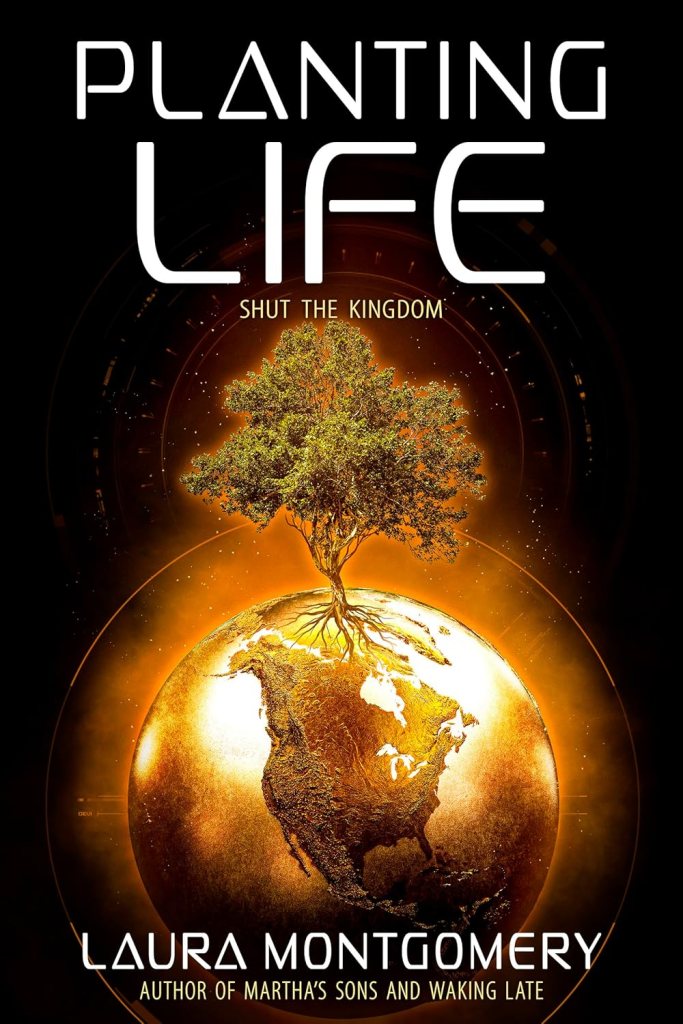
FROM LAURA MONTGOMERY, GO AND GET IT. I READ IT AND LOVE YOU AND YOU NEED THIS IN YOUR LIFE: PLANTING LIFE: Shut the Kingdom
The road to Mars has to start somewhere. It might as well be central Virginia.
Jack Darien scorns his parents’ path. After the disaster at his father’s Mars settlement, the high school senior scraps both his lifelong interest in space exploration and his college plans. Even his rescue of a college student from assault doesn’t make him see his own future any differently.
Jack becomes obsessed, however, when one strange comment from the attacker draws him to unravel secrets at the former Superfund site that is now Webb University, the school where his returning father teaches and eco-restoration reigns. What starts for Jack as a distraction from thinking of his future turns into a dangerous journey that puts him, his mother, and sister at risk. As for his father, Jack decided long ago the man was on his own.
Jack’s determination to chart his future clear of his father’s failures hits a snag when he learns the school’s hidden mystery. Unfortunately, those determined to bring Webb down learn it, too, and ratchet up their own efforts toward Webb’s destruction.
Planting Life is an immersive young-adult science fiction adventure. If you like unearthing secrets, a dogged hero, and reckless courage under threat, you’ll love Laura Montgomery’s near future coming-of-age saga.
*I read this book. It kept me up all night. You need it. You do. – SAH*
Sufficiently advanced science is indistinguishable from magic.
On a lost colony world, mad geneticists thought they could eliminate inequality by making everyone hermaphrodite. They were wrong. Catastrophically wrong. Now technology indistinguishable from magic courses through the veins of the inhabitants, making their barbaric civilization survivable—and Publius Cornelius Scipio Africanus Kayel Hayden, Viscount Webson, Envoy of the Star Empire—Skip to his friends— has just crash-landed through a time-space rift into the middle of it all. Dodging assassins and plummeting from high windows was just the beginning. With a desperate king and an archmagician as his only allies, Scipio must outrun death itself while battling beasts, traitors, and infiltrators bent on finishing what the founders started: total destruction. Two worlds. One chance. No time to lose.
Volume 1 The Ambassador Corps has rules: you cannot know everything, don’t get horizontal with the natives, don’t make promises you can’t keep. They’re a lot harder to follow when assassins are hunting you, your barbarian allies could kill you for the wrong word, and death lurks around every corner. The unwritten rule? Never identify with the natives. Skip’s already broken that one. Now he’s racing against time to save his new friends from slavery—or worse—while dodging energy blasts and political intrigue. One crash-landed diplomat. A world of deadly secrets. And absolutely no backup.
Some rules are meant to be broken. Others will get you killed.
The Austringer has fallen! A new Austringer is risen!
Minalav is in pieces, needs are high but trust is low. After Axly’s plan placed her on the throne, she is faced with the displeasure of High and Low Birds, the Nameless, and the humans of the city.
In a bid to bring much needed supplies, Axly offers the one thing all nations covet: sprygan weapons. In the lands of Remorra, General Grimwalt is selected to represent his kingdom. Sent by his cousin, King Henry, who has more in mind than just the sprygan weapons, Grim must negotiate with a woman he doesn’t remember.
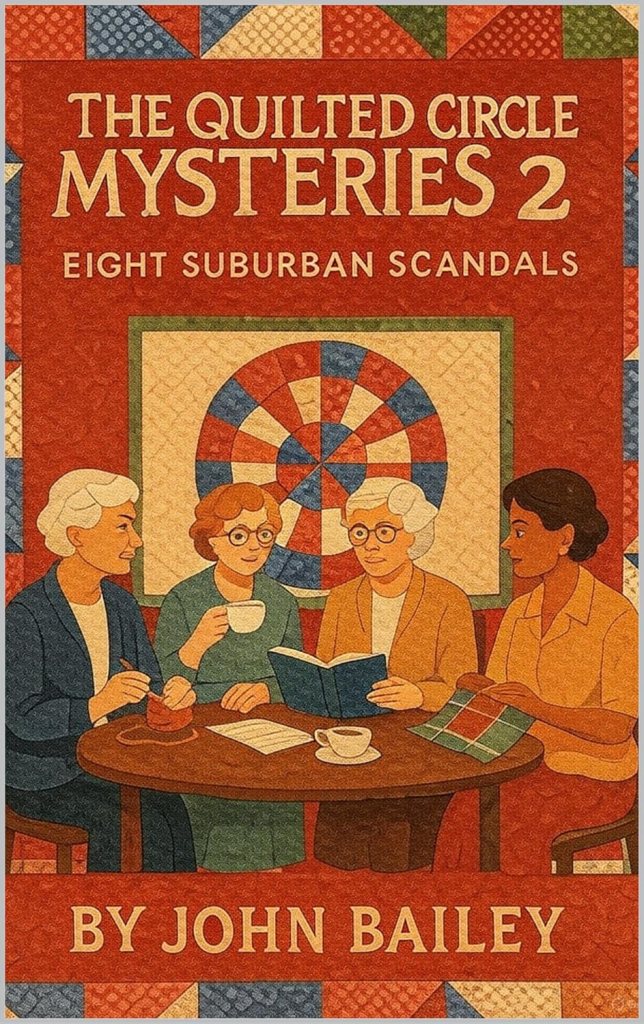
The Quilted Circle Mysteries 2: Eight More Suburban Secrets A Cozy Mystery Collection Featuring the Quilted Circle Sleuths
The Quilted Circle is back — and suburbia will never be the same.
Five retired women from the northern suburbs of Philadelphia claim to meet for quilting, crafts, and community projects. In reality, they’re an unstoppable (and nosy) detective club whose “hobbies” keep unraveling local scandals. Whether it’s a sabotaged PTA bake sale or a dog-napping at the neighborhood park, these lifelong friends can’t resist pulling at loose threads until the truth comes out.
In this second collection of laugh-out-loud cozy mysteries, the Circle faces:
A yard sale box hiding a fortune and a family secret.
A poisoned PTA fudge tray that turns school politics deadly.
A golden retriever ransom scheme with suspicious paw prints.
A country club accident that looks far too tidy.
A Halloween disappearance inside a haunted house.
A cookbook contest scandal with recipes worth killing for.
A parade float sabotage that puts one of their own in the spotlight.
A stolen snow globe that draws the Circle into a dangerous game of cat-and-mouse.
With wit, warmth, and more than a few well-timed casseroles, Vera, Dottie, June, Lois, and Marie prove that curiosity, friendship, and sharp observation skills never retire.
Fans of Agatha Christie’s village sleuths, Richard Osman’s Thursday Murder Club, or Rita Mae Brown’s Sneaky Pie mysteries will adore this second installment in The Quilted Circle Mysteries. Quilting may keep their hands busy — but solving crimes keeps their minds sharp.
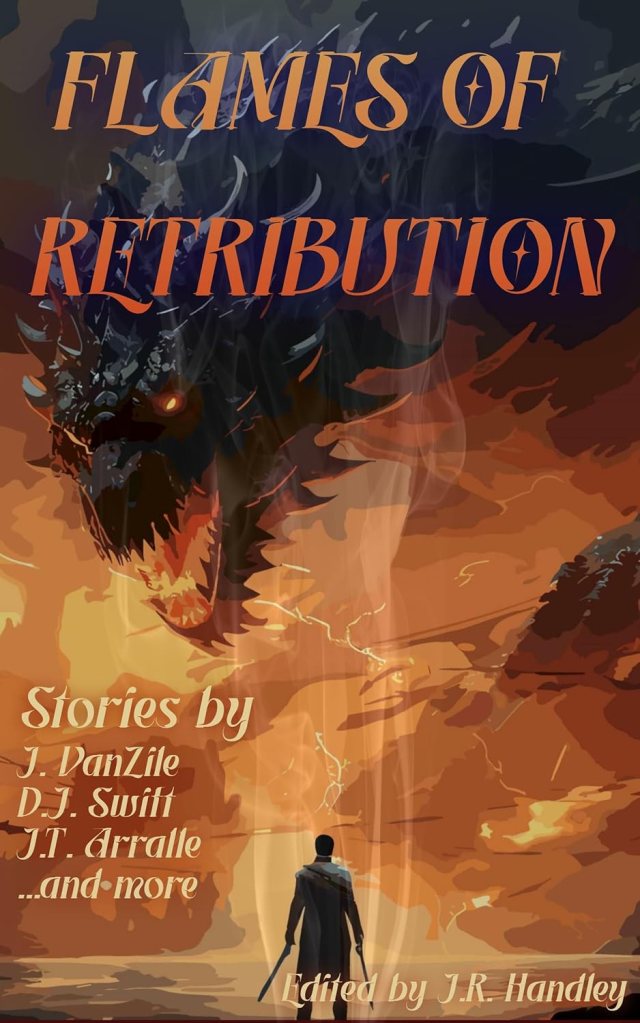
Are you ready to face the fury of dragons that aren’t just beasts—they’re harbingers of vengeance? In “Flames of Retribution,” Bayonet Books unleashes 11 scorching tales of mythical monsters, ancient evils, and fiery showdowns. From bio-engineered horrors stalking primate troops in “The Ghost of Arriscado Basin” by Jon Michael Kelley, to a steamship crew battling an unseen terror in “Isle of Ash and Flame” by J. VanZile, and a knight’s desperate quest against legendary lizards in “Born of Blood and Flame” by J.T. Arralle—these stories blend fantasy, horror, and pulse-pounding action like never before!
Featuring gripping contributions from authors like Andrew Milbourne, Dean Stone, Matthew Olaranont, D.J. Swift, Eric J. Juneau, Gaetan Battaglia, A.B. Casadella, and Sarah Das Gupta. With an incendiary introduction by J.R. Handley exploring humanity’s eternal dance with dragons—from ancient lore to modern myths—this anthology pays homage to the ultimate predators that haunt our dreams.
Why settle for friendly fire-breathers when you can dive into tales of raw retribution? Perfect for fans of “How to Train Your Dragon” gone dark, Dungeons & Dragons epics, or classic monster hunts like Beowulf and St. George.
Don’t let the flames die out—order your copy today!
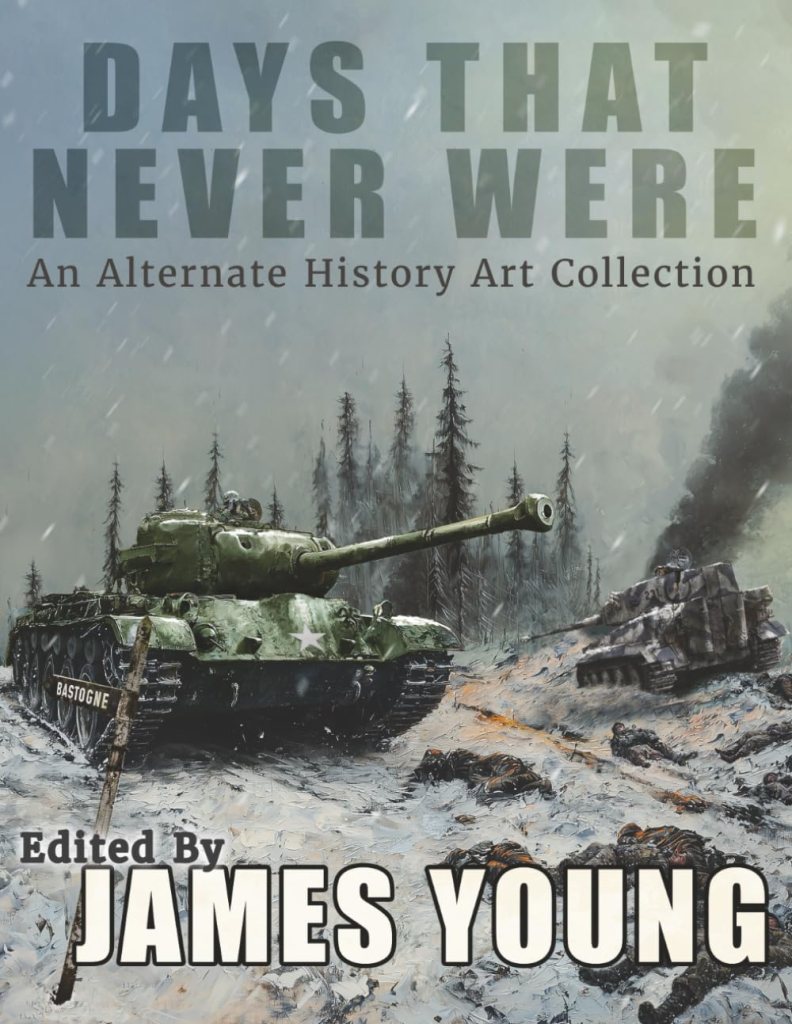
This book contains 14 visual representations of alternative history scenes from the universes created by James Young, Slinger of Tales. Each piece not only depicts key events from his Usurper’s War and Arc of Ares’ series but also explains the background of how the artwork came to be. An additional purpose of this work is to give fans of fine military art another unique avenue to enjoy this medium. Dive into this book today to find days that never were…but could have easily been.
A collection of short humorous stories, quotes, headlines, and articles designed to make you laugh out loud. Straight humor, no politics or satirical derision of others disguised as humor. If you can read these stories without laughing, you might need a funny-bone implant.
In the face of extinction, you do what you must, regardless of who stands in the way.
Tom Beadle only volunteered for NASA’s neighborhood watch program when his department said it would maybe help him get tenure.None of them counted on the Neighborhood Watch becoming a mortifying political liability when a malfunctioning probe accidently reveals an asteroid hiding behind the larger outer planets, setting off impact alarms– and politicians looking for blame. When their answer is to defund the Watch program and fire all involved, Tom’s only chance to save the earth is to lie through his teeth and try to deflect the asteroid under cover of harvesting rare not-of-this-earth elements. And even that may not work.
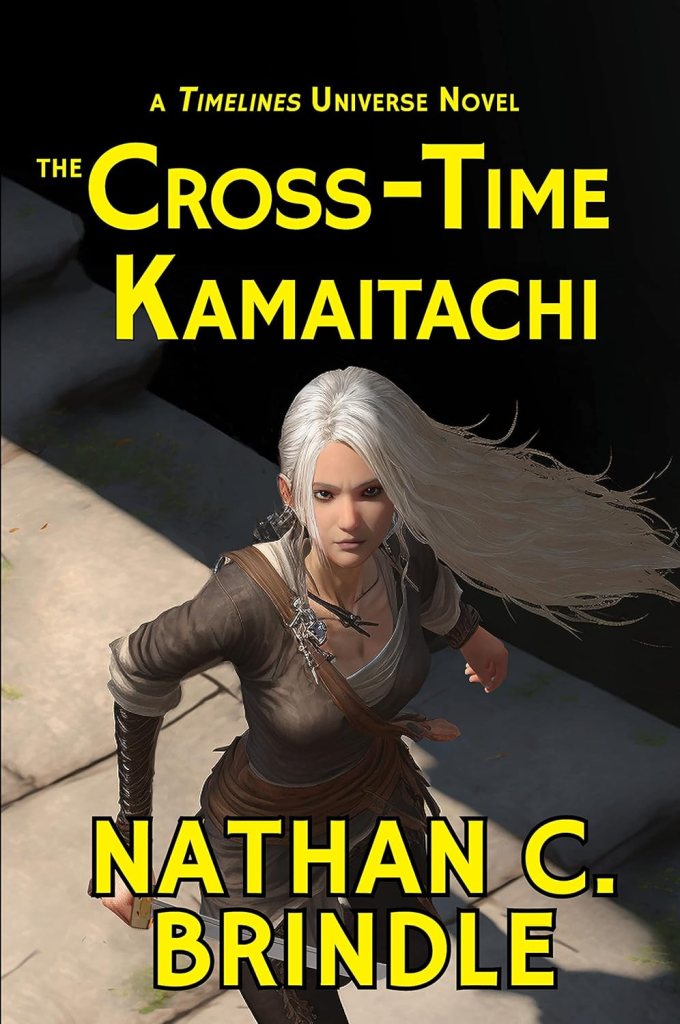
I did not land here as a warrior, but a warrior I so soon became . . .
One moment, Dr. Yukiko Yamaguchi was in her high-tech singularity research lab in California, busily adjusting an electronically-leaky fitting playing hell with her instrument readings.
The next moment, she was falling through space, and landing hard in a wilderness area she would quickly discover was her family’s ancient stomping grounds in Japan – but with an apocalyptic twist.
A hundred years later, there would be legends of a great yōkai, a demon, whom some called a kamaitachi – a sort-of whirlwind, weasel-like creature with blades for claws, which catches up unwary humans and slices their skin. But this kamaitachi is no ordinary yōkai – rather, she is
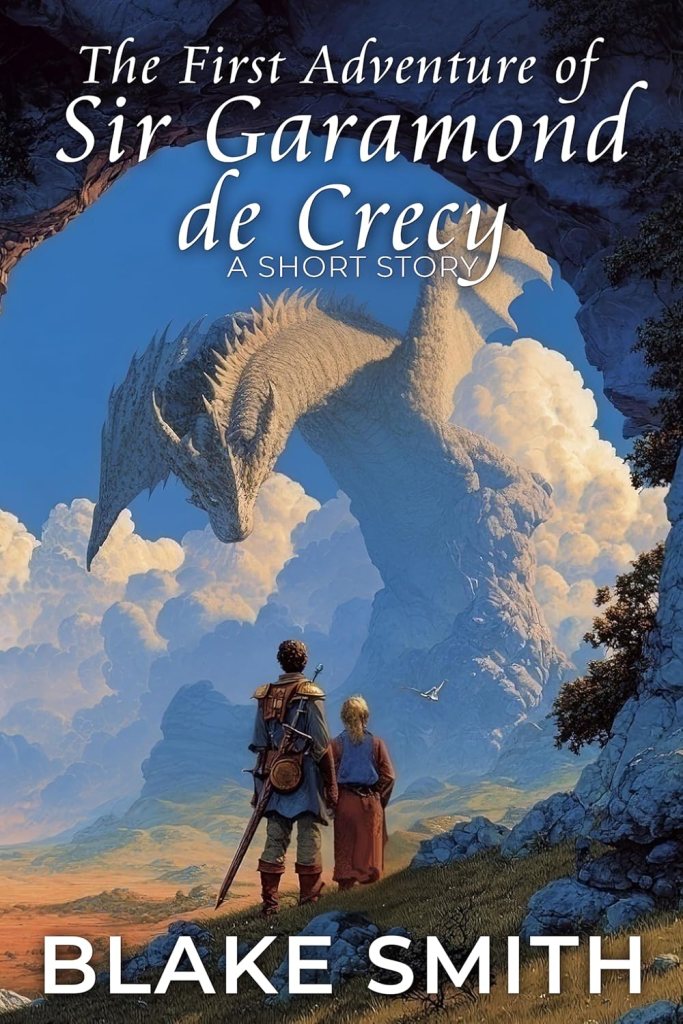
Sir Garamond- Gerry, to his friends- has been knighted for less than a month, and he’s already found his first great quest: saving the beautiful and helpless Princess Alyssia of Ollandra from the dragon that is holding her in dreadful captivity. Or so he thinks… A lighthearted short story.
As Frank Correra brings his family to a lunar settlement to get them away from a worsening political situation on Earth, he reminisces about how he and his wife met.
Frank had always dreamed of the skies. As a clone of an astronaut who subsequently became a US Senator, Frank thought he had a clear path ahead of him. But when it comes time to apply for the Air Force Academy, it is an election year. His ur-brother can’t promise a nomination until he’s won another term, and this year promises a hard race to run. When the other side puts up an ugly attack ad, can Frank find a way to discredit it before it destroys his ur-brother’s chance of re-election, and with it Frank’s slot at an Academy appointment?
A short story of the Grissom timeline.
Vignettes by Luke, Mary Catelli and ‘Nother Mike.
So what’s a vignette? You might know them as flash fiction, or even just sketches. We will provide a prompt each Sunday that you can use directly (including it in your work) or just as an inspiration. You, in turn, will write about 50 words (yes, we are going for short shorts! Not even a Drabble 100 words, just half that!). Then post it! For an additional challenge, you can aim to make it exactly 50 words, if you like.
We recommend that if you have an original vignette, you post that as a new reply. If you are commenting on someone’s vignette, then post that as a reply to the vignette. Comments — this is writing practice, so comments should be aimed at helping someone be a better writer, not at crushing them. And since these are likely to be drafts, don’t jump up and down too hard on typos and grammar.
I’ve been very disturbed by various “mental” health initiatives and attempt to codify declarations of madness into law.
No, I don’t think Trump is evil or Hitler. Yes, I do think mental health is a massive crisis in this country and we need to do something. I just want so many bumpers and padding on that “something” that it’s not even funny. And I’m absolutely sure whatever we do, the left will weaponize once they get power again.
Weaponize? you ask?
Well, you see, every communist country committed their opposition to madhouses, sanatoriums and rest homes for being mentally unwell. I remember in the late eighties going to a lot of talks by poets and writers from anywhere ranging from East Germany to Russia, who had spent years in various kind of mental health hold ups and sometimes heavily “medicated” for their crime of not being communists. How they were treated was a sliding scale of how well known they were abroad. If they weren’t well known at all, they got the harshest treatment.
And the most horrifying, scariest part about this is that in doing so the communists (yes, they called themselves socialists, mostly) weren’t being hypocrites. They really thought it was mental illness. Particularly the ones who’d gone through various college programs. They were taught the full on “weird Christian heresy” tale, including that humans in the beginning shared everything and there were no hierarchies or private property. And then property and hierarchy appeared, and that twisted humanity. (Yes, it’s Eden and the fall dressed up in red clothes, with a little hammer and sickle.) So communism restored sanity and allowed humans to be sane. And to reject communism was a mark of insanity. (Curiously, being insane was also a mark of being an opponent of communism. They had the courage of their delusion.)
How do I know this? Well. I read a lot of AMERICAN psychiatry manuals in the seventies, and they — as usual for academics — had bought the entire story from the Soviet Union lock, stock and barrel.
Part of the push for the de-institutionalization of the mad — something given full court press, from A Flight Over the Cuckoo’s Nest, to various stories in all the sf mags, to oh so many biographies from “feminists” claiming that promiscuous women were treated like mad and institutionalized because they were “just” trying to live naturally (There are various reasons why promiscuous women should be institutionalized. NO, not ALL promiscuous women, duh. BUT there are forms of mental illness and self-abuse that manifest that way. The fact these stories blur the distinction between “likes sex and likes men” and “can’t control herself and sleeps with people who might kill her, and has caught three venereal diseases this week” is your first warning they’re unsound — was because the Soviet Union’s sincere belief they were doing the sane and logical thing bled over here.
And if you’re going to say “Sure, but people here will never be convinced that people who disagree are insane” you’re whistling past the graveyard. The well intentioned ones on the other side already do.
That is the people who used to be friends, who know I’m not evil or stupid, or uneducated think I’ve gone “peculiar” which is British for raving mad.
And they’re utterly serious about it, and utterly honest for a change. Which is where the danger lies, to be honest.
The truth is that when your entire concepts of the world are completely opposed, it’s impossible not to end up thinking these other people must be crazy. How often do we say the other side is mentally ill?
Which is the danger of this whole thing.
Is it a danger insofar as putting the homeless in institutions where they can be looked after? Well… no. Not if restricted in certain ways. BUT the problem is that once the bureaucracy is in place, you can’t restrict it that tightly.
Look, I fully understand that we can’t go on the way we are.
And in the same way, I’ll say — about the full court press above — that yes, I’m aware that mental health accusations and commitment were improperly used in the past. Because mental health is hellishly difficult to diagnose. You know something is very wrong, but … there’s a spectrum?
People today make fun of the idea that people in the past thought the mentally ill were possessed. Having found myself attempted-cornered by a homeless guy, and looking in his eyes seeing nothing human, I’m not sure the middle ages were wrong in every case.
Were they wrong in some? Well, we diagnosed a vast amount of physical illness as mental, because it’s all connected. Epilepsy was considered a form of madness, for instance.
Also, the “village madman” who died committed to a madhouse was probably only suffering from a case of a recognized syndrome that comes in the aftermath of a stroke (I can’t find the link now but was horrified when I found it) where you decide some part of your body doesn’t belong to you, and will not look after it. Unfortunately for this man he declaimed ownership of everything below the neck. So when his mother failed to force him to dress (He was a very distant cousin, and built like my kids, while his mom was a normal-sized Portuguese woman) he’d run through the streets of the village mother-naked and screaming “it’s not mine.”
This kind of illustrates the issues with mental health. This was HIS ONLY quirk. He was calm, biddable, would still work, was not a danger to himself and others. Except he wouldn’t wash or dress below the neck, because it wasn’t his.
It might be “just” the result of a stroke and physical, not mental, but what the heck do you even do with it?
The village mothers decided they couldn’t have this giant guy randomly running mother-naked through the street and went to the city fathers and got them to take him and have him committed.
I don’t know how he was treated in the mental hospital. Look, yes, bad mental hospitals existed. It wasn’t all propaganda. I figure the percentage was the same as bad old age homes or bad care for disabled children (because dealing with the helpless.) Which is WAY higher than bad normal hospitals.
And maybe that’s something we can do something about, though G-d help me, the government would make an ash of it and I don’t know any other institution that will reliably supervise and not make it worse.
I used to think the place the man was committed was one of the good ones and well run, but then in high school I met a young man who had been committed between 12 and 14 due to some emotional breakdown when his mother died, and during those two years he was raped countless times, which screwed him up more. So it was, at the very least, poorly supervised at times? (And I do realize administrators are human.)
So yeah, there are horrors, and there’s a responsibility towards making sure people who are committed are at least as well treated as prisoners in minimum security wards?
On the other hand, you know, what we have is untenable. Because schizophrenics for instance, can be controlled with medication. The problem is making them take the medication. And if you want to read fully on how cruel we are being to the mentally ill by letting them live on the streets, read My Brother Ron. (Yes, that, as all book links on this site are linked to my associate account and I get a tiny portion of the purchase at no extra cost to you.)
To make it even more cruel, there are predators and just regular bad people who hide among the homeless and are neither mentally ill nor disablingly drug addicted. I found this out by spending time in a downtown area with lots of homeless and hearing the talk. A lot were what I call “homeless by choice” and thought we who insisted on having jobs, paying our bills, etc. were idiots. A not insignificant portion of these preys on the mentally ill homeless.
And then there’s yet the other side. The people who owned small ma and pa shops in downtown Colorado Springs that ended up closing because the mentally ill would chase their customers around yelling stuff, or come in and pee on the merchandise, or menace them and passerbyes downtown.
Homelessness, as practiced in 20th century America (and all over the west, because we exported the damn psychiatry books) is not a victimless crime.
I’m wary and horrified about talk of involuntary commitment. Because I know it can become a horrifying weapon against political dissidents or (merely) the very Odd (like most of us.)
On the other hand, I’m also aware a significant portion of the “unhoused” (I love how we keep concentrating on that, like THAT is the relevant part. “Rebarbarized” would be a better term.) are a danger to themselves and others. AND by giving the predators a hiding place, are making our cities (and a lot of small towns and villages) frankly unlivable.
So what is my solution. I don’t know, short of “Sure, we do need to reopen mental institutions, with a lot” A LOT “of safety bumpers” including in what meds can even be administered, because a lot of these can kill people either by using too long or on the withdrawal.
Because we can’t go on as we’ve been. At this point it’s like embodied mental illness, spread to the whole of society.
On the other hand it’s almost impossible not to worry about how it will be weaponized and used in bad ways.
You’ll tell me the left is quite capable of doing it to us without us doing it onto them first, and fair point. In fact, if Kamala had won, people like me would be in the crosshairs of “We must institutionalize these poor mad people now.” They were leaning that way for a long time with all of their “disinformation” bs.
And perhaps actually that’s a reason to do it now, and to build in as many safeguards as possible. And hope they hold for a little while at least.
Sometimes the best you can do is the best you can do. “And let the devil worry about the rest” as mom would say.
The problem is that the devil (in the non-metaphysical sense) is very inventive. And I fear what hell do about the rest.
Covers are a funny thing, you know. And by that I don’t mean funny ah ah.
It’s one thing to do a cover for another person. I only really need a blurb, pick out central elements and mood, and I very very rarely go wrong.
But for me, it gets complicated. Usually it gets complicated because whatever I’m using to do covers can’t do what I wanted. I had Musketeer problems until AI got good enough to do Musketeers.
And the clanker has real issues with Ellyans, because, well, if it gets them right our hypersensitized eyes see “trans.” And that on a cover would not be really good to sell. Not for me, at least. Besides having the major problem that the people who bought it for the cover would really, really hate it with a burning passion.
So I had a cover and I was happy with it. It conveyed the duality of the worlds, and while Brundar (the Ellyan) looked a little odd, it wasn’t wrong.
And then Dan hated it. So I tried to do another figure….
They looked okay before I uploaded them, and then I wanted to claw my eyes out because after processing by Amazon and in thumbnail, they looked horrible.
I should explain, lest you think it’s ignorance that I was DELIBERATELY going for a late seventies early eighties feel to the cover. This came about while talking to Foxfier and Holly F. who were my unwilling cover sounding board.
I had come up with more modern covers, but they either gave the feeling of “mil sf” which it ain’t or “YA sf” which it CERTAINLY ain’t.
So the two juvenile delinquents (look, they’re in their forties) said “the problem is that nothing like this has been published since the early eighties.
And my brain flicked. The unofficial name for this cover is “That seventies cover.” It’s not ideal, nothing is, but it’s the best I could do for the feel. (The cover before last of the alternates was ALMOST perfect, except all the colors were too dark and believe it or not that immediately gives the feel the book also is “dark.” So.)
If it sells really well, there will be an artsy cover, probably centering on a hand holding the power ruby, and there will be interior illustrations too. BUT that’s if it sells really well.
So, we don’t talk about covers…. And last night, just before the gate clanked shut, I looked at the covers on the side of the site, because my web person hasn’t been able to change it (Because I kept changing them. some lasted hours) and realized I still like it best of all. So were back to the first cover, and we don’t talk about covers.!
Meanwhile, of course, on Sunday as I was trying to figure out how to do a promo push (do you see a promo push? I don’t see a promo push!
Yeah, I gave it to a bunch of people with blogs, and hoped– But that’s fine. if people don’t like it, they don’t like it.
I know some are still reading, and a couple got back to me with “wow, just wow.” Which is highly gratifying. But I still don’t know how to do promo.
I’ve done very strange little videos, and some even capture the dual nature of the critters.
Like this one, of Nikre Lyto, Archmagician in waiting. (Can’t remember if I’ve shared before.)
Most of them, though are just… odd. Midge has the certainty that what you really really want is a sword. or at least it does that in MY videos. “Nice family breakfast!” “Why did someone pull excalibur out of their pocket and brandish with intent? But anyway….
I found Uncle Lar’s blurb for No Man’s Land (it really is just a blurb) and since I’m all out of crying I can do it now:
It’s an open secret that I do beta reads, copy edits, and some subject matter research for a small cadre of indie authors. Mostly SF, but I’m a pushover so western and even Regency romances have been slipped in front of my red pen for a quick scrub. So when Sarah asked me to take a look at her latest of course I agreed as I always have since millenia ago when she first delved into independent publishing. I am not writing this bit for her fans or those long time readers of her works. All y’all already know what you’re getting. This is for the readers looking to pick something interesting up by an unfamiliar author. My message is simple, dive in and stick with it. First ten pages or so I felt like walling the thing out of frustration. Things were not adding up. By a quarter through I was disgusted with myself for failing to properly appreciate her skills in foreshadowing and the planting of suggestions that would take full flower later in the tale. Now done I’ve gone back and reread the first several chapters just to chastise myself for missing so very many hints. Sarah tells me she was inspired to write this in response to Left Hand of Darkness, and that certainly makes sense, but for me I caught a definite whiff of Keith Laumer’s Retief stories. A word of general caution, even though my review copy clocks in at 275 pages do not expect everything to be wrapped up in a bow and settled. The title is after all No Man Volume 1. My recommendation, buckle up, dive in, and enjoy the ride.
Larry A. Bauer aka Uncle Lar
I’m going to miss him terribly, and can’t believe this is the last book in which he’ll be in acknowledgements. Maybe Mom has found him and is trying to organize him. (For some reason the idea amuses me, even though it would drive him to distraction.)
Anyway, when I got word mom died, I’d just discovered (via my kid) a site where I could put lyrics and it wrote music and “sang” it for me.
I don’t know if it was finding it out right then, but I got stuck writing lyrics and putting them to music and having AI sing it to me. Every style from sea shanty (son’s favorite) to Celtic metal. I might not be totally sane just now.
Anyway, I am going to share, but you’re not obligated to hear them. Mostly I’m doing this post today because it’s easy and because I am starting to stress over not doing promo.
So, I started with songs FROM Elly, two of which are quoted in the book. The first one is their culture hero story (Amissar (Missa) Mahar.) Or as Foxfier calls it “the cowboy murder suicide song.” (I honestly don’t know why cowboy.) It sounds subtly “off” because it’s of course a translation. And though their voices run the gamut don’t for the love of your sanity imagine this sung by a male.
Oh, for those not having seen that, Elly is populated by humans genetically modified to be hermaphrodites. It is the longest waiting book in my head, as it appeared there when i was 14 because I read Left Hand of Darkness and decided I could do better. I couldn’t, of course, but the irritation the book sparked led to this world and to my learning to write.
It’s in two parts, because it is in two parts, though usually sung together in Elly.
Another song, in volume 2 is Master of Illusion, so of course, I did it too: Master of Illusion. (Eighth circles are … um… the lowest power in the brotherhood of magicians, but also they have a knack for people and creating illusions and have a reputation.)
And for a palate cleanser, this doesn’t appear in the book (other songs do) but it will appear in book two, and it’s a parent singing to his future eighth circle child. Because eighth circle’s have a reputation, they’re called “snakes” which they tend to embrace, though not complimentary. So this is: The Snake’s Lullaby.
But then I got caught in making …. well music to advertise the book. Something might come from it…. or not.
Anyway, lookit (They all have slightly different lyrics. Lyrics mine, the rest AI with some… okay a lot of direction “I created a monster” quoth younger son.):
So, yeah, I’m done with that now, before it becomes “We don’t talk about songs.”
If you want to read the first chapters of the first book, it’s on my website which is mostly unbuilt, but hey. And you get to see the problem with covers, since it has the second cover we came up with: https://www.sarahahoyt.com/shrodinger-worlds/
Anyway, all this was in the name of promoting, so I’ll end in a link, and I promise to have a real post tomorrow when hopefully I’ll write something other than… lyrics? What even?
Sufficiently advanced science is indistinguishable from magic.
On a lost colony world, mad geneticists thought they could eliminate inequality by making everyone hermaphrodite. They were wrong. Catastrophically wrong. Now technology indistinguishable from magic courses through the veins of the inhabitants, making their barbaric civilization survivable—and Publius Cornelius Scipio Africanus Kayel Hayden, Viscount Webson, Envoy of the Star Empire—Skip to his friends— has just crash-landed through a time-space rift into the middle of it all. Dodging assassins and plummeting from high windows was just the beginning. With a desperate king and an archmagician as his only allies, Scipio must outrun death itself while battling beasts, traitors, and infiltrators bent on finishing what the founders started: total destruction. Two worlds. One chance. No time to lose.
Volume 1 The Ambassador Corps has rules: you cannot know everything, don’t get horizontal with the natives, don’t make promises you can’t keep. They’re a lot harder to follow when assassins are hunting you, your barbarian allies could kill you for the wrong word, and death lurks around every corner. The unwritten rule? Never identify with the natives. Skip’s already broken that one. Now he’s racing against time to save his new friends from slavery—or worse—while dodging energy blasts and political intrigue. One crash-landed diplomat. A world of deadly secrets. And absolutely no backup.
Some rules are meant to be broken. Others will get you killed.
In All Nations, Raise the Colors, a guest post by Bill Reader
I have written before in this blog about the value of nationalism. But this moment in history has both clarified some points of my argument that I have struggled to articulate, and motivated me to once again attempt to put these points forth so that they can be understood—even if not wholeheartedly adopted— by any good faith reader.
I realize now that I need to begin this article by stating explicitly certain things I consider to be true. If you disagree with these points, you will likely disagree with all I have to say beyond this point. I consider this to be a fair trade off, because if you disagree with these predicates, then from my perspective, your outlook on reality is so warped that reasoned discussion is going to be impossible on a wide range of points.
I believe fundamentally that things which are immoral for an individual to do, do not magically become moral when a group of individuals does them. I believe fundamentally that things that are damaging, dissipative, or foolish, when done by an individual, do not magically become healthy, productive or wise when a group of individuals does them.
I acknowledge there are many ways of successfully existing in the world, but I in no way concede that they are all of equal merit. I explicitly favor those ways of existing that first contribute the most to the survival, both short and long term, of the individual, to their comfort, to their safety; and also to the survival, comfort, and safety of those around them, in descending order of priority beginning from those most cherished by and related to themselves.
Those who maximize the first with no regard to the second trend towards sociopathy and—at any rate— rarely are successful in the long term when the game is iterated long enough. Those who maximize the second, while admirable in their own right, at the logical extreme will do too little to ensure their own survival, and grind the corn to feed the poor today that might be planted to feed a hundred times more people tomorrow. I do concede that the full extent of the best mode of being is not fully understood, and that its expression is in dialogue with the circumstances of a person to some degree (EG- you can be a good Christian in a church and on a battlefield, but what specific actions that belief is instantiated in will differ greatly).
I believe, therefore, that people are due grace regarding their differing approaches, in direct proportion to their good faith and reciprocal good will. And as a final and pragmatic point, I believe that all these truths are intrinsic properties of humanity and the world it inhabits— which is not to say that I believe humans cannot delude themselves, even in large numbers, into treating these points as untrue. It is however to say that when they do, their fundamental opposition to reality will bring them to ruin, fast or slow, but whether they destroy people who recognize the nature of the world and set back the progress of humanity before they destroy themselves is ever an open question.
From this I derive the duty and mission statement of this blog against the opponents of civilization— for in the long run they will always fail, but it is up to us to secure victory so their failure does not take the world with it.
Having laid out these premises I want to turn to my thesis. It has been time, it remains time, and by the grace of heaven I hope there will be yet some time tomorrow, for people of all nations to abandon the mad sickness of globalism and re-embrace nationalism. Not just Americans, the English, the Australians, the Argentinians—people of all places and all creeds.
I have stated before and I will state again that Europe took the very wrongest lesson from World War II in one particular.
In looking at the sins of the National Socialists in Germany, they attributed all of their sins to the Nationalism, and their leaders began to seek, from that moment forth, to eschew nationalism, while embracing socialism.
In this folly they had no small help from propaganda originating in their erstwhile allies from the Soviet Union. The cold war came, pitting these same people against their very way of life. They persisted in foolishness. The Soviet Union collapsed under the weight of its inefficiency, inhumanity and brutality. But its roots had grown too deeply into European hearts and minds for them to regard the implications. The interpretation of “the right wing” as being wholly defined by its nationalism— with socialism not just in name but fully embodied in policy, laughably excepted as inconsequential to the political alignment of a party— was accepted without thought (it could hardly be accepted any other way). Why? Because nationalism was nominally the difference between Stalin and Hitler. But of course, in practice, it was no such thing. Stalin was every inch the nationalist that Hitler was. It’s self-obvious from looking at his modern successor in Putin that the Russian Left is steeped deeply in Nationalism.
Globalism as preached by the USSR was a way of getting other countries to abandon their national identities in favor of a new Russian hegemon. It was always a weapon. They never meant a word of it.
How then can I advocate nationalism, if I begin by stating that two of the world’s most rightly-reviled ideologies were nationalist?
Because their sins did not arise from their nationalism.
Hitler and Stalin seized control of, both directly and indirectly, private industry large and small within their countries. That is the action of a socialist, not a nationalist. Hitler and Stalin disarmed their people and suppressed their speech— you have to do one to effectively do the other. That is the action of the socialist, not a nationalist. Hitler and Stalin confiscated the private property of their people for redistribution to their favored groups. They took from them everything up to their very lives for the primary crime of being effective opposition. They sought to control the people they ruled, and to expand their rule to all people. Every one of these actions is motivated by and wholly justified within the philosophical constraints of socialism, independent of nationalism. Every one of these actions is done today, to a greater or lesser degree, by every socialist country in the modern era, to include the so-called enlightened lands of Europe. Socialism is inextricably an oppressive, totalitarian ideology— and hence as a place becomes more socialist, its leadership becomes more totalitarian.
It has never been otherwise, because it cannot be otherwise. To build a government large enough to tabulate in detail the output and need of every citizen is to build a surveillance state. To justify the taking of a majority of the fruits of a person’s labor by the state, with or without their consent, is to make peace with theft. To justify the state control of their business is to make peace with slavery, howsoever gilded the cage that results.
To return to the premises we began with, what would we say of a man who spied on his neighbor’s every move; stole his neighbor’s wallet and took half its contents; helped himself to half the contents of his neighbors house or bank account; who inserted himself into the running of his neighbor’s affairs against their express consent? These actions do not become moral because a government does it, they merely become harder to oppose. Left wing thought always begins and ends, as I argued in one of my first essays for this blog, in the fundamental proposition that might makes right.
Countries that cast their lot in with socialism become evil even if they do not start obviously evil, because only evil men and women are comfortable with the mode by which socialism operates.
Moreover their conditions quickly worsen as the sensible citizen does not tolerate their idiocy. This is why every socialist country hemorrhages its best and brightest. Socialists raid their luminaries for their treasures, take a substantial cut for administration of their theft, and pass an inadequate pittance to their poor, with a promise to improve upon the pittance if re-elected. So the latter happens—but the prior, never. In consequence they end up inevitably with many more poor and dependent and many fewer rich and capable, and such rich as they do have must either not be the brightest (so as to not realize how badly they are robbed) or be so loyal to the country as to endure it out of love for it.
Only, of course, the latter is not allowed under the globalist regime, so perhaps you can work out what happens. The hangers on who believe in freedom but lack the means to leave endure oppression of every flavor from governments that, bit by bit, recapitulate every sin of totalitarianism in the name of defending against it. Europe’s final form, on the path it’s walking, is a man in a uniform, standing vigilant guard for any signs of a rising dictator… at the door of a dictatorship.
And what of nationalism? Nationalism is nothing more than the belief that your country’s ways are the best.
It is an earnest belief in one’s own language, culture, arts, priorities, morals, modes of thought. It has been a hallmark of every successful country in world history, whatever their moral valance. The Aztecs and the Spaniards were both nationalists of their own kinds. So too were the very people who actually fought the Nazis. Europe might have tried with some success to sell America on the idea of fighting on the side of “the allies”, but said allies were very much fighting on behalf of themselves. The French resistance was first and foremost a French resistance. It is not some inconsequential accident that the “Keep Calm and Carry On” sign is headed by the crown.
Europe didn’t have the luxury of being so stupid about this point until after the shooting stopped. Truly, how even does one articulate the desire of European powers to oppose Nazi Germany without acknowledging their justifiable fear that the Germans would wipe out their local customs in favor of their own? And what a tragicomic turn it is, therefore, that they went through all the effort of opposing the depredations of Berlin only to be willingly ravished in the selfsame manner by Brussels within the century (a tip that the Europeans would have done well to heed, and one well substantiated by the historical record, is that if you are going to be colonized by any country in Europe, pray to all the saints in the heavens that that country isn’t Belgium. They ought to have fought to the bitter end what they willingly acquiesced to.).
Why is this treated as some shock or surprise? Anti-nationalists are the kinds of people who would ask a man take a spouse but carefully never express any love for her.
They want the behavior of good citizenship while erasing the rights, duties and responsibilities of citizens. The individual version of the globalist philosophy is a person wracked by self-hatred not only at their own sins but at the sins of people they are merely descended from, sometimes so remotely that the sins of their fathers are practically the sins of everyone’s fathers. It’s a person incapable of asserting themselves to defend the most obviously innocent from the most transparently evil because some unspecified person somewhere in the dusty past with whom they might share a fragment of genetic code committed sins, and who then are they to stop a Muslim man from raping their countrymen’s children? No evil he can commit can ever make him not “oppressed” and no virtue of their own can ever make them fit to confront him.
You need not imagine this man, he is out in force applying his boot to his fellow’s face because unlike the people actually causing pain and distress in his country, he know his own countrymen will not fight back. What long term goal could he imagine himself to be serving except his own country’s extinction? And isn’t this, he thinks, in its final estimation, such an improvement on Nazism, to have all the horror of totalitarianism but turned entirely inward? For truly that was the problem with the Nazis, yes, the fact they believed in themselves, think the members of their police as they busily defend the violent third world antisemites who do to their citizens in peacetime what any European would be reviled for opportunistically doing in war.
But now at long last St. George’s cross is once again rising above England, and the southern cross over Australia. And while the destination is far from certain, in these embers lies a chance of rekindling the health and well being of these countries. In fact, on long enough time scales, nationalism taken to its logical conclusion could overthrow even socialism itself. The global Left, of course, believes that to be its intrinsic threat, but as discussed above, the global left fears the right thing for very much the wrong reason. Many of the “right wing” movements they revile are still heavily laced with Left Wing thought. They’re simply falling for old soviet propaganda. And yet, though they’ve done the math wrong, in a way they have come to the right answer in one particular.
Nationalism is rising at the moment because the leaders of nations are trying explicitly to destroy the health, happiness, and future of their own subjects. Where the USSR and 3rd Reich were homicidal, Europe is suicidal. It happens, however, that many of the good people of England are not particularly interested in committing suicide. So too in the US, hence Trump. So too in Argentina, hence Milei. But so strong is the cultish fervor for suicide among the global Left that mere belief in one’s own country now evokes the ghost of Hitler (nobody inform them of Hitler’s flagrant habits of drinking water, eating, and sleeping; or actually, perhaps do inform them, but film it for me).
The Left is committed to putting down its marker as the people devoted to sinking the ships aboard which the whole world floats, and they will tar all who oppose them as every -ist, they will censor, fire, and slander anyone who tries to pry the axe from their hands. And of all the things we could ask for at this moment, perhaps that is the best.
Because, at the heart of nationalism lies a belief that one’s nation is good and is worth supporting. That implies in turn a belief that the long-term well being of one’s nation is good. And the people turning explicitly against the well being of their own nations are taking an opportunity at every breath to declare fealty to socialism. Even if it were not the fundamental reason for their totalitarian behaviors, the fact that it’s the preferred draught of these fevered madmen will, I hope and pray, make its toxicity obvious if only by pure association. Europe’s socialists held a gun to their own people’s heads, and there is some small, faltering chance that having been the people to do so brings the wisdom of their other ideas into question.
But I will make even bolder, because I want to make a further point.
Right now, I believe the world is suffering more greatly than is fully reckoned for lack of nationalism. Iran in particular is being oppressed under Islam, which a bit like if a stone-age madman came up independently with all the worst parts of socialism but imagined them through the lens of a crazed desert raider. In fact Islam is subjugating much of the world under its banner and making huge chunks of the world unlivable Hellholes in consequence.
The result of this is two-fold—people flee the unlivable Hellholes and bring the source of their misery with them. It would be better, much better, certainly in Persia at least, for them to reclaim the history that preceded this madness. The Arab world at large, meanwhile, could use a different variety of nationalism. Rather than the arbitrary lines that keep warring factions bound within artificial countries, they could use borders that reflect actual coherent groups interested in self-determination. While they would still undoubtedly engage in constant tiresome warfare, at the very least they would have less built in internal conflict. Even a soupçon of an improvement in stability, combined with a sterner immigration policy on the part of the Western world, might do much to quell the relentless torrent of third world predators washing up on our doorstep. The history of this influx is, it must be remembered, relatively recent, and the conditions under which it did not happen, not so terribly remote.
South and Central America have much to offer the world in culture and resources, but they must spit out the poison pill of socialism. Argentina has lead the way, giving hope I never thought I would see in my lifetime on this front. Will the rest of the continent be wise enough to learn the lesson presented by their neighbors? Will they take anything away from the predictions of doom that fizzled, from the material improvements where the experts promised a deepening of the destruction (as if that was even possible after decades of socialists looting the ever-diminishing treasury)? Will any of them get a glimmer that when a man says what he’s doing, how and why he’s doing it, predicts what its effects will be, and then turns out to be entirely correct, that that is not a miracle, a trick, a fluke, a magic trick, but the man with two eyes coming to the fore in the land of the blind to don the crown? A cynic would say no, but an empty stomach, and an empty future, are as powerful of an inducement for change as any man in history has ever had. Call me a fool, but I harbor some little hope.
And last but not least, how much better could China be if instead of Communism with Chinese Characteristics, it were Chinese with Chinese characteristics? The great con game of the CCP, to make their own knock off of Marx’s work and tie it by pretzel knot logic into their own national identity, has lead to misery, market distortion and stupidity of a scale perhaps never before seen in world history. China wants to be dangerous, and it certainly is. China wants to be ascendant, but it never will be, because in the current of history it tied itself to the boat anchor of socialism. The best it could have hoped for was to temporarily be the top of the heap as the other countries suffering under the benighted political theory fell. Now I’m not even sure I give them that much credit. How much better might it be if West Taiwan gave it a rest already, for everybody’s sake, and rightfully shucked the fundamentally European sickness they’ve contracted, stopped pretending Marxism was somehow perfected by China (behold, my perfectly polished cowpie!). I grant you Chinese history is a frustrating ring of déjà vu all over again up until such time as the Mongols beat some sense into them, but even that morass of slow learning couldn’t possibly be worse than what they have currently.
Let the world’s people once again believe in themselves, pick back up the threads of their histories and begin to act again in their own self interest. We have tried the alternative. Nowhere has it succeeded. It has failed the people of every nation, and left a power vacuum which has been invaded by collectivist and stone-aged ideologies whose first draft might as well have been written in the seventh ring of Hell. Enough. Enough. Enough.
To all people, of all places—abandon these unworthy nightmares, turn your thoughts back to the lands your fathers built before you fell into this dreadful sleep, and as the Brits are doing now—raise the colors!
To make things more confusing, we were away from home and had to drive back, and I was out of internet range for most of it.
We still don’t know if we’ll be traveling for the funeral. It’s a tiny country so they expect Wednesday and I don’t know if we can make it work.
I can’t see comments on Holly’s post (don’t ASK ME WHY. I’m the blog owner) on the back panel. And WP won’t let me comment from the front. But I have read all the comments, and you made me cry.
Mom was okay until 3 days ago, so it’s a bit of a shock. (Stepped wrong, broke either her hip or the head of the femur. (Family is unclear.) Got through surgery okay, but never came back fully. It’s a big ask in your 90s to put up with that kind of physical insult.)
It was surprising (Yesterday night they were still expecting her to recover) and I still don’t know how I feel. Particularly coming so close after losing Uncle Lar (not my real uncle, but very ductapped on for… 15 years?)
So I feel like I was smacked upside the head and still walking sideways, all while trying to prepare for the release of No Man’s Land.
Once more I must apologize to those who subscribe to the substack. Yes, serialization will resume, it’s been a crazy two weeks, with one thing and another. (I’ll tell you the story of the cover insanity soonish, too. Not sure I’m done with it, yet.)
I’m still not absolutely sure how I feel or how I’m coping. Sometimes I think I’m doing fine, then I find I’m crying.
Please be patient. Holly F. will keep you updated in the (looks unlikely) event I travel.
Right now I’m feeling very tired though I slept and Dan did all the driving.
Anyway, thank you all of you. I’ll post again soon(ish). Might post late tomorrow. Again, I’m SO tired. Or I might find I can’t sleep, so….
Sarah’s out of pocket and I promised to accompany family to the Fair. So, please don’t panic if your comment stays in spam til after your bedtime today! I’ll get it later.
That said, can you all tell me how you first found Sarah’s writing? Where, when, and why, and what made you keep reading and come back for more? Fiction and non-fiction, both.
And also, check out the newly updated author website: https://www.sarahahoyt.com/ it’s very much a work in progress.
Oh. She says to tell you why she’s out. She just received an overseas call no one is ever ready for or wants to get. Please pray for comfort for her and her family, and for the repose of her mother’s soul.
Try and not burn more than two or three small dumpsters today, please? And I’ll see you all later. Holly
If you wish to send us books for next week’s promo,please email to bookpimping at outlook dot com. If you feel a need to re-promo the same book do so no more than once every six months(unless you’re me or my relative. Deal.) One book per author per week. Amazon links only. Oh, yeah, by clicking through and buying (anything, actually) through one of the links below, you will at no cost to you be giving a portion of your purchase to support ATH through our associates number. A COMMISSION IS EARNED FROM EACH PURCHASE.*Note that I haven’t read most of these books (my reading is eclectic and “craving led”,) and apply the usual cautions to buying. I reserve the right not to run any submission, if cover, blurb or anything else made me decide not to, at my sole discretion.– SAH
SOME THINGS SHOULD NEVER BE BOUGHT — OR SOLD. When ten-year-old Allie Campion wins a finalist slot in the Friendly Family Freedom Franks national Fourth of July essay contest, she and her dad, Dan, depart their small Virginia town, embarking upon a zany whirlwind adventure in the nation’s capital. During their week in Washington, Allie and her spirited fellow finalists discover a conspiracy of crony corruption in high places, and – inspired in part by a curmudgeonly American bald eagle – gallantly set about revealing the truth and righting the wrongs, all while navigating betrayal, defamation, and their own growing desire for independence.
Intelligently and charmingly written by a former licensed D.C. tour guide, Some Guy Wants to Buy the Fourth of July™ offers readers a heartwarming, wholesome, laugh-out-loud tale of the indefatigable American spirit.
“A bedazzling book! A fun read for all freedom-lovers… Former D.C. tour guide, Beth Homicz, takes readers on a rousing ‘tour’ of the capital that includes political chicanery, vile villains, an eloquent eagle, and some very smart, determined children.” — Claire Wolfe, author of Hardyville Tales and other books
Children’s / Middle Grades / Young Adult American patriotic adventure fiction Suitable for independent reading by ages 8 and up. Family-friendly, educational, enjoyable entertainment. Highly recommended for helping young readers to build vocabulary and civic knowledge.
For generations, Mossy Creek was a haven where Others, people with “special” talents, and Normals lived in peacefully. Unknown to most, trouble brewed just under the surface and is now about to erupt. Outside forces are determined to destroy the town in a vengeful plot that goes back generations. The only thing that might save Mossy Creek and those living there are the town’s “wayward children”.
Over the last few years, Annie Caldwell, Meg Grissom, and Jax Powell have all returned, facing down their personal demons and rising to the challenge to protect their town and loved ones. Now the storm clouds once again gather. Trouble from the past returns. Trouble the town isn’t ready for. Trouble that is determined to destroy the Others and the town they love.
Shay Griffin is the last of the town’s “wayward children”. She is also the one with the best reason not to return. Will she be able to put the demons of her past behind her and help protect her family, friends, and the town she still loves despite everything that happened? Or will she turn her back on those who betrayed her?
A young man and woman abandon a near-future Los Angeles that is so addicted to technology that human needs are met at the cost of everyone’s humanity. After 40 years in the wilderness that has been abandoned by the population, the family they raised returns to the city one by one to either revolutionize the dying city or be consumed by its seductive allure. Does all hope rest on their youngest son?
“Seth, everything I have, and everything I am, I now bequeath to you. Do you understand?”
“Yes Father,” Samuel managed to stammer despite his father’s mistaking him for his eldest brother, the brother he had never met, the brother that had died before any of his siblings were even born, the brother that had never had the chance to grow up.
“Take care of your mother. She’s your responsibility now.”
The dream of a new world has become a desperate fight for survival.
On Proxima Centauri, humanity’s fragile foothold is shattered when mysterious machines descend from the skies, laying waste to the colony’s domes and towers. With weapons useless against the invaders, the settlers are driven underground, forced to endure starvation, fear, and the creeping sense that hope itself is slipping away.
As leaders falter and factions divide, ordinary colonists must find the courage to endure. From desperate raids to haunting discoveries, their struggle reveals that Proxima is more than a hostile frontier—it may be the key to humanity’s survival, or its final grave.
Blending the tension of classic survival tales with the wonder of golden-age science fiction, The Siege of Proxima Colony is a gripping chronicle of resilience, sacrifice, and the strange partnership between humankind and an alien world.
Perfect for readers who enjoy Kim Stanley Robinson, Arthur C. Clarke, or The Expanse, this is science fiction with a human heart—where the true frontier is not the stars, but the courage to endure.
He joined the enemy to take them down from the inside. It’s not going great.
The Imperium of Greater Scorpius is brutal, relentless, and bent on galactic conquest. Their massive interstellar army, the Scorpion Horde, uses overwhelming force, bureaucratic ruthlessness, and a complete disregard for ergonomics.
Ogden “OK” Kevitch meant to join the rebellion and fight Imperial tyranny. Really, he did. But due to some bad decisions and misunderstandings, he joined the Imperial Horde instead. Assigned to food service, he’s slinging tuber-tots in the mess hall of a Scorpion Horde battle cruiser.
Still a rebel at heart (but an engineer by nature), OK tries to sabotage the Horde from underneath a hairnet. Unfortunately, his efforts have a tendency to backfire—and accidentally make things better for the Horde and worse for the rebellion.
His latest scheme involves smuggling out the stolen brain of a dead rebel scientist. It’s risky, it’s stupid, and it just might be exactly what the Horde wants.
The Baddies is a darkly satirical military science fiction novel about failure, rebellion, and the quiet horror of being employee-of-the-month for the bad guys.
The Baddies and its companion novel, Hell Yeah! We’re the Baddies, explore the light side of the dark side—where one hapless food tech and one disgraced intelligence officer try to outmaneuver an empire built on cruelty, incompetence, and performance reviews. Together, they tell two distinct stories wrapped around the same set of events: a Rashomon-style exploration of different perspectives inside the Scorpion Imperium.
The Earth below is a house in disorder. The spacers increasingly just want to be left alone. They need less from Earth all the time so many don’t really care what they do down there on the Slum Ball, but what if improving technology made it easier for them to bring all their old factions and sects and rivalries among the stars? The three partners April, Jeff and Heather hope to beat them at that game and find a firm foothold out there before the Earthies arrive. The book is also laying out details leading up to the merge of the “April” series of books with the story of the “Family Law” series.
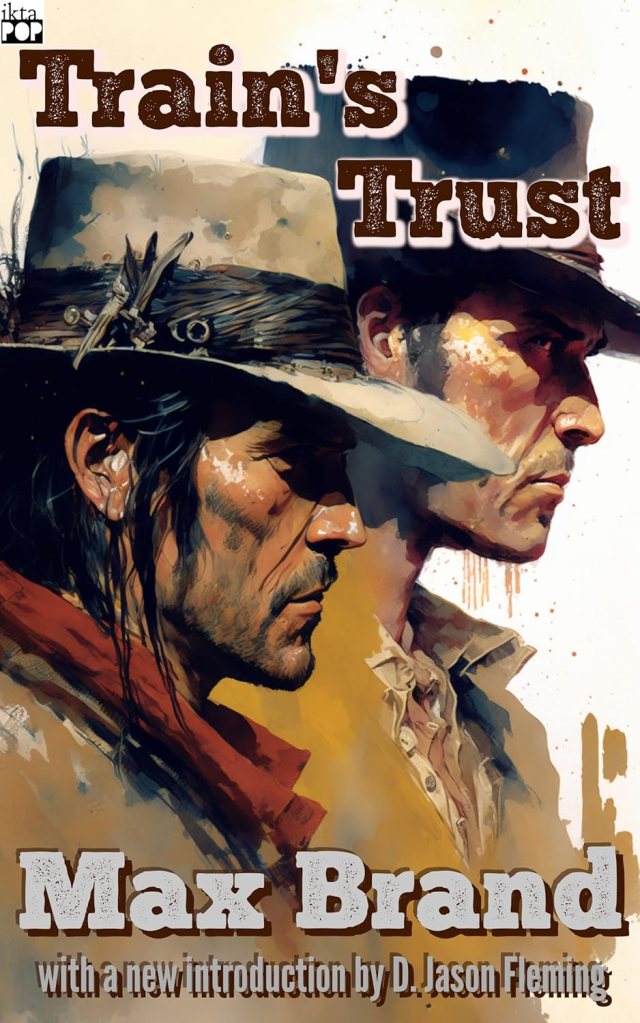
Steve Train, gambler, adventurer, clever rogue, didn’t care much for work. But then he was offered a job with no work, but plenty of danger. The job: track down outlaw Jim Nair — and hand him a pile of money!
This iktaPOP Media edition includes a new introduction by indie author D. Jason Fleming giving historical and genre context to the novel.
All Col. Dr. Ariela Rivers Wolff, M.D., Ph.D., USSFM – the Lion of God – wanted was a little piece of paradise to call her own.
Being stuck on a desert world – even if she was the CO of the premiere battalion of the 1st U.S. Space Force Marines that was based there – was not getting her any beach time. Mostly because, without an ocean, there’s really no beach at all.
But she’s got a fix for that problem.
Now, if only the academics studying the problem of terraforming the exile world of al-Saḥra’ would get out of her way . . .
. . . and if only the religious fanatics who want their planet left as a desert, despite all the water from the planet’s former oceans being accessible only a few miles down, will leave the terraforming project alone long enough to see the good it will bring them . . .
. . . then, the Lion would truly be in Paradise.
But even in paradise, black clouds – and black ships – can herald danger for the Lion, herself, and for her daughters as well.
Sufficiently advanced science is indistinguishable from magic.
On a lost colony world, mad geneticists thought they could eliminate inequality by making everyone hermaphrodite. They were wrong. Catastrophically wrong. Now technology indistinguishable from magic courses through the veins of the inhabitants, making their barbaric civilization survivable—and Publius Cornelius Scipio Africanus Kayel Hayden, Viscount Webson, Envoy of the Star Empire—Skip to his friends— has just crash-landed through a time-space rift into the middle of it all. Dodging assassins and plummeting from high windows was just the beginning. With a desperate king and an archmagician as his only allies, Scipio must outrun death itself while battling beasts, traitors, and infiltrators bent on finishing what the founders started: total destruction. Two worlds. One chance. No time to lose.
Volume 1 The Ambassador Corps has rules: you cannot know everything, don’t get horizontal with the natives, don’t make promises you can’t keep. They’re a lot harder to follow when assassins are hunting you, your barbarian allies could kill you for the wrong word, and death lurks around every corner. The unwritten rule? Never identify with the natives. Skip’s already broken that one. Now he’s racing against time to save his new friends from slavery—or worse—while dodging energy blasts and political intrigue. One crash-landed diplomat. A world of deadly secrets. And absolutely no backup.
Some rules are meant to be broken. Others will get you killed.
When love sparks a war, can four hearts survive the flames?
Zara thought escaping to freedom with Téo was the end of her story. She was wrong—it was only the beginning.
Their forbidden love has ignited a war between two kingdoms, and now they’re refugees fighting for survival in a hostile land where every shadow could hide an assassin and every stranger might be the end.
Meanwhile, back in the marble halls of the East Morlans, Prince Hanri races against time to contain his father’s burning thirst for revenge before it consumes everything in its path. And in the glittering palace where whispers are weapons, Alia must navigate a maze of deadly rumors and half-truths to uncover the secrets that could save them all—or destroy everyone she loves.
With armies gathering and alliances crumbling, four young hearts must learn that sometimes the greatest battles aren’t fought with swords, but with courage, loyalty, and the unbreakable bonds of love.
In a world where kingdoms clash and hearts collide, who will you trust when everything falls apart?
War changes everything. But love? Love endures.
Perfect for readers who crave epic romance, political intrigue, and characters who will fight to the end for what they believe in.
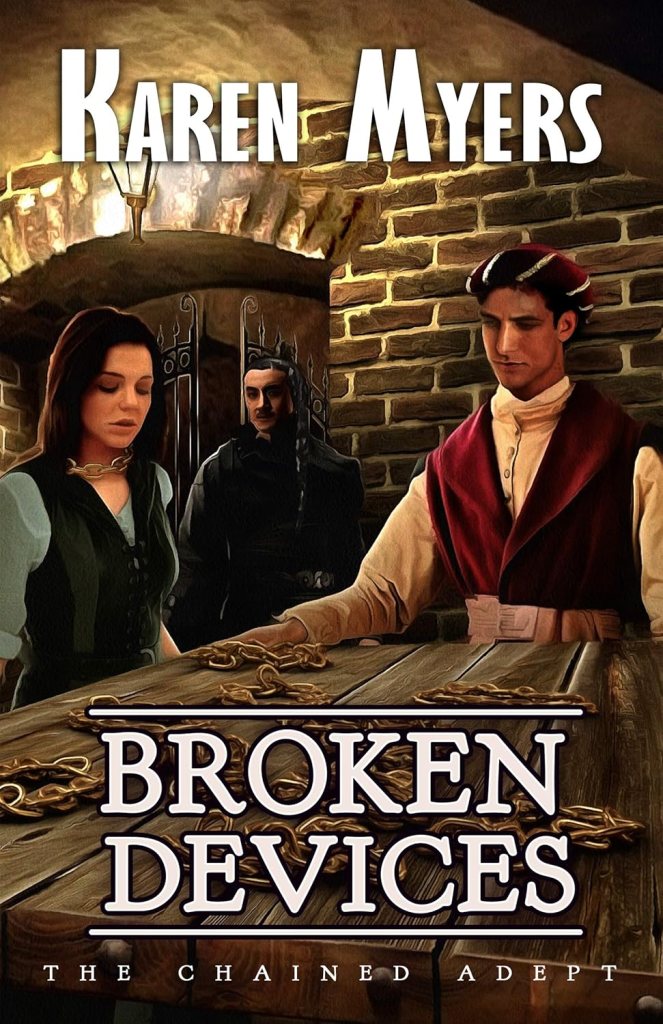
CHAINS WITHOUT WIZARDS AND A RISING COUNT OF THE DEAD.
The largest city in the world has just discovered its missing wizards. It seems the Kigali empire has ignited a panic that threatens internal ruin and the only chained wizard it knows that’s still alive is Penrys.
The living wizards and the dead are not her people, not unless she makes them so. All they have in common is a heavy chain and a dead past — the lives that were stolen from them are beyond recall.
What remains are unanswered questions about who made them this way. And why. And what Penrys plans to do to find out.
Life has been a nightmare for Mitya ever since he was arrested on trumped-up charges and exiled to Siberia. But this labor camp in the far north of Magadan Oblast hides a secret far more terrible than the merely human evils of the Great Terror. For the universe we know is not the only one, and there are places where it interpenetrates with universes where the laws of nature as we know them do not operate, where humanity has no place. Worlds inhabited by beings ancient and terrible, to whom humanity are slaves, playthings, food.
ALSO THE BASED BOOKSALE COMETH. IF YOU’RE A WRITER, CONSIDER PARTICIPATING: Based Book Sale.
Vignettes by Luke, Mary Catelli and ‘Nother Mike.
So what’s a vignette? You might know them as flash fiction, or even just sketches. We will provide a prompt each Sunday that you can use directly (including it in your work) or just as an inspiration. You, in turn, will write about 50 words (yes, we are going for short shorts! Not even a Drabble 100 words, just half that!). Then post it! For an additional challenge, you can aim to make it exactly 50 words, if you like.
We recommend that if you have an original vignette, you post that as a new reply. If you are commenting on someone’s vignette, then post that as a reply to the vignette. Comments — this is writing practice, so comments should be aimed at helping someone be a better writer, not at crushing them. And since these are likely to be drafts, don’t jump up and down too hard on typos and grammar.








































































































































































 According To Hoyt