Something to keep you amused

We have company.  To be exact, our child-by-late-adoption (as in he was grown and married.  Also, he has parents, but he acts so much like our kids we decided he was 3rd son,) his wife and practice-grandchildren are spending time with us.  This means I spent the last six hours in the kitchen, talking, which is why this is so late.

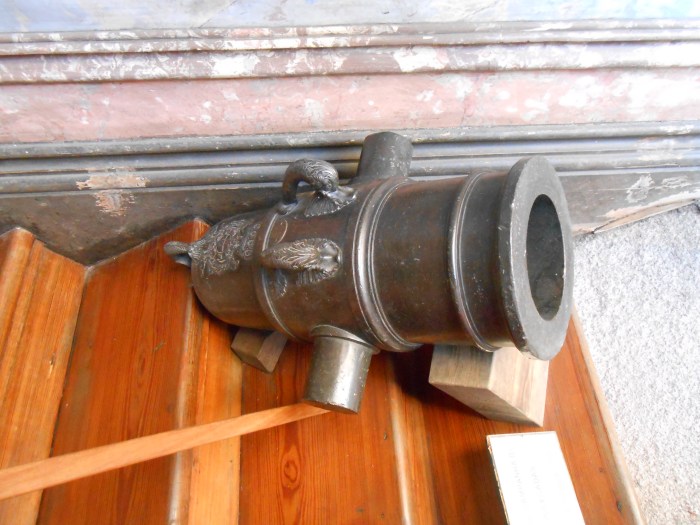
I also didn’t feel like writing a post.  So I thought I’d put up from pictures from the visit to Portugal’s military museum.  Keep in mind most of the pictures didn’t come out very … clearly, and though I have notes, we don’t always have the sign with the thing, so it’s not as informative (and it’s more challenging) than intended.  However, I thought it might amuse you if I posted some of them.
Unfortunately NONE of the miniature pictures came out :/

DSCN0756

UPDATE: Okay, I am an idiot. As I was lamenting that I hadn’t got most pictures, including the Lewis Gun, I realized that I was looking in the wrong folder. Mwahahahahahahahha!
Also, btw, the Portuguese originals were made at the Fabrica do braco de prata. (Factory of the silver arm.” THERE will be some supernatural explanation for this. (Oh, and dad got me 3 books called “legends of Porto.” (Actually “weird Porto” but…) Yes, there will be snippets of Grant goes to Portugal as soon as I’m marginally more organized. I figure house won’t be DONE till December, but I need it to the point I can CLEAN.)  The first Lewis is the one I got to fondle. :)
The miniatures are just a few to see the extent of it.  One of the miniature displays are one of the fictional battles of Conan the Barbarian.  I mean, I’m sure Larry Correia could spend three days at the museum JUST looking at the miniatures ;)

A Very Old War

First of all, sorry this is so late, but my husband was updating my machine to Windows 10 so it was not reachable/useable by me, and I occupied myself with unpacking suitcases (one to go.  Since we spent yesterday out of the house dealing with pets/house/and such I only could do it today.) On windows ten, rest assured this was done over my kicking and screaming.  Mostly because not only do I hate having my work space disrupted, but because it did some really weird stuff to my travel computer, including making it impossible to connect to my phone as a hotspot.  So connecting from Portugal had to be done over a VM in windows seven, which I could not write on, as it didn’t have access to Word.  And it wouldn’t let me switch back and forth easily.

Anyway…

Because I’m that kind of a cheerful person, and because (I think I’ve mentioned it here once or twice that in stressful situations I read non-fiction because it needs less emotional involvement than fiction.  And though the trip back — economy premium on Lufthansa is more like what we think of as first class, except for the chair not FULLY reclining — was quite pleasant, I was sleep deprived and generally depressed/exhausted.)

What I’ve been reading a debunking of the myths of the “Convivencia” paradise that Al Andalus and generally Islamic Hispania is supposed to have been.

It’s not exactly a shock to me.  First of all, my preferred reading, as soon as I could read, was history, most of it written in the early 20th century, and a lot of it local histories or histories of regions of Portugal and Spain. I won’t say that the authors universally rejected the myth of Islam as a civilizing/science-bearing force.  I will say that when they applied it (in elementary school we were forced to memorize the improvements the Arabs brought to the peninsula — we did that with each invader, and boy did the area get invaded — almonds, pillows (al-mofadas), the sort of fountains that spout by themselves (you build them by making the water gravity fed from above where you want it to spout.  I’m explaining very badly, but I am still not fully sleep recovered, and there’s a hole where the name for the fountains should be, orange trees.  There might be something about the way oxen were yoked, but I doubt it. Oh, yeah, the way we write our numbers.) it left me curiously unconvinced.

It was little things, you see, having actually been born/grown up in one of the areas/near the area where this supposed paradise existed.  yeah, sure, the North of Portugal got off lightly.  We were freed fairly early on (we were a crusade land and were freed mostly by French crusaders, one of whom, having married a daughter of the king of Castille became father to our first king.)

More specifically, though there are no specific histories of the village (duh) I heard more than once from people I trusted, that we were the sort of place that got by with one or two Berber supervisors, and local toadies… er, I mean functionaries.

But Portugal is a small place, and I went to other places.  And there are things…

In a truly multicultural society, with REAL religious tolerance, the local church wouldn’t have been commandeered as a mosque (apparently this was a standard humiliation technique for captive populations.)  It was returned to use as a church, and has been such for centuries now, the interior having been ALMOST completely scrubbed clean of arabesque decorations.  ALMOST.  Why almost, you ask?  The wall near the door, around the door, where you can’t avoid seeing them as you leave, was left “decorated.”  It was left so that people would never forget.

Then there are churches that were pulled down by the Muslim invaders, and into which people were buried through all the years of occupation.  It was the only consecrated ground around, you see.  The poor bastards weren’t allowed to have their own religious cemeteries/bury their dead in peace.  Oh, and this was often in areas that were considered solid Muslim (this ties in to something else later on, so stay tuned.)

But there is more than that.  I never BOUGHT the idea that Muslims were kind and gentle overlords for a more bone-deep reason.

Look, people with ancient cultures all in the same place REMEMBER.  They remember in ways that no academic gaslighting, no professorial assurances to the contrary can erase.  For instance, do you know how you can tell which Roman emperors were considered decent by the local people?  they give their names to their kids.  Still.  Trajan, for instance.  And then there are the bad ones, that are also still remembered, but whose names are given to dogs (Nero.)  And then there are the unspeakable ones.  Neither child nor dog is named Caligula.

Well, in the local area, you find some kids named Ibrahim (though that is a bit confusing since local custom does weird things to spelling) but NONE named Mohammed.  (This might be different now, since the Conquista II — this time we pretend to be innofensive — is in progress.)  But back then there were no Moes around.

And that is plain weird in a place that has forgotten nothing.  (Seriously, there are still people around named after Roman gods, because the name runs in the family.  And Greek Heroes.  And Carthaginian heroes, too. My brother went to school with Hannibal, Hasdrubal, and a bunch of Roman historical names — I want to say Cipius, but I’m probably wrong.)

So I never bought it.  There were also very old writings with casual throw-away lines that made you go “Uh.”

None of the authors I read was trying to sell the Islamic occupation as a paradise, mind, though one of them did his best to try to convince us it was better than the Romans (maybe better than the falling apart Roman empire, but even then I doubt it.  Look, there simply weren’t enough people, at the end of 500 years of occupation, (roughly, though I REMEMBER hearing a linguist say the village was settled in the 4th century BC.  I HAVE to be wrong — or he was — since I know the village was on the wrong side of the punic wars) Roman citizenship and intermarrying who didn’t CONSIDER themselves Romans, so trying to portray the locals as impatiently waiting for someone to free them from the Romans and turning gratefully to Islam is coming it on rather too strongly. Even if there had been Carthaginian sentiment still around.  (More on that later.)  OTOH more importantly if the locals wanted to be freed from Rome that had already happened since the region had been invaded by the Suebians.  Anyway.  His thesis didn’t pass muster.

I didn’t meet the “Andalusia and more broadly Islamic Hispania was a paradise” thesis until the late eighties in, of all things, a Romance novel.

I wasn’t/still am not a romance reader, but the local Sunday supplement promoted this woman as a local writer, and I thought I might run into her somewhere (heaven knows where, since I never went anywhere writers gathered, back then) and might as well read her book.  Also it was historical and set in the peninsula, which peaked my curiosity.

The book was … very odd.  It starts with a Christian girl watching a Muslim man being burned (circa the 11th? century, dating by the royalty involved) and he throws her a little, beautiful miniature koran he wears at his neck (?) She goes on to (while hiding this) marry a (of course) brutal and abusive Lord, from whom she’s saved one night, when she’s kidnapped to become a Moorish sex slave.

Muslim culture and Al Andalus is portrayed throughout as having near modern sensibilities, hygiene, etc.  Think NYC but it raids for slaves, and there is polygamy — both of these things danced around so fast if you weren’t paying attention you might think they weren’t there.

Anyway, our kidnapped noblewoman becomes a wife of a Muslim Lord who is in all effects a sweet, gentle modern man, and she falls in love with him and converts, and it ends with a little thing about their grandchildren running to the North of Africa from the onslaught of the reconquista.

It was like reading about a parallel universe.  Oh, sure, there were some fulminating things written against bathing by less than sane hermits (and some Church fathers) but the middle ages were not nearly as dirty as we tend to think, and Christians still averaged about a bath a week, which is what populations today, who have no running hot water/central heating do, with washing of hands, face, and other crucial parts every day.  (What mom called a cat-bath.  No it doesn’t leave you feeling as clean as a full body shower, but it keeps you decently socially acceptable.)

Oh, sure, some Medieval Lords abused their wives, but so did the Muslim men of the time (and still, in mostly Muslim countries) since wife-beating is enshrined in the religion and culture.

And no, polygamy is never better for women, WTF?

Also, the historic personages I KNEW were not precisely portrayed recognizably.

Oh, also, they didn’t at that time burn Muslims for being Muslims.  The area she set the thing in (and I can’t remember where exactly, sorry, but it was in Portugal — which btw, made her ending up in Al Andalus semi-implausible — was at the time a frontier between the two civilizations.  Think of it as the old west.  There were some Muslims on the Christian side, under their parole (it was a couple of centuries before they became suspicious-persons and were forced to convert, deported, whatever) and there were some Christians on the other side (as dhimmis by that time, mostly) and there were starcrossed romances and what not, but what there wasn’t that early on was an inquisition, which crazy writer chick thought there had been. (And the inquisition didn’t burn Muslims for being Muslims, but for breaking a supposed conversion– Never mind.)

I thought this was an isolated case of insane writer (I never did meet her) and shrugged it off.

It wasn’t until the late nineties that I started running into this versoin of “but it was a paradise” everywhere.  And I started getting seriously disturbed.  I suspected (apparently rightly) that Saudi-Arabian money was softening the West to the idea that Islam was benevolent and civilized.

(By the way, no invaders at the time were benevolent and civilized, but Islam brought with it some of the dysfunctions only an invading desert-culture could bring in.  Like a tendency to cut down all trees and turn entire areas into deserts.  Or a disdain for work, and a preference for plunder and baksheesh.  Or–)

If this book — The Myth of the Andalusian Paradise by Dario Fernandes Morera — is right, then the pattern of invasion was much like we’re seeing, a lot of it having to do with the West being considered a soft target, while the West considered Islam either not that much of a threat (at the beginning, when treaties were attempted) or being softened by continuous acts of terror (like killing entire villages) so that some surrendered preemptively (not that we’ve seen anything about that.)

And the counter-offensive only got going when half the lands were destroyed and the aggression couldn’t be hidden/ignored any more.  (Part of it being that life standards in the Islamic areas steadily declined, since the dhimmis are supposed to be the ones working/paying for the Muslims to live in style, but over time dhimmis either “convert” truly or not, or run away, leaving the terminal Muslim state rather like the terminal socialist state.)

So, what can we do?

The only way we can get out of this semi-peacefully is to have Islam reform.  This won’t stop crazy acts of terror, but if Muslims can be convinced they can’t win this, and that it’s in their best interests to be decent human beings who don’t bomb and don’t support bombing (or killing, or sexually assaulting, or) other people of different religions, and there is an alternative that’s loud and open and isn’t afraid of communal backlash (the reason most decent Muslims don’t talk against acts of terror is that they are also afraid of the crazies) eventually it will become the predominant form in the west and community pressure will go the other way.

What are the chances of that? Less than zero, I’d guess.

First of all, our genuinely pluralistic society CAN’T demand forcible conversions.  (And to what would we convert them, anyway, given we are a pluralistic society.)

Second, forcible conversions SORT OF work.  Given enough time families and even regions forget they were ever anything else.  But only sort of.  See above where I said the defeat of Carthage in the punic war might have meant local sympathy with Islam (from same general region) and doors open when they arrived as invaders.  And then there is Algarve, the last province of Portugal to be freed, and a rather pleasant/touristic sea side enclave.  People there still listened to Arabic radio stations, when I vacationed there in more innocent times.  I overheard a weird remark about people down there more or less mumbling about supporting Jihad.  I hope the person was joking.  BUT they might not have been. I find it interesting that suddenly the North of Portugal, which has yes, historical charm and depth, but also has the climate of Scotland in Winter and California without air conditioning in summer is now a touristic hub, more so than the South.  I wonder if hearing Arabic singing worries tourists.  (It would worry me.)

And short of a really hard ass position, the sort of thing a civilized and decent people don’t do — like killing everyone from the same area as a terrorist, or everyone who might have known, or… — we are on a train that has only one stop.

Eventually — it took centuries before, I don’t think it will take as long now, but it might take another decade or two.  Less if the attacks keep coming closer together — the West will lose patience.  And this time we do have weapons that mean predominantly Muslim areas simply stop existing.

We are in fact, trying to convince Muslims to allow us to let them live.

And it’s not going well.

And the last thing we need — the very last thing — about this as about communism or socialism, we can afford is to be gaslighted by an industrial/media/entertainment/educational complex who is on no one’s side but theirs.

Because if we are, then when we lose patience we’re going to lose patience harder and more thoroughly and the world that emerges will be remarkably short on “convivencia” not just for Muslims (who might have all but stopped existing) but for everyone non-standard or who sticks out.

And that’s not a world I wish for my descendants.

So its time to start seeing past the lies, even when they’re so thick around us we see nothing else.  And start plotting our course with open eyes.

Even when it’s unpleasant.
 

What A Strange Trip It’s Been

So, the Hoyts are back in town.  That’s the good news.  The bad news is that I wrote at most 1k words while out of town.  Mostly because of heat.  We were clocking in the eighties and nineties.  Okay, nothing weird for CO at this time, but 50% humidity or better, and local culture hates fans.

We actually don’t have air conditioning in the new house.  This will be fixed once I finish Revenge and get paid.  It will go to that, mostly.  BUT even without air conditioning, we’re a mile high, which means we can open all the windows at night.  And we have frigging airplane-sized fans moving the air, so even in the heat of day it’s not that bad.

With nineties, high humidity and no air movement, I was sweating like being in a shower CONSTANTLY and at night, I just couldn’t sleep.  My own skin touching my skin HURT.  I was in a constant state of sleep deprival.

Maybe that’s why this trip was sort of a midlife crisis rolled into two weeks.

I know this will sound daft, but I didn’t realize that when I moved away to pursue… well, my life, I was cutting drastically down on the amount of help and support I could give my parents as they aged.  They don’t really need it yet — not really — rather they’ve felt stymied by not being able to help me, at least to the extent of taking the kids so I could work on my career when I was younger.

You see, Portugal is … tribal?  Clannish is more like.  Tribal too, but not as much as other societies.  It was part of my parents’ duties to further my progress in my chosen career and they really couldn’t do that, except by sending us gifts which sometimes kept their grandkids fed, but which to them is neither enough nor the form they would have chosen.

I’ll confess part of me wishes I could have sent the kids over in Summer when they were late elementary through high school.  I probably would have done it, if it weren’t for 9/11.  9/11 meant I’d have kitten fits putting the kids on a plane without me.  I’m also not sure how either of my independent-minded not great at reading different cultures kids would have done.  I think my older son would have got it, but the younger would have spent a lot of time speaking the unspeakable, so to put it.

Anyway, what’s done is done, and can’t be undone, and regrets won’t mend anything.

Weirder and more revealing was my realizing — now I’m about the age she was when I left — that my mom does love me.  She just has issues of her own, which makes expressing that very hard.  She spends a lot of time talking through forcing me to accept gifts and buying me inadvisable food.  If you’re sitting there saying “Duh, of course your mother loves you” you don’t understand.  I spent most of my life there fighting mom, and absolutely convinced she loathed me.  There’s reasons for that and issues I will not go into in a public blog.  BUT … yeah, she loves me.

And we still can’t live together.  Give me another week there, and we’d be at each other’s throats just like when I was a teen.  Part of it is that mom lives within certain parameters and that I was born with fists clenched and disposed to ask “You and whose army?” even at sensible solutions, much less at weird, culturally dictated ones.  Just an example, before the big family party, I was cautioned not to talk to anyone about my work.  Now, look, mom has done this before, where she threw herself across a big room when someone asked “so what do you do for a living?” and yelled “she’s a housewife” before I could open my mouth.  This time — I’m 53, and I have very little space for nonsense in my life anymore — I said “WHY?”  And she looked confused and blinked and said, “They’ll say your husband doesn’t make enough to support you.”  I appreciate her attempts at protecting my husband’s honor, and hell, she might even be right for the village grapevine, but gods above, she’ll never get that “we won a million dollars in the lottery” would be followed by “cool, more time to write.”

So, my internal parameters have shifted (it’s nice to know she loves me) but it doesn’t change anything.

The whole mid-life crisis bottomed out on the plane home, probably because I hadn’t slept in 20 hours and had slept no more than 4 hours a night for two weeks before that.  I went into this big depression because I felt like I had — to put it in a  weird but the only way I can — “lost me.”

I don’t know how to explain this.  I didn’t regret moving.  I didn’t regret my marriage, and I’ll never regret the boys, but I felt like I was holding two halves of me, and I couldn’t make them meet in the middle.

Part of this is that I met a lot of me in airports.  Slim Portuguese girls with adidas bags on their shoulders, rushing along.

But understand 99.9% of them will go back and live quietly wherever they came from, in the expected path.

Portuguese immigrate, sure, but usually as couples.  And there the big thing is “don’t let the kids marry abroad or you can never return.”  And if single males immigrate, they usually come back, marry a local girl, settle down.  Or at least (like a cousin of mine who married an Englishwoman) they send their kids back.

It’s not a normal thing for Portuguese Women to go away and not return, and it’s even less normal to BECOME something else.

And on the plane, in the midst of a depressive crisis I couldn’t figure out how to reconcile the two halves.  It took older son noticing I was crying and starting with twenty questions, until he elicited that I could FAKE fitting in Portugal when I was young, not now, but I always felt like an exile.

He says the way to reconcile it is simple.  I just was an American born tragically abroad.  If that requires pre-existence of the soul, so be it.  If it requires my being a genetic freak, so be it.

He says I am what I am and shouldn’t feel the need to justify it.  And perhaps he’s right, even if I still feel guilty I couldn’t be what family and tribe wanted of me.

As for the more material regret: My parents are well, but I can see the bend in the road.  I’d like to be able to visit them every year for the next ten years.

Yes, you know it, that means I must make a lot more money.

So, I’ll go unpack bags, then unpack boxes.  And then work.

I guess this midlife crisis ends where they all do: I am what I am.  I don’t regret my major decisions (Oh, some of the details, but who doesn’t?)  Now I’ll make the best of what I have.

It is perhaps symbolic that we returned home on the day of my civil ceremony anniversary, when Dan and I got legally married in York County Courthouse in South Carolina, so it would make getting religiously married back in Portugal six months later, easier.

Those promises I made?  Best thing I ever did, even if it send me careening down a path my younger self would not be able to understand.

All is as it should be.


“Litfic: Literary Science Fiction and Recent Hugo Winners” – Jeb Kinnison

“Litfic: Literary Science Fiction and Recent Hugo Winners” – Jeb Kinnison

I’m one of those people who straddles STEM and the literate arts with reasonable skills and interest in both. I took time off to study literature-type writing with a crew at Harvard, and John Updike visited one day. He made it clear he was a craftsman aiming at a specific audience, highly-literate Northeastern upper class sorts, but I doubt he would have looked down on someone writing for readers who like adventure stories. Dickens and Stephen King wrote for mass audiences and were looked down on by the literati of their day, but over time they became respectable and suitable for PhD theses.

The definition of “literary” is fuzzy. It’s confused with “inaccessible” and often the most obscurantist works are lionized mostly because only a few people can appreciate them, since they require study not enjoyment — e.g., James Joyce or Thomas Pynchon. Modern art became a thing because commercial, mass-produced representational art had flooded the world with photographs and advertising that made art accessible to everyone, so artists set out for new territory, fleeing the old world of representational art and pioneering obscure abstractions and art-as-statement. Wealthy patrons had to be persuaded that paying more for art that was impossible for them to actually appreciate was going to give them higher status. Pretending to appreciate the avant-garde became another class signifier. Modern literature similarly fled the masses and accessibility to keep exclusivity and high status.

But “literary” in the sense of complex, deep characterizations and prose that uses the full vocabulary available to the very well-read is still with us, and valuable. It is satisfying to read a story that is not only emotionally powerful but challenges you to learn new ideas, words, and phrases. Go too far in that direction, and your appreciative audience shrinks to nothing (and if you do get critics’ support and New York Times book reviews, your book will be bought by many but finished by few.) Too light, and you have grade-school pulp, which can be satisfying and gain you big sales, but isn’t challenging readers.

The problem with the Hugos is partly a lack of good material. My ideal science fiction leads readers through an involving story that also explains and projects new science and technology’s effects on the future. Many of the greats of the past were a little weak in characterization (Asimov, Clarke), but they were keenly interested in explaining the ideas that molded their fictional worlds. Recent literary science fiction tends to lack that emphasis on explaining new ideas, partly because there simply aren’t as many good writers as there were, and the younger ones tend to lack scientific backgrounds. And in fantasy, so much has been done that new ideas are rare.

A recent online discussion of “The Windup Girl” (2010 Hugo and Nebula awards) had many criticizing its implausible science and economics. If I’ve studied literature and come into science fiction and fantasy to write colorful, elaborate stories without much background knowledge, my stories may fall flat because people who understand science and reality see them as implausible. If one good literary value is complex and realistic characters, one good science fiction value is complex and believable science, and a good worldbuilding value is plausible economics and government. And there aren’t enough new science fiction books that have all of those these days, which is one of the reasons I read less.

“There were giants in the earth in those days…” Has the field been exhausted? I think not. The thinness of the last decade of SF&F is a consequence of the lack of money for writers now compared to several decades ago — if you want to be commercially successful now, you have to be willing to go into growing subgenres where a less literate population with reduced attention spans are buying. Comics, movies, and games satisfy the impulse for cool speculative stories and provide pre-marketed platforms for new work, while a standalone science fiction novel is trying to create a world all by itself and has to overcome the flood of new products set in worlds that have already satisfied millions. Both Hollywood and publishing are now finding marketing the key bottleneck, which explains the flood of reboots and copycat stories. Talented writers have left for the more fertile fields of Hollywood and games, leaving academics and part-time authors to fight over a declining pie.

When a field stops growing, it stagnates. The mainstream literary fiction market is deathly ill, with the green shoots of flash fiction on cell phones too minor to make up for the loss of millions of readers to other entertainments. The legacy publishers are now staffed with underpaid graduates of literary programs, not the war veterans and market-conscious editors with varied backgrounds of the post-WW2 era. Meanwhile, the funding of higher education by loans and subsidies exploded, producing excess graduates in English and literature who dream of writing for a living. Supported by grants, fellowships, and low-paid adjunct teaching jobs, they write part-time and flood the few remaining markets for short fiction hoping to get recognition and a “real” publishing contract. Many have invaded SF&F where there is still a better chance of getting published. An entire ecosystem of virtue-signalling self-congratulatory nonprofit writers now validate each other’s work and denigrate “popular” work. While there were always trust-fund babies writing for little literary magazines and being made fun of by successful writers, there are now more of them than there are self-supporting writers.

Being a writer was tough and never a good way to get rich before this happened. Now it is almost impossible for even some of the best to survive on only writing earnings. And that’s where self-publishing has helped — by routing around the right-thinking gatekeepers and the high costs of legacy publishing, self-directed writers can package and sell their own work quickly and cheaply. If it’s entertaining, a few years of writing can build enough of an audience to support full-time writing with the higher royalty rates self-publishing allows.

—
Jeb Kinnison writes on science, politics and relationships at JebKinnison.com and SubstrateWars.com. In his three-novel series The Substrate Wars, a band of liberty-loving college students rebel against an oppressive near-future security state after they discover quantum transport.

It Goes By Itself

One of the things that this trip has highlighted — I’ve now been in the US for 30 years, and functionally, although with some “window” into Portuguese culture, I’m now American.  But there is that window.

This means I spent a lot of time in this visit telling my kids/husband stuff like “no, you can’t do that/ask that” and when they say “why not?” I say “because it would be a social solecism, and I can’t explain why to you.”

I run into this in a lot of Jane Austen and her contemporaries.  In modern regency romances, when you say “she did something unforgivable” it usually is something that you can understand, like sleeping with some guy she’s not married to or showing up naked, or something.  But if I understand Jane Austen and her contemporaries,  you could end up disgraced and essentially exhiled for doing much less.  A question that none of us now would dream of not asking.  A refusal to show up some expected place.  wearing the wrong color dress.  It wasn’t and isn’t clear to us because the books were written for people in the same culture the writer came from and to them it was invisible.

That is one of the characteristics of culture: it is invisible to those who are in it.  It is just “logic” or “common sense.”

I remember, kind of, the bumps in a road in coming from a culture where things were assumed to be much different.  Of course, the ones I really remember are not the real ones.  Well, not the big ones.  I remember being shocked two aspirin at once don’t kill you, and neither does drinking water at meals (there is a list of things you can’t drink water with and its extensive, and because in Portugal most people drink wine with dinner, I guess no one ever tested if you die of drinking cold water over melon, for instance.  But I believed it implicitly, and it was a shock.)  Everyone knows, also, that cold “currents of air” can kill you (so did your ancestors) so even in a stifling hot summer day, you can’t have a fan pointed at you (this makes a huge difference in comfort, particularly at night.)

But there are nuances I never noticed, but my son did.  “If you open a door for a woman, she’ll almost hit you, and it’s not feminism, it’s that you’re shilly shallying and not going through.  The possibility you’re opening the door for her and don’t mean to go through first, as is your right, never occurs to her.”

This ties in with two things: first, Portuguese culture is a culture in a hurry.  “Ser despachado” more or less translated as “doing things fast” is highly valued, even if you objectively don’t know what you’re doing.  Or as my brother used to put it when I was young, “Shove in, and let the ships fall where they may.”

The other thing is sexism so bone-deep that even women who call themselves feminist don’t see it in every day life.  It’s  the assumptions that get you, like, of course, the woman will tend to the table/guests at any time, no matter what her real job is, or her husband’s.

I’m not running Portuguese and Portugal down, mind.  It is what it is.  And four centuries of moorish occupation left a mark in the culture.

I’m here to say when people squawk about “race” half the time (or more) what they’re actually talking about is culture.

But is it bred in the bone?  I doubt it.  All countries that came from Rome have certain dysfunctions (particularly where it pertains to government,)  EVEN (particularly) France.  And yet, they have no shortage of blue eyed blonds.

In fact were it race (which in Europe often amounts to nationality) the demarcation lines wouldn’t be clean.  As I joke with Jason Cordova, whose ancestors come from a little village across the border from the one where some of my ancestors lived “We’re probably tenth cousins several times over.” But you can look at borders and see the culture, sharply, not gradually (like the US and Mexico border.)

Because it’s culture.

All countries occupied by the moors have the same dysfunctions.  And yet you can see, by the look of people, etc, that it’s not a matter of how much they interbred but of how the culture was affected. For instance in the North there were only really Berber overseers and very few colonists, and yet until very recently Portuguese women covered their heads with a scarf after marriage, even though there was no religious reason for it, just a vague idea uncovered heads in married women were “indecent.”

The problem with culture is that it’s really hard to change en masse.  Individuals can change their culture if they really want to, and really, really try.  It’s not the same to change an entire culture, though.  There is (sort of) a proven way of doing this: kill everyone over three years of age, and teach the kids to despise their own culture for that of the invaders.  It sort of work, except it only takes one story, one “epic hero” to raise a rebellion 20 years later.

Cultures might as well be organic, bred in the bone, unless people are convinced to change.  They’ve been trying to convince us to change for four generations — our very own invaders — and yet we still resist.

Immigrants, absorbed by a larger and confident culture can and do change.  At least mostly.  For others absorption is chancy and might take generations.

When the Western World takes it upon itself to import wholesale members of a dysfunctional culture whom local prejudices forbid being scolded, much less punished or made to integrate, the result is … what we’ve been witnessing across Europe.

That saying this is frowned upon as “racism” just shows how far the invading anti-western ideology has gotten.

And yet it’s true, and it must be said.


A Whole Raft of Books – Free Range Oyster

A Whole Raft of Books – Free Range Oyster

Ladies and gentlemen of Hoyt’s Horde of Huns, we bring you another stack of books! We’ve some interesting submissions this week: an anthology edited by one of our frequent promo posters, omnibus editions of Karen Myers’ Hounds of Annwn as well as her latest novel, and some great adventure stories from TK Naliaka. On those last, I want to add my personal recommendation. I worked on the first two as editor, and have read the third. They were a lot of fun, exciting and occasionally poignant. So go check out some of these authors, support your fellow Huns, and always, always leave a review. We’ve had reports of trolls spamming 1-star reviews on some of the Huns’ books, and the only counter to that is more honest reviews. As always, future entries can (and should!) be sent to my email. Happy reading!

Jason Dyck, AKA The Free Range Oyster

Clothier, Code Monkey, Word Polisher, and Faithful Servant of the Hunnic Horde

Anthology

Quantum Zoo

Jack the Ripper arrives for one last murder, while a dinosaur – out of place and out of time – bridges the gap between two poignant lovers in the wonderfully atmospheric England of Hugo- and Nebula-nominated Bridget McKenna.

From a haunted old zoo filled with ghosts to a dying starship on its way to a new home – humanity’s final gasp, Quantum Zoo presents a dozen compelling stories featuring a dozen exotic and unusual menageries.

Edited by promo regular J.M. Ney-Grimm

Karen Myers

Broken Devices

The Chained Adept Book 3

CHAINS WITHOUT WIZARDS AND A RISING COUNT OF THE DEAD.

The largest city in the world has just discovered its missing wizards. It seems the Kigali empire has ignited a panic that threatens internal ruin and the only chained wizard it knows that’s still alive is Penrys.

The living wizards and the dead are not her people, not unless she makes them so. All they have in common is a heavy chain and a dead past – the lives that were stolen from them are beyond recall.

What remains are unanswered questions about who made them this way. And why. And what Penrys plans to do to find out.

The Hounds of Annwn Bundle (Books 1-2)

A Virginian in Elfland

To Carry the Horn – Book 1 of The Hounds of Annwn

NEW JOB, NEW FAMILY, AND IN TWO WEEKS THE END OF A WORLD HE’S JUST DISCOVERED, IF HE CAN’T RISE TO THE CHALLENGE.

George Talbot Traherne is just doing his job on a fine autumn morning, keeping the hounds together for the huntsman of the Rowanton Hunt in Virginia along the Blue Ridge Mountain. Doesn’t pay to get distracted by a white stag in unfamiliar territory, though. Next thing you know, you might find yourself… somewhere else.

The land is the same but not the people. Their huntsman has just been murdered, and George is tapped for the job. It’s an emergency – the Wild Hunt is only two weeks away, and if it doesn’t happen on schedule, the antlered god Cernunnos will take the realm from its ruler Gwyn ap Nudd and find someone who can mete out justice with the Hounds of Hell in his place.

The Ways of Winter – Book 2 of The Hounds of Annwn

TRAPPED BEHIND ENEMY LINES, CAN HE FIND THE STRENGTH TO DEFEND ALL THAT HE VALUES MOST, OR EVEN JUST TO SURVIVE?

It’s the dead of winter and George Talbot Traherne, the new human huntsman for the Wild Hunt, is in trouble. The damage in Gwyn ap Nudd’s domain reveals the deadly powers of a dangerous foe who has mastered an unstoppable weapon and threatens the fae dominions in both the new and the old worlds.

Secure in his unbreachable stronghold, the enemy holds hostages and has no compunction about using them in deadly experiments with newly discovered way-technology. Only George has a chance to reach him in time to prevent the loss of thousands of lives, even if it costs him everything.

The Hounds of Annwn Bundle (Books 3-5)

A Virginian in Elfland

King of the May – Book 3 of The Hounds of Annwn

MORE VALUABLE AS A WEAPON THAN A KINGMAKER, HE MUST MAKE HIS OWN CHOICES TO SECURE THE FUTURE.

George Talbot Traherne, the human huntsman for the Wild Hunt, had hoped to settle into a quiet life with his new family, but it was not to be. Gwyn ap Nudd, Prince of Annwn, has plans to secure his domain in the new world from the overbearing interference of his father Lludd, the King of Britain.

The security of George’s family is bound to that of his overlord, and he vows to help. But when he and his companions stand against Lludd and his allies at court, disaster overturns all their plans and even threatens the Hounds of Annwn themselves.

Bound into the Blood – Book 4 of The Hounds of Annwn

DISTURBING THE FAMILY SECRETS COULD BRING RUIN TO EVERYTHING HE’S WORKED SO HARD TO BUILD.

George Talbot Traherne, the human huntsman for the Wild Hunt, is preparing for the birth of his child by exploring the family papers about his parents and their deaths. When his improved relationship with his patron, the antlered god Cernunnos, is jeopardized by an unexpected opposition, he finds he must choose between loyalty to family and loyalty to a god.

Tales of Annwn – A Story Collection from The Hounds of Annwn

Five short stories: The Call, Under the Bough, Night Hunt, Cariad, and The Empty Hills

T.K. Naliaka

In Time of Peril

The Decaturs Book 1

Raised most of his life in the challenging world of West Africa, young Chris Decatur is in the United States for college, leaving behind dunes, nomads, and baobabs for the quiet halls of academia. Studying the American Revolution, Chris and his classmates embark on a reenactment trip to Upstate New York and New England. A week of hiking and learning, accompanied by a few reenactment volunteers and Chris’s knowledgeable father, Robert, should be an entertaining excursion. But even the backwoods are no refuge from the dangers of the world. The group stumbles on a terrorist plot in the works and the students are taken hostage as a mysterious plan unfurls. Chris’s unique background places him in the forefront in an ordeal of brutal fighters, uncooperative classmates, deadly threats and a battle of wits against ruthless foes, as Robert Decatur risks everything in a daring pursuit to rescue his son from the hands of evil.

A Difficult Damsel to Rescue

The Decaturs Book 2

SWAT officer Enrique Vargas was smitten with exotic Chlotilde Decatur from the first glance. Helping to save her brother’s life got his foot in the door, but the tough young cop faces new challenges when it comes to courting the irrepressible daughter of the Decatur family, in this sequel to In Time of Peril. When their first date ends with a brutal shooting, the young couple’s courtship is off to a perilous start. As specters from both their families’ pasts assail them, Chloe and Enrique must lean on each other and their loved ones to survive. Love, danger, and betrayal carry them from American western prairies, through the Straits of Florida and ultimately to the wild west, lawless desert frontier of the African Sahel, where dark promises will be fulfilled. Joining the Decatur family can be a dangerous proposition, but when those who they count as their own are threatened, they rally from across the globe to defend!

Between Dunes and Hard Places

The Decaturs Book 3

As Chris Decatur does hard time, his younger brother Daniel is hard beset on multiple fronts: calving season, interminable fence repairs, dangers of court testimony and the unexpected extended family duty of properly chaperoning Enrique Vargas’s gorgeous sister. Daniel finds an excellent solution to his troubles..… fleeing… as far from Wyoming as is possible on the planet: Hindustan, India. But with two families reeling from a brutal and vengeful attack, Daniel becomes the stumbling block to their enemies, but in the process inadvertently places himself in deeper peril when he steps where a long-set snare lies waiting for him. A fresh and fast-paced action-romance adventure for all ages across three continents with an engaging cast of international characters.

Iron Mixed with Sand, Salt without Memory

The Decaturs Book 4

The trail to the fate of three missing contractors leads Chris and Djibi into dangerous territory, but when their job is done, a simple exit for them is not in the cards. Rounded up with a group of villagers by a brutal and cruel militia leader, Chris and his fellow captives are forced to dig underground caves in ancient salt deposits. Desperate to escape before they are worked to death, they see no way out. Have the Decaturs taken on more hazards than they can handle as they search for a lost needle in the haystack of the massive expanses of the harshly beautiful yet rebel-infested West African Sahel?

The Inevitable Guilt

Years back, when an obscure film maker of a you tube video got arrested for …well, objectively for being a perfect scape goat.

I watched my husband and his sister go the full rounds with Dan saying “If they arrested him for anything, it was for making a movie against Islam, and do you want to set that precedent” and her saying “Well, he was violating his parole which required him to not post on the net.”

Even though we tried to make her see that without the need for a scapegoat, he’d never have been arrested for a “parole violation” she told us it was fair that he be arrested.  After all, if he weren’t a criminal, he wouldn’t have been arrested.

Yesterday Larry posted — sorry I was/am out of the country till next week and therefore don’t know the details — about police called to an incident where someone decided an autistic kid was trying to commit suicide.  The policeman didn’t shoot the kid (though he tried) but shot the caretaker.

Most people — including policemen — agree this man really screwed the pooch (and you’re talking to someone who thinks police are under attack at the front of a race war because the left needs a scapegoat.)  But even on Larry’s thread there was the inevitable “it’s all his fault.”  In this case it was “he wouldn’t have been shot if he’d run away.

Since what he’d done instead of running away was to lie down on the ground, hands up, as the police ORDERED, this is not a valid objection.

But some people feel a strong need to blame victims of authority/violence that might also hit them.  It’s a little incantation to convince themselves they’re safe.  (Look to the whole left and blaming victims of islamic violence, for further examples.)

It is comforting and helpful, psychologically,to think that the guy who just got kicked in the nads did something to deserve it.

And I’ll say that in the vast majority of run ins with police that turn violent, yeah, someone did something to bring it about.  Most of the time someone is arrested, yeah, they did something to bring this about.  Were it no so, then all criminals would be — as the left pretends -= angel.

Yet the police and the government of which they are instrument, are necessary but dangerous tools.  It is necessary, when humans live together, to have sheep dogs that control the wolves.

To imagine that when a sheep dog goes crazy and goes after a lamb, though, it was the lamb’s fault for looking particularly vulpine, is to give permission to tyranny.

In every tyranny in the world, the victims are blamed.  Under communism you were often called crazy and sent to a madhouse instead of to prison, but it comes to the same.  There was always a justification. “He caused panic by speaking against the government.”or “He was spreading despondency” or “He was really evil and one dayy when he chewed gum, he just threw the wrapper on the sidewalk.

Even in petty tyrannies like the SJWs, where you don’t lose your life, only your livelihood, people can be attacked for writing a respectful article about sf/f female writers and editors.  But it’s okay, they had it coming. They used the word “ladies.”

Stay alert.  Remember this.  Do not let yourselves be manipulated into piling in on the side of tyrants because victims aren’t perfect.

No one is perfect.  This is no justification for using disproportionate force against them.

Stay awake.


The Writer In Portugal

It’s not right to say I’ve got nothing done.  In fact, I’ve done a ton of research and my dad has given me enough books that it will make our weight going back um… problematic.  The problem is that I haven’t written at all.  Part of this is due to the fact we spent a week (give or take) sleeping.  Note to self, coming here straight from Liberty con might not be the best idea.

I don’t know why the flight across the ocean is so frigging tiring, I know the last time I did two in 10 days it nearly killed me, so I’m going to assume there is some inherent physical factor to it.  The truth is all of us, even kids, pretty much slept 16 hours a day for five days.  Which left very little time to do anything more interesting.

The last three days we’ve gone on the train to downtown Porto, where we have generally poked around places I used to hang out in (most changed beyond recognition) and scouted places to kill monsters.

Today, literally between the last paragraph and this, dad took me to a “military museum” which is actually a gun museum.

We interrupt this program to note that the writer got to see and fondle a Lewis Light Machine Gun.  More importantly, it was the gun dad trained with in the army, so he was giving me all sorts of insight into it, and why he preferred it to the others available.  Mwahahah…. I mean, it was very useful.

As for the rest of the museum, d*mn but I wish I had had Larry Correia with me.  (His visit to Portugal MUST happen.)  Half the museum is detailed military miniatures, the rest is guns, some incredibly obscure and strange and some frankensteined from pieces in Portugal.  I had a very fun two hours, and honestly could have spent two days there.  (And for idiots reading this who’ll call me ammo sexual f*ck off.  Fascinating history and ingenuity there.)

Anyway, the research she is beautiful, and the opening to Guardian came to me in a dream, but d*mn it, I still haven’t finished Darkship Revenge.  You must all keep fingers crossed that we have a good flight home (10 hours) with spacious enough seats (we’re in economy plus on the way back) that I can ACTUALLY bring out the laptop and type.

Until then, I’m going to go research more stuff.

(I think I frightened my dad a little, as his little girl was never interested in guns before.  See what hanging out in Baen company does to you?)

Well, I’m off to visit a port wine cellar (yes, they give you samples at the end.)

Be good until I return.

Becoming American – Kate Paulk

new-york-115626_1920 (1)

Becoming American – Kate Paulk

What feels like an eternity ago I started a journey that has involved a lot of money, multiple panic attacks, quite a lot doubt, and at least one complete meltdown. The first stage of that journey ended at about 10:15 am on July 20th, when I became a citizen of the United States of America.

I say “about” because I’m not sure exactly what time it was: despite the bureaucratic persnicketiness I’d battled in the past, actually becoming a citizen is remarkably simple (Qualifying to become one, on the other hand…)

The procedure went a little like this: around 8:30 in the morning the not quite twenty of us becoming citizens gathered outside Berks County Courthouse Courtroom 5A (http://www.co.berks.pa.us/Dept/Courts/Admin/Pages/Courtroom5A.aspx) with friends and family. Soon after we were ushered into the courtroom, where soon-to-be citizens were asked to sit on the right, and friends and family to the left.

The atmosphere was friendly and cheerful while the final round of paperwork (a short form confirming that we hadn’t done anything to render us not of good character to become a citizen in the time since our naturalization interviews) was dealt with and everyone had the chance to check over their naturalization certificates and make sure there weren’t any mistakes, as well as to sign the certificate. Mine had no mistakes, but I’m not so sure about the resting bitch face photo on it. It’s recognizably me, which is the important bit, but my vanity is a little miffed I wound up with such an ugly picture. Oh, well.

We were also told how the ceremony would progress, reminded (several times) that during the ceremony photography wasn’t permitted but photos before and after were allowed, and that a group photo would be taken and mailed to us all. It was all very friendly and low-key.

At close to exactly ten am, the presiding judge entered the courtroom and the ceremony started. There were a few short introductory remarks from the president of the local county Bar Association welcoming everyone and especially those of us taking citizenship, then the pleasant elderly gentleman from Immigration (with a mouthful of a title) formally moved that the oath be administered.

When the judge gave his assent, he called the names of our nations of origin. Me being from Australia, I was the first one listed. Some of the others were from (I don’t remember all the countries: there are just what I do remember) Italy, Romania, Mexico, Vietnam, Philippines… Quite the diverse collection of origins. Each of us stood as our original nation was named.

We were asked to raise our right hands, then the judge read the Oath of Allegiance (in “Do you…” form rather than the “I…” form on our printouts) At the end, all of us said, “I do, so help me God.”

That was the moment I became a citizen of the United States of America.

It wasn’t the multiple forms I’d signed, or the signature that went on my certificate, but giving the Oath of Allegiance – an old-fashioned, purely verbal action on my part.

The local high school’s US Marine Corps JROTC Color Guard presented the colors once we’d given the oath (and did it very well, too), then a music student with a lovely sweet soprano sang the National Anthem – which is when my eyes started to leak, because it hit me right then that this was my National Anthem now, and it went from being a nice song if rather difficult to sing well to meaning something (meaning rather a lot, as it happens).

After that, we new citizens gave the Pledge of Allegiance for the first time, then the first speaker gave his remarks.

And that cemented quite a few things: he spoke about how we’d gone from being tenants to being homeowners, and that like a home, a nation like the USA needs a certain amount of maintenance or it will fall apart. That maintenance consists of such things as voting in all the elections – and that local elections are more important than the presidential race, because the local officials are the ones who run your courts, your schools, your towns; it consists of jury duty, and being part of your community, and all the many little things that make for good citizenship across the full spectrum of life.

The judge’s remarks were just as focused on the responsibilities that go with citizenship as the rights it confers. He pointed out that we weren’t expected to abandon the culture and traditions of our respective homelands, but to meld them into the culture and traditions of our surrounding community, to integrate ourselves and our distinctive traits into the larger whole to help make the USA a better nation – and that this is the spirit of E Pluribus Unum.

The judge also made a rather strong comment that it’s a bad thing to sit around with your hands out waiting for someone to do things for you: instead look to President Kennedy’s famous remarks “Ask not what your country can do for you, but what you can do for your country.”

After all of this, it was almost an anticlimax to be called out to collect my certificate and a collection of other bits and pieces (including a passport application form). Almost.

I’m still processing the thing, but it was a pleasant surprise to have such a traditional (in all the good ways) ceremony and so much emphasis on the duties that go with citizenship and exercising one’s rights, and on the need for all citizens to fulfill those duties for the nation to remain healthy. To be told outright that to be a citizen of a nation like the USA is hard work, because too many people seem to have forgotten this – a nation that is ruled by “We, the people” must be maintained by “We, the people” or it becomes corrupt and slides back to a tyranny where a few people control things and everyone else is expected to do as they’re told.

I’m up for the job. I just can’t do it all on my own: the other two hundred million or so of you are going to have to help.

Talking Real Loud

If most of my Portuguese relatives (instead of one or two) read this blog, I’d be in even more trouble than I am.

The one or two who read the blog get really upset at my America-Pride posts, and even more upset at the USAian short stories.  (Shrugs.)  So much the worse.

I do understand their taking offense, to an extent.  After all I grew up Portuguese and that I love the US and rally to it seems like an insult to them.

It is not an insult, it is what I am, sort of an inner compulsion of the soul.  If my kids should go to say Australia and write endless posts and stories about how much they love it, I’d hope to be able to only sulk a little bit.

But weirdly I think if my dad could read my blog (he doesn’t speak/read English) he would understand, precisely because he is a Portuguese patriot, while the family members getting burned are mostly tres internationale, tres chic, tres moderne, and think patriotism itself is something slightly gauche that belongs in the nineteenth century in a scent of mothballs and a cloud of kids named after kings.

So when I’m publicly patriotic, what I’m doing is worse than insisting on wearing pettycoats and ankle length skirts, which could at least be charmingly eccentric.

Because you see they know, because six generations have learned this now, that patriotism kills.  This was the lesson they took from world war I and, because world war two dressed socialism in funny German outfits, it didn’t shake them.  It never occurred to them that people go to war for many reasons, one of them being that they think they can win, which might or might not be fed by exaggerated pride in their country, but that no one has gone to war UNPROVOKED just because they love their country.

I can’t even imagine the mechanics of that “we love our homeland, it has beautiful fields, let’s go invade next door and kick their ass”  WHAT?

What happens rather is that when a nation attacks for whatever reason, patriotism and national pride allow a nation to defend itself.

I was thinking about this because Julie Pascal (I THINK on facebook) made a comment  about pride and bragging on your homeland being a good thing. It builds confidence and certainty, it gives you something to fight from.  She says she’s not sure a land where its people don’t brag about it might be able to survive.

We used to teach the kids stories about their country and their ancestors (real, or at least theoretically so — more often — in Europe, and ideological in the US.  We taught them patriotism by degrees.

Was the story about Washington and the cherry tree a lie? Perhaps so, but in the grand scheme of things does it matter? It taught them virtues we want associated with the country. Teach them not only what is admirable about our land, but what we want to be admirable about our land. If they believe men of their land are strong and true and lay down their lives for the weak, it will help them to be so.  Virtue is not easy, and taking a good run up to it, and feeling we naturally should do it, helps.

In the same way courage is hard, and you can’t ask people to lay down their lives for something they’ve been taught to despise.

Patriotism never caused wars.  (Not even German Patriotism.  Their desire for a warm water port and markets for their wears did.)  Patriotism is the white blood cells of the culture, the defensive mechanism of the territory.

Imagine — this is easy for me, since I’m a guest in someone else’s house right now — that you live in a really nice house.  It cost you a lot of money.  It took you years to work up to buying it, and it is the house you always dreamed of.  You clean it every day, polish the woodwork, clean the windows.

Now imagine your no-good cousin and his five ill-taught brats come to visit.  Those kids are trumping up and down your polished hardwood floors in steel-toed boots.  Your cousin is sleeping on your leather sofa, slopping beer onto it.  Your no good cousin-in-law has burned something indescribable on the stove.

You’re gonna get mad.  You’re gonna ask them to shape up or ship out.

Now imagine you’re living in a tar paper shack.  It’s objectively a lot more fragile than your big dream house.  But you don’t like it, don’t want to live there, and don’t think it’s a big deal when the kids are poking holes in the walls, and your no-good cousin is spilling beer on your third hand sofa. So you let them.  And come winter you’re going to be mighty cold int hat tar paper shack with the holes in the wall..

Or to make the comparison fairer, take the home we just bought.  It’s a suburban house.  In fact, it’s a d*mn nice suburban house, rather fortunate about its location.  Because we took 25 years working up to it, starting with a starter house of 800 sq feet which we couldn’t sell at the price we bought it.

Sure our new house needs a bit of work.  Sure, in the fullness of time we’ll change the counters to granite, we’ll put wood on the floor instead of the rather ratty carpets on it now, we’ll give it a good painting.

BUT as it is right now it is the best d*mn house we’ve ever owned.  (We didn’t live in Victorians because we wanted to, but because they were usually cheap enough/in bad shape enough when we bought them that we could afford them and the neighborhood was better than the house.  This also means after years of fixing and improving we sold them at a nice profit, allowing us to work up the scale.)

Anyway, imagine instead of making our slow way up, we had made our way precipitously down. Suppose we’d lost a house twice the size and fixed up top of the line and up to the minute.

Then take the same no-good-cousin in law on the wrong side of the blanket as visitor.  You can see how, right now, we’d defend our place tooth and nail, right?  If it were our “make do” and “any place to crash” house?  Not so much.

Same with countries.  If you think your country is the best thing since sliced bread, and that your culture is the best thing that ever happened to mankind, you’ll defend it.  You’ll fight for it.  Long before time comes to fight physically, you’ll have taught any visitor or anyone moving in that your place is something special and that, being so privileged as to be admitted to it, they should be on their best behavior so they can have their kids live in that special place too.

The problem with this war we’re fighting, this attrition and invasion offensive is that the perfect defense for it is the nineteenth century kind of patriotism.  That same patriotism our upper classes have spent a century removing, under the amiable impression they were preventing war.

If France and Germany and yeah, us too, still believed that their country, in itself, was a value, something to care for, something to be proud of, we wouldn’t be in the pickle we’re in.  Terrorists would know that people who love their country would respond to outrages with overwhelming force.  Terrorists might never have started because those of them in the west would have imbibed the message of how wonderful the west was, and they’d have mental tools to shut down the crazy uncle at the back of their head, telling them that their birth-land was best and that their birth religion gives them dominion over every other human.

So I’m sorry if it offends the delicate sentiments (lilac-scented feelings)of any citizen of a lesser country reading this, but the US at least still has vestiges of its white blood cells.  We still fought back when attacked.  Meanwhile the Europeans wring their hands and wish that something would happen to make these nasty people stop attacking them.  Not that they mean to imply that the nasty people are any nastier then them, of course, or that they shouldn’t be attacked, but really….

What they need to do instead is take a hint, and start bragging on their country and loving it, just like we do love ours.  And we too need to start pouring on the bragging, even more than what we feel (if that is possible) to counter decades of public school blame-America-first teachers.  We need to walk really proud, and talk really loud again.  We need to talk about how we’re faster than a jackrabbit, and braver than a mountain lion, how our cowboy boots are seven league boots, and how when an American spits in the ocean it causes a tsunami.

We need to teach the kids to love their homeland.  And to stop frigging apologizing.  In the history of man, there is no nation who ever had nothing to apologize for, but ours has less than most. And even those lands — I’m looking at you Germany — who have a lot to apologize for, have more good than evil in their ancestry.  Start honing the good by praising it and teaching it, and make that evil a foot note.

Walk real proud, talk real loud again.

Or die, and leave the world to nations mired in darkness and evil who never yet apologize for anything and who brag of their hatred for you, when they have nothing else to brag on.

It’s that simple.

And to my little adopted sister, Kate Paulk: if ever there was a time I didn’t want to be out of the country, and I wanted to be there to support you, it was today.  But since I can’t, have a good naturalization ceremony and welcome home to this fractious family that is the best thing to ever happen to G-d’s green land.

Happy naturalization day.  We’ll throw you a shindig later.