Solar, Space, and Geomagnetic Weather Part I — An Introduction
By Stephanie Osborn
http://www.stephanie-osborn.com
“Interstellar Woman of Mystery”
Rocket Scientist and Novelist
A lot of my friends and fans over on Facebook have become followers of my various solar and aurora alerts there, and Sarah keeps asking me to come blog more about the stuff — which I enjoy doing, immensely — so I thought I’d explain what it is and why it’s important.
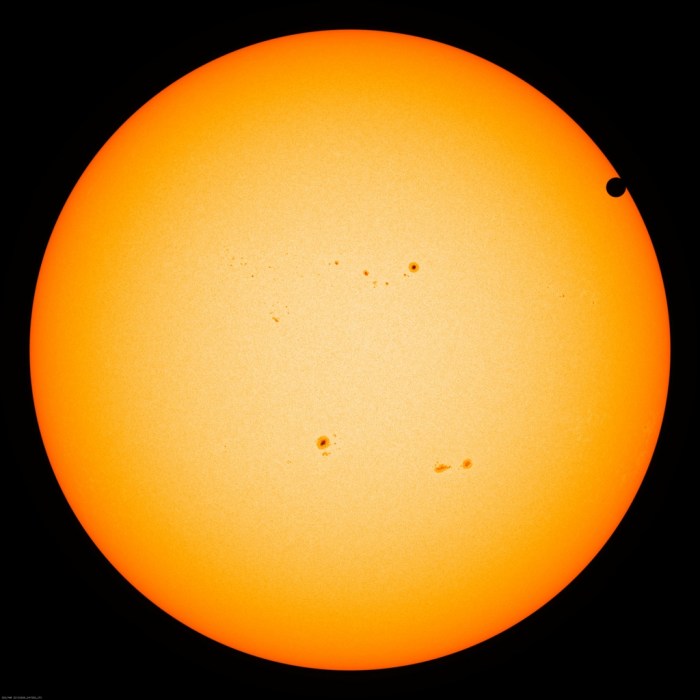
[This is a basic image of the Sun, complete with sunspots. The small black circle in the top right edge of the solar disk is actually Venus beginning a “transit” (passage) between us and the Sun.]
All three — solar weather, space weather, and geomagnetic weather — are interconnected. This is because the Sun has a magnetic field that extends far past the Earth, and so the Earth’s magnetic field interacts with it. “Space Weather” is essentially a term for the conditions of space in the general vicinity of Earth, but not necessarily inside the Earth’s magnetic field.
We are also sitting inside the atmosphere of the Sun, the corona. The corona is a plasma — a gas composed of charged particles, mostly protons and electrons, with some neutrons and assorted atomic nuclei (such as alpha particles — helium nuclei) thrown in for good measure. Its temperature is around a 1,400,000°-1,600,000°Kelvin, or about 2,500,000-2,900,000°F. It has a density that ranges about 5-10 particles per cubic centimeter, and it is generally moving away from the Sun, “evaporating” under the influence of the powerful solar magnetic fields.
This generates a kind of wind, usually coming out from the Sun and spiraling away — yeah, the “solar wind.” Granted, the corona isn’t very dense, but it’s dense enough to create some effects, and we’re working on using it to our benefit, like in solar sails and such, which can use the solar wind as much as light pressure to maneuver around the Solar System like a spaceborne version of the clipper ships of old. (But that’s a different blog post.) Solar wind speeds range from 400-750km/s (895,000-1,700,000mph), and under certain conditions, can get much, much faster.
But when the Sun gets…agitated, we’ll say…it can get a lot denser. Coronal holes move from the poles down to lower latitudes, and the Sun’s face develops an astronomical case of acne. This usually occurs around the time of solar maximum.
Whoa. Waitaminit. What’s a coronal hole?
A coronal hole is a magnetic field artifact.
Earth has a dipole field, like a bar magnet, because it is a rigid spinning body, so the dynamo inside it is all rotating at the same angular velocity. Remember elementary school when you put a piece of paper on a bar magnet and sprinkled iron filings on it? It made a cool bunch of lines that arced from one end of the magnet to the other, and then fanned out at the very ends. That’s what I’m talking about here.
The Sun is a gigantic ball of plasma. It spins on an axis. These two facts, when combined, create an electric current. An electric current, in turn, generates a magnetic field. This is why the Sun has a magnetic field. A magnetic field which TENDS toward a dipole.
Only…the Sun is a big ball of plasma, not a rigid body. More, each particle of that plasma is obeying Kepler’s Laws of orbital motion. Consequently, the Sun experiences something called differential rotation. This means that the area near the core doesn’t rotate at the same rate as the area near the photosphere (visible “surface), and the poles don’t rotate at the same rate as the equator. Consequently, the solar magnetic field is MUCH more complex than a simple dipole. It can, and does, occasionally have more than one north or one south magnetic pole. This means that it can look like this:
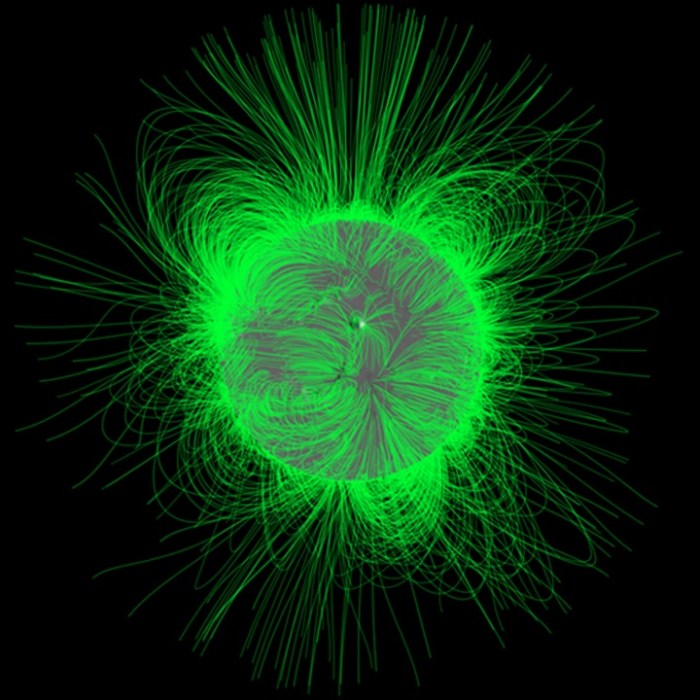
Now, see all those places where the magnetic field lines are going off into space, instead of looping back around to the “surface”? Those are shooting all that plasma off into space, ALONG THOSE LINES, and the result, when you look at it with the right frequency light and equipment, is what’s called a coronal hole. Looking at ‘em the right way, it looks like this:
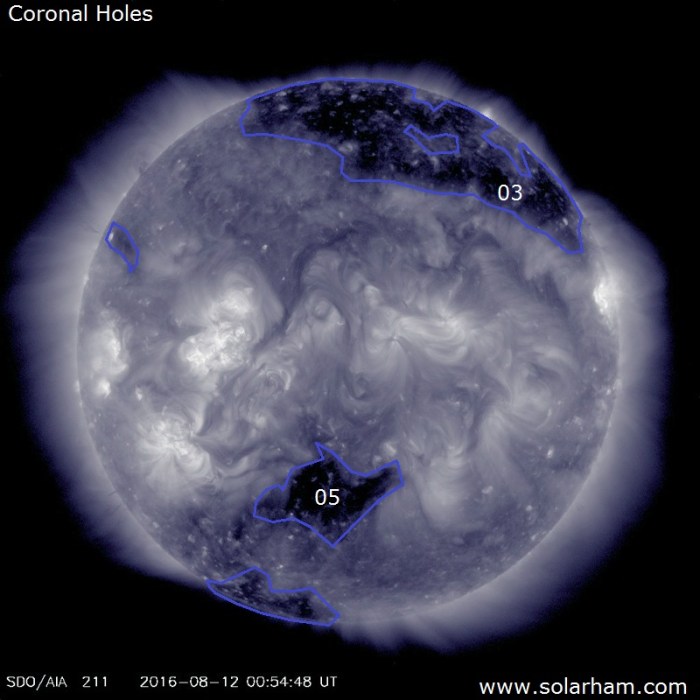
The polar areas normally have “coronal holes,” because of the open-ended lines of the dipole.
Occasionally one of these will get really large, and then the lay news media get all bent out of shape about “the huge hole in the sun” that’s going to destroy it. Nuh-uh. Ain’t gonna happen. Just shows they slept through all their science classes, assuming they had any. A coronal hole isn’t really a hole at all; it’s just a region of lower plasma quantities in the chromosphere (the lowest part of the solar atmosphere), caused because the mag fields are shoving it all off into space.
The streams of plasma coming out from a coronal hole are known as “enhanced solar wind streams.” (I never said all scientists were creative.)
So. That’s a quick synopsis of what coronal holes are.
Wait. What’s “solar maximum”?
Our Sun has cycles that it goes through. Some are short and some are long. These cycles are related to its magnetic field and to sunspots. In fact, many variable star astronomers such as myself consider that the Sun is at least a borderline variable star because of this; some consider it outright variable. We’ll leave that to a later discussion. For now, let’s just look at those cycles and why they exist.
Again, since the Sun isn’t solid like a bar magnet, the plasma doesn’t all have to spin around the axis at the same speed — and it doesn’t.
So let’s think about those lines of iron filings again. Our bar magnet has gone and gotten itself all twisted up because it isn’t solid, so the lines of iron filings get all twisted up, too. Now, scientists are still working on this, but the best we can figure out now is that sunspots are places where “snarls” form in the magnetic lines, and float up and break through to the “surface,” or photosphere. (In the last couple of years we’ve learned how to look “deeper” into the Sun to see these snarls below the photosphere. Remember that. It’ll come into play later on, when we start talking about the Sun as a variable star.) This means that sunspots have magnetic fields, sometimes very complicated. There are almost always at least two — one is a north magnetic pole, the other a south pole. (When there is just one, it is usually funny-shaped and one end will be a North magnetic pole and the opposite end will be South. And sometimes there’s a whole cluster, which gets really complicated.) And most all of the spots on the Sun will have the same N/S orientation.
It turns out that every 11 years, there is a peak in the number of sunspots, and a minimum in the number of sunspots. We aren’t quite sure why, because we don’t have all the theory worked out yet. But we’ve all heard of Solar Maximum and Solar Minimum, and that’s what those terms mean. Solar Max is when we have the most spots, and Solar Min is when we have the least.
~Stephanie Osborn
http://www.stephanie-osborn.com


