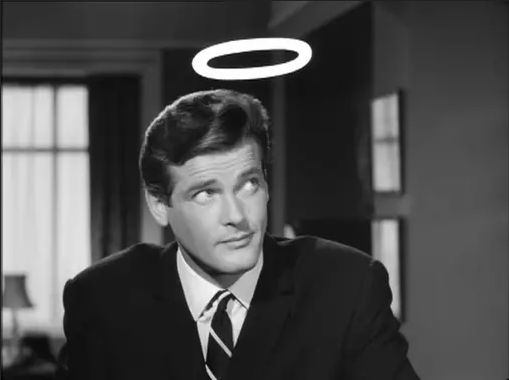
Long before I watched The Saint, I’d read all the books, by Leslie Charteris.
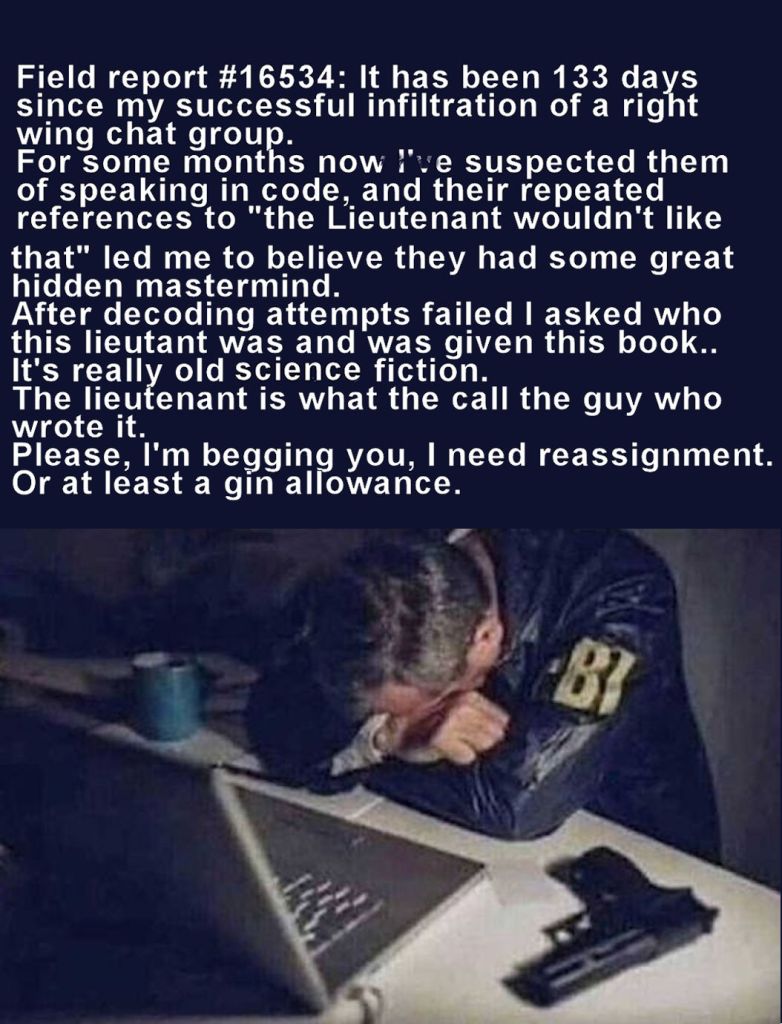
I count it as one of the saddest moments of my grown up life having found out that Leslie Charteris didn’t in fact write most of them, but farmed them out to other writers who were going to a tough spot and that he often didn’t say them. The last one is the material point. I don’t hold it against any of my favorites getting work done in whatever way. After all, the book is the book. You do the best you can with it. If you can’t write it for whatever reason and outsource it, that’s fine. So long as you make sure afterwards that you edit it so it matches the previous style, that’s okay with me. It was the fact that he stiffed fellow word-harvesters, including Heinlein that truly broke my heart.
Robert A. Heinlein, of course, didn’t let him have the story he hadn’t paid for. Instead, he filed serial numbers and released it as “They do it with mirrors.”
I don’t actually remember at what age I first watched the Saint. I want to say I was eight, but as I pointed out, in my memory, I pretty much was 3, 8 or 13. Sometimes 16. The other ages don’t seem to exist.
But of course, for the little girl who liked Robin Hood, the saint was catnip. And whatever age I was, I was old enough to appreciate Roger Moore’s looks. Though young enough to have no idea why I liked them.
I didn’t realize until we started re-watching them that the first series aired in the US before I was born. To be fair, the run in Portugal was probably at least 10 years later, since the Portuguese usually got these series as bargain, so they were either really not very successful, or very old.
Anyway, because we live in clown world, and because clown world has decided it needs to mess with even my innocent pastimes, like watching British mysteries, by making them increasingly, every year, both woke and nonsensical, as we were flipping around the many things available for free — mostly old or not very successful, but that’s fine — my husband and I realized that we both had enjoyed the Saint, but neither of us remembered much about it.
So, we decided to watch it at night, after we deal with various… duties and annoyances,. We sit on the loveseat and cuddle, and I do my crochet as a wind down towards bed.
Yeah, some things have struck us as funny or, you know, just not very convincing, like the fist fights. Dan says part of this is because of the fixed camera issue. They simply filmed with only one camera, so they had less latitude to pull punches while appearing not to, or something. I’m not sure I understand any of that, since I don’t in fact know much about filming and photography. (Or no more than I’ve learned playing with DAZ3D)
But black and white and all — because, well, as we all know the world was black and white till about 1967. I don’t remember it that way, only because I was very young, but we have the historical documents. — we’ve been enjoying it. I won’t say the plots are much better than TV these days. They’re not. Though this series has managed to surprise me once or twice.
It is interesting to watch their blind spots, versus current blind spots. I’ll stay silent– No, heck, I won’t.
I was amused, though not offended, at the Saint’s advice that one of his clients (?) spank his woman to earn her respect. On the face of it I’d say that was ridiculous — more or less ridiculous than current film makers’ tendency to make any smart female lesbian, I can’t say. Both annoy me — but given the success of Fifty Shades, perhaps he was correct. Not being a typical female, I don’t know. Anyway laying hands on me in any way I didn’t wish him to, or in any way that caused pain usually lived to regret it. (I mean, the regretting was a given. I think most of them lived. I didn’t check in a couple of cases, so who knows? Also, it was long ago and memory is hazy.) And though I can understand power games in bed (well, it’s much easier to write, for one, because there’s a clear line to follow) I never understood pain. Perhaps because I was sufficiently spanked as a child to associate it with punishment.
On the other hand, despite the fact that we all know, as we’re told so endlessly, the women of that time were horribly oppressed and treated as nothing but objects, I’ve found that the women depicted tend to be of the same kind as those that make good characters today: self actuated, independent, and quite capable of pulling a fast one on the men.
I don’t know, something must be wrong, since obviously — we’ve been told — women in sixty one and sixty two were complete slaves of men, never seen outside without being in chains and wearing an apron (which as we’ve been told is a symbol of subjection, and not something that protects your clothes.)
Perhaps the film makers of the sixty just continuously and consciously lied to us? I mean…. surely it can’t be that today’s mavens are completely insane and suffer from excessive presentism, having been lifted to positions of cultural influence through either strict and loud adherence to Marxist views or diversity that consists in having an interesting skin shade, sleeping with people other than the most commonly expected, or styling themselves as something quite different. Or of course through yes.
Thank you to whomever just slapped my back. I did have a piece of snark stuck in my throat. Hopefully the cats don’t eat it.
Anyway, we’ve been doing this for a week and change, and yesterday it hit me, and I confessed in some dismay that though it’s not the main reason I’m watching it, Roger Moore’s looks, such as they were, are part of the reason that I’m enjoying this rewatching.
My husband laughed at my chagrin, and said, and I quote “So?”
Which is about par for the course, because you know… I have never resented his ogling beautiful young women. Why should I?
Provided neither of us builds a fantasy life in which because someone is prettier or younger (often prettier because younger) than our spouse, they must also be what we want, the sheer enjoyment in watching a beautiful person of the opposite (or same. I mean, not for us, but whatever does it for you) sex is… rather innocent. It’s an aesthetic pleasure, comparable to watching a beautiful sunset, or admiring a gorgeous sculpture, only more so because human and the sex one is attracted to.
I never understood the entire crazy-hole-in-the-head of feminists and other ists who think that because you enjoy looking at someone and admire the way they look, you are objectifying them.
I honestly don’t know a blessed thing about Roger Moore the person, nor am I even vaguely interested. I know he died recently. I also know he was a very good actor (the expressions in The Saint are…. speaking, so to put it. Even if it’s played a bit over the top, as it should be.) I suspect his political opinions were appalling — actors’ opinions tend to be — and … Well, I just don’t care much one way or another.
Is enjoying watching him act, when he was young, and not caring the least what he thought or how he lived “objectification”? Likely if he were female and I male, the feminists would accuse me of it.
But the truth is this: I like beauty. I — being female and heterosexual — particularly like male beauty. Particularly well-groomed male beauty, of a type that is increasingly hard to find.
Beauty is, at any rate, rare. Most people aren’t beautiful. They’re okay. They pass. But they are not beautiful. Worse, very few of those remain good looking as they age. (And seeing a picture of Roger Moore in his old age was very sad, really.) Some do, but those are even rarer than those that are beautiful as young people.
Even though the Roger Moore of the Saint is young enough to be my kid now, I can enjoy his beauty captured on film and rejoice we live in an age of miracles, when such can be captured and enjoyed long after the person aged and died.
I don’t see any reason to feel guilty. If you enjoy my words, I don’t also demand you know what I look like much less find me ravishing (I was all right when I was young, but never ravishing at this time, at this weight, at this age, if you find me ravishing, I recommend a psychiatrist..)
It was important to me, of course, that my husband have an interest in me beyond the way I looked when we got married. Mostly because I knew my genetics, and that things would go downhill look-wise fairly quickly (How quickly and how far downhill was the only surprise.) In my relationship with him, it was important that he like both the way I looked and the way I thought, and the second one a little more, since it’s likely to last longer. (Though not permanent, either. You change. Everyone does.)
But for the vast majority of people out there, supposing someone stumbles on my picture of me at 19 and takes pleasure from it, I don’t require they know who I am, or what I enjoy, or even that I exist and am not an AI creation.
Beauty is damn rare. And we should enjoy it where and when we can.
Because it is all too fleeting. As is life. Which was going to be the theme of today’s post and will probably be tomorrow’s, but I spent the night dreaming of the solution to Dyce’s book, and having figured it out, I want to write it.
Which I should have been doing all this time, but things sidewayed (totally a word) at speed today, so I’m only now about to start.
Go forth and look at something or someone beautiful today.
And take sometime to sit with someone you love and watch something old, or silly or interesting and unwind a bit.
And then return to the fight. Because it’s clown world. You can’t go go go all the time. You’ll wear yourself out.
So take a breath. And then get back to work.























 According To Hoyt