Neener neener I got our hostess! Also her husband!
Ok, actually they tried to steal my son, but he has college classes. But still. (I think they’d give him back after he ate them out of house and home.)
Son of Silvercon is a lovely, friendly little convention, and you all should consider booking yourselves into it next July.
Someone who shall remain husband has turned this into “the man who traveled in elephants” type of trip. Turns out stopping to see the world’s largest ball of twine and such slows a trip down to a crawl.
To paraphrase, in a completely different context the ending of another Heinlein story: It’s already been a bad week. We don’t want to lose YOU. (Also, no free kittens. They have homes. And we have at least one backup.)
On the serious side, guys, mind yourselves and those you care for. It’s been a bad year. And though I’m 90% sure it’s nonsense, it matches my nightmares too closely, and there’s that large open border.
Yesterday was a very weird day, complicated by not sleeping more than about 2h the night before. So I was doing the strangest things. Today I need to get some stuff done. But if I can I’ll write a post this afternoon.
One of the challenges when dealing with people who are unfamiliar with firearms is that many of their impressions have been formed in the media sphere. Whether through books, movies, television, video games, or the nightly news, an often erroneous understanding of firearms exists.
Take the fun Bruce Willis movie “Last Man Standing” for example. In one scene his character sends an opponent flying through a plate glass window and rolling across the street with multiple shots from a pair of 45 caliber pistols.
Any gun owner knows that this is impossible and a clear violation of the laws of physics. However, we generally let it pass as dramatic license and enjoy the movie.
This is not a unique dramatic element. I could call up many similar scenes that are as equally unrealistic. I’m sure many of our readers can as well.
The problem isn’t the dramatization of firearms in movies. I enjoy a good shoot ‘em up movie as much as anyone and probably more than many.
The problem occurs when this type of exaggeration is someone’s only exposure to, and understanding of, firearms.
Here’s another example. For people living in large urban areas with strict gun laws like New York City, very few people have hands on experience with firearms. On the occasion they hear about a firearm on the news, it’s almost certainly been used in a crime. In their mind, firearm usage equals crime. If, after this association has been fixed, they meet a law abiding firearm owner, it’s often difficult if not impossible for them to break free of their conditioning.
This is especially true if they’ve also conflated a political position with their misunderstanding of firearms.
Several years ago, when we still lived in upstate New York, members of my family came to visit from New York City. One of the things some of them wanted to do was visit my local shooting range.
As usual, I started them out with my Ruger 10/22. Everyone who chose to shoot had fun. I then pulled out one of my New York legal AR15s with a 22 rimfire conversion kit installed.
At the sight of this, one of my cousins immediately recoiled and refused to shoot it because she thought it looked too scary. This belief persisted even after I showed her it shot the same ammunition as the Ruger and my petite wife fired it with no issues.
Because of the media implanted association that AR15s are somehow more dangerous that other firearms, she was scared and intimidated.
On another family visit, I gave my uncle (a firearm owner in New York City) a tour of my gun safe. His reaction was one of shock. Asking why I had so many guns and why did I have holsters for my pistols?
Following that visit he referred to my firearm collection as “an arsenal” since that’s what he had been taught by the nightly news.
By the way, at that time, my collection was a handful of pistols and maybe a dozen long guns. Many of them antiques. Some arsenal, huh?
Sometimes this misinformation is not necessarily accidental. I remember watching a firearm related story on a local news broadcast years ago. There were several shots of someone shooting various rifles with voiceover telling the story. Then they showed someone firing an AR15 and cut to a cinder block flying apart. It later came out that the cinder block had been shot with a 12 gauge shotgun firing a slug.
Their excuse was that they didn’t have enough time to show the effects of all the firearms so chose the most dramatic to close the segment. However, instead of showing someone firing a shotgun and its effects, they chose an AR15. Subtle this wasn’t.
As I mentioned earlier, some people will firmly hold on to their misinformation, especially if it’s combined with a political position.
I once had a several minute back and forth with one of my more stubborn left leaning friends that AR did NOT, in fact, stand for Assault Rifle.
He was insistent that it did.
I explained that the AR series of firearms were developed by the Armalite Division of the Fairchild Aircraft Corporation and all of them had the prefix AR.
He remained insistent.
Finally, I pulled out one of my reference books and showed him a picture of the AR17. A two shot semi-automatic 12 gauge shotgun introduced by Armalite in 1964 for the sporting market.
At this he relented. Albeit reluctantly. His opinion, which had been formed by repeated exposure to misinformation, had become personal. After that conversation, I made this meme to help educate others.
On the other hand some of these misconceptions can be pretty amusing as well. Years ago, when one of my nephews was young, he was really into the video game Call of Duty. One night when he was visiting us I mentioned that I had some of the guns used in the game and asked if he would like to see them.
His answer was an enthusiastic yes. He specifically asked about the M1 Garand and as I unlocked my safe I told him some information about that rifle. I then asked him how much he thought it weighed. His response? 50 pounds. Which at the age he was then was probably around half his weight.
Admittedly, at nine and a half pounds the Garand isn’t light, but it’s not nearly that heavy.
Remember, while education is important, knowledge is essential and neither of them do us much good without wisdom.
On 9/11 it took some two weeks before my liberal friends started beating their chests and saying that it was all our fault for… existing, I guess.
After the horrendous events of Saturday in Israel, twitter is already full of idiots, most of them, yes “liberals” (in newspeak, since they are totalitarians at heart) doing the two step of “Israel brought it on themselves” followed by alleged (they’re not. Well, they’re maybe European right, which is national socialist at heart) right-wingers doing the “let them fight” two step.
I’ll just say it right now: if you can look at the wholesale slaughter of civilians, including grandmothers and babies, and say they had it coming, you’re a monster. And if you think it’s nothing to do with us, and both sides are wrong, you’re a monster and an idiot. An idiot at a level that I can’t begin to describe. I’m surprised you can breathe and walk at the same time, and I wouldn’t be surprised if you have to repeat at the back of your head “move foot.”
Those who condone monsters are monsters. And those who think that throwing the baby off the sleigh will keep the monsters away are stupid monsters.
If you think the monsters are only coming for Israel, and don’t have America — and all the West — on their sights, you’re an infant, and not worthy of speaking where adults gather.
Like the left, these people believe they deserve mastery of the world and all in it, and stew in rage that you haven’t yet rushed to give them everything and subject yourself to them. Any country that does better than their shitholes must be punished, because of course, they’re supposed to reign supreme. Don’t do them the injustice of believing they don’t believe their own religion. They do.
Which means they’re everyone’s problem. And the left, the other cultists sure they should inherit the Earth due to their ultra specialness and the power of the arrow of history has done their work for them. Look at what happened in Israel and look to our open borders.
A week or a little more ago, I warned here that I had a sense of very bad things coming. Very bad things close up. This sense, btw, probably has buggerall to do with prophecy. I am, sadly for my sanity, a compulsive reader of news and well… everything. And I have the type of brain best described by Heinlein in Friday, when the boss calls Friday in the middle of the night and asks her when the Bubonic plague will hit again, and she answers, though she’s not sure where the answer came from. She’s been processing things at a very deep level, and arrived to conclusions that have nothing to do with her conscious.
(Yes, you can get me to give that type of answers if you wake me up, and they’re often accurate. Fortunately (?) the people who have access to me when I sleep prefer to either ask me funny questions or implant novel ideas. Yeah. That sort of person.)
Most often though, I just wake up at 3 am and “know” something. Sometimes I can backtrack logically and tell you what I know and why, which is why I went from worried about Covid to coldly sure it was bs. And I knew what I’d seen that prompted that certainty. (For all the good it did me to scream in the desert.) Or take when I knew the 2020 election would be stolen. It was obvious no one would run Biden, or the campaign Biden run, unless they had unimaginable amounts of fraud sewn up, so that they could defeat practically anything short of a major landslide (which caused them to fraud at the last minute and visibly.) This did not much other than depress me and make me frantic. Again, no one else seemed to listen.
So, I don’t like these “hunches” and I dislike them more when they are vague, unfocused and of the “something wicked this way comes.” Which is what I had.
A lot of you have pinged me to ask me if the events in Israel were what was triggering it. Maybe? Though I don’t think it was that specific, there was a certain easing of the “now there’s nothing we can do” sort Saturday night. (What my subconscious thinks I can do, I don’t know. It has an inflated idea of my importance in the world, I think.)
BUT — and it pains me to tell you this — we’re not done. The first pebble has fallen, but the avalanche is not started yet.
If you ask me, I suspect the two-steppers — because these people think twitter is life — are encouraging the left…. and others.
The amoral, excitable elements among us looked at what happened in Israel, and they liked it. Oh, they liked it. They smell blood and they want them some.
Who? you’ll say.
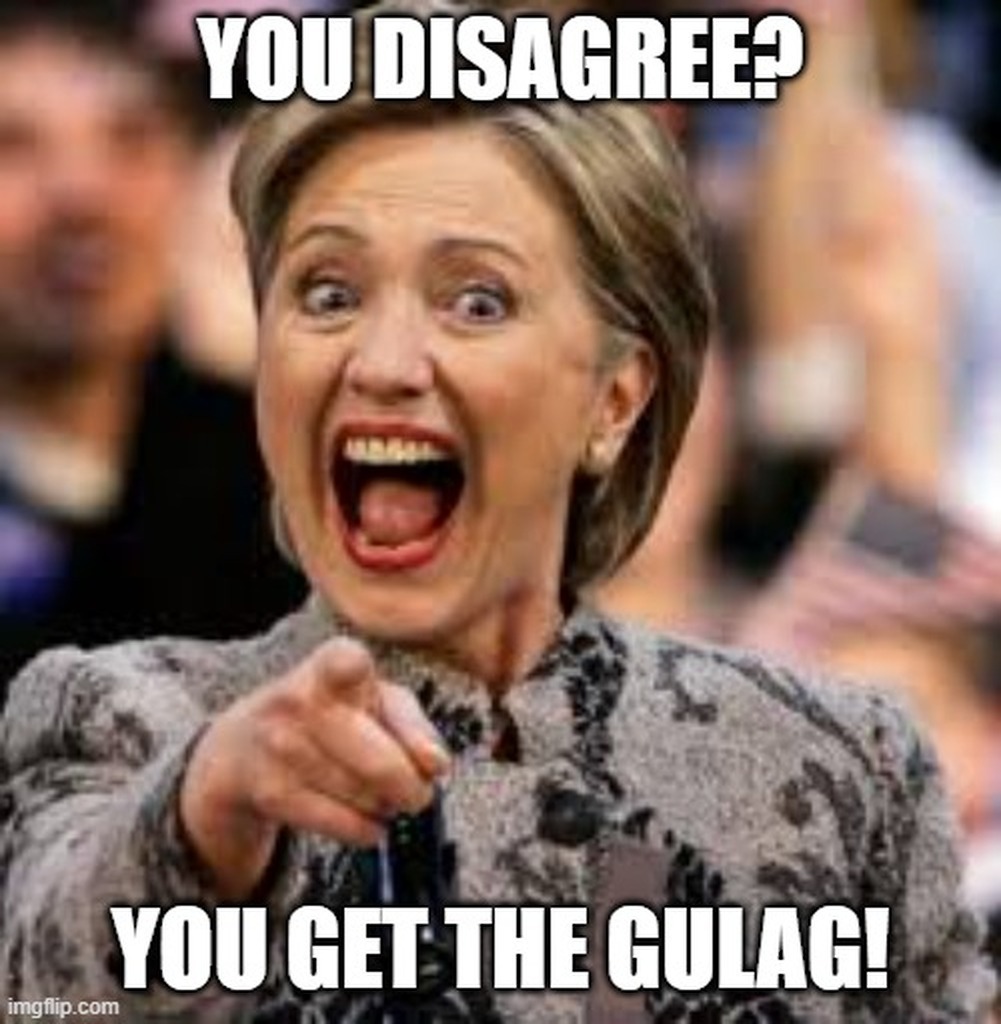
Oh, we’re spoiled for choice, and it’s a devil’s choice. We have our national malcontents, who think if only we let them go Stalin on us, they will have paradise. Hillary wants to re-educate us, but let us face it, most of the left just wants us dead. Some cartoon character I no longer remember was talking last week of killing all Trump supporters. So, you know. They want blood. They want to let the beast out.
Then there is the open borders. Even in the best possible situation, when you let carefully vetted foreigners in, there is hostility. I saw it as an exchange student — and distanced myself from my fellows because of that — when day two of gathering the students from all over the world at a NY university for “orientation” (Mostly how to buy things, how to write a check, what is considered polite. That sort of thing) the students were talking about how horrible the Americans (Volunteers who had given up their summer to help us) were. I don’t want to rundown my fellow exchange students. This wasn’t universal, just a majority. And even those who were blaming all their difficulties with… being in dorms? in a university? on American horribleness became saner when separated (as most of us were) from those of their culture or adjacent cultures.
I think it’s instinctive in humans, in a new situation, to try to bond by denouncing the strangers. And the strangers to denounce were the Americans, because this was their country. So, that’s what they were doing. (No, I wasn’t doing it, but that’s because a) I didn’t really bond well with my countrymen — Odd, you know? — and b) I realized, having the self-consciousness of a snail, that it was unhealthy to turn against America when we were here for a year. Yes, there were things that annoyed me during the year, but 90% of them were the climate. I think some people at headquarters delighted in sending people from lands without snow to places where snow remained on the ground for six months. Eh.)
But now picture that with often illiterate and very much pre-modern people flown across the world to be smuggled over the border, with promises of everything free, and more wealth flowing to them than they can imagine. (Yes, sure, some people still come here to work. But we all know that since Obama, there has been a campaign to convince people to come to the US for the things they are “entitled” to. Like all the health, welfare, education, etc. programs.)
And… it’s not going according to plan. Even in the best of times, with limited immigration, it won’t. Look, exchange students took umbrage at dinner being too early by Portuguese standards. And later, when I was with my host family I was surprised they — early 80 — were struggling paycheck to paycheck, and expenditures carefully controlled. Because that wasn’t the image of America in my mind.
Now, in a situation of mass immigration? Logistics becomes a nightmare. Even if we tried to give them everything the left has promised — and we weren’t broke as heck — it would be impossible. You can’t feed/care for/look after these many people perfectly.
I’d think by now any number of groups among those who came in, are working up a fine froth of anger at America. This is made worse by a lot of them having been recruited by/from communist orgs, for whom America is and has always been the enemy. And by the fact a lot of them are recruited from those who consider themselves at war with America and we’ve mostly ignored, like Iranians. Or, you know, Chinese. Or Afghans. Or–
Oh, and let’s not forget the climate hysterics, who are sometimes distinguished from the outright communists (but there’s a slide.)
The usual two step are going to convince all of these that they’re safe to act. And, oh, they want blood. They want revenge on Americans, who have the nerve to live their lives and pay these people very little mind.
And the two-steppers are going to convince them that they’re safe; that we’re soft; that it’s a great time to act.
Will it be as bad as Israel? Well, no. There’s a lot more of us. The country is very large. There will be no coordination between the various groups. There’s unlikely to be (but I wouldn’t bet against some) a barrage of rockets and covering fire to create confusion. It will be, as I’ve been telling you, isolated. Some places will be very bad indeed; some will read about it on the news. Which honestly is what a lot of people even in Israel are doing.
What will be as bad? All these idiots will be convinced they’re winning. There will be a barrage of pictures of the atrocities they commit. They will be doing selfies with the raped and murdered. And they will be PROUD. Just like the monsters of Hamas, they will be giddy with blood and wanting to show off.
And then things are going to get very weird, very fast.
And there will be a crisis. Because something shifted in the night between Saturday and Sunday. I expected to be angry. I didn’t expect how angry other people would be, nor the reason of their anger.
It wasn’t so much the surprise attack on Israel. I’m sixty, and some of my earliest memories of the Olympic games involved the massacring of Jewish athletes by terrorists. And I remember the Yum Kippur war. And I remember the Iranian hostage crisis. And I remember — Most of us are inured to Islamic terrorism. We’ve seen too much of it to be shocked. And I don’t know about people who grew up here, but I grew up in Europe, so communist terrorism is also a known. From the lunatics who’d take whole planeloads to Cuba, to the lunatics who planted bombs. You guys saw your bit with the likes of Weather Underground, though our media, then and now would not report much of it.
But that’s the thing. The reporting has changed. The media has been protecting the monsters, by not telling us the full measure of their blood-insanity. Even now they’re keeping quiet on a lot of killing, and either not revealing the motive or back pedalling the identity of the killers, or the insane evil of the killings.
This won’t happen this time. Like the Hamas savages, these people think their ability to hurt others is a super-power. They think violence makes them super-human and somehow justified. They’re going to take selfies. They’re going to tweet. They’re going to post on facebook.
And there will be a lot of them, from a lot of organizations, cascading, because once one starts the others will also want to brag and show how important they are. There are probably some in planning, right now. When it will hit, no one knows, but my feeling is probably not long. Because they saw. And they want. And they’ll be driven by the feeling the war is already won, all they have to do is join the victors or be left out.
Our official response will be weak and vacillating. Our media will do its best to cover it up.
It won’t work.
Because something shifted overnight between Saturday and Sunday. Something in the zeitgeist. The quiet, private men and women who just want to be left alone woke up.
What comes next? I don’t know. I know it won’t be pretty. And it’s not something I’m looking forward to, no. Because when the majority gets upset, all those who stick out are at risk. My liability is an accent and a vague “Latin” look, though honestly it could be Italian. Or any other Mediterranean sub-race. (You are allowed to spot the issue.)
But it doesn’t take that. It takes “Odd” and “sticks out.” Now America has more of a tolerance for that than practically anywhere else on the globe. (And my guess is the whole globe will go froggy if/when provocations happen in America. Why? I don’t know, but people, they had BLM demonstrations the world over. And demonstrations against Trump with “not my president.” It’s like they can’t help themselves.)
So most of us might be okay? Probably. Just not a good time to make too many waves, I guess.
Be aware. Be alert. Plot your routes. (Ask me how happy I am to be traveling this week. OTOH maybe some of you will come to Son of Silvercon in Vegas, yes?) Watch your six. Be prepared to defend yourself and those around who need protecting. Before, during and after.
Mass insanity is very hard on individuals. And must be prevented from devouring everything.
And you are to keep yourself alive and well. Because we have a republic to rebuild.
Be not afraid. Something has shifted and the common man is awake. And angry.
It is our duty to control the fire, lets it consumes us and everything we value.
The world is full of pretty lies. And normally, I’m able to scroll past them and go “oh, idiocy, more idiocy.”
Today is not that day. No, listen to me. Today is not that day.
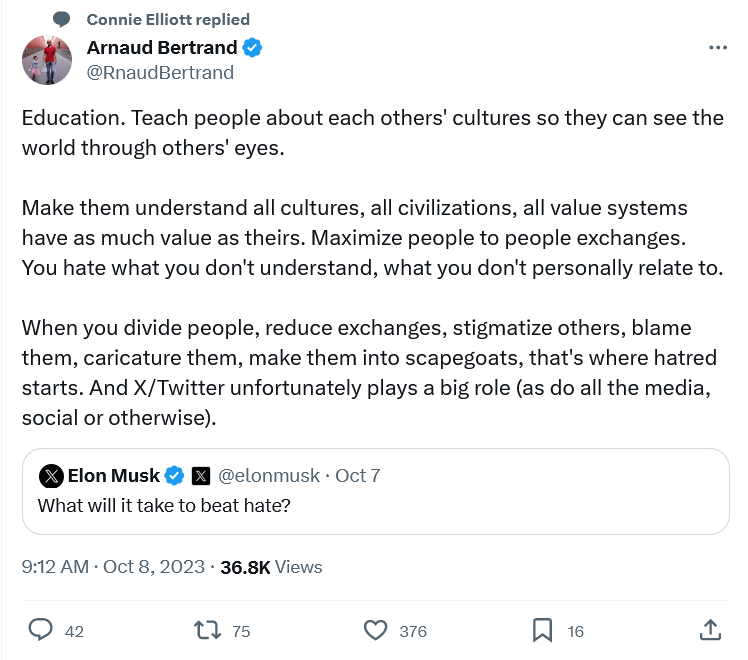
I was scrolling through twitter looking for an update on the war in Israel, and I came across this:
And I stopped. And I read that post. Every single word of it is a lie. A lot of it are pernicious lies. And they’re told by well-intentioned people who can’t or won’t look at the world without the rose colored glasses.
It’s not just these things are lies. It’s “they’ve been proven to be lies, over and over again.” But a lot of, perhaps the majority of “educated” people in the west piously believe them. Because they want them to be true.
Start therefore with that “Education” — education can be many things, but some of the best educated people in the world at the time led World War I. And while on that, do you realize the cultures fighting knew each other very, very well. Heck, most of the nobility was related to each other across Europe. Which did not stand in the way of turning Europe into one vast abattoir.
In fact, most of the vicious wars were civil, or between neighboring countries that knew each other’s cultures intimately. So this “Get to know the other culture better” is utter and complete poppycock. Or as the British say “Bollocks.” And smelly bollocks, at that.
As for all cultures, all systems, all value systems being equally worthy of respect?
Oh, really? So, a culture that enslaves women is the same as one that values women? A culture that protects and takes care of the weak is the same as one that tortures and kills them? A culture that welcomes difference is the same as one that pounds down the nail that sticks up? A system where — as in all communist systems — a small elite lives very well while others starve is the same as one where private property allows even the poor to suffer from obesity? And a culture that doesn’t believe it has to exterminate its neighbors is the same as one that does?
Don’t be ridiculous.
And as for not stigmatizing, dividing, etc? Pernicious bullshit. Pernicious bullshit on stilts. The horrible savages who kidnapped innocent people at a rave and raped women to death are not the same as people who are breaking themselves trying to spare the innocent. There is no comparison.
And evil needs to be called out and stigmatized. Else, it will take over the world. Go read this: Proportionate about Gang Rape.
Savages celebrate the death of and desecrate the corpses of those who’d never harm them because they CAN. Because they’ve been marinated in hate and their own superiority from birth.
Their culture is not the same as those people who try to save the wounded and help the victims of natural disaster. And they shouldn’t be treated the same and looked at the same.
If there’s hope for the savages it is for them to realize and be made ashamed of their savagery. And that won’t be achieved with some highfalutin “education” which will only give them better words to justify why they should be able to rape and kill innocents. No. the only way they learn it is by being stigmatized, shamed, and having vengeance rained upon them. And having them know they did wrong. And that the rest of humanity will not tolerate their evil.
Coddling them and treating them like precious darlings that don’t know better and just need understanding? Will only destroy civilization and spread their evil savagery everywhere.
No, the answers aren’t what I was taught at my very good college. Or what you were taught, either. And they’re certainly not the principles of international bodies that seem to enable only kakistocracies and rapinage.
But they’re the way we get out of this loop. The only way. We have to denounce evil and let them know it’s evil. That they did evil and will not profit from it.
Everything else is a betrayal of humanity and civilization.
These are not the answers I’d wish for. They keep me awake at night.
But they’re the only ones that work, so our children and grandchildren don’t live in hell.
If you wish to send us books for next week’s promo,please email to bookpimping at outlook dot com. If you feel a need to re-promo the same book do so no more than once every six months(unless you’re me or my relative. Deal.) One book per author per week. Amazon links only. Oh, yeah, by clicking through and buying (anything, actually) through one of the links below, you will at no cost to you be giving a portion of your purchase to support ATH through our associates number. A COMMISSION IS EARNED FROM EACH PURCHASE.*Note that I haven’t read most of these books (my reading is eclectic and “craving led”,) and apply the usual cautions to buying. I reserve the right not to run any submission, if cover, blurb or anything else made me decide not to, at my sole discretion.– SAH
Despite their animosity, North America seems cowed into leaving Home and the Kingdom of Central alone for the moment. They are begrudgingly honoring the treaty Singh and Love hammered out in Hawaii and allowing free passage to home. That doesn’t mean they’ve lifted the sanctions on Home trade. The European powers are as friendly as needed to do trade but have never apologized for the lies about the origin of the last flu pandemic. That’s already fading from short-lifer’s memories. They can’t understand why long-lifers just won’t let stuff go. It helps that North America has other problems like Texas aggressively nibbling away at their border. Quebec has always been patiently waiting for them to be too busy elsewhere to repress them, and Mexico is quietly slipping away to Texan influence without a shot being fired. China, never really homogenous is too fractured into competing regions and interests to be a threat for a while. Jeff may have tipped them over the edge to that but it wasn’t hard. In the relative peace holding for a moment in history, the habitats and the Moon are progressing past survival to making life comfortable. While many on Earth think the Spacers survive on Earth-grown food they’ve progressed to an abundance of essentials and are working away on the luxuries. They are acquiring extra-solar real estate beyond the Earthies reach. Heather and her peers, April, and Jeff, plan a Grand Ball to celebrate life, friends, and allies. If the timing doesn’t work for the Earthies that’s their problem. It’s time to enjoy what they’ve accomplished and make plans for the future long put off. Soon enough, short-lived politicians will be replaced by those who don’t remember what happens when you rile the Spacers up. But for now, they can enjoy the moment.
In the ruins of an ancient alien city, a half-alien slave’s act of mercy will change the course of a cold war.
When Mika saves Arkady, a wounded enemy soldier, he offers her a path to freedom. All it will take is finding a hidden artifact that may alter the course of an interstellar conflict…
But the path there will plunge their team into the depths of inhuman nightmares, battling ancient bioweapons and outwitting her former owners. It’s going to take everything they have just to survive, much less escape with their prize!
Steve White was just taking a leisurely stroll and looking out over a small pond to see if any of the turtles were out. When suddenly, he finds himself 423 light-years away. Surrounded by strange aliens and desperately trying to fake his way out of an impossible situation.
He “fakes it” and assumes the role of the Earth Ambassador to the Pathless, the somewhat insectoid partial humanoid 4-sexed race he now finds himself with.
His goal is to return to the Earth.
Their goal is much harder to understand. They want him to be the trade ambassador. But what do they want from the Earth, and what can they offer the Earth in return?
They agree to send him back to Earth, but they insist he brings along one of their race, modified to ‘almost’ pass as human.
Convincing the Earth that the aliens are real is surprisingly tricky. When he does finally convince them, then things get strange fast.
“First” is an electrifying tale penned by Randy Brown, where our hero, Lewis, aspires to be the inaugural human to voyage to another star system and return unscathed. His journey, however, is fraught with unexpected obstacles – ruthless competition, treachery, personal loss, and a tumultuous relationship that threatens to derail his mission.
When he finds himself in a race against time, the stakes skyrocket. Uncovering his true adversary propels the narrative to another dimension – not only is his life in jeopardy, but so is the future of humanity and the course of space exploration. As Lewis grapples with these challenges, he discovers that being ‘first’ comes with burdens he never anticipated. “First” is an enthralling exploration of determination, survival, and the boundless realm of space.
The Stephens-Townsend-Murphy wagon train party crossed the continent in 1844, blazing a trail through the wilderness from Ft. Hall in present-day Idaho, across the high desert and over the Sierra Nevada range to Sacramento; two thousand miles across unknown, trackless wilderness on a gamble that life at the end of the trail would be better. This is the story of their journey, every dusty mile and hard choice, and of an extraordinary group of ordinary Americans.
What if the doom of the universe or its salvation didn’t depend on humans? What if cats were far more than we imagine? What if— But enough of this: At the end of the universe there is a Mountain. Every thousand years, a bird flies to strop its beak on that mountain. When the mountain is worn to nothing the universe ends. The mountain is down to a few grains of sand. The only hope of survival for the entire universe rests in the grubby paws of an alcoholic alley cat, a fluffy cat with not much brainand a bookish cat who thinks Guinevere is a male hero’s name. The universe might have run out of luck. Or not.
Everywhere Evangeline looks, a thin coating of ice makes objects gleam in the sunlight. However, the beauty proves deceptive, for it hides a deadly secret, one only she can recognize.
In her youth, Evangeline had aspired ot master the powerful magics of her world. Those dreams died the day her Gift awakened uncontrolled and plunged her into a vision of a full fleet battle. The Admiral’s Gift will not be denied, and for Evangeline there was no choice but to trade her mage’s robes for Navy blue.
Now she is faced with an enemy she cannot fight save by magic. Except those who bear the Admiral’s gift are forever barred from working magic.
When D’Artagnan, Athos, Porthos and Aramis discover the corpse of a beautiful woman who looks like the Queen of France, they vow to see that justice is done. They do not know that their investigation will widen from murder to intrigue to conspiracy, bring them the renewed enmity of Cardinal Richelieu and shake their fate in humanity. Through duels and doubts, they pursue the truth, even when their search brings them to the sphere of King Louis XIII himself and makes them confront secrets best forgotten.
Vignettes by Luke, Mary Catelli and ‘Nother Mike.
So what’s a vignette? You might know them as flash fiction, or even just sketches. We will provide a prompt each Sunday that you can use directly (including it in your work) or just as an inspiration. You, in turn, will write about 50 words (yes, we are going for short shorts! Not even a Drabble 100 words, just half that!). Then post it! For an additional challenge, you can aim to make it exactly 50 words, if you like.
We recommend that if you have an original vignette, you post that as a new reply. If you are commenting on someone’s vignette, then post that as a reply to the vignette. Comments — this is writing practice, so comments should be aimed at helping someone be a better writer, not at crushing them. And since these are likely to be drafts, don’t jump up and down too hard on typos and grammar.
Israel is the bastion of civilization in the Middle East. It is also the ultimate place of safety should things every go that far froggy — as they’re likely to be under any seriously leftist government — not only for those who are Jewish and openly practice the religion, but even for people of Jewish ancestry. It was created for that reason. And for that reason the left does not wish it to stand. (Oh, possibly for other reasons, having to do with prophecy, but we won’t go there, because I dislike woo woo, even when it comes from my own head.) In many ways it is the last place of safety for civilization BECAUSE of that.





























































 According To Hoyt