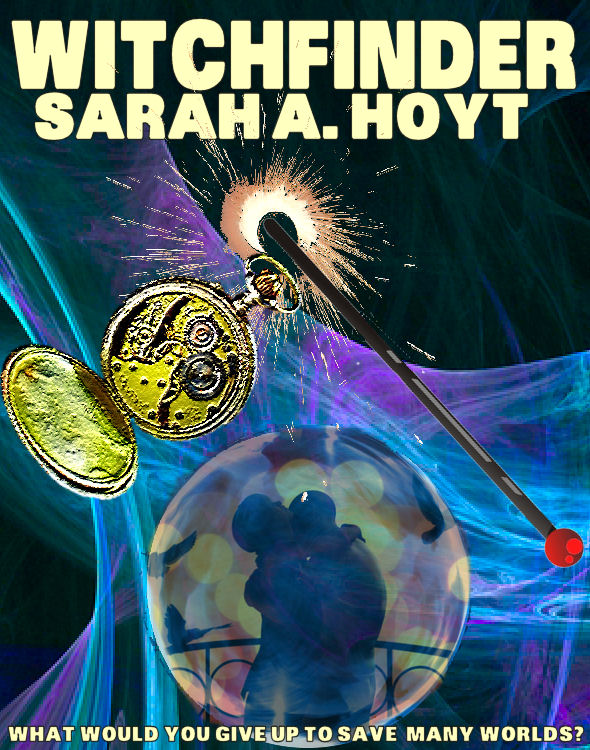
Free Novel — Witchfinder Chapter 15

*This is the Fantasy novel I’m posting here for free, one chapter every Friday.   If your conscience troubles you getting something for free, do hit the donate button on the right side and down.  Anyone donating more than $6 will get a non-drm electronic copy of Witchfinder in its final version, when it’s published.
There is a compilation of previous chapters here and I will compile each new chapter there, a week after I post.  When the novel is completed and about to be edited the compilation page will probably be deleted.

Oh, this is in pre-arc format, meaning you’ll find the occasional spelling mistake and sentence that makes no sense.  It’s not exactly first draft, but it’s not at the level I’d send to a publisher, yet*

For previous chapters, look here:  https://accordingtohoyt.com/witchfinder/

The Fear Of Darkness

Nell looked at Gabriel as he proclaimed his willingness to take down fairyland if that was what it took to bring his youngest half brother back.  For a moment, for a brief breath, she caught a look in Seraphim Ainsling, Duke of Darkwater’s face, as he looked at his half-elven sibling, nominally his valet.  She didn’t know what that look was.  It might be surprise or awe or fear.

Nell knew, however, with absolute certainty, in that moment, that Seraphim hadn’t known the details of Gabriel’s ancestry.  He might have known Gabriel was half-elf but not that he was what could be termed a prince of fairyland, nor why he’d left fairyland.  And he definitely hadn’t known how strongly Gabriel felt about elves and the king of fairyland.

It was just a moment, and then Seraphim looked away, his eyes half-lidded, hiding his expression, and is face went back to the impassive, reserved look she’d seen on it before.

Training, she thought, as though it were a novel idea.  The man had been trained to hide his feelings.  He’d been trained to behave impeccably in public.  He’d been brought up to fulfill his role and his role required that he follow a protocol in public and show nothing of his inner thoughts or feelings and, particularly, show no doubt no fear and no pain.

Once having realized that, she could detect things in his expression: pain mostly, and tiredness.  Though he looked alert and aware, she realized there were fine lines at the corner of his mouth, as from holding his features unnaturally serene against suffering.  And his shoulders were held too square and straight, as if he were afraid they’d sag under tiredness.  And his hands held the head of the walking stick far too tightly.

She looked at him until she caught him giving her a long side glance, and then she looked at her feet.  She hadn’t yet decided what to tell him.  What could she let the Darkwater’s know about her origins, her work, her involvement with Antoine, let alone her involvement with Sidell?  What and how much did they need to know?  And how much would endanger them?  She didn’t know enough to know what she could tell and to whom before they became targets for the secret service.

Now that Antoine was dead – something that didn’t seem quite real, yet – she didn’t even know how much of what she thought had happened since she’d landed in Avalon was true, and how much had been a lie perpetrated on her.  The idea that Antoine would try to kill Darkwater made no sense.  Certainly not when Antoine was supposed to be in a dungeon, his life dependent on her good behavior.

Once more, she caught the Duke of Darkside’s glance on her, and she looked down at her feet.  The Darkwaters talked around her.  It seemed as though they had little more thought than she did on how to rescue someone from the clutches of elves, and on this she had very little to hide from them.  She’d had some idea that elves were real here, and their magic here, as opposed to being – as on Earth – mere legends and rumors.  But she knew nothing else.  She’d heard of treaties between the two realms, but had never sought to inform herself of the details.  Her assignments had been among humans.

It seemed as though the conversation was winding down when Gabriel said, “I will speak to my mother.”  From the way he set his jaw after saying it, the quick, concerned glance Seraphim shot him, and the more openly concerned and pitying look given him by Caroline, it was obvious that this was neither an easy nor a safe task, but no one said anything to dissuade him.  The Dowager Duchess said in a tone of someone who relieves her mind, more than someone who says something that needs saying, “We must get Michael back as soon as may be.”

And Gabriel said, automatically, as though he’d been asked whether he intended to wear clothes outside, “Yes, Your Grace, of course.”

Then Darkwater’s voice rose, composed, forceful, “Miss Felix?”

She looked up at him.  She remembered the charade the two brothers had played for the benefit of Darkwater’s mother, and now she wondered if the Dowager Duchess had yet realized there was more to the two of them than they’d been letting on?  Or if she’d known it all along?  Or if she just now noticed that Seraphim’s wastrel ways, his dissolute living were, at most, a mask upon his real activities?  Or perhaps not, Nell thought.  Seraphim wouldn’t be the first man to be both heroic and a libertine.  The two were so far from being opposed character traits that it wouldn’t even be that unusual.  She must remember that when dealing with the two brothers, no matter how much she admired their courage and mutual loyalty.  Until she could find a way to make it back to her native world, she must play by Avalon rules, and by Avalon rules her reputation was both valuable and easily lost, so she must keep undeserving males at bay.  “Your Grace?” she said a trace of reserve in her nature.

Darkwater’s glance slid sideways at the Dowager Duchess.  So, she either didn’t know of the two brothers’ full adventures or Darkwater thought she didn’t know and wished to protect her.  She watched as he frowned slightly, then shook his head as though to himself.  “There is absolutely no reason for me to ask you questions tonight, he said, though I will have to ask you.  I beg you to hold yourself at our disposal.  It’s been a very long… few hours for me, since I woke up, and I don’t believe I can stay awake and speak with any semblance of rationality for much longer.  I would enjoin you not to teleport anywhere.  We would prefer not to fish you out of the trout pond again.”  He glanced at his sister.  “Caroline, if you would take Miss Felix to the blue room, on your floor, and arrange for it to be made up for her use.  Miss Felix, I shall see you at breakfast.”

Nell understood it as what it was: dismissal.  She didn’t try to argue it.  She knew enough of this world to know that Dukes weren’t argued with.  She guessed even that she was being got rid of so they could speak privately, which was probably the point, too, of having Caroline leave with her.  As the youngest female, she would be protected by her older brothers, though Nell guessed that not much escaped Miss Ainsling’s shrewd eyes.

The girl opened her mouth and said, “But Michael–” and must have read something in Darkwater’s look, because she stopped her protest and said, “Yes, Seraphim,” and bobbed a curtsey, then waited while Nell did likewise.

Nell followed her down a series of broad passageways and down two grand staircases, before Miss Ainsling opened her mouth to say, “I despite my older brother.  My older brothers I should say, since it’s no use their pretending Gabriel isn’t one, as his story made perfectly clear.”

“Despise?” Nell said.

“Oh, yes.  They are so stuffy and full of their own consequence.  And the way they try to keep me from doing anything, simply because I’m a girl and young is not to be borne.  Do you have any brothers, Miss Felix?”

“No,” Nell said.  Then sighed.  “That is, I don’t know.  I was adopted, you see.”  And then she thought in terms this world would understand.  “I was a foundling, I mean.  Abandoned.  I don’t know my true parentage.”

Caroline Ainsling sighed.  “Oh, that’s lucky.”

Nell must have made some sound – some gasp – in reply.  She wasn’t aware of it, but Caroline Ainsling laughed, a brief burble.  “I mean, you must understand, that growing up as the Duke of Darkwater’s daughter, and then sister, I was forever being judged by what they did and how they behaved.  I understand papa was terribly shocking, and Seraphim is in a good way to being so.  And then when Papa…  That is, after Papa died, everyone looked at us with pity and wonder, and you know, we were the center of attention, and we could not shed it.  I often wished to just go somewhere and hide, but of course, there was nowhere where I wasn’t known.  Michael is lucky because he can hide out wiht his machines, as it were, and abstract himself from the real world, but I…”  She shrugged.  “I shouldn’t be speaking of these things.  I am conscious of my good fortune in having a family and a position in society.  And I should worry only about recovering Michael, safe and sound.  I am a wretch.  But so I’ve always been.”  And she sighed again, though there was a theatrical element to her chagrin.

But wretch or not, despite her young age, Caroline Ainsling was competent at mustering the staff to make the room assigned Nell very comfortable indeed.  It wasn’t – of course – by any means a room such as she’d have had on Earth.  There was no bathroom attached.  The watercloset – Caroline said, lushing slightly as she pointed – was down the hallway.  There was a basin and a hewer of water from which it could be filled, the hewer perpetually renewing, Caroline said, with warm water.  And the bed was made with clean freshly aired sheets, and the bedspread was velvet and soft.

Nell suspected that were it seen by daylight and not soft magelight, the room would look shabby.  She remembered stories of Darkwater financial difficulties, and she remembered shabby fabric and worn furniture.  But by magelight this room looked luxurious.

When all was ready and the servants retreated, Caroline said, “And Seraphim will want to talk to you, of course, which is a great bore.  But I’ll have the maid wake you with tea in time to get you down for breakfast in the morning.”  And then, as though realizing for the first time that Nell remained in her wet clothes and wrapped in a blanket.  “What fools men are.  No one gave you time to change.”  A self-conscious smile.  “But then, neither have I.”  She gestured towards the closet.  “There is a night dress and robe in there which should fit you.  And there are many dresses from which you can choose, come morning.  Mama used to keep many in different sizes in all the rooms assigned to ladies.  I understand when Papa was alive, we had many house parties, and ladies would slip into the pond or tear their flounces or… there you have it.  One of them should fit you.  If not, ring the bell and tell the maid what you need and it shall be found.  A maid will be sent to dress your hair for breakfast.”

Nell started suspecting the Darkwater house was far more formal than she was prepared to endure.  Then she thought that, perforce, it must be.  After all the man was a duke.

A moment later Caroline was gone, saying, “I shall have hot chocolate brought to you.  You must be very uncomfortable in those soaked clothes.  Do you need a maid to help you undress?”

Nell assured the girl she didn’t, and as soon as Caroline was gone, undressed herself quickly and laid out her clothes by the fire, to dry.  They were, of course, ruined, but she could wear them to return to London, she supposed.

She had just dressed in a nightgown and dressing gown, both of which smelled faintly of mothball, when there was a scratching at the door.  The hot chocolate, Nell thought, and called out, “Come in.”

The door opened, but what came in had never been a maid.  She saw him first in the mirror, very pale, his eyes half-lidded a lingering smile in his pale lips.  She turned around and said, “Antoine!”

May You Write Interesting Books — Part 8

Junk Food For The Soul

We’ve gone through boring at the beginning and boring in the middle, so you know it would come to boring at the end.  (Wake up.  This will be interesting.  Even if I used the dreaded b word three times.)

Boring at the end is a different type of boring.  If you got to the end, the book, by definition held your interest that long.  But I’m probably not the only one that gets to the end of a book sometimes and goes “well, that was painless” but can’t remember a single thing about what she just read.

This is not always bad.  In times of high stress I read a lot of popcorn or “chewing gum” books.  In fact for someone like me, who – to allude to Heinlein – is a print addict and who needs a certain amount of reading per day, and who will read old personal ads off the back of fishwrap after brushing off the scales, most of what I read is by definition popcorn.

But there is a difference between popcorn and tofu.  (And for my vegetarian readers, by this I mean unadorned, uncooked, un-seasoned tofu, which by definition has almost anti-taste and takes a lot of seasoning to taste like ANYTHING.)  By definition at the end of popcorn you go “um, that was kind of nice.  I think I’ll have some more.”  (Keep on crunching, we’ll write more.) BUT after a slice of raw tofu most human beings go “uh… that didn’t taste like anything.  I can live without it.”

Boring at the end are the type of books I read and when they’re done, I remember neither author nor title.  In fact – and this is really tough as I tend to remember 99.9% of what I’ve read – I sometimes will re-buy or re-pick-up the same book and only realize I’ve read it halfway through.

Now, you want to make more of an impression than that!  And don’t ask me “why?” because the answer is obvious.  You want to make more of an impression than that because otherwise people won’t pick up your next book, except by accident.

This is still better than having the reader throw the book against the wall and say “I will never, not in a thousand years, read another book by this XYZ>@}|*” but only marginally so.  Because while it won’t burn you, it means ALL of your books will be first books, forever.

So, how do you imbue the book with deep meaning and make it stick in the memory.

The first cure for this is really simple and it’s something I can only in good conscience tell people now.  Even two years ago I’d have told you that you couldn’t do this, because it would be mentor malpractice to advise it.

Because the first cause of doing this is “writing to market.”  Now, I’ve never done this fully, partly because I have a sad dysfunction of the stereotype gene.  Whatever I take on, no matter how much I attempt to make it a cliche tends to get a twist usually in direction “Weird”.  This is the way my mind works, and it’s unlikely I’ll be able to make it work any other way.  So…  Live with it.

However, all of us, from beginner to bestseller, to some extent “wrote to market” in the past.  This is for the very simple reason that there was absolutely no point NOT doing it.  When the powers that were who controlled access to bookstore shelves and therefore to the public made a decision from the top – say (and yes, all these are decisions they made, solely from the top, at some point ) “cozies aren’t real mysteries” or “Space opera isn’t real science fiction” or “Regency isn’t real romance” – you might be able to buck it if you already had a name, but you could NEVER make a good living off bucking it.  Because they wouldn’t take you seriously, and therefore they wouldn’t put you on the shelves.

To what extent did that influence us?  Well, we all read the bestsellers (I wonder how much of a bump they got from that?) even if it wasn’t our subgenre, because we had to know what had impressed a publisher so much they’d pushed it.  We read books on how to write bestsellers, too.  And we would pay attention to what was “hot” right then.  When I started paying attention to the field this was quest fantasy.  Then there was a brief “historical” hotness, which I loved because it was something I could do, but that went away really quickly and we were told it didn’t sell.  Which might be true, or it might be that the minds at the top – the same minds who know their Three Musketeers from the Disney movie – couldn’t keep up and hated to feel like idiots and not be able to tell when they were being spun.  (Yes, I’m uncharitable.  What of it?) So, the next “hot” was something that New York Junior Editors definitely know.  First there was chick lit because, well, duh, Sex And The City did well, so of course books about shoes and sex will do well.  Only they didn’t, which is interesting since at one point that was ALL you could find in all genres in book stores.  Maybe the public has a spine after all (who’d have thunk it?) So, that was brief too, and then there was just sex mostly in the form/excuse of undead porn (thank you Kate for the moniquer) which did well enough because it’s sex & violence and some of it is even competently written.  The last fad I’ve become aware of is steampunk which is one of those that seems to me misguided, since by definition it’s more of a costuming than a writing trend.  It’s a very visual subgenre which doesn’t work well in print.  But it might not matter, anyway, since I don’t think that trends can or will hold on as they have before the onslaught of indie fiction and surprise sellers.  I think the time for trends from the top has passed.

However, we had to be aware of these so we could spin our writing that way.  Put in a sex scene, drop in a werewolf, whatever.  If it was the choice between not being accepted and being accepted you did what you had to do.

Does this mean everything written was pap?  No.  Look, given my ideal career path, when I first came into the field, I’d probably never have written fantasy, or perhaps have written one or two stand-alones in fantasy amid a sea of space opera.  But I got my spirit broken on that before I ever sold novels.  My space opera short stories didn’t sell at all, no matter what the level of competency and in self defense I started writing “significant” sf and a lot of fantasy.  Which sold.  So I was prepared to write fantasy novels.

Now, most of the time the mind that does SF can do fantasy, because it’s the explanations that are different.  However, I made the fantasy mine.  Some would argue too much so, as I’m one of the very few fantasy writers that makes her fantasy feel non-supernatural.  This is partly because my first love was SF.

But there are people – perhaps more lacking in self-confidence, or perhaps just saner – who go “the other way” on that fork in the road.  Having read what’s selling, or having decided to write what’s selling, they go full “pattern” and write such a stereotypical book that it should be sold in a white cover with a bar code.

Those tend to fall under the “tofu book” category.  And those will condemn you to a lifetime of first books.

So, my first advice on beating the bland is easy.  Don’t write books to pattern without making them yours.  Look, in the present day it won’t even help you that much.  Yeah, you might sell to the big houses – maybe – but what are they going to offer you?  Shelf space?  Don’t be silly.  They no longer have command over that.  So, what else?  Cover?  Sister, let me tell you about covers…

I’m not saying here that there aren’t reasons for a dual traditional and indie career.  That would be rich, coming from me, since I’m doing both.  I’m saying that there aren’t reasons compelling enough to justify writing a generic book and suppressing your own individuality (there’s a question if the reasons were ever compelling enough for THAT.)

So, stop playing to the house.  Just write what you want to write.  Some of it you’ll have to publish Indie.  Big deal.  You’ll live.

The other causes for this are more difficult to cure, and we’ll deal with them Monday.  Why Monday you ask?  Well, tomorrow I’ll mostly be running errands, shopping and taking down holiday decor (Witchfinder will PROBABLY be posted late as tonight I’m also dealing with a bunch of minor housekeeping stuff.) and then new year’s intervenes, including the infamous tradition of at least one meal at Pete’s on New Year’s Eve to see off the year in style.  And I’ll have to molest dinosaurs (i.e. visit the natural history museum, whatever they call it these days) either the eve or the day, because that’s what I do (Yeah, like you’re not all geeks.  Pull the other one, it plays jingle bells.)  So posting will likely be irregular.  I’ll still try to post everyday, but won’t make any promises as to theme and promptness of post.  So, class dismissed, see you Monday, drink a glass of champagne for me and don’t forget your writing resolutions.

May You Write Interesting Books — part 7

Plot Can Never Dull Her Infinite Variety

Okay.  So, you’ve got all your ducks in a row. Unless your plot is about misaligned ducks.  You’ve sent the pope for a swim.  You’ve Heinleined your info.  You’ve let go of what you can’t control.  Your plot starts with action.  You throw us in head first.  Your middle sequence is a rising series of battles.

And yet, your first readers, or, worse, your reviewers, read your book and say “It’s so boring.”  So you scratch your head and you say “Uh, but I did it all right.”

And you might have done.  But what you might be looking at is a failure of foreshadowing technique.

Foreshadowing is one of those things no one tells you are essential and which, when it fails, mimics several other issues.  So you might get told you don’t have a plot.  Or that your timing is wrong.  Or that the plot is too predictable or not predictable enough.

If you’re getting told stuff like that, and you’re absolutely sure you have a plot and that the plot is long enough for your needs and that it does in fact have some surprises in the structure, you might have a foreshadow failure.

How can that be a foreshadow failure?  Well… To explain, let me give you an overview of a situation in which foreshadowing – what we make sure readers know ahead of a scene and which they need to know for the scene to work – is essential.

Okay, here’s the situation, not unusual for a woman-in-peril or a thriller.  Your female character comes home to her apartment.  She’s showering, undressing, putting make up on.  And while she’s doing all this, there’s a serial killer hidden in the closet, watching her, waiting to strike.

You can make several mistakes with this kind of situation.

1 – killer from the ceiling, a variant of elephant from the ceiling.  This is page 120, the killer has never been mentioned yet, and suddenly he springs out of the closet and tries to knife your character.  This almost kills your reader with shock, as until now he thought this was a book about mutant chickens.  Don’t do this.  If your mutant-chicken stalking serial killer is needed now, but you didn’t plan on him, go backward and make sure that he’s mentioned, hinted at or somehow suspected from the beginning.

2 – The killer has been talked about so much that when he shows up people go “Oh, it’s just the killer.  This is so boring.  We’ve expected him all along!”  Master the art of foreshadowing without making it so obvious that people are going “Oh, the killer.  DUH.”  One way to do this is – to paraphrase Heinlein, misdirection, indirection and razzle dazzle.  Mention of the killer is in a talk about mutant chicken eggs.  Alternately he’s mentioned, but your character laughs at the idea. When it happens it’s not out of the blue, but you also don’t expect it all along.

3 – We don’t know killer is in the closet.  Let me put it this way – your character showering, putting on her best clothes and applying make up is NOT riveting.  However, if we know killer in the closet might jump out at her at any minute, it becomes fascinating.  We watch and wait for the killer to attack.  Good suspense.

Unless…

4- You tell us everything about the killer ahead of time.  We know he won’t jump out till midnight.  This takes all the interest out of the dressing scene.  This is a failure of TOO much foreshadowing.

Now you’re sitting there, holding your breath and threatening to turn blue if I don’t tell you how to do this foreshadowing thing just right.

I can’t.  This is something you learn by doing.  One small thing you can do is make yourself aware of it.  Take two of your favorite books re-read and mark or compile all instances of foreshadowing.  And then practice, practice, practice.

You wouldn’t expect to dance the ballet without practicing, and I guarantee you Mona Lisa was not DaVinci’s first picture.  So, to learn foreshadowing, if at first you don’t succeed, try and try again.

May You Write Interesting Books — 6

Round Round, You Get Around

One of the common syndromes of the middle of the book is the loop-de-loop syndrome, or the “why are we going around in circles, again?”

One common reason for this is that the author ran out of plot and decided he needed more wordage and tried to add “something happens here” in a way it wouldn’t affect the plot before or since, which is fine, as far as the writer is concerned.  So the author added three or four incidents that are solved and add nothing to character development.

These might be entertaining enough, but people are not stupid and they do realize that they’re being led in a merry go round.

Look, even when I was a kid and was taken on those little airplanes attached to the center of the ride, after a while I realized I couldn’t fly out into the wild blue yonder.

So… if you have loop-de-loop syndrome, what can you do?

First, you can take it out, and you can figure out how to make it honest plotting complications, and revise the rest of your book, backward and forward to make it integral to the plotting.

But… but… you’re not willing to do that – well, tough.  Seriously, kids, the readers are definitely not stupid, an you need to give them honest plot for honest money.

The second thing you an do is take it out and make the story shorter.

But Sarah – you whine – what if I didn’t do that to pad the story?  It is part of what I wrote, and I just realized in revision that it has loop-de-loop syndrome?  Doesn’t the character have to go through trials and tribulations?  What do I do?

Well, then.  If you weren’t padding the story and you still ended up with loop-de-loop, here are some things to consider

1 – Do you have rising action or is it all at the same level?
Loop-de-loop is caused by same-level, same old same old syndrome.  To correct it make sure that something bigger is at stake or something more is needed each try-fail sequence.  So, the first time your character had to bend to go through the passage and the fate of her family was at stake. Next time make her crawl on her knees and the fate of her city is at stake.  Next time, you have her crawl on her belly and the fate of the country is at stake.  You get what I mean?  Raise stakes AND effort required and you won’t get the feeling of going around and seeing the same landscape again.

2 – Are the confrontations happening between the same two people in the same old place?
Sometimes you get the feeling that it’s all going in circles because of staging.  So, if your characters keep arguing in a diner, have one of the scenes happen in the bedroom and/or in the car.  Think of the complications this can add, too, like a character demanding to be let out of the car.  Same thing with stage business.  I think I’ve told you before one of my books RIGHT after I discovered stage business my characters drank so much coffee they’d have spent their life in the bathroom in real life.  One of the good ways to break this, have a character do something that’s his job or hobby, while the argument takes place.

3- You’re overmatching the opposition.  If your character is stronger/smarter/better than all opposition and you let the him/her win everything easily, you can get the – yawn – feeling you’ve seen it all before, and what’s the point reading more.
A) consider solution for problem one.  Have rising stakes.
B) consider that even a weak or stupid opponent can get one in by accident and make life difficult even for a superhuman.  So make it so.  Make your character work for it, more and more.

Next up “It’s sooo boring.”

May You Write Interesting Books — 4

The Flabby Middle

So, we’ve covered how to begin a book without making it boring – if there’s anything you need to know about THAT topic, feel free to ask in comments, but for now let’s move on to the next topic.

Does your book suffer from a flabby middle?  Well, then it’s time to take it to the gym.  Make it do some stretches and lose that extra fat – can you tell what my New Year’s resolution is?  Yeah.

Most of the time, the flab in the middle of the book is like the flab in your middle – stuff you don’t need but are storing because your body thinks it should be a certain weight.  If you know you’re contracted to deliver eighty thousand words and you find yourself suffering from premature ending (hey, it happens to the best of us) it might suddenly seem very tempting to just start describing everything ad nauseum and with relish.  You may suddenly feel a need to explain the fashions of your world or give us a lecture on alien textiles.

Do try to resist it.  Unless strictly needed for your story, that kind of intrusion becomes really old really fast.  Again, your readers might find your textiles fascinating, AFTER they read and love the novel, the world and the characters.  If you bore them in the middle of the first novel, this is unlikely.

One cure for this type of flab, of course, is to make your book shorter.  With indie publishing, and if you’re not contracted to anyone, ask yourself if the novel REALLY needs to be eighty thousand words.  Would it be a better novel at fifty thousand words?  The whole point is, after all, to make your readers happy.  It’s better to leave them wanting more than to make them throw their kindle against the wall.

On the other hand, perhaps you are indent– Er… contracted to a traditional publisher already.  And maybe it’s not the kind of publisher you can call up and say “that goat gagger at 229 thousand words just isn’t jelling.  Can it be eighty thousand words instead?”  So, what do you do?  Well, if you have a goat gagger to write, I suggest you leave the country and tell the publisher you died.  At least it’s what I’d do, since I’ve never managed to write one of those.  Okay, I’ve never managed to write a PUBLISHABLE one of those.

But if it’s a matter of going from fifty thousand to eighty thousand words…  That I can advise on, having done it.  Instead of loving descriptions of your character’s socks, consider going back to the beginning and reading it again.  Would a subplot help you tell this story?  Say, if the character’s favorite sister has a romance that parallel’s the main character’s and shows the main character something?  Or if the sister ship to the ship whose captain your space opera is following has a problem and is lost, perhaps it will show us the possibility for disaster of your own trip.

If you can’t add a subplot, then consider what questions your beginning asks.  Do you answer them all?  If you do, then perhaps there is a flaw in your character that you can exaggerate and which has to be fixed before you can go on?

When all else fails, of course, just get your character in real, serious trouble.  Go back to the beginning and introduce another problem.  Make the thing your character fears the most happen.    Go back to the beginning to seed details, of course, and make sure that this is not a mountain you dropped on him, but something plausible and terrible you can make happen to the poor critter.  Say give him a fear of rats, and then have him drop into a rat’s nest in the third chapter.  The panic that will induce can then cause other problems…  You see the point, right?

There are other, more genre-specific cures.  If you have a mystery, introduce another murder.  The murderer things someone knows something, say.  Or, you know, the red-herring character?  Yeah, have him be found dead and introduce two more red-herring characters.  For an adventure story, introduce a complication.  Have your character get lost, or be captured by the aliens.  Or introduce another puzzle that must be solved before you can get to the end.

Beware of loop-de-loop syndrome, though.  And walls falling on character syndrome.  You must go back to the beginning and make sure these proceed from the beginning, otherwise you’re trapping your reader in a roundabout.  Having taken a trip to Europe this summer, let me tel you that while roundabouts might slow down traffic, getting trapped in them isn’t fun.

The cure for that will be explained in tomorrow’s riveting installment.

It Is Clear There Will Be No Post Today

For obvious reasons of Holiday and family.  In fact, posting for the next week will be irregular.  BUT for now, there will be the Free Short Story posted today.

It is the closest thing I have to a Christmas story, (though I suspect those dang Nuns of St. Lucia of the Space Ways will inflict one on me sooner than later)  so I hope you enjoy it.

The story is here — or just click on the Free Short Story tab at the top of the blog.

I’ll be back sometime tomorrow.

Free Novel — Witchfinder Chapter 14

*This is the Fantasy novel I’m posting here for free, one chapter every Friday.   If your conscience troubles you getting something for free, do hit the donate button on the right side and down.  Anyone donating more than $6 will get a non-drm electronic copy of Witchfinder in its final version, when it’s published.
There is a compilation of previous chapters here and I will compile each new chapter there, a week after I post.  When the novel is completed and about to be edited the compilation page will probably be deleted.

Oh, this is in pre-arc format, meaning you’ll find the occasional spelling mistake and sentence that makes no sense.  It’s not exactly first draft, but it’s not at the level I’d send to a publisher, yet*

The Duke’s Duty

And now this.  Seraphim stared at the thing on the seat.  Were it not for his ability to unfocus his eyes and to look just so at that he would think it was Michael, but it was not.

The question was, how long had his brother been missing?  Would this sculpture, this animated construct always have been like this, listless and unresponsive?  Or was there a way it could have acted like Michael and Seraphim not have known, or – more importantly – the household not have known, while Seraphim was unconscious?

He looked towards the Duchess and narrowed his eyes, “Mama, they’ve always told me… that is… I’ve always heard it tell that you knew about changelings, and that this related to something in your childhood, but no one ever told me what?  It was all whispers and then ‘well, you know, because of her childhood’ and when I pursued the information they told me I was not to speak of it.” He looked steadily at his Mama, hoping that she wasn’t about to tell him this was not to be spoken of.  He knew he was making poor Penny damned uncomfortable.  He could tell without turning to look, without Penny saying a single word.  He knew whatever the mystery with changelings in Mama’s childhood was related directly to whatever and whoever Penny was.  That Penny would not in fact be here today but for mama and whatever had brought her in the presence of elves in her childhood.  “How did you know, Mama?  What is it with changelings?  Have you seen one of these before?”

The Duchess looked at the thing on the stool and sighed.  “It is not,” she said.  “A changeling like the one they left for me, when they stole me to fairyland as a child.”

A long breath, with a sound on the edge of keening escaped Penny, but Darkwater didn’t turn to look, and instead kept looking at his mother, who spoke like one in a dream.  “This is a construct, animated.  It looks like, and probably is, ice.  Water that someone poured in the rough shape of a young man, and then left overnight to freeze, then animated and gave your brother’s look by magic.  It is not alive.  It has no feelings.  It–”

“Stop,” Gabriel Penn said.  And what was so strange was that Penny had told the Dowager to stop, something he’d never done before.  “Stop, Your Grace,” he moderated, and sighed.  “It will not do.  We should discuss it, yes, but not here.  Not in … its presence.”  He waved towards the changeling, who remained, impassive, on his stool, looking blankly at the world.

“But Mother says it’s not animated,” Caroline said.

Penn sighed again.  “No, but still.”

“What should we do with it then?” Darkwater asked.  It seemed to him foolish to leave the thing alone, as though it might get up to mischief on its own.

“Nothing,” Penn said.  “It is losing its magic and will presently melt.  But if you feel better, Duke, we shall lock it in the closet.”  He took the creature’s arm and led it, and it let itself be led, to a cupboard in the wall, where Michael kept his chemicals and his vials.  Penn pushed the creature in there, closed the door and locked.  Then closed the closet to sight and sound with a carefully aimed spell.

Then he turned to the room, “Shall we speak, now?” he asked.  “This is one of the safest rooms in the house to discuss such things in, since Michael has hardened it against magical interference, so no rival houses could see his designs.”

“But that thing got in,” Caroline said.  And Penn smiled at her.  “Yes, Caroline, it did, but not through here.  My guess is that Michael has been gone for days, perhaps before Seraphim was injured.  These changelings have a certain programing and seem more real and solid, and interact with everyone normally for a few days, and then wind down and become whatever material they were.”

“Then why didn’t you allow us to speak in front of it?” Seraphim said.

“Because sometimes they are rigged so as to transmit sight and sound to whoever made them.  I have shut it in the closet and blocked all sound magically.  We are safe now.  And I believe,” he said.  “First I will let Her Grace tell us what happened to her in childhood.”

It occurred to Seraphim, for the first time, that Penny spoke as though he knew what it was.  He said so, and Penny pressed his lips together.  “Indeed, Seraphim.  Perforce I know.”  And though Seraphim didn’t know why perforce, in fact couldn’t think of any reason for Penny to know, save that, of course, his mother was an elf, and changelings were connected to elves, he kept quiet.

“I will tell,” his Mama said.  “But let us sit.  Seraphim should not remain standing long.”  He allowed his mother to lead him to a little sitting area around a large, glimmering sphere whose purpose Michael had never succeeded in explaining fully, but which seemed to interest the heads of several magic houses.  There were three straight backed chairs, a chaise and a sofa.  He refused to lie down on the chaise, but allowed himself to be led to the sofa and sat down on it, glad only that no one had brought an invalid’s shawl to drape around his shoulders.  Mama sat in one of the straight backed chairs.  Caroline half-reclined on the chaise.  Penny remained standing, but Seraphim wasn’t about to challenge him, suspecting it had to do with his idea of preserving the appearance of his position, while in public.

Then he realized there was someone else with them.  They’d been so absorbed in their conversation that he hadn’t noticed her before.  Miss Helen Felix had come with them, trailing her grey blanked.  The woman must be freezing, even with the blanket, and indeed looked very pale and tired.  He looked at her, “Miss Felix?  Should we have private talk in front of you?  Two whom do you report?”

She gave something that wasn’t a half laugh.  “To no one, Your Grace,” she said.  “Up until this mor– No, up until the day I left here, whenever that was, I worked for Sidell, spymaster for the king.  Then I would have said I reported to him.  But all that was severed first by his betraying me, and then by his killing the man he was holding hostage for my good behavior.  I am now, Your Grace, entirely a free agent, and as a free agent, I confess I’d like to do what I can to bring your brother back.”

Seraphim didn’t know whether to believe it.  After all, the king’s spies were trained and paid to lie.  He hesitated.

“She can hear my story,” his mother said, quietly.  Seraphim noted that the Duchess didn’t protest that Miss Felix was Penny’s fiancé.  “It is nothing so secret that she can’t find out the general outlines of it simply by talking to anyone old enough to have listened to gossip or practiced magic when I was a child.  It is not normally spoken of, because people are afraid to give me pain, not because it is not known.”

Seraphim looked at Penny, “And you?  Since I presume you’ll be talking, also?”

Penny looked surprised, then glanced at Miss Felix and shrugged.  “Oh, she can hear mine too.  There is nothing in it that cannot be gathered with some sleuthing, and I suspect the king’s secret services know it well enough.  If I’ve kept it secret at all it was to spare your family shame by association, but I judge in the trouble we face that is the least of our worries.”

“When I was five,” the Duchess spoke.  “I was stolen away to fairyland.  No one knows why.”  She spoke a little too loudly, a little to cheerfully, as though trying too hard to sound normal.  And she’d barely let Penny stop talking before she started.  “I had magic, of course, but no more than my brothers and sisters, and no more than a hundred other children in the immediate vicinity of my parents’ estate.  But whatever it was, and for whatever reason, it was a well planned thing.  You see.”  She looked up at Penny, and her eyes unfocused.  Not as though she didn’t want to see him, but more as though she knew what she had to say would touch him very nearly and were trying to pull herself away from it, and not to dwell on the pain she was giving.  “You see, the changeling they left in my place was not a construct, but a little girl.  A little elf girl they had to have shaped from very early on to look exactly like me and behave exactly like me.  For days – weeks – my parents didn’t know I was missing.

“For myself too,” she said.  “It was hard to tell.  I lived mostly in the nursery, with nanny and the nursery maids.  My life was surrounded by toys and I was an imaginative child.  As such… Well, I thought simply that my toys were more alive than before.  For a long time, I didn’t notice that I was in another realm and then…”

“And then?”

“And then I started to feel cold.  Not physically.  I don’t think fairyland is any colder than here.  It is, after all, like another world in the multiuniverse, just one that never fully separated.  So while it is in a way attached to our world, it is also a copy of it.  It has the same climate at the same time.  But there is… Everyone in fairyland is cold.”  She shrugged.  Penny was walking back and forth across the little sitting area, as though he couldn’t sit still, but he nodded when she said that.  “It’s not that they don’t show emotion,” she continued.  “It is that they don’t know what emotion is.  They are like humans without the…”  She shrugged.  “I’m sure Gabriel can explain it better than.”

“Yes,” Penny said.  “Yes.  But not just yet, pray go on.”  He paced.  She looked up at him.

“I realized that I was in a way absolutely alone, like… like a child raised by wolves would be alone.”  Penny shuddered, as though in response to her words.  “But I was too young to know what had happened or to seek to escape captivity.  I could not, and as such, I would have remained forever captive in fairyland, but…  But my parents had an hostage.  And they did what has always been done when a real changeling, a living one is left behind in place of the child taken.  They tortured her.  They subjected her to various discomforts, until I was brought back.”  She took a deep breath.  “I’m sorry Gabriel.”

He paused in his pacing.  For a crazy moment, Seraphim wondered if the changeling had been Gabriel, such the tone of his mother’s voice.  Could elves change their gender?  He’d never heard tell of such a thing.  And besides, Penny was around his age, was he not?  Could he have been kept in some stasis, so he didn’t grow?  But no, Penny was Seraphim’s half brother.  He had the Darkwater look, the Darkwater magic, and Seraphim’s own father had recognized him as such.

“What is there to be sorry for, Your Grace?” he asked, pausing in his pacing to look at her.  “Oh, perhaps, yes, perhaps it was that torture, which, though, from what I heard was very mild, at least for an elf, which led her to never quite fit in fairyland again.  But I don’t think so.  I never told you why we were thrown out, she and I, have I?  I told my father when–” He shook his head.  “I beg your pardon.”

“You beg my pardon?  For admitting the duke was your father?  Or for mentioning it in my presence?  Of all the things your father did, Gabriel, siring you was probably one of the most worthy.  Don’t scruple to admit it.  He admitted you openly, even if he never changed the name your mother gave you, since nothing could be gained by saddling you with Ainsling, when no title and no fortune accrued with it.”

Penny only nodded, though Seraphim wasn’t sure to what.

“My mother was the changeling left in place of Her Grace,” he said.  “She was also the child of the deposed king of fairyland.  No, don’t ask me how or why.  There are revolutions in fairyland, and civil wars, just as there are here.  And I think at the end of the last such war, when my… I suppose, my grandfather, the then sovereign of fairyland was deposed, he left behind his young daughter.  It was thought that by sending her as a changeling to the world of mortals, it would dispose of her, I think – though the thinking of elves is not the same as ours and it is hard to fathom at times.  However, in the time she was away, there was another revolution and my… I suppose my uncle, became the sovereign of fairyland.  he could not allow a princess of fairykind to be tortured in the world of humans and therefore, reluctantly – and I do feel it was reluctantly, though I can’t explain why – he gave Her Grace back to her parents and took my mother back.  But he had children of his own to inherit after him.  And my mother was ever odd.  Oh, I don’t think they did more than threaten her and make her uncomfortable, and perhaps make her work – the things that legend says one should do to changelings, though some people make the poor creatures sit on live coals or worse – and strangely, from what I know of my poor Mama, I don’t think that’s what changed her.

“Just like Her Grace could not survive in fairyland, not without noticing the exceptional coldness of elves and would have been changed beyond repair had she stayed in there longer, my mother had experienced the warmth of humans and it had changed her, so she no longer responded like a real elf.

“And she could not live in fairyland, not fully.  Instead, she would escape to the world of men.  Which is how she met with Arden Ainsling, Duke of Darkwater.  And she returned to fairyland expecting me.”

“And meanwhile, Darkwater found me, was enchanted by my resemblance to his vanished elf love, and started courting me,” the Dowager said.

Penny hesitated, looking like he would apologize, then inclined his head.  “Only I fit in even worse than my poor Mama.  I was more human, you see.  There is… there is sport the elves engage in.  They will capture some child out of doors on a dark night, or some lost creature, and they will torture it.  When I was three or four, I tried to rescue a puppy that was being tortured for the amusement of the court.  My mother and I were flung from fairyland and unworthy.”  He was silent a long while.  “When my father found me, we were living in a tenement and Mama…”  A long, deep breath.  “I begged to supplement our income.  It wasn’t until I had lived in this house for two years that they tried to reclaim me, and only because they couldn’t allow me to live as a commoner among humans.  They didn’t want me to keep me.”  He looked up, and a sudden fierce light burned in his eyes, such as Seraphim had never seen.  “They didn’t want me for me, or because they cared for me, or even because they honored me, or my lineage.  They’d probably have killed me once they’d got me back to fairyland.  But they didn’t want me to live among humans and perhaps come to value my human heritage over my elven one.”  Another pause.  “I don’t know why they took Michael or what for, but I swear to you, all of you, that I will do my outmost to bring him back, and – if I can – to bring fairyland down with it.”

Witchfinder Compilation Up

In new page — here https://accordingtohoyt.com/witchfinder/

And a new chapter will go up in a couple of hours.  Sorry, it’s been Murphy’s day including an hour spent on the phone tracking something that should have arrived today and corrupted files, including the — sob — new cover for witchfinder.  I’ll track that down soon, and prettify the whole thing, but for now I need food, then going over chapter.

Again, sorry I’m so late.