What’s The Big Idea 5

*Guys sorry I didn’t post till now.  I seem to have caught the flu. (argh).  Hopefully the post makes sense.  I’m now going to nap.*

Very Big, Very Small

When I was a kid, the part of Alice In Wonderland that both fascinated me and disturbed me was the eat this to get big, eat this to get small thing.

Little did I know that when I grew up and became a writer, I would run into the same idea.  Almost as soon as I broke in, agents and editors started telling me that I needed to make my books “big”.  The bible on making books big was Writing The Blockbuster by Albert Zuckerman, the iconic founder of Writers House Agency.  Perhaps it still is.  If you are trying to sell to the big houses and go the traditional route, the book is definitely worth reading, re-reading and taking notes on.

Others have written variants on these books, of course, and they all read to me like diluted versions, but then I’m a well known intellectual snob when it comes to studying difficult material.  At any rate, the entire concept of writing “the big book” and “writing the blockbuster” became massive in the oughts.

This is not a coincidence since the oughts is when the publishing houses and the bookstores perfected their control over what the public got to see and, therefore, got to buy.  To put it bluntly, the only route to a bestseller was to do exactly what the publishers thought would make a bestseller.  Then you got push and it would do well.

Theoretically, of course.  A lot of things were “big” and still didn’t get push.

I’m doing the book a disservice, but what it boils down to is a “big” book contains big ideas, ideas beyond the story it encompasses.

If you’re scratching your head and saying practically any book contains that, even if the idea is “love conquers all”, you’re absolutely right.  BUT and this is important, the ideas had to be those the publishers viewed as “big.”  For instance, in my third Shakespeare book, whose ideas I’d define, if anything as “a man may smile and smile and be a villain” critics detected the “big” idea that I despised racism.  (Rolls eyes.)  True, as far as that goes, but it is an incidental and small point of world building – it is however the “big idea” they could identify… i.e. the one that tied in with their own ideas.

This obsession with the “big book” which eventually became a condition of the agents sending the d*mn thing out at all, gave us romances in which every regency female is a proto-feminist.  It gave us mysteries in which an important person’s life ALWAYS has to be at stake.  It gave us… nonsense.

Did this help the books sell?  Well, it helped them sell to the publisher, and – insofar as the publisher decided to put push behind it – could help it sell to the public.  Now, all these variables are questionable, since, after all, your book could become a stealth hit on Amazon even if your publisher doesn’t put it on shelves – even in traditional format.

So, if you’re going indie, does the story “size” matter?  Do you have to put what NYC publishers recognize as big ideas in it?  Does it have to involve people of importance, historic or otherwise?

I don’t know.  I’m one of those people who reads anything, “big” and “small.”  OTOH would Da Vinci’s Code have sold as well if it were “The Code of Guido, the renaissance accountant?”  Probably not.  The fact that Da Vinci name recognition called people’s attention should not be underestimated.  So, if you’re selling something with an historic tie, making it have some relation even if peripheral to a famous person – famous enough to be recognized by most of the public – might help.

Considerations of this nature help if you have a formless idea.  Say I wanted to write a book about someone usurping the throne.  I could use a king in Portugal, but no one in the States knows or cares enough about Portugal (In fact I’m using a dynastic Portuguese squabble as the basis for the partly finished fantasy book To The Dragons.  Yeah, yeah, hey, let me kick the flu and resume writing.  I will try to get to it this year, I promise.)  But if I use the war of the roses, I clue in the vast majority of the historical-story-reading public in the US.  If you have a choice with your idea, please take that in account.  I’m not saying you shouldn’t.

OTOH let’s say the story you WANT to write, the one that’s pounding down the doors, is a small, private story: a cozy mystery with murder in a family circle or a house party.  Should you force your idea to become bigger so it will sell better?

If you’re going indie, please don’t do that.  (If you’re not, I’m not informed of the benefits of playing to the audience, right now.)  There is nothing more infuriating than a tightly woven mystery with understandable private motives and suddenly, out of the blue, the government did it, or the mafia did it, or… There is nothing worse than a romance that becomes social commentary halfway through.

Keep things plausible.  Stick to the scale you do have.  And if people don’t like it because it’s too small or too big, well, that’s life.  Some people prefer one or the other.  (I have a slight preference for small, since I have a slight preference for internal moves, as a reader.)  But if they don’t like it because the “big idea” is shoveled in with a trowel and doesn’t fit – that is your problem!  Don’t let it be your problem.  Suit your idea to the story you’re telling and beware making it really big or really small when in fact it’s just proper sized.

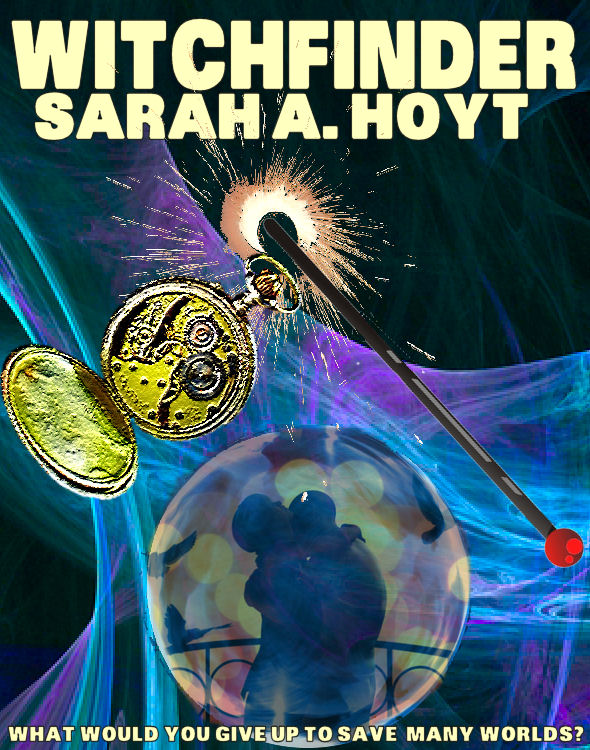
Witchfinder Free Novel Chapter 17

*This is the Fantasy novel I’m posting here for free, one chapter every Friday.   If your conscience troubles you getting something for free, do hit the donate button on the right side and down.  Anyone donating more than $6 will get a non-drm electronic copy of Witchfinder in its final version, when it’s published.
There is a compilation of previous chapters here and I will compile each new chapter there, a week after I post.  When the novel is completed and about to be edited the compilation page will probably be deleted.

Oh, this is in pre-arc format, meaning you’ll find the occasional spelling mistake and sentence that makes no sense.  It’s not exactly first draft, but it’s not at the level I’d send to a publisher, yet.*

For previous chapters, look here:  https://accordingtohoyt.com/witchfinder/
Trapped

“Antoine,” Seraphim heard, as he approached Miss Felix’s room.  He heard it clear as day, sounding through the closed door, and he stopped, swaying a little as he balanced on his feet and his silver headed cane, and looking at the door in puzzlement.

She’d said the same word – ad used the same tone – when she’d seen the corpse.  Seraphim wrinkled his forehead.  Was she talking about the corpse?

The next words “Oh, Antoine, no,” made him wonder if she was lamenting the corpse’s death.  Stupid if so.  Well, perhaps he was not in the position to judge.  He’d never been in love.  At least, he didn’t think so.  There had been that cook’s assistant when he was twelve, but he rather thought that his interest in her had been predicated more on the currants that she had it within her power to dispense than on her own, very young and charmless, person.

However, he’d seen in his time, how men – and possibly women too – could become utter fools over love, or what they believed was love.  Even Gabriel Penn, one of the people Seraphim knew best in all the world, had thrown over his academic career and the possibility of making his independent way in magic or law for the sake of love.

But at that moment words echoed through the thick oak door which might be related to love, but were not related to mourning a dead lover, “No, Antoine.  Stop.  You cannot do that.”  The last words were a scream, and there was real terror behind them.

Seraphim didn’t think he could use enough magic to unlock the door.  Not in his present weakened condition.  And he didn’t think he could put his shoulder to the door, either.  He opened his mouth to call for help, but – this far, in the guest area of the house – he doubted anyone would hear him.  Oh, of course when they had a house party they staffed this part of the house, but not when it was merely a guest and an unexpected one at that.  There would be a bell in the room, but–

He put a hand to the doorknob.  To his surprise, it opened at his touch.  He threw it open, and stepped into the room before he realized he was staring at the back of a man, who loomed large, standing up, and cornering Miss Felix, who, in the corner of the room, held her fingers crossed in a gesture of aversion.

“Step away from the lady,” he yelled, even as he thought that corpses were not supposed to be wandering the house in the night.  The man was dead.  Seraphim had made sure of that.  The magical bolt he’d thrown at the creature would have felled anyone with even a particle of magical talent.  And the man had magical talent.  Had to have it, else he’d not have been able to attack Seraphim.

So, this man, Antoine, had to be dead.  And dead men didn’t walk, except in the fantasies of sickly old maiden aunts.  Or unless, of course someone had used the resurrection spell.  And that would mean someone in Seraphim’s house.  And it would mean, of course, that Antoine, whoever he was, would still be dead, just an animated corpse.

The idea made Seraphim’s hair stand on end.  The man? Corpse? Hadn’t reacted to his shout.  Animated corpses were notoriously hard to deter.  As Seraphim watched, the creature took one step closer to Miss Felix, whose whole face had drained of color, and whose eyes looked too wide as she looked up, in sheer terror.

Seraphim grabbed the nearest object – one of the decorative vases atop a nearby table – and threw it with force at the creature’s head.  The creature started to turn and Miss Felix ducked under its arm, and ran towards Seraphim.  “I’m so glad,” she said.  It was almost a scream.  “Oh, thank you,” as she grasped his arm and almost toppled him with the force of her terror.  “He’s dead, you know.  Quick.  Let us–”

Before she could say what he should let them do, the creature who’d been threatening her had spun around, and Seraphim grabbed for his cane, and took in breath, horrified.  There was no doubt that Antoine was dead.  He looked exactly the same as he had while lying on the pallet which the gardeners had carried up from near the lake.  His face was pale and immobile, his lips drained of color.  His eyes, as far as they were open, showed only a sliver of white.  There was no expression to the slack features.

Seraphim pushed Miss Felix behind him, with barely a qualm as he remembered she seemed to have objections to being protected.  “Stay,” he said.  “What was he– it doing to make you scream?”

“Chasing me,” she said.  She must be mad with terror, because she made no effort to assert her ability to care for herself.  “Trying to corner me.  He should not be alive.  Why is he alive?”

“Someone must have made a resurrection spell,” Seraphim said, as the creature shambled towards them.  “Someone in the house.”  The idea was alien and obscene.  “Stay behind me,” he said.  “I won’t let it hurt you.  You must remember he is not your friend.”  He had no idea how he would not let it hurt her, considering that he felt as week as a newborn kitten.  But, he thought, though it was true that only the man who’d done the resurrection spell could undo it, it was also true he should be able to set a small magical restraining spell and stop this creature from coming closer.  Once enclosed in a magical cocoon, it would be unable to follow Helena Felix, and Seraphim should be able to question her about how this situation came about.  More, he should be able to find out who, in his house, had dared use an illegal spell to rewaken someone who’d tried to kill Seraphim.  And if Seraphim couldn’t, Penny could for sure.

The thought of the circumstances under which Penny had last been involved with resurrection spells made Seraphim hesitate, but he shook his head at his own foolishness.  Gabriel Penn might have been a fool for love.  Gabriel Penn might be an idiot when it came to loyalty and friendship, even, but the one thing Gabriel Penn wasn’t was a traitor to Seraphim.  Half elf, perhaps, capable of his own designs and his opinions that would shock the polite world, almost certainly.  Too smart for his own good, assuredly.  But Gabriel Penn would not betray the Darkwaters.

The creature shambled towards them, and Seraphim put out his left arm, to keep Helena Felix behind him, while he raised his right hand that held the silver-tipped cane, and, using it as a magical wand to concentrate his power said the first words of the cocoon spell, “Miras, enax–”

He got no further.  The animated corpse facing him stopped at the first wound of the words, the first feeling of the power leaving Seraphim’s body and flying forth.  But that was only in the first second.  A breath later, there was a feeling as though a line that linked Seraphim to the corpse had gone taunt.

Later, neither he nor Helena could decide exactly what had happened.  Each of them had different accounts, and both accounts were impossible.  Seraphim remembered – he doubted he could ever forget – the thing’s eyes opening fully and sparkling as though there were a fire lit behind them.  Its mouth too opened, wide, wide, wider, impossibly wide, till they’d fallen into it, he and Helena both.

And that made no sense at all, because in his memory, either the corpse had grown very large, or they’d grown very small, both of which were impossible, and then he and Helena had stumbled together, falling into that dark vortex of a mouth, falling, falling, head over heels, like flying leaves or tumbling sticks, falling, falling, falling, falling, in darkness and cold.

He was so shocked it took him a moment to recognize the in-betweener and by that time they were past it, and dropped, head first into light and music and sound flailing and screaming.

As they landed on the ground, hard, he was aware of people all around and something ahead of him.  He blinked… an elephant?

It was all the time he had before someone screamed, pointing at them.  He was not sure where they were, or what had happened, but he knew one thing: in nine out of ten worlds, what they’d just done, falling out of seeming nothing, in a public place, was enough to warrant their death.

Barely able to stand, feeling as though the entire world had fallen on him, he stood.  His mind in turmoil, not knowing where they were or how they come to be there, he reached back and grabbed Helena Felix’s wrist, and pulled.

He ran away from the elephant, away from the press of people, and into the first dark space his blurry and stinging eyes could find.     In Darkness And Despair

Gabriel Penn sat up at the feeling that his spell had been disrupted.  He’d left an alarm spell in Seraphim’s room, and it was supposed to trip and wake him if Seraphim left the room.

What he felt instead was the sensation that the spell had been tampered with, and that muffled and distant.  Which meant whoever had interfered with his magic alarms had done it in such a way, and with such sure knowledge of how Gabriel set spells that he could disable it and delay Gabriel sensing it had been disabled.

Because Gabriel’s magic was an amalgam of the human magic he’d learned in Cambridge and that elven magic he’d learned when very young at his mother’s knee, only one of the human magicians in this house knew it well enough to disable it and to muffle the realization it had been disabled.  Seraphim.

Cursing under his breath, Gabriel reached for his dressing gown, which he’d flung across the foot of the bed before laying down.  He slipped it on by touch, then said the one word that brought the magelight on the bedside to full glow.  It illuminated the full extent of his room – a tiny servant’s room containing a narrow single bed, the trunk he’d taken to Cambridge and brought back again, and which contained all of his clothes, and a desk, pushed up against the wall and piled high with papers.  From the mess on the desk he extracted his magic wand.  He rarely used it these days, but he had a bad feeling over this whole situation – a persentiment of disaster, he thought, and he didn’t like these feelings.  Given his origin and avocation they tended to be all too accurate.

Holding the mage light – fully lit – in one hand, and the magic wand in the other, he opened his room door and, not bothering to close it, pelted down the hallway and up the stairs towards Seraphim’s room.  He muttered under his breath, continuously, a word that would have shocked the ladies of the house very much if they’d heard it.  It would to be honest, probably have shocked them, too, to see him running down the hallway in an ill-tied dressing gown over his underwear, which was all he’d worn to bed.

It didn’t matter.  He’d rather shock them, or them the female servants, than have the feeling of dread in his mind be justified.

He ran up the stairs, two steps at a time, and down the hallway.  But Seraphim’s room was empty, the door open, the magic spell broken.

Gabriel stood in the hallway, his heart beating so loudly he could barely hear himself think.  And then he felt it, coming from the guest wing, where they’d lodged Miss Felix: magic. A big discharge of magic.

He started running again, mindlessly, pleading with some nameless divinity to let him be wrong.  Just this once, please let him be wrong.

But before he reached the room, he knew he wasn’t.  He felt the magical discharge of a trap going off, the pull and suck of a vortex opening between worlds – a portal not activated by the people thrown into it.

And turning a corner, he saw Seraphim and Helena Felix being sucked into a maw of darkness.

As the magical fog and darkness dissipated, he realized what was left behind was perhaps even worse than having lost your legitimate brother, the duke, to a magical trap that had taken him who knew where.

In the middle of the guest room stood an animated corpse.

“Shit,” Gabriel Penn said, loudly and emphatically.  And raised his wand.
I’m Sorry

I’m trying to write the next chapter of Witchfinder — actually edit — and though I know what is happening, it’s just not gelling.  Nor is anything else.

I think between the writing pace, the very busy holiday season AND the major cleanup, I’m a bit scorched, if not burned out.

I am therefore taking a leave of absence from this blog till Monday, when I’ll be back.  I’ll make it up to you re: the free fiction.  However, not today and not tomorrow.  I’m going to convince my husband to take me to molest dinos and maybe a long walk in the park where he threatens ducks with roasting them. (It’s a hobby.)

Since I’m not really “burned out” just tired, a day and a half away should be enough.

Wish me luck and decompression.

Posting will be late tomorrow

For various reasons, including that after eight years in the house we thought we should unpack.  So, I’ve been organizing the house from the basement up & decluttering the downstairs, as well as trying to finish three books.  (You’re going to ask.  I know.  Please don’t.)

So I intend to sleep late and post late.  Live with it.  Witchfinder might not be out till Sunday…

What’s The Big Idea 4

Making It Your Very Own

Unless you’re a pure pantser – and if you are you should read my friend Kate Paulk’s Pantser’s Guide over at Mad Genius Club – and even if you are (in which case, sure as shooting you’ll need to face this when you come around to revising), sometime between first glimmer of an idea and writing that story you’ll have to admit that it’s a tale told many times.

I usually get my ideas from a character who intrudes into my mind with enough force and determination that I can’t banish him or her.  And yet as individual as that character is, it’s impossible for me, as much as I read, not to see the character’s pedigree.  Lucius in A Few Good Men obviously has a good dose of genetic material from The Count of Montecristo.  In fact, I make an allusion to it in the first chapter or so.

And it’s impossible for me to send Athena into space without knowing she has a good dose of Friday who, in turn, had a good dose of Candide, of course.

It happens with other people’s work, too.  I can’t really watch Fiddler On The Roof without thinking of Pride and Prejudice.

I’m not saying any of these books have the same plot, or even the same theme.  (I tried years ago to write a book with the revenge-plot.  It didn’t come off well.  But Lucius, like the main character of Count [I’m blanking on the name.  Live with it.  Not enough Caffeine] had years in prison to discover his true self.  And he was educated while in prison.  And while Athena finds out she’s human in the end, she didn’t know she wasn’t human at the beginning – the theme of the book being a ‘yes, but’ to Heinlein’s idea that someone raised to think of herself as not human would be flawed and need to learn the natural human.  Thena was just very badly raised, which had the effect of making her, to some extent truly not human.)

So, sooner or later you’ll find that either your character, your theme or your plot has echoes of other books.  You might be choosing a story Or you might have finished a book that looks vaguely like a cabbage – since lately I’ve done a bit of pantsing, this has happened more than once – with leaves going off in all directions, and be trying to figure out a pattern to superimpose on it in rewrite.  In which case you’ll run across the disturbing truth (A truth universally acknowledged, you might say) that there are only so many patterns.

How do you make a millionth time told tale your own?  Don’t say “you don’t” because of course people do.

Well, remember when I commented on “being yourself outloud?”   There is a post on that somewhere around here, but I can never find anything in this here place.

Taking a pattern and making it your own involves looking at the story – or the pattern – dispassionately and deciding what parts of it you like and which you don’t.  This is useful for people who get their inspiration from stories.  By which I don’t mean you read the latest short story by Big Name Author and go “I’ll write one just like it” – though you might do.  I’d think it’s silly, but you might.  It’s more taking, say, a legend or a fairytale, and saying “how could I write this as a contemporary romance with underwater adventurers?”  Or listening to a song about heartbreak and thinking “How could I write this as a story about robots?”  Or…  You see what I mean?

So, let’s say you just found a character, a story or a plot wandering about the street, lonely and forlorn.  You’ve checked the tags and it is yours to adopt.  How do you go about house breaking it, feeding it, petting it and making it your very own?

1- Take a dispassionate look at the material that your material has the DNA of.  This is kind of like looking at the parents of the puppy you want to adopt.  And you do it more or less for the same reasons.  Which characteristics do you want to keep and which do you want to change?  (If you want to keep everything, we submit you might be a copyist not a writer.  Take calligraphy lessons.)

2 – At a first cut, see which parts are yours to write.  Which parts could you write convincingly, with or without a lot of research.  Take Starship Troopers.  I could never write that book because my head doesn’t work in a military fashion.  I can write war but from the POV of a “lay” character pulled into it, only.  So, while I love the book, if I were to write something about a war against a ruthless enemy… Oh, wait, I intend to.  It’s called – dang it, it won’t let me change it – Winter Prince, and my main character, Lucky, is a prince’s bodyguard and therefore outside the chain of command.  Also, her work is more with getting the guy who CAN defend the world in place than with going out and fighting the aliens herself.  Because much as I like the other story, it’s nor mine to write.

3 – Second cut – look, really look at the story or pattern or theme or character.  Do you agree with the underlying assumptions that went into creating it?  Don’t assume you do just because you like the author or the author’s view on the world.  For instance, as much as I love Heinlein, was raised by him and feel completely weird admitting this, I have a major source of disagreement with Heinlein’s way of viewing human population as inevitably expanding.  (Looks up.  Sees no thunderbolt, lets breath out.)  Part of this si because I grew up seeing those predictions fail.  Part of it is because I don’t think that’s how HUMANS work.  Part of it is that I think an expanding population would be PREFERABLE but that’s something else.

The thing is that if you take that assumption out of his world building, you realize a lot of his future topples down, leaving a place to build a different future history.  I’m sure there are other “assumptions” built into the stories you love that you know ain’t so, not in the cool light of day.  Once you remove those and substitute your own, you’ll find things are already quite different.

4 – Third cut – if you’re going to admit to your story’s DNA you can either choose to make it as different as possible (i.e. change names, change place names, etc) or leave in allusions in names, place names and/or a reference to trained rats in the first chapter.  I find readers prefer the second approach.  IF you are taking it from a recent story, though, I’d remove anything that might be considered too close.  Partly because of course you might get sued, but more importantly because if you are too explicit, you’re comparing yourself to this author.  I don’t know about you, brother, but I ain’t no Jane Austen.

5 – Now that you’ve cut all the things you don’t agree with/can’t fit in/don’t like/aren’t yours/are too proprietary, you can start building.
The first step of the build is “what does your story necessitate by virtue of its peculiarities?”  For instance, Pride and Prejudice underwater where Mr. Darcy is the king of an underwater realm would have to overcome the fact that Lizzy can’t breathe water.  This will necessitate at least a mention, if not a whole subplot.  For them to be together, there has to be a way for her to breathe underwater.  What does achieving that entail?

6 – You meant to say something with this story.  By which I don’t mean send a “message” because then there’s Western Union.  But, just like a painting captures a certain fall of light, a story captures some element of your view/thought about the world, even if it’s just exploring True Love (and explaining that it’s Mostly Dead.)  Make sure that’s in, either in the outline or in your editing of the book.  If an important part of your theme is that kindness is a good thing, make sure your character doesn’t pull wings off flies for no reason, even if this was part of the theme you stol– used.

7 – If you’re already published and you have fans, make sure you include things you know they’ll like.  These are called in the trade “reader cookies” and they can be a certain character, or the way a character behaves (Thena and ballet, for instance.)  Or even a certain place (at this point my readers get very happy if anything is set in Goldport and the characters eat at the George, for instance.)  Sprinkle those liberally, then adjust the plot to fit.

8 – Do the final polish, either on the novel or on the outline.  Make sure that the way you altered the theme/story is still functional.  Make sure it all works together.  Call this the dress rehearsal.

9 – Proof that pudding – pass it to betas, and see if they say “I see where you got THIS.”  (A lot of my betas know when I’m walking in Heinlein’s footsteps, but they don’t accuse me of stealing, which is good as most of the time, his DNA in my stories is not conscious.)  If they don’t come back and tell you it’s too close for comfort, or even “I’ve read this somewhere before” congratulations, you’ve succeeded.  That story is now your own.

Tomorrow: Very Big And Very Small (Also Witchfinder.)

What’s The Big Idea 3

You Don’t Know Where That Idea Has Been

We come at ideas many ways.  Probably the least likely, the least useful, is the person who accosts us and says something like “I’ve always had an idea for a story, you can have my idea for free.”

These ideas usually fall into three categories:

The concepts, which have been done so many times that they will induce sleep on any editor at first glimpse.

The more developed concept plus pattern which are still fairly familiar, and would take more effort than most of us are willing to expend to turn into something worth reading.

And finally the fully completed story idea which would take a certain turn of mind to make moving or interesting or whatever the aim of it might be.

For instance, the last time it happened to me was a lady a little older than I, on finding I was a writer of science fiction and fantasy telling me that she’d always had this idea for a story and I could use it, for free, (this offered with a big, magnanimous smile, by the way.)  It’s about this woman, you see, whose daughter has died.  And this weird shop opens in the neighborhood, and on the window is a doll like her daughter used to have, and so the woman goes in, and there, behind the counter is… her daughter all grown up.

Not only was this proffered with the generous “for free” stipulation, but with the sort of smile of a queen conferring a boon on a peasant.  She was sure, you see, this idea would make a brilliant story, a story so fantastic, in fact, that it would make my name forever.

What she was in fact giving me, though – supposing I was fool enough to pick it up, which, thank you, I’m not – was an episode of Twilight Zone, complete with shock unexplained ending.  And at that, to make a decent episode it would need some hint of an explanation in the leadup to the end and, to make it emotionally satisfying, the woman would have had to have something to do with her daughter’s death either or purpose or accidentally (which would make the ending either terrifying or redeeming.)

Look, I’m not disputing that Ray Bradbury could take that bare skeleton, add very little, and make you sob like a baby at the end.  I’m not Ray Bradbury.  I can’t even imitate him with any degree of consistency.  The roads of science fiction are strewn with the literary corpses of those who thought they were Ray Bradbury.  Also, if it comes to that, even supposing I did it perfectly, it would be just a short story.  Even if it should win the Hugo (unlikely, as there’s a lot more that goes into that than “a good story”) it would not make my career.

However, my experience with this lady is neither unusual nor to be honest that different from what goes on in the minds of beginner writers.  I think, frankly, that these people who maniacally try to give us ideas whenever we turn around, are just would-be writers who are to scared to write the story, or who have tried and failed.

Which means, if you’re a beginner writer and you get this fully formed idea, examine it.  Try to figure out where it came from.  There is a chance what you’re remembering (as I’m sure the lady above was) is a confused hodge podge of a television show or a story you read long ago.

Does this mean that this is a bad idea?  Or that you’re plagearizing?

No.  Under the “there are no new ideas” when you reduce an idea to pattern/concept you’re pretty close to the universal. And when you don’t even remember where you saw the thing, it is likely to be like that.

I have a friend who lives in fear of being inspired by anyone’s stories.  He’s convinced this is plagiarism.  In fact one of his best short stories was written based on a song, and he’s convinced that this is plagiarism.  It’s not.  Well, not unless it is a story-song and you use every event in the song.  Then it’s a little close for comfort.  But if it’s just that you were inspired by a verse, or you interpreted the song as meaning a story, well, go on with you and write it.

We do get inspiration from other stories, which doesn’t make ours unoriginal.  It is a good thing to be aware of those stories.  To be aware in fact of where our idea has been.

I’ll confess I don’t try very hard for short stories.  As long as I’m sure I’m not echoing another person’s story point by point, I don’t care.  I rarely get fully fledged ideas.  When I get them, they’re usually so odd, and based on a dream or something like it, that it’s unlikely anyone ever thought of them.  And if I DO get a story idea I know it’s based on a story I read it’s usually a dialogue thing, where my story is going “Oh, no.  You’ve got it all wrong.”  Or “Yes, but” to another’s.  I.e., I normally know where it’s been.

But if you’re doing a novel, you might as well research where the idea has been so you know what you want to avoid and what you want to emphasize.  I’ve grown resigned to the idea, for instance, that my science fiction will echo Heinlein to some extent.  This is not on purpose most of the time, it’s just the result of having been raised IN his books.  You form an idea of what the future is going to be when you’re very young, and no matter how irrational it seems as an adult, bits of it leak into writing.  (Irrational?  Vibro.  Freshers… that sort of thing.)  This is why I must read Heinlein regularly, to overlay rational interpretation in what my subconscious spews up as “futuristic.”  This way if I steal, I steal with malice aforethought and not blindly and whatever happens to be laying around.  Look at it this way, to quote Heinlein “If you’re going to steal, steal from the best” and not just that, but steal the best from the best.  If you’re going to break into the palace, steal the chandelier, not the light bulbs.

And lest it be thought I am advising plagiarism, I’m not.

My friend above who is afraid that he’ll commit plagiarism unwittingly is also very fond of doing the sort of critique that starts with “You can’t possibly send this out.  Everyone will know you stole it from the 1928 play by I Iz Unknown.  You plagiarized it!”
Of course, nine times out of ten (and often iffy on the tenth) I’ve never read I Iz Unknown and never heard of his “famous” play from 1920.  Leaving that aside, when I manage to pry the “why it’s plagiarism” out of my friend (this normally involves plyers) what I get is “It’s also about a man who lost something essential to himself and is looking for it in a senseless universe.”

In other words, what he thinks I stole is one of those universal, fleshless patterns which can fit a thousand stories, and no one would ever attach to a particular one, unless they have convinced themselves that any resemblance between stories is plagiarism.  In which case they’ve paralyzed themselves and can’t write at all.

We’re again up against that “All ideas have been used a million times and are therefore free” (not true) and “I must avoid all resemblance with another creative work or I’m a dirty rotten plagiarist” (also not true.)

Confused?  Don’t be.

Most ideas, even complete ideas, reduced to their bare bones have indeed been done countless times.  If you want to play you have to admit you’re not so startlingly original that you’re going to come up with one that’s completely new.  That said, in most cases you should avoid stepping into someone else’s world too much, because then you murky up (shut up.  I’m a writer.  I can make up expressions) your legal position.

Look, take my series of short stories in which I recreate either mythological stories or mythological beings in science fiction in the future, with bio-engineering and technology.  Has this been done in the past?  Sure it has.  But I made it mine by fitting it into my future history.  The stories: Ariadne’s Skein, Castor, Neptune’s Orphans, and Ganymede fit into the time before and up to the turmoils.  Most of them deal with “What’s human” and what should we do with biological creatures who are humans except for having extra abilities and being grown in vats.  Of course they also deal with slavery, chattel, human perception of the extraordinary outliers, etc.

Let’s say you read Neptune’s Orphans (boys bioengineered to be mermen, who were created for use in war and are then almost killed by their creators, who want to hide that they were made at all) and you think “Oh, no, they should have been killed.  That’s how it should be.  Keep the human genome pure.”

Well, it’s your option to do a story that’s “yes, but.” Or even “hell, no, you got it wrong.”  The thing is in doing that story you’ll have to have some elements of mine, obviously.  For instance, you’ll need bioengineered humans.  Wait, that’s all you need.  You really don’t need that they be aquatic, though I suppose that’s an option you could use.  What you couldn’t/shouldn’t use are the other elements of future history: the war between the seacities and the land states, for instance, as a framing device.  The entire mule issue.  (Weirdly, despite the name, I was not in fact making an allusion to Asimov’s mule.  For whatever reason Foundation is one of those works I’ve read a hundred times and can never remember anything from.  “Mule” came from the fact that they look human but can’t reproduce.  I grew up in a farming village.  The word came naturally as a derogatory term, though I suppose to be exact they should have been cross-bred with another species.  So, clearly I’m not saying you can’t write the word.  I’m saying you can’t have mules be what they are in my world.)

If I were writing it, I’d boil it to the essentials: should humans created by humans in labs, with some special innate power other humans don’t have be allowed to survive?  And if I were doing it as an “answer” I’d do it deliberately as different in set up from the one I was “answering” as possible.

And that would be fine.

Now, say you read my story and you go off and write a story about mythological creatures, created in a lab and living through one of the Greek myths…  Is that plagiarism?  Probably not, unless you steal the specific story and framing device.  Is it a new idea?  Well, hell no.  And, particularly if you’re submitting to an editor who’s read me (I know, I know.  But there are a few) it will leave a bad taste in the mouth.

At worst, you’ll get rejected because the editor won’t be sure how much you took and will be leery of getting in the middle of it.  At best, you’ll become known as a “derivative” writer.

And, of course, if you publish on your own, if you’re in the habit of doing this, the best you can hope for is a “Yeah, he’s pleasant, but never had an original idea in his life.”

So, in these indie days more than ever – know where that idea has been.  And wipe its little nose before you love it and make it your own.

Next up: Making It Your Very Own.

What’s The Big Idea? 2

That Idea Isn’t Yours

Years ago, when I thought my official career was over, I had a phone call from a friend who was contracted to write a thriller which he could not do because of health problems.  He offered me half his advance if I would write it.  (Mimicking styles is one of my many skills – snort.)

This is when I disappointed myself.  I could not do it.  Fortunately, because I was an experienced writer, I knew I could not do it.  It was not a matter of trying and falling on my face.  I knew the particular source of tension/plotting in the story was something that not only left me cold but annoyed me faintly.  You see, it was a “corridors of power” sort of thriller set in Washington DC.  It required the inherent belief that making a law alters reality and has no unintended consequences.

I lacked that base belief, and therefore could not believe in the plot.

Could I write the book, in the sense of writing each of the scenes?  Sure I could.  Could I write the book in the sense of the words being right?  Sure I could.  But, again, as an experienced writer I knew that no matter what I did to it that story would feel hollow.  It would never be right.  I couldn’t feel it and therefore I would betray a reader who expected feeling as well as sense in the story, in a thousand little different ways.  The… rhythms of it would be wrong.  The cookies the reader expects as reward would not be there.  It would in fact be a very bad book.  And I couldn’t do that to my friend.  Not knowingly.  So I said no, as much as I needed the money (at the time we were paying two mortgages as our former house hadn’t sold yet) I couldn’t possibly write that.  (This by the way is also why I’ve never done any writing for hire – save the book about Jane Seymour and even that was difficult, as much as I live part time in Tudor England, seems like – because I’m not a great TV or movie watcher, and therefore I would never FEEL the universe as people who are fans enough to buy books set in it.  I could totally have written a novel in Galaxy Quest universe, mind you, but no one ever asked – sigh.)

But the odd thing, and the reason I had experience enough to know what I could and couldn’t write, is that you can have ideas that aren’t our own to write.  Well, at least every writer I know can, though it’s entirely possible that this only happens when a bunch of writers get together and are shooting the cr– er… breeze together.  Or, as we call it around the house, dinner time.

You get a bunch of writers together and we start talking about stuff and the conversation can easily range from economics to the painting styles of the sixteenth century, and next thing you know someone goes “That would make a great story.”

Sometimes the words just came out of your own mouth, and it might even be a story you’d like to write, but when you try to write it, it just… falls.

What do I mean by that?  If the words come out of your mouth, wouldn’t it be something you can write?  Not necessarily.

Given enough incentive – or liquor – I could have come up with Target Santa, for instance.  (No, I didn’t.  My son did.  I didn’t even know he was writing it till I saw the first episode written out.)  I could have come up with it but I could never have written it.

Why not?  Well, because that sort of sustained relentless action is not my thing.  I can write action as well as the next person, but then other stuff must happen to ratchet up the action or the prize, and then action again.  There is a rhythm to the way I write.  And at least for now, that isn’t it.  (It can change over time.)  Also, my sense of humor is quite different.

Or take Dave Freer’s stories, which are subtle and layered.  I’m about as subtle as an ax through the head.  If I tried to do what he does I’d sprain my brain cells and bog down in chapter one.

I do in fact have three or four novels started which I’ll never finish, because they’re not mine to write and that became obvious by chapter three.  I’d still love to read them if someone better at it writes them, but I can’t.  (Both of them are convoluted and interior and the narrator of the first is an opium addict.  It requires painting with a far smaller brush than I even know how to use.  I like splashing the yellows and reds on the canvas, lets face it.)

So how do you know which stories aren’t yours to write?  Well, most of the time you have to actually try it out.  If you’ve started the story and the feel of it is wrong, and you can’t bring it to feel right no matter how much you twist it, it might not be your story.  Set it aside for a few years.  In a few years, it might have become your story.  Or not.  Or you might have a better understanding why you couldn’t write it.  Or not.

Insisting on writing a story that patently isn’t theirs to write because they’re stubborn and take it as a challenge is one of the easiest ways for someone to run aground and never really have a career.

Note I’ll never write from inside the head of an outright STUPID character.  I can be close – Dyce is a total dits, but she’s more impaired in her sense of reality than dumb – but I can’t DO THAT.  Because to an extent I don’t believe in stupid people.  Yes, I know they exist, but I’m surprised every time I come across them.

I’ll also never write a lesbian character.  Well, not from inside her head.  No offense to my lesbian friends – you know who you are – but heck, I have trouble believing that men REALLY are attracted to women (took me a while.  I’m almost sure it’s true now, which is why I can write romance, which was impossible 20 years ago.)  The idea of women being attracted to women SIMPLY won’t fit in the reptilian brain.  Don’t get in a huff.  I KNOW it’s true, intellectually.  I just can’t believe it at the basic, primitive level required to feel it and write it.  And therefore I can’t write it.  I don’t have any issues with whoever people love or whatever does it for them – I just can’t write it convincingly.

There are other things I can’t write, as I’ve pointed out above.  And if you think that a good guide to this are “things I don’t like reading”, that would be wrong.   There are things I enjoy reading that I can’t write.  I love F. Paul Wilson’s Repairman Jack, but I couldn’t possibly write it, even if I labored at it for a hundred years.

As I said, the best way to learn what is and isn’t your idea to use is to try a lot of them.  (This is where writing short stories is useful.)  After a while you come to realize some stories will never be part of you, and not being part of you cannot be written to any degree of competence.

Mind you, if they offer you a lot of money and you know they’re not going to require a GOOD book – say the next megamillion dollar movie release wants you to write the novelization for a million dollars – go for it.  If you can.  I probably couldn’t because it would break me TRYING to write it.

So, try a lot of stories, develop a feel for which aren’t yours to tell.  And if a story feels wrong and you just can’t get into it while writing it, and it’s taken an unreasonable amount of time, unless you’re contracted to do it already, set it aside and come back to it in days or months or years.

It might be you approached it wrong.  Or perhaps that idea isn’t yours to write.

Up next: You don’t know where that idea has been.

New Collection Up

On amazon.  I know it’s a little more expensive, but hey two of the stories in it Neptune’s Orphans and High Stakes are 2.99 and 1.99, with the collection at 4.99 you’re getting three short stories for free.

Non DRM of course and weighing in at 35000 words.  (Yes, RES I’m now selling stories by weight <G>)

What’s The Big Idea?

Ideas, I’ve Had A Few

This is the first of another series (Hey, what’s the big idea!) which, if it generates enough interest will be turned into an ebook when it’s done (the other series is being fixed up expanded and edited for ebookdom.)

Doing this finds a solution between my not wanting to stop blogging and feeling guilty because I’m writing stuff that can’t be sold.  I do take suggestions for other series on aspects of writing (or reading) in comments or email.

To start with let’s establish that though ideas are not the main material writers work with ( Not unless you write non-fiction or the type of hard sf or puzzle-based mystery that might as well be non-fiction.  There is a market for that, of course, but it is not the largest market, nor the one most writers work.  People who want to use their brain in a pleasurable way now have a lot more outlets, like puzzle games.) they are essential to a writers’ work.  (The essential material of the writers’ art is emotion.  More on that later.)

My mom used to make clothes and it’s easiest for me to explain the place of ideas in terms of dress making.  An idea is the first glimmer of a project.  “I know,” you say.  “I shall make a hat for my cat.”  (Most ideas are, I shall add, about that sensible.  The first thing to do when you get that first glimmer of a thought is to sit down till the urge passes.  If the urge doesn’t pass, then you might have something worth working with.)

But though we call this “an idea” it’s not.  Not in the sense of having something you can make a story from.  Not yet.  (Though most newbies try, which is why most newbies write “stories” under two thousand words.)

So, let’s start at the beginning.

Let’s define story idea first.

1- A concept is not an idea

When people tell you things like “I have an idea for a story,” or “there are no new ideas for stories” they are not actually talking about a story idea.  They are talking about a concept.  Concepts are the very first glimmer of an idea and they’re usually fairly general. (No, boy meets girl isn’t even a concept.  It’s a pattern.  We’ll talk about those later.)  To give some examples a school for magic users is a concept.  A rogue who has never fallen in love is a concept.  A body in a very respectable house where no one knows the victim is a concept.

In our example, a hat for the cat is a concept.  Or a shirt is a concept.  A dress is a concept.

A lot of writers say “you can’t steal an idea, because there are no new ideas.”  Most of the time – 99% of the time – they’re not talking about ideas but about concepts.  Unfortunately their words give cover to not-particularly-clueless newbies who then proceed to come within a whisker’s edge of plagiarism.

It’s like clothing.  There are no new “ideas” in clothing, either.  Heck, “skirts for me” well… talk to Scottish men.  “Hats for cats” talk to your local masochist society.

BUT saying “There are no new ideas in clothing” won’t get you out of trouble if you copy a designer’s dress and sell it as the real thing.  So, keep that in mind.

2 – An idea is not a pattern.

What do I mean by pattern?  Well, my mom made her own patterns.  I suspect, mutatis mutandi, I tend to also.  But that doesn’t mean you don’t start with a pattern off the shelf.  You want to make a dress, so you find a pattern for the sort of dress you want – say, a tailored dress.  And then you bring it out, you cut it, and you start thinking about how to change it.  Some changes are inevitable, like making it the right size, but then, you know, say you want it to look like you have a bigger bosom or a smaller waist.  There are ways to do that.  And you go to work.  The pattern is the general shape of your concept, and it also, usually, is not startlingly original.

In the same way, say you have a concept for a romance “They are in this place and can’t get out, and this guy who never fell in love starts feeling for this girl.”  You then look for a pattern and find that boy meets girl, boy loses girl, boy finds girl again will apply to your story.  That is a pattern.  Then you squint and start making changes so it will fit your situation.

Attempts to mess with the pattern to make them “totally new and startling” are usually unsatisfactory.  For instance, I can’t imagine anything more annoying than finding a dress where the bottom is sewn almost shut, so that you can barely shove your legs through and when you have, you can’t move.  There are few things you can do to alter the PATTERN of a dress and still have it functional.  Romances where in the end the boy and girl (which in this case means people of any age, of course) don’t end up together aren’t clever.  They’re annoying.  Or literary.  Oh, wait, I already said annoying.

Also, they’re not really new.  Literary is just a different pattern.  It’s like making a cover for a lawn chair, then selling it as a dress.  (I once wore a pillowcase as a dress, but that’s something else.)

Patterns can be applied to many concepts and settings and characters.  A lot of us who write fanfic or who did something for a fanfic antho and were rejected know about “filing serial numbers” and writing the concept/pattern in a different setting with different characters, so we can sell it.

3 – Ideas are highly individual.
An idea – an actual fully realized idea, of the sort you can sit down and write a story from – are highly individual.  Not all of them have been written and you bet your behind they are copy-rightable and they can be stolen.

There is nothing more annoying in a writers’ group – particularly one full of newbies – than the person who heard “there are no new ideas” and therefore proceeds to write watered down carbon copies of other people’s ideas or even of famous stories.  You can’t call them to task because they start repeating “There are no new ideas” like some form of tourettes.

And this isn’t true because ideas are highly personal, highly modified combinations of concept/pattern/alterations.  As such they are well-nigh unique.

Take the dress concept, and the pattern.  Now add in fabric of your choice, throw in strategic slashes on the skirt, put in a belt that closes off center, just THERE.  See what I mean? If you see another woman (or a woman) wearing the same exact dress, she sure as shooting stole it.  Impossible for it to be otherwise.  The fact that she did her own stitching (different wording) or the fabric is thinner doesn’t mean it’s not plagiarism.  An executable idea is NOT free.

This is why though you can take a story and file the serial numbers and publish it, there has to be a story there.  Yes, you can have a spaceship that goes out to explore different new worlds.  You can even have a captain who is rakish and a lady’s man and a first officer who is stodgy and rational.  But if you lift a star trek episode wholesale, you’ll also need to lift the back story.  (You really can’t have say, the Pon- Farr story without the background of Vulcans, Spock’s own background, Kirk’s unlikely friendship with him, etc. WITHOUT stealing the entire setup for the universe.  Or rather you can, but it will have no resonance.)  There ARE ways to steal ideas without stealing them and without getting people annoyed at you.  That will be covered but it’s advanced lessons.

Next up: That Idea Isn’t Yours.  (And that’s not plagiarism, but how you can’t write a concept/pattern that is not “yours” – i.e. doesn’t fit you.)