For the daily dose of controversy, go here. I’m talking about other stuff today.
This is a post about how to foreshadow in a book. It is of course a post for writers, but also for readers. Sometimes being aware of the foreshadowing is a delight. I confess I don’t usually do it first read through, when I’m like “yay, story.” BUT on second read, seeing how beautiful the structure is supporting the tent can help appreciate the work.
I will warn you I am no expert. I only discovered foreshadowing after selling FOUR books. Does this mean I was doing none of it? Well, no, it doesn’t. I’ve read so much – books and stories have always been part of my life, even if the earliest reading I remember is comic books. What I mean is, I absorbed some of what to do through the skin, without thinking about it.
[CACS asked how I could have a degree in literature without learning about foreshadowing. Very easily. First you have to account for different cultures. I don’t know HOW Portuguese novels are structured, but I know it’s different from Anglophonic novels. For one, they read far more leisurely and unstructured to me. Now, we studied English and German and French novels, too, but if a concept does not exist in your own literature, you’ll be blind to it in other literatures. OTOH it’s entirely possible that foreshadowing is well known in Portugal and I never heard of it. Honestly, having gone into highschool in 75 (highschool in Portugal starts with 7th grade) and graduating in 81, I got the first wave of what we’ll call ex-hippie (and sometimes not ex) teachers. College was more mixed, because some of my literature professors were older, but they too were under the tyranny of the hip. Just like art was about throwing us at a wall with paint and telling us to express ourselves, we were encouraged to analyze literature anyway we wanted to, with bonus points for Marxist. Just like I now take arts courses to learn about stuff like perspective and shading, I had to unlearn almost anything I thought I knew about literature, in order to write readable books.]
Anyway, I thought – feel free to laugh here – that things were just supposed to happen in books. In the same way I like surprise endings, I thought that ALL plot developments should be surprises, the more surprise the better. This resulted in some reviews for my first published books, saying the books had no plot. This is silly, because they do. What happens HAS to happen, logically. It’s just that I didn’t signal it enough in advance and from the readers’ perspective it just “happens.” At that, my first published books have SOME structure that’s visible to readers, in the form of leaning on older fairytales. The great Minoan saga suffers, most of all, from a complete lack of foreshadowing (yes, I DID think I was being clever) which means walls fal on the character. From the reader’s perspective, this character is just cursed, and he can’t walk past a wall without it’s falling onto it. (A quick note on plotting here – your character should suffer mostly from things he did himself. While the eternal victim character – Jane Eyre, or the beginning of Harry Potter – grabs you, if the character doesn’t start having some control over his destiny and soon, you’ll either lose readers or win a Nobel Prize, depending on who your victim is.) This is why the great Minoan saga MUST be rewritten, even IF I bring it out myself.
And then within the space of a month, both Dave Freer and Toni Weisskopft informed me when I said something like “I know, my plotting sucks” (which I’d told other professionals before and they never disabused me) “No, your plotting is fine, but you have no clue how to foreshadow.” (Boy, were they right. I’m looking at novellas I wrote before that, and OUCH. Those too are being rewritten. The short stories “swim” better because very short.)
They both then left me to sink or swim, (and in Dave’s case we ALL know there are sharks in the waters he swims in!) They both recommended I read Georgette Heyer as an example, though. (This started my downfall into reading icky, icky romance. Actually reading ANY romance doesn’t hurt, if you haven’t read it before. Or any genre you don’t normally read. You see the structure better if the idea is unfamiliar.)
The first time I foreshadowed I was convinced – CONVINCED – that people would tell me I’d ruined the book; that they knew all the plot in the first three pages, that they didn’t like it.
Instead, that book, Draw One In The Dark, though it had a horrible cover in hard cover, and therefore negligible numbers, was the beginning of my building my fandom. (It’s available at Baen’s Webscriptions at a reasonable price, too AND with the not-horrible mmpb cover.)
Foreshadowing is one of those things you have to learn by trial and error, but from the height of my eight years of doing it, let me tell you what I’ve learned so far.
1- Tell the readers what the book IS in the first few pages. By which I don’t mean your character should stop and say “Welcome to my world, this is a sf/adventure/with dragons.” I mean that the major elements that shape genre or sub-genre should be there. PARTICULARLY now that covers are often thumbnails and you decide to purchase on the first few pages. If I think I’m reading quest fantasy and then they arrive at the spaceport I’m going to be jarred at least, and throw the book against the wall at worst.
But SARAH, you say – stop whining, kid – my book doesn’t start at a place that tells you what it is. You see, my character is in this perfectly normal coffee shop, and then this magician comes in… (Noted, coffee + magic equals AWESOME, but–) and the world is perfectly normal till then. Yeah. Okay fine. BUT there are ways to give clues. If your character knows magic exists, give him a thought about oh, fixing his own coffee maker with magic. If he doesn’t, have him see something and go “Impossible. There’s no such thing as magic.” This can be very short and throw away, but it’s enough to let the reader know – even if at a subconscious level – that magic is part of this novel.
This is more important the more out of the ordinary your book is. So if you’re writing a science fantasy or a techno romance, you need to signal more and earlier. People tend to default to book-patterns they know. If you don’t signal, they’ll assume your book is a standard whatever they read last.
2- For major plot points ahead, signal three times.
Say your character is going to suddenly and explosively turn into a dragon when cornered. You should have this signaled ahead, in different ways – he remembers doing it at some point, and leveling the area (weak); he is afraid of doing it (stronger, but still weak); he goes halfway to changing and pulls back (stronger.)
It needs three times because your readers might not notice the first, and think the second is accidental.
3 – For minor plot points, you can foreshadow less, or just weakly. Say by mentioning a few times, in passing, through different characters that red hats attract dragons.
4 – Take what you think is excessive signaling ahead, then amp it to double. Remember, you know the book, so to you it feels like being beat over the head. It doesn’t to a reader because they don’t KNOW what you’re trying to do. (Which is rather the point.) Objects in the writer’s mind are larger than they appear to the reader. Remember that.
For those going traditional publishing, copy editors are the enemies of this process. They don’t seem to GET that they’re doing this professionally and line by line, and the reader doesn’t read like that, so they’ll tell you things like “you already told us that!” This is why G-d gave you a STET stamp (or if you’re me, you had it made at a local shop.) Use it. Try to make sure you didn’t repeat the words, though, particularly in different characters’ mouths, because readers DO get THAT.
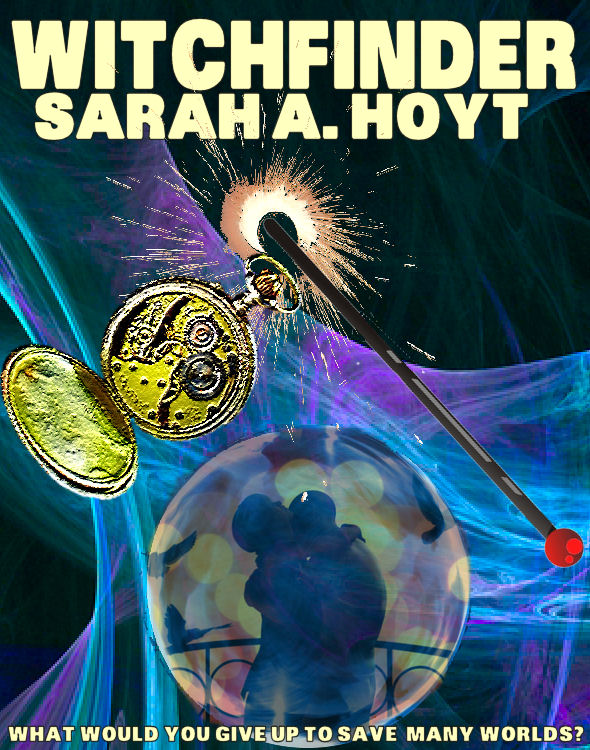
5 – If you’re a pantser or an occasional pantser, or a pantser in details (which I am, sometimes) don’t go in with a heavy hand in revision and ASSUME you didn’t foreshadow. I seem to be foreshadowing behind my own back. Take the whole child prostitution thing in Witchfinder – which, ick, ick, ick, I wouldn’t consciously put in, but my subconscious THINKS must be in there – it surprised me as coming out of nowhere, but when I read back over it, it is foreshadowed. This has happened to me A TON of times, with various books. So, read first. The foreshadowing might ALREADY be there.
6- OTOH when revising, make sure you remove accidental foreshadowing. I.e. Foreshadowing for things that aren’t in the book/won’t happen/are just plain weird. Take the beginning of Death Of The Musketeer. I have – I think I’ve admitted this – a crush on Athos. When writing that book, the first time I got to play with Athos in my own prose, I forgot I was in D’Artagnan’s mind, and described Athos… rather… lovingly. This was the author having fun, but when I revised, it read like signage for guy on guy romance, if not guy on guy porn. I deleted six pages, in utter horror at my slip-up. (No. You can’t have them. Geesh. You guys just want to laugh at me.) A lost of accidental foreshadowing isn’t that in your face, and you might miss it. Say you mention your character is an excellent rider, just because you want to give him ALL virtues. If this is done early, the reader will expect… horsemanship to matter. (If it’s later in the novel, they might get you’re just saying he’s “Wonnerful.”) Unless horsemanship matters, take it out.
Of course, the BEST way to test your learning of these techniques is beta readers you can trust. If this IS what you’re testing, you might ask them to write on the margins (or make a note) at certain points in the book of what they think the book is about and where it’s going.
Another good way is to write fanfic. At least at the Derbyshire Writers’ Guild, you get a lot of comments, and from the comments – where people ALWAYS speculate on what will happen next – you can judge how your signaling is.
Good luck, and may you learn to cast long shadows.