The Failings of Experts

I didn’t want to write this post, mostly because I had planned to do a different post on the panic going on from people of inelastic minds (not their fault, most of them were indoctrinated that way) in the face of tech that seems inoccuous but is changing things in ways we can’t figure out. Ah, well, will do that tomorrow.

Today I need to talk about experts.

Look, I love experts – real ones which doesn’t necessarily mean credentialed ones – and having one give an opinion on something I’m trying to master is wonderful.

Right?

Well… waggles hand. If you get the right expert, at the right time, in the right mood.

I first learned this when I was a green as grass writer. ALL my group were green as grass writers.

Unfortunately, I was the green as grass writer who did all the work. If the group were a sled, I was the one pulling the sled. I’d come up with a new technique, (new to me, okay? Pipe down) such as starting a story with dialogue. Next thing you knew, everyone in the group was using it. Other things I discovered that are wonderful and startling to newbies, like not having dialogue tags, but tagging dialog with action also disseminated through the group. (It’s amazing. You can read a million books, but you never apply it till a fellow newby does it in group and then you go “oooh.”)

Writers groups are usually like that, though there’s usually more than one innovator. But there’s usually the innovators and the followers.

Not disparaging the followers, they could learn from seeing, which I’m unable to do. (More on that later.)

In our case, because it was so lopsided, I used to get awfully tired. So when we had a writer join the group who had published a book, (remember, guys, we hadn’t even SOLD a short story. Any of us) I not only happily relinquished leadership to her, I learned at her feet, too.

I did say I was green, right? I couldn’t read the signs. This author had published one book ten years before with a very distinctive house. (Yes, it was Baen. No. I’m not going to tell you who it was.) Since then she hadn’t sold ANYTHING. If it were now I’d know that she either had had only one book in her, or only one specific type of book, and that her book hadn’t sold well enough to buy a second or third.

But I didn’t. Green as grass, remember?

She, OTOH had no doubts of her status. Yes, she hadn’t published again, but that was because the publishing industry was wrong. And the public who hadn’t bought her book were wrong. She knew the One Right Way To Write A Novel.

That too, a few years later, would have been an awful warning.

You know those “learning styles” that we (well, I) always assumed were cover for “we don’t know how to teach kids”? Well, turns out they’re real. There is a reason for instance I can’t watch instructional videos and REMEMBER but if I read instructions I’m fine. This has been brought home to be by a son who is an extreme visual learner. I’m actually a kinetic learner. I learn better by touching and feeling something (shut up.) Which is why I can learn better if I’m crocheting while listening to a lecture BUT learn best of all if you make me do it, and correct along the way. (This is difficult with books, which is why I’m largely self-taught.)

Unfortunately, the same way that there are different types of learning, there are different types of writer. The two seem to be correlated.

I can for instance write a novel from outline, but it will be flat. I can do it, because I was taught linear learning, and had it pounded home with a ruler. What I mean is, to an extent (but only to an extent) my suspicions of the “learning styles” thing is right, because learning styles can be ignored, if you’re willing to use force and discard about 30% of the pupils as “too dumb to learn.” (This is a luxury we had when we had kids by the dozen and when there were a lot of GOOD manual professions.)

My best way of writing a novel is to tinker with it, until it coalesces. Which is why I get stopped by illness. However, it gives the richer, deeper substratum. A Few Good Men I could only see one chapter ahead. I understand Pratchett writes like that too (well, wrote) which was a relief finding out. I thought I was broken.

And I usually get the novel from the character who is in trouble.

This was a problem because the woman who came into our group wrote a novel from the plot out. So when I brought in a first chapter about this woman being followed by a mysterious stranger, she told me it was wrong. I didn’t have the setup for the whole plot in the first chapter.   Into the trunk the story went.

Over the two years she was with us, she nixed many stories, both mine and others by telling us things like “it doesn’t have a motor.”

It wasn’t till my first fantasy series was bought and I sent it to her (she had left the group by then) that I realized what the problem was. I sent it to her electronic. She told me I’d never sell it because it was a romance with fantasy elements, not fantasy (she missed the part where I’d sold it already) and that my characters had too much interior monologue.

Now, think what you will of Ill Met By Moonlight. I know I do. Geesh, if I ever go down the rabbit hole of beautiful language again, shoot me. It’s more merciful.

But it didn’t have “too much interior monologue.” It had what it needed to for that sort of story.

And that’s when I realized she ONLY knew how to write adventure SF. (Her book is pretty good, even if it didn’t sell wonderfully.) In her mind this was so much “the one right way to write a book” that she couldn’t even cross sidewise into Fantasy, let alone literary fantasy, and heaven forbid she even considered other genres, because she didn’t read them. (For instance, Ill Met is many things. It is NOT romance.)

She WAS trying to guide us as best she knew, but the only road she knew was the one she could see through her blinders, and she imagined it was ALL roads.

And this is why you should be afraid of self-proclaimed experts, particularly in fields where some of you learn in an intuitive and non-linear manner.

An argument has developed in the comments of the post two posts ago. Only I’m not sure it’s a real argument, because it’s Fail Burton against everyone else. He thinks you should leave covers for experts, or do them as flat and boring as possible, because you’d do less harm. The rest of us think he should shut up and try to understand he’s out of his competence.

I’m not going to address his claims except to say that I read a LOT of sf in the sixties. The cover mockup he put up fairly screams “Ace Double.” If you put that up, you’d get everyone assuming it was not only the reissue of an old book but that the person putting it up was dumb enough to scan in his old cover.

What I’m going to tell you is how I came by doing cover design.

First of all, I do have some artistic credentials, in that I’ve taken about three years of training. This was done to keep from going insane while writing six books a year, because while doing art the words SHUT UP.

Where am I? I’d say better than many people selling their drawings, but definitely not professional. Given time – a lot of time – I can produce something that both my teachers and a leading artist in the field said was about 2 years from ‘cover level’ level. The problem is not just those two years – though once the kids are out I intend to resume training – but the time. For instance what I did for the cover of ConVent, back when I THOUGHT you had to do all your own art (long story) took me about two hours. If I’d taken a month, instead, it would have been pretty good art. (Still sucky for a cover, particularly in the digital age, though.)

I’d like to return to drawing, but if I do it will be to do things like draw something for my husband for his birthday or draw some of my friends as pixies. (You know who you are.) And each of the drawings will take six months or so, in the background of what is going on with writing/life.

But that’s neither here nor there. Suffice to say I had training in art. It’s time for the execution I’m lacking and the time to finish learning to “pro level.” I can do that or I can write. I choose to write.

In most cases that’s immaterial. There is always Dreamstime. The covers for my Shakespeare series cost me a grand total of $50 for all of them, and only because I bought big for eventual print.

The one thorn on my side art wise has been the Musketeer books. There simply are no non-photograph musketeers, and most of the photographs are unsuitable, as there is something in the male brain that turns the possessor into a raving idiot the minute he has a sword in his hands.

The expressions on most of the people posing are variations of “Sword, how cool is that?”

Also, historic mysteries NEVER have photographs on the cover.

Most of the historical mysteries have either full paintings or something “iconic” on the cover, like a piece of architecture from the time period. The problem is that the iconic ones take A LOT of push.

I first tried a contrivance of having the landscape in woodcut, with a figure from one of the many out-of-copyright-because-old musketeer paintings. This didn’t work because it signaled “literary.”

BUT for a while I thought it was the best I could do, so I ran with it.

I did a post on covers at MGC in which I put up that cover.

In the next six hours I got emails from TWENTY experts, offering to do my covers for free. Lettering, etc. Also, I got people coming to the site to tell me that the whole painting would look better. Yes, of course it would. It also signaled “reissue of classic” which you don’t want unless the book is… reissue of classic. (My plan for art involves learning DAZ 3-d which is pretty sucky and stiff without post-render work, and then do post-render work, for which my art training is MORE than sufficient.)

The lettering samples they sent me had… the same issue. Look, a lot of them looked very pretty, very balanced, very professional. No argument on that.

The problem was looking at them I got the feeling of “literary and little” tables at cons.

There were also the “it came from the sixties” look of some of them.

I tried to talk about it to a couple of the more reasonable sounding designers, and got the “there’s one right way to do it.”

Which made me run screaming into the night, to learn myself.

I took the Kris and Dean workshop (which is actually taught by a professional cover designer, one who works in many genres.) And I’ve been trying to implement it ever since, hampered by the fact that I learn by doing. Which means my covers are changing every month or so so drastically that the old ones make me cringe.

However, books do sell better with these covers, and not just my books.

Part of what I do is look at the top 100 paper bestsellers, to see what the houses are doing. I don’t have to like them. For instance, the ones for Urban Fantasy and paranormal romance hit me as tawdry and trashy. But that’s what I want to look like to sell those books.

As for the cover of Witchfinder, well, when I asked the vendors at the con about it, they were iffy until I showed them the book, and then they said, “We’ll send you an email about stocking them.” So I know the cover is okay.

Is it brilliant?

What you have to remember is that you don’t have to be brilliant. You have to be as good as an untrained assistant editor in NYC.

What? Oh, sure, that’s who ends up designing most covers – beginner and midlist. The designers do the high falluting covers for the people they intend to push. You and I get English major who knows some photoshop and gets some guidance “That sucks, try again.” And “use minion pro for fantasy.”

This is for cover design, not art, of course. For art…I’m seeing more and more pro covers which come from dreamstime. From the big houses. Okay, mostly romance, but…

But here’s the thing – almost everyone – Dorothy Grant aside, because the designer is excellent and beyond the risk of most of us – NOT doing literary who pays for covers ends up paying $500 or more for “literary and little.”

Also, as you develop an eye for the art that works for covers, you find you need less and less complex art, because thumbnail. Take your favorite painting and view it from across a conference room. It tells you how it works. Our own Mary Catelli in comments has a lovely drawing of a woman as an icon, but for months I thought it was a blown dandelion. Because, small.

Dorothy tells me the K boards are full of designers coming rapidly up to speed and in a year this might have changed, but right now most designers out there are either retired and stuck on the “good design” of their time, which will make your book seem like a reissue. OR they are people my age who’ve been making a living in small press which has its own style.

So… roll your own. Run it by friends to make sure it’s not atrocious. Take comfort in the knowledge that most of what is out there is OBJECTIVELY atrocious. All you’re trying to do is signal “I’m main stream big publisher published” and your genre. You’re not trying to signal “I’m DaVinci.” None of the people working for big houses are that. And you probably have as much training as they have.

Go look at some covers. See what they do with typography. Read Cedar and Dorothy and people who blog on covers. If you can take the Kris and Dean class. It will help.

But most of all, let it go.

Unless your covers are at the extreme of inappropriate (the most common for this being pictures of a landscape as covers for mystery, which requires a drawn cover) or Science Fiction (drawn and with something having to do with science fiction) it’s not going to STOP you selling. It might make your climb slower. But I know at least one indie bestseller with really bad, no good, scary ugly covers. (But they do signal genre and subgenre well.)

And at some time – as with books – you’ve messed with them enough.

Now excuse me. I have to do the litter boxes and go do a third pass on the novella.


UPDATE: I am aware that this post has grammatical subject/verb issues and a couple of huge typos.  Deal.  I don’t have the TIME to fix it, and I’m on Benadryl, which means likely I’d “fix” it wrong.


The Quest For Truth — or Who Are You Gonna Believe?

“What is truth?” a man of the world asked, and washed his hands.

And now in what was once the land of the free, we’re reading newspapers that sound like echo chambers and we’re asking ourselves, “What is truth?”

I don’t now, and you don’t either.

In some cases, like when “the truth” refers to who created the world, or the date set for the heat death of the universe, this is not exactly a problem.  At any rate, I suspect the answer to the first doesn’t filter well through time/place bound minds, and so, the best we can do is an approximation.  And, as Heinlein put it, one of these days you will know.  Until then, you and everyone else just do the best you can.

In other cases, though, not knowing the truth is a real problem.

I am the sort of person who is always suspicious when too coherent an image is presented — or as my mom puts it, I can’t see a freshly painted wall without making a little scratch to see what’s beneath — which means I never precisely fell for the glossy images the Soviet Union presented in the seventies.  Does anyone but me remember it?  The glowing production numbers, the assurance that there were no poor and no unemployment?  Why in the eighties I read a poor idiotic journalist who’d visited the USSR enthuse in the Charlotte paper about how the very simple cartoon she’d seen on Russian TV represented their embrace of simple living and sophisticated aesthetics.  When in fact it represented their penury, their old equipment and, yes, the fact that their audience had no other choice.

In Europe this sort of self-delusion was almost universal particularly among the intellectuals.  You see, they had bet their future, after WWII on a Marxist-lite mess of pottage.  To suddenly find out that neither socialism nor its big, bad cousin communism worked, would have shattered their view of the world and revealed that they’d in fact been taken for patsies and wrenched the more or less functional core of their country’s economy, and engaged in massive redistribution… for nothing.

So they couldn’t believe that, and instead chose to believe USSR was a finely tuned, humming machine or success.

They managed to believe this despite the fact that visitors to the Soviet Union inevitably caught a feeling for just how deprived these people were.  But of course, they could tell themselves that they were just rich in non-material things.  (Someone tried to make a similar point when I echoed a post by Charlie, on Facebook, in which he pointed out how astonishingly well the Free Market has done in the last fifty years, in making us massively more wealthy.  All of us.)

They managed to believe this despite the fact that escapes occurred overwhelmingly in one direction: from the USSR to the free world.

Humans can believe just about anything if it’s printed in glossy magazines and nice (wholly made up) figures.  Particularly if it tells them what they very much want to believe.

So… You’ve probably by now got the glad tidings, that our unemployment is way down, and we’re roaring…

Do you believe it?  Or does it seem like a repeat of the “roaring recovery through the summer of 12 which continued through the elections, so that smart people said that “the economic policies of the Obama administration are working.  We must give them more time” even as they made fun of us skeptics who said “uh… isn’t this awfully convenient timing?  And lookit the innards of these figures?”

Amazingly when the real news trickled out they were not only bad, but appalling, kind of like the squalor beneath the facade of the USSR.

Steve Green goes into the figures behind our “good news” here.

Is he right?  Or are the people right who say “see, cutting off unemployment insurance works?”  (Of course it does.  Drops people off the books like a rock.)

Look, I know I have my haunch.  Yeah, yeah, the plural of anecdote isn’t data.  Bah.  Do you see the job market superheated, right now?  Are your friends spoiled for a choice of jobs after years of unemployment?  Do you see the restaurants with a wait after work, as they had even ten years ago?  Do you see shops opening?  Do you feel the economy taking off?

Or are you sitting there figuring out how to make your car limp another year, and are your friends in pretty much the same situation?  Are you tempted to cry while grocery shopping, because everything costs three times more? Is your family all out of luxuries to cut, and is now cutting into what you used to consider necessities?

I’ll confess my situation and those of my friends resemble the second more than the first.  I confess after summer of recovery 1 and 2 and 3 and 4 and 5 and… I don’t believe the economy is roaring back.  I confess I think this is a case of lies, damn lies and government reports.

But the the truth is as unknowable as the truth about who created the universe.  While I doubt the fact sand figures of our sad situation are transcendant and unknowable by the human mind, when you are dependent on a government for all your information, and when that government visibly puts ideology over information, you end up not knowing.

Look, it’s entirely possible that people who were dead broke in their town in the USSR, and who knew all their neighbors were broke, yet thought that maybe, possibly, in other towns the economy was roaring.  They had no way of knowing.

By making itself an uncritical lapdog, our media has made itself even more partisan, more unreliable, than the old Pravda and the glossy Soviet Life.

Which means the books are cooked, but we don’t know how far.  We don’t know if some books aren’t cooked.  We don’t know which books are cooked.

The problem is not just that absent information on what’s really happening, we can slide slowly into the abyss, as others before us — Zimbabwe, Argentina, Greece — have.  The problem the information on what is going on with the economy is vital for a hundred different decisions: which job to take; what property to buy; whether to invest in this or that.

Of course, the administration that couldn’t run a lemonade stand doesn’t know that.  They’re academics and ideologues for whom the essential ingredient for success has been fanatical adherence to progressive ideology, not rational analysis of reality.

And so they spin their numbers and they think if they click their heels three times and wish really hard, this time when they stop telling us lies after securing the election, it will really be true.  The economy will be roaring, you see, roaring.

It might very well be true, too.  Being from Colorado I’m used to massive fires, and they do roar as they consume anything of value in their path and leave only ashes and destruction behind.

Which is what I expect to be plain once this last effort of obfuscation evaporates.

But until then even sensible people are believing those glossy pictures.  Because none of us wants to see the real squalor.  It must be that we love simplicity!  Yes, and we’re really aesthetically advanced.  And besides, this is a wonderful day until we get buried in the corn field.

And we don’t know the truth.  Knowing you’re being lied to is not the same as knowing the truth.

They say the truth will set you free.  Perhaps that’s why the administration is so carefully making sure no one (not even the various departments who make up one or the other set of numbers, but assume all others are right) has it.

And meanwhile we drown in a welter of made up figures and pretend facts.

“What is the truth?” a man of the world asked.

At least he had the decency to wash his hands.


Almost Famous

I never wanted to be famous. As far as I can tell, this is weird for people in my field who want fame and fortune.  I just wanted money to live. I’m not at all sure how I imagined this would work, honestly, but I envisioned myself as making a good living from writing, without anyone ever knowing me from Adam. It took me years into this business before I figured out that the two were inextricably linked. Probably.

Part of this – again – was because I had NO interest in the fame part of it. Ideally I would live in either the equivalent of my native village, where maybe not a single soul read the stuff I wrote, or in a large enough city that I could smile and say “it’s the other Sarah Hoyt.” And they won’t know any better.

I could still get lucky and make a living with no fame attached. I mean, Indie allows a lot more scope for making money without becoming “a name.” Hugh Howie went to a local con, and no one had an idea who he was, which indicates that there is less than a perfect overlap between con goers and buyers of sf/f. In fact, to a great extent, they might be completely different audiences. But it also indicates it’s possible, outside our incestuous little circles, to be a total unknown, while being a millionaire.

Or it might be too late. You see, I find myself in the curious position of being “almost famous” and like MacBeth think it would take more effort to go back (and it might cost me my career) rather than forward.

Look, I’ll be honest – I still cringe about going into bookstores and seeing my books on the shelves. I mean, I’m glad they’re there; given current stocking practices, I have to be selling at least a book a week, and that’s good. OTOH it’s me, there on the shelves.

It’s probably easier to understand – maybe – if you know that after sixteen years of trying to publish, my first nationally distributed short story came out (Absolute Magnitude, I THINK 97?) and my friend Charles called me from the magazine stand downtown to say “It’s on the shelves.” And my stomach dropped, and I said, “buy them all. Some stranger might read them!”

The reaction surprised even me. Since then I’ve become more accustomed to the idea that a lot of people read the contents of my daydreams. I’ve become more accustomed to the idea that some people at least will like it. Since then I’ve had at least three stalkers, two potentially dangerous. (At least? Well, I’ve learned to turn it off earlier.)

I’ve learned to walk the fine line between being open to beginners and those needing my help and putting down a pretty stern boot on pretensions, when needed. It’s not that I think I’m high and mighty, it’s that at least twice my not turning things off early enough might have endangered my family.

I don’t view what I do as anything special. I probably would do better at promoting if I could.

It’s a craft, and I’ve worked at it long enough I HOPE I have some competence. But I’m not G-d’s gift to writing, nor do I expect everyone to swoon at my words.

Look, guys, not everyone is going to love a book. Heck, my husband and I are not only close in the husband-wife sense, but we’ve been best friends for thirty years.

But some of the books he raves about I can’t get past page three. And some of the ones I love get me the raised eyebrows look, in puzzlement, when I tell him about them. When you hear of something that’s universally loved (any of the mega bestsellers) chances are they were so “pushed” that people are afraid to say they don’t like it. Most of them don’t even read the books or finish them, they just buy them because “everyone is….”

Alma Alexander, with whom I have severe philosophical and political disagreements, but who is in many ways a very astute person, once told me (well, technically told someone else, but I was sitting right next to her. And yeah, she’s one of the people “on the other side” I talk to, at least for some things. BUT in this case I just happened to be a bystander) that every book you write is going to be someone’s favorite and someone’s most hated book. She was right. I’m lucky that I’m usually surprised at how well people like SOMETHING rather than by how much they hate it. Take Plain Jane, for instance, written under the house name Laurien Gardner. I have no idea why but people rave about it. (I wrote it shortly after getting concussion, so I’m not even sure what’s in it.)

I haven’t had the misfortune of throwing a beloved book out there and getting it pummeled. Now that doesn’t mean my books are universally loved. I wish! Mostly though, they are liked, and then I have two or three reviews that would sting like h*ll if I read them. (I’m not that stupid. I have someone else filter them.)

Anyway – I suspect if I could get out of the door tomorrow and find multitudes bowing to me and comparing me to Shakespeare, other than assuming older son had slipped something funny onto my morning coffee, I’d be well and truly horrified. Because it would take some serious slippage to the fabric of the world to have me be that popular.

In my dream world, 100k people read my books, on average. To put this in perspective, those are dream-numbers, but it doesn’t make you rock-star famous. More than once, while out with Kevin J. Anderson, I’ve been amazed at the fact that normal people – you know, outside sf/f – have no clue who he is. For a while my husband was sure they were joking and tried to get them to come off it. Those numbers are not high enough for readership-wide penetration.  Just for “SF/F wide” penetration.

But see, I want those numbers for the money, for the ability to have a cleaner and a secretary, so I have time to write and time to take a day or so off every couple of weeks. Probably won’t ever happen, but with indie, it might.  The fame I could do without.

Unfortunately, reality right now is a bit more… confusing. I’m not famous, precisely. And my numbers from all I see are closer to a tenth of that wished for number. And SLOW (meaning my books don’t sell right off the door, they just don’t stop selling, so the trickle continues.) Part of the reason for this is that I write in so many genres. Yeah, okay, I have core fans who love Elise Hyatt and Sarah D’Almeida as much as Sarah Hoyt’s fantasy, as much as my SF. But usually my fans specialize. They’ll love the fantasy and the mysteries, and hate the SF for instance, or vice versa. Perhaps the sharpest divide is between the historical and non historical portions of my work. And then there is this blog and the posts on PJM which are very much their own fandom.

The problem is that between all these venues, I’ve achieved the opposite, just about, of what I want. I am “famous” (or at least almost famous) but not rich. I’ve achieved the sad state of having cashiers and neighbors go all weird when they ask if I wrote x and I say yes. And yet the bank account… well, it’s no longer panicking me, but I’m still trying to figure out how to get all the damage from the hail repaired so we can move and sell. (And it might take till next March, because the kids and I will have to do some of the work to keep it within budget. Dan will help too, but he works all day. At least the COSMETIC stuff, like painting.)

As for cleaners? Someday my ship will come. And as for assistant, right now I’ve enslaved the older son, even as he audibly rolls his eyes at my historical stuff.

I tell you, it’s enough to make me wish to write dinosaur porn under an uncrackable pen name. Except I’m busy enough with my writing I don’t have time.

So, what is this other than a long whine? Oh – the problem is this: where I’m stuck, nice people are afraid to talk to me or take up my time. Several of my fans who have approached me about a book but were interesting have become friends. I like that. However, this has become more difficult in the last three years, because people will treat me with “old woman on the mountain deference.” This – besides of course my not being that old – is plain weird. Just yesterday I was a rank newbie. I still feel like one inside.

On the other hand, the crazy people all feel they have a right to accost me and behave as though they owned me.

I have had people I don’t know order me to go to bed via private message. (!) I’ve also had OTHER WRITERS’ FANS approach me and tell me to “order” a mentee or protégée of mine to do something or other.

So, to level set. I am fifty one years old. Yes, I often need a minder, but I have one. He’s my husband.

I’m not going to say I don’t appreciate ya’ll worrying about me or praying for me, or even sending me suggestions on what might be hailing me. I do. Through the HORRIBLE year last year, at least knowing ya’ll were worried kept me trying to get better. (I was afraid you’d come over and shake me, if I didn’t.)

OTOH before you ping me, consider – is what you’re about to tell me something you’d tell a two year old? I probably don’t need that. I have been dressing myself and cleaning after myself for at least 48 years.

Or does what you’re going to tell me grossly exaggerate my influence over the universe? At least THIS TIME I wasn’t asked to rein in either one of my Baen colleagues or my publisher. One should be grateful for a show of SOME clue. (I once had a letter asking me to rein in Jim Baen. I wish I were joking.)

But for the record, see, part of that not wanting to be famous, just rich, is that I don’t particularly want to have power over other people. So I don’t. I mentor people at various levels, from acquaintances I just encourage, to people Dan has read and liked (Hi Mackey!) but who don’t need my MENTORSHIP as such, just some cover help, to people I try to read even if I’m half dead, and whose deficiencies in writing I try to point out and help with.

Most of the people on that higher level of involvement (Amanda, Kate, Cedar, our Dave, older son and half a dozen others who are going to be mortally offended I can’t remember them right now, because half dead) are also friends at varying levels of closeness.

What this means is that they’re independent their-own-people. Sometimes I don’t even agree with everything they say/do/write. They’re neither my servants, nor my children, nor do I enjoy psychic domain over them.

They have been known on occasion to slap me on the back of the head. Sometimes I even NEED it. I have to ask other minions to check their reviews of me. And some of my books don’t work for any given one of them. I like it that way – look, the individualist doesn’t want to own anyone, okay? – because it means I can teach them stuff, but we’re still FRIENDS. Friends is a relationship of equals. Those – mostly. Sometimes I have to beat them – and my other close friends know they should be able to ask me anything, at any time – but they often don’t.

Which brings me to the other half of the recommendations while I’m stuck in this half-famous status. Look, half the time your fawning email hits me between doing the litter boxes and folding a load of laundry.

I’m not living on Mount Olympus, or even Olympus seacity. If I sound distracted, it’s not that I’m upset at you. If I space sending you a story I promised, it’s just that I SPACED. I didn’t suddenly decide that I’m too good for your anthology. I don’t have an assistant right now, not even a voluntary one. Which means things slip. (Look, I bought my son a birthday gift a month ago, and if my husband hadn’t reminded me today, I’d never have remembered. Even though it was something special and one of those in-a-life-time finds.)

I’m a total dits not because I’m stupid, but because I’m living at least three lives. If I said I’d ship something/write something/read something, and I space, poke me in the midriff. (You’re more likely to get a result if you poke me on Friday, because that’s when I catch up with stuff.)

I’m a fairly direct person. If I don’t like you, I’ll tell you so. If I don’t have time to do something, I’ll tell you so (And it doesn’t mean I don’t like you!) If I haven’t told you either or have told you the contrary, assume things slipped. So – in summary – I’m not complaining about being almost famous. I’d rather have more money and less fame. But if I need fame to make a living, I’ll endure it.

One way or the other this in-between state will (probably) eventually end. I’ll either become more famous and richer or sink into obscurity and become very poor. I was about to say either is okay, but I’d rather have money to live – if that’s okay with everyone else, thank you. Still… there’s always other work. If I have to, I’ll even go into politics. (Winks. No, seriously. Think about it. Consider I hate fame.)

OTOH even supposing I get there, please remember that I’m neither an ogre nor a goddess. Don’t imagine I’m spending all my time either in Olympus or in my evil mountain lair plotting the take over of the world. My life is bounded by cleaning the kitchen while I cook breakfast, and writing this blog before going to bed.

In between, I write, drink way too much coffee, go for walks with my sons, and do the litter boxes. If I’m lucky, I get to see my husband in the evening, if he’s not too busy writing, and I haven’t collapsed yet. Sometimes if I have a day off, I refinish a piece of furniture or read a book.

The exciting stuff, for good and evil, happens in my fiction. As it should be.

Men Fight to Protect Their Emotions – David Pascoe

Men Fight to Protect Their Emotions – David Pascoe

Sarah dropped this little gem in a conversation last night (edit: timing unclear. may have been a comment), and I’m not even sure she was aware of it. A further conversation just a few moments ago (yes, I’m under the wire. All of the them. why are they attached to a funny little box that says, “This side toward enemy”?) just proved it, but I’ll let her tell you about that tomorrow. When she’s less likely to physically remove anybody’s limbs. No, really.

Himself is doing well. Growing, growling, and generally making life difficult for me and Mrs. Dave. He’s showing sparks of personality (I tell half a lie (it’s Arthur the Half a Lie (more caffeine!))(wheee! nested partheses!) )he’s been showing signs of personality all along) and doing much better at maintaining eye contact. He’s still not effectively using his words. Communicating, yes, but I want him to tell me why he’s distraught. Fortunately, he still has a fairly simple input/output flow chart. Of course, it is right that this should be so. After all, I am the simplest of men. Should not my son be likewise?

Short aside, aside (yeah: really need some coffee) men fight to protect their emotions. This is a self-evident phenomenon, and one that – depending on your theological bent – is a result of some truly heinous choices by choice forebears of ours. As my sainted *snort* father, the Irreverend, has said, “the Fall was worse than we thought.” Without getting into the theology (do that gingerly, as it treads on well-mined ground. so: probably not here) use that as a metaphor for whatever makes you comfortable. The end result is that we’re broken, and fractally. Notable is how we get defensive. At pretty much everything that even seems to threaten our comfort. See: vileprogs getting mildly tetchy when confronted with facts. Or when we refuse to step into their kafkatraps. See also: when they arrive full of bluster and contumely, sending broadside after broadside of noxious wind.

This is a human pattern as far back as Cain getting his feelings hurt when he brought a sacrifice for the wrong reason. Alternately, when Mog clunked Ogg over the head for looking at his girl (she had such a fine, downy pelt, after all). I’d argue that it’s been a significant factor in conflicts ever since. Before you think I’m suggesting that Great Harry cut off Anne’s brainpan just because he was wroth, or the 20th Century War kicked off because somebody flipped Austria the bird, that’s not -exactly- where I’m going with this. We all do this, but we don’t do solely this.

We’ve also been given an amazing intellect, clouded by levels of not-thinking-ness (which is a word, and I’ll swear a blood oath to it. what? not with my blood; don’t be silly) we’ve barely begun to penetrate. This is what gives rise to such joys as confirmation bias, and survivorship bias, and the sunken cost fallacy. All of this is the source of some delightful verses and aphorisms. Things like, “the heart is deceitful above all else,” and “love is blind,” (don’t let it lead you on trust exercises, per Mrs. Dave) and even, “throwing good money after bad.” This is why the Placeholder-in-Chief is heading to Texas, not to tour the border, but to throw fundraising parties for Democratic candidates (speaking of good money after bad *rimshot).

Welcome to being human, oh Lightbringer. Yeah, I only occasionally like it, myself.

Why bring up such a self-evidently self-evident factor of human existence? Mostly for reminder. We’re good at forgetting things. We’re especially good at ignoring and forgetting things that make us uncomfortable. Witness the electorate’s treatment of just about anything outside of business-as-usual. We need to be reminded – and forcefully so – of how apt we are to settle into our own little worlds where we don’t have to think very hard about how neither Amazon nor Hatchette is a hero in their negotiations. How life is always chaotic and tumultuous and we’d do well to learn to surf. The flip side of that is gaining just an ounce more of perspective.

I’ve read a few comment threads in my day (getoffmylawn,kid) and I’m passingly familiar with the way we’re likely to get our dander up over something someone else has said. Or worse, written on the internet. We do it here on a regular basis, though I fancy we’re a skosh better about it than other communities. Goodness, if you want an education in it, get a Twitter account. I don’t suggest it, as I’m fairly certain it’s the most puerile of social media, but you can learn a lot by watching what people think is worth wasting 140 characters on.

Ultimately, this is a lesson about human nature, and how and why we’ve gotten ourselves to the place we are. As individuals, as a community, and as a species. Most people don’t “think” at all. Ever. They “reason” with their emotions, and react accordingly. I’m not one for rationality uber alles, but a better understanding – and better ways of thinking – among the vast majority of humanity would, no doubt, benefit everyone.

So take a moment before you say something. Before you hit that button to broadcast your thoughts to the world, think about the impact thereof. I’m not saying you shouldn’t drop that bomb; I’m just saying you should be thinking a few steps ahead of the other guys when you do. When you threaten the comfortable place of another person, they’re more than likely to attack, just like any other beast.

Don’t Sit Down, John! – Bill Reader

It is a tradition that I got from my friend Sarah that I watch 1776: The Musical on Independence Day. It’s a flawed gem, unquestionably. It’s brilliant where it isn’t terrible. But I watch it less for its cohesion and thorough historical accuracy than I do for a yearly reminder.

I appreciate that yearly reminders are lame. I’m not yet so old I don’t remember thinking that. Especially because life seems like nothing but a long string of them. And yet, we keep forgetting, and so we need reminding. The whole film/play, every inch of it, is summed up and embodied by Benjamin Franklin near the end.

“…what will posterity think we were–demigods? We’re men–no more, no less–trying to get a nation started against greater odds than a more generous God would have allowed.”
It’s something that, almost two and a half centuries hence, we still can’t quite get our head around. The founding fathers are viewed as a kind of amorphous hive-mind of freedom, and as a unit the founding fathers (TM) are credited with almost saintly selflessness and superhuman ability. And doubtless they were, many of them, quite accomplished men. But it is important to remember that they were men. Brave, mostly, quite successful, mostly.

But they felt, as much as any of us, the burdens, grinds, and fears of daily life. Moreso, in fact, living in a less technologically advanced time and having fewer resources to salve their pains.

So the next time you think about the revolution, think instead of this. Imagine you, your most talented friends, plus an array of equally talented friends-of-friends you didn’t necessarily like, got together in your garage and planned a revolution. That’s perhaps a bit strong. After all, the continental congress was convened somewhat more formally. But it’s a lot closer to the truth than a brain-storming session on mount Olympus.

I want you to remember that, the next time you think you can’t stand up to this or that power structure. Yes, Obama has the IRS, FBI, NSA… the whole can of alphabet soup. But you have a G*d-given right to stand when others tell you to kneel. It’s a lot more powerful than it looks, as better tyrants have learned before him.

Now I have always included this caveat: you are not required to be stupid. I understand the problem. But the economy looks to me to be well and truly cratering. The job market is a not-very-funny joke. The punch line is either “part-time” or “Obamacare”. And regulations are being piled on at a rate of knots. The EPA regulations alone are going to bleed us dry.

Maybe the time has already come for you. Maybe it hasn’t. Maybe it won’t, though if this goes on long enough I can almost guarantee you it will. You might look around you and realize you have very little left to lose.

If you’ve been knocked down by this mess, believe me, I sympathize. But if you can spare a moment from trying to make ends meet, we need you. Your country needs you. Maybe you’ve been quiet for a long time because the ruthless partisans across the aisle tend to have problems with non-compliance. That’s how a lot of jobs work these days. But if they’ve knocked you down and out, ask yourself how much worse it can actually get before you let habit dictate your choice in whether to speak. Freedom is granted, ultimately, by no one except yourself.

And if your instinctive reaction is that you are too uninteresting, ordinary, or humble to assert your beliefs, remember that the men who walked before you cast a shadow no taller than your own. They were brave, but to downplay the weaknesses they fought cheapens the victory they won. And like them, you don’t need to wait for a savior, or hope someone comes to fix things. The revolutionary the country needs… the person who will stand up for our principles and assert their correctness against bitter opposition… will be found not in a history book. There, sadly, you will find mostly saints, and they are all long gone. You and I have only our mirror.

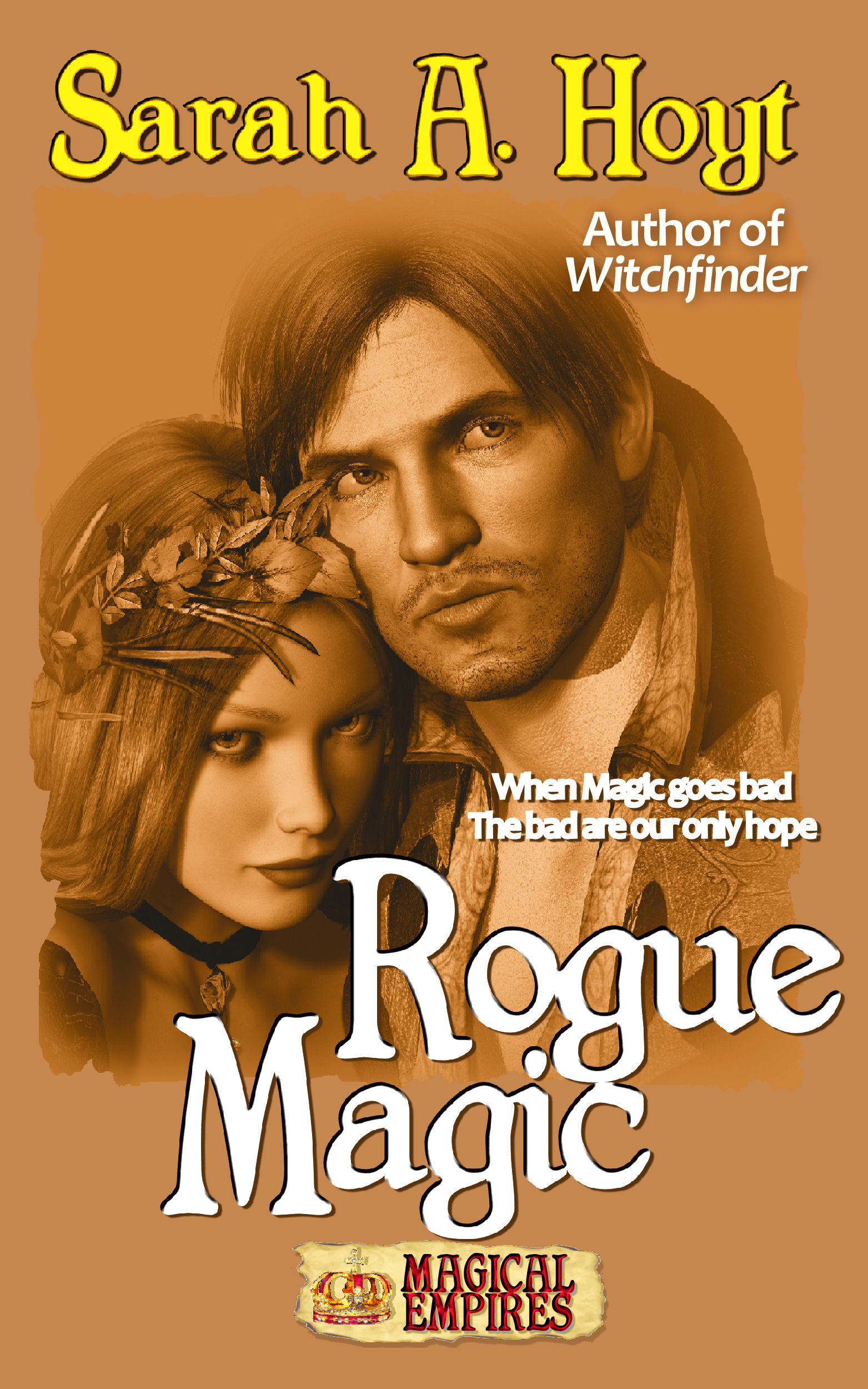
Rogue Magic, Free Novel, Chapter 52

*Yes, this is late.  I had the brilliant idea to sort and clean my closet for the first time in a decade and a half.  This is something that must be done preparatory to moving (which might not happen till next Spring because the damage from the hail storm must be dealt with and it’s eating our time) I MUST somehow find the time to reconcile this.  But for now, here is a LITTLE chapter.*

Rogue Magic, the second Magical Empires book.

The prequel to this — Witchfinder — is now up on Amazon.

This novel will get posted here a chapter every Friday or Saturday, or occasionally Sunday.  If you contribute $6 you shall be subscribed for the earc and first clean version in electronic format.  I think it will probably take another three months to finish.  Less, if I can have a weekend to run through and get ahead of the game.  It hasn’t happened yet.

NOTICE: For those unsure about copyright law and because there was a particularly weird case, just because I’m making the pre-first draft of my novel available to blog readers, it doesn’t mean that this isn’t copyrighted to me.  Rogue Magic as all the contents of this blog is © Sarah A. Hoyt 2013.  Do not copy, alter, distribute or resell without permission.  Exceptions made for ATTRIBUTED quotes as critique or linking to this blog. Credit for the cover image is © Ateliersommerland | Dreamstime.com


Ginevra Mythborne:


The tears trick had never failed to work before. It was a magic that even humans could work, and I put all I had into it. Though I’ll confess it didn’t start as planned. The first tears came as Jonathan Blythe – I’d never think of him as the Earl of Savage, a role he filled as badly as a man could fill any role, but as the young rogue I’d met that night the demons had invaded London – turned on me, his face stern and said I would tell him the truth.

The truth… The truth is that I couldn’t tell him what I’d been told, a story that I had, at any rate, long started to doubt.

But on top of that I couldn’t tell him anything. I’d run out of lies, to him and to myself.

I remembered only the softened look in his eyes, the way he’d looked at me when he’d met me that first night, and even the way he’d looked at me when he’d met me in the Witchfinder’s office, and now – and now it was all gone, and all broken, and his eyes were cold, his face stern, and something emanated from him like the cold and distance of the stars looking down on humanity.

I’d always known he could be distant and cold. He had His blood after all, and of all the children of the Pater He was one of the few that even I couldn’t read – a creature of fog and slippery thoughts. He was not emotionless, but what his emotions might be, few knew. I guess you had to keep yourself detached to walk between worlds. I’d tried it myself, but at Jonathan Blythe’s look, something snapped.

The tears came. After that I realized I was in danger, and giving myself away, and decided to use my not-inconsiderable power to encourage him to feel sorry for me.

I saw something like a spark light up his grey eyes, and then he said, “Kindly stop it. It will not work. Miss Mythborne, you’ve led me a merry dance, and you might have been responsible for setting the rogue magic loose upon my world. I believe it’s time you gave me an explanation. And no. Don’t consider crying harder. It simply won’t work.”

I looked up into his eyes and saw that it wouldn’t, and yet, my eyes kept trickling out tears. “I don’t do it on purpose,” I said. And sniffled.

He took out his handkerchief and handed it to me. There was barely courtesy in the gesture, there certainly wasn’t any careful coddling of my feelings.

I ran the handkerchief across my eyes, and pressed my nose to it, and then I sighed. “You see,” I said. “People who are conflicted in their position and… and trying to subsume themselves into a place they don’t quite fit in, if they’re magical people, they give off a power that…”

“Yes, Miss Mythborn?”

“I can’t tell you. They would destroy me!”

“They?”

“The people who… sent me.”

“People?”

I looked up and met with his clear and speculative gaze. The amiable drunk and the easy going dunce he could play were both that, playing. This one was for real.

I shrugged.

He sighed. “Miss Mythborne, you have two choices. You can explain exactly for whom you’re working and why – and no lies this time – or I can deploy my not inconsiderable capacity for magic, that magic of rogues you seem to think is so powerful, on you, right now.” He narrowed his eyes. “I wonder what the result would be of using some of the nastier sorts of spells in Fairyland. You know, when my papa died, I found on his shelves several books of forbidden knowledge, including Barbossa’s spells of control.” His voice had gone all cold and speculative. I felt the hair on the back of my neck rise. I remembered those spells from back when I’d got my education in the world of humans and I didn’t want to have them applied to me. I very much didn’t want to have them applied to me by this cold creature. But my concern was all too real. I let him feel it. “I can’t talk,” I said. “they will hurt me. They will… reduce me.”

His eyebrows went up. “Now, I wonder…” He said. And then cooly, managing to look as though he’d just gotten dressed, as though he were in his house, and in full control. “As I see it, a difficult choice is before you. You can tell me what I wish to know, right now, and I’ll protect you from those … others… to the best of my ability. Or I can use the best of my ability against you.”

I opened my mouth to talk, but he lifted an admonitory finger. “Only before I believe anything you have to say, I’m going to need to use a truth spell.” He grinned. It wasn’t a nice grin. “Perhaps the most innocuous of Barbossa’s spells, and frankly necessary to believe something such a gifted liar tells me.”

This was not going to be any fun at all. I wanted Jonathan Blythe back, the Jonathan Blythe I’d first met.

But I was afraid the games I couldn’t help but play had destroyed him. At least when it came to his feelings for me.

I’ll Be Back To Do A Chapter

How did I become this family’s cover maker?  Between doing covers for two of the guys (I still need to proofread for one of them, but that will happen tonight), trying to write and the high holy holiday, I was beat and only woke up now. So I’m a zombie in search of caffeine and yogurt.

However, I think you need to head over to MGC, before I come back and write a chapter of Rogue Magic:

F%$K me, SFWA, One More Time

Nothing like supporting the pimp and dissing the girls.

What? I give you pleasure, you give me money. What does that make me? 

Only… I don’t have a middleman over my head taking most of my money. I’m a free girl. 

I’ve blogged before at length about the whole Hachette-Amazon thing, here, and here, and here. It’s business, folks, nothing personal. Amazon is in the process of renegotiating, which comes after Hachette settled over a price-fixing dispute. If you’ve been living under a rock, this comes as a surprise to you. Otherwise, it’s everywhere.

And now, SFWA has come out in support of Hachette. “Author Don Sakers has posted an essay to his blog complaining that the SFWA has endorsed Douglas Preston’s letter. Sakers, an independent author who makes most of his sales through Amazon, is annoyed that SFWA’s leadership did not make any attempt to consult or discuss the matter with its members before acting, and points out that this comes only a week after SFWA asked its members to comment on a proposal for allowing self-published authors to join.” Chris Meadows does a good job reporting on industry news over at Teleread, and covers this one.

So here we have an organization that still claims it supports authors and helps them get the best deal, but now they are in bed with one of the biggest publishing businesses. Their cover story is getting thinner than a streetwalker’s top.

The always articulate Cedar Sanderson has had it, and I confess, if I were still in SFWA this would be when I walked out. And kept walking.  A long, long way off.

They might be in a panic, but do they own mirrors?  Or are they like the vampires of time past incapable of seeing their reflections as they betray those who trust them and behave in ever more despicable ways?

Don’t answer that.  Go read Cedar’s post.  And remember, in my circle of friends, Cedar is the NICE one.

Go read.

Getcher books right here!

Morning, ladies and germs. I hope your festivities yesterday were pleasant. I had the chance to meet a couple of Our Beloved Hostess’s fans and hang out in an air-conditioned hotel, and the Oyster Wife and Minion #4 arrived at the Oysterhaus while I was off committing commerce and Staying Out of the Way. Life is pretty awesome.

We have several entries this week, especially since we lost last week’s post to technical difficulties. So go buy books, enjoy them, and if you’re anywhere near Salt Lake City today, do drop by the Westercon dealers room and say hello. Lots of books to buy there, too! As always, future entries can (and should!) be sent to my email. Happy reading!

Jason Dyck, AKA The Free Range Oyster

Mercenary Wordsmith, Electron Herder, and Henchman to the Stars

Michael A. Hooten

Wizard’s Heir

A Bard Without a Star, Book 1

Gwydion ap Don is a talented harpist, and a known rogue. But his Uncle Math sees something more: a young man with the magical talent to succeed him as Lord Gwynedd. But to learn magic, Gwydion will also have to learn self-control, duty, honor, and the martial arts. He’s not sure which will be the hardest. And when his training in magic begins in earnest, his whole world will change, as well as how he sees himself.

Based on the ancient Welsh myths from the Mabinogion, but set in the world of Cricket’s Song, this new series looks at one of the three great bards of Glencairck, Gwydion. But long before he became a great bard, he had to learn how to be a good man. This is the story of how his uncle tries to temper him into a leader, and a suitable heir.

Sam Schall

Vengeance from Ashes

Honor and Duty Book 1

First, they took away her command. Then they took away her freedom. But they couldn’t take away her duty and honor. Now they want her back.

Captain Ashlyn Shaw has survived two years in a brutal military prison. Now those who betrayed her are offering the chance for freedom. All she has to do is trust them not to betray her and her people again. If she can do that, and if she can survive the war that looms on the horizon, she can reclaim her life and get the vengeance she’s dreamed of for so long.

But only if she can forget the betrayal and do her duty.

Walt Pimbley

Golf Cart Blues

A foursome from Fordo (Iran’s nuclear bomb research center) take a breather on the links, where they discover that Commies make poor caddies. When Mossad shows up to play through, things get dicey.

Cedar Sanderson

Plant Life

A science fiction novella of exploration and first contact. A quartet of planetary scouts make a startling discovery on an uninhabited planet. If a being can appear human and act human, how alien is it? When an entire planet has a voice, what does it speak for? The scouting team is left with a dilemma, a person to protect from those who want to experiment on her, and a revelation about the world they introduced to humanity.

Free until July 7th!

Ellie Ferguson

Hunter’s Home

Hunter’s Moon Book 3

They say you can never go home. That’s something CJ Reamer has long believed. So, when her father suddenly appears on her doorstep, demanding she return home to Montana to “do her duty”, she has other plans. Montana hasn’t been home for a long time, almost as long as Benjamin Franklin Reamer quit being her father. Dallas is now her home and it’s where her heart is. The only problem is her father doesn’t like taking “no” for an answer.

When her lover and mate is shot and she learns those responsible come from her birth pride and clan, CJ has no choice but to return to the home she left so long ago. At least she won’t be going alone. Clan alphas Matt and Finn Kincade aren’t about to take any risks where their friend is concerned. Nor is her mate, Rafe Walkinghorse, going to let her go without him.

Going home means digging up painful memories and family secrets. But will it also mean death – or worse – for CJ and her friends?

I Was Born American

Yes, I was born in another country of foreign parents who would no more become American than fly unassisted, but I figure that was an accident of circumstance.  What really matters is that I was an American in my heart.  I just had to get here and become one in truth. (And that, by itself, is an American attitude.)

This week while talking to a friend about a foreign SO, I found myself explaining that other people, in other countries, have a hierarchy in their heads all the time — who is powerful, who isn’t, what attitude is proper.  You can find it (if you know where to look) even when reading British novels.

We’re not like that.  Whether we were born elsewhere or here, Americans — those of us who are proud of the name —  are rebels, revolutionaries, something new under the sun: a people who believe people should be equal in their right to life, the right to liberty, the right to pursue their happiness undisturbed by either inimical neighbors or oppressive “betters.”

We have no betters.  We are American.  When I got citizenship I had to swear never to accept foreign titles of nobility.  I thought it was silly.  What title of nobility could compare to being an American?

I’m not saying that Americans are for absolute equality.  We’re not.  We’re however for equality before the law (and we want it back, thank you very much. Yes, IRS, NSA, the rest of the alphabet soup and Mr. “I got a pen and a phone” I AM talking to you.  Who are you to arrogate to yourself the authority of the people?)  And that notion, alone, has permeated the country and even in the breach it makes the humblest man feel like he’s able to stand up to the most powerful.  Because they’re equal before the law, and even when our law is corrupt, that equality of free citizens lives on in our hearts.  We can each of us stand tall, American citizens, unbowed.

In the same way, though I was born very far away, in a very (trust me) strange land, I never fit in there.  The hierarchy seemed wrong and contrived.  I evaluated people for what they did, not their clothes or their last name.  And though years later it would take me conscious effort to fully acculturate, the seeds were there.  I had a congenital inability to bow or obey; a tendency to roll up my sleeves and try to fix whatever was wrong, instead of just moaning about it; and a need to look after those people who were “my group”.  All I wanted to do was to shoulder my own life and do the best I could to the best of my ability and to call every battler striving along with me a brother or a sister.

I bought Stranger in a Strange Land, based on the title, because that’s how I felt.  Then I came here and found I belonged here, all along.  The day of my citizenship ceremony, after we came home, I walked out to the mailbox and on the way there it hit me “I am an American now.  I belong, in law as I always did in my heart.”  Then as now the thought is enough to bring tears to my eyes.  Thank you, guys, for accepting me as one of your own.  (And that total acceptance regardless of national origin is nowhere else as complete as in the US.  (Though some other ex-British-colonies come close.))

In Portugal I felt strange because I believed in life, liberty and the pursuit of happiness.

I believed in this, in fact:

We hold these truths to be self-evident, that all men are created equal, that they are endowed by their Creator with certain unalienable Rights, that among these are Life, Liberty and the pursuit of Happiness.–That to secure these rights, Governments are instituted among Men, deriving their just powers from the consent of the governed, –That whenever any Form of Government becomes destructive of these ends, it is the Right of the People to alter or to abolish it, and to institute new Government, laying its foundation on such principles and organizing its powers in such form, as to them shall seem most likely to effect their Safety and Happiness.

Still do.  Those beliefs make me American.

To their defense, I pledge my life, my liberty and my sacred honor, in the full knowledge that, like those long ago signers, I might be required to give them up for the cause.

I have my scrap of flag.

Oh, say can you see by the dawn’s early light
What so proudly we hailed at the twilight’s last gleaming?
Whose broad stripes and bright stars thru the perilous fight,
O’er the ramparts we watched were so gallantly streaming?
And the rocket’s red glare, the bombs bursting in air,
Gave proof through the night that our flag was still there.
Oh, say does that star-spangled banner yet wave
O’er the land of the free and the home of the brave?

Long may she wave over the land.  Long may she wave in our hearts.  The price is required of every generation, to keep this radical idea we call America going.  Our price might turn out heavier than we bargained for, but great things cost much, and what is greater than liberty?

The baton has been passed onto us, and it’s up to us to run with it, even if it means dying on the way.

We are a radical experiment, a nation not of blood and genes, but a nation of heart, of mind, of belief.

Don’t let it perish from this Earth!

Happy Fourth.

Did I forget to post?

Why, yes, I did, because, well, I’m still me.

I was working on And Not To Yield and had a bright idea at five am, so I got up to write and, er… then we remembered that we need to take cat for x-ray.  (Miranda.  They want to x ray her heart before they give her more heart meds, so…)  And then… I just remembered now.

Not my announcement to make, but the Oyster has a new little boy-oyster who seems healthy and doing well.

And I’m just busy with the sort of things that come up before a long weekend — like figuring out where we’re going to go for fireworks.

Then there’s the fact we didn’t put up a Liberty Tree and Bob Hayte  er my oldest son says we’re grossly unprepared for the high USaian Holiday.

Since I’m still myself, (I’m sorry, I thought I’d be someone better by now) I’m going to link some stuff for you to read.

Cedar did a Liberty Con After Action report.  (Weirdly this time with no threats of lawsuits.  Who knew?)

And for those of you who don’t follow Mad Genius Club, you should go over because Kate took on the Passive Guy’s impression of living in two worlds.  The original article is very worthwhile (I’ve often felt like that at cons and panels, when another writer, sometimes someone I like and respect, but who is older than I, starts with “you know, the first thing you do is get an agent.”  If they’re not people I like and respect, and or if they are impervious to hints, it’s all I can do not to yell “the nineties called.  They want their publishing advice back.”) and you might as well give Kate some hits on the way there.  (Mercenary, I am.)

And then there’s Dave Freer on Monday on what we shape and how it shapes us.  Part of the whole “write what you want but beware what you write and whether it has the effect you want.”