The Tragedy of the Commons and Society – Bill Reader

The Tragedy of the Commons and Society – Bill Reader


            I consider myself to be a patriotic libertarian. But in the circles I move in, I may as well bill myself as a red-hot snowman or an honest politician. There are many libertarians… really, mostly Libertarians… who feel that a belief in borders, let alone national pride or a national character, is antithetical to the entire philosophy. This post is addressed to them.

I would first like to lay out, for the sake of clarity, what I see to be the main drivers of this belief and most particularly the vehemence with which it is held. The first and most obvious contributor is the idea, central to all libertarian thought, of valuing the individual. Whenever people are treated as a homogenous group, it is thought that the individual loses some of their relative value… that some minority opinions will be trampled. I think all libertarians are especially sensitive to this point because we have, often, spent our entire lives being politically marginalized, and it will leave certain characteristic scars whether we choose to admit it or not.

I will address the point briefly. It is absolutely true that thinking of people as faceless mobs rather than individuals has caused, and continues to cause, untold harm. Too often, decisions by the collective are decisions by a few power brokers. Identity politics is this exactly. And from it we know further that reinforcement by in-grouping is as destructive as the more obvious problem of trampling the minority. The prior, more than the latter, is what makes Orwellian futures so grim. It is likewise true that the very act of establishing and maintaining a state requires some kind of collective action. Unless a sufficiently large number of people in an area are willing to assert, in common, that an area is a state, within whose bounds certain rules apply; unless they are willing to commonly put teeth in that claim when it is tested, a state does not exist.

You may think I’m going to say that the collective idea of the United States manages to avoid these problems. But the fundamental principle the United States is based on is destructive of some individual views. Yes, you read that correctly. Because the fundamental principle behind the United States is “mind your own business”. This is, we are graphically reminded every time Obama opens his mouth, very much at odds with those individuals who want to mind everybody’s business. Their opinion is absolutely squelched in a free society, and we made no bones about that fact when we kicked out the king. In theory, it could even be defended too zealously and make everyone’s life difficult with those same old shades of Orwell. But if you’re listening at your neighbor’s door for signs of insufficient freedom, I’m wondering if you might not be minding your own business. In any case, people who think a libertarian society looks like a never-ending stream of McCarthian witch-hunts (I’m looking at certain penny-ante philosophers in the game industry who believe they are much smarter than they are) seem to be confused about whether libertarians want a bigger or smaller central government.

And here we move on to my broader point. Many libertarians see the dissolution of borders as a necessity of carrying libertarian thought to its natural conclusion. By that I mean that, as a general rule of thumb, we believe less government is better. Obviously, then, absolutely no government would be best, right?      And this is where I bring up the tragedy of the commons.

The tragedy of the commons, in the very unlikely case that you have not heard, explains the problem of resource management, usually with the example of grazing animals and farmers. A grazing area where there are no property rights tends to turn into, say, the Sahara desert. The farmers have every incentive to graze as much as they can and no incentive to seed or maintain the land when it will just get trampled in the process. If the farmers parcel the field, and each own part of it, however, then the land stays in much better shape. Each farmer has reason to get more out of the land in the long run, rather than only getting whatever resources he can grab now. He has incentive to maintain rather than strip the property.

I think of that as the most basic case of the tragedy of the commons. But it applies to countries as well. And in a richer and more complex way, because a country is not merely a landmass and the set of resources it is on, but a unifying principle that the people on that land are bound by. Many countries use ethnicity (or more accurately, the culture associated with an ethnicity, since melanin and facial features are infertile ground for agreement), or religion (like most of Europe and some of the middle East). Some, where that would be impossible, use a common history (this is India’s excuse, as near as I can tell). And most every failed state on Earth can’t decide (giving you the rest of the middle East, most of Africa, much of South America… it’s a popular choice). All of these things except the last are shorthand for a set of ideas, encapsulated by the ideals of a certain culture, the teachings of the religion, or the lessons of the history. In the last, people agree to disagree, and they do it with Kalashnikovs. And then there is America, one of a select few founded explicitly on ideas, cherry picked and synthesized with intent. Certainly the only one I know of that hasn’t torn itself apart… yet.

To explain how the foundational principles of a country relate to the tragedy of the commons I’d like you to go back to the scenario of the parceled land. Let’s suppose these farmers live in a governmental vacuum. There is no place to register the claims. When a perfect stranger comes along, who is not privy to the pact, he’s as likely as not to accidentally graze the pasture, unaware there’s any reason not to. How do you stop him? You can put up fences, of course, and stand armed shifts around the land. This deals, at least, with unintentional vandalism.

But with the solution comes other problems. For the sake of argument we’ll say that this is mighty juicy farmland we’re sitting on here. Now that you’ve prevented casual intrusion, rustlers become the major problem. So the land doesn’t just need people constantly on guard, it needs a lot of them. But the farmer has other duties. There are two directions he can go.

One is to get together with his family and muster enough people to handle all the tasks. You can post the teen boys and young adults on guard duty, have the older people at home to raise the kids, and the younger people tend your cows. What you’ve formed now is a tribe: a group held together by family ties and designed to secure the property of that group while still allowing people to do the necessary work to help it grow and thrive.

The other is to get together with your neighbors and find some common ground on which to build partnerships to get this work done. You could base it on a common set of values, a common religion, or just on common enemies if things are bad enough. As long as the deals are struck, their actual basis is secondary. Now you pitch in for a somewhat larger, more imposing fence around the whole pasture, and build smaller fences on the inside, mostly to denote property lines since you know everyone who’s in there. Everyone’s got sons manning that wall, and you’ve become a very basic city-state. This is how cities like Rome started (Well, mostly. Most city-states start out semi-demi tribal. But in practice that just means tribes rather than individuals get together as described.).

Unlike a tribe, city-states are flexible. You don’t have to exert any effort just to add people to the group (though you might take a shot at it on your own time anyway). You don’t have to worry about inbreeding. All you have to do is find someone trustworthy, add to the wall to enclose some extra land, and voila. Of course, if you have any idea how human nature works, you figure out pretty quickly that you need to make some extra provisions. “Trustworthy” means something to you and something different to your friend. You need some clear accounting of the rules, because the grandchildren of friends of friends of friends are more than likely going to need a refresher. You start needing internal rules to moderate how rules are made. And in the same vein, you quickly need to start putting in provisions regarding who can come in.

Our city-state farmers and our tribal farmers alike have a bigger problem, too. Rustlers can make arrangements of their own, mirrored to their prey. That could be the barbarian horde or the Barbary States, for example. Such groups represent credible threats even to well-armed city states. Another problem is fellow ranchers, who look next door and see territory they’d like to get a piece of. How do we respond to these problems? Well, when we start getting up the level of armament needed to maintain a city-state, we’re talking about enough raw force to maintain control of a lot more than just a little walled compound. Not as effectively, to be sure. But land between city-states doesn’t take as much of a commitment to control, because there’s usually no one to say you can’t have it. You just need enough minimal force to patrol it. Then you concentrate forces anyplace a threat rises.

A lot of libertarians don’t like this bit of the story. Once land starts being taken over by people who don’t actually have any immediate use for it, it’s arguably not being used in the best way possible. It has a landlord, but the landlord is absentee. Superficially, it seems hard to dispute. The US seems to have entire states worth of land it’s not doing much with. That’s to say nothing of national parks, which we’re proud of not doing anything with. But I’m getting ahead of myself.

There are, in fact, a number of reasons why borders must be established at this point, and why land must be controlled even if it is not being used. The most basic reason, underlying the more tangible ones, is that nature abhors a vacuum. It may not seem as though that’s a justification, and it wouldn’t be, if it were possible to reason with a Julius Caesar or Genghis Kahn. But as brutish as it sounds to say “If we don’t do it, someone else will”, the world is full of people who (shock!) never bother to build an ethical case before they do things. If there are practical advantages to owning more land, therefore, and a city-state has the capacity to, it will do so. And as it happens, there are advantages, both in resources and in trade.

The need for resources is obvious. So obvious, in fact, that it is easy to overstate. Nevertheless, our resident ranchers have by now brought a great many people into the fold. They have gunsmiths for the boys on the wall, tanners and tailors to make things from dead cows, cooks and butchers to make food from dead cows. These people, in turn, want metal, wood, various chemicals, various machines, spices, of course the dead cows… and the list goes on and on. Some of these, the raw materials, can be found at home. Strategically, there’s a drive to get as much as you can at home, too, so that the potentially-unfriendly neighbors don’t have it.

But there are all sorts of limits on this. Where do the best craftsmen work? Where are the best places to get raw resources? Where are the best techniques used? The answer isn’t going to be “at home” for everything. Our cow farmers need trade. They’re fortunate. Their neighbors need trade too! At least, they need trade as long as they can’t just come in and take things. And that’s the rub. That’s the other reason you need territory… it establishes buffer zones. When you own the land around yourself, and can enforce that ownership, it’s a lot harder for other states to come knocking at the door to demand you hand things over. You may laugh at that idea, but having forewarning and space to prepare if an assault comes over the border is beyond strategically valuable. If you need an analogy, I have heard that some Japanese forts were built with open doors and a clear hall all the way to the head honcho. The assumption was that invaders would get in. The point was to control how they moved and fought in the long, long journey inwards. Similarly, an invader crossing into the territory of another nation must travel some distance to reach its capital, space in which the invaded country has opportunities to defend itself before it is truly desperate

This, more than the raw materials extracted from the land itself, is what makes owning the additional land valuable. The land could be the most barren, boiling, salted, oil-free desert on earth and still be more valuable than the richest temperate farmland, if it provides a nation the leverage it needs to defend itself and hence enables it to trade with its neighbors rather than be overrun by them. The state establishes ownership of a territory and in the very act of doing so derives value from it. It may not be exploiting it in the optimal industrial or agricultural manner, but so long as it is enabling the industry and agriculture in other places, what it is doing is valuable.

This gives us some idea of how modern states form. Now let us pull the camera back again and reflect on the lessons of this journey. Many Libertarians frame the world as a contrast of reason and force. They support the free market, and voluntary cooperation among individuals in general, because it derives from reason. Since the state is undeniably force… the ability to force compliance of others with borders and the ability to force compliance of its own with the ground rules on which the city-state is based… they oppose the state as a philosophical entity entirely.

They forget that while exchange is based on reason, it is only vouchsafed by the threat of force. Very few pay for what they can take without consequence… that is human nature. And there is no way to prevent people from grouping together in some way, because the first group to do so will be at a disproportionate advantage relative to those around them. You will find few advocates of individual human achievement stauncher than I, but I like to think I’m also rational. It is romantic to imagine there could be one individual so industrious and so smart that if a tribe sent a hundred people or a nation-state a thousand to claim the land he lives on, it would be rebuffed. In reality, the larger group will probably hardly notice him among the individuals it routes. People will organize because it’s effective and relatively easy.

Note that this does not mean the state is somehow owed all money merely because it enables all economic activity. A state is fundamentally derived from the consent and cooperation of the governed. This is true even in empires, though “the governed” may frequently represent more than double the number who consent and cooperate. Should the society be dominated sufficiently by people who do not consent and do not cooperate, the society will fall, as indeed empires do, most frequently by encapsulating too much dissent under too little force. To put it in another light, the state is a tool derived from the cooperation of individuals, but not an entity onto itself, any more than a club has independent agency from its owners. The requirements leaders of states levy on their constituents are therefore justifiable only when they are necessary to maintaining the state and its borders. And hence the definition of “necessary” is first expanded, and then finally ignored by the dishonest politicians of the left, who have sunk to using terms like “tax expenditures” for letting you keep your own money. Be wary of the man who thinks of the state as independent of you, and your master, rather than as existing at your pleasure (A brief side note to Halbig trolls. When you whine about the ruling meaning corporations are people, this explains why you’re inverting it entirely. You are, yourself, thinking that because people form a corporation they are superseded by it… that they are, essentially, subservient to their own institution, restrictions upon which dictate the restrictions upon them. And for the most part this explains your regrettable view of the role of government.).
The progression from the classical tragedy of the commons to the level of complexity expressed in the modern state hence explains the necessity of borders. Moreover, it makes the case for the ownership of land by governments, even land that is not being commercially exploited, as a good for those within the domain of said government.

From the foregoing, and in closing, it should be noted that the discussion also explains the fundamental problem with illegal immigration. States may be capable, if their people so wish, of performing humanitarian functions. But they are not, intrinsically, humanitarian organizations. The campus Democrats may meet to discuss how the terrible humanitarian situation in South America gives people from South America a right to come here. So why don’t they invite all of the city’s homeless to their weekly meetings, paying any damages or fees incurred in the process? I wonder, would they say it’d be disruptive and distracting from the club’s actual business?

Nation-states, as I said, have underlying their laws some kind of grander, simpler pact. There is something that brings people together to agree in the first place. The laws are the fine details. Britain, people are fond of pointing out, is a country founded on an ethnicity and its associated culture. They are hence paying a price… economic, and legal… for frantic multiculturalism and lenient immigration. And is it because the new immigrants are upset that their fellow Brits can’t tan as well? Or are they enraged because they came into the country with a different idea of what society should be based on, one that cannot ever be reconciled? A liberal decides it’s the prior. A conservative can see the patent problem, that people who believe vehemently that society should be based on the Qur’an (And it is the Qur’an. London’s Catholics, for example, are not beheading guards and demanding independent neighborhoods run according to cannonical law.), cannot be good citizens of Britain, a country whose whole motivation and justification is founded in British cultural traits. Instead of bringing in Brits with the misfortune of being born abroad, they’ve brought in any refugee who could get together the paperwork. No doubt, these people come from desperate circumstances, but that in itself does not qualify a person for immigration (An aside: I am being a little unfair to Brits. I don’t think they have a common idea of what being British is, anymore. Since the empire fell, the principles that used to be Britain… uneasy constitutional monarchy, jingoism, understatement, relative personal freedom checked instead by rigid and complex social rules… are thought of as silly or antiquated. And I wouldn’t argue they’re ideal, certainly. If I thought that, I’d apply for a visa. I will argue that without them, or some other common raft of ideals binding society together, Britain will suffer injury worse than would ever be caused by the flaws in its own history and nature.).
Illegal immigration goes one step beyond even that. At least Britain’s wounds are self inflicted. It is monstrous to suggest we, as a nation, should have no say in who becomes a citizen, when the basis of our society is entirely a philosophy. Children from South America haven’t the slightest idea what the underlying principles of America are, nor do they care. We have enough trouble getting American high-schools students to learn them, and many of them never manage, as the existence of the DNC proves. In that, illegals represent a basic societal threat, especially now. We are bringing into the country people used to living under a strong-man government, right as the Democrats choose to test the limits of the constitution to the breaking point. It doesn’t take any great leap of imagination to suppose they will do what other immigrants have done when allowed into a country whose society they fundamentally disagree with, and continue to hold and exercise their own beliefs. But a strong-man government happens to be antithetical to the basic principles of freedom the country is based on. I do not believe Democrats can be ignorant of this fact. I think they mean to drive the needle of consent among the governed towards centralization of power… their power… and in doing so destroy America’s heart and soul.

And the whole while, they will accuse us of being anti-humanitarian… as they work to destroy the basis for a country whose existence has done more for the well-being of mankind than all the refugee camps in history.
When You’re Squeezed For Information


Recently someone did a survey on the American public. The question was simple: could you absorb an unexpected expense of $400 without putting it on cards, selling something or asking for a loan?

The results… are dismal.

Apparently only 48% of the people can do that.

Now, consider this is me, a person who not so long ago budgeted the $8 for contact lens solution, the person who routinely tears out her hair when buying school books for younger kid. And then keep in mind the sum in question $400. Not $4000. We’re not talking replacing a car or having major repairs done on the house. $400 is a visit from the plumber when our sewer line gets clogged. (It’s a community sewer line problem. The clog is usually out of our property, but…) or it’s having to replace headlights on one of the cars. (Stupid design. You need to remove the front bumper to replace it.) or filling my gas tank five times. $400 is enough food, cleaners and consumables for a month. $400 is a vet visit if we take all the cats in for vaccination.

It’s not what it used to be, in other words. $400 thirty years ago was real money. Rent and electricity paying money. Now it’s moneyish, money to meet some expenses, money to get by, but not big money. But it makes or breaks almost half of us.

Yeah, 48% of us are that close. I wonder how close the other 50% are (2% I presume being very well off.) Are they “$1000 and it goes on cards?” Are they “$2000 and we don’t know where house payment comes from next month?” how close are they?

Reading this survey was one of those moments – like when I figured out that after April half the houses in my neighborhood went up for sale and I went “So, we didn’t hit the wall alone!”

And note that through all this we’re assured that the economy is booming. Guys, when people can’t muster $400 they’re not going to make their Christmas really special, ($400 is two laptops if you’re REALLY good at shopping) and you know the role Christmas plays in our economy. (Last Christmas the boys got socks and underwear. We don’t really need gifts for Christmas, and we don’t feel comfortable splurging on them. NOT right now. I like to get a book that I can spend the day reading, but what with all the kindle free stuff… it’s not needed.)

Of course the survey also says that Americans report they’re doing okay. They’re fine. They’re comfortable.

Of course note those words. No one says “I’m in wonderful shape.” “Things are Great!” “I’m growing by leaps and bounds.”

I suspect what is relative to is that all of us – every one of us – knows people who are worse off.

To quote Leonard Cohen:

When you’ve fallen on the highway
and you’re lying in the rain,
and they ask you how you’re doing
of course you’ll say you can’t complain —
If you’re squeezed for information,
that’s when you’ve got to play it dumb:
You just say you’re out there waiting
for the miracle, for the miracle to come.

No, it’s “Okay” and “comfortable” but no one knows relative to what. Yes, yes, William O’Blivion will come and tell us we have full stomachs and roofs over our head and functioning infrastructure.  And he’s right.

But part of the reason we have those is that we expect those.  Let me explain: in Portugal, growing up, we’d put up with the electricity being turned off every day in summer for up to six hours.  We just stocked candles.  Here it would be considered an outrage.  Ditto with the countries which are in really bad shape.  Take Argentina — they took the slow slide down with “I’m okay.  I’m surviving.”  What they put up with by now, would frost your hair, even though they were, in every sense a first world country when the slide started.  Oh, and Venezuela.  Shortages of toilet paper, milk, water…. everything, really.

The problem with that survey is the problem with all our sources of information these days, when you read it you feel guilty and alone. You feel guilty because people say they’re doing well – so why aren’t you doing well?

Look, we’re not starving (we could use some starving around here! Well, not really, because then I can’t write, but you get the point) and if I can just get off my duff and deliver books, we’ll be okay.

I feel guilty enough for that – survivor’s guilt – when I look around at my friends in immeasurably worse straits. We’re getting by. A $400 hit means some adjustments, and maybe we sell some stuff (there’s a reason we’re selling the books) but they’re just things, right, and anyway, we want to move so we’re cutting down on stuff. And we’re okay. We’re not losing our house, at least not if we can sell it. We wouldn’t put $400 on credit. I’d just call a few people and see if they needed a short story. And I have friends who’d pay for cover design if I cleared my throat in their direction. So – we’re really okay. We’re comfortable. And the savings are recovering from April (thanks to Indie) so that we can meet stuff like that from them. We’re even planning and prepared for the dreaded College Book Season. (Apparently they engrave engineering books in gold leaf. Doesn’t look like it, but really, have you seen the prices?)

Provided another year of illness doesn’t intervene, or another hail storm, we’re probably going to be okay.

Not wonderful, but okay.

But the other side is when the reports tell us it’s boom times, and everyone is doing great an rolling in dough. And we feel alone.  And well, we shut up and don’t make a fuss, and we allow the slide to continue.

Look at the numbers. $400 means a payday loan (and a horrible cycle to enter.) And $400 could be… a new set of tires. A minor fender bender. Nothing much. The sort of accident that happens to everyone sometime.

We’re all fallen on the highway and lying in the rain. We’re waiting for the miracle. We’re waiting for the miracle, because we think everyone else is doing great, so it must be our fault.  And we’re not that bad.  We can’t complain.

Maybe it will come. We know what they say about Himself’s affection for drunkard’s, fools and the United States of America.

In the mean time, I propose a simple plan: If you’re doing okay (we sort of are, provided Indie doesn’t totally collapse. It’s taken our fat out of the fire, and now if I can deliver for Baen, we’ll be fine) stop feeling guilty. Pay it forward. You might need it tomorrow. What goes around comes around.

If you’re not doing okay stop feeling like you’re a massive failure. (And if you’re indie publishing, yep, there’s been a big dip since April. From the fact sales move massive amounts of merchandise I’m going to guess people still want to read, they’re just broke. Consider sales. I hate going KDP exclusive, but the countdowns DO help.) You’re not a failure. It’s not your fault. There are tides in economies that drown people pretty much arbitrarily.

This doesn’t mean you should stop trying, and if you already know you can’t find anything in your field/specialty/knowledge, it doesn’t mean you shouldn’t come up with something new to try and maybe support yourself.

Work at working.  If you’re unemployed, find other ways to make at least some money.  Learn better ways around.  Get creative. fix stuff to sell.  Do whatever fits your abilities.

But it means you shouldn’t give yourself ulcers while doing it. You should be kind to yourself. If you’re surviving, no matter how barely, you’re doing okay. You’re doing as well as can be expected. Keep trying, keep aiming for more, refuse to embrace the decline, but don’t kick yourself in the process.

And if you’re doing okay, see what you can spare and help those who can’t. It seems every other week some friend is facing something really serious. Keep your eye on your tribe. Give them a hand.

And when money comes in – those unexpectedly good indie royalties, for instance – set it aside to meet the next smack by fate.

We’re all doing okay at best. The sea is choppy and stormy. Some people will get washed overboard. Stop feeling guilty that you can’t hold your personal boat steady and everyone in luxury. Reports of luxury might not be a lie, but they’re not typical.

Adjust and make your fun in smaller ways, find happiness in different things. Learn to make your own beautiful music. Learn to take help, learn to give help. LEARN.  Learn new ways to do things around the ones that no longer work.

The people at the top wish us gone or broke or used to the decline. But we’re Americans. We won’t give them the satisfaction.

We’ll build under, build around, build despite them.

And work towards getting our would-be Aristos defeated at the ballot box.  Yes, fraud is massive.  So your involvement needs to be bigger.

The country is struggling. The American people are okay. And we’ll be better.

We will make the miracle HAPPEN.

As surely as Water will wet us, as surely as Fire will burn

When The Lights Go Out….

I was in a forum, sometime in 03, which was pretty mixed politically, and people were saying “We need to leave Iraq. We need to go back home and mind our own business.”

And then… someone said something I still remember. I remember the sound of it and that chill feeling you get up your spine when an unpleasant truth is spoken.

“If you leave now, you’ll come back when the lights go out. You’ll come back from a severely crippled America. You’ll come back in far worse circumstances, when things are more against you and it’s impossible to win.”

Well, thank heavens we’re not there yet. Thanks to the men who’ve fracked and who’ve exploited our energy resources against the express will of those who want to “skyrocket” our prices. And thanks to the men and women who has floundered and fought and struggled to survive, instead of subsiding quietly into a collective torpor where the state is going to take care of everything.

Thanks to them, the lights are on, and America is still working. Oh, not as it was. Oh, not full throttle. But the lights aren’t flickering, and we’re not Detroit.

We’re not there, but neither are we where we were in 03. And the president says we’re not going back, which of course, after five years of this most of us recognize as a sure sign that we are.

I have no idea how the news are going to dress it up. The spin I’ve heard was that this is Bush’s fault, because he created a power vacuum and he didn’t have a way to fill it. He didn’t have “an exit plan.”

I’m here to tell you the fault was of those demanding an exit plan. The fault is of those who demanded a set date for the end of the war. A set date to withdraw. A set date to let the Iraqis be themselves, to leave them to their own fate.

But Sarah, you say, wars have ends.

Yes, they do. But not like that.

I’m not going to say I was enthusiastic about going into Iraq. Unlike Bush, I’m not a compassionate conservative. (He wasn’t my horse in the race in 2000.) I’m not even really a conservative. I’m a person who errs on the side of freedom and who hates the golden-bricked road to serfdom to the state with a passionate, visceral hatred.

I believe not in isolationism but in overkill. I believe that when attacked a country should do only one thing: retaliate hard enough to make the other guy afraid to do it again.

I don’t believe in bombing aspirin factories. I believe in bombing to the stone age. I admire Israel’s habit of sending notices to their enemies to evacuate targeted sites. I admire it, but I wonder if it’s sane. And if it’s part of the reason the enemy won’t relent.

Oh, I am in general on the side of people. I hate the loss of life, particularly young life. When I first heard about war I was four or five, and I asked my father why all the children weren’t evacuated before a war started.

Dad told me about some of the evacuations in WWII. He didn’t tell me about the young man he grew up with who’d been evacuated from France to the family of (VERY) distant relatives, probably because he hadn’t thought of it in those terms. Antoine was just Antoine. It wasn’t till he visited with his children and grandchildren five years ago that the whole thing was put in perspective for dad.

But he also didn’t tell me that yes this should be done all the time. Instead, he told me war was a terrible thing and I should pray it never came near me.

I was, I think, too young for him to explain how war works.

War is a terrible thing. War is like a combine going through a field on an erratic path, cutting wheat and rose bushes, potatoes and trees at random, and pulping them. Sometimes war spares the wicked and takes the innocent. Sometimes war seem pointless, like, say, WWI, even to the people fighting it. (It wasn’t. But the peace was almost pointless, it was certainly forced, and it was only an hiatus in the war.)

War is a terrible thing because wars are clashes of cultures and because human cultures, while they’re not innate and they can change, don’t change suddenly or in any significant way unless they’re under extreme trauma. And even then the word is out on whether they change markedly and permanently or just sort of change, for a while. None of which matters, since in the end, changing for a little while and stopping attacking people that aren’t attacking it would be a vast improvement on the Middle East.

Here’s the thing, though – sometimes it’s best to have a terrible and SHORT and decisive war than a prolonged, lasts forever, claims lives, claims generations war.

It doesn’t seem that way to us, of course.

I think a lot of the pacifism of our culture and a lot of the crazy, sappy, silly nonsense that the war in Iraq has been subjected to is that we’re not just the children who came after WWII. Oh, no. We’re the children who learned about WWI and II in school from people who didn’t experience them. This means the academics have got hold of them, and if there’s one thing academics do, really well, is to take the moral high road. They might be people, in colleges, giving their opinion on things they never experienced, but they have thought really hard, and they have read books and they’re morally superior, anyway. And you should listen to them.

And so generations of children have been taught about the horrors of the world wars but not of the alternative. And they’ve been told about the spots where the cold war got hot, but not about the spots where it didn’t, or the places where the west cut and run and let the other side win. Places like Cambodia. Places like North Korea. Places like the Soviet Union itself.

This feeling of “peace at any cost” has settled in. Be quiet. Don’t make waves. War is a horror.

I’m not going to tell you war is not a horror. Or that we should have more wars.

What I’m going to tell you is that war is inevitable. It’s a result of humans being flawed creatures, not angels. It’s a result of humans being tribal. Sometimes a tribe’s internal culture will spin out of sanity and become convinced that, yes, indeed, the most important thing for its members’ happiness is to kill everyone else. Sometimes a tribe will want mastery over a resource, a place, an area that is, alas, also wanted by another. And sometimes a tribe can be convinced that no, this is not what you want. Given sufficient firepower. Given enough losses. Given enough pain. (Whether that breaks it or not, I don’t know. Japan did stop its ideas of mastery and superiority, but its birthrate is dismal. Shake the magic eight ball and ask again.)

The point I’m trying to make is that your choices are never between war and an ice cream social where feelings are discussed. Your choices are never between war and holding hands together and singing kumbaya.

War comes. It comes because we’re humans. It comes whether it’s declared or not. And it comes whether a ceasefire is proclaimed or not, weather a peace treaty is signed or not. The peace treaties of the end of WWI didn’t hold, because they weren’t real. The causes of the war weren’t gone, and the war would return as soon as another generation grew up to man the machine guns.

You declare war, usually a recognition of what is already happening. You don’t declare peace. You negotiate peace. And for peace negotiations to work, they must remove the cause of the war, or at least make one of the sides to the war give up on its claims. This is usually only achieved through massive losses that hurt the other side. If you’re not hurting, why would you give up on what you want to those other guys?

So I wasn’t crazy about the Iraq war, because I thought we should have gone in and really created a power vacuum. Bomb Saddam and his family into the stone age. Bomb every presidential palace. Destroy their oil wells or, not to be wasteful, take them over and occupy the area around them. And then let them figure out how to crawl out of the hole by themselves.

I wouldn’t like it – but I like it better than what we have now.

Bush was a better person than I. He wanted to go in and liberate the Iraqis and win hearts and minds. He almost managed it too. With his hand forced by the opposition, with demands for an exit date and an exit, he almost managed it. While being called names, he almost managed it.

And then came Obama, who is my generation, and was taught by people who thought wars could be stopped with Woodstock. He thought we could retreat, because the country was stable, and because ending the war looked so good on his resume. He didn’t get that the only way to wage war without massive casualties and destroying the place was to stay long. Stay long enough for a couple of generations to grow up. Create a tradition of democracy. Build the culture from the inside out.

No. He wanted to declare a peace and have a victory dance. And – and this is the important part – this is one act he thought would never explode in his face, because to him peace is like that. You plan it, you declare it, you leave. And peace stays. Because if you’re not fighting the other side also won’t.

This is war theory as explained by squirrel high on methamphetamines, but it’s what he was taught. It’s what most people my age were taught. I think I told here the story of a beginning writer at an impromptu workshop at a local con reading a story of a dead Iraq (female) soldier watching her own funeral. The story was weird, because it was all bathos and memories of walking in the beach and playing with her little sister and nothing about volunteering to serve. Nothing about honor, or duty or tratidion. I don’t know any military person who doesn’t think of those. But worse of all, the writer was crying as she read it, and when we told her that the story had some issues, she cried even harder. “But I have to write this story,” she said. “I have to write it, because otherwise the war will never end.”

She was my age. At the time, late forties. And stories were things that could end the war. A short story about a fighting woman, dead in the war, would make everyone change their mind and stop fighting. Or at least it would make the US change its mind, and of course, little browns peoplez would never continue the war once the evil imperialists left, right?

This is what we were taught, and the incurious, the fantasist, the idiot believes what he is taught.

There is a reason spreading despondency and doubt was considered treason. But we’ve let treason walk and talk, and teach school and write stories.  What do you call that?  What but monumental stupidity?  Oh, not in letting them do it, but in letting them claim this is the only truth, letting them corner the narrative, going along to get along. Letting them think stories and bathos will end a real war, and not stopping them and telling them they’re wrong and what’s more, their beliefs are dangerous — or pointing at them, laughing and making duck noises.

We’re going back. We’re going back when the locals have no reason to trust us. We’re going back without allies. We’re going back when Europe is on the verge of flames. We’re going back with the world burning and our economy in ruins.

We’re going back because there are worse things than that – like letting the horror that is ISIS and its seventh century culture take over the Middle East and possibly swathes of Europe.

So we’re going back. And the illusion that peace can be declared from on high is going to cost us rivers of blood. The blood of people far better than the fantasists who pushed for and declared “peace.”

Will we learn? Shake the magic eight ball and ask again.

Will it really be Power to the People? – Amanda Green

Will it really be Power to the People? – Amanda Green

(Apologies for the lateness of the post. It is my fault, not Sarah’s.)

The day has come that I never thought I’d see. WorldCon is about to commence and the newest Hugo winners are about to be named. But we aren’t hearing about that. There have been very few rumblings this past week or so about what sort of outrage will be shown should people like Larry Correia win. Instead, we’ve been hearing about how Evil Amazon has been taking food out of the mouths of poor, struggling authors like James Patterson by continuing to be mean to Hatchette.


Could it be that the SJWs and GHH crowd have forgotten about the Hugos? Nah. How could they forget someone they feel is too white – even though he’s Portuguese which makes him Hispanic – too male, too outspoken, too much in love with personal freedom, too hetero, too proud to be a father, etc. etc. etc.?


So there has to be another reason for the silence. Ever your intrepid reporter (well, blogger), I went in search of the answer and I think I found it.


The preliminary agenda for LonCon’s business meeting has been released and there is a lot of food for thought in it. As Ruthless Culture puts it, “The agenda appears a good deal less worrying than last year’s, which included motions to dismantle the fan categories and impose severe limitations on the use of cheaper supporting memberships to encourage people to nominate and vote for the Hugo Awards.”


Wow. That surely ought to have the SJW/GHH crowd’s panties in a twist, especially after Sad Puppies. Before this year’s Sad Puppies campaign, the highest number of votes cast for the Hugo before had been 2,100 in 2011. This year, there were 3,587 votes cast. That is a huge increase, most of which came, imo, as a direct result of Larry encouraging folks to actually vote this year.


One of the first proposals that caught Ruthless Culture’s eye, and mine as well, is an amendment to WSFS’s constitution requiring “all changes to the WSFS constitution be ratified by a vote of the membership at large.” Think about it, instead of requiring only that such amendments be ratified by a majority vote of those attending the business meeting at the following WorldCon, it requires the amendment be sent out to the qualifying membership AFTER WorldCon to be voted on. That opens the process up to those who don’t have the spare coin to travel across the country or overseas to attend the convention.


You can see the actual language of the motion here. What it basically says is that no longer can the WSFS constitution be amended by a motion passed at the Business Meeting and ratified by a simple majority vote at the Business Meeting of the subsequent WorldCon. Instead, if a motion is passed at the Business Meeting, it is then to be sent to the membership following that WorldCon for a vote.


What the impact of this will be if passed is anyone’s guess. It still means those attending WorldCon have the upper hand because they are the ones who will be attending the Business Meeting and voting on whether or not to pass the proposed amendment on to the membership-at-large. There will be those, I’m sure, who will see it as a means to remove WSFS from the “American culture” that pervades it now. (Their words, not mine.) However, with the power still in the hands of those who attend WorldCon, that sort of falls flat. Of course, so does the fiction that there is some sort of white, male, heterosexual, fanboy conspiracy to keep all others out of the culture of WorldCon and science fiction in general.


There is another proposed amendment that Ruthless Culture points to, this time with concern (and I’ll admit here, I’m not nearly as concerned as RC seems to be). This one deals with how Hugo nominees are proposed. The current rule states that nominations come from members of the “administering” WorldCon or the immediately preceding or following WorldCons. In other words, if you’re like me and haven’t had enough coffee yet, last year’s WorldCon, this year’s and next year’s.


Under the proposed amendment, nominations could come from “Each member of the administering Worldcon and any member of any convention sanctioned by WSFS in Article 4 held in the immediately preceding, current, or immediately following calendar year.” In other words, NASFIC members would be able to vote as well and this, in short, is where RC has problems. After all, that sort of thing would favor American voters and WorldCon is already has an “in-built bias toward American science fiction culture.”


Now, I’ll admit that the way the WSFS constitution is written right now, the only folks who could vote under this proposed amendment would be WorldCon and NASFIC members because those are the only cons sanctioned under Article 4. However, if RC were to actually read not only the introduction to the proposed amendment but the commentary below it, the purpose would become clear. It is to “extend the right to nominate for the Hugo Awards to members of all WSFS-sanctioned conventions, including NASFiC.” So the solution to the “problem” is simple — sanction more conventions from around the world.


Do I expect either of these proposed amendments to pass? No, especially not the one to send proposed amendments to the entire membership. Why? Because despite all they say about wanting equality and such, the SJWs and GHHers are like everyone else: they want to control and if you give the right to vote to the general masses, well, the rabble will rouse and you lose control. After all, look what happened with Sad Puppies and do they really want to risk that sort of rabble having a real say in what goes on with WSFS?


I also doubt the Hugo nominating amendment will pass and for pretty much the same reason. Heck, the SJW/GHH crowd accused Larry and others of buying memberships for people and then submitting votes in their names. Can you imagine the accusations that would follow should free supporting memberships be given to NASDFIC members?


Of course, if these two amendments are voted down, how are the “progressive” folks attending LonCon going to justify their stance to maintain the status quo? How many knots will they tie themselves into trying to explain why they didn’t open voting up to the membership at large? Hmm, this may just get interesting. Guess I’d better go lay in a supply of popcorn.

Of course, they may not be around to vote if Larry – or, gasp, Vox – wins a Hugo. Their enlightened brains might just explode if that happens. Then who will vote on the amendments? Oh, wait, I know the answer to that. It will be the folks who still possess not only common sense but the ability to think logically and to see more than three steps beyond the one they are currently taking.

Before the Fall

I’m tired. And not just because I was cleaning the garage yesterday. The thing is, I’m sick and tired of nonsense and stupidity. I didn’t realize how cranky I’d gotten about it all, until older son told me, “Mom, people are people. They’re just people. Once you get a crowd and they’re frightened, and everyone is frightened these days, you’re going to get stupid stuff. I’d say we’ve done amazingly well, overall, for how stupid people get in crowds.”

I guess he’s right. He’s certainly nicer, more patient and more willing to listen to people than I am. Me? I’m just tired.

Maybe it’s being alive for half a century by which point you’ve seen the same politicians trot out the same discredited lie at least three times, and be believed every time even though the last time turned out disastrous and even though it’s turned out disastrous every time it’s been tried. Things like trying tos top people from leaving the country with their money. Things like claiming the man is hiding the stash and that the economy can be righted on the backs of one percent of the population. (Sure it can. Confiscate all their money and the country will be well of for three days. After which we all starve. Do the math.)

Catalina and Robespierre, Marx, Lenin, Mao are dust in the dust (or really repulsive stuffed mannequins in the capitals of their countries. Comes to the same) and yet the same lies are listened to reverentially as though they were new stuff. And our press, our horrendous traitorous press promulgates these lies without thought, without bothering to investigate what the truth was, or what really happened. This is what they learned in school as the “smart thought” see, and most people don’t think at all, they just go through life bleating the things they learned as children.

I’m tired. I’m tired of the idea that if we take away people’s chance to start new businesses and benefit from them we’ll all be rich. Because, I guess, wealth comes from the air or from the withered teat of our meretricious government.

And our government – oh, h*ll – a group of whores would do better. At least whores understand business and that some control must be exerted over who gets the … ah… teat for free. They understand that the teat is not endless and neither is the other thing, which will get really unusable if you let the whole world use it. I say next time we elect a whore, not a skinny, duplicitous, indoctrinated red diaper baby with promises as thin as his addled intellect.

Because this plan of erasing our border and catering for the world is the plan to abolish the United States of America. Other countries can have borders, but we’re uniquely rich – apparently because we were born that way. Ignore the fact that almost every other land is naturally richer than us, and that the people who colonized this great nation were the dregs spit out by other lands: the lame, the odd, the strange, those who didn’t fit in. We’re rich and therefore we need to look after the entire world, yes, more than we’ve been doing. Now we’re to let them into our living room and feed them all personally.

And if I hear one more bleat about Christian charity someone is going to die screaming, and it ain’t gonna be me. Christian charity like Christian virtue is admirable, but it can only be practiced by the individual. Once you get nations involved, you have theocracy and theocracy always ends in tears, whether it’s Christian or Marxist or an unholy amalgam of the two. (Or Muslim, or presumably Hindi or Buddhist, before you ask. I just don’t know if the two ever established theocracies. I haven’t read as much history as I’d like to yet.) Also, once you have governments involved everything gets twisted. For instance, is it Christian charity to relieve the pressure on another land just enough that the people there continue to be oppressed by horrible governments rather than rebel? Does it not fall under making their lot worse? In the end, what is the calculation? What is good and what is evil when it comes to nations? Are we allowed to kill in order to save? Should we allow ourselves as a nation – including those who aren’t Christian – to be destroyed in order to give people a short term gain that will end up with everyone steeped in greater misery and nowhere to run to?

I’m tired. Some part of me suspects this is the tired before the storm, that if I actually stop cleaning and carrying and packing and writing, if I actually allow myself long enough to thing about everything, you’ll hear a scream rising from Colorado, and it will clear the birds off the trees all the way to DC.

I know that the end result of all these policies is always the same. Yeah, everyone ends up poorer, even those who will Lord it over them. But for the people who get to distribute the scarcity this is better than being rich under the present chaotic arrangement. Because they’ll get power. And that’s meat and drink to them. In the same way destroying the best healthcare in the world was worth it even if it reduces their own life expectancy because it means they get to say who lives and dies. And that’s worth it to them.

Me? I got over my urges to tell others what to do in elementary. If they obey you you have to look after them forever, and if they don’t obey you what’s the point?

And I look at this big game, and I’m just tired. Maybe I’m getting old. Maybe that’s what it is. Or maybe people are getting dumber. Or not getting smarter.

And trailing through the cleaning, the packing, the tiredness, is this feeling that something wicked this way comes.

I don’t know what it is or where it will come from, but there’s a feeling of the boot, suspended mid-air, already on the way to fall.

And I’m tired.

This is the moment before the worst happens. The moment you can grab the boot and set it gently down. But we’re creatures of history and lost in it. We’re looking up at the ceiling. Somewhere above is the floor onto which the boot is falling, but we can’t see through it. We can’t see the boot. It could be one of so many.

It could be whatever is coming over the border.  It could be our financial doom because of that and those printing presses which I understand are now as hot as the inside of some stars.  It could be an attack on us.  It could be a war in Europe.  It could be any two.  It could be any three.  It could be something else I’ve just not thought about, just like the days of waking up screaming in August gave me no hint that the horror would come in Benghazi, a place I hadn’t heard of. The horror and the total loss of faith in our current administration and their presstitutes.

And I’m tired, because being tired – and cleaning, and reading and writing, and packing and organizing – is better than sitting here, looking up and listening.

For the boot about to fall.

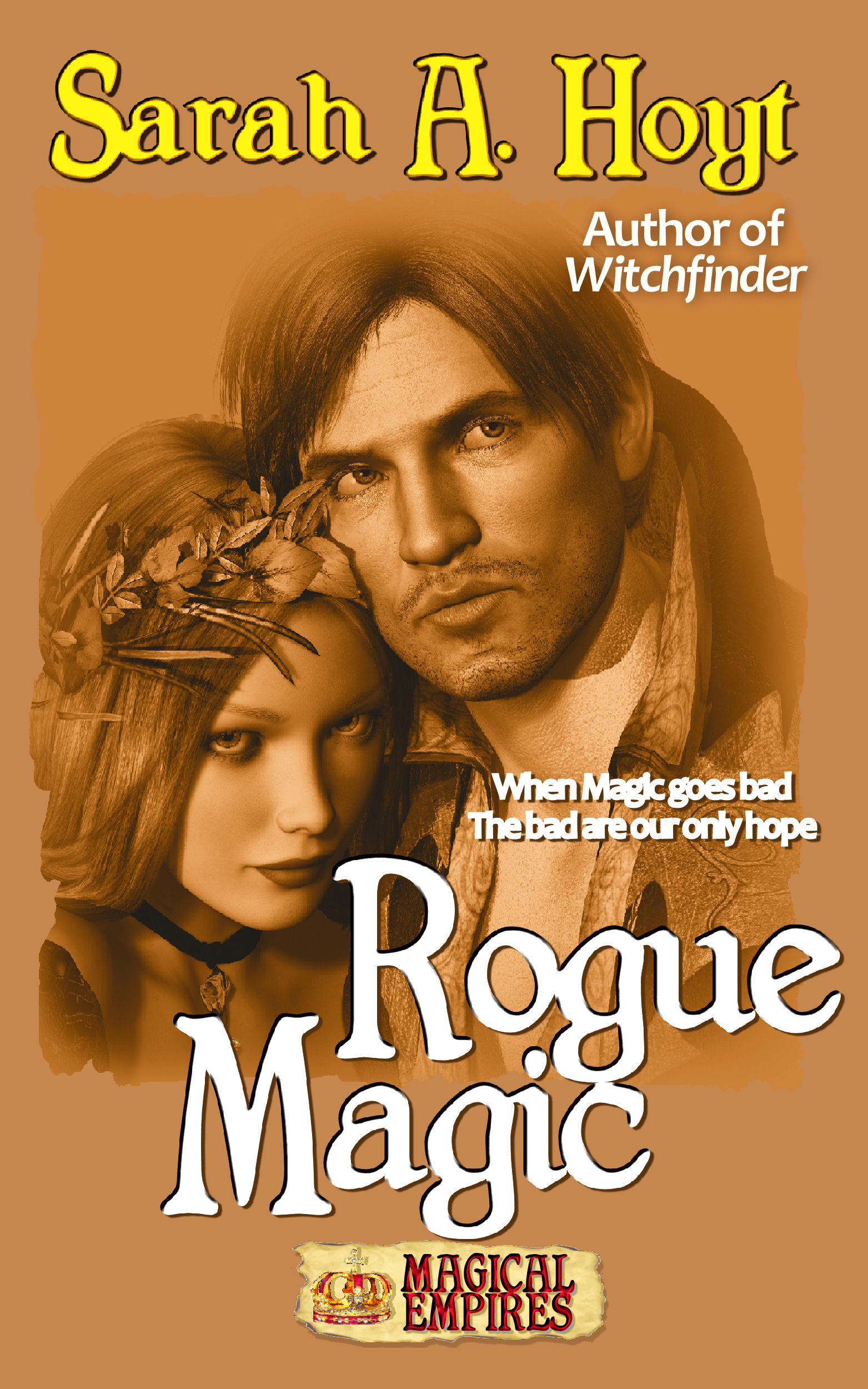
Rogue Magic, Free Novel, Chatper 54

Rogue Magic, the second Magical Empires book.

The prequel to this — Witchfinder — is now up on Amazon.

This novel will get posted here a chapter every Friday or Saturday, or occasionally Sunday.  If you contribute $6 you shall be subscribed for the earc and first clean version in electronic format.  I think it will probably take another three months to finish.  Less, if I can have a weekend to run through and get ahead of the game.  It hasn’t happened yet.

NOTICE: For those unsure about copyright law and because there was a particularly weird case, just because I’m making the pre-first draft of my novel available to blog readers, it doesn’t mean that this isn’t copyrighted to me.  Rogue Magic as all the contents of this blog is © Sarah A. Hoyt 2013.  Do not copy, alter, distribute or resell without permission.  Exceptions made for ATTRIBUTED quotes as critique or linking to this blog. Credit for the cover image is © Ateliersommerland | Dreamstime.com


The Last Magic

Jonathan Blythe, Earl of Savage,

When I was very little, when mama and papa tired of me they used to send me to stay with dad’s father.

This fearsome personage, known variously as “his lordship” “the old lord” or Old Nick, all of which, to those under his rules, meant “the old devil,” was … well, he was a rogue.

At the time, my being very young, I didn’t fully understand people’s whisperings about no village maiden (and very few village lads) being safe with him. I thought perhaps he took them somewhere and killed them.

I was, of course wrong. For one, no one would accuse grandfather of being a danger to lads as such. Or lassies. When they said that they meant rather older people. For another, grandfather didn’t feed on blood sacrifice. Whether or not he might have fed on the other greatest impulse for life in the humankind, I refuse to say. For one, it was said he had elven blood.

Now, in the middle of fairyland, and standing next to a bewitching woman who came from yet another world, neither Earth nor fairy, I wondered if that was true. There was something… I won’t call it a scent, for it wasn’t physical, but something about Ginevra Mythborne that reminded me of grandpapa. In fact, I thought, that might be what first interested me in her, though not exactly what first attracted me, because there couldn’t be anything more different between Miss Ginevra’s shape and grandpapa’s.

But in another way, grandpapa, you see, had been one of the anchors of childhood. It’s not that I loved him. At least I don’t think I did. And I certainly didn’t feel safe near him. I very much doubt anyone felt safe near him. There was a reason for those nicknames and he positively exuded all kinds of danger one can exude.

And yet I understood him. I understood him in a way I didn’t understand mama or papa. I understood also that he’d never lie to me. Because he didn’t. He told me the shocking truth, bald as day, and he never thought one should water down things for children.

He’d told me things like “if someone gives you something for free don’t take it. Likely it will cost more than you can spare.” Or “Three things are likely to be lies: a pretty woman, a perfect horse, a crying orphan.”

But beyond that, he liked telling me frightful stories,and he’d taken me to the old stones, the ones the locals called King’s men, and had not told me the story of warriors transformed mid battle. Instead, he’d told me that there was a time men were bery weak and powerless, and besieged by magical creatures in their own world, they’d turend to the blood for protection. He’d told me that now it was illegal, and it might always have been immoral (grandfather was honest enough to never preach of morality) but how in the end blood magic was the most true of magics, and everything else a mere allusion and invoking of it.

And now, in the middle of fairyland it came to me. Something – something that used Ginevra as an agent, probably the mythworld – was gathering rogues from all over, and intended to use us, somehow, for power.

The hair stood at the back of my neck. In the end, the only way to get power from someone else was the blood. It was always the blood.

But then…

The thoughts came rushing upon me, like many fast horses converging on a central point. But then …. Ginevra, myself, the king of fairy and whoever else had fallen into this trap, including probably my misguided sister and yes, Wolf Merrit…. We were all people out of place in our circumstances, people fighting or accepting fate, but out of place in our destiny. And the mythworld was gathering us in.

Well, it bloody well wasn’t to give us a box of chocolates.

I wondered if my fair charmer knew. Looking at her, I said, steadily, “You realize, Miss Ginevra, when they tie us to the sacrificial stone, you’ll be right there along with us?”

She shook. Her lips opened. She started to say, “No! Not–”And then frowned at me, as her eyes widened. “How could you know?”

I should have felt fear or confusion, but her widened eyes, her parted lips, her whole look of confusion made me cackle and say, “Got you now my pretty.”


Apologies. Chapter will be late.

To those looking for the chapter of Rogue Magic, it’s like this — as many of you know we’re hoping to stage the house/put it up by next Spring (only because there’s no point putting it up during winter.)  We simply don’t need this much house.

Unfortunately the preliminaries of this involved cleaning the garage, one half of which has been packed tight with stuff the movers dumped there/and/or/we dumped there on final move from the last house because “we’ll go through it when we’ve rested.”  Well, then came the year of the six books while homeschooling and then health and life got interesting.

It’s not like I have the time now, and I really need to write, but we’d decided that we’d do two hours or so a day towards clearing the house so that in march all we have to do is rent somewhere, stage, and leave it undisturbed till it sells.

This morning I woke up with an infernal headache, the sort that brings aphasia and I couldn’t think IN words.  (I was grunting at the boys who got exasperated with grunted orders.)  So I thought “I’ll do two hours in the garage, then write the chapter.”

Well, it’s eight hours later.  EVERYTHING is finally unpacked/donated/tossed, and a few things kept only because we’ll have to paint and fix this place.

I think I’m going to burn the jeans I was wearing.  They’re dust encrusted and have weird stains.

One note to self — used paint rags are not precious and should NOT be kept for years on end.

The Mathematician has promised to make me cow.  So.  After dinner, I’ll write chapter.

Sorry.

The promo post! Good for What Hails You!

Happy Saturday, Huns & Hoydens! We’ve a good load of books again this week, including an entry from the elder scion of the House of Hoyt! Go, read, review, enjoy; that is all. Well, except to note that future entries can (and should!) be sent to my email. Happy reading!

Jason Dyck, AKA The Free Range Oyster

Horde Herder, Mercenary Wordsmith, and Keeper of Useless Secrets

Robert A. Hoyt

Cat’s Paw

King of Cats Book 1

Many humans know there is a mountain at the end of the universe to which a bird flies every thousand years to sharpen its beak, until the end of the mountain comes, and thus the end of eternity. What few of them know is that of the mountain only a few small grains of sand remain. And the bird that is to end eternity is alive and ready to fly. At half past noon at the end of the universe, the last great hopes of everything that exists, ever existed or has yet to exist, rests with a stray cat with alcohol issues, a Siamese cat with gender issues, and a Persian cat with pregnancy issues. Things are just about to get fun.

Alma Boykin

Cities and Throngs and Powers

Honor or freedom or yes?

The Salazar family lost everything in the Collapse of 2015 except their pride. Two years later, Mr. Salazar pays a debt with his youngest daughter, Alicia. She must work at Illif House, the mysterious mansion on the plains near the Flatirons. Alicia discovers more than she could have guessed, including a chance at independence. When blood ties threaten to drag her back into the world she’d hoped to leave forever, Alicia must choose between her family’s honor and her heart’s desire.

Laura Montgomery

The Sky Suspended

A generation has passed since asteroid scares led the United States to launch its first and only interstellar starship. The ship returns and announces the discovery of another Earth. People are star-struck, crowds form in Washington, DC, and a boy from Alaska and two lawyers grapple with questions surrounding whether ordinary people will emigrate to the stars. Calvin Tondini is one of those lawyers, and he works his way to the heart of that question.

This is human wave science fiction.

Michael Kingswood

Glimmer Vale

Glimmer Vale Chronicles Book 1

Free this weekend!

Lydelton, a small fishing town in a remote valley called Glimmer Vale, is the perfect place for two fighting men on the run to stop and decide on a plan. But when Julian and Raedrick arrive they find the town besieged by a ruthless band of brigands. Worse, the brigands have taken up station in the mountain passes, blocking the two friends’ escape. With no way around the brigands and no option of returning the way they came, Julian and Raedrick accept an offer of employment. Their mission: defeat the brigands and restore peace to Glimmer Vale.

They are outnumbered at least twenty to one, long odds even if they recruit help. But that help may not be enough when the specter of their past rears its head, forcing Julian and Raedrick to openly face what they are fleeing or risk losing not just their freedom but the lives and fortunes of Lydelton’s inhabitants.

Glimmer Vale is a short, fun fantasy adventure novel, the first installment in the Glimmer Vale Chronicles.

Also available from these fine booksellers:

Tollard’s Peak

Glimmer Vale Chronicles Book 3

Winter in Glimmer Vale – a time to remain close to shelter or, preferably, indoors. Most definitely not a time to brave the mountain peaks surrounding the valley. Raedrick and Julian certainly have no intention of doing so until a man from their past, nearly dead from exposure, appears at the outskirts of Lydelton. Once recovered, he tells them of his friend who lies injured on the flank of Tollard’s Peak, the tallest mountain in the region. Unable to ignore the stranded fellow’s need, the two Constables form a party to rescue him.

But there is more to the story than it first appeared, and very soon Raedrick and Julian find themselves struggling against far more than the elements as they brave the perilous peak. It will take all of their strength and resolve to survive their quest and get to the bottom of the mystery that drew these men into the bleak cold of the mountainside. And they are not the only ones who are searching.

Also available from these fine booksellers:

C.J. Carella

Bad Vibes

Occult consultant Dante Godoy arrives to the small town of Redemption, Nevada, just in time to help Sheriff Matilda Knobb deal with two impossible murders. Together they will confront unspeakable evils in the night.

“Bad Vibes” is a 7,900-word short story introducing a horror setting that will be explored in future novels by C.J. Carella

Steven G. Johnson

Keep of Glass

Girls can’t be knights. Not in the real world. But lately, with all the strange things happening, the real world’s gotten a lot less predictable. So why can’t Galehodin fight for the King like her brother? Well, besides the strangers trying to kill her, there’s always the angry immortal who wants her soul… literally.

Michael A. Hooten

The Curses of Arianrhod

A Bard Without a Star Book 4

There is no magic strong enough to break a mother’s curse.

On the day Gwydion ap Don discovered he had a son, the boy’s mother Arianrhod cursed him to never have a name unless she gave him one herself. Now he wanders Bangreen, exiled from his home, and trying everything he can think of to break the curse.

Left with no other option, he takes the boy to Caer Sidi, where Arianrhod lives in her own exile. But even when confronted, she refuses to name the boy, or even acknowledge him. She wants to punish Gwydion for the rest of his life, despite the fact that he still loves her.

Gwydion almost loses hope, but a tiny sparrow leads him to the wise Ousel of Penwyth, who tells him not to break the curse, but fulfill it. So Gwydion and his son return to Caer Sidi, disguised as shoemakers, to trick Arianrhod into giving the boy a name. She calls him “the fair one with the sure hand”—Llews Llaw Gyffes—and the curse ends. But in her fury at being tricked she curses him again, this time that he will never bear arms until she gives them to him herself. Gwydion swears that he will trick her again, but can he come up with a plan that both fulfills the new curse and keeps his son safe from his mother’s wrath at the same time?

Bullies Knights Savages and Komissars

Yesterday’s topic which was supposed to be about men fighting (why men fight – eh) got sidetracked into schoolyards, bullies, fights, blatant abuse, wife beating as related to fist fights and the advisability of authorities intervening in all this. Which was bad. Very bad. Because it got me thinking. And that’s bad. Very bad.

It’s very bad because I never come to the expected conclusion which I suppose is that I was wrong, violence is bad, etc., etc.

I wasn’t wrong, violence isn’t – by itself – bad but – more importantly – you can’t eradicate it from a human society, and we’re going about the problem of keeping the savage part of man controlled upside down and sideways, when we KNOW the solution. What we’re doing deliberately ignores hundreds of years of experience and we’re going to pay for this. We’re going to pay for this in awful ways. In fact, we’re going to pay for this in a lot of violence that will be targeted mostly at the defenseless.

We’ll start with me as a mother. No adult fully understands the world of children, the sudden violence and the vile ways they go after each other. In a way this is because we have a softened recollection of our own childhood. Part – son would say – is because our brains aren’t fully developed as children, and as things change, things get stored elsewhere and lost. Think of it as moving and shoving some stuff into the garage which you only open 13 years later and go “oh, wow, I didn’t remember that.” Only in this case you don’t open it ever again. (Son, who can be incredibly literal wants to point out I have the process wrong.  It’s more like living in the garage and then moving out, because memory doesn’t get moved out and into another place.  You just grow out of it, and stop using it. — He insists it’s vitally important I correct this.  So, now you’re enlightened.  Right?)

So we’ll start with my being in my early thirties and taking older son to kindergarten, and waiting outside the row of kids, then watching the teacher come to gather them in.

These were good kids, in a little mountain town. Since the mountain town is a dormitory for the larger city, most people there were white collar workers, a few artist and other creatives. There was exactly one blue collar worker, a dad who was a carpenter. (He was my buddy while standing outside with the kids, waiting for the teacher.)

And yet an observant adult could see the tides of violence beneath the surface. My kid was often a target because we’d taught him NEVER to hit anyone, because he was so outsized. (We later had to modify that. More on that later.)

When the teacher came to get the kids, not only was I relieved that I didn’t have to arbitrate those disputes, as I was totally baffled as to why an adult, any adult would want to spend their time with the kids.

They were, to put things mildly, little savages, without a glimmer of mercy, order, compassion or justice, or any of the higher values. They lied, hit, bullied and formed gangs to prey on the weak as easily as they breathed.

Here’s the thing: I don’t think the teacher was aware of all the currents (I know I wasn’t.) And I don’t think she was often able to do justice. I think most often, like a policeman, she made peace – by the method of getting them to shut up and go away – but not justice. And I know, from being in charge of kids, that it’s very easy to give in to the sweet and angelic looking one who brings you tales of the awful stuff those rough boys are doing. More on that later too.

I know many of you had experiences of awful PHYSICAL bullying in school. Note I said “physical” and note I said “many of you.” No, I was never physically bullied. I was attacked and there was what I THINK was an attempted rape, but that was middle school and I dealt with it.

I wasn’t attacked, not because I’m some sort of uber mensch but due to accident of genetics. At 5’7” by 12 and weighing in at just over 100 lbs, I was a moose. Even fighting with boys wasn’t a problem until I was about 14 and they got the testosterone boost. By 12 I was taller than most of my teachers, including males.

Given that and – yeah, I know myself – a tendency to crack heads first and ask questions later, in fact, given a preference for the fast, clean solution of a blow to the offender’s noggin I must have been a bully right?

Throughout most of my childhood, I was the center of a group of small and mousy friends. When I was fourteen the bete noir of my childhood, the man who liked arguing politics with me to prove his superiority, and who was at that point losing interest in me because I was too old for him, (and yes, that means exactly what you think it means) and who had always thought of me as a more sexual being than I thought of myself, accused me of picking as friends the skinny, the fat, the ugly, and those who would make me look good.

This startled me, because a) I didn’t think of myself as any different from my friends (and more on that later too.) and b) I was inside my head a boy. Physical beauty didn’t come into it. I knew by then I liked boys, but I had this hazy idea the boy I wanted would overlook the externals. (A surprising number of guys I dated did, considering most of them are now happy with guys. Eh.)

Throughout elementary school and into early high school, my friends were my friends because I stopped people hitting them.

Look, I knew myself – still do – and I knew I liked violence and hitting. (Physical. I’m not a verbal happy warrior.) That has receded somewhat as I got older, though sometimes I wonder if it’s just I learned to control it and sublimate it into stories.

My dad, bless him, knew that too. Probably because he recognized similar savage tendencies in himself. So he taught me a code. It wasn’t a new code.

The people I could hit were those doing harm to others. Tattle tales, particularly those either bearing false witness or distorting things were free to hit too. I was never though, under penalty of being pushed off the human race for shoving in line, to hit anyone smaller, weaker, or more defenseless than myself. Ever.

So by default I became a champion of the weak and the bullied. Until high school. When I found that my strength and size didn’t save me from one kind of bullying. What was more it was a kind of bullying I’d saved my friends from in the past, but it could still get to me.

Those of you who are women know exactly what I’m talking about. That kind of bullying was the whisper campaign, the snide remark, the glance that said “who, her?”

Look, I entered high school in seventh grade, but here I’m talking about high school as in the US – 9th to 12th grade. I entered it functionally a boy. Not physically. I had breasts from the age of eleven, which proves G-d has a sense of humor because what in heck did a tomboy want those for? But in my head I was a boy. Externally to an extent, too. I lived in my brother’s discarded sweaters and cut down shorts and pants. I had leather elbow patches. My mom had to sew holes caused by my fighting.

I left it in 12th grade, after a stint in the US, where my host mother finally got me to see the benefits of lipstick and hairdos, as a proper young lady. Okay, a weird young lady. Like my older son I dressed entire in thirties style, complete with fishnet or lace stockings, (Robert, fortunately skips those and goes with the male version, including Fedora and trenchcoat.) but hey. By that time I’d also learned to ignore idiots saying stupid things about me. But it had been a hard climb.

Which means in 9th grade I was totally unprepared for the “feminine way of fighting and enforcing group cohesion.” I was unprepared for the whisper campaign, the put downs, the giggles when I did something the group had arbitrarily decided was wrong.

Most of you were physically bullied. Let me tell you something: if that’s all you were, you’re lucky.

I won’t tell it, because it’s not my story, but one of the people who regularly guests here had her life nearly ruined by concerted, sickly sweet, concern trolling BULLYING. I’ll let her tell it if she wants to.

One of my regrets is not having gone to her school, because I’d have descended like vengeance from above and shoved the bullies’ heads in till they stopped it. Which they did.

I couldn’t do it when it was directed at me, but I came to the states as an exchange student and left them behind, and that’s a long story we don’t need to go into.

What we need to go into is violence and the way humans hurt each other, both in school and in the larger society.

It’s relatively easy for the “authorities from above” be they playground guards and the civil authorities alike, to “suppress violence.” Unfortunately that leaves the bullying of a different kind in place. It also takes off the table the solution that was used throughout the centuries to keep the violent nature of mankind under control.

Humans are violent and nasty. Every human. Given a chance the little mouse of a girl will kick the bully, or at least fantasize about it. I think most of those feminists fantasizing about hurting men that Cedar quoted a while back, were in fact bullied/hurt little girls who know they can’t fight physically. But they can fantasize.

Faced with a classroom full of violent kids, or a world full of violent adults (none of us are angels) it’s very easy to say “I’ll just stop all fighting. I’ll beat anyone who fights.)

Here’s a problem – you too are a fallible human and filled with violent impulses. (And before one of you asks – did I as a kid dispense the wrong justice? Probably not often. It was a small school and I was aware of the personalities and proclivities. Sometimes, though? Probably.) You’re going to listen to the side that seems right to you. The angelic looking and cleaner side does it for most adults. And half the time it will be the wrong side. Plus, you can’t be everywhere. One of the worst beatings I EVER got as a child, was when I cut between two houses on my way to buy mom some butter at the dairy. I was trying to save a few blocks of walking. I was jumped on by a group of the guys I’d often beat at the school (because they were repeat-violent-bullies and at this point all have criminal records.) You can’t fight a group. While patching me up mom asked “Why did you go out of the main street, where people would have intervened on a fight of many boys against one girl?”

And that’s the second part. You can’t watch everyone and everywhere. You can do two things:

You can teach kids to watch themselves, which makes them adults who watch themselves. You can’t tell them “never, ever, ever, ever fight/have a violent thought.” They’re still humans. But you can tell them the acceptable… ah… boundaries to their savagery. “Fight on the side of good. Protect those weaker and more innocent than yourself.”

And you can communicate that to the greater community. You can teach people what’s “fair fight” and what’s not. If they learned it as kids, they will enforce it when blatantly violated as adults.

In the same situation “never fight, ever, ever, ever, ever” is just going to disarm those who would otherwise jump to the rescue. (And the victim, should she ever wish to fight back.) The untamed savage? They don’t care. They’ll continue committing acts of lawlessness.

Faced with a similar problem, rulers of the middle ages, who needed their vassals in good shape to fight off invasions and aggressors in the time of chaos after Rome, invented chivalry, which is basically “you fight to defend the weak and poor and helpless.”

Did it work? Eh. In default, often, like my happy go lucky violence in elementary school.

Were these men still horribly violent to underlings and women? Surely – it was the time it was – but often FAR less violent than they would otherwise have been.

It could be argued not only isn’t there a link between wife-beating and inter-male personal violence but that there is a reverse link. I’m not sure about this. Don’t know if a study has ever been done – or a non-doctored study – and I know anecdote isn’t data. BUT I know that in the village the worst wife-beaters were the lame, the halting, the ones under suspicion of being less than manly, the ones in fact who couldn’t hold up their own as men among men. Take it for the price I’m selling it, which isn’t very much, just “this is what I’ve seen.”

In this as in everything else, it’s impossible for the authorities to be everywhere at once. It always was. It always will be.

It’s better to teach each person to channel his or her violence.

But why not teach them to suppress it then?

Because you can’t. What you’re asking is “why not make men angels, then?”

Look, we’ve cut down on personal assaults dramatically, but we’ve done it at the expense of the wave of non-physical assaults.

I think middle school was always h*ll on Earth, but I didn’t know how bad it could be until eighteen girls bullied my son by using the school authorities as weapons.

If the rule is “don’t fight” and “if I feel uncomfortable, I’ll go to the authorities” clever bullies are always capable of running to the authorities with stories, real, invented or exaggerated. In the case of my son they were wholly invented, and to boot these girls were perpetrating violence on him out of sight of the authorities. (Which I only know because I accidentally observed it.) BUT the authorities believed it was possible to completely suppress violence, and that the physical side of it was the only violence, and that a big, strong male must be at fault, always.

We’ve seen what the “don’t fight” and “use the authorities as whips instead” has done in our society at all levels. The male is always guilty and always suspect, but women can make up things out of whole cloth and no one questions it, because “they’re not violent.”

This puts power in the hands of women and men of a certain stripe: the weasels, the tale bearers, the plausible liars, the yellow streaks of sh*t, who would never face another man (or woman) in the full light of day, but who will lie and connive their way to the top.

This way, anti-bullying initiatives become bullying. Someone was discussing on FB how the Goodreads “anti-bullying” groups come down like a ton of bricks on any author trying to defend his book, or anyone else trying to protect himself from group evisceration.

Same as it’s ever been. Take away physical weapons, and people will use the authorities as physical weapons. (And psychological ones too, which is worse.)

Now, the weasels we shall always have with us (I think that’s in the Bible, somewhere.) And the wicked flourish like the green bay tree.

But when you take from society the manly weapons of open and clean, minor and non-lethal violence, what you’re left with are the female weapons: the denunciation, the stab in the back, the laughter, the snark, the reputation-destroying rumor. And the advantage is not just to women (the wrong kind of women) but also to entirely the wrong kind of man. Some men are very good at it indeed.

And what results is what we’re seeing in certain professional organizations: bullying of the ones perceived as weak. Hounding of those who don’t think with the group. Abuse of elders. In fact, the full panoply of the crab bucket.

This is because people have been taught violence that’s not physical is okay, and because they’re human and violence, group fighting and group protecting has to go somewhere.

And the advocates of non-violence can wipe their hands to the wall. I hope to heaven I’m wrong, but I predict that in less than a decade, those will be very bloody fingerprints.

UPDATE: Welcome Instapundit readers and thank you to Glenn Reynolds for the link.


And Then I Popped Him One


I grew up reading Rex Stout books (And all sorts of mysteries, ranging from cozies to the hard stuff. Because my dad read them.)

It wasn’t till older kid started reading them recently, and I started reading him through his eyes (After he told me, “Society sure has changed!”) that I went and looked at them through … well… new eyes.

Yes, a lot of the changes were for the better. What he was talking to me about was how some things seemed so expensive/upscale in those books, but to us are the merest common place. (I don’t even remember what.) But then I went in with fresh eyes and noticed tons of things. Guys and girls would flirt in public and often on first meeting. Yes, yes, the SJW’s would tell us we’re all so much better now, but our interactions, I’d guess would seem rather bloodless to them.

But the thing I noticed the most was interpersonal violence between males. I’d noticed the same when reading For Us The Living.

Popping a guy one for saying something funny about your girl was perfectly normal. In fact, men could punch each other out and then arrive at an uneasy truth, and sometimes even progress to friends.

If those books are an accurate representation – and I have no reason to believe they aren’t – two guys engaging in fisticuffs was a perfectly normal scene.

Ah, but we’re so much better now, aren’t we? We’re so civilized. If some guy punched another guy for being rude to his girl, why, he could be taken in for assault. And if the girl is a ninny she’d leave the guy too, for icky, horrid violence, or something.

This is better, right?

You know – I’m not sure.

I mean generally the trend in society has been towards less interpersonal violence. If one is to believe memoirs and first hand accounts, getting a duel in the middle of an Elizabethan street was not all that odd. And though other things went into it (like the fact that they could no longer do inter-domain war) duels were such a popular er… pastime that the king had to make edicts against them in the France of the Musketeers.

This might be a symptom of us taming ourselves, as time goes on. We pick for people more likely to do well in a tightly packed society, perhaps.

But at the same time, it seems very long to have come in less than 100 years, from fisticuffs in the street to people being unwilling to speak out against someone else who is doing something heinous.

And we know part of this is not natural. Part of this is the enforcement of the laws on assault, the tightening of the mesh of anti-male behavior, the de-legitimization of the code of chivalry that had obtained in Western Civilization since the troubadors.

Man is no longer allowed to fight for his honor or his maiden fair, even with words or fists. Instead…

Instead we have lawyers. And girls are insulted if someone defends them. And it all rests on the law and government, and little nuisances get magnified to major issues.

Note that this change has greatly taken power out of the lower classes – as in those who can’t afford lawyers – rendering them in effect powerless and emasculated by the “upper classes.”

I suspect, though I have no proof, it has also increased the level of thug behavior to shooting, because, well, just punching someone’s lights out isn’t acceptable.

This has rendered some movies and behaviors completely opaque to today’s teens.

And since the school is teaching them things like not fighting back because all violence is bad even (particularly?) self defense, and to run screaming to the principal instead… the feeling I have is that we’re creating a nation of snitches.

My parents had a simple rule. Yes, you were absolutely allowed to come and tell them if someone was doing something wrong. But then you were a snitch, and you got the same punishment the other kid got. So you’d better be very sure that you couldn’t deal with it yourself and that it was important enough to tell.

To this day I’m thoroughly unrepentant for giving the beating of her life to the girl who threatened to tell my friend’s parents that my friend had failed her dictation again. (My friend was severely dyslexic.) Because in my eyes there was nothing – nothing – more repugnant than the sticky-sweet girls who would simper to the adults that so and so was doing bad things, and could the adults stop it, now?

I can’t help but feel that’s what this change in the standards of interpersonal violence (particularly between males) has done. It took the power out of the individual hands (and fists) and put it in the hands of authorities, to whom you have to debase yourself by snitching. And then you have to wait till they make it all right.

It’s not, you know, that people are less prone to fighting and disagreement. It’s not that people hold fewer grudges. You see them on internet forums pouring out the crazed venom of people who tell themselves they’re too civilized to hit a fellow human.

It’s just that the power of solving disputes quickly (and often physically) has been taken out of the hands of individuals and delegated to the state and, for the very rich, to lawsuits for personal injury.

Reading Rex Stout reminded me how much simpler and more egalitarian it would often be to just pop someone one – right in the nose.

When the king of France forbid his noblemen from dueling it was to concentrate power in his hands. If they could not deal with their own problems, they’d have to come to him.

It seems we’re all French noblemen now.