The Pure

This morning the ADHD is exceptionally strong. I’ve been up since 8, and been running side quests, one after the other, because anything will distract me.

While reading the news in bed — no, not a usual thing, but I got distracted by a text message, then flipped over to Bongino reports and it tells you something I haven’t even finished reading the headlines there — I came across an article where Harris’ advisors are lamenting that they have lost the culture war by relying on legacy media.

The implication that the culture has left them behind is paved in with the certainly that they will start their new hip shows on the net and… show us how it’s done.

You and I know it won’t happen, but it bears examining why it won’t happen. It’s important to examine why in fact they had their own Tom Poole and their own Joe Rogan. They were the same people, and were shoved out. They had their own Elon Musk too… And they lost him over the fact they refused to accept jokes made by the Babylon Bee.

The problem they’re facing is not a change in media. I mean, it absolutely is that, in the sense that the alternative media had ended their supremacy of the culture which should NATURALLY have ended a good fifty years ago.

The change in the media, and the appearance of blogs wasn’t only the precipitating incident of the appearance of effective cultural opposition to the left. It was also the inevitable result of how repressive leftist culture had gotten and how iron-clad their control on the traditional forms of the communication-industrial (including the arts) complex had become. Like indie publishing’s success is, sure, contributing to traditional publishing’s failure, but it only got a beginning because trad pub was already failing. Because it was part of the industrial media communication complex and had been (and still is) captured by the left for decades, with the grip tightening.

If this were only about how the left is losing its grip on the culture (It’s lost it, really. We’re now at the moment when everyone realizes it, is all) I wouldn’t have bothered trying to work through extreme ADHD to write about it. I could just post a picture of me doing a little dance, or perhaps a meme about my schadenboner.

But that’s not what I want to talk about.

Look, we’re not the left and they’re not us. If they’re similar to anything it would be an authoritarian theocracy. Which I suspect is why they adore Islam.

They did “conquer the culture” by questioning what was there, and mocking the established norms. But once they took over, all they had to offer was rigid, doctrinaire interpretations of everything from a story wrapped around the news, to literature needing to affirm their core beliefs. And the more those core beliefs proved wrong — particularly after the fall of the USSR — the more they felt a need to push it into everything, and police everything that questioned it.

I’ve often mentioned that the only difference between the early nineties and the late oughts in literature was that in the early nineties they allowed you to maybe give a casual nod to one of their principles, but write the rest of the story as you pleased, while by the late oughts they were policing every detail of the story to see if you’d slipped in something that might oppose them. And then it moved wider. Over the next decade they, obscurely aware that the control wasn’t enough, moved on to try to police the fans. To try to demand people have fun the RIGHT WAY while genuflecting to the latest shibboleths pronounced from on high by the left.

And that’s my reason for writing this today: because if they are losing the culture war (they lost it long ago, in my opinion. It’s only now people are becoming aware of it though) it is because of that move. Of trying to control everything.

The linked article says that Kamala going on talk shows would be viewed as political and that was bad, but the truth is this is what the right has labored under for decades. Their point of view was “Just normal” and ours was “political” and political was bad. This is de facto true in a lot of left-leaning work places and groups today. You protest something overtly political being said and get slapped for being “political” because to their minds they’re not. They’re just repeating what they’ve heard in the whole culture forever, therefore they’re not political. And this assumption — later on he talks about their just being “normal” or something like that, reverting to base mode — is what is making them so profoundly unappealing.

Look, I don’t care if someone has an ambition to star in a Broadway play. I find it a little odd, to say the least, for this to be an ambition for a Supreme Court Judge, but whatever. I find most Americans are more into acting than I am, and would be tempted by something like this. That’s fine. Except go and read about the play Kentaji Brown thought was worth participating in. Go on, read about it. I’ll wait.

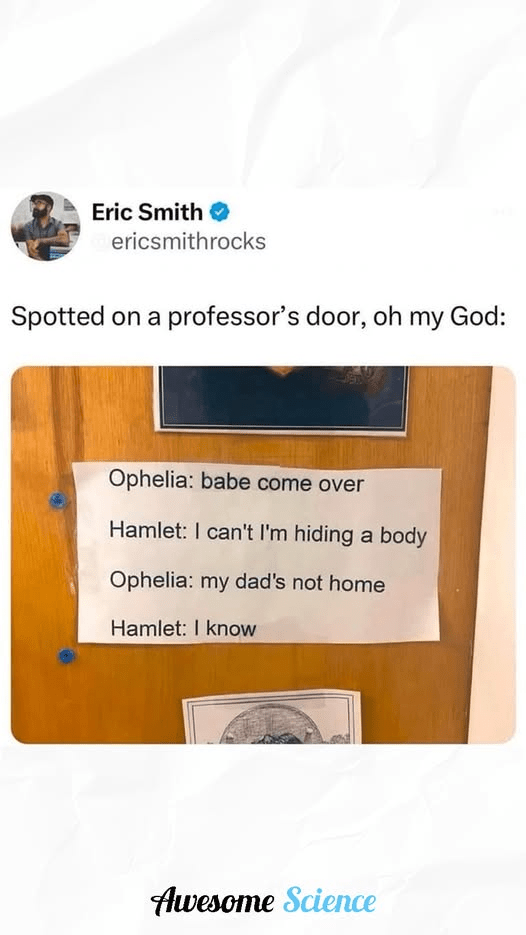
It’s not just that the whole thing sounds unbelievably, mind-bogglingly paint-by-the-numbers leftist-obsession infused, no. It’s that the whole thing sounds unbelievably stupid. And for its utter and stultifying nonsense, it relies on…. Shakespeare. I mean, look, you want to make a play about someone running off with xyr/xer/candycone and leaving a guy behind, go ahead and do it. It better be amazing, because I think it’s the fifteen hundredth done this year. But whatever. But to do it by taking one of the archetypal plays of our civilization and then overlying this puerile…. preachy fantasy on it? That’s pathetic. That his is even on Broadway, let alone that a Judge, no matter what a dim bulb she is, thought “Oh, yeah, I must be in this?” It’s pathetic. It’s sad.

Note, I’m not saying that classics shouldn’t be touched or reinterpreted. Or that a lot of those reinterpretations won’t be stupid. I’m saying this one is particularly boring, repetitive, and OMG haven’t we seen a million of these before? The abandon the heartthrob guy at the altar and run off with the unlikely goes all the way back to The Graduate, which was not that shocking to me at 16. That the unlikely is now “Gender neutral” is…. well. I yawned while typing that.

In fact, at this point if you wanted to shock me, you’d have a woman wanting to get married and have kids. Even Disney has stopped having a romance at the end, opting instead for “empowering” its girl boss heroes. And supposed rom coms often end with the woman going off to “find herself.” Which is why Hallmark eats everyone’s lunch, but that’s something else. (Yes, repetitive and boring — look, I have someone in the house who loves Hallmark Christmas movies — but they’re NOT PRETENDING TO BE ART AND GROUND BREAKING. They don’t demand applause.)

Look, I don’t think we’re at danger of becoming them. For one, the individualists, as always, fail to organize.

But it is important to know in these days, as we breathe in and take a pause, to realize that yes, already, there are people running around screaming that you have to “be this way”, “write this way”, “play this way” to be “on the right.”

It’s very very important, while we stand on shaky ground, to reject that nonsense. First of all, the call to “normalize” a single vision is the call of a dying vision. Only those who are unsure want to control every expression of the culture.

Even traditionalists wrote things that made other traditionalists raise their eyebrows, before the left went all ascendant. And sometimes it was the truly odd things that started conversations.

Look, I’m not saying this because I write what I write, and because the novel being slowly and excruciatingly edited is … well, the most normal character is a gay male. (And no the book isn’t in the slightest sexually transgressive. Mostly because I’m not even sure how to write that and make it fun in science fiction.) The entire book is a sociological exploration of important topics of being human (yes, sounds about as fun as shredded lettuce, but trust me, it’s also a gonzo adventure involving firefights, sword fights, baking and as my betas informed me, an absolutely gargantuan number of babies. Babies as a good thing. I told you I was a weirdo.) and gee, I am cringing at the thought of what “some people” theoretically on my own side will say.

This is a problem. I mean the fact I’m cringing. It betrays the first signs of people running around trying to define “the right” according to rigid parameters, and trying to make it so that artists can ONLY express themselves within those parameters.

I didn’t write the book (any of my books) to be transgressive. I know some very good writers, even on our side, can be motivated by that, but that’s not how I work. I tend to start from “what if” and at some point the whole bolus comes to life, and sometimes it’s even compelling and makes sense.

But I’ve been yelled at in the past because people — and yes, I do get some of this is trauma, too, on THEIR part — assume anything that is “what the left would have done” (but is it really? REALLY? Think about it) is an attempt to make them “like the other side” and to disrupt their thought.

I was yelled at about Witchfinder because I had a “fated queen” at the end. Even though the world build is bog standard fantasy, and therefore “the king and the land are one” is a thing. (And like other magic, fails to work in real life.) Because apparently it was a disgrace for a “libertarian” to write a monarchy.

I was yelled at from BOTH SIDES about A Few Good Men, because people on the left decried it as homophobic since the main characters are gay, never engage in what a reviewer I like very charmingly described as “exchange of precious body fluids” on the screen, and spend a lot of time debating and fighting for the principles in America’s Founding documents. I was decried by the right, because, well, they’re gay and this is obviously my attempt to preach social Marxism (which makes about as much sense as musical Marxism, but never mind. Social Gramscianism makes more sense, but not much since his fixation was not on sexual minorities but racial ones. Never mind. It’s something people have convinced themselves is a thing. On both sides. Kind of like institutional racism.)

So why were the characters gay? Well, there’s a ton of reasons, if you analyze the book, including the layering of a culture of secrecy in a world where it is sometimes a death penalty matter (though not where/at the social class they are.) It explains a lot of their isolation and how they might not have figured out what is going on behind the scenes.

Is that why I did it? Oh, heck no. I did it because that’s the way the characters were in my head. Because that’s how I work.

In the same way the new book is not the way it is to make you consider sex and gender issues, and the cultural implications of it in reproduction, or the innate characteristics of hormonal expression (in other animals, since this doesn’t work in humans), or the horrors of utopianism and designing humans to be “perfect”, or… I mean, all those things are there. They fell in. And from them logically came the discussions about what to do when a re-barbarized culture is discovered by an advanced one, and how and if it can even be integrated, when there are other biological differences, or if they should be preserved, like zoo animals, in a way. These are, of course the questions that science fiction used to ask, before it devolved (in the major houses, guys. I know Baen doesn’t do this) into endless just-so stories depicting the imagined racial and social oppression of the 21st century over and over again, in costume for the “science fiction” part.

But I wrote it because at 14 I read The Left Hand of Darkness thought “This is wrong” (Well, I was fourteen) and overnight got afflicted with the entire world and had to write it. But I couldn’t, because my first attempts taught me no one would buy it. And I swear, this world there, in my head, was shutting me completely down until I wrote it.

Is it the best thing since sliced bread? Well, husband thinks so. And before you say “Well–” no, that’s not a given. There are things of mine he doesn’t even read, and a lot of others he’s like “Well, that certainly was a book.” Some of my first readers seem to agree.

But the act of writing it has done amazing things for me, personally and enabled me to finally enjoy writing again.

So– Will you like it? I have no idea.

But I think we need to learn that if we don’t like it, we put it to the side of the plate and eat around it.

We’ve been in a position of defensiveness so long that we scrutinize everything for signs of “not being on the other side.”

It’s time to relax that. Look, most of the art on the other side isn’t even art. It’s just preaching and will turn you off anyway. Stop thinking they’ll sneakily get in your brain and convert you. I read an awful lot of communists growing up. Some were fun. Most were… communists and forgettable. But the art isn’t inherently trying to sell you a point of view. The good one will have some ideas leaked from the writer, but is other than that just a story (or art.) The bad one is preaching and not art.

Again, if it personally and outright offends you, set it to the side of the plate. But don’t go on a crusade for a purity spiral.

Recently I blocked someone on his first comment on this site. Now, part of the reason I blocked him was based on a misunderstanding. But afterwards, examining it, I still went “yeah, no. There’s at least one lie there, and the rest is some of that shivying towards a purity spiral, which sucks and which is out of place on a first comment on this site.”

The comment was that this person “borrowed all your books from the library.” I assumed he meant MY books apparently in error, since this was put on the Sunday book promo. Fans corrected me that he meant books I promo in the post. But “Come to a standing still and it takes me an hour to recover when I read the phrase “his husband” or “her wife” and I would like a warning at the beginning.”

I accused him of lying, because I don’t think I’ve ever used those phrases in my books. Yet. Though I make no promises. And since it struck me as utterly bizarre a comment, blocked him.

So, do I repent blocking him? No. Because you know what, he can’t be borrowing all the books I promo from the library unless by library he means KU, in which case he can get most of them. And because at the top of the promo post I say I don’t read all these books.

But mostly because what kind of candy-asses are we becoming if we need “trigger warnings” for those phrases?

I fully understand wanting trigger warnings for full on sex on screen (I only mention the word penis in one book ever, and it’s not sex as such. Well, it’s vampires.) I mean, no, I don’t understand it, but I’m willing to believe some people might need that. (I’m a child of the seventies, and stumbled on full on orgies in the middle of otherwise innocuous science fiction books, and the worst I did was flip past them because most written sex is boring and doesn’t advance the plot.) But needing trigger warnings for passing mentions of homosexual marriage, which already exists, and is likely to continue in the future at least in places (or at least as likely as to go away) is… weak. And dumb.

And hectoring other people about it is an attempt and stampeding people who are just realizing they can create whatever, and the boot of the left is starting to lift from their faces, into creating only one way and repeating only one message. WORSE into believing that ALL ART is message, and that’s all it is.

… That’s ultimately what creatively castrated the left, and demoted it from culture-bestriding colossus to… Echo chambers filled with resentment.

Let’s not go there.

Look, artists — I’m at 62, slowly, coming to accept this title for myself. Reluctantly — are strange people. We are moved by weird compulsions. (This week… making houses out of gourds, with pieces of pine cone for stone work. Perfectly normal for a sudden obsession, right? And thanks to Stephen for sending me the pine cones from the Missouri woods ;) ) and things we write and paint and create cannot be confined and cannot be interpreted as a “message.” There might be a message in there. There often is. Its relevance is likely to be “This is a fruit of its times.” And the message each of us finds in a book might be completely different.

But don’t start off an attempt at a cultural revolution (A real one, not the Maoist caricature) by forcing us to sing from the same hymnal and support the things you think we should believe (That’s the Maoist caricature cultural revolution.)

Let us be our weird selves. If we are pro-liberty this will leak in weird ways into the most unlikely pieces of work. And our questions, our prodding, our strange ideas and thought experiments will all contribute to liberty and the prosperity it engenders.

Demanding utter purity from your artists just makes people want to break the walls, even those that are holding up the ceiling.

And we all know how that ends.

Politics Gives You Wings

Politics gives you wings, while rotating blades are given to you because of politi–

Okay, fine, I’ll behave. Even if I’m coming to you from a semi-disclosed location and profoundly uncaffeinated this morning. (I should go grab another cup. One advantage of having Charlie staying with us a little while is that he makes coffee.)

The other day, while in a discussion on Twitex I came across a kiddie who wasn’t making any sense, and since I have absolutely no patience these days, I just blocked him when he said something about how communism wasn’t all bad. But of course the way twitex blocks these days, I can still see replies to him, and one of you finally answered with something like (Forgive me the paraphrasing. I don’t remember the exact quote): You absolute moron. Right and left wing aren’t like wings on a bird, something you need to fly. They’re legacy terms from the French assembly, and no, all nations don’t need a little bit communism in order to work. They work much better without.

(Speaking of morons, I’m arguing, when I remember to log on, with one who insists of course we need a strong central government because power vacuums will be filled, otherwise. I used the pimp hand to point out in the US the lack of a central power is not a vacuum but belongs to We The People. I doubt this will be understood, partly because I recognize “arguing from European assumptions.”)

Anyway, of course, the one of you (Jay? Maybe?) who answered the idiot is absolutely right. Politics isn’t a bird, and it doesn’t need to have a right and left wing to work.

Frankly in the US — anywhere, really, since in Europe left and right are simply different flavors of socialism, international versus national — right wing and left wing don’t make any sense. Our right is frankly so far on the side of freedom that it’s impossible to explain to the rest of the world. (Hey, remember when the French rent boy came here to argue that the press had to be controlled by someone. It just couldn’t operate otherwise? — good times. Oh, idiot on Twittex is now arguing without a strong central government we’d be controlled by corporations. He’s either stupid or European, or the ever popular, yes.)

Of course our left wing is bog standard European left, good old international socialists. Perhaps that is because they all believe they’re elites, and elites in the US have always been more than a little stupid on the subject of “those sophisticated Europeans.” It’s nothing some time of living in Europe as a middle class person with no special access wouldn’t cure, but what are you going to do.

OTOH, though it’s far too early to worry about this, there is a case to be made that in a bi-party system like ours we do need two parties. And two parties that make some sort of sense for us.

Now, it could be argued the problem with this idea is that we haven’t had two strong, functional, American parties for…. almost a century. I’m not going to lay any bets on when the Democrats were institutionally captured by international socialists, because I simply don’t feel like doing a deep dive into the history of the party just now. (For one, as uncaffeinated as I am, I’d never come back. It would turn into the ADHD drunkard’s walk.) However, Heinlein, whom, despite being a man of his time, I consider a creditable source, thought the inner structure of the party had been captured by communists by the 40s, and I see no reason to doubt it.

I was aware of the myriad little acts of “stupidity or treason?” that allowed the USSR untold power in the sixties and seventies, which could have been curbed by … not believing communism had the upper hand. And I maintain that what was wrong with McCarthy’s red hunt is that it was already far too late.

So, technically we haven’t had a left and right wing party (whatever wings you want to call it in the US) in a long, long, long time.

Which probably explains how things have got so out of control. When you have to vote for the GOP because the other party hates America and is frankly dangerous, it gives the GOP all sorts of power it wouldn’t otherwise have to ignore its constituents. Worse, it causes the Evil…. er…. Democrat party, with ever diminishing constituency to reach for other means to power, from divisive rhetoric to outright fraud, without which they’d long since have disappeared.

Frankly, unless we can do something about the fraud, I wouldn’t count them out yet. But other people are. I found this article interesting, even though I think it’s far too optimistic in thinking we’ve defeated the monster. On the other hand, this is an age of miracles, and perhaps he’s right.

Let’s suppose we do something about fraud and the democrats, like other obsolete parties, roll up and disappear. What then?

Well, as you guys know my view of the “Trump coalition” is that it contains enough internal contradiction that it won’t lack for enemies. I mean, I think Tulsi Gabbard agrees with the guy in the article, and that’s why she turned her jacket inside out, because she thinks the way to run in the future in any relevant way starts with “be part of the Trump version of the GOP” but inside it she can do whatever she wants.

Frankly, this gives balance to the coalition, but it gives me cold sweats because Tulsi, RFK Jr. and the running mate he ran in with and whose name evades me just now are all outright communists, if somewhat more quiet about it than the crazy dems.

Hopefully we didn’t go through all this only to have the GOP calve a new wing of commies to plague America. Note, that even then commies who love America are preferable to those who allegiance rests with the rotting corpse of the USSR, but the difference is small, and it doesn’t reassure me, since the communist, central control by government ideology has exactly zero wins, and has destroyed lives (metaphorical and literal) all over the world for a century.

Then there are the crazy born-again monarchists who think that if we had a king it would solve everything. I honestly recommend laying off Tolkien and Tolkien derived fantasies and reading the history of Europe. Or even better, go and live like the middle class in Europe for a while, with no special connections or favors, to fully absorb the layer of classist “They’re better because they were born that way” nonsense that still infuses Europe these many centuries later. Then take some anti-nausea meds and return to reality.

I honestly don’t think those guys have a chance in America for reasons both good and bad. The good being that the sumabitch that would be our better ain’t been born yet. The bad being that enough of the left’s propaganda about tradition lingers with us and there ain’t nothing more traditional than kings.

Then there are the blood and soil fantasists. They’re even more at sea and disconnected from reality than the monarchists, but their arguments are partly bolstered by the racialist nonsense of the left, and the fact that so many are so maleducated that they think inverting the leftist shibboleths must be what you do to fight it. (The opposite of fabulist utterly wrong, is fabulist and utterly wrong. Neither have contact with reality.) And also unfortunately not everyone realizes how many corrupt tests and statistics float around, nor that some things we really don’t have an unbiased metric for. This means that this idiotic position is getting some traction even in minds I expected better from.

But again, I believe that perspective, by being weirdly intellectualized will never find true purchase in America. Partly it won’t find true purchase, because it requires a particularly dim (or foreign) type of mind to think there are many Americans whose bloodline hasn’t had immigrant contributions in the last 3 generations. And even more of a detached POV not to realize how — in reality — American families and associations have become a panoply of what the democrats (they slice very finely) consider different races and ethnicity. (Yesterday at church, the obviously close knit extended family in front of us taking up three pews and passing kiddies back and forth were, I THOUGHT missing Asian. Until the couple with the Asian wife came in, three minutes late. They were exciting no curiosity, and frankly I only noticed them at all because they were such a sweet bunch. Also, because it was the first time I saw very obviously Hispanic features and skin color and shock-blond hair in a toddler. Genetics, eh?)

So I don’t think the “blood and soil” nonsense can fly here. Though it can put us all off our feed for a while….

Now note I’m making several leaps here, but positing that the article I linked is right and that the dems are truly vanquished, positing further that the GOP won’t calve its own opposition–

What comes next?

Way too premature to speculate. But hey, it’s Christmas, and if we’re wishing…

In my ideal future the GOP is opposed by a Libertarian party that has remembered its roots and decided to actually be for individual liberty and not nominate communists. I.e. a Libertarian partly L. Neil Smith would approve of.

This means — remember it’s my ideal future — that our civil sphere is held in check by minarchists fighting with libertarians.

And I happily vote now for one, now for the other, depending on the candidate and which idea I think is saner at the moment.

Hey, now. It’s Christmas. It’s my Christmas wish.

A woman can dream.

Book Promo And Vignettes By Luke, Mary Catelli and ‘Nother Mike

Book Promo

If you wish to send us books for next week’s promo, please email to bookpimping at outlook dot com. If you feel a need to re-promo the same book do so no more than once every six months (unless you’re me or my relative. Deal.) One book per author per week. Amazon links only. Oh, yeah, by clicking through and buying (anything, actually) through one of the links below, you will at no cost to you be giving a portion of your purchase to support ATH through our associates number. A COMMISSION IS EARNED FROM EACH PURCHASE.*Note that I haven’t read most of these books (my reading is eclectic and “craving led”,) and apply the usual cautions to buying. I reserve the right not to run any submission, if cover, blurb or anything else made me decide not to, at my sole discretion.SAH

FIRST LET’S GET THE SHAMELESS SELF PROMOTION OUT OF THE WAY. ALL THESE BOOKS FROM SARAH A. HOYT ARE ON SALE RIGHT NOW FOR 99C. REMEMBER YOU CAN ORDER FOR DELIVERY ON CHRISTMAS MORNING:

ON SALE FOR 99c FROM SARAH A. HOYT: Darkship Thieves

Athena Hera Sinistra never wanted to go to space.

Never wanted see the eerie glow of the Powerpods. Never wanted to visit Circum Terra. She never had any interest in finding out the truth about the Darkships.
You always get what you don’t ask for. Which must have been why she woke up in the dark of shipnight, within the greater night of space in her father’s space cruiser, knowing that there was a stranger in her room. In a short time, after taking out the stranger—who turned out to be one of her father’s bodyguards up to no good, she was hurtling away from the ship in a lifeboat to get help.
But what she got instead would be the adventure of a lifetime and perhaps a whole new world—if she managed to survive….
A Prometheus Award Winning Novel, written by a USA Today Bestseller.

ON SALE FOR 99c FROM SARAH A. HOYT: Darkship Renegades.

When you save the world, you expect a hero’s welcome.

Maybe a ticker tape parade.

Instead, Athena Hera Sinistra and her husband Kit find themselves arrested,

threatened, accused of crimes they don’t even understand.

Tyranny has seized the free world of Eden.

With Kit wounded, his life in peril, they must go to Earth and risk all to save him.

And perhaps, perhaps, to save Eden once more.

If it can be saved.

Join Thena and Kit in their desperate quest to save the world. Again.

ON SALE FOR 99c FROM SARAH A. HOYT: Noah’s Boy

Tom Ormson and Kyrie Smith are suffering the growing pains of young romance and young business people. Tom worries obsessively about the new fryer in the diner exploding. As though he didn’t have enough on his mind, though, life decides it’s time for a sabre-tooth with vengeance on her mind to come to town, and for the Great Sky Dragon to try to arrange a marriage for Tom. Meanwhile, out at the old amusement park, the one with the really good wooden roller-coaster, a series of bizarre murders is taking place. And, as if that were not enough, Conan Lung, dragon shifter, ex-triad member and waiter extraordinaire starts his country singing career with an original song “If I Could Fly to You.” When Kyrie is kidnapped, it’s all Tom can do to make sure he protects her while not eating anyone. With new afterword by author. Originally published by Baen books.

ON SALE FOR 99c FROM SARAH A. HOYT: Bowl of Red

At the top of a tall mountain, there lives a dragon. And the dragon is the master of all animals.
Okay, let’s rewind that. Tom Ormson is a dragon shifter, the scion of a line that was created to rule both Chinese and Norse dragons. But he doesn’t want the job. He co-owns a diner with his wife, Kyrie, who is about to deliver their first child.
In fact, they just got married, when the entire shifter-world, which centers on their diner goes insane.
You see, it is a time of Ragnarok, which means all of the shifter clans are in turmoil, with changing leadership. And the lion clan, to which Kyrie belongs has just lost its leader. Poor Rafiel, too, is tormented by very strange dreams and premonitions. Also, the Queen of the Norse dragons has woken, and wants a word with the Great Sky Dragon.
Hold on to your hats. A wild ride is about to begin, with Tom, Kyrie and their friends at the center of it.
When it ends, the world will never be the same again.

ON SALE FOR 99c FROM SARAH A. HOYT: Lights Out and Cry

It is New Year’s Day in Goldport Colorado, the most shifter-infested town in the known universe.
At the George — the diner where shifters gather — Kyrie is about to give birth, Tom is getting psychic messages from the Great Sky Dragon and Rafiel is looking for information on why the mayor exploded.
Fasten your seat belts. This is going to be a fast ride into adventure and shape-shifting, after which things will never be the same.

FROM JEFF DUNTEMANN: The Camel’s Question

In this short Christmas fable, three camels carry the Wise Men to Bethlehem, where the Christ Child speaks to them in their own language, and grants each their heart’s desire. For two of the camels, their desires are simple and easily granted. The third camel asks a difficult question of the infant Christ, but Christ answers Hanekh the Camel nonetheless, in a way that Hanekh could not have predicted.

FROM MARY CATELLI: The Wolf and the Ward

A wolf wanders the land. . . .

Charity had thought it dreadful, being sent like a package to a man who might refuse to take her on as a ward. But when a wolf comes to look her up and down in the woods, and the man she is sent to greets her, making her wonder if she remembers something that never happened, she finds that there are problems far worse than that in the duchy.

FROM DANIEL WILLARD: The Mobster’s Daughter

Danny couldn’t understand why he was so attracted to Carly, because they didn’t have a lot in common. Danny was quiet; Carly couldn’t stop talking. Danny loved science and math; Carly was terrified of them. Danny read science fiction; Carly read Harlequin romances. Danny’s favorite band was Pink Floyd; Carly had never heard of Pink Floyd.

It was only later that Danny found out that Carly’s father was a Mafia boss. That made things complicated, because Danny’s father was an FBI agent.

The Mobster’s Daughter is a tale set in Youngstown, Ohio, a blue collar city of giant steel mills and back-room bookie joints, close-knit families and unsolved disappearances, church festivals and car bombs.

FROM STEPHEN PALMER: The Unlikely Candidate: A Novel of Politics, Religion, and the Media (Stephen Palmer’s “Unlikely” Series).

After completing his second and final term as governor of Mississippi at age fifty, Jeff Ackerman is seeking direction for the next stage in his life. On a whim, Ackerman decides to run for president in the 2016 election against incumbent Democrat Upton Landers. Landers is a reasonably popular sitting president during a time of peace and a stable economy. The well-known Republican politicians elect to sit on the sidelines for the election, implicitly conceding re-election to Landers. This leaves the Republican field open to squishy moderates, has-beens, and never-have-beens such as Jeff Ackerman. The Unlikely Candidate takes the reader on a thought-provoking and sometimes infuriating journey into the Oval Office, Air Force One, a New York City newsroom, the pulpit of an African-American church in Detroit, and the headquarters of an agribusiness conglomerate in Iowa. One part political commentary, one part media criticism, and one part Christian apologetic, this novel prioritizes ideas and ideals. Author Stephen Palmer weaves various threads into a compelling, fast-moving narrative that keeps the reader thinking while anxiously turning pages. After a successful twenty-year legal career, Stephen Palmer retired early from a major international law firm in order to focus on writing and public speaking. He and his wife, Jennifer, are originally from Jackson, Mississippi and now live in Atlanta. Visit http://www.sdpalmer.net to learn more about the author.

ON SALE FOR 99c FROM NATHAN BRINDLE: The Lion and the Darkness

The Long-Awaited Sequel to The Lion in Paradise

At long last, Ariela Rivers Wolff begins her mission to the Simulated Worlds.

As the Martyr of Sardristra, she finds herself in the position of a Joan of Arc, burned at the stake for preaching a sermon of love to a very violent race of . . . blue, four-legged, four-armed, sort-of-horse analogs. Five hundred years later in their history, she finds a totally-reversed welcome as “Saint Ardreyelya” in the country in which she first appeared. Will she be able to prevent the rest of the world from destroying “her” people before she can convert them, too?

As the Goddess of Mahoukai, she finds herself the deity of a world religion in a world governed by magic. And like all worlds with magic, inevitably there is a Demon Lord. She’ll have to deal with that Demon Lord before the world of Mahoukai can be realized into the True Universe . . . but in the event, the Demon Lord is an infiltrated agent of the very enemies she is sworn to fight in the real world. Can The Lion of God take on a Darkness, single-handed? If not, it may spell doom for the inhabitants of Mahoukai – and for herself.

ON SALE FOR 99c FROM NATHAN BRINDLE: An American in Iya (Timelines Universe Book 8)

Over 200 years ago, a Plague overran the world, and 9 out of 10 human beings died.

In a small Japanese village on Shikoku, a group of American tourists found themselves stranded — and in grave danger of being murdered, merely for the sin of being 外人 (gaijin).

Luckily for them, their Japanese hosts took pity on their plight, and took them in as their own.

This is the story of their descendants — who still, more than anything, wish only someday to go home. That is . . .

. . . if they still have a home to return to.

FROM HOLLY CHISM: Certified Public Assassin

Molly McGuire: murder for hire…

Working as a Certified Public Assassin was, after all, the fastest way to pay down millions of dollars of medical debt. Between that payment and the student loans from getting her associates’ degree, she’s barely making enough to keep body and soul together, but the debt’s almost gone.

Except…she’s paid her student loans. Many times over. There’s something going on, and her handler can’t figure out what. Hiring a hacker to track whatever’s glitching in the student loans database and programming seemed to be a logical next step; however, it isn’t just a glitch. Somebody’s got it in for Molly…and for everyone that has a license to kill.

This has barreled from circumstance through happenstance, and straight into enemy action. But who’s the enemy?

FROM LEIGH KIMMEL: The Shadow over Leningrad

In Stalin’s Soviet Union, Tikhon Grigoriev lives a precarious life. He knows too much. He’s seen too much. A single misstep could destroy him, and if he stumbles, he will take his family down with him. With Leningrad besieged by Nazi armies, the danger has only increased.

He’s not a man who wants to come to the notice of those in high places. But when he solved a murder that seemed supernatural, impossible, he attracted the attention of Leningrad’s First Party Secretary.

So when a plot of land grows vegetables of unusual size and vigor, and anyone who eats them goes mad, who should be called upon to solve the mystery but Tikhon Grigoriev. However, these secrets could get him far worse than a bullet in the head. For during the White Nights the boundaries between worlds grow thin, and in some of those worlds humanity can have no place.

Vignettes by Luke, Mary Catelli and ‘Nother Mike.

So what’s a vignette? You might know them as flash fiction, or even just sketches. We will provide a prompt each Sunday that you can use directly (including it in your work) or just as an inspiration. You, in turn, will write about 50 words (yes, we are going for short shorts! Not even a Drabble 100 words, just half that!). Then post it! For an additional challenge, you can aim to make it exactly 50 words, if you like.

We recommend that if you have an original vignette, you post that as a new reply. If you are commenting on someone’s vignette, then post that as a reply to the vignette. Comments — this is writing practice, so comments should be aimed at helping someone be a better writer, not at crushing them. And since these are likely to be drafts, don’t jump up and down too hard on typos and grammar.

If you have questions, feel free to ask.

Your writing prompt this week is: RUDDY

In Defense of Telework

This is one of those strange subjects, in which I seem to be out of touch with, if not in opposition to most of the right. It’s also somewhere I think that Musk is not just wrong but also d*mn wrong.

As in I read the whole about how most (98%) government workers don’t bother coming into work and was mildly shocked, then realized they meant most of them work from home, and headdesked so hard my desk is going to need repairs.

Not coming into the office is not the same as not working. In fact, it can be the absolute opposite.

Sure, I mistrust everything the government does, because in the long run government has a track record of doing only two things well: Hurting their own people; killing their own people.

But let’s talk about telework itself outside of the context of government (with the understanding at least some people in government are doing good work, and doing it well. And some of them are undoubtedly teleworking.)

Telework has one major problem: it’s hard to manage. I.e. Managers need to have along-the-way goals and verification that it’s being done. They can’t just look over and verify that x is doing what he’s supposed to. (TBF they never could, but that’s something else.) On that, it becomes worse if you’re managing a group from another culture, particularly one that has internalized that all questions from above are to be deflected to save your life. (China, for instance.)

The management problem is partly one of all work: People don’t have the same basic social bend across the board. Some people are extroverts, some introverts, though there’s a gradient in both cases, and some introverts — raises hand — actually need to see people every day, particularly people they don’t live with. So given a choice — not here — I work in places like coffee shops. I don’t want to interact with people — beyond ordering and paying — because that’s stressful, but I need to see people to, as I put it “know there are people outside my head.” In the same way, I suppose there are some extroverts who are only extroverts under precise and isolated circumstances.

For whatever reason (having to do with how personalities express) managers tend to be extroverts. Extroverts want to manage people where they can see them. Meanwhile, in tech and frankly a lot of the creative professions, people tend to be introverts. And work better without people continuously poking their nose into what they’re doing.

So, working at an office is not without management problems: it’s just what we’re used to because tech used to demand it. And because we’re used to it, we think of it as “normal” and “normal” gets taught in business schools. That’s it.

And that “normal” is really only of the eighteenth and nineteenth century, and even then I’m not absolutely sure. Sure, we all have the image of Christmas Carol and Cratchit working in an unheated office, but I’m not sure how universal the “works at the office” is nor how blurred office and home were.

To explain: in Three Musketeers Porthos goes to get money from his mistress who is an accountant’s? solicitor’s? (it’s been a minute, and I haven’t had nearly enough coffee) wife. He’s invited to dinner with his mistress, her husband and her husband’s apprentices. Who lived in the house, and got treated as extended family members. In fact, a lot of the employment through the 19th century — and probably the late 19th century — blurred the line between “where you live” and “where you work” and though I can’t think of any office work being done that way in literature of the time, I wouldn’t be surprised if clerks worked from home, copying contracts, or correcting writing.

I know non-office work, things we’d think of as factory work was done at home more often than not. Sure, piece work, with people sewing stuff, but also not rarely, there were looms in the house, either owned by the family or by someone else, who contracted the family to operate it. The job might be shared by wife and daughters and even, sometimes, husbands. I only came across it for textiles, but I know other such things must have been done. From personal witness in the village, when I was a kid, every woman had a work table in a back room, where they put in time working for a contractor. The work when I was little was making boxes. Okay, this is hard to explain: most “higher grade/higher cost” products like cosmetics or tonic pills or such, came in little proprietary, often beautiful decorated card boxes. I don’t know why in mid twentieth century Portugal these weren’t made in factories, but they weren’t. They were made by housewives in their spare time, for pennies a piece. The more talented painted the scenes/lettering on the top for a little more money. Did it pay amazingly? I doubt it. But it was something they could do while the kids napped, while the food cooked, etc. And it gave them a little money, something that was just theirs, for gifts, for tiny indulgences “something in the stocking foot.”

I understand there was more of that type of work earlier, and more women did it. (And frankly, knowing how much more work housework was, my hate is off to those women. What I did, getting up at 5 am to write is nothing to it.)

It was only with the advent of mass production and the concentration of non clerical work in factories that the idea of “you go to central location distinct from home to do work” became “normal”. So late nineteenth or early twentieth century, depending on location. (And yes, I realize some work couldn’t be done at home. You’d be surprised how little that mattered. Sure, the farmer worked in the fields, but the sharpening and repairing of tools, the looking after livestock, etc. was all done at home.)

For that matter, the forbidding of work at home piece-work was mostly to appease unions. And sure, the unions said they were stopping exploitation. And maybe they even thought that was true. I mean, sure there were probably instances of people being exploited, but how much of it was true and how much was a few dramatized cases, and the unions taking the opportunity to expand their power? Consider that these same institutions demanded that people working at home taking care of family members for no pay join the service workers union. Also, sure, I’m sure the piece-price for the little boxes by the women in the village sucked on ice. It had to be low enough that getting a machine to do it wasn’t worth it. On the other hand…

On the other hand it was work those women COULD do. While minding the children and watching the pot. While cultivating the yard that amounted to a little farm. While caring for the sick and helping the neighbors.

When that work went away, the choice was to let everything go and go to work on the factory floor, or to lose the extra income. I disapprove very strongly of interfering with contracts between workers and those who need the work done.

Which brings us back around to work from home now, as telework, for “office workers” and white and pink collar occupations.

I’m prejudiced on this. Dan and I wanted to work from home long before it was feasible. Him, because he’s an introvert and likes his silence and ability to concentrate. Me, because if I tried to do multilingual translation, which was the idea at the time, I’d have had to move to NYC because it’s the only place enough jobs existed. But also because we like being together most of the day.

So that’s my prejudice. But the truth is that Dan and I were working from home (me full time, obviously) and he three days a week since about 2012. So we got to see the advantages (disadvantages too, as we tend to forget to stop working, but that was always a thing, anyway.) From that perspective, until 2020 we were baffled by the resistance to telework from most companies. It seems to me the ability for most office workers to work from home has been there for… 15 years maybe 20.

And the advantages from a company perspective are obvious:
Have access to the best workers, regardless of where they are.
No need to have offices in large/expensive cities.
Save money on utilities, desks, all the other accoutrements of an office which is no longer needed. You can have minimal meeting room for visiting dignitaries if that’s a thing, but that’s it.

For workers:
Sure, you’ll use utilities at home, but you don’t use gas.
Depending on your company, this means you might not need work clothes.
You won’t need a car that you commute in every day.
You gain about an hour aggregate that you’re not driving to work (and sometimes more) and back.
You can eat at home, homecooked if you wish, which is cheaper and healthier.
More importantly, you can do other things: put dishes in the dishwasher. Pop clothes in the washer. Keep an eye on the baby. Go outside and weed the tomatoes for ten minutes.
It is particularly good for women who wish to raise their own kids.

But won’t doing all these things mean shoddy work?

No. Distractions always exist. At some point in the 90s someone did a study in which they established that people in offices only did productive work for one to two hours. Because humans are humans. I used to go with Dan to his office (we really don’t like being apart) about two days a week (the kids were in school, and this allowed me to be near Dan. And write. But mostly be near Dan) and that’s what I observed in the land of cubes. People chatted, and got coffee, and someone came over to ask about goals, and then talked for an hour, and then it was lunch time, and– (Dan mostly didn’t take part in this, because we’re both a little broken. We just like working side by side…)

It’s just at home the work that’s being done is work that is arguably better for society. Or at least I believe that women are happier and raise saner kids when they are raising their own kids. Working from home is the only way that I can see “almost every woman working” being good for society. Also, in that sense, it’s a restoration of an older way of life. That’s how people used to live until very recently in sociological terms. And though it’s not as easy as it sounds, I can even envision marriages of the future being made with an eye towards job-sharing. If you’re both programmers in the same specialty, I can see sharing one job and having time for other things/sharing the other gig work/child raising too. (Not as easy: There are as many types of programmers/engineers/etc as there are of writers and note that Dan and I have never collaborated, I collaborate only in shorts with older son, and … well, yes, I’m writing novels with younger son. And we’ll finish it when my body gets a little less proactive about trying to kill me.)

And heck, the environmentalists ought to LOVE love love telework with an unclean love. Think how much less pollution it causes when people aren’t driving around. It also allows people to disperse, so as to minimize environmental damage to any one area.

On the other hand, of course, most environmental activism is designed to make people uncomfortable, not to stop polluting the Earth so they probably won’t like it. Heck, part of the reason the crazy gas prices hurt less these last few years is that fewer people were driving.

The biggest problem — BIGGEST — with telework is managers who don’t know how to manage remote workers. And while that is a problem, yes there are management techniques for remote work, including checking productivity at various intermediate points.

Unless your productivity is impossible to check, as in, it’s make work, this shouldn’t be a problem and it’s a matter of adaptation.

In my opinion right now the biggest opposition to telework is from companies that have invested fortunes into centralized, showy offices, and who see their “investment” losing all value if telework becomes the “normal.” This is supported by raging extrovert managers who are being denied their supply and really should find another hobby.

Will some people work best in centralized offices? Maybe. Professions dominated by extroverts such as sales seem to get energy from each other and bounce off each other as part of their process. No one is stopping them. But there’s no reason to apply that to everyone, including people who are more productive in isolation.

How many people can even work from home is …. unclear. Obviously those who must work with materials and machinery belonging to their employee and which can’t be removed to the home, truck drivers and other transportation workers, hospital workers and obviously farmers and mechanics cannot work from home.

But even there, I would hold a tic, as we see other innovations come to bear. Tele medicine is a thing for instance. And before you scream it’s not the same as an office visit, let me tell you as someone with a wonky body, office visits these days aren’t much like office visits in the past, and the chances of things being missed are about the same. And it’s possible that fabricating machines will be possible to have in the home in the near future, working for a contracting entity who collects the product, in a return to the old ways. (Yes, some of it is already possible with 3d printing and being done entrepreneurially.)

The one thing I can tell you is that in the end telework will win, regardless of the raging of the companies trying to avoid the commercial real-estate/large city crash. It will win because as my friend Charlie Martin said about ebooks versus paper books: ultimately the method of delivering product/service that’s less costly and more efficient always wins. It’s not what one wants. It’s what it is.

How long it takes, how many distortions in the way, it all depends on how strenuously our government and “managerial elite” oppose it.

Faster might be less painful, like ripping off a bandaid.

Meanwhile, of the many many reasons to be upset at government worker waste? Telework isn’t one of them. Even if their work is largely make-work and therefore can’t be verified, at least by doing it from home (or not doing it from home, more like) they are wasting less taxpayer money for utilities and accommodations.

The Incredible Story of Neptune Coffee By King Harv’s Imperial Coffees

The Incredible Story of Neptune Coffee by King Harv’s Imperial Coffees

It all started four and a half years ago during my visit to King Harv’s Imperial Coffee’s private island just off Bristol Bay Alaska. My job was to evaluate the status of our new arctic coffee trees. This one of a kind coffee was genetically modified to grow fast and furious in the short arctic summer, then hibernate in the deep arctic winter. Weeks of internet searches, a cheap off market Russian CRISPR gene editor, and some good old American know how seemed to be paying off.

During the first harvest, just before the first snow, I discovered the first evidence of events of a most disturbing nature. A truth so bizarre and untoward that it took years of psychoanalysis before this story could be put to print. It is not without synthetic substances that I have coughed up the courage to bring this serious matter to your attention. This very serious matter.

“It seems that Walruses now live on the planet Neptune. And they drink lots of coffee.”

There was absolute silence in the room.

“You there, in the back, do you need me to repeat this?”

A man in the rear of the bar stood up and shouted at me. “This is ridiculous! Please explain to me how a 2800 pound marine mammal finds it’s way to Neptune?”

I squinted deeply at this back dwelling man. As this was looking to be a long night, I downed my shot of vintage Greenland Shark Liver liquor, and slowly poured out another. Walking over to this questioning soul, I held out the cup to him. “Drink well and listen good…”

Allowing a few minutes for the coughing and gagging to subside, I began to tell the tale.

The winter of 1937 presented particularly stormy and icy arctic waters. The Bering Sea was not a fortunate place to be for a mysterious Nazi merchant ship. One rogue wave was all it took. The ship sank quick and deep, along with its hold filled with highly processed uranium-235.

Tons of this U-235 spread quickly onto the ocean floor, the current settling most near pristine Bristol Bay Alaska. The Germans of course took no responsibility. They blamed the Canadians, who in turn blamed the Americans. After years of stern congressional hearings, the Americans dumped the whole blame back on the Germans, who by this time had started World War 2. No matter really. The deed was long done. Gamma rays were doing their dance.

Soon after the event, the walrus were shocked to find that the local mollusks and clams were glowing a curious and enticing blue color. And they discovered that these tasted especially good. So good that soon the walrus were searching out and hunting exclusively these glowing blue creatures.

Most scientists believe that there are absolutely no side effects to eating radioactive mollusks. We are all taught this in school. Well perhaps yes and perhaps no. But these massive sea mammals were eating well over 1000 pounds a day of these now crunchy blue creatures. And strange things began a happening.

DNA it seems, has long had a bit of a feud with Gamma Rays.The Walrus were mutating and their skin was now covered with a white gelatinous substance. Later tests were to show they could withstand a direct 10 megaton hydrogen bomb hit. And by tests I mean real thermonuclear bombs dropped on real walruses. Bikini Atoll had nothing on Bristol Bay!

“All well and good.” said Narsu, as I was to learn was the name that strange man in the back of the bar. “But what has this to do with Neptune?”

A world famous author friend of mine would say that it’s complicated. But it isn’t really. Imagine if you will a volcano the magnitude of Krakatoa erupting just under Bering Sea near Bristol Bay. The same Bristol Bay recently filled to the brim with these strange mutating walrus.

Imagine no more, as it actually happened. The blast was so massive it shot the whole dang bay out of the atmosphere, out of Earth orbit, slingshotted around Mercury, hightailed it past Mars, juked through the asteroid belt, stuffily ignored both Jupiter and Saturn, and gave a less than dignified salute to Uranus on its way to orbit around Neptune.

“Balderdash” Narsu said. “How could it go from zinging around the planets to suddenly being in orbit around Neptune?” I cut him off. “There is a scientific explanation for everything.” That shut him right up, and acceptance finally seemed to dawn on him.

So let’s just move on now. Once in orbit, the walrus mutated further, allowing them to breath the Neptunian atmosphere in which they gently floated. The Walruses, always thinking creatures, thought to themselves “A cup of coffee would be nice…”

Coincidentally, right at that same time King Harv’s Imperial Coffees was harvesting its first Neptunian coffee crop, grown on a floating island of pristine scientific construction. Orbiting nearby, the captain of the good ship “King Harv’s Imperial Coffees Buy Some Now” felt empathy for those gentle giants and offloaded crates and crates of the specially roasted Neptune coffee as a gift to them.

Would you believe that just then I received a message from Earth regarding an old jaywalking ticket I had been given decades ago in Hollywood California? Pulled over by a gruff tobacco chewing motorcycle cop. And I paid the fine too, to derision of my older brother Andy. Incredibly, it appears that my citation became Officer Jenkins sole claim to fame. Now well into his retirement years, the cranky old bastard’s been sending me taunting letters for years now. Then with a forged signature he signed me up for an extended warranty for my 24 year old Saab convertible. It was a bridge too far.

Ahh, perhaps I digress a bit… Back to our story.

The Neptune orbiting U-235 mutated walruses were more than happy with their unexpected gift of coffee. Pot after pot, or in their case vat after vat, were brewed. We began to discuss long term relations. In exchange for their labor, King Harv’s would supply them with a limitless supply of our Neptune coffee, which by the way is available on Earth at www.kingharv.com. Like the Walruses, you will be astonished by the incredible selection of coffees, intergalactic quality, and sincere humbleness of this gracious company. Free shipping too!

And that, my friends, is the tale.

Author’s Note
I was arrested within hours of this story being published. Something about driving with an unpaid extended warrantee. And being a disgrace to the scientific community. And stealing my Dad’s cashews when I was little. I regret nothing but the latter.

Blog owner’s note: Neptune is my favorite of the King Harv brews.

Anyway, go look at King Harv’s. Tell them I said hi.

I should write a post

I’m not going to. I feel like a cartoon character who had a safe dropped on her head.

I’m told it’s normal when defeating an infection this bad, but it’s still a load of… everything.

For the record:


Draw One In The Dark

Gentleman Takes A Chance

and

Noah’s Boy are 99c each.

New round of sales staring Friday.

And I’m going to go and do something mindless or something. I’m not sleepy, just feeling like crud.

I Died In A Carriage Accident

Having caught a friend’s cold — the best method to get rid of a cold is to pass it on, apparently — I’ve been reading … say it with me: Jane Austen Fanfic.

It’s illuminating, since a lot of the newer people writing it are young. Like, my kids age.

This is not a post about how uniquely bad these kids are or how they don’t do their work. I mean, it’s true some of them are a little … loosey goosey but frankly so were we at their ages, and but for there not being indie publishing at the time, we’d have our own juvenile mistakes all over the place. Heck, I need to republish a couple of my things, and have been delayed by health reasons, and have some of my own mistakes out there (Mostly mistakes of typesetting, to be fair.)

No, the fact is that I can read past typos and strange punctuation. I mean, I read my own first drafts, okay?

But it’s a fascinating window into the younger people’s image of the world and of history. Which, yes, ties up with “what do they teach them,” but also…

Look, people talk about the singularity, but I wonder if it’s already happened. Because it seems absolutely impossible for most people, to be fair, my age and under to conceptualize how different life was in the past.

I only have a little more insight on it because Portugal is consistently twenty years behind Appalachia and playing a game of catch up. They’re weird, because every time I go over there’s something that’s utterly new and they act like it’s always been that way. I guess an adaptation to living in catch up mode. The latest was “laundromats.” They’ve always known them from the movies and TV, so they act like they always had them, but Pepperidge Farms remembers.

Anyway, I have SOME though not enormous view into the past because until I was ten cars were rare, and my parents one and only house move was accomplished by borrowing an ox cart. And most travel was by tram or train. And while in my time, thanks to antibiotics, childhood death was rarer than in mom’s time — though not unheard of — if mom’s childhood stories are real, she lost half her friends to illness and accident before the age of 18.

But most people don’t. And this is particularly true for younger people. Say 40 and below. They grew up in a world that would be considered a paradise by all of mankind that came before the 20th century. An unattainable paradise. And they don’t realize it. Not just how much more they have, but how different their lives are.

The title, and illustration are from one of my “favorite” pet peeves. If for some reason you need to kill someone early they ALWAYS die in a carriage accident.

I about reached my limit with the one where the character’s father (probably in his fifties) died suddenly in a carriage accident. First, this man doesn’t like to travel. And second– argh.

Okay, it’s not that there weren’t carriage accidents. Of course there were. Nor that people couldn’t die in them. They could.

It’s just that… well, guys, fifteen miles an hour was a crazy speed. A carriage accident was in fact far more likely to kill the horses than the people inside. Carriages didn’t, as a rule, careen into each other or t-bone each other, unless there was something seriously funky going on. Mostly accidents were due to breakage or pushing the horses too far, or trying to go through too narrow a passage. They were rarely fatal to the passengers, unless the carriage fell down a ravine or something (and how many ravines were there?) which was more likely to happen in long course travel.

But if you take the fanfic, the level of deaths in carriage accidents was higher than any car accidents nowadays. And it’s ridiculous. Because the reason they’re all over is because these writers reach into “What could cause so and so to be an orphan in his twenties?” and immediately come up with “his parents died in a carriage accident.”

Okay, to begin with and to get it out of the way, in the early 19th century, carriage accidents were rare ways to die mostly because extensive drives by carriage were rare. Let me interject here that they were slightly higher for sporting age and type gentlemen who might be driving high perch phaetons or other vehicles that had no shell and had a high risk of turnover. Heck, the risks of horse back riding deaths were higher. All you had to do was fall wrong. And I understand as with motorcycles, if you ride you will have a spill, the question is where and how.

But you don’t need accidents to justify early — meaning before 60, let alone our normal now of around 80 (Yes, I know what statistics say. Also pfui.) — death. Death was startlingly easy to come by.

It has become normal these days to claim that people always lived “about what they do now” and claim the difference is because childhood death skews statistics. Bullshit. Again, I say to you, bullshit.

In fact this claim is ALMOST a perfect test for strong Marxist convictions. I guess having realized they want to take people back to the middle ages, they have to convince themselves it’s not all bad.

Look the truth is that there’s no way to tell how long people in the past lived. What we have are at best “hints.” Time keeping and records weren’t a big thing for most of human history and what skeletons show (even assuming we found all of them, not about 2% of them) is debatable. What we have — mostly, kind of — for Europe is church records of baptism and death. But you’d be shocked how flexible and shoddy those can be. Not to mention how many get lost.

But those of us born in the middle twentieth century — THE MIDDLE TWENTIETH CENTURY — can give you some hints. Particularly those of us born in less affluent places/times. I can tell you for instance that when someone died in the village at 60 or older, they were “old and full of years” and while it was sad, it wasn’t unexpected. Also I was 14 the first time I saw an 80 year old, and he was a wreck. He sat on a chair and shook, unable to do anything for himself. Yes, there are 80 year olds like that now too, but guys, we see eighty year olds on the regular. The man was a rarity and from a very wealthy family.

Then there is the congratulatory calls when someone turned 100. It was on TV. Like, once every few years. And the person usually looked half dead, or wasn’t 100 at all but they were surmising. Recently someone on our side was holding forth on twitter that anyone who thought they were 100 or more were either lying or it was bad records. PIFFLE. No, more than that, piffle with piffle on top. We know for a fact there are a lot centenarians, because the records in 20th century America were way better than in Europe at the same time, much less before that either place. Now, I don’t know if we’ve broken the upper limit of 114 consistently, and there records don’t help, because we enter the realm of shaky records. However, your local hospital on any given day will have a couple, three, half a dozen centenarians. It’s not that rare. It’s probably more common than 80 year olds when and where I was little. And while 100 is still rare there, it’s also not THAT rare.

This has happened in 50 years, everywhere. I can give you guesses as to why, and it would have to do with better hygiene, better food and ANTIBIOTICS. (Yes, I am in sympathy with the folks in MAHA and I think we eat a lot of overprocessed crap that doesn’t need to be so, particularly since the fad of having things packaged/mixed in China means … well… nothing good. But just simple refrigeration and worldwide transportation of food means we eat fruit and vegetables in winter, which makes a huge difference.) Less physically punitive work, even for those in physically demanding professions. And antibiotics. Most of all, I’d guess antibiotics, from various things, like seeing pictures of people in the past, the size of the interior of cars and how it changed from the 30s to the 40s. Etc. etc.

Look, being sick all the time has a wearing-down effect. Put a pin in this but: by the time you reached ten, as a child in the regency, you’d already have survived ten or twenty SERIOUS life-threatening illnesses. It is stupid — no matter how stupid the not-vax was — to claim that vaccination and herd immunity for children had no effect. And sanitation — clean water, and the ability to bathe at least once a week — was also instrumental in reducing not just childhood death, but continuous childhood illnesses.

The illnesses extended to middle aged years. It seems to me from their mid thirties on, people were never quite well, and were managing more or less serious conditions. Now thirties still counts as young age, and barely past your teen years.

Then there was for men — almost every man — serious every day risks. Even noblemen and the well to do rode horses, which as we’ve established aren’t death machines, but are, as a means of long transportation, far more dangerous than carriages. In addition most of them engaged physical activities even if well to do. From shooting to supervising around the estate, to “sport” which often meant boxing. And every woman who married spent most of her life pregnant or nursing. Unless very, very well to do and hiring nurses.

Activities that we consider quite harmless could turn around and bite you when antibiotics weren’t a thing. President Coolidge’s son died from a blister that got infected. This is unthinkable for a healthy young person in the 21st century. It’s not just unthinkable. It’s laughable. And when Jane Austen says “People don’t die of trifling little colds” it’s supposed to be a laugh line, because people could and did on the regular. This is why colds in her books were treated like life threatening illnesses, with isolation and careful bed rest, and protecting from all chills while recovering. They didn’t do this because they were zany. They did it because there was a serious risk of death.

But even if you didn’t die it left you “shaken” kind of like I’ve been the last two and a half months: weakened so something else caught you. And even if you survived them all, it aged you prematurely and left you aged and ultimately dead “before your time.”

Where I put the pin: You see people like the main love interests in Pride and Prejudice, orphans in full control of their money in their mid to late twenties. And the modern mind immediately scrambles for catastrophic explanations and seems to land, unthinking on “died in a carriage accident.”

BUT for the love of holy Bob, we don’t even know that young man was their first son, and that therefore they were in their forties. It’s entirely possible they had and buried five or six children older than him and that they were in their early fifties or sixties when they died.

I really heartily recommend anyone who wishes to write historical fiction, or even simply to know how blessed our age is, to read historical biographies. The things you discover will be worth it. Things like even in upper class families, fertility might be low because (no refrigeration, no transportation) they often were malnourished (no fresh fruit and vegetables, and “fresh” meat depends on how fresh is fresh.) Women might have countless failed pregnancies before they had a child who lived. And the child who lived might not live very long or die well before the age of reason. So the oldest son and heir in his twenties might be not at all the first born. Again, I like to point when a well brought up girl, of the upper classes sewed her trousseau before marriage, that trosseau typically included a few child shrouds, because she might be too weakened or tired from birthing to sew one for her children who would die at birth or shortly after. IN THE UPPER CLASSES.

Second, explaining death of people in their forties or older (or younger, to be fair) isn’t the hard thing. The hard thing is how in heck these people even survived. Go and look at the report on Czar Nicholas’s remains. The man had massive teeth problems and raging infection probably for years. And he was undeniably one of the wealthiest people of his time, who gave his wife golden, jewel encrusted eggs for Easter.

But all the wealth in the world couldn’t buy dental care that even not particularly well off people can get in the 20th century. Or the benefits of regular brushing and flossing and well-designed tooth care products. Oh, and again nutrition and antibiotics.

Look, if we don’t listen to the siren song of the Marxists, it’s quite possible my kids generation will view living to 120 in relatively good shape (Yes, it’s possible. My parents are still living independently in their nineties, and they don’t live anywhere as well as lower class Americans (though they’re not lower class for their country.)) as “Oh um, so that’s a thing.”

Not common, probably, but maybe around 50% of people will attain that kind of longevity in the next thirty to forty years.

Look, what disturbs me is not just bad fiction. I wouldn’t rage at you guys for that, since many of you don’t even write. Though if you do, please find better ways to kill people in the past than the apparently feral carriages that ran around the countryside in England, attacking and eating humans.

What disturbs me is that most people, even those who think they do, don’t realize what an amazing time we live in.

We are living in paradise, people. Act like it.

And work to stop the sh*theads who want to take us back to “a state of nature.”

Nature is okay, but it’s something that should be enjoyed from a position of superiority not one of need.

And the human animal does best when in a civilized setting. So let’s keep civilization going.

A Squirrel for Christmas

I’m running a mid winter fundraiser for the blog. You know why.

There’s a Give Send Go for the Winter Fundraiser and well, if you need anything else including a snail mail address, please go here.

But I don’t like to ask for money without giving something back. Yes, I know, the blog. But I mean something else. I’ve been ill, and just writing this took the stuffing out of me. BUT here’s a Christmas story. Now I rattle the tin cup.

Whether you donate or not, whether you’ve donated or not, I hope you enjoy the story. – SAH

Of all the times and places to get stuck in, late Christmas eve in Goldport, Colorado had to be the pits.

Alger Monday had been headed to Denver: Denver, where there were hotels near the airport, and there were connections to other airports. But instead, they were told that Denver and Colorado Springs were both under blinding snow and attempting a landing was impossible. And so, here he was about to land in … Goldport Colorado.

A place no one had ever heard of. As his plane circled, he caught a scattered handful of lights on a mountain side. It looked like the sort of place that had maybe a hotel, perhaps two taxis, and had never heard of Uber. If he were very lucky, he’d spend the night sitting in uncomfortable seats in the airport. If he weren’t very lucky… Well, some of these small airports closed for the night. And he’d spend the night sitting on a park bench, or something. If the place had parks and benches.

If he were just your normal business traveler, Alger would have been upset enough. But the truth was that Alger had a condition that made it difficult to fly at the best of times, to stay in hotels for the best of occasions. And to interact with strangers even under the most normal circumstances.

If he became too stressed, or put under any unusual kind of pressure; if he, in fact, lost control of his temper at all, Alger would turn into a small, furry menace to society. Oh, no, not a werewolf. The romance bookshelves were full of stories about sexy werewolves. Some of the more daring ones had stories of sexy dragons or sexy lions or something. But poor Alger had found at 12 that he’d turn into a distinctly non-sexy, completely non-seductive … squirrel.

The first few times he’s woken up naked, draped over the tree branch outside his bedroom, he’d thought he was crazy. His parents certainly thought he was crazy. The number of counseling sessions he had to endure, before he got used enough to the process that he had a perfect recollection of his time as a squirrel. He’d even managed enough control to take a selfie on his phone.

After that, he’d started closing any hole that would allow escape from his room. Which was hard because squirrels could get through very small apertures.

And what sense did that even make. How could a boy become a squirrel? Someone should resurrect Lavoisier and tell him his conservation of mass thing was hokum. If Lavoisier hadn’t been dead — the coward — Alger would have kicked him five ways from… Monday.

At any rate, most of the time, he’d managed to keep himself in his room and out of trouble after that. Or at least, come scurrying back into the room after his nightly adventures. Sure there had been the thing with the neighbor’s cat taking a bite out of his tail, that had kept Alger from sitting down for a week.

But considering his problem, Alger had navigated his teenage years well enough, and much to his parents displeasure, had opted to study computer programing online. Mostly because the idea of being in a college made him so nervous it was hard not to shift just at the thought. He’d researched of course, and knew computer programmers often could work remote, which was perfect. And as soon as he had a job and some savings, he’d bought himself an isolated house, which he’d squirrel proofed as well as possible.

Of course, dating was out of the question, and marrying was not even on his life map. How do you explain to your significant other that at any moment of strife, you’re likely to chitter and twitch your tail at her? Or worse, that you’d had an affair and had another family in burrow in the yard?

Lonely? Of course he was lonely. But he was alive, and had a good job, and could make a living. It could be much worse.

And then his company had been bought by Germans, who, for reasons probably having to do with a ski vacation, had insisted all employees come to Denver for a meeting… On Christmas eve.

It was probably meant to be a treat. The email said, if they wished they could stay over at the company’s expense for up to two weeks, and the company would pick up lift tickets and such.

But Alger had just wanted to stay home. However, his job was very good, and the economy wasn’t. So he’d tried to relax and face the inevitable. And so far the flight had been a success. And then this….

By the time the plane touched down on what seemed to be one of two runways, Alger’s hands were clasping the arms of the seat so hard they probably left indentations. The only thing keeping him from chittering was warm, jovial thoughts of setting fire to Germany. All of it.

“It is very unpleasant, isn’t it?” said a throaty female voice from beside him.

Alger turned to see his seat mate in this puddle-hopper. He’d been concentrating so much on staying calm when he came into the plane he’d not even noticed he had a seat mate. Despite the femme fatale voice, she looked to be around 25 or so. Alger’s age. And she was wearing a t-shirt, and strategically ripped jeans. She’d just pulled a pink backpack from under her seat. And she favored him with a dazzling smile. Her hair was dark brown, her eyes were leaf-green, and she smiled at him, a friendly smile full of comradery.

He mumbled something that could be taken for agreement and sighed, and tried not to let his pulse speed up at all.

“Very small town, Goldport?” he said. “Right?” He had no idea what he was saying, to be fair, only that it must not be in the slightest sexy or encouraging.

“So, so,” she said. “I lived here for college. I just moved to Denver a couple of years ago.” She looked him over and seemed to see something. Alger couldn’t imagine what. But her voice became sympathetic as she added. “Don’t worry. Goldport is very welcoming to strangers. Particularly those– Well, it’s just welcoming, that’s all.”

But it didn’t seem welcoming at all, as they landed in an airport where all the lights were dimmed, the lone coffee stand closed, and a sign said that the airport would close at 10 pm. That was in less than an hour.

Alger took deep deep breaths all the way the luggage claim, where he got his sole overnight bag. He looked up hotels on his phone, but what came up was Leather and Lace twice, one a large hotel, the other a B & B and both full. Lovely.

Park bench it was.

As he got out of the airport, he saw his seat mate get in a car — probably someone she knew — and drive away. He was momentarily upset, before telling himself that he really wasn’t shopping for a relationship. What was he supposed to tell her “I change into a squirrel, but I’m really good at gathering nuts?”

He flagged down a taxi asked if there was some place to eat. The cabbie had looked at him, his expression on the rear view mirror wondering what asylum Alger had escaped from, then said, “Lots of places. What kind of food you want?”

“Chinese,” Alger said, and didn’t even know why. He didn’t like Chinese food that much, but it was the first one to come to his mind.

Which was how he found himself, twenty minutes late, at the edge of town, being let out in a deserted parking lot, where the blinking in and out sign said “Three Luck Dragon.”

The place looked dingy, the neighborhood non-existent and the chances of a taxi coming by here looking for fares was about zero, but by the time Alger thought all this, he was already standing under light snow, in the empty parking lot.

He went in, half expecting it to be empty. But in fact, there was an Asian man, behind the reception desk, watching some kind of sports match on the TV. Alger only had to clear his throat once, before the man turned around and asked “Table for one?”

Alger sat down to a meal of fried rice with “One is the loneliest number” playing in his head. He was so busy in his misery, eating as slowly as possible, while looking out the window at the increasing snow that he didn’t realize two more people had come in.

The first he heard was “Ragnarok business!” shouted very loudly. Startled, he looked up. There were a man and a woman standing in front of the reception desk. They were maybe in their fifties, and looked very upset.

He was almost sure he’d misheard, when the guy who’d brought him to his table sighed and said, in a low, menacing tone, “Are you out of your ever living minds? Do you think the Great Sky Dragon will tolerate this?”

Alger blinked. No. What was this about Ragnarok and great sky dragon? He must have fallen asleep on his dinner, and was dreaming this.

“Well, in time of Ragnarok, there’s time for changes,” the man yelled.

In the next second he knew for sure he was dreaming. As he watched, all three people started coughing. Before he could fully recognize the cough as the one that he suffered from before shifting, the couple had become hyenas and the Asian man had become a dragon. They flung themselves at him, snarling, he– he flamed first one and then the other.

By that time all Alger could think was chitter, chitter, chitter.

As he forced himself to be aware of his surroundings, in was on a high shelf, chittering down and flicking his tail.

He had enough control to know what had happened. The Asian man shifted back to human. He grumbled and got a broom and dustpan to clean the remains of erstwhile hyenas. Then he looked over at the table, and his eyes widened to see Alger’s clothes over the chair.

Then he saw Alger on the shelf, amid some very odd figurines of dragons, and his eyes widened more. As he strode out towards Alger, Alger knew he had only one chance at survival.

Presumably the dragon couldn’t flame his own nose. Alger launched himself at the Asian man’s face, chittering.

He woke up in a dark room, with a splitting headache. And naked. His first thought was that he had died, but that was ridiculous, because he was patently alive.

“Feels pretty gross, doesn’t it, when you’re killed?” the voice of the woman from the plane said from his left side.

He about jumped up a mile in the air, which considering he was completely naked must have been an interesting sight. He landed somehow standing up and covering his privates with his hands. “What– what– what?”

“I wouldn’t be too upset,” the girl said. She was sitting on an armchair, and had been reading something on her phone. Alger realized he’d been lying on a cot and she’d obviously been… watching him? nursing him? “Wan Lee kind of lost his mind, when you bit his nose. But he didn’t kill you seriously.”

“What?” Fine. He’d gone insane. It was the only explanation. “Are you saying someone killed me, but that’s all right, because he only killed me a little?”

The girl’s green eyes opened very wide. “Oh, my,” she said. You don’t have any idea how shifters work, do you?”

“Sh– Sh– shifters?” Alger managed. “I’m not a werewolf.”

“No,” she said. “You’re a were squirrel.” She smiled. “Like I am.”

Unaccountably Alger’s heart sped up and his throat closed and the weird thing was that he didn’t feel in the least like changing. “You are?”

“Oh yes. Here in Goldport… well, there are reasons. There are a lot of us.”

“Do you have any idea what happens to our mass when we get that small?” he asked. And he had no idea why, except he’d always wanted to ask that of someone. And she was definitely someone.

“No. Not all squirrel and rat shifters change mass. The Rodent Liberation front doesn’t. But some do. And no, we don’t know how it works.”

She talked a bunch more. Apparently Goldport was where the Great Sky Dragon, the master of all shifters lived. And she had smelled that Alger was a shifter, which was why she’d been so friendly on the plane. And then Wan Lee had called the Great Sky Dragon and asked for help, and Rachel — the nice girl from the plane — had been in the Great Sky Dragon’s diner, and had–

“Wait! The master of all shifters has a diner? Not a palace or something?”

She hesitated. “There is a palace too, but it was from the last Great Sky Dragon. Tom doesn’t go in much for places. He and his wife own a diner in downtown Goldport.” She perked up. “They have an adorable little boy!”

Among other things she’d told him that most shifters could come back from death, provided they weren’t beheaded of burned to cinders. So while Wan Lee, in a panic, had broken Alger’s squirrel neck, it wasn’t enough to stay dead. “It just means you won’t shift for three days after. It’s kind of the thing.”

She’d waited till he could walk, and she’d helped him dress. Once he was on his unsteady feet, shaking, she’d smiled up at him, “Do you want to go to the diner, and meet everyone else?”

He’d been afraid. After all loneliness had kept him safe. But he liked her. And he liked being able to talk about being a shifter. And he had so much to learn.

In her car — which she said she had borrowed from the Great Sky Dragon — she told him, “Everyone at the diner tonight is a shifter, because it’s Christmas eve and pretty late. So we can all be at ease.”

She was right. The diner was filled with people who all seemed to have heard of his adventure and introduced themselves, and shook his hand. No one was that upset about the hyenas, because, they said, the hyenas were always a bit high strung, and it was a time of Ragnarok.

Alger had no idea what they were talking about, but he didn’t care. Everyone was very friendly, and he was offered three different places to sleep: at the home of a policeman who was also a lion shifter; at the home of the Chinese man who sang some lovely Christmas carols, and at the home of the Great Sky Dragon himself.

Then he chose to stay where Rachel was staying, “It’s a friend’s place, but they’re away for Christmas and gave me their lock code. It’s a two bedroom,” she said.

“I feel,” he told Rachel after dinner. “As though I could move to Goldport, and maybe have a normal life and friends and everything.”

She grinned at him. “Why don’t you? I was thinking of moving back anyway, since my company is going to remote work.”

And like that Alger realized that his flight getting deviated to Goldport was not bad at all. It might turn out to be the best Christmas gift he’d ever gotten.

Make Airplanes Affordable Again? by Jay Maynard

I was drawn by a recent post to X (*) comparing the cost of a new Cirrus SR22T, a modern single-engine airplane that carries four people and a reasonable amount of fuel and luggage, and a Tesla Model Y. The poster complained that the Model Y costs $50,000, or $25 per kilogram, while the SR22T costs $1.1 million, or $1000 per kilogram, and suggests that the airplane is far too expensive. He asked, “An airplane is not more complex than a car, but it costs 40x as much per kg. What would it take to build an airplane for $25/kg?”

I’m a private pilot and certificated flight instructor (CFI), so naturally this caught my attention. He’s got some good points, but ultimately, he’s living in a fantasy world.

Quite aside from the validity of comparing the two by weight, there are plenty of reasons that airplanes are more expensive than cars and probably always will be.

Let’s start with just why you can’t compare airplanes and cars based on weight. To be sure, cars have focused more and more, recently, on shaving weight in the name of fuel economy. In a car, though, there are other considerations which prevent bringing the weight down to the same scale as a light aircraft. The Model Y weighs 1980 kg empty; a Honda Civic EX weighs 1650 kg empty.

The SR22T weighs 1111 kg empty. To get there, it uses composites for its entire structure (aside from the engine mounting cradle). Other light aircraft made of metal are almost universally made from aluminum. I owned an AMD Zodiac Xli once upon a time, an all-aluminum light sport aircraft, that weighed 350 kg empty.

There’s no way I’d take a car based on the construction techniques used in either aircraft onto a Houston freeway. They’d either crumple or shatter in an accident that would do little more than dent the average car. Roadgoing cars’ structures aren’t built out of aluminum or fiberglass for good reasons. This is also why flying cars (or, more realistically, roadable aircraft) have always been a pipe dream, and will always be, at best, a niche product.

Aside from that, though, there are lots of other reasons airplanes are expensive and probably always will be. Regulations, the focus of the original post, certainly are part of them, but far from all of them. To be sure, there are plenty of regulations around certification and manufacture of aircraft, and I agree that many of them can and should go away, but even doing so won’t bring the cost of a new SR22T-class airplane down to even the level of a Model Y.

Type certification, the process of obtaining the legal ability to build and sell an airplane by having the FAA certify its design and manufacturing processes and tooling as safe, is time consuming and expensive. The same goes for the components that are installed in an aircraft. Many of them are subject to a process known as TSO (technical standard order), which is another level of certification for things that go into an aircraft.

The alternator that you’d install in an older Piper Arrow is the same one you can buy for your Dodge Charger, but because it’s TSOd and extra specially tested, the price is tripled. The problem is worse for newer aircraft that have 28-volt electrical systems. There, the parts are different and made in far smaller volumes, so naturally they’re even more expensive.

The old saw about how slapping the label “marine” on an item doubles the price has a corollary: the label “aviation” raises the factor to 10. There’s far more truth to this than is comfortable.

The original post cites the FAA’s MOSAIC initiative, which greatly simplifies the certification process for aircraft, as one that will lower their cost. He’s right, as far as that goes. MOSAIC builds on the current light sport aircraft (LSA) rules to expand them to many more airplanes and many more uses.

My Zodiac was a factory-built LSA, an all aluminum two-seat airplane that could carry me, a passenger, some baggage, and a decent load of fuel. It cost $135K in 2008. I specified everything at the high end, but a base model version would still have been within a steak dinner of $100K.

There are larger issues than this one. The biggest is simple: if you have a mechanical failure in a car, it leaves you on the side of the road with the hood up, but if you have a mechanical failure in an airplane, you get your picture in the papers – and if you’re lucky, you’ll get to see it.

This has implications throughout the entire production process. In particular, the kind of quality screwups we tolerate in a car – think the Tesla Model X’s glass roofs that fly off – will get you killed in an airplane. To combat this, there are requirements that the people who build airplanes are specially trained and certified, or work under the direct supervision of someone who is.

Are those regulations too onerous? Quite probably. But you’ll never get me in an airplane built by Tesla.

There’s another factor here that no amount of regulation can fix: liability insurance. At one point in the 80s, the liability coverage for Cessna to build a 172 was *half* the cost of the airplane. That’s been significantly ameliorated by improvements in the legal landscape, but it’s going to be an issue for any aircraft builder, no matter how low the rest of their costs are. We come back to the difference in risk: insurance costs for an aircraft builder will always be higher than for an automobile builder because the cost of problems will always be higher than the costs of problems in an automobile, and the pool of users and aircraft to spread that risk over will be smaller.

That last point brings us to the other major problem in making aircraft sell for the level of the average car. The market is simply far smaller. Getting a private pilot’s license these days will cost north of $10,000. Granted, a large part of that is simply that renting a $500,000 Cessna 172 for $120 an hour adds up fast, but it’s also simply a harder process that takes more time and more commitment than getting a driver’s license.

The post cites MOSAIC again as allowing simplified flight controls that make flight training easier and less time-consuming. While there’s some simplification to be had, it won’t reduce the cost of getting the license nearly as much as he thinks, simply because learning to make the airplane go where you want takes time and repetition, and working in the national airspace system takes learning a lot more than that you have to stop at a red light.

History has a lesson for us here. After World War II, there were lots of people who left the military as trained pilots. The aviation industry shifted from building military aircraft to civilian, expecting a boom in sales that never materialized. The kind of economies of scale that would have made an airplane as inexpensive as a car never happened, either.

With all of this in mind, how low can we get an airplane’s cost? I contend that an airplane of the same capability as the SR22T, even with greatly loosened regulation and some economies of scale, can’t be brought realistically below about $300K. If you cook off all the fat of regulation for regulation’s sake, and just leave the regulations that are actually necessary, there are still a lot of processes that you just don’t have in building a car, and those processes drive up both cost and time to build. That, in turn, drives down the market, preventing the economies of scale that make cars so (comparatively) affordable.

$300K is about the cost of a low-end Rolls Royce. When was the last time you saw one of those on the street? Even my Zodiac cost as much as a fully loaded S-class Mercedes, and it had the benefit of many of the improvements in environment the poster of that first tweet cited.

I’d love to see airplanes made much more affordable, but it’s just not going to happen, for many good reasons.

(*) https://x.com/elidourado/status/1858992139700514873