Dealing in Stereotypes

*Maybe the “I have no strength” is tiredness.  I’m fuzzy enough I almost posted half a novel here, instead of this blog.  Fortunately I noticed before I pressed publish.*

Sorry to be so late with this. I didn’t exactly wake up tired or in pain, which is an improvement over the last few months, just scattered and feeling rather as if I didn’t have any strength in my arms, which is odd.

So it took me a while to get to this.

Yesterday my friend Dave Freer blogged on stereotypes, and I’ve been mulling on what he wrote while I cleaned.

Stereotypes are of course a tool of the trade for writers. We have to know what the stereotypes are in people’s minds, and therefore use them to suggest things we can’t thoroughly describe. (No one can thoroughly describe everything, even in a long book. Nor would you want them to. It would get truly tedious.)

Sometimes I fail at this, the same way I have trouble picking fonts for covers, because the stereotypes in my head are not the same as in most of my readers’. Take Irishmen for instance. I actually know something about the stereotype here, because it’s all over the books everywhere. However, if I’d tried to write an Irishman (or woman) when I came here, and assumed that my readers knew to round out the character with extreme politeness, drive and organization, it would backfire, and at best people would think I was being creative. At worst it would be a “wait, what?”

I suspect the Portuguese stereotype for Irish tells you rather more than you want to know about Portugal, but also about the sort of Irish we got in Portugal. Here you go people looking to make a new living, perhaps not drawn from the higher echelons of society. There you got either rich people, or people who came over as upper servants to British residents. In either case, the unruly Irishman stereotype doesn’t apply, even if both agree on song and poetry.

In the same way I often disappoint on the Portuguese stereotype, because my family runs to relatively tall, I haven’t been in the sun much the last few years, and oh, yes, I fail to be outwardly and loudly pious.

Partly it’s because most of the Portuguese you get here are from the isles whose culture is about 100 years older than the continent. So my grandmother would be more like the rest of the Portuguese here.

For instance at Liberty con years ago, while I was sympathizing with a writer who is – I think – 1/6th Portuguese, I said my shoes were lovely but were killing my feet. (I have since ditched them. It’s a pity. Very steam punk, but painful.) She asked if my granny would have said I deserved it for my vanity and that it was the devil torturing me. I honestly can’t remember my grandmother ever threatening me with the devil for anything, and her only comment ever on vanity was that if I kept looking in the mirror I’d neglect the true beauty which was inside. (I was about five.) But more than that, if someone had said that, openly, in our circles, people would have looked at them like they’d grown a second head. It’s simply not something you talk about in public, unless it’s as a joke.

Anyway, so as with me picking fonts for covers, if I use national stereotypes I have to check that I’m not misfiring. (Historic fonts for me often read western or horror to Americans.) For instance, recently an Indian fan explained to me that yes, there is a stereotype for Indians in the US and it’s NOT as I’d have assumed from the ones who have worked with my husband “unholy intelligent, mathematically gifted, ambitious and hard working.” Who knew? I certainly didn’t.

So I’m not going to rely on stereotypes too much, of course. And sometimes the stereotypes I use are those of the character’s time, not mine. For instance a character in Shakespeare’s time would expect every Italian to be aggressive and possibly a poisoner.

However, as Dave put it, some stereotypes exist because they’re true. Not in the particular, of course, because each individual IS individual. But if you’re writing a Spaniard and make him small, black haired, voluble, and excitable, people will get some of those qualities even if not very well sketched out. (This leaves Jason Cordova right out, as he’s not like that at all, but again, it works in general.)

I prefer to use stereotypes for my secondary characters, which prevents my having to draw everyone fully out.

Anyway, so, what is this about other than writing?

The problem with stereotypes is not in writing – unless you populate your entire world with them, of course or use stereotypes only a few people share – it’s in life.

I find a lot of people think in stereotypes. I’d like to say it’s just the left, but you know that’s not true. Or at least I know. It took a long time for some people on the right to stop treating me like a leper because Latin, graduate degree in Liberal arts, writer. They KNEW I was one of them crazy European SJWs and they kept waiting for me to show it. (They probably are still waiting.)

However the left, particularly the left in my field, are particularly prone to stereotyping and completely unaware that they’re doing it.

It’s been somewhere between funny and sad to watch people like Madame Butthurt trying to fit me into their mental map. Having taken off after me, in the complete conviction that I was a white American woman who had never travelled outside the country (and a lot of them having made comments to that effect to me, Amanda Green AND Kate Paulk) she was thrown off base at finding I was Portuguese. Then she tried to say I fled to the US to escape the revolution and was therefore an evil fascist (which would have required me to pack really slowly, as I came over in 1985, at least permanently.) And then she wandered in circles, and for all I know is still wandering in circles (I don’t know. I have a life), making the perma Tourette’s-like accusations of “racist, sexist, homophobic.” None of which make any sense in my particular case, but never mind.

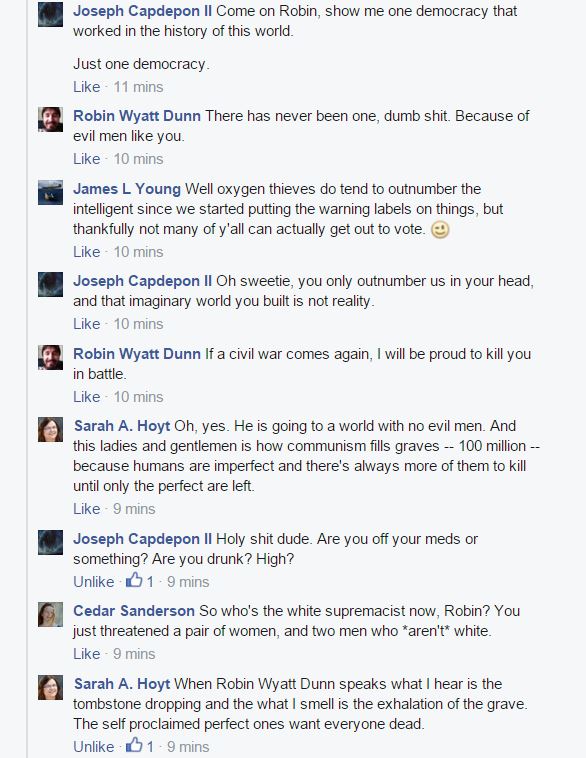
Then there are flowers like the persons who invaded my facebook page, the screenshot of one of which Cedar posted yesterday. First, the guy, who apparently has an history having managed SOMEHOW to make himself persona non-grata at HWA and who seemed to think that anyone not agreeing with his choice of (socialist) candidate for the presidency was a “fascist” and longed for a “fascist” dictatorship (Those libertarians, always longing for dictatorship.) He also seems to be a dyed in the wool anti-Semite (and here allow me to put on my stereotype hat and say “of course he is.”)

Then there was the woman who posted “Hilary 2016” and when I said “Yes, she does have a vagina and got where she is on the back of a man, what a fine example for our girls” she said what I’d posted was “ew” (really? I could be a lot more “ew”) which seems like the objection of a two year old, and as we piled on the reasons her skankiness the carpetbagger SHOULDN’T be president, she said we were very angry people and that she’d have to block us and ran away.

The second one is more indicative of the type of non-reasoning I see involving stereotypes. The people most addicted to stereotypes learned them in college (which is why they think they’re the truth and not stereotypes. Hint: Marxist classifications of victim classes are NOTHING but stereotypes.) They not only learned these stereotypes, like that anyone who doesn’t agree with them or their professors is “racist, sexist, evil, doubleplusungood” but they have learned that if they find themselves agreeing with those people on the slightest thing, then you become one of them.

And this is why my colleagues on the left try to find ways to dismiss me (“Oh, the Portuguese were colonialist” – um… yes, but not as bad as the Belgians. All human breeds were colonialists. “The Portuguese are just Europeans.” “Fascinating. Perhaps you should share that wisdom with the bars in France who as little as ten years ago had ‘No Portuguese or dogs’ signs.”) or ways to make what I have to say irrelevant. “She’s just angry” (yeah, and? I actually am not, or at least only at some specific publishers, and not for anything public. But what if I were. Since when is being angry a reason to dismiss someone. Take the woman who came to yell at my mom because I’d bit her son (for good and sufficient reason but never mind) if my mom had said “oh, you’re just angry” instead of explaining why her son had come by his just deserts, the fight would have escalated to blows. Yes, the woman was angry. She thought I’d attacked her precious son for no reason. Which, were it true, would make anyone angry.) Or applied to everyone who disagrees with them “You’re jealous. You’re a bad writer.” Even if we were – and honestly, give us evidence, please, evidence we can’t cherrypick out of your darlings too – why would that dismiss arguments that have nothing at all to do with envy or our quality of writing, such as when I say that most books pushed and promoted are boring and incredibly predictable to anyone who studied Marxism as much as I was forced to?

I am admittedly jealous of some people’s writing skill. I have for instance, been studying P. F. Chisholm’s way with an historic mystery, because that how I deal with jealousy of another’s craft. I learn.

I am occasionally a bad writer, particularly in these blogs, which are unproofed and often written early morning or late night.

None of which means my opinions on stories or writers are therefore invalid.

And if I say something in a repulsive way, it might make you recoil, but a reasoning human being won’t say “that’s just ew” and dismiss it that way.

People, however, who are afraid to see real human beings behind stereotypes WILL. Because they can’t think of real people or of issues individually. They see only categories. And they KNOW that if they step outside the reservation they’ll find themselves BECOMING the stereotype they dread.

When they call us names, it’s a sort of incantation to make the bad thought go away.

Which is why when they (by which I don’t mean liberals, but people so impaired in reasoning that they respond illogically to any challenge to their world view. Not all liberals are like that, and some conservatives are) produce art it tends to be flat and lifeless.

Piers Plowman by any other name.
Unmasking the Clown- Cedar Sanderson

Unmasking the Clown – Cedar Sanderson

I’m not only a writer. I’m also a student working on a science degree, but for fifteen years now, I have been a performer; an entertainer whose job was to amuse others, make children smile, and generally forget their cares for a short time. Although this was a long, slow development for me, and originally not my intent to do, I was thinking about it the other day as I put the red nose on.

We all wear masks. Most of us would no sooner go out in public without that barrier between us and them than we would walk out of the house in our underwear. My mask for performing is simply more visible than the intangible most people use. When you see a clown, with the nose and the smile and the silly clothes, you expect to laugh, be amused, and enjoy the show. Before I ever tried clowning, I was on the puppet team for a year, and was really hidden. The thing is, you can do things while you are hiding behind the mask you would never consider doing without it.

I have a touch of agoraphobia, and for me to just walk into a party as me, and start talking to strangers is impossibly difficult (agora = the marketplace, or the mall, in Greek. So, literally fear of the mall). But as a performer (even without the red nose, which I rarely wear) I can make an entrance, dominate the room, and keep them laughing until I’m ready to go.

It’s exhilarating, and exhausting. I was thinking about it the other day because I was so unprepared to be a clown that day. It had been a stressful week, capped with arguing on the internet, and the last thing I wanted was to walk into a room full of strangers. But I’m a professional and I can slip the mask down and go onstage at the drop of a hat. I pay a cost for it, though. It takes a lot of energy to do this, even though I’m not a physical performer.

I once watched a professional entertainer I worked closely with go through what once would have been called a mental breakdown. The audience never guessed. He’d get up and have them all in stitches, and go home to sit in the dark and contemplate ending it all. It was only when, very near the end, he was finally unable to force himself to go to performances that his clientele had any idea something was wrong. He didn’t end his life, but he did leave performing. It’s a huge part of your life, when you do this job.

The arguments I’d been involved with online – one direct and personal, the other tangential and more amusing than stressful – reminded me of these masks we wear. It seems to me that when we are online we forget that the masks give us a buffer. We leave them off, and with them, the manners and courtesies we would observe if we were in that roomful of people. Not that we are all clowns. Nor that introverts can, with enough training and given little choice in the matter, become clowns (although I am living proof of that).

Rather than attempting to understand the other, to put ourselves in their shoes, people unmask on the internet and focus only on their concerns. Presented with a statement they see as wrong, they instantly go on the attack. Presented with the opportunity to attack, they lose all empathy and forget that there is another person on the other side of the screen, with feelings, thoughts, and differences. The dehumanizing effect of unmasking and then attacking leads them into behaviours they would never consider if they were looking into the other person’s eyes.

Consider this. If you assume that everyone you interact with knows the same things you do, has had the same education, shares the faith and beliefs you profess, then you are impossibly naïve. But I see this online. It may happen in a more personal setting, but there at least you can read the body language of your audience. That confused puppy cock of the head, wide eyes, and mental ‘baroo?” reaction to an angry statement. Online, you don’t get that. If you react with unthinking anger, they can’t, in turn, see the assumptions you have made to reach the conclusions you did.

We risk much, by stripping off our masks and letting our inner selves show. We risk more by the loss of empathy that communications without body language bring. Unmasking the clown can show the depth of pain and anger that most of us have learned to keep in check. But it boils out when the mask is off and we don’t care what others see.

I watched this happen the other day. A knee-jerk reaction to a badly phrased statement. One forgot, or never bothered to learn, that the other didn’t have the background he did. He went on the attack, to the deep bewilderment of the person being attacked. But worse than the public attacker was another who kept on a mask, but in private went about spreading lies. Humans are all too fallible. Unmasked, they can be downright repulsive.

And then there are the trolls. I’ve written more than once about the fuzzy edge of normalcy. The internet can facilitate the person who is borderline incapable of living a normal life to contribute to society. It can also enable a person who is full of venom to prey on anyone weaker than themselves. Some trolls are capable of rationale, others make you scratch your head and wonder if they really do live in a cave or under a rock, they are that far out of touch with reality.internetexchange

I screencapped this conversation segment because it was literally jawdroppingly wrong. There are times you simply have to wonder how much of a mask they can put on, to hide behind? What did trolls do before the internet?

This exchange left me amused rather than angry. It’s fairly clear in the course of the conversation that something was seriously wrong with the mental workings of the mind behind the screen. This, I find, doesn’t upset me.

What upsets and angers me is the sort of mind that feels the need to bully those who are unable to fend them off for whatever reason. The first argument I referred to, the one where a person went off privately, that was a bully in action. They took advantage of another who was at a vulnerable point, goading them into going on the attack rather than directly confronting themselves. I have no sympathy for cowards.

I find that I am also upset by people who I liked and respected suddenly going off the deep end. Being able to have a debate sometimes means that not everyone will agree with you. If you cannot bear to be disagreed with ever, then you need to withdraw from social media. If you can disagree, except on that one thing… then you may need to stop before hitting send and decide if this is worth the fight.

And above all, we must learn to remember that there is another person on the other side of the screen. One that is, or isn’t, self. I was explaining the immune system to my son the other day, and how the body reacts to invaders that aren’t self cells. The angry inflammation isn’t caused by the invader, it’s caused by the overreaction to the invasion by the body’s systems.

I’ve seen that, in groups of likeminded people. Feeling under attack by those who are outside the group, for whatever reason, they overreact when their personal pet beliefs are prodded. Yes, they are tender, but they can’t realistically expect everyone around them to walk on eggshells. Stripped of their masks and vulnerable, they overreact and as I can attest, an out-of-control immune system can kill a person. So can the overreaction and immaturity of group members.

Moderation is key, I was taught as a girl, to everything. We put the masks on to moderate our behavior to suit the environment we enter. We must remember to moderate our reactions, or risk shocking and killing the support group that keeps us all functioning as a body.

But I don’t Wanna be cured – a blast from the past from April 2012

*Sorry to BFP you guys, but I had a horrible night.  I think I’m channeling Emily because for some reason my shoulders feel broken at night — I think my pillows are in bad shape, and I’m a side sleeper.  At least I hope that’s it — then the morning was full up.  So, here’s a post on addiction.  Enjoy.*

“The truth is, I’ve got a monkey on my back, a habit worse than marijuana though not as expensive as heroin.  I can stiff it out and get to sleep anyway……..  The fact is I am a compulsive reader.  Thirty-five cents’ worth of Gold Medal Original will put me right to sleep.  Or Perry Mason.  But I’ll read the ads in an old Paris-Match that has been used to wrap herring, before I’ll do without.”  Robert A. Heinlein, Glory Road.

My name is Sarah A. Hoyt, and I’m a reader.  Unlike my struggle with writing, which more closely resembles an unhappy love affair, where I’ve walked away several times, only to be pulled back by the stories that form spontaneously in my head, I can’t say I’ve tried very hard to give up reading.

This is weird, because any way you look at it, reading is expensive.  And like with any drug, once you’re good and hooked on a series, you’ll do anything to get the next fix.  Anything, including but not limited to spending the grocery money for the week because, well, you can live without eating for a week, but you can’t live without reading for a day.

You know you’re an addict when you face this dilemma and the little voice at the back of your head goes all helpful.  “Buy it,” it says.  “Think about it.  Food you can only eat once, but books you can re-read for years.  You are holding cumulative days of enjoyment in your fingers.  Buy it, I say.”  (If this were the little cartoon demon sitting on my left shoulder, he’d be wearing glasses and carrying his own little book.)

Part of it, as in any addiction, is habit.  I won’t say that I don’t remember a time I couldn’t read, because it’s not precisely true.  But it’s only not precisely true because I also remember learning to walk.  So I remember lying on my stomach on a sun-warmed patio with a stack of comic books and trying to remember what the words were that my brother had read to me when I last had that book in hand.  I know I was reading – and attempting to write – by four.  For this my brother – nine years older and with no resistance to nagging – is largely to blame, since he read me those same comic books over and over again.  It also helped that Portuguese is largely phonetic.  But most of the blame must go to my parents who had absolutely no concept of “age appropriate reading.”

When I entered fifth grade, I was shocked to find most of my classmates were still reading lavishly illustrated books with more pictures than words, and on subjects as exciting as “Anita” (the girl who did everything in Portuguese children’s books) “Takes an airplane trip.”  I’m not saying I didn’t read those too.  Of course I did.  Some of my less than clued relatives gave them to me for my birthday or Christmas.  I didn’t mind, except that of course, they didn’t last very long at all.  And by that time I was fully into Clifford Simak and Robert A. Heinlein and Asimov and Anderson and Rex Stout and Earle Stanley Gardner and Agatha Christie.

Actually birthdays and Christmas were a great source of annoyance.  You see, my parents didn’t allow me to tell the sweet old relatives that I just wanted money.  That was unmannerly.  But as short on money for books as I always was, the best I could do out of those festive occasions, should the relatives be informed that I liked to read  Science Fiction, was Jules Verne or H. G. Wells.  Until I was old enough to go to school in the big city nearby and discovered I could exchange books at the bookstores, I read all of Verne and H. G. Well, of course.  The problem was that they weren’t “real” science fiction.  Not about the future as I’d like it to be.  Also, the translations were often awful.  But I read EVERYTHING.

I read Dumas (yes, all of them, even the ones that appear to have been paid by the word) and Sir Walter Scott and Twain.  My parents eventually told my relatives that it would be easier to give me Portuguese Historical novels or history books.  And even later, they sort of gave up and started giving me money to buy books.

By that time my brother and I were on an equal footing as addicts.  Often the only money we could spare would buy us half of that month’s science fiction release (one book per month, yes.)  To this day he chortles that my marrying an American saved us the epic fight we’d otherwise have had over who got to keep those part-ownership books.

Portugal doesn’t have – or didn’t in my day – public lending libraries.  Not even subscription libraries as those found in Regency England.  It has a public library but it is more like our library of congress.  And every new school I entered had what they called a “library”, usually stocked by some well meaning lady in the previous century.  So, did I read the manuals of young ladies’ deportment and lives of saints that those mostly consisted of?  Duh.  They were print.  And any print is better than going without.  BUT being me and unable to leave well enough alone, I thought of all those kids who wouldn’t be so lucky as to come from a family of bibliophiles with hundreds of books laid by and hidden everywhere from the attic to the potato cellar.  Every school I ever attended I started a library club which held fundraisers to buy books, and which requested of the parents one book for the library, in commemoration of their kid’s graduation.  Even in college, I vastly improved the American Library.  Okay, at least I filled it with Science Fiction.  I think it was an improvement.  (I’ve wondered, if I can get the address, if we could convince Baen to donate to it.)

When I became an exchange student, in 12th grade, for the first time I entered a house with no books.  No, this is no disparagement of my host family.  My host mother, particularly, was very kind to me and responsible for who I am today.  But they weren’t readers.  Not really.  My host brother and sister read magazines, but that was about it.

So… my first day in the US, in Stow Ohio, I made them take me to a bookstore.  I bought Assignment In Eternity.  Then I found the public library.  You lucky sons and daughters, you don’t know how good you have it.  I volunteered at the library because then I could check out unlimited books.  And I did.

When I found myself newly wed and broke, we set aside 3 quarters of our entertainment money for books.  And like all junkies, we quickly discovered where we could get the most book for the money.

Now, when I’m hard pressed and under the gun, I might just reread the familiar, so that I can put it down and go back to work.  A riveting book can cost me five hours work time, you know?  I start it and then have to finish it.  Heck, I can only exercise to audio books, which is costing me a small fortune.

And yet, I don’t want to be cured.  Let them say we read this much because we can’t handle reality.  I say reality is for wusses who can’t handle fiction.

Argument and Offense

Lately I’ve been seeing blow ups not only in all my groups on facebook, but on my private email lists, blow ups between people who granted have bloody nothing in common beyond opposing socialism.

This is perhaps to be expected.  I mean we’re living through the crazy years, the mania for eating dirt spreads to the South East, the “serious” discussion in Sci fi is “Should you even acknowledge gender”, we’re financing Iran’s quest for a bomb, Donald Trump tops (a minor, but much publicized) poll for president (with 17%) cats and dogs sleeping together.  The end of the world.

As I’ve said before I can judge the general mood of the nation by how fricking crazy the drivers are on the road.  And right now they’re pretty crazy.  And just as at other points of high tension, arguments and screaming are breaking out over the stupidest things.

I hate it because right now I’m not feeling up to this kind of nuttiness.  Perhaps it’s envy I can’t join in the fights, who knows?  Right now berserking would about kill me.

BUT what struck me is what is the difference between genuine argument and argument by “I’m offended” which quickly devolves to mud slinging and name calling?

I mean, free speech and all, so we certainly need to know, right?

What I’m seeing to a great extent in mostly conservative-libertarian corners is people snapping over points of disagreement they SHOULD have known were there.  But they’re snapping because they feel attacked from all sides, even nominally their own.

This is silly.  Discussion is important otherwise we become like the SJWs.  It is also human.

So maybe we should lay down some rules for “disagreements with people who are roughly going the same way we are.”

1- It is important to remember you are a broad coalition with many aims.  Some of you are almost as opposed to each other as to the people on the left.  It is important to remember that’s fine.  Once we take the left’s corrupt and murderous hand from the tiller, you can feel free to fight with each other.  Until then, if you love the constitution, you’re going our way. LEARN strategy.

2 – So you’re in this forum and someone made a joke/comment/etc. part of which offended you.  Consider DO YOU NEED TO COMMENT?  Is this issue so fargin important that you just HAVE to start an argument?  Remember you know our coalition is broad and not homogeneous.

3- If you HAVE to speak up, be as specific about the instance of disagreement as possible (it’s that important, right?) and present proof.  Arguments might still develop over what you consider proof, but it is less likely to go toxic.

4- If you don’t have to speak up in public, but still feel offended, pm the offender, or just say “I’m hurt.” in private.

5- REMEMBER YOU DON’T have the right to NOT be offended.  I am friends who people who offend me at least once a month.  I have friends who believe things I find deeply offensive.  I understand why they’re coming from, why they believe that, and why taking offense is counterproductive: I’m not going to change their minds.  So I avoid the subject and talk of other things. And we’re still friends.  And largely speaking we’re “going the same way.”

6- When someone raises a hue and cry and you vaguely agree with them, don’t immediately jump in on their side.  See if they violated one of the rules above, and if they did, well, ignore the mess till it passes.  If they didn’t, run it through the checklist yourself to see if you need to jump in.  “Is this something I need to be public on? Is this something that’s going to change anyone’s mind? Is this just going to create bad feelings to no purpose?”

This is not aimed at anyone or any group or list in particular, but I’m tired of seeing pointless arguments flare up everywhere.

Being offended is a great tactic for the left, because they command positions of power and can “group shame” on an epic scale.

For us all it can do is tear us apart and allow those who would divide and conquer us to do just that.

Don’t fall into this habit.  Beware agent provocateurs.

In the end we win they lose, but we can’t just react without thought.

Ripples In The World

Sorry this is late.  I am very tired/dragging, partly because the monster tiredness hit yesterday, I went to bed at nine thirty, then had a conversation with a family member that not only prevented me sleeping till well past midnight, but gave me the sort of night where you fight shadows in your sleep.  So I’m tired and achy.

For those who sent donations recently and to whom I haven’t answered because a ton of things are slipping as I’m trying to deal with older son’s (and his evil cat) moving out, as well as with getting the house ready for sale — I’ll get to it.

I meant to explain, because we sound as though we are in financial trouble — we’re not, precisely.  We are simply in a tight position, right now and until house sells.  We have no other debts, though we have financial obligations, such as helping sons with their tuitions (though not nearly most of it) which we promised to do if they took useful degrees.  The financial trouble will come only if house just sits and doesn’t sell, and I hope that’s not the case.

This is in fact one of those gambles you take for a better position, because if house sells as we hope/expect, then we can substantially reduce our mortgage debt, be able to help the boys more and also stop running scared.

My problem is that I don’t have the nerves to be a gambler, so I sit there imagining the worst possible outcomes.  It’s who I am.  As I said nervofage, or nervibore.

The other problem — one of you whom I will not name unless you choose me to — researched the surgery I had and tells me the normal recovery time is six months, and that either my doctor lied when she told me it was six weeks or I misunderstood, which is possible due to being high as a kite on percocet at the time.

Anyway, I thought it was six weeks and I’ve been impatient and trying to do what the guys need me to do (this whole house stops if I go to bed, as does the “house to be finished and sold”) and working more than I usually do even while healthy.

So, the whole Tiredness that Falls On You From Nowhere and which I’ve nicknamed The Stupid Tired, because I can’t function and nothing matters, and you could tell me the house is on fire and I’d ignore you and try to lie down and sleep (and sometimes just find myself lying down with no idea how I got up the stairs) is apparently a NORMAL symptom during recovery from this surgery.  For six months.  Which means I’m normal (for what I’m sure is the first time in my life.)

What difference does this make?  Well, today not much.  I have to go to the other house for the glass man (he fixes your panes) and while there, I might as well wax the front room floor, though cleaning the kitchen might wait till tomorrow.

Going forward?  Well, I’m afraid I might have done damage — I swear I thought I was following doctor’s orders — so I’ll try to rest more, but I will also try to write more.  Despite the Stupid Tired, stories have been bubbling up, and I’m reading again (three days after house death-march.  At the end of that I couldn’t even LISTEN to stories.)  I have my story for the Black Tide antho started and I WANT to write it.  (Rocky Mountain High plays a part in it.  No, REALLY.)

But I might schedule naps in the afternoon.

Meanwhile the point of this post: All of us make ripples in the world.  All of us change culture for the better or worse.  It might be small ripples, a conversation you had that someone else thinks about that leads to them having another conversation.  Sometimes the ripples turn big.

When I decided to start speaking and come out of the political closet, it was because I caught ripples of something vaguely hinted at in a post at a large and influential blog, where, to my knowledge, no one reads me.  But clearly because it was a very specific thing, someone talked to someone who talked to someone.  And I had been feeling a “pressure” to speak out, and suddenly that pivoted me out of the political closet.

Most of the ripples of what we do might never be obvious to us.  Jim Butcher speaks of that in the beginning of Side Jobs.  Others we think are really important and aren’t.

But the thing is this: some things that seem small or playful are the only things that can do the really big jobs.

I’m not announcing I’m closing the blog.  I need to say this, because my being late and what I’m going to say next will seem to lead to it.  It doesn’t.  This blog does its job and serves its purpose and I don’t know how big the ripples are, but I’ll leave to someone more omniscient than I to determine that.  I’ll just do what I can. (I might run more guest posts, because fortunately I have a dozen or so waiting, and I’ll be able to run them once the “help older son find apartment” run is done and I’m home to approve/nix comments.)

But yesterday I was reading something that truly made me ill about the culture and our government’s response to it: to whit that Planned Parenthood is selling fetal organs and our government’s response to it is to investigate the whistle blowers.

And the thought that ran through my mind was: this is too big and too sick to be handled by blog posts speaking directly to the point.  This needs stories that build the culture as it should be, that make people think and question things about humans and what happens to a culture that views humans as commodities.

That’s a big and slow job, like getting rich slowly.  It’s a job for fiction.

Before you laugh, Heinlein’s ripples in the world — sight unseen, possibly unintended — made a little Portuguese girl a Usaian, and are probably responsible for my being an sf writer.  (I likely would have been a writer, anyway, but probably not sf, almost certainly not in the US.)  Anything I do in/to the culture is a far off ripple of his work.  And he was “just” telling stories.

So my stories — as my publisher keeps telling me — need to happen and be front and center of my work.  The blog will happen too, because it too has its place, but it will have more guest posts (when husband and younger son are done with their work in the house probably regular features by both of them) and more bfps.  But it will have my stuff too.

I’ll do that best I can. And I’ll leave for someone else to judge and access my ripples.

Dying Cultures

I’ve been reading a book by Joseph Campbell, which I can’t name — I looked it up, and they list everything, but not these books, and I think I know why — because I was reading it in the car on the way to Denver, to help boy look at apartment, and that car eats books. It will surface months from now, in the trunk, where it couldn’t possibly have got.
The book is a series of lectures on society and myth which were delivered the year before I was born at a free university type place in NYC and the title is something like “The power of myth in your life.”
I bought it at arc thrift store, 50c half price day, for the same reason Joseph Campbell is a bestseller: because his theories might or might not have much resonance in real life, but they do resound with the stories humans like to tell.
This book was an attempt, if the first half is indicative, to make the book and ultimately the Hero’s Journey relevant for everyday people and not just writers. It has that half embarrassed tone of a geek trying to communicate with normal people by bringing up “scientific discoveries” and “relevant stuff.”
The first half is also hilarious (not on purpose) which is why I hope I didn’t accidentally kick it out of the car when we got out at one of the complexes.
Mind you the laughter cringes a little in sympathetic embarrassment.
The book — again, kindly remember, a collection of lectures published before I was born — starts by pointing out that religion is dead. It might think it isn’t, but it’s a dead man walking. It has in fact been thoroughly disproved by science and archeology.
This part is unintentionally funny on two fronts: first, the author doesn’t seem to have the slightest concept of the broad swath of belief he is addressing which is a little odd since he’s an expert on myth. Even if he viewed religion as pure myth, surely he’d have studied the various ways people address it. For instance, he seems to think the only form of Christianity is the one that takes the Bible literally, and conflates this with the calculations on the age of the Earth which were in fact made by a medieval monk, and with the prophecies made by a Scottish something or other, until it baffles the mind.
Second, most of the science he cites as “proving” that we were not created but evolved (as though the two were inherently contradictory and the ‘clay of the Earth’ couldn’t mean what was found here) is now — 50 years later– thoroughly discredited. Among other things, he believed we were descended from the Australopithecines, which we most certainly weren’t, and makes inferences about our myths based on the Pithecanthropos.

Anyway, Campbell, whose (modest) aim is to convince us to believe in myth even if we don’t believe in myth, in order to save civilization, goes on to point out something I should have thought about before, something that does apply and it’s true.

When a society loses its fundamental beliefs by having them proven wrong, the society spirals down the drain.  You see increased alcoholism, a fall in birth rate, suicides and general purposelessness.

Before you apply this to our society, hold on, hoss.  Yeah, we have some of these problems, but we only hit them in the last 8 years or so, and they’re nowhere as serious or at crisis level as in other western societies.  The clustercongress in the economy and the fact that the boomers in academia have decided to found their golden years on the backs of the younger kids student loans probably have more to do with the fall in marriage and birth rate than any loss of cultural purpose.  So probably does feminism, but that is active poison, not the slow drainage of loss of cultural faith.

In fact, in many ways, we’re starting to see fight back against the extreme left in the culture.  Not in politics, yet, but politics is ALWAYS downstream from culture.  If you don’t believe me, remember how political correctness was viewed as serious in the eighties, and it is now considered a roll-the-eyes matter.

Yes, there are segments of our culture that are in that sort of death spiral of a discredited culture.  More on that later.

First let me assert that as far as I can tell, yes, Campbell is referring to a real phenomenon of “lose faith in your culture, culture dies.”

We’ve seen that in many primitive cultures when faced with more aggressive/assertive cultures and it could be argued it’s still operating in places like Japan, even if masked by abundance.

More well-read people than I have applied it to the Russian decline, which is almost a text book example, but no one has thought to apply it to Europe, except perhaps Ed Driscoll and I when we scream that Europe is dying from WWI.  And we’re being accurate but not detailed, and it’s not reaching to the roots of “dying because they lost faith in their basic values.”

First let’s discard the idea that America has — fifty years after Campbell — lost faith.  We probably display it less, because it’s not mandatory and we’re not a conformist society, but if you count all forms of religious faith, we’re a near-fanatic country, and possibly the only one in which a scientist can announce himself as a person of faith and not be run out of his practice.

You can moan about faith being greater in the past, but take it with a grain of salt, will you?  Faith in the past was political correctness in the eighties. You had to pay lip service to play, so people did.  Whether there was any more ACTUAL faith and religious devotion is not for me — or anyone else — to know.  The very imposition of social pretense of faith masked what might or might not be there.

I suspect that accounting for the fact it’s now as fashionable to be “agnostic” as it was in the past to be religious, and that taints what we hear in public, faith is more or less as it’s always been.  Something I’ve observed is that some people are naturally mystical, some are naturally materialistic, and some like me strive towards faith never ending up fully achieving it but having too much of it to give it up.

However, in Europe religion is all but moribund.  It amused me when an exchange professor talked about how he was shocked Portugal wasn’t a land of great faith as he’d heard.  Oh, yeah, sure, it was still fashionable in certain circles, but the same people would diss faith in other circles.

Anyway the problem is not that religion died there, but what we mentioned in comments yesterday: In the Europe I grew up in, there was a great faith in communism.  Not (necessarily) the road to communism that the USSR had taken.  We knew that was brutal and all.  But we also met with the Russians who were sent to visit, we read Soviet Life, and we KNEW however we got there communism was the way of the future, the only civilized society worth living in.

And by “we” I mean not me, because well… because I’m me.  My mom says my personality is the type that can’t see a freshly painted wall without making a scratch to see what’s underneath.  I don’t think I was very old when I realized Russia killed people trying to escape their “paradise” and so did the DDR and…

But the level at whic this was the assumption in ALL writing, news, literature and even education is hard to overestimate.  My history book in 11th grade defined Portugal as a society on the way to socialism, which would eventually lead to communism, the perfect the society.

The first part of this was enshrined in the Portuguese constitution because socialism (as the gentle, non-murderous) path to communism, was CLEARLY the only civilized path.

Please keep in mind, btw, that people in the US who were Europhiles or even in literary circles read these books, with this assumption, and internalized it.  And that these people are now at the peak of their careers in academia and politics, and most of the “focal points” of culture, including the media.  I don’t know if it will help, but it should make us judge them less harshly.  Unless they’re odds, people don’t question the foundational myths they were given young.

Anyway, when the USSR collapsed, what Europe lost was not religion, precisely, but it was the myth that was holding it up after they seemingly lost their religion in the abattoirs of WWI.

They knew there had been errors on the way to communism in the USSR and of course they didn’t want that, but they wanted that command economy, which worked so much better, and in which everyone had what they needed and…

And the rug got pulled out from under their feet.  Which explains what I see when I go to Europe, the despondence and anomie that pours off the walls and seeps in from the trendy cafes.  It explains how monuments are decorated with art not worthy of toddlers (we’re not that bad here) and all the other symptoms of loss and decay.  They are a society that has lost their guiding myth.  That the guiding myth was stupid and artificially implanted by power hungry serpents is of little consequence.  In an era of mass media, they bought the pervasive lie and they believed in Soviet Life.  Now, even if the horrors of the reality weren’t fully documented, they know there was rot and horror there and that planned economies don’t work, and of course, they’ve been told for years of the horrors of capitalism and freedom, so they’re left with nothing but suicide.

We too have been told of the horrors of capitalism and freedom, for at least 40 years in our schools, though it took multiculturalism to really convince the kids we were inferior, and even they might not stay convinced.  You see, it’s really hard even for non-odds to think America is terrible when at the same time people complain that we have too many things and are too affluent.  (In fact, our issues are those of the affluent, not to be confused with the issues of defeated societies.  The idea that Rome died of affluence, btw, is wrong and one of those socialist prisms applied to history.  “Let’s be poor, comrade, so we don’t get decadent” is their only offer to the world.)

I suspect eventually the kids will be all right.  Right now they’re being pounded by an awful economy and scams to make them slaves for life.  Which are of course, courtesy of the socialists of the previous generation, but they don’t know that.

And the sectors of America that have been most like Europe — Journalism, the arts, academia, political bureaucracy — are going through the same spiral as Europe too.  This is sad, but not fatal.  As someone pointed out, if you removed those sectors our economy and ultimately our society would do better.

So, what to do about it?

Stop mourning.  The story of our demise was started by people like Campbell who imagined it was “scientifically inevitable.”  And it’s grossly exaggerated.

Keep destroying the narrative, which is the remnants of that fairytale about wonderful command economies and the glitz of “Soviet Life”.

And teach your children well.

This too shall pass.

The Flesh Thing

Yesterday older son and I were talking while driving back from Denver from looking at apartments for him, and we agreed this being dragged around in a vehicle of flesh is a pain in the behind.  Because with the drive to Denver and some duties still at the other house (such as being there for handymen and such) we’re netting about viewing an apartment a day.

In fact, he says, the whole apartment thing is a nuisance, because he should be able to just send his mind over to attend classes, of course.

In my case, this is more critical because of course the flesh thing is no longer working all too well, so it keeps giving out on me when I least expect it to.

This is to say that now that we punted back from working in the house 12 hours a day to about 3 hours in the evening, I’m slowly coming up from “stupidly tired.”

And yes we should be done by the end of the week. And the writing should start again today.

BUT I was shocked at how tired I was.  How tired?  Well, full dose ibuprofen was not DENTING pain. I still wanted to cry every time I moved.  I not only couldn’t concentrate on reading a book, I couldn’t stand on listening to a book.  And eating stuff with flavor was too much work, so I was living on milk.  We came up from this to being able to eat and read comics, and today interest in reading other stuff.

The thing is, I HOPE this is because of the surgery four months ago.  I mean, I’m not that old and I was never that bizarrely tired before.

Mind you my doctor told me two months ago I was healed and could live a normal life, but friends who were in the sort of shape I was in and who had the form of surgery I had (well, I actually ended up having both forms) say six months recovery is not unusual and a lot of it manifests as tiredness.

Anyway, what I find amusing and interesting is my mind’s assumption that it’s a separate entity from the body and that it SHOULD be able to overcome the body’s weaknesses just because.  It’s not possible, of course, and sometimes the body is VERY annoying.  Even if no one sends a rescue party into Plato’s cave.

This is totally not an excuse for a post.  It’s a serious thing.  But if you need more meat with your Hoyt post, my husband posted about writing today at Mad Genius Club.

And now the writer who is shamelessly typing this in bed is going to contemplate maybe getting up.  Or perhaps sleeping another hour.

A Certain Familiar Sense

When I was little, one of my favorite times in history class every year was when we studied the Spanish occupation.
From 1560 to 1640 and due to some truly gifted stupid actions of Portuguese kings, the throne of Portugal was occupied by the Philips. The first Philip was the famous Philip of the Armada.
Now the throne of Portugal was acquired as legitimately as any other succession at the time and more legitimately than most. Technically Philip was the late King Sebastian’s nephew. (And possibly first cousin, uncle and grandfather. There is no word on whether the royal lines of Portugal and Spain could play the banjo really well, but if they didn’t it was only because they didn’t have banjos.)
However by the time I studied the occupation or “usurpation” EVERY year of elementary school, great indignation was built towards the Philips. One of the reasons I really liked that lesson is that our prim and elderly school marm would instruct us to bring out our crayons and deface our pictures of Philip of Portugal and Spain. (And for those cringing about destruction of school property, in Portugal you buy your school books. You can sometimes buy them used or inherit them from a sibling — not me, my brother was much older than I and books had changed — but in general everyone from the richest to the poorest bought the school books. I rather suspect, now I think about it, that this keeps the Portuguese publishing system working.)
The reason they were hated, the reason we were instructed to deface the pictures was that while occupying the Portuguese throne, perhaps because they were sure it wouldn’t last, or perhaps because they wanted to reduce the proud and independent spirit of the Portuguese (from their perspective the last of the small kingdoms in the peninsula to be swallowed by the Spanish leviathan) the Philips seemed to go out of their way to destroy all Portuguese interests, possessions and wealth, as well as the Portuguese standing with their allies and the world.
It’s been a long time, and mostly I spent my time studying how to deface a picture, but I remember the Spaniards broke the Portuguese alliance with the English which had lasted almost since before there was England, and save for that interruption has lasted to present day. This meant Portuguese ships could fall prey to the British privateers. They also failed to adequately defend Portuguese colonies and gave some of them away as dowry to Spanish Princesses or perhaps party favors.
There were other things, and the rule must have been felt even at the time as disastrous because particularly in the North a cult of the “King who will return” (in this case King Sebastian, young and possibly nuts or at least a really good banjo player, since his mother was the upteenth Spanish princess the Portuguese kings had married in a row.) He died in a futile attack on the North of Africa (there’s taking the fight to the enemy and then there’s nuts) which left the kingdom without a king. Save the Spaniards.
For years, and then centuries, adding an element of fantasy, the legend grew that he had not died and would return “one foggy morning.”
I must have had a fantastical or romantic bend from early on, because one of my favorite songs was by a group called 1111 (Ah ah) which sang about King Sebastian and how they’d found his horse and pieces of his doublet, his sword and his heart, notwithstanding which he’d come back in a foggy morning to lead the half mad seers and witches of the foggy Northern lands. (Represent, I say, represent.)
However, no matter how bad the Spanish occupation was, in that morality tale it became the inflection point at which Portugal stopped being amazing and became beaten down and down and out. At that moment (even though colonies and empire remained) Portugal was broken in the eyes of the world and in its own eyes.
Yesterday I was talking to my mom and she said the news from the States and the things “your funny critters” (pretty much how mom refers to governments in general!) are doing remind her of the Spanish occupation of Portugal. (She asked if perhaps one of Obama’s names, never mentioned, might not be Philip. As in “perhaps when he was adopted his name was Barry Philip Soetoro.”) And she said “May G-d help you and preserve as only He can.
Needless to say I have nothing against her last sentiment, but I want to say something about it.
Yeah, I too have the feeling of a government trying to reduce a proud nation, either because they hate it (no, don’t bother arguing, they do. Our intelligentsia consider themselves citizens of the world. Mostly because they know NOTHING about the world and think it’s a giant vacation resort and we the only political actors in it, while everyone is our hapless victim.) or simply because they fancy themselves as our perpetual rulers, and a proud and self-sufficient people are hard to rule. I suspect they’re doing what they’re doing in the happy notion it will make us “governable” and since THEY know exactly how to govern us, it’s for our own good in the end. We’ll be prosperous and happy just like France (rolls eyes.) Magically we’ll acquire hundreds of years old buildings which we can contemplate from our coffee shops while drinking ridiculously tiny coffees in our 385 nationally mandated days off a year while the government automagically makes sure no one starves.
However let’s not fall into the Portuguese trap. It makes a certain sense for Portugal, I guess, since it was a monarchy and therefore the king was supposed to embody the country.
But we’re not a monarchy. The president is just the president, and if you think this one is the worst… you might be right, but good Lord not by much. A cursory read of our history will tell you that while we’d never before managed to elect someone who actively hates us (I maintain because he blames us for his father abandoning him) but we elected people who were bound by ideas that would have destroyed us, anyway if they had had time and enough sway.
We are a republic of ideas and of people who believe in that idea. We’re down but we’re not out. I’m not going to lie to you, this one is going to hurt like a b*tch. Our grandkids are still going to be recovering from this clustercongress (congress, you understand in the Kama Sutra Sense.)
But it takes more than a Philip to beat us. We might catch a nuke, we might even lose one or two generations of prosperity, but Philip is just Philip. We’re the USA. Takes more than one man to keep us down as Fat George (the one who didn’t write GOT) found out.
Long after he’s gone we’ll be here and the ideas of life liberty and the pursuit of happiness will be resurgent.
Because this whole government by the people for the people thing? It’s an idea so spectacularly crazy and yet so gloriously daring that it has been lighting the world ever since it was first conceived.
And so it will continue, world without end.

Liberty Con After Action Report – David Pascoe

*Apologies to older adopted son for this being so late.  We are done with the “Robert and Sarah Show* of 12 to 16 hours of heavy labor.  The house isn’t ready to go on the market, because there’s stuff other people need to do, and also the kitchen is still somehow full of unsorted stuff, as we reached the time when I went “ARGH I don’t know what to do.”  So we’re going over after (Dan’s) work for the next three days a few hours a day and all sorting things into ours, Robert’s, trash or donate.  To make the difficulty clear, we have about 10,000 (okay, maybe 50, but it feels like 10,000) porcelain spoons with little spoon rests in the form of koi fish.  These are not things I bought but gifts — mostly from mom — so I feel bad getting rid of them (and I haven’t) but sometimes…

Anyway, so I woke up late, and all my limbs (and my butt.  I swear I didn’t polish floors with my butt.  Not fair.) still hurt, so today I’m doing not much.  Some laundry and the litter boxes because those are urgent.  The rest will wait.  Oh, I’ll probably write, if the head is up to it.  Or we might end up driving to Denver to find the boy an apartment.- But it’s an easy day.  And the day this house lists, Robert and I (if he’s still here, and not at medschool) are flipping off low carb and getting doughnuts. – SAH*

Day the Third

Ok, I have to come clean. I’m breaking this up (and going into excruciating detail) partly to spare Herself. The house-prep may or may not be coming down the home stretch, and I may or may not be attempting to remove one thing from Mum’s plate (a more overflowing vessel cannot be found except in the dining hall of Unseen University) so she can devote more energy to the set of all things that will get the writer paid.

Saturday was, full. Very, very full. Breakfast we managed on our own, with supplies brought from home, and we showed up at the Choo Choo just in time for me to scramble for the Planet Mercenary play-test. For those who aren’t aware, Howard Tayler, creator of Schlock Mercenary was the MC this year. Well, he brought along his oldest, Keliana Tayler (who did the cover art for the Unquiet Gods stories) and a mutual friend, Alan Bahr, with whom he is creating – and recently completed a wildly successful Kickstarter campaign for – a pen and paper RPG set in the Schlock Mercenary (“epic science fiction told four panels at a time”) universe.

I was a few minutes late (hence the scramble) but right behind Alan, who was running the session, so I didn’t feel at all bad. Howard, Keliana, Guy-I-Don’t-Know, and Steve Jackson were already sitting down, and we even had a small group of onlookers, rubberneckers, and skylarkers watching us like geek-shaped hawks. Oh, right, I should back up a little. Steve Jackson (of the eponymous gaming company) was the Special Guest this year, and as he and Howard are friends, he sat down to play Howard and Alan’s game.

The primary conceit of the game is that the players are running a mercenary company in the 30mumbleth century. Each member of the group is an officer somewhere in the chain of command of this company. So, we divvied up pre-made characters, and got to it. Yours truly ended up as an AI, occupying a mobile combat chassis, affectionately labeled ToG, short for “Tons of Guns.” I was, I think, the XO, or at least the captain’s second for the mission. Said captain played by Steve, was an Ob’enn of o’erwheening pretentiousness. Howard played the company medic (a human variant with purple skin), Keliana played the Chief Engineer (uplifted polar bear with a bad attitude) and Guy-I-Don’t-Know (Elijah played the company attorney. The company – along with many other mercenary companies throughout Known Space – were attending the annual MercCon. The convention was set in one of the absolute worst cheapest space stations imaginable. The place was an accretion of derelict ship parts and obsolete habitat modules held together with space tape and hope. It was such a good place to hold a gathering of noble officers and their barely-leashed bloodthirsty, trigger-happy grunts. I was glad I didn’t have to breathe air like the colloidal intelligences in the company.

We started off strolling the dealers room, soaking up ambiance and swag. Our attorney, ever the calm and cool head (really, he was a creature with a small body and four all-purpose limbs) started taking the free stims and jabbing random passersby. This led to a tense moment when the Neophant felt it, and nearly threw the lawyer through the nearest booth. It didn’t help that the ChEng encouraged this behavior. The captain offered the offended party half of the attorney’s earnings from selling recordings of his antics to the stim makers as “product testing.” Nothing like not getting in a fight with an enraged, uplifted elephant in the middle of a crowd of tetchy – and very well armed and poorly disciplined – mercenaries, none of whom owe allegiance to anything greater than their company.

Fortuitously, as we were on the way to the opening ceremonies (how meta) I received notification that a truly stupendous bounty had been placed on the head (and other parts: worth more alive than dead, as it happened) of a particularly notorious arms dealer located somewhere on the planet below us. Unfortunately, we’d already entered the hall, and exiting precipitously would have been … untoward. Our purp medic, thinking quickly, made noises about the ChEng having a potentially disastrous case of Smutto-rhea.

With the advance notification I pulled off the network, we were able to formulate a plan to get us to the surface in an armed vessel and cause enough chaos at the convention to give us the necessary head start at collecting the bounty. I found an unarmored (but guarded) transport shuttle whose IFF was cleared for planetary descent (our assault shuttle was most definitely not cleared) through the station network I’d hacked earlier (as terrible a virtual mishmash as the station was an actual one).

The ChEng was all for assaulting the shuttle and taking it down, but the captain insisted on offering the guard an opportunity to, ah, recognize the activity of a greater intelligence at work. Or at least to display greater intelligence in the face of overwhelming force. The poor grunt at the hatch immediately saw the wisdom of Captain Steve’s (not his actual name) words, and signed a contract with us. He then immediately allowed us access to his former company’s shuttle. With a little elbow grease, the ChEng removed the IFF from the shuttle. But not before the lawyer (I’m still not sure who would willingly give that joker a license to practice anything, let alone law) made off with her supply of Boomex, and, ahhh, explosively liberated the contents of the shuttle’s lock-box. The Boomex would have liberated his internal organs, as well, but for the timely intervention of one of his combat paralegals, who received a posthumous promotion.

Once we had the new IFF installed in our drop shuttle, it was time to implement the second phase of our distraction plan. Piloting the unarmed shuttle via remote access, I found the biggest, slickest, most upgraded battlewagon and nudged it just enough to jam the airlock, causing enormous chaos on the station as mercenaries ran every which way trying to get back to their respective transports, finding said transports, ah, indisposed, and trying to avoid the possibility of catching the highly contagious, weaponized Smutto-rhea rumored to have been released in during the opening ceremonies. I was so busy admiring my mayhem, I missed an amazing opportunity to make a “bumperships” quip. Mrs. Dave took care of that for me (best wife evar).

Now, I’d love to go into further detail, but for two things. Firstly, and mostly importantly, Alan told us the scenario we test-played is going to be written up and included in the final game, and I don’t want to give too much away. Secundus, most of the best parts happened on the station, at least from an onlooker’s perspective. Third, and lastly, this is already getting long enough, and I haven’t even gotten past noon.

When we wrapped the session, the final scene was of the medic hard at work stemming the bleeding of our target, wounded by our captain’s excellently terrible sniper shot, of our attorney handing out hiring contracts to said target’s erstwhile minions, while grunts picked flechettes from the hide of the engineer, all under the watchful guns of the AI. It was glorious.

I hoofed it to the meeting rooms just in time to meet up with Herself, the Redhead of Doom (or the Other one. Still not sure), and the Impaler, and crash the How to Write pa-workshop-nel. The first half, at least. I think I was mostly the comic relief, as the ladies had matter well in hand without my presence. After the first hour, I slipped out to man my table along Author’s Alley. I think I spoke with one person I didn’t already know, which is either a comment on the whole “LC is a family affair” notion, or suggests that I really need to develop my in-person marketing copy. And write more.

After, there was the Baen Traveling Roadshow, hosted by Editrix-in-Chief Toni Weisskopf and featuring, well, an enormous chunk of the attending professionals. John Ringo talked for a bit, and brought KC Ezell up to discuss her story in the upcoming Black Tide anthology (despite what she’ll tell you, KC did just fine) which was selected to provide the cover image. He also announced that Chris Smith (a good buddy) would have a story appearing. It was possible to read by the light shining from those two for the rest of the day. (Aside: I mention those two by name, as I went to their joint reading session on Sunday. I’ll describe it in the next wall of text, but the take-away is this: lodge their names firmly in your skulls, as these two are new authors to watch.) Many books were given away, but I spent most of the time standing near the door, cracking wise with Eudyptes Diabolicus, and so wasn’t paying terribly close attention to what was happening on the stage.

Thereafter, I shot the breeze with several other attendees, and took a spin around both the art room and the dealers room (I confirmed that the only things I really wanted were all too expensive, for now * shakes fist *) until it was time to gather in the lobby for the Baen dinner party. While waiting for the bus, I had the opportunity to chat with David Weber, where he described the process of adopting his daughters from Cambodia while Oleg Volk took some excellent pictures. The dinner itself was a low key affair, and I spent most of the time chatting with the Hoyts and – later – David Weber, again. As well as MadMike, Chris Smith, KC Ezell, Kelly Lockhart, Dr. Tedd Roberts, and various and sundry others.

After dinner, we returned to our hotel room to put the Creature to bed (he’s only Wee Dave when he’s cheerful and pleasant. Otherwise he is The Creature, energy-vore and notorious in myth and legend for devouring muses). Then, I made the, ahhhh, questionable decision to return to the Choo Choo to * coughcough * network. (Yeah, that’s it.) Eventually, across any number of conversations, I ended up in John Ringo’s suite, or as I tend to think of it, the All LibertyCon Party. Not so much because it’s open to everybody, as because it never seems to stop. Eudyptes was there. Speaker brought scotch, as Speaker often does. Much conversation was had. The Insectress and the Dragon arrived at some point (different points, I think) wearing their battle corsets. Docfather sported a natty Imperial X-Wing pilot’s uniform. Later, Robert and Jeremy arrived to begin the Saga of Rick Astley the Magnificent, Bard of the Way of Al and wielder of the masterwork accordion. They played an increasingly for laughs session of Pathfinder that ended with the cleric racking up the most kills, the bard getting resurrected the most, and ultimately with the rogue betraying the party to a greater demon before getting killed by the cleric, in an effort to avoid eternity with said bard. It was great fun just to watch, and all may have been an attempt (successful, as it happened) to rickroll a bestselling author at his own party.

Stories were told, new friends were made and old friends introduced to each other. Hooch was consumed, along with munchies of various stripes, and ultimately, our hero trudged home (temporary though it was) before the sun arose Sunday morning. Just barely. Not a feat I intend to repeat any time soon. Not voluntarily, at least. In the next installment, we find out if two hours of sleep is sufficient for a convention (hint: it’s not. Really) and what can be done about such a disastrous state of affairs. Stay tuned!


The Problems of Abundance


The house is done for values of done. By which I mean all that’s left is cleaning the remaining living room floor (about one fourth) and polishing the wood in the back hall, and then cleaning the kitchen. However, the painting, flooring and heavy lifting is done. I might need to help the guys paint the fence, but we’ll see.

However, what I’ve found is that we have way too much … stuff.

Most of the stuff we have too much of are cleaning implements and tools. How many jigsaws can a woman have? This woman, at least four. Three sanders. Five stapleguns. This is not counting the endless packages of special cleaning cloths, the FIVE count them five glass cleaner bottles, the…

You get the picture, right. So, how did we get here?

We got here mostly by having large storage spaces for both tools and cleaning implements. (And food. More on that later.) Oh, and lousy memories.

Because I spent so much time busy and overworked and sick, I’d TOTALLY forget I’d bought a saw or a sander. OR more commonly I knew I’d bought it, but I couldn’t find it when I needed it. This was made worse by carrying things from house to house. For instance, I have sheers for every imaginable window, except the windows at this house.

The saws, mostly were because I never unpacked boxes from the other house and decided the saws were lost in the move.

Anyway…

We’ve found a similar problem with the deep freezer.

Before we had the kids we made do with the freezer in the fridge. Then a year after Robert was born, my inlaws drove from Ohio to North Carolina bearing their old freezer as a gift.

At the time I was flabbergasted by the idea. You must understand that at that time we rarely could afford more than one meal at a time. Of course my inlaws had also brought us several blocks of Pennsylvania cheese. Which went into the freezer.

Over the next three years, though, the freezer was often clean and empty. Notwithstanding which, out of a sense of obligation, we carried it with us from house to house.

Then life got a little better, and I discovered sales. Things like the week before Thanksgiving, we’d buy all the discounted turkeys we could and I’d chop them into faux veal scallops, and stuffed thigh roasts and… and we’d live off it for three months.

The problem came when the writing became a job, rather than a somewhat paying hobby. No, I’m not complaining, but it was a disaster for my housekeeping.

You see, I could no longer take three days to cut up a turkey or that great roast at a great price into smaller meals. So I’d shove them in the freezer and forget them.

The forget them was the big problem. When I started looking at moving stuff from the freezer a lot, if not most, of it was freezerburned and past its prime.

So we didn’t move the freezer and I don’t hit the meat sales. Weirdly, that means we’re spending less. (Well, not this last month, because we’ve been eating out, because there is no strength left to cook. THOUGH I’m a cheap date. I get so tired I can’t eat, so I just have a glass of milk before bed.)

The problem with the cleaners and tools is similar. It’s okay to have storage and keep a lot of stuff when you are doing primarily cleaning and fixing. But my job now is writing (again not complaining.) This means I will clear forget from one year to the other that I even have a staplegun, or more likely where the heck I put the thing the last time I used it.

So part of the clearing up is going to be “pick one of the thing I use every once in a while” ONE and put it in a place we remember and where all the tools are.

As for the deep freezer – almost brand new – it will stay. Particularly right now, at the cusp of the boys moving out, and with this sort of internal feel that my writing is about to become way more important/demanding, I don’t see much use for it. I had the fleeting thought that I could cook once a week and freeze the meals, but then we’ll just forget them. Better if I do that to keep the meals in the fridge, where we’ll remember them.

And that’s what’s left: other than the fence and finding someone to build two steps and a little platform in the back – reevaluating our lifestyle going forward.

Weirdly, abundance and trying to save money can cost you more money and infinitely more time/clutter. It’s time to change that.

So today we go over and clean. And tomorrow we start looking for a place for older boy.

And then I can write.