Words of Power

Sorry for being so late — this actually is germane — but I’m still recovering from stupid infection and also not sleeping very well.

Why is this germane? Because words are still not flowing easily — in case you haven’t noticed the blog has been relatively sparse — but I got “poetry” or in this case song lyrics first. This is fascinating to me, at least from a “how my brain works” perspective, since I originally started in writing with poetry, and it’s the family disease, even more so than for normal Portuguese. (I’m totally going to blame the Irish contribution to my DNA.)

Anyway, as you guys know — well, I don’t remember if I wrote it on a post or in comments, so you might not — we had a mini-family-reunion (Because we’re a mini-family) over the weekend, and therefore time to sit at the keyboard was low, but I managed nine songs, seven of which have music and three of which have videos (but not published on youtube yet due to not sleeping much and have to do some house stuff.))

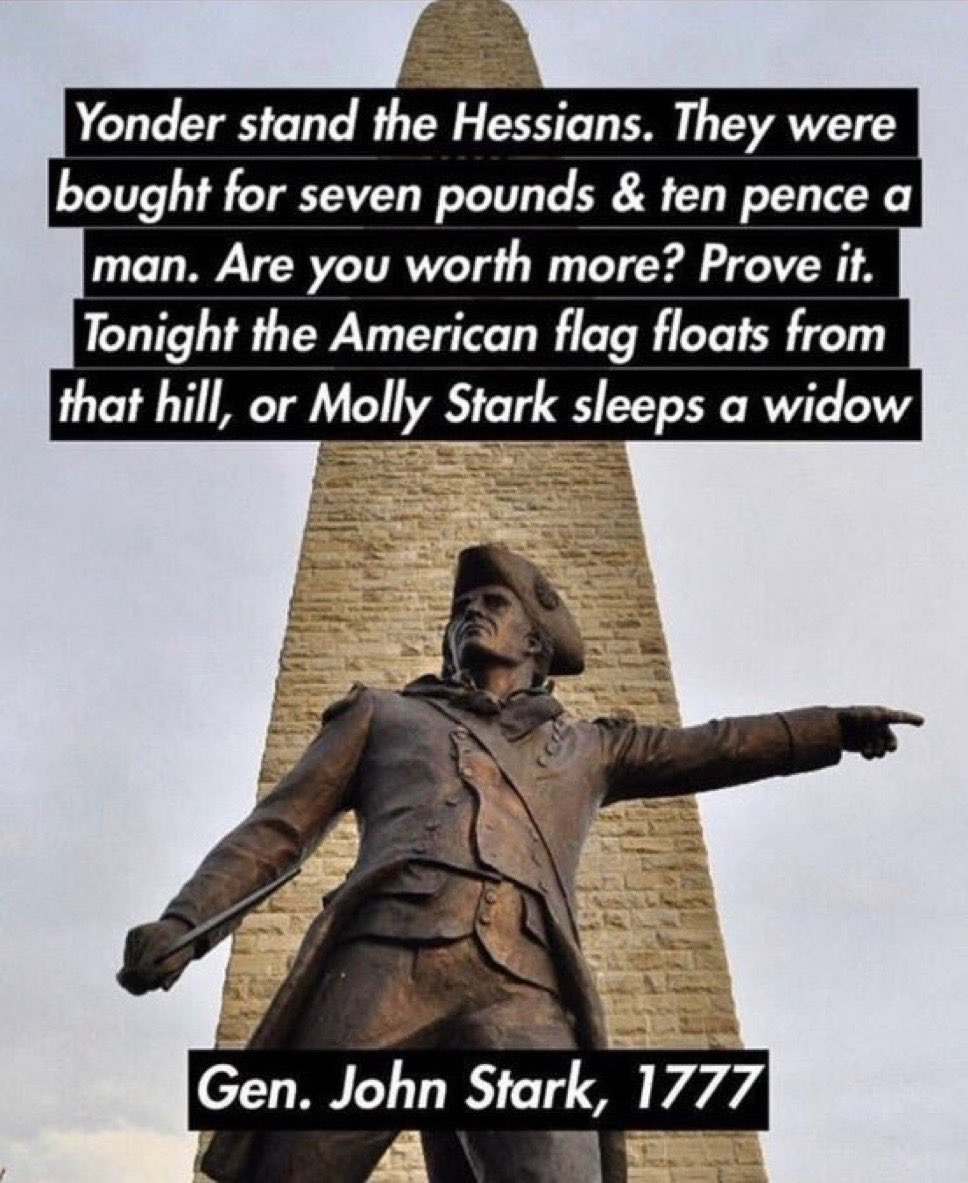
While I was setting one to music I realized there were some words that kick me in the… well, that seem hard wired to the core of my being. Take the line (from the song about the duel at the Troz clan reunion, for those who have read the book) “Instead, he drank his shattered honor/And spent it on his rage.

I used those words advisedly, because “shattered honor” isn’t even an image in my mind. it’s just a kick to a very ancient part of my being that brings up an immediate emotional reaction.

I won’t pretend this is innate. I know exactly what implanted that button in me. To wit, I almost called this post “words my father taught me.” Words like honor and dignity, like ancestral, like ancient, like duty reverberated through my father’s voice like a bell, imbuing them with qualities to which Western Civilization (all human civilization to be fair, but Western for sure and with certain resonance) aspires, and which made it what it is.

Words like that go back. All the way back to the dawn of civilization. They call each of us to things outside ourselves, things that make the individual act and work for things greater than our very short lifespan.

To an extent — understand — they are very strong for me because my father is MADE of them. I don’t know what he would be without those, but judging by myself, nothing good.

Yes the words can be weaponized for evil too. Of course they can. The strongest things in human nature can. But when properly employed, and particularly when combined with the values of Judeo Christianity, they are why men (and some women) will stand between their beloved home and war’s desolation, why a mother will voluntarily starve to death to feed her kids, why men and women will subsume their own desires and needs for those of the people in their keeping and under their care, why a naturally dishonorable person will bear up and act honorable so not as to dishonor those who raised him/her and who taught her/him better.

Properly employed they are the very building blocks of civilized behavior, of what raises us above the appetites we share with dogs (to quote Rex Stout) and the common greed we share with roving nomads who despoil settled communities.

And the words themselves have weight and — as I said — bypass all rational thought to get us to do the right thing in situations when there is not much time to think. As I said, for me, it seems to reach back, ALL THE WAY BACK to the pineal gland, the oldest structure in our brain.

But they are not genetic. Civilization isn’t genetic. It might seem like that, because culture almost acts like it. The things we learned very early, before we consciously could learn anything are almost ineradicable. But they are not. The weight needs to be installed, and it normally is. Through songs and lullabies, through stories told in early childhood, through your father reading you Roman poetry (pfui), through conversations overheard amid adults.

Where that’s missing, where the expedient and the “smartness” of despoiling and tricking others is most admired, civilized culture unravels. And not all the modern appliances, not all the lighting, not all the buildings will save you from ruin and barbarism.

We’re in the fourth generation largely raised by strangers, as women have been told their highest calling is as corporate drones, and men have been convinced their highest call is as tom cats and consumers and only a fool raises his own kids.

Honestly, it’s puzzling — particularly for a time-capsule woman like me — to contemplate how well civilization has held when the words of power have been ridiculed and destroyed.

It’s like for over a hundred years people have been running around chopping at the columns holding up the roof. I’m amazed so much of the roof still stands.

Culture is very difficult to eradicate. Particularly culture that deeply implanted and that old.

But when my generation, the grandparent-age, largely doesn’t remember, the roof starts buckling.

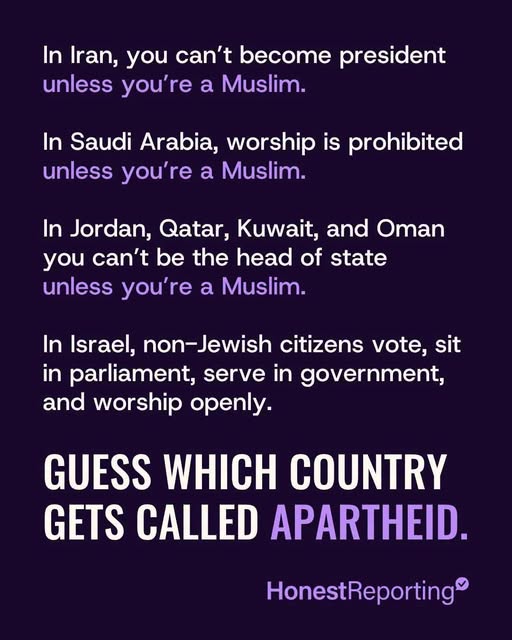
It doesn’t help that the left keeps attacking words, though honestly at this point they’re just silly. They think meritocracy means “group merit” aka head counting of “under-represented minorities.” And of course the utterly despicable Maureen Galindo has tried to claim that Zionists are somehow “anti-Semites.”

But more importantly, we LET them take the words, by not installing them early and often. In our defense few of us had them installed.

It’s time to bring them back. Not by just so stories, no. But by making sure the stories we tell are seen through the lens of civilization. And by raising our own kids (or other people’s kids who need it) and by taking an interest in making sure that civilization goes on.

As always, it won’t be easy, and I’m not pretending it is. But in the long term, if we want civilization to go on we must rescue history, all the way back, and make sure it’s known. And we must make sure those of us with worst impulses have reason to behave in the best way. Because the nature of humans is what it is, and some will always be born despicable. The more of those we raise to be good people the more secure civilization is.

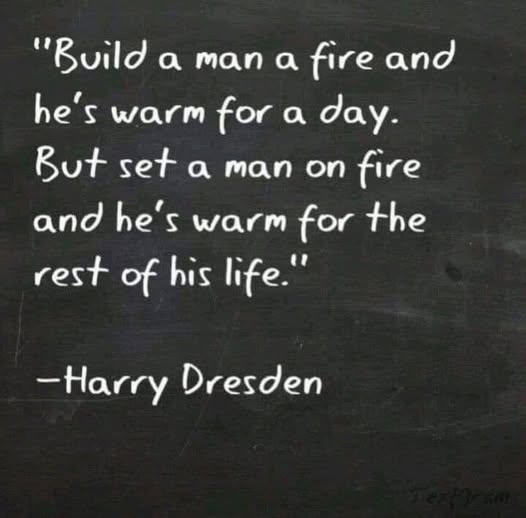
Do, please try, to snatch brands from the fire. Lest the world burn.

COMPLETELY UNAVOIDABLE SELF PROMOTION:

I have a bunch of books on the Based Book Sale. Three of them are NML’s three volumes, which if you buy them now will cost you $3 total. I don’t intend to do this often because, well, it’s expensive (I get about 33c.) But I felt compelled to do it now, so… I’d take advantage of it if I were on the other side of the screen.

No Man’s Land: Volume 1 (Chronicles of Lost Elly)
No Man’s Land: Volume 2 (Chronicles of Lost Elly)
No Man’s Land: Volume 3 (Chronicles of Lost Elly)
Draw One In The Dark (The Shifter Series Book 1)
Death of a Musketeer (The Musketeers Mysteries Book 1)
Done With Mirrors: A Collection of Short Stories (Sarah A. Hoyt’s Short Story Collections)

the Secret Cheat Code by James L. Cambias

High school English teachers get obsessed with fairly minor aspects of literature. One perennial favorite is “Theme,” and this leads to hours of frustration in class as teachers struggle to make a room full of bored students understand — let alone care about — the theme of a story. Moby Dick is about Man versus Nature, or the sin of Pride, or the nature of obsession, or some damned thing like that. The Great Gatsby is about social class, or the nature of identity, or the moral corruption of the 1920s, or maybe about giant eyes watching you.

          The students come away convinced that literature is either filled with hidden secrets they’ll never be smart enough to understand, or that literature is full of plonkingly obvious messages and it’s a bunch of hooey not worth understanding.

          The funny thing is that English teachers — and let me note here that my experience was in a very good school with amply qualified teachers — focus on theme and message but ignore a lot of the mechanics of telling a story. I don’t think any of my English classes talked about dramatic structure, or narrative voice, or how to create a scene. It’s as if we were studying automobile repair and the instructor spent all his time telling us about different kinds of fuel injector systems without really going into why you need fuel in the first place.

          In recent years I’ve taught in a summer program at Smith College, trying to guide a dozen bright high school girls through how to create a science fiction story over the course of two weeks. I think I’m learning as much as they do. In the process I’ve had to rediscover what all those topics that bored me in high school English are really for. And the biggest revelation has been theme.

          Theme isn’t (only) a way for high school teachers to frustrate students by having them try to discover some secret hidden lore in every story. It’s a cheat code for writers.

          Let me explain: the process of writing involves a little physical effort, chiefly moving your fingers around on a keyboard. But it does demand a lot of mental effort. Every word on the page represents a decision. And decisions are hard.

          Seriously! What neurobiologists call “executive function” involves multiple regions of the brain, including much of the prefrontal cortex, the cerebellum, and parts of the midbrain. Lots of cells are active when you make a decision. And when cells are working, be they brain cells or muscles, they burn energy. They generate waste. They get tired. There’s a reason why we make bad decisions when we’re tired. Your brain literally doesn’t work as well.

          For experienced writers, the specific words in a sentence don’t require a huge amount of decision-making — rather the way that the details of driving a car become essentially “muscle memory” for an experienced driver, so that one can drive while having a conversation, or planning a novel. But plenty of decisions remain even for writers who can crank out sentences by reflex: what’s going to happen in a scene, what scenes go in the chapter, and so on. And those decisions take work.

          Themes are a way to streamline your decision-making process by narrowing the scope of things you have to decide about. I’ve always said that “constraints cause creativity” and it’s true. Faced with a blank sheet and infinite possibilities, most people can’t create anything. Give them a set of constraints and then the creative spark ignites. That’s what story prompts are: constraints, so that you can apply your limited executive function ability to a defined task instead of wasting time and effort trying to decide what task to do.

          A theme is a ready-made set of constraints. Let me use my new novel The Ishtar Deception as an example. As the title might suggest, the theme is deception. My main character, Sabbath Okada, is a secret agent sent by the government of Deimos to the megacity of Ishtar on Venus in the year 10,000. The life of a covert operative is naturally full of deception, and having that as my theme made all my story choices very simple: nothing can be as it seems. Every action is a deception of some kind, every relationship a betrayal. Even the betrayals aren’t what they appear to be.

          This actually makes the job a lot easier. In every interaction between characters, I already knew that there was deception going on. That decision was made for me when I picked my title. Following the famous guideline of “who, what, where, when, how, and why,” I had already made many of those choices before any scene began. “Who” was everybody. “What” was lying. I managed to off-load a third of my decision-making effort to my theme!

          Along the way I finally understood the distinction between a theme and a message. A theme is a process, a message is one possible outcome. In my novel there are many deceptions going on, for many different reasons. Some are justified, some are silly, some are deadly. Having deception as my theme meant I could explore the various kinds of deceptions people commit, and the reasons for them. Whereas if I started with a message — “Lying is bad,” perhaps — then all I could do is state it, over and over.

          So don’t be afraid of themes. They weren’t invented by high school English teachers to fill up class time, they were invented by working storytellers as part of the universal tool kit for creating stories. When Homer was trying to figure out what would happen to Odysseus next, he just had to decide “who is going to violate the rules of hospitality in this section, and how?” He knew his theme. Pick a good one for yourself and half your work is done.

James Cambias’s newest novel is The Ishtar Deception, the latest in his “Billion Worlds” series of far-future hard science fiction adventures from Baen Books, due for release June 2 of 2026. You can read his blog at www.jamescambias.com.

I Felt The Earth Move Under My Feet

I don’t know if the rest of ya’ll are 100% clear on the weird workings of my marriage when it comes to politics. Not that there was a reason for you to be, but for this post it is necessary to understand it.

When we first got married Dan was well…. in eighties terms, a Reagan democrat. I shoved, argued and seduced him considerably to the AMERICAN-right from there, but he retained the conviction that “politics isn’t quite nice.” So, 99% of the time, he’s a LIV (Low Information Voter). His instincts are in the right place, but he pays zero attention to politics until it obtrudes on his consciousness, sometime around three months before an election. And then he starts by asking me a lot of questions before proceeding to research his options. Because he assumes I know what they’re up to, and he doesn’t.

His department in this marriage is popular culture outside politics, movies, songs and also what the heck is going on in the neighborhood. When I wave incoherently at a house he goes “Oh, Joe and Tish, yeah, they’re nice. Three kids, and their dog has been sick.” I don’t understand how he does this, as he doesn’t even talk to neighbors that often, but he knows them and they all like him. (I think some of them think I don’t speak very good English, considering how hard I avoid them.) He also keeps an eye on the kids unless it’s something complicated, in which case I do, and figures out money and investments.

My job is almost solely politics. (Okay, and cleaning and cooking, because I’m faster and better at it. As well as minor home maintenance and gardening.)

… Younger son and I are ROUTINELY sucker punched by his reaction to something. Like we’ll be ranting about oh, Swallwell, and he says “What an unfortunate name. Is he a Republican?” Or he finds out that Trump’s Mar-a-largo was raided two years after it happened, and is hopping mad, and gets upset when we go “Oh, yeah, that” because well…. we’ve processed it already.

That was at least the deal until recently.

This morning I woke up to news that a CNN poll (CNN – Snort, giggle) said the Republicans are in trouble for the midterms. Also that everyone is displeased with the Trump economy.

Okay. Maybe this is true? Who the heck actually knows? I’ve not been particularly impressed with polls in a long time, and I take them to be “Battle space preparation for how much fraud the left intends to perpetrate.” I remain convinced that without fraud, the left would routinely get a solid 25% of the votes, and half of those would be people too old to know better.

As for the economy…. It’s better than under Biden. I don’t feel we’re about to crash. BUT I UNDERSTAND people’s short memories and impatience.

And to give people their due, I wish Trump would stop making like Obama and Biden and drawing red lines for Iran that he later erases. Look, I understand his not wanting to destroy the production capacity for oil, because of how that affects the world, but it’s obvious we’re going to have to, so do it quickly, then get back to real stuff, and we’ll cope. (Respectfully, Mr. President. Truly.)

BUT again, for decades now polls have been more corrupted than voting, and you know what voting is like.

I’m not seeing any of this hostility to Republicans here on the ground, or amid my acquaintance (note I didn’t say my friends, who tend to be on the right. Acquaintance is more mixed.) There is in fact a growing horror among all but the crazier about what the democrats have become.

And then there’s this sense things have shifted.

I suspect even if the left wins the elections, they’ll find it’s a phyrric victory. I actually expected them to b eable to do a lot more while they had 4 years of autopen, but instead what they actually accomplished only served to hurt them more in people’s eyes.

I think Trump has created a lot of change not just in how things are done, but in the culture. So where the “left” is now is not where it was among the people. (Among the politicians it’s apparently now the CCP but that’s something else.)

How changed? Well, there’s my beloved LIV. You guys don’t know how I’ve suffered. I’ll sit here, next to him, setting up the memes, chuckling to myself. And of course he asks why. And I show it to him. And then I have to do a half an hour lecture on “How we got here” before he gets why the meme is funny. (Unless it’s a non-political meme.)

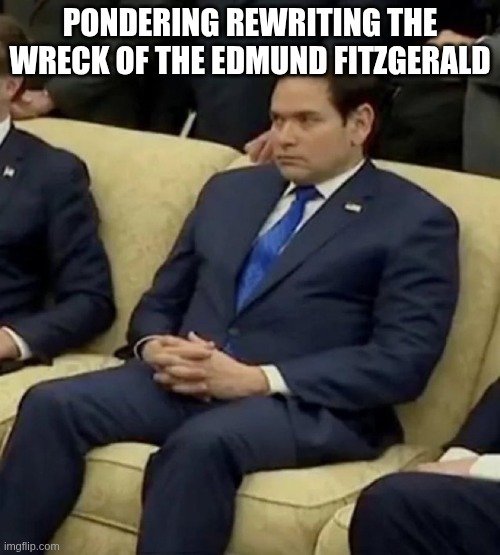
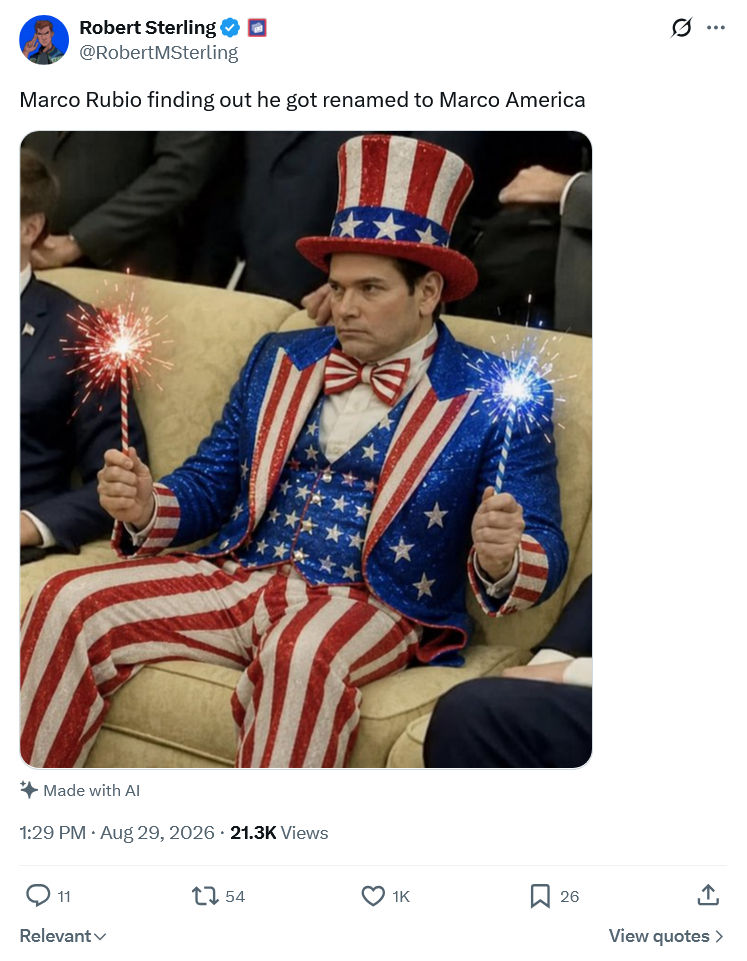
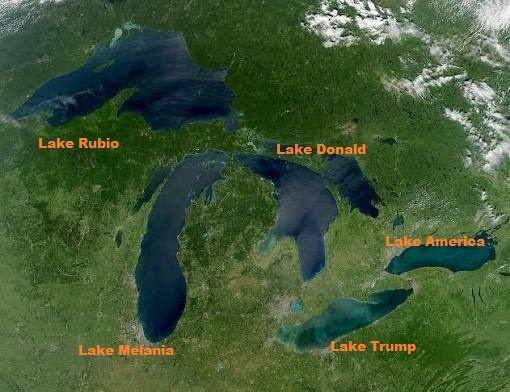
And then there was last week. We started with the Rubio as Helen of Troy. And he GOT IT immediately. Not just the Helen of Troy (his dept in the household includes movies, after all) but he GOT THE RUBIO thing. Immediate belly laugh. And as though this weren’t enough, he got three others, immediately.

Our younger son did due diligence in searching the basement for pods. There were none.

Here’s the thing though, you guys have no idea what a seismic shift this is. I keep telling you we know how outrageous the left is because we’re political animals and extremely online. That we have to have patience witht he normal, let alone low information voter.

BUT– Oh, he’s still a LIV compared to me. But–

Maybe the LIVs are paying more attention now. And maybe the Earth has moved (for everyone. ;) )

Just a ray of hope as you face all of the left’s attempts at discouraging you well before the elections.

So. Don’t be discouraged. Get out there and work instead. Because the current left is worse than ever (and that’s saying a lot.) And we have a future to work on.

Be not afraid.

Book Promo And Vignettes By Luke, Mary Catelli and ‘Nother Mike

If you wish to send us books for next week’s promo, please email to bookpimping at outlook dot com. If you feel a need to re-promo the same book do so no more than once every six months (unless you’re me or my relative. Deal.) One book per author per week. Amazon links only. Oh, yeah, as an Amazon Associate, I earn from qualifying purchases. By clicking through and buying (anything book-related, actually) through one of the links below, you will at no cost to you be giving a portion of your purchase to support ATH through our associates number. A COMMISSION IS EARNED FROM EACH PURCHASE.*Note that I haven’t read most of these books (my reading is eclectic and “craving led”,) and apply the usual cautions to buying. I reserve the right not to run any submission, if cover, blurb or anything else made me decide not to, at my sole discretion. Remember though all of these submissions are from people willing to be associated with this blog. So if you’re trying to buy from people who don’t hate you, this is a good place to start.– SAH

Book Promo

FROM PAM UPHOFF: Mercenaries.

A hundred and seventy years before the Fall of the Alliance . . .

Anatoli Vyatkin and Wolf Offen have graduated from college into a major economic slump, and no job offers at all.

So why not check out some property Wolf inherited? Previously rented to a mercenary company, a desperate mayor from a world under threat mistakes them for real mercenaries . . . well, why not give it a try?

Bad Hunting (Daughter of the Wildings Book 2)

FROM KYRA HALLAND: Bad Hunting (Daughter of the Wildings Book 2)

Once a hunter of renegade mages, now he’s the one being hunted.

Silas and Lainie have defeated the dangerous rogue mage who brought Lainie’s hometown to the brink of open warfare. But the town of Bitterbush Springs isn’t big enough for two wizards, or even one, so they’ve hit the trail. Married now and on the wrong side of the mages’ law themselves, they just want to find a good bounty and stay out of trouble.

Then Silas gets word that another mage hunter down in the dry and desolate Bads is onto something big and needs backup. The money is good, and Silas can’t turn down a fellow hunter in need, so he and Lainie head into the badlands, only to discover one mage hunter dead and another one missing. And if they can’t find the killer hiding in the vast, trackless desert, Silas could be next.

Join Silas and Lainie in an adventure filled with magic, danger, and romance and discover the wonders and mysteries of the Wildings in the epic romantic fantasy-western series Daughter of the Wildings.

Content note: language, violence, and mild to moderate sensual content.

BY ED LACEY, REVIVED BY D. JASON FLEMING: Blonde Bait (Annotated): A hard-boiled noir thriller

Mickey Whalen lived on his boat and bummed around the Caribbean all by himself, until he found a woman alone, on a sandbar, with a suitcase full of money. He fell for her, hard, even as he was trying to figure out who, or what, the hell she was running from!

  • This iktaPOP Media edition includes an introduction giving historical and genre context to the novel.

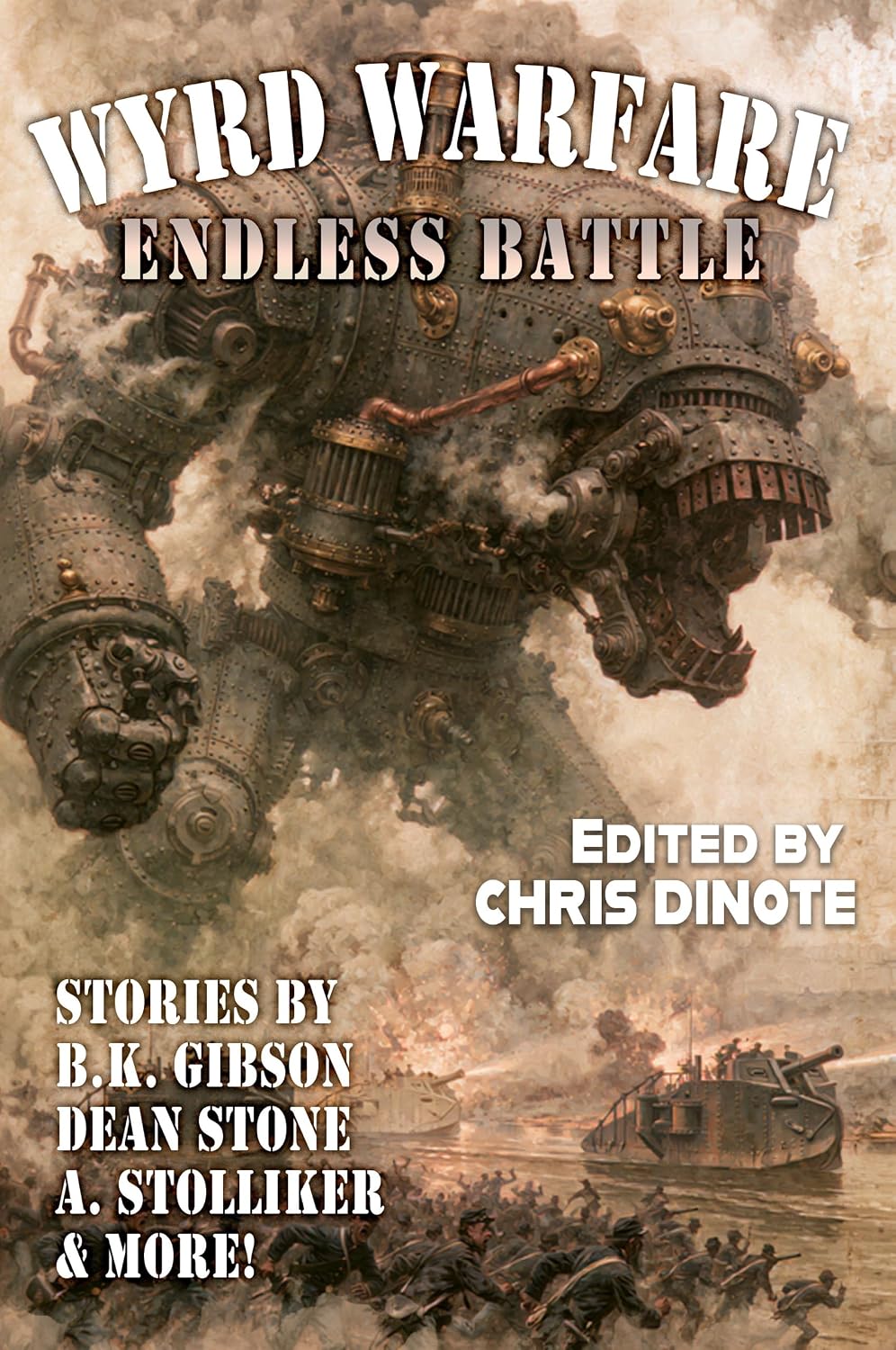
FROM RACONTEUR PRESS: Crashed Landings: Stories of First Contact, Strange Arrivals & Cosmic Adventure (Raconteur Press Anthologies)

Ten writers. Ten crashed landings. Zero warnings.
In Crashed Landings, editor David Badurina has assembled ten all-new stories inspired by the group-adventure films of the 1980s and ’90s —The Goonies, Explorers, Stand by Me, The Sandlot–where a strange event throws mismatched kids together and nothing is ever quite the same afterward.
A boy and his bully chase a fallen meteorite through the woods — only to find out it belongs to someone else. Three friends on prom night stumble onto a robot that fell out of the sky, and have to put it back together before the town pays the price. A fungal alien heart crash-lands in the forest and starts rewriting the wildlife. A teen grief camp gets an unexpected visitor from a crashing seed-pod. A space trucker with a time-traveling rig and a trunk full of contraband coffee recruits a girl with a slingshot and a very good reason to disappear. A boy in Kansas realizes the thing living in his skin isn’t quite him anymore. Bird-like aliens help a crash-landed human pilot evade an enemy patrol on a planet that isn’t Earth. And more.
These stories share a DNA: emotion, banter, wide-eyed wonder, and the kind of friendship that only happens when the world gets weird enough to need it. Good guys and bad situations. Stakes that feel real. Characters you’ll root for. Endings you’ll remember.
If you grew up watching kids on bikes outrun something impossible, and you’ve been waiting for that feeling in prose, Crashed Landings is for you.
Ten stories. One anthology. Infinite crash sites.

FROM FRED PHILLIPS: Sons of Gold and Fire: A Boy, a Dragon, and an Impossible Quest

From the award-winning Gold and Fire Series — Winner of the 28th Annual Critters Readers’ Poll (1st Place, Tied), Finalist for the 2026 Imadjinn Awards Best Middle Grade, and Nominee for the 2025 Kearsells Indie Book Awards.

Aron’s brothers are gone, snatched by goblins in the night. His father and his knight-master rode after them into the mountains and never came back. The only one who can fix this is Aron — and the great golden dragon who is his best friend.

But Doubloon has been snared in a wizard’s enchanted trap, held fast by a net that his own fire cannot burn through. With his family imprisoned and his dragon helpless, Aron is out of options.

His only move is across the mountains. Alone. No harness. No wings. No backup — except a smart-mouthed goblin who talks, a couple with dark ideas about adoption, a sabrecat who takes his last strip of jerky, and one massive platinum dragon who actively despises humans.

Sons of Gold and Fire is a quest story that never lets up. Packed with monsters, narrow escapes, and a friendship between a boy and a talking goblin that nobody planned but everybody needed, this is the kind of book that stays with you long after the last page.

Perfect for fans of fast-moving adventure with heart. Ages 8–14.

Series reading order: Book 1 — Dreams of Gold and Fire Book 2 — Sons of Gold and Fire

FROM ALMA T. C. BOYKIN: Of Land and Magic

Something hides under the land …
Knights guard secrets …
Three sisters watch a new world and old evil …
Stone and metal conceal a surprise. Or do they?

Four short tales of fantasy, set in places as different as central Spain and the cool valleys of Austria, to the deserts of Arizona and a city like and unlike our own.

FROM LAURA MONTGOMERY: PLANTING LIFE: Shut the Kingdom (Near Future Science Fiction Adventure)

Nominated for the 2026 Prometheus Award for Best Novel.

The road to Mars has to start somewhere. It might as well be central Virginia.

Jack Darien scorns his parents’ path. After the disaster at his father’s Mars settlement, the high school senior scraps both his lifelong interest in space exploration and his college plans. Even his rescue of a college student from assault doesn’t make him see his own future any differently.

Jack becomes obsessed, however, when one strange comment from the attacker draws him to unravel secrets at the former Superfund site that is now Webb University, the school where his returning father teaches and eco-restoration reigns. What starts for Jack as a distraction from thinking of his future turns into a dangerous journey that puts him, his mother, and sister at risk. As for his father, Jack decided long ago the man was on his own.

Jack’s determination to chart his future clear of his father’s failures hits a snag when he learns the school’s hidden mystery. Unfortunately, those determined to bring Webb down learn it, too, and ratchet up their own efforts toward Webb’s destruction.

Planting Life is an immersive young-adult science fiction adventure. If you like unearthing secrets, a dogged hero, and reckless courage under threat, you’ll love Laura Montgomery’s near future coming-of-age saga.

FROM MACKEY CHANDLER: I Never Applied for This Job (Family Law Book 8)

Lee seems to be getting a handle on this sovereign business. Mostly it is making sure you have exceptional people and then stay out of their way. She’s learning moderation a little at a time and commissioned a self programming AI who may be a he instead of an it.
Friendship is also a difficult process to master when you are torn between the standards of several species, but she manages to satisfy Badgers ideals, and her Human allies turn out to be very good friends too. A little working vacation with Jeff and April solidifies that bond and gives then a couple of adventures too. They really needed to check on the Bunnies and the Jeff had to teach the squids to keep their filthy tentacles off Lee.
Now if the Earthies would just stop trying to kill her, and they figure out how to deal with the impending death of money, maybe she can do some stuff again just for fun.

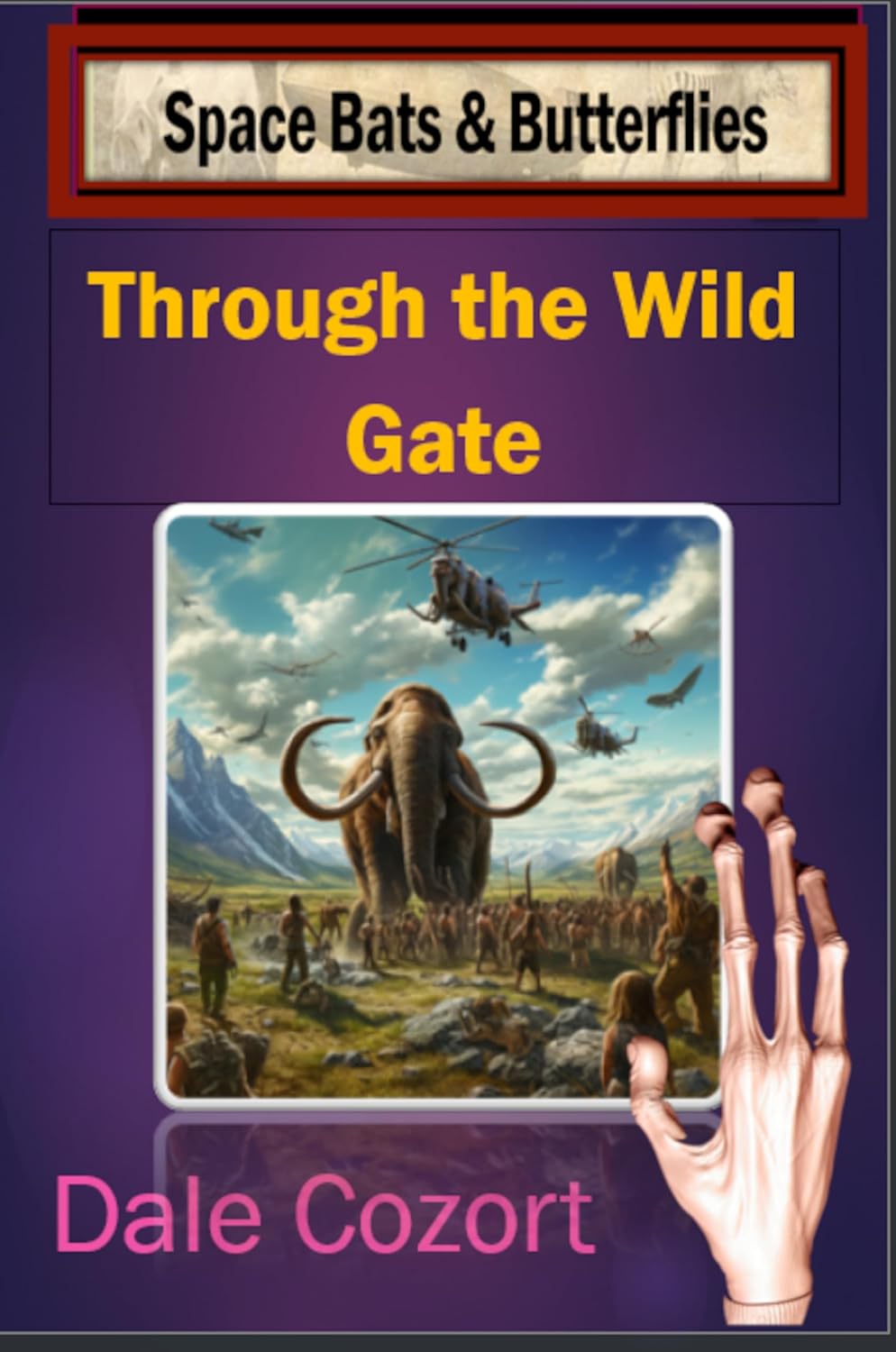
FROM DALE COZORT: Snapshot II: The Necklace of Time

For eighty million years, the Tourists have taken Snapshots of Earth, creating living replicas of continents. Life in the Snapshots quickly diverges from the real world, creating a universe where humans and animals from Earth’s history fly between Snapshots, exploring, fighting, and sometimes meeting their alternate history selves. In 2014, the Tourists create a Snapshot of North America in a snow-globe shaped artificial universe, linked like pearls on a necklace to other copied times and places. In that timeline, Simon Royale—a.k.a. Simon-2014— is a legendary best-selling author. When he was only seven-years-old, his sister mysteriously vanished. Simon-14’s writing—and the power in it—is born from his obsession with discovering what happened to her. But now, cut off from the life he’d known, he may never find out.US-53 isn’t really the past. Thanks to the Tourists, it’s a mutant off-shoot, the 1950s grown up and sneaky, with sharp elbows. In this version of the timeline, Simon Royale—a.k.a. Simon-53—is just an aspiring author with a trunk full of unpublished novels. Then the two worlds connect. For an ambitious publishing company, it looks like a golden opportunity for Simon-53 to leverage Simon-2014’s fame.Can the clashing versions of Simon Royale coexist in the unnaturally linked timelines? Simon-2014’s legal battle over the right to his own work and identity are the least of his worries. In the 1953 timeline, his sister is still alive. What made her disappear in one reality but survive in the other? Is something dangerous hidden in his memories or his first novel? As Simon inches closer to the truth, one thing is clear: it’s a secret someone is willing to kill to keep.

FROM ANNA FERREIRA: The Flight of Miss Stanhope: A Short and Sweet Regency Romance

Marianne Stanhope is in trouble. Her family is urging her to accept the attentions of a most odious suitor, so she turns to a gentleman of her acquaintance for aid. But Mr. Firth has his own reasons for assisting Miss Stanhope, and it falls to her childhood friend Mr. Killingham to convince her that she’s made a dreadful mistake.

FROM LEIGH KIMMEL: The Baying of the Hounds

In the world we know, Nikola Tesla’s Wardencliffe experiment proved a costly failure and was ultimately torn down for scrap. But what if things had gone differently and he pressed his work to completion? In a world similar to but unlike our own, Tesla completes his transmission tower. But when he turns it on, he discovers his calculations were incomplete. Some unknown factor has created a connection with another world with physical laws unlike our own. The commingling of curved and angular space has led to catastrophe. Now his greatest rival, Thomas Alva Edison, compels him to repair the damage. To do so, Tesla must make his way through a ruined city to the locus of the damage. And through his mind echoes the baying of unseen hounds. A short story originally published in the anthology Steampunk Cthulhu.

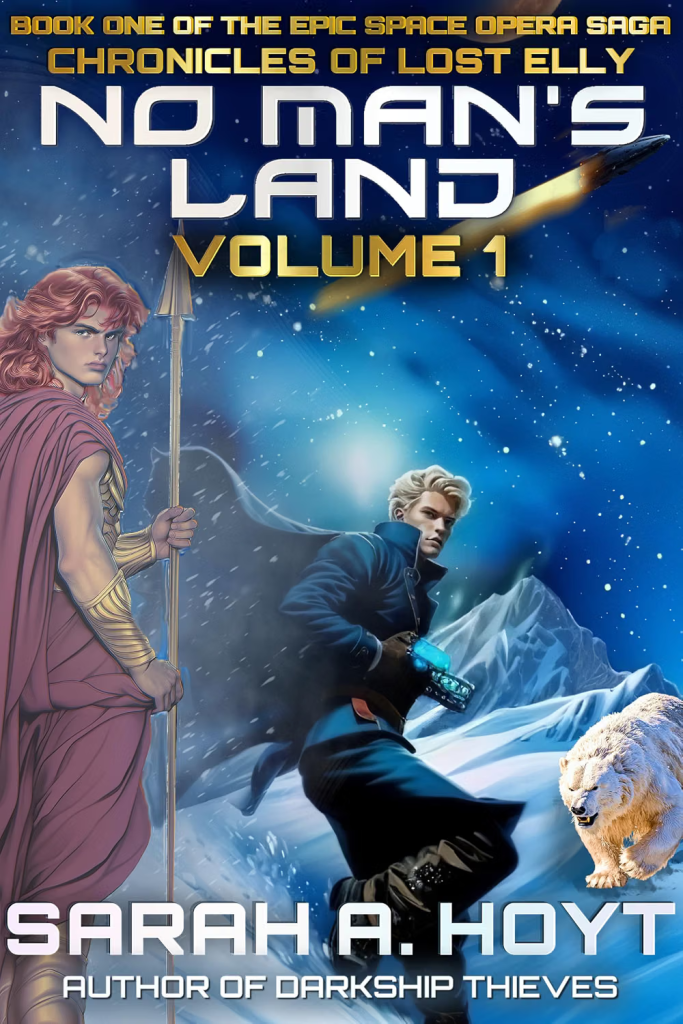
FROM SARAH A. HOYT: No Man’s Land: Volume 1 (Chronicles of Lost Elly)

Because the promo must flow! (There will be clanker songs later)

Sufficiently advanced science is indistinguishable from magic.

On a lost colony world, mad geneticists thought they could eliminate inequality by making everyone hermaphrodite. They were wrong. Catastrophically wrong.
Now technology indistinguishable from magic courses through the veins of the inhabitants, making their barbaric civilization survivable—and Publius Cornelius Scipio Africanus Kayel Hayden, Viscount Webson, Envoy of the Star Empire—Skip to his friends— has just crash-landed through a time-space rift into the middle of it all.
Dodging assassins and plummeting from high windows was just the beginning. With a desperate king and an archmagician as his only allies, Scipio must outrun death itself while battling beasts, traitors, and infiltrators bent on finishing what the founders started: total destruction.
Two worlds. One chance. No time to lose.

Vignettes by Luke, Mary Catelli and ‘Nother Mike.

So what’s a vignette? You might know them as flash fiction, or even just sketches. We will provide a prompt each Sunday that you can use directly (including it in your work) or just as an inspiration. You, in turn, will write about 50 words (yes, we are going for short shorts! Not even a Drabble 100 words, just half that!). Then post it! For an additional challenge, you can aim to make it exactly 50 words, if you like.

We recommend that if you have an original vignette, you post that as a new reply. If you are commenting on someone’s vignette, then post that as a reply to the vignette. Comments — this is writing practice, so comments should be aimed at helping someone be a better writer, not at crushing them. And since these are likely to be drafts, don’t jump up and down too hard on typos and grammar.

If you have questions, feel free to ask.

Your writing prompt this week is: tacit

Kingship By Consent

No I haven’t gone Monarchist — snort, giggle — I’ve also not been replaced with a pod person.

However work on the second book of Chronicles of Lost Elly — NOT THE SECOND VOLUME, that’s out, the second book Orphans of the Stars — brought up the concept and then I ran into some stuff on Twitter, which made me realize there are instances of that — sort of — in our own world.

Okay, to some extent kingship, like all forms of government, is always “by consent”. Piss off enough people who are strong/rich enough to unseat you and you’re going to have a problem. (Communism, of course, solves that problem by making everyone not the dictator and henchmen poor and powerless. It’s a choice for them. Not the people. In that sense it’s most closely related to feudalism, and I suspect Europe would still be locked down in THAT if it weren’t for the Black Death upending everything.)

However in small enough or in some cases distributed enough (later) systems, the kingship is more by consent than not. This is particularly the case if the king doesn’t really have armies. Or does, but it’s no more than some of his vassals can command.

Which is the situation in Elly, because small, distributed population, primitive armament and some of the clans, say, or even rich tradesmen can command a larger force than the king’s dedicated “personal guard”. In primitive fighting the size of the army is a lot more important than the proficiency, to a point, so that’s that.

And the problem is since they are also more … um…. primitive in communications — which weirdly isn’t any or much different than the situation we’re in, where we have massively unreliable mass media, and a zillion small voices often contradictory or falling for Mass Media’s bs. — it means that any rumor that catches hold of the people, or acquires legs of some sort can mean the kingship will be toppled. If not by killing the king (which might or might not be difficult) by disengaging from him so completely that he might as well not be there.

They have in fact, in their very long history had several situations like that, when it then takes a strong and charismatic king, with an ability to use rumor and story to his advantage to become a king again in anything but name.

So, why was I thinking about that for any other reason than that I’m writing the book. Because it occurred to me that it applies in all sorts of ways in our world to things that aren’t exactly monarchies.

For instance the Papacy. There is a concerted campaign to discredit Pope Leo, against all possible sanity or sense. No, seriously, they are calling him “Obama’s Pope” when the man has more than once possibly stretched his neck out too far to signal “I’m not a leftist.” I covered some of it here on the blog, but yesterday I sort of lost it at instapundit and blasted one of my favorite blogs for a serious case of head in ass. Here.
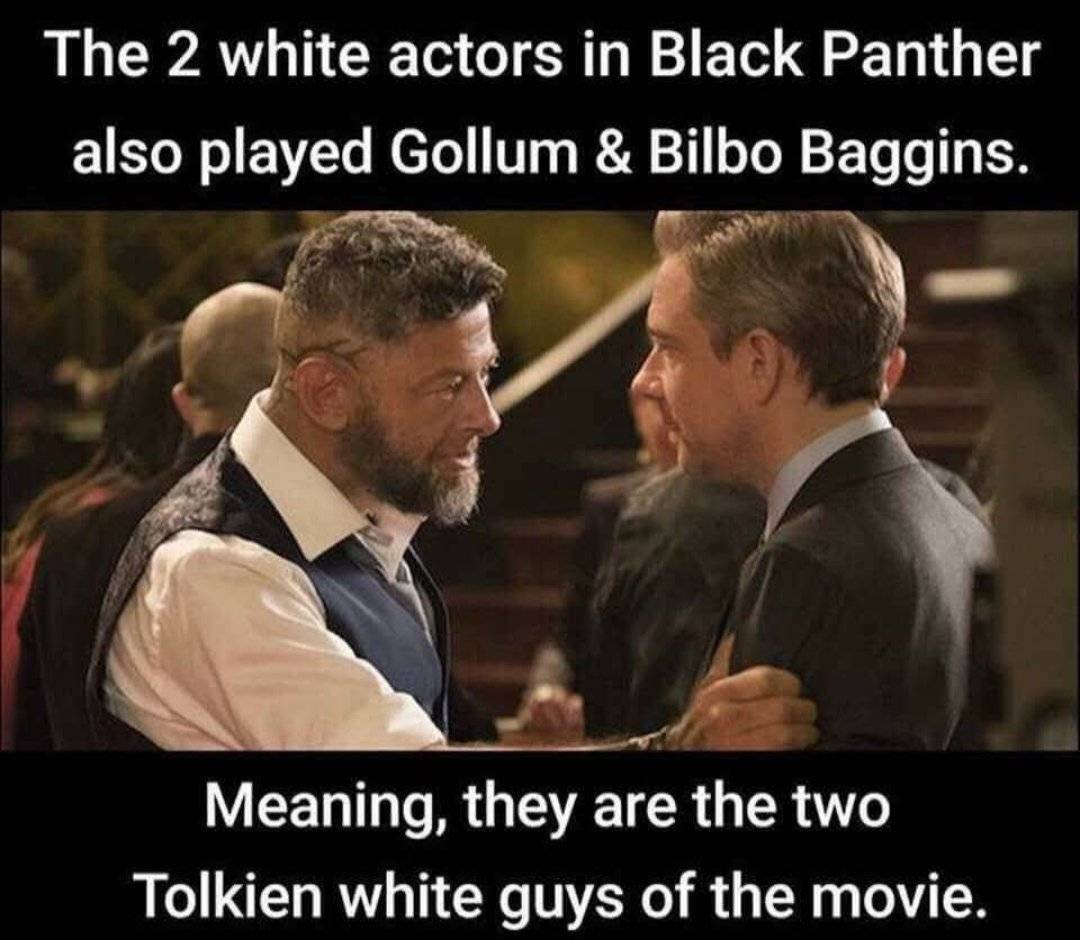
Note I’m not defending Leo because I’m Catholic. I was one of the first/most prominent Catholic bloggers to make bear and Pope jokes about Francis the excessively woke. I like to think that even if I weren’t Catholic I’d be defending Leo. A) because it burns me when someone is accused of exactly the opposite of what they’re doing, thereby catching the same flak from the right he gets from the left. b) if the left really wants you to hate him that badly, then you probably shouldn’t. Particularly since he seems not to like commies.
And every time I do this someone is like “Well, then why doesn’t he come right out and say it?” Well, because he is a king by consent. Yes, once upon a time the pope had armies and could send them out on various punitive expeditions. But right now, um…. no. And frankly the lower offices can and often do ignore him. So he has to be agreeable enough that people don’t simply tune him out and strong enough that he can do something other than wear the crown. Or in the Pope’s case the funny hat thing.

(Oh, I suspect the reason for the campaign to discredit him is that Leo has already once come out against mass migration from the third world. And if he can carry or make that point bear fruit and convince third worlders they shouldn’t be doing this, a lot of grifters within the church structure lose their rice bowls. Not to mention a lot of other grifters not in the church, and oh, yeah, the people who hope to wholesale replace their electorate.)

Anyway, so that’s why he doesn’t come right out and say stuff.

However, while on that, I’ve been reading Roger L. Simon’s American Refugees book. Thank you to whoever linked it. I’m reading it for obvious reasons: I are one. And it’s a fascinating mix of matching my experience and places I giggle, because — I like Roger. He was my remote boss when I worked for PJM and though we never had much contact, I find him eminently readable and interesting but — liberals who got red pilled have some interesting illusions, like his idea that the left ever actually was for free speech, and it wasn’t a from-the-lips-out and no such things behind the scenes (like how they controlled mass media and kept conservatives away) thing.

Anyway, one of the things he ran into which we did also is the existence structures of power in the red states we moved to, some of which bear a striking resemblance to kingship by consent, because there’s really no reason for locals to put up with corrupt or incompetent petty pseudo-GOP people, except personal loyalty and “I remember when his daddy…”

I’m not in politics. Well, other than this blog, and the fictional politics in my books. But if I were, that would be a b*tch to deal with, particularly since we would be dealing with it as refugees/new comers, ie. handicapped by “y’all not from around here” and “You can’t just that because you just arrived.”

So, definitely to topple the petty small local kings, you need some kind of power: either local ties that allow you to say “yeah, and I wasn’t that impressed by his daddy, either” OR a rumor mill worthy of a dystopian novel. (Which to an extent is what the left employed to flip those petty kings on the right.)

Anyway, I really don’t have any other point except that I find people don’t understand this. We are so entrenched in an elective system that we assume everyone is able to behave like an elected leader.

While in fact, for those whose power is more granted by prestige and tradition, they have to be almost Machiavellic to manage to do anything they actually want to do.

And many are. But they baffle those watching them. Having figured it out, I wanted to share the insight.

You Impostor!

I have no idea for whom I’m writing this, but it must be written, so here goes.

I spent the first ten years of my writing career in panic fear. This is from the time my first novel was published. The panic fear caused me to make a lot of bad decisions, like not push for a higher advance in my second and third novels, not figuring out what the house was up to, not generally being in your face and demanding with the house. (So, in all artistic human endeavors, if you behave like a big deal they treat you as such. I didn’t know that, and my tendency is to be polite and stay out of the way of people — presumably — doing their job. This was a mistake.)
What was I in a panic about. Good question. I was recently talking about this with my husband, and he was utterly baffled. The bizarre thing is that looking back so am I, because the me now is not the me 26 years ago. In fact, in many ways, save for inheriting an aged version of her body, we might as well be aliens to the other.

I mean logically, and on the face of it I DO realize what she was scared of. Except that…. really?

So younger Sarah’s completely logical fear was that she’d be found out as a fraud and bad things would be said about her on the internet.

Husband’s first question was: “What? Like they’re said now every hour of the day, sometimes even to your face?” Me: “Yep. Exactly like that.” Him: “Why be afraid of that?” Me: “Because she was afraid that people saying it would make the bad things true. Or at least make people believe they were true. And then she wouldn’t ever be able to keep her head up.” Him, giving me the narrow side-eye: “Your head seems to be up just fine.” Me: “Yep, but she didn’t think that was possible.”
His second question was “Logical fear?”

Me: Think about it. Think about the astronomical odds against getting published at all in the old days. (Seriously, you guys who are mostly readers have no idea. You, and even I, dismiss the people who published a single book, it wasn’t very good, and they vanished. But in terms of competition to get published, even that single book meant overcoming immense odds by an amazing combination of skill and — yes — luck. (Because luck is a factor in every human endeavor.) I no longer remember how we calculated it one long drunken evening at World Fantasy, but I think the odds of any novel getting published were one in ten thousand, at any given time. Almost regardless of quality, because in odds that vast quality must have some assist from luck. (Unless sheer nepo is involved).)
I’m an English-as-a-third-language-speaker (and writer.) The fear that I’d suddenly be found to be truly terrible at it after publishing six or seven books was a successor to my certainty, when I first started mailing out books that every editorial office was laughing at my story submissions. So that part was logical.

What wasn’t logical, but was a product of impostor syndrome and insanity was my conviction that “EVERYONE” would suddenly realize my books sucked (this btw got worse with things like the finalist status for Ill Met By Moonlight in the Mythopoeic, and winning second place in the Colorado Book prize (whatever that is exactly. I no longer remember, because I have no brain.)) Because OBVIOUSLY they were just delluded about my being competent. AND my absolute certainty that if “everyone” decided that they would be “right” and that therefore I would be eternally and completely reviled.

Looking back, all of this seems like a ten-year-long psychotic episode, but at the time it was so real and seemed so “might happen at any second” that I lived under an immense amount of stress, roughly akin to a rabbit pursued by hounds. How I managed to function, keep house, raise the kids and write several books that way is a testimony to the fact I’m part badger. You can drive me into a hole, but I’ll fight like a demon with my back to the wall.

The problem of course was that it was me chasing me into a hole.

Discussing this with Charlie in our monthly or so dinner (Should be weekly, but life is weird right now and sometimes we don’t want to drive all the way out, even if dinner with him is always a blast) he said everyone goes through that. I mean not about being a writer in his third language, but in all his many varied careers he says that’s exactly what he always felt like at the beginning. Further he said that when he went to medschool (you guys read the “varied” career right?) he realized that every one of the doctors he studied or worked with, even the ones who looked cockily or psychotically self-assured went through this: in their case the certainty they’d one day hurt someone, perhaps fatally, and the fear they weren’t competent enough for their job. NO MATTER HOW COMPETENT THEY WERE. Except trauma surgeons, because their work is basically a last ditch effort to save someone, and the fact is that even bad trauma surgery at least has a chance, which is better than no chance.

Which I think is part of what was at the heart of my fear, and perhaps what is at the heart of all modern impostor syndrome.

Hear me out: we — all of us, pretty much — these days are the product of a schooling system in which we are continuously tested against a platonic ideal.

No? Think. Tests have a 100% mark. IDEALLY you’d hit the 100% mark. And for us, those born owing money, forever justifying our existence and perpetually suspecting ourselves of sucking if we got a B+ — because it’s not 100%. DUH — we internalize that idea.

Once we’re doing our jobs, we’re utterly convinced we should do our jobs PERFECTLY. And if we don’t we suck. Even if we’re performing at 98%. And anything below that? Well, we’re absolutely utter failures. Even if normal performance for our jobs is say 50% (We’d be lucky if it’s that high. Have you seen some of the people doing their supposed jobs? Some of which are colleagues of each one of us here?) we think we’re failing because we’re not 100%.

I think that’s “public education mind warping.” Though perhaps we’re just broken. Because G-d knows the incompetents out there aren’t worried every day that they’re failing. They seem utterly convinced they’re the best think since sliced bread. With butter and jam, at that.

So, if you’re experiencing impostor’s syndrome and experience a panic fear that you’re going to be found out to be a total fraud, or make a mistake SO catastrophic the world collapses around your ears forever and ever amen, you in fact are probably better than average at what you do. (Look, at least you’re working at it!)

BUT the problem remains, even if you accept that impostor syndrome LIES to you. How do you get rid of the feeling you’re an utter failure wearing a plastic nose, glasses and mustache of competence as a disguise? I don’t know.

I did it, but I’m not exactly sure why. Part of it, I think, was actually having what I was afraid of happen, but differently. I.e. it wasn’t because they thought I was terrible writer. (Yes, they say so, but you know it’s not.) Part was just… growing up. Realizing how pathetic so many of the litewahwy dahlings are. How much nepo goes on in the business, and how effed up the world is in general.

Realizing that this is not school. No one in the real world does 100%.

We just do what we can, the best we can. And yes, sometimes we make horrible mistakes*, and then we recover from them as best we can, and we go on.

Because in the world of humans, “perfect” isn’t on the menu. If you weren’t doing your job, someone else would be doing it. And the someone else, if they don’t suffer from the same crippling impostor syndrome, are probably just doing it “good enough” which means worse than you.

So, carry on, you brilliant impostor, you. I have no idea what you are impostoring about, but if you feel like an impostor, you’re probably doing better than 75% of people. (There have been studies, though I’m too lazy too find them.)

So wear your plastic glasses, nose and mustache with pride. In this fallen world, no one is doing that wonderfully, but you just might be among the best.

You brilliant, wonderful impostor you.

Go do the job.

*Though I admit that somehow forgetting the first chapter of your just published book is a special kind of mistake. And I thought I’d made all possible ones BEFORE that.

The Blind Leading The Blinkered

I am not trying to start a blog war. Yes, I know that means I’ve lost some of the fire in the belly. But look you, I’m recovering from severe illness, and we’re probably looking at another move this year, plus there’s a bunch of family stuff going on and…. I’m swamped. Also judging from the tone of this article, it would amount to wrestling with a pig. You just get muddy and the pig — being a stupid animal — likes it.

Anyway, since I don’t want to start a blog war, I’m not going to link the offending article, (UPDATE: After sleeping I realized I can do this (derp) with archive link. So if you want to enjoy the nonsense in its full glory https://archive.is/DSSRB) just quote bits of it. However, I daresay if you wish to find it, you can search. I mean, it’s called: Five Ways Fascist Culture Appears in Our Stories. Do you know how fascists see the world?

I actually DO know how fascists see the world. Fascism, classically, is a form of national socialism that relies on “state capitalism.” Which is to say, it relies on the state controlling every commercial and industrial concern in the country for the state’s business. However, since no one has made much of a paen to fascism in the modern world, at least since the Portuguese ancien regime (notably called Estado Novo) stopped cribbing FDR’s speeches and notes, this post seemed a little odd. What were they doing, really? The closest thing to a fascist regime (please don’t remind me we have a bit of that state/industry thing going on please. It’s mostly “environmental” regulations.) in the modern world is the PRC. Were they going to do a tour of Chinese real-politik writing? Sounded interesting.

So, I clicked through. Almost right away, I got a feeling the person writing this might not know fascism from a hole in the ground.

To someone on the left, fascist culture may seem bizarre. Why do they keep supporting a man who has violated all of their moral rules? Fascists don’t view this situation like we do; they have cultural propaganda that repackages repugnant things as attractive. If we want to push back against these ideas rather than spread them, we need to know what they are.

Wait what? Is this person under the impression that people not on the left are … fascists? And then he alludes to crazy ass stuff that implies he’s talking about America. We’ll leave aside the fact that he apparently shoots PBS straight into his veins bypassing his brain, and ask what in the effing hell he thinks the American right — mostly leave-me-alone freedom lovers — has to do with fascists, but the ride gets more bizarre. So put on your helmets, buckle your seat belts, keep hands and feet inside this flaming handbasket to hell at all times, and for the love of heaven stop giggling. We’re not responsible for damage done to your psyche by encounters with a parallel — ahem — differently-logical reality.

But What Is Fascist Culture?

Before we dig in, let’s examine what we’re looking for on a more conceptual level. What do fascists believe? To answer this, I’ve consulted good ol’ Wikipedia and the work of late psychologist Bob Altemeyer.

Altemeyer studied authoritarians for about 60 years before his death in 2023. His 2006 book The Authoritarians* predicted the rise of a fascist authoritarian leader in the US. I also gleaned information from his more recent book, written with John W Dean: Authoritarian Nightmare: Trump and His Followers.

Face-paw. In which we learn the late psychologist Bob Altemeyer was tripping balls and took his Columbian marching powder with no cutting, straight up. Children, babies and short tailed marmots: if you’re living in a totalitarian nightmare, you’re not publishing cutsey books about the totalitarians. At least not in that country. So to the qualifications of the late Bob and the author of this article we must add: Completely virgin of any even vague nodding acquaintance with historical totalitarianism. Or perhaps more germane: busy posturing for an audience even more clueless than they are, and capable of smarmy and bottomless self-delusion.

Blah blah blah about a group of “Trump followers” who are called “social dominators” (rolls eyes) who have made a conscious choice to work against equality and embrace bigotry. No support for how anyone on the right side of the aisle is actually a bigot or against equality (before the law) but I guess when you’re speaking to delusional ignoramuses, you can just make sh*t up. And they’ve been making sh*t up by the bucketful in the social “sciences” since Margaret Meade was hoaxed by a bunch of teens.

Then we get to the good part, where he examines the intellectual characteristics of what he thinks is the majority on our side. Cough. A moment please while I fetch and excerpt. I am sure all of you who know me and have read me for years will look at these characteristics and…. I won’t spoil it for you. Here:

Submissiveness towards authority. RWAs believe it is a moral duty not just to obey, but also to respect leaders and authority figures that they believe are legitimate. Conversely, they are extremely lenient about the behavior of authorities, believing it is a leader’s right to break the rules.

Conventionalism and conformity. RWAs believe that conforming to traditional social norms is a moral imperative. They want everyone to be the same and do not see value in diversity, bucking trends, or free thinking.

Aggression toward non-conformists and outsiders. RWAs are driven by fear that others will cause the “proper” social order to break down, and this makes them xenophobic and aggressive. In particular, they like to punch down at people who break norms. However, RWAs will show higher aggression toward any group when it is encouraged by their leaders.

Stop laughing! I can’t hear myself thinking for your guffaws. Decorum in the pews.
Look, it’s absolutely hilarious, I get that, to hear someone from what has been not only the dominant, but the overwhelmingly dominant and controlling side of the aisle for the last 100 years imagining that anyone who disagrees with them, that is anyone who has gone against schooling, indoctrination, “expert opinion” the industrial information/entertainment complex, is the “conformist” who hates free thinking. As for the hostility against outsiders, we recommend this fine gentleman buy a mirror. And the soonest the best. And let’s not get into the whole submissiveness to leaders when it comes to a leader who was supposed to be “a kind of god.” PFUI.

I’m running incredibly long, so I’ll just quote the title of his “characteristics” of what I must presume he thinks is OUR fiction.
1. Glorifying Loyalty to an Alpha Male

I have no clue what he’s talking about. Is Alpha Male a furry thing? Anyway, judging by what has gone before, I’m going to assume in his conception an “alpha male” is any man who doesn’t need mommy to tie his shoes, isn’t rendered impotent by the thought that all penetration is violation. If that’s the case, I must admit I often have alpha males in my stories, both villains and protagonists. Even my men who are… ahem fond of the company of men tend to be indeed more than piles of goo in the fetal position on the floor. (Even those who logically should be.) As for glorifying loyalty? What???? Look, my characters PRIZE loyalty to those who deserve it. That can be yes, male leaders, but also female leaders and much more often the weaker people — male, female, alien, raccoons — under their protection. I don’t know what the hell “glorifying” is this context, but I can tell you I’d rather fight by the side of people who prize loyalty than beside weasels who’ll betray you for the next hotness in critical theory.

2. Villainizing Rabble-Rousers

All I have to say is, of course, anyone who has read my books knows I villanize the rabble rousers. In fact, I’m sorry to tell you this everyone in this blog who writes, both commenters and main writers are guilty of this.

This is absolutely true if by “Rabble rousers” this speshul flower means “people who bellyache, smarm and whine about how others are better off while doing nothing to improve or fix the problems.”

At this point one begins to wonder if this wise poster has ever read a book by one of the people he villifies and, shall we say, villanizes.

3. The Man Who Does What It Takes

In which I find out that MacGyver, Simon Templar, and in fact Gilgamesh were all characters in fascist literature.

I don’t feel like reading, much less transcribing the pseudo-intellectual drivel in packed under this heading, but seriously…

Again, face-paw. Let me explain, very carefully how fiction-for-entertainment (as opposed to fiction for preaching, which no one reads, but every politically correct person claims to have read) works: the reader likes reading about a character who can get out of difficult situations in ways the reader himself isn’t sure he could. It’s called a vicarious cathartic experience and also fun. I’m not going to explain the concept of fun, though I think the gentleman poster would do well to study it.

Oh this also makes Captain Kirk a fascist character, something that would shock the heck out Roddenberry.

4. Stranger Danger

The what? No seriously, what the actual, what? I don’t read much on the left. I used to. But I really haven’t since I’ve had a lot more of the indie stuff to read. And this rubric leaves me utterly confused.

Oh, wait, I do read some leftist stuff, mostly young chicks writing JAFF. They’re more likely to have “stranger danger” than anyone else, in that anyone who doesn’t fit the in group they’re portraying as good is bad-evil.

Most of the stuff I read does not portray people who are not in the in-group as dangerous or evil. And in fact, in science fiction, the stranger tends to be far more interesting.

5. Poor Representation

Yes, here he is absolutely correct. Most of us do not represent!

On the serious side, I have to confess that I don’t go out of my way to have one each of any race, ethnicity or other minority I can think of.
This is on account of the fact that, unlike fascists or other leftists, I don’t think of people — and most of my characters are people — as broad categories of groups. I don’t lay awake at night wondering if I have enough pacific islanders in my Regency England romance, for instance.

As for the future, I have serious doubts they will still consider the same categories as categories or obsess about current issues. (Particularly since most of those issues are being kept issues by ideologues mostly interested in power.)

I don’t talk a lot about what color each character is because that absolutely doesn’t matter to me.

You know who was race obsessed? Fascists.

On the other hand we’ve already established the poster is not really cognizant of history or philosophy or much of anything.

I am very disappointed to find this article twaddle wrapped in pretentious academic speech.

I would caution any of you to ignore this stuff and write about real people living in the real world and not the phantasmagoria conjured by the minds of those who live in such an ideologically sealed bubble that they have no idea what is going on in the minds — or books! — of those they would claim as opponents.

NOW: Remember this is a writer’s blog, so confine your discussion to the writerly aspects. If you wish to discuss politics, go to accordingtohoyt.com, where you can pound on the politics to your heart’s content.

A note- This is a political and lifestyle blog, so to discuss such aspects of this post, do so here. If you want to discuss writing and possibly froth at the mouth about writing, head to madgenius.com.