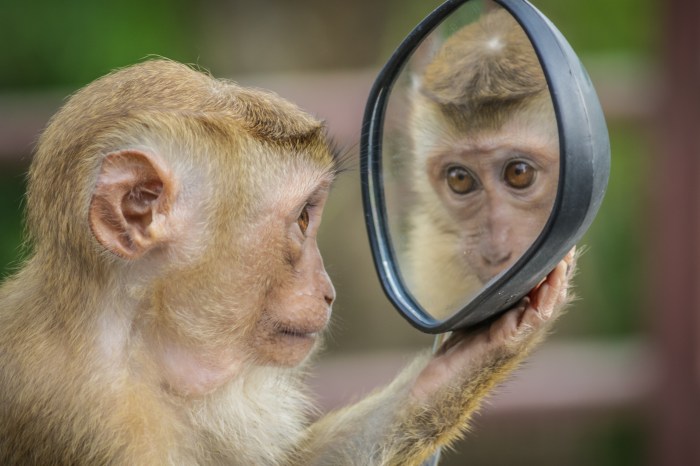
As we get older it becomes harder to look at ourselves in the mirror. And no, it’s not just the obvious signs of aging but that we have to face — not even choices but — things that happened in our lives that left a mark on that person looking back on us.
Those of us who grew up near a large and relatively stationary family (look, dad’s family lost half its kids or more to other countries each generation (I represent) but there were enough that stayed there) and had enough generations to know the “family look.”
When you’re young you can deceive yourself that you don’t belong to this large, clumsy, lumbering tribe (represent again!) but as you age, you start seeing other people in your mirror. For years now, I’ve been looking at my paternal grandmother, which is funny since, objectively my features are more like mom’s. But there’s the look.
Otoh, when I’m tired or ill, the voice that comes out is that of my maternal grandmother.
So, what does it matter? Oh, well, it doesn’t. Not really.
Knowing where you came from seems to be a human obsession, though.
I have friends who were adopted and who would like to know who their real parents are, in varying degrees. Some have been trying to figure out for years (and some managed) and others would kind of like to know for the health information, but have no burning desire to find out.
But humans as a whole seem to want to know “where we come from.” It could be said that in the past nobleman-privilege amounted to knowing who your great grandfather was. (Actually I know that. It’s after that that it gets fuzzy. Usually in varying degrees of family legends, and stories of ancestors getting amalgamated with each other.)
Sure there are things to knowing who your ancestors were and what they were good at. It managed to make me pass (usually B) in math, even though I have severe digit dyslexia (how severe? Well, I led the entire family on a search for a house number 265 recently, verifying my print out several times, until younger son pulled paper from my hand and went “For the love of heaven, mum, 295!”) because “our people have always been good at math.” Ditto history and languages. In fact, the only thing I was allowed to be bad in was crafts and art. Art, because only about half of us were good at art. And also because “crafts don’t matter.” This is the other side of knowing. You see, I actually COULD be quite good at crafts and art, but I got a free pass, because the family as a whole wasn’t.
Oh, yeah, and I could be as bad as I wanted in gym because the family as a whole had such coordination issues we could never jump rope or ride a bicycle. (This part is good. I tried. I tried really hard. Knowing no one on dad’s side could do it, just saved me beating myself up.)
There are stories particularly from the early twentieth century of noblemen walking away from their heritage and finding it immensely freeing.
I think part of the reason for American exceptionalism is just that. You walk away and can reinvent yourself any way you want. Easier, even in early days, as you could not travel, and your relatives didn’t check up on you via facebook. You get there, and you can be anyone you want, and the people around you don’t have expectations of you based on the lives of people you never met.
To an extent, the left is reversing that. It’s locking people up in victim/oppressor groups. It’s worse than being bound by the deeds of your ancestors. You’re being found by the deeds of people you never met and who might have no genetic relationship with you: nothing but a vague physical resemblance.
Take our former president, embraced by the descendants of slaves in America, thinking one of them finally won the presidency. Yeah. His mom’s family were slave owners, and I read convincing accounts of his father’s family’s relationship to Arabs and Dahomey, both slave dealers. So, why is he supposed to be descended from the oppressed again? Oh, yeah, he can tan, so he’ll always be a victim. Gotcha.
Does anyone think this makes a yota of sense?
I have a friend whose ancestors fit in the same “oppressed group” at lest on appearance. But they came to the US recently, and as she pointed out once, they certainly didn’t consider themselves oppressed in their homeland. Why should they? What their status was in America didn’t affect them. They weren’t here.
There is a certain blinkered twenty first century American blinkeredness about this designation of oppressors and victims, as though no other country ever existed, and as though everyone should care what WOULD have happened to your ancestors here.
It’s like we’re locking people in that same web of expectations, but not only less rationally, but also immutably.
Hey, it doesn’t matter if your dad is the president, if you’re of African ancestry, you’re still a victim forever. And it doesn’t matter if you’re a concentration camp victim, you still have white privilege.
It’s like they’re constructing an entire world with no contact with reality. Oh, wait, they are. It’s what they do, and why communism is so lethal and socialism kills on the installment plan: because it tries to force people to act like equal and interchangeable widgets. Which can’t happen.
Sure, family trauma, and if your ancestors were badly treated has some influence on you. Not a ton. I mean, look guys we’re all born broken. But some of the breaks of the past come through to us in a way. Mom’s obsession with never being quite good enough might have a lot to do with where she grew up. But passing it on to me second hand makes mine less rational. The fraction I passed to my sons is utterly inexplicable. But yeah, it’s there. You don’t raise kids with your good intentions. You raise them with all of you. They learn from things you don’t know you’re doing.
So, yeah, the children of the oppressed — or the abused, or the social climbers, or the unsatisfied, etc — bear their scars.
But this is not something that can or should be fixed by government. I might still be working through the guilt of some great-great-great ancestor at what he did in a war we’ve now forgotten, but CERTAINLY that doesn’t mean everyone who looks like me or has a similar geographic ancestry is working through the same. And the government has no way of knowing PRECISELY what you might be working through. Even if we could precisely identify all your ancestors (I have a feeling people in the future will find our DNA testing as funny as we find phrenology) do we know who raised them? It’s not a matter of DNA alone, and the raising has at least half of it.
Right now, what we’re doing is creating “aristocracy” of the blood, endowed with rights just because of their PRESUMED ancestry, and “peasants” (really villains) of the blood, endowed with guilt and shame because of their birth. No society who does this can retain its rate of innovation or be socially permeable for long.
We are who we are, to an extent, and as different from the rest of the world as we are, because those chains were broken. It’s okay to want to know where you came from, provided you’re not going to find yourself in the ancestral village with the neighbors and even strangers telling you the limits that sets on who you are.
It’s okay to want to know what went into making you. It’s not okay to make yourself part of a victim or oppressor group based on “looks like.”
And it’s a really bad idea to have the government give bennies or punishment based on “looks like.”
Using the government to do anything is akin to practicing surgery with a wooden spoon in the kitchen. Using the government to right the wrongs of past generations and fix the psychological wounds of individuals by coddling or reviling is more akin to doing all of that, only it’s brain surgery, and it’s midnight, and the electricity is out.
It can’t be one, or at least not in any way that makes it better, instead of worse.
Yeah, that person looking at you from the mirror doesn’t feel like you. But you are. And you are human with all the goods and ills of it.
So, yeah, sure, you might be carrying wounds you don’t even know about because some past ancestors was very badly treated.
All of us have some wound. No one can do the work of saving you. It’s time to become the self-rescuing princess (or prince.)
Pick yourself up, dust yourself off. Whatever your ancestors endowed or failed to endow you with, it’s you who has to make your best of what you have.
Now go do it.