Doing the promo post in a little while.
We’re on the road this week, so posting times will be …. whimsical.
Born Free
Doing the promo post in a little while.
We’re on the road this week, so posting times will be …. whimsical.

You see, I caught a second 24 hour ban for an OLDER post. Considering how many times I posted Mr. Caramel’s name, it’s going to be a LONG time.
Anyway, I can post in groups, and comment on other pages — want a comment from Sarah A. Hoyt on your page? Tag me, do — but I can’t approve new posts on my timeline (I turned them to approval-only during a similar kerfuffle, but not with FB.)
So, until I can promote the promo, there’s not much point doing it. Maybe tomorrow. We’re going to be on the road with irregular hours all week. And frankly, I’ve passed Deep Pink to readers, and am now trying to write a full-length space opera in the next couple of week. Also, I have SIX short stories overdue. Spent the long drive talking them over with husband, I now just need to write them.
As for why I’m not abandoning facebook? Because we can’t guys. That’s what we’ve been doing wrong for seventy years or so. We’ve abandoned their spaces and silenced our own voices. It not only makes us unheard, it gives them illusions of invencibility and has brought us to the brink of civil war.
This is what I’m posting in comments, all over:
Oh, also bake me a cake, Facebook. An Italian Caramel cake.
Are you a publisher or a carrier? Are you a wave or a particle?
What you are is a corrupt idiotic cabal. Maybe you think I’ll get so annoyed I’ll leave.
Only I’m not self-cancelling for your pleasure.
Bydand!
(And yes, curiously, I have a right to the motto. Tenuous, but there.)
And now I’m going to go write. Send me a file baked in a cake ;)
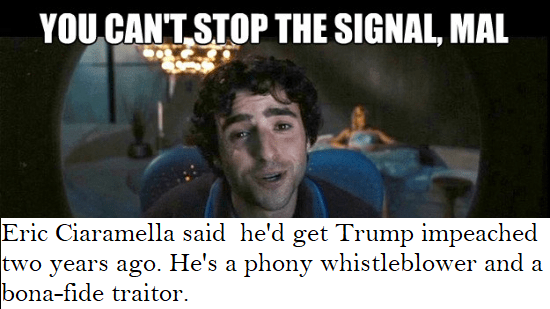
It occurred to me yesterday that all the command and control left are like a dog chasing a car. They really want to hold the US. But when they get hold of us, they find they can’t and they’re the ones hurt when they try.
I came home to my computer this morning to find out that I’d caught a 24h ban for “coordinating harm.”
Now, by the point I put that up I was just in full rebellion mode. I didn’t verify the statement above, for instance, because I’m just pissed enough. I know he talked about impeaching Trump way before this and of course he IS NOT an impartial “witness”. (For one he didn’t witness anything. It’s all hearsay. WRONG hearsay. Which he coordinated with Schiff of the “made up memo read in a hearing” fame.)
And I know the left is making a bizarre effort to protect him, which is enough to tell me that no, this is not a bona fide thing. Then there’s stuff like this. And this.
And I wouldn’t even be this mad, it it weren’t so fargin stupid. The son who is all mine, couldn’t be more mine if he’d emerged whole from my head keeps getting this status deleted:
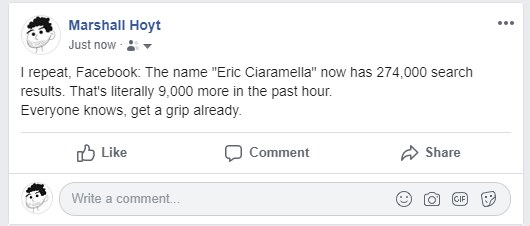
Note despite manipulations, those numbers are way higher now. And I’m tired of this nonsense. I’m so tired of this nonsense.
Sure, Facebook is a private platform, but it’s also a public venue, and it should damn well bake that cake already!
Also “coordinating harm” is idiotic. Unlike antifa which does use FB to coordinate harm, I’m just passing on information. I’m not suggesting anyone do anything to the unindicted coup conspirator Eric Ciaramella. I’m just exposing him as a traitor and a disgrace, which he is. That’s not coordinating harm. Unless it’s the harm the citizens of America could do to the Dems quest for unbridled power.
And by the way, even if Trump were as bad — he’s completely not — as I thought he’d be when I held my nose in November 2016, I’d crawl over broken glass to the voting booth to vote against the outright communists in the Dem ticket.
I’ve seen it, I don’t want it. We don’t need a third of our population in mass graves. Fuck off Marxists.
These are my middle fingers. And as for Facebook: BAKE ME THAT CAKE MOTHER POCKERS.
I have a big pocking wrench. And I intend to continue using it.
Facebook, go eat a bag of dicks:

If you’re on Facebook, please share this on your page. Be assured what shows is the last image. You see, Facebook decided we could no longer choose which images to show, so now they show the last image by default. Which is why the last image is as rude as it is.
:)

The left has lost their bloody minds. No, more than usual. You see, having lost control of the information stream, they are now trying to stampede us in the direction they want us to go.
Obviously their only knowledge of stampedes is from the lion king, and they didn’t spend their childhood watching cowboy movies, so they neither know how uncontrollable stampedes can be, nor the essential rules of creating the stampede:
1- To create a stampede you must have full control of the situation.
2- You must know the “cattle” you’re stampeding. For instance, stampeding elephants can be difficult because they are smart animals. (Coff.) And if you’re a city person from Europe who knows nothing about elephants and tries to stampede them, you’re gonna end up flat.
I woke up this morning with the phone ringing. When you’re someone my age with aging parents, and particularly when it’s been a week of deaths and bad diagnoses, this is a really bad moment.
As I sleepily reached for the phone, a million scary things went through my head. This wasn’t improved by seeing younger son’s number, he who was born with a heart defect. But the “emergency” wasn’t, and son only called me at that hour because he weirdly thought that I would be awake for other reasons. That was his confusion.
The reasons he called me was the following: one of my posts had not only been removed from a Facebook backroom, but the mods had been alerted the post was removed for “trying to coordinate harm”.
Screen capture of the post, below:

Of any of you can figure out which harm I’m trying to coordinate and with whom — Adam Schiff, perhaps — you know more than I do.
BTW and in passing, I LOVE the Epstein didn’t kill himself memes. Are they getting tedious? Kind of. OTOH they are legitimate popular insurrection. They are us waving the flag in the faces of the idiots and going “We can see you.”
I won’t go on whether Epstein deserved to die or not, because I don’t think we have the death penalty for under age sex slavery. He deserved to be locked up. But the rest of us know he died so the Empress can run for president again. And we want to make sure they know it too.
Other things we need to start screaming about is motor voter and vote by fraud mail. They need to know they’re not invisible. It’s the only hope we have of avoiding blood on the streets at this point.
BUT back to the meme above: Obviously it was throw away snark. So what do they mean with “trying to coordinate harm?”
Well, there’s only one logical route to THAT. It goes like this:
We know Eric Ciaramella IS the whistleblower (duh, duh, duh. Everyone does, guys) and we know that Epstein was killed so Hilary’s candidacy can live. Therefore when this person says this, she wants the same thing to happen to Ciaramella that happened to Epstein. Which is ridiculous, since I — thank heavens — am not Hilary Clinton.
I mean, I completely get if they’d marked my post as fake news, but even that is not justifiable because, well, Ciaramella is not really a whistleblower. He’s an unindicted conspirator in the world’s stupidest attempted coup — which really makes me think that “national intelligence” is a gross misnomer when it comes to the US agencies — and … no, wait, Epstein DIDN’T kill himself.
There might, of course, also have been a trigger on the name of Eric Ciaramella, because the frigging idiots THINK they can keep it secret, after Schiff for brains forgot to redact it.
Quoted from the David Blackmon daily update:
The utter mendacity behind that scheme becomes crystal clear now that we know who this guy really is:
– Ciaramella is a long-time associate of senior staff for Adam Schiff;
– Ciaramella has worked at various times for John Brennan, Susan Rice, Joe Biden and other Democrat skunks;
– In 2015 and 2016, Ciaramella worked on Ukraine policy with Biden and never raised a peep of alarm over Biden and his son’s obvious influence-peddling operation there;
– He was an Obama holdover on the initial Trump NSC staff, led by deep state snake H.R. McMaster, serving there until mid-2017 when he was revealed to be a serial leaker of classified information;
– While working at the NSC, Ciaramella was in fact instrumental in creating the false “Putin fired Comey” narrative that helped create the rationale for appointing a special counsel;
– Instead of being fired on the spot, McMaster intervened on his behalf and sent him to work at the CIA;
– Ciaramella was not on the July 25 call between President Trump and Ukraine President Zelensky, and has zero first-hand knowledge of anything that was said on that call;
– All of the allegations made in his false “whistleblower” complaint come from second-and-third-hand hearsay accounts, with much of it very likely coming from fellow deep state functionary Alexander Vindman, who is most likely the second fake whistleblower in this impeachment scam.
Ciramella is, in other words, the classic example of the sort of anti-American deep state functionaries who remain embeded throughout the federal bureaucracy, especially in our intelligence community, Department of Justice and at the State Department. Obama literally filled our government with this kind of disloyal hack, people who have no respect whatsoever for our nation’s electoral process, and who place their their political ideology above the good of the country.
No wonder Adam Schiff, Nancy Pelosi and the disloyal hacks who infest our national news media outlets were so desperate to keep his identity a secret. Paul Sperry and the editors at RealClearInvestigations deserve medals for breaching that wall of conspiratorial silence.
You can see PRECISELY why they wouldn’t want Ciaramella’s name to be out in the open, right? It endangers their little coup.
Of course, everything endangers their little coup because they’re hothouse flowers. The conspirators grew up and came of age in a system where the only information flowing to the people was via the press. And the press was a wholly owned subsidiary of the leftist/progressive/Marxist/remnant Soviet propaganda machine.
You know how some novels are awful, because the main characters are stupid assholes, but get away with it because of course they do, because after all, the author is on their side?
Our left came of age and political maturity in that environment. They didn’t have to be good. The author was on their side. I wonder how much that fed into their impression that the future came with an arrow and their victory was “inevitable.”
Must be a shock to realize that they’re not infallible and that people don’t believe them. And they’re so stupid they think they can stomp their feet and get us to “shutupshutupshutup.”
Also they have no idea WHO they’re dealing with. No, seriously. Not one single fricking clue. They simply don’t know who their opponents are. They know the straw versions of us, but they’re not even aware those are wrong.
You know when they say we’re racist, sexist, homophobic for instance? That’s not just a tantrum. They really believe that crazy shit. And if we’re proven not to be, they come up with some psychic bullshit about what we “really” think as though they were in our brain.
I.e. they’ve set themselves up an IMPENETRABLE bubble of unverifiable assertions.
This is not the work of a reasoned, planned, or even vaguely in touch with reality group/faction. And the only reason they could carry this sort of shit off is if they had total power and were honestly pulling this off in China. (Hence their constant jonesing for China.)
Because one of their things is that they think we’re THEM: i.e. highly social, and raised/conditioned to communitary action and belief.
When I posted this on FB:

Someone in comments pointed out that the left is complaining that FB is too right wing.
Yeah. remember how I told you I can see their little coordinated campaigns start (the next one is “we’re running out of water in [some ridiculously short time]” in a planet that’s mostly water.)
Well, their “FB is right wing” is based on the idea we’re just like them. By doing this, they’re going to convince the right that FB is actually trustworthy to the right. This will give them back the FB advantage they haven’t had since 2012 (and at that time impaired, since the full advantage was 2008) when people didn’t know they were playing with what you could see and trying to manipulate your voting behavior.
This is not just bloody stupid. This is crazy of the first order. Because anyone over 30 who is not leftist is used to reality-testing their perceptions and isn’t going to believe the leftist drumbeat anyway, except for looking at them, scratching our heads and going “They really are nuts.”
Dear left: you’re not going to stampede us.
All you’re doing is destroying our opinion of your sanity and intelligence. And that was already low.
These are our middle fingers. You still have the advantage of millions of fraudulent votes, sure, but you can no longer shape opinion. And at this time if you continue trying to stampede us, you just might find the elephants have turned around, and you’re going to be flat.

In order to best understand the details of what happened, along with the speed with which they occurred, I thought it made sense to generate a rough timeline of events. With considerable research, judicious estimations, and a bit of calculation, I was able to put together a table that depicts how events would have happened across North America. I lay NO claim to its preciseness; without knowing a great deal more detail than it is currently possible to know, there are a lot of things I just can’t determine.
Note that the primary distance used roughly corresponds with New Orleans, Louisiana, USA (aka NOLA); this is approximately the distance from the tip of the Yucatan Peninsula to the northern coast of the Gulf of Mexico. Also note that, by some researchers’ estimates, no living thing within this radius would have survived the initial impact.
| Time from Impact
y/day/hr:mi:se |
Event |
| 0/000/00:00:00 | Impact. The asteroid blasts a crater possibly up to 30mi deep. |
| 0/000/00:00:05 | The central peak rebounds, temporarily forming a mountain higher than Everest. |
| 0/000/00:00:09 | Thermal radiation blast; plants spontaneously combust, animals suffer instant 3rd-6th degree burns at NOLA; all life within that radius dies instantly. |
| 0/000/00:03:00 | The central peak collapses, flooding the crater with lava, which splashes and rebounds from the periphery. The lava splash forms a ring of tall peaks as it solidifies. |
| 0/000/00:04:10 | Magnitude 10+ earthquake strikes NOLA as the P wave arrives. |
| 0/000/00:04:20 | Seismic seiches begin to set up in inland waters. |
| 0/000/00:05:33 | The S wave of quake strikes at NOLA. |
| 0/000/00:08:00 | Molten ejecta (7500km/hr, 4660mph) begins to fall at NOLA; secondary fires ignite anything that was not burned in the thermal blast; the atmosphere heats back up. An atmospheric shock wave hits NOLA? |
| 0/000/00:08:20 | The Love & Rayleigh surface waves strike NOLA (total quake duration: ~5-6min minimum). |
| 0/000/00:09:00 | The atmosphere begins to dim to complete darkness from the combination of rock ash and smoke from fires |
| 0/000/00:20:00 | Sea water resurges into the crater, over the peak ring, carrying ~130ft (40m) of impactite debris and depositing it across the crater. |
| 0/000/01:00:00 | The peak ring is breached to the northeast by resurge, and another ~33ft (10m) of impactite is deposited; this layer is more rounded and size-graded (sorted), indicating it has traveled further through turbulent flow. |
| 0/000/01:10:00 | First megatsunami strikes NOLA. |
| 0/000/01:40:00 | Ejecta could reach the opposite side of Earth. Fires may ignite world-wide. |
| 0/000/02:00:00 | Ejecta ceases falling at NOLA. |
| 0/000/02:30:00 | Secondary mega-tsunamis (from underwater landslides) begin to strike NOLA. |
| 0/000/03:00:00 | The sky gradually lightens to twilight levels; Earth starts to enter a “nuclear winter.” Scientists estimate that the “nuclear winter” effect dropped global temperatures by as much as 30°F (~17°C), for anywhere from a year to decades. |
| 0/000/05:00:00 | Acid rain begins to fall at NOLA. |
| 0/000/06:00:00 | Smallest animals begin to suffer silicosis from ash inhalation, far away from the impact site. |
| 0/007/00:00:00 | The first animals begin to die of secondary effects (silicosis, injury). |
| 0/040/00:00:00 | The first animals begin to die of starvation. |
| 1-50/000/00:00:00 | “Nuclear winter” ends. The atmosphere begins to clear; temperatures begin to warm toward the Paleocene-Eocene Thermal Maximum. |
| 200,000/000/00:00:00 | Temperatures begin to cool from the Paleocene-Eocene Thermal Maximum. |
~~~
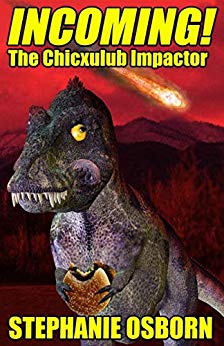
For more details, check out INCOMING! The Chicxulub Impactor by Stephanie Osborn on Kindle and Nook.
And check out Stephanie’s fiction, also!
Seriously guys, what are we teaching kids these days? More importantly what are they learning?
Because I can’t even (though I Odd pretty well) I’m going to link the post at Mad Genius Club.
And if you don’t want to follow the link, it pertains to this silly git:
![Screenshot_2019-11-06 Sci-Fi Fantasy Author Fonda Lee Criticizes Barnes Noble Stocking J R R Tolkien Robert Jordan Books 'W[...]](https://accordingtohoyt.com/wp-content/uploads/2019/11/screenshot_2019-11-06-sci-fi-fantasy-author-fonda-lee-criticizes-barnes-noble-stocking-j-r-r-tolkien-robert-jordan-books-w....png?w=700)
Sigh. We won’t get into the idiocy of traditional publishing and their artificial restrictions on market, but still…
This poor woman has everything backward in her head. It makes it very difficult for me to believe that she can create any kind of sane or believable world. Why? Because she doesn’t understand the laws of supply and demand, which means she doesn’t understand reality.
It is clear that she comes from an academic background, since she thinks that shelves are allotted by order of “importance.”
This is a problem for me as a reader often because I run into a lot of writers like her. It’s less important in things like romance, though even there it can’t get weird, like when some authors assume that the best thing possible in the Regency would be being a duke AND a doctor. (Head>desk, repeat.) This is because they misunderstand the relative wealth and importance of earning a living in the professions.
But there are a ton of books in mystery that hit the wall. Those that require understanding of how the world worked. So the economics these writers write are what you expect from exquisitely maleducated people. They learned sociology and various grievance studies. So you know, factories are bad places where people are forced to work in terrible conditions — for the 21st century. None of these darlings has the slightest idea what actual conditions were like at farms in the Regency, say — and do not even get health care or counseling, and are probably totally deprived of free ice cream.
I have now walled mysteries, some romances and a few fantasies, because they assume people who build and run factories are “evil exploiters” and villains. (As opposed to you know not building anything and letting the peasants starve.)
I’ve walled even more of them when the villain becomes “reformed” and just gives his whole fortune away to people who probably drink it away within a week and, presumably, dies in a gutter shortly thereafter.
In science fiction and fantasy this is even more painful. You’ll have entire worlds getting paid for things, without it making any sense, since there is no galactic agreement on money, no universally agreed upon standard, nothing that makes whatever they hand you worth anything. We have entire worlds paid for things that make no sense to transport inter-world with the money existent at that time. You have “exploited” groups, that you can’t figure out why anyone would exploit or what sense it makes.
Then there is the soc jus in these worlds, which often consists of upending historic injustices by creating worse injustices and, oh, yeah, incidentally making it impossible for the economics to function and starving everyone in the world. If you’re going to do that call it Planet Venezuela already, okay?
And don’t get me started on the economics of worlds with magic, where monetizing magic is somehow either wrong or no one ever thought of doing it (because everyone in that world is born mentally impaired.)
Anyway, why am I so iffy about reading a book by an author who made the post above?
She might swing words like there’s no tomorrow. She might be an imaginative creator of characters. She might love puppies, be kind to kiddies and adore helping the poor. She might also know a lot about all sorts of things.
But she’s missing the one and important fact of life on Earth: everything, from plants to animals has to make a living. And everyone’s life is limited. And when you come to individuals with sentience? We know it too. We know our time and life, our energy and ability to survive are limited.
Therefore we pay for that which we need or want. And we don’t pay for or buy that which we don’t need or don’t want.
Sure, there are things we would love if we could just know they exist — but the problem with the book not even being on the shelves is the idiocy that paper book sellers have come to. They mishandled the market till it’s now extremely limited — but mostly? What sells is what people want to buy.
So why does Barnes and Noble “give” space to dead guys? They don’t. They sell it. Dead guys pay their way by, in turn, selling a bunch to the public. Barnes and Noble is in enough financial trouble through NOT doing that for a number of years, that it desperately needs that “dead guy money.”
And why is there only one copy of this author’s book? Well, because B & N and traditional publishers still use push? Must be because they don’t think her book will sell and her publishers targeted her for going down hard. This is bolstered by the fact that she won the World Fantasy Award, an award that for … 20? years since I broke in has been known to have NEGATIVE impact on sales.
It’s all about making a living. It’s all about supply and demand. Yes, in our field we have to create demand for our books, and it starts with knowing we exist. That is something that traditional publishers don’t help with. And something that is still hard in indie.
Which is part of the reason classics routinely outsell current authors.
But it is not the only reason. Nor is whining, crying and beating your heels on the ground about it the way to change that.
The dead great shall always be with us. You want to outsell them: write a lot and write well. Or find another job.
Economics in the end — regardless of what prizes you get for being a good little girl, or how much your professors praised you — is cold equations. Cold equations ALL THE WAY DOWN.
Is it fair? No. Well…. Not fair in the sense that it doesn’t matter how good you are if people don’t know you exist. But it is fair in the sense that if you write well and a lot and figure out how to advertise you’ll be rewarded.
But fairness has got nothing to do with it. It is the way of the world.
Dead guys outsell you? Well… judging from the two you mention, they are people whose company is worth it.
So, instead of complaining, learn about supply and demand. And work to supply something people demand.

I’ve found that just like in the old Soviet Union, we know more or less what the future will bring (at least a lot of us are beginning to be very afraid we know what the future will bring, while our adversaries are sure they know. And also wrong. And pushing us towards a precipice*.) It’s the past that keeps changing.
Now, this was not a surprise to me, so much as it must have been to Americans born and raised who were paying attention at the time (seemingly a minority, but what do I know, since we were in the power of the MSM back then) but I’ve watched the past change many times in this country. It wasn’t as much a surprise, because I’d watched it change in Portugal too, as good years of sane-ish economic policy became in retrospect “good agricultural climate years” or complete messes of leftist governments became “Competent” and “unimpeachable” in the rear-view mirror.
Leftists in the rear-view mirror look more centrist than they really are. And everyone to the right of Lenin is evil and corrupt. I’ll say it again, in case you missed it the first few times: of all the events in my life that I was present at and which were reported in the press, not a single one matched, and the slant was sadly and stupidly predictable.
But even that did not prepare me for the suddenness in which the prosperous 80s (following on the f*cked up 70s) became “the decade of greed.” Or how Clinton’s grasping and corrupt administration was whitewashed in retrospect.
And the thing is, there is always an agenda, always a plan. The left will pull the strings of their media puppets — always — with intent to lead people somewhere. The stampeding is that of a band of primitive men surrounding the mammoth. The mammoth is much bigger but never realizes it, because there are these scary sounds all around. Any minute, he could break free, trample a couple of the annoying gits, and get home free, but he doesn’t. He allows himself to be driven to the precipice.*
Thing is, if you look at what the left is stomping and yapping about, you know where they want to lead you and what their ultimate plan is.
Deriding the 80s as the decade of greed allowed for shaming corporations into cooperating with the Clinton crime syndicate. It allowed for people knuckling under tax increases. It allowed for a patina of “virtue” needed to hide Clinton’s zipper eruptions.
You could sort of see it coming, if you paid attention.
This is particularly obvious with the culture.
Sure, some of their moves are obvious to anyone who can read print written seven feet high and in letters of fire, right?
Their distortion of history so that everything America ever did is wrong and evil-bad is designed to make our own kids hate their own country and imagine themselves as “citizens of the world” which is to say citizens of nowhere.
Which in turn allows for wide open borders which bring in the population of 3rd world serfs the statists count on to keep them in power forever.
For the last ten years I’ve been disquieted and disturbed by the persistent myth of: Our ancestors were far more cleanly, happy and prosperous than we think. Yep. Your foot-in-the-mud ancestor didn’t suffer under the lash of his feudal overlord. Oh, no. He had hot running water, regular baths, religious holidays off and–
Spits. And the girls sang as they wove garlands on Mayday, I suppose.
Most of these myths are arrant nonsense. Some are arrant nonsense on stilts with a dash of oikophobia thrown in.
I’ve mentioned here that I went to the Viking exhibit at the museum some years back, and it was all about how free and egalitarian the Vikings were, male and female. Which I suppose was true, if you miss the large component of slavery. And the fact that they raided foreign shores for slaves and loot. And that almost every skilled artisan was a slave. And–
Then there is the continuous “The Vikings were much cleaner than the Christians and women preferred them.”
First let’s cut the crap. We have zero clue if women preferred them. When the raiders come to town, they don’t stop to ask thee fleeing women to sign “affirmative consent” forms.
Second, yeah, I’m sure in some Viking villages they were cleaner. We do have have reason to suspect some areas had functioning saunas. But then some of the areas raided had functioning Roman baths still extant.
I’m sure for some times and places, that was true. I’m also absolutely sure that for most times and places the Vikings were about as clean as everyone else, which is to say not very, due to the lack of easy-accessible soap (yes, it existed. In certain times and places. NOT everywhere and not of a kind you’d want to use on your skin) of easily accessible acceptable-temperature water, and/or of warm enough places to bathe in.
No, medieval people weren’t as utterly filthy as it’s imagined (though there were some, I’m sure) but I’m also utterly sure, having experienced this in a temperate climate, that washing in winter would be limited, careful, and therefore maybe not as thorough as we imagine. Or to put it another way, when the Victorians went on about catching a chill, they weren’t just blowing smoke, guys. People didn’t willingly strip down and dip in lukewarm water int he dead of winter and when clothes would take forever to dry, unless they had other clothes, and facilities for getting warm right after.
In other words, Vikings and the rest of the Middle Ages were, from our POV a little wiffy. As were most places until the late 20th century.
So why the cleanly and perfumed Vikings (Particularly since the records of the time don’t support this view, except in very few, highly publicized circumstances?)
Oh, that’s the “don’t go imagining Christians were better” wing of the oikophobe chorus. They will tell us Christians were filthy. The pagans, on the other hand, were cleanly and perfumed.
Weirdly the one people we know were cleaner than Christians, also more literate and prone to less domestic violence never come in for praise in these comparisons. I suspect being part of the foundational build of the West, the Jews aren’t considered “wonderfully other” enough. Or given some of the recent bs on the left and the people they embrace, perhaps it’s a hate thing.
BTW that Christians being filthy is bullshit. Later on, in defense of “but medieval people weren’t that filthy” they’ll bring in the injunction to change your underwear daily. Which is more than a little confusing when you researched the heck out of “underwear use” in various places in the renaissance and know most women at least wore none. Eventually you find out the injunction to change underwear was in monasteries. Monk’s orders in fact, also had various guidelines on cleanliness which, for their time, were amazingly enlightened. Even if, yes, by our standards, they were all a bit wiffy.
The same applies to a ton of other things. These revisionists tell us they ate better than we think, oh, and by the way, except for infant mortality they lived as long as we do.
All this is insanity on stilts.
Those of us who didn’t grow up in the first world (second and a half at best!) know d*mn well how people lived in the 20th century, with nominal indoor plumbing, but without a lot of changes of clothing, washers and dryers, heated houses, etc. (The trains from the mountains, where it was colder, in winter, smelled like a mix of VERY unwashed bodies and wood smoke. You never forget that smell.) The particular etc. I have in mind in this case is the lack of refrigeration.
Look Portugal is fertile enough that a careful planner can feed a family on less than an acre of land (particularly the area I come from, apparently one of the oldest inhabited in Europe and whose name in Indo European translated as wet and fertile valley.) I’m sure the food available to us in the 20th century when you could buy improved seeds, etc. was way better than the one available to people in the middle ages.
But … yeah, no. We didn’t eat like people do now. Not even close. For one, meat was fairly scarce. We mostly ate fish (thanks to the coasts!) and vegetables. Oh, and we were relatively lucky. A lot of people got almost no protein. The most common lunch among the people was the “isca” that is a bit of fried flour which might or might not have a couple of shreds of codfish in it. The very poor ate a lot of vegetable soup.
And again this was in the 20th century. In winter vegetables more or less vanished and the only fruit available were the wrinkled, flour-like apples.
Christmas treats were dried fruit, not cookies. It tells you all you need to know. (Yes, it was healthy too except for the scarce protein for most people, but no one said the way we eat is particularly healthy.)
I’m not complaining, but I know that we ate massively better than my parents did in the mid 20th century. And they ate better than their parents. So, kindly, do not tell me some serf on a medieval estate got his choice of however many flavors of ice-cream.
Sure the very rich ate well, if sometimes oddly. But the average person, not so much.
And as for living as long? Yeah, no.
I still remember vividly — as do many our age — when 60 was old, 70 VERY old.
Yes, I’m concerned for my parents in their late eighties. And that’s, as my dad puts it “after 80, that’s old”. But it would surprise no one is they lived another 10 years. Because a lot of people do now. And now one makes a big deal of people who turn 100. (Even though 114 seems to be, a little inexplicably, our hard drop-off limit.)
And besides we KNOW. Shakespeare at 58 — two years older than I’m now — was “very old.”
So kindly take your “people lived about as long,” fold it all in corners and put it where the sun don’t shine, even if people in the arctic in winter will be a little puzzled by it.
So, why is the past changing in that curious way? What are we being stampeded towards?
Ah. Well, see Occasional Cortex’s magnum opus: the Green New Deal (Temptation to write The Green Nude Heel intensifies.)
If you believe your ancestors who were serfs to their “betters” and tended a plot of land by “natural” means (read ox and man power) lived about as well and were about as fulfilled, wouldn’t you say “okay, maybe.”
The problem being of course, that none of that is true. The Green Nude Heel (eh) would in fact put us on the verge of what was it Obama called it “A precipice* of achievement.” I’d even call it a precipice* of prosperity. A veritable Venezuelization, in fact, like… oh, what happens to all the democrat controlled areas from cities — hello, Detroit! — to states — I’d say California should chime in, but it’s hard to make smoke signals with candles.
What the Democrats and their associated media and education industrial complex are signaling so hard with their changes to their past is that what they have in store for our future is about as good as the Middle Ages… if we’re lucky. And if we’re not lucky we deserve it, because our ancestors were filthy Christians, and generally evil.
The thing is you see that if you refuse to let them change the past, and you make sure the kids know we know that’s bullshit, you’ve gone a long way to reclaim the future.
Reclaiming the language helps too. For instance *contrary to what Obama seemed to believe means, in fact, a great drop. Mind you, maybe he knew what it meant and just experienced a need to be truthful, for one moment, who knows.
However, I’d very much like for people to stop imitating his misuse.
Keep in mind when someone is lying to you about the past they’re trying to stampede you. They’re trying to stampede you because they don’t have the ability to force you.
If you end up going over the precipice, it’s because you listened to them.
And that would be tragically stupid.

One of the things I loved about biology was the concept of feedback. If you get too much inventivium in your blood system, your science fictioning gland shuts down so you don’t get too far from reality. (What, you don’t have those? Really?)
Anyway I don’t love feedback in electronics. In the bad old days (yes, kids, pre-history) when we had a house phone (landline) with a mobile receiver, and Dan and I were one on each receiver, if we got too close it started to whine. You know, you’re discussing a party invitation and you want to see the other’s face to find out if he’s saying “We’ll try but” because he doesn’t want to go, or whether “we’ll try, but” and suddenly the phone is screaming in your ear.
I suppose it had a useful side, because I suspect you got other interference when too close, but it was annoying.
Well, now I think about it, most feedback is annoying.
Economics is full of it — as are other economic systems — and humans find it so annoying they have devised various means of shutting it down, and then become puzzled and do crazy stuff when the system goes out of control.
Take price controls. They deliberately shut down feedback. The idea is “people need to eat and the essentials should be cheap.” We went tons of rounds on this in the seventies in Portugal. It was FUN — not — and responsible for empty grocery shelves and problems getting the essentials. Because when cooking oil was dirty cheap by price control, everyone who had ridden this pony before (with bread, with toilet paper, with…) would buy everything in the grocery shelves. Meanwhile, because it was impossible for merchants to make a profit on the thing, they didn’t stock it. Which was okay, because the factories that made it couldn’t afford to at that price, so they stopped. And all the way down the line.
This is because what the idiot politicians were shutting down was the feedback. Prices are many things — and sometimes annoying when you really want a good pair of noise-cancelling headphones but your bank account is crying, to use a totally random example — but MOSTLY? They’re information. They’re feedback.
Because, yes, people work for profit, and profit — things that Warren and Sanders will never get — is not dirty, it’s what people live on, when prices go up — meaning there’s more demand than supply — people go “hey, you can make a profit in this” and start making more, until the supply and demand match, and you can’t make as much money, so people wander off to do other stuff.
You shut down the signal, and things go insane. You keep it shut down long enough while handing down lists of things that the government wants you to make, and vast famines sweep the land but you have a surplus of size 35 shoes for the left foot only. Because the directive handed the factory made that the easiest thing to do.
But it is not just in economics (though eh, everything is a branch of economics, as my reading in my 30s informed me. Which means that’s probably when I started going insane) that humans love shutting down feedback.
The truth is we don’t like reality very much, and are more or less perpetually at war with it.
We have this image of how things should be, and because we imagine it so clearly we think it’s a moral imperative.
Which brings us to how we got into a fine mess, in publishing, in universities, in… everything affected by the long march.
The long march looks cunning, and it was. And for some people it was a conscious plan. But here’s the thing, it’s also a process that goes automatically when a large enough group of humans in a nation or a field share an image of what’s “ideal”. In other words, in theocracies, the shut down of feedback from reality, and the ramping up of bringing in other true believers is standard, and intensifies as it goes.
This is not a thing of the left, btw. Every human institution, given the power to do it, shuts off feedback they don’t like.
This is why large corporations who can do so buy monopolistic status from governments (in various ways) and then stop heeding reality and go insane. Which is why large and powerful enough corporations become indistinguishable from totalitarian states. And also why, no matter how much influence they have on government, they eventually crumble and fall apart.
It’s also why publishing came up with “ordering by computer” and “ordering to the net” which allowed the houses to determine who stayed in and who got kicked out, all the while claiming they were being responsible and following the “numbers” — except that the numbers were vitiated by factors in their control — like the original laydown. Or how much push a book got. Or how willing they were to reprint. And none of this was taken in account in the “ordering to the net” thing, which ultimately reinforced the publishers’ ideas of what should sell. IOW it was a lie, but it was a lie that accorded with their idea of the perfect reality. Which is why it didn’t work. None of this worked.
And the problem is that as gatekeepers they were inclined to pick things that reinforced their biases — not even just political, their lifestyle biases, and age biases. One of the biggest arguments I had with a publisher was for having Dyce not follow her crazy parents’ dreams, because the boomer publisher identified with her parents, so… — and disliked feedback that told them this stuff didn’t sell. So they came up with a way to make the stuff they disliked (and they bought some, though not a ton, and yes, usually tried to pick not so good stuff) sell even worse. That way they could “prove” that the stuff they liked was the stuff the “few smart people who still read” liked. And most people were “too dumb to read” thereby explaining the cratering print runs.
They’re still doing this, btw. In their circles, the fact that indie exposed their lies and that genres they declared dead, like the cozy or mil sf or clean romances are doing amazingly well is obscured by “games with statistics.” They routinely say “ebooks don’t sell” meaning their own (well, duh, priced not to sell) and therefore trad pub is in control again.
It’s as big a fantasy as the USSR leading the world in steel production and it ends the same way: in massive destruction of wealth, lives, and good will.
But the market will go on, and find a path.
The thing is that once you shut off feed back, the insanity is self-feeding. And if you’re invested in it, you can’t admit it.
Also that once you shut off feed back pushing your favorite view becomes THE thing. Hence not just publishing going hard left, but the universities following, and the utter crazy of corporations (I’m looking at you Gillette) rolling left to die is all part of “there are no other standards, everyone agrees with us. We must preach the truth(y) word from on high, because we’re doing good in the world, and it shows how good we are” missionary effort of a religion without an afterlife and with no concept of forgiveness. Oh, and no contact with reality.
Sooner or later, feedback wins.
You see, it’s there to give you signals that things are going to be in serious trouble and soon. If you shut it off, it doesn’t stop happening. You just can’t hear it.
If you shut off the feedback signaling that the pressure is too high, all you’re doing is ensuring things blow up.
Build under, build around. Because sure as the sun rises in the morning, there she blows.
Our job is to ensure when the lefty dream society goes sky high, it doesn’t take Western Civ with it.
*Note these are books sent to us by readers/frequenters of this blog. Our bringing them to your attention does not imply that we’ve read them and/or endorse them, unless we specifically say so. As with all such purchases, we recommend you download a sample and make sure it’s to your taste. If you wish to send us books for next week’s promo, please email to bookpimping at outlook dot com. If you feel a need to re-promo the same book do so no more than once every six months. One book per author per week. Amazon links only.-SAH*
FROM L DOUGLAS GARRETT: Remember Them (Remember The Trade Book 2).
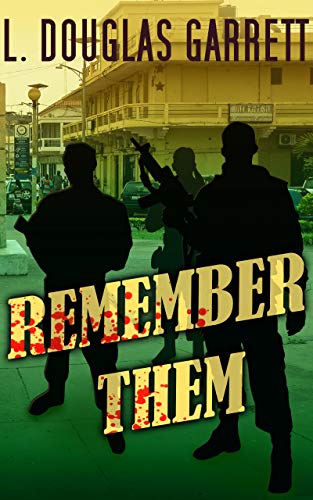
The man who became his cover identity is back in action! He had to become someone new in time to be sent on a mission he was ideal for: taking in a team to ferret out a secret Cuban plot in West Africa. But has the identity of David Cox really been put to rest?
Remember Them brings the details and dirty work of covert missions to the forefront, an espionage thriller where clandestine violence and disposable identities combine. You know all about the Cold War spies in Europe. This was 1984, West Africa, and The Trade. It was a dangerous place, rife with mercenaries, coups, and a dozen little wars. But there was even more happening behind the scenes.
“The Dogs of War summed up 1960’s mercenaries in Africa. Now, add in spies and welcome to the 80’s.”
BY MEL DUNAY: Slaying a Tyrant (Ancestors of Jaiya Book 1).

Journey to the country of Jaiya, in a world not quite like ours. Here the humans wield magical powers and fight against an Empire which seeks to enslave them, but they share their world with insect people and trollfolk, and stranger things lurk in the shadows…
Vanti would be happy to spend her life in dance and choreography, but her family chooses her as their champion in a deadly gladiators’ tournament. To save her country from enslavement, she must defeat King Obiar the Conqueror and his magical powers. But will the brooding trainer named Gurion be her guide in the battle to come…or a dangerously handsome distraction?
Note: Tyrant is meant as a standalone with a “happily ever after” ending. However, the heroes in the later books in this series are descended from Vanti and Gurion, who are also the ancestors of some of the characters in the original Jaiya series. The romance is on the sweet side, but there is some violence due to the villains’ actions and the tournament in which the main characters fight.
FROM MARY CATELLI: The Firemaster and the Flames.

Jan well knows that it is an honor to serve the king as a firemaster.
Even when it means leaving the lands where firemasters are known and common, and traveling to where they are feared and hated, bringing with her the foundling she is raising, to fight a strange manifestation of fire.
FROM KEITH FLICK: Betrayal on BestYet (The Universe of Little Ships Book 1)

Alfred Young had it all. A scion of one of the founding families of BestYet, he had just successfully finished his first interstellar voyage. He was happy to come home to his planet, family and fiancee. What he wasn’t expecting was an attempt to frame him for one of the biggest robberies in history. A heist big enough to destroy his family’s company and plunge his planet into a recession. He thought he’d be safe once he reached home, he wasn’t expecting Betrayal on BestYet.
With his mind damaged he just wants to sit on the sidelines and heal but his family and planet need him. Knowing he was sane would be nice too, but after all, who really gets to have that?
FROM HENRY VOGEL: The Lost Planet.

The Progenitors—ancient, powerful rulers of an empire spanning a thousand suns—vanished before mankind discovered the Americas, leaving the Elders to rule as Regents of the empire. Three thousand years later, the Regency set their sights on the Terran Republic.
When the vast Regency fleet attacks, the fate of humanity falls on a pair of young shoulders. Elise, a scholar’s daughter who has never been on her own. Glen, the slave of an alien master, who doesn’t know how to be human.
Against the vast empire, Glen and Elise have nothing to oppose the aliens but their wits, a spaceship, and a handful of allies—an ethereally beautiful alien artist, her equally handsome brother, and a quadruped mob boss protecting her teenage daughter.
Together, they must steal a sacred text out from under the Regency’s very noses, rescue Elise’s father, and hope he can solve the mystery of the Progenitors’ whereabouts. If he can, they must pray humanity’s salvation can be found on…
The Lost Planet.
So what’s a vignette? You might know them as flash fiction, or even just sketches. We will provide a prompt each Sunday that you can use directly (including it in your work) or just as an inspiration. You, in turn, will write about 50 words (yes, we are going for short shorts! Not even a Drabble 100 words, just half that!). Then post it! For an additional challenge, you can aim to make it exactly 50 words, if you like.
We recommend that if you have an original vignette, you post that as a new reply. If you are commenting on someone’s vignette, then post that as a reply to the vignette. Comments — this is writing practice, so comments should be aimed at helping someone be a better writer, not at crushing them. And since these are likely to be drafts, don’t jump up and down too hard on typos and grammar.
If you have questions, feel free to ask.
Your writing prompt this week is: didactic
Taking the day off. Well, kind of. I intend to be writing, just not blog posts.
I’ve spent a lot of time recently reading back where I come from in genre and style. For me that’s space opera.
It’s weird to say, but in the years of writing to market, or at least writing to publishing houses (you didn’t sell directly to people) it’s easy to forget why you start doing this thing, and what you want to do… what the lamp burning inside your soul is, and what feeds it, versus what just keeps it sort of burning.
I’m starting to have some clarity. I get the impression this is a road, though.
Meanwhile I write, building a rope of words back to sanity and health. Keep me in your prayers, your thoughts.
This writing things is not as safe as it looks. Not inside.

