By Holly the Assistant
(Say a prayer for Sarah and Dan, as today they perform the final duty of any pet owner to their Havey.)
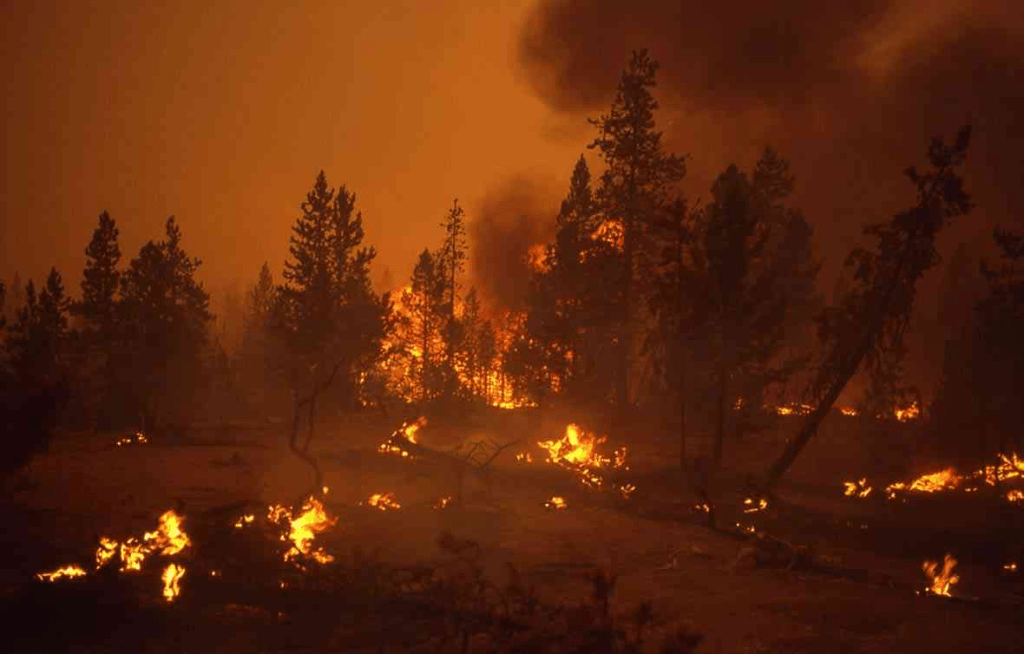
(Photo by Jeff Henry, National Park Service)
Once upon a time, not so very many years ago, the summer skies were mostly blue and clear . . . not in 1988*, but before that, and after that.
But that isn’t far enough back. I’m lucky to live in a place that still has living memory of when was far enough back, at that.
An elderly friend told me that when she helped her daddy pull cattle off the range for the winter, they always fired the range, because the Indians had told her daddy to do that when he first came out and settled. The transition of the land from nomadic to ranching/farming is just outside of living memory, today: the oldest generation here are the first settled children born here.
The experts decided at some point that fire was very bad, and banned the regular fall burning.
And here we sit, under an orange sky, with a red sun, in June, July, August, September . . .
Somehow, we need to get back to the ranchers firing the range when they pull the cattle, and burning all the stuff that needs to burn, when the fall rains and snows will put fire out, and the burns will be light and skippy like they were back before the experts got involved because they happen so often they burn the tinder fast and don’t get into the larger plants.
It seems increasingly clear that absolutely everything has had the same problem of incorrect experts infesting the system. People who didn’t have the entire picture, only parts, and wanted to fix the problems, and did fix the problems, they could identify, but in so doing broke the entire system and left us with a world prone to conflagration.
Medicine. Education. Research. Publishing. Government. Food. Transportation. Culture.
All it takes is a spark, and there are so many sparks blowing around right now. Who knows how things actually work? When did they actually work? In what ways did they not work that left openings for improvements that were actually the seeds of destruction?
Much of it was a multi-generation process of breaking working systems to improve them, in the name of progress, in the name of scientific advancement, in the name of modernity, equality, charity, environmentalism . . . and some fields have definitely improved immensely at the same time as they have created the conditions for destruction. It doesn’t seem to have been pure malice, but misguided and/or ignorant do-gooderism, with a touch of malice slipping in here and there.
Like Sarah always says, Build over, build around, build under. Keep building, and try to rediscover what used to work in the areas you can see starting to smolder that you can touch your own self, and build from that.
*Yellowstone Fires. The Yellowstone Fires were a direct result of the long time policy of suppression of fires being lifted. There was too much to burn, and did it ever burn.


Prayers up for Sarah and Dan.
LikeLiked by 3 people
🙏
LikeLike
Prayers for Sarah and Dan.
Rest well, Havey cat. You will see Sarah and Dan again, when it’s time.
LikeLiked by 4 people
I was talking to a young woman some time ago, and the discussion drifted into environmentalism. She seemed stunned at the idea that there might be a difference between an environmentalist and an environmental activist.
We talked about a lot of environmental disasters, how they happened and why. I think I left her with some things to think about. I hope so.
LikeLiked by 3 people
Probably the greatest environmental disaster the United States experienced was the American Chestnut blight. The entire Appalachian ecosystem collapsed with the death of those 4 billion trees.
LikeLiked by 2 people
I read about chestnut blight as a child, and it was dire. I wonder what the final bill for citrus greening (aka the Probable PRC Act of Unrestricted Warfare™) is going to come to.
I’m terribly sorry about Havey Cat.
LikeLike
I am so sorry.
LikeLiked by 1 person
Dan and Sarah, I’m so sorry.
LikeLiked by 1 person
It’s terrible to lose a pet in that manner (actually any manner). [Sad]
LikeLiked by 3 people
Death has taken so many from me over the years, and it never gets any easier.
The older I get, the more I lose to the grim reaper.
Yet not fighting is not an option. Never give up. Never surrender.
The best weapon against death is new life, new friends, both 2-foot and 4-foot varieties.
And don’t wait for death to add life. Keep adding life every chance you get;
Build a bulwark and a support network against the pain.
LikeLiked by 5 people
Oh, and here’s a funny for everyone heading into the weekend.
LikeLiked by 8 people
That’s a lotta heads! 🤣
LikeLike
A good post, experts usually aren’t. They tend to screw up things that have worked for years because they are sure that they are so much smarter than everyone who came before them.
Sorry to hear about Havey, when a beloved pet is lost it’s the loss of a family member. So hard to deal with when they reach a point they are suffering and nothing else can be done.
LikeLiked by 3 people
–
Knowing it is coming never helps. Picking the right timing sucks. Been there, done that. It is the price of having them in our lives.
Prayers for Sarah, Dan, and the boys.
Regarding firing the land. The natives did not start fires in the Cascades, the coast range, or the various other mountain ranges in Oregon. But they did fire the Valley, letting it run into the foot hills. Which did two things, bring in better forage for the wildlife and the plants the natives used directly. Fire is what kept trees from getting established in the valley. It also kept the mountain lightening fires from overrunning the valleys when they started.
Anyone thing the big fires burning now are new does not know the west coast history. The Big Burn, also known as the Tillamook Fire, early in the 20th century (not the only one either). Large burns observed by early trappers and traders as early as 1810. All lightening caused. Future fires severity were mitigated for awhile by those occasional large “devastating” fires. Timber cutting, thinning and clear-cut, mimic those large fires to an extent. Not completely because man cannot completely mimic nature (not that timber harvesting is to mimic nature, side affect, not intent). No harvesting then nature fully takes over (not all the current fires are arson).
Least people argue that the private timber landowners do harvest and they are being overran by the big fires. Note, big fires generally do not start on their lands. Managed timber lands have been known to stop or at least have the larger fires go around (partly luck too). Too big to stop is a thing. Especially in the mountains in the west.
LikeLiked by 3 people
Not an wildland fire expert. Not even with my forestry degree. Wasn’t when I worked in the woods, 50 years ago; just a line grunt on small district fires. Even then only a few in the four seasons I worked for the USFS in the field (not on a fire crew).
But I know enough to state what should be obvious but does not appear to be (at least in the news).
LikeLiked by 3 people
Havey has earned his rest, I will miss hearing about his adventures.
He had the best life a kitty could ask for. I’m sorry for your loss.
LikeLiked by 2 people
Prayers for Sarah and Dan, that they find comfort.
And for Havey, that he will have a warm cushion and cuddles by the Bridge.
LikeLiked by 2 people
Greebo will look after him and make sure that he’s taken care of.
LikeLiked by 2 people
For a very long time, historians did not want to take seriously claims that the Indians managed lots of the North American environment by use of fire (sometimes semi-controlled and planned, other times, not so much). The tallgrass prairie is a pyrophilic biome, just like parts of what is now coastal California. If it doesn’t burn, the dead material chokes out new growth, and brush takes over, then trees (if there is enough water).
Early forestry people studied in Germany, which has a very different environment than, oh, the Blue Mountains, or Sierra Nevada, or central Rockies. What was important in Germany didn’t work for a lot of North America that is not plantation pine, and even there differences exist. Ditto the forests of France and parts of Spain. They brought the best practices to the US, and used those long after Germany changed how it managed forests. Then you had the Mann Gulch Fire, and the decision was made not to allow controlled or “natural” burns. Enough fuel load built up that, well, we’re seeing the results on public lands. Private lands, where salvage logging, controlled burns, et al are permitted don’t go up in holocausts to the urban Environmental Religion.
[Kicks away soapbox, stalks back to work.]
LikeLiked by 3 people
–
Not even managed private lands, in the western forests, can stop the wildfires burning today.
Can prevent the big fires from starting. If only because most timber companies gate their roads now. Prevents arsonists from getting very far; at least they have to hike in (gates and environment stop pretty much everything short of climbing over the gates, so even horses are stopped, short of cutting locks). Lightening strikes on private land do not generally have the fuel to run and blow up; still possible, just not as likely.
But actually stop wildfires from overrunning the privately managed forests? I wish. There are instances where a bad wildfire skirted private managed forests. But do not bet on it. Look at what Weyerhouser experienced in the 2020 Holiday and Detroit fires. Weyerhauser is still harvesting the timber from these two fires. (FWIW Weyerhouser scrapped their planned harvest schedules for the entire PNW, and refocused on logging the lands impacted by all the 2020 fires.) Just followed two log trucks on Beltline, one a self loader with two large logs, the other standard log truck with 8 logs. Could only tell burned off bark. Guessing Weyerhouser. Definitely not federal government. Could be other-than-Weyerhouser private small landowners.
LikeLiked by 1 person
Agreed that once a bad burn gets wound up, even the best land management on other property won’t help. Flying embers don’t care, sort of like flying cow pats back in the day on the south plains. (Yes, the wind would pick up burning prairie coal and roll or toss them through/over fire breaks.)
LikeLiked by 1 person
Sequoia sempervirens (redwood trees) are both resistant to and dependent on fires.
Smaller fires, where there is insufficient undergrowth to constitute “ladder fuel”, basically just scorch the thick outer bark a bit as they pass through the groves. The are writings from the 1800’s describing a forest fire approaching, and it is low enough and mild enough that the author steps over it as the line of fire burns through the duff on the forest floor.
But if the brush and duff fuel is thick enough and the fire gets going hot enough, it triggers the dependency. Sequoia can retain their cones intact on the tree for up to thirty years. When the temperature in the tops gets high enough, though, the cones flex open and release their seeds. Those seeds need to germinate in soil, not duff. The seeds dropping onto the newly burned-clear forest floor can germinate and sprout, and as they grow the young seedlings, intolerant of shade, need the sunlight from the gaps in the canopy where trees were burned out to grow.
Absent fire the sequoia would all die out.
LikeLiked by 1 person
Sequoia can also grow a tree from a piece of wood, or root.
Lodge Pole Pine also requires fire to germinate. Look at the pictures of progression in Yellowstone from the ’88 fires. Must admit I miss the wide open views now missing because the fire reseeded trees are tall and thick enough to obstruct the view and make wildlife viewing any distance impossible. Do not miss it enough to wish a fire on the area.
I have not seen pictures of the fire that took out 1/3 of Jasper Alberta. This isn’t the fire situation they were terrified of. Started south of them and swept north. They had been working frantically to clear out the beetle kill all around the town. Both campgrounds on the south end of Jasper had been cleared out. Did not help, at all.
There had already been two big fires, one north, and one through the canyon in Maligne Canyon. Again, not the ones feared. The one the experts fear is the fire that is coming in from the west, over the mountains; prevailing winds.
Waterton (Canada side of Glacier NP, US) already had their worst nightmare fire. Fire came in from the west starting in BC and swept through into the park. Both park roads, both canyons hit hard. Entire groves of pine, poplar and aspen, groves, blackened. Fire raged down to the water edge. Town was evacuated. Town was spared. That was luck. No one knows why.
LikeLiked by 2 people
Re redwoods growing from the roots, yeah, the fairy rings around the base shape of what used to be a ginormous redwood are one of my favorite cool features in redwood groves. When hiking here I see rings of old redwood trees that are thirty-plus feet across. The old original redwoods grew huge.
LikeLiked by 1 person
Hubby tells a tale (do not know what fire it was, other than pre-1979) of a fire he was on in California (he worked on a USFS fire crew). Home was in fire danger due to huge fire. Just had bought brand new household full of new furniture. Field plowed furniture put into plowed field with fire “proof” covering. Fire spared the house and out buildings. Furniture was ash. Insurance would not cover the burned furniture. If it had been in the house or even in any of the insured outbuildings, and the structure had gone, it would have been covered.
The 2020 Holiday wildfire. Aunt’s sister and BIL have a home in a neighborhood up the McKenzie (other than not Blue River, I do not know where exactly). They were level 3 evacuated for most the fire. Their neighborhood street was spared, both sides. Fire went around the area. The neighbors behind either side, and those east and west of them, were not. No one knows why.
LikeLiked by 1 person
clears throat
New England’s Dark Day was in 1780, even if it took centuries to definitely pick out where the fire was. (Ontario, BTW.) There is, in fact, only so much that people can do.
LikeLiked by 1 person
My condolences on Havey’s passing.
LikeLiked by 1 person
‘New Math’ and ‘Whole Language’ reading. ‘Nuff said. 😡
LikeLiked by 1 person
When I was a grad student in Geography in the early 80’s, there was much discussion of how to restore the forest mosaic. Satellite images had made it obvious that the US/Mexico border was a huge dividing line. In Baja, the government just let the fires burn. The result was more, but much smaller fires. In the US, geographers lamented the influence of Smoky the Bear and the urge to put out every fire, leading to rarer and much bigger and more destructive fires.
How to return to the original mosaic once the damage was done was a tough problem though, and not one government bureaucrats were interested in.
LikeLiked by 1 person
I worked with a forest scientist and statistician (classmate, a year behind me at <redacted> school of forestry). He presented a paper that showed that there was more timber now (end of 20th century) than when the first European explorers arrived on the west coast, because of forest management.
LikeLiked by 1 person
I’m just going to cry a lot over Havey because he’s one too many today. But you are right about all the experts on one point.
Jolie LaChance KG7IQC unstagehand@yahoo.com
LikeLiked by 1 person
Condolences on Havey.
TIL I am a year older than Chuck Schumer. And, while I have aged from the flourish** of my youth, compared to Schumer I am Dorian Gray. (So, where’s my Mina Harker girlfriend!?)
** Best I can assert is I didn’t alarm children by just my appearance.
LikeLiked by 1 person
With all the ways they’re discovering that the ancestors knew what they were talking about, I expect any day now they’ll start saying the best thing to do is put butter on a burn.
LikeLiked by 1 person
“Everything the Old Folks knew is Golden!” is just as destructive as “Everything the Old Folks knew is crap!” ☹️
The Old Folks knew a lot. Some of it was right, some of it was wrong, some of it was disastrously wrong. Bloodletting, anybody?
Everything has to be reasoned out with facts and logic. There is no other way to avoid Teh Stupid.
———————————
When reality fails to conform to your theories, it’s not the universe that’s wrong.
LikeLike
They have found that blood letting is useful in limited cases. Leeches as well.
LikeLiked by 1 person
Certain larvae too.
LikeLiked by 1 person
Maggot therapy is a recognized practice for some kinds of wounds. They use relatively sterile maggots to micro-debride things like burns.
LikeLike
prayers for Sarah and Dan. Wishing Havey sunny nooks and clear skies and fields with slow mice.
LikeLike
Sorry to hear Sarah and Dan have lost Havey. It is hard to lose a cherished furry friend. I will pray for you.
LikeLike
We have wildfires here in NW Montana right now, air quality is “unhealthy” and everyone is being told to stay inside with the windows closed. Likely the cause is the activists telling people that we can’t burn pro-actively to prevent spread like this.
When will it stop?? They just don’t get it!
LikeLiked by 2 people
There are rumors, strictly rumors, that what temporarily stopped arson on one of the Apache reservations was an apparent arsonist being “rescued too late” from a fire he/she/it seemed to have started. That is, I have been assured, strictly rumor, and I’m certain that there are other, more probably reasons.
Better land management would also help a great deal.
LikeLiked by 5 people
They’ve got a guy in custody in Spokane who is probably alive right now only because they put him in jail before the public knew what he was accused of.
LikeLiked by 3 people
Yeah, I saw that. I figured it was suspicious when they said where it originated (grass, small brush).
LikeLiked by 1 person
Been saying probable homeless camp from the get go. Who was caught does not quite fit that profile. Crazy as a loon part of homeless profile, just not homeless. After, what is rumored, his third arson attempt.
They let him out, ever. “Worse case of suicide ever seen!” (?) Probably.
LikeLike
Kalispell? Worked several projects on Flathead Lake up there.
LikeLiked by 1 person
Sorry for Havey.
LikeLike
The people who build things and made them work have been replaced by the people who *managed* the builders, ranchers, etc. Before they outsourced everything, or replaced it with DEI hired. The management class has no idea what they’re doing.
And now it’s Pointy-Haired Bosses all the way down.
LikeLiked by 1 person
My father was a research biologist, and a keen appreciator of the ecology – his knowledge was deep and wide, and peculiarly unsentimental. He gave the best nature walks ever … and he was the one who told us, over and over and over again – that it was the nature of the California chaparral to naturally burn over about every thirty years. It was to clear away the dead, dried out old brush, the standing dead grass — also dried out – and necessary to germinate many of the seeds of native species.
The standing forests are also on a burn-over timetable, but every seventy or eighty years, and for the same reason: to dispose of dead and dying trees and brush, and clear away the layer of duff on the ground.
To not allow a burnover within that schedule is to allow the dead and hideously flammable materiel to build up and up, and to burn more catastrophically when it finally does catch fire.
And it will. Mother Nature does not like being fooled. And that is no joke.
LikeLiked by 2 people
Sequoia cones will only open in a fire. No fires == no new sequoia seedlings.
LikeLiked by 1 person
Must make the tree-hugging business boom, no?
LikeLike
We have become terrible systems thinkers. The scientific revolution ushered in many tremendous innovations, but we also became too enamored of making everything compartmentalized and measurable. The metrics are useful, but they are also wrong at the same time. But I’m not entirely sure how we finally square that circle.
LikeLike
And next year the fires will be worse if we don’t have a long and snowy winter.
LikeLike
Here, if we have a dry winter everything dries out and the fire risk is high. If we have a wet winter everything grows vigorously — and then dries out, and the fire risk is high. 😮
LikeLiked by 2 people
I’m guessing you live somewhere in the western half of this great North American continent. That is definitely the case just about everywhere in the western US (Pacific NW temperate rainforests perhaps excluded).
LikeLiked by 1 person
–
Huge “perhaps excluded”. See Tillamook wildfire … Granted one does not have to go very far inland on the coast range to get out of the perpetual fog. But still considered temperate rainforest.
LikeLike
:looks at last year’s winter, as well as the snow/ice that hit early this year, sighs:
LikeLike
A couple weeks ago, I was thinking about the distinct lack of wildfire smoke in my youth, from the ’70s through the ’90s, and how it seems that ever since about 2009-ish we’ve been practically bathed in smoke every summer, and wondering which was the natural way of things…
Maybe the answer is both, and neither. The “no fires ever” thing was *huge* back in the day, and there’s been an unfortunate swing towards a lack of forest management (wherever it could’ve been done, that is) in the past 25-30 years. And it’s not like there never were any big conflagrations before the mid-20th century. There was an enormous one in northern Idaho/Montana back in the early 1900s, and I remember reading about other big ones that aren’t coming specifically to mind right now.
There was a comment above about the “mosaic”; we might be in a cycle that’s reestablishing it (rather painfully). It’d be nice if the forests didn’t also burn down our cities, though. The people of Gatlinburg and Spokane might like to have a word with Mother Nature about that.
LikeLiked by 1 person
The fires at Spokane were, at last report, a result of human activity. Given previous experience, I don’t believe it was a campfire or a cigarette butt.
LikeLike
Arsonists should be burned at the stake. Mostly I favor the guillotine, but for them I’d make an exception. 😡
LikeLike