
*First, and OT, the next Clanker Song “Blood On Ice” has dropped. Again, not happy with the video, but I have ideas for improving it. (Likely easier when the antibiotic isn’t trying to kill me, yes?) Anyway, here’s the new song:
Note that it helps immensely if you like and comment on the videos. It tricks the algorithm into showing it to more people. And the comments can be just “I like this” or whatever. If you have no idea what this is all aoubt, the rest of it is here. Now for the real post. -SAH)
Some days ago I got — of all things — in an argument on libertarianism on X.
I said pure libertarianism is a utopian ideal that — because it is utopian — can never be achieved. Someone got very upset at me and told me that someone whose name I don’t know (or if I know, I don’t remember, because my mind is made of taffy right now) said that libertarianism is not utopian. So, I was wrong. Which I have to tell you is the most libertarian argument yet. Because libertarians are people of philosophy and often argue in screamed quotations.
So, am I abjuring libertarianism? Oh, please! I retain a high value for the philosophy. It is important for any number of reasons, but mostly because it stands in direct contradiction to most other philosophies of government. Even if it were completely insane, (it’s not) it would be desperately needed in today’s world.
First, let’s make it absolutely clear that EVERY political position, taken to its ideal is absolutely impossible. Yes, even monarchism at the twitter-monarchists view it, where the King is appointed by G-d and either very good or supposed to be a scourge the people deserve. In fact monarchy with rare intervals ends up like any given family business where the guy who takes over does so by nepotism and not competence: slowly grinding downfall, but taking an entire country along for the ride. And it’s peculiarly brittle around rapid change, be it social or technological.
In the same way I don’t need to outline the failure of communism to anyone. Marxism is a theory built on air, with no connection to real economics. (Any theory that misunderstands distribution as waste has serious issues.) It appeals to minds broken by envy, but anyone else can see what it does it cut off the economic signals of individual consumption from the producers, leaving people to decide what’s needed by fiat from above, from people who — by the nature of it — are misinformed or not informed at all. The result is a rapid devolution into “rule by a king” by any other name. And, stripped of upbringing meant to make them think they owe the people something, the ruler tends to rapidly fall into the “mad king” category. (Looks North-Korea, or for that matter Cuba-ward.) What it doesn’t do is become a utopian stateless society where everyone automagically gets what he/she needs.
Socialism is Communism on the installment plan, having surrendered the idea that they’ll eventually get to that magical state withering away and instead believing it’s possible to stay suspended in that place where everyone gets what he needs and everyone contributes what she can. Like communism, in its most functional form, it is an oligarchy, nepotistic and brittle in the face of any new technology. For its failure mode, see the sh*tshow of Europe these days. Or the way we were headed two years ago. Eventually the nepo oligarchy becomes an open kakistocracy that can stay in power only by brutal repression. Next verse, same as the first, welcome to the end stage of various dictatorships as the velvet glove comes off and the steel clad boot comes down.
And then there is us. Are we a libertarian country? Meh. Somewhat. It scares the pee out of the rest of the world, to the extent we are, actually.
What we are is the result of founders who had the foresight to say “Government should be as small as possible, and central government smaller than local government, and the individual should have the most power of all.” Did it work? Are humans involved?
As someone pointed out in some comment, we started betraying our own constitution when the ink was barely dry.
And yet– And yet, what remains and our absolute certainty that this is how things are SUPPOSED to work is enough to make us the powerhouse of civilization and prosperity for the world.
But is constitutionalism and an unwavering devotion to minarchism (not the i not o) libertarianism.
I don’t know. Do you?
Part of what we’ve run into is “who defines Libertarianism?” or if you prefer “The individualists are still arguing over it.”
As I first encountered Libertarianism, I’m no longer a libertarian. Why? Open borders. Open borders are absolutely an utopian idea, predicated on the idea that cultures somehow stopped existing, or that people won’t have greater loyalty to their cousins than to complete strangers. For a soft failure, look at the H1B visas and various companies being wholly taken over by foreign ethnic groups for whom nepotism is a POSITIVE value, much more important than competence. For the hard failure, the open borders under autopen and oh, Venezuelan gangs. (Though the Mexican gangs are enough to do for us, honestly.)
I hate to say this, but humans aren’t interchangeable, and even without a welfare state open borders would be dangerous. Because if you dilute the culture to the point that people don’t understand their neighbors social signals, the failure mode isn’t “we fall apart” it’s “multiple warring ethnic and cultural groups.”
What I don’t understand is how I came to forget that in the nineties, when I’d seen it among exchange students, with people clinging to their nationality, the next closest nationality, and vaguely related cultures after that. Except me, because I’m broken or something. BUT all the same. It’s a human thing that makes open borders suicidal.
And I’m not sure about legalized drugs. Look, I’m divided on this. Because the war on drugs has caused enough trouble. BUT on the other hand, there are foreign cartels who view pushing drugs everywhere, including on those too young to know better, as an excellent business opportunity. And a lot of the newest stuff are “take it once and destroy yourself” (Okay, it’s a Russian roulette, but). And also I saw the results of legalization in places like Portugal.
It’s hard to know what part is the drugs, and what part the reaction to the drugs, and what part well, fraud around, under and between all the drug dealing. For instance, how much of the mess in Portugal is just “Portugal.” And how much of the fact that legalizing pot destroyed Colorado is real? How much of it was JUST fraud masquerading under the new influx?
How much, in fact, of the havoc I’ve seen legalization wreak is the drugs, and how much of it is stuff like no enforcing laws against petty theft, camping in public spaces, homelessness, etc. etc. etc.?
I don’t know. Hence “I’m not sure” and not a hard coming-out against it. Because I don’t have all the data and can’t therefore decide. What I’m sure about is that legalization destroys neo-liberal states in which letting drugs eating your mind is proof you’re a victim and need to be given everything.
Other things: still sure you should be able to do whatever you want sexually, provided no force or coercion (or inability to consent) is involved, and you don’t do it on my front lawn and scare my cats.
Still think taxation is theft. (No, hear me out, how about a lottery to finance the few functions that are actually constitutional to the Federal government. Because we don’t need the rampant theft and grift going on at all levels of government. Less money would make it less attractive.)
Still sure “public education” is an oxymoron, and we would be better off with “charity schools.”
I still think the Libertarian Party as an entity is over its skis and has been for a long time. Their last chance at redemption was the election in 16 when they decided to nominate… a democrat.
I still think that the socialist libertarians are as L. Neil Smith put it “something smelly clinging to our shoes.” And to prove it, I’m going to quote Ayn Rand, because of course I am.
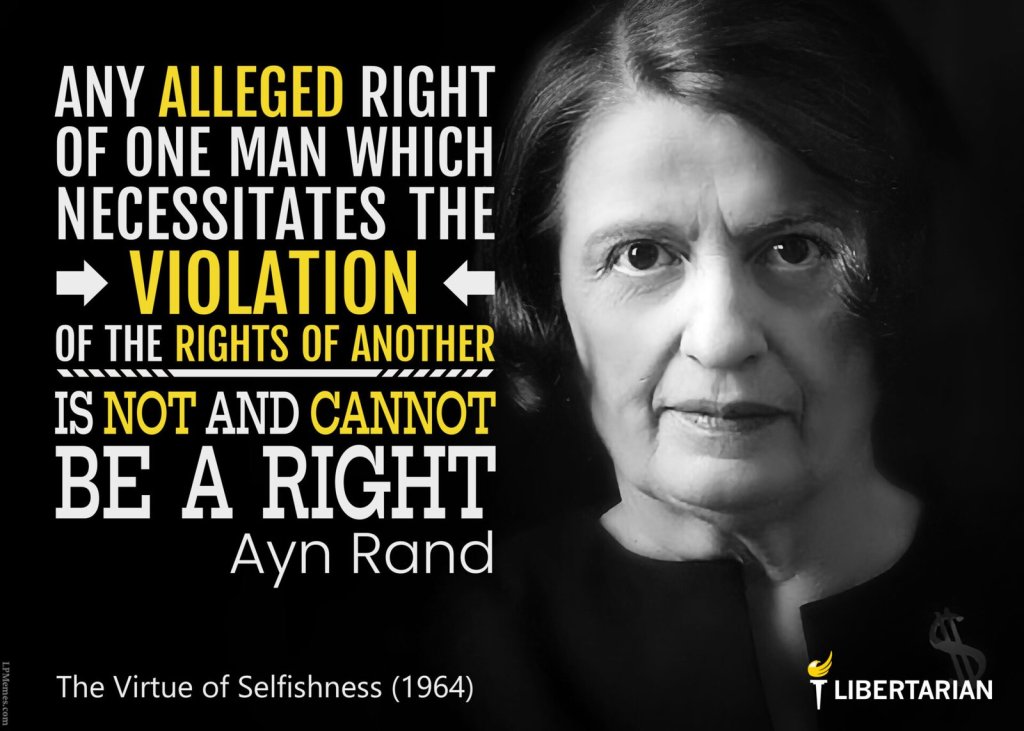
And I guess that makes me a libertarian, since I’m arguing in loud quotations. :D
On the serious side, I’m exactly what I’ve always been, the same person who wrote A Few Good Men. I believe in our Constitution. I believe the government should wear it as a girdle cinched tight enough that it can’t escape. I believe in the quotient of individual versus government the individual should now and always have primacy.
To my view that’s libertarian enough, without accruing the utopian and evangelistic view of open borders that requires libertarianism all over the WORLD. The world is not our concern. Let’s start here and make this a shiny city on the hill.
I am in truth an OWL — Older, Wiser Libertarian — who has learned some things sound great in the abstract but are in fact impossible in this our fallen world.
And in the end, I think that’s the greatest value of Libertarian, small government and individualistic philosophy. A grand implementation of it is at its complete best, absent small colonies away from Earth (eh) is utopian and impossible.
But just by existing, by being loud (and sometimes shouty in quotations (eh)), by keeping emphasizing that power always comes from the individual in ultimate instance, we provide much needed leavening to a world that is sure of the opposite, and in which the solution of all problems is assume to be “get a man” (Or these days often woman) “with a bigger stick.”
In that sense, I’m perfectly happy to be lumped in with the liberty lovers, the trouble makers, the goats refusing to be herded, the rebels who refuse to fall into line.
Because we’re the ones who keep humanity from rushing forward, as one…. and fall off the cliff.


“twitter-monarchists”?
Oh yes, those sorts. I “ran into” one of those critters and to make it worse he loved the idea of a “Christian” king with absolute power.
And he had worse faults than that. [Frown]
LikeLiked by 2 people
Oh, yeah. Those are LIKELY to have other faults. They eat their own boogers at industrial quantities.
LikeLike
Keep in mind that a steady diet of paste and window licking palls after a while.
LikeLike
Even if you add an occasional doorknob lick for variety, you are quite short of sufficient protein for adequate brain function.
LikeLiked by 2 people
I rather suspect those lots are ones who saw the sort of fantasy monarchy set up in the Lord of the Rings and think “that’s a great idea!” and absolutely a.) never looked at real world history, and b.) didn’t even look at the fictional Middle Earth history (including things directly mentioned in the trilogy) that pointed out an awful lot of bad kings. Also they ignore the whole “Aragorn is a fictional character who was deliberately written to be a perfect king who ushered in a new golden age” part.
LikeLiked by 5 people
The sad thing is that Tolkien had written that after Aragorn, Middle Earth would go down hill.
LikeLiked by 1 person
Well sure, Aragorn is a Christ figure, Christ reigning as the righteous king. I’d be happy to have Christ here as my king. It really is an accept no substitutions situation though.
LikeLiked by 4 people
Or like the Isaac Azimov theory that everyone who thinks it would be great to live in ancient Athens assumes that they would be upper crust Athenians and not slaves in the Athenian silver mines.
The Magna Carta was a massive step forward in human rights history. But, even so, we had to fight a war to free ourselves from the tyranny that still remained.
LikeLike
Nothing so romantic. In my experience online monarchists tend to be “neoreactionary” types who think the Stuarts (the ones who got deposed twice in the 17th century) were the ideal monarchs and the Glorious Revolution a grave mistake. Only their knowledge of that history doesn’t run very deep.
LikeLiked by 2 people
To be fair, he was more or less raised by (A) an elf king who had been there, done that, and seen it all and (B) an actual angel. If nothing else, it would have drilled into him that he was *not* the biggest kid on the playground.
That gave Strider a bit of a leg up, I think.
LikeLike
Also, though, that he would face huge moral choices that could lead either to victory and a temporary stay against the forces of darkness, or the deaths of everyone he held dear. He knew he had a destiny and a duty, and he had the character to handle it well.
LikeLike
Those people who believe that a monarchy is God’s preferred form of Government really need to read 1 Samuel Chapter 8. To paraphrase:
Israel: We want a king!
God (via Samuel): No, you don’t want a king. A king is going to force your sons and daughters to serve him, take the best of everything you have, and basically make you into slaves.
Israel: Yes, yes, we want a king.
God: Okay, fine. I’ll give you a king. But you’re going to be sorry. And don’t come whining to me when it turns out that the king is every bit as bad as I warned you it would be.
LikeLiked by 7 people
My favorite moment in season 2 House of David is when it comes out that David’s father Jesse is a libertarian Israelite who thinks Israel was better off under the Judges. :D (I mean, I like the character anyway because he talks exactly like Don Alejandro De La Vega, Zorro’s Dad, in Guy Williams Zorro, but the libertarian moment was a favorite).
LikeLike
As has been shown all too often, adding priestly authority to a ruler ends even worse.
https://www.kiplingsociety.co.uk/poem/poems_macdonough.htm
We forgot that lesson, and we’re paying the price for it daily.
LikeLiked by 5 people
If that’s supposed to be a knock on the Judges (whose time ended in part because Samuel’s sons were power-tripping scumbags), their regime is described as “every man doing what was right in his own eyes,”
LikeLike
Sorry, that came out grumpy. I am generally in agreement with Kipling on this point.
LikeLike
From Judges to Islam, the path is JUST as Kipling described it.
And he explained why here:
PS: WPDE sometimes pastes plain text processed by Notepad with line feeds…. and sometimes doesn’t……
https://www.kiplingsociety.co.uk/poem/poems_disciple.htm
LikeLike
I more or less agree with Kipling’s discussion of the corruptibility of human institutions in general terms,, but when it comes to equating Samuel, or even his sons, to Omar Abdel-Rahman, my answer is yeah no. Israel under the Judges gives much more of the vibes of Saga-era Iceland: a moderately lawless society only united (and that only partially) in warfare, with religiously sanctioned law-reciters conducting somewhat ineffectual private arbitration sessions that end badly.
LikeLike
If men were angels, no government would be necessary. If angels were to govern men, neither external nor internal controls on government would be necessary. In framing a government which is to be administered by men over men, the great difficulty lies in this: you must first enable the government to control the governed; and the next place, oblige it to control itself. — James Madison
LikeLiked by 2 people
Name me one socialist/fascist/communist ruler (lumping them all together because they are so hard to tell apart) that didn’t become a ‘mad king’. Including Turd-o in Canuckistan, Merkel in Germany and Starmer in (formerly) Great Britain.
LikeLiked by 1 person
I have heard a defense of Communism that all the bodies are a result of a “right-winger” taking over.
Apparently it never occurred to her that setting up conditions so that this “right-winger” could take over was enough to condemn them for the bodies.
LikeLike
Hm… you know…..
Look at those in terms of how quick they eat resources without resupplying them– King types have to keep folks from killing the farmers to get enough support, because of all the layers, but Marx could kill off the farmers and all the layers. So, fails faster.
Now apply that to making it folks’ best interest to do The Right Thing, even if they’re a bad guy.
This feels like it might connect to CrossoverQueen’s post on good guys who do the good thing for the wrong reason.
:spends way too long stopping WP(DE) from inserting post rather than linking:
LikeLiked by 3 people
RAH himself said (through Lazarus Long) that the most effective form of government is a well-run tyranny.
Three problems: (1) How do you ensure that it is well-run, (2) who decides, and (3) how do you select a worthy successor for the Benevolent Tyrant? Because history shows that the 3rd Tyrant is likely to be either an idiot or a psychopath. (Or both. Could be both.)
LikeLiked by 2 people
There’s also a fourth issue: the longer you leave one guy in charge as an absolute ruler, the worse he gets. General personality changes as a man grows older, coupled with growing sycophancy over time are two of the reasons why. Deng Xioping recognized this under Mao, and specifically changed up the CCP’s constitution with term limits to block another Mao (and applied those changes to himself, though he apparently shifted to a “power behind the throne” position when his was up).
Unfortunately for China, Xi removed those limits.
LikeLiked by 4 people
Fortunately, after FDR, we had the sense to put Presidential term limits into the Constitution, because FDR just couldn’t imagine that he wasn’t better than George Washington. Damn, but I hate that guy.
LikeLike
Don’t we all.
LikeLike
I am not a libertarian, because I don’t have unrealistic views of how the US should be run (into the ground). Plus I don’t smoke pot.
I am a USAian if I am anything. I’m one of those grouchy old men who just wants to be left the hell alone.
LikeLiked by 4 people
This is much more sensible than pretty much any political ideologue of any stripe, Left to Right to Committed Middle. Thanks for putting it in print.
LikeLike
Idealism is to an extent an attempt to convert an idealized model into reality.
The inherent devil in the details is how one sorts priorities, and what the specific person in question stops at, rather than autistically screeching as they have a melt down at the literal closed form not being realized.
The same ideas might have different results for a natural bloody-minded fanatic of the ‘do it at all costs’ variety, versus someone who gives up at the first sign of difficulty. But the selection of ideas also does matter.
The mind a person has before the ideas, and the ideas they latch onto, can be related.
Libertarianism may correlate less strongly with malign ignoramuses than communism, but it can be a model that might not have been realized.
Realizing an unrealized model can correlate to bloody-minded fools who might destroy everything in a quixotic quest.
Preserving a realized system, on the other hand, can be a) small c conservative b) attract a different sort of personality. Preserving a bad system can also correlate to bad personality traits. Good and bad in a system relate to realized systems, not imaginary systems, and we best evaluate unrealized systems close to currently extant and functioning ones.
(Failing or non-functioning systems in human behavior have a ton of routing around that is off-model to more official models.)
Anyway, there are mental phenomena that are shared between many cases. My own mistakes, actual facism, actual communism, and actual libertarianism. At least perhaps.
I’m having a sort (1) of day, and do not have the spoons to really nail quite a lot of things down.
(1) good, productive, tiring
LikeLike
The longer and deeper you get into the founding documents and their original intent, you realized they knew from the start that Humans are fallible and tend over time to corruption. But just like an aircraft carrier takes a long ways to turn, so does our bloated government. And the pigs feeding at it’s myriad tits squeal like the swine they are when you try and save the bloated sow.
LikeLiked by 3 people
If it took a hundred years of communist corruption for our government to get this bad, we can hardly be surprised if it takes a hundred years to correct.
LikeLike
Fight will never be over. Freedom isn’t free. There will always be classes of people who think they know better what everyone else should do. I mean, I do. Just I don’t believe in forcing my way on everyone else.
But our current situation? There are solutions to clean it up. Make it better. SAVE act is one. Elimination and prosecution (follow the money) of fraud. Tighter controls and audits to prevent future fraud. To name a couple.
LikeLiked by 2 people
At this point, they’re no longer piglets or pigs. They are vampire-leeches.
LikeLiked by 1 person
Shotguns with incendiary loads.
Er, in that novel to be written. Yeah.
LikeLike
Communists and Libertarians operate under the same basic fallacy – people are perfectible. Orphan you are correct that the US Constitution was written from the perspective that all people are inherently bad – one of the foundational beliefs of Christianity. So the least bad system is one that limits the power of any person, or group, by checks and balances. The power shifted too far the last century but I think the power is shifting back the other way. And yes, it took time to shift and it will probably take time to shift back.
LikeLike
I believe power should lean toward individual freedom as much as practical. In America most of us seem to honor the ideal if not the practice, which is, at least, a step in the right direction.
I actually became a registered Libertarian in the early 70’s. That’s because of a fit many of us threw over a little tyrant, Fu Manchu (actually March Fong Eu) who was Secretary of State at the time, meaning she was in charge of elections. Now the California Constitution lists two ways for a political party to be recognized in the state. First is to have over 0.33% of the registered voters register under that party designation. Second is for a candidate from that party have a vote total exceeding 2% of a statewide election. Sometime in the 70’s the Libertarian candidate for Governor got some 6% of the vote, bu Fu Manchu ruled that section of the Constitution did not apply because he hadn’t been listed on the ballot as Libertarian. Since her own rules prevented that from being the case because the party hadn’t been recognized as official before the election, she created a nifty Catch-22. In a fit of pique, I and enough others went out the next day and registered Libertarian to put the party over the other threshold.
I have never voted for a big L Libertarian, and soon thereafter reregistered as a Republican, but we made our point.
When i was young, I voted for a lot of bad things, because I was naive (another reason to re-raise the voting age to 21 even though I was 21 when I first got the vote along with a horde of 18-21 year olds). I’m ashamed to admit to voting for the Coastal Commission (Prop 20), something that turned out to be a very bad idea. I’m proud to admit that I voted for the limit on reassessment of property values for taxation purposes (Prop 13), but even that has had deleterious consequences. It eventually shifted the funding of public schools from the local level to the state level. Definitely a very bad thing. Sigh.
LikeLiked by 1 person
The main bad thing from all the good Prop 13 did is the “reallocation” mechanism that the state bureaucracy built into its implementation – it’s clearly unfair that county X is wealthy and spends its property tax wealth to make its schools great, so Sacramento reallocates property tax revenues from those counties to the counties with crap schools, with the result that the schools are still crap, but with much higher administrative pay.
Capping the property tax rates without the Sacramento central planning aspects would have been better, but overall it’s still a plus. And plus, the decades of loud complaining from local governments is entertaining to this day.
LikeLiked by 2 people
Side note: Sac City Unified School District is so badly run that some of their schools are going into bankruptcy. There’s already been one school shutdown from this debacle. (Note, no tears from my friend who is in that district, because that particular school was horrible to her kids. Homeschooling was not an option for her, alas.)
Anyway. San Juan USD and Elk Grove USD are both doing great, and they are the two districts nearest to SCUSD, so it’s not a proximity issue. It’s an administrative culture problem. (Among other things, those districts publish their financial status reports. It’s almost as though being public about publicly-held costs actually helps keep people honest, y’know?)
LikeLiked by 1 person
I am similar, I like the ideals of liberty, but find actual libertarianism to be too utopian.
I do have an ancap YouTuber I like, and after watching one video he had about logical fallacies of collectivism, I had the realization that the fallacy of extreme individualism is to deny the power of collective action. Basically, by accepting the assumption that collective action means government they miss that there are many ways for people to voluntarily work together, and that teamwork is a.powerful tool.
Also, I have realized that I conceptualize the non-aggression principle differently than many libertarians.
One way is to realize that government is a technological tool of violence. This is no different than any other weapon that can be used to protect or to rob. This means that a government expanding its power can be good if it is doing so to restrict other governments from infringement of liberty.
LikeLiked by 1 person
Mind you, you can still get me to shout incoherently in individualist. :D
But yeah. Part of coming to terms was realizing that things like “abolish the welfare state” are probably beyond my reach in this time, much less anything else.
Brother, we need us a man like Miley. But for now, I’ll take Trump. Better than the other side.
LikeLike
Yeah, I have a friend who is a hard core Randian objectivist, and it had taken me a while to really articulate what felt off to me about the whole “altruism is evil” that he buys into (but does not actually follow).
I am reminded of a blog I read the other day by a tech entrepreneur who was comparing his experience in Silicon Valley vs. growing up in India. In India people see knowledge as zero sum, and only share if they get something in return. In Silicon Valley they see sharing tips and wisdom with other entrepreneurs as what you do, and it helps all of them improve and do better and have a flourishing ecosystem that produces huge amounts of wealth for all of them.
LikeLiked by 1 person
Altruism is not evil if you believe in it and practice it on your own. Forcing other people to fund your altruism is as wrong as any other form of robbery.
LikeLiked by 5 people
Indeed. I think that what tends to trip people up is understanding the difference between what is moral to do, vs. what is moral to force everyone to do. So people like my friend see that altruism is used as an excuse to justify forcing people to do stuff, and then think it is the altruism that is the problem instead of the force.
I was also thinking along the same lines with regards to pacifism, and how it can be morally good to be a pacifist, but forcing others to be pacifists is not good even so.
LikeLike
The problem with pacifism is the burden it places on others. If you won’t defend yourself, somebody else has to. A nation of pacifists will only last until some non-pacifists decide to indulge in that old tradition of rape, loot, pillage and burn.
It takes two to make peace. Only takes one to make war.
If one would have peace, one must be eternally ready for war.
LikeLike
The pacifists I support are those who go to war as things like combat medics and clergy. You won’t carry a weapon, but you’ll go under fire to assist or bring spiritual comfort to your comrades? That’s pacifism done strong mode.
LikeLiked by 1 person
Oh, bugger. I got moderated. Sarah coordinate! 😁
LikeLike
That was what I got out of Atlas Shrugged. What she calls “selfishness” is “acting in accordance with your own interests and values”, and what she calls “altruism” is “letting other people use your values to enslave you”. At least how I read it.
You can help others as much as you want, as long as it’s on your own terms. Which lines up neatly with the Christian idea that charity should be given freely, not coerced. Also with C.S. Lewis’ point in The Great Divorce that the righteous should not be held hostage by their love/sympathy for the wicked. (And with a few scenes in Man of Steel that boil down to “Being Superman is a burden that must be taken on freely.”)
LikeLike
Silicon Valley is actually a fairly small pool of people. You keep running into the same folks over and over as you do your rides on the Tech jobs rollercoaster, so you really never know which random acquaintance will be the next VC lottery winner whom you can catch your the next ride with, so it is in one’s self interest to share such tips and keep your amicable networking alive.
That’s not to say there are not infamous grudges, but generally it’s seen as smart to keep things friendly.
LikeLiked by 2 people
Apparently, however, while the Indians in Silicon Valley may have given up the “zero sum knowledge” tradition, they haven’t given up the “hiring more Indians improves my social status” tradition.
LikeLiked by 1 person
Yeah, but it’s fun to observe the angst when subcontinental managers have to lay off subcontinental individual contributors, or their much greater angst when they RIF subcontinental H-1b indentured individual contributors, forcing them to go back home.
After all their thumb-on-the-scales hiring efforts, there’s only so many U.S.-born employees around to lay off first. Eventually they have to start in on the“somebody’s cousin” pool, and you can tell they are racking up real in-culture social opprobrium in so doing.
Anyone know the Hindi for “schadenfreude”?
LikeLiked by 2 people
The antonym of izzat?
LikeLiked by 1 person
This is useful.
https://xcancel.com/XJosh/status/1992348701793349827#m
LikeLike
So is this
https://xcancel.com/Slatzism/status/2001760206511050825#m
LikeLike
Under the “Never let a crisis go to waste” rule, this whole massive fraud in every welfare program imaginable thing seems like the ideal time to just shut them all down until we can figure out what’s going on.
LikeLiked by 2 people
I would be a libertarian if I believed it to be possible. What annoys me is the “die heretic!” that the true believers come out with when you try to discuss the thing.
LikeLiked by 2 people
An Individualist orthodoxy is kind of ironic.
But I suppose it follows that some schools of libertarianism read more theory than the Marxists.
LikeLike
For proximate examples of libertarian “no drug laws, dude” in real world application, at least basically no drug use enforcement plus free needles and free money for voter fraud, see The City and County of San Francisco, though the worm just possibly may have started to turn there, and the City of Los Angeles under it’s current Cuban administrative oversight. Where on the libertarian free drug spectra does “camp on the street, shoot up in doorways, and poop on the sidewalk” go?
LikeLike
Where on the libertarian free drug spectra does “camp on the street, shoot up in doorways, and poop on the sidewalk” go?
Same place as “drive drunk and cause an accident” goes when it comes to alcohol–it ain’t there. Libertarianism holds people responsible for the consequences of their actions, even if the actions themselves are legal.
LikeLiked by 4 people
Yep.
LikeLike
It’s the enforcement.
Notably all three of those, which I saw a couple of years ago with these my own eyes when I last visited the streets of SF, are individually illegal – public use of illegal drugs, public defecation, and camping on streets each violating actual on-the-books laws.
The lawlessness by those individuals violating those laws continues because those responsible for enforcing the laws decided to skip that bit to pander to a political constituency. Back in the 1960s and 1970s, and for that matter as late as just prior to the accession of Gavin the Dim as mayor, the SFPD had a reputation as a bit of a hard nosed agency, and would have run sweeps to deal with these occurring in any neighborhood other than The Tenderloin.
So the current state of affairs in SF (as noted there may be changes afoot there, too early to tell for certain yet) and LA are really more public officials choosing lawless libertinism as performative “compassion” than anything libertarian.
LikeLiked by 1 person
Case in point, if tents show up on the street where Nancy Pelosi’s in-town residence sits, the address which qualifies her for her seat in Congress rather than where she really lives up in the wine country, those tents mysteriously get cleaned out pretty quickly indeed.
LikeLiked by 1 person
Funny how Nantucket and other eastern coastal enclaves yelled for (N)ICE when Desantos and other republican governors assisted illegal border crossers further north by bus.
LikeLiked by 2 people
Canada. Seriously, a judge in Ontario has ruled that government [tax payers] can’t evict homeless druggies from an encampment unless the government (tax payers) provide housing that the homeless approve of (have to be able to shoot up, smoke, fool around, be loud), because they have a right to housing {free to them} that matches their right to be antisocial in all sorts of ways.
LikeLiked by 3 people
It’s not mandatory, but the billboard opposite the Flyover County JC gets my neck hairs to raise a bit. I have to paraphrase, but it’s on the order of “Make sure you have Narcan on hand for your friends.”
Um, you want to have your drug use enabled by making sure your group of friends will save your ass when you do something stupid. Is that what you want? Mind if I say “Think of it as Evolution in Action”?
LikeLiked by 1 person
Blink.
Think this might be the correct interpretation, or (and) could be “have Narcan on hands for your friends”, to save them; or strangers. Latter you can’t control, unless a hermit. Former? Have different friends.
LikeLiked by 1 person
Foxfier mentioned dogs. Kat-the-dog has 13 acres she considers her play yard, and hates city noises with a passion. Hasn’t been to a park, and especially not a dog park. Neighbor’s dog is across the road, and 1.5 times the size and with uncertain temperament–they don’t play together.
The billboard wouldn’t bug me so much if it said “Somebody might need it someday.” I’d not hesitate to give it to an afflicted EMT or LEO (the former are almost always in pairs here, but the latter frequently are solo, especially out in the boondocks). Not sure about how I’d react to body-on-the-sidewalk. I usually don’t go where that’s common, and F-Falls got serious about the homeless camps. (General Winter also has a vote. Not too many abandoned buildings around any more for squatters and the tent camps were cleared last year.)
LikeLike
My argument for having narcan on hand is that it works on a dog that gets a nose-full.
Known cartel way to kill off dogs.
LikeLike
We’re also seeing way too many episodes of environmental contamination because of “containment failures” among users, makers, and shippers, and the LD50 dosage on this drug is horrifyingly low.
LikeLiked by 1 person
I can’t remember the year, but didn’t Russia dump fentanyl into the air vents for that long-running hostage situation, too?
LikeLike
Yes, and/or possibly nerve agent(s). An acquaintance in the business of “in the know” said they tried out their whole cabinet of nasty chems.
After the local Jihadis zorched 200+ kids in a school, the Russian security services tossed “nice” right out. In fact, they went beyond “make a Nazi puke” straight to “Demonic Influence Accepted Gladly”.
These are the folks who responded to an early Mideast hostage taking of a Russian diplomat by snatching several relatives of the perps, and mailing the severed gonads home in sealed envelopes.
They might have had their reasons, say 200+ dead children worth, to go a little wilder than usual.
LikeLike
Except last I heard at least half of the school kids were still warm when folks got inside.
That is, Russia directly killed them.
LikeLike
Friends of ours in our volunteer group lost their dog because he dug up someone’s stash on a work site. He was a tiny fellow trained to alert the diabetic husband when his blood sugar went out of whack.
You knew he accepted you when he’d come up with a tennis ball and go, “Ptui!” right at your feet. Your turn to throw the ball.
LikeLiked by 1 person
Neighbor at our last rental was a vet with the fluffiest little nonsense dog who did the same.
RIP faithful servant.
LikeLike
Oh the reality is far, far worse.
Junkies want to get high, as high as possible. And they get really freaking creative at it. But too high and you die. No more highs. Bummer.
Narcan enables getting higher at lower risk, because your buddy or the EMTs will save your ass from an otherwise fatal high. You can push th elimits of tolerance very much harder, berceuse -MAGIC- Narcan and helpful fools save your ass.
Yes, the junkies really do. Just like they go for broke right outside an ER, or even in one.
Yes they do. I can hear a few nay-sayers I know saying “That isn’t how it works! No one does that!” They don’t personally know any junkies, at least that they admit or consciously realize.
Yes. They do. They are -junkies-. Junkies are junkies are junkies. Even sober they still act like junkies.
LikeLiked by 1 person
Drugs really turn people into zombies, don’t they?
LikeLiked by 1 person
Narcan does not decrease opiate-related deaths. It increased opiate-related crime.
LikeLike
My wife and I put it this way:
Ideologically, we’re libertarian and (therefore) pragmatically we’re mostly conservative except where the conservatives start getting bossy.
LikeLiked by 2 people
I like “non-bossy conservative” as a label.
LikeLiked by 2 people
This is pretty close to where I’m at. Considered myself a liberal for a fair while, and compared to the conservatism of where I grew up, I was quite liberal; center-left, you might say; but prolonged close exposure to a bunch of people who were SJWs before we had that term for it began to cure me of it. After seeing them in action, I knew for sure that going Full Progressive was not good for anybody.
And then, a few years after that, I started reevaluating what both ends of the political spectrum say about themselves vs. what their actions and policies do, and at the same time was thinking about what my fundamental beliefs and principles are. Not focused on theory much at all: how well does this actually work, and what’s the principle behind it was what I wanted to know.
End result, after finding that libertarianism was the political philosophy that most closely matched my principles, was realizing that the pure philosophy utterly fails the “does it actually work” test. It’s like communism in that only angels could make it function as the theory envisions — and unfortunately, we don’t have any of those on hand.
So that’s why I caucus with conservatives. They may get judgy about some of the places where we differ, but the vast majority won’t try to coerce or unperson me for disagreeing. And until we figure out how to change human nature itself, the closest thing we’re ever going to get to a libertarian utopia is embedded in the principles, guiding documents, and vision behind the founding of the United States of America. Libertarian-minded folks will probably always be a minority (see: human nature), but we can do a valuable service by reminding the majority that LIBERTY is the ultimate thing we all need to preserve against the leftist onslaught.
LikeLike
Any ‘right’ that has to be supplied by somebody else is not a right. 😡
LikeLiked by 2 people
I’m a libertarian–registered Libertarian and Trump’s the only non-Libertarian I’ve ever voted for–but I don’t consider open borders to be a valid libertarian position, even as a philosophical ideal. Don’t have time right now to go into my reasoning, but I’ll do so later if anyone’s interested.
LikeLike
I can fairly easily seen where you’re coming from – it comes down to self-ownership, and its corollary – property rights. A nation is the property of the legal population. That means the legal population gets to select who comes to visit – and who cannot come to visit or move in.
Legal visitation under some form of visa is like getting an invitation to a party in a person’s house. Once the party’s over, you have to leave. You don’t get to claim that you live in that house now because the owner invited you to a party. And if something comes up, the owner has the right to cut the party short and ask everyone to leave. Visas are the same way – you can come in for a while, and maybe you’ll get invited to move in, but the Government reserves to cut that visit short for any – or even no – reason.
The biggest problem with the media today is their absolute refusal to distinguish between legal and illegal immigration. And refugees are not given preference for immigration – they’re given visas, or in some cases “Permanent Resident Status” (green card), but even so-called Permanent Residents can have their residency removed for cause.
LikeLike
I don’t want open borders for the same reason I don’t leave the front door of my house open all day and night. 😛
LikeLiked by 3 people
I consider myself…um…it’s complicated? And probably doesn’t translate into US political ideas well. I would say I’m more a minarchist than a libertarian, and that what little government should be is meant to fill the gaps between individual moral compasses. The closest semi-coherent ideology I’ve ever found to where I land is what the Euros call “Christian Democracy” and even that is far from a perfect fit. So, darned if I know.
LikeLiked by 1 person
Subsidierist works. “The lowest, smallest level of government that can do it should do it. If they can’t then it goes up one tier.”
LikeLiked by 4 people
That’s a Catholic teaching, right?
LikeLiked by 1 person
My response to the assumption that I’m a moderate is “no, I’m extreme in all directions.”
They assume I’m joking, but it’s truer than a lot of descriptions.
LikeLiked by 2 people
My response is usually “You just NOW realized I’m a misanthrope? Would a billboard help???”
LikeLike
oh, heck no. Christian Democracy is socialism. Just not atheist.
LikeLiked by 2 people
Yeah, I did say a far from perfect fit, just the closest resemblance. I long ago accepted that I’m probably just ideologically incoherent.
LikeLiked by 2 people
And for those who think Christian Socialism can work I refer you to the Book of Acts, in particular Chapter 5, as well as 2nd Thessalonians Chapter 3. I have a principle that if the saints (and Saints) of the early church couldn’t make it work aint no one making socialism work, and I stand by it.
LikeLiked by 1 person
European Political Party ID Rule: If is does not get called “far right” in the yoorupeen press, it’s Marxist, either hard or soft-serve.
LikeLike
EVEN when it’s called far right, TBH.
LikeLiked by 2 people
I agree with you on the drug thing. Colorado was also one of the first states to legalize pot, which drew in a less than productive wave of immigrants.
One of the things that bothered me, right from the start, was both smelling pot on the street all the time and the people that complained about it. It is not legal to smoke it in public. That has _nothing_ to do with legalizing pot. It has everything to do with not enforcing laws already on the books.
I was a fairly hard-core libertarian in my youth. I’m not so much, now. I do believe in minimal laws, which is somewhat libertarian.
I also believe that if a law exists, it should be enforced or repealed.
I’m going to have fun with that in fiction. Our intrepid heroes want to farm a dungeon. To farm it, you have to feed it. I believe it was a RAH (or maybe Clarke) story that had almost every crime warrant the death penalty so organ harvesting could keep up with demand. This will be similar. No one objects when you toss murderers and rapists naked into the dungeon. When it gets to j-walking, people start to get upset. Plenty of story fodder there.
LikeLiked by 2 people
That was a Larry Niven story.
LikeLiked by 2 people
I know someone who is anaphylaxis-allergic to pot. (She buys Epi-pens on the open market, since there isn’t a blood test for cannabis, so to get the 100% certain that it’s pot test, she would have to go to a hospital and do deliberate exposure.) You can’t contain pot smoke like you can, say, peanuts, so public pot-smoking is a direct health hazard for her.
LikeLiked by 2 people
As Drak noted, that was Larry Niven, from his short story “The Jigsaw Man”, set earlier in the timeline of his “Known Space” universe.
He continued with it in his “Gil the ARM” series, focusing on a UN agent policing organlegging (illegal organ trade, primarily used by criminals).
LikeLike
Epoch Times reports the Chinese government is basically doing Niven’s thing. They can get you a transplant organ pretty quick, just don’t ask where it’s from. Uighurs and Fulan Gong practitioners, mostly.
LikeLiked by 2 people
Niven’s “The Jigsaw Man” was published in 1967, the same year Laumer’s “The Day Before Forever.” Both stories were about organlegging.
It’s hard to tell who actually wrote their story first – and there was a lot of cross-pollination between SF writers back then – but Niven carried organlegging on as an integral part of his Known Space series, and Laumer’s story was just a one-shot.
“The Day Before Forever” is usually bundled together with “Thunderhead” when reprinted, as they were both odd-sized novellas in their day. Both are worthwhile, but “The Day Before Forever” really deserved more attention than it got.
LikeLike
And Niven’s The Gift From Earth is what happens when New tech from Earth lands on a colony planet where organlegging of the proletariat has become the upper classses privilege.
LikeLike
Believe it or not, I just read that for the first time
LikeLike
See also: mid Victorian England, when there were several hundred various capital crimes.
Though they did have transportation to Australia as an alternate.
LikeLiked by 1 person
See also: “Fate worse than death.” 8-)
LikeLike
It should be noted that the Oz thing was the Imperial fallback – prior to the American Revolution, convict transport to the American colonies was much cheaper.
LikeLike
Having spent time in GA, the whole “penal colony” is a good explanation…..
LikeLiked by 1 person
I -liked- Fort Stewart. (Just down the road from Savannah) Fort Benning wasn’t quite as pleasant, but tolerable.
(grin)
LikeLiked by 1 person
Char-Broil used to be in Columbus; worked a B2B engagement there in 1999.
Some parts were nice, some parts of there and Phenix City across the river made me think that a dose of “Patton’s Urban Renewal and River Crossing” would be just about right….
LikeLike
See also: mid Victorian England, when there were several hundred various capital crimes.
Though they did have transportation to Australia as an alternate.
LikeLike
One of our neighbors (not sure who) smokes pot habitually. It’s very annoying in the summer, Mom likes to have the windows open for the canyon breeze, and the smell of pot is so unpleasant.
LikeLiked by 1 person
Skunkweed 😁
LikeLiked by 1 person
You and I are Owls. Hoot.
LikeLike
I generally sum up my live and let live attitude on dope thusly: That burning hemp crap gives me migraines. Keep that shit away from me. Keep it out of my home you assholes. You do not have the right to inflict that stupidifying shit on me. I don’t give a dang what you do in your caves, bon appetite. Just keep it away from me and mine.
I had a neighbor argue I just had to suck it up, ’cause Freedom. I pointed out that if he was free to push toxins into my home, so was I free to do so in the other direction. And my hobby toxins of choice are Lead based.
He agreed that perhaps he could see my point, and would be more… respectful of boundaries. (grin)
LikeLiked by 1 person
We discovered husband has the same allergy as yourself via living next to a trailer park and going insane trying to figure out how husband’s “mold allergy” was being set off.
LikeLiked by 2 people
The reason long-lasting monarchies (Romanov, Habsburg – Austrian version) seem to have hung in there is that there was a limited amount they could actually do. They were not all-seeing, all-knowing, and all-meddling.
Since the empire really was a family business, at least for the Habsburgs, there was also an obligation to keep it intact or grow it through marriage and investment as well as conquest. Oddly, the Habsburgs had a habit of throwing “that crazy Archduke” who was actually listened to when he did local reforms. Not every generation had one, and over time entropy won.
LikeLiked by 3 people
Yeah, the Habsburg inspired Empire in one of my series has an Emperor who’s chosen by a group of electors that including upper nobility, upper clergy, and some commoners chosen from the Assembly to represent them. He can ratify or veto laws generated by the Assembly and he can appoint the highest tier of military officers, subject to Assembly approval. The character who’s elected as Emperor towards the end of the series has a stated policy of vetoing any law that reaches his desk on general principle, and wonders if the large ceremonial seal that goes with his job would make a good bludgeoning weapon. (His friend the Prime Minister approves, and was the one pushing for him as Emperor for some reason.)
LikeLike
The Romanovs also ruled over a territory larger than all of Europe, and much of it ran autonomously due to communications lag. Its sheer size confounded normal military operations, and even if one of the various attempts had managed to take the current capitol, it wouldn’t have been the kind of coup d’etat that taking Paris or London would have been. European countries are so centralized on their capitols that was a blind spot for their military planners.
LikeLike
I’m an accidentalist. The point is not the form of the government, but to what extent it does its job of protecting people from force and fraud without harming them in other ways. An absolute monarchy that does a better job than a republic is more legitimate.
Also, history shows that governments must be fitted to times and circumstances.
LikeLiked by 1 person
I have no desire to replace our current form of government. But, that is likely true for most people at most times – experience shows a government has to be very dysfunctional to be overthrown – see the Declaration of Independence language on tolerate while they may.
Pray for wise people, that those in government would have less difficulties in governing, and be more likely to be wise themselves, drawn from a society that encourages wisdom.
LikeLiked by 1 person
I do want to see our current form of government replaced — with the one the Founders intended. I want to see an end to the corrupt self-dealing political-bureaucratic Deep State that squanders tax money robbed from us on their corrupt cronies.
Washington D.C. needs an enema. 😡
LikeLiked by 3 people
No. It needs the Augean stables treatment.
LikeLike
Wasn’t that just a really big enema? 🤣
You’re right, though, I didn’t complete the sentence correctly. Washington D.C. needs an enema with a fire hose. 😛
LikeLiked by 2 people
And here’s the hose…..
LikeLike
Hose, chainsaw – whatever works.
it’s when the job needs C4 that a cleanout gets problematic.
LikeLike
Yeah we are moving from Hercules and the Augean stables to nuke it from orbit just to be sure.
And I will note whether you’re redirecting two rivers into stables that haven’t been cleaned for 30 years or performing an enema the output is likely the same a whole bunch of effluent, it is merely a matter of scale…
LikeLiked by 1 person
Keep in mind the Augean effluvia was -poisonous-, not just noxious. Hercules may have been responsible for the first major fishkill.
LikeLike
Frederic Bastiat is quoted as having said that any form of government was acceptable, as long as it could not steal from its citizens.
LikeLiked by 4 people
An accidentalist…I hadn’t heard that term before. I might also be one. Even though I’d defend the American republic to my last breath, I don’t necessarily think there’s anything sacred about our form of government, even if I do have an instinctive conviction that its establishment was basically an act of God. (I mean, what in either human nature or history would lead anyone to expect all those revolutionaries to voluntarily eschew the pursuit of personal power and say “now, how can we ensure prosperity and liberty for everyone else”? That is not how humans work. Divinely ordained or not, it really was a miracle.)
What makes the American system worth devotion is that it’s conducive to liberty, and it WORKS. Or used to; maybe not so much now, buried under 100+ years of authoritarian and socialist detritus. If a monarchy could somehow protect the American people from force and fraud while maximizing liberty and prosperity in the long run, I’d be for it. Key caveat: in the long run. No other system or polity that I’m aware of has ever managed it for longer than a couple of decades.
LikeLiked by 1 person
it helps if you are trying to run a system with Americans.
LikeLike
I’ve heard it rarely. People in the Spanish Republic who professed they didn’t care, as opposed to the monarchists and the republicans.
LikeLike
The thing about “legalizing drugs” is that without that, we have cartels making mega-billions and killing everybody in their path. Al Capone and Lucky Luciano would be weeping with envy to see our modern drug cartels.
The medieval church tolerated whorehouses, not out of hypocrisy but out of a doctrine of “harm reduction.” Their take was that all men (yes, even you and I) are fallen, and all men will sin. Sinlessness is not an option. So they figured that allowing sin some licit outlets was better than trying to stamp sin out completely.
And another thing—which drugs are we talking about? Pot is not opiates is not hallucinogens is not uppers is not downers… I will stipulate freely that some people and some drugs are a bad, bad combination. But I could say the same thing about alcohol. I know quite a few people who’re OK when they’re sober but put a few drinks down them and it’s Katy-bar-the-door. The temperance/prohibition people started out with a good idea—the amount people drank as a matter of routine in Colonial times boggled my mind when I found out about it. But they took it way too far, and now the whole idea’s discredited.
The “drug exemption” to the freedoms granted to us in the Constitution also concerns me. In the names of the Drug War and the Holy War On Racism, they’ve made much of the Constitution and Bill of Rights dead letters. They haven’t tried quartering soldiers on us yet, but give them time. I’d rather deal with giggling druggies on every corner than that.
LikeLike
–
There is a reason why Europe, early pioneer America, and even now outside of US and Canada, that alcohol based drinks are the drink of choice. Often the only safe option for those of us traveling from Canada and US. Suppose to be watered down alcohol. But still contains alcohol.
Drinking water flat out not guarantied to be safe. Can’t always boil the water either. But one can always add drinkable alcohol to an unsuspecting contaminated water source.
LikeLiked by 1 person
Alcohol consumption increased as agriculture became more productive and transportation improved. And this occurred as power-driven machinery became more widespread and people became more concentrated around it. (A drunk farmer endangered himself and his family. A drunk driver in a city endangered hundreds of strangers.)
Something would eventually have to be done or the gutters would run with blood. But the decision to ban alcohol was like the decision to ban guns: blame the thing, not the person.
Does this apply to high-power opiods and to hallucinogens? Start from first principles and balance responsibility, harm to others, unmanagable danger, harm to one’s ability to be a responsible citizen … .
LikeLike
They’re not quartering soldiers; they’re quartering ‘homeless’ and illegal aliens.
LikeLiked by 3 people
I sometimes think it’s a pity that the words “drawing and” immediately prior to “quartering” are missing from your comment.
LikeLiked by 1 person
Why do you think they call them “The Salvation Army”?
LikeLike
“Take over a once respected institution, kill it, skin it, wear it as a skin suit, etc., etc.”
LikeLike
As I pointed out I am not saying it should be illegal. I’m saying as it is right now, it’s…. Also in CO the illegal drug trade flourishes more than ever, because the government taxes legal out the wazoo.
LikeLiked by 2 people
Sarah, they already proved “couldn’t organize a boink in a brothel” at the Mustang Ranch…… 8-)
LikeLiked by 1 person
Same in the Formerly Golden State – the state taxes and regulation on legal pot growers and retailers, as well as the obstacles to getting bank loans and insurance, make the illegal growing and selling activities financially viable, especially with no limits on possession so demand is higher.
And the tax revenue windfall remains the square root of minus one.
LikeLiked by 2 people
Same in Oregon. In addition, banking is danged near impossible.
All the old time growers went legit as grow consultants. Now newcomers have come in, and they are batching chemical drugs too.
LikeLiked by 1 person
One wishes. They funded the legal places, so — negative.
LikeLike
Except they factually don’t.
That requires enabling structures. Which is why California has a very big drug-dealer death issue, and Iowa doesn’t. Because Iowa doesn’t turn folks right back out when they’re snagged, and actively prevent enforcement of the laws on international terror groups that happen to sell drugs.
When various states legalized pot, what actually happened was that the cartels– who were already sheltered via failure to enforce existing laws– rolled in to the legal grows and informed them they would be working for the cartels.
Source: I know, personally, 4 “legal grow” owners. Three of them got this deal and got out because of that, cartel gets you dead. Silver or lead.
LikeLike
Also a brothel was like a sewer: it kept its contents contained in one place.
LikeLike
I’ve seen too much to think that there are really too many “victimless” crimes. I’ve seen enough families ruined by drugs to think that addicts are only hurting themselves. And, yes, I know, alcohol does much the same thing, we tried prohibition with that, and it didn’t work—but that strikes me as an excellent reason not to let another drug get embedded in our culture to the point where we can’t get rid of it.
LikeLiked by 4 people
The case for Prohibition is stronger than many credit it: alcohol consumption and related ills fell and remained low for two generations after the end of Prohibition.
I don’t think that’s enough to salvage it as a good idea. But “not worth the trade-offs” is subtler than “doesn’t work”Pharmacopeia
LikeLiked by 1 person
It seems to me that there are two impulses to libertarianism. One is toward individual responsibility; the other is toward licence or licentiousness. And I’m not convinced that either occurs in pure form, though if either does, the latter seems more likely.
There may also be a willingness to accept some degree of the latter in order to get the former.
LikeLiked by 2 people
and vice versa…..
LikeLike
I’m one of the victims.
The “war on drugs” hurts because of folks blocking “hey, these bad things are bad.”
LikeLiked by 2 people
A king is humans choosing a substitute for God.
LikeLiked by 2 people
“It scares the pee out of the rest of the world”
The Anti-American propaganda is getting pretty ridiculous on social media, especially Instagram.
LikeLiked by 1 person
But it all makes it easier to tell who our cultural friend group is.
Hiya, Japan! Ohayo gozaimas!
LikeLiked by 1 person
…promo post?
LikeLike
I forgot. It will happen, but apparently only on sunday. I’m so sorry. I really was NOT doing well yesterday, so I just finished the started post.
LikeLike
My only quibble with the article is that I would substitute “limited government” for “small government”. I don’t want a small government which does nothing but regulate my toilet. I’m OK with a big government that does nothing but protect my borders from invasion. Perhaps a pedantic quibble, but one nonetheless.
LikeLiked by 1 person
The current Federal government authorized by the Constitution of 1789 has many limits. Unfortunately they feel free to ignore the parts they don’t like.
LikeLike
That’s because they’ve figured out the weakness:
“Don’t like what I’m doing? Well, until you’re willing to shoot me, I’LL KEEP DOING IT.”
And now we’re watching leftist judges continue this in real time.
I support everything Donald Trump has done….. and I hope he puts down the current slow motion coup hard.
LikeLiked by 2 people
Slow motion coup:
https://pjmedia.com/tim-o-brien/2026/05/18/comeys-message-to-the-deep-state-on-meet-the-press-run-out-the-clock-on-trump-n4953000
LikeLike
Slo mo coup, Exhibit B:
https://pjmedia.com/matt-margolis/2026/05/28/now-we-know-who-was-really-behind-e-jean-carrolls-bogus-allegations-against-trump-n4953338
I can’t help but think that if my standards of evidence were in place (physical evidence required, 72 hours to file, false accusations punished), we’d see lots less of this junk.
LikeLike
I’m impressed with Trump’s patience. If I were in his shoes, I’d have gone Andrew Jackson long ago. But he’s been racking up some impressive wins at the Supreme Court just by letting the process play out, and the leftist judges seem to be getting more desperate and less effective.
The judiciary still needs cleaning out, and the fact that Congress hasn’t impeached Boasberg, at the very least, is an indictment. But the Left needs their judicial warfare to be much more effective than it has been, and that gives me hope.
LikeLiked by 1 person
Gaius Julius Caesar meant to reform Rome. His methods wound up enabling Octavius to toss our the reality of the Republic and become Emperor Augustus.
Caesar’s assassins meant to save Rome from Caesar. They enabled the methods of Octavius.
Oops.
LikeLiked by 1 person
Not really. Boasberg doesn’t really have to even show up.
“Hi? Remember the decision that granted Trump immunity unless you could successfully impeach him to remove it? I do. The same standards apply to judges. And I also remember that there’s no way anyone is getting to 67 Senators over me. I’ll be in court ruling against Trump some more.”
LikeLike
At this point, I’d consider a strongly worded letter from Congress to be real progress.
LikeLike
If he wasn’t up against several fairly hard time limits, that would be the way to go.
LikeLike
So I have not now or ever have been a member of the Libertarian Party. They are NOT serious (apologies to registered Libertarians) , they run candidates at the top of the ticket who don’t even hold libertarian standards (i.e. Johnson/weld who BOTH supported the New London side of New London vs Kelo with their state governments when they were governors). They have no concerted effort to take state offices, particularly the legislatures, where ultimate control for the electoral votes comes from. Don Quixote jousting with windmills has more effect.
That said I am a Constitutionalist with a minarchist libertarian bent. I believe government is not wholly useless (like an anarchist libertarian might) but that it should be limited to a small set of actions. I think the US constitution as originally framed AND as interpreted through a moderately tight originalist exigesis. I believe the 16th and 17th ammendments were mistakes, the 17th was a misguided attempt to deal with corruption in appointing Senators. It basically changed the Senate into the House with slightly longer timelines breaking much of the original design of the Connecticut Compromise which was to give the states a direct leash on the Federal Government. The direct taxation of income created a power in the legislative branch that perhaps was not intentionally intended. Interpretations in the 30’s particularly around using the commerce clause to justify everything have made a hash of where power lies.
How do we get out of this mess? Beats the heck out of me. It is clear internal spending needs major control, and we really need to focus on clearing out any old super liberal judges, We’re stuck for a while with the Obama and Biden Appointees (as well as the squish Bush II appointees) Most of Clinton and Bush I appointees ought to be aging out. And the bureaucrats need probably a 50% purge (and likely more in some parts).
LikeLiked by 4 people
Funnily enough, Trump 2.0 seems to be tackling things in the right order. Deport the illegals, uncover the fraud, slash the bureaucracy, etc. There’s a lot of mess to clean up, but that also means it’s a target-rich environment. TBD if we can pivot to a saner government once things get cleaned up, but doing things in the opposite order wouldn’t have worked because moves like reducing the power of the Presidency or limiting the ICE/BP budget would just let the existing rot fester.
LikeLiked by 2 people
–
Um. “NICE/BP budge” – FIFY
LikeLike
They need more budget to afford the “N”.
LikeLike
Someone in the Trump Administration has NOT read That Hideous Strength , N.I.C.E. is solidly the Opposition, bad precedent even if it does enrage the Liberals (who haven’t read it either apparently, too “Christian” an author, too much badthink).
LikeLike
Okay.
I had to look up Lewis’s “That Hideous Strength“. I see your point.
But … nope. Trolling the liberals and making them use National ICE for ICE is just too good to pass up. While President Trump has trolled the liberals it hasn’t happened, not even EO (has to go through legislative body) and probably won’t.
I don’t think there is any concept out there that hasn’t or could have someone go “um …”, like N.I.C.E.
LikeLike
Trump 1.0 was basically a pre vietnam 1960’s northern NYC Pro Business Democrat. He was playing by the pre Clinton politics of that party, and expected collegiality from the Democrats, with whom on many points he was in agreement. Instead they came after him hammer and tongs while in office because their chosen graftmaster was unable to win a rigged election (How Democrat, Hilary couldn’t even lead a booze up in a brewery, though she got her boxes of wine). Then when they did oust him for a turnip they couldn’t just leave him and his associates alone. Instead they ginned up anything they could to limit or imprison his “people”. Therein lay their mistake
I think the DOGE work (as incomplete as it’s resolution ended up) and the investigation of folks like Datarepublican (President Trump that lady needs a medal of Freedom post Haste) has made it clear that the Democrat party is astroturfed all the way down. Gutting USAID has the Democrat party sitting on several million dollars of debt (Nicely Done Ms. Harris you along Obama torpedoed your own ship) as The Republicans sit on 100+ million surplus (which Heaven help us they choose to use to try to rescue RINOs, lets make RINOs endangered again!). It is massively frustrating that we seem to have the Democrat party by certain delicate portions of their anatomy and that the GOP will not go for the killing blow.
LikeLike
The Libertarian Party ahs been a grift engine since at least the mid 1980s. Reference L. Neil Smith’s character “The Byzantine Pope” and flunkies in “The American Zone”.
Libertarianism to have any meaning going forward needs to first scrap the Capitol P Party entirely and start over.
Of course, this is also true of the RINO-DINO Hegemony.
LikeLiked by 1 person
The thing that kept trying to take over my mind as I read this, and thus distracted me throughout, is that scale is the enemy of libertarianism. Liberty scales down well. Up, not so much. You simply cannot have a small government over a large geography. Doesn’t work. At least, I can’t think of a single example of it working. I’d say the early US is the closest anyone has ever gotten, but the Articles of Confederation is not coming back for its beer.
The thing that tried to take over my mind as I neared the end of the piece was this: at least libertarianism is consistent about open borders. There seems to be some disagreement among the other major political-economic models as to whether it is people who should move about freely or goods that should amble unencumbered, but nobody seems to think it should be both. Not that we have a true case of either in any system, but I’m hard pressed to find another ideology that favors both. And a quick sidebar, what we now call economics used to be called political-economy. And for that matter, what we now call politics used to be called political-economy. Maybe we should retvrn.
I got a good public education. Or maybe I just got good genes or good parents, but I repeat myself. It’s not all bad. But I look around and see that a lot of it is bad. I bet if my parents didn’t have to give up so much income to taxes, they would’ve put me in a modest private school.
On taxes, I’m against most but where any libertarian will probably fight me is property/asset tax. I think it is one of the better, more stable forms of taxation. Notice I didn’t say it was perfect. But it’s better than an income tax, which disincentivizes work. And it’s better than a sales tax, which is truly regressive and has the same suppressive effects as income tax.
What am I? I don’t know. Is there a philosophical name for realpolitik? A realpolitikker? Sounds like a heart condition.
LikeLiked by 3 people
Libertarian ideas have a wide spectrum of feasibility.
All of these ideas are libertarian (or at least anarcho-capitalist). All of them are easy to talk about. All of them derive from the same first principles. But some of them are much more feasible than others. A lot of the extremes you see with libertarians come from putting the ideas first and the feasibility second.
The libertarian solution to catching a mouse ranges from buying a mousetrap to rebuilding your entire house from the foundation up. Treating both ends of the spectrum the same way makes debates screwy and the “libertarian” label an unreliable of someone’s beliefs.
LikeLiked by 2 people
You know the most common expression of Libertarian philosophy?
HOAs.
They’re literally a private contract to control the behavior of a group, which you enter by buying in.
LikeLiked by 1 person
My husband calls HOAs “fascist by definition.” As in, public control over private property.
Honestly, the only type of HOA I support is one that pays for a group pool and landscaping. Everything else is micromanagers.
LikeLike
There’s very few that I think are a good idea– but it takes some pretty big reasons to forbid folks from entering into private agreements with other willing individuals.
LikeLiked by 1 person
I just hate that there are some areas of the country that are almost impossible to buy HOA-free. (Not ours. HOAs are very much voluntary here.)
LikeLiked by 2 people
It wouldn’t surprise me if one of the factors in choosing not to buy houses is the lack of housing without an HOA: All the intrusiveness of a landlord, and you pay for the maintenance.
LikeLiked by 1 person
As far as pools go, alternatively Park Districts, with or without pools (although my example is a park district with a pool) work too. Part of the property taxes. Created either with original homeowners voting it in; or maybe neighborhood developers joint (district old enough that IDK). Future homeowners for homes and properties within the district vote by buying the residence.
Difference is, park area allows all comers. Discounted rates for those within district to rent event spaces (generally covered picnic, barbecue and horseshoe pits). “Free” swimming and extreme discounted rates for trips (senior trips are the ones mom does). But, anyone outside the district can participate. Just pay the non-District rates for whatever. Sister was on the swim team from grade (pool “club” team) school through HS (HS team). Family had to pay not only the team fees, but pay the annual out of district pool fees, because we were out of district.
Shocker was that childhood home is in an HOA. No fees, toothless as far as I can tell (based on 63 years of yard observations), miss-informed, kind of. What happened was mom got a call on her cell phone, which HOA shouldn’t have (old house line, yes, but she had dropped that; not in “phone book”, opted out). A neighbor complaining about mom’s barking dogs (because that is the property caller insisted the barking was coming from). Mom “What dogs? Don’t have any pets. Last dog we had died at age 20, in 1980. He did not bark.” (Truth. Beagles howl.) She did not rat out the neighbors, all of whom do have dogs. All of them.
We are not in an HOA. Surrounded by newer neighborhoods with HOA’s. Minute we looked at a house we liked, digged, discovered the HOA, we walked. We officially have two neighbors who do not take care of their yards. PIA. One is elderly widow who will not contract out help (could get it for free too). The others are new younger working homeowners.
Sigh. Doesn’t take long for yard to get away from you. We know. One year (pregnant, then newborn/toddler and working), and it took us years to get it looking nice again; 30 years to get everything where we wanted it and “easier to maintain”. Still have one section that is not majority weed free (we really need to pave the thing). Spray and mow are the current options. Now with my current medical issues, it too easily can get away from us (I’ve made requests).
LikeLiked by 1 person
–
Some already do and have for decades. At least concessionaires, most facilities like campgrounds, picnic areas, hotels, stores, etc. Even some wildlife/people management, although those are often volunteers. (Tetons/Yellowstone use official trained park volunteers to manage traffic for animal jams, especially bear jams, or to use vehicles to move bison off roads. Rangers, law enforcement, can be radioed if needed. Better than tying multiple park rangers to a scene.) Don’t know who has the concessions for either park, but know the larger campgrounds and all the hotels in Yellowstone are not reserved on recreation (dot) gov (until last year the smaller campgrounds were first come, now they all require reservations through recreation (dot) gov).
LikeLike
Makes sense. I was riffing on some half-remembered discussions on Coyote Blog from like 15 years ago.
LikeLike
Aramark and Xanterra, mostly. And yes, there are complaints about their behavior and the way they treat their property.
LikeLike
I went through a long libertarian phase which I greatly regret. Wanted to vote L in 2016, didn’t like Weld. (Voted Castle, Constitution Party). Voted JJ in 2020. Supported and donated to other libertarians, like Austin Petersen in MO.
The problem is that too many libertarians (or, possibly, people falsely claiming to be libertarians) are awful people. Also, too many Jew-haters. Bouncing around libertarian groups on MeWe for a few years, I ran into a lot of it. They have all these wonderful principles that they claim, but you say the trigger word (Jew/Israel/Zionist) and they turn into neo-Nazis.
Back to common sense conservatism for me.
LikeLike
That is bizarre. There was no Jew-Hate when I was running in all-libertarian circles in the oughts. And none of my libertarian friends is even vaguely anti-semitic.
Is it possible those are well… bots and trolls?
LikeLiked by 1 person
“Our Utopia would work if only we eliminate the wreckers!”
-That- belief is the gateway to Libertarian Antisemitism. “Bankers and false money.” “secret power brokers” “THEY conspire against…” All the usual slurs and libels, with a weird twist or three.
And it gets much uglier.
LikeLiked by 2 people
Regional, and probably related to “College Libertarians.” You know, the same ones who will be libertarian socialists.
LikeLike
I’m certain some of them are. But not all.
At this point, zero surprise at Massie’s trajectory.
Oh and the left-libertarians are worse.
LikeLike
Yes, this turning of online-Libertarians into neo-Nazis would be funny in their display of collectivism, if it wasn’t so terrible.
LikeLiked by 2 people
Hah. I went through the same evolution. I guess as I grew older, I shed some of the idealism. Although I don’t think I ever viewed the notions of open borders and “all cultures are equal” with anything other than incredulous distaste.
I still call myself a “small-L libertarian constitutionalist,” in that order, because the constitutionalist part comes first, and the libertarian preference cannot contradict it.
LikeLike
Voted L in 2000 (lived in MA at the time, so my vote didn’t matter). But not since.
LikeLike
Me too. LAST time I did it.
LikeLike
Oh, I realized all cultures weren’t the same. I just somehow convinced myself that open borders would work. I don’t know how.
And yeah, I call myself a constitutionalist minarchist.
LikeLike
I have classed myself as a mostly libertarian for many years. Many years ago I was more hard core but also ran into the problem that a libertarian system has to be self regulating by culture. Bad people have to have good people step up to stop them. For those that are infirm, old, weak, unable to protect themselves they need a proxy wether it is family clan or government of some sort to step up to bat for them.
A lot of visions of a libertarian culture seem to operate on a shunning basis. That if your not a good libertarian everyone will shun you in and no one will do business with you.. Human nature doesn’t work like that. Someone will offer the goods or service under the table for a premium regardless.
Most libertarian models seem to have the courts as the primary method of redress but never seem to make the jump to who enforces the courts judgment. Not to mention we have courts and they are as corrupt as everything else. They would become so in a libertarian society as we haven’t figured out how to not have corrupt people.
Right now with what we have I have a few thoughts of what would make my life better in our system now.. First move back toward a republic by making senators appointed by the states rather than elected in a general election again. They need to represent the state not the general population. That was an important part of the checks and balances. Back when they changed it rather than fixing the corruption issues that were happening they just threw out the baby with the bath water.
Next no property taxes sort of… I was a die hard no property taxes period every for much of my life but getting older and seeing some of what goes on has changed my opinion. So no property taxes for your primary home. Maybe no property taxes for Sole proprietor businesses. No property taxes on small family run farms. Lots of ifs and buts in here that probably need to sorted. What reason do i think we need property taxes on property other than primary residences? Because no one would ever be able to buy property again that didn’t already own it. Large investment firms, banks and super wealthy individuals would purchase all of it and never sell it again. If it doesn’t cost to just let it sit there, then it would sit there for ever. We see this happening now with homes, apartments, farmland etc.. If your rich and have a multi million dollar residence that you have declared a primary residence, no taxes. If your small and have a primary residence, no taxes. No one can rent your own paid for home to you.
Next, no income taxes personal or business period. you say, how will government get money. The same way it is now. First a service/transaction tax, maybe. How about though we be honest and talk about what a drag on us as individuals dealing with income taxes is and what a drag it is meeting the requirements with tax accountants, lawyers, etc etc… Its estimated it cost the country about half a trillion dollars to pay to have those taxes done every year. So we get rid of all of it and just let the gov do officially what it does behind our backs already. Just print money at a calculated inflation rate to spend. Have caps based on annual adjusted GDP averaged over a few years. to keep the rate of change slow. Have it be transparent so everyone can see how every dime is spent. Every check written by government, every digital transaction available to anyone to look at. it would be better than the increadably complex, uneven and in many cases corrupt system we use now as far as we as individuals would fare in dealing with it. This idea horrified me years ago as a fiscal libertarian purist but now I know we will never have a pure libertarian system so how can we fix what we have to just leave us as individuals the fuck alone. This would do that. Your money is just worth less every year to give the government money to spend. It’s not like they aren’t already doing it. Just make it official and more regulated. Regulate the government no the citizen.
I always loved the idea of Enlightened self interest. There are a lot of us that try and live like that, however for a culture to work like that everyone has to buy into it. If some people don’t and prey on those that do it breaks down with out an enforcement arm. Then your start having a organization that has to regulate what enlightened means, that just runs into socialism or communism play book. For any government or culture to survive and benefit all its constituents it has have a bit of self enlightenment, honor and civic duty built in on an individual basis across the entire body politic, or described differently every freaking citizen.
in the end though it still comes down to having hard men doing hard things to bad men preying on good men.
Most libertarian systems seem to break down in the he who has the most physical power gets to do what they want. Which isn’t very libertarian.
sigh… losing my focus… so stopping now.
LikeLike