*Real post is coming. I slept very badly. One of those nights where I fought my bed and the bed won. Inexplicably I have a small cut between my eyes. My cats don’t sleep in the room, and my nails are short. It’s bizarre. There is this head cannon that someone comes and beats me in the night, as I will have inexplicable cuts and bruises. Anyway, real post in an hour or so, but I should do this, since Witch’s Daughter is on pre order and comes out on the 23rd. AS USUAL ALL LINKS HAVE MY ASSOCIATE’S ACCOUNT AND GIVE ME A SMALL TIP AT NO EXTRA COST TO YOU IF YOU BUY THROUGH THEM. – SAH*
Witch’s Daughter, coming out on Thursday, up for pre-order
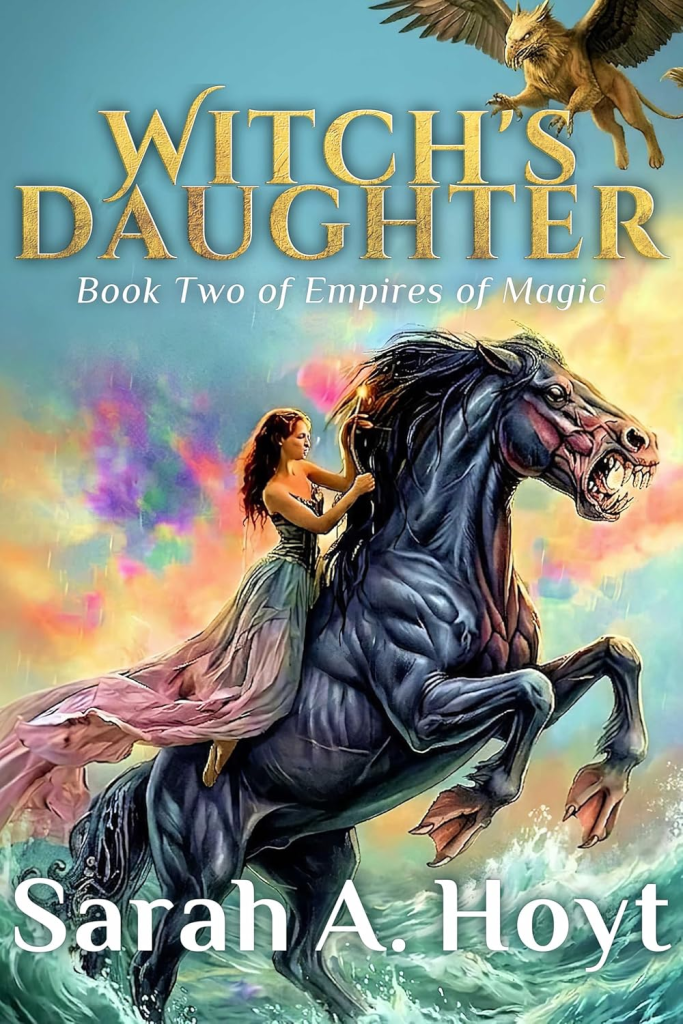
(This version is not copy-edited. It’s out at the copyeditor, and I hope to upload the clean version tomorrow.)
Witch’s Daughter
by Sarah A. Hoyt
The Letter
It has often been said that dead men don’t talk. In Avalon, this isn’t necessarily true. Dead men can talk if a reasonably talented necromancer is willing to risk the death penalty for reanimating a corpse.
But Michael had never heard of a dead man who wrote letters.
The letter lay on the breakfast table, next to the only setting on it, on a silver salve between the spoon and the porcelain creamer.
Michael Ainsling, youngest son of the late Duke of Darkwater and brother of the current titular, eyed it suspiciously, while he took his seat. His eyes widened slightly at the name of the sender, then he frowned at his own name in the space reserved for the recipient.
He hadn’t slept well. Dark rings marked the pale skin beneath the dark green eyes he shared with all his male relatives.
A well grown boy at the age when he resented being called such, Michael had that look boys have when they’ve achieved adult height but not yet filled in. He’d been the quiet half of fraternal twins, his sister Caroline being the garrulous and outgoing half. Then Caroline had been sent to an academy for young ladies, where she was presumably still garrulous but far away from Michael, so that Michael had to do his own talking and endure social interaction.
It had been thought – then – that Michael’s recent experiences had left him too frail to attend Cambridge. Michael frowned with distaste at the thought, as he folded and refolded his napkin. He did not believe he was frail. Nor did he understand why Seraphim had thought it better to leave Michael here on the deserted estate. With Caroline gone, Seraphim — now the tenth Duke of Darkwater and the prince consort of the Princess Royal — spending most of his time in London, and Mama having gone adventuring no one knew where, Michael’s was the only place setting at the table designed to accommodate twenty.
Most of the days he swallowed tea and toast and rushed off to work in his workshop. Today… He glared at the letter by his cup. Like it or not, he would have to face this problem. What could it mean?
He realized that the footman who’d discreetly followed him into the dining room still hovered near his chair. “You may go, Burket,” he said, without taking his eyes off the letter.
“Will you need anything else, Lord Michael?” the man asked and made a broad gesture as though encompassing the breakfast spread clustered around Michael’s place setting: fried kidneys and some sort of pie, and toast and butter and something else that looked suspiciously like fish cakes.
Michael didn’t sigh. “No, thank you, Burket. I have everything I need.”
Truly he wanted the man gone so Michael could look at the letter at leisure. The sender’s name was Tristram Blakley, and surely there couldn’t be more than one of those. The writing and the paper both looked fresh, as though someone had dashed off the note just this morning.
But Tristram Blakley had been dead for sixteen years. Michael had studied him among the great inventors of his time, the man who had created the carpetship liners that crossed the air between Britain and the Americas and took the upper classes of Avalon on pleasure cruises the world over. He remembered M ama telling him, once, that she’d known Tristram in youth, that he was a lot like Michael himself, always dreaming up new magical machines, but how he’d died young and how sad it was.
“Beg your pardon, Milord,” Burket said, which was when Michael realized the man had leaned over to pour him tea, and had almost poured it on Michael’s lap as Michael lifted his head.
“Thank you,” Michael said. “But you don’t have to pour my tea.”
Only now the man was buttering Michael’s toast and setting it on a plate, and smiling enticingly at Michael while nodding at the toast as though, for all the world, Michael were a toddler in need of being tempted to his food. “I know, milord, but you haven’t been eating, and what are we to tell his grace, should he ask? And he does ask, you know. ”
Michael picked up the toast with what he knew was ill-grace, and took a bite, while still frowning at the letter. He could well believe that Seraphim worried about his eating and his health and everything else. And that was nothing to what Gabriel— his older half-brother, once Seraphim’s valet and now the king of fairyland— would be. Those two had always mistaken themselves for Michael and Caroline’s parents. Michael was sure someone in the household was in Gabriel’s pay and sent him regular reports. It was a damnable intrusion.
When you have two older brothers who are far more powerful than you, and determined to protect, cosset and annoy you within an inch of your life, sometimes all you can do is play along. But Michael wished they’d let him read his letter in peace.
He took another bite, gulped down the tea, which was still hot and made his tongue sting, and then took another bite of toast, doing his best to simulate appetite he didn’t feel.
He had spent a restless and turmoil- filled night, dreaming of fairyland and his recent captivity in it, and it was all he could do not to allow a long shudder to go through him at the confused and patchy memory of that dream. That was the problem, too. In dream and memory fairyland was never anything clear and solid, anything you could rebel against and resent. It was a foggy, threatening recollection, in which places and people changed shape and essence, and in which pain and worse happened to you without warning.
“That is better, Milord,” Burket said, in the sort of kind, patronizing tone that made Michael wish they hadn’t forbidden duels and that it weren’t frowned upon to duel one’s social inferiors.
“Would you fancy a kidney? Perhaps a fish cake?” At Michael’s headshake, Burket stepped back, but didn’t leave, as Michael expected. Instead, he cleared his throat and looked towards the entrance door to the room, set next to the window that looked out over the gardens.
There was movement, and then two women and a man came in, all of them smiling widely, but all of them looking just the slightest bit embarrassed, as though they were doing something they shouldn’t be doing. The women were Mrs. Hooper, the housekeeper, starched and stiff in her black dress with its immaculate white collar, Mrs. Aiken, the cook, and the man was Dyer, the Butler.
What on Earth could be the matter?
Before Michael could even think to ask, Mrs. Hooper advanced, curtseyed, advanced again, curtseyed again, then beamed at him, again, as if he were an infant in the nursery, and spoke, “Lord Michael, since today is your seventeenth birthday, we thought it only fair…” She stopped and sniffled, as though she were fighting strong emotion, though Michael had no idea what that could possibly be. “That is, last summer, Milord, we thought you lost, and we wish you to believe we all hold you in the greatest affection, and therefore…” She blushed, which gave Michael all he could not to let his jaw drop in astonishment. Mrs. Hooper had never seemed fully human, much less capable of embarrassment. “Therefore we got you this gift, from everyone on the estate, to commemorate your seventeenth birthday Milord.”
She dropped a parcel wrapped in silver paper and neatly tied with a silk ribbon, upon the table, just north of the letter from the dead man, then beat a hasty retreat.
Michael’s turn to blush, and to fumble with the paper. And then he had the devil’s own time concealing the expression of astonishment on his face, and overlaying it with gratification. “Oh, thank you,” he said, staring at the tiny gold box with the miniature scene of Zeus in judgment worked painted upon the porcelain lid. A snuff box? Why in heaven’s name did they think he’d take snuff? Even Seraphim didn’t. Snuff was, by and large, a thing of their father’s generation.
But he also understood, immediately, how expensive such a thing was, and how much of a sacrifice it had been to the servants to contribute to it. That colored his voice and his expression, as he stood and said, “I am not good at flowery speeches, but—” He lifted the box and looked it over. “I am most gratified at your kind thought. Thank you. I thank you most heartily.”
The four of them curtseyed or bowed according to their different sexes, looking gratified, and left.
Which is when Michael opened the letter from the dead man.
Escaping The Tower
The problem with a wicked stepmother, Miss Albinia Blakley thought, as she stood in front of the mirror, wearing William’s clothes, and tucking her abundance of red hair into a hat rakishly set on her red curls, was when the wicked stepmother was in fact your real mama.
It was all very well, after all, for Miss Albinia’s brothers – who always called her Al – because Mama was just the woman who had married Papa when William, the youngest, was three, and was in fact no blood relation to them. So they had nothing to be either sorry or worried for. It wasn’t their mama who mistreated them so.
Oh, it had been terrible for them, from what they’d said, to find that their kind and absent-minded father had married a forbidding and interfering woman who was a powerful witch to boot.
But at least all of them, even William, remembered Papa . Albinia didn’t. She didn’t remember anyone but Mama, the sole authority and arbiter in her fifteen years of life. Albinia locked the door to her room as she thought this, and sighed, because now she was on limited time.
Mama didn’t like her to lock her door, ever, and there was no point at all imagining that Mama didn’t spell that lock, so that she knew the moment Al locked it. Mama spelled everything and kept track of everything Al did, which is what made this so devilishly difficult.
But spell or not, Albinia had to lock the door, to at least delay Mama and give her a chance to escape.
Because the thing was, Mama or no Mama, Al must leave and go find the boys.
She didn’t know if the boys had felt this way when Papa left shortly after marrying Mama . She didn’t know because they never spoke to her of that time, before Al was born.
What she knew was that Papa had disappeared shortly after marrying Mama, and had never returned. Presumed dead, everyone said.
And now the boys had disappeared. Al didn’t know where, but she knew two things. One, that Mama had made them leave against their will. And two, that wherever they were they needed Al. And at any rate, Al needed them. She had been raised by them since she was in leading strings, and their presence had made life at Wulffen Downs less than torture. Even if Mama was her real mama, Al was not going to stick around and have the full benefit of Mama full attention for the duration.
Whatever the duration was. It had been miserable enough since William had left.
She scrunched under the bed to find the old sheets she had torn and tied together. They had to be old and discarded, because that was the only way to make sure they were no longer bespelled. The spells wore out and weren’t renewed when the sheets were ready for the rag bag. It had taken her six months to find some and to braid them into a passable rope, in the few minutes a day Mama left her alone.
Tying the sheet rope to the foot of the bed and throwing it out the window was the work of a moment. Al’s mind ticked through where Mama would be now.
Even if she were close by—say in her room, as she would be at this time—she had to come up the North staircase, down the hallway and up to the door. Right now, she would be on the top step.
Al got the magical kit, likewise assembled painstakingly over a year, from discarded bits and ends, so that she could be sure no one had bespelled or could track any part of it. The hard part of it had been buying the herbs, because she’d had to spend her allowance on them, in a shop at the other end of Wulffen Downs, so that Mama wouldn’t hear about her purchases. And she’d had to wrap them so they looked like candy.
It had earned her a sermon from Mama about spending her money on tooth-rotting sweets. But she had got the herbs necessary for enchantments. She tied the pouch to a cord under her jacket, and then slipped the few silver coins left of her allowance into a pouch in her sleeve.
She could now hear Mama’s step in the hallway outside. Mama was clearing her throat, preparing to call her name.
Albinia pushed the window fully open, knelt on the parapet, and held on to the rope with both hands. She had remembered to put knots on the rope, and she set her feet on the first one, carefully, otherwise it would be like when she tried coming down from the cliff when she’d been bird watching with Edmund, and had got her hands burned, with the speed of sliding down the rope.
She clambered down the rope as, from above, came the sound of knocks and Mama calling “Open up. Open up immediately, young lady.”
She felt the little puff of magic as Mama opened the door with a spell, and she moved faster down the rope, because she had to be on the ground and running by the time Mama got to the window.
She had to go to her brothers. Samuel wouldn’t be able to look after them. He thought he could, but the others resented his attempts at invoking authority he didn’t have. And Geoffrey needed someone to help him make himself understood when he started stuttering and Edmund would turn his clothes, his room and everything into an aviary, and Aaron would lose everything, including specimens of marsh plants, Jeremy and Joshua would argue about everything and end up with ruined canvases and paints from throwing them at each other, and William was likely to disappear into his music, and Samuel would just go all extremely disappointed at all this, which helped nothing.
Albinia looked down to see how far the ground was. She had measured the tower where her room was situated. She’d calculated the height to the window five different ways.
But as her stomach sank to her feet, she realized none of that mattered now. Because she was not suspended from her own home manor’s window, but from a window open on a façade of glass. In fact, it looked like she was hanging from a giant glass rectangle. Except that as she looked forward, she could see these were windows and that oddly dressed people inside the building were pointing at her and a woman was covering her mouth, but looked like she was screaming something.
Gone was the tower of the manor house on the cliff, overlooking the ocean and the familiar marshes. Mama. Mama and Mama’s magic!
She could feel as though an abrasion upon her magic, as if something in this strange place were trying to get through her magical shields.
Beneath her, there were flashes of moving things that she couldn’t understand and the sound of klaxons, superimposed on a low roar as of a million voices.
She had no idea where she was, dangling here, between Earth and sky, on her fragile ladder of sheets.
All she knew was that the ladder ended far short of the ground. More than the height of Al’s tower.
Far above, Mama leaned out the open window, and Mama’s voice called, “Albinia Blakley, you little idiot. Hang on. I shall pull you in.”
But if Al let Mama pull her in, she’d never ever get away again. Al let go of the ladder.
She let go before she could think. She let go knowing only that she couldn’t stand to go back in and explain herself to Mama. She let go knowing that she must get to her brothers, somehow, but not knowing how, except that she must get away from Mama and Mama’s magic, first.
She tumbled downwards, head over heels, wondering how it felt to hit the ground so far below. All her carefully constructed protective and helpful charms in candy wrapping rained down onto that distant pavement. They wouldn’t save her.
Would it hurt? Would she even feel it? She hoped she didn’t land on some innocent and kill them, even as air escaped her lungs and she couldn’t find the voice to scream.
Rescuing the Dead
Michael frowned at the letter. It was undoubtedly addressed to him, by a man who couldn’t possibly have known of his existence, unless he had read the announcement of Michael’s birth in some society newspaper once upon a time.
Swallowing tea and toast as fast as he could, Michael put the snuff box in his pocket and retreated to his workshop.
Properly speaking, he had two workshops: one in the house, a room that had taken his father a substantial portion of the family fortune to build for his ingenious and precocious son, and the other deep in the garden, where Michael assembled and tested those experiments that might explode or otherwise cause damage to the family.
The workshop in the depths of the garden, he’d all but abandoned. Even if a changeling had been left in the inside workshop, it was from the outside workshop that he’d been abducted with a cunning spell from the — now fortunately deposed and dead — king of fairyland. And though Michael was quite sure the present king of fairyland, his brother Gabriel, had no intention of kidnapping him, he felt alone and vulnerable in that building. It had been violated once, and so it could be violated again.
The inner workshop would be harder to breach. For one, when it had been claimed from its previous use as a ballroom, it had been lined in leather between two layers of copper, the whole bespelled, forming an impassable barrier to both organic- and inorganic-affecting spells from outside.
In the ballroom, a sort of platform had been built, and up on it, Michael had his sky-observing apparatus, designed to help him calculate the form of spell to use.
The rest of the workshop held machines of Michael’s own invention, many of which now seemed impractical and childish to him. Take for instance his careful replica of the world of Avalon, in brass, rotating in proportional time around a miniature sun. It had been fun to build, but what practical use was it?
Since Seraphim had visited the Madhouse, the strange parallel world without magic where the Princess Royal had been raised, and brought back ideas for useful machines like shavers and mixers and clothes and dish washers, Michael had been working hard on magical replicas for such wonders.
The clothes washer was a success, except that the housekeeper had banned its use, saying it was an abomination and would run laundresses off their jobs by the score. However, Seraphim had arranged to have it tested in the royal palace and it was well on the way to becoming accepted in other, less hidebound households than the Darkwaters’ country estate. Seraphim said it would make Michael a fortune.
The automated barber, though… Michael frowned at his creation standing by the workbench near the far wall of the room. It was not a little portable thing, as Seraphim had described, because Michael had believed by making it large and capable of giving haircuts as well as shaves, it would be more popular. Particularly if it could also dress the hair of young ladies.
But all the thing had done, in actual fact, was chase Michael through the house, trying to cut… not his hair. The bits of his jacket it had got had been enough. Michael was not sure what had gone wrong with the animating spell, because when a cylindrical, man-high thing is wheeling after you brandishing knives, razors and scissors in its many arms, the only possible thing to do was to run as fast as possible.
Which he’d done, until Dyer had shot the mechanical barber through the head with a fowling piece. Michael stared at the multiple holes perforating the creature, right through the space where its directing magic had been. Well, never mind that. This was not a good time to attempt to reproduce that… experiment.
Michael perched on a high stool near the model of Avalon and tore into the letter, breaking the seal which showed – he’d swear to it – a lamb devouring a wolf, with the words Scientia et Astu beneath.
The letter started formally enough. “Dear Lord Michael Ainsling, You’ll forgive my addressing this letter to you, though we’ve never been formally introduced, or, indeed, introduced at all.”
And it proceeded strangely. “You might have heard of me, and have some idea that I am dead, but do not let that concern you, as rumors of my demise have been greatly exaggerated.”
Michael chewed the corner of his lip, perceiving that the person who’d written this letter, in strong angular handwriting, was what Mama would have called an original. And by original she normally meant that they needed help finding their way across a street, and were none too certain where they might have placed their head that day. She had been known to describe Michael himself in such a way.
“Whether you think me dead or alive, I suppose it will be a matter of some concern to you how you come to be receiving a letter from me, and also possibly some curiosity as to what you can do to help me, or hinder me, or indeed do anything in my case.
“I’ll tell you the truth. I do not know. I have cast and recast these runes, and all I can tell is that there is only one person in the world capable of understanding my work – and you must understand what keeps me prisoner here is my own work turned against me – and disabling it, so I might perhaps be set free.
“I have never had the pleasure of meeting you and the last thing I’d expect would be that the Ainslings would throw any kind of magical genius in the normal way. Pardon me for saying so, but your father was one of the accredited adventurers of my time, in more ways than one, meaning he was rather more adept at using other men’s magic all too often in order to use their wives likewise. And although your Mama was one of the beauties of her day, and indeed a diamond of the first water, I never found that she had an inquisitive and mathematical turn of mind. But then, of course, sometimes every breed throws a sport, and my runes assure me that you are that. A magical genius, I mean, not a sport, though I suppose that also.”
By this time Michael’s head was whirling and he felt he should have had rather more than one cup of tea to fortify himself to deal with this very strange missive. Or perhaps he should have had brandy, except that none of the servants would let him have it, or at least not without telling Seraphim. And maybe Gabriel. And all he needed was for his older brothers to decide he had turned into an alcoholic.
“However, before I can request that you rescue me—though I do, of course, request that—I must ask you to find my sons. The rest of them, as one has found me. You see, the woman I married, in what I’m sure now seems to me like a fit of madness, has applied some sort of spell to them, so I can no longer track them nor communicate with them.
“I’m afraid she means to do away with them and use the lands of my ancestors to form a dowry for her whelp. And while I have nothing against the mite, who was not born by the time I got confined to this place, and whom my sons inform me is a pretty good sort, in the way young females sometimes are, and not at all like her mother, I do not wish for my legacy to pass wholly into her hands and those of whichever rogue Augusta chooses to marry her to.
“I presume you have a row boat of some sort on your property, as I vaguely remember there was a lake there, in which much boating was done in the summer. I remember the lady your mother looking very fine in a lace dress upon a boat, in fact. At any rate, if you apply the formula I enclose onto a rowboat, it should bring you where you need to be to start unravelling this knot.
“Since the full extent of the knot laid by the one I must call my lady wife is not known or understood even by me, I must trust in the formula and in the kindness of a total stranger to do what must be done. And my scrying assures me you’re the only stranger who can do so.
“In full hope, if not trust, of your doing what is needful, I subscribe myself your most grateful and devoted servant, Tristram Blakley.”
Having laid the letter down on his workbench, Michael stared at it, fully wondering whether the person who’d written was the – presumed dead – author of magical carpet travel on a grand scale, or simply a madman possessed of illusions of being such a parsonage.
It was not till he turned the page and looked through the formula, written in a hand that gave the impression of impatience with writing itself, that Michael blinked, whistled under his breath, and realized that this was indeed the work of Tristram Blakley.
No one else, barring an equal genius, could have come up with such a strange mix of magical formulae, turning a simple rowboat into a vehicle of both magical transport AND divination.
And Michael knew, as he knew his own name, that he would have to try it out. It was like climbing the tallest tree or exploring the most dangerous part of the woods. He’d like to believe he was doing it for the sake of the unknown Mr. Blakley who seemed to be in a terrible position, but in his heart of hearts, he knew he was doing it for the thrill of it and to prove that he could.
Enough of nights hemmed in with nightmares of fairyland, and of moping about the otherwise deserted estate. Michael wanted to be doing. No matter how strange the doing. He must answer the call to adventure.
The Kindness of Strangers
Miss Albinia Blakley didn’t scream. Or at least she tried, but as she turned over, her hair falling out and her cap tumbling lost to the street below, it seemed to her that the air robbed both her ability to breathe and her ability to make a sound. From above she heard her mother’s scream, but not what her mother said. From below other screams joined, together with some sort of strange musical instrument that sounded like a crazed goose. Or rather many geese honking.
She caught glimpses of the street below, the glint of something like metal boxes but in many colors. She tried to use her magic to slow the fall, but of course it didn’t work, when she couldn’t even think clearly.
And then from somewhere she heard a male voice. It said a jumble of words. Or at least the words sounded like a jumble in her ears, though of course, right then anything would.
Her fall halted. Not suddenly, but first slowing down, like a leaf falling gently from a tree onto the welcoming ground.
Only she didn’t fall on the ground. Or get a chance to straighten up. Instead, she fell face first onto something hard and wooden. As she recovered breath, she realized that the something she’d fallen on was moving, gliding rapidly through the air. Or perhaps not gliding, because… She blinked as she picked herself up to sitting on the floor of a small rowboat and looked at the boy who was rowing it. He was tall and dark, scowling, and plying the oars with a will. They were charging through the air, weaving and twisting, while Mama screamed above, ever more distantly, and below the screams had changed from a horrified to a strangely excited tone as the honking stopped.
“What?” Albinia heard herself squeak as she picked herself up. “How? Who—”
“Not now,” the boy said, between panting breaths. “We must get out of here, before the location affects the spell. In the madhouse, no magic persists for long.”
Like that, they seemed to push through… something, and there was the brief cold of what Albinia had learned to call the In-Betweener. She’d never experienced it, of course, not being allowed to perform spells that dangerous – or really to escape Mama’s orbit that easily – but she’d read about it in her instruction books. It was supposed to be the time you slipped between one world and the next, and you were nowhere. There were horrible warnings against getting stuck in the In-Betweener, unable to breathe, forever. Albinia had always wondered how anyone knew you could get stuck there, or if you died or if you just stayed suspended forever. Since there was no time in the In-Betweener, could you die there?
When she’d tried to ask such questions of Mama, Mama had told her that young ladies of refinement didn’t ask stupid questions. But she’d never explained to Albinia why the questions were stupid, or, indeed, what refinement had to do with it.
Now going through, for however brief a moment she was, she realized what had originated the talk of dying in the In-Betweener. Even if no one could know if it had ever happened. Only that someone hadn’t arrived to the place where they’d meant to go. The seconds – minutes?—In-Betweener felt like she’d been dragged head-first through hell. No. Not hell, hell would have been something, even if the something was pretty unpleasant. This was just…nothing. Humans couldn’t live in nothing.
She’d had no more than a moment to think this – or perhaps think was too clear a word. She’d in fact only had a moment to feel it, like one groping in the dark for an unfamiliar shape – and then they were out, into cool clear air, with bright sun and a smattering of snow flakes dancing in it.
And the boat was falling.
The young man whose boat it was – unless, of course, he’d stolen it – rowed more frantically, and the fall slowed down and changed into a glide.
“We’re in London,” Albinia said, delightedly, recognizing things only seen in woodcuts, the Thames and the Bridge, the tower of London, as they turned and glided in the air above the city.
The boy only gave her a dirty look. But maybe he couldn’t speak. He was red in the face and rowing fast enough that if they were on water they’d be achieving quite a speed. Maybe. Because he was rowing faster with one hand than the other, and seemed to be controlling the boat, to make them fall slowly in circles.
They weren’t the only traffic in the air. There were magic carpets, as she expected, some of them pretty scruffy and small, probably pieces of bigger gliders cut and sold at a knock-off price. Those seemed to be barely above the trees, and piloted by untidy boys carrying packages. She’d never thought of that but she supposed it made sense, to deliver purchases to ladies – and gentlemen – not willing to carry them.
There were only a couple of floating carriages, both with crests on their doors, and both, fortunately, well above them, so that there was no fear of being hit by them. She’d heard of those, or rather, read of those, in romantic novels of the kind Mama most strenuously disapproved of. They were expensive, both to build and to bespell, which meant that only the wealthiest who could command the best magicians had them. A lot of them were connected to the royal family.
The only other air traffic, too far away for her to see clearly, was what appeared to be a sort of airborne building. It would be one of those carpet-liners, the vast magic carpet supporting a first class hotel. Such plied the routes between Europe and other continents, and Albinia had often dreamed of going on a round-the-world tour on one of them. Papa had invented the spells for those, so they could be done by normal magicians, with an economy of power.
She was looking longingly towards it, thinking it was unfair she’d never be on one of those, when her papa had invented them, when the boat dipped and swayed abruptly. They careened downwards at speed, towards a sort of little wilderness in the middle of busy London streets.
She screamed and held to the side of the boat. The boy was almost not rowing. Was he mad? He didn’t even look at her when she screamed, his eyes fixed downward.
They fell past the small rug messengers, past the trees. Albinia kept trying to keep her eyes open, while they closed in sheer terror, and she forced them open again.
She must have closed them momentarily, because the first she knew about the small lake was when they splashed with force into the water. Water splashed on her face. Ducks screamed. She opened her eyes to see a flurry of feathers and ducks.
The boy was bent forward, his hands clasping his arms, his breath coming in ragged gasps.
She was dripping water, trying to wipe at her face, her hair sodden and soaked on her head, when the boy recovered enough breath to look up and fulminate her with as hateful and dark a glare as he’d given her before. “I—” he said. “I think you must be the most cowardly boy in the whole world. Why did you scream like that?”
Answers flitted through Albinia’s head, including that she had screamed because she’d been scared, that she didn’t think she was cowardly at all, and finally that she wasn’t a boy.
But the truth was that there was a reason she’d put on Geoffrey’s long outgrown suit. It wouldn’t do for a young woman, much less what Mama called – heaven only knew why – a “gently reared female” to be traipsing around by herself and under her own recognizance. Men – if Albinia understood correctly from the novels she’d consumed – were forever wanting to do something called “stealing the virtue” of women. She had absolutely no idea what that meant. No book she consulted explained it – just like not really explaining if you could die in the Betweener —but she assumed that it meant they could take your magic or steal your magic, because after all when a magical object stopped working it was said to have lost “its virtue.”
But that had never been very clear, because a lot of the protagonists in the novels didn’t have any magical power.
All the same, and just in case, she made sure there were protective spells over her, so he couldn’t steal any of her magic – however that was done – and decided to not tell him she was a girl. Instead she said, her voice scathing and her diction precise, “Well, and you’re quite the rudest boy I’ve ever met.”
To her surprise, he laughed aloud at that, the anger disappearing. “I suppose you can’t help it,” he said. “You’re just a scrub, aren’t you? How old are you, twelve? I see your parents never even had your hair cut.”
She started to protest, then grunted something that could be taken either way.
“And what’s your name?” he asked. “I presume you’re Master Blakley…”
How did this rude boy know her name? “I’m Al,” she said. “Call me Al.”
He opened his mouth. Closed it. “I’m Michael,” he said.
He took up the oars again, and started rowing more gently towards the edge of the lake. You’d think there would be people gathering and pointing at them by now, even if it was a cold day. Albinia wondered why there weren’t, and if the boy realized this was wrong. Then she realized he hadn’t given her a last name and looked at him curiously. Right. Well, then she wouldn’t ask. You could tell from his clothes and the way he talked he was a gentleman. But why wouldn’t he give her his name?
“Where are we going?” she asked instead.
He looked embarrassed. “I thought you might want to get dried and changed before I explain.”
Clear as mud, wasn’t he?
She wouldn’t give him the satisfaction of getting upset though. “Very well,” she said. Could it be any worse than being caught by Mama?
It wasn’t till they’d stowed the boat, and he’d done something that obscured it so it had become invisible, then led her across a busy street and galloped up the steps of an elegant townhouse, that she wondered if he was kidnapping her for nefarious purposes, like those things she had read about. Again she made sure the shield was fastened over her magic. She wondered if he had enough magic to feel her spell work, as he looked over at her out of the corner of his eyes, the green in them flashing in the light in a way that made her think he was amused.
He knocked at the door to the townhouse, and stood back, waiting, his body posture denoting impatience. She wanted more than anything to ask him who they were calling on. But she didn’t fully realize how much trouble she was in, until the house was opened by a liveried footman, whose face seemed permanently arranged in an expression of something like disdain. Which changed almost immediately. The man’s eyes widened, his mouth dropped open, and he said, “Lord Michael!”
She was well brought up. Well, in some things. One of the things Mother had made sure she consumed was the manuals of peerage and etiquette. All of them.
If this young man was being addressed with Lord and his first name that meant only one thing: not only was he of a noble family, but one of the noblest.
After all, only the sons of dukes merited that courtesy title.
Michael forged ahead, with a look over his shoulder calling her, “Come!”
And they were into the house, the footman barely jumping out of the way.
“Is Seraphim in?” Michael asked.
And then she realized: the name was unusual enough, she had to be at the home of the prince Consort. There was no other possibility.
She couldn’t swoon. It just wasn’t done in boy’s clothes. But she wished she could.
 According To Hoyt
C4C
LikeLike
I ordered it as soon as it went up for pre-order. Really looking forward to this.
LikeLiked by 1 person
Oh thank goodness — I have been waiting nearly forever for this to be finished and published. I’m glad your health finally allowed this to make it to the top of the list. :-)
Unfortunately I can’t preorder it because I did so when you firet announced that we could, though rediscovering that again is a peculiar pleasure all its own.
Looking forward to der Tag!
LikeLiked by 1 person
Glad to see your book is coming out. Not my style, but….
Anyway, do you think copyediting and proofreading can be done by the author? I received the dev-ed and made changes, but have exhausted funds for anything else. I’ve reread my story and along with ProWritingAid, should have all the typos and grammar issues settled. I was just wondering whether to hold off on publishing until I can get money for a copy/proof reader? It seems they’re more expensive than a dev-editor. I suppose I could just write, get a dev-ed, then try to go the trad route, successfully or not. Decisions decisions.
LikeLike
Probably. Er… my copyeditor is about 1/3 the price of a dev. editor.
LikeLike
So… maybe $150 for 95k words?
LikeLike
Try to copyedit in a different font and with a font color set.
Then do another pass, still another font, different color.
LikeLike