For those of you who just dropped (possibly on your head!) in here, this is what I’m doing and why.
Sorry to take so long between these posts, but mmm. Yeah. It’s been weird out here, with a bunch of traveling around and being sick and stuff. If you want to see the previous posts, search “future of the past” in the search bar.
Also, add to “why did this take so long” that this is an Heinlein title. From the time I moved to the US and could secure all of Heinlein’s works (the juveniles were hard to come by when I was in Portugal, most having been published while I was far too young.) I re-read Heinlein about every year. Sometimes every two or three years, because life intervenes.
But, anyway, I’ve read Heinlein a lot, so it’s hard to give the same type of “looking at it with fresh eyes” perspective I give on stuff I’m re-reading after a long long time, or perhaps reading for the first time.
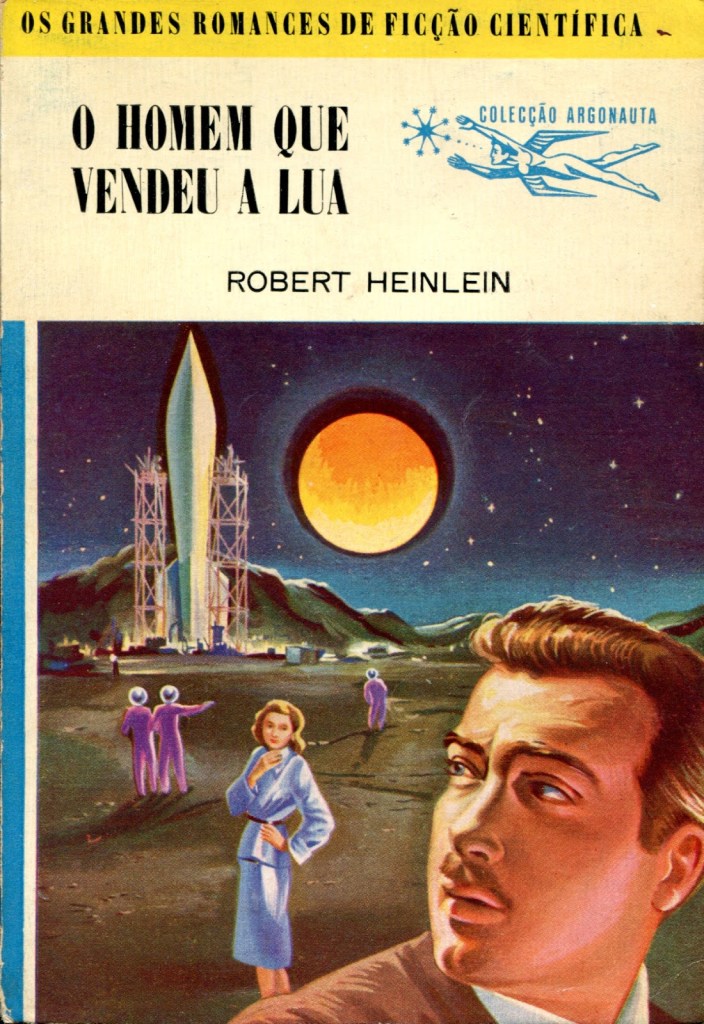
This is the copy of The Man Who Sold The Moon I bought for this. Interestingly, I’m sure I read it as a kid, in Portuguese, and also I’m sure that it was JUST The Man Who Sold the Moon. In the US it’s of course a novella and sold in various bundles. (In audio I have it in a future history collection.)
I think I’ve alluded to this in the past: Portuguese is a very …. expanded language. It takes more words and more difficult constructions to say what you say in English. (One example of this was translating the wedding ceremony (younger son’s) including the sermon so the happy couple could understand, which forced me to translate partial sentences because you can go on for three minutes and it translates as “I want them to realize they should try to be happy even when they’re not.”) Anyway, this means that English sf was often translated as duologies or trilogies, unless the novels were very very short. Like… a canticle for Leibowitz was two physical books, and a lot of Heinleins were trilogies.
Anyway moving right along:
Robert Anson Heinlein was born in Butler Missouri in 7/7/1907. The always biased Wikipedia will have the basics of his life and career here.
On his life I’ll only say that Heinlein is a good example of iterate till success in everything, from marriage to career, and gives hope to the lot of us who have not been instantly successful, shall we say. (Though I lucked out on marriage.)
Wikipedia mentions that Heinlein was a hard science fiction writer, and of course for his time he absolutely was. However I’d like to enjoin all my friends and followers who write hard science fiction to study him.
Modern hard science fiction is hide bound and too scared of stepping wrong, while Heinlein’s magic came from melding absolutely hard science (of the time) with traditional story forms to create ripping good yarns with a solid science foundation.
The Man Who Sold The Moon is precisely that. It’s the romantic scoundrel, the adventurer, the explorer. Only the romantic scoundrel has an obsession a lot of us empathize with: he wants to go to space. Which at the time meant the moon first.
May I say, it’s weird to read this after the trip to the moon, and still feel the same surge of excitement as he sets it all up to reach his goal.
The other thing I’ll say is that, in particular compared to the writing of science fiction of the time, while The Man Who Sold the Moon has pulp-pacing it is much more realistic. The problems they face are not alien mind control or another evil scientist trying to steal the rocket, but sane, completely plausible bureaucratic and financing and engineering problems.
It is in fact a highly crunchy story which once you swallow the moon-obsessed multi-talented main character is completely plausible.
And Delos Harriman is impossible not to love. (The difference between him and our very own Elon Musk is that Delos is a salesman possessed of the common touch, which Elon seems to be lacking. He does what he can with what he has.)
The end sequences, where he remembers seeing Haley’s comet as a kid and wanting to touch it, I wonder if those were autobiographical?
Also, having finished the story, I’m struck by the fact that it is far more plausible — and immensely more American — than the way we actually got to the moon. Going tot he moon via government program and purloined German scientists was always an improbable plot twist, one that seems to be a result of the deformations induced on our system by FDR. In fact, I find it wholly implausible, and DD Harriman by far the better way of getting to the moon, and most likely one.
No wonder Heinlein’s version lead to sustained space exploration and ours didn’t. (Though maybe we’ll fix that.)
And here let’s hold a moment of admiration for Heinlein’s naming. Delos, of course, a worth descendant of Dedalus, a son whose wings — this time — didn’t get singed by the sun (or perhaps did, considering the ending.) And he did in fact harry man onto space exploration. We should all be possessed of the deep symbolism and ability of a Heinlein.
Speaking of which, that ending is one of two Heinlein endings that always has me in tears, no matter how often I read it.
It is sad, of course, but also wonderful because he got what he wanted.
I think that is all I have to say about The Man Who Sold The Moon, other than, you should definitely go an read it.
Oh a passing funny. I swear the author of the Portuguese translation cover put in a Heinlein look alike. Also, the woman in the background is pure artist’s imagination. This is one of the few Heinleins in which there isn’t really a love interest (unless it’s the moon.) Delos’s relationship with his wife hardly matters except as a complication.
Next up by Argonauta listing should be this:
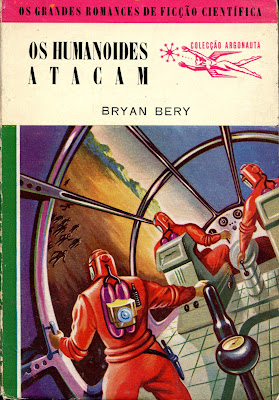
The title in English is From What Far Star, and there are used copies available. Je suis desole, but I’m not buying it (Cheapest I’ve seen is $19.) If one of you has it or wishes to get it for me, that’s fine, though I highly dislike paper books at this point in life. (Eyes, mostly. E-ink is easier.)
However, before we do that, we’re going to take a circle-back and do David Starr, Space Ranger, by Isaac Asimov. (Thank you to Uncle Lar who insisted on sending me a copy.)
This is the Portuguese title and cover:
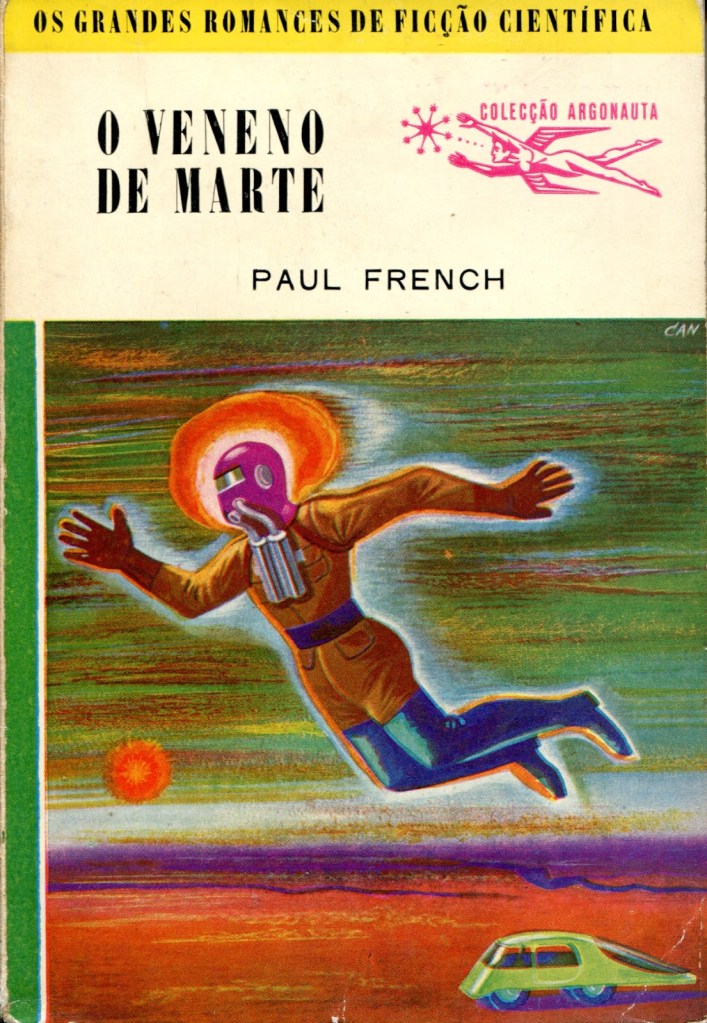
(Yes, Paul French is Isaac Asimov. No, I’ve never read the book, so it will be interesting. No, I have no idea why it was called Martian Poison in Portuguese.)
So, that’s next week.
Until then!
 According To Hoyt
C4C
LikeLike
Late c4c
LikeLike
And “Delos” was the brand new, not quite finished, island where Apollo and Artemis were born, which later became a site of one of the greatest oracles of the ancient world
LikeLiked by 2 people
Yes. Of course. How did I forget that? Artemis the moon. DUH.
LikeLike
Nomination time
https://www.goodreads.com/topic/show/23184389-august-2025—-a-sequel
LikeLike
I’m curious – did the Portuguese edition include the short story “Requiem”? From your post, it seems so. (The recent issues in English apparently do not – they combine it with “Orphans of the Sky” for some reason.)
LikeLike
Yes.
LikeLike
Ah, your post makes a little more sense to me now, in terms of getting what he wanted.
LikeLike
Regarding your upcoming adventure into “Paul French” territory: Why is it called “Martian Poison”? Heh. You’ll find out, although please don’t read it near anything fragile, you might break things through the mystic medium of flying books.
LikeLiked by 1 person
Asimov wrote a lot of juvenile “basic science” stuff. Elementary school libraries bought them by the truckload, and most of them are still in print. They use a simplified vocabulary and don’t go into extensive detail, but they gover the basics without talking down to the reader.
But even as a pre-teen, I thought the Lucky Starr books were aimed a very young audience. Or perhaps, “what parents of the day thought their children ought to read.” I think I read three or four of them simply because they were there, but couldn’t muster the enthusiasm to pick up the next.
LikeLike
So far as “educational science” books aimed at the very young – I preferred the Miss Pickerell and Danny Dunn books more than the Lucky Starr ones.
I thought then, and probably now if I were to reread them, that the protagonist was simply a milquetoast version of Kimball Kinnison.
LikeLike
Oh, goodnees NO! While Kinnison was the product of a ages long selective breeding program, he had to go through the trials and turmoil to be able to exhibit his latent abilities. Lucky Starr was pretty much just that – lucky. Lucky Starr also had a immensely annoying sidekick (yep, you can tell these were aimed to be plots for a TV show). Kinnison had associates who were friends, and capable in their own right.
Of course, “Doc” Smith never met an adjective (or an adverb) he didn’t like, and he used every one of them. It was, however, the series where I learned the meaning of the word “toothsome”. So inaddition to being nonstop fun, it was also educational!
LikeLiked by 1 person
Danny Dunn was a staple of my elementary school years.
LikeLiked by 1 person
Good times, yeah. I read so many of those books.
LikeLike
I’ve always thought they read like little TV serial script treatments. I can’t remember if that supposition is fact.
LikeLike
LOL
LikeLike
Anyone notice Harriman could be Musk?
LikeLike
Well, yeah, Sarah did a compare and contrast about paragraph 16.
LikeLiked by 1 person
No. Harriman was more of a “common touch” guy. Other than that, though, yeah.
LikeLike
Harriman – social engineer. Musk – mechanical engineer. I’m at a loss to think of anyone that has ever combined the two into a single personality, famous or not.
LikeLiked by 1 person
Musk is trying to be a social engineer via the tech he invents. .
LikeLike
The story is almost a reply to Ayn Rand, isn’t it? Getting it done by digging in?
LikeLiked by 1 person
I think Daniel Boone Davis of Door Into Summer is a closer analog than D.D. Harriman. Tesla is even working on a robot that seems to have some of the Protean Pete like capacities.
LikeLiked by 1 person
The ending of TMWSTM is bittersweet and moving. It’s the ending of “Requiem” that yanks the tears from my eyes. And he wrote that one first, by several years, interestingly.
As to the deformation of the culture by FDR, I think you need to go earlier, to Wilson and TR, if not a bit earlier than that. Heinlein’s despising of “Mrs. Grundy” goes back to his boyhood, and what is the bureaucratic state if not Mrs. Grundy (first name Karen) given legal unassailability?
LikeLiked by 1 person
Same here! I didn’t know he did Requiem first, though.
LikeLike
“Requiem” was published in Astounding in 1940, The Man Who Sold The Moon in the self-titled collection in 1950 (which I did not know until I checked just now, I had always assumed it first appeared in one of the slicks around 1948 or so; it’s remarkable he wrote such a damn good story to round out a collection).
LikeLike
It’s conceivable that he wrote it first and had trouble placing it — improbable, though, given the pulp era.
LikeLiked by 1 person
Also highly improbable just given his skill as a writer comparing the two stories. RAH started strong, no argument about that, but he kept improving as he wrote, and TMWSTM is a much more mature piece than “Requiem” in terms of writing craft.
LikeLiked by 1 person
Oooh. I must have Karen Grundy in a book…. Or does that telegraph too much?
LikeLiked by 1 person
Only to Those Who Know. I’m fairly sure “Mrs. Grundy” is not generally remembered.
In fact, someone should do a whole cultural archeology thing on all the things Heinlein assumed “everybody knows” because they did at the time, but no longer do. Some are more obvious than others, like the people of his future society in Stranger having any clue who Lippman and Winchell were, let alone well enough to contrast the two.
LikeLiked by 1 person
Well, Jill knows, but her boyfriend’s a newspaperman. Jubal, who knows Everything, is confused about which is which.
LikeLiked by 1 person
It’s been long enough that I forgot that detail.
LikeLike
He also had enough view into how future happens that he applied it with a light touch, like his flying cars having a lift fan burn out so they automatically safely put down on the remaining three, or what was in effect computer aided design in the time-travel one, or not making a big deal about what are effectively cell phones as “belt phones,” plus then working out how to write what was in effect a mystery without the damn cell phones ruining it, all underneath the hood of a engaging story and characters.
And I just realized “underneath the hood” will be probably become one of those “look up what they meant” things, like “dial the phone” (“why did they call it ‘dialing’?”) as yet more future happens to us all.
LikeLiked by 1 person
Because ‘poking the phone’ just sounds so, sooo wrong. :-P
LikeLiked by 1 person
I wasn’t criticizing him on this point. It’s impossible to know what will be remembered and what will be forgotten, and he also had to write for his audience then, and let the future attend to itself. But the things he assumed are interesting, more so than most other SF writers (IMO).
LikeLiked by 2 people
No criticism from me either. It just struck me on rereading whichever juvenile it was in that “belt phone” * was another “water bed” or “drafting Dan” that he basically put in as a throwaway line to make it feel “future”, but that accurately captured something we now have.
—
* or the flying car motor redundancy practicality, or the discussion of how to get around ATC when it’s set up as an uber-safety all-seeing “no sparrow shall fall” system, or his ideas on 3-vote redundant computers for critical flight control systems, etc. etc.
LikeLiked by 2 people
some might be regional.
LikeLike
Could be, but RAH was well-traveled enough (and acquainted with people from enough different places) when he began writing that I assume if he used a regionalism, it was deliberate. “Mrs. Grundy” was a common reference in the early 20th Century.
LikeLiked by 1 person
Looks like a common reference throughout the 19th and early 20th century (https://en.wikipedia.org/wiki/Mrs_Grundy its wikipedia for what that’s worth). Actually, Mrs. Grundy is from a late 18th-century play where she doesn’t actually appear as a character.
LikeLiked by 1 person
Wikipedia is generally trustworthy on non-controversial topics, weirdly enough. Always pays to check the references, of course.
LikeLiked by 1 person
Yep, in general most non-controversial stuff is OK although anything referencing more modern entities may be manipulated to favor said entities. Also much of it’s coverage of Christianity favors the more modern liberal interpretation of scripture and favoring the much later (2nd or 3rd century) origin of the written sources rather than the traditional mid to late 1st century origin.
LikeLike
That would fall under “controversial”.
LikeLike
Miss Grundy dates to 1941, Archie Comics. The reference is getting obscure from disuse. However, it appears in that “Riverdale” reboot.
There was an Archie reboot.
My brain hurts.
LikeLike
According to both Wikipedia and Grok:
Mrs Grundy originated as an unseen character in Thomas Morton‘s 1798 five-act comedy Speed the Plough.[2] The figure of Mrs Grundy became well established in culture: as early as 1813 The Examiner referenced her (with a specific nod to Speed the Plough),[3] and in Samuel Butler‘s 1872 novel Erewhon, the goddess Ydgrun (her name an anagram of “Grundy”), dictates social norms. References to “Mrs Grundy” as a personification of propriety, as well as to “Grundyism”, “Grundyists” and “Grundyites”, can be found throughout the English-speaking world[4] and beyond.[5]
I know C.S. Lewis referenced her as well.
LikeLike
I have trained myself (mostly) to use “Mrs. Grundy.” The SIL’s name is “Karen” – and she’s not like that. I don’t know any person named “Grundy” for me to worry about offending. (Although they apparently do exist, the poor sods…)
LikeLiked by 2 people
Well, there’s Solomon, for one…
LikeLike
The guy in the nursery rhyme or the supervillain named after him?
LikeLike
I should have said “for two.”
LikeLike
Yes? [Twisted Grin]
LikeLike
I use “Kravitz” as in “Gladys Kravitz” – Bewitched.
LikeLiked by 1 person
I like the first Mrs. Kravitz better than the second. Though the second had huge shoes to fill. (There are actresses who could have played her credibly, but they should have just have had the Kravitzes move to Florida than replace her with the actress they did.)
LikeLike
Random thought, is it a pun on Venus in Portugese? (Venemos / Vênus)
LikeLike
Nope. Not even vaguely. Portuguese is remarkably pun-poor anyway. But Veneno is simply the Portuguese word for poison.
LikeLike
Poison?
LikeLike
Poisoned food from Mars is a story element in the first “Lucky Starr” book.
LikeLike
Just a drop.
LikeLike
The Man Who Stole The Moon by R.A.H.
The last time you mentioned this story, I linked you to Charles Sheffield’s “The Man Who Stole the Moon”. This time let me recommend Larry Niven’s “The Revenge of William Proxmire” where the eponymous senator creates a time travel project to cure Heinlein’s ‘cough’ before it destroys his naval career. When a stranger in civvies shows up on your tin can in the 1930s with a high tech injector and says he has a cure for your cough then you take the injection. Proxmire figured without Heinlein the writer a lot fewer people would go into STEM and he’d have an easier time promoting his social programs. Admiral Heinlein had other ideas though.👹
LikeLike
Okay, having refreshed myself of the plot (which says how much I did not care for the book, as I can remember the plots, if not details, of any book that I’ve enjoyed) – “Martian Poison” is a reasonable re-titling.
Not going to say why, as I don’t think you’re going to enjoy it all that much even without spoilers.
LikeLiked by 1 person
Thanks for the reminder/review. Thinking I read this as a pretty young kid, cause some of what you’re saying rings bells. Have to go get a copy.
LikeLiked by 1 person
Edit: remembering Selling the Moon
LikeLike
Looking at one of my Signet “The Man Who Sold the Moon”, (second printing April 1959). The cover is both very similar, but different from your cover. Sort of one of those find 6 differences puzzles.
There is no moon or starry sky. It is just yellow. The man’s face is similar yet different, the mouth is not the same, yet it seems the same man. The woman almost the same, her hand is slightly moved, and some shadows are different. The topography of the hills differs, and the 3 men in the near distance are also slightly different.
The notes at the start of the book indicate that two of the original stories have been removed since the first printing. “Life Line” and “Blowups happen” have been omitted. So this copy contains 4 stories: “Let there be light”, “The roads must roll”, “The man who sold the moon”, and “Requiem”. It also has a Heinlein preface, dated 5 may 1949, where he notes his future history, also included in the book, shows men landing on the moon in 1978.
LikeLiked by 1 person
The woman on the cover bears a passing resemblance to the (very) young Virginia Heinlein. I wonder if the artist put her there solely to lampshade his portrayal of Harriman as Robert Heinlein. Never mind just one; he put both of them on the cover.
LikeLike
My thought about the woman on the cover was that she was in front of the rocket ship in a pose that sort of signaled “Me or her.”
In the story I think Harriman’s wife had a similar scene and he chose the ship. Later on I think there’s mention that she’s suing him for divorce, allied with the others trying to prevent it from flying.
However I may be misremembering things. It’s been a long time since I read it.
LikeLike
As a youngster; I enjoyed the “Paul French” books; the science is now dated but they are still good reads. Something I didn’t realize until long after I first read “The Man Who Sold the Moon” was the significance of D. D. Harriman’s last name
The Harriman’s were part of the “Big Four” families who financed the Soutern Pacific railroad that connected California, and then Southern California, to the rest of the country. IIRC, Stanford, Crocker, and Huntington were the other involved families.
LikeLike
I’m on a long quest to purchase all of Heinlein from used bookstores and thrift shops. Of course, Amazon exists, but there’s no adventure to that.
LikeLike
/archive dot org /details/spaceranger0000asim/page/25/mode/1up?view=btheater David Starr
LikeLike
In addition to the classical references–which I confess I hadn’t given much thought to–Delos D. Harriman may be a tongue-in-cheek reference to W. Averell Harriman, the scion of a successful business family and later governor of New York.
I’ve been telling people that Elon Musk is the 21st-century Delos D. Harriman for a while now. My conviction on the subject was reinforced when I read an article pointing out that pretty much everything Musk has decided to do would be useful in building a Mars colony, even the less-successful enterprises such as The Boring Company. Delos D. Harriman spends his life building a business empire to fund his moonshot: Elon Musk is spending his building an industrial empire to support his Mars colony.
You make an interesting observation about the length of books. It’s been my observation that at least in the SF world, books have been getting longer my whole life. When I was a lad, Heinlein and similar authors were writing novels that ran to 250-300 pages, whereas nowadays you’d be shocked to find a novel under 450-500 pages. And although I don’t believe Heinlein’s work is represented there, many of the SF novels I read back then were Ace Doubles, thus even shorter in many cases.
LikeLiked by 1 person
Page count can be monkeyed with, what matters is word count. In the 1950s and 1960s, science fiction was a ghetto genre in an industry still recovering from paper shortages from the war, so publishers pushed authors to do novels in 80k words or less (some of the Ace Doubles are 40k or shorter per “novel”).
Heinlein had a battle with his publisher over Stranger in a Strange Land, which he turned in at, IIRC, 220k, and the publisher demanded he cut it to 150k. The published version was 160,013 because Heinlein held that he couldn’t cut another word at that point. Glory Road, his very next book, ran… I want to say 120k, but might be wrong. Long for the market, shorter than Stranger, and the publisher accepted it without complaint. I think the bestseller status of Stranger and, just a couple years later, Dune, quietly ended publishers’ word count mandates.
However, the trends of book length in SF are not linear. The heyday of the goatgagger or doorstopper was probably the 1980s, though you can find many examples into the 1990s, for sure. But readers are wanting shorter books just now. And for that and other reasons, Raconteur Press (where I am lead novel editor) holds the line on novels at about 100k. Longer than that, it either needs to be cut, or be two books, depending on the specific context.
LikeLike
They’re getting shorter with indie publishing. And heck, some of the Rex Stout or Clifford Simak novels were barely 200 pages.
LikeLike
Kipling is in mourning…..
https://www.kiplingsociety.co.uk/poem/poems_threedecker.htm
LikeLiked by 1 person
See Book of Bone up there? That’s an honest to goodness novelette.
I’ve put out novellas too, as well as short novels.
LikeLike
Larry Niven “The Revenge of William Proxmire”. The Senator goes back in time to prevent his tuberculosis from destroying his naval career. So Heinlein never becomes an author.
LikeLiked by 2 people
The payoff to that story is brilliant.
LikeLiked by 1 person
While not my favorite Heinlein of the period (I much prefer the story it is a prequel to, “Requiem”) it is above average for Heinlein meaning it is well above the general market’s standard for “good”.
If you are a writer interested in the nuts and bolts of Heinlein’s telling such ripping yarns, or even a reader desiring a peak behind the curtains, I highly recommend The Secret of the Heinlein Juvenile by J. Daniel Sawyer.
Full disclosure, Dan is an acquaintance and I participated in the Kickstarter for the book. Paper sold out long ago but the Kindle is available.
Amazon: https://a.co/d/9clRRI2
LikeLike
While not my favorite Heinlein of the period (I much prefer the story it is a prequel to, “Requiem”) it is above average for Heinlein meaning it is well above the general market’s standard for “good”.
If you are a writer interested in the nuts and bolts of Heinlein’s telling such ripping yarns, or even a reader desiring a peak behind the curtains, I highly recommend The Secret of the Heinlein Juvenile by J. Daniel Sawyer.
Full disclosure, Dan is an acquaintance and I participated in the Kickstarter for the book. Paper sold out long ago but the Kindle is available.
Amazon: https://a.co/d/9clRRI2
LikeLike
What if I may ask was the other Heinlein ending that left you in tears? And if I might recommend a book of his I just reread, the Doors into Summer. That has a spectacularly wonderfully written opening.
LikeLike
The end of The Moon Is A Harsh Mistress, when Myke won’t answer. EVERY TIME. Right in the feels.
LikeLiked by 1 person
If I would have had to guess, that’s what I would have said. The whole ending though. as you see the moon turn into a bueracratic state is depressing.
LikeLike