But many times, even if the ritual is done correctly, what you get from the demon isn’t “what you really want”.
And of course, unless you “Get Right With G*d”, you’re the play-thing of the demon (or its masters) after your death because you thought it was a Good Idea to summon a demon.
Erwin pulled back his wounded arm and was sick on the ground. It took some time, even though his stomach was empty. When he looked back at the demon, she was sitting cross-legged in the middle of the of the circle. The weakness and burning were gone. She was huge, a hulking gray form, with coarse fur and yellow eyes.
“Interesting,” said the wolf conversationally. “As necromancers go, you are not much to look at.”
“I am not a necromancer,” said Erwin wiping his mouth. “I did the ritual, but no one died. Not even the wolf, I found her dead already.”
“Oh?” asked the wolf skeptically. “More interesting. So, you thought it would be a good idea to summon a demon with nothing to bind it? What’s to stop me eating you, skinny boy?”
“Gratitude?” suggested Erwin a bit crossly, because he was in shock from the cut. He was seeing stars. “And the circle. Mind you don’t touch it, the magic will give you a burn.”
“You mean this circle?” she asked casually. She reached out a claw and slowly drew a line through it.
One possibly-under-appreciated virtue of the ‘Oxford’ or ‘serial’ or ‘extra’ comma [A, B, and C not A, B and C] is that it lets you do lists-of-lists stuff, like…
“…blood and toil, sweat and tears…”
(which is the way I remember first reading it, though some sources now have it all as a single list… either this is post-speech ‘copy editing’ done on Winston Churchill(!) of May 13, 1940, or else we have us another instance of the Mandala/Mandela Effect…),
without ‘breaking’ the entire format. (Of course, if your lower-level lists run to more than 2 items each, then it seems you must resort to expedients like “…red and white and blue, blue and yellow, red and green and white, and…” — but you can still do it and get your precise meaning on to the page.)
There might be a small number of pandas involved in violent ‘dine and dash’ activities, for whom ‘Eats, shoots, and leaves’ would be appropriate description.
Quoting “like this”, not “like this,” is apparently a British thing (though they also use single quotes where we’d use double and vice versa, etc. etc.).
Years ago as a (college-era) copy editor, I started out with the British “what you see is what you get” or “honest” quotes — but got talked out of it by so many complaints. Still makes a lot more sense to me than American or quoted “almost,” but not quite right, ones…
For whatever it’s worth, I was progamming back then too.. had probably already finished my second Forth-in-assembly by then, for instance.
And the required precision of thought (and action) is indeed… contagious, into other non-programming things. (“We are not built to comprehend a lie” — just as Kipling said.)
It all depends on exactly what meaning you want to convey to the reader. Sometimes the comma conveys that meaning, sometimes the absence of it does a better job.
As for quoted punctuation, if you end a sentence with a quote that itself ends with a terminal punctuation, do you really need another one?
———————————
There is but one greater sin than to be right when those in power are wrong — proving it.
To me it reads as if the students will be protected, but it is a warning to staff and visitors. (As in “Staff and visitors, beware, certain employees are armed and …”)
1:52:33 is part I of MCMLXVII of volume one of the first series. More or less the intro and laying of the groundwork, as it were.
Amateurs generalize and let it go at that. Hardened veterans have references, histories, examples, and opinions on just how bad Rome f*cked up and may a bone to pick concerning the many, many insults that government hath wrought over the millenia.
Are your sure? The Reader heard that Satan was so disgusted with the poor quality of souls he was getting from the Democratic party that he was considering starting a third party.
Here we have part of why we see anime (particularly catgirl type ones) and Cats as cute. The large cheeks, exaggerated eyes and outsize head are all also features of human infants. Nature has made us (perhaps inordinately) fond of human infants (if it hadn’t none of us would be here discussing this :-) ). It is thought to be part of why we find cats (Who can be raving nuisances) so appealing and perhaps part of why we helped them self domesticate in the first place beyond their obvious value in pest control.
Okay, we know colonial Philadelphia was all businesspeople and nerds, but I just ran across a hilarious article on Philadelphia’s standard of women’s education and reading. (“The Sweet Recourse of Reason: Elite Women’s Education in Colonial Philadelphia”) https://www.jstor.org/stable/20093721
Basically, a lot of serious subjects (ie, philosophy, science, history, and pre-Byron poetry). The idea was that education and character could be a class distinction not obtainable by everyone, but only by worthy people with cash. But all these Philadelphia folks were convinced that they had worthy enough birth to count, and that they had cash, so yup, they
followed all that advice meant for gentlewomen and nobility. They read English magazines and books of advice, or on serious subjects, that were meant for both men and women, and for both young men and young women.
The great thing is that they ACTUALLY HAVE “The Library Company of Philadelphia” with their list of who had what books, of people by name. So if you want to create a heroine and give her a reading list, you can read the books she would have read.
And since science was fashionable, a lot of Philadelphia ladies did science experiments too. They quote a guy named Thomas Marriott who wrote something called Female Conduct, on p. 197 —
“Tales, and Romances, will delight no more,
To Themes sublimer, Female Taste will soar;
It will disdain Smollet’s insipid Pickle,
No more shall Roderic the Fancy tickle; Tom Jones no longer shall inchant the Fair,
Nor Betsy Thoughtless fascinate the Ear;
The magic Charms of Science can subdue
The love of Masquerades, and Gaming too.”
Anyway… obviously all this English advice led to English “bluestockings,” who were fashionable and then weren’t. But in the US, we actually had a lot of colonies go all in, on this kind of women’s life of the mind, because a lot of the colonists were GIANT NERDS.
Oh, and Eliza Haywood in England, who edited The Female Spectator, actually had an article talking about how scientific pursuits could be fun activities for ladies visiting the country. She and her friends went out with “microscopes” (magnifying glasses) on their country walks, observing snails and caterpillars. They observed the Moon through small telescopes and discussed the “Plurality of Worlds Theory,” and whether there was life elsewhere in the solar system. They observed and discussed the nature of lightning during stormy weather. And so on.
(The hilarious thing is that a lot of the “too modern” bad Regency heroines might have worked out better as 1700’s heroines. All that rational improvement and political stuff was what 1700’s gentry liked to do.)
OMG. The article gets better. The author found old advice books that said that the habits of scientific thought would naturally help one in social intercourse, and that they would also help a woman to pick a good husband.
Yes. This is fricking gold. You have to read it. And what’s better, all these freaking books and magazines are probably on Google Books or archive.org, somewhere.
Even better, there’s a section on how Philadelphia women criticized their reading matter, in surviving letters to each other or to relatives. For example, they roll their eyes at the idea (from a book of moral sermons) that women can’t be friends.
Holy crud, the response to a letter to the editor escalates very quickly into a giant essay. The story about medieval Candia is too amazing to be true, but very neat.
Okay, I had never before heard of Mistress Eliza Haywood, but she apparently DOMINATED the novel market in London in the early 1720’s. She was extremely prolific, and The Female Spectator was just one of many projects she completed, before her death in 1756.
She began her career as an actress and transitioned into playwriting and writing… which didn’t happen very often then, to say the least.
Wikipedia says that her novels were mostly romances (in the modern sense) that started out titillating (which was when her sales were best), and then moved into woman-in-jeopardy in the 1830’s, and then later got into happy endings and true love marriages.
Her very bestselling book was The Distress’d Orphan: Or, Love in a Madhouse, a 1726 novella about an orphan imprisoned in a private asylum by her guardian, in order to take her inheritance money.
She also wrote a political fantasy satire, The Adventures of Eovaai, Princess of Ijaveo: A Pre-Adamitic History, in 1736, which basically rips on Walpole. It looks funny, though, from the frontispiece.
She wrote a 1741 novel responding to Richardson’s Pamela that was called “The Anti-Pamela: Or, Feign’d Innocence Detected”.
She also wrote one of the novels mentioned in the poem above!! The History of Miss Betsy Thoughtless is about a heroine who marries badly, leaves her abusive husband, and eventually finds happiness through a better remarriage. One character gives a lot of advice about marriage, which may or may not be sensible.
The article helpfully explained that since 1700’s authors only got paid once per book, with no royalties and no money from new editions or reprints, it encouraged them to write two or three volume novels (which meant two or three payments, since an additional volume was treated like a new book). So Haywood wrote a fair number of multi-volume novels.
It’s amazing how many good and popular writers we never hear about, unless they become fashionable again, for some reason.
Oh, and she wrote sf/parallel histories. Memoirs of a Certain Island, Adjacent to Utopia (1724) and its sequel, The Secret History of the Present Intrigues of the Court of Caramania (1727).
Seriously, I had not heard of her as an sf writer, either, and I’ve read a lot of scholarly books cataloguing utopian novels. I am disappointed, academics!
She seems funny, but I don’t know if there’s too much inside baseball and outdated political satire. I’d like to find out.
And she translated bestseller romances from other countries, probably because her name would reassure English romance readers that this would be good stuff.
Oh, and before Kidnapped by Stevenson did it, Haywood fictionalized the real life kidnapping and enslavement/indentured servitude of James Annesley, at the age of 12 in 1728, who ended up on a plantation in Delaware when he was an heir to the Earl of Anglesey.
He eventually escaped, ran away to Philadelphia, took ship to Jamaica, joined the Royal Navy, and finally got recognized by somebody who knew him as a kid. He got back to England after good war service, accidentally killed somebody in a hunting accident, got prosecuted for murder by his wicked uncle who had gotten him kidnapped, was saved by last minute Perry Mason-style testimony, and eventually proved his identity… and then he died before he got his title, and then his wicked uncle died too.
Haywood’s version is called The Memoirs of a Young Nobleman. Apparently it has some unintentionally hilarious depictions of American life, because of course she’d never been there and she was just cranking it out.
Boston versus Philadelphia. Heh, Boston is a great place too, albeit a lot bigger than when the Founding Fathers were there (courtesy of the Back Bay landfill). Probably safer for your colonial tourism needs than today’s Philadelphia.
It talks about the documentation of a good number of female shopkeepers. Not huge numbers, maybe 2 percent of the total shopkeepers, but a lot of them being very important in the world of women shopping in the city with their friends (and without male escort or maids). Of course, in Philadelphia, unless people were visiting the city or lived on estates/farms outside the city, this meant walking a block or so from home – and merchant families also lived very close to their stores.
There’s a ton of entertaining quotes from letters. The article title comes from a husband talking about how his wife had been sick and is now back working at the store she owns, where he observes that “If She is able to Crawl, She will be in the Shop.”
So basically women tended to sell certain kinds of home goods, clothing, etc., to the point that a woman who had inherited a hardware shop from her husband turned it into a different kind of shop. But there weren’t any formal rules or laws, and it was normal that wives and daughters tended to work and do accounts at more “manly” kinds of stores. It was often the case that widows’ sons were sent to learn business from male relatives or friends, though.
JSTOR is great for random flavor, on all kinds of subjects that you might wonder about or need to know about. Get a free account and you can have some fun. I tend to forget to use my free “read 100 articles every month” until I have questions.
Ah, so that’s how you get around the (quasi) paywall I encountered last night, and did not have enough instant motivation to try to analyze / evade.
And, this is impressively (but not uniquely) remarkable. Imagine how I felt finding out that not only was the “Morse” code really invented by associate Alfred Vail, but there were also many, many competing telegraph systems (which the Morse consortium’s patent lawyers kept playing wack-a-mole against as fast as they could) around at the time…
Just think of the huge set-up compressed into “I grew up reading Eliza Haywood books” — only that once sentence alone — even potentially decades or generations later. (And, yes, I have a Northern inventor much like this profile, up to her “blue blood” pretentions… though the neatest inventions of that 1860s + or – a decade or so, alternate-history / steampunk setting, trace to “bluestockings” living further south, and end up benefitting mostly the Free States, the neutralist third faction of their 1860-1871 “War Between”…)
The free access is only to a subset of the articles on JSTOR, drat it. But it’s a lot better than no access at all – and you can find some surprising things that are completely free to download/print for more detailed perusal.
If there’s a specific subject you’re interested in, you may want to search JSTOR without signing in first. If you’re signed in as a free user, you won’t even see the articles you can’t access!
“and it was normal that wives and daughters tended to work and do accounts at more “manly” kinds of stores. ”
That’s still the case today. I see auto parts stores or welding shops all the time where some female relative of the owner (or even just some female) handles the bookkeeping.
Clearly it’s not just the Valvoline Instant Lube in my town that has a funny guy.
My favorite was from summer 2022: “Is your wife hot? Fix her car’s air conditioner for $—-
There was also a ‘help wanted’ in 2021 that read: “Stimulus check every 2 weeks – apply inside.”
There’s some company that makes doll-sized guns that can be disassembled into the same parts as a real gun. (I don’t think they make doll-sized cartridges so they don’t work, and probably the parts aren’t as strong as real gun parts; but they’re metal.)
IIRC the old generic term was “muff gun” — because it was small enough to disappear into one. This is back around the time “Deringer” became A Thing, of course. (And the 2-r and 3-r spellings, also A Thing, but digressions are.)
A good soldier can field strip a weapon blindfolded, and reassemble it.
Just sayin….
Note that -detail- stripping it down to components is usually restricted to the armorer.
….
Now, if your father teaches you how to completely detail strip an M1911 pistol down to components, using only its parts as tools, you have the potential to seriously prank the (poop)bag sergeant that tries to stick you with cleaning his sidearm.
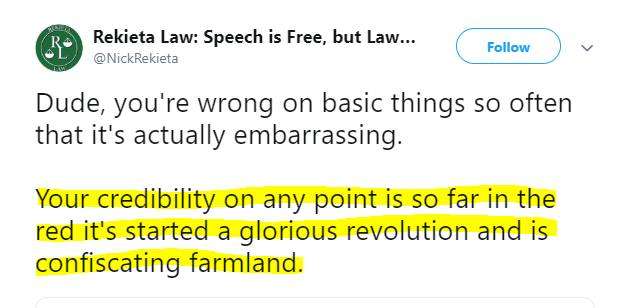
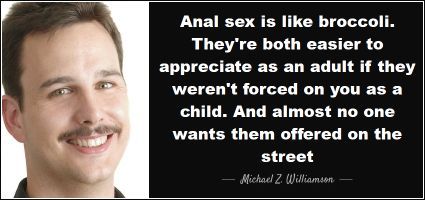
Okay, I’m impressed — this set of memes has Michael Z. Williamson, Rekieta Law, and G. K. Chesterton, all in one place together.
Of course, the last bouquet of memes (proper collective noun?) featured the Scales of Maat, which is so obscure I had to trip over it in a psychology book, once upon a time…
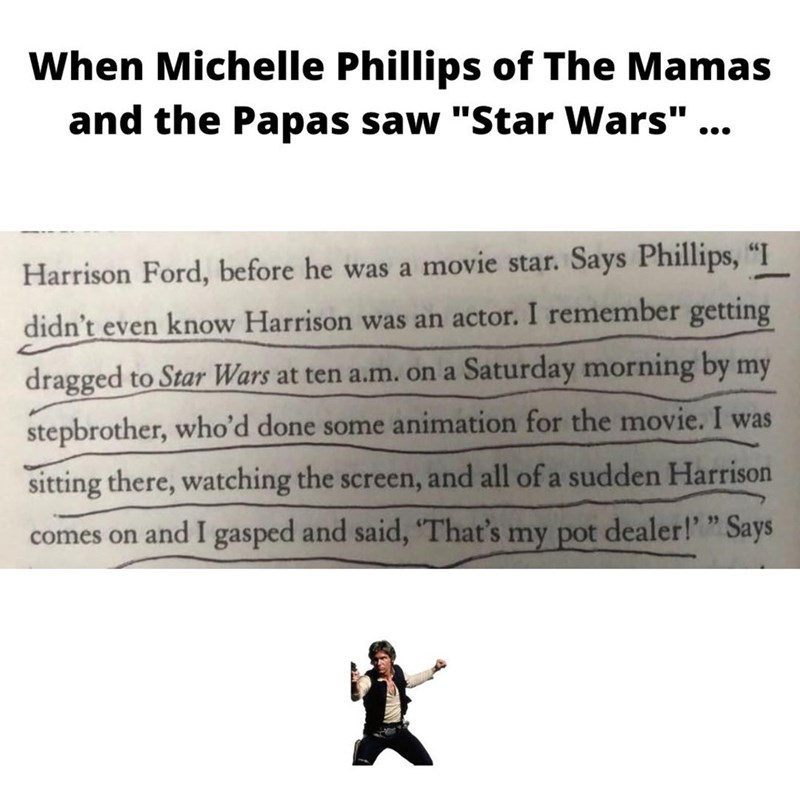
On the pot dealer one, I think I like better the story about the British journalist who, as a small kid, was screaming bloody murder on a family vacay to Whitstable, had an old gentleman come up and ask his mother if he was okay, and then give him a couple of cheap plastic toys from a cereal box to cheer the kid up. The next time the kid saw the old gentleman the latter was on the big screen, blowing up Princess Leia’s planet.
Peter Cushing also played the Doctor, in two 1960’s Dalek movies that were released in cinemas. Since the TV show was still in black and white, the technicolor movies were pretty striking.
They’re okayish movies, and he’s an okayish Doctor. But he already had done some stuff for kids, and was probably used to keeping an eye out.
True that, also a man who lives in a beachside house in a resort town seems likely to encounter more than his fair share of a). abandoned cheap plastic toys on beach and b). screaming littles in need of placation.
America is not the government. The government is not America.
The corrupt lying politicians and bureaucrats that have turned the government against the American people in blatant defiance of the Constitution are definitely not America. A strong case can be made that they have ceased even to be Americans.
“A government which derives its just powers from the consent of the governed.”
I didn’t consent to 95% of the horseshit this government is pulling. I didn’t consent to racking up $31 TRILLION in debt. The politicians created that debt, let them pay it.
———————————
Today, every child in America is born $139,000 in debt.


























Summoning Demons for any reason really ruins your eternity. :twisted:
LikeLiked by 1 person
And possibly your shortened present, if you cross up the ritual.
LikeLiked by 1 person
Nod.
But many times, even if the ritual is done correctly, what you get from the demon isn’t “what you really want”.
And of course, unless you “Get Right With G*d”, you’re the play-thing of the demon (or its masters) after your death because you thought it was a Good Idea to summon a demon.
LikeLike
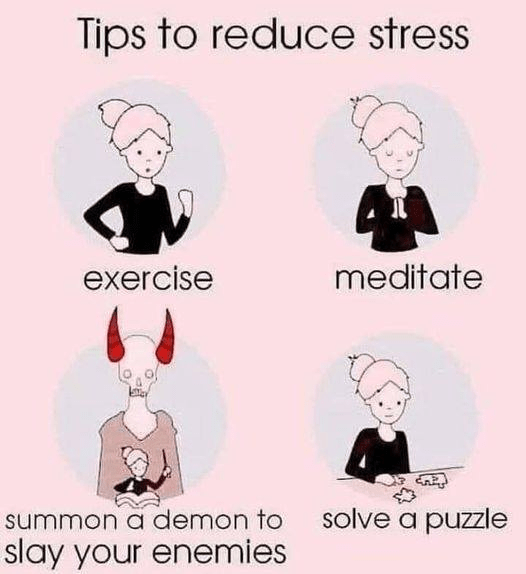
Summoning ritual:
Erwin pulled back his wounded arm and was sick on the ground. It took some time, even though his stomach was empty. When he looked back at the demon, she was sitting cross-legged in the middle of the of the circle. The weakness and burning were gone. She was huge, a hulking gray form, with coarse fur and yellow eyes.
“Interesting,” said the wolf conversationally. “As necromancers go, you are not much to look at.”
“I am not a necromancer,” said Erwin wiping his mouth. “I did the ritual, but no one died. Not even the wolf, I found her dead already.”
“Oh?” asked the wolf skeptically. “More interesting. So, you thought it would be a good idea to summon a demon with nothing to bind it? What’s to stop me eating you, skinny boy?”
“Gratitude?” suggested Erwin a bit crossly, because he was in shock from the cut. He was seeing stars. “And the circle. Mind you don’t touch it, the magic will give you a burn.”
“You mean this circle?” she asked casually. She reached out a claw and slowly drew a line through it.
LikeLiked by 1 person
Gratitude?
You pull somebody from their home to another place and expect them to feel gratitude?
Very foolish especially when your “protective” circle doesn’t protect you. :evil:
LikeLiked by 1 person
And they drew the circle on the ground.
LikeLike
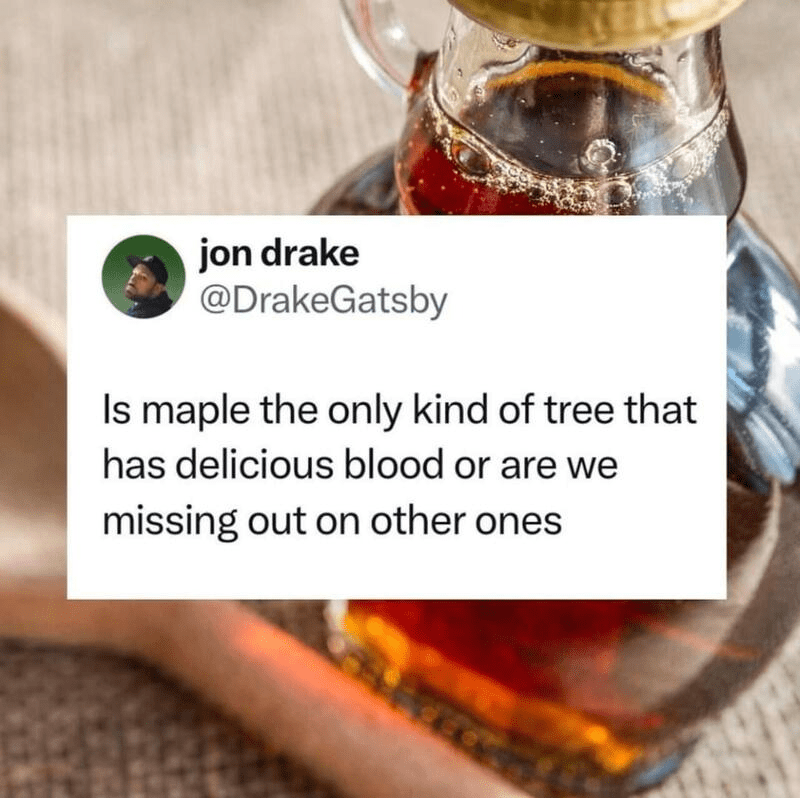
Why yes, yes there are other trees with delicious blood – birch!
https://alaskabirchsyrup.com/
LikeLike
I have also seen hickory syrup, though I have no opinion on the taste.
LikeLike
Sometimes I contemplate giving some folks a good Hickory Shampoo.
…
(As in Eastwood’s “Preacher” in town at the hardware store)
LikeLike
I was think pine isn’t good; but maybe some like spicy food.
LikeLike
Walnut syrup is pretty good.
LikeLike
Oak is really good for tanning your insides. Of course your insides aren’t much good for anything else afterwards.
LikeLike
Also delicious birch wine.
LikeLike
There is also such a thing as food grade pine pitch.
LikeLike
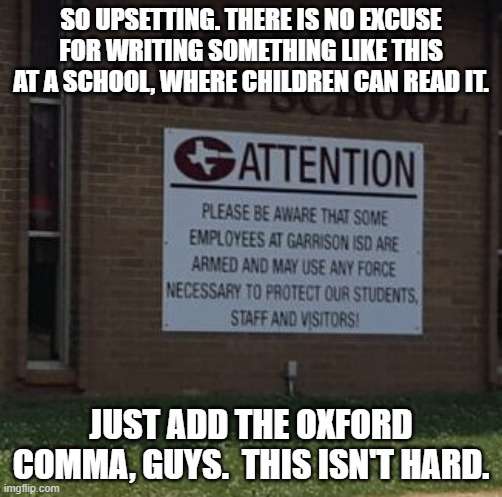
I know as soon as I click ‘Post’ I will realize what’s wrong with Garrison ISD sign but right now I can’t find anything wrong with it.
LikeLike
Here, I think the Oxford Comma is a matter of taste rather than clarity.
“to protect our students, staff and visitors” is as clear to me as
“to protect our students, staff, and visitors” would be.
It’s not so obvious as “the panda eats, shoots, and leaves” where no commas should be the choice.
LikeLiked by 1 person
I personally like the oxford comma.
LikeLike
The Reader had the Oxford comma drilled into him by a British teacher in 6th grade and can’t let it go.
LikeLike
Oxford Comma….
Lovecraft?
LikeLike
Depends on how pissed off the panda is.
LikeLike
And what he’s packing. :-P
LikeLike
One possibly-under-appreciated virtue of the ‘Oxford’ or ‘serial’ or ‘extra’ comma [A, B, and C not A, B and C] is that it lets you do lists-of-lists stuff, like…
“…blood and toil, sweat and tears…”
(which is the way I remember first reading it, though some sources now have it all as a single list… either this is post-speech ‘copy editing’ done on Winston Churchill(!) of May 13, 1940, or else we have us another instance of the Mandala/Mandela Effect…),
without ‘breaking’ the entire format. (Of course, if your lower-level lists run to more than 2 items each, then it seems you must resort to expedients like “…red and white and blue, blue and yellow, red and green and white, and…” — but you can still do it and get your precise meaning on to the page.)
LikeLike
Semi-colons for stacked lists:
Horses; cats and dogs; fish, mice, and snakes; and birds.
LikeLike
Sure, but annoying.
LikeLike
Annoying, but logical. And much more understandable when it comes to converting an abstract into code.
LikeLike
Comma comma comma comma chameleon….
LikeLike
There might be a small number of pandas involved in violent ‘dine and dash’ activities, for whom ‘Eats, shoots, and leaves’ would be appropriate description.
LikeLike
Consider it protection against pedants.
LikeLike
And quoting with the punctuation inside the quote can also still be worked out, “like this.”
That doesn’t make it not a bad idea which should be eradicated from the language.
LikeLike
Fix the usage of apostrophes (not “apostrophe’s”) first.
LikeLiked by 1 person
The Bee Award.
The Bee Award?
The Apis Trophy.
Carp in line 4!
LikeLike
/em Severe groan heard from the Granite State.
LikeLike
Quoting “like this”, not “like this,” is apparently a British thing (though they also use single quotes where we’d use double and vice versa, etc. etc.).
Years ago as a (college-era) copy editor, I started out with the British “what you see is what you get” or “honest” quotes — but got talked out of it by so many complaints. Still makes a lot more sense to me than American or quoted “almost,” but not quite right, ones…
LikeLike
It has spread here under the influence of programmers.
If you try that punctuation nonsense with a computer it will error at you exactly as much as you deserve.
LikeLike
For whatever it’s worth, I was progamming back then too.. had probably already finished my second Forth-in-assembly by then, for instance.
And the required precision of thought (and action) is indeed… contagious, into other non-programming things. (“We are not built to comprehend a lie” — just as Kipling said.)
LikeLiked by 1 person
Exactly.
LikeLike
It all depends on exactly what meaning you want to convey to the reader. Sometimes the comma conveys that meaning, sometimes the absence of it does a better job.
As for quoted punctuation, if you end a sentence with a quote that itself ends with a terminal punctuation, do you really need another one?
———————————
There is but one greater sin than to be right when those in power are wrong — proving it.
LikeLike
I don’t know. . . I’ve seen him play. His shooting is terrible. Of course, claws and basketballs are pretty incompatible.
LikeLike
To me it reads as if the students will be protected, but it is a warning to staff and visitors. (As in “Staff and visitors, beware, certain employees are armed and …”)
LikeLike
1:52:33 is part I of MCMLXVII of volume one of the first series. More or less the intro and laying of the groundwork, as it were.
Amateurs generalize and let it go at that. Hardened veterans have references, histories, examples, and opinions on just how bad Rome f*cked up and may a bone to pick concerning the many, many insults that government hath wrought over the millenia.
LikeLike
LikeLiked by 1 person
LikeLiked by 1 person
Elmo is a lightweight compared to Cookie Monster. Now there’s a badass. :-D
Enemies of America wet themselves when they hear CM is on the offensive.
LikeLike
Word is, The big B tried to deploy CM to Ukraine, but was blocked by higher. Wouldn’t be worth the war crimes, they said.
LikeLike
Don’t like it Democrats, change your party

LikeLike
LikeLike
The most accurate future prediction from TOS. Unfortunately…
LikeLike
You know how hard it is to find a copy of that particular episode?
LikeLike
Are your sure? The Reader heard that Satan was so disgusted with the poor quality of souls he was getting from the Democratic party that he was considering starting a third party.
LikeLike
LikeLiked by 2 people
Oldy but Goody. :lol:
LikeLike
The Climate-Change Emperor’s New Clothes

LikeLike
LikeLike
Re-Greta-ble.
Greta Tintin Eleonora Ernman Thunberg, (born January 3, 2003). Got her own Britannica article and ever-thin.
LikeLike
So, then, the child abuse started at birth. :-P
No wonder the kid is so f*d up.
LikeLike
Greta Eleonora is fine. Tintin is just mean.
LikeLike
Tintin means her parents were doing the hard drugs.
LikeLike
It’s actually Greta Tintin Eleonora Ernman Thunberg
LikeLike
Tintin? After this guy?

LikeLike
yep. their parents were (are?) doing serious drugs.
I think fondly of Asterix, but it never occurred to name one of the boys for him.)
LikeLike
Rin?
LikeLike
The Climate Change poster child is no longer a child? That must chap her hide.
LikeLike
Thank Goodness!
LikeLike
Wait, so all anime characters are actually cats?
LikeLiked by 1 person
All cats are animals characters.
Mine is from Dirty Pair.
LikeLiked by 1 person
Crap… how the f(mumble)
….
All cats are anime characters.
Mine is from Dirty Pair.
….
LikeLiked by 1 person
Ours are, in order of age, from Samurai X, Tenchi Muyo, and Fairy Tail.
All of them took their name as a challenge, and both succeeded and failed spectacularly.
LikeLike
Here we have part of why we see anime (particularly catgirl type ones) and Cats as cute. The large cheeks, exaggerated eyes and outsize head are all also features of human infants. Nature has made us (perhaps inordinately) fond of human infants (if it hadn’t none of us would be here discussing this :-) ). It is thought to be part of why we find cats (Who can be raving nuisances) so appealing and perhaps part of why we helped them self domesticate in the first place beyond their obvious value in pest control.
LikeLiked by 2 people
Because people here will appreciate it —
Okay, we know colonial Philadelphia was all businesspeople and nerds, but I just ran across a hilarious article on Philadelphia’s standard of women’s education and reading. (“The Sweet Recourse of Reason: Elite Women’s Education in Colonial Philadelphia”)
https://www.jstor.org/stable/20093721
Basically, a lot of serious subjects (ie, philosophy, science, history, and pre-Byron poetry). The idea was that education and character could be a class distinction not obtainable by everyone, but only by worthy people with cash. But all these Philadelphia folks were convinced that they had worthy enough birth to count, and that they had cash, so yup, they
followed all that advice meant for gentlewomen and nobility. They read English magazines and books of advice, or on serious subjects, that were meant for both men and women, and for both young men and young women.
The great thing is that they ACTUALLY HAVE “The Library Company of Philadelphia” with their list of who had what books, of people by name. So if you want to create a heroine and give her a reading list, you can read the books she would have read.
And since science was fashionable, a lot of Philadelphia ladies did science experiments too. They quote a guy named Thomas Marriott who wrote something called Female Conduct, on p. 197 —
“Tales, and Romances, will delight no more,
To Themes sublimer, Female Taste will soar;
It will disdain Smollet’s insipid Pickle,
No more shall Roderic the Fancy tickle;
Tom Jones no longer shall inchant the Fair,
Nor Betsy Thoughtless fascinate the Ear;
The magic Charms of Science can subdue
The love of Masquerades, and Gaming too.”
LikeLiked by 1 person
Anyway… obviously all this English advice led to English “bluestockings,” who were fashionable and then weren’t. But in the US, we actually had a lot of colonies go all in, on this kind of women’s life of the mind, because a lot of the colonists were GIANT NERDS.
LikeLiked by 1 person
Oh, and Eliza Haywood in England, who edited The Female Spectator, actually had an article talking about how scientific pursuits could be fun activities for ladies visiting the country. She and her friends went out with “microscopes” (magnifying glasses) on their country walks, observing snails and caterpillars. They observed the Moon through small telescopes and discussed the “Plurality of Worlds Theory,” and whether there was life elsewhere in the solar system. They observed and discussed the nature of lightning during stormy weather. And so on.
(The hilarious thing is that a lot of the “too modern” bad Regency heroines might have worked out better as 1700’s heroines. All that rational improvement and political stuff was what 1700’s gentry liked to do.)
LikeLike
OMG. The article gets better. The author found old advice books that said that the habits of scientific thought would naturally help one in social intercourse, and that they would also help a woman to pick a good husband.
Yes. This is fricking gold. You have to read it. And what’s better, all these freaking books and magazines are probably on Google Books or archive.org, somewhere.
LikeLike
Even better, there’s a section on how Philadelphia women criticized their reading matter, in surviving letters to each other or to relatives. For example, they roll their eyes at the idea (from a book of moral sermons) that women can’t be friends.
LikeLike
The Female Spectator is a pretty good read.
Here’s Volume 2: https://www.google.com/books/edition/The_Female_Spectator/AzEJAAAAQAAJ
Holy crud, the response to a letter to the editor escalates very quickly into a giant essay. The story about medieval Candia is too amazing to be true, but very neat.
LikeLike
Okay, I had never before heard of Mistress Eliza Haywood, but she apparently DOMINATED the novel market in London in the early 1720’s. She was extremely prolific, and The Female Spectator was just one of many projects she completed, before her death in 1756.
She began her career as an actress and transitioned into playwriting and writing… which didn’t happen very often then, to say the least.
Wikipedia says that her novels were mostly romances (in the modern sense) that started out titillating (which was when her sales were best), and then moved into woman-in-jeopardy in the 1830’s, and then later got into happy endings and true love marriages.
Her very bestselling book was The Distress’d Orphan: Or, Love in a Madhouse, a 1726 novella about an orphan imprisoned in a private asylum by her guardian, in order to take her inheritance money.
She also wrote a political fantasy satire, The Adventures of Eovaai, Princess of Ijaveo: A Pre-Adamitic History, in 1736, which basically rips on Walpole. It looks funny, though, from the frontispiece.
She wrote a 1741 novel responding to Richardson’s Pamela that was called “The Anti-Pamela: Or, Feign’d Innocence Detected”.
She also wrote one of the novels mentioned in the poem above!! The History of Miss Betsy Thoughtless is about a heroine who marries badly, leaves her abusive husband, and eventually finds happiness through a better remarriage. One character gives a lot of advice about marriage, which may or may not be sensible.
The article helpfully explained that since 1700’s authors only got paid once per book, with no royalties and no money from new editions or reprints, it encouraged them to write two or three volume novels (which meant two or three payments, since an additional volume was treated like a new book). So Haywood wrote a fair number of multi-volume novels.
It’s amazing how many good and popular writers we never hear about, unless they become fashionable again, for some reason.
LikeLike
Oh, and she wrote sf/parallel histories. Memoirs of a Certain Island, Adjacent to Utopia (1724) and its sequel, The Secret History of the Present Intrigues of the Court of Caramania (1727).
Seriously, I had not heard of her as an sf writer, either, and I’ve read a lot of scholarly books cataloguing utopian novels. I am disappointed, academics!
She seems funny, but I don’t know if there’s too much inside baseball and outdated political satire. I’d like to find out.
And she translated bestseller romances from other countries, probably because her name would reassure English romance readers that this would be good stuff.
LikeLiked by 1 person
Oh, and before Kidnapped by Stevenson did it, Haywood fictionalized the real life kidnapping and enslavement/indentured servitude of James Annesley, at the age of 12 in 1728, who ended up on a plantation in Delaware when he was an heir to the Earl of Anglesey.
He eventually escaped, ran away to Philadelphia, took ship to Jamaica, joined the Royal Navy, and finally got recognized by somebody who knew him as a kid. He got back to England after good war service, accidentally killed somebody in a hunting accident, got prosecuted for murder by his wicked uncle who had gotten him kidnapped, was saved by last minute Perry Mason-style testimony, and eventually proved his identity… and then he died before he got his title, and then his wicked uncle died too.
Haywood’s version is called The Memoirs of a Young Nobleman. Apparently it has some unintentionally hilarious depictions of American life, because of course she’d never been there and she was just cranking it out.
LikeLike
So… is that another influence on Heinlein’s Citizen of the Galaxy? It was a famous case, and Andrew Lang wrote a book about it.
LikeLike
Nabs for story potential, because Why Not.
LikeLike
Heh heh, I thought you’d appreciate it.
Philadelphia seems to have been a fun place, in its own weird way.
LikeLiked by 1 person
“At a stage in life when other men prosper, I am reduced to living in Philadelphia.”
Ah, John. We love you, you prickly Adams.
LikeLike
Boston versus Philadelphia. Heh, Boston is a great place too, albeit a lot bigger than when the Founding Fathers were there (courtesy of the Back Bay landfill). Probably safer for your colonial tourism needs than today’s Philadelphia.
LikeLiked by 1 person
Oh, and there’s another entertaining article called “She Will Be in the Shop: Women’s Sphere of Trade in Eighteenth-Century Philadelphia and New York”
https://www.jstor.org/stable/20092959
It talks about the documentation of a good number of female shopkeepers. Not huge numbers, maybe 2 percent of the total shopkeepers, but a lot of them being very important in the world of women shopping in the city with their friends (and without male escort or maids). Of course, in Philadelphia, unless people were visiting the city or lived on estates/farms outside the city, this meant walking a block or so from home – and merchant families also lived very close to their stores.
There’s a ton of entertaining quotes from letters. The article title comes from a husband talking about how his wife had been sick and is now back working at the store she owns, where he observes that “If She is able to Crawl, She will be in the Shop.”
So basically women tended to sell certain kinds of home goods, clothing, etc., to the point that a woman who had inherited a hardware shop from her husband turned it into a different kind of shop. But there weren’t any formal rules or laws, and it was normal that wives and daughters tended to work and do accounts at more “manly” kinds of stores. It was often the case that widows’ sons were sent to learn business from male relatives or friends, though.
JSTOR is great for random flavor, on all kinds of subjects that you might wonder about or need to know about. Get a free account and you can have some fun. I tend to forget to use my free “read 100 articles every month” until I have questions.
LikeLike
Ah, so that’s how you get around the (quasi) paywall I encountered last night, and did not have enough instant motivation to try to analyze / evade.
And, this is impressively (but not uniquely) remarkable. Imagine how I felt finding out that not only was the “Morse” code really invented by associate Alfred Vail, but there were also many, many competing telegraph systems (which the Morse consortium’s patent lawyers kept playing wack-a-mole against as fast as they could) around at the time…
Just think of the huge set-up compressed into “I grew up reading Eliza Haywood books” — only that once sentence alone — even potentially decades or generations later. (And, yes, I have a Northern inventor much like this profile, up to her “blue blood” pretentions… though the neatest inventions of that 1860s + or – a decade or so, alternate-history / steampunk setting, trace to “bluestockings” living further south, and end up benefitting mostly the Free States, the neutralist third faction of their 1860-1871 “War Between”…)
LikeLike
I’m glad that’s an option now. When I last looked, 10 years ago, the subscription fee was, ahem, more than I could justify even for academic research.
LikeLike
The free access is only to a subset of the articles on JSTOR, drat it. But it’s a lot better than no access at all – and you can find some surprising things that are completely free to download/print for more detailed perusal.
If there’s a specific subject you’re interested in, you may want to search JSTOR without signing in first. If you’re signed in as a free user, you won’t even see the articles you can’t access!
LikeLike
“and it was normal that wives and daughters tended to work and do accounts at more “manly” kinds of stores. ”
That’s still the case today. I see auto parts stores or welding shops all the time where some female relative of the owner (or even just some female) handles the bookkeeping.
LikeLiked by 1 person
LOL
LikeLike
Wait…
ATH is Philadelphia?
But, I am a Stillers fan.
LikeLike
Shrillary’s lust for power is certainly still there:
LikeLike
Always ask yourself: “Where’s Hilary?”
LikeLike
Branco is always good for a wry chuckle . . .
LikeLike
Clearly it’s not just the Valvoline Instant Lube in my town that has a funny guy.
My favorite was from summer 2022: “Is your wife hot? Fix her car’s air conditioner for $—-
There was also a ‘help wanted’ in 2021 that read: “Stimulus check every 2 weeks – apply inside.”
LikeLike
“God thinks he can get me out of this, but he wants me to let you know, you’re F(YAY!)KED!”
LikeLiked by 1 person
OK:
How did they get the squirrel into that outfit, and
Where did they find a squirrel-sized M4? Does it shoot?
LikeLike
One of those famous .9mm the papers tell us about.
LikeLike
There’s some company that makes doll-sized guns that can be disassembled into the same parts as a real gun. (I don’t think they make doll-sized cartridges so they don’t work, and probably the parts aren’t as strong as real gun parts; but they’re metal.)
LikeLike
My grandfather had a gun which was shorter than my palm but fired real bullets. No trigger, as I remember, just a hammer.
Provenance said it was carried on the pony express routes.
LikeLike
That sounds like a derringer, of sorts. A hideout gun, anyway.
LikeLike
IIRC the old generic term was “muff gun” — because it was small enough to disappear into one. This is back around the time “Deringer” became A Thing, of course. (And the 2-r and 3-r spellings, also A Thing, but digressions are.)
LikeLike
“Polan Asks”
:loooooool:
LikeLiked by 1 person
Poland also has reactors.
LikeLiked by 1 person
Yes, their theater scene sticks to well-known repertoire.
LikeLiked by 1 person
Carp away! sinks claws into lanyard, pulls hard
LikeLike
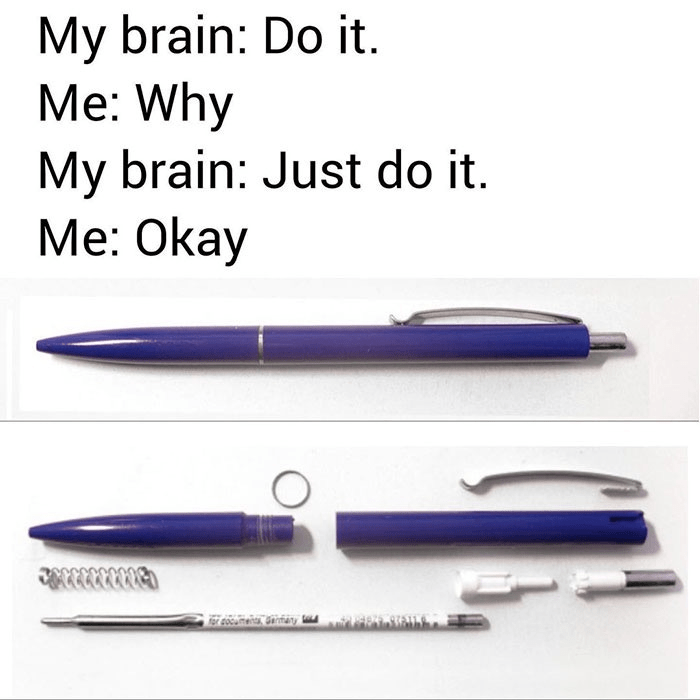
That pen meme….
A good soldier can field strip a weapon blindfolded, and reassemble it.
Just sayin….
Note that -detail- stripping it down to components is usually restricted to the armorer.
….
Now, if your father teaches you how to completely detail strip an M1911 pistol down to components, using only its parts as tools, you have the potential to seriously prank the (poop)bag sergeant that tries to stick you with cleaning his sidearm.
Heh.
LikeLike
Okay, I’m impressed — this set of memes has Michael Z. Williamson, Rekieta Law, and G. K. Chesterton, all in one place together.
Of course, the last bouquet of memes (proper collective noun?) featured the Scales of Maat, which is so obscure I had to trip over it in a psychology book, once upon a time…
LikeLiked by 1 person
lol
LikeLike
C:\Users\Big Bob\Downloads\53682544_2612903295402899_4820585887605719040_n.jpg
LikeLike
Yep:

LikeLiked by 1 person
As always and ever… Catturd(2) for the win!!
LikeLike
Mood. Nod
LikeLike
“One of those famous .9mm the papers tell us about.”
Like these?

LikeLiked by 1 person
Then ther are the folks yelling about banning “forty millimeter Glocks”
I said “that’s a Bofors, not a Glock”
LikeLiked by 1 person
90 centimeter Hellbore. Two megatons per second.
That ain’t no Glock.
LikeLike
Only counts if you are wearing your regimental Bolo tie.
LikeLiked by 1 person
On the pot dealer one, I think I like better the story about the British journalist who, as a small kid, was screaming bloody murder on a family vacay to Whitstable, had an old gentleman come up and ask his mother if he was okay, and then give him a couple of cheap plastic toys from a cereal box to cheer the kid up. The next time the kid saw the old gentleman the latter was on the big screen, blowing up Princess Leia’s planet.
LikeLiked by 1 person
My Star Wars moment was Kylo Renn taking off his helmet for the first time. I said “Oh my God its Justin Trudeau!” out loud.
This was in Phoenix Arizona, and it still got a laugh from the audience.
LikeLiked by 1 person
heh, well-played.
LikeLiked by 1 person
Peter Cushing also played the Doctor, in two 1960’s Dalek movies that were released in cinemas. Since the TV show was still in black and white, the technicolor movies were pretty striking.
They’re okayish movies, and he’s an okayish Doctor. But he already had done some stuff for kids, and was probably used to keeping an eye out.
LikeLike
True that, also a man who lives in a beachside house in a resort town seems likely to encounter more than his fair share of a). abandoned cheap plastic toys on beach and b). screaming littles in need of placation.
LikeLiked by 1 person
& forget not that Mars is the only planet in our solar system solely inhabited by robots.
LikeLiked by 1 person
So you say :-) . All Hail VxWorks…
LikeLike
We just haven’t looked in the right places yet…..
LikeLike
Robots either haven’t made it to other planets, or haven’t made it on the other planets they’ve reached. The system is not a very friendly place.
LikeLiked by 1 person
America is not the government. The government is not America.
The corrupt lying politicians and bureaucrats that have turned the government against the American people in blatant defiance of the Constitution are definitely not America. A strong case can be made that they have ceased even to be Americans.
“A government which derives its just powers from the consent of the governed.”
I didn’t consent to 95% of the horseshit this government is pulling. I didn’t consent to racking up $31 TRILLION in debt. The politicians created that debt, let them pay it.
———————————
Today, every child in America is born $139,000 in debt.
LikeLiked by 1 person
Particularly since a substantial amount goes to support foreign subjects and principalities.
LikeLike
LOL, good ones as always! Thanks!
LikeLike
https://babylonbee.com/news/trudeau-having-difficulty-teaching-canadian-mounties-to-goose-step
LikeLike