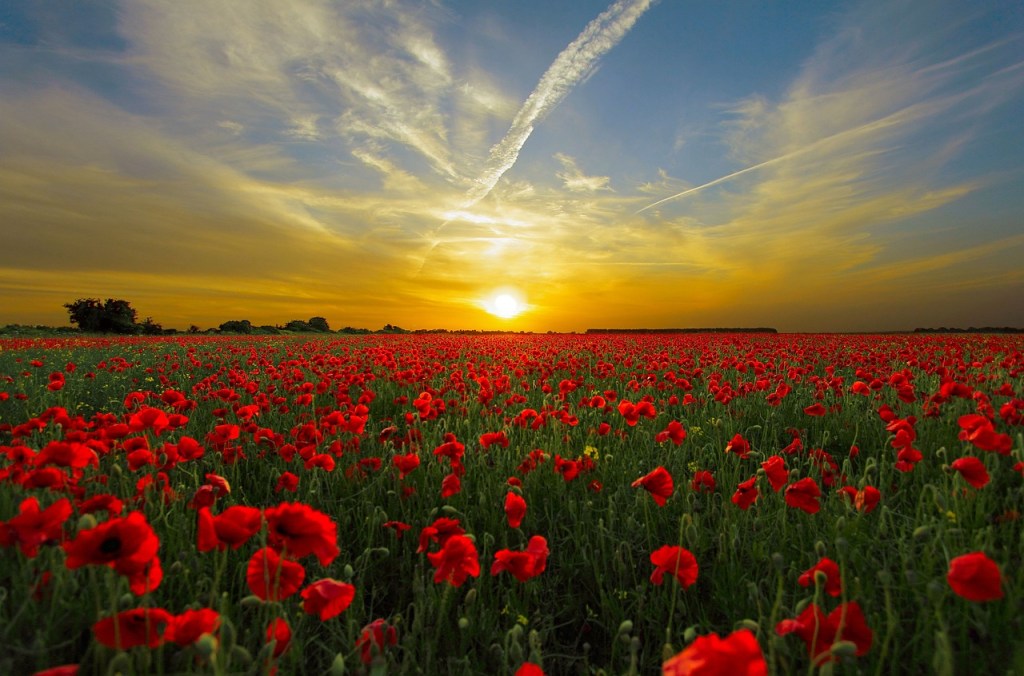
In Flanders Fields
By John McCrae
In Flanders fields the poppies blow
Between the crosses, row on row,
That mark our place; and in the sky
The larks, still bravely singing, fly
Scarce heard amid the guns below.
We are the Dead. Short days ago
We lived, felt dawn, saw sunset glow,
Loved and were loved, and now we lie,
In Flanders fields.
Take up our quarrel with the foe:
To you from failing hands we throw
The torch; be yours to hold it high.
If ye break faith with us who die
We shall not sleep, though poppies grow
In Flanders fields.
 According To Hoyt
Amen
LikeLike
Amen. It was good to see lots of younger people (my age and below) and families at the Memorial Day observation at the public cemetery today.
LikeLiked by 1 person
Resquiat in pace all those who have died in service of our country. Also those who served, came back and have later passed. I grew up being taught by many WWII veterans and Korean War Veterans. WWII Veterans are mostly 90+ and getting rare, Korean War vets aren’t much younger and are also rare. Even most of the Vietnam vets are 70+ . The soldiers of Flanders field are all long gone, the last of them passed in 2014 If I remember right.
LikeLiked by 1 person
All honor to those who fought and dies. As for the politicians responsible fro all that the verse from Chesterton comes to mind:
“And those that rule in England,
in stately conclave met,
Alas, Alas for England,
they have no graves as yet”
LikeLiked by 1 person
I almost called this Curse Woodrow Wilson Day
LikeLike
That would be the other 364 days.
LikeLike
And those that rule in Washington, in stately conclave met, Alas! for America, they have no graves as yet.
And when they finally die, in unhallowed fields they’ll lie.
LikeLiked by 1 person
Dump them in the mass graves they’re planning for us.
LikeLike
‘died’.
where is the edit in this thing?
LikeLike
Amen. Thank you for remembering.
LikeLike
Ditto.
LikeLike
May their souls, and the souls of all the faithful departed, through the mercy of God rest in peace.
LikeLiked by 1 person
Amen.
LikeLike
Thank you to our hostess for remembering.
LikeLike
Makes you wonder what the Leftists who did military service think. I know a couple, both officers, one AF, one Army. Both support the System; but I don’t think they’re anymore honorable than Schumer, Pelosi, Biden, et. al. And I don’t think either of them have any problem with sacrificing as many bodies to achieve their ends, as long as it isn’t their own.
LikeLike
Amen.
LikeLike
Requiem aeternam dona eis Domine,
et lux perpetua luceat eis.
LikeLiked by 2 people
Amen.
LikeLike
— “For the Fallen” by Laurence Binyon.
LikeLiked by 2 people
Plus ca change:
Then out spake brave Horatius,
The Captain of the Gate:
“To every man upon this earth
Death cometh soon or late.
And how can man die better
Than facing fearful odds,
For the ashes of his fathers,
And the temples of his gods…
—“Horatius” by Livy(?), Macaulay translation
The tradition lives on…
LikeLiked by 1 person
You beat me to it. I was just about to post that very poem.
In Flanders Field is moving and inspirational, but it’s also a call to arms. To everything there is a season, but the time for the stoking of passions has long since passed.
LikeLiked by 1 person
well, passions, but maybe the foe is not who we thought then.
LikeLike
The foe is always “of the moment”; the issue is simply to keep your knowledge current.
LikeLike
Ouch. OK, that sounded both dismissive and patronizing, which was NOT my intent. A better way to phrase it would be “…keep ONE’s knowledge current” (regarding who or what the foe of the moment actually is), since it applies to everyone.
LikeLiked by 1 person
I got it.
LikeLike
OK; good. Thanks.
LikeLike
Eternal Rest grant unto them, Oh Lord, and let perpetual light shine upon them.
LikeLiked by 1 person
When my grandpa was still alive and I was just a little kiddo, I memorized this poem and recited it to him one Memorial Day. I think that’s the only time I saw that crusty old man cry. He was a WW2 vet. May he, and all who served their countries so bravely, rest in peace.
LikeLiked by 2 people
To absent companions…
LikeLiked by 1 person
It was good to see people at the local Walmart with their arms full of silk flowers.
LikeLiked by 1 person
Nicol Williamson stealing scenes in Boorman’s “Excalibur”. “…For it is the Doom of Men that they forget.”
LikeLike
Aidos surpasses gold.
Reverence for the aged
Is wholesome as seasonable rain,
and for a man to die
Defending the city in battle
is a harmonious thing.
Let their sacrifice inspire partisan courage in our occupied nations.
D.V.
LikeLiked by 1 person
Thank you.
LikeLike
We do not forget those who gave their lives for the ideal of our Republic.
We will not forgive what the current bunch of lunatics have done to our Armed Forces.
LikeLiked by 2 people
Absent friends.
LikeLiked by 1 person
Slainte
LikeLiked by 1 person
Despite any political views you might hold, I would ask that anyone, Please, remember all of those in the cemeteries of nations around the world, died defending your freedom!
LikeLike
Or at least they believed they were saying so. This could very well be “Spit on Woodrow Wilson” day, but nothing to the men who went to as they saw it defend their homeland and that of our allies.
LikeLiked by 1 person
Thank you for quoting C. S. Lewis’s “A Cliche Came Out of Its Cage.” It’s been a favorite of mine for 50 years! For anyone who doesn’t know it, it’s a satirical response to the idea that “the world is going back to paganism” that manages to capture the spirit of both Greek and Norse paganism in just a few lines.
The lines quoted are utterly appropriate to Memorial Day. Thank you for giving me a new way to appreciate a beloved poem.
It gives the satire in the poem as a whole fresh bite.
“Are these the Pagans you spoke of? Know your betters and crouch, dogs;
You that have Vichy water in your veins and worship the event,
Your goddess History (whom your fathers called the strumpet Fortune).”
LikeLike
Among the things run by the NY Post for Memorial Day was this:
The dead we honor: Shakespeare’s apt words for Memorial Day
Post Editorial Board
NY Post
May 28, 2023
Memorial Day inspires mixed emotions: pride in the valor of those who gave their lives in the cause of freedom; sorrow that such self-sacrifice should have been necessary. Pride in past valor may be best expressed in the St. Crispin’s Day speech from “Henry V” (Act IV, Scene iii), delivered by the young king on the eve of the Battle of Agincourt.
St. Crispin’s Day
By William Shakespeare (1564-1616)
If we are mark’d to die, we are enow
To do our country loss; and if to live
The fewer men, the greater share of honour.
God’s will! I pray thee, wish not one man more.
By Jove, I am not covetous for gold,
Nor care I who doth feed upon my cost;
It yearns me not if men my garments wear;
Such outward things dwell not in my desires:
But if it be a sin to covet honour,
I am the most offending soul alive.
No, faith, my coz, wish not a man from England:
God’s peace! I would not lose so great an honour
For the best hope I have. O, do not wish one more!
Rather proclaim it, Westmoreland, through my host,
That he which hath no stomach to this fight,
Let him depart; his passport shall be made
And crowns for convoy put into his purse:
We would not die in that man’s company
That fears his fellowship to die with us.
This day is call’d the feast of Crispian:
He that outlives this day, and comes safe home,
Will stand a tip-toe when this day is named,
And rouse him at the name of Crispian.
He that shall live this day, and see old age,
Will yearly on the vigil feast his neighbors,
And say ‘Tomorrow is Saint Crispian:’
Then he will strip his sleeve and show his scars,
And say ‘These wounds I had on Crispin’s day.’
Old men forget: yet all shall be forgot,
But he’ll remember with advantages
What feats he did that day: then shall our names
Familiar in his mouth as household words:
Harry the king, Bedford and Exeter,
Warwick and Talbot, Salisbury and Gloucester,
Be in their flowing cups freshly remember’d,
This story shall the good man teach his son;
And Crispin Crispian shall ne’er go by,
From this day to the ending of the world,
But we in it shall be remembered;
We few, we happy few, we band of brothers;
For he to-day that sheds his blood with me
Shall be my brother; be he ne’er so vile,
This day shall gentle his condition:
And gentlemen in England now abed
Shall think themselves accursed they were not here,
And hold their manhoods cheap whiles any speaks
That fought with us upon Saint Crispin’s day.
The English at Agincourt lost about 700 men; the French dead totaled at least 8,000, including seven princes of the blood and the flower of French chivalry.
LikeLike