Lady Bountiful and the Illusion of Heroism

So I promised I was going to handle what was fundamentally wrong with the argument between my “raccoon identifying friend” and the “white knighting for the leftist agenda” writer he was engaging on twitter. (Because it really even wasn’t white-knighting for minorities, as I’ll explain.)

I know some of you guys are too young to remember this, but there was this fad in the seventies where “feminists” (usually very young girls who had just been sold a load of goods at school by some angry female teacher) would turn and punch whichever man opened the door for them, because “you’re treating me like I’m not capable of doing it for myself.”

I remember this vividly because coming from a culture that had a lot less public politeness, it seemed just plain dumb to me.  Besides, now as then, I opened the door for EVERYONE if I was walking ahead, and I couldn’t understand why poor guys should get hit for being polite.

But there it was.  Women didn’t want doors opened for them by men, because they could “do for themselves.”

This brings us to the twitter argument my friend was having.  Because he just likes being a gadfly (what part of raccoon don’t you understand?) he was just trying to annoy her.  So he just kept telling her he didn’t care if a writer was any given color or gender or sexual preference provided it’s a good story.

Mind you, from the point of view of acting like a gadfly this was perfect and got her to call him racist, because of course, not giving a goodgaddamn about race is being racist.  Whatevs.

But this allowed her to go down the track of posing as greater and kinder and more caring by asking him “But don’t you want to open the door to minorities and the underprivileged?” or something like that.

Uh.  Note that this woman is so white that, like Jane Seymour (Henry VIII’s Wife) under certain lights she’ll look green.  Note also she’s comes from an upper middle class background and is “very well educated.”

Note also that she’s a feminist and about ten years younger than I.  I grant you that by the eighties, when she’d have become aware of the behavior of older feminists, the showy smacking of guys for being helpful was over.

But still, surely she heard of that trend.  Surely she read about it, if nothing else.

And yet, she can stand there and blithely declare that she wants to open the door to “disadvantaged others.”  And she doesn’t see any problem with it.

So, for her edification and those of other people like her, including the twits who run around saying that it’s time to bring “the world” into science fiction IN THE US (as though other countries didn’t have a science fiction community or for heaven’s sake, better things to do with their time than become known in another country, in a different language — and yes, I know what I did, but I’m not typical.  Or arguably all there.  Wherever there is.) and similarly crazy pronouncements, let me enumerate what is wrong with this:

1- I know you’re used to living in countries that immigrants aspire to enter, and so you’ve kind of grown up with the understanding that, of course, everyone wants what you have.  I also know that in kindergarten you got bonus points for being a good little girl (particularly if you were a boy) and sharing.

Having grown up in another country, a country of emigrants, where nonetheless the proportion of the population that did NOT want to go to another country was around 90%, chill.  Not everyone wants what you have, particularly when what you have is mild notoriety in writing in one of the smaller (commercially) genres in popular literature.

2 – The ability to make a living in this genre, or even to be published in this genre is not yours to give.  Not even if you are an editor.

Perhaps it was at one time, in the not too distant past, but I’m sorry, that ship has sailed, and it’s time you got over this idea that you can tell who should board and who shouldn’t, and you can pick people according to whatever crazy standards you’ve internalized.

People anywhere in the world, from any walk of life, who want (heaven knows why) to write sf in English and to make a living from this, have as good a chance as you do, if not better.  Right now my indie friends are doing a little better than my traditional friends in the money front.

REALLY if you’re a writer, there’s nothing really you can do to open the door or close it, or spin in circles screaming (which seems to be what most of the left does at any given time) because in the huge marketplace Indie has opened up, your help/push/award giving will be of limited help to your friends, and your bitching moaning and maligning will be of limited hindrance to your enemies, who, at any rate, can always change their name and evade you.

3- It is INCREDIBLY insulting of you to think that people of other races, creeds, orientations and/or genders need YOUR lady bountiful act to open the door for them.

By itself it arrogates to you a power that they lack.  If they had the power, surely they wouldn’t need your help to open the door, right?  If they really want it and are willing to work their behind off, what do they need you for?

By giving them “help” which they neither asked for nor required, you’re putting yourself in a position of power and superiority over them.

I don’t know if it’s true that Japanese has many words for thank you and all of them imply a degree of resentment.  I do know that this type of “help” breeds resentment in those who are truly capable and truly willing to work towards their goal.

Yes, I know, you are absolutely convinced everyone but you is a racist/sexist/homophobe who will throw obstacles on the path of the “other” trying to climb up the ladder, and that you’re the only one caring, understanding and enlightened enough to actually help them.

Most girls (I don’t know about boys) get over this at around sixteen or so.  You realize at some point that no, you’re not particularly enlightened, kind or understanding, and that people don’t need you to be an angel of mercy.  You learn that, yes, there is still some prejudice, but the prejudice is as likely to be from people wanting to “open the door” to the other, as from people wanting to keep them down.  You also learn that human beings are individuals and that among the “other” there is the usual number of grifters quite willing to coast on proffered help to get a leg up with minimal work, while genuine strivers would rather die than take your help, because of that implied power relationship thing.

And by the time you’re in your middle twenties, you usually have got around to just treating people as people, giving help where you can and when you can and not looking at whether the person is supposed to be a victim.  Because you see, in the real world, victims don’t always correspond to what your “Studies” teacher told you.  There is many a white male who in fact had nothing resembling privilege.  And if you think people treat them better just because they’re white or male, it is possible that’s because you’re a big, stinking racist.  Doesn’t give you the right to assume the majority of people are like you.  Not even a significant proportion.  Unless of course you happen to be standing in the middle of a KKK rally, in which case take off the sheet and join humanity.  We’re not perfect, but most people are trying the best they can.

4 – Realize in your heart that this is your way of propping up your self image.  No?  Imagine for a moment that these “others” for whom you want to open the door happen to disagree with you.  They think that promoting leftist politics and race-and-gender-pimping in literature is despicable.  They make fun of your degree.  They find your manners hilarious.  They think your American-feminist pseudo-superiority is a hoot. They think your condescension towards them is not only ridiculous but infuriating.  They know that if they want to write this sf/f thing and make it big they can make it without help, thank you very much.

Do you still want to open the door to that person?  You know in your heart you don’t, as I have proof daily. (And I don’t even think your manners hilarious, just a little … rough.)

So your motive in opening the door to others is what, but to think of yourself as perceptive, kind and condescending above all others?  Which of course attracts the attention of people like Requires Hate who LIVE for that type of “help.” And yet hate you for it.

FINALLY note that I’m not now nor at any time — because I know you’re going to claim that — telling you that writing/publishing/reading is a dog eat dog world.  I’d never do that because it’s not true.  I’m just going to say what you’re doing is not what mentoring/helping/paying it forward looks like.

I should know because I’ve been the recipient of real help and mentoring from people of all political descriptions who never ONCE bragged about helping a little Latina girl who is ESL and has no connections, or opening the door for her.  And I’ve given help when I can (usually little stuff, though I’ve done a deal of mentoring and reading and teaching — less these last two years due to health issues, but that will change — for beginners and midlisters, and even people well above me who needed a critique or a quick look over of something new they were trying.)  I’ve given help without caring what the person’s color, gender, orientation and/or social economic status is and truly without expecting anything in return.

This is the general opening the door to everyone that I found unexceptionable even in the seventies.  Let me tell you that even someone of my disposition would have slapped a guy who said “I’m opening the door to you, delicate flower of womanhood, so you don’t strain your little muscles.”

Yeah, so I give a little more help to people who are in a crisis, just like I open the door faster to people burdened with packages. Not because I’m special, but because they need it more.

THAT is what opening doors looks like.  You do what you can, and you don’t pose as superior and holding the power of career-making in your hands.

Because you don’t. And if that’s the source of your self esteem it’s time you found another.

Helping others is what humans do, and in this crazy field, it’s what writers do.  It’s not something that makes you kind and special. It’s the minimum requirement for “decent human being.”

Anything more than that is up to you.

The Inside of the Outside

The good news is that I finished the short stories that were grossly overdue.  It took me forever because I was not in a short story mood. So I had to chase myself around and make me do it, which is always the hard part of writing.  Though this time it might also have been “there was a lot to do around the writing” and even “I was too tired to concentrate that long” I’m saying this because I seemed to crash and burn after an hour or so.

Well, that’s better and now I can work on the ridiculously overdue novels, both for indie and for Baen.  (Yeah, indie can be overdue.  I need a sequel for Witchfinder to pick up the sales again.  Should have been at least six months ago.)

So why bother with short stories, you say.   Well, individually they pay almost nothing, but they pay when I sell them first, and they pay in collections, which I can do after a year.  Anyway, never mind.

My friend who self identifies as a raccoon shape shifter wandered around Twitter arguing with a feminist writer who self-identifies as a white knight for ChiComs.

I had clear nothing to do it.  I was busy trying to finish a story and he kept popping up with excerpts of what we must call for lack of a better word their conversation.  I say this so you understand I was neither controlling nor directing him (as if.  I don’t know how difficult raccoons are to herd, but cats are easier I’m sure.) and that he didn’t seem to think what I thought out of the exchange.

Their exchange was peculiar in the extreme for two reasons: one because it touched on an ancient and ongoing argument about writers and writing, but neither of them (and in defense of my friend, he is not only not a literature major, he’s a journalist and they would consider those arguments self-copulating… which in a way they are) seemed at all aware that it was an ongoing argument, and she didn’t even seem aware that it was an argument, but took her position as proven.

Second because she didn’t seem aware of the inherent contradictions or the gaping logic hole in her position.  It had the feeling of something she had learned, and therefore couldn’t think around it.  As though she was just repeating over and over “But the sky IS blue.”  My friend meanwhile got distracted (there is a reason he talks of being a shifter raccoon by hot-key words instead of pursuing the central argument.  Which allowed her to fall into her learned pattern and not think.  (Which at any rate wasn’t likely to happen because thinking — really thinking — about this issue could easily take her outside her comfort zone and make her think thoughts that would cause her circle to turn on her.)

So for the record I have a year short of a doctorate in Modern Language and literature.  Sorry.  I didn’t have a choice.  They wouldn’t let me have the language without the literature.  I was good at it, and enjoyed portions of it (some German Literature, mostly.  Okay, a lot of French Literature.  You already know I loved Shakespeare with an unnatural love and Austen almost as much.  I’ll be d*mned if I remember either Portuguese literature (except Eça de Queirós.  I loved Eça de Queirós.  I wanted to name second son Eça and got told no.  sniffle. Though of course in English it would be spelled Essa, and you can see the issue, right?) or Italian Literature.  I never got far enough in Swedish (only three years) to study literature, and though I heard about Spanish literature and my brother liked some of it, culturally it simply wasn’t taught.)

So much, btw, for the whole GRRM’s slam that the puppies formed because we aren’t literate.  We’re not only literate, some of us have a grasp on the literary and know what is not so.  Never mind.

One of the ongoing arguments in literature is how do works of art emerge.  (mostly because the artist needed rent money, is my cotention, but I’m a cynic.)  In the past there were various theories, and simplifying brutally, they ranged from the genius theory which means that something inside just clicked and created a genius.  This theory is somewhat in disuse because go far enough down that rabbit hole and you find eugenics and the theories of inherently superior men.

Another way to identify how the art came to be is to study the artist’s biography.  This is the old fashioned way to do it, saying, for instance, that the Three Musketeers were inspired by the stories Dumas heard from his father.

Which incidentally is why the ongoing argument of whether Shakespeare was bi or not.  It’s not his private life people care about but how it affected his art.

When I was in college, the first year this (rather old fashioned) theory reigned, so we got told about the author’s heartbreak and his difficult potty training (only somewhat exaggerated.)  I think this is where the “you must suffer for your art” comes from.

However, after that they got the memo that it was new days, and we heard clear nothing about the author’s life.  Because the new hotness was Marxist theory. Or, because even in a country where Marxist was not an insult they’d rather not tell us that in the open, it was “social analysis.”  A piece of writing was art if it captured the class struggle, or the feminist struggle, or whatever we were struggling against that week.

You’re going to say that’s just the author’s biography writ large.  Well, sort of.  You don’t actually need to know the author’s biography.  You don’t actually need to know if they’re white, black or purple.  You need to look at the work and note if it displays the right — left — class consciousness and depicts the struggle.  This is how we got all the very rich guys writing about how poor the poor were and how horrible this was, and how they hated the rich.  (I don’t know if we got it here, never paid much attention to so called “literature” here, but I do know it’s that way in Portugal.  And as someone who grew up what they’d consider very poor, they were wrong from top to bottom.  For one we didn’t hate the rich nor revel in breaking bourgeois morality, because that has nothing to do with how rich you are but with software in the head.)

Of course, in the way of Marxism, they’ve now stumbled around again to the old theory and mixed it with their favorite way of thinking.  Because it’s impossible to imagine the writing has nothing to do with the head that produced it, they’ve come around to deciding that the writer matters MORE than the writing, provided the writer fits in with the theory of Marxist struggle and writes stuff that can be imagined to conform to Marxist analysis.

So they care desperately whether a writer “suffered” in the APPROVED manner.  Because only then are their works worth reading.

The problem, of course, is that art is not the artist and art is certainly well not the Marxist class/theory which frankly doesn’t apply to anything in the real world.

The art comes from the artist, certainly, or as the vileprog told my friend “doesn’t the artist’s experience count towards the art?”

Well, of course it does, but the artist’s experience IS not the art.  And the artist’s experience can’t be inferred from the artist’s skin color or any other external characteristic, because the world is not a Marxist fantasy, and people aren’t arrayed according to how they “should have suffered” or what they should have experienced.

To imagine for instance that any two lesbians had the exact same experiences in childhood is profoundly dehumanizing (and completely wrong if my friends are any indication.)

To imagine that even two people from my village had the exact same experience is borderline ridiculous.  My best friend came from a family with 13 children, and she was way higher class than I (until my parents built the new house, for instance, she had a bathroom inside, while ours was outside.) Her parents were from high-but-impoverished class from the city and moved to the village to live more cheaply.

So, she never spoke village dialect.  They learned manners from birth.  (A lot of the ones I have I learned from her parents.)   More importantly, they had the experience of a very large family, while my brother and I were both technically only children, due to the huge difference.

If my friend were a writer, or even wrote blog posts, you’d see the village as completely different through her eyes.

Technically, from afar we were both Portuguese village girls from the North and roughly the same class, both our fathers being white collar.  But the problem was in the details.  And of course, arguably, that’s why we were friends.  We each reveled in the other’s fascinatingly different family culture.

Which bring us to the plea of the progtards “Why would we want all white males writing science fiction?  Don’t you want different perspectives?  Why not let the world in?”

Well, first of all the last one is incredibly arrogant and will require a separate post, but for now WHY WOULD THE WORLD WANT IN?  Why do you think you’re so fascinating that the entire world wants to play in your pool?  I know if I’d stayed in Portugal I’d be writing in Portuguese and while it would probably pay less, I’d get WAY more fame, as the pool there is very small indeed.  And there are rewards to that.  But let’s leave that aside, shall we?

Yes, I like reading writing from different perspectives.  Even if it’s about a subject I know I find it fascinating when people bring it to life in a different (but not wrong) way.  Take P.F. Chisholm’s mysteries.  I find them fascinating because the Elizabethan England in her head is so different from the one in mine (more on that later) and though both accord with evidence, there is no way to tell which is right.  (Probably neither, really.)  Because past, another country and blah blah blah.

But different perspectives have very little to do with the writers’ … official life/class/etc.

It’s not the official large stroke stuff that make people fascinating.  It’s the real, individual details.  And it’s those little, individual details that fall into a work and make it art (in the right hands.)

As a minor example, I’m sure most people reading my work think I grew up at the seaside.  I didn’t.  It can be argued that ALL of Portugal is the seaside, since it’s a thin strip of land by the sea.  But in the absence of adequate roads and transport, distances magnify.  Now, with both roads and transport, my dad can drive to the sea in ten minutes. We took after dinner walks there, when I was visiting.

When I was a kid, getting to the sea took two hours on buses — if it was not the season, when it took longer — and we only did it for the month a year without which Portuguese believe that you’ll grow up sickly.  And mind, those days at the beach involved 2 hour bus trip each way every day because we couldn’t afford a rental.

Later, when I made friends who had vacation homes by the sea, I often went by myself for a mouth or two there, in summer.

But then, you ask, why are so many of my stories set by the sea.  Because I love the sea.  And I probably love it more because I only experienced it in the summer and on vacation.

In the same way, notice that while my stories involve close knit families and communities (often) which is a reflection of my upbringing, this is not necessarily from being “Portuguese” as I knew tons of people who didn’t have that stereotypical experience.

Or consider my friend, Dave Freer.  He’s white.  He has blue eyes.  But he grew up in Africa, and speaks native languages as a matter of course.  He also did a lot of subsistence-living that involved hunting and cultivating his own food, and because he’s an adrenaline addict, he climbs and dives and does all sorts of fascinating things you couldn’t pay another white male — my husband — to do.  My husband grew up in the US, granted, but despite his and Dave’s similarity of coloration (my husband is darker) they are completely different INSIDE.  Their experiences are completely different and their writing will be completely different.

Now take the girl my son had his first crush on.  Her dad is part black part Amerindian, and her mother is Irish.  So, yeah, she’d have the approved skin color and if she wrote the right — left — things she’d be the sort of person who is “diverse” enough for the establishment of SF.

Only really, when our kids were all playing together, they had about the same experiences.  Oh, sure, both their mothers had different accents.  BUT in actual point of fact, her parents were science fiction geeks.  We were science fiction geeks.  Her mom wrote books and her dad composed music while working a day job as a programmer.

Discrimination?  Sure.  I’m sure she encountered it.  WHO DOESN’T?  And some of it was even based on her skin color.  (I know this for a fact because both she and Robert were victims of a first grade teacher who picked on what she perceived as mixed race children.) But heck, Robert got an awful lot of discrimination too, based on always being a little chubby (yes, he was very active, no he didn’t eat a lot and candy only on Halloween) and being about a size and a half larger than every other kid.

In the end, though, neither of them had half as hard a time in life as even my pampered classmates in the village because a) life is easier here. and b) even our most exclusionary/xenophobic people are not nearly as tribal as in a small village in Portugal fifty years ago, where who you were related to mattered more than anything else.

The ridiculous thing about the progtards is that they want to decide what’s art based on the two or three characteristics of the author they’ve been taught to pay attention to.  They — as they’ve been kind enough to reveal — don’t even find reading the book necessary.  It is after all an ‘inefficient’ way to find out if it’s good.  They judge these “different” voices from the outside in by “does it have the right markers, and does the author have the right beliefs?”

Art is not that.  And most books aren’t art.  They’re entertaining pieces of craft.  Art is not necessary to make a piece of literature enjoyable.  Note no one has college courses exclusively about other playwrights of the Elizabethan era except perhaps Marlowe.  BUT several men made their living at what to us now is entirely forgettable drivel.

Art might be in a book, but if it is, it’s not derived from the author’s melanin content or social class.  It is a happy and fortuitous combination of experiences and subject.

And it is not Marxist whining about oppression.  Because the first rule of art, or even good craft, is “though shalt not bore” and at this point it’s really hard to whine in a new fashion.  We’ve heard it all before.

Anyway, yeah, sure, the artist matters to what art is produced, but to reduce the artist to bullet points: Female Tongan Lesbian with a Missing Leg, say, ignores the ability of humans to take all that and make it absolutely different.

I’d say I have way more in common with most progtard writers — having had a demanding education which dipped heavily into Marxist principles — than I have with my friend Dave Freer, because if you put me in a wet suit and had me dive, I’d probably die before getting in the water just at the thought of doing it.  And this doesn’t cover cliff climbing which eeep.  Not me.  Otoh if you drop Dave in a large city and tell him to find the best diner by nighttime, he’ll go back in his hotel room to read.

We’re very different people and what we write is fascinating to each other because of this, but none of us is going to give you a Marxist paean of oppression by the numbers.  Which is good because those are boring.

Now would some minorities, left unfettered, write fascinating stuff based on their experiences.  Sure.  Same as some white people would (and don’t because they’re busy writing Marxist class consciousness.)

But then the question becomes: do they want to?  And do they want to write science fiction?  And do they want to write science fiction in the US?  And more importantly, if they’re good at their craft, why would they need white-knight white feminists to open doors to them.

That’s a subject for another post.  For now:yeah, experience of the author matters, but it neither makes, or destroys the art.  It neither makes nor destroys enjoyment of the work either.

There have been authors with profoundly boring lives and lively imaginations and I KNOW writers with rich experience who were too traumatized by it to write about it, and who write soft, fluffy fantasy.

The writer is not the art.  You need a long and expensive education to confuse the inside and the outside of a person to that extent, and to think that the writer literally writes with his (or more likely her) Marxist-victimhood points, tm.

Or it could all be a rationalization to allow rich white bread guys (and in our field often women) to claim victimhood on behalf of other people and get unearned success.

If you look at the facts, that might be the most obvious explanation.  And historically it would seem to be the true one.

Last One, or Do You Get to Have an Opinion- David Pascoe

Last One, or Do You Get to Have an Opinion- David Pascoe

This is … late. Like, really late. But I owe a couple of people some good PR, so you’re getting The Latest LibertyCon AAR EVAR!! Ok, it’s not *just* that: I’m also going to ramble on about conventions, fandom, and similarly madness-inducing concepts. There’ll be a connection, I promise.

Sunday morning was as a poor choice, all things considered. If you recall, I’d stumbled back to the hotel room (purely due to fatigue, as I hadn’t consumed nearly enough in the way of potent potables to ‘fect my shpeech, let alone my gait), just barely beating the sun. I was *grits teeth* pleasantly awakened – at around 0800 – by my delightful hellspawn, Wee Dave, poking me in the nose. Mrs. Dave thought this was quite amusing, as well. I somehow threw myself together, and took Wee Dave to the Hun breakfast which had been in full swing for nearly an hour. When Mrs. Dave joined us, as the Huns were leaving, we am-scrayed, ourselves.

By the time we arrived at the Choo Choo, the Kaffee-mass-klatch was nearly over, which was the last official thing on my *cough* professional schedule. I was left to my own devices (always dangerous) and proceeded to wander aimlessly for a few minutes (basically what happens when I’m severely sleep deprived and undirected) before remembering that I had a couple of buddies reading in the American Car (it may be listed as a room – I don’t recall, and I’m rolling, here – but it’s in a train, albeit one that hasn’t rolled in decades: ergo, it’s a car) and I really, really wanted to make sure I was there. One of them – Chris Smith – is a stand-up dude and a beer geek from Texas. We’d learned at the Baen Roadshow that a story of his is included in the forthcoming Black Tides antho, and the main character is a corrections officer tuckerization of your truly. The story (at least the bits Chris read) is great fun as I *blinkblink* transport a criminal from one prison to another in the middle of a zombie apocalypse. A convict with a secret people are willing to kill for, even in the midst of Hell on Earth. It was mighty strange – surreal, even – to experience third person narration of “me” doing things in places I’d never been, during circumstances that will hopefully never come to pass. Also, I have some concern for “my” survival: the convict seems far more mentally flexible. A must when Ringo’s zombies are howling for blood.

The other author reading during the session is a lady by the name of KC Ezell. During the previously mentioned Baen Roadshow, John Ringo called her up on stage to talk a bit about her story in the antho. Her cover story in the Black Tides anthology. KC read from that story during the hour. The cover art shows cheerleaders. Armed cheerleaders during what is obviously a zombie apocalypse. KC read a couple of passages, one of which involved a van full of high school cheerleaders and their coach as the world starts to fall apart (before the cheerleaders get armed). KC is military (and I presume has more than a passing familiarity with cheerleading, an arcane and mysterious realm), and gets a lot right. Of course, she immediately seizes all of your heartstrings (ALL) and twists. I’m serious: after her second passage from that story, she had a room full of military, LEO, and generally tough guys (and me, too) tearing up. I’m very much looking forward to reading the rest of both stories. And Sarah’s. And the other ones in the antho.

Chris and KC also both read from stories they have in an upcoming Sha’Daa anthology (the specific one eludes me. I blame sleep deprivation) of dark-fantasy/horror about a 48-hour period that occurs every ten thousand years, during which all the end-of-the-world scenarios try to happen at once. Good times, good times. Chris’ story follows a couple trying to deal with a demonic tattoo. KC’s story follows a young woman whose exotic dancing career may just spring from otherworldly origins.

I vaguely recall drifting around the convention spaces after the reading, saying goodbye to friends I won’t see for another year, before ending up sitting outside John Ringo’s suite listening to people tell sea stories. Sometime later, we gathered for a Hun dining out. There was surprisingly little blood. I think we all wanted to party long into the night (those of us who didn’t leave until Monday) but we were all too tired to do more than run the hug gauntlet and stumble back to our respective rooms.

That was my LibertyCon, and I’m hoping to enjoy many more in the future. I’d like to be on more panels, having written more and acquired more readers. I’ll be aiming for a solid six hours of sleep each night in the future, regardless of how much I desperately need to not miss those sacred hours between 0200 and 0800. So that’s my AAR, in its entirety.

And now I’d like to talk a little about safety and freedom. I’ve been to three LibertyCons now, three WorldCons, a WindyCon, and a RavenCon. Not exactly the most con-experienced among us. Still, of those, the little con in Chattanooga is by far the most free, and, I’d argue, the safest because of it. There are many words floating through the writerly ether that could be nailed down as regards community, and what it takes to make and maintain one. I’m not going there. There’s community at pretty much any con, any little section of fandom that gets together to enjoy the same stuff.

For years, the only “fannish community” I had was the few buddies who read the same stuff, and the other few buddies who liked role playing games, and later video games. I grew up in rural Washington state, and there wasn’t money to go to Seattle for a weekend, even if we’d had the opportunity.

At that point, we were all pretty safe. The jocks did their thing, the stoners did their thing, and the rest of us did our things. While they may have looked down on us, we didn’t know it, and physical altercations were unheard of. There were perhaps two from ninth grade to twelfth. Nobody had time or energy to do more than disagree over what we did during our off time.

Flash forward twenty years, and the major fight in this particular large group of people who all like the same things is how we’re allowed to like those things. One side of the argument claims to want inclusion, and diversity, and then acts in such a manner that only the things of which they approve are deemed acceptable. The other side simply says, “bring your A-game.”

The proof in the proverbial pudding, for me at least, is in the attitudes I’ve encountered at the disparate cons I’ve attended. Really, only at LibertyCon did I feel, well, at liberty to express opinions that didn’t align with the Accepted Wisdom. At other cons, I’ve heard ideas with which I identify disparaged. I’ve personally been snubbed and dismissed if I wasn’t of a sufficiently high status. Not so at LC. Just this summer, I had a conversation on stage over what constituted dark fantasy. I don’t think any of us actually agreed, but we managed to do so without insulting each other, and I learned from the dialogue. That’d sure be nice, wouldn’t it, perhaps on a larger scale? I get the feeling, though, that after the bloc voting, and the asterisks, and the cheering, and the private partying, there’s not much room for free discourse.

I’m not sure what the course forward is going to be, but I know I’ll be going where I can be myself without fear of censure, where I can do what I do without being told I’m doing it wrong, that what I like sucks because reasons, and to go somewhere out in the dark and give my own awards if I want. I’m glad I’ve got a community who agree.

Weaponized Empathy

I’m really bad at fighting.  Oh, not physical fighting, though I suppose I’m bad at that too at this point, since I haven’t been exercising like I used to and I’m not twenty anymore.

And I don’t mean I’m not good at landing metaphorical blows.  No.  The part I’m bad at is staying angry.

It’s funny, as much as we get accused of “hating” the only things and people I’ve hated are historical people and regimes that have killed millions of their citizens.  Yeah, yeah, I hate red and black fascism, aka Nazism and Communism like I hate hell, all Capulets and … well. Not thee.  The other things I hate are more things I strongly dislike: Licorice, bad, preachy books, teachers who don’t do their job, cold days.  I don’t spend my time sitting around and going “I hate you snow, I do.”  I just mumble disconsolately about not being able to walk and my fingers hurting with cold even while inside.

There is on the left this certainty that women are more peaceful than men that I think comes from two things: first the empathy which women have, or at least display more, which is part of raising infants; two women’s inability to stay burning at peak flame and the ability to find excuses for even the worst misdeeds, in order to keep their “tribe” together.  What my mom called “Mothers always love the worst child the best.” (I never asked whether this was an admission I’m her favorite.)

This doesn’t mean, mind you, that women are not capable of aggression and war.  I’ve said before that having attended an all-girl high school I could tell these people something about women and fighting.

It’s just that when women are bad, they’re very, very bad.  They tend to fight in an underhanded way that leaves plausible deniability and the ability to pose as an angel before the world.

Of course, in an all-girl high school, like in prison, some women would adopt masculine personas.  So we had a lot of ninth graders when I entered (first year of school was seventh) who were all but gangs and would run around beating up the younger and smaller kids and making them fall into line.  Since these gangs were, not  coincidentally (the revolution had happened the year they entered high school and were starting to have illusions of adulthood, so they were fertile ground for proselytizing by the worst kind of person) extreme left, the things they wanted us to fall into line with were things like demonstrating to support the communist regimes in Africa, the same ones that were laying waste to the countryside and were propped up by Russian and Cuban mercenaries who thought the cultural revolution had maybe been a little soft.

Which brings me to “Not only no, but hell no.”

One day, herded into the gym with the rest of my class for one of these “demonstrations” which were then televised in the nightly news as “the students of blah blah support” I had had enough.  You see, I’d built a radio that got the BBC.  I knew some of the atrocities going on over there.  (Not all, of course, the BBC too had long since taken a sharp turn left. Talking to Peter Grant is an education.) So I stood up and said “Enough of this bullsh*t.  I’m not supporting murderers anymore.” And walked out.  Now I was one of the largest kids there, having stopped growing at 12, and I was known to be a fighter.  They couldn’t in front of everyone try to stop me, because that meant that there would be a free for all, and there were only 50 or so of them and a couple of hundred of us in that gym.  My class felt emboldened and walked out after me.  And then everyone trickled out, leaving the raging, powerless storm troopers of communism fuming.

There was an after-episode to this, of course, where half a dozen of them ambushed me on the way out.  I wasn’t alone, and I could fight.

This is not told to show my courage.  Before I did that there had been five or six such demonstrations I’d sat through, because — honestly — I didn’t want to get beaten to death.  It’s just to show I’d had enough.  It takes a while, but at some point I’ve had enough.

The funny thing, you know, is that I don’t remember the names nor the faces of some of those girls, and simply by age/timing, it’s quite possible some of them were in my circle of friendly acquaintances in college.

But the REALLY funny thing, and the part the soft-headed left in science fiction generally confuses with women being “peaceful” is that this type of behavior — being physically threatened — is much easier for me to be brave about than a typical female way of fighting.

You see, women fight by stealth and in the dark.  The blows they deal you are by whisper campaigns, and by “the big lie” and they rarely leave any dealings in the open that let you say “Ah, that, this far and no further.”

On top of that, there is the Weaponization of Empathy. There is a wonderful article about it here, much better than I could write.  (The author is young and falls under the heading of “so sharp he cuts himself.”  But when he pokes under his own self-assumed despair about the times (we who lived through the seventies rolls our eyes) he’s truly brilliant to the point of “that’s so true it hurts” and if Reason doesn’t snap him up soon, they’re fools.)

I think this is evolutionary.  Women are smaller, more fragile, and if they weren’t able to turn on the tears and the poor me and stop what is coming to them when machinations in the dark are discovered, the species would have died out long ago.  (And my entire plan for getting into heaven at four, when it seemed quite likely I’d die any night, was to turn on the tears and claim I didn’t mean any of the bad things I’d done, so I should know.)

So, what is weaponized empathy?  It is the use of your own best qualities against you.

No matter how much they’ve done to you, and you can prove — say, for instance, orchestrated an international media campaign to call you racist, sexist and homophobic, or perhaps threatened your careers, your invites to cons, etc — they always come back to “you were wrong about this minor point and you wronged us, and how can you be such a bad person?”  And because you are a nice person, and PARTICULARLY if you are a woman, you will buckle.  You will wonder if you’re being too harsh, if you’re being mean.

Recently I was talking to a friend about such feelings about an editor.  It is not too much to say this editor made my life living hell for almost ten years.  The problems ranged from simple miscommunication to outright lies such as telling me that I’d have to reclaim my rights through the same agent who sold them, something she could not avoid knowing it’s a lie unless she is completely senile.  They ranged from what could be simple incompetence to what most certainly was malice, unless again she is completely senile.

Notice that last caveat.  When this editor then tried to scold me for saying something very like this in a post (without naming her) I thought “what if she is senile” and felt bad, until my friend pointed out she’s way too cogent in public to be THAT senile and that at the same time appalling stuff was being said/done to me, other authors were getting the velvet glove treatment.

But I still feel bad about cutting her off, even if I did it for my sanity, because the feelings are stupid-female, and my instinctive feeling is to heal the tribe.

This is how women are more prone to end up in abusive relationships forever, how women end up taking back accusations of spousal abuse even before the bruises heal, and how women often get the short end of a divorce EVEN WITH ALL THE LAWS WEIGHED IN THEIR FAVOR.

Because once we come down from being angry, our instinct tells us we need the tribe intact and we should heal it.

In my case because I think a lot and self analyze continuously (a necessity if you want to write, or at least to write believable characters, or “simply” to live) I know this fatal tendency and I watch for it.  My most common defense against it is to “wall people off.”  In my life, since about twelve, I’ve done this exactly three times.  I stop talking to the person, having any interaction.  I pretend they don’t exist.  (Yes, above mentioned editor is one of them.)  In most cases, when I get really mad, even for cause, I find a way to forgive my friends. And though we might not be friends again, not as we were, we remain friendly or sometimes not-as-close friends.  But in the case of a truly toxic relationship, in which the person is trying to push me into feeling guilty, I de-exist them. It requires that I have liked the person a lot at some time, but that I know they’re bad for my emotional (and sometimes physical) survival.  Nothing they do or say can reach me, because I’ve cut them off. That is the only thing that stops them using my empathy against me.  And every time I’ve done that, after I’ve done it, I found out what they’d been doing behind the scenes against me was much worse than what they were doing openly that caused me to cut them off.

Weaponized empathy is being used right now by Islam against the west.  And by the left against the right in every arena in this country.

The funny thing about weaponized empathy used by a group is that those fighting in the front lines are very often not the ones who are toxic or conniving. Those fighting on the front lines are often also victims, sent against you.  In the case of Islam, who the hell can avoid feeling for the refugees trying to get into Europe?  They are like most refugees pathetic and poor and fleeing for their lives and the lives of their children.

They are also instruments of Islam’s diaspora.  The bad unreformed, serious as a heart attack Islam that has kept vast regions of the world in a darkness far worse than the middle ages.

Because you see, if people simply flee by one or two, they often leave behind all those rules they were taught.  The women uncover.  The men start wondering if they really have the right to kill their daughters for dating a foreigner.  They become the assimilated Muslims that Islam’s sh*tlords hate.

But if they flee by the community-full?  You will never escape those rules, and you’ll be bringing the power of the crazy imams to entire regions of Europe.

We’ll leave aside the part Europe and Lead From His Behind Obama had to do with creating the crisis.  The crisis can now be used for the Diaspora of Militant Islam on a grand scale, putting Europe in an existential cultural crisis, where they either abjure the humanistic values of their past, or they will be destroyed in all but name.

Or take the cases of the left.  Most of the people screaming that de-funding planned parenthood will leave women without access to health care, know bloody nothing about it.  But they have been convinced of this, till they feel guilty for pulling tax payer money from an organization that actually and quite literally sells pieces of murdered babies for profit.  (Put that in a fantasy setting for the full recoil.)

The Hugo fight, btw, a very minor battle in the cultural war is using this too.  Right after the beginning of Sad Puppies III they orchestrated a vast international mass media campaign to reverse the sides in this equation.  The pasty-white entrenched power side portrayed itself as trying to bring more women and people of color into SF and being opposed by this, shall we say “neo-nazi, reprehensible” slate of racists, sexists, homophobes.  In fact the battle had bloody nothing to do with gender or color — except perhaps that we have a few more women and people of color — but with the old, stale, Marxist ideology (not even Marx, Marx, you know, but College-Marx) that the entrenched establishment of SF endorses and considers the mark of “good literature.”  (And btw, not even with that but with the fact that these books are by and large either barely competent or snooze fests.)

BUT we were tarred with the brush of reactionaries and imaginary-vast-right-wing-conspiracy. Horrible things were said of us, including that Brad had married his wife SIMPLY AS A SHIELD.  Yep, his marriage of 20 years is a shield.

But because these people fight like girls, and because their tactics and methods are of a few behind the scenes weaponizing the empathy of the others, the screams go up whenever you point this out.  “I didn’t do it.  I was willing to give you the benefit of the doubt.  I–”  Only of course, some of them show quite a different face on twitter, but that’s another story.  Some of them really might not have done it.  But a lot of them have used that as cover to then accuse us of monstrous crimes like saying we called them Nazis and Marxists (I thought they liked that one?) and CHORFS (which in most cases is no more than a description.)  Note that up to that last one, which was coined by Brad to refer to the side we were fighting and is about as effective as islamo-fascists, even if it’s descriptive.  The other two?  Not even close.  Kate merely pointed out their early tactics resembled early fascist.  And I called SOME of them Marxists, because hell, most of them self-identify as Marxists, in tweet and blog post and bio.  (Yeah, I’ve said a lot of the non-Marxists are still tainted by Marxist thought.  So am I.  So are you.  It’s been taught as “knowledge” in our colleges, from literature to sociology.  It requires conscious effort to extirpate.)

So over on the post when Kate announced Sad Puppies IV there are people casting aspersions over how we’re going to count mentions of a work that should be nominated and whining I cast aspersions over the vote counting at Sasquan.  I honestly didn’t remember what I’d said about it, but when they reminded me I said the low votes for Kevin and Butcher were obvious evidence of funny business, I remember saying that.  And you know what?  It still strikes me as funny.  Though Australian rules play havoc with REAL vote-by-preference and I haven’t had time to analyze the vote counts. If these votes are above reproach, they are at the very least poof of how “Fans” have got divorced from the real fans in the genre and how badly new blood is needed.

Now it’s being demanded I apologize for saying that a thousand ballots were spoiled.  Again, that is what the numbers seemed to indicate at the first glance at the time.  I haven’t had time — I work for a living — to go over the numbers and crunch them and make sure that’s true.  Perhaps what they’re saying is true and that was a false claim.  Perhaps not.

And if it was a false claim, it makes me feel bad I repeated it.  But then I think about it.

At the same time, when Kate announced the beginning of Sad Puppies IV, the cries went up from the other side that it was a Slate, even though Kate was careful to point out you shouldn’t even nominate anything you haven’t read it.  But, ah, she didn’t repeat that in a paragraph referring to the mathematical possibility of getting your favorites in.  And so they bay “slate” and “funny business”.

They can’t be that stupid.  No, seriously.  NO ONE CAN BE THAT STUPID who reads books, much less writes them.

What they’re doing is deliberately distorting Kate’s words to create a big lie.  Compared to that, I should feel guilty for saying I am iffy about their probity?  Oh, please!  No, I don’t feel guilty at all.

I particularly don’t feel guilty when the concom tries to cover its ass by saying it returned the ribbons they confiscated to Captain Comic.  Sure they did.  AFTER the con.  And they gleefully tweeted thanking the twat who removed them from the freebie table before that.  (And by the way, there was nothing even vaguely inflammatory about these ribbons. All they did was let puppy supporters know they weren’t alone.  Which I think was what bothered these people with whom the concom GLEEFULLY aligned.)  And also that the Assterisks were Gerrold’s attempt to “honor” the nominees.  (Sure they were.  Because he never read Vonegut.  Please, do pull the other one.  It plays jingle bells.)

What these things consist of are weaponizing our empathy, so they can then demand we apologize, while they continue to revile us and malign us.

And of course, the instinct is to go “what if?” particularly since the people making these claims are, they, themselves, exceedingly credulous and possibly dumb.  Your empathy goes “but I’m being mean to these poor little–”

It is important to remember that weaponized empathy IS weaponized.  At the same time they demand apologies and act aggrieved, they’re still hitting you behind the scenes,and are often the same people saying something quite different in their own forums.

It’s important not to let your best qualities be used against you.

It’s important to know that you’re still a decent person, even if you don’t let yourself be bullied.

The appropriate answer is “Go fish.  There is no empathy at home for you anymore.”

No retreat, no surrender until they stop distorting and hitting and trying to destroy people over a plastic rocket.  No retreat, no surrender until the Lords of the Establishment stop trying to reverse our situations and appeal to the empathy reserved for those who ware genuinely disadvantaged.

I am not Lutheran, but I will say it: Here I stand.  I can do no other.

SECOND ANNUAL LABOR DAY INDIE AUTHOR SALE

Indie Author Sale Banner

A curated list of authors selected works and put them on sale, just for readers like you. If you’ve been waiting for the next fun read, or for a reason to Read Indie, this is that time. All the books are priced between $2.99 and $0.99, affordable ways to explore new worlds.

You will find this a list spanning genres from Fantasy and Science Fiction to Thrillers and Romance. Something for every reader in your life, if you are looking for back-to-school gifts.

Enjoy!

take the star road

Take the Star Road

By Peter Grant

Sale Price: $0.99

Blurb:

By facing down Lotus Tong thugs, Steve Maxwell earns an opportunity to escape orbit and become a spacer apprentice on a merchant spaceship. Sure, he needs to prove himself to an older, tight-knit crew, but how bad can it be if he keeps his head down and the decks clean?

The interstellar trade routes are anything but trouble-free, with local wars and plagues of pirates. Also, the jade in his luggage is hotter than a neutron star. Steve’s left a world of troubles behind, only to find a galaxy of them ahead…

Amazon Author Page

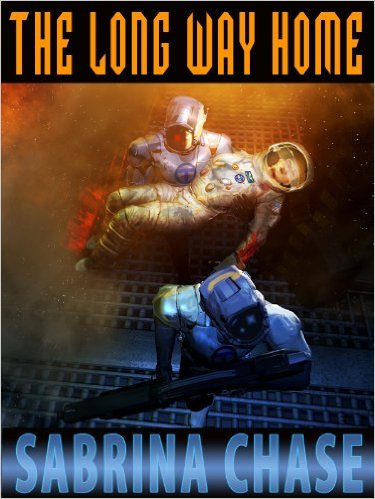
long way homeThe Long Way Home (Sequoyah book 1)

By Sabrina Chase

Promo price: $.99
Blurb:
Moire Cameron ran to protect her secrets — ran to the heart of an interstellar alien war. Her fellow mercenaries care only about her fighting skills, not where — or when — she got them. You’d think that would be good enough…

But a false name and fake ID can’t conceal her dangerous lack of contemporary knowledge, and they won’t help fulfill her last order, given by a dying man eighty years ago. To do that she must find a reason to live again. A cause worth fighting for, comrades to trust, and a ship to sail the stars.

Amazon Author Page
vengeance from ashesVengeance from Ashes

By Sam Schall

Price: 99 cents for the Labor Day Weekend, down from $2.99

Blurb:

First, they took away her command. Then they took away her freedom. But they couldn’t take away her duty and honor. Now they want her back.
Captain Ashlyn Shaw has survived two years in a brutal military prison. Now those who betrayed her are offering the chance for freedom. All she has to do is trust them not to betray her and her people again. If she can do that, and if she can survive the war that looms on the horizon, she can reclaim her life and get the vengeance she’s dreamed of for so long.

But only if she can forget the betrayal and do her duty.

Amazon Author Page

grey man changesGrey Man: Changes

By JL Curtis

Sale price $2.99

Blurb-

When Texas Deputy Sheriff John Cronin thwarts the Cartel’s plan to get paid to smuggle Muslims across the border, he becomes the target of the Cartel once again. One try fails, but the cartel isn’t about to give up. With his granddaughter, Jesse, still recovering from her last run-in with the Cartel and now far away with her Marine husband on a military base, Cronin only has to worry about the innocents around him.

One way or another, this old school law man plans to end this cat and mouse game for good. But, this time, the Cartel is playing for keeps; ending this war might just cost the old man his life.

Either way Cronin plans to go out on his feet, fighting tooth and nail.

Amazon Author Page

survival testSurvival Test

By David Burkhead

Price: I’ll set it at $2.99 for the promo.

Blurb:
War!
A series of diplomatic crises precipitate a limited nuclear war on Earth. Missile defenses block access to space. Nothing goes up and nothing comes down.
The people of the various space stations, the moon base, and a space colony whose construction had just begun must find a way to survive until the war is over.
The ultimate survival test.
Amazon Author page

outcasts and godsPam Uphoff’s Wine of the Gods Universe 

99 cent Labor Day Sale!

Genetic engineering enabled psychic abilities in the test children. And the ability to control the machinery to open portals between parallel Earths. But prejudice turned into exile across the dimensions, and the escape of the most powerfully “magical” to a world of their own.

It all starts with the stand-alone Outcasts and Gods and continues with twenty (so far) loosely connected stories in the same Multiverse.

Amazon Author Page

Zoey Iver’s YA Adventures

By Pam Uphoff

99 cent Labor Day Sale!

The AI war was deadly—and invisible. Until two teenagers found themselves in the middle of it.

Amazon Author Page

Eyes of OsirisEyes of Osiris

By Anita Young

Price: $2.99

Blurb:

Thanks to the curse of foresight, Dr. Kayara Ingham has had a vision of her husband’s death. While she desperately tries to avert the grim future, she meets a mysterious Osiris Corporation man who gives her an impossible ultimatum. When Kay is forced to choose, she learns that Osiris Corporation is not what it seems. The company is made up of a people that call themselves the Architects of Lore and, like many powerful organisations, their reach is extensive—one might say inescapable.

Amazon Author Page

acts of warActs of War

By James Young

Price: $2.99

Blurb:

August 1942.  Adolf Hitler is dead, Great Britain is surrendering, and the Royal Family is fleeing to Canada.  In this critically acclaimed alternative history novel, James Young details a World War II that is far different and much worse than the terrible conflict we all know.  Follow the Cobb family as they, and the nation they love, are confronted with horrible events while being swept away by war’s chaos.  If you are a fan of historical fiction, or just like a good yarn with mortal heroes, Acts of War is for you.

Amazon Author Page 

Pixie NoirPixie Noir

By Cedar Sanderson

Price: $0.99

Blurb:

Lom is a bounty hunter, paid to bring magical creatures of all descriptions back Underhill, to prevent war with humans should they discover the strangers amongst them. Bella is about to find out she’s a real life fairy princess, but all she wants to do is live peacefully in Alaska, where the biggest problems are hungry grizzly bears. He has to bring her in. It’s nothing personal, it’s his job…

Amazon Author Page

FarmhandFarmhand

By Lilania Begley

Price: $0.99

Blurb:

Wounded veteran Dev Macquire needs some farm help until he recovers. When his father, Gray, brings home a new hand, he’s dismayed to meet Irina. How can a woman do the rough, heavy work they need? As she works her way into their life, and into his heart, he’s faced with a new dilemma. Can he persuade her to stay, and to accept a new role in his life?

cunning bloodThe Cunning Blood

By Jeff Duntemann

Price: $2.99

Blurb:

Caught violating Earth’s Zero Tolerance for Violence laws, Peter Novilio is sentenced to a one-way trip to Hell, Earth’s prison planet in the Zeta Tucanae system. Hell is forever: Two centuries earlier its ecosphere had been infected with microscopic nanomachines that destroy electrical conductors, condemning its inmates to a neo-Victorian steam-and-gaslight society without computers, spaceflight, or any hope of escape.

Amazon Author Page

Ninth Euclid’s Prince

By Dan Hoyt

Price: $3.99 (dropping to $2.99 some time this weekend, so check the price when buying.)

Blurb:

Welcome to New Rome!

The far-flung heirs of the empire have been called home to the capital of worlds. In these mean streets, no wife is above suspicion, and no man above assassination. With the Emperor poisoned and prince Oswald in jail, Ninth Euclid, a mathematically gifted secretary from a rural backwater, must solve the knottiest problem of all: How will he keep his liege lord safe from daggers in the back and politically scheming trollops in the night?

Here Be Dragons: A collection of short stories

By: Sarah A. Hoyt

Price:  $2.99

Blurb:

A collection of short stories by Award Winning Author Sarah A. Hoyt. From dark worlds ruled by vampires, to magical high schools, to future worlds where super-men have as many problems as mere mortals, this collection shows humans embattled, imperiled, in trouble, but never giving up. Angel in Flight is set in Sarah Hoyt’s popular Darkship series.

The collection contains the stories: It Came Upon A Midnight Clear
First Blood, Created He Them, A Grain Of Salt, Shepherds and Wolves,
Blood Ransom,The Price Of Gold,Around the Bend,An Answer From The North,
Heart’s Fire,Whom The Gods Love,Angel In Flight,Dragons as well as an introduction by fantasy writer Cedar Sanderson.

Unringing the Bell — A Blast From the Past Post, October 2011

*Almost four years have passed and the amazing thing is how much of this is still “news” to most of my field, and how much of this is at the basis of everything that’s going on, including the Hugo struggle.  Well, everything that’s going on in Science Fiction.  I don’t think we can hold indie publishing responsible for the situation in the Middle East, Putin’s insanity or the heartbreak of Psoriasis.  However, again, it’s amazing how much of this is current.  Four years ago when I took the “going indie” workshop with Kris and Dean they assured us we were cutting edge pioneers.  I thought “surely that can’t be right”  People have been doing this for years.  And yet for most of my colleagues all this might as well be non-existent, even as the effects roil their lives and livelihood.*

Those of you who haven’t read Kristine Kathryn Rusch’s Writing Like It’s 1999, do so.

For those of you who read my blog this might seem like I’m harping on a theme, or like I’m getting repetitive.  Well I’d think so too, truly.  Except…  Except…whenever I’m at a con, someone – usually someone much less published than I am – comes back with a variant of “I’m going to keep my eyes shut tight and in the morning, this will all go away.”

Disruptive change is very scary and most people would rather pretend it will all go away, and we’ll be back to the familiar landscape and the familiar certainties.  Even if those are horrible.  Freed lions will often pace as though in the confines of the cage.  Those few of us who are awake and exploring every possibility, looking in every corner, searching for the way things will be are a small minority.

At cons, I still run into authors who look down on self-published authors.   I still run into authors who parrot the line about how much the publisher is investing in them: when it is patently obvious they’re lost in mid-list hell; I still run into authors who say “if you want to make a living at this, you have to publish with the big six.”

I had the dubious privilege of hearing a mid-press published author telling a self-published author whom I happen to know makes more in a month on one book than the mid-press published author has made for any two or three of his books that “most of what’s self published is crap and no one would buy it.  The future is finding a publisher and convincing them to accept you.  In two years, all this e-book stuff will be gone.”

It was breathtakingly bizarre.  Kind of like, in a fantasy novel, standing next to the hidden prince and watching the false king parade down the street looking down on everyone.  Like Saturnalia, with the fools reigning.

And then I catch myself – occasionally – thinking the old thoughts, too: “Well, what does he/she know.  He/she is small press published.”  Or perhaps thinking that some of my fledgelings will of course, eventually, follow the route I have.  And then I stop.  Because there are few things I know, but I do have some certainties.

These are the things I know:

Even if e-books all went away tomorrow, it wouldn’t go back to the way it was
Not the way it was in the early nineties, or even the way it was in the late nineties when I came in.  No way, no how, never.  Because there’s this thing called Amazon.  The publishers no longer control what’s on the shelves and what gets seen.  And even if Amazon died tomorrow, there would be other e-tailers.  Trying to control shelf space is not a winning strategy.  That bell has rung.

E-books aren’t going away
You can’t put the e-book genii back in the bottle.  I’m reading on kindle.  My kids are reading more on kindle than on paper.  So is my husband.  So are most of my friends. Barring some planet killing type of event, this is not going to go away.  No, the economic crisis won’t kill it.  Kindle books published by indies are cheaper.  The tighter life gets, the more likely we’ll buy those instead of the agency-modeled-to-death.

The hierarchies of prestige are gone
Because the big six no longer control access to shelf space (except in Barnes and Noble, and it no longer has the influence it once had) the safe hierarchy of self-published, small press, medium press, big press is gone.  We used to assume someone who self-published hadn’t even been able to get a small press to accept him/her.  We approached their work expecting it to be awful.  It often was.  That certainty is done.  A savvy author with time on his hands can decide he has a better chance going it alone.  Be careful how you talk to other authors.  That person with a single indie book out might have a larger readership than you could dream of.

Most authors have had a taste of freedom
I’m one of them.  Look, I’ve done next to nothing Indie.  A Touch of Night and a few short stories through Naked Reader Press. Interesting results but inconclusive.  However, just knowing I can write whatever and if it doesn’t sell I can put it up on Amazon and it will sell a minimum of x – plus be in print forever – has given me massive freedom.  I no longer feel like I’m blindfolded in the cattle car of a train over whose destination I have no control.  Even if indie proves to be less than half of my income, the ability to put out there what I think should be out there is slowly molding me into a different person: a much less fretful and worried one.  It’s likely to lengthen my life.  It will certainly make me easier to live with.  I don’t know how it’s taking other authors, but I don’t think it’s that bad.

We’re scared, but we’re not stupid
I know, I know, Dean says we’re stupid.  And he’s right in a way, but we’re a very specialized kind of stupid.  Also, he’s not seeing the pressures on my generation – those who came in after 2000 when the publishing houses looked at things ONLY through agents, and the publishing houses’ decisions could make or break your career, regardless of how good your book was.  We had to learn to shut up, no matter how stupid we felt what was happening was.  Not anymore.  And we’re losing the habit of silence – slowly.  The chances of a mass exodus back to publishers on the old terms because we don’t want to do everything ourselves is about … oh, look, do you see that flying pig?  Yeah.  Some of us will go back, of course – most of us who have made our name and can dictate terms, or the really small ones who couldn’t make it on their own.

And I’m not saying publishers are going away
Of course they’re not.  Though a few of the houses will vanish and almost certainly a few of the imprints will vanish.  What I’m saying is that the majority of the writers are NOT going to go back on the old terms.  You want us back, you’re going to have to do things for us that we can’t do for ourselves or hire someone to do for us.  I’m thinking this is the true “demise of the midlist” and not in the fake way you tried to do it before, where you simply announced the midlist was gone and kept changing midlisters’ names and paying them as beginners and not allowing them to build a following.  No.  I think the “midlister” the “shelf filler” the “person we print but don’t do anything else for” is gone.  You’ll have to treat every author as if he/she matters.  You have to make it better for them than they can do by throwing it up on Amazon.  I’m thinking good covers, publicity, limited contracts.

Make it worth my while
Or at least, don’t use aversion therapy on me.  You can’t keep me in the dark and feed me on shit anymore.  If the book is not selling, sure, I need to know, but don’t tell me it’s because it’s not a good book, when I know you did nothing to market it, not even get it on shelves.  And don’t, then, treat me as if it’s all my fault.  Because if you make things unpleasant enough and treat me like a serf, I’m going to think “well, I don’t need to work for you anymore” and I’m going to go Indie.

Give me a public
I’m thinking more publishers should look at Baen books, instead of turning up their noses.  Baen commands loyalty among its writers and gets dedicated readers who look for the brand.  Some of this is (good) marketing gimmicks: buttons saying “I read baened books”, book bags given out at cons, a slide show where upcoming releases are announced, a forum where fans can meet and geek out on their favs.  Part of it, though, the most important thing, is what none of the rest in sf/f or mystery has (I don’t know enough of Romance): a brand.  A unified taste.  For the big houses with multiple editors, this is difficult, of course.  But you can no longer be all things to all people.  Baen chose and does plot.  It does plot really well – whether it’s in sf/f or any of the variations.  “Things happen in Baen Books” would be a great tag line.  Mind you, if it’s one of my books (or Dave Freer’s, too, or a half dozen others) the books also have characters and feelings – but the “things happen” and “adventure” aspect MUST be there for it to be a Baen book.  When I started being published by Baen I immediately “slotted” into a pre-made public.  This, as a newby, gave me something to put my back against, as I grow the rest.  So, what can the big houses do.  I don’t know.  I don’t know under what constraints they operate.  BUT if I owned one, I’d give each editor an “imprint” and then give them the resources to publicize that imprint.  “Okay, Jane likes craft mysteries.  She can specialize in that.  We’ll call it Golden Brush books, and…”  Have them appeal to a segment of public, but appeal to them very powerfully.  It’s better to command 50k loyal readers and grow them slowly than to have most of your books bomb, except for a mega ultra blockbuster a year – which these days might not materialize.  (No power to push, remember?)  And meanwhile tell the editors that the house does… oh, pick one.  Beautiful, doomed adolescents.  Or perhaps more generally “character” or “angst” or “Beautiful language.” and unify that across your “imprints” which will maximize the chance of people reading the brand, not just the imprint.

Will there be a new equilibrium?  Of course there will.  And I think it’s about two years out, too.  But will things be the way they were?

E-books.  E-tailing.  Soon, the book printing machines in every bookstore.  Writers who’ve taken the bit between their teeth.  Will all that vanish?

No way.  You can’t put humpty dumpty together again.  And you can’t unring a bell.  So publishers and writers both will have to stay alert and change to survive.

UPDATE:  Ask not for whom that bell won’t unring…  I think what you’re hearing today, loud and clear, are funeral bells.  Or perhaps the woosh of the meteor falling to Earth.  The dinosaurs will never be the same:  http://www.thepassivevoice.com/09/2011/amazon-launches-79-kindle-and-99-kindle-touch-ereaders/

Yokels Abroad

In case you guys haven’t got a feel for it, I grew up in a village where being cosmopolitan wasn’t exactly a plus.  The thing to do was to do things like your ancestors had always done.

At the same time, stifled by this, a lot of “intellectuals” by which you should read “village kids who did well enough in their examinations to attend high school (let alone college) in the city often identified not with their homeland but with some foreign country.  (Yes, I went through this phase.  England, because my brother preferred France.  There are traces left of it in my fascination with English history and my turn of phrase.)

It wasn’t just the village, either.  This was pretty common all over the country. In fact in college I found people whose chosen allegiance was to Germany or Russia.  (The last ones were special snowflakes indeed.  Like the guy who signed up for Russian to read Marx in his original language.  Rolls eyes.)

Part of this of course is the inverse issue that America has.  Portugal is a tiny country.  On my dad’s globe the entire country was the size of the tip of my five-year-old fingernail (I remember being very disappointed.)  You can’t swing a cat without a passport.  And part of it is that it is a stagnant country, dozing and dreaming of past glories.  Almost all the advanced scholarship, from mathematics to language (even Portuguese.  The greatest Portuguese linguists are German) takes place abroad.  To get to a high level of studies you MUST learn a foreign language.

Now the more sophisticated of us who fell prey to this might have a country of allegiance of the heart, might love the language and read the books and magazines, but we did not commit social solecisms.  My love for England came from a love of the language, a love of Shakespeare, a love of Austen.  It did not come from a desire to lord it over my fellow villagers.  The one mistake I committed after coming back from the states was wearing shorts outside the house, and that didn’t brand me as “lording it over” but as an impudent hussy, which all the village women assumed I was anyway, gallivanting to foreign parts on my own.  Fortunately they were way too scared of mom (and particularly grandma) to give vent to the venom and contented themselves with inventing more boyfriends for me than anyone could have at the same time, or even serially.

But other people did what was obviously not a mistake, but an attempt to signal “I’ve been elsewhere.”  So you got the young man who had visited South America briefly and came back to the village shop and ordered Montserrat cigarettes.  He was henceforth known not by his name, surname or even family nickname, but as “Montserrat.” (Look, the cigarettes were right there, behind the counter, and you could see they had the two brands that were available in Portugal at the time.)I understand he’s now a local politician.

The culmination of this was speaking a foreign language in public.  Because my husband is not very tall and is dark haired, as recently as ten years ago when we visited, people make rude remarks to the tune of “they’re just speaking English to given themselves airs.”  Not in the village, where it’s well known that Dan is either an Italian I met in Germany (please don’t even ask.  I’d gone to Germany last before my marriage, and as everyone knows all Germans are tall and blond, so…) or a guy who works in a bakery the next village over.  I think they’ve gotten over that one, though, since I’m obviously living abroad and the guy isn’t and is clearly married to someone else.  (If you were a village baker, my love.)  But when we’re in downtown Porto, they often make jokes and laugh at the assumption we’re “giving ourselves airs.”  This is worse when I’m with younger son, who looks more Portuguese than I do.

Needless to say speaking a language in public that your fellow-citizens don’t understand is in my opinion not good manners, unless you have a good reason.  (I’m not sure practicing older boy’s French is a good reason, but the times we’ve done it we’ve been fairly isolated.)

So I understand the pseudo-sophistication that comes from loving “every land but your own.”

In the united states, though, this is overlaid with something weirder.  Because we have the opposite syndrome of Portugal.  We’re very big, and most of the scholarship (unless it’s in the latest branch of Marxism) comes from America.  The future, as it were, is forged here.

So while the same class of idiots — overeducated and under employed — here is obsessed with “foreign parts” and somehow convinced they’re subtly better than our habits customs and behavior (bah.  They don’t have anything in Europe that we don’t have bigger and better in Nowhere Kansas.  At least in the ways of creature comforts) even if what they have to come up with is the equivalent of “they know better ways of splitting a bean to feed ten people” but also, in a curious and bizarre way the people who think this way are the greatest American chauvinists and the only real ones I’ve found in present day America.

They will, absolutely and without hesitation believe that what is wrong with any foreign country has its origin in American actions (usually, such the provincial tribalism of such people in a Republican president.)  Part of this, of course, is that maleducation at American universities, teaches them fixed pie economics.  They presume, that is, that for us to be rich someone else must be poor.

G-d only knows why they think German public places — to pick a place at random — tend to have no water fountains.  I’m going to guess it’s either their sainted care for the environment or that somehow America hoards all water.  Or something.

To me this form of reasoning is particularly ridiculous because I’ve seen it applied to Portugal.  In the US people who aren’t absolutely sure where Portugal is will lecture me about how of course I came here because we were so poor (not by the time I came here.  Also, not really.  I came here because I fell in love with my husband and the country, though not in that order) and how our poverty results from the American tariff act of 1982 or some equally asinine nonsense.

Portugal is poor because it has never fully shaken off the Roman prejudices and form of government.  Portuguese institutions and public officials (not all of course, but as a system) tend to be corrupt, it was for a long time under a paternalistic form of government that, yes, was national socialism (without a racial component, though, because, well, Portugal).  The Roman prejudices, which Heinlein noted in his visit to South America, present as inheriting or being naturally rich is better than to work for a living.  Socially, you can’t let your compatriots see you working like a dog.  (In the North this is confused in that there is some English culture rubbing off and people like my dad manage to mingle opprobrium and admiration when they say “I’ve never seen anyone work like him.” Portuguese are capable of an untold amount of work and dedication, which they usually reveal while safely living abroad and hidden from censorious eyes.

However, there’s very little in those two factors that America had anything to do with.

Still some Portuguese — mostly those on the left — believe it too.  It’s convenient.  They really have no clue how screwed up the country is, because they’ve never been anywhere else.  So they will say that the reason Portugal didn’t invent its own computer was that if they’d tried America would have penalized them on rice imports.  (Heaven only knows where THAT theory came from.)  And yes, even at 16 I gave the rough side of my tongue to the idiot.  I don’t think — correct me if I’m wrong — that IBM which was butt of his rage has anything to do with rice imports in Portugal.

However, it is always easier to blame someone else.  And to be fair, particularly in Europe, a certain amount of resentment at the US is normal.  America has a disproportionate footprint in the world, both because it was the only giant standing after WWII and because it has a huge entertainment footprint.  Which means a lot of the anti-Americanism is fostered by our own yokels abroad.

Our yokels abroad to an extent behave just as the yokels who’d visited Venezuela or Argentina and came back to the village telling amazing tales of their two weeks abroad.

There are the outright stupid, like the idiot who told me that socialism must be great, look at all those wonderful buildings in Europe.  (Headdeskheaddeskheaddesk)  Apparently under the impression that Chairman Louis XVI was responsible for the Louvre.  (I tell you guys, those d*mn time travelers.) Or that having built wonderful monuments is the mark of a just and equitable regime.  (Though to be fair, communism joins to its other amazing characteristics an uncanny incompetence in the building trade.  The further you slide from social democracy to socialism to communism the more likely you are to find newly built buildings crumbling and/or architecture so ugly it makes you want to slit your wrists looking at it.)

Then there are the “Smarter than Havelock-cat” lot (mind you, Havey has three brain cells, one for eating, one for sleeping and one for cadging scritches.)  They will tell me the French or Swedish or whatever system must be better because AS TOURISTS while visiting they saw how  people have a lot more free time and security.  They miss the frustrations of day to day living, which frankly the citizens don’t realize are there, and therefore don’t realize how much better/easier life is in the States.

(One thing we do really well is provide everyday comforts and the ability to buy whatever strikes your fancy at the moment.  This might be stupid, and the yokels who’ve been abroad will scream “greedy” but often it’s neither, it’s something totally off beat one in a 1000 people need. And you can find it, easily, particularly now in the age of Amazon, a unique American development.)

You see, there is a trade off not just between security and innovation but between security and comfort.  Systems designed to make life safe from surprises are, by definition, hostile to innovation and competition. The Scandinavian countries, in burdening employers with regulations designed to smooth out employees lives also made it almost impossible for entrepreneurs and non-corporations to survive, thereby stifling the fountain of innovation, for instance.

It is important to remember all this as our economic lives become more interconnected.  In watching the economic follies out there (yes, yes, this WILL end in blood, duh.  But not everywhere, and there is a chance however slim that in the end sanity prevails) one can’t help but go “Who in heaven’s name thought it was a good idea to trust economic reports from a communist regime that controls everything that comes out of it?”  And then one remembers.  Maleducated yokels.

These are the same people who run around the net lecturing us on the virtues of things they never experienced — like communism — but about which they’ve read.  Because they think — being yokels, of course — that other countries function exactly as the US and that their priorities and “control” of information is the the same.  Also, inexplicably, that people abroad know more about the US than people in the US.  So when French or Scandinavians lecture them on how in the US we’re much worse off, it never occurs to our yokels to go “Wait? Wut?  How do you know that?” No.  They nod their little pinheads and go “Oh, yes, of course.  Because I’ve been there on vacation and–”  (In fact, if you talk to foreigners in web forums the “reporting” they get about the US is not only wrong but hilariously so.  For instance, people without insurance are routinely left untreated in our emergency room.  Yep.  Sure thing bob.  Because see, their governments have a vested interest in supporting socialism, which gives them power, and in keeping them on the farm without seeing Paree.)

But our yokels swallow all that without chewing on it, because, well, someone is saying it who lives there, and they must know.  It never occurs to them that to “know” something is better than the US people have to see both ends, and see both ends from the same perspective of the workaday world.

(There is a book I’ve been meaning to buy called A House In Portugal.  I don’t know if it flatters Portugal — or rather, I know it does, just not how truthfully.  I mean, let’s face it, Portugal has some awesome aspects, it’s in the daily life meets bureaucracy thing that it falls flat on its face — because it was a bestseller there.  It’s the story of an American woman renovating a house in Portugal.  My brother gave me to understand it has to do with the strange paths to licenses and the bribes to acquire materials, etc.  Don’t know if it’s true, but mean to buy it and read it when I have time.)

And this is how we end up with people who are convinced that all cultures are equally valid, except the US is equally evil.  And they must protect poor little communists from “slurs” (or as an unspeakable ignorant *sshole put it, “people who think communism is the worst regime ever should be pushed out of airplanes.”  Because he’s read books.  Books, I tell you.  Or more likely watched movies, or maybe cartoons.  And he’s been assured that greed and the evils of capitalism are much worse than being assigned a job where you pretend to work and they pretend to pay you.  Said idiot should contemplate the joke add that P. J. O’Rourke reported from the waning days of the Soviet Union “Want to trade Moscow state apartment for sleeping bag on the streets of New York City.”)

The thing to do to such posturing morons (of which my field has an overabundance) is to point and laugh and do the equivalent of sticking their stupidity to them as a tag that the village did when it nicknamed Montserrat.  (I am not understand, suggesting that anyone should be nicknamed Chicom.  Oh, whatever.  I know what you guys are.  Do as as conscience dictates.)

However, they are far more dangerous, because America isn’t Portugal.  While people living in both are basically as ignorant of abroad and what it really is like (well, not so much in Portugal now, where people are better off and travel is more affordable.  Again, you need a passport to swing a cat and the cat needs a passport to bite your *ss in revenge) the Portuguese footprint in the world is minimal right now.

There is no way that Portuguese yokels misapprehending the wonders of … oh, I don’t know, having to pay for all your water in Germany, can write scholarly papers that will make yokels in every other country decide this is da bomb.

There is no way Portuguese yokels deciding IBM is why their rice is so expensive, will write anti-IBM (is IBM even still a thing) screeds that will convince the rest of the world that IBM is teh evil that outranks all evils.

BUT American Yokels, because of America’s disproportionate footprint in the world can do just that.  And, in an increasingly interconnected world, that brings the risk of serious mistakes.  Like, believing that Iranian leaders think just as we do and aren’t really serious about this bringing back the Imam thing and the end of the world.  Or like believing the reports from a communist dictatorship.  Or–  you can fill in the blanks, right?

So we need to stop maleducating people and treating stupid opinions as though they deserved some sort of respect.

Just Montserrat them.

Interview with Cathy Young — part 2

*So in March? April? Cathy young interviewed me about the Hugos, and I gave her my trademark long answers.  Her article is up now, but she’d graciously agreed to letting me post my original answers when it came out, so here it is (not a verification thing, she’s okay, even if she is a journalist.;)  I thought you might want to see it, is all.*

(4) Do you think Sad Puppies is also a backlash (and I don’t mean that in a negative sense) against the dominance of “social justice” activists in blog and social media discussions in the science fiction fandom, and the resulting intellectual climate?

I don’t think it’s so much a backlash as a great freeing from shackles. As I documented in my blog posts starting with “He Beats Me But He’s My Publisher” there was a great climate of fear in publishing. This is because the publishers had all the power, the writers’ none. I’ve seen friends fired for no reason any sane person could divine, and it was often a whispering campaign or being seen with the wrong person.

Social Justice infected that structure because the structure was rotten and ready for whisper campaigns and top-down dominance by a handful of people who held the reins not just of whether you’d be published, but whether you’d make it to the shelves or not. I.e. whether your career would be able to continue or flourish.

If you look at (particularly the women) the names allowed to flourish, they all proclaim themselves not just as people of the left, but people who take some pretty extremist positions on the left. Take K. Tempest Bradford who made a vow to read no white males for a year. Imagine that someone said “I will not read females of color for a year”. The backlash would be howlingly insane. But what she said? It was met with laudatory comments about reading “the other”.

The problem is that in this climate, you’re not reading the other. You’re reading people of various external characteristics or orientations, who all write from the same soft (or hard) left perspective.

I for one believe you should judge a book and whether it challenges you or not from the pov of what’s in the author’s mind not between his/her legs.

The problem I have with social justice is not that it’s insurgent, but that it’s reactionary and boring. I was taught this stuff in school and I’m over 50 years old. Granted, Portugal was a little “advanced” in that respect, but all the same.

So, the climate has been stifling because we all depended on this small number of like-thinking people in NYC. Now with the possibility of going indie (and I have friends published only indie making six figures) that restriction is gone. What you’re seeing is not a backlash, it’s the Berlin wall coming down.

I’ve before used the image of Lloyd Biggle Jr.’s great novel The Still Small Voice of Trumpets. In it artists formerly revered get banished and mutilated at the capricious command of a cruel king. In the end the hero finds a way to bring them back. The hero is not named Bezos. Strangely.

(5) Is there any merit to feminist critiques of how sci-fi/fantasy has traditionally portrayed women? Any thoughts on Kameron Hurley’s Hugo-winning “We Have Always Fought” essay?

Will I be penalized if I roll my eyes? There is this strange tendency among the Social Justice Warriors to behave as though they were fighting a “straw science fiction” that never existed. The truth is that, given the restrictions on women’s lives before being freed from some of our biological constraints by contraceptives, science fiction was one of the more accepting/enlightened fields ever for a woman to work in.

Consider the Hugo Award was instituted in 53, and that Marion Zimmer Bradley, with a distinctly female name was nominated in 63, (a year after I was born, btw.) You can say she didn’t win, but she was up against strong competition, i.e. The Man In The High Castle.

And 64 saw Andre Norton nominated, while in 1970 Ursula K. LeGuinn won.

But isn’t this proof of discrimination, you’ll say. Note all the years with no female nominee. The fact is that the field at its inception was incredibly… well, geeky. In the same way that engineering classes start over half female and end with a handful of geeks, very upset there aren’t any more girls (my younger son is going through this) the field started as a geek-mathematician-engineer fest. My husband loves Flatland, and apparently so did Heinlein. To me it’s a story without characters, a sort of Mathematical Wank.

I’m not saying some women aren’t capable of/interested in “mathematical wank.” My friend Kate Paulk is.

The fact is it took women who were interested to draw other women in, by degrees, kind of like fish learning to work on land. For a while there the emphasis was on “Science” fiction, which meant that you had a lot of socially gauche geeks, which means you had to have very strange women to first penetrate those circles. (Is a strange woman, but not that strange.)

By 1970 you had maybe one third of the writers as female.

This, btw, doesn’t mean women weren’t properly depicted in science fiction. Take in account that very few people but geek males were the heroes up through the fifties, and the women are actually amazingly depicted. There are female lensmen. More importantly, even when depicted as love interest or wife, the women are often the strongest character. I was reminded of this when reading again Way Station by Clifford Simak. One of the women is a deaf mute mountain girl, but she is the redeemer the universe has been waiting for. The other woman is literally a Pygmalion creation, a dream made real, and yet she is the one who sees clearly enough to end the unequal relationship with the hero, which he lacks the strength to break.

The much maligned Robert A. Heinlein had women spaceship captains, women engineers, women heroes.

If I have a complaint about golden age women it is that they tend to be glorified by golden age men. This is partly the geek effect. Most geeks I know adore women, and adore them even more if they take an interest in their pursuits. I recently – at fifty two, overweight, graying – found myself the hot babe at a space symposium because I have exactly the same interests as those men and am willing to work on the math at which I’m wretchedly bad. (Or good. I get theoretical math very easily, I’m just digit dyslexic and transpose digits in calculation, which is maddening.)

By the time I came into the field in the late nineties, most of the new writers’ were women. This is partly economic, because writing no longer pays enough for the primary income earner something that like it or hate it our society tends to assign to men.

I expect that will change as people can make a living from indie, but since the awards lag the actual achievement – i.e. people who are at the top of their game not beginners tend to get the awards – I’d expect a plethora of women winners for the next few years.

Kameron Hurley’s essay. I went and read it when you asked this question.

The essay is rather baffling. It’s sort of the same “fighting a past that never existed” combined with a strange belief in “narrative” which means the author must have imbibed a good deal of post-modernism.

She compares women being depicted in stories in relation to men to llamas being depicted as carnivorous. This is a bit insane, as llamas have never been carnivorous cannibals, but women have moved in relation to men (and men in relation to women) for millennia or, that is, forever. It is what we call “being the same species” and “obeying reproductive imperatives.”

She also seems to believe we should depict people as thousands of genders, which is when my head hit the keyboard (this is bad. I have a Y imprinted on my forehead, now.)

I view this type of thinking as a sort of cognitive disorder, that demands that every little widget be in a little can with the label perfectly matching the contents.

At the proliferation of “other” genders and sexual orientations, I made a mildly annoyed comment on facebook, (I think referring to “Searching” – as an orientation for adults.) I was told I was lucky I’d always known my “gender.” As it happens it made me cackle, because I’m one of those women who used to be called tomboys and of course underwent the usual doubts in adolescence. (Except for the fact Mr. Hormone came calling and I really like boys.) A lot of people still tend to identify me as lesbian, in interaction. However this doesn’t make me “Searching” or even “bi.” I am female and I like men. The end. Gender allows for infinite statistical variation within it, and each individual has a distressing tendency to be individual, a concept Hurley doesn’t seem to be able to fully comprehend. She wants a label, by gum. Many, many labels, so each individual can be a group, even if the group has one member.

In the same way her call for writing women completely divorced from men, and then this will happen baffles me, as I can not decide whether she’s calling for species extinction, or whether she thinks she can with story alone rewrite millions of years of evolutionary history.

It’s the sort of pseudo-feminist, pseudo-intellectual games that college professors adore, but which will never make any sense for real people in the real world.

As for women fighting: what kind of impoverished lore and history did she learn that she thinks she’s making a profound statement? From Judith in the Old Testament, through Bodicca, through the various warrior queens, including but not limited to Matilda and Elizabeth I, I fail to see the shocking part of this. History tends to mention only noble women fighting, but if you study a little closer, you find that women followed their husband’s to war and yes, had some role in the fighting even if it was capturing escaped enemy; women defended citadels while their men marched off, sometimes with notable valor. And women often became heroes though not often through the means of going off to battle. (Some, sure, but our upper body strength is a limiting factor for most. Genetics are what they are.) For instance one of my personal heroines, learned in grade school in Portugal was the Baker of Aljubarrota. I’m too lazy to google the official details (probably available, since she was a national heroine) but while her town was under siege by the Spaniards, (I think) she took the little remaining flour and kept bread baking continuously, while the wind blew the smell of warm bread to the enemy camp. Then she set up behind the bakery door in the outer wall, and as each enemy came in she killed him with the oven-shovel. Her assistants whisked the corpse out of sight, rinse and repeat. She is credited with killing hundreds of men and ending the siege.

Now, did the fact that she fought invalidate the fact that she was some man’s daughter and possibly even some man’s sister, some man’s wife and some man’s mother? Why should it? Why should women be one-dimensional?

The whole construction of the essay is puerile.

(6) Is “politically correct” dominance in SF/fantasy really as bad as you suggest? In a recent blogpost, you mentioned a time in the 1990s when every single novel on the fantasy shelf at B & N was in the “young female magic user with abusive father figure” mold. I have to say I found that rather surprising — what about Wheel of Time, A Song of Ice and Fire, Sword of Truth? IIRC, those were the big fantasy hits of the ’90s and none of them fit that pattern. Also, is “peaceful matriarchal utopia” fiction all that common? I know about Sheri Tepper’s books and the Holdfast Chronicles, but it hardly seems a huge wave. 

Okay, on the first one – I didn’t even view it as a politically correct thing, though let’s not forget the nineties was the time when a lot of the stores changed the History section to “Herstory.”

I am at a loss as to why people expect me to remember books I didn’t buy twenty years ago. However, some of the books I did buy with that pattern and enjoy despite that pattern were Mercedes Lackey’s fantasies that I want to say had bird names as titles. (I could be wrong. I haven’t re-read them in a long time, and everything is packed. See also how I’m still on pain pills. Much better, but they leave weird holes in my mind.) A lot of the McCaffrey’s also had the same pattern, though hers were science fiction (even if with a fantasy mouth-feel. Oh, and there was a reason for overbearing patriarchy in her roughly medieval world.) I want to say there was also a successful one by Elizabeth Moon, but I hesitate because I don’t remember clearly when books came out.

The point of that anecdote in the post, though, wasn’t what was being written or sold at the time. It was more what was available to me at the time, as the anecdote involved my walking away from the field for a time.

If this was in the mid-to late 90s, i.e. just before I gave up on Barnes and Noble and sf/f altogether, it is important to note that Barnes and Noble was stocking according to the decisions of the tri-state manager. This meant someone in Kansas decided what books I could find in Colorado Springs. These were usually (though at that time not always) the books pushed by the publisher because the tri-state manager was a business man not a reader. (And it was the beginning of what we see now happening to the chains. They could undermine mom and pop’s due to deep discounts on books, but their lack of variety eventually ate them alive.)

By that time my local Barnes and Noble had three shelves devoted to sf/f and the vast majority of these was taken up with media tie-ins, which I don’t read because being abnormal I don’t watch TV/movies. Half of the remaining one third, in those days when reprints still happened were either novels I wouldn’t read (See where my tastes aren’t normal. I MIGHT have read The Wheel of Time if I got desperate enough, but if the audience were all like me it wouldn’t have been a bestseller. I simply could never get into heroic fantasy. I’ll read it if nothing else is available, but I also read the back of shampoo bottles) novels I had read such as, if I’m not misremembering, Lackey, MacCaffrey and the excellent Wizard series by Simon Hawke. I was looking at novels I hadn’t read, which might have been 12 or so that had been stocked in that store. And they were all Lackey/MacCaffrey pale immitations.

This is not so much a “politically correct” thing, except in the sense that a certain group-think that all men were oppressive seemed to have set in among middle aged boomer women. At the time it got me raw because I bore easily. If one of them had had an abusive mother for a change, I’d probably have bought it.

How much of this was the restriction of NY publisher group think, I don’t know. I will note that when I first started writing I had a science fiction novel with a seriously broken, borderline psychopathic male hero. I could never sell it. I heard he was “hateful” and “evil.” HOWEVER when I wrote the main character of Darkship Thieves as a female with basically the same personality, not only didn’t I have issues selling it (granted to Baen) but until I came out of the political closet no reviewer had those problems with the character. This is personal experience, and of course it fits my own internal narrative, but it’s hard to avoid the suspicion the reason there were no evil mothers/sisters is because it shocked the sensibilities of the NY establishment and their attempt to establish a “narrative” of women as always good.

Speaking of which, in terms of peaceful female planets, you forgot Suzy McKee Charnas and Suzette Haden Algin. Heck, the trend is so relevant it has a wickipedia page, here:

http://en.wikipedia.org/wiki/Single-gender_world?hc_location=ufi

It is also in TV tropes.

Enlightened Matriarchy – A more benevolent or enlightened rule than patriarchy. A form of non-sexual Author Appeal for certain feminist writers, especially second-wave feminists in the 1970s. On its way to being a Dead Horse Trope, at least for the more extreme versions, as well.
http://tvtropes.org/pmwiki/pmwiki.php/Main/Matriarchy .


And it is often the background (together with an imagined pre-historic matriarchy for which there is no evidence and plenty of contrary evidence) for books that aren’t about “women planets” such as the work of Anne Rice.

Frankly being asked to provide examples of both of these – and I’ve had comments demanding this on my blog out of the blue – was one of those indications that a strange twitter storm was going on where the other side had decided to treat my anecdotes about my experience of the field as social history and were demanding footnotes. It was also bizarre, as neither of these trends is secret (no, not even the one of abused-by-father magic users.) It was like being asked to prove that elephant bells were once a thing. Didn’t people wear miniskirts, instead?

And in case this libertarian writer needs to say so, I don’t want to silence either of these trends. It’s the fact that the opposite doesn’t exist, that there is no peaceful and beautiful planet of the men (well, maybe Ethan of Athos – tongue planted in cheek, though Bujold did not make it a hell hole, which is innovative) that is telling of political correctness in the field.

After all, men as well as women can be peaceful or war like. Or, to quote Kameron Hurley, “We have always fought.”

Now is this the writers, or the gatekeepers? I’d guess the gatekeepers, of which reviewers and awards are part.

(7) Getting back to Sad Puppies: I hate to bring up the Vox Day issue, and I know that he’s not part of Sad Puppies per se, but he is perceived as a SP ally (and he’s the publisher of some of the SP authors). Do you think having a perceived connection to Vox lends ammunition to those who want to depict Sad Puppies as a backlash against women, gays, and racial diversity in sci-fi? I’ve seen some of your posts on the subject and I know you’re strongly opposed to the idea that people should be “disavowed” for having the wrong political opinions. Are there any opinions that should be legitimately considered beyond the pale? (Not to Godwin this question, but pro-Nazi sentiment would be one obvious example; or, for instance, approval of slavery.) 

This is somewhat of a mis-reading of my position. I have no problems at all with people being disavowed for having stupid opinions. I have problems with their being kicked out of a professional association for having unpalatable opinions.

In other words, the organization’s goal is not to assure “correct thinking in science fiction” but to work with publishers on improving the writers’ lot. I know for a fact we had members who were jailed for murder, something much worse than thought crime. They weren’t forbidden from joining/kicked out for this crime, nor should they be.

If members of the organization had merely told Vox he was bad, evil and they were telling everyone he was a poopy head, that would be entirely in keeping. And if in pursuance of its function of improving the lot of SF writers, the organization had put out a memo saying “We strongly disagree with Vox’s stated opinions on—” Meh. I wouldn’t care. He is a grown man and says what he thinks, and he knows there will be consequences. Mind you, I’d like to see them say the same about misandrist speech, but that’s not within the abilities of the “elite” in our field at the moment.

Opinions beyond the pale? Absolutely. I consider a lot of them beyond the pale, and so do any number of people.

Forbidden, though? No.

Look, free speech needs no protection when it’s about loving puppies and butterflies. In the same way, say speech “empowering” women and slagging men doesn’t need protection in SF/F. It brings rewards in terms of the person being applauded for courage. I suspect in Imperial Rome speech talking about the awesome power of the Emperor didn’t need protection, either. It’s when you actually do speak truth (or lies, but dissidence, at any rate) to power that you need to be protected. A Roman saying the emperor was just a man who had bunions and bad skin would need protection (which he didn’t have, since free speech was not part of the Roman culture.)

For an example, I find it absolutely appalling there is (or was a few years ago) a group of writers known as “the young communists club” (all about ten years younger than I, but never mind.) Why would you knowingly proclaim allegiance to a system of belief that has caused 100 million deaths around the world? It appalled me more that this affiliation was lauded on various reviews.

Should it be forbidden? Oh, heck no. It’s appalling, as is Nazism or promoting slavery. However, if you forbid that speech, what will you forbid next? And also, isn’t it better for horrible speech to be out in the open where it can be refuted?

I’d argue that America where Mein Kampf isn’t illegal has fewer problems with Neo-Nazis than European countries where it is. (This is just a feeling, from talking to friends. I can’t provide statistics.)

More importantly when I was twelve and ranting about how this or that should be forbidden, my brother who is ten years older asked me “And who decides?” That was when I realized authorities that could forbid things were ALSO only human and therefore could decide things I didn’t agree with. I still haven’t solved this conundrum and therefore will stay on the side of having things – speech included – as free as possible.

On association with Vox: that is an association carefully implied and cultivated by the anti-sad puppy side in the Hugos. After all Entertainment Weekly, The Guardian and the New Republic, not to mention the repulsive Daily Kos all pounded that little drum.

Look, it’s predictable. After all, they can’t in any other way substantiate their racist/sexist/homophobic slurs. Larry Correia is technically and certainly culturally of Portuguese descent. Brad is in an interracial marriage, and even idiots have to laugh at the idea he chose to do this and having a mixed race daughter to disguise his deep racism. I often have gay protagonists (no idea why) and consequently about as many gay fans as Mercedes Lackey, a lot of whom write to me and become at least distance-friends. Half of our slate was female. Some of them were other races/orientations. They weren’t picked because of this, it just happened.

But the end result is that the only way they can justify their unhinged attacks is to tie us to Vox. Now, did Vox help with this by commissioning a similar logo to the Sad Puppies one? No. Did he help with this by copying part of our slate (not hard to do since Brad assembled it in public)? No.

I will even admit there was a sort of rapprochement, not this year but last year, in which he was nice to us because we defended him against SFWA (at least in his understanding.) He asked for review copies of my indie book, for ex, and gave it to followers of his to review. (I have no idea how that shook out, as by the time the reviews were done, I’d taken a look at his blog and decided this was something I didn’t want to be associated with.)

I have no idea if his positions are shock-jockey efforts or his real beliefs. I don’t want to know.

I don’t know what he means to do with the Hugos. I don’t want to know.

We have no more way of controlling him than the other side does. Arguably they unleashed him by kicking him out of SFWA.

My answer to cries of “if you don’t want to be tied to him, stop Vox” is “not my circus, not my monkeys.” I refuse to respond to “let’s you and him fight.” My answer to Vox and anti-Vox is “A plague on both your houses.”

Meanwhile the sane ones among us (well, sane for science fiction) will continue trying to save the Hugos and the image of written SF/F in the world at large.

Right now, for me at least, that passes to getting as many fans to get supporting memberships as possible, so that a wider opinion prevails.

And I’m looking forward to the Hugo nominee packets that will include Kevin J. Anderson, Jim Butcher and Liu Cixin. I’m getting better, and expect to put the health problems of the last few years behind me. I’m already concentrating better and longer, and have undertaken reading some half-forgotten classics, but will move to new stuff soon, and these books will be a great treat. I expect to be quite delightfully stumped as for who should get my vote.

Interview with Cathy Young, Part One

*So in March? April? Cathy young interviewed me about the Hugos, and I gave her my trademark long answers.  Her article is up now, but she’d graciously agreed to letting me post my original answers when it came out, so here it is (not a verification thing, she’s okay, even if she is a journalist.;)  I thought you might want to see it, is all.*

(1) Were you/are you directly involved with the Sad Puppies project, or are you simply a supporter?

I’m a friend of Brad’s and Larry’s and have taken part in a sort of free-floating email discussion of the Hugosplosion since the first one when Larry was doing it for a joke. There was then the second when he set out to prove that people of the wrong opinions/wrong views couldn’t win the Hugo.

That second one included two of my works on the suggested slate. They didn’t make it, partly because I didn’t even mention it to my fans (or at least not the short stories.) And I didn’t mention the short story because I had no idea it was suggested. (It wasn’t one of my best. It’s almost fanfic for my Shifter world.)

Here I must interject that I’ve been very ill for about two years (more, but the very only the last two years) which brought my reading and, unfortunately, my writing to a halt. So some of those emails (and the participants vary because it’s not a conspiracy and people keep adding/dropping people, including friends and spouses) I merely skimmed. I got enough to get Larry’s point, and I defended him from some of the crazy accusations, such as that he was buying votes. BUT I wasn’t participating very actively. I neither nominated nor voted last year, because for a free-lancer health difficulties mean money difficulties, as you probably know, yourself.

When discussion came around to this year, Larry said he’d proved what he wanted last year, and was not running a slate this year. It was mooted that I should. By that time, I knew I’d likely need major-ish (turned out far more major and explained my issues) surgery early in the year. So Brad volunteered. His goal was not the same as Larry. His goal was to reclaim the Hugo as a brand of “something people will want to read.”

Unfortunately, though I bought a supporting membership this year, I didn’t even nominate, because I was dealing with health crisis from December onward, as well as a house move. This will make my answers to some of these questions fairly odd. (Not helped by the fact I’m still in recovery.) Sorry.

(2) What do you think Sad Puppies was primarily a response to: stories getting Hugo nominations/wins for reasons of ideology rather than merit? Or, conversely, worthy sci-fi/fantasy literature not getting nominated because of ideology? Or both? Can you give me some examples of stories or books that you believe won/got nominated undeservedly (other than “If You Were a Dinosaur, My Love”), and ones that were unfairly excluded?

I can’t speak for the rest of the participants. This is a centerless movement, a lot like the Tea Parties. I know Brad’s goal is to “restore” the awards, and also that Brad is well to the left of me. In Portuguese classification terms, which since it’s all left provides greater amplitude of dividing the left into segments, I’d say Brad is a social democrat. This means he has no objections to the politics in the winners, only to ineptitude.

Now that I think about it, I also have very little objection to the politics (save when they’re predictably boring.) Most of my objection to recent wins of the Hugo doesn’t even rest in If You Were A Dinosaur My Love being nominated. I hate that story because of how it portrays “every man working class” in America (and yes, I know it’s been said this “rough bar” isn’t working class. Because, you know, the Harvard Faculty bar is truly dangerous. I mean, I don’t know about your area, but in every place I’ve lived in the true underclass doesn’t congregate in bars. Flophouses and crackhouses [we had one down the street twenty years ago], maybe, not bars.) Heck, how it portrays every man working class anywhere. My grandfathers were both carpenters and my mom’s brothers were in the trades. It didn’t make them raging bigots, even if one of them had a crude sense of humor.

But it wasn’t what I call the Dinosaur Abomination nor even the fact that for years I haven’t been able to use the Hugo as a guide for what to read that convinced me something had gone very wrong. No, it was Red Shirts win. I’m sorry, that book is at best bad fanfic, and yet it got the honor of being “the best of the year” against, if I remember the year correctly an excellent (ie better than normal) Lois McMaster Bujold book.

I know you’re going to say taste can’t be argued, and this is true, but it prompted me to start looking more closely at the awards, and what I found and had already known at the back of my head, is best encapsulated in my friend Dave Freer’s words, back at Mad Genius Club:

“I used to be a member of SFWA. I used to get the Nebula nominations notifications. They were fascinating, pre 2010… because they listed the names of those who voted for them.

Guess what?

It was all the same names. Jim got nominated by Joe, Mary, Sally, and Charlie. And Charlie got nominated by Jim, Joe, Mary and Sally. And next year lo and behold! Mary got nominated by… yeah, you guessed it. Jim, Joe, Sally and Charlie. And yes, many of the names now screaming in outrage about the ‘evil’ puppies… are the same names. This is not a lie, or conjecture. It’s a fact. Well known, well established and one you can verify. The process is called log-rolling, it’s incestuous, unfair and a very very poor measure of quality.”

I had in fact been advised in workshops to aim to compete in the less “packed” categories where you could more or less buy the award for a couple thousand dollars by buying memberships for friends and family. I THINK – I never engaged in the game – novella was one of the least packed. Ten years ago I had a friend who won at least a short-story award by buying a lot of memberships. (And no, I’m not going to give a name.)

Now, all is fair in publishing and publicity, but when the award bills itself as “the best” in the field, people are going to think the rest is worse/more of the same, and it will turn away new/naïve readers who don’t like the limited selection.

It is in the interest of my livelihood to ensure that the science fiction genre thrives again in books as it does right now in movies and games. You see, I’m a libertarian and not as altruistic as Brad who is a boy scout. I just want to ensure we’re not eating our seed corn.

(3) Following up on (2): I’ve seen the argument (I believe from George R.R. Martin) that last year’s Hugo finalists for best novel were good old adventure stories rather than “message” tracts, and that this shows the Sad Puppy complaints are baseless. Any comment on that?

See the part above where I said I hadn’t had much ability to concentrate on long reads the last two years. However, when Ancillary Justice was praised to the skies and when half of my readers thought it was pretty good, I downloaded the sample from Amazon.

It does show a certain amount of talent. It also has the thumbprints of a first book. The pacing seemed off to me, as did the cueing of where/when the reader is. I chose not to read the rest. In online discussions I keep hearing the story referred to as “a ripping yarn” and “Just good space opera” but two things lead me to believe this is wrong. Even its supporters say “the story gets good after page 40” which if you ever took a fiction writing course is sort of like saying “But other than that, Mrs. Lincoln, how did you like the play?” Second, what I’ll call the pronoun gimmick. The character expresses herself in a language that has only the feminine pronoun, even though the characters have two genders like other humans. This causes a distancing of the reader, in that you keep trying to figure out if this “she” has an innie or an outie. It’s human. You want to visualize the characters. This would be justified if it impacts the plot and so I wouldn’t say anything, if the author herself hadn’t said that there is no plot reason for that “gimmick.” I will not hold her to the words of her fans, who seem to think it’s fitting “payback” for English having the male as default. But they miss that English (indeed, all indo-European tongues) only has the male pronoun as default when the gender is not determined, such as when seeing someone in a fog or talking about someone in the abstract. (I bet they’re the sort of people who think History is His Story. Sigh.)

As for the others, Charles’ Stross does sound like space opera, but until I read the actual book, I can’t tell you if it is, or just a vast tract against capitalism. Mira Grant’s sounds like a horror novel of the aliens within kind (again, not something I can comment on for sure unless/until I read the novel) and well, the Wheel of Time is the Wheel of Time. I’m not particularly enthused by vast heroic fantasy epics, preferring contemporary or historical parallel world novels. I might have read the first few books back in the mists of time before Noah built the arc, but I don’t remember it.

I have read (actually listened to, which makes the attention span and concentration thing easier) Warbound and like it, because it’s a painstakingly built parallel world with intriguing rules and intriguing characters (and no, I don’t like ALL of my friends’ writing. It’s a curse in this field to love someone to death and not be able to read their books. But I like this one [And MHI, natch – not in the answer, because not nominated.)

However, even reading the other descriptions, one boggles at “Why Ancillary Justice” with known flaws and from a less experienced storyteller?

Taste, of course, but how representative is that taste? Hard to tell when only a miniscule group voted on the award.

Offensitivity – Cedar Sanderson

Offensitivity  – Cedar Sanderson

I started out my research for this post looking for the one right word that summed up what I was going to explain. Surely I remembered that there was a psychological term for the people who get a rush out of attacking other people when instigated and when it could be done at little to no risk of harm to themselves? I asked friends, and we all mulled it over… turns out, no, there isn’t a single word. Although the one that Berkeley Breathed invented back in 1982 or thereabouts works nicely for the topic I was addressing.

offensitivity50

I’m talking about the herd mentality, otherwise known as Mob mentality, a phrase first used and described in Mackay’s Memoirs of the Extraordinary Popular Delusions and Madness of Crowds. In this sort of behavior, we see people do things they would never dream of doing to another person on an individual basis. “Groups can generate a sense of emotional excitement, which can lead to the provocation of behaviors that a person would not typically engage in if alone.” Tamara Avant goes on to explain the kinds of people you will find acting in this way, “The greater individuals feel like they identify with a group, the greater the pressures for them to conform and de-individuate become.” And finally, in the list of reasons people begin to herd, we find that they include when “we are surrounded by like-minded people, and/or when emotions are aroused.”

So we find that “As humans, we have instinctual responses that are exacerbated by group influences. What we might not do as individuals we may do as part of a group.  People may lose control of their usual inhibitions, as their mentality becomes that of the group.” In the age of the internet, this may not lead to violence as it did with the witch hunts, but the possibility of shattered lives is still a clear danger, and one that you cannot escape from, seemingly, as internet lynch mobs spring up globally in response to imagined slights.

For that is what I was thinking of when I went looking for the word I wanted. People who hop on a bandwagon because of the mental mechanism that rewards their righteous indignation with a burst of dopamine. It’s addictive, as any athlete will tell you. It’s an all-natural high, a rush, and once you’ve figured out how easy it is to get, you go after more. Humans are clever monkeys in some ways, and in others they never take the time to figure out why they act the way they do.

One of the theories surrounding the actions taken during the Salem Witch Trials sheds some light on the new era of internet mobs, where the ducking and hanging is virtual rather than literal. Dr. Brian Pavlac writes, “Witch accusers acted on a psychological need to blame others for their own personal problems. Drawing on functionalist anthropology, psychology and post-modernist criticism, supporters of this theory argue that witch hunts were therapeutically beneficial for society, since they defined what was right and wrong and rid society of its troublesome marginalized folk, like the old and the poor.”

Feeling some lack in their own lives, then, leads people into following internet trolls. Let’s define a troll, shall we? Psychology Today has this to say: “An Internet troll is someone who comes into a discussion and posts comments designed to upset or disrupt the conversation. Often, in fact, it seems like there is no real purpose behind their comments except to upset everyone else involved. Trolls will lie, exaggerate, and offend to get a response.”  The article goes on to quote from a study performed by Buckels, et. al ” “Both trolls and sadists feel sadistic glee at the distress of others. Sadists just want to have fun … and the Internet is their playground!”

Narcissists, Psychopaths, and Sadists. Keep that in mind as I explore a couple of recent outbreaks of internet lynch mobs.  These centered around people who were attacked for ‘misconstrued’ words, attacked by people who were seeking to take offense in order to generate controversy and propagate their own causes. Hence I plan to lead off with Tim Hunt and only use Sarah Hoyt as support material, along with Matt Taylor and possibly one or two other cases. In all of those, you have an agent provocateur who was then joined by an internet mob in a witch hunt.

In all of these cases, once the blood was in the water, the mob fell into a predictable feeding frenzy. Due to the mechanism of dopamine release, which then leads from an autonomous bodily function  and that turns the internet mob into unthinking predators seeking instinctively to harm, rather than employing intelligence and reason in assessing the target of their rages. in the case of Tim Hunt, a single tweet, which contained some half-truths mixed with made-up (lies, if that’s not plain enough) statements purporting to be quotes, started the lynch mob on their crusade that would lead to his career being irrevocably destroyed, despite the whole matter having been revealed to be a baseless calumny.

In the excellent Commentary Magazine article which sparked my interest in writing about this messy situation, Jonathan Foreman explains why it didn’t matter that the tweets and initial news reports were revealed to be falsehoods. “That’s because for anyone with an ax to grind about gender equality or sexism in science, this was one of those stories that the tabloids used to label (jestingly for the most part) “too good to check.” For politically committed editors and reporters, a story that is too good to check is one that perfectly confirms their suspicions and prejudices about those they consider the enemy.” If you will recall, one of the motivations of a mob is to react to the arousal of their emotions, and gender equality is a push-button topic in this modern era, whether it is a valid concern in the developed nations, or not. And to bring this back to the title of my post, the people who made it their job to destroy Tim Hunt?

The coup de grâce came in July with Mensch’s release of a short recording from the luncheon. One can clearly hear applause and laughter in the room as Hunt ends his speech. Apparently out of a hundred guests from around the world, most of them women, the only people who were offended by Hunt’s remarks were a handful of British and American science writers, all of whom happen to be diversity obsessives.

Hunt experienced in less than two months’ time something similar to the process of denunciation, destruction, and rehabilitation that the main character in Milan Kundera’s autobiographical novel The Joke (1967) endured over a period of many years. Set in Stalinist Czechoslovakia, The Joke tells the story of Ludvik, a student who sends a jesting postcard to his girlfriend that concludes with the words “Long Live Trotsky.” Ludvik is actually an enthusiastic supporter of the relatively new Communist regime, but that doesn’t prevent him from being denounced, expelled from college, expelled from the Party, and then sent off to a labor battalion. Ludvik is too young and naive to understand that totalitarian systems have very limited tolerance for humor and see it as dangerous and subversive. Perhaps Hunt was too old and naive to realize that the worlds of science, education, and “science journalism” are policed by people who are not exactly totalitarians but whose obsession with “correct” language and thought is incompatible with humor and intellectual freedom.

It is a phenomenon that combines modern ideology with quasi-Victorian notions of “respectable” behavior and feminine fragility. For these witch-hunters, there can be no toleration of “inappropriate” speech by the contemporary equivalent of “Society.” The wrong kind of joke, breed of joke-teller, or even the wrong political opinion, moreover, creates a “hostile environment” that supposedly intimidates the sensitive victim to such a degree that she cannot function on an equal level.

I highly recommend that you read the full article. It is lengthy, but it will serve as an excellent primer on what the internet witch hunts looks like, and how it literally cannot be stopped with the truth. I do like Foreman’s term of Diversity Obsessive, as that is a perfect way to look at what happened to Matt Taylor, who wore a shirt that a rabid feminist objected to. Note that his boss, who was female, and co-workers, many of whom were female, had no problem with a ‘lucky shirt’ he had worn on previous occasions. The reporter who cornered him for an impromptu interview – he was not expecting to be on television that day – had nothing to say about his shirt. Instead, a blogger half a world away took the time to screencap him from a brief video, blow the screenshot up, and proceed to be loudly offended on the internet. Which led to the man being bullied into public tears as he broke down and apologized for the shirt his good friend – also a woman – had made for him.

Because reality does not matter to the internet mob. Case in point, where MR Kowal accused fellow author Sarah Hoyt of using an ethnic slur.The word she said was a slur? ChiCom, a commonly used abbreviation of Chinese Communist. Since ChiCom is used to differentiate between fellow Chinese factions of differing ideology, ethic is more than just a stretch, it’s a flat-out fabrication. When pressed, MR Kowal then insisted that she had found in one source that the term was held to be derogatory. She ignored the multiple other sources that are more reputable, and do not do more than define the term as I have above. Instead, with less academic prowess than a first-year college student, she insisted that her source was the right one, and led a small mob in denouncing the confused Latina lady whose first language was not English, as racist.

I have no real answers for how best to cope if one is confronted by these kinds of witch hunts. It is clear that the de-individuation of the mob leads to a dehumanizing and instinctive reaction, fueled by the dopamine release they find from the arousal of emotions. While confronted individually, the members of the mob would likely be willing to listen to reason, as a herd, they are no longer rational, interested in seeking the truth, or able to be reasoned with. Confrontation with the truth only leads to more accusations, often of unrelated and imagined sins the mob demands expiation for, without ever stopping to explain what would redeem the target individual. Furthermore, the mobs are egged on and ignited by trolls, who feed off the results to satisfy their own sadism. Fueling the mob energizes the troll to new heights as they scent blood in the water.

It is said that an argument on the internet is not for the benefit of either side – the one in the right will never win, and the troll will never admit they were wrong – but for the bystanders. The important distinction then becomes: at what point are you fighting with a foe who is psychopathic, and willing to do literally anything to cause you harm? There is no point in debate with the mentally ill, and they can harm you. Be aware, and be wary. Know that it doesn’t matter what you say, the grievance seekers will find something they can use to gain the attention they so desperately seek.