Villains and Villainy: The Choice to Be Evil
By Mike Brogley
A while back, during a discussion by the Hoyt’s Huns Commentariat on character motivations, our hostess, the lovely and talented Senhora Dona Sara Hoyt, saw a comment of mine on villains, villainy, and choice, and asked me to expand on my thoughts a bit as a guest post. Being both naturally long winded (ask my lovely wife) and a fan of anything allowing Sarah more time to write her books, I agreed.
Our discussion that day was on the topic of bad guys, villains and villainy, and what goes into making a character’s villainy believable. I’ve certainly read stories and seen TV and movies where the character designated as the villain is identifiable because he’s in effect wearing a black “I ARE A VILLAIN!” t-shirt. In silent westerns the identifying item of clothing was the black cowboy hat, while in young-lady-tied-up-on-the-tracks melodramas the villain was generally the guy with the stooped posture and the large waxed mustache. Given the limitations of these early movie formats, shortcuts like these served as a quick way to let the audience figure out who they should be rooting for so the action could commence.
Written fiction gives more opportunity for the author to go past simply describing what is happening, and readers expect a more insights into just why that fellow wearing the black hat is so invested in continuing to do bad things which our heroes must oppose. When the villain’s actions make sense, the hero’s challenges are more challenging, heroic setbacks are more believable, and heroic accomplishments are more satisfying.
In the Commentariat discussion the villainy of one Darth Vader, formerly Anakin Skywalker, Dark Lord of the Sith, Galactic Overlord, right hand man to and eventual assassin of the Emperor of the Galactic Empire, was brought up as an example. An examination of the Darth Vader character works for our exploration of villainy on a couple of levels, both because he was drawn so well, and because he was drawn so poorly in the extended Star Wars saga. We’ll get back to Darth in a bit, but first let’s talk a bit about villainy in general.
By definition, something is wrong with a villain. The choices they make are not the “correct” choices with which society in general would agree. Something has shifted the structure of beliefs they use to decide what to do that yields an altered value system, leading to actions – betraying trusts, harming innocents, causing unnecessary pain – that are generally recognized as “bad”.
So what makes a well-rounded characters’ villainy believable? And how can this be done while also avoiding muddying the writing to the point that our villains become more sympathetic and likeable than our heroes, since, to paraphrase what Sarah has said, that way leads to deep, deep mud indeed.
In real life, ‘experts’ have been trying to understand what makes people do evil for a very long time. Explanations including possession by demons, curses by angry gods, and spells cast by evil magicians or witches standing in threes around a big pot were popular in the past, Modern experts have a similar range of explanations. At base, all of these explanations fall into two broad categories: Nature – that the person who performs some evil action has some innate characteristic, flaw or fundamental void of character that causes them to do bad things, or alternately prevents them from being able to distinguish between good and evil so they can choose to do good; or Nurture – that the person’s environment, education or upbringing led, lured, or forced the person to their eventual acts of evil.
My default answer to any “Choose A or B” question is always “Both,” and I think that applies to this question as well – aspects of intrinsic “flaw” as well as environmental factors both undoubtedly contribute to a person committing heinous acts.
Sometimes a person who commits evil is just broken. A number of articles from a few years back explored the use of Dr. Robert D. Hare’s Psychopathy Checklist, Revised (PCL-R), a commonly used screening tool in the diagnosis of psychopathic individuals. People with psychopathic characteristics are highly impulsive, lack empathy, anxiety or guilt, and effectively lack any conscience (here’s a good blog post on this topic). Using the PCL-R test, researchers document a general adult population incidence of psychopathy of 1 in 100 in males and 1 in 300 in females. Then they looked at prison inmates, where the proportions were significantly different: 1 in 5 prisoners in the general prison population are diagnosable as psychopaths, and 1 in 2 violent offender inmates are diagnosable as psychopaths – fifty times the ratio in the general non-prison male population. Obviously there is a connection between this particular fashion in which people can be broken and crime.
We should just give this test to kids and preemptively lock up anyone with a certain score or higher indicating psychopathic characteristics, right?
Not so fast, cowboy. Not all psychopaths become criminals: Those same articles revealed that PCL-R testing of corporate CEOs yielded a ratio of 4 in 100 as diagnosable psychopaths, a rate four times higher than found in the general male population. Obviously if clinically psychopathic individuals can attain and sustain the heights of corporate governance, these people can by definition be fully functioning members of society.
I couldn’t find any testing results along these lines for government employees or politicians, alas. Wouldn’t that be an interesting PhD. dissertation?
And recall, half of violent offenders are not diagnosable as psychopaths, yet they still committed the violent acts that sent them to prison – these folks who are not lacking in empathy and conscience nevertheless acted in ways presumably equally as evil as those diagnosable as psychopaths. To return to our character study, aspects of brokenness can inform the basic makeup of the character, but there has to be more involved to enable our villain to choose villainy.
Fundamentally broken characters can certainly make interesting villains (Hannibal Lector in The Silence of the Lambs, or Joker in The Dark Knight), interesting supporting characters (Tovera, Adele Mundy’s personal aide in David Drake’s RCN/Lt. Leary series), and even interesting heroes: In researching for this article I came across a compelling argument that James Bond – a manipulative person, very good at lying, who kills easily with no compunctions – could be a psychopath. And yet Bond is in the service of good.
What about these characters drives why they choose the paths they do?
So let’s go back to one of the primary mainstream cultural references on heroism and villainy, the Star Wars movies, and Anakin Skywalker/Darth Vader. In the first trilogy (episode IV – A New Hope 1977, episode V – The Empire Strikes Back 1980, and episode VI – The Return of the Jedi 1983), we don’t really get a lot of insights into the Darth Vader character, certainly not in the first movie. George Lucas consciously patterned his movies after the serialized cliffhanger adventures, and as such he started out consciously using the shorthand tropes of that form and built from there, mostly in surface details: Vader wears black, chokes people, and ends up killing the hero’s mentor and tries to stop the hero from succeeding in his first quest. In the later movies we learn that Vader works for the head evil character, the Emperor, who is not attractive and talks in an evil voice, and at the Emperor’s direction Vader does more evil things – he tortures prisoners, chokes annoying subordinates to death over the phone, and chops off the hand of the hero, Luke Skywalker, Vader’s own son, while trying and failing to get Luke to change sides in order to set up something of a family villainy business. In the end Vader becomes un-evil, kills the Emperor, saves Luke, and dies. There’s lots of adventure derring-do by the heroes along the way, and unfortunately Ewoks as well, but we only get a very short character journey for Darth Vader and not much about why Vader is evil.
George Lucas has talked about using Joseph Campbell’s The Hero’s Journey as a major basis for the story progression in Star Wars, and his first trilogy concentrates on the character journey of Luke Skywalker. Luke starts as an innocent, endures trials and challenges, identifies and faces his fears, in the end chooses to remain good, which leads to the defeat of his opponent and victory.
But what about Darth Vader’s path? We had to wait twenty two years after the first movie for George Lucas to tell us more, until he released the first installment of his Star Wars prequel trilogy (episode I A Phantom Menace 1999; episode II Attack of the Clones 2002; episode III Revenge of the Sith 2005). This trilogy is all about Anakin Skywalker, the person who will eventually become Darth Vader. It starts out with Anakin as an overly cute 9 year old blonde slave kid with a severe midichlorian infection who Yoda tries to blackball from entering Jedi training, who by the second movie has become a whiny teenage Jedi Knight trainee with problems avoiding interactions with his protectee that Jedi HR would find very troubling, and by the third movie he’s a combat veteran Jedi Knight with a secret: Anakin has secretly married his prior protectee in major violation of Jedi regulations, and she’s now pregnant. Anakin’s effort to protect his wife and unborn child lead him into making his one fateful choice, when he intervenes to prevent the arrest of soon-to-be-Emperor Palpatine by the Jedi, and thus Anakin’s fate is sealed. Then Anakin changes his name to Darth Vader, kills his wife because George Lucas, and falls into hot lava.
George Lucas wrote Anakin’s character in the prequel series as a victim with only one choice: whether or not to stop Palpatine’s arrest. Anakin’s choice to stop the Jedi and join Palpatine at that pivotal moment is the net result of all the forces (no pun intended) acting on Anakin, from his birth as a slave, to his adoption and training as a Jedi, to his courtship and secret marriage. And even then Anakin doesn’t really get to choose – his tragic history has already made the choice for him, and once this choice is made, Anakin/Vader’s future is fixed.
This is predestination, and I have a problem with that. Choices matter, and one bad choice that a character may be driven to make cannot predefine all the rest of the character’s choices as they go on living their life. Only a set of values that make those (evil) choices the right choices can do that.
So Anakin, raised as a Jedi paladin from the age of 9, gets stuffed into the Vader suit at age 25 or so. Suddenly he’s 6 inches taller and speaking with James Earl Jones’ voice. He becomes by Imperial HR job description a full-fledged Evil Overlord, second in power only to the Emperor in the new Galactic Empire they’ve created. Anakin has made his one fateful choice and… That limits him how?
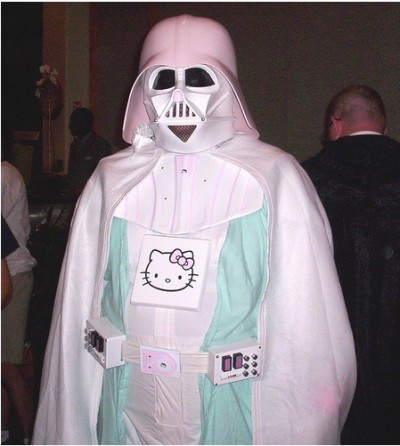
What’s to prevent Anakin from choosing to be Imperial Super-Nice-Guy Darth Vader, painting his suit white with a My Little Kitty logo on his chest and travelling across the Empire, spreading cookies and candy to all the kids on colony worlds he meets as he fulfills his Imperial mandate? Sure, he might have to make a few hard choices, but he appears on Imperial holoTV all the time to make sure all Imperial Subjects know how he feels their pain, how much he cares about their problems, how hard he’s working to keep all Imperial Subjects safe and happy?
In other words, what prevents Anakin Skywalker from acting as a good guy in the twenty-something years between the end of episode III and his death at the end of episode IV? The one fateful choice theory just doesn’t work for me – destiny is fine as an explanation by lazy historians after the fact, but when Anakin is standing there trying to decide what to do next, he has to have something more complex than “Oh, that’s right, I forgot; I’m Evil!” to drive his decisions.
Perhaps he regrets his one fateful choice. Certainly regret can play a role – there’s not a much more powerful emotional driver than regret over past choices. But I can’t see regret alone as driving anyone to consistently choose to do bad things. I think most people, and thus most believable characters, deal with regret without constantly referring to any one fateful choice in their past as the determining factor for everything they choose to do from that point on. Being consistently evil is a lot of work. Consistent evil must have enormously strong underpinnings to keep villains from just quitting and planting a garden.
Characters need a consistent internal structure of values and beliefs that justify the choices they make, every day, day after day. One weak moment, one poor decision, one slip of the tongue, one fateful choice to support one mentor over another, just doesn’t rise to that level. Villains, like every one of us, make a whole pile of choices every day, over and over again, for years on end – and as they just choose to consistently do evil things, the reason they continue to make those choices have to make sense.
There is a maxim that everyone is the hero in the story they tell themselves in their own mind. In Vader’s mind, the story he tells himself must build a framework of assumptions and practical guidelines to support the daily choices – throttle this annoying incompetent admiral here, choke this diplomatic courier captain whose throat he finds in his grasp there, torture Han and Leia to lure Luke into a trap the next day – that the rest of us call evil, but in his value structure those evil choices are perfectly justifiable, and in fact are the correct choices for Darth Vader given his objectives, beliefs, and value system.
Now George Lucas didn’t show us this level of insight – we never saw R2-D2 plug into the Death Star’s network, happen across Darth Vader’s personal storage allocation in the Death Star Storage Cloud, and copy Vader’s private journal including his personal mission statement – but hey, we’re creative here, let’s synthesize something that makes sense. Imagine this as one of those pop-up holograms that R2 occasionally emits:
The Republic was a failure. I fought and nearly died in the Clone Wars, and we came close to losing over and over again. Only through the efforts of my Master, now Emperor Palpatine, and through no help of the Jedi, did we eventually create the Clone Troopers that enabled us to defend the Republic and have any chance of winning. Then, when we’d nearly won, the Jedi tried to arrest Palpatine and take over!
And don’t get me started on the Jedi – those weak fools with their endless rules and constraints, limiting what powers to use, what relationships to have, what actions to take – as if concepts of good and evil matter when what is needed to protect civilization is clear! I had to break their rules just to have a normal life and marry my wife! And then the Jedi betrayed the Republic and Obi Wan tried to kill me, even dragging Padme into what should have been an honorable duel between the two of us, causing her death and that of my unborn child! I lost both my legs and my remaining arm to that sanctimonious fool, but he couldn’t bring himself to finish the job, and failed to kill me. He was weak – they all were. The Jedi were a cancer on galactic society, and they had to be exterminated, root and branch. There was no choice.
The Empire has been the guarantor of Peace and Order across the galaxy ever since the Clone Wars ended, and I will use any power, destroy any being, do anything to prevent another descent into chaos like that from happening again.
Anyone who stands against the Emperor stands against civilization, and I stand for civilization as its protector. That service is all I have left. Thanks to Obi Wan and the Jedi, the Empire is the only legacy that I can leave behind.
With that story running through Anakin’s head, his actions over the next twenty years make sense. Leveraging his training as one of the protectors of the Republic, he allows nothing to stand in the way of the protection of his legacy. Anakin’s belief structure sustains him until he is hit with a series of shocks – His son is alive! And he has a daughter! The Emperor plans to include him in the next Imperial Downsizing! His son is about to die! Can this be what he committed all those evil acts, sacrificed everything he was, to protect? Can he allow his son be murdered in front of him rather than challenge Palpatine?
With our statement above as the mental background, that’s a pretty good story.
I was going to keep talking (ask my lovely wife) and touch on the implications of Maslow’s Hierarchy of Needs to a character’s motivations, and the usefulness of the concept of a decision chain in looking at a character’s progression into villainy, but perhaps I should refrain and wrap up here.
Building a good character, especially a good villain, requires that the character is believable, and building a coherent (if twisted) mindset that clearly explains how that villain can justify to themselves continuing to consistently act within their particular manner of villainy over time will pay dividends across your story, especially in how these well rounded villains in turn will help flesh out your heroes.
Maybe you will even find out that, once well rounded, your villain has something of a mind of his own, and your story will become richer still.
And if that happens, that’s cool – a story with depth, and challenge, and development, and interesting people, some of whom try to kill other interesting people, for various interesting reasons, not all of which are clear all the time… THAT’s the kind of story I like to read.
Thanks for your time, and thank you Sarah for the opportunity to play in your sandbox.
—
Mike Brogley is a nascent writer, photographer, pilot and 25 year semiconductor industry veteran, currently between jobs and actively searching in the Silicon Valley job market, so if you know of an opening in marketing or program management, shoot him a message. Otherwise, just be glad he’s helping Sarah take a day off from the blog so she can write more shifters and darkship thieves and musketeers and stuff, as we all know how much we all want more of that, even if she won’t say “moose and squirrel”.
Mike comments on According to Hoyt as FlyingMike.
Alces et Sciurus mori debet!
 According To Hoyt
I am of the opinion that very few view themselves as evil, most regard themselves as pragmatists taking back what has been denied them by society.
There is also the factor of POV. Forex Take two tropes from fantasy. The rightful king, raised in secrecy since the murder of his father and the usurpation of the throne in his infancy. And the rightful heir to the throne whose father killed an evil and unjust king before his birth. Both can bee seen as heroes, both can be seen as villains. It all depend on whose ox is getting gored.
This is not to say that there isn’t true evil, just that villains are the heroes of their own stories. At least assuming sane villains
LikeLike
Well, there are the adolescent idiots who voluntarily claim to be evil. The sort that vandalize for giggles.
And there are certain dessicated souls. . . Dorothy Gilman had one character in The Clairvoyant Countess chuckle and call the question of good and evil “conventional”. . . and King Haggard is starting to push past human into the area of a pure force, of evil.
LikeLike
Yes but they are a minority. The Moron -in-Chief probably doesn’t view himself as evil but…
LikeLike
Yes, but would he be any fun as the chief villain in your story?
LikeLike
Hmmm, maybe, If I named him Barry al Bama…
LikeLike
Compare Stalin, who was once watching a show trial behind a screen and lit his cigar to let the old ally on trial know that, yes, he was watching, and so, no, he wasn’t ignorant of what was happening.
LikeLike
I had to ask my wife about the “moose and squirrel” line, since I don’t have time to read all the comments, every day, and thus had no idea. When she explained that Sarah doesn’t like Bullwinkle, I saw an instant connection to your column. Anyone who doesn’t like Bullwinkle has a fatal character flaw, perfect grounds for making someone a villain ;)
More directly on topic, I was reading along with your Anakin motivation, wondering how you could connect that to the turnaround in episode 6, and then you put it together. Excellent!
But where and how was Lucas to work that into the movies? Seems like it would have to have been worked mostly into 4-6, and his reverse order of publication short circuited that.
LikeLike
I like Bullwinkle, he tastes great. :)
LikeLike
Sigh. It’s not so much that I don’t like Bull Winkle — I don’t SOUND like Natasha, and I’m tired of being told I do!
LikeLike
You don’t sound like Natasha to you; you sound like Natasha to these unwashed phillistines, though. Not to myself, but then I’m also trained as a linguistic technician (don’t ask: long, boring story).
LikeLike
We always sound different to ourselves than we do to other people. From my experience as a singer it is something you need to get around. But, hey, I can see two simple explanations, both of which show well for you:
1) You have a memorable voice.
2) To the unwashed masses of Americans all non-English foreigners just south alike
LikeLike
No, as a trained Linguist I KNOW my accent isn’t Russian. My Russian acquaintances refuse to believe me, though :-P
LikeLike
I heard you speak online once. I’m pretty sure the speaker was (identified as) you, but I forgot the link. Iirc your voice is higher than Natasha’s and the accent sounds different too.
My impression was that you’d make an effective talk show host. Your background is distinctive enough that you’d attract callers.
Come to think of it, presumably at some point indie talk shows will take off, what with VOIP etc.
LikeLike
There are already some — I just need to grow two or three more heads and hands to fit everything in ;)
LikeLike
I agree. Sarah, I saw your interview with Stephen Green on PJ (I think). Your accent combined with your mastery of American jargon/idiom/metaphor/puns is irresistible. You talk more American than many people I know IRL, and with a better accent, too ;)
LikeLike
Wow. I had to go look it up, because your comment made me remember Natasha’s voice better, and I thought perhaps it was done by a man, but no, her voice was done by the same woman who voiced Cindy Lou Who in the Grinch animated special:
http://en.wikipedia.org/wiki/June_Foray
She did a really wide variety of voices.
LikeLike
To be fair, June Foray’s accent probably wasn’t really Russian (or East German) either.
(One big problem I’m having in my series is writing a believable Russian accent. Instead, I’m relying on the fact the woman inspires so much fear in anyone around her that nobody ever had the nerve to correct her abuse of the gerund.)
LikeLike
DO NOT write the accent (it’s hard to read for people who are not auditory, like yours truly. Just write the grammar and the occasional foreign word. No doubt can fake Russian accent that way, Tovarish. Heinlein did in Moon Is Harsh Mistress. Da.”
LikeLike
That’s what I did with the Spetsnaz-cum-Anglican-priest in the novella I sent you. He’s got an interesting grasp of American idiom. “What is word? Da!” Also, he’s way more jolly than any Slav should be, but I think that comes from hunting and killing supernatural badness for decades. Also, the sacramental vodka. And the sacramental scotch. And rum.
LikeLike
I hope to get to it this evening. Sounds like great fun. I just need to have my brain on to look/make suggestions.
LikeLike
Don’t sweat it terribly. I have plenty to keep me busy. Short stories to edit, novel to write, GIMP vids to watch, covers to design, my wife to murder and Guilder to frame for it.
LikeLike
I know. (Simpers) You work too hard.
LikeLike
Ypou cannot murder your wife until I have gotten her beta report and your combined one. And Guilder has been framed too often, hang it on the butler
LikeLike
“You are doing explaining now! P.A.T.R.I.O.T. is trying to be killing you three days ago, and now you are going visiting with them? Are you wanting to die? Because I am ready to be killing you now!”
Major Anya Mikitenko has atrocious grammar, but she has this aura of terror around her such that nobody dares defy her and tell her she’s wrong, Except Dr. Mauser, who is immune, and sometimes calls her kitten (which does not help her temper any).
Also people in this world have the ability to pronounce acronyms such that you know somehow it’s an acronym, not a word.
It doesn’t hurt to let drop the occasional “боже мой”, although I have learned to avoid relying too much on Google Translate. Google Translate will start the next world war, I’m sure.
(My father was in computers in the vacuum tube days. He told me a story about a Russian-English translation program. With the input “Out of sight, out of mind”, they fed the Russian result back in, and got back “Invisible idiot.”)
LikeLike
You know what’s funny, in a kind of scary way? I have a book that, in flashback-like scenes where it shows prior Earth history (At the point of the story, the Earth has been turned into a spaceship to travel to a new star, don’t remember why), shows that translation computers HAD caused giant conflicts because of having the nuances incorrect.
LikeLike
Yeah, just dropping articles makes a good Russian “voice”.
LikeLike
Also, ragging on temperamental American firearms. Not like Kalashnikov, which fire with pound of mud in barrel! Fire underwater! Fire when caked in demon ichor. Is reliable, Tovarich!
LikeLike
I hate the SOUND of Ak47s. The two times I was in the middle of a crowd that was fired at, it was an AK. Well, there were molotovs also. I’m normally okay, but if I’m really stressed, like right now — in case y’all wonder, I get these “feelings.” I don’t think it’s psychic. It’s the times I grew up in. You get used to reading subconscious signs, and your hackles are up and you’re full of adrenaline. Sometimes I feel what I call “the other shoe about to drop. Let’s say the last week the shoe is in the air. Or if you prefer “I stand before the gates of hell and death is at my side.” I’m PRAYING really hard that it’s hormonal and not “real” — a car back firing or weird cough-sounds are enough to make me dive under the nearest parked car. First time I did that in a parking lot, while shopping with Robert, he thought I’d lost my mind.
LikeLike
The difference in our ages means I likely will not be around to read it, but do write your autobiography someday.
LikeLike
The problem I have with AK47s is their lousy trigger, realistically it isn’t important for what they were designed for, but they have 3/4″ of creep, I swear, and it drives me nuts. The sound is totally different depending on which end of the gun you are on, so I highly recommend you be behind them when fired.
The only gun I have ever had fired at me was a 12 gauge, (certifiably crazy neighbor lady when I was a kid, us kids knew better than to be fooling around near her property, she had shot at a couple people before and shot one guys car when he was driving by on the county road, but you know dumb kids, they have to learn on their own) and I don’t notice it at all when shooting one or standing beside someone shooting one, but if someone is say fifty yards away and shooting quartering towards me the sound is totally different and makes me jump, even when I know it is coming.
LikeLike
“This is the AK-47, the preferred weapon of The Enemy — and it makes a very distinctive sound when fired at you.” [_Heartbreak Ridge_]
LikeLike
Rusty and Co has a gorgon that runs a pizza joint where dropping the articles conveys the accent nicely.
Freefall has one of the security guards with the same accent.
LikeLike
Well, as an untrained linguist, it’s always struck me as very, very odd how similar the prevailing accent traits of the Iberian peninsula (whether the original language was Portuguese, Catalan, or Castilian Spanish [as opposed to Latin-American Spanish, which sounds completely different]) are to what comes off to American ears as being from Slavic regions.
LikeLike
No, you have misunderstood – Natasha as portrayed on the cartoons had the wrong accent; clearly the center of the spying universe is Portugal (see WWII, the Cold War, etc.), so “Natasha” is clearly Portuguese spy, who drops definitives on purpose to confuse stupid Americans as part of cover.
Thus Dona Sarah has the correct accent for Master Spy, Code Name Natasha.
LikeLike
Natasha and Boris (and Fearless Leader, for that matter) were not Russian — they were Pottsylvanian. A careful analysis of linguistic roots and physical morphology makes it obvious that Portugal and Pottsylvania share a common ancestry, probably Carthaginian, possibly as far back as Phoenician.
LikeLike
Ha! You are Kate Elliott and I claim my five pounds.
LikeLike
You are A BAD MAN.
LikeLike
Uh…. in as much as you sound vaguely Russian and you’re a woman, you sound like Natasha, but that’s like saying Spike on Buffy the Vampire Slayer sounds like Giles the Watcher.
LikeLike
But where and how was Lucas to work that into the movies
Basically, he needed to hire a better writer than he is. J. Michael Straczynski could have done it. So could have Lawrence Kasdan, who already had ties to the canon.
But note, Lucas didn’t even have the story worked out, even at the end of regular shooting on ep III in 2002 – he went back and reshot a ton of scenes in post, re-editing the entire movie after he had a working preview cut completed, doing major revisions to try and make that one make more sense.
There is no way George Lucas could have worked anything like what I put together into eps IV-VI since he hadn’t the slightest glimmer about the Vader backstory that he ended up actually using back in the 1975-1984 time frame.
LikeLike
Of course, Lucas has already demonstrated his willingness to treat the original trilogy like a teenager at a BBC Christmas party, so he could have put something like that in there, if he had the talent to think of it.
This is going to sound like damning with faint praise, but I mean it as a complement. Mike, you’re a better writer than Lucas. And now you have your cover blurb.
LikeLike
I meant to link this —

— the other day and only now goat around to it. The accompanying pictures are a great antidote to Progressive stupidity, Get there by editing 2013/08/the-week-in-pictures-rodeo-clown-edition into the link.with a dot-php extension.(I hope that defeats moderation. I detests being moderated.)
LikeLike
Tsk! You left out how the Jedi kidnap children and indoctrinate them.
Very interesting. I shall have to run off and analyze my Bad Guys.
LikeLike
Thanks.
I actually had something in a draft about the societal side effects of the Jedi child collection and reprogramming effort, and the effect of Yoda trying to blackball young Anakin from even that (“Not good enough to kidnap are you! Too old – nine years! – and too powerful are you! Leave you untrained and free to turn into a feral super-powerful non-Jedi midichlorian-infested wild card we should!”), but I was worried this was already getting long.
LikeLike
I’d rather be trapped in an elevator with poor ventilation with Dominar Rigel XVI than with Yoda. Rigel’s grammar is better, he doesn’t pose as a holy wise man, and his stories are likely to be more entertaining.
The helium would get old after a while, though.
LikeLike
Ha, that was a great series.
LikeLike
Basically, don’t make your Bad Guys carry the Villain Ball.
(Don’t click that link. If you do, you’ll find yourself three days from now with three dozen open browser tabs and a case of malnutrition and dehydration—and you’ll have missed the discussion over here.)
LikeLike
AND we’ll expect a summary.
LikeLike
Too true. TV Tropes is very similar to that old joke: “What do you get when you mix Sake and Ouzo?” “There’s a blue flash and suddenly it’s Thursday.”
LikeLike
One of my plans: Develop a computer virus which, in the three weeks before Finals Week at various universities, sends everyone e-mails containing TVTropes links…. >:)
LikeLike
They really need to code browsers so that clicking on a link to TVtropes causes a popup asking if you’re sure you don’t need to be productive for the rest of the day.
LikeLike
YES!!! There’s gotta be an ap for that…
LikeLike
There is an app for that. :-)
https://addons.mozilla.org/en-US/firefox/addon/leechblock/
The equivalent of clicking on a “Yes, I’m really sure I don’t want to do anything productive for the rest of the day” button would be going into your extensions and disabling LeechBlock.
LikeLike
I’m sure there’s a corresponding Chrome app too; this is just what I found in thirty seconds of searching.
LikeLike
I’ve had to block on my laptop. I just have no self control. This cartoon is a good illustration.
http://xkcd.com/609/
LikeLike
Nice work, Mike. *grin* It can be a lot of fun making the world evil (or at least, your characters), because it can be just as deep and interesting as your heroes and sets up an awesome story besides. When I set myself an evil task, it requires some mental gymnastics to make it work.
One thing I like to keep in mind for about half my evil characters is their good side. Wait, what? The good side of bad? The down side of up? ‘Tis true, folks. Some believable villains go by the “ends justify the means” rule. My child is starving, I must steal this bread! The Empire is failing, I must restore order! That last can mean by any means possible.
The kind of villains that would pay any cost to achieve their ideal ends, can make a great bad guy. Not just Vader, the Operative from Serenity fits here, too. Another way to see this kind of character is a badly misguided good guy- and most of us think we are, at heart, good guys. Well intentioned, at least. *grin* The path of evil is quite seductive that way.
So I get how we can have villains who don’t know they are evil, who know but don’t care because Progre- err, I meant the Empire, and those who think evil is good. That last one can be either simple or rather tricky for me- a la the Joker. Evil monsters are easy. Trolls eat people because people are tasty, and cause havoc on the interwebz because they are simpleminded. Thinking evil characters who have unknown reasons for evil can be fascinating, but I’m not quite sure how to address random evil.
Other than lack of empathy/fundamental character flaw, any other ways to create “Nature” evil with thinking characters? I’m kinda drawing a blank here.
And fear not. You’re not the only one who has issues with brevity. *grin*
LikeLike
The most evil people that I have known operated from a sense of entitlement. They believed that they were entitled to whatever they wanted so of course they could do anything to get it after all it was simple justice. Sociopaths can fit in here, but so can people with some empathy. There are also people that do great evil without being evil themselves. Think rabid dogs. The dog isn’t evil, but he still has to be put down to protect everyone else.
LikeLike
This sense of entitlement can often arise from a feeling of unjust deprivation. Mean Mr. Potter used political connections, adverse economic conditions and great-uncle Billy’s minor forgetfulness to destroy my poppa, forcing momma and us into destitution which only I, Zasu Bailey, have survived. I will wreak my vengeance on the citizens of this miserable town who were happy to benefit from my father’s selflessness but raised no hand to aid him when he needed help.
LikeLike
Oooh, now there’s a character I’m not sure I want running around inside my head …
LikeLike
Every time a bell rings, a hypocrite goes to hell.
LikeLike
Excuse me, I’m off to play “Carol of the Bells”.
LikeLike
Consider the ephemeral like button clicked.
LikeLike
Virtual like button.
LikeLike
Indeed, half of my wittiest comments are stolen from Rob Crawford.
LikeLike
… with her toxin derived from flower petals …
LikeLike
Like the high-powered gossips who are convinced that you just love hearing all the latest news while they interrupt your concentration to vomit it all over you.
LikeLike
One element of “bad guys” is absence of a sense of proportion. They allow the ends to justify their means. They are willing to not just steal a car to run down the “monster” before he opens the gates of Heck, but to do it they are willing to run over a crippled granny, a trio of schoolgirls and a puppy carrying a basketful of kittens.
LikeLike
And now I can’t get that image of a puppy with a basket full of kittens out of my mind. As a painting, one of those painted on black velvet, as cute as can be. If I need to start using insulin I’m blaming you.
Okay, maybe if I can imagine that as a horror story, with a cursed painting, it might help.
By the way, I’d say one pretty common type of bad guy would also be the one who does start out as pretty normal, but really, really wants something, and so justifies the people who are in the way as being evil themselves, which of course justifies him treating them badly. Let’s take an old classic, the person who is in danger of losing an inheritance he thought certain when an unexpected heir is suddenly found, maybe the boy who was stolen by the gypsies as a baby gets finally tracked down by the tireless efforts of a P.I. family friend. So now there is a legitimate heir. Except the more distant relative – who is not evil, per se, or at least doesn’t consider himself so – really, really needed that money. For good purposes, really. And that ‘heir’ has been raised by gypsies. Highly likely he’s not really even the right heir. Knows no manners, is impolite, and probably a thief too (raised by those gypsies, who, as everybody knows, are all thieves). And yes, highly likely that boy is not the true heir anyway, just some random blond kid the gypsies stole. So, it’s not that bad if he tries to get rid of the boy and save the estate (the kid would not know how to manage it anyway), is it?
So the villain starts with more legit measures, like trying to prove that the boy is not the true heir, but when that fails slowly starts sliding towards more questionable methods.
LikeLike
I can’t remember if it was Pratchett or another author who noted that true evil was treating people as things. Joker used people as tools and got rid of them, or destroyed people in his way, or just made them cringe enough to satisfy his needs, depending. Internet trolls are attacking people either as feared things that must be destroyed for safety or as things to cut down to earn their bones among their peers. The skill level is immaterial (both in concept and in execution:)
Though, on the whole, I’d stay away from the New-Wave idea, “Evil characters are just friends we haven’t reached yet, or conservatives.”
LikeLike
That’s another interesting shade of evil: those who allow evil to prosper. Accessories to evil? Good people or not, when folks allow evil to pass unremarked, it grows from their inaction.
Too much of that, and you end up working for the mainstream media, extolling the beautiful virtues of “freedom fighters” in a third world country.
LikeLike
Evil accessories? You mean like a $3,800 handbag, or puppy-skin shoes and matching scarf-with-elderign-motif?
LikeLike
I *knew* someone was going to snag that line. *grin* I was thinking more possessed jewelry and demonic sunglasses.
LikeLike
Pratchett. Carpe Jugulum.
It’s what made me realized that Pratchett was coming around to Catholic teachings, natural law, from the opposite side.
LikeLike
Well, *sigh* he still needs to work on his life issues…
LikeLike
True evil is sacrificing a lesser good to a greater good.
LikeLike
I’ll have to think about that one, marycatelli.
I believe there are some sacrifices which *are* worth the cost. And there are situations where one must choose which is the greater good, where all options seem relatively equal.
Perhaps the distinction is that the good will see that sacrifice as significant, while an evil character would pass it by? Or the evil character could hold a distorted view of what that “greater good” is, that could work.
LikeLike
The distinction — I had to do this in a book. My agent wanted me to sacrifice a character for the goal. I mean, he wanted (yes, my agent was a he at the time) me to have the other characters sacrifice this character for the greater good. He got back “No. I don’t glorify evil.” I COULD have the character sacrifice himself, but it would have to be against the wishes — possibly resistance of the others, or the others would be tainted forever. YOU might choose to sacrifice for other’s good. but no one — NO ONE — has the right to sacrifice YOU.
LikeLike
So you are against human sacrifice … without reservation?
Shucks. I had a nominee in mind….
LikeLike
O am adamantly opposed to human sacrifice under any circumstances!!!!
I am, however, willing to be extremely flexible in how human is defined.
LikeLike
Dang it! I must type too slow, every time I make a comment tonight I hit post and when the screen refreshes I see someone else as already made my point for me.
LikeLike
*looks mildly ill*
Great line, but way, way too close for comfort.
Just had an argument about two days ago with a whole herd of supposed libertarians arguing that they get to decide which homo sapiens are sufficiently human to have the whole “no initiating violence” thing applied to them.
One of the things I like about here. The line can be funny, instead of a statement of intent…..
LikeLike
That herd shows up on my front lawn … they won’t be doing any deciding for anyone.
LikeLike
I trust my bona fides here are adequately established for folk to assume my definitional flexibility is toward expanding, not constraining.
While sorely tempted to assert that the one certain trait that excludes any person from the human race is a claimed right to define who is (and isn’t) human, both history and logic counsel restraint even there.
(I am aggrieved to note that I need to seriously contemplate replacing this keyboard, as the blankness of the “I” and “O” keys is ibvoisly encouraging typigraphocal errir. Looking closely O alsi perceive the “L” key inly offers to dash and I am alsi on danger if losing my “S”.)
LikeLike
Maybe try something like “those who try to argue with biology about who is human”?
I can’t believe I’ve actually had to argue with doctors about the biological definition of life….
LikeLike
RES, I’m not sure about defining who’s human, but I’m a firm believer in the “he needed killin’ ” defense.
Note that it is a defense, not an excuse. The homicide is still a homicide; it’s simply justified and I’m willing to try and prove it.
LikeLike
Well first we need to define human, and decide if your nominee fits the description or if they are simply humanoid.
LikeLike
Oh shucks, I just realized — do you mean opposition to walk-in human sacrifice? I staunchly oppose that!!! A 24-hour reservation is a minimum; we don’t want to become barbarians, do we?
LikeLike
RES, why do Americans say “take out” with respect to food and Brits say “take away”? Hmmmm? Supposedly we both speak English.
And what do Aussies say for take out? Probably some odd garish rhyming slang like “bush ranger”.
LikeLike
Two peoples divided by a single language is how Churchill described it. While I can’t answer your first question, I can advise our British friends to not invite the local constable around for a Sunday joint, nor should Americans stop in at a British camping supply shop to ask for a Fanny Pack.
As to your second question, I am reliably advised that the Australian word for carry out is “Fosters.”
LikeLike
ROFL
LikeLike
….Might that desire not be seen as a warning sign?
LikeLike
Yes. I fired him shortly after.
LikeLike
“I believe there are some sacrifices which *are* worth the cost. ”
In which case, by definition, you are sacrificing a lesser good to a greater.
LikeLike
Whoops. I got mine backward. I meant to say sacrificing a greater good to a lesser.
LikeLike
Makes a lot more sense now. *grin* Thanks.
LikeLike
Thank you. That typo was starting to bother me. :)
LikeLike
I think you got that reversed. True evil is sacrificing a greater good to a lesser.
Very often (but not always) it happens because the lesser good is MINE, and the greater good is WAY OVER THERE, and if I hold MY good up and look at them both, I can see that MINE is bigger. Just like my thumb is bigger than the moon, if I hold it close to my eye.
In more sophisticated cases, it happens because there is ONLY ONE TRUE GOOD, which is defined in terms of the Sacred Struggle. You then prove how wonderful you are by sacrificing every other good to the Struggle. The more it outrages your conscience, the greater the sacrifice, and the greater the glory. A Bolshevik who rips the last crust of bread from a starving peasant child’s hand, if he does it on orders from the Party, is a good Bolshevik. The Bolshevik who beats the child with the butt of his rifle is a better Bolshevik, and the one who shoots the child and buries the body in an unmarked grave in the Gulag is better still. Or to vary our villains, the really striking thing, to me, about the meetings that set the Holocaust in motion, is that every participant knew he was doing something monstrously evil, yet they were all proud of it because it proved they were sacrificing their ‘bourgeois morals’ and ‘sentimentality’ to the ‘higher morality’ of the Master Race.
As soon as anyone starts babbling about ‘higher morality’, have your best weapon ready and be prepared to kill. You may become the next victim at any moment.
LikeLike
Your point about MY GOOD vs OTHER GOOD is kind of like one that I had been thinking: The one of “The strong survive and take what they want, the weak do what they are told, or are trampled.”
LikeLike
Thank you. I was thinking on those loons who think they are parents in CA that decided that their 6-YO is transsexual, and why they did it. I was coming around to something like what you said (I was trying to make an analogy of the sacrifice of children to Baal during the second Punic war) but you say it much better, more plainly and… I don’t have the words.
LikeLike
Or the one in CO — who decided this when the little boy was two. Seriously. At two!
LikeLike
See “they needed killin’ ” defense above.
LikeLike
Whoops, you’re right.
LikeLike
Other than lack of empathy/fundamental character flaw, any other ways to create “Nature” evil with thinking characters? I’m kinda drawing a blank here.
Well, there’s almost an opposite to low empathy: An obsessive John Hinkley type, who’s story goes something like “I absolutely love and adore , whom I’ve never met and who doesn’t know I exist, so I need something BIG to bring me to her attention so she can love me back – I know, I’ll assassinate President Reagan!” This person is obviously broken, but not empathy free.
Then there’s the “lesser of two evils” chooser who’s greater evil is only in their head – “I have to prevent the Demon from manifesting, and the only way to do that is – I can’t believe I have to do that terrible thing, but Demon manifesting on our plane will be a lot worse, so I have no choice.” The thing about this one is, if that’s the perp’s after-the-fact justification, you actually can’t know it didn’t work – imagine a character that tests out totally sane and completely normal, yet they did this terrible thing, and no manifestation of the Demon manifested.
Then when one The Combat Accountant’s typical events happens, that guy gets a recruitment visit at the confinement asylum.
LikeLike
And WP ate my wildcards – trying again:
Well, there’s almost an opposite to low empathy: An obsessive John Hinkley type, who’s story goes something like “I absolutely love and adore [random actress] , whom I’ve never met and who doesn’t know I exist, so I need something BIG to bring me to her attention so she can love me back – I know, I’ll assassinate President Reagan!” This person is obviously broken, but not empathy free.
Then there’s the “lesser of two evils” chooser who’s greater evil is only in their head – “I have to prevent the Demon [name redacted] from manifesting, and the only way to do that is [evil act] – I can’t believe I have to do that terrible thing, but Demon [name redacted] manifesting on our plane will be a lot worse, so I have no choice.” The thing about this one is, if that’s the perp’s after-the-fact justification, you actually can’t know it didn’t work – imagine a character that tests out totally sane and completely normal, yet they did this terrible thing, and no manifestation of the Demon [name redacted] manifested.
Then when one The Combat Accountant’s typical events happens, that guy gets a recruitment visit at the confinement asylum.
LikeLike
“you actually can’t know it didn’t work”
So, your time-travelling master assassin committing murder by shooting Schicklegruber in the head in a 1920s beer hall… of course, the TTMA can’t be sure that the changes to the Time Stream will cause improvement. Without the Nazis Stalin is able to bring the Soviet Union up to par before open warfare commences (and the Western Democracies had completed their disarmament.)
LikeLike
So perhaps WWII was an evil that came for good — shudder! I both love and hate those time travel stories.
LikeLike
Kind of like how I’m convinced Pearl Harbor was the best thing that could have happened to the Pacific Fleet in 1941.
LikeLike
This scares me, you know? Assume time travelers came back to set up the Obama presidency. Assume they are US patriots who want to save/restore the republic. They want to save us from? If this hadn’t happened we’d?
Go. (Yes, I lie awake at night with this stuff running through my head.)
LikeLike
Domestic: No Obama, No Obamacare. Which means no TEA parties, which means the GOP and Democrats stay in their decaying orbit toward state socialism. Obama’s election prompted the vile progressives to turn up the heat on the pot too soon, and the frog jumped.
Foreign: I have this idea that Obama’s apology tour prompted the Islamists to think they had one, and to move to take on actual governments in places like Syria and Egypt, before the populace had come around to them. I can’t quite get it to gel.
Plus the world is a much suckier place without the US as the police.
LikeLike
OK, toss this in: there’s a truly malignant force behind the Salafists/Wahabis et al. When it finally becomes visible, it is an entity arranged such that the US government can’t go after it root and branch, BUT someone like the company-formerly-known-as-Blackwater can. And since all the fire-breathers have been driven out of the US military and into security contracting, a TEA Party president realizes that he or she is in a position to deal with the problem indirectly but effectively, especially if a good chunk of older but effective US weapons end up with the contractors (A-10s, Abrams, you know). And the TEA Partiers and preparedness-types have strengthened the US enough so when an EMP strike or some other horrible last-gasp attack comes, American culture can survive and rebuild.
LikeLike
Obama’s an incompetent wanna-be dictator. Ever consider how much worse a fix we’d be in if he was actually competent?
LikeLike
That’s actually an interesting counterfactual – the reasons the Germans had their way in the first half of the war were pretty much Wehrmacht-driven and mostly independent of the Nazi’s being in charge. There were certainly changes in materiel and manpower – a lot of the German tanks used in Poland and France were Czech-built, and the Nazis definitely increased spending on armaments in the 1930s as well as expanding the acknowledged military and instituting the draft really early on – but from strategy down through training doctrine and tactics, the early successes had little to do the the Nazi leadership, and were mostly the result of WWI lessons learned and interwar work on things like independent logistics and ground-air coordination.
So suppose WWI veteran Corporal Schicklegruber drowns in a beer stein in 1920, the Weimar Republic falls neither to Hermann Göring’s NSDAP nor to the German Communist party thanks to a timely intervention in it’s support by a tiny-but-professional Wehrmacht, and among other things the cooperative German-Russian military exercises held secretly in the 1920s were continued. With that access, the Germans learn of Stalin’s preparations to invade and annex the Baltic States and Poland, so after secret negotiations with France and Britain they start to quietly rearm in the 1930s. Things escalate, and eventually (lilley a bit later) it comes to a head – Do the Germans join with the British and French to come to the aid of the Poles in 1942 or so when Russia attacks? If so, does the Wehrmacht have enough manpower under arms and advanced enough armor and air to take advantage of their superior tactics and doctrine?
LikeLike
Or: Uncle Adi eats a bullet — and Sepp Dietrich, or someone else who had a clue, takes over….
It says something that during the War, only one of the Party’s upper-rogers was assassinated — Reinhard Heydrich. The rest were left alone. Hmmmmmmmmm….
LikeLike
Oh, and thanks.
LikeLike
An interesting post and I do agree with most of what you say. In real life i find that the longer people continue to make evil or bad choices, the more they have to protect themselves from facing the reality of what they have become and the consequences of their behaviour. I am not a great believer in death bed redemption and find them hard to take in fictional characters.
Thanks for giving more time to write :)
LikeLike
Thank you.
LikeLike
One of my favorite science fiction novels is Samuel Delany’ s “Nova”, which features a very complex hero/villain dynamic. Lorq VonRey and Prince Red are both acting from typically villainous motives–the acquisition of wealth and power–the only real difference between them is their methodology.
LikeLike
Something else to think about Anakin Skywalker/Darth Vader is the “Dark Side of the Force”. We’ve been told that once somebody “turns to the Dark Side” they can’t “return to the Light”. Assuming there’s some truth in this, (ever heard of “Lies Like A Jedi”?) then a Dark Sider may be enslaved by the Dark Side of the Force leading him/her into darker modes of being/actions.
IMO Mike has a good explanation of how/why Anakin chose to become Darth. “Young” Darth may have been little different than Anakin but over time grew more evil thanks to the influence of the Dark Side.
Yet, he was redeemed at the end. I suspect that the part of Anakin who hated being a slave was still alive in Darth. It showed mostly in his desire to destroy his *Master* the emperor Thus in the end, when it came to a choice between saving Luke’s life and remaining a Slave of the Dark Side, he destroyed the hold of the Dark Side on himself.
Mind you, it is fortunate that he died while saving Luke and himself. Not only would few trust him if he lived, it would be hard IMO to live with himself knowing what he had done as Darth Vader.
LikeLike
One of the Star Wars commentaries said that when Anakin went after the Sand People who carried off his mother, that’s when he began tapping the Dark Side. Killing Count Duku pushed him farther that way, and then not stopping Palpatine finished the deal. The Dark Side (supposedly) requires less effort and allows greater access to power, but at the cost of judgement and awareness of the needs and desires of others (you get selfish and mean, then evil). Note, I am not affiliated with Lucas Films, and I’d be perfectly happy if he’d either stopped after the Holy Trilogy, or stopped after the last Admiral Thrawn novel.
LikeLike
Interesting thoughts. Mind you, I’d say “joining” Palpatine against the Jedi would has “sealed the deal”.
LikeLike
Can’t remember the source, Bujold or Manning Cole probably: a small sin gives leverage to force a larger crime, which leads to greater and greater acts, and then the subject is theirs, wholly.
I can so hear Tommy Hambledon say that.
LikeLike
Sounds like the progression of some addictions.
LikeLike
Sort of like Weber’s Bahzell books, where blood wizardry is weaker and sloppier but easier to tap.
LikeLike
Really enjoyed this post ;-)
LikeLike
Thanks!
LikeLike
I’m sure also Anakin’s motivation would have included the thought that he could push along as a highly talented Jedi spear-carrier, slowly climbing his way up the ladder, failing to be properly rewarded for doing the impossible, and advancing by filling the occasionally empty shoes of regrettably long-lived, wide-bottomed superiors as long as he could keep providing miracles to order, or he could just empty all the shoes above him himself, and go to the head of the hierarchy, all in one fell coup. [sic]
Added to what you said above, he would be by his own values definition, “doing well by doing good,” and he was probably extremely vexed that he was kept on a choke collar by Palpatine as his reward.
LikeLike
Yes — keep in mind that he won his freedom through gambling!
LikeLike
Yes – keep in mind that he won his freedom through gambling!
Hm… And Anakin/Vader’s ultimate bet in his quest for freedom was on the historical standard Sith kill-and-replace succession strategy, sooner or later. He was just biding his time until he though he had the juice, then WHILE HE WAS STANDING RIGHT THERE his master tells Luke that he will be discarded in Luke’s favor – so in a violent rage, he takes advantage of the Imperial Guard’s absence and acts too early, paying the price for rushing a coup.
Anakin was probably humming You have to know when to hold them…. as his suit shorted out at the end.
LikeLike
Well, yes. Luke was to be everyone’s pawn, from the Emp to Vader to Yoda. Obi-Wan just wanted him to be his redemption of his failures of the past, but the others wanted him for their own view of the future. Leah would have been the fly in the ointment, since she was the focus for the rebellion and would not play her part.
LikeLike
Yes, well, you can see why Yoda wasn’t ecstatically happy when presented with a second, yet-OLDER untrained Jedi-wannabe with whom old Obi Wan started the training (OK, a couple hours in the lounge aboard the Millenium Falcon, followed only by some non-corporial shouting, but still).
Obi Wan’s track record in the front of his mind had to have been.
LikeLike
I was not happy with Yoda, worse after the last movie. Why hide on Dagobah, you should be wise enough to know you can’t hide from yourself, and Vader will find you the second he decides to care. So why the swamp? I think it is to hide from friends and allies who could tempt him back to the world where he might finish his own journey to the dark side.
But I also think that where Obi Wan was promoting Luke out of his wish for redemption, Yoda was looking to wipe out his own guilt for going to the dark side in order to survive his fight with Palpatine.
LikeLike
“Shiny! Let’s be bad guys.” – Jayne Cobb, Serenity
LikeLike
Nothing good can come of modeling villainy on George Lucas’s storytelling. One might better ask, what made George Lucas become the villain who inflicted Star Wars episodes 1-3 on us.
LikeLike
You’re a bad person telling the truth in social situations, Steve. Go to the corner! ;)
LikeLike
…what made George Lucas become the villain who inflicted Star Wars episodes 1-3 on us?
I personally favor the abducted-and-replaced theory put forward in George Lucas Strikes Back
LikeLike
Same with poor old Charlie (Not Martin) from the blog that shall not be named.
LikeLike
*snif* (adjusts black armband).
LikeLike
Yes. Here too. EVERY day.
LikeLike
I prefer the theory that the reason why the first three were so much better was Marcia Lucas, his first wife, she edited at least the first one and possibly had more than a bit of an influence in the story lines too. He really didn’t manage to do anything well after the divorce. Either she was the muse he mistreated, or she was the witch who cursed him after he divorced him. Take your pick. :)
LikeLike
Or he could only write when a certain lightbulb was on and she told him she’d been changing it every week for years. (No, that story isn’t about him, that I know.)
LikeLike
I have the honour to inform you that I have considered that question at some length.
LikeLike
I’ve said this before about you, but now I get to say it to you: your alternate version of Anakin killing Padmé is so much better than what Lucas wrote that if I ever run the Star Wars RPG game I’m pondering, I’m going to make that the official backstory. The version as presented in Lucas’s episodes 1-3 will become the cover story that the Empire spread around to lionize Anakin Skywalker: born of a virgin, he saved the noble Emperor Palpatine from arrest at the hands of the evil Jedi, who murdered him for it. Which is why Vader (who was a friend of Skywalker’s) is now hunting down and exterminating the Jedi, for their crimes against the State.
LikeLike
Not meaning to disparage the intent, but
is damn faint praise.
You could get story no worse telling than what Lucas perpetrated by fishing out letters from a daily bowl of alphabet soup.
Still and all, I absolutely agree that Tom Simon’s story has one primary advantage beyond Lucas’ storytelling: it makes sense. Even with half the acting and a quarter of the SFX it would be a better movie. (More faint praise — I’ve seen test patterns that were better movies. It may be impossible to compare anybody to Lucas’ story without it being faint praise. Ed Wood’s oeuvre at least had a compelling watchability to it, awaiting the train wreck.)
LikeLike
I admit, I watched (skimmed through) the “first” films just so I could say I’d seen them and to see the special effects. When Padme showed up at the end of the second film in Col. Wilma Deering’s costume from “Buck Rogers in the 25th Century,” I rolled on the floor laughing.
LikeLike
Some of Padme’s outfits were gorgeous. In a rather overwrought way, but still. So if you watch them as a fantasy fashion shows…
LikeLike
You could get story no worse telling than what Lucas perpetrated by fishing out letters from a daily bowl of alphabet soup.
How do you think I came up with mine?
(‘Hey, Brian, I found a secret message in my Alpha-Bits! It says “OOOOOO”!’ — ‘Peter, those are Cheerios.’)
LikeLike
Thank you, Mike, very enjoyable and thought-inducing read.
LikeLike
Oh, yeah, Mike, I didn’t even thank you — sorry, I’m distracted this morning. Friend in hospital and we’re a bit… odd. Well odder than normal.
What I like about my readers is that they’re all well spoken and erudite and could carry this blog if I dropped dead tomorrow.
LikeLike
Sarah, you are quite welcome. It was an honor to help you out.
LikeLike
No, without a cat herder this horde would dissipate within a few decades.
LikeLike
herding cats is easy. All you need is food.
LikeLike
So what you’re saying is that we’re all gluttons?
LikeLike
(Looks down at gut) Well, *I* have no proof otherwise.
LikeLike
Morw? *urp* Mrrrow?
LikeLike
“You broke into my cavern
Like a glutton after punishment”
— Leslie Fish
LikeLike
You are very welcome – it was fun to put together.
LikeLike
The folks I don’t like are the “fun villains.” People who just like to have fun and enjoy themselves, and can be perfectly nice as long as you don’t provide them any fun opportunities. Of course, underneath they’re being either aggressive or passive-aggressive, but they really don’t need to justify their actions to themselves because they enjoy them. Occasionally they might worry about good taste, but that’s about it. Generally it’s your fault if you can’t take a joke, or think ahead enough to avoid getting skunked by them.
LikeLike
Bullies.
LikeLike
Great post. An interesting thing about writing very realistic, well-rounded villains who have a lot of “good reasons” behind their evil actions is that one can sometimes find oneself easing toward sympathy for them, if one is not careful. I think this happens in real life, too–for example, with such people as Hitler, people who use appeals to emotion, superstitious fear-mongering, divisive speech, and other manipulative tactics to amass followers. Those who are not able or willing to step back and evaluate the message they are being given are the ones who will soon be goose-stepping behind whatever evil it takes to “save the world/our way of life/our people/our purity.” Such villains always seem to believe that they’re doing good, and not evil, and they are often able to convince many, many people to join them in their “goodness.”
LikeLike
Thanks.
Re heroes in their own mind: Compare and contrast Hitler, who likely thought he was just being ruthless in doing ultimate good, and Stalin, who I think pretty clearly knew what he was doing was evil in service only of himself, but didn’t care.
LikeLike
Yes, good comparison!
LikeLike
The original “power corrupts” line was about that exact issue– hand-waving about breaking a few eggs because they’re so great.
LikeLike
The whole issue of evil and villains is one that fascinates me. Which is quite possibly why I end up writing a lot of characters who are functionally “evil on the side of Good”.
LikeLike
BTW, I have a theory that the REAL villain in the Star Wars stories is the one who enabled the Emperor, the one who put forward the legislation that ended the Republic and began the Empire.
Jar Jar Binks.
LikeLike
Nah, he was just a fool. The Emperor-To-Be could have found another fool if Jar Jar Binks wasn’t available.
LikeLike
A widely held view.
LikeLike
Well some blame Yoda. Personally, I think that goes a little to far but IMO none of the Old Republic Jedi seem that good/worthy.
LikeLike
The Samuel L. Jackson character shows glimmers, but he’d need better dialog:
“What? Are you f—- kidding me, Yoda? You knew about this all the f— along and just neglected to f—— tell me? Just f—— great – now I have to go over and clean this f—— mess up myself. No, you just stay here and watch the kids. I’m going to go educate that m——f—— about what you get when you f—— MESS with the JEDI. Get out of my f——- way, Jedi door guy.”
Exit Samuel L. Jackson, stage left.
LikeLike
We needed Jules the Jedi.
LikeLike
‘And I have HAD it with these m—f— Muppets on this m—f— spaceship!’
LikeLike
I find Yoda the least bad, because I didn’t see him use freaking mind control on anybody.
These are the GOOD guys?!?!?
LikeLike
Jar Jar, the dismissable fool, present at nearly every critical event in the founding of the Empire, the Senator who introduces the critical legislation, but no one suspects him; picture him with his big floppy ears, standing behind the Emperor’s throne, whispering in his ear in his politically incorrect accent, pulling the strings of power.
And when the Empire falls and the fireworks go off on Coruscant, he’s still there, on no-one’s reprisal list, the master manipulator and mastermind: Jar Jar Binks.
LikeLike
Having watched that George Lucas Strikes Back trailer, I now _know_ that Jar Jar is a villain.
LikeLike
Joe Biden?
LikeLike
Perfect. Jar Jar Biden.
LikeLike
yep.
LikeLike
“It was all a cunning facade.”
LikeLike
Well then it can’t be Biden. All he knows about cunning is that people giggle when he pairs it with linguist.
LikeLike
My son says that the VP has always been the face of Americans that people abroad see. (True to an extent.) The goer to funerals; the present at ceremonies.
Right now, in the world’s eye, the US suffers from invasive, brain damaging hair plugs.
LikeLike
Great, the face of America is a f’ing demented stroke patient.
LikeLike
Probably helps to pay the surgeon enough so he doesn’t install them upside down.
LikeLike
It’s all a cunning plot so they will underestimate us.
LikeLike
“Milord, I have a cunning plan!”
LikeLike
Oh no. Does it involve a turnip?
LikeLike
No, but you could stick a tail on it and call it a weasel!
… looking around for SPQR….
LikeLike
“It was all a cunning facade.”
Whereas around here, we occasionally get a “funning cascade”.
LikeLike
OCCASIONALLY? Gestilly You Sure? (sorry, ’tis weak.– after this week– Carry on.)
LikeLike
Well, at least you didn’t call me Shirley. :-)
LikeLike
As far as I can see the Vader characterization is a problem of the order in which the stories were told to us. The entire saga, in order, is a tragedy, the rise and fall of Anakin Skywalker. But we the viewer didn’t see it that way. We saw the comedy of the Luke thread first, probably because Lucas correctly thought that the American movie goer couldn’t be shown a tragedy as tragedy. So we saw Vader as the villain caricature with all the villain tropes without knowing the history. And we see the Jedi as the absolute good. Why, because Obi wan and Yoda told us so, and who were we to know different at that point. As for the old Republic, it was glorious as only things that only exist in memory can be. For instance that’s how we envision the Romans. We don’t see the decay and corruption that had destroyed the Republic in the first movies. So by the time we get episode 1 we know how the story ends, but not exactly how we are going to get there.
I find it interesting that Lucas apparently kept far more control over Parts one, two and three than he did over “Empire” and “Return.” But he had a problem. He had a tragic story to tell, but had to balance that with the comedic elements that Star Wars fans, his market, had come to expect. The problem with tragedy is that it can be pretty depressing. Think Oedopus or any of a bunch of Greek plays. Lucas wasn’t able to bring off the correct balance(Jar Jar anyone) and the movies suffered.
LikeLike
You really need to read the Journey of the Whills webpage about the actual course of Star Wars story development. (It’s also great for validating the memories of geezers like me, versus the rewritten history of later George Lucas statements.)
LikeLike
He basically made it all up as he went along, and because he (correctly) judged the rip-roaring space opera in his 4th story would be easier to sell to a studio, that’s where he started.
“Han shot first” aside, Lucas is a first rate historical revisionist, who in his early days was relatively open about what he had, but as he got richer he clammed up more, then started airbrushing – see his Pythonesq “I have nine stories all worked out!” “Six, sir.” “Six! Six stories all worked out, and there never were more than six. Seven is right out.” At least until Disney gave him a check for $4b, and now there’s suddenly nine again, plus a few new side story movies.
What he really had, according to contemporaries who saw it, was maybe a half page of bullet points for each “story”, and even those were quickly superseded when he went to go actually write the prequels.
Also note Lucas was completely independent of any editorial or financial controls external to himself by the time he started the prequels, and it shows. A similar effect can be seen in Tom Clancy novels – the early ones are tighter and much better written, but later on when Clancy was independently wealthy and had much more pull with the publishers, his novels became progressively more bloated and in desperate need of editing.
Finally I maintain that the quality of eps IV through VI is inversely proportional to the degree of involvement by film editor Marcia Lucas, George’s soon-to-be-ex-wife. She recut the entire first movie after the first editor on the project turned in a horribly flat cut, and given the limitations on the effects they could do, her skills really made that movie work. On the The Empire Strikes Back she ran the whole editing shop, but by the third movie George and Marcia were getting divorced, and while she shares the screen credits as one of three editors, I suspect she didn’t run the shop, and likely didn’t have much input into the final cut. And it shows: Jedi is not nearly as tight as the first two, with lots of scenes that go on way too long. And of course 20 years later for the prequels she was not involved at all.
LikeLike
Nah; the whole story was a D&D-type SF game that went off the rails.
http://darthsanddroids.net/
LikeLike
This reminds me of a review of a Stephen King novel that had been re-issued in a “Director’s Cut” edition, restoring the 25% of the book his editor had forced him to excise. (The Stand? Mebbe.) The reviewer’s conclusion: it truly demonstrates the value of a good editor.
LikeLike
“Han Shot First”….
[deep breath]
GREEDO. NEVER. FUCKING. FIRED.
Get it right, people!
LikeLike
Ah, of course, but you have to use the common shorthand to reference tropes, otherwise people get lost.
Han shot first, Greedo expired,falling forward onto the table, and then Han stood up, reholstered his scoped broomhandle mauser and headed for the door, saying “Sorry about the mess…” to the bartender as he tossed a 20 credit token his way as he headed out into the dusty streets.
It was another hot day in Mos Eisley, the most wretched hive of scum and villainy on Tatooine, but in spite of that widely repeated motto, nobody was ever cautious…
LikeLike
How he got an actual Broomhandle Mauser a long time ago in a galaxy far, far away is another story.
LikeLike
Probably the same way that stormtroopers for Sterlings and MG-42s.
LikeLike
He basically made it all up as he went along, and because he (correctly) judged the rip-roaring space opera in his 4th story would be easier to sell to a studio, that’s where he started.
Actually, he started with the only story he had. There was a vague idea that there would be several more, but he kept changing his mind about how many, and what they would be about, and how much personal involvement he would have in them. The words ‘Episode IV’ were added to the title crawl for the 1981 re-release; they were not there originally.
I believe you’re quite right about Marcia Lucas’s role. Additional credit goes to Gary Kurtz, who shot down some of Lucas’s dumber ideas, and who let Irvin Kershner have the longest possible leash when filming Empire.
If you haven’t run across it before, here’s a terribly interesting website (and book) on the whole subject:
The Secret History of Star Wars
LikeLike
“Every villain is the hero of his own story” – I forget who.
One problem with avoiding Mustache-twirling is that it can often lead to moral ambiguity, and “Grey Goo” storytelling.
On the other hand, there is something to the theory that villains are much more fun, they let us vicariously do what we could never do in real life.
But the bigger question is, whose values are the ruler against which we should measure Good or Evil. Case in point, Winston Smith of 1984. To us, freedom-loving people, he was a hero, but to IngSoc, he was an enemy of the state.
LikeLike
Oh, yes. If I can’t tell which side ought to win, if it would not matter to anyone outside those competing, and there’s no moral reason to favor one, I don’t care. Well, normally. At worst, I wish they could both lose. At best — and very rarely — they are both paragons of virtue locked in conflict over something where comprise is impossible, and loss terrible. (Obviously. Such paragons would not conflict over anything else.)
LikeLike
This is the problem with Marlowe plays.
LikeLike
Great post, Mike. One thing Ive been fighting with is a novel that doesn’t really have a villain, at least not until the very end. The character is a slimy git whose parents probably looked at each other at some point and said simultaneously “he’s not mine,” but he’s not evil incarnate. Granted, his greed and willful pride set into motion events that lead to the deaths of easily a million people, but he doesn’t have a claw in the matter until the last third or so of the book. Is he really the villain, or is he just an obnoxious SOB who deserves what he gets? He certainly chose to be a greedy bastage, though. (For those keeping score, his favorite Deadly Sins are greed, pride, and wrath.)
LikeLike
Thanks.
LikeLike
Great article, thanks!
Short-form melodrama at its finest nowadays is probably pro wrestling, but the big contrast between that and what you’re describing is that the action is really driven by the heel/villain: that’s who instigates the conflict and is generally the more interesting character.
LikeLike
You are quite selcome.
Short form melodrama? Commercial TV advertising. The guy is the villain.
LikeLike
Both selcome and welcome! Two for one!
LikeLike
Bit of an aside. I used to run crew for an indie pro wrestling show, and the heels are usually the more experienced guys. It shows up in their acting (and yes, it takes actual *acting* skill, too). A talented wrestler tells a story in the ring. How well he tells it along with what that story actually is, makes a good show.
Of course, there’s not much subtlety that can go into a five to eight minute match once or twice a month. And, I’m given to believe that playing the heel is a lot more fun than playing the babyface (good guy) is *totally* not the reason the more experienced guys snag the role first. Really.
*chuckle*
LikeLike
Possibly the most interesting villain I’ve seen recently was Nox from the first season of the French cartoon “Wakfu”. He was basically going around and sapping all of the magical life energy from everything in the world to fuel his time machine. He wanted to roll the world back to the point (roughly 200 years earlier) when he’d made a critical mistake and lost his family. It didn’t matter to him how much evil and misery and destruction he wrought, because if he was successful, every sin he did would be undone.
LikeLike
It’s funny James Bond is mentioned as a prospective “bad guy” here — I quote from _The Man With The Golden Gun_, after Scaramanga claims Bond and himself are the same:
“There’s a useful four-letter word, Scaramanga — and you’re *full* of it. You and I are *nothing* alike. When I kill, it is on the strict orders of my government, and those I kill are themselves killers.”
Useful reading material: _Meditations on Violence_, and _Facing Violence_ by Sgt. Rory Miller; much is said on the mind of the criminal. (Scary datum: The group in human society with the highest-recorded self-esteem? Serial Killers — they have successfully “othered” the rest of society to where they are not seen as humans but as Prey.)
And finally: I don’t choose Evil — I choose the course which gets the job done; the people who call me Evil are typically the ones trying to patch up the damage done by my boot-heels as I walk over them. >:) (My favorite comic-book hero is Iron Man — There Is A Reason For This.)
LikeLike
Nobody wants to mention any “anti-heroes” here?
The Man With No Name…
or my favorite: Parker, from the (Westlake) Richard Stark series.
He can do nasty things, he has an anti-social career, but it is really quite rational–
And the doin’s are truly fascinating!
We need more writers who did what D.E.W. did: write about a gang of bumbling buffoons (Dortmunder & Co), and then write about a criminal expert (Parker). Stay sharp all the way ’round…!
LikeLike
I think the post was limited in scope to avoid running into too many weeds (we do that enough around here as it is). Anti-heroes have been discussed on this blog before, but when one is discussing a trope that is as slippery as the discussion has shown, it’s best to focus primarily on the main, then save alternates and other digressions for later.
For example, it might be a good idea for someone to do a post specifically on anti-heroes and what makes them different from “ordinary” heroes.
LikeLike
Totally agree. The Anti-hero is on the verge of being overdone, to the point that finding dirt on straight villains anymore is actually difficult.
LikeLike
In the vein of villainy, one of the film-making tropes that drives me up the wall is what I call the Deus Ex Villainy. Early in a film, a villain who has been give too believable and potentially sympathetic of a setup will do something deranged, cruel or socially “unacceptable”, just to make sure we all understand who the baddie is. Most of these actions make little to no sense, and only serve to make what could have been a good opposition into a farce. Perhaps the foil to a plucky environmental crusader could just be a good businessman who loves his family and does his part for the economy. But no, we will be treated to a scene where he beats or degrades his wife/assistant/child, because no two people ever can have opposing goals without one person being Satan.
Something I’ve always appreciated about Japanese tales is the idea that the good guy and the bad guy are the same guy, just serving different masters or ideals.
LikeLike
Hollywood’s contempt for its audience is a topic that is probably too broad for addressing here. It is in part self-fulfilling, Hollywood having long since driven out the consumer’s of intelligent well-wrought cinema.
It should be considered that Hollywood’s portrait of corrupt business practices is likely derived from Hollywood’s own experience of business practices. It is mostly peopled by those who couldn’t wait to shake the dust of their home towns off their shoes, or those who are second and third generations scions of the industry. One reason for Jimmy Stewart’s loving depictions of small town Americans is almost certainly his youth in the family’s hardware store.
LikeLike
Of course! If all the businessmen you’ve ever personally come into contact with are the ones playing the Hollywood accounting game (a.k.a. the largest con job in known history, dwarfing even Social Security in its sheer brazenness), then no wonder you’d think “businessman = evil”. Why did that never occur to me before?
LikeLike
Wow. I hadn’t thought of that either, and the “vilification of businessmen” phenomenon is a favorite conversation topic in this house. Thanks, RES!
And thank you, Flying Mike, for an excellent meditation on evil and a comprehensive dissection of Star Wars, to the point you explained why I had such a major problem with the Lucas Story Line. Because, yes, I hate the “one choice” theory of good vs. evil, too.
LikeLike