Odd

If you’re a regular reader of my blog, there’s a very good chance that you’re Odd. Yes, I spelled that capitalized, because you’re not slightly odd. You’re not odd in the sense you aren’t even (though occasionally you can’t even.) And you’re not odd in the sense that you try to be, or you dress funny to call attention to yourself. You’re just Odd.

Something in you is at fundamental odds with the world. You try to do the same things everyone else does, and they come out different. Sometimes this is good and people look at you in wonder and tell you how creative and amazing you are. Other times they stare at you as though you’d completely lost your mind and ask you why you thought it was a good idea to balance the antique teacup on your head at the formal tea. And you look back and don’t say anything because if you did it would go like this. “The teacup was empty. Everyone was talking about things I don’t care about. I got bored. And then I got past bored to the point where I forgot to watch my body. So it went AWAL. The teacup was in my hands, and my body wondered if it would balance on my head. There was no intervention from my rational mind. It had long since fallen asleep.”

People accuse you of looking at them funny, and you can’t say “I was actually working out Pi as far as I could go in my head.” Or “I was trying to choreograph a space battle to write the next chapter of my epic.” Or “I was wondering what color would look good with salmon and which should go on the walls and which on the ceiling.” Or even “I was just thinking of this movie/book/comic I saw/read and wondering what happens next/why the MC did that.” Whatever is your jam, of course. Instead, you turn red and mumble something about “didn’t even see you” which can backfire super badly.

So, are these the things that make you Odd? No. As I said, Odd is being fundamentally at odds with the world. It’s like everyone else got a manual for how to do this existence thing, and you’re missing it.

It’s very hard to explain, really easy to spot from the outside, if you know what you’re looking for. And science fiction is rife with it. Or was, back when it was the refuge of weirdos and misfits.

Decades ago (I have a feeling it wouldn’t be this way now.) I went to a science fiction conference somewhere in the North East. Afterwards we had a forever wait at the airport. It was a small con and a small airport, but near enough to NYC that a lot of editors had come.

I was sitting there, and got tired of the book I was reading, so I started people watching. And I found I could identify people from the con with unerring accuracy. No, I don’t mean they were wearing t-shirts or carrying books. Some of them were. But even the ones that were NYC editors, in their professional attire and trying to look oh so suave had something that gave them away. (And I don’t remember why but the airport was really crowded and there were all sorts. But our people stuck OUT.) I’d watch them until they pulled out a book, or talked to someone I knew was from the con, with the appearance of great familiarity OR — in two cases — got called to the counter for something and I recognized the names. No, my watching didn’t make them act weird because I have great practice at people watching. More on that later.

Anyway, I can’t explain it, but the way we hold ourselves, the way we move, is different. Autistic? Well, there are things in common, but most of us aren’t that obviously on the spectrum. Though we share some characteristics.

If I had to put it in a brief quip, imprecise as all such quips are, it would be this: We all act like the world is an unwanted distraction from what is going on in our heads at any given time.

This is imperfect, but it’s sort of a guide.

Whatever it is, most kids, Kindergarten or Elementary, at the age when they’re mostly ruled by instinct, see it and sense it. And ooh, boy, they hate it. In retrospect, a lot of adults sense it too. They just don’t know what they’re sensing, and ooh, boy, they hate it too, which explains some very weird and sudden antipathy or outright hostility that seems to come out of nowhere at us. (And which plagues the lives of historical figures I suspect were of us.) I was fortunate in being massive so I was mostly left alone or (merely) laughed at and played underhanded pranks on. It’s worse for the little ones.

As we get older, a lot of us carve niches for ourselves and often end up more functional — if by functional you mean contented and doing something we like — than the rest of the culture, at least now when the culture is incredibly dysfunctional. But it might take us a good while to get there. I think I’m just now reaching some sort of peace with myself. Until then our life experience is of being a square piece repeatedly trying to pound yourself into a round hole. And sometimes ejecting hard enough to bounce across the room.

We tend not to fall for social narratives; social panics; social insanity. We tend to refuse to believe anything we’re told without doing a deep dive ourselves, according to our own inclinations (which means the deep dive can be effective or not.) This comes with bad sides: sometimes we careen from the main stream narrative into a non-mainstream but far crazier narrative. We join cults, come up with weird theories of everything, invent bridges across the ocean made entirely out of soap, spend years chasing some wild hare that turns out to be a bouncy ball. It comes with good sides too: we sometimes stumble, unannounced and often unintended into a a discovery no one else has made, a side door of research or creativity everyone else walked by without looking. And sometimes, rarely but sometimes, it is good.

In real life, we might not be any smarter than anyone else, but we tend to be slightly obsessive. (Or massively obsessive.) We read strange stuff. Not just science fiction. Just weird stuff. If you’re in a room with a hundred people and mention The Man Who Walked Around The Horses, you’ll get 98 blank stairs, a person who says “oh, yeah, that, he disappeared.” And one who says “Actchually it was probably a political assassination disguised as an unexplained event. If you look at the political situation at the time–” Those two are Odd, and the second has never learned to disguise it.

Because most of us learn to disguise it. To some extent. You see, most of us are not rich enough to be eccentric, so we’d just be Weirdos, if we didn’t learn to disguise it. I learned to disguise it a little better than the rest of you, because Portugal has less room for Oddity than the United States. (In fact one of the first reasons I fell in love with the US is that the culture gives you a lot more leeway to be slightly “off.”) It’s a small country, full of people immersed in an hyper-social culture. Everyone lives in everyone else’s pocket. My mom’s kitchen where she did most of her work (yes, she had a workshop. Never mind) had a continuous stream of neighbors dropping by all day and into the night. Why? My guess, they didn’t have anything to occupy them and were bored, so they drifted from friend to friend around the village.

In that type of environment and where everyone talks about everyone else, you learn to disguise. I people watched. A LOT. I remember being little, hidden under a table, watching the adults. You learn expressions and what constitutes conversation. And you start imitating. At some point, probably in school, you realize this stuff comes naturally to those around you, and that you’re still slightly off. So you learn harder. Until you ALMOST pass. ALMOST.

I’ve come to suspect I’m more disquieting because I ALMOST pass, then something creeps in that makes the whole act uncanny valley. Eh. That’s life, right?

There is nothing solid about it, and I’d think we’re just defective monkeys. I mean, there’s a weird correlation to above-normal Neanderthal DNA, but even that isn’t solid.

But then years ago I was talking to Dave Freer who is a biologist, and he explained that yes, every ape band has apes that are like us. Kind of.

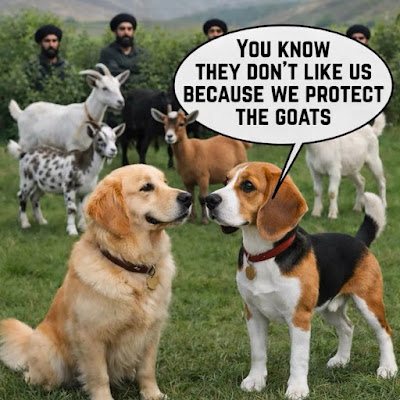
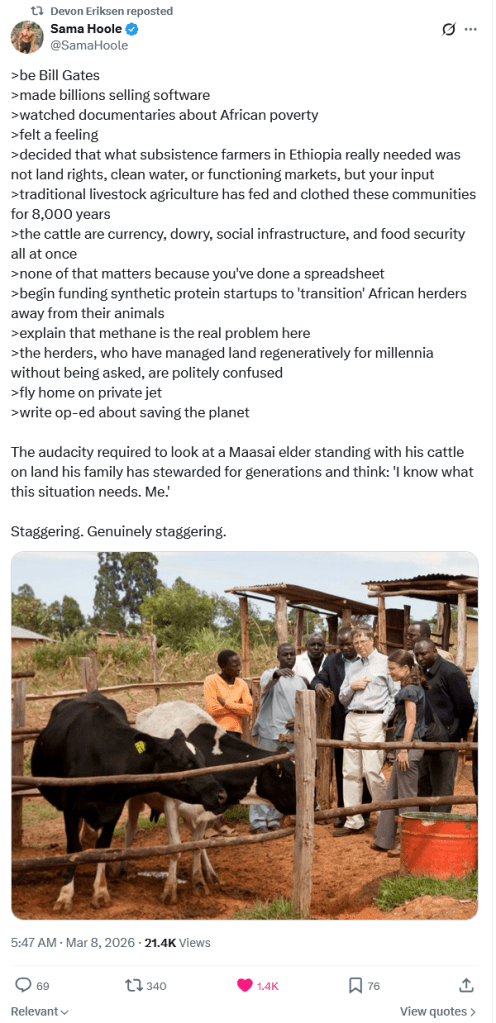
He explained that — bear with me — metaphorically speaking and for shortness of explanation, most social animals are sheep: they live for the band, believe with the band, do what the band does. But there’s always some social animals (weirdly even sheep) who behave more like goats. They strike out on their own; try the new path or the new plant; and (if you follow Sama Hoole on twitter, think of Keith) always test the gate or the fence, because who knows what’s on the other side?

In human-ape terms, we’re the goats. The ones who don’t quite fit in, and therefore see things slightly askew, and therefore can see the hole in whatever beautiful dream everyone else is following. If the pied piper is leading our peers away, we’re the ones who can’t even hear the music. We might be following just as dangerous a music, but it’s not the same music. We marsh tot he sound of a different kettle of fish, so to put it.

Dave says that kind of person is essential. Societies without them — there’s no society really without them, but there’s groups that manage to get rid of them — can go down terribly dangerous paths, and there’s no one to scream the cliff ends, or the king is naked, or whatever.

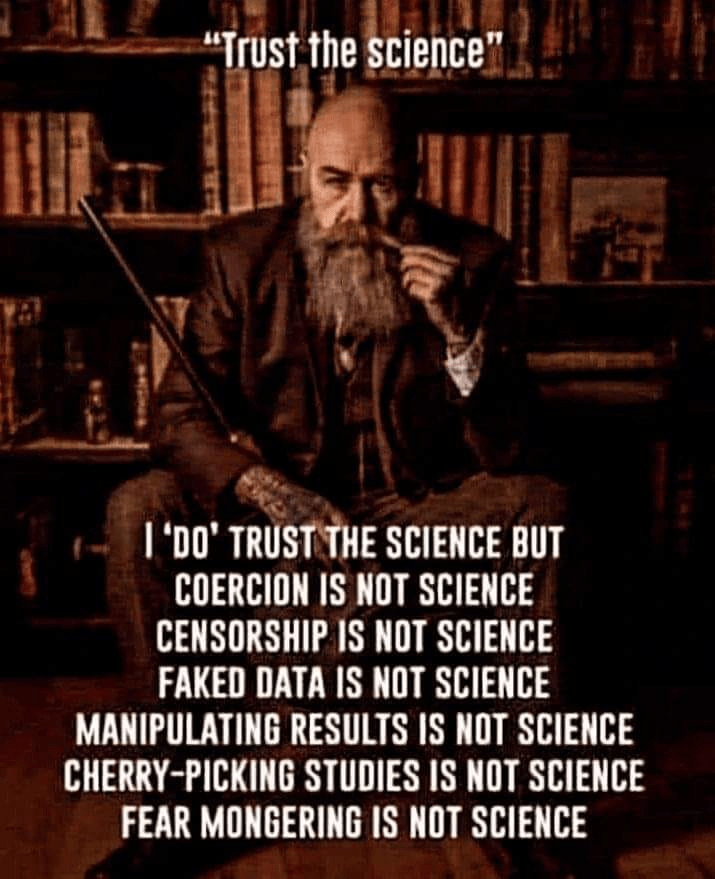
This is why, btw, our First Amendment is just an amazingly good piece of social engineering. Why the censorship around the Covidiocy was a piece of nasty, and why Great Britain should repent and turn back now.

Actually the Covidiocy is a good demonstration of what we’re for. Not that all of us saw the problem with it. We were evenly divided between those on whom propaganda didn’t work at all and those on whom while the propaganda didn’t work, their need to fit in and fear of not convinced them Covid was WAY WORSE than they were told. Those poor souls careened right into insanity and were horribly unpleasant to be around.

BUT some of us were the voices that cried out in the desert and that was important. It seems that when sophisticated psy-ops are applied they shed off our brains like rain. We don’t fall for it. Heck, most of the time we don’t perceive it and can’t figure out why everyone is acting so goofy.

People like us have existed throughout history. You can find us, if you read enough biographies. And no, it had nothing to do with “witches” or witch trials. Oh, it could be deployed against us, sure, like it was deployed against the isolated, the lonely, the poor. I suspect, I mean, that some of us were “real” witches, meaning people who did very nasty things that might or might not have had a peternatural component. For a perspective on this read a book called “The affair of the Poisons” by Anne Sommerset. (This is the link. I get no kickback from it because Amazon is too dumb to distinguish a book on an historical event from one advocating these subjects. SMDH.) But mostly probably not, since these people tended to be adept social manipulators.

It’s more the recluse who did something that no one else could understand. Either the village oddity or the eccentric squire. (And sometimes both.)

Sure, 90% of what we did was design intricate bridges out of soap, to span the Atlantic. BUT sometimes we did the brilliant thing. More often we discovered the small thing everyone thought utterly irrelevant which in turn spurned a true genius to do something completely new and useful.

We’re the square pegs in a world of round holes. But sometimes when the rare square hole appears we’re there. And when all the round holes are on fire, we can scream hard enough the little round pegs don’t get burned. (No. It’s YOUR mind that’s in the gutter.)

We’re sometimes tolerated, sometimes hated. But where we’re tolerated and given leeway as we are, by and large, in America in a way we’re not in most of the world, we can come up with the most innovative things, the most amazing ideas. Now and then. Amid bridges made out of soap.

Look, you’re an Odd. That means you have amazing potential. Sure. Everyone does. But chances are yours is unique and unexplored and strikes out in pathways no one else’s does.

As long as you don’t kill anyone and don’t start any cults, that’s a good thing.

You’re an amazing, bizarre, unique creature, with a different perspective on the world. Don’t beat yourself up for being who you are; for not fitting in.

Sure, do the minimum not to be a source of distraction or fury to the rest of the herd. Ixnay on the pantsonheaday.

But other than that? Cherish who you are. Be aware of your oddities and embrace them. Be glad you see what others don’t; think in strange ways.

Sometimes the rest of the herd needs those of us who don’t fit to tell them when they’re being spooked of the cliff.

It might not be needed in your time, but if it is, you’re there. Be ready.
Book Promo And Vignettes By Luke, Mary Catelli and ‘Nother Mike

If you wish to send us books for next week’s promo, please email to bookpimping at outlook dot com. If you feel a need to re-promo the same book do so no more than once every six months (unless you’re me or my relative. Deal.) One book per author per week. Amazon links only. Oh, yeah, by clicking through and buying (anything, actually) through one of the links below, you will at no cost to you be giving a portion of your purchase to support ATH through our associates number. A COMMISSION IS EARNED FROM EACH PURCHASE.*Note that I haven’t read most of these books (my reading is eclectic and “craving led”,) and apply the usual cautions to buying. I reserve the right not to run any submission, if cover, blurb or anything else made me decide not to, at my sole discretion.SAH

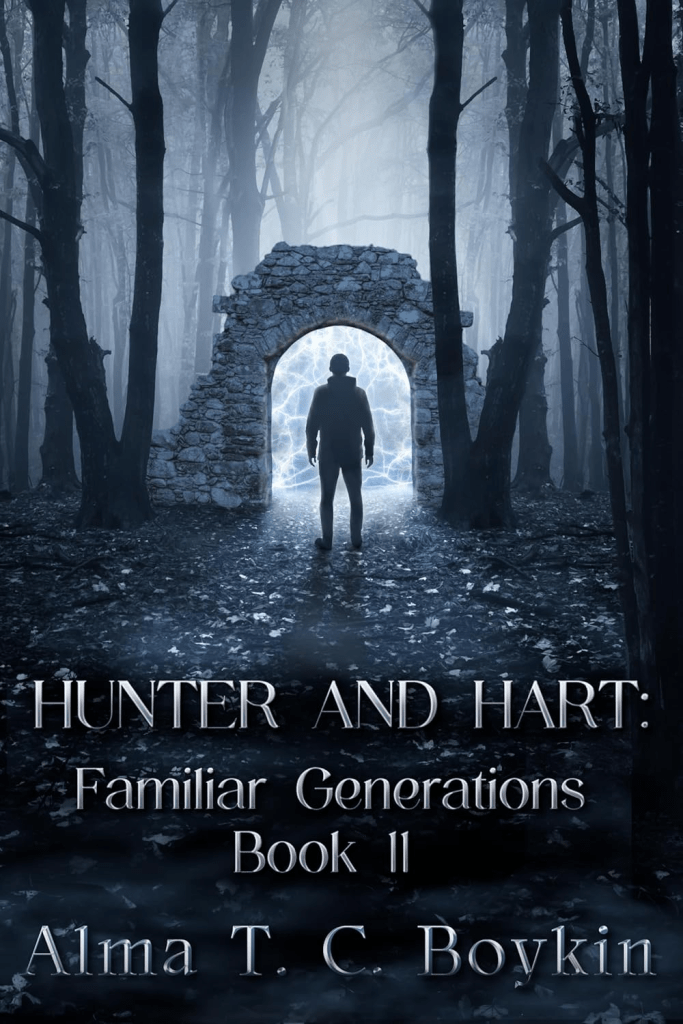
FROM ALMA T. C. BOYKIN: Hunter and Hart: Familiar Generations Book 11

“Uncle Jude, Beth saw a glowing white deer.”

When his student reports her classmate’s tale, Jude feels a chill. Deer from Celtic mythology rarely bring good fortune, even when seen by multiple people. Still, he hesitates. Could it be a transformation? An illusion? A practical magical joke? The duties of father, husband, Hunter, deputy, and employee keep Jude—and his Familiar Shoim—occupied.

Then the first teen, a sorcerer, goes missing.

Tangled magic and a summoning “from long away” draws Jude’s family deeper into danger. When the deer and the magic behind it threaten his wife and children, the stalk among shadows turns into a Hunt. One that draws on lore of the Old Land and power from the New.

Ancient darkness and modern evil both lurk behind the glowing white hart. The Hunter in Shadows must go wary, or he may loose more than just his life in the gathering storm.

FROM NYM COY: Mumbai Singularity

This starts as a murder investigation.
It doesn’t stay one.

Inspector Krishna Mehta’s mesh antenna is broken. In a Mumbai where augmented reality overlays every surface, his glitching connection strands him in the raw city underneath.

That’s when he sees the marks.

Faint rainbow shimmers on people’s foreheads, invisible to everyone else. When the marked start dying from catastrophic brain haemorrhages, Krishna follows the pattern to a hospital shrine, a corporate conspiracy, and uploaded human consciousness running on living minds.

Someone is hijacking the gods themselves.

And the deeper he investigates, the more he realises the conspiracy isn’t just killing people.

It’s already inside his partner’s head.

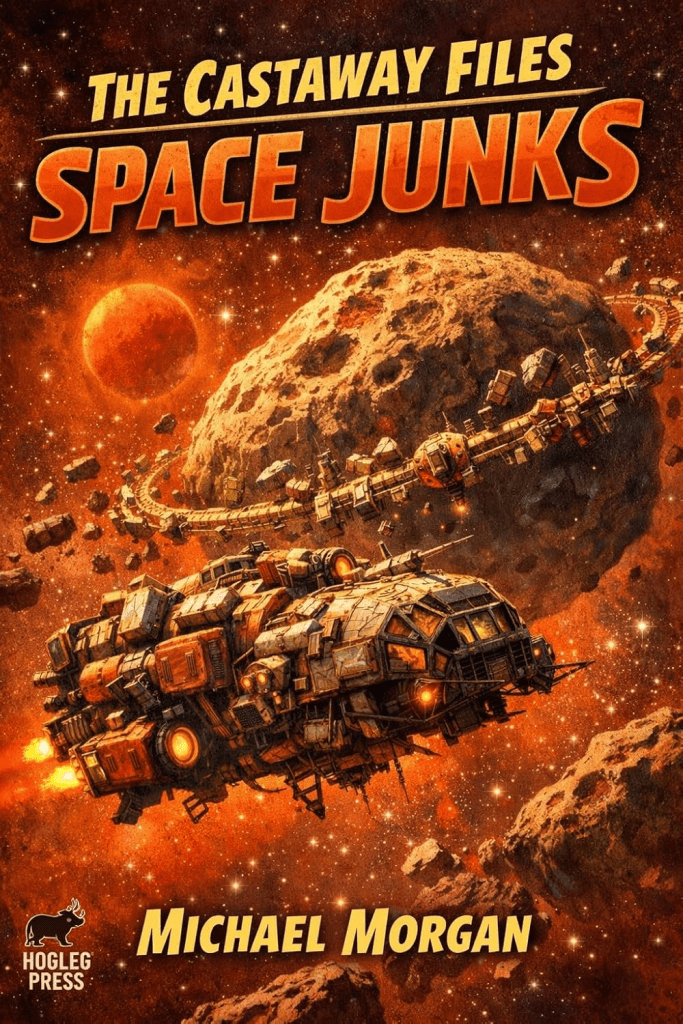
FROM MICHAEL MORGAN: The Castaway Files: Space Junks

In the far reaches of space, survival favors the stubborn, the clever, and the slightly unhinged.

Space Junks is the first volume of The Castaway Files, a collection of gritty, pulp-inspired science fiction adventures where desperate crews, scheming governments, mercenaries, and machines collide in the debris fields of the future.

A scavenger freighter crew discovers that the most valuable salvage in the system might also be the most dangerous prize imaginable.
A team of post-apocalyptic mercenaries hunts for lost technology while shadowy bunker elites prepare to reclaim the world.
Two bored soldiers accidentally trigger a catastrophe that could reignite a forgotten war.
And somewhere in the background, someone may be pulling the strings—turning humanity’s greed and fear into the most dangerous weapon of all.

From derelict stations and orbital junk rings to battlefields littered with the relics of old wars, these stories celebrate the grand tradition of classic pulp science fiction: bold ideas, dark humor, scrappy heroes, and impossible odds.

Strap into the jump seat and keep your salvage hooks ready.
Because in deep space, one person’s trash might be another person’s fortune.

Welcome to The Castaway Files: Space Junks.

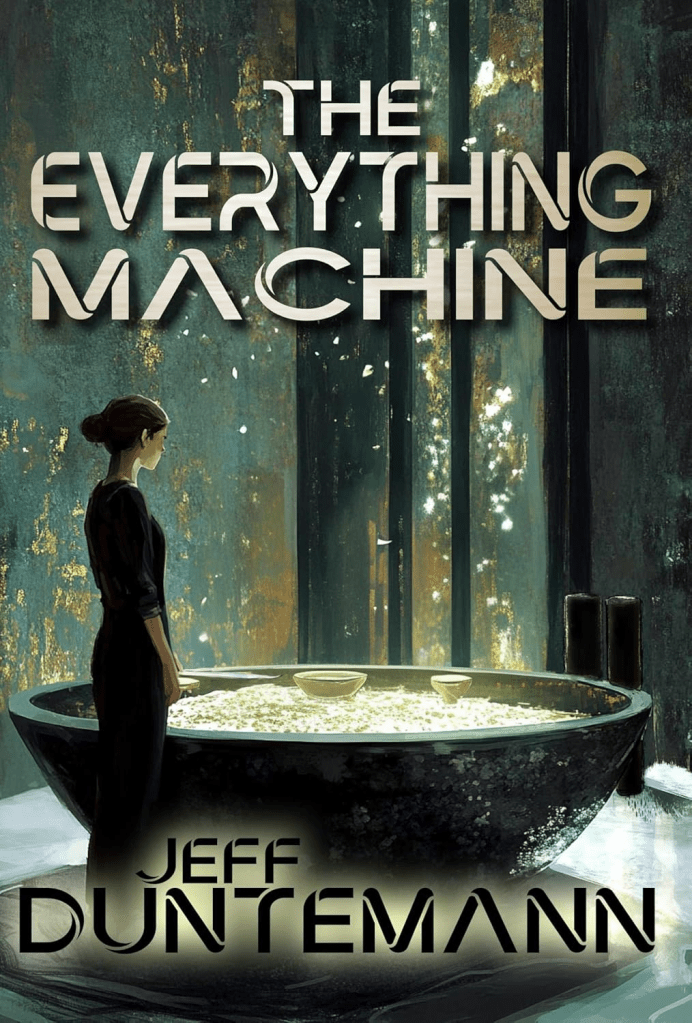
FROM JEFF DUNTEMANN: The Everything Machine

Carrying 800 passengers and their household goods, agricultural animals, and farm-related supplies to Earth’s first interstellar colony, starship Origen’s hyperdrive self-destructs, marooning its passengers near an Earth-twin planet orbiting an unknown solar-twin star. While settling in, the inadvertent colonists name their world Valeron, and discover that Valeron is scattered with hundreds of thousands of alien replicator machines—but there are no aliens nor any other trace of them.

Each replicator is a shallow 8-foot-wide black stone-like bowl half-full of fine silver dust. Beside the bowl are two waist-high pillars about 8 inches in diameter, one pale silver, the other pale gold. Tap on either pillar, and the pillar makes a sound like a drum, one pillar high, the other low. Tap 256 times on the pillars in any sequence, and something surfaces in the bowl of dust. Simple sequences create simple and useful things like shovels, knives, rope, saws, lamps, glue and much else. Complex or random sequences create strangely shaped forms of silver-gray metal with no obvious use. 256 taps on the pillars can create any of 2E256 different things; in scientific notation, 1.16 X 10E77.

That’s just short of one thing for every atom in the observable universe.

The artifacts are dubbed “drumlins,” for the sounds the pillars make, and the replicators called “thingmakers.” Drumlins have strange properties. Although virtually indestructible, drumlins can change shape, especially when doing so will protect a human being from injury. Drumlin knives will not cut living human tissue, but they will cut living animal tissue or human corpses. Press a drumlin knife against your palm, and it will flow and flatten out to a disk. Pull the knife away, and it will slowly return to its form as a knife. Some claim that drumlins read human minds and grant wishes. Others insist they are haunted by invisible and perhaps hostile intelligences.

After 250 years on Valeron, the colony prospers. Starship Origen is still in orbit, and a cult-like research organization called the Bitspace Institute vows to repair Origen’s hyperdrive and return to Earth. With millions of drumlins catalogued using the thingmakers, Valeron’s people live well and begin to lose interest in returning to Earth. This threatens the Institute’s mission, prompting it to launch a covert effort to undermine public faith in drumlins. A low-key war begins between the Institute and those who value drumlins–including farmers, rural folk, an order of mystical women, and several peculiar teen girls who have an unexplained rapport with the thingmakers and their mysterious masters.

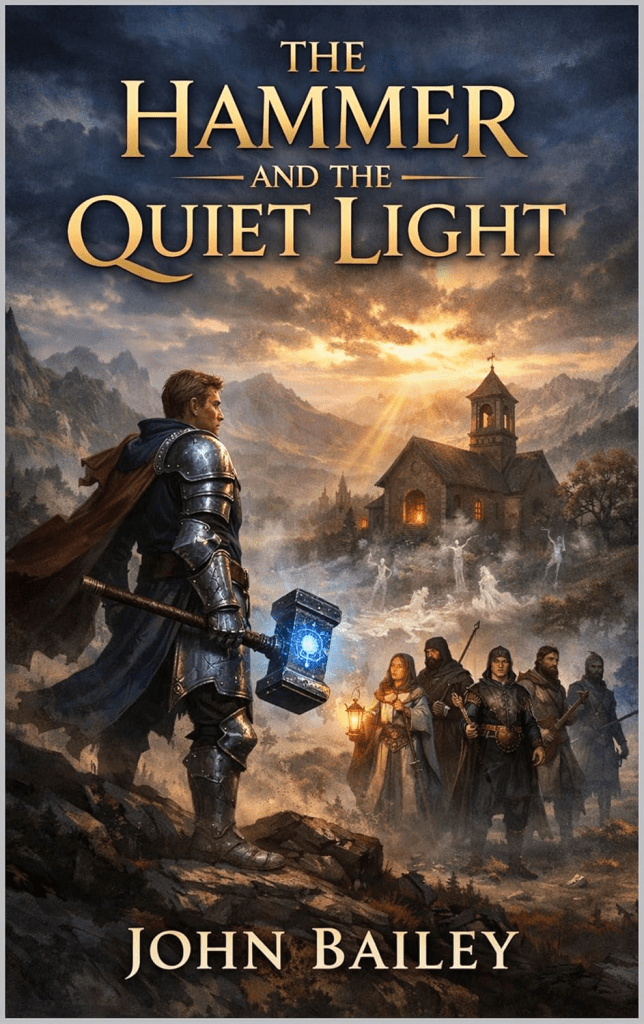
FROM JOHN BAILEY: The Hammer and the Quiet Light (The Fantasy Books)

In a kingdom where the dead will not rest and history itself is quietly unraveling, a small band of travelers chooses to stand where others turn away.

A disciplined paladin following an uneventful patrol.
A cleric who keeps the names of the forgotten dead.
A scholar whose magic bends perception rather than force.
A ranger guarding roads that no longer remember where they lead.
A mediator who believes words can prevent bloodshed.
And a veteran warrior seeking redemption without recognition.

When graves are disturbed without theft and records are erased rather than destroyed, these strangers discover a threat more dangerous than war: an enemy that feeds on forgetting. As undead stir and truth begins to vanish, the fellowship must decide whether goodness is still worth defending when it offers no glory and little reward.

Set in a classic medieval fantasy world of chapels, borderlands, and ancient roads, The Hammer and the Quiet Light is a story of quiet courage, moral clarity, and the enduring power of remembrance.

This is the first book in a character-driven epic fantasy series centered on faith, justice, and hope without naïveté.

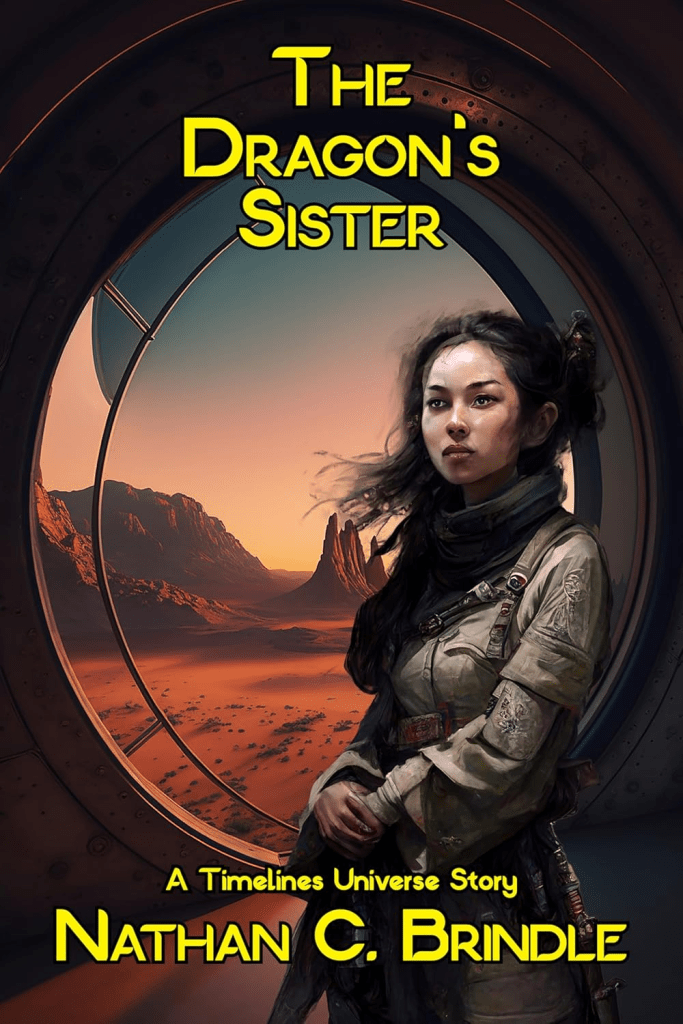
FROM NATHAN C. BRINDLE: The Dragon’s Sister (Timelines Universe Book 7)

Two Sisters, Separated By A Timeline

When most people find out they have a long-lost twin sibling they never dreamed existed, reactions can range from happiness to anger.

In the case of US Space Force Marines Brigadier General Mei-Lin Lai, her “twin” is her timeline analog she was told did not exist. And because of that reassurance, the expatriate Chinese taikonaut migrated to Timeline Zero from Timeline One Right, to take command of United States Space Force Base Terra Meridiani, on Mars.

But her analog did exist. And was pulled out of a cold-stasis chamber in Chicago eighty years after she’d been recruited into a failed plot to disrupt an American presidential election.

Twenty years later, Mei-Lin must grapple with a woman who is her genetic twin and wishes to join the Space Force Marines as a medic — and will go through Basic Training on the planet where Mei-Lin is the boss Marine.

Will the two women, identical but different, be able to form a sisterly bond? And will Mei-Lin finally come to grips with the very existence of her other-timeline twin?

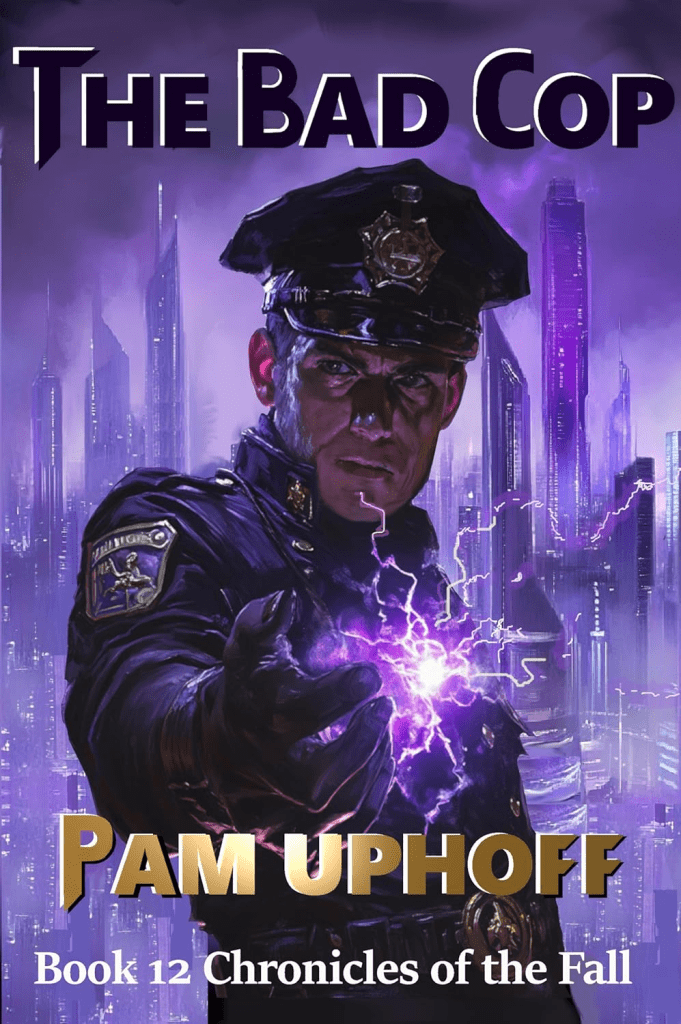
FROM PAM UPHOFF: The Bad Cop.(Chronicles of the Fall Book 12)

“There was a shield piercing Impression on the bullet. Karl had a shield up, too, and it wouldn’t have stopped that bullet.” A faint snort. “I think he’s a little indignant that the ‘Bad Cop’ saved him.”
Police Captain Lord Daniil Ambrose Vinogradov grinned. “As opposed to the Good Cop? I’m afraid that when it comes to double teaming on a suspect, the role of Bad Cop does come rather easily to me. And Nix is a damn good cop.”
“Ah. I thought you two disliked each other?”
“We’re rivals for the next promotion, and, well, I am more aggressively ambitious and less well mannered. Or to be less polite, a ladder-climbing asshole.”

As the attack on the 300, the Government Council, leaves the Three part Alliance without leadership, a runaway teenager leads a police detective deep into trouble, and romance.

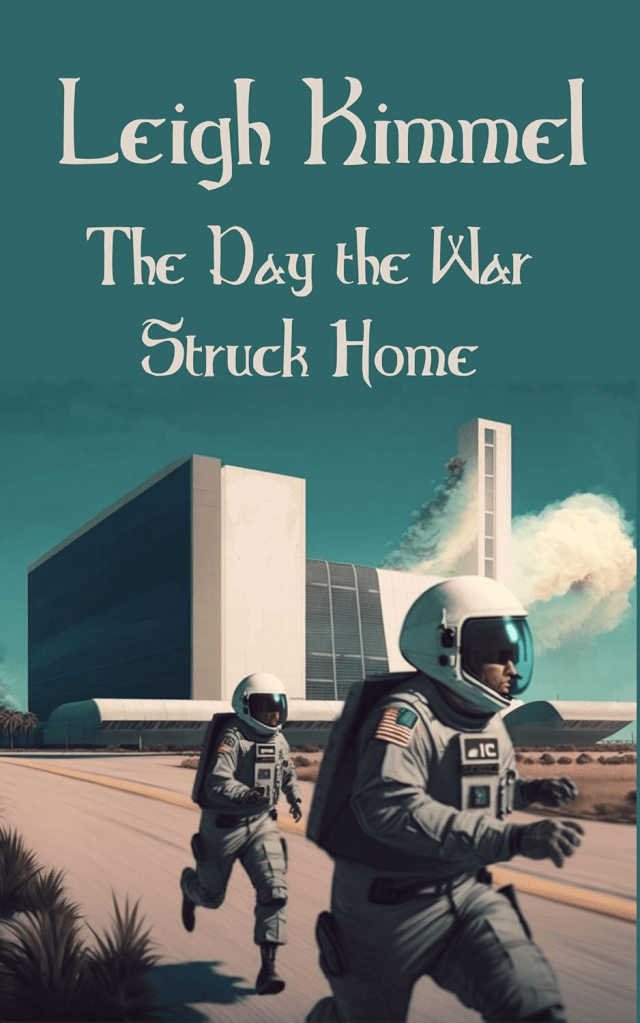
FROM LEIGH KIMMEL: The Day the War Struck Home

Astronaut Peter Caudell comes home to find his daughter struggling with a school assignment. She’s to write an essay for Memorial Day, and her teacher suggested astronauts — but she wants to write about combat heroes, not REMF’s. So Peter suggests the NASA Massacre and relates his own part in those events.

It’s the summer of 1994, and the Energy Wars are raging in the Middle East. On the home front it’s the Summer of Fear, a season of continual terrorist attacks. All eyes are upon Kennedy Space Center, where a Space Shuttle is launching for a critical on-orbit repair of a spy satellite. When it goes up without a hitch, everyone breathes a sigh of relief.

However, the intelligence proves incomplete — the actual target is Johnson Space Center. Suddenly Peter is in the fight of his life, as the presence of multiple police agencies further complicates the fight to stop the terrorists from slaughtering the astronaut corps.

It’s a story of courage, patriotism and self-sacrifice that proves a much greater lesson than the teacher imagined.

A short story of the Grissom timeline.

Originally published in Liberty Island Magazine as an Honorable Mention for the Memorial Day contest. This version includes a bonus essay on the genesis of the Energy Wars.

FROM ANNA FERREIRA: The Root of All Evil.

When murder comes to Stockton, it brings long-buried secrets in its wake…

Kate Bereton leads a busy but unexciting life as the clergyman’s only daughter in a small Dorsetshire village. She’s grateful for the break in routine heralded by the arrival of her stepmother’s latest guests, but when Kate discovers a dead body in the parsonage one morning, she finds herself in much more danger than she could have ever anticipated. Terrified and desperate, she turns to the local magistrate for help. Mr. Reddington is eager to aid his dear friend Miss Bereton, but can they discover the murderer before it’s too late, and the secrets of the past are forgotten forever?

With a dash of romance and a generous helping of mystery, The Root of All Evil is a charming whodunit that will delight fans of Jane Austen and Agatha Christie alike.

FROM HOLLY CHISM: Bite Sized (Liquid Diet Chronicles Book 1)

Meg Turner has been a vampire for twenty years. Her favorite food is rapists. Which is how she met Andi Donahue, her new best friend/ girl Friday.

And then the nightmares start. And the bodies start showing up–bled out and raped. Just like Meg was. They don’t have a whole lot of time to stop the killer before he strikes again, and only one way to stop the killer.

But how can Andi help Meg stop a killer she can’t even see?

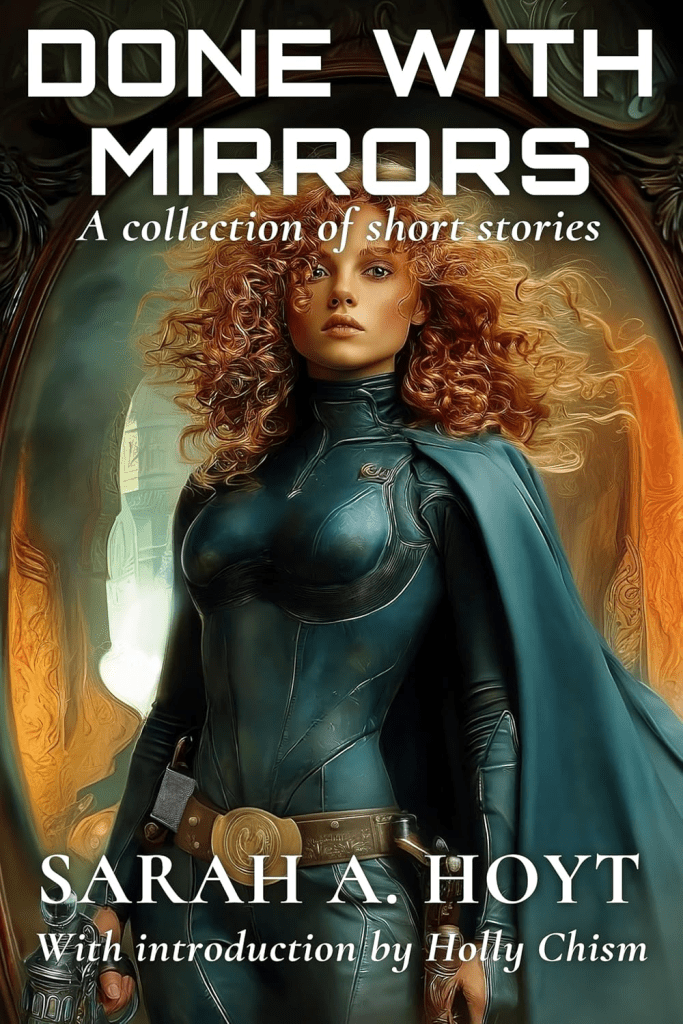
FROM SARAH A. HOYT: Done With Mirrors: A Collection of Short Stories (Sarah A. Hoyt’s Short Story Collections)

DONE WITH MIRRORS

From Prometheus Award winner Sarah A. Hoyt comes a dazzling collection that showcases why her work has appeared in Analog, Asimov’s, and Weird Tales—and why readers can’t get enough.

Magic-soaked noir in 1920s Denver. Mirror-hopping time lords fleeing across infinite universes. Survival in John Ringo’s zombie apocalypse. Murder and mystery in the world of Darkships and Rhodes. Each story in this collection pulls you into a different world—and refuses to let go.

Previously published in acclaimed anthologies from Baen and Chris Kennedy Publishing, these nine tales span Hoyt’s most beloved universes alongside standalone adventures. Whether she’s writing in Ringo’s Black Tide Rising series, exploring her own Darkships and Rhodes worlds, or crafting speculative noir that defies categorization, Hoyt delivers the vivid storytelling and emotional resonance that has earned her a devoted following.

From rain-slicked streets where magic and murder collide to the far reaches of space-time itself, Done With Mirrors demonstrates the genre-hopping brilliance of one of speculative fiction’s most versatile voices.

Nine stories. Nine worlds. One unforgettable collection.

Contains the short stories: Honey Fall; Scrubbing Clean; Last Chance; Great Reckoning in a Small Room; Horse’s Heart; Do No Harm; Dead End Rhodes; Knights of Time; Done with Mirrors.

With an introduction by Holly Chism.

Vignettes by Luke, Mary Catelli and ‘Nother Mike.

So what’s a vignette? You might know them as flash fiction, or even just sketches. We will provide a prompt each Sunday that you can use directly (including it in your work) or just as an inspiration. You, in turn, will write about 50 words (yes, we are going for short shorts! Not even a Drabble 100 words, just half that!). Then post it! For an additional challenge, you can aim to make it exactly 50 words, if you like.

We recommend that if you have an original vignette, you post that as a new reply. If you are commenting on someone’s vignette, then post that as a reply to the vignette. Comments — this is writing practice, so comments should be aimed at helping someone be a better writer, not at crushing them. And since these are likely to be drafts, don’t jump up and down too hard on typos and grammar.

If you have questions, feel free to ask.

Your writing prompt this week is: INSPIRE

Telling us it’s raining

There is a reason I don’t watch TV much. No. Seriously, there is a reason I don’t watch TV much. Because when I do, I start threatening to throw shoes at the TV or … or write rants at my blog about it.

Stop popping popcorn right this minute. You’re all BAD people. You should be ashamed of yourselves.

Besides most o you will say that I got what I deserved for watching a romance series. Guilty as charged, but you have to remember I read EVERYTHING including regency romances. It’s just I tend to read regency romances when I’m on low brain-effort mode. This doesn’t mean, btw, I’m calling people who read regencies preferentially stupid. People like what they like and it has nothing to do with how smart they are. I’m saying I, personally, read them on low effort or low-emotional-give mode, because they are predictable. I know they are going to end in HEA (Happily Ever After) and usually nothing too terrible will happen. It’s the equivalent of putting on something in the background when I’m cleaning that I know is not going to make some jump-scare sound and upset me. Mysteries (depending on the level of mystery) and science fiction require more engagement because the formulas are more complex, and have the potential to do things that really upset me. For me, Romance is my easy-listening. I prefer them clean, or I flip past the sex, as written sex doesn’t do much for me, and it rarely advances the plot.

Oh, the other thing is that I don’t usually read what I’m writing at that time. I’m not even sure why, but if I’m on a scifi writing jag, like now, I read mystery for fun. And vice versa. And if I’m cycling fast between sf/f and mystery for writing (which I did for much of my writing career, due to contract commitments) I STILL have to read SOMETHING. So I spent years on end reading romances, and of those mostly regencies.

Anyway, when the Bridgertons was being talked about, I watched a show, was mildly baffled at the racial thing and thought it must take place in a parallel world, which actually made it sort of cool, even if I grumphed at their not giving me the world building for how we’d got here. (I have the same complaint against 90% of Urban fantasy, so… I think I’m more of a world building geek than other people.) I asked if the racial thing was in the books and someone (I think older DIL) told me they were bog standard regencies. So I looked them up, and realized I’d read them during one of my binge-reading regencies… Well, when we still lived in downtown Colorado Springs.

It was from there that I followed through to the gobsmacking realization that the mentally impaired producer of the show (sorry, but the truth must be told) had decided Queen Charlotte was black due to two bad portraits and a rumored MOORISH ancestress FIVE HUNDRED YEARS IN THE PAST. Chilluns and babies, Moors ain’t black. Most of them are Mediterranean looking. Since this was a Portuguese “Moor” she was likely redheaded because uh… both sides kidnapped women from the other side and the Moors really liked Germanic and Celtic blonds, okay? But sure, let’s play along and pretend Moors were black from the deepest Africa. FIVE HUNDRED YEARS. That’s seventeen generations. I have black ancestry from Africa much closer than that, and look bog-standard Mediterranean. Because that’s I presume what most of my ancestors looked like. In a Northern European country a black ancestor can disappear into the background in three or four generations. Our neighbor who was in fact black and married a blond man had very light children of “undefinable race” and her grandkids look “light Portuguese.” FIVE HUNDRED YEARS. Only an idiot who believes in one-drop would believe that someone with a black ancestor five hundred years in the past would still be “black” even by the standards that Americans consider people black.

Five hundred years an ancestor from Africa might not even show up in your 23 and me. And if he does it will be in the less than 2% range.

But the producer is obviously mentally impaired by racial notions and obsession, so she decided that there must have been secret black nobility and gentry around England at that time, and that the Queen was outright black. And then ran with it.

As annoying as I found this — and I did find it annoying — I could enjoy it at the level of “this is a parallel world where things are very weird.” I still wished she had given more alternate history to go on, something that made sense. And I resented the fact that people who tend to think what they see on TV is true — mostly because of our appalling educational system — would believe that there was always parallel white and black nobility in Europe, but what the heck. The costumes aren’t realistic. The society isn’t realistic. The dances, instead of being the synchronized walking of British Regency (seriously what is with Northern Europeans and inability to dance), are this strange, beautifully choreographed thing to modern music. As a fantasy it was visually gorgeous and the male love interest for the first season, sure, was black but also gorgeous. So low brain power eye candy. And besides Dan was watching it, and I could watch with one eye (on eyestalk) while I wrote the blogs at night.

The second season was actually more believable, since the female love interest was Indian (dot) which did happen in British families at the time (particularly if the girl was only half Indian and had a considerable dowry.)

But now we’re in whatever this season is, and I’m getting p*ssed off. Why? Oh, I’ll tell you why. It’s like this, it’s okay if there’s a few drops on your neck, and they tell you it’s raining. You try to believe it and go along.

BUT when there’s a stream on your neck, and you look back and there’s some grinning bastage with his pizzer out and telling you “Nah, dude, it’s raining.” you’re liable to get upset.

The first thing to piss me off came on gradually. At some point it dawned on me that EVERY couple — except the one in which the girl is morbidly obese! — is bi-racial.

Do I disapprove of bi-racial couples? Brother! If I did, and depending on how you counted it, husband and I would have to get a divorce. Also, I wouldn’t be here if my ancestors had had that attitude.

No. What I disapprove of is contrived and unnatural emphasis on race. The first one was okay. The couple had chemistry, and were both very good looking. After that it started slowly impinging on my consciousness that a-historicity aside, this was neither casual nor aesthetic, but fetishism. Race fetishism. And not even for sexy reasons. Just because someone has racial rats in their heads and wants to inflict them on others.

And then there’s the ridiculous. I’d be willing to pretend that there was a parallel world in which somehow there was a parallel British gentry that was black and that there had been some sort of apartheid that was broken by the Queen marrying the white king. (Except that of course, in the other miniseries they make the king black also? I think?)

Anyway, fine, whatever. But now there’s apparently also a parallel Chinese Gentry. All in England, which frankly was the size of a tea-tray. And among the gentry which were also known as the “upper ten thousand” because they were more or less ten thousand people, or the size of a small town.

Look, I’ll suspend my disbelief, but you don’t have permission to leave it dangling there till dead.

Then there comes the throw away stupid that one of the grand-dames of the show — who happens to be black — is retiring and going back to Africa. Africa! in the late 18th century! Someone who is the highest of the British court! I ASK YOU. My poor disbelief might not come back, even with the paddles of life. Also, I think we could kill the producer of the show by sneaking a general history of the world into her room and leaving it near her for the night. Because it’s obviously kryptonite to her.

And then comes the crowning insanity which hasn’t happened yet, but I could see them preparing for, and apparently Dan has found the producer bragging about what they’re doing and I’m right.

So, stop reading here if you are following the show and don’t want spoilers. But having read the novels… One of the daughters, the shy, bookish one, marries a man who is much like her. He then dies of brain hemorrhage and she feels guilty, because by then she was attracted to his male cousin, who is a bluff soldier and lives with them.

The romance with the cousin is one of the last books.

When this season the cousin was introduced and was female my hackles rose. For one, because the male character being really close to this cousin gave it a completely different aspect.

But there were other clues, like the cousin getting really upset at match making her with some guy, etc.

I told Dan “they’re going to make that a lesbian romance”. He didn’t believe me, till he read the producer bragging about it.

So, do I have anything against lesbians? No. There is only one person in the world whose orientation means anything to me, and as long as he likes me, other people are free to sleep with whomever they want. It’s not how I relate to other people. I relate to them as individuals. If I like them i will be nice to their significant others. If I like both of them, it’s a bonus. If Dan and I like both of them, it’s a miracle. (Those of you who are married know how rare that is. We have maybe four couples where we like both members of the couple equally. Wait, eight if you count kids young enough to be our kids.)

I am however way beyond sick and tired tv shows making the bookish, introverted girl a lesbian. It wasn’t cute or edgy when they did it to Willow on Buffy and it’s even less so now.

This might not be obvious to the grand-poobahs of Hollyweird, but here in the real world, even back in my day, any girl who was awkward, bookish, or not particularly into makeup and clothes, was ASSUMED to be a lesbian. I suspect these days it’s lesbian-or-trans. And if you’ve attended public school, you know that being one of the best students is already hell on Earth. If the kids have another way you’re obviously different to fasten onto, you will be tortured at least psychologically and often physically too. I suspect nowadays being tortured by telling you how accepting they are and how you MUST come out to their idea of who you are the most exquisite torture.

Please stop. Stop it already. Stop pissing down our neck and pretending it’s raining.
If you want to do all interracial romances? Set it in the present day in a college town. Or if you absolutely must put it in the past, tell us it’s an alternate history. Or at the very least, stop claiming that you’re telling the “real” history.

And, hey, why not? Make the quiet bookish girl, or the tomboy REALLY heterosexual every once in a while. Heck, have some of them be in happy heterosexual marriages. Because I am here to tell you it can happen.

Yes, I do realize that in your bizarre tiltawhirl circles all this bs seems realistic and inevitable. But do strive to look in on reality every once in a while. Or at least send it a postcard.

Because I’m really, really, really tired of your stilted lack of imagination combined with attempt to shock people who have been seeing this stuff since they were kids and are now grandmothers.

Have an original idea. I beg you for the love of Bob. Because I can’t afford to put a shoe through the TV.

This Is Not A Post

Holly might post later if she chooses. This is my not a post post:

I am still mired in fixing Witch’s Daughter, mostly because apparently when I write a book over 10 years lots of false clues and contradictory bits drop in to the point I suspect I might be an LLM. (Well, I am large. Attempting to work on that. I’m not sure I’m a model, though.)

This work is being rendered snail-slow due to the fact I have a massive head cold. I’m mostly okay, except for lingering cough. Which, of course, interrupts sleep, which makes me slow and blah. Thank heavens for caffeine, though as a curative measure I’m imitating a Jane Austen heroine and, if not staying in bed all day — someone would die. Probably me. Of boredom — taking frequent naps. Unfortunately the seriously slow and concentrated effort of cleaning up the novel is exhausting anyway and worse at this point.

Anyway, people don’t die of trifling little colds (snork) and I’m fine, just impatient and upset at myself and how slow I am. Indy is doing his best to cheer me up which alas includes back-engineering the feeder which rendered it inoperable (of course) because he doesn’t understand electricity. Okay “cheer up” should be understood as gritting my teeth AND laughing at the same time, which let me tell you is a doozy.

Havey continues his slow march to the end. Now that I’m not there but can see from here the extreme old age he has achieved in human terms as it were, and the possibility I might get there, it is both depressing and cheering. Depressing because seeing pictures of him even three years ago as a fluffy full-of-himself brat, and contrasting it the little fuzzy skeleton now running around the house is sobering. Time and all that can’t be denied. Cheering because the little so and so, on hospice-level pain killers for arthritis, and with his kidneys slowly failing, still finds it in him to call me out for my mistreatment of elderly cats (not making my lap available 24/7, you see?) and to occupy my lap the minute it becomes available. So other than the fact he now doesn’t eat much, he’s still himself to the end. An example to us all.

Anyway, politics is… well… if you’re the praying sort, pray for the SAVE act. It will take a miracle, and after the elections in 24 we might be pushing our count.

And now I’m going to return to editing, then nap. Post — I’ll try at least — tomorrow.

Use Your Power For Good

Of all things that have surprised me recently — and a lot of them have — the one that almost shocked me was my first reaction to Paul Ehrlich’s death.

For those who’ve been asleep for the last fifty years plus, Paul Ehrlich was the man who hated humanity and was never right. Ever. He wrote the Population Bomb, a book that pushed Malthusian ideas to the criminal degree and was almost single handedly responsible for things like forced abortions and sneaky sterelizations in Africa.

He convinced people — and perhaps himself — that human population was going to continue exploding until it overrun Earth resources. I remember being scared spitless while reading him in the seventies, about how we were going to run out of potable water and food in less than a decade.

He painted a vivid, compelling picture of a world where you’d have to ask your neighbor to breathe out so you could breathe in. And being a kid, I had no way of knowing that some of those predictions were already outdated, and others were outright bloody impossible.

Anyway, if human population crashes to the point that civilization falls in the next 100 years, it will be Paul Ehrlich who is the most responsible for it. (Not the sole responsible, mind. Governments that pushed all women into the work force in the name of maximizing their tax revenue and corporations that encouraged same in the name of lowering salaries (before they found third worlders to lower it even more are there on hte same pillory.)

And yet I felt — immediately — a pang of sympathy for the man, and said a prayer that he might have found mercy on the other side.

This surprised me, and I had to think through it. The answer, of course, is that I felt quite a bit of fellow-feeling with him.

No, no, I never thought that the human population is increasing exponentially. Nor do I think we should control human reproduction. Nor should we be putting sterilizing agents in the water. And if I’d gone to India, I might have been appalled at the crowding and some people’s living conditions, (supposedly his trigger for the Population Bomb) but I’d have realized a lot of it was cultural and also that the countryside would be far emptier.

However, Paul Ehrlich’s real talent was …. persuasive writing. Something for which I have some little talent of my own. And I know the pitfalls. And could see it getting out of control.

Every talent has its own danger. Like, if you have a talent for balance, you might decide that tight rope walking is your metier, and might eventually meet your demise that way. If you’re really good at sales, but you’re an artist… well…. I envy you to the point of (almost) hating your guts. But more importantly, there’s a danger you’ll get really involved in the sales and forget to produce a worthy product.

But in my case, if you have a talent for creating plausible story lines, compelling motives, and to write persuasively, it’s quite possible you’ll find yourself buying into your own stories. Particularly since, inevitably, they are targeted at your strongest interests and most profound fears.

So a man who got utterly panicked over the crowding and living conditions on the streets of Indian cities, and who was naive enough not to realize that the countryside is not that crowded, could conjure an elaborate pseudo-scientific nightmare vision that convinced various governments to limit their own populations, sometimes by draconian means.

The point is, he probably believed it himself. Even the NYT who bought into it lock stock and barrel, because they hate humans, reported that Ehrlich was “premature” in his predictions and not wrong, wrong, wrong, so far steeped in wrongitude to the point of no come back. (This is because they too also hate humans and want us to go extinct.)

So? So, be aware of your talents, and their pitfalls. I continuously test my own perceptions and theories against the real world, so that I don’t con myself (much less others) into something stupid. I’ve learned — through hard experience — the feel of when I’m diving into my fantasy. There’s this “slippery/excitable” feeling. And I stop and examine things.

I have no idea what your talents are. I know someone who reads here occasionally has the same talents I do, which means she’s really good at talking herself into crazy stuff.

This type of talent, if you’re in a good situation, can convince you you’re invulnerable and leave you wide open to attack. And if you are in a bad situation can amplify “uncomfortable and somewhat depressing” to the level of a frontal attack and an horrendous torture. And it feeds on itself with each level of self drama amplifying things and making the next level worse.

Do not fall for your own stories. Make up stories about whatever you want, but NOT YOUR OWN LIFE. That way lies madness. Particularly because if you’re good enough at it, you’ll take others along for the ride, including everyone in your orbit.

Always, always, always reality test instead of feeding either euphoria or panic.

Use your powers for good. They’re all double-edged. What can take you to success, can also destroy you.

Remember that and stay in control of your abilities. Don’t let them control you.

And more importantly, don’t use them to set the world on fire, lest you get burned.

People Are Not Widgets

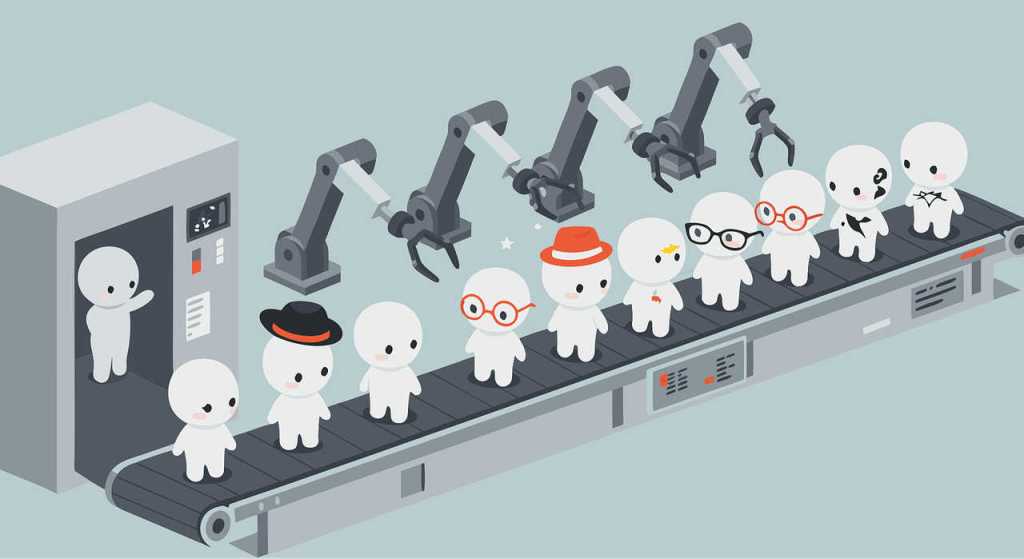
If there is one thing that I’d enjoin you to remove from your mind, for the sake of humanity, please, if this idea that people are widgets who can be molded, twisted, packaged, arranged, engineered!

The proximal cause of this post is Paul Ehrlich’s death, but that’s only part of it. I might or might not, later, write a post about Ehrlich, the man who was always wrong and an actual contender for History’s Greatest Monsters, easily edging out Carter’s considerable credentials and bidding fair to compete (if in a different way) with people like Hitler, Stalin and Mao. Heck, he bids fair, just in lives distorted, maimed and never born to compete with Karl Marx himself. (And as a very minor footnote scared the screaming bejeezus out of me when I was a little kid, reading him.)

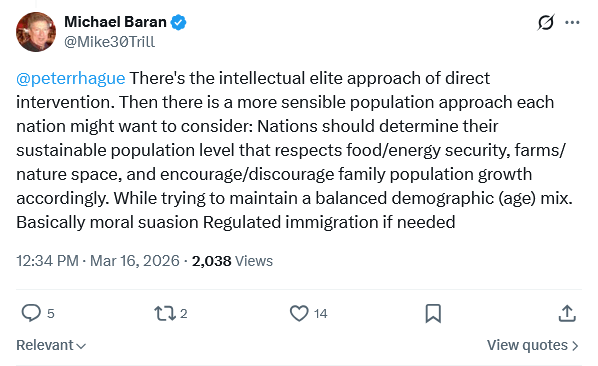
However, the cause of this post was a comment on an x post about Ehrlich. This man was well intentioned, I think, and trying to say “whoa, Ehrlich went way too far.”

But this what I mean by “Marxist rats in people’s heads.” This man needs a few glue traps in there to capture the rats.

Of course, I went after it hammer and tongues, in my gentle, persuasive (cough) way. That is, I started jumping up and down and metaphorically speaking throwing shoes at his head.

But on the serious side, look at all the words there. “Sensible population approach” “Nations should determine” “Sustainable population level” “Encourage/discourage”.

This man might disapprove of Ehrlich, but he’s going down the exact same pathway to hell.

The problem with Ehrlich wasn’t Ehrlich. Yes, he was a complete amoral lunatic who only didn’t encourage sterelizing agents in drinking water because that would sterilize other species too, not just human, but humanity has had plenty of immoral lunatics and immoral people, and lunatic people, including a lot of them with ineradicable self-hatred and an overarching messianic complex that have not done the damage Ehrlich managed, and in fact who, in the end did more harm than good. At least I knew one of them, who worked a decent trade, had a wife and family and was a kind father and a fun grandfather. It was only when he got to speaking about how most people in the world were a waste of space and how the world would be so much better if you eliminated 2/3 of them that you saw the madness peek out of his eyes. The difference is he didn’t have the power to sell his toxic ideas, and the credentials and ability to make entire governments either believe them or act on them because they believed it made them seem “smart and progressive.”

Now we can’t eliminate people who write persuasively — take that dagger off my back, thank you, it stings — but what actually allowed Ehrlich to do harm was this idea — which the poor man (I’m convinced he has not idea how toxic he sounds) above echoes so exactly: the idea that governments CAN AND SHOULD determine how the people of the nation should live: how many people should be born, how many die, what’s “sustainable”, what they can eat, what they can’t, how much they should exercise, what type of work they should do, etc. etc. etc. ad nauseum and ad vomitus.

Without this bizarre idea that a handful of people at the top should determine all this stuff; that the smart and “enlightened” should decide when the rest of us can wipe our asses, and how many ply the toilet paper should be, Ehrlich would have been just another harmless madman, foaming at the mouth and screaming into the void — or perhaps the college classroom, which comes much to the same — without influencing mass media, the culture, and outright governments like India, China, and a bunch of countries in poor, benighted Africa.

I do understand the temptation — lead us not into — of thinking you’re smart and better read and more enlightened than the rest which fed both Ehrlich and those who fell for his load of week-old, rancid maltusian fish. I get it because I think I and most of those reading this blog fell into that trap when we were teens. We read a lot, and we were smarter than our classmates (Which, unfortunately wasn’t very hard) so we thought we should have more say in how people lived than the run of the mill kid still reading picture books in fifth grade.

Then we grew up. And in growing up we came to realize that though — by and large, and with exceptions — we could run circles and figure eights around most people in the fields we were really good at, even with half a brain tied behind our backs, there were things that were utterly impossible for us that other people did easily. And I’m not talking about the bane of my existence in middle school, aka, “dribble a basketball” but things that are needed for every day life. I’m complete and utter drawers at assembling any structure more complex than ikea furniture. Do not under any circumstances let me lose with any process that is primarily visual (I’m okay if I can handle the pieces of something, but just icons on a screen? ick) like a bunch of programming systems. And I had to invent ways to figure out what pieces of wood I needed to cut that didn’t involve measurements, because 543 and 453 and for that matter 345 become the same thing in my head, once I walk away from my notes. (The way I figured leaned into mom’s trade of making clothes patterns. I use massive sheets of newsprint and cut a shape of the piece I need, then tape that to the wood, and cut. Yes, it’s stupid but it works.) Meanwhile people who found “See Spot run” a challenging read could do all of the stuff that bedeviled me (including dribbling a basketball. Sigh) with trivial ease.

More importantly in the process of growing up I figured a lot of “my people” came up with absolutely bizarre and perverse theories from all that reading, and were wholly unamenable to argument once it was in their head. And I found — and you guys probably found too — that I actually got along with a lot of people who didn’t really enjoy fiction reading, or abstract theory, but whose hobby might be building cool engines, or building interesting furniture, or even things like gardening or cooking. I could relate to them on that plane, and often found more in common with them than with the people who were more like me.

Because, HEAR ME OUT: People are not widgets. They aren’t even easily classifiable into types. Heck, Dan and I are obviously the “same time of person” and can usually figure out the reasoning the other followed to get where he got. Except he can think in math and doesn’t switch digits, and scares the living daylights out of me when he and younger son sit down and start discussing their ideas for a time machine. I’m fairly sure they do it only to annoy me, but seriously I wouldn’t be surprised if I came downstairs some fine morning, and they told me they had built a time machine — in the basement, of COURSE — and had brought Master Shakespeare forward so I can meet him.

That’s the other thing, she grumbles ceiling-ward, younger son! He is the one whose thought processes are more like mine, but what he chooses to think about might as well be alien. And he came from inside me. I know, I was there. It hurt.

But he’s like me, and yet utterly different. Like his father, and yet utterly different. Second verse, same as the first, brothers and sisters, sing from the top of the hymnal: PEOPLE ARE NOT WIDGETS.

Eugenics is inherently evil and counterproductive, whether you’re religious or not, because you can’t weed people out. You just can’t. Genius birth morons (and vice versa) and geniuses have places in which they are utter morons, while morons are genius of its kind. Even if you set out to sterelize everyone who has some supposedly wholly harmful characteristic, like say a high cancer tendency, or depression, you might find out you’d eliminated a most of your creative people. (I have theories, I do.) BECAUSE PEOPLE ARE NO WIDGETS.

Social engineering is just as evil. Start with that post above: Who determines what population is “sustainable”? Sustainable according to whom? And for whom?

Sustainable so people don’t outstrip resources, which was Ehrlich’s insanity? But what are the resources? Do you know? Because Malthus, that horrible man, has been wrong all along the line. More humans means more creativity (law of averages) which means an ability to create ways to feed all of us, which yes, in theory leads to more humans, but in reality doesn’t seem to. So, again, sustainable according to whom?

The government might seem like a good idea — at one point in defending his comment this guy told me we needed honest politicians. But he’s wrong. We’d need demi-gods for this — but even if we had very smart, honest and kind leaders, the platonic ideal of civil servants, say, WHERE WOULD THEY GET THE KNOWLEDGE. How would they know what population was sustainable? Forget knowing when the population will throw a genius that changes the game, how can they tell what the game is or what the pieces are? I swear the illusion that the government has accurate counts of everything is one of the crazies delusions begat by the 20th century. Never has this been true, and never will it be true. Let’s say someone goes out to determine how much edible foodstuff there is in a small village: they’ll come back with a count that doesn’t even vaguely approach reality. Because some people will inflate what they have for social purposes; some people will undercount out of sheer paranoia; some people will lie without meaning to, because they were distracted and just spit out a number. And some people will lie because they made mistakes on what they had (Take the five items for a greatly discounted price that our grocery store runs. We tend to buy things like detergent then, because well… it’s cheaper. The other day, late at night, I was in a panic because I’d run out of dishwashing soap and the store was already closed. I’d looked everywhere… Except husband had moved two large packages into a different area of the basement… But if you’d asked, I’d have said “We’re out” and lied unintentionally.)

This is why (among many other reasons) communist governments fail. Because the people at the top can’t get an accurate count of anything including people in general. And they’re even worse at predicting what will be needed. Which is why the furthest a government interferes in the economy, the more likely immiseration and collapse. This is known as “the knowledge problem.” People at the top can’t KNOW what millions of people need, can do, or even are up to. It’s impossible. (I believe, for instance, lying to government busybodies is one of the beatitudes. Well, it is one of the beatitudes in USAianism. Because I say so. So there.)

The whole idea that governments not only can but SHOULD “social engineer” people is arrant nonsense. It is also evil, because while you can’t engineer people to the desired results, you can accidentally send them down some very weird paths. You can’t create homo sovieticus, who lives for the state and is utterly selfless, but you can create vast classes of people who have no idea how to survive without government handouts, or who would murder their neighbors for a snickers. More to the point, you can’t stop people drinking alcohol, but you can empower the mob because they’re the ones trafficking in the now illegal alcohol.

Because people are not widgets. They have decision power and agency, and if you herd them one way, they might not be able to go against you, but they will find other things to do that is not what you wanted.

For instance, the lockdowns were designed to steal the election for Biden and to convince us of how great this totally managed society was where the government could ban misinformation and force you to own nothing and be happy. This was the beginning of the reign of a thousand years… Or it would reelect Donald Trump who is now forewarned and forearmed and better able to be burr on the left’s posterior, of course. But they never saw that possibility coming because for them people are widgets, and therefore would just do as the plan said.

They also never foresaw that a vast contingent of people would not want to go back to the office afterwards, because they found they were more productive from home. Or that an even vaster contingent would see what Junior was learning at school and bring the kids home to learn. Oops.

Yes, the left thinks it scored early hits with social engineering. Mostly with racial integration. They forget that the races always wanted to integrate. It’s a basic humanity thing. Humans like strange. It’s why there were segregation laws.

They did score some hits with sending women into the workforce and making men less “aggressive.” Within my lifetime at that. They managed this through unrelenting propaganda, some of which is still messing up even my thinking, and I’m good at seeing the poison. The problem is that telling people that being wives and mothers was a betrayal, or letting down the side, and portraying women who wanted children as stupid was not enough. No. They had to portray family life as hell. They had to propagandize women and men to think they’re on opposite camps. They had to, in fact, destroy basic humanity to get there.

And even then, most women are in the work force due to a combination of high taxes (as is, in my family, I work mostly to pay our taxes, I think — gives a baleful eye to the tax papers… at least at my darkest moments, I’m convinced of that) and poor financial math ability. (Most women working entry level jobs are, if they were brutally honest about work clothes, fuel, second car, etc, costing the family money.) Or, of course, because they’re single because the left has propagandized people away from dating, let alone marrying.

You can call that a success. I call it short sighted. Since yes, it’s brought us to where we’re facing a demographic cliff. Which means in the next generation, even if women stay in the work force, there simply won’t be enough humans to do the necessary work.

No, I don’t know how many people there are. But I do know I see more elderly than kids, and that isles with kid stuff in the stores have shrank and shrank and shrank in my lifetime.

And that’s a problem. Because the fewer people you have, the more likely we won’t have that one rare genius who solves the problems that will need solved. And for that matter the more likely a virus will render us extinct. Not to mention that not reproducing is also a way of going extinct. (Not with a bang — definitely NOT with a bang. Or any bang — but with a whimper.)

It is imperative we take the stupid idea that humans are things that can be “engineered” out of our minds. It is important to eradicate the idea that a precious few have the knowledge to HERD and CULL humanity as though they were sheep.

Because humans aren’t sheep. Though they’re closer to sheep (no, really. Have you ever DEALT with sheep) than to obedient widgets who do as told every time and don’t come up with creative, insane, bizarre ways to obey your orders while utterly subverting them.

There are no special few, honest or dishonest, who know everything needed to deal with humans (or even sheep) except in very small groups (we call those families) that they know very very well. Other than that, mostly, governments should do as little as possible.

And every government office should have a plaque that says: People are not widgets. Don’t forget this. If you do the penalty is death. For someone.

Go Pick On Someone Your Own Size

Years ago — so many years ago I think it was the FIRST Bush administration, right after he’d said something about the axis of evil — I had a phone conversation with my brother which shocked me so much that I still remember it vividly.

He was very disapproving of Bush of course. Look, no. He’s not stupid. In fact I’m the dumb bunny of my (I was going to say birth, but it’s both, really, birth and married) family. But you have to understand the “news” they get in Europe make ours sound raving right wing. Yes, even CNN. CNN international is… well, I won’t insult piles of steaming garbage. At least they’re not communist propaganda.

Anyway, he was ranting about Rush and war monging (I THINK. It’s been a while) and then he said “He’s even picking on poor, mad little North Korea.” My jaw dropped. I don’t think I ever managed to pick it up off the floor. It’s still there, metaphorically speaking.

I was a large, ungainly child. Not fat, just built like a tank. And for those who’ve met me and are staring at the page in confusion, yeah, I gained a lot of weight since the six months in bed with pre-eclampsia and repeated dances with hypothyroidism some of which took a while for the doctors to figure out. But I was not a fat child. What I was was huge. And if you’re staring at the page and going “But you are–” Yeah, well, you see, it was Portugal in the sixties. When I stopped growing, at 5’7″ I was taller than probably half the men. (I am now shorter yes. Pre-eclampsia did weird things to my joints, okay?) In all my pictures with my class or friends, from first grade on, not only do I stand a head taller than them, but I’m built on a different scale. Brick sh*thouse comes to mind. (It’s very different in Portugal now. Keep that in mind when we talk about the effects of nutrition. A lot of younger people over six feet.)

Anyway, perhaps because of my size and my being … uh… combative, dad sent me to school with a set of instructions that included “never physically fight someone smaller than you.” Dad truly didn’t understand what evil lives in the heart of little girls. Oh, not mine. Neither subtlety nor conniving were ever part of my character. I’m too ADD to plan underhanded attacks, and as for subtlety, I plain can’t be arsed and besides my face is glass fronted. Most little girls…. uh… Make use of the weapons they have. I’m trying to remember which British author said the most conniving thing in nature is a school boy. He OBVIOUSLY never hung out with school girls.

I was completely unprepared for the character shredding, undermining, “pranks” that destroyed my belongings, etc. And the solution would have made dad very worried, if he’d ever known about them which he didn’t. I couldn’t nor did I want to change my entire personality to retaliate in kind. Frankly, besides the fact that it was against my inclinations, that kind of underhanded attack struck me as something that, for lack of a better term, stains the soul. So once the mess obtruded on my consciousness (you’d really need to know me very well to know how much it takes for me to realize I’m being harassed much less who is doing it) I arranged for a moment where no one saw it, smacked the idiot once or twice and told her next time I’d wipe the floor with her. It’s REMARKABLE how that stopped the shenanigans cold. In fact it stopped them so much I aggregated a circle of friends who were also socially awkward and likely to be the target of such bullying. (Later, in the bigger schools, I also acquired a bunch of LITTLE (or handicapped) friends who were the target of PHYSICAL bullying from larger people. But they weren’t conniving. They were all Odds, bless them. I wish I had pictures. We were the most ridiculously assorted bunch.) I acquired them because being my friend, even if I never did anything (and sometimes I did) to protect them meant they could say “if you mess with me, she’ll be upset.)

However, to dad’s advice, I never picked on those smaller than myself. Actually I never picked on anyone. My basic attitude is that I very much would like to be left alone, preferably with a book and (these days) a cup of coffee. Frankly I think this attitude attracted a lot of the nonsense, but I have ABSOLUTELY NO IDEA WHY. Still don’t.

Anyway, countries of course aren’t people. The dynamic in “girl’s schools’ works though, in a weird way, only more so.

The reason my jaw dropped is that my brother seemed utterly unaware that not only was North Korea hell on Earth for its citizens (do they consent? Who knows? No, seriously. When you’re brought up in that kind of regime, you don’t even know there’s alternatives) but also a danger in the larger sphere. Turns out nuclear bombs are not that difficult to build though thank the Lord apparently near impossible to build functionally for most of the schrecklich regimes of this world. Even “little mad North Korea” can build nukes. And while reaching us with one is unlikely, reaching South Korea or much of the Asian sphere is within their means. And this is not just bad because of alliances, but because it disrupts global trade and America lives and dies by global trade. (Among our many virtues. You don’t kill people you hope to sell to. that would be stupid.)

Beyond nuclear danger though, which our own missiles might or might not deter (say, if a regime is nuts and wants to bring about the apocalypse, “we’ll nuke you back” might mean very little. Just off the top of my head.) The world is not the size it was even in World War II. Not only is travel faster, but money and propaganda flow freely.

Which are the way the weak battle the strong. See my brother’s indignation on behalf of poor little mad North Korea. Note I don’t ask him his opinion of Hamass. I’d like us to remain friends.

In that way the world and the relations between countries are a lot closer to an all girl school and anything between men. Though in our feminized age, a lot of men fall into the worst female behavior, so my guess is this is about to become a universal problem even at the interpersonal level, if it hasn’t already.
Which brings me “To what does size have to do with it?” or even relative health or capacity for war.

Sure, the US can and is wiping the floor with Iran. This is justified because Iran has killed a lot of Americans in terrorism, and I don’t put it beyond them and the current axis of evil, including Venezuela and China to have financed most of the invasion of our borders (helped, of course by the enemy within) which was a genuine and disturbing innovative way of war. “Attack by human wave, with the human wave weaponized to disrupt and hate and the host country.” (A lot of the recruiting for ‘immigration’ was via communist group membership and worse, criminal organizations.) And that stroke of genius tactic almost did for us, will probably do Europe in, and our only chance of surviving it is to keep the left out of power long enough. That is evil, diabolic, and weaponizes our compassion and generosity against us, helped by a giant dose of insidious propaganda.

So should we hit “little mad” countries. Yes. At least when they’re attacking us by various insidious means. Because as the actress said to the Bishop “what does size have to do with it?”

Sure, if the US took it upon itself to attack countries because they’re small, that would be wrong and evil. But Lichtenstein is safe from us, and I don’t see Portugal on the hit list.

Look, the more important thing is you can’t really apply the size or “many against one” thing to nations that you’d apply to people. If we did, then the allies ganging up on “poor little Germany” which was certainly mad and by LAND MASS much much smaller than the rest, would be wrong and evil and a terrible injustice.

But you see, it’s not land mass that makes a country dangerous. Or even population. It’s what they try or succeed to do to countries that just want to be left alone, and often, in fact, to their own people. (No, we’re not the world’s social worker, but there are limits. And their actions against their own people and the world are often linked. See Germany.)

Take the current hotness for terrorist mass shooters. I don’t care if the tactical armored guy with the gun intent on shooting kids in synagogue is a shrimp, and if he’s taken down by ten big footballs players who beat him to death with his own gun. He was a clear and present danger.

Anyone who pushes the “look at big country attacking little country” is selling you something. Russia invading Ukraine isn’t wrong because the Ukraine is smaller. It’s wrong because Russia’s aggression came out of nowhere (trust me on this. False flag doesn’t justify it) and is fueled by Russia’s deranged fantasies of reviving past glory. You can disagree on the causes (and you’d be wrong, but never mind) but from my perspective, size ain’t got nothing to do with it.
In the same way, the US has a lot of land mass, resources and wealth, but it’s not stomping around the world trying to destroy small lands. Anyone who tells you that is also selling you snake shoes. We are mostly, at heart, businessmen. And businessmen can’t sell to the dead.

It’s time people realized the international sphere is NOT in fact a scaled up kindergarten. And even if it were, sometimes the little kid is a stone cold psychopath, and a slap and the promise of more stop a lot of suffering before it happens. Yes, sometimes the big guy ALSO uses that as an excuse.

Which is why sane people judge individually and not generally and blinded by their prejudices.

Unfortunately sane people are rare in this world, and propaganda makes them rarer.

Keep that in mind when propaganda buffets you.

Book Promo And Vignettes By Luke, Mary Catelli and ‘Nother Mike

If you wish to send us books for next week’s promo, please email to bookpimping at outlook dot com. If you feel a need to re-promo the same book do so no more than once every six months (unless you’re me or my relative. Deal.) One book per author per week. Amazon links only. Oh, yeah, by clicking through and buying (anything, actually) through one of the links below, you will at no cost to you be giving a portion of your purchase to support ATH through our associates number. A COMMISSION IS EARNED FROM EACH PURCHASE.*Note that I haven’t read most of these books (my reading is eclectic and “craving led”,) and apply the usual cautions to buying. I reserve the right not to run any submission, if cover, blurb or anything else made me decide not to, at my sole discretion.SAH

EDITED BY DAVE FREER, WITH STORIES BY HOLLY CHISM AND ROSS HATHAWAY: Mad Science: Bits and Pieces (Raconteur Press Anthologies)

In a world where genius teeters on the edge of catastrophe, mad scientists tinker with the impossible—and sometimes succeed.
From a genetically engineered lobster staging a breakout to a grieving inventor building a gravity-defying escape vehicle, from a boy turning catfish into cybernetic heroes to a lone mechanic assembling a story-powered machine to defy both villains and overlords, these ten wildly inventive tales explore the glorious, ridiculous, and terrifying consequences of unchecked curiosity.
Expect sentient toasters, soul-splicing radiators, apocalyptic piano dollies, and one very determined vacuum cleaner. Expect laughter, dread, heart, and the occasional explosion.
Welcome to the laboratory. Mind the sparks.

FROM DWIGHT R. DECKER: The Napoleon of Time

In a near-infinity of parallel Earths identical in every way except for their current moment in time, Doug Arngrim and English-born Gillian Tilbrook, two college instructors from different centuries, find each other in 1912 Poughkeepsie. Meanwhile, a rogue professor roams the past and future in a stolen time machine, changing history on a multitude of worlds according to his whims as the Paratemporal History Institute attempts to track him down and put an end to his historical meddling. Destiny may unfold the same way on every Earth as long as everything is the same, but when the course of human events is interrupted by outsiders, almost anything is free to happen — or is there a still higher Destiny that controls even that? The Napoleon of Time is a quirky science-fiction adventure that takes a slightly different slant on time travel with a dash of trans-temporal romance!

FROM ROSS HATHAWAY: Beautiful Regrets

This anthology is 10 stories from my first year of writing.

In worlds where blades flash, ships vanish into cursed horizons, and dark magic always demands a price, danger is never far and neither is a crooked smile at fate’s expense.

These are stories of mercenaries and misfits, pirates and detectives, warriors and wanderers who live by grit, nerve, and the occasional bad decision. They face haunted seas, alien suns, brutal battlefields, and the long shadows of the supernatural with equal parts courage and gallows humor.

Blending the raw energy of classic pulp with a modern taste for irony and edge, these tales race forward with action, strange wonders, and sharp-tongued wit. Heroes are rarely pure, villains rarely simple, and survival often depends on who can laugh at the darkness the longest.

Fast, fierce, and darkly playful, this is speculative fiction that knows the world is dangerous and finds the adventure in it anyway.

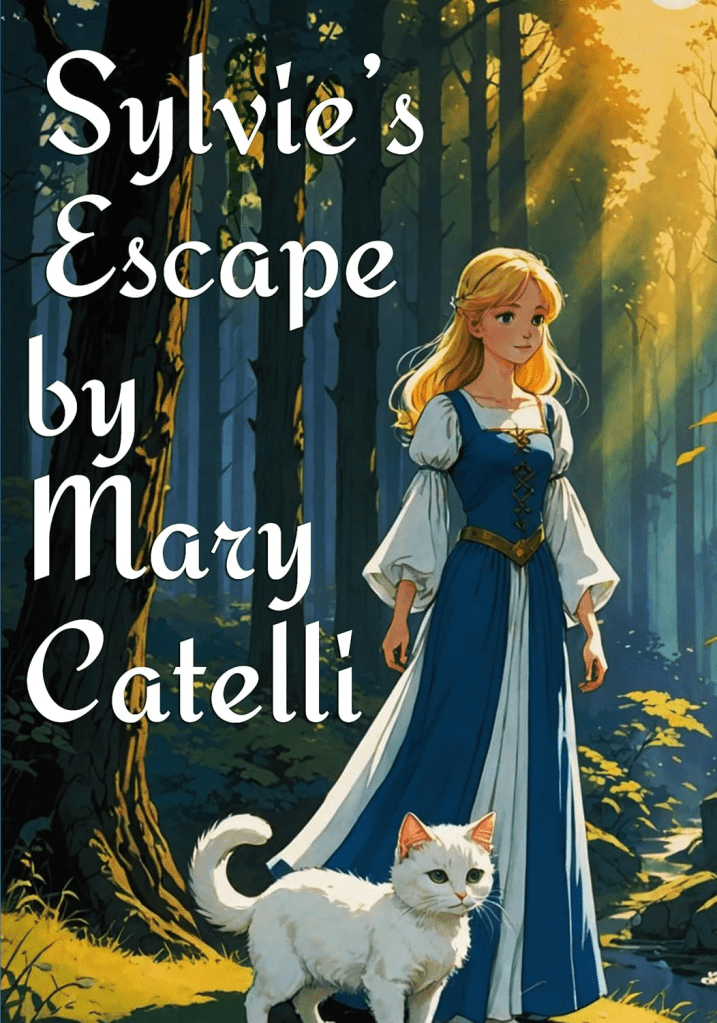
FROM MARY CATELLI: Sylvie’s Escape

Princess Sylvie’s parents sent her off to a mountain castle for her safety. There, she is greeted with a gift of a kitten. Not just any kitten, but one of the legendary Queen Angelique’s kittens.

When the kitten leads her into the forest, she follows, just avoiding capture as soldiers arrive to take the castle. She must flee and find refuge among the mountains and the mountain folk.

If she can.

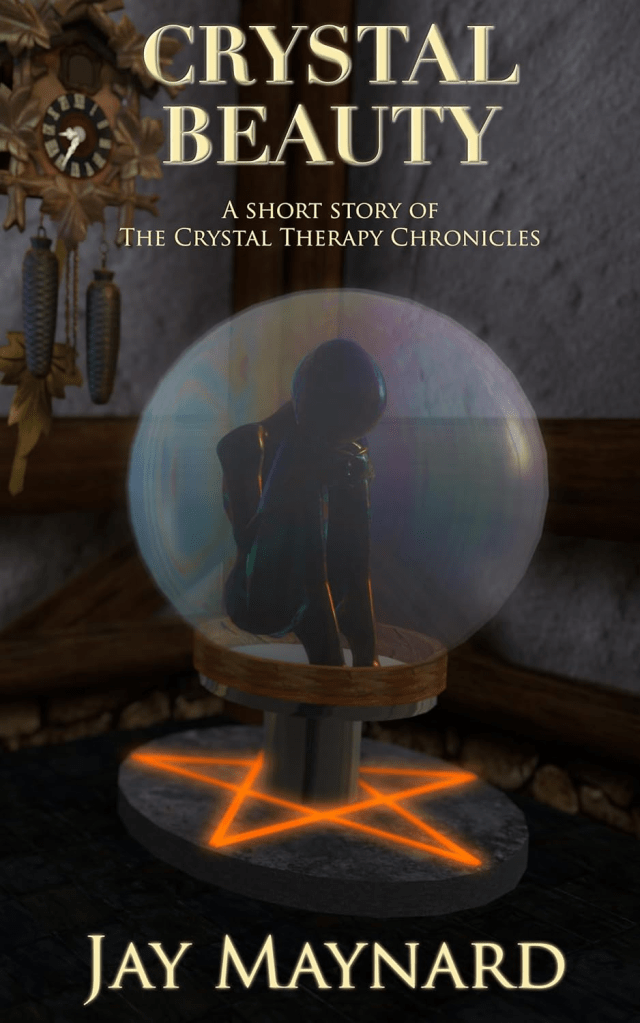
FROM JAY MAYNARD: Crystal Beauty (The Crystal Therapy Chronicles)

She was supposed to be treated.
Instead, she was abandoned.

Talia entered an experimental therapy hoping to heal a depression that nothing else could touch.

Instead, the sorcerer overseeing her treatment sealed her inside a crystal sphere—and left her there.

Unable to move.
Unable to hear.
Able only to see the wall before her.

While only three years pass in the outside world, Talia lives fifty years alone with her thoughts.

Now the truth has been discovered.

Sky 12, a guide from the Laminatrix Mental Hospital, enters the crystal to attempt the impossible: reach a mind shattered by decades of silence and rebuild it from the inside.

If he succeeds, Talia may reclaim her life.

If he fails, he will never leave the crystal either.

Inspired by Sleeping Beauty, Crystal Beauty is a quiet, haunting, and ultimately hopeful short story set in the world of The Crystal Therapy Chronicles, where even the deepest wounds may yet find healing.

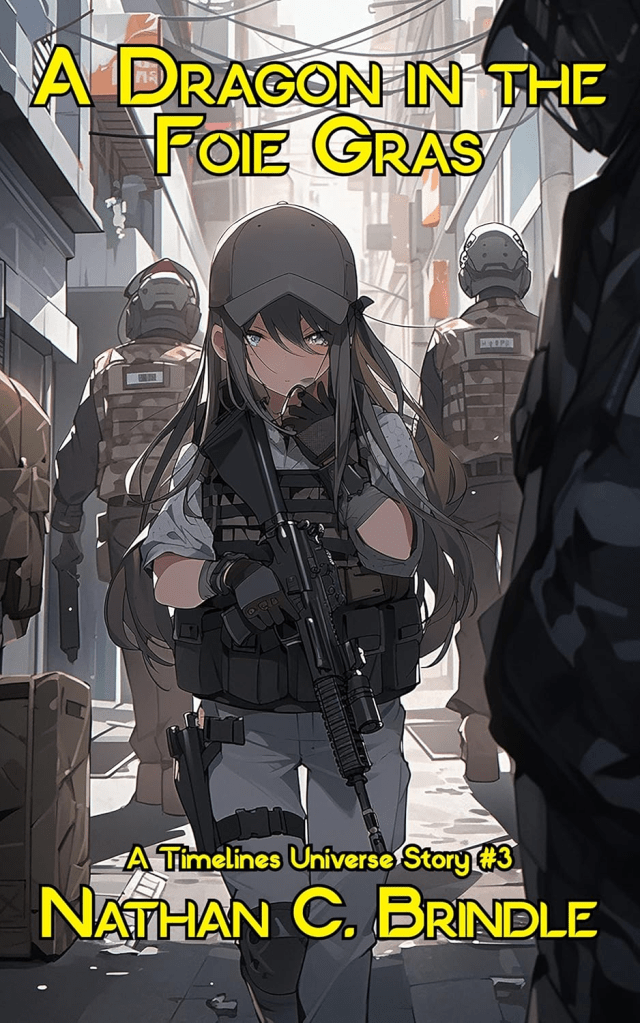
FROM NATHAN BRINDLE: A Dragon in the Foie Gras (Timelines Universe Book 3)

Captain Delaney Wolff Fox is back.

She’s just led her team on a months-long hunt through the penal world al-Saḥra’ (known otherwise by its semi-satirical name “Sanddoom”), looking for an industrial-sized illegal drug “kitchen” that’s been supplying colony worlds with various illegal substances via a network of involuntary migrant “mules”. That hunt ended satisfactorily, and rather explosively, with the destruction of the “kitchen” and hundreds if not thousands of personnel associated with it.

Now the team is heading back to Earth, hoping for some well-deserved shore leave . . .

. . . but it’s not to be. A long-sleeping foreign agent has been found in a stasis chamber in an abandoned Chicago warehouse, and it’s up to Delaney and crew to investigate the mystery, by traveling back to the year 2017 to find out why the agent was placed in stasis then, and why the stasis seems originally to have been planned to end in late 2020.

And when the sleeper wakes, asks for and consumes an entire pound of goose liver pâté, and asks for more, it’s pretty obvious they’ve got

A Dragon In The Foie Gras

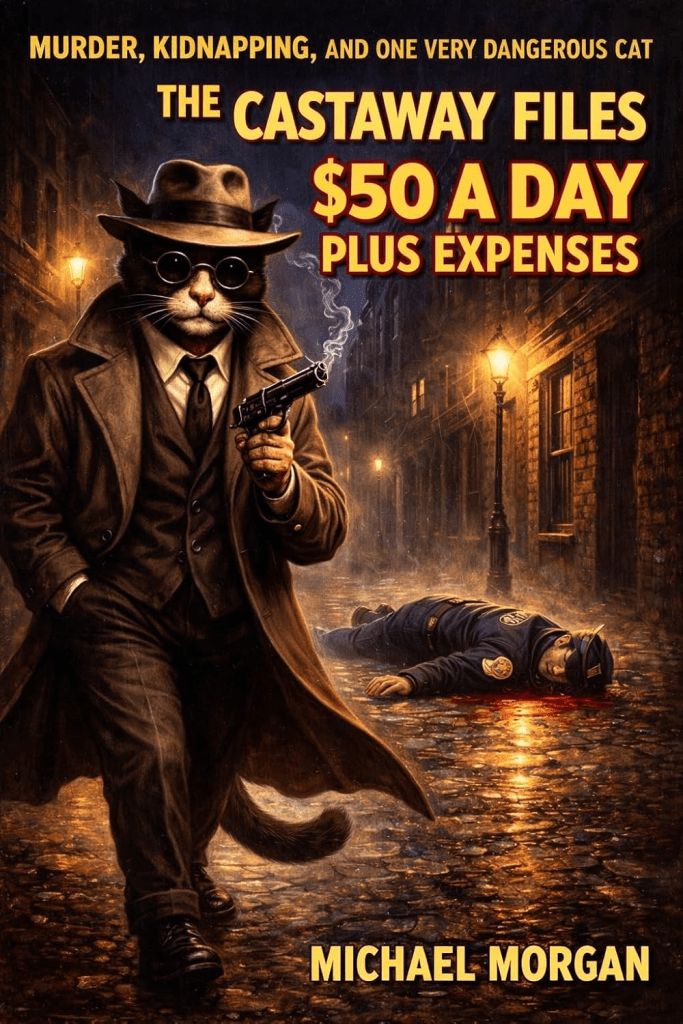
FROM MICHAEL MORGAN: The Castaway Files: $50 a Day Plus Expenses

In the shadows of the city, trouble always finds someone willing to take the case.

The Castaway Files: $50 a Day Plus Expenses gathers four gritty detective stories where the stakes are high, the streets are dangerous, and the truth rarely comes cheap.

• A retired cop investigating a mysterious death on his apartment stairs discovers that the missing instrument of a young cellist may be worth killing for.
• A group of kidnappers discovers that abducting a millionaire’s wife can lead to a payday—or a bloodbath.
• A former operative pulled back into the game hunts the people responsible for a brutal kidnapping, only to uncover a conspiracy that reaches far beyond the underworld.
• And in the city’s darkest alleys, a cat with too many toes and a trenchcoat goes looking for a cop killer—and finds a tragedy no one saw coming.

Hard-boiled, fast-moving, and full of dark humor, these stories carry on the tradition of classic pulp crime fiction while adding a few unexpected twists.

Because in the Castaway Files, every case begins the same way:

Someone is desperate.
Someone is dangerous.
And someone is willing to pay.

FROM JOHN BAILEY: Lunar Detectives: 12 Tales of 2040s Moon Bases (The Detective Stories)

In the 2040s, the Moon is no longer a distant dream but a bustling frontier of corporate ambition, where helium-3 mines fuel Earth’s energy hunger and rival bases—LunarCorp’s Alpha, Selene Industries’ Hub, and NovaTech’s Station—vie for dominance. Amid this tense lunar landscape, Lunar Detectives: 12 Tales of 2040s Moon Bases weaves twelve gripping mysteries, each a standalone tale of intrigue, sabotage, and human resilience. Led by Dr. Lena Voss, Raj Patel, and Aisha Khan—brilliant minds from geology, security, and logistics—these unlikely detectives unravel crimes that threaten the fragile lunar order. From a helium-3 heist to a sabotaged gravity array and a sprawling conspiracy named Dione, their investigations reveal a web of corporate greed, hidden networks, and secrets buried in lunar dust. Inspired by classic detective fiction, these stories blend wit, deduction, and heartfelt moments under the stark lunar sky, culminating in a battle to save the Moon from economic warfare. Perfect for fans of science fiction mysteries and intricate puzzles, this collection proves that even in the silent void, truth is worth pursuing.

FROM HOLLY CHISM: The Godshead (Modern Gods Book 1)

Food and drink for sale; snark for free…

It’s hard to be a god nobody believes in, sometimes. Especially when one spends their days trying to quietly go about his or her life in a world that barely remembers the myths surrounding the old Greek gods, but where some religions still follow the old Norse gods.

And some of the Norse gods are getting more dangerous: Loki, the trickster, has lost the last of what passed for his sanity, and needs to be helped, or stopped. One of the two. And no one seems to be up to it.

At least, not alone. Working together, they can avoid the worst of Loki’s tricks, and maybe even solve their problems.

A tale told from several points of view.

BY HENRY KUTTNER, REVIVED BY D. JASON FLEMING: Elak of Atlantis (Annotated): The complete classic sword & sorcery tales

Join Elak on perilous quests across the ancient world! These four classic sword-and-sorcery tales by the masterful Henry Kuttner take us to realms of wonder and terror.

Across the mystical landscapes of lost Atlantis, Elak faces down ferocious monsters, cunning foes, and alien magical arts. With his unmatched skill with a sword and unyielding will to survive, Elak battles to protect the innocent and vanquish evil in this action-packed collection.

With their unique blend of swashbuckling adventure, fantastical world-building, and Lovecraftian horror, Kuttner’s Elak tales have captivated fans of fantasy and science fiction for generations.

  • This iktaPOP Media edition includes a new introduction giving the stories genre and historical context.

FROM KAREN MYERS: Monsters, And More: A Science Fiction Short Story Bundle from There’s a Sword for That

A Science Fiction Story Bundle from the collection There’s a Sword for That

MONSTERS – Xenoarchaeologist Vartan has promised his young daughter Liza one of the many enigmatic lamedh objects that litter the site of a vanished alien civilization.

No one can figure out what they’re good for, but Liza finds a use for one.

ADAPTABILITY – The Webster Marble Deluxe Woodsman, Model 820-E, has been offline for quite some time. Quite some time indeed.

Good thing Webster has a manual to consult, and a great many special functions.

AND FROM SARAH HOYT, WHO REALLY IS GOING TO LEARN TO DO REALLY PUBLICITY THIS WEEK, SHE SWEARS*: No Man’s Land: Volume 1 (Chronicles of Lost Elly)

Sufficiently advanced science is indistinguishable from magic.

On a lost colony world, mad geneticists thought they could eliminate inequality by making everyone hermaphrodite. They were wrong. Catastrophically wrong.
Now technology indistinguishable from magic courses through the veins of the inhabitants, making their barbaric civilization survivable—and Publius Cornelius Scipio Africanus Kayel Hayden, Viscount Webson, Envoy of the Star Empire—Skip to his friends— has just crash-landed through a time-space rift into the middle of it all.
Dodging assassins and plummeting from high windows was just the beginning. With a desperate king and an archmagician as his only allies, Scipio must outrun death itself while battling beasts, traitors, and infiltrators bent on finishing what the founders started: total destruction.
Two worlds. One chance. No time to lose.

Volume 1
The Ambassador Corps has rules: you cannot know everything, don’t get horizontal with the natives, don’t make promises you can’t keep.
They’re a lot harder to follow when assassins are hunting you, your barbarian allies could kill you for the wrong word, and death lurks around every corner.
The unwritten rule? Never identify with the natives.
Skip’s already broken that one.
Now he’s racing against time to save his new friends from slavery—or worse—while dodging energy blasts and political intrigue. One crash-landed diplomat. A world of deadly secrets. And absolutely no backup.

Some rules are meant to be broken. Others will get you killed.

*Early, often, and in a bewildering profusion of languages. Sorry.

Vignettes by Luke, Mary Catelli and ‘Nother Mike.

So what’s a vignette? You might know them as flash fiction, or even just sketches. We will provide a prompt each Sunday that you can use directly (including it in your work) or just as an inspiration. You, in turn, will write about 50 words (yes, we are going for short shorts! Not even a Drabble 100 words, just half that!). Then post it! For an additional challenge, you can aim to make it exactly 50 words, if you like.

We recommend that if you have an original vignette, you post that as a new reply. If you are commenting on someone’s vignette, then post that as a reply to the vignette. Comments — this is writing practice, so comments should be aimed at helping someone be a better writer, not at crushing them. And since these are likely to be drafts, don’t jump up and down too hard on typos and grammar.

If you have questions, feel free to ask.

Your writing prompt this week is: Share