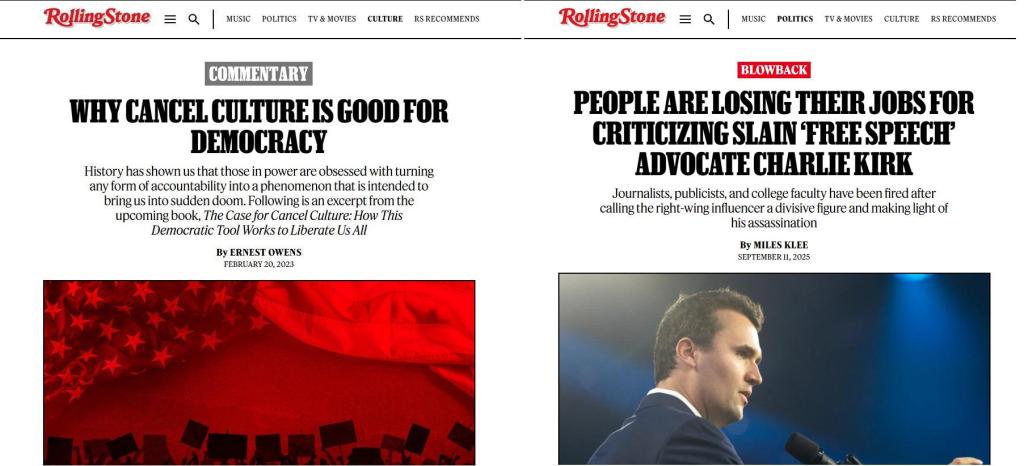
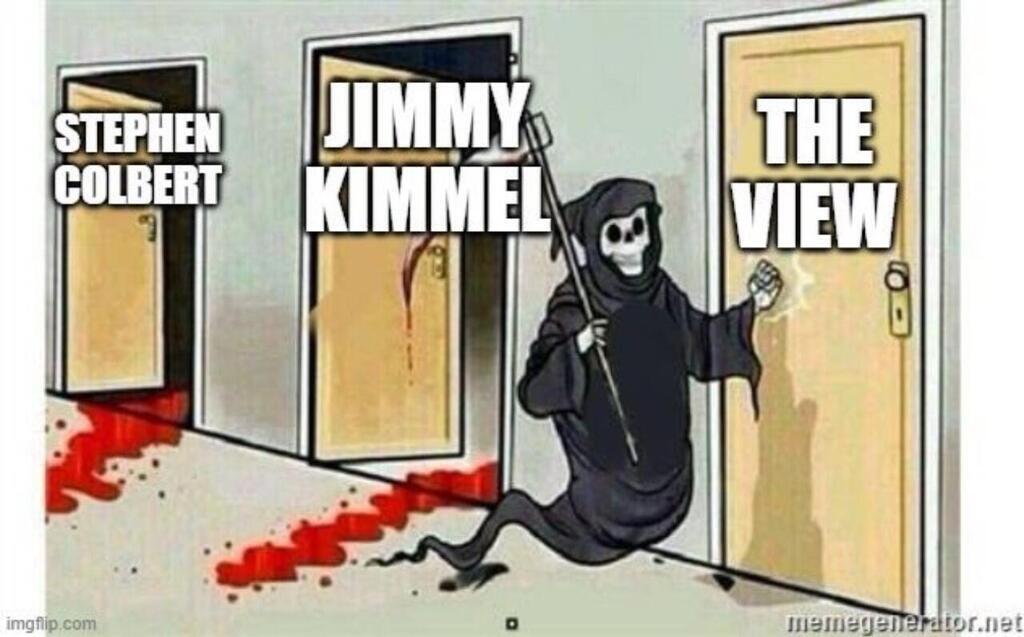
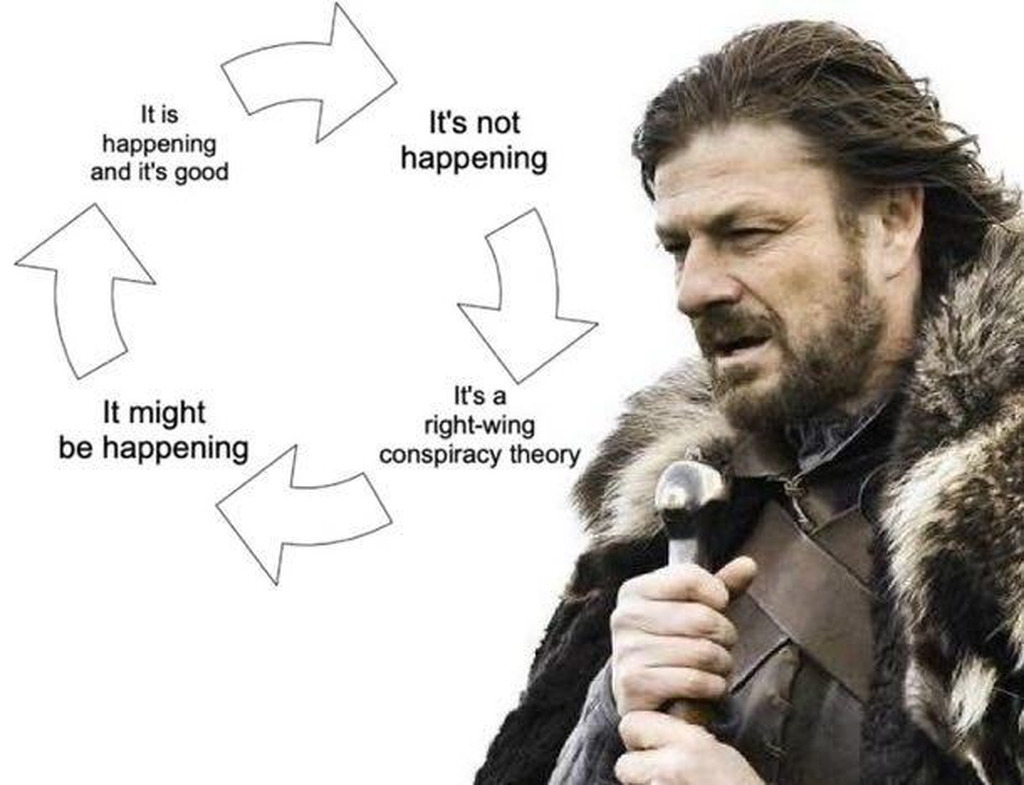
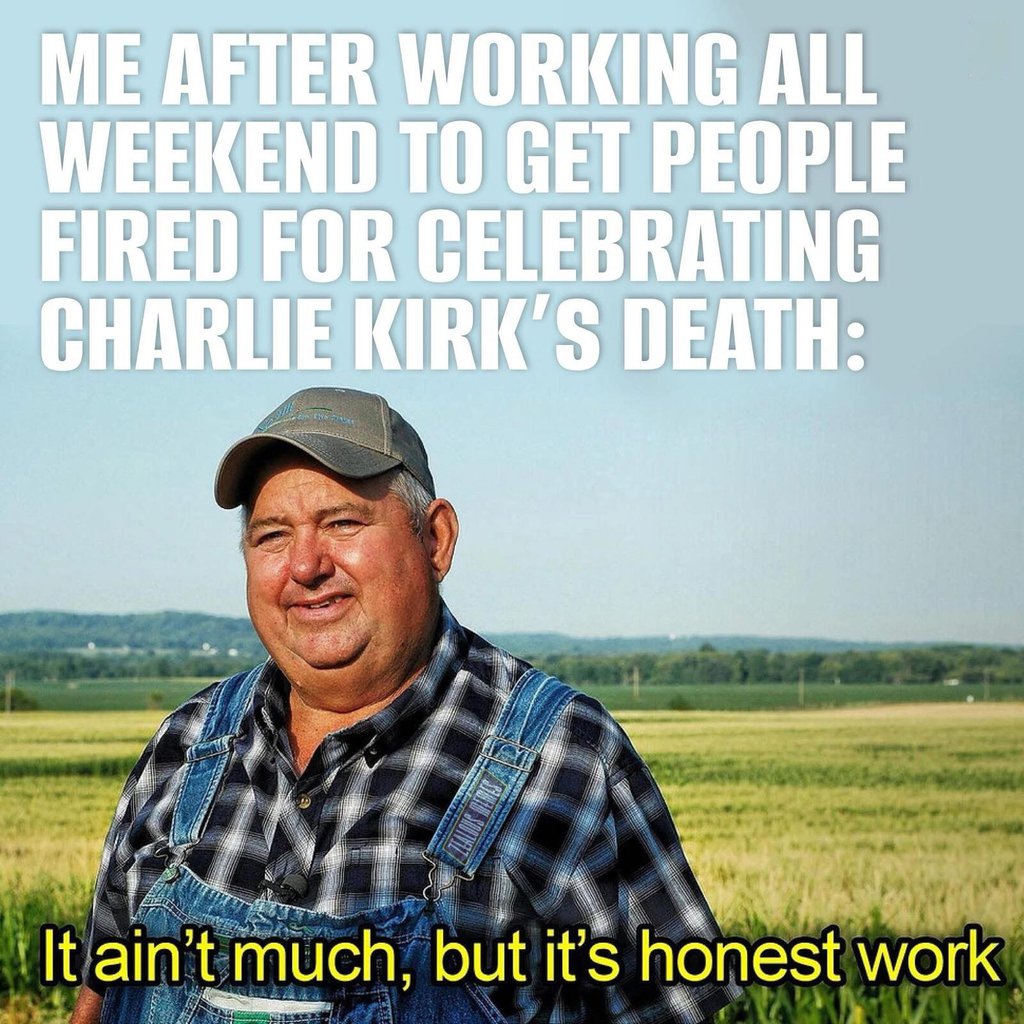
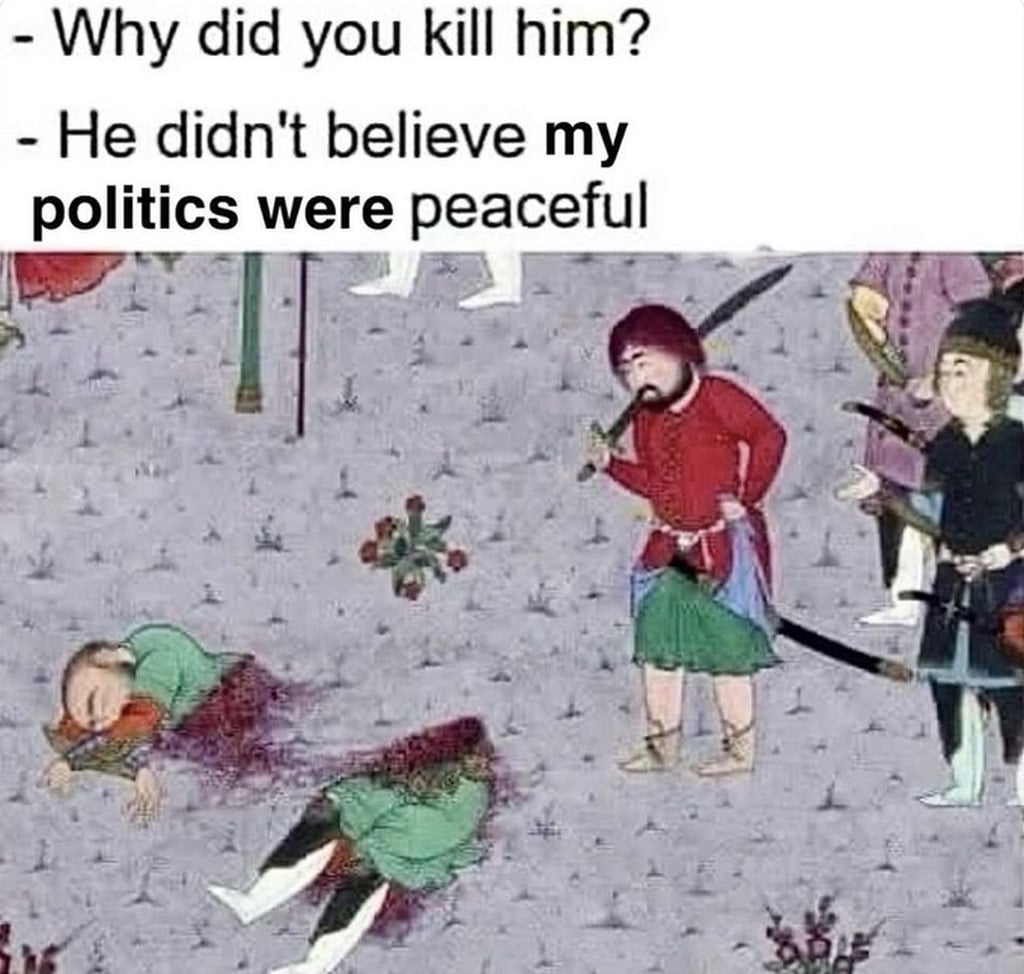
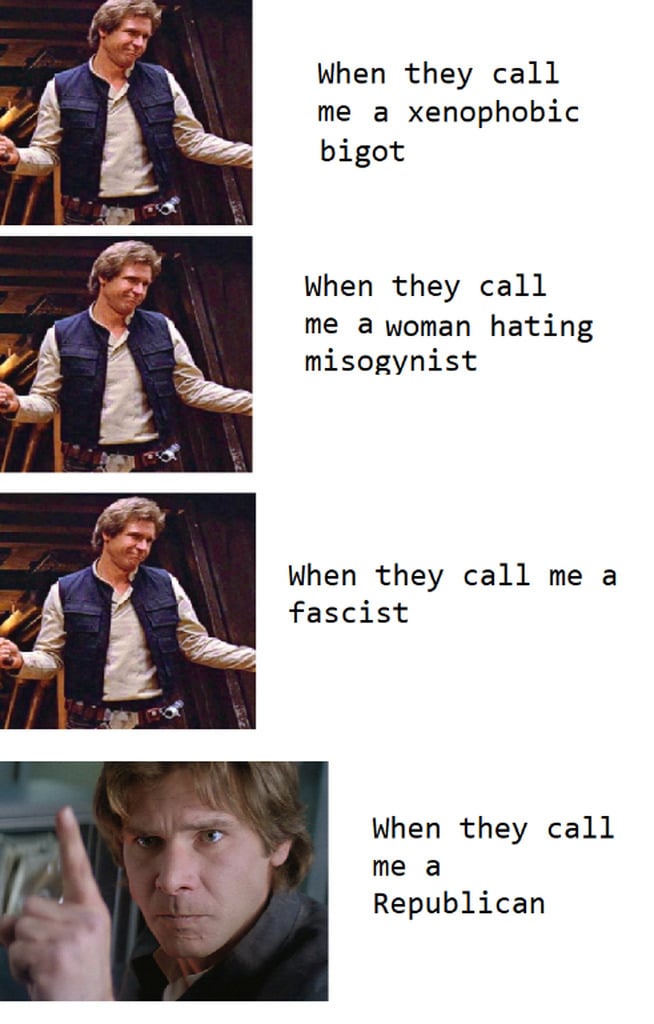
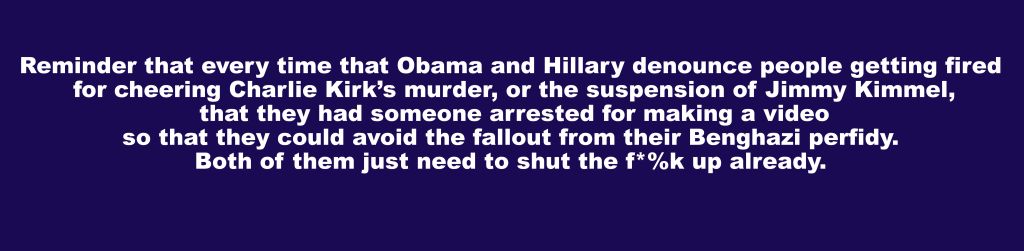
Before you freak out, not I’m not doing a “both sides” thing and I’ll confess to more than a bit of glee at seeing Kimmel banished to the outer darkness where there will be gnashing of teeth and pathetic walking around the streets trying to get passerbyes to agree with him. Okay, fine, that’s Don le Lemon, but still. (But he was intending to retire. Yeah, yeah, more on that later.)
But–
Yes, I do know he outright lied, and that his shtick as a comedian is the same clown nose on, clown nose off we’ve known from Colbert and other such unfunny clowns. And I do know as well that he wasn’t fired due to government pressure.
Look, yes, Trump tweeted (Truthsocialed is so cumbersome) about how he should be fired. Yes, it might have caused it, but if so it’s not Trump’s fault but Biden’s (more on that later, too) and I don’t buy it anyway because Trump tweets the most absurd stuff and the most sensible stuff too, and the left does remarkably well at ignoring all of it.
Mostly the reason for the firing seems to be a revolt of the affiliates, which frankly is overdue IF they want to save their business (and might be too late.)
Still, I will confess it made me uncomfortable — even while gleeful — at the level of an itch in the back brain, so I’m trying to reason through it.
And part of the reason I have not to be overly disturbed by the Kimmel firing, besides the fact it wasn’t government ordered — as the silencings, firings, etc. under Biden. Remember the attempts to create a Ministry of Truth? — is that I don’t think it’s a market distortion so much as an overdue market correction.
Okay, fasten your seatbelts because this involves my explaining that I view pretty much EVERYTHING (except religion and family and love of country, maybe, though I could argue for those too) as an economic/market problem.
Most issues in society today, for instance, are caused by imposed top-down market distortions. And don’t get me started on that, or we’ll never talk about this specific issue again. But if you want to wind up the Sarah and watch her go, I can do another post (couple three of them) later.
But for our information market — from entertainment media to news media, to everything else, including education — from which people derive their view of the world, the case for market distortions is trivially easy to make.
Or maybe it is so only because I lived in the belly of that beast for so long.
I got so tired in the oughts of seeing people talking about how conservatives abandoned the market, yadda yadda yadda and coming up with all kinds of pseudo psychological just-so stories for why conservatives weren’t going into teaching, writing, journalism, art, etc etc etc. I mean people ON THE RIGHT came up with all sorts of reasons, from “Conservatives are more money oriented.” (Bullshit. Like. Total bullshit. I’ve never seen anyone as money oriented and grasping as a devoted communist.) To “Oh, conservatives are more concrete thinkers and want to work on things more easily quantifiable.”
All of this was utter nonsense on stilts. And every time I tried to explain people on our own side argued with me. EVERY TIME. Because what I said seemed soooo improbable to them.
You see, it’s nonsense to look for pseudo-psychological explanations for a field being totally dominated by one political side. There is no explanation in that case except market manipulation.
Okay, I’ll cop to our side having more autists and their side seeming to have more psychopaths. There are reasons for this, and they aren’t integral to the people. They are because their side has been a “social positioning good” for so long that psychopaths will latch on to it. And our side therefore collecting the people for whom social anything, not alone positioning, is a mystery. BUT the truth is that this is on the margins. maybe we have 10% more autists than they do and they have 10% more psychopaths than we do. But I’d be frankly surprised if it’s event hat start. It’s mostly marginal adjustments.
Mostly people are people. And just because “capitalism” (aka the free market pro freedom side) has more quantifiable benefits, it doesn’t mean it won’t attract any number of shiftless artists (raises hand and self identifies) even those who aren’t artists because they were promised it involved no math (they lied!) but those too.
Again, I’d buy a minor distribution difference on the margins, for psychological reasons. But the total dominance of entire fields by the left is evidence of one thing and one thing ONLY: market manipulation.
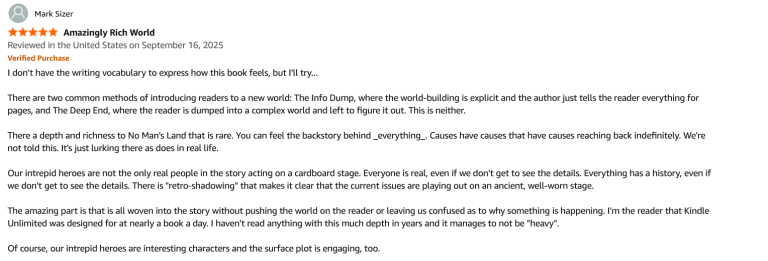
I’ve been the voice screaming in the desert so long that it’s always a surprise to see someone come up and corroborate it. What this lost soul is doing trying to break into trad pub in this day and age is a quandry, but the story she tells? Same, same. And bad news for her, it only gets worse. Both in terms of being discriminated against, and being held back and…. all of it. At this point trad pub will deliberately hobble you on telling a story that doesn’t accord with the woke shibboleths. And if you manage to find a publisher that takes it, the bookstores will play games with your books. And–
And it’s like that all over. For about a century now, not only is everyone to the right of Lenin discriminated against in broadcasting, news, entertainment (of which writing is broadly a part) and education, but the level and amount of distortion undertaken to keep people to the right of Lenin from succeeding in these fields while propping up the most absurd mediocrities of the left is– breathtaking. And usually locked in people’s heads, and people might doubt it themselves, even when it happens to them.
Let me explain: I say “a great part I was stuck in mid list was because of shenanigans” I sound incompetent and resentful both. Even though I know it’s not true, I only know it’s not true that I’m making this stuff up because during the hard times I did a bunch of write for hire. And the most off-the-cuff, just-writing-this-because-kids-need-winter-coats books made other people’s careers. Or shot to the top and stayed there.
Now you could say “maybe the stuff you labor over is not as good.” Fair call, as coffs many such cases. BUT contra that, a lot of my books are also the most off-the-cuff, just-writing-this-because-kids-need-winter-coats books and none of them described that trajectory. (Why would I write those? Well, in trad pub you write what the gatekeepers will buy. Because baby needs shoes. And if you think the years I wrote six, ten, or twelve books all of them were labors of love, I have a bridge to sell you cheap. It kept us above water but it was sometimes brutal. (And if you’re going to say indies do those numbers all the time, cool story bro. Now try doing them on someone else’s schedule, with tons of interruptions thrown in by the process itself (revisions on someone else’s time, for ex) and these books being 120k words plus. And on ideas you might have submitted 10 years before and not only aren’t interested in now, but need to do all the research on again. And note I’m not complaining about that. Publishing is a business. The needs of the company paying you are…. the market under that scenario.))
And I still feel uncomfortable complaining. Other people? Much much more so. They (probably) most of them don’t have even that kind of internal proof.
When they tell you “No one likes you and you don’t sell” you shut up and go away. What else can you do?
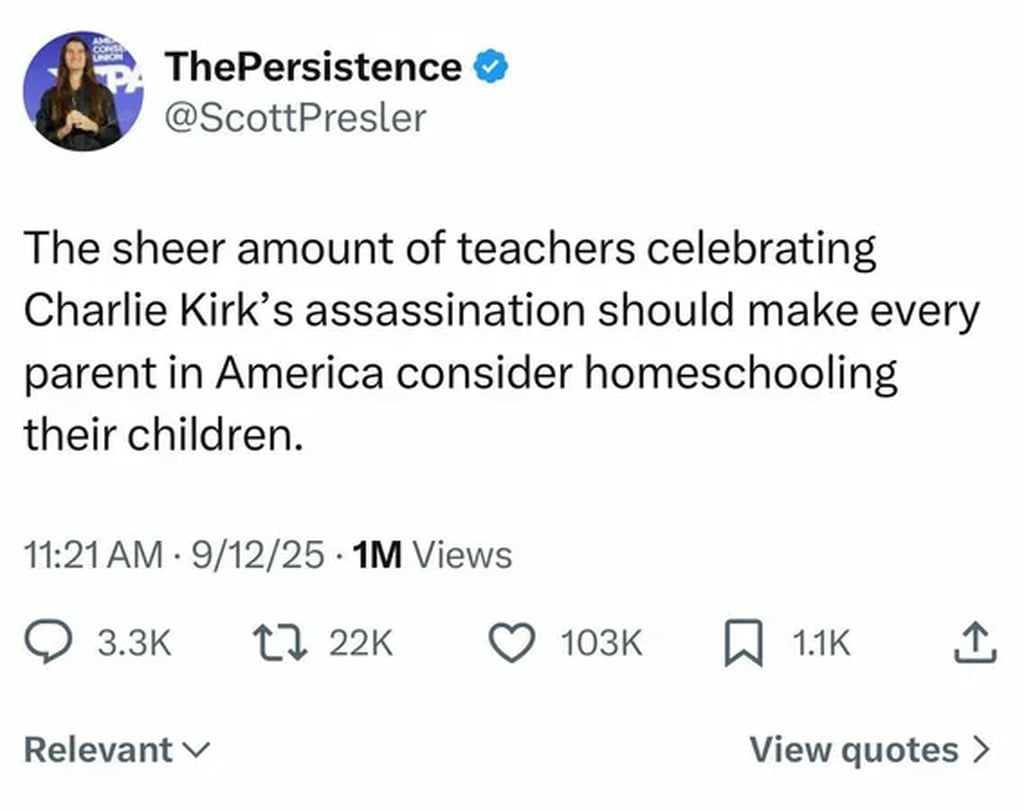
I don’t know if it’s the same mechanics for teachers, but I imagine just the opinion of the teachers’ lounge might break you. On top of which I find it curious that more than one right of Lenin would-be teacher seems to have given it up when they got their student teaching assignment in schools dangerous to life and limb. It makes me wonder if the same prospiracy (not a conspiracy. That would be easy to nail) type of thing made sure those they weren’t sure were fully onboard with their insanity got the worst assignments.
And that’s part of the problem. The thing that kept the right out of these professions wasn’t a conspiracy. That would have track records and evidence. It was a prospiracy of like-minded fellow travelers helping each other. In publishing the code was “is one of the good people.” In other fields? I don’t know. (And I only caught that by accident, btw.) And how much of this was honest prospiracy and how much the cells of three of typical communist org, only the Good Lord knows at this point.
But it doesn’t take much reading of past publishers and journalists bios from the early twentieth century to see it in action. And they were naive enough to BRAG about it. About how they kept right wingers, therefore obviously evil and stupid, out of the field.
At the same time they were giving plum assignments, pushing, etc. people with not a yota of talent but singing in the choir.
Which is how we get to Jimmy Kimmel, a largely talentless unfunny comedian, who had a golden ride to success due to his willingness to tell any lie, smear anyone, etc. etc. (Not all deals with the devil are a contract signed at a crossroads at midnight.)
Note I’m shedding no tears for him. And while firing a journalist for lying does make me uncomfortable (much less a comedian) since it’s a grand tradition of the profession — and then again, who is to say what’s a lie? (Yes, I know it is a lie that T. Robinson is MAGA, but hear me out.) Are we going to start our own disinformation department? — at the same time, in the face of a thoroughly corrupted market, any corrections are going to look like violations.
You see, a corrupted market functions to keep itself in business more than anything. Just because their people suck, doesn’t mean you can outsell them, because the market is vitiated to protect them. Whether what they’re selling is bad information, corrupted medical studies, or lumpy pottery that comes apart in the dishwasher. Corrupted is corrupted and self-protecting.
So to correct the Chinese corrupt market dominance, tariffs might be needed to encourage companies to stop outsourcing.
And to correct the corrupt and monolithic information monopoly, the affiliates might need to put the fear of them into the station.
That’s the only way to do it, short of it crashing utterly first, and some things — like say our market of medicinal production, or news — we can’t afford to have crash utterly for national security and sanity reasons.
However it does feel like a violation. It is a violation. I mean, fish got to swim, some jornos will lie. If you stop a fish swimming, you can at least eat them, but stop some jornos from lying and you’re interfering with their ability to make a living. (And I’d never advise eating them. Don’t put that in your mouth. you know exactly where it’s been.)
So? We still have to break the monolith. Oh, and btw, that “he was going to retire” (I told you we’d come back to it) might be true or not, but it’s irrelevant in the end. These people never fully retire. There’s sinecures, accolades and teaching and– This scalp collecting was real. We won’t let his hoary head decline peacefully into the grave. Much delayed justice, etc–
…. Here’s the thing… Normally at this point I give a pallid scolding along the lines of “We don’t want to do what they did. We don’t want to shut out all other opinions till we’re as useless and stupid as the left which is unable to course correct and at this point completely unable to figure out what things mean. What things? Oh “hate” for one.”
Whoever said that faced with any pushback, the left goes down like a tribe that never met smallpox is correct. They isolated themselves so much that at this point they don’t even realize the things they’re doing and saying aren’t defensible.
But normally when I offer that, I’m mostly doing it in the hopes that someone 100 years on somehow finds this and takes note. Because, you know, fighting such an entrenched establishment takes time, and we’re certainly at no risk completely dominating everything to the point we become useless.
…. Maybe? I mean, that was my absolute certainty until last week.
Looks around.
Guys, it might be you need to remember that. Do not ossify into tolerating no dissent at all. And while it might be needed for a little while — Lord, you have no idea how this bothers the libertarian — to shut the worst of the left out of these professions (tbf the worst of the left is very bad at their jobs too. The job is never the thing. The revolution is the thing) remember that when you hire for any reason but competence you always degrade competence. There is no way around that. And we’re already in a crisis of competence because of the left’s insanity.
So while you’re prying Jimmy Kimmel out of the fortified tent that keeps us out — and the others too. So many others — don’t forget that our aim is not simply to reverse positions.
In the end the free market is best, be it in the flow of goods or in information. Which means we need to make this phase as short and thorough as possible, and break down the walls quickly, and oh, get rid of the old managers, no matter how much they say they’re now on our side. They only know one way to operate and they’ll be just as bad under the new regime. (See USSR’s heads becoming oligarchs and mob bosses.)
And then we need to go back to, in the measure of the possible, trusting the public (which won’t be trained into half a dozen “valid” sources, which a lot of the older and much younger population still is.) to find their way amid truth and lies.
Freedom must be our watchword and our ultimate aim.
And not having to give a damn what political opinions your writer of bubble gum fiction holds is a consummation devoutly to be hoped for.
After the tsunami.
Make sure you remember. Because in the meantime, it’s going to get ugly. And there’s nothing we can do to stop that. Market corrections are always ugly, even when not physically violent. This one will not be an exception.
Buckle up and hold on tight. Things are about to get choppy.