Encroachments of Power -Cedar Sanderson


Encroachments of Power -Cedar Sanderson


About two hundred years ago, a British jurist named Albert Venn Dicey coined the phrase the Rule of Law. The idea behind the phrase extends back as far as written history, however, with the tablets of Hammurabi that laid out the laws of a long-vanished society, and the even older Code of Ur-Nammu (Kramer). The Rule of Law holds that not only one person ought to be obedient to the laws as recorded, but the governing body must be equally constrained. The opposite side of the Law is Man, capricious and vindictive. “The law – and its meaning – must be fixed and publically known in advance of application, so that those applying the law, as much as those to whom it is applied, can be bound by it. If courts (or the officials of any other institution) could make law in the guise of applying it, we would have the very ‘rule of men’ with which the Rule of Law is supposed to contrast.” (Fallon)

The Rule of Law means different things taken in different contexts. Applied to a single individual, it is usually taken to mean adherence to the written laws of the nation where that person is in residence. Applied to governments, it can be taken to mean the codex of laws recorded, enforced consistently and without capricious punishments handed down outside of those laws. Public officials, despite being elected or appointed, are not to be above the rule of law, even while they guide and refine it.

The Founding Fathers of the United States attempted to anticipate the need for a rule according to law in the new nation they struggled for. Alexander Hamilton wrote “how easy it is for men to change their principles with their situations; to be zealous advocates for the rights of the citizens when they are invaded by others; and, as soon as they have it in their power, to become the invaders themselves; to resist the encroachments of power, when it is in the hands of others; and, the moment they get it into their own, to make bolder strides than those they have resisted.” Our government, far from being a monolithic machine, is made up of just such people, and the rule of law is what must remain in place to prevent them from seizing power in some petty tyranny.

Governments around the globe in modern times display varying adherence to the Rule of Law. In some places, lip service is paid without reality reflecting what is said. China recently proclaimed “fairness is the lifeline of the rule of law.” However, external observers and activists reject that statement, “like a rooster dreaming that he can lay eggs, the basic political system is incompatible with rule of law, they mainly want to use the law to control society and control the public,” Teng Biao, a prominent rights lawyer, wrote this week. Currently in Hong Kong, a pro-democracy movement called the Umbrella Movement is testing the limits of that rule of law in China, and finding that it is fading in the once independent city.

Zimbabwe and its fall from the Rule of Law to the Rule of Man is a perfect example of why the ideal of the Rule of Law is a worthy one to strive for. In 1999 it was reported “Mugabe has arrested, jailed and tortured journalists, imposed bans on the media, outlawed strikes and “stay-aways” and allowed the military and the Central Intelligence Organisation (CIO) to arrest and detain civilians. He has openly flouted court orders and challenged judges to resign.” In the fifteen years since then, an estimated 30,000 deaths have occurred under his genocidal regime.

On an organizational level, the Rule of Law means not only obedience of the laws in place, but protection from infringement of the individual’s rights by the organizations that impose and enforce those laws. Police, for instance, are intended to be a force for good, “Cops and liberties are not zero-sum rivals; a strong and effective police force is not a corrupt or abusive police force; good street policing does not oppress and brutalize.” Here in the United States, the core principles of the Bill of Rights are intended to give every person an equal chance before the law, something that has been refined, battled, and re-discovered many times since the ink was wet on that document.

Policing seems to be a central point of a growing concern here in the United States. Laws, loosely adapted to suit the purposes of those organizations which once proclaimed an intent to protect and serve are now turned against that very citizenry, often if no intent or crime exists. Seizure of assets, originally intended to work under the Rule of Law to threaten drug dealers, is now seen as a ‘revenue stream’ for “A thriving subculture of road officers on the network now competes to see who can seize the most cash and contraband, describing their exploits in the network’s chat rooms and sharing “trophy shots” of money and drugs. Some police advocate highway interdiction as a way of raising revenue for cash-strapped municipalities.”

The police are not alone in this tactic of seizing money for no good reason. “The Internal Revenue Service agents did not accuse Ms. Hinders of money laundering or cheating on her taxes — in fact, she has not been charged with any crime. Instead, the money was seized solely because she had deposited less than $10,000 at a time, which they viewed as an attempt to avoid triggering a required government report.” The NY Times goes on in this article to enumerate other instances, and the frightening fact is that there is no Rule of Law that can stop the IRS, it seems. Rule of Man holds sway in what is possibly the most draconian of government bureaucracies. Not a tyranny of a single dictator, but that of thousands of petty tyrants, pecking the nation to death in their pursuit of power.

For each individual, living under the Rule of Law ought to mean trust and security, and when the authorities fail as sometimes happens, recourse to not only make it right for that single person, but to safeguard others, and to mend the broken trust before it threatens to decay into the Rule of Man. The United States government was designed with checks and balances between the three branches for good reason, to prevent the tyranny of a single man at the apex of the pyramid proclaiming that he holds the pen that dictates the Rule of Law.

Taking the Centipede for a Walk in the Dreamtime

Yes, I’m still stuck with Through Fire. These things are sent to try us. Actually the book is turning unholy complex and no, don’t worry about it, it’s not complex on the surface.

Lately I’ve been writing these short stories – and I think the same is happening to this book – where there is layer upon layer of build, done so subtly that until the end upends everything you thought you knew about the world and the people, you don’t realize it’s all there.

This is not on purpose. In fact, most of it seems to be coming from the deep subconscious and surprise me. Maybe it’s the direction in which my writing is going, in which case it’s worrisome, because I could starve this way. My normal rate for a short story is two hours but the last one took me three days of work.

Or perhaps it’s just because this – I don’t know what to call it. It’s not a technique because I’m not consciously building it. So what is it? A…frame of mind, would be the easiest way to put it.

Even those of you who are not writers might have gone through this in real life. In real life it’s usually traumatic and severing of all you were to the point people wonder if you had a change of personality.

I’ve observed it in people following the death of the person they live with: parent, child or spouse, all alike; after the birth of a child; after the loss of a child; after falling in love; after moving to another country or even another city; after accomplishing something or failing to accomplish something that they’ve been working for a long time.

If Tedd Roberts comes by, he might be able to explain this better but the way I always understood it is this “In reply to unbearable emotional and cognitive disjointing, the brain rewires itself.” Piaget used a form of this to explain how children become adollescents and adollescents adults. (There’s more than that, in his case, since he’s talking about a brain that’s changing anyway, but the rewiring occurs in response to extreme and unbearable pressures, I remember that.)

Some of these re-wirings take years and you don’t see it on the surface, not unless these are people you are in the habit of having long philosophical discussions with and sometimes not even then. But when they emerge, it’s like you’re talking to a whole new person. (Sometimes worse.)

This is because you’re talking to a whole new person. Their brain is not wired the way it was supposed to be, the way you knew.

This is one of the reasons, btw, that I am against psychological mollycoddling of young people. Yeah, okay, some people had genuinely horrible experiences that happened to THEM personally, not to someone else and they have PTSD (you don’t have PTSD on another’s behalf) and that means that you shouldn’t be cruel to them by bringing up things that will hurt them to no purpose. BUT what we’re seeing is people demanding accommodation for what I’d call “preemptive trauma.” People who demand someone be removed from a con because he MIGHT say something. Or people who demand you give them notice before mentioning small holes or spiders. People who call you a hater because you disagree on them in some fine point, like the person who branded me homophobic and transphobic when I said humans come in two differently wired brain forms (with a lot of variation and cross over, but basically two distinct forms) created by hormone baths in-utero and beyond our volition or our will.

We’ll take that last person as to why people shouldn’t be mollycoddled. Of course I was not implying the non-existence of homosexuals or trans people. In fact, when I was growing up the theory was that they’d got the “wrong” baths in utero. Now it is that certain trigger genes got flipped or not according to factors we don’t quite get, because it seems to be a complex of genes rather than a single one. Epigenetics. Don’t get my older son talking about it, he will talk for hours.

Anyway, what I mean by this, to bring it back to point, is that I think that last person has cognitive dissonance between her chosen narrative “Men and women’s brains are exactly alike” AND her acceptance of gay and transsexual people because after all if the difference is all in the plumbing, what’s the big fuss about? And it could be trained out of it, right? So, my post send her over the edge, and maybe at some point she’ll have an epistemological breakthrough and be a “whole other person” and maybe a better one (though there’s no guarantee of this.)

This is the only way I know of that people grow – unbearable pressure, forcing them to reexamine the way they’ve been doing things.

This ties into writing because writing is supposed to engineer a lot of these cathartic breaks.

I’ve said before it is stupid for a writer to think he or she works in language. The medium we actually work in is emotion.

And it seems to be the way writers grow, too. The inherent pressures between our subconscious trying to express itself through our sane and rational (shuddup you) brain, eventually causes a break: a break with old style, a break with who you were.

You can see this in almost every notable writer.

Early Terry Pratchett is not the same as medium Terry Pratchett and certainly not late Terry Pratchett. It’s all incremental and slow, but there is a break there. With Heinlein it’s more notable. Reading his work in order once I could (once I came to the US) I noticed the glimmers of “real Heinlein” around Double Star. That again evolved into Late Heinlein (and yes, I know ya’ll’s opinions. Don’t want them. Other than some odd linguistic sources I like Late Heinlein. Note I’m not saying I agree with a lot of it – don’t agree with a bunch of details in early, or middle, either – but that’s not required to admire someone or enjoy his/her writing.

There are mini ones of these, what I call the “learning to walk again” or “another step on the ladder” that are attributable to learning craft. You look back, everything you ever wrote seems like crap and you want to write it better now you know better.

The thing is that this feels more like a huge, seismic one. It’s not craft. In fact, it’s like I’m relearning the craft to express the new mind set. It’s more like I’m… in a different frame of mind.

My opinions didn’t change, or my sense of self, just the feeling of what I am and how to express it in writing.

I’ve already been told by Kate that Through Fire is full of deep-laid high-depth bombs. Of course, being Kate, she expressed this as “I hope you can tie it all at the end.”. That doesn’t worry me. I know I can. Or rather, if the short stories are any indication, it will tie itself.

It’s more the feeling that I’m learning the craft to express something that is coming from the deep subconscious and that won’t let me know what it is till I write it.

The d*mn centipede is learning to walk. Again.

Have You Seen the Well To Do?

A friend sent me the following, yesterday and I liked it so much I stuck it at the end of the Friday Bookplug, which, btw, is here.  It sort of fits if you squint.

What it does fit is the modus operandi of the SJWs with their continuous whine and claims of being discriminated against and suffering micro-agressions.

Robbing the Midlist
Have you seen the well to do?
Walking down Marx avenue
Crying that everything’s unfair
While their butlers do their hair
High-toned, caterwaulers
Condoned with lots of dollars
Spending every dime
Made on other guy’s lines!

If you’re blue, and you want dough
Why not lean on someone you know
In the pubbing biz?
Robbing the midlist

Different types will write a dystop-
ian cliché or bash on the pope
It all fits
When you’re robbing the midlist

Cashing in their six-figure advances
Even if their book has got no chances
Of a profit

Come let’s mix where pampered authors
Politic to get job offers
Hope they’re picked
For robbing the midlist

Tips the scales to favor their own voices
Tries to “Push” to cover their bad choices
Disappoint us

NYT Bestsellers topping the list
Make readers stop or numb their wits
Robbing the midlist
Robbing the midlist
Robbing the midlist!

I’ll point out that Baen’s NYT bestsellers are genuine.  The others… (waggles hand.) And my friend is exactly right that it’s all in displaying the right (left) colors.  As for robing the midlist — well, some day over some wine I can show you statements where the print run changed over time…  Yeah. (And btw Baen beating them by playing fair at their rigged game is a “yay” — no wonder they hate Baen.)

As for why these people who are on top, who are “power” think they’re speaking “truth to power” and keep trying to push the envelope with little orphan Annie short stories on how the minority they belong to is soooo discriminated against, I direct you to this article at Powerline:

Rob Stein is the founder of the Democracy Alliance, an umbrella a group that organizes the funding of left-wing causes by rich liberals and interest groups. In The Blueprint: How the Democrats Won Colorado by Adam Schrager and Rob Witwer, at page 7, Stein explains candidly what politics is all about for the Left:

“The reason it is so important to control government is because government is the source of enormous power,” Stein continued. “One president in this country, when he or she takes office, appoints…5,000 people to run a bureaucracy, nonmilitary nonpostal service of 2 million people, who hire 10 million outside outsource contractors–a workforce of 12 million people–that spends $3 trillion a year. That number is larger than the gross domestic product of all but four countries on the face of the earth.”

“So the reason we’re doing what we’re doing…and the way we get progressive change, is to control government,” Stein said. “That’s what this is about.”

This will to power explains why the Left, a clear minority among Americans, consistently punches above its weight, politically.

Read the whole thing.  A stunning admission.

And it is the same in publishing.  Not, mind you, that publishing has the kind of power or money that government does.  But it has enough.  And the multinationals run by Europeans like the idea that they’re helping enlighten those backward Americans (who man on man and woman on woman are far less racist, sexist or culture-supremacist than ANY European you’d care to name.)  For that they pick editors indoctrinated educated at our “best” (europhile) colleges.

The hierarchy of publishing is so steeped in Marx that parroting Marx is the way to gain access to money and power.  Whining about Marxist class/race oppression is the way to be fawned upon.

And while publishing doesn’t have the money government does, it has enough.

Of course all this produces very bland and same-old, same-old literature.  Perhaps I tired of it earlier because I had already had my full dose of Marx.  But even in SF/F Social Justice Warriors are best known for making people stop reading the stuff.

The precipitous decline in print runs from the seventies till now tells its own tale.

When they whine about Amazon, they have only themselves to blame.  They left a vacuum of unmet demand and indie publishing found it.

Now, I’m not a gamer.  I am strictly a reader and a writer.  I don’t even watch much TV.  BUT years ago, I can’t remember why — it must have involved being confined in one of their rooms while something was done to the rest of the house — I watched my boys play a game and I thought “That’s where fun, adventure science fiction, space opera, military SF, the stuff people read to enjoy and not to be lectured has gone.”

Which explains everything about what is going on in games, now.  They want to close off that avenue of escape and stop people having fun their way.

It’s not event hat your having fun annoys them — though since they’re sourpusses that tends to be part of it — but that the big money, now that printruns have crashed, has moved to gaming.

They want to be able to command the kind of money from gaming, for their regurgitated Marx, that they once commanded from publishing.

The social justice warriors are about two things, none of which are social nor justice: money and power.

They will follow the money and they’ll do anything to get some of that sweet power and money without having to have a single original thought or do a serious day work.

I’m glad to see that in gaming they might have met their match.

Have you seen the well to do?
Walking down Marx avenue
Crying that everything’s unfair
While their butlers do their hair
High-toned, caterwaulers
Condoned with lots of dollars
Spending every dime……..


They’re Baaaaaack

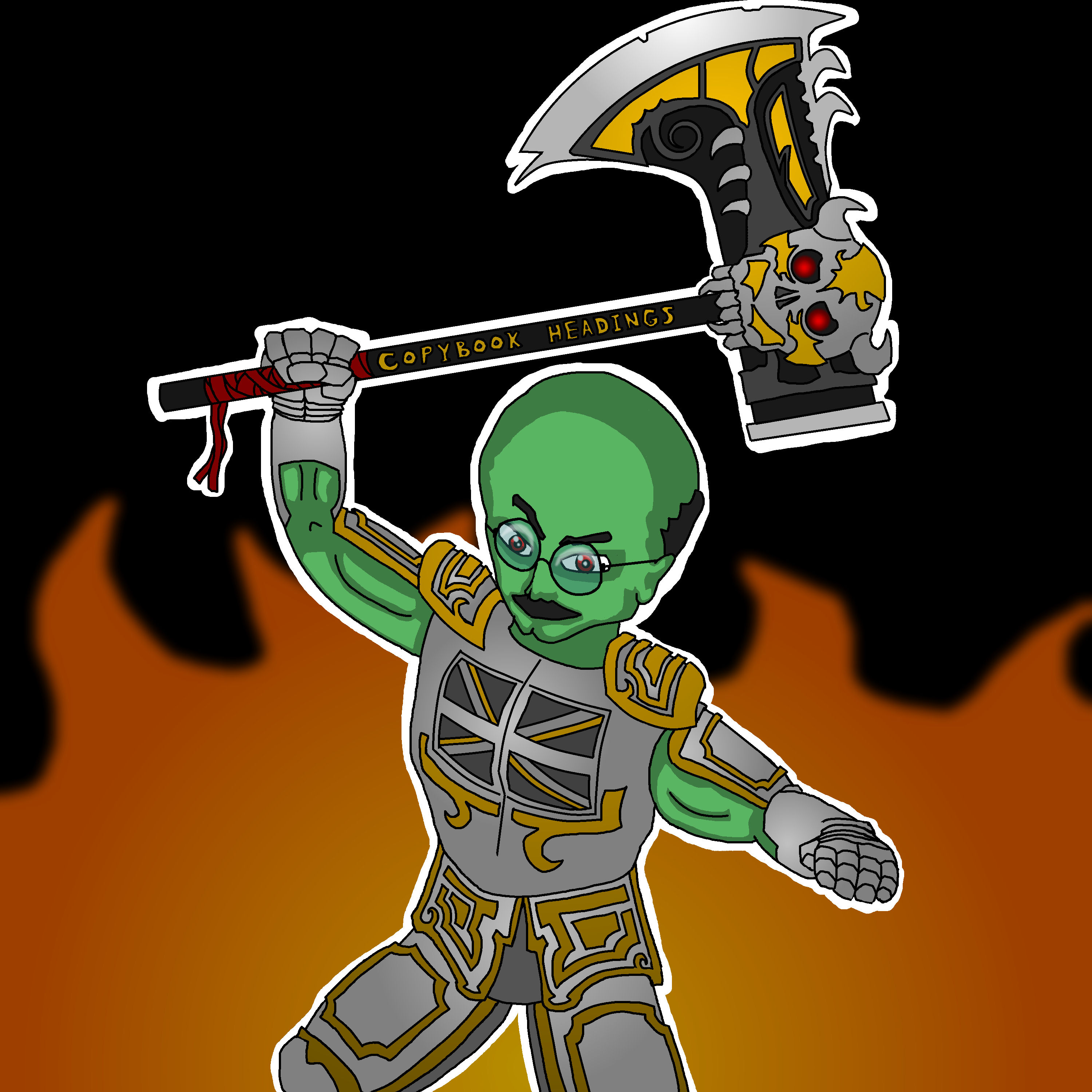
Green Rudyard Kipling WITH AN AX, biatch!  Your argument is invalid!

The Gods of the Copybook Headings – Rudyard Kipling


AS I PASS through my incarnations in every age and race,

I make my proper prostrations to the Gods of the Market Place.

Peering through reverent fingers I watch them flourish and fall,

And the Gods of the Copybook Headings, I notice, outlast them all.


We were living in trees when they met us. They showed us each in turn

That Water would certainly wet us, as Fire would certainly burn:

But we found them lacking in Uplift, Vision and Breadth of Mind,

So we left them to teach the Gorillas while we followed the March of Mankind.


We moved as the Spirit listed. They never altered their pace,

Being neither cloud nor wind-borne like the Gods of the Market Place,

But they always caught up with our progress, and presently word would come

That a tribe had been wiped off its icefield, or the lights had gone out in Rome.


With the Hopes that our World is built on they were utterly out of touch,

They denied that the Moon was Stilton; they denied she was even Dutch;

They denied that Wishes were Horses; they denied that a Pig had Wings;

So we worshipped the Gods of the Market Who promised these beautiful things.


When the Cambrian measures were forming, They promised perpetual peace.

They swore, if we gave them our weapons, that the wars of the tribes would cease.

But when we disarmed They sold us and delivered us bound to our foe,

And the Gods of the Copybook Headings said: “Stick to the Devil you know.”


On the first Feminian Sandstones we were promised the Fuller Life

(Which started by loving our neighbour and ended by loving his wife)

Till our women had no more children and the men lost reason and faith,

And the Gods of the Copybook Headings said: “The Wages of Sin is Death.”


In the Carboniferous Epoch we were promised abundance for all,

By robbing selected Peter to pay for collective Paul;

But, though we had plenty of money, there was nothing our money could buy,

And the Gods of the Copybook Headings said: “If you don’t work you die.”


Then the Gods of the Market tumbled, and their smooth-tongued wizards withdrew

And the hearts of the meanest were humbled and began to believe it was true

That All is not Gold that Glitters, and Two and Two make Four

And the Gods of the Copybook Headings limped up to explain it once more.


As it will be in the future, it was at the birth of Man

There are only four things certain since Social Progress began.

That the Dog returns to his Vomit and the Sow returns to her Mire,

And the burnt Fool’s bandaged finger goes wabbling back to the Fire;


And that after this is accomplished, and the brave new world begins

When all men are paid for existing and no man must pay for his sins,

As surely as Water will wet us, as surely as Fire will burn,

The Gods of the Copybook Headings with terror and slaughter return!


Will You (Also) Tolerate This?

As some of you know, I’m not only American, I’m Coloradan.

Mind you, the South will always be a part of me. It was where I first lived in the US and the place I was naturalized.  The voice in my head has a Southern accent, and I love going back to the South East for cons. But Colorado is where I was meant to be.  We came into Colorado the weekend before Thanksgiving 1993 (it’s been pointed out to me I had 2003 which is both a bit of wild flattery on my age, and my lacking coffee.  I’ve only had one cup),   and just ahead of the Thanksgiving Snow Storm TM which dogged our steps all the way, with the gates clanging shut just after we passed.  And then we crested a ridge above Colorado, and I saw it for the first time, and I knew it was where I was supposed to be.

Which makes sense since, at the age of eight, I knew I wanted to be a writer and live in Denver.  (Of course I thought Denver was by the sea, but we’ll avert our eyes there, right?)

This feeling of belonging has never changed, even though Colorado has changed.  But the most marked change was in 2008 when the legislature flipped dem, and they took the bit between the teeth.

I’ve said before and I’ll stand by it, that there was massive fraud in 12. Unless you REALLY believe 1/3 the people had already voted by mail and forgotten.  People of all ages.  And then there’s this.  I don’t think people willfully forgot voting for Obama.  I think only 45% of them did.  It matches what I saw on the ground.  And heck, that might be inflated.

But apparently it came close enough that it scared them.  The fraud wasn’t easy enough.  They couldn’t manufacture hundreds of thousands of votes as they could in Detroit and Chicago, in California and in Oregon, in Washington, and in the other lovely bastions of Democrat rule.

And so they changed two things.  Now all elections are by mail. And there’s same day registration.

Of course, elections by mail, we’re told, have nothing to do with fraud. The whole purpose of it is not to commit fraud.  Why, voting by mail is good for all sorts of things, like… like… like.  It saves money.  Yes, that’s the ticket. And gives work to printers.

But even with the voting by mail, they’re desperate. You know they’re desperate because every other commercial on the radio is about how Cory Gardner denies Global Warming AND eats Puppy Shakes.

And they need cover, for their massive fraud.  They need to say “A bazillion more people registered on election day!” So…

So yesterday they left this on my front porch.001

Will you look at that? Register the same day! In case, you know, you never wanted to vote, and were seized with a powerful urge on the first day.

What on Earth is this for except as a mask for fraud?  WHO ignores the elections till the day, and then has a desperate need to vote? And is informed?

And, oh, yeah, if your driver’s license doesn’t have the address you have to pinky swear you live there.

This is not a banana republic.  Banana republics have more voting security.  Portugal, a land that is a stranger to organization, a land where anyone queuing for everything instead of jumping into it in a bunch, will be laughed out of the country (yeah, that’s what happened to me) has better voting security than that. You have to register ahead of time.  You have to show your birth certificate or passport.

Oh, yeah, note above, none of this verifies citizenship. Not only that, but it doesn’t say ANYWHERE that you have to be a citizen.  Honest but dumb people might register to vote not knowing that it’s for citizens only.  My son registered to vote with only his driver’s license.

All of these laws, starting with motor voter were to “make it easier” to fulfill your “obligation” to vote.  And no one is supposed to ask if you’re a citizen, because that will hurt the feels of dark people or people with an accent.

First of all, I couldn’t care less about feels.  I care about law.  I’m a dark person with an accent.  I EXPECT them to ask me to prove I’m a citizen.

Believe it or not the right not to have your feelings hurt has never been enshrined in the constitution.

Second, there seems to be this cringing, implicit thought that not letting foreigners vote in our elections is discrimination.

Say what?

A vote is something that pertains to a citizen, who is expected to live the rest of his life in the country, and for whom that vote matters.  Why should people wholly unconcerned with us, working in the country for a few years have the right to tell us how we should be governed?  Why should people who know nothing of our history, our civics, our traditions, have a say?  Do you want to vote/would you vote in another country’s elections?  France? Somalia? Brazil?  WHY?

And then there is this belief that a vote, no matter how uninformed, how misguided is an “obligation” and you should treat them all as precious.  And more votes are always good.

This is what leads to all these “opening” of the vote measures.  The idea that voting should be easier than… buying a bus ticket.  Paying for shipping something at the post office. (Both of whom ask to see ID, at least a long-distance bus.)

Americans have been raised on the idea that a poll tax or a voter test are wrong.  (Are they?  I don’t know.  All I know is that I’ve been told the same.  And of course you can see how it could be manipulated.) And so we are to let anyone vote, with no verification, no security, no proof of citizenship.  Because that’s somehow better.  Even though it’s just as open to manipulation.

(I will note the people who manipulated poll taxes and voter tests to exclude their “enemies” were the democrats, too…  It’s almost like they can’t win without fraud.)

So we’ve run the other way, and now everyone can vote.  They want to teach the world to vote in our elections.

And we have been disenfranchised.  We the real citizens of the state, the ones with skin in the game, who are neither cartoon characters nor bused-in-people.

There are two ways to steal your vote.  One is to deny you access.  The other is to dilute your vote with fake votes till it counts for nothing.

Will we tolerate this?  For how long?  Why doesn’t anyone else realize that under the cover of seeming openness they’re making our votes mean nothing?

And why don’t the clever fools in the Democratic party realize that when you block the ballot box, people will come at you another way?

I’m not calling for revolution.  I’m hoping very much we can avoid it.  I’m exhorting those of you in CO and similarly blinkered states to vote and to vote Republican.  Yes, even if you are a Libertarian.  Vote Republican because the press hates them and will magnify everything wrong they do, if for no other reason.

And vote republican this year, while we can still turn these election rules around.  And do it before they become cemented in place. Even if we have to hold the squishy Republicans’ feet to the fire.

I don’t want to leave Colorado.  Like Thorby in the Sissu, a bit of me has gone into Colorado a bit of Colorado into me.  I am Colorado.  And we can’t keep letting them take states because first time they get a solid foothold they corrupt the voting and it’s game-over.

This is our country.  No one should dilute our vote who isn’t with us for the long haul.  No one should vote who isn’t a citizen.  I’d go further and say no one should vote who doesn’t believe in the constitution and the bill of rights, but I know right now that’s a pipe dream.

The hour is late, the need urgent.  If we don’t fight at the ballot box now, we’ll be taking another step on the road to Boston Commons.

And at some point there will be no return.

UPDATE: Welcome instapundit readers.  (I thought I’d done this already, which tells you how my mind is working. )  Thank you to Glenn Reynolds for the link.

While you’re here look around, but most of all buy my books! (Hey, writer got to eat.)


Rachel Griffin

A few months ago, Jagi Lamplighter Wright contacted me and asked me if I wanted to read her newest book for a blurb.

Since I’d known Jagi’s work and loved it since the Prospero’s Daughter books, I said “of course” but since I hadn’t read the first book, the Unexpected Enlightenment of Rachel Griffin, I put off reading it for a while, then started the first one late one night and lost two nights and a day to reading the books.

So, how are they?

Mostly they are unusual.  Jagi writes a compelling, fully realized not-our-reality.

Yes, some of you will detect shades of Harry Potter but that will be mostly because it’s set in a boarding school.  The Roanoke Academy (don’t kill me) makes a lot more sense than Hogwarts even if both remind me of how happy I was reading Enid Blyton under the covers with a flashlight at eleven.

I liked all of it: the mystery, the fully realized and sometimes bewildering characters, the technology and the subtle hints that this world is in fact not our world.

Most of all I liked Rachael, a self-possessed and competent young woman who is none the less very believably an early teen, in her doubts and her second thoughts.

The second book has just been released, and I understand the International Evil Lord Of Evil himself will be giving it a little push today.

So, I thought I’d join the party.  See, these books made me feel thirteen again, that indefinable joy and enchantment that comes only when you’re very young — or when you’re reading these books.

You can see why I’d like Jagi to write more of them.  Well, that and young me in my head has a crush on Gaius.

They’re an extremely good price, too, so hie thee over to Amazon and give the sample a try.


Cleaning Up Pollution

(Sorry to be so unholy late with this.  I woke up knowing exactly what I wanted to write, but not sure how to phrase it.  Took me forever.  Now I’ll have tea, and write the book, instead.)


Lately I’ve become aware of a tendency in myself and I wonder if other people have the same problem.

I’ll be writing a book, and going along, and suddenly the idea comes for a plot twist that will make it… Well, the way it feels is relevant and meaningful, but if you turn it around what it really is is… meaningless and grey.

You’re running along writing your hero, and suddenly you get this strong need to give him not just flaws (every proper hero has flaws) but fatal flaws.

Look, we’ll call this the Lord Bane issue, shall we, after the leper who is taken to a fantasy world, miraculously cured and his first act is to rape his guide. And there are no consequences of this act in the book. (One of the reasons the book took a flying lesson out of the train window somewhere between France and Germany.)

Or you have a character who is a mentor and a great guy, and suddenly you feel the need to reveal something awful about him.

Look, we’ll start by admitting that my characters tend to have very dark backgrounds. By nature, I’m not a sunny happy-go-lucky person, and I write characters I can relate to. BUT all the same, my characters might have their down moments, but mostly they fight and are active and don’t give up (until you kill them. Sometimes not even then.)

So…

Whence comes the sudden need to “make it all go dark, make it al meaningless.”

Training and immaturity. There is an immature desire to make things “serious” by making them dark. Most people grow out of it at the end of adolescence. Except of course those trained to educate our young.

It starts early. Look at what stories get the most praise in classrooms? The ones where the characters solve the problem and move on, or the dark ones with no solution? And what books do you tend to study in school?

Everything in our culture praises the darker stories, the ones where humans either don’t win or where humans shouldn’t even win, because they’re bad and evil and deserve to be exterminated.

It wasn’t always like this. Mark Twain, while skewering a lot of garbage about his time, writes engaging interesting characters who are not meaningless nor live in meaningless worlds.

In fact, before our current era, the worst offenders in the dark and dreary sweepstakes were the romantic poets and seriously, those people had, as they say, the issues. But even they usually held out a good form of conduct and a bad one, even if in the end the “reward” for the good guy was to die a tragic death and be mourned.

I’d say that the fact that our darkest stories are favored is a sign of a culture in decline, only I don’t really believe that. It’s not the culture but the elites. The people are not despairing nor do they hate humanity, it’s just that the “intelligentsia” wishes we would.

The problem though is that THEIR problems get in your head. Get praised for dark, meaningless stuff, read dark meaningless stuff, get told that only dark, meaningless stuff is good, and you start to fall into it.

How many book series have you read where the author slowly makes the main character unlikeable? (This is particularly awful with funny series, because some people don’t seem to understand that certain things stop being funny and become horrifying.)

I realized, as I was writing a story and this “great twist” occurred to me (short story for the Baen Valentine’s collection) that it not only wasn’t a great twist, it robbed the story of meaning and made it a dime a dozen, but if I went THE OTHER WAY then it actually was a great twist, because given the dark and dreary stories out there (even though this one has… maybe a happy ending, eventually, the characters are both decent people) anything that breaks that mold is innovative and “oh wow.”

And there you have it. The attraction to dark and hatred of humanity of our (coff) “betters” has made their favored grey goo endings the yawn inducing ones.

Reject their pollution trickling into your thoughts. Write good and startling stories.

Dare to be meaningful. Dare to have a favored mode of conduct. Dare to write admirable people.

And as a reader, feel free to praise meaningful books and even (just?) happy books.

Reject the pollution of the dreary.

Doing it p*sses off all the right people.


Living With A Hyperactive Imagination – Kate Paulk

Living With A Hyperactive Imagination – Kate Paulk


A while back Sarah dropped an aside into one of her posts about the “joys” of living with an active imagination, and that maybe I’d write more about it because not only do I have one, it’s kind of… er… interesting to live with. So yes, this is that post.

Feel free to move on if you wish. You don’t have to live with it, after all.

I’ll start with a bit of an overview of the whole deal: I wouldn’t call myself terribly empathetic, but I can get to the equivalent by imagining how I’d be in an equivalent situation and going from there. I’ve done this so many times now it’s damn near automatic and looks like empathy. I’m also perfectly capable of mentally sliding myself into another world in tiny time-slices.

This makes me a very effective tester because I can put myself in the shoes of multiple kinds of user, and a very evil tester because I can think of all manner of ways to do things to software that the programmer never thought anyone would try (if I had a buck for every time a programmer has asked me “But why did you do that?”I’d have a lot more cash than I do now).

The thing about having an active imagination, though, is that most people don’t get it. They don’t get close enough to realize they don’t get it. The reaction to something completely different usually isn’t “Wow! That’s so different!”, it’s “WTF?” on a good day. On a bad day, you stand a good chance of someone calling for an exorcist, or the modern equivalent, a psychiatrist.

What most people consider “new” is usually “an uncommon perspective on something I’m used to”, so someone who can twist things sideways and find something that looks completely new is going to get hell because it’s just too different, too strange, and too much. Me, I don’t even realize I’ve done it, so I’m left wondering why I’m getting the “WTF are you on?” looks. And that’s when I’m trying to be normal.

When I’m relaxing and being myself, it goes beyond that.

My personal theory here is that a really active imagination is in line with controlled schizophrenia – you hear voices and see things but instead of treating them as if they’re real, you treat them as something to make stories from. Of course, I could be completely wrong here, but it seems close enough to work for me.

So, yes. The more lively aspects of my imagination talk to me. They show me things. So much so that I had to make the conscious decision to pay attention to the world my physical body is even though it was much less interesting (which doesn’t always translate to enjoyable) than the worlds inside my head.

I can – and have, when I’ve had bad times – lose myself for days in my imagination, just daydreaming in the form of narrative. I try to avoid that for obvious reasons. Life doesn’t happen when I do that. Bills don’t get paid, cats start getting irritated over not getting fed on time, and things fall apart. It’s not exactly pleasant.

So how do you live with it?

Start with Gandalf’s advice to Frodo about the Ring: “Keep it secret. Keep it safe.” Until you know someone is going to be able to follow your imagination without freaking out, they’re better off not knowing it exists, because in my experience, recovering from freaking out a friend just doesn’t happen. There’s always that lingering question on my end of whether I’ve gone too far, which always buggers up my judgment.

Pay attention to the world that your feet are in. This is the one that can hurt you. You need to learn to live in it or it will hurt you (something highly intelligent, extremely imaginative small children really don’t like to hear and don’t want to understand… if my experience is any guide). You also need to learn to interact with “normal” people (yes, yes, I know there’s no such thing. I mean people who aren’t like me, because the closest I get to normal is when I plank on a sphere – and yes that is a really crappy geometry joke. So kill me) without scaring the living daylights out of them.

Find a more or less socially acceptable way to let the imagination out. It could be fanfic. It could be original fiction. Or role-playing. Whatever, as long as it works, it’s good. Because – again, from my experience – if someone bottles this up for too long, the best option is that it dies.

The worst is that it twists. And when that happens… That’s a completely different post, and a much less pleasant one.

So those who have an imaginative child, don’t try to squash it, but do try to direct it in ways that won’t scare the mundanes and teach the child how to live with this world as well. Those who have the imagination themselves, if you’re still fighting it, try a few of the things I’ve suggested.

And remember, ordinary people really don’t get it, no matter how much they think they do.

A Fatal Eclipse Of Trust

Sorry, guys, we’re not all going to die of Ebola. I know, I know, we’ve been hoping for so long for the Sweet Meteor of Death that the Sweet Pandemic of Death would do, right?

But life is full of these little disappointments, and we’re going to have to live and – being us – rebuild the republic.

Which is a problem, because while we’re not all going to die of Ebola, Ebola has revealed how far gone we are in lack of civic trust.

No, I’m not accusing you of being untrusting. I trust you to be untrusting. I count on it.

The poor creatures who “trust government” much less those who think they “belong to the government” can only be kept alive, let alone safe, when surrounded by a lot of us jaundiced creatures who examine every statement of the government and who, if the government tells us our mother loves us, verify it.

But truth be told, even we trust the government, or at least the structure of society in a hundred different ways every day, unless our antenna go up at the indication of duplicity.

Things for which we used to trust the government, if not exactly to at least be in the right ballpark: Unemployment, inflation, the state of the economy, the state of the population, disease statistics, warnings about what was safe and unsafe (yes, sometimes we got the alar scare, but the truth is, it usually erred on the side of two much caution), the state of the world, the state of our enemies’ forces, the state of our forces.

There are more things I’m not calling to mind now, a myriad points that informed us that civilization was in fact still working, that statistics were still being gathered, and that we could – through them – know the state of the world that we couldn’t verify on our own.

This is not – ah – to say that we, we particularly who tend to hang out in this blog, believe in these things in whole or even implicitly. No, but we did believe in them more or less, and kind of. We would say things like “Of course, the census overestimates the uncounted in the big cities, but—” or “They’re having a panic fit over the disinfectant in smokeless cigarettes, ignore that.”

However, for the big things, important things, we trusted government. You know, weather alerts, forewarning the economy was about to take a dive, election results, that sort of “big thing.”

What Ebola has shown is that this trust has eroded to the point it’s practically non existent. It’s also revealed why.

The clown show that has been the CDC handling of it, and then Obama appointing yet another czar – a position not provided for in our constitution – and one who is JUST a political operative, shouldn’t feel anyone with confidence. And it won’t.

It doesn’t mean we will die screaming, but only because we are – relatively – lucky. As Rand Paul (who is a doctor) said the disease is highly infectious (by which I mean that you can catch it from a relative low volume of virus) but not highly contagious (by which I mean that you have to be pretty close to someone and that they’re only contagious in a small window.)

Also our hospitals are among the best in the world (still) even if under pressure from Obamacare.

I don’t mean to say that more people won’t catch this, or that we won’t be made very uncomfortable. I also don’t mean to say it’s a good idea not to institute quarantines for people coming from the affected countries and not to delay visas for those not on urgent business.

Other countries in Africa are completely closing their doors to people from those countries, and there is absolutely no reason we shouldn’t at least ensure those coming in are healthy.

Yes, it would be a bit of trouble/expense, but not as much as the stupid questions at airports and the taking of temperature (which I live in fear will keep me from coming back from Portugal, because one thing I can guarantee, after two weeks in an unheated house, where the temperature hovers between the thirties and the forties I’m going to be ill. I plan for recovery after my return.) And certainly not as much as ending up with 800 people being monitored. Which is part of the problem because we didn’t monitor/restrict the movements of the relatively few originally.

And I’m not saying we’re not going to see more cases. We are. Probably a couple hundred, or I’ll be very surprised. And those couple hundred cases will be cases that could have been avoided.

What I’m saying is that, because of the nature of the illness and the fact we have sanitation and hygiene practices, as much as because our hospitals do still function in some manner, we’re NOT going to have a pandemic.

That’s not to say things can’t get bad enough. A couple hundred cases, if they come close enough together could be enough to ignite a panic. And if you’re thinking of a panic in terms of riots and fits – oh, there will be those too, likely – you’re missing the most important point. First person – first – who catches it through traveling with an infected person, and our airlines face a crisis that will make the post-9-11 one seem like child’s play. And if you think “well people can just drive” you’re missing how much we depend on air transport for business. Yeah, true, business meetings can go virtual and so can other such things, but deliveries can’t.

But as bad as that could get, it’s not TEOTWAWKI and it will pass.

What won’t pass is the reason we’re at risk for it. And that’s the symptom of a far greater disease.

After Summer of Recovery six; after the best unemployment statistics ever, which in fact aren’t, because no one is reporting on the fact our work force participation is smallest since women joined the work force in droves; after ISIS as a JV team; after Benghazi; after the IRS scandals, which even if not fully reported have made it through, like a trickle under the door, to pollute public trust; after Fast and Furious; after journalists joining in presidential debates AND LYING in favor of the administration; after the purposely inflated stock bubble; after global warming; after the press has finally reversed itself on the weapons of mass destruction in Iraq (after spending years telling us Bush lied); after the secrecy and rumors about the current president’s past; after, after, after…

Even the sheep are restless. Trust in our institutions let alone our leaders is at a minimum.

Of course the leaders’ think if we, the goats, just stop showing where they lied, then everything would be hunky dory. But it’s not like that.

Even sheep realize when you tell them the economy is booming and everyone they know, even the relatively well off are struggling. They’re not stupid. The only people doing well have been those riding the stock market and that might be coming to an end.

So—Why is that a problem?

It’s a problem because in modern life we can’t gather information by ourselves about everything, and because we have to trust two things: the media, and the government.

The government mostly as a collector of facts, something it has done since ancient times. And the media to tell us the truth, no matter how unpalatable.

If we can’t trust them, where will we go? How will we gather true info?

Even I can’t. And I have more experience than most, both of research and of living under untrustworthy governments. But I see movements, like the recent one in real estate in this area and I wonder what is going on and precisely what it means. Is it because more people have better paying jobs? But that doesn’t accord with any statistics. Is our good neighborhood receiving the run off of neighborhoods that crashed? And why is Denver real estate running hot and as a seller’s market?

I read at an economic blog that the government is reinflating the real estate bubble, but I don’t even GET the reasons they say that. And economics is my hobby.

And meanwhile I see what I saw at the beginning of the crisis: Top and bottom restaurants closing (the middle holding fast.) Rents climbing (because so many people can’t buy.) And, because I have a kids in their early twenties, a multitude of young people with high debt, locked out of our economy.

None of this accords with “the economy is getting better.” I lived through the eighties. I know what that looks like.

So what the heck is going on? I don’t know, and neither do you. The government won’t tell the truth and the press won’t report anything that hurts this government. (One reason to vote Republican is that while they can be just as corrupt and venal, the press doesn’t protect them. And after this administration that’s reason enough. Though the fact the press outright lied about WMDs doesn’t help either way.)

And that’s a problem. In a country as complex as ours, in a world as complex as ours, the individual needs to be able to trust signals and facts he can’t gather himself.

When those are corrupt, you end up with an entire society in an hallucinatory state, and behaving like people who hallucinate will: we’ll respond to things that aren’t there, and fail to see the ones that aren’t.

And some of those might kill us, if not now not very far off, if not physically then as a society.

Ebola might cost us as many as a hundred lives (a pessimistic prognosis on my part, btw) and it might throw our economy into greater chaos.

But the lack of trust in anything our government, our media, our institutions say? The DESERVED lack of trust I might add?

That could cost us everything we still have of the republic and send us to third world status in a decade.

And all we can do about it is strive to elect trustworthy people, call the press on their lies and omissions and try to build a network of information composed of individuals.

It’s time we did the job our institutions won’t do.

Until we can supersede them.

In the end, we win, they lose, but let’s shorten our time in the wilderness.

They’ve lost our trust. Let’s rebuild parallel networks of trust.


Ladies and Germs it’s the book post – Jason Dyck

Good morning, Huns, and welcome to the weekend! We received some interesting submissions for promo this week, including a fascinating bit of sci-fi history. Got something of your own to promote? Want to help the Huns and lurkers to surf the Human Wave? As always, future entries can (and should!) be sent to my email. Happy reading!

Jason Dyck, AKA The Free Range Oyster

Spaghetti De-Tangler, Mercenary Word-polisher, and Twenty-First Primarch

Eberhard Christian Kindermann

The Speedy Journey

Translated by Dwight R. Decker

On July 10, 1744, a German astronomer named Eberhard Christian Kindermann thought he had made the discovery of a lifetime – a never before seen moon orbiting the planet Mars, more than 130 years before any were officially observed. Instead of announcing his discovery the usual way, Kindermann chose to dramatize it by writing a story about an interplanetary voyage to his alleged Martian moon. The result was The Speedy Journey on the Air-Ship to the Upper World, perhaps the first story ever written about a trip to Mars (or at least somewhere close by). By turns quirky and even bizarre, the story is still astonishing today for its sheer imagination as a work of pioneering science fiction. Besides traveling through space and encountering alien life forms on another world, Kindermann’s heroes even use balloons for aerial transportation nearly forty years before the actual first balloon flight in 1783. Never before translated into English, little known outside its native country, and usually relegated to uncertain references in footnotes and bibliographies, The Speedy Journey is now available after 270 years to science-fiction fans and historians, astronomy buffs, and everyone else in “the curious lower world,” as the author would have said. This edition includes the complete translated text of the original story as well as essays by science-fiction historian John J. Pierce and translator Dwight R. Decker that put it in the context of its time. The cover by Alan Fletcher Bradford and new illustrations by Donna Barr are supplemented with vintage illustrations from E. C. Kindermann’s own works.

R.K. Modena

Sparrowind

Tiny Sparrowind can’t hunt from the sky, cannot hope to best his siblings in contests of strength, and scrapes by to survive. But in the books stashed in his parents’ hoard of gold and gems he finds a greater treasure: ideals.

Deciding to make his own way in life gives him more hope than he could have if he tried living only by the way of Dragonkind, but can this dreamer of a Dragon find his place in the world?

Available from these fine booksellers:

Kal Spriggs

The Shattered Empire

The Shadow Space Chronicles Book 2

Baron Lucius Giovanni has managed to buy the human race a brief reprieve from the two alien races which seek humanity’s extinction. In the process he has become the leader of a new nation and the commander of a powerful fleet. However, victory comes with consequences. Without an imminent threat, old feuds have sparked back to life and tenuous alliances falter. There are also old enemies who cannot forget that Lucius has what they wanted. He must find a way to hold off scheming rivals, sociopathic psychics, and even former friends. If he can’t do all that and take the fight to humanity’s true enemies, billions may die under alien servitude.