Sunday Vignettes by Luke, Mary Catelli and ‘Nother Mike – the net security version

Sunday Vignettes by Luke, Mary Catelli and ‘Nother Mike – the net security version


So what’s a vignette? You might know them as flash fiction, or even just sketches. We will provide a prompt each Sunday that you can use directly (including it in your work) or just as an inspiration. You, in turn, will write about 50 words (yes, we are going for short shorts! Not even a Drabble 100 words, just half that!). Then post it! For an additional challenge, you can aim to make it exactly 50 words, if you like.

We recommend that if you have an original vignette, you post that as a new reply. If you are commenting on someone’s vignette, then post that as a reply to the vignette. Comments — this is writing practice, so comments should be aimed at helping someone be a better writer, not at crushing them. And since these are likely to be drafts, don’t jump up and down too hard on typos and grammar.

If you have questions, feel free to ask.

Your writing prompt this week is: virus free.


For some reason this week I have no promos from The Free Range Oyster.  So you slackers might want to write, publish, run sales, and send your promo to: Free Range Oyster.

Free Short Story

It’s my birthday and I don’t feel like writing a post.  I do have some work to do this morning, anyway.
So….  Here’s a free short story.  Some of you might have read it in the first suburban fantasy book edited by Esther Friesner (that I’m blanking on the name tells you everything you need to know about how little coffee I’ve had.)  OH, yeah, Witch Way to the Mall.  It’s beyond silly but Jerry Pournelle loved it (and its sequels) and wanted me to write a book with these characters, so…. maybe you’ll enjoy it.

The Incident Of The Inferno Grill


Sarah A. Hoyt

 © Sarah A. Hoyt 2008.  All rights reserved.  Reproduction prohibited except for brief excerpts for review purposes.

“What do you mean the grill is possessed?” I asked my new boss.

He shrugged.  “Sometimes, things just are,” he said.

Now, while I had often had my suspicions about my computer, and wasn’t about to put hands in the fire about my tv either, I’d never gone so far as to say they were possessed.  Self-willed maybe.  And perhaps agents working for down-below.  But possessed?

It didn’t make me feel better about driving into Oak Leaf Subdivision in the passenger side of Ken’s tenth-hand vintage early eighties Volvo, our backfires making gentlemen in chinos and white t-shirts look up from tending their already immaculate lawns and the car’s appearance making the tots playing on the sidewalks abandon their bicycles and plastic pedal cars and run screaming inside for mommy’s protection.

What the sign painted on the side of the car Nephilim Psychic Investigations might make the moms do was anybody’s guess.  I certainly didn’t want to think about it.

The job wasn’t exactly something I’d set out to get, either.  It’s just when you’ve gone through all the ads that relate to your training – and of course, the thing about being a classical historian is that there are hundreds of people out there just waiting to shove the big bucks at you for your knowledge of the impact of Augustus’ monopolies on Roman economy – and the ads for secretary and receptionist; when you’ve gone to more retail stores than you can count and filled out all their applications, only to be told you’re overqualified; when you have tried the Work At Home Carding Wool jobs, what is left is not the merely improbable, but the impossible.

For me the impossible had arrived in the form of a brightly colored flier stuffed into my mailbox with all the bills.  Local Business Looking For Reliable Employee it said.  Creativity and Love Of Adventure a Plus.  Industry Standard Wages.

My first thought was that anyone who needed to put out a flyer asking for an employee during one of the tightest job markets ever to hit our city– in a college neighborhood, yet–could not be on the level.

However I took the flier inside, and looked over the pile of bills that had also been in the mailbox.  Then I drank the last bit of the milk in the fridge.  There was no  money to buy a new gallon – or quart.  Or pint, for that matter.  I looked at the flier again.  Perhaps the person looking for an employee just wasn’t very good at public relations.  And perhaps he needed a guiding hand.  Not to mention a firm but friendly employee to cure him of his sad addiction to capital LETTERs.

All of which had got me to Ken’s dingy office over the corner deli.  I’d balked a little at the sign on the door.  Nephilim Psychic Investigations didn’t exactly inspire confidence.  Neither did his explanation that his given name was Nephilim Kentucky Jones III.  Regardless of his explanation that his great grandmother had been into biblical prophecy and missed Kentucky, any family capable of perpetrating that name not once but three times probably had other genetic issues.  Madness, for one.

And yet, Ken looked like a perfectly reasonable man.  Black, in that indeterminate age range between thirty and fifty, with a lean physique, slightly receding hair and the oddest tone of skin I’d ever seen.  He looked exactly like he’d been born to be very dark skinned but went around with a permanent pallor.  He smiled, keeping his teeth hidden, and told me that he went by Ken.  Ken Jones.  He just thought given the nature of the job, Nephilim was a good name for the business.

Which it was.  Just not for any business I would be involved with.  But he gave me a hundred dollar advance, which kept me from bolting when, after he had hired me, he asked me, “So… do you think you might have any psychic abilities?”

“I don’t think I have any more psychic abilities than your average cat,” I said, calculating the distance between me and the door, which wasn’t very large considering the whole office could be crossed in a dozen steps in each direction.

“Ah well,” he said, picking up a pen and making some random notation on a notebook on his desk – I swear he wrote cat – “Cats are actually very psychic.”  After which he seemed to lose interest in me, as he looked through his desk for something.

When I cleared my throat, he said, “Oh.  You’re hired.  Otherwise I wouldn’t have given you a cash advance.”

Which he had,  for which I was grateful.  But all the same, I thought I needed to know some minor things.  Like, “Uh… when do I start?  What do I do?”

“Oh.  I’ll call you,” he said.  “When we have a case.”  He looked over my resume.  “I do have your cell number so just keep that on.”

And I had.  But I hadn’t expected to be called in less than two hours.  Nor had I expected to be picked up in a Volvo that backfired constantly.  Much less did I expect to be driving through the burbs with that ridiculous business name on the car door.

Which was just as well, because Ken pulled into a cul-de-sac, and up the driveway of the last house.  This house could have fit my two bedroom apartment in it at least ten times, not that it would, since it was much better kept than any place I’d ever lived.  In fact, it looked like painters had just finished touching up the exterior, and making sure the picket fence going around the spacious yard was as immaculate as possible.

Ken opened the car door with an audible shriek, and got out.  I got out on my side, cringing at the sound of unoiled metal.  As we approached the broad porch with its unsat-upon-by-human-behinds wicker chairs, I swear I saw a hand twitch the lace curtains in the window next to the door.  So I fully expected no answer to the doorbell. She had seen that car.  What sane suburban matron would answer the door to someone who arrived in that car?

Only, of course, there was an answer.  A woman in a white dress opened the door and smiled at us.  “Yes?”

She didn’t at all look like an inmate from a lunatic asylum, so I had to assume that whoever had called Ken and complained of a possessed grill had been playing a prank on her.  Or on us.

But when Ken said, “Good afternoon, Ma’am.  We’re here about the–”

She blushed slightly and said, “Of course.” And stepped back, opening the door wide.

We crossed a hallway and a kitchen, and though she said “Forgive the mess” I didn’t see anything even out of place other than a Barbie doll on the counter.

Outback, there was a little brick patio and a neat lawn strewn with kids’ toys.  And just as I thought the woman was about to say that she wanted an estimate for aerating the lawn or the like, she gestured helplessly towards the grill.

The grill took up the entire side of the brick patio, perpendicular to the house and it looked more complex than some upper model cars.  It was one of those deals which could accommodate five full racks of ribs side by side, and cook the sauce on the side, on a little gas burner.  Grills like that always made me feel inadequate since I couldn’t even imagine having the sort of social life that required that sort of cooking implement.  This one was all polished black and chrome and gave me a strange feeling that I should fall on my knees and worship.

For some reason, Ken reached over and grabbed my elbow.  “Steady now,” he said, in an undertone, before turning to the homeowner.

“So, Ma’am,” he said, as he pulled a notebook from his back pocket.  “What were the first signs of trouble?”

She hesitated, then sighed.  “Well…” she said, and stepped aside reaching for a plant stake that was leaning against the house, beside the patio door. She stepped a distance and used the stake to raise the grill cover.

A column of flame shot up, to the second floor window level.

I jumped back and attempted to take cover behind a child’s bike.  The homeowner lifted  the stake, clearly with the idea of closing the grill again, but Ken held her wrist.  “No, no,” he said.  “Leave it open.”  He looked up and down the blue and red flames, which gave off a distinct smell of sulphur.  “I imagine that must have been disturbing.”

The woman wrung her hands.  “It ruined the brisket,” she said, with a sort of sob in her voice.  “It was the best brisket, too, and we were going to have a cookout.  We had invited all our friends.”

Ken nodded sagely.  The blue and red flame acquired purple highlights.

“And when did you realize that you were in true trouble?”

“That…”  She looked thoughtful.  “That would be when it demanded human sacrifice.”

“I see,” Ken said.  Behind him, the purple flames were forming faces, with huge, gaping mouths.  “And did you give it that?”

The woman’s mouth dropped open and her eyes opened wide.  “What?  No!”

“Good,” Ken said, flipping a page in his notebook, and making some cryptic note.  “Human sacrifice always complicates things.”

The woman’s mouth opened and closed, like that of a fish recently removed from water.  I was probably doing the same.  I was also still cowering behind the little kids’ bike.  It had pink streamers on the handlebars and a plastic basket with plastic flowers glued on in the front.  [The flames had now grown and shaped into beckoning fingers.  I hoped the plastic flowers were sturdier than their looked..

“So, do you have any idea what might have brought this about?” Ken asked, calmly.

From the grill, a voice was hissing, in what would be enticing tones, if there were not the stench of evil in every syllable.  “We know you.  Come to us.  Come to us…”

The homeowner was looking at the grill.  “Perhaps if we could cover…”

“Nah, don’t worry.  It always says that sort of thing,” Ken said, waving his hand as if to say that the grill could wait.  “Just tell me if you have any idea what caused this.”

“I…”  She wrung her hands together.  “I don’t know.”

“Well, you know, grills don’t normally become possessed,” he said.  He sounded very much like a plumber talking about some foreign object found in the drains.  “So there must be something special about this one.”  He looked over his shoulder, at the obscene mass of images that the flames had formed – arms, hands, lips, tongues, and some very lascivious faces leering straight at him – and narrowed his eyes in professional appreciation.  “Remarkable,” he said.  “Would you tell me where you bought it?”

“House Despot,” she said, with a quiver in her voice.

“I see.  And… well, forgive me, it is of course, none of my business, but you and your family don’t happen to be Satanists?”

“No!” It was a wail.

“Any practitioners of the black arts hereabouts?” he said, as he scribbled furiously.  “Suspicious teenagers, shape shifters, wizards, vampires?”

“Vampires?” she said with a sort of a gurgle.

“Well, not every vampire, you know, but some are true bad lots, and– ”

And I could see if I let Ken go on with this, the woman would have a nervous breakdown and give the grill the human sacrifice it demanded, probably in the shape of Ken.  I got up from behind the bike, with the reflection that, at any rate, it wouldn’t save me from the worst.  I mean, if the hellish forces dragged me off to, well, hell, at best I could make sure to take a bike and a handbasket with me.  And at worst, I’d have bike-shaped scorch marks on my body.

Instead, I decided to save my job, such as it was, and possibly my life, not to mention, my immortal soul.  I advanced on the two of them with what I’m sure seemed like a semblance of bravery, though I was careful to keep them between me and the grill, where a thousand flame tongues were lolling out at me, while the hissing flames called out obscene suggestions.

“Ken,” I said.  “I’m sure you have other diagnostic tools.  I’m sure Mrs– ”

“Smith,” she said, looking away from Ken and the flames towards me.

“I’m sure Mrs. Smith doesn’t know anymore about the origins of the trouble, or she would have told you already, isn’t that right?”

“Of course,” Mrs. Smith said, with such a tone of relief, that it cut at my heart.             “We’re going to go inside, and she can have a cup of tea, while you do your thing, all right?” I said.

Ken looked somewhat put out.  He put his notebook in his back pocket, turned around to face the grill and said, “Right.  It’s time to roast.”

I didn’t want to see what he was going to do next, so I just led Mrs. Smith into the kitchen, where I nuked a cup of water and, following her directions, found her her favorite herbal tea.

“We moved here two years ago,” she said.  “Such a nice place we thought.  I mean, our children go to the school just down the street.”

I handed her the cup of tea, which smelled strongly of mint, and she took a sip.  “And never a hint of anything strange, you know?  I mean, the children play outside, and my husband has a lot of friends that he golfs with and–”

I found a tissue box and handed her one just in time.  She blew her nose.  “We were so happy here.  Every month or so, we had a barbecue and everyone in the neighborhood came.  Best ribs in the stateMy grandmother’s recipe.  Everyone loved them.”  She took another sip of the tea.  “But now it’s all ruined.  No one will ever come to our parties again.  We’re the crazy people with the special effects grill.”

“Have you tried getting rid of it?” I asked.  “Just putting it out with the trash?”

“Yes.  Oh, yes.  But, you know, it popped open, and the garbage collectors came and knocked at the door and said that if we did that again they would report us.”  She wailed again.  “For trying to dispose of dangerous materials.”  She took another sip of tea, like a woman drowning.  “We even… we even tried putting it at the corner, with a sign saying free.  We thought some… some college student might take it, or something.”  She put her hands to her face, as if to cover the raging blush on her cheeks.  “But all that happened is that by the time we came home it was back  there, with the flames shooting up to the second floor.

“And it’s so bad,” she said.  “I mean, the lid will open in the middle of the night, with the wind, or some vibration, or something.  And the flames will wake our daughter in her room.  It’s just… just facing the grill.  And our son thinks it’s cool.  He’s thirteen, you know.”

I provided another tissue.   She sniffled, daintily.  “And he’s learned all sorts of bad language from that grill.  The flames hiss it, you know.  He called his teacher a den of iniquity last week.  Let me tell you that was a fun conference.  And then he said the principal was a beast of concupiscence.”  She finished her mint tea at a go, as though trying to fortify herself.  “I don’t know what to do anymore.  We’d move, but I’m afraid the grill will get there ahead of me.”  She put a hand up and grabbed my wrist, and motioned with her had towards Ken, who was out there, making wild gestures and seemingly negotiating with the demon in the flames.  “Is he any good?”

For one crazy moment, I toyed with telling her the truth: That all I knew about him was his pamphlet design skills and his name, and that neither of those inspired me with confidence.  But I looked at her woebegone face, her tear-filled eyes, and I decided the lie was the best part of valor.  “Oh yes,” I said.  “He is… uncanny.  Such power and psychic, er, perception.  He’s almost as good as a cat.”

“Oh, that’s good then,” she said.  And I must have sounded convincing, because she didn’t even bat an eye at the cat thing.

I thought I’d better get out of that kitchen, though, before I were tempted into a sin of telling the truth.  I mumbled something about helping Ken and stepped out.

He was facing the grill, which was singing in a thin, reedy voice.  It sounded like “staying alive, staying alive.”

“Well?” I said.

“It’s very bad,” he said, turning around and frowning at me.  “Those flames are straight from the pits of hell themselves, and judging from the sound of it, that’s Disco.  That means it’s from the lower pits.  The only worse ones are the accordion players’ pits.”

“What can we do?” I asked.

He shook his head.  “Damned if I know,” and glared at the faces that were now chortling at him.   He ran a hand backward through his very short hair.  “Or at least, the grill is.”

“So what can we do?” I asked.  “She’s terrified in there.”

“It has to be the work of someone around here,” Ken said.  “A neighbor or something.  I mean, if they’re not Satanists, then someone has invoked this and wished it on them.”

“Okay.  So, how do we go about finding who it is?”

“I don’t know,” Ken said, exasperated.  “Look for familiars or brooms or something.”

“Brooms?  Are you seriously suggesting I go to every house, knock at the door and ask to see their broom?”

He chewed on his lower lip, as though deep in thought.  “No,” he said.  “Too time consuming.  Besides, if it’s a new broom, or if they fly relatively slow, the scorch marks aren’t really obvious.”

“Nephilim Kentucky Jones, are you telling me that people really fly on brooms?”

He looked confused.  “Uh… yes?”

It was clearly hopeless to bring him in touch with reality.   And besides, looking at that grill with its outright sentient flames, I was having trouble telling him that flying brooms were impossible.  So I cast a look around the immaculate lawn, the carefully tended bushes and flowers surrounding it, and the white picket fence encircling the whole.  Just in time to see a cat looking over the fence.

Okay, it was just a black cat.  Maybe.  It had intent, curious eyes and the strongest claws I’ve ever seen, holding on to the edge of the fence.

“You’ll never figure it out,” the grill was hissing at Ken.  “You should give up and let us cook you.”  It turned around 180 degrees, in a way that was probably more repulsive for a human head.

And the cat was looking over the fence.  Another cat head appeared right next to his.  I noticed that Mrs. Smith was in the patio door, looking distraught.

“Whose cats are those?” I asked.

“Oh, that’s Black Cat and Black Cat Two.”

“They’re yours?” I asked.

She shook her head.  “Sort of the neighborhood cats,” she said.  “Their mother dropped them in our yard.  Mama cat has moved on, but they stay here.  We… we feed them.  No one else would, you know?  Poor things.”

And the two of them were looking over the fence, their yellow eyes shining and intent.  The bigger one seemed to be muttering cat curses under his breath.  Right.  As psychic as a cat.  Black cats as agents of the devil.  And then there was the whole familiar thing.  I looked down, happy that not only did I have jeans on, but I had my grubbiest jeans on.  That meant I could climb that fence.

I approached the cats slowly, passing Ken, who muttered as he looked at the grill, “Oh, pea soup, now.  Really bad.”

I didn’t look, but the air was filled with the smell of burnt split pea soup.

I  headed for the fence and the two cats.  I expected them to run when they saw me coming.  And they did.  Sort of.  Only it was a slow-mo run, with looks back to make sure I was following.  And I did.  Over the fence and onto another immaculate law.  And all the way to the garden shed.

Where I looked through the side window, to see a woman – at least I hoped it was a woman – tracing figures in chalk on the floor, and lighting candles and muttering “That will fix them.”

I lopped all the way back, jumped over the fence.  Mrs. Smith was still standing in her doorway.  I said, “How do you get along with the neighbor next door?”

She looked puzzled a second then shook her head.  “Well, not at all.  You see, she tried to steal my ribs recipe.  Her family is not… very popular here.  She resents my husband and I.  Her parties used to be the best attended before we moved here.”

Bingo, I thought, even as part of my mind told me I was over the edge and far away.  “Ken,” I said, as I approached him and pulled him by the arm, away from the grill which was now vomiting wave upon wave of pea soup onto the brick patio.  “Come with me.”

He looked as if he was going to protest.  He had a book in his hand, which he’d clearly been reading from.  I confiscated it, and dragged him behind me.  It wasn’t till I was near the fence that I read the title on the leather.  “War and Peace?” I said.

“I thought it might put it to sleep,” he said, defensively.  “It often does for me.”

“Never mind that.  Come.”

I led him, on tip toes all the way to the shed, where I showed him — through the same grimy window — the woman who was now engaged in a hopping, skipping backward dance around some mystic symbol on the floor.

“Right,” he said.  “Wait here.  This isn’t going to be pretty.”

“War and Peace?” I asked.

“Worse.  Much worse,” he said.  “I think we’re into the territory of Collected Anthology of Romantic Poetry.”  I thought he was joking, but as he went he took a small black-bound volume from what appeared to be a bottomless back pocket.

He went in and I heard a woman’s voice say, “What are you doing here?”

Ken’s voice answered, deep and resonant, “She found me roots of relish sweet…”

The woman screamed, loudly, drowning out Ken’s voice.  There was a series of thumps.  Then Ken’s voice rising again, “So are you to my thoughts like food to life.”

Another couple of screams, followed by an explosion and a sudden smell like burning lavender.    And then Ken’s voice, resolute and confident, “How do I love thee? Let me count the ways.  I love thee to the depth and breadth and height…  Is that enough?  Yeah.  That’s what I’m talking about,” he said, in the tone of someone who has finished some difficult work.

He emerged from the shed bedraggled, his shirt rumpled and burned in three spots, as if someone had applied a cigarette to it.  His short hair managed to be on end, and it looked like there were a couple silver threads mingled in.  He held something in his hand. It looked like a sachet woven out of straw with a couple bones and things tied to it.  “I tell you,” he said, shaking his head.  “Whenever these suburban women get some book on dark magic out of the library, they always go for the nastiest stuff.”

He seemed to be walking back to the grill, so I walked with him, and helped him over the fence.  He looked like he was barely able to remain standing.  At the moment we came into sight, the flames froze in the classic cartoon uh-oh faces and I swear I heard, “Well, if that will be all,” coming in the hiss of the flames, as the lid started to swing shut.

“Not so fast,” Ken said, and flung the sachet of workings overhand into the flames.

There was a sound like the scream of a thousand pierced accordions, and the flames died suddenly.  The pea soup that had been pouring over the edge of the grill disappeared too, leaving a scene of suburban calm.

“Wow,” Mrs. Smith said.  “That was good work!”  She seemed all polite eagerness and I detected just the faintest wish to see us leave.  Not that I blamed her.  I mean, if a possessed grill was bad, the sort of oddballs we were would be bad too.

“It was just your next door neighbor,” Ken said, slowly, as he wiped his sweaty forehead to his sleeve.  “You don’t have to worry about her anymore.  She’ll be going very far away.”

***

“How far away are we talking about?” I asked him, as we were back in the car and headed for our safe downtown neighborhood.

“What?” he said, looking over at me.  “Oh, I suggested Bermuda.  In that state of mind, it’s likely to become a fixation.  I just stripped all her psychic defenses and removed her witchcraft.  If she can convince her husband – and maybe even if she can’t – I’d guess it’s Bermuda or bust.”

“Oh,” I said, feeling terribly relieved.  “I thought you’d killed her or something.”

He looked startled, and the car wavered on the lane.  “I don’t kill people,” he said.

I gave him a sideways look.  He could be a madman.  Except… what he’d done had worked.  And we had a thousand dollar check to prove it.  “How did you find out how to do psychic investigations, anyway?”

“Online course,” he said.

I gurgled with laughter despite myself, and said “What?  How did you find such a course?”

“It was that or computer programming, and psychic investigations was cheaper,” he said.  “And less competition.”

“But… most people don’t think there’s anything to investigate,” I said, trying to sound reasonable.  “I mean, psychic stuff…”  I couldn’t say it didn’t exist, after what I’d just seen, so I just opened my hands, helplessly.

“Young lady, when your parents named you Nephilim Kentucky, you know there is far more to the world than is dreamed of in anyone’s philosophy.  And evil is always a possibility”

“Okay,” I said.  And smiled to myself.  “I wonder what our next case will be.”

“A sense of adventure,” he said.  “I knew that about you first time I saw you.”  He turned off the interstate towards downtown.  “I just hope our next case is not in the burbs.  Thing about the burbs is, if anyone has any beef at all, it all ends up in a big cookout.”


Dark Fate Ten b – The Sequelning!

*FIRST AND VERY IMPORTANTLY, THIS IS NOT CANON. THIS IS COMPLETELY UNSANCTIONED (okay, not completely. Larry said I could do this for you guys without his ripping my head off) MHI FANFIC.
Good, now that we got that out of the way, why am I doing this? Both Grant and Fado Negro (Portuguese Monster Hunters) have minuscule parts in Guardian, the MHI book I’m collaborating with Larry Correia on. However, obviously the Portugal of Monster Hunter is not the real Portugal (Really, no arcane creatures come stumbling out of the undergrowth there. If there were arcane creatures, the country would be chock-a-block with them, when you take in account the continuous human occupation since… well, forever.) And this story gives me more of an opportunity to firm the worldbuilding. (Yes, it would be MUCH easier to do this with a notebook and noting things down, but that’s not how my mind works, d*mn it.)
Okay, that’s the rational excuse. The real reason is that d*mn Grant Jefferson won’t leave me alone. (Always had a thing for men from Patrician New England families. Ask my husband.) So I’m torturing him in order to redeem him.
Will this ever be a book? Don’t know. First Guardian will get delivered. Then, this being finished, I throw it at Larry. And then it’s his SOLE DECISION. (Which means, don’t you monkeys hassle him.) It’s his world and his character. I’m just grateful he lets me play in it in Guardian and here for your amusement.

Previous installments are HERE.*

Come to Portugal, I thought.  Come for the history, the culture, the thousands of years of ruins and artifacts.  But stay for the beaches.  I stared at the hordes of revenants scrambling up the beach towards us.  Or on the beaches.  In itty bitty pieces.  Until the next goddess or false saint or whatever gets its panties in a twist and…. assembles you to do her bidding.

It was bright enough — the police had spotlights on the bridge — that I could see the nearest revenants were collections of marine life in human form.  Some fish were still flopping, while pretending to be part of a leg or arm.  One of them, I could distinctly see, had seaweed air, and sea shells for eyes.  I shuddered.  I don’t know why and I will certainly not explain it, but I hated the idea of being eaten by zombies made up of seashells and fish more than being eaten by zombies made up of rotting flesh.  To be fair I never liked fish.

Silvia was yelling loudly at the policeman, and one of the dark haired, thin guys I had seen at the Dark Fate headquarters lay down next to me, supporting his — machine gun? — on the top of the seawall (which was deeper on the beach side, but here was about 2 feet up from the road.)

The machine gun went the hack hack hack of an AK47, and he stitched neat rows across the heads of the first row of zombies who fell to be trampled by their fellows.

He looked up at me, “So, Americans too good to shoot? he said, before resuming shooting.

My first impulse was to tell him to go to hell, but if I understood what I was supposed to be doing here,  but I was supposed to be a good will ambassador.  Considering it was Franks who had told me that, perhaps I should be Grrrrring or shouting “Classified” at the hapless people now taking their place on the wall and shooting down at the zombies.  I noted they made no big difference, except the horde advanced somewhat slower.

Silvia was still yelling at the policeman.

I shouted over the machine gun and — were some people really shooting handguns? — other fire “And what do you think this will do?”

“We die defending the city,” the guy next to me shouted, and took a moment to glower at me, as if I were a bad person for not embracing this glorious martyrdom.

Look, the point of a battle is to make the other guy die.  Sure, sometimes you have to give your life to save someone, but the whole point is that in that situation it should be possible to save someone.

I’d once made a snap decision that I couldn’t save someone else and saved myself, and therefore had lost Julie Schakelford’s good opinion, but hey, sometimes your decision was wrong.

In this case, though…  I looked at the massed, massing hordes, and the idiots machine gunning them down, without trying to do something that would actually save them.

Right.

I thought if I started running now, stole one of the cars parked in the police barricade of the street, and drove like hell to the airport, I could definitely save myself.  Of course, sea-revenants might eat and shred the whole North of Portugal.

And Franks would almost certainly growl at me.  Also, possibly rip my head off and beat me to death with it.

So…

Besides, it would take a hell of a lot of driving to get me out of there.  And look, the US couldn’t possibly drop a nuclear bomb over Portugal without starting some internatioal incident.  … well, it could if the other option was letting all of Europe be devoured.  And damn it, I thought well of the Louvre.

The idea of cars waiting at the barricade stirred in my mind.  There was something….

Suddenly it bloomed in my mind, filling everything — so to put it — with light and heat.  The hordes of undead were now so near I could smell them, a smell like clam chowder gone very, very bad.

I ran back towards the barricade.  I barely heard the sneering “Run, American run.”  Yeah, what I really needed in my life, right now, was sneering nationalistic condescension.  Well done, them.

The vehicle I remembered seeing was just past the barricade, and I was very glad to read on the side “BP Oil” Because it would be pure crap if, say, it had been milk.  My mind desperately wanted to make a joke about the milk of human kindness but I didn’t let it.  I also didn’t let myself think about whether this would work.  After all, could you burn sea-revenants?

I knew it was a crazy, last ditch idea, but it seemed better than let the sea-dead eat the living of Europe.

I climbed on the running board and knocked at the window to the tanker truck, and the man rolled it down and garbled at me in Portuguese.  I screamed incoherently at him “Get out, get out, get out” and reached for the door handle.  To my shock the door came over.  The guy was about twice my size, and started screaming at me and trying to push me.

In the process, he also half-stepped out of the truck.  Which is when I beaned him with the guitar — Toink — shoved him out of the truck, shouting, “There really are useful for monster hunting” and then, after a moment of confusion, drove the tanker truck forward.

This involved driving between two rows of parked cars.  Well, kind of in between.  As people screamed and ran out of the way, I scraped the doors of cars on either side and might have dragged a smart car several feet.  The police tried to wave me off the barricade, but when I drove towards it, they dove out of the way.  I stopped the truck, looked over at the beach, and the situation was as desperate as I thought, so I ran back.

The guys with machine guns were preparing to fall back, and Silvia was about to join them.

People surrounded me and tried to stop me, or pull me away from the truck, but I was bigger than most of them, and bulled through.  The guitar, much the worse for the wear, thonked a couple more heads.

Fortunately the tanker had a hose.  Well, sort of a hose.  I think it was meant to fit into the receptacle for gas stations’ underground tank.

I didn’t have a way to unlock the end, though, and nothing was flowing.  So I dragged the hose out to the wall, pointed it over the wall,  banged the end-piece of the hose till it broke and gas started flowing.  I was in luck.  It flowed out with pressure.

I pointed it at the revenants, and let it fly.  Then I yelled.  “Anybody have matches?”

The guy next to me passed me a matchbook, and suddenly all the guys on the wall let go the machine guns and started flinging lit matches.  None were making it.  They were just too light.  The gas-soaked revenants advanced, close enough to see the shells of their eyes.

I said “Lighter.”

Guy next to me said, “It won’t stay lit”

I said “Lighter.”

Looking dubious, he handed it to me.

There was something I had learned.  That is that sometimes you really do have to risk your life to save others.  I lit the lighter, jumped over the sea wall and ran at the revenants.

A hand made of fish and shells grabbed me.  I put my lighter to the other arm.

I think it let go of me.  I wasn’t sure.  I was too busy wondering if I’d come back as a sea zombie or a vampire.  I tried to run for the sea wall.  There was an explosion — I think — at least I was flying through the air, and I think my hair was on fire.  At least it hurt like hell.

I hit the wall face first, and fell into…. Her arms.

She was blue and twenty feet tall, and the most beautiful woman I’d ever seen, even if she smelled like fish.

“Hello Sailor,” she said.  “I’ve been waiting for you.”

“Not a sailor,” I said.

And everything went black.


HRC: A New Deal, A Square Deal or How She Wanted to be the Next Roosevelt –Amanda S. Green

HRC: A New Deal, A Square Deal or How She Wanted to be the Next Roosevelt –Amanda S. Green


Welcome to the ongoing saga of What Happened or, as I like to call it, the Revisionist History of the 2016 Presidential Election. In our last installment, HRC said what finally convinced her to run for president again were Bill and Obama telling her she was the best person for the job. Now we know the truth. Her campaign didn’t start with those two convincing her to run. According to her, “it started with something a lot more ordinary: a Chipotle burrito bowl.” (Pg 59) Now we know who — or at least what — to blame.

Seriously, that is almost as easy to believe as her next couple of chapters. As she lays out her “low key” trip from New York to Iowa, she tries to convince us, or maybe herself, that she had no real plan to run for President. Oh, she’d thought about it but the decision hadn’t been made. Riiight. Stranger than that, she goes on to spend close to two pages talking about that burrito bowl and how it, because of actions of the media, became the kick-off point of her campaign.

That’s fine. If she wants to act as if everything about that road trip hadn’t been carefully planned out, who are we to complain? She’s already shown through her testimony regarding the attack on our compound in Banghazi that she can bend, stretch and break the truth when it serves her purpose. We’ve seen with her brushing aside the sexual antics of her husband while he occupied the Oval Office as having happened in the past and having been litigated and, in the next breath, condemning every other man accused of sexual harassment or assault (unless, of course, they can somehow benefit her).

Her next point in the chapter entitled “Getting Started” deals with how she set strategy for her campaign. She writes about pulling into a town in New Hampshire and talking with a grandmother whose daughter had become addicted to pain meds. According to HRC, she “knew a little about this”, meaning the opioid addiction problem. Then she goes on to say how she knew three families who had lost someone to opioids. So, after talking with this grandmother and others about the problem, she told her campaign staff to come up with a policy on opioid abuse.

This became a model for how my campaign operated in those early months. People told me story after story about the challenges their families faced: student debt, the high cost of prescription drugs and insurance premiums, and ages too low to support a middle-class life. I’d use those conversations to guide the policies already being hammered out back in our Brooklyn headquarters. I wanted my policy shop to be bold, innovative, industrious, and, most importantly, responsive to people’s real-life needs. (Pp 62-63)

That sounds pretty good until you start taking a hard look at what she really says, especially in light of her experience, experience she has already touted as having made her the best person — not just the best candidate — to be President.

Here we had a woman who had been the First Lady of Arkansas. That came after she had spent years as an activist and attorney, years that should have given her a pretty good idea about what challenges her husband’s constituents faced. Those of us old enough to remember shows like Designing Women know that even then Hollywood was in love with the Clintons and their “progressive” policies. At that time, Slick Willy was governor.

As First Lady of the United States, one of HRC’s pet projects was health care. One would think she’d have an idea then about the cost the average family faced when it came to insurance and medical treatment. Oh, but wait, maybe she hadn’t read the Affordable Care Act. After all, most of those in Congress who supported it hadn’t. Besides, Congress and the Executive Branch didn’t have to worry about finding their own insurance or going through the pool. Taxpayers took care of making sure they had insurance. Silly me.

Still, one would have thought HRC would remember what those very same voters had said about health insurance, not to mention the other concerns she listed, a short eight years earlier. Or is her memory so selective she couldn’t remember because she had wiped that defeat out of her memory, much as she would like to wipe her defeat at Donald Trump’s hand from memory?

What struck me most about that paragraph, however, is that it makes it seem as if HRC formed policy only after she had enough people tell her something concerned her. I don’t know about you, but I want a president who can anticipate trouble, not one who is always having to react to it. That is especially true when the person elected president has been involved in politics long enough that they ought to have already dealt with those issues in some form or fashion before taking the oath of office.

Her misunderstanding of the American people and their view of her continues to amaze me. In discussing a conversation she had with Joel Benenson, she writes, “Voters liked that I had worked for Obama after losing to him in 2008. They thought it showed loyalty and patriotism. They also thought I had done a good job as Secretary of State, and most believed I was ready to be President.” (Pg 68) I don’t know about you, but I figured she’d worked for Obama because that was the agreement she’d made with the DNC. You know, one of those “You do this for the party and we will back you in the next election.:”

Yet, showing just how many holes there were in her belief about the American voting public, she adds this: “Despite having near-universal name-recognition, I would have to reintroduce myself — not as an extension of Bill Clinton or Barack Obama but as an independent leader with my own story, values, and vision.” If this is true, what had she done when she ran for the Senate? What was she doing as Secretary of State? What about her role with her beloved Clinton Foundation? Had she been nothing more than an extension of the two men in those roles?

Despite my intention to run like a scrappy challenge, I became the inevitable front-runner before I shook my first hand or gave my first speech, just by virtue of sky-high expectations. (Pg 72)

C’mon, Hillary. None of us believe that. The fix was in from the beginning. The DNC never had any intention of allowing anyone but you to be the Democratic nominee for President. Many voters realized that in 2008. They watched you position yourself after you left the State Department for just that. Do you really expect us to believe you didn’t know it was in the bag? Pull the other one, why don’t you?

I don’t know what had me shaking my head more, the quote above or her attempts to show how she would have been the Teddy Roosevelt of the 21st Century if only we had been wise enough to elect her.

I was particularly struck by the parallels between what Teddy faced as President in the early years of the twentieth century, as the industrial revolution upended American society, and what we faced in the yearly years of the twenty-first century. In both eras, disruptive technological change, massive income inequality, and excessive corporate power created a social and political crisis. Teddy responded by breaking up powerful monopolies, passing laws to protect working people, and safeguarding the environment. He may have been a Republican but he put the capital P in Progressive. . .  Teddy found the right balance and called it the Square Deal. . . I felt that what we needed was another Square Deal. We needed to regain our balance, take on the forces that had crashed our economy, and protect hardworking families shortchanged by automation, globalization, and inequality. We needed the political skill to restrain unchecked greed while defusing the most destruction impulses of resurgent populism. (Pg 78)

Wow! Full of herself, isn’t she? Note that she never says how she was going to do any of this. Nor does she admit that much of those so-called problems had come about under the administrations of Democrats like herself or that the root cause of much of the problems lay in the policies begun by her idol FDR, who she writes about a little later. Note, too, how she implies that she was the one with the “political skill” to do all she said needed to be done. Finally, damn that resurgent populism and let’s not forget that poor Hillary couldn’t be bothered to find out why it was becoming a stronger force within in the US. Even when a lifelong Democrat from Arkansas explained it to Bill and then he to her, she didn’t listen and she sure as hell didn’t learn. Why? Because it didn’t fit the narrative and, with Hillary like with so many liberals, the narrative is all-important.

Is anyone surprised when she writes, “I also was inspired by Frankly Roosevelt’s New Deal program of the 1930s, which saved capitalism from itself following the Great Depression, and by his vision of a humane, progressive, internationalist American”? (Pg 78) Of course, she loved the New Deal. More government intervention in our lives. A welfare system that was supposed to be temporary and is now such an ingrained part of our society that we have generations of some families on the government dole. And saving “capitalism from itself”? WTF?!? But it sounds good, especially to the rank and file of the Democratic Party.

The next chapter, “A Day in the Life” is exactly that. I’ll leave it to you to read. If you want to hear about the minute details about her life on the campaign trail, especially at the beginning of the campaign, this is the chapter for you. She talks about her nutritionist, her hair stylist, her resentment that men can simply get up, shower and dress. She makes it sound like few politicians — or any other successful businessman — ever had the demands on her time that she did during this election.

It is in this chapter that she speaks about the incident on 9/11/2016 when she collapsed at the 9/11 Memorial. She basically brushes it off. In fact, she spends a total of 2 paragraphs on it and one of them spent more time talking about Chuck Schumer than what happened. So, to answer a question one of you asked earlier, she doesn’t spend a great deal of time discussing her health and is no more forthcoming (at least so far) about it now than she was at the time. (Pg 101)

There’s more but it is typical Hillary. The crowds loved her. Trump is evil. She worked hard and was the best candidate. Trump is evil. Of course, that is the basic outline of every chapter of the book.

One of the problems I have with the book — and one of the reasons this is being done one and two chapters at a time — is that Clinton doesn’t follow the timeline as she writes. She will be discussing the beginning of her campaign and suddenly she’s discussing 9/11/16 or the debates with Trump. This particular chapter is worse than some of the others. On Pg. 105, she writes about the debates, “Trump wouldn’t answer any question directly. He was rarely linear in his thinking or speaking. He digressed into nonsense and then digressed even more.” That pretty much describes her writing style in this book. We are now 107 pages into the book, and we have yet to hear much about her campaign to win the primary (with the exception of those first few weeks). A quarter of the book is done and we have yet to get to the meat of the campaign. She gets there but it comes in bits and pieces.

What Happened might have been her attempt to describe her campaign but it comes across as the wandering of the mind of a bitter, defeated woman who still can’t accept the outcome of the election. And, like the Energizer Bunny, I’m going to keep going. I have to see where this train wreck leads. Now to go find a drink. I think I deserve one after this.

*You know that this is a job where Amanda Green has to endanger either her mind or her liver.  Send the woman a drink-SAH*

Prisoners

There are sentences you are reading that suddenly change how you view the world.  For me that was a Terry Pratchett sentence where he basically said “We’re all prisoners in that space behind the eyes.”

He’s right you know?

The immediate response to this is to lash out.  I’ve been everywhere, I’ve read the great works, I’ve lived!  Or as one early short story my brother wrote “I’ve lived a thousand lives, I’ve sailed on wooden ships in alien seas, I’ve traversed space and time.”

But I haven’t really, of course.  I mean, even the things I’ve really done: have children, go various places, love and been loved, all of them are filtered through the narration behind my eyes.

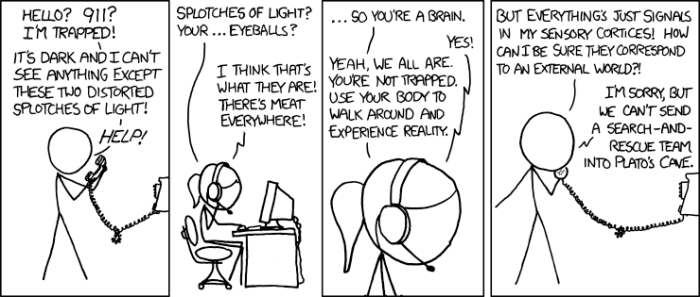
Which brings us to the XKCD cartoon (which is on my fridge.)

rescueteamplato'scave

So, what is the point of this depressing contemplation?

Well, it is exactly the point of the cartoon.  We’re all prisoners inside our own brains, victims of the narration (and narrative) behind our eyes.

So, if you realize that it doesn’t make you special, but might make you curious.

I’ve long ago maintained that movies and other visual media is inferior to books.  Why?  Because you’re observing things happening to other people.

HOWEVER when you’re reading a story, particularly first person, though others work too, for a moment it replaces the voice that narrates your life.  For a moment someone else is behind the eyes.

Powerful writing can even create the impression you LIVED something.

In other words: novels, written by people we’ll never be, about experiences we’ve never had and never will have, are the only escape from being a prisoner behind your eyes.  They’re the only way for you to truly experience being someone else.  And they’re a great way to build both sympathy and empathy for others, and a wide enough experience so that in our non-exciting times, we can grow through the harrowing experiences of others.  It also helps build up our imagination, so that we and our problems are not the sum total of what we can imagine.

So.  There are people — okay, not a lot; most of that community seem to be coff bots — who believe that we want to reduce “diversity” in science fiction or literature in general.

Even if this weren’t crazycakes on account of a lot of us being female and of foreign origin, or in my case so very diverse I often disagree with myself, it would be crazycakes for someone who REALLY enjoys reading.  The more diverse the better, particularly in science fiction.  Hell and damnation, I’ve read books whose sole recommendation was that they presented a time and place I’m not familiar with, like, say, ancient Egypt.  (I wonder why so many of those suck?)  Or ancient China (A lot of those suck too.)

Then you find out their idea of diversity is a little different: you’re only allowed to write people who are exactly like you and have had the same exact social experiences.  Because people don’t want to read anyone who isn’t exactly like them, who hasn’t had the same exact social experiences.

It is at this point that you sort of scrabble backwards going “What the heck?” and start looking for the pods.

Sure, SOME kids might need this.  In fact, some kids prefer to read books in which the character’s name is their own.  (My kids always hated that, btw, with a burning passion, because they knew d*mn well that they hadn’t done this.)

But if the kids are more than 10 and proficient at reading, I suggest they need to be weaned of that, before they ossify into the position of thinking they are unique, alone, and only someone who matches them absolutely could understand them.  That we don’t need more of.

Because it’s bridges between people, and being able to understand people very different from you that make society function, particularly a society like ours, built to be plural and where we’re supposed to tolerate non-conformists.

No, I don’t mean we should prescribe that people read books about people different from them either.  Some will never like them.  Heck, some will never like any books, and the fact our school system turns out “barely literate enough to fill a form” doesn’t help.  Reading for pleasure requires proficiency enough you can enjoy the story without thinking of the medium or the words, anymore.

BUT I think those who think diversity consists of reading in our narrow paths and only about people like us are the jailers in this jail where our own cell is the space between our eyes.

Me?  I’m not a jailer.  I’m more the Count de Monte Cristo, trying to communicate by taping with the prisoner in the next cell, and training a rat or two for company.

Because I know the space behind the eyes.  Sure, it’s safe.  But it’s boring.  The world is full of different persons and different experiences.  And history is full of even more so.  I want to escape this space and experience those things.

Plato’s cave is okay.  It’s safe, dry and comfortable.  But I want to turn around and see the world.


Story First

I have read enough about the spreading and eventual hegemony of the Indo European culture to believe that:

a) it was not a race as such, or at least not what their own members would believe is a race.  I.e. in that time and in that place, race was akin to tribe which partook “extended family” and for that matter some might have been distinct sub-races when you think of the past and how isolated some families/tribes were for how long.  (I’m calling to mind the “generations” of occupancy in some place in Siberia that seemed to always consist of a man and several women, all of them relations.  Don’t go there.  The past is not just another country.  It can be icky beyond belief.  I figure the story of Lott and his daughters happened many times.)

b) part of other tribes and families starting to ape Indo-European culture and wanting to be part of it is that the Indo-European culture was full of “glamour” for that time and place.  To wit, we’re fairly sure part of the culture was massive banquets, at which story/sagas were told, in praise of the host, but also sharing common background “history” that made people want to be part of it.  Though the Aeneid and the Odyssey are, time wise, many millennia removed from those sagas (of which only a sense remains) they would have been something like: a rousing story of shared history (even if made up or mythological) telling the deeds of heroes past and inspiring the future.  The way they were told — and note that what survives is full of action and adventure, as well as heroism, even if some of the heroism has worn poorly in our eyes, because our morals are different enough that, say, slaughtering your hosts and making off with their stuff requires at least some sort of justification — made the other tribes, isolated families that the culture came in contact with want a piece of it, want to invent a genealogy or history that made them part of it, want to join up.

Why is this important?  Or even relevant?  Or has Sarah gone down the rabbit hole of ancient linguistics AGAIN?

Well, no.  For various reasons, (only half of them family, the rest being a friend in trouble who seems totally unaware of his situation, and whom I’m powerless to help.  This is going to end in freezing under a bridge, and there’s bloody nothing I can do.) I’m actually under such high stress that I spent most of the weekend reading about Gondwanaland dinosaurs.  Because dinosaurs are what I do when the derp gets too deep.  Also, I have a planet to populate.  Not with dinos, but it gives me ideas.

But I experienced this sort of cultural glamor.  You could say it was generational.

One of the saddest things to me is that again for various reasons, mostly because when he stopped working his health wasn’t good enough for the trip, my dad never got to visit us in CO.  Dad grew up on stories of cowboys.  He read books — both fiction and non-fiction — about the American west all the time.  In fact, an old train bridge about three miles from grandma’s was used for the filming of Spaghetti westerns, and formed a great part (literally “great” as in fun) of dad’s childhood memories.

To him because of the west, to mom because of translated Hollywood gossip of the “glamor” age, and to me at first because of the image of the moon rocket (and later, because of Heinlein, for more ideological or idealistic reasons) America was the promised land, where everything fun happened, and where barefoot immigrants could become wealthy.

Mom and dad never even wanted to immigrate, but they aped a lot of the perceived culture and talked about America a lot.

Hell, the world talks about America a lot.  I assumed all countries were more fascinated by what was happening abroad until I became an exchange student and discovered international news in the US ended up on page twenty of the daily paper, if at all.  (This is both a blessing and a curse.  It allows our “progressives” to imagine the world is just like America but with a bigger social net.

It is that glamour that brought “modernity” to the rest of the world.  When I grew up it was still normal for married women to cover their hair in a scarf, but only women of the “lower classes”.  Women like mom, who were influenced by Hollywood wore their hair short and permed.  Because it was “the modern way.”  Which is why I say “the future comes from America.”

The problem is that in our own country, the glamour has turned sour. You want Russian influence?  Look at what its agents and influence did to our culture for almost a century.

They too started with glamour: the glamour of being a communist and “caring” for the poor, which slotted neatly into Christian virtues, but was ever so much more exciting and interesting, not like those pious church ladies, but more like being warriors and all that.

And since creating world communism (which was always Russian communism, because “internationalism” was always Russian nationalism.  You can tell this by how ardently old communists will still defend the soviet union, as though it were the motherland of their dreams.) required dismantling the glamour of the free market and its wealth and free wheeling culture, and “they’re like Rome in the decadence” (a crazy accusation, since Rome was more like the Soviet Union) didn’t bring us down, so they had to start picking at the flaws, and comparing us to a regime that killed 100 million people as if we were equivalent.  We still get that, like “But people starve under capitalism” (well, yes, you can’t save everyone from themselves and humans are still humans.)

But there’s been 100 years of anti-glamour.  The problem is that it’s not really that.  America’s movies and stories are still loved the world over, partly because of habit, partly because the future comes from America.

So what our stories are now doing is not just destroying the image of America abroad, but in a twisted way making the world worse, because some amount of people still want to imitate America even though they think we’re a hell hole (glamour isn’t rational.)

They’re trying to destroy America, but in the process they’re destroying all of the west, and themselves too.  And when this doesn’t automagically result in utopia, they start picking at other things and dictating what messages your stories must have: more diversity, more social justice, more–

They think this will make the world what they want. Only it doesn’t work that way.  Because they still build worlds (and yes, even contemporary fiction worldbuilds) according to what’s in their heads, and they’ve been taught to be resentful and hateful of their own home culture, and everyone in it.  So what they actually write is futures of hate, resentment and envy, which frankly builds nothing.

On top of that, they write — because message first — stories so boring that they serve as reading aversion therapy.  I mean, haven’t they noticed no one is praising the “soviet realism” novels?  (Or maybe they are.  I refuse to keep up with academia crazy.)

So what to do about it?

Story first.  Always story first.  Then trust that your view of the world will leak into whatever you write.  And write things you love, not stuff you hate.

Western culture is dying of reverse glamour.  Let’s build ‘er up.


Sunday Vignettes by Luke, Mary Catelli and ‘Nother Mike & Better Late Than No Promo – by Free Range Oyster

Sunday Vignettes by Luke, Mary Catelli and ‘Nother Mike

So what’s a vignette? You might know them as flash fiction, or even just sketches. We will provide a prompt each Sunday that you can use directly (including it in your work) or just as an inspiration. You, in turn, will write about 50 words (yes, we are going for short shorts! Not even a Drabble 100 words, just half that!). Then post it! For an additional challenge, you can aim to make it exactly 50 words, if you like.

We recommend that if you have an original vignette, you post that as a new reply. If you are commenting on someone’s vignette, then post that as a reply to the vignette. Comments — this is writing practice, so comments should be aimed at helping someone be a better writer, not at crushing them. And since these are likely to be drafts, don’t jump up and down too hard on typos and grammar.

If you have questions, feel free to ask.

Your writing prompt this week is: Temper

Better Late Than No Promo- by Free Range Oyster

*blows off dust* Testing, ein, deux, treis, IV… Oh look, the mic still works! Hello, ladies, gentlemen, dragons, and assorted riff-raff! Feast your eyes on a new load of books. So much good stuff! So many pretty covers! Indeed I have brought you a wonderful trove of tasty pulp, with many brand new recent releases including two anthologies, one of them positively encrusted with names familiar to regular visitors of the Promo Post. [You’re trying to spin a month-long backlog as a good thing? –Ed.] Pay no attention to the man in italics! This bounteous promo is simply the result of my love for all you wonderful people and people-like entities. It has nothing to do with any supposed failings of time management or email synchronization. Nothing! Speaking of which, there is a new email address intended solely for promo material: promo(at)freerangeoyster(dot)com. Just drop me a link to the Amazon page for your book, and a blurb if you want it different from what’s at the ‘zon. So go, enjoy this week’s [month’s –Ed.] haul of books, leave helpful reviews, enjoy your weekend, and don’t call me for bail money unless there’s a really epic story to go with it. As always, future entries for the promo post can (and should!) be sent to my shiny new email! Happy reading!

Jason Dyck, AKA The Free Range Oyster

Minion Wrangler, Code Monkey, and Chief Assistant to the Assistant Chief

J.M. Ney-Grimm

Livli’s Gift

Livli struggles with a secret she keeps from everyone, even her closest friends, and she must solve the problem at its heart before she’s discovered.

She’s certain the answer lies in a fragment of folklore and magic half-remembered from her childhood. Almost certain.

She wouldn’t need forgotten magic if only the men and women of her secluded mountain culture dwelt together. But the women—and Livli—inhabit their sister-lodge atop its lofty bluff, while the men live apart in their brother-lodge several valleys away.

Unless she can force a change, Livli stands to lose everything… including the most precious thing in her life: her son.

A story of secrets, shibboleths, and deep-forged strength told with all the insight and engaging intimacy that J.M. Ney-Grimm brings to epic fantasy.

M L Clark

Target Seventeen Must Die

Time traveler Jeremiah Gale kills people in the past to create a better present. He fails to kill target seventeen, but when he returns to the future, it is changed for the better. He’s on an orbital colony, everybody is friendly and kind, though a bit conformist. Gale thinks his mission is finished, but soon gets kidnapped and interrogated. It doesn’t take long for him to realize assassins from even farther in the future are hunting for somebody. Eventually able to capture one of the time travelers before she suicides, he deduces they wish to kill a novelist before he writes the novels that will bring down their fascist state. Instead of killing target seventeen, can he protect him and stop the time travelers?

Leigh Kimmel

Starlight Running

Eight lives depend on Kyle’s desperate trek across the Moon to get help. But someone – or something – intends for him to fail. Can he defeat it in time?

Pam Uphoff

Directorate School

The Directorate Book 1

What’s college without friends and enemies?

Ebsa’s reached the height of his ambitions with acceptance at the elite college that trains the people who will explore the worlds across the dimensions. Now all he has to do is survive it.

Amie Gibbons

Psychic Wanted (Un)Dead or Alive

The SDF Paranormal Mysteries Book 4

Hell hath no fury…

Halloween’s here and psychic FBI agent Ariana Ryder is ready to party. Sure, her and her boss Grant haven’t been in a good place since what happened in Miami; he’s basically acting like he doesn’t care and isn’t her friend anymore, let alone anything more, but she’s sure he doesn’t mean it. And besides, she has her boyfriend, Quil, so it’s not like she cares anyway.

And then there’s Carvi, vampire king of Miami, back up in Nashville with a warning.

That someone’s put a hit out on Ariana, and assassins are on their way.

But a psychic has a job to do, and when a ghostly curse of vengeance born from broken hearts starts killing men all over Nashville, Ariana has to psychic up and get her butt to work, cuz everything about these supposed suicides screams ghost, but it’s doing things no mere specter can pull off.

The clock’s tickin’ before the ghost strikes again, and Ariana’s going to have to face her own past to stop it.

Because it’s just set its sights on Grant.

Anthology

Calexit

When California declares independence, their dreams of socialist diversity become nightmares for many from the high Sierras to the Central Valley. Follow the lives of those who must decide whether to stand their ground, or flee!

In San Diego, the commander of Naval Special Warfare Group One finds his hands tied by red tape, even as protesters storm the base and attack dependents.

In Los Angeles, an airline mechanic must beg, borrow, or bribe to get his family on the plane out before the last flight out.

Elsewhere, a couple seeks out the new underground railroad after being forced to confess to crimes they didn’t commit.

In the new state of Jefferson, farmers must defend themselves against carpetbaggers and border raiders.

And in the high Sierras, a woman must make the decision to walk out alone…

Inn Between Worlds: Volume 1

Sitting outside of time and space is the Inn Between Worlds. Residents might say it’s a place for travelers, or a place to rest, a place to find excitement. Or they might say it’s dangerous and to be avoided at all costs because Reality Does Not Work Right inside its infinite walls.

Contained in these pages are three stories that all share one important point: Their events would not have been possible without The Inn.

“Gideon Wallace and the Sapphire Woman” is the first story in a new series by Thomas A Farmer, and shows what happens when a mortal man finds himself drawn into a fight between gods.

In “Chaos Candy,” by Amie Gibbons, supernatural bounty hunter Zee tries to uncover a dark secret and learns much more than she ever wanted to know.

Finally, Michael David Anderson’s “Flux” continues the adventures of Teddy Dormer, taking him once again to strange new places and showing him new nightmares.


Dark Fate Ten? What, again?

Sorry this is so late.  Our internet has been up and down like a whore’s drawers which made compiling past posts kind of hard, but that’s done, in this page — Here.  And now, when last we saw our heroes…

*FIRST AND VERY IMPORTANTLY, THIS IS NOT CANON. THIS IS COMPLETELY UNSANCTIONED (okay, not completely. Larry said I could do this for you guys without his ripping my head off) MHI FANFIC.
Good, now that we got that out of the way, why am I doing this? Both Grant and Fado Negro (Portuguese Monster Hunters) have minuscule parts in Guardian, the MHI book I’m collaborating with Larry Correia on. However, obviously the Portugal of Monster Hunter is not the real Portugal (Really, no arcane creatures come stumbling out of the undergrowth there. If there were arcane creatures, the country would be chock-a-block with them, when you take in account the continuous human occupation since… well, forever.) And this story gives me more of an opportunity to firm the worldbuilding. (Yes, it would be MUCH easier to do this with a notebook and noting things down, but that’s not how my mind works, d*mn it.)
Okay, that’s the rational excuse. The real reason is that d*mn Grant Jefferson won’t leave me alone. (Always had a thing for men from Patrician New England families. Ask my husband.) So I’m torturing him in order to redeem him.
Will this ever be a book? Don’t know. First Guardian will get delivered. Then, this being finished, I throw it at Larry. And then it’s his SOLE DECISION. (Which means, don’t you monkeys hassle him.) It’s his world and his character. I’m just grateful he lets me play in it in Guardian and here for your amusement.*

Dark Fate 10

There is a point at which you become suicidal.  Since landing in this forsaken country, I’d been attacked by red caps, lamias and now revenants, and no one was explaining anything, and I was half-assedly (or perhaps not assedly at all) armed and I had run out of ammo, and I was heading to “the real outbreak.”

Also, my suit was ruined, and I was now out of suits and would need to buy — shudder — off the rack, in a country where most people were way smaller than I.

I texted back “What now?” followed by “Why are we working with the private Portuguese Monster Hunters, instead of their government counterparts?”

The answer came back almost immediately: “Classified.”  And then after a second “Also complicated.”

I texted back “Grrrrrr.”  There was no answer.

“WHY are we still headed to the outbreak?”  I asked, turning my frustrated anger on my companion who was driving like laws of traffic happened to other people while the wind whipped bits of safety glass in my face, as more of the windshield disintegrated.

She turned to me and blinked “Because otherwise sea revenants are going to eat all the population of the seaside, before we get there, and then there will be more revenants.”

“But we’re out of ammo,” I said.

“Nah,” she said.  “There’s more in the trunk. More guns too.  And more guitars”  She continued driving with, as far as I could tell, two hands, while with her third hand she lit a cigarette and started smoking.  Okay, she didn’t have a third hand, but that’s the impression I got, from the fact that she never seemed to take both hands off the wheel and we were taking some pretty tight turns down this street with houses and parked cars on both sides, and yet she lit a cigarette and started smoking.  Well, at least with the windshield out I wasn’t confined in here with the cancer stick smoke.

“I can see where guitars are essential equipment for monster hunting,” I said at my most sarcastic.

She grinned at me.  “They are.  Not only do they provide us cover from being anywhere at any time, since, you know, student music groups will practice all the time in the oddest places, but as you saw guitar strings come in handy.”

I remembered what I’d seen her do back there, and also her fury at my letting myself get jumped, and I felt my face heat up.  I said, “Yeah, well.”

Seriously, I’m not usually an inept monster hunter.  I’m not usually that inept with women, either.  Watching my father and his guests at my father’s parties, I knew how to talk to women and how to act like the suave, sophisticated man of the world from the time I was ten.  It had worked in the past, even with Julie Schakelford.  Okay, only for a while, because–  Never mind.  There were times when the smooth and suave act melted, and one of them was when the woman decided they preferred a savage half polynesian or something.

But I wasn’t usually this inept, and I couldn’t understand why this woman neither reacted to my charm, nor, in fact, why I couldn’t find the charm I usually had.  Mostly this small, slim, monster hunting, guitar-carrying female made me angry.  She made me angry in a way I couldn’t even understand.

I said, “You probably can’t even play that guitar!”

She smiled, as if I’d paid her a compliment.  “Of course, I can,” she said.  “I am more likely to sing, though.  I’ll sing for you sometime.”

Damn it, I hadn’t asked her to sing for me.  This too annoyed me.  I wanted to say something cutting, something that set up my superiority over her, but instead I said, “You know, I don’t understand any of this.”

To my surprise, she reached over and squeezed my thigh.  Which is when I realized my thigh was all bruised, but I think I kept my mouth shut and my face manfully impassive.

Oh, and it wasn’t a come on.  In any other circumstances, a cute female squeezing my thigh would be a come on, but this wasn’t.  It was a weirdly friendly and reassuring gesture.  “Don’t worry,” she said.  “I understand Portugal can be bewildering for foreigners, and you’ve been having a very hard time of it.  This will calm down a little at some point, and I’ll give you a briefing, and you’ll get it more.  For one, I’ll introduce everyone better.  But right now we fight.”

We had entered a wider street, with houses set back well away from the road and surrounded by iron fences.

She stopped in the middle of the street and said, “Here, put this in your ears.”  This was rubber ear plugs, the kind of ear protection one should wear while shooting.  “They’re to protect you from the siren,” she said.

Then she hooked something behind my ear, and a mike, attached to it, got stuck on my face by my mouth.  She was doing the same.  “Testing, can you hear me?” she asked.

I said, “I can.”

She said, “Good.  We can neutralize the effect of the sirens, while still keeping in touch  Okay.  we’re about half a mile off, and the reports aren’t good.”

The reports, or at least I assumed that’s what they were, were coming in in a jibber jabber of Portuguese though the ear thing.

“Speak English,” Silvia said, sharply.

“Don’t see how much good that will do,” a male voice said.  “We’re being slaughtered out here.  We’ve dropped back to the circumvalacao and the police are closing it to traffic.”

“How many revenants?” Silvia asked.”

“Thousands,” the voice said.

Just then, we came across a police barrier.  Sylvia spoke to them, and they let us through.

We crested the road, and up from the ridge glimpsed the beach.

It was covered in undead, all shamblinging, limping and leaping towards us.

We weren’t going to get rid of them with bullets, blessed or not, and guitar strings so weren’t going to cut it.

“Merda,” Silvia said.

I agreed wholeheartedly.

(This is part one of this chapter.  Part 2 next week.  Between the internet issues and reading myself up to date on this, I haven’t had time to do more, but I promise longer next week.)

Sorry, Dark Fate Later

Spent the morning in medical appointments (no, nothing serious, but due to various relatives dying this year, a lot of travel and other issues, I dropped everything on the floor re: follow up on the thingy in the brainy and so on.)

Today it was doctors in the springs, (an hour away.) We’re going to move our doctor, but honestly, not until some stuff that was halfway through is stabilized.  Also the doctor in Denver (neurologist) also takes us an hour, because — argh — Denver traffic.

I want to clean up and set up a tab for Dark Fate, then write next chapter, but obviously the morning was NOT conducive to this.  So I’ll try to have the next chapter for you soon, but it’s going to take a while and MIGHT be tomorrow morning.

Guardian is with Larry now, and we should be able to deliver it on time.

I’m trying to setup a “bible” for the Dyce books.  I did it sometime in August but the file has more or less vanished into thin air.  I can’t finish the fourth book (editing) till I have it on hand again.

The things I’m trying to get out this year, before the end of December, A Well-Inlaid Death (fourth Daring finds book), Royal Blood (2nd Vampire Musketeer book), The Musketeer’s Confessor (sixth Musketeer Mystery book), and if I can get it typed in, what will now be called Alien Curse, the first book of Worlds Mage.  Oh, also if I can finish it, Witch’s Daughter, the sequel to Witchfinder.  I also want to resume posting chapters of Rogue Magic.

That’s about it, but Dark Fate either today or tomorrow.  How soon depends on how soon I get home.  This is hard to do remotely on a little screen.

Possess your souls in patience!