The Masquerade is over by Charlie Martin


I’ve wanted to revive the term “yellow journalism” for a while. It originally came from the “newspaper wars” between Joseph Pulitzer’s New York World and William Randolph Hearst’s New York Journal, and was named for the comic strip The Yellow Kid, which eventually ran in both papers. Both papers were known for outrageous and inflammatory headlines and a certain respect for facts, although the story of Hearst’s promise to Frederic Remington — “You furnish the pictures, I’ll furnish the war” — is itself apparently a myth and a bit of yellow journalism.

But the distinction between “respectable journalism” and “yellow journalism” has always been less than its reputation would suggest — going back to Walter Duranty’s Pulitzer Prize for his heavily propagandized coverage of the Soviet Union and the Holodomor famine that killed 10 million Ukrainians. The Pulitzer, considered the non plus ultra of journalistic honors, is actually named for one of the originators of yellow journalism.

Still, legacy media like the New York Times and the “respectable” major news networks tried to maintain the the fiction that they strove for fair and objective reporting, and that anyone who claimed otherwise was trying to “work the refs” and revealing their own bias.

Then along came Fox News. Fox did two unheard of things: first, it drew a careful distinction between its daytime news coverage, and its nighttime opinion; second, taking a markedly more politically conservative tack in that opinion coverage.

Arguably, there was a third distinction, because by trying to actually cover the news fairly in the daytime hours, they looked politically conservative compared to the news coverage on the other networks.

And then along came Trump.

Trump was a massive shock to the system. he had billions of dollars of his own. There had been other unconventional candidates, like John Anderson, and more notably H. Ross Perot. Perot also had plenty of his own money, but he tried running as a third party candidate. Trump correctly recognized that the US election system was heavily oriented to the two major parties, and had been since before the Civil War. Rather than swim upstream like Perot, he decided to run for a major party’s nomination.

Besides the third-party handicap, Perot had a gratingly whiny nasal voice and the stage presence of a tobacco auctioneer or carnival huckster.

Trump, by contrast, had more than a decade as a reality-show fixture in The Apprentice, and numerous cameos in film and making fun of himself in appearances in places like Saturday Night Live. He was engagingly willing to be the butt of their jokes and even make fun of himself. Unlike Perot, his presence in the media was not immediately painful.

Then he ran for president, and what’s worse, ran for the Republican nomination, even though his policies were more like a Truman Democrat or an early FDR.

At first, the legacy media saw him as a bit of a buffoon, a sideshow but interesting. And besides, what chance did he have against the Obama machine and against Hillary Clinton, when it was clearly her turn?

So Trump got an immense amount of “earned media” — publicity gained through something other than paid advertising. It’s publicity you don’t have to pay for.

Then.

He won.

The nomination.

… and the legacy media turned on a dime. He wasn’t an amusing buffoon any longer, he was a dangerous demagogue. At the same time (we now know) the full power of the Obama Administration and much of the Intelligence Community turned to undermining his campaign and preventing his election.

And the son of a bitch won anyway.

This was simply and obviously unacceptable. Something must be done.

At this point, the traditional categories started to break down. No matter their political inclinations, the embedded bureaucracy and a good part of the political commentariat turned out to be utterly conservative in the old-fashioned sense of a desire to preserve and maintain the status quo ante — change as change was bad, and particularly change from outside the hallowed Ivy League idea of acceptable thought. And never mind that Trump, as a graduate of Penn, was an Ivy Leaguer himself — Penn was only a sort of junior varsity of the Ivy League. Besides, Trump was brash, had a Queens accent, and while okay, he was rich, he had made that money by building things, instead of something respectable like financing corporate takeovers or international currency manipulation.

He was a threat to the world view of the embedded and conservative — in the old sense — power structure. He was, simply, “not our kind.”

At that point, the masks must come off, and they did. The New York Times was calling for resistance in the first weeks of Trump’s first term. In the meantime, we now know, highly-placed FBI agents were reassuring one another that they would stop Trump somehow, while the Obama Administration and the Clinton Campaign were doing everything, legally or otherwise, to attack Trump.

Some examples — Jorge Ramos said in 2015 that “neutrality is not an option.” Christian Amanpour argued that journalists couldn’t remain objective in November 2016, just days after the election. The Washington Post changed their slogan to “Democracy Dies In Darkness” in February of 2017, and columnists like Charles Blow in the New York Times was urging a fight, not just reporting.

To those of us of a conservative bent — although I maintain I’m not a conservative, just an 18th century liberal — this wasn’t a surprise, going back to the coverage of the Tet Offensive in Vietnam. The difference was that Trump, with his combination of in-your-face advocacy and refusal to follow the Acela Corridor line, finally forced the legacy media to remove its masks. It is, and has always been, advocacy media and not objective at all.

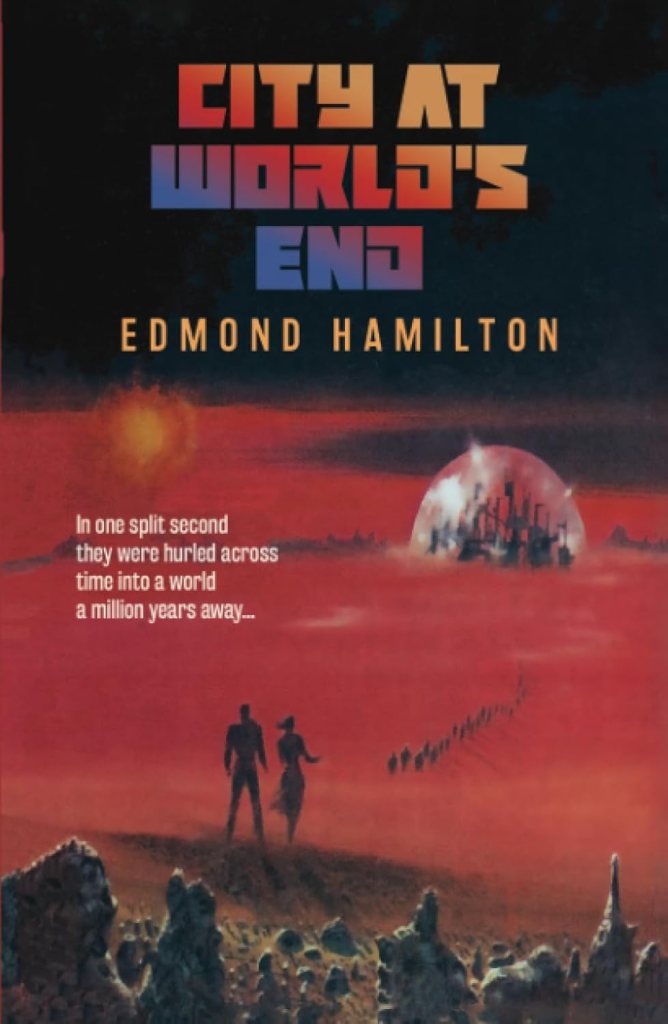
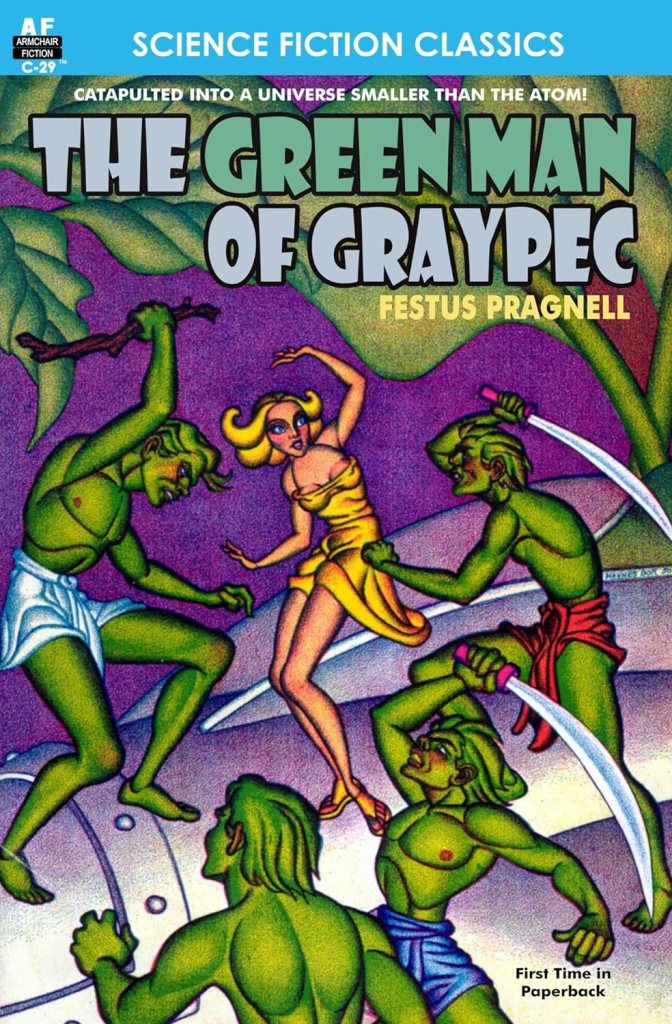
The City At World’s End by Edmond Hamilton

You guys really must tell me if my trips back into the memory lane of science fiction bore you to death. I’ll continue making them, and probably keep notes — because I’m old and have hit my head a bunch of times — but not inflict them on you.

For those who are not aware of what I’m doing, this is the initial post.

The short version is that I was introduced to science fiction via a friend of my much older brother’s. His friend had a real library and all the books of the only dedicated Portuguese science fiction imprint, the storied Argonauta. This imprint was so formative for me that when I established my own press I looked to see if I could name it Argonaut. Unfortunately at least at the time there was a gun/war oriented imprint by that name in Colorado, and I couldn’t use the name.

However I didn’t read the books in order, and might never have read all of them (again, having been hit on the head once too many times my memory is no longer eidetic so I don’t actually remember.) In Portugal the print runs were always too small and there were no reprints. This meant that finding the books after the initial distro depended on luck: someone else’s library, used bookstores or the spinner rack in some tiny tobacconist in a forgotten village. (Where I found a treasure trove of Heinlein’s in the 70s.)

Having found the listing online back in 2016, I decided I would read it from the beginning and blog it, and then…. Well, by the time I got around to it it was 2018, we were in severe financial distress, our older kid was getting married, I got ill and and and–

Now here we are. And now I don’t have any more kids to marry off, so the time has come to do this, unless you guys say I’m putting you to sleep, in which case I’ll still do it but not inflict it on you.

Today’s victim is Edmond Hamilton’s The City At World’s End. Next Week’s is Murray Leinster’s The Last Spaceship. (If you buy through these links I get a tiny commission. Just so you know.)

So, the City At The World’s End: first, what a lovely evocative name, isn’t it? It just gives you shivers, like science fiction was supposed to.

Second, I loved the writing style in this book. That probably sounds strange. But I absolutely loved it. It’s spare and tight and stark and beautiful. Reminded me a lot of Clifford Simak when he was on his game. In fact it reminded me so much that when I looked up Edmond Hamilton I was shocked that he was not a journalist. But no, he seems to be one of those rare science fiction writers — then or now — who was just a writer and didn’t have an arm’s long resume of weirdness to lean back on.

The book itself is weird. I enjoyed it a lot, but it could be argued and other reviewers have argued that it’s fractured, and seems not to cohalesce front to end.

I kind of understand them, because it’s a deeply philosophical book (also reminding me of Simak) but the question it explores is not the same it begins with. And yet… And yet, the book is almost a collection of the fears, the mind set of the mid-twentieth-century. It might at that have resonated more with me because I’m a cold war baby. Born too late for anyone to believe in duck and cover, I was told someday the hammer would fall out of a clear blue sky and then our choices were die or die. (Rest assured privately I’d decided I was not going to die, just to spite them. Which is, basically, the story of my life.) Honestly, it’s a wonder any of us, the kids from that time, grew up to be sane. Those of us who did, it’s like we blocked out the doom and gloom and just decided we’d do well and that was that.

Anyway, the book opens with our nightmare back then. John Kenniston, (Ken) works in a laboratory in a small town on the prairie (Middletown) where he does war-related research of some sort. The locals think it’s just an industrial laboratory. These locals include his girlfriend/fiance, Carol.

On a fine morning, Ken is on his way to work when a Super-Atomic-Bomb blows up above the town. This is told in an absolutely passionless way.

In the aftermath, people are shocked to find that they are alive, there is no radiation. But their entire town has been moved millions of years into the future to a time when the sun has become a red dwarf and the Earth is barren and frozen.

They find a domed city on the plains, an abandoned city of their future which allows them to survive. But they’re obsessed with the idea they’re the last of the humans of Earth. So, they blast out a call “Middletown calling”.

Eventually they are answered from the stars, where humans have gone and found other sentients too.

From that point on we are exposed to the overweening might of a Star Federation which decrees the stranded humans must leave the Earth, since it’s dying. They have autocratically moved other populations before. It is not well received by the people of Middletown, who’d rather die on their own terms than be ordered around by distant, faceless authority.

Enter a genius, who has some process–

I will be honest, I’d much prefer if this were a process someone from Middletown — preferably our hero — comes up with. Yes, it would be more implausible, but also would make for tighter and more satisfying plot. But this might be just me making a critique as another word slinger. It’s probably not valid, really, because “I would do it this way” doesn’t mean it’s how it should be done.

But there’s a trip to Vega, there’s a blond from the stars, Varn Allan, there’s weasely bureaucratic scheming, and the romance isn’t even forced, really, even if it’s truly embryonic as it ends, and the “Because you were warmongers” isn’t overloaded and no one really acts like we humans of the 20th (well, I was made then) are inferior. Not really.

I really liked the way the Americans of the plains of the US tell the Star Federation and their incontrovertible laws and commands to put it in their pipes and smoke it. I liked that the rebellion isn’t looked down on.

Because to me, ultimately, this was a collection of the knotty problems of the 20th century. I think the novel escaped the author, as his subconscious decided to work through some stuff. This is so much how my own best work happens, that I’m not going to throw stones.

The fear of the bomb collides with the then popular idea of world-government, only this time on a larger scale, with the peacenick idea that war is primitive, with a lot of ideas that festered then and that we now are fairly sure were always bokum.

Oh, yeah, and in the end, improbably, the individualists of the small town USA win which is just perfect.

I will add this was probably more bittersweet to me, because I have been in love with small town USA in the mid twentieth century long before I came to the US, having fallen hard for it through the stories of Clifford Simak.

And though the cities we lived in were larger than that, Colorado Springs when we moved in still retained the small town feel and the small town occasions.

This was particularly bittersweet as for most of my time in the US these cities have been dying. Now? I don’t know. It’s entirely possible the seismic (“world revolutionary”) changes of the last few years and the next few will change that.

I hope so. There is a dignity, a strength, a community that doesn’t crush the individualism characteristic of America, in these small towns. I’d love to see them flourish.

Anyway — Despite its possible flaws, or maybe because of them, I greatly enjoyed The City At World’s end, and will be looking for more for Edmond Hamilton. I’m sure I read him before, but weirdly, I didn’t remember his name at all.

Next week, onward to The Last Spaceship.

Man-Hours

Yes, I’m still doing the reading myself back through old science fiction, but post probably tomorrow. I’m JUST starting to function so things will be a little off schedule.

And speaking of old science fiction, I keep remembering an old-science fiction where the unit the dollar was based on was the “man-hour”, ie. how much work a man could do in an hour.

This tied in in my brain — forgive me, I’ve been feverish for the last few days — with the fact that every year I seem to get busier. And I have a never ending list of things that I MUST do this year.

I’m not alone, either. Most people are… hustling. They have the thing that do that brings them their main money, the secondary thing they do for money, the third thing they’re trying to learn to upgrade thing one and thing two.

I’m not talking about having multiple jobs because one job doesn’t pay enough. That is a problem caused by illegal labor and forbidding teens from working and a bunch of other things, including stupid MBA tricks.

No, what I’m talking about is the people in my circles — who are, almost to the last person, smart, self-actuated, hard working — and who get busier and busier every year, even those of us reaching retirement age.

It finally clicked. It’s not a bad thing. It’s that our man-hours are increasing in value.

Let me explain, take me … 20 years ago. There was one thing I could do. I could write books and submit them. The books would then sell or not sell. I could optimize my value per hour by writing to the house. I.e. since I was in Baen, there was a certain type of book they’d accept. Same for the mystery publisher, for that matter.

I’m not even talking about matter or content, though there was some of that. There is a touch-feel to the books that will sell and where. But more importantly, if I had an idea that could be sufficiently told in 20k words, I couldn’t sell that. Heck, I couldn’t sell 40k words or 60k words. It had to be 80k words or nothing. And the same thing for the current monster which will weigh in at 250k words. I can already imagine the “no. It’s too long.”

So– So I wrote what I could, and put up with it.

Nowadays not only can I write and market whatever crosses my mind, but there’s a million things I can do to make them sell better. From learning publicity, to improving covers, to better typesetting.

You’ll say I outsourced that to others and you’d be right, but that also reduced how much I was worth to me. I now can make things sell better, goose them with a little extra time/effort.

The same with other side things. I’d like to start a podcast (eventually he’ll remove the boxes from my audio booth. After taxes, likely. Right now I don’t have a voice anyway) that is a reading, a talk, sometimes interviews with my friends, etc. I’d like to do short animated movies (I have been playing with animation programs) which I think can exponentially work to promote the books. Or at least some of the books.

And needless to say I want to write. I want to write all the things that I couldn’t write for trad pub.

The point is that every hour can be filled with activities that will certainly pay at least some, and probably/possibly a lot. The potential man-hour is near endless. And not just for me. I’m using my own situation, because it’s easier, but I think each of you could give the examples.

Two conclusions from this:

The first is What a time to be alive!

If they’re right and you live longer when you’re involved and interested? I’m gonna live forever. (Now, can we work on that forever not being taken up with hacking a lung?)

The second is… If you’re one of mine, one of the people who feel pathologically obligated to maximize your value and effort in the world (born owing money) you have to learn to take breaks. You have to learn to pace yourself. And you have to carve out time when you’re not “on”.

I say this as someone who sucks at this. I am aware the fact I forget to take time off leads to my getting sick, which leads to my falling behind, which leads to my forgetting to take time off as I’m catching up, which leads….

I told Dan the other day my happiest time in recent years was a mini vacation we took in September. We spent two hours walking around a car museum, and in my head this keeps shining like a golden moment. Oh, what fun we had!

This is stupid. I mean the fact we don’t have more of these times. Hence the serious talk on how we need to do a weekend every two months or so, so that we decompress.

Because yes, our man-hours are more valuable in potentia than ever, but the body is still mortal and made of flesh, and the d*mn thing just gives out unexpectedly. Particularly if you’re over sixty.

So, rejoice in your potential, but make time when you say “yes taking time off costs me money, but I’m worth it” and take a break now and then.

I will tell you this is not how I thought it would be in my sixth decade.

And I’m very glad it is.

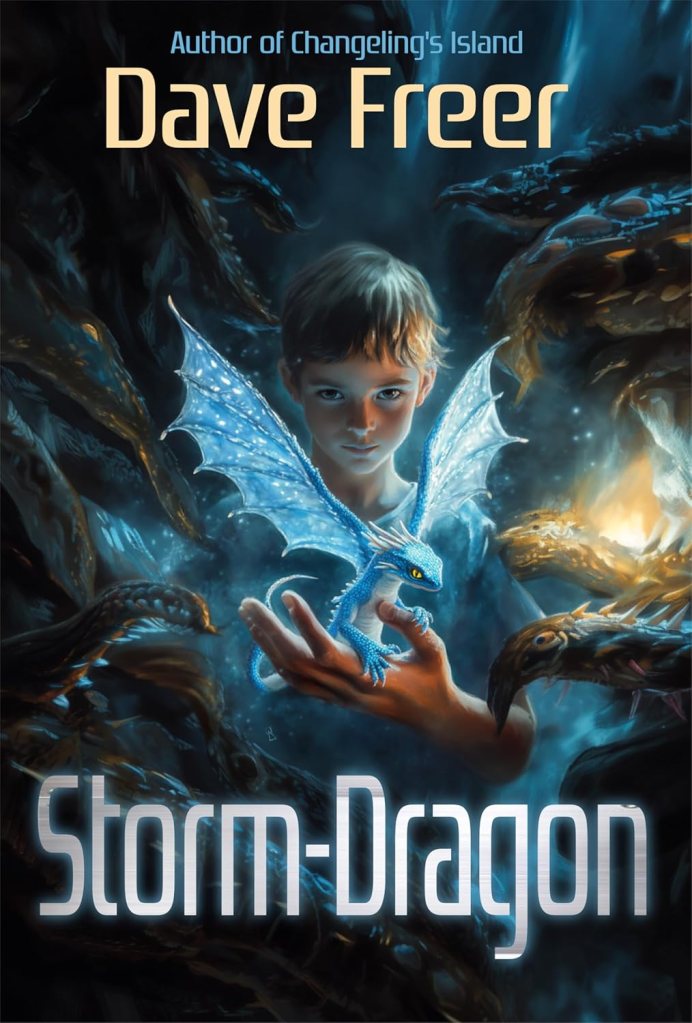
STORM-DRAGON by Dave Freer

Writers… do shape future, as well as reflect the present. Often those reflecting the present will tell you they’re affecting the future. That’s usually because they LIKE the present or certain trends in it. It’s why the Left were so determined to capture the institutions and publishing and the media. They saw them not education or entertainment, but as tools, first to start things down their course, and then to keep it going that way.

I’m afraid, certainly as far as publishing goes, and reading and the effect thereof goes, we’re heading toward an Eloi/Morlock path. Remember, not the endpoint H. G. Wells referred to – but the part where the ‘beautiful ones’ lived lives of happy indolence, sex and ‘art’ while the Morlocks worked underground to feed them. Remember too, the Eloi got idle and stupider and stupider – as the selection pressure to be intelligent and hardworking was stripped away.

The US Left seem to see themselves as the beautiful ones, and the rest as Morlocks, to be kept underground (or at least out of their sight. Ignorant, separate, lesser…) It doesn’t make a lot of sense mathematically or any other way, as Eloi are effectively unskilled, defenceless, and, as heterosexual men – particularly of their own culture or even genetic heritage, are definitely Morlocks, the Eloi are doomed long before the Morlocks eat them.  It’s a kind of short nasty future, unless you have the weird assumption that the Morlocks will defend you, feed you, and maybe breed you parthenogenically.

My problem is that I have no interest in being a Morlock. Or having my kids, grandies, family, friends be Morlocks to provide for and defend the wanna-be Eloi.  They are welcome to be Eloi in their own minds and on their own dime.  This is not the future I am prepared to surrender to them. Humans may be a PITA, but I’m not having my descendant – or those of my friends, descend into being a servant class to a bunch of ‘beautiful ones’ – not even if the beautiful ones end up as roast dinners. The only thing I’d like less is having my people forced to become ‘beautiful ones’ (beauty is, we note, a matter of opinion. Some people find nose rings attractive.).

But… if they control the levers of culture, education, and publishing, and are pushing the world by it toward a suicidal and nasty end for Western Civilization if not humanity (because it will be. Messy and totally unlike their dream) what’s to do?  Well you can either say ‘they control nearly everything’ and just give up. Or you can fight back.  I guess I don’t have the genes to be a ‘hensopper’, so  -as the song says  ‘when they poured across the border, we were cautioned to surrender. This I could not do. I took my gun and vanished.’ (Leonard Cohen. The Partisan).  Gradually, despite the left’s determined efforts to make it feel like we were fighting alone (and I know a few good writers who just gave up, in the face of character assassination, silencing, exclusion and de-platforming) we have come back from the shadows – at least in publishing. For years it was just Baen. But now there is Indy, and a number of small publishers. The ‘beautiful ones’ still seem to be stuck on supporting the Trad houses they infiltrated and took over.

Late last year, I got a message from a friend who does some production work for one of these small, fighting-their-way-up new publishers – Raconteur Press. They had mostly done anthologies, but they were putting out an open call for books for boys. Books down the line of the Heinlein Juvies – to fill up a niche the beautiful people of publishing had declared dead, now geared to generate the Morlocks to serve them. Boys could read either nothing at all or books that would teach them their place in ‘beautiful ones’ future utopia. 

Only, there are a lot of parents who don’t accept that for their sons. They don’t want it for their daughters, the ones that don’t want to be Eloi or marry someone destined to either not read (and be unable to venture into the infinite worlds of the unknown) or be part of the underclass.  Still, the wanna-be Eloi ensure that reach into libraries, schools, bookshops and certainly any mass media mention is a no-no.

To even try is crazy.

So: of course, I did it.

STORM-DRAGON is sf. I set out to write Heinlein Juvie. The kind of book, that despite having a younger lead protagonist would be fun for anyone. I was inspired by two stories – one in the US and one in Australia – where bureaucrats wanted to kill ‘rescue’ wild animals – common baby wild animals that would have died had a human not stepped in. Having grown up, and had my kids grow up with a succession rescued of small animals – some of which died, some of which went back to nature, some of which lived a good life among humans, antelope, various rodents, snakes, and birds and a bat… my sympathies were NOT with the bureaucrats. There is a surprise for you all!

My hero – a boy having a rough time — finds and rescues a small alien creature. It’s a strange, dangerous world this human colony is on, and the little creature is both electrosensitive (it can detect electric fields of living things as many fish can) and can also generate powerful electrical shocks – a storm-dragon. He’s not allowed to have native life-forms inside the human habitat, say the bureaucrats. But if he leaves it, it will die.  He’s not going to leave it to die.

 In strong contrast to most of the Trad offerings, this is set among normal families.  Mums and Dads who love their kids, and are loved by them. And actually, I don’t give a rat’s butt-end if you think some of the gender-roles are typical and that none of the heroes are top of the victim hierarchy. They’re supposed to be real people you might meet, not Eloi. They’re boys, and they like boy practical jokes and doing boy things.  They don’t waste pages on angst or feelings – these exist, but they aren’t the story.  They are boys becoming men, with the honor and dignity and the price of that.

So: Storm Dragon is up for pre-order. We need critical mass, or the Eloi win. Stand against them.  ‘We need to come from the shadows and then Freedom soon will come.’

Buy Storm Dragon.

A Choice of Evils

Let it be established that taxation is theft. If I were all three branches of government (Puts puppet heads on every finger and toe) I’d finance the government through a naitonal weekly lottery.

Sure, it’s a tax on stupidity, but at least it’s a volunteer-paid tax. And it’s not just stupidity. Yes, I know odds, but I do sometimes buy a lottery ticket. Because I’m buying something real. No, not the chance of winning, or not exactly.

In the most depressed, hopeless times in my life, we bought the lottery fairly often. The trick was to buy it early enough. You see, if I bought early enough I had pretty much a whole week of dreaming. Yeah, I knew how unlikely the odds were, but it was POSSIBLE. Which meant I could look at multimillion dollar houses, I could dream of the perfect library. And it helped me get through the horrible times.

So there is some value in return for the lottery ticket and $2 — or $1 back when we used to buy it — is well worth the dreaming and the mood uplift for a little while.

So, if I were all three branches of government that’s exactly what I’d do. I’d do a national lottery. And then chop the government to the limits of its constitutionally allotted powers, so that I didn’t have to worry about the money shortfall from that.

But darn it, no one has put me in charge of everything. Honestly, they probably shouldn’t. If stress were energy, I’d generate enough just trying to run my regular life, to power all of our great cities and a few of the smaller ones. Having that kind of responsibility on my shoulders would make make me blow up or something.

That said, tariffs are taxation and taxation is theft. And after a while, any form of taxes strangles, and it’s like getting blood from a stone.

So yeah, on principle I’m against tariffs, but I’m against income taxes too.

I’ll preface this saying that I, like everyone else, has no clue what Trump is playing at with tariffs. I do know there is, probably, a tax cut coming for most people. There have been rumors of abolishing income taxes and the man has a tendency to do what he talks about.

So maybe that’s the intent. He puts in tariffs, abolishes taxes. Is this what I want? No. I told you what I wanted up top.

But again, what we get as choices in this world is not cake or death. It’s usually more like a light beating or a serious scratching. So to put it to coin a phrase.

If he puts in tariffs and actually gets rid of the income tax, is this a good thing?

I could argue it is better, relatively. Considering how intrusive, confusing and stifling our tax system has got, tariffs are less intrusive in our lives.

Sure it controls what’s available on your shelves and at what price, but it at lets you NOT be complicit in your own theft. I mean, the current taxation system doesn’t only take our time. If you run any business at all, it requires you to keep records at the expense of time and space. It forces you to file multiple times a year, at more time expense. It forces you to not only hand money and time over to the intrusive government, but to convince them that you’re paying all they think you owe.

The current tax system has the ability to suppress activity and encourage malactivity, it has the ability to make powerful men control who gets to speak and who has to shut up. I’m not convinced that the philosophies of progressivism combined with our tax policy haven’t been shaping economic activity and science for a hundred years. It’s not all as blatant as the Green Nude Heel. Or the fact that for the last decades all scientific funding has come from the government.

But I’m sure there’s been other stuff. The power to tax is the power to destroy. As annoying as tariffs would be I don’t think they can be nearly as bad as the intrusion into every nook and cranny of our lives.

Would I prefer another form of pummeling like, say, national sales tax? Sure, maybe. Provided that it doesn’t turn into a VAT on every step of the process of getting things to the shelf. I’ve seen that “work” in Europe.

Tariffs does have something else to it. If — as likely — they are used to shape foreign diplomacy, they do fall under the purview of the executive. There is a good chance that a president will need to, say, discourage the manufacturing of computer chips abroad. In case of war or disaster, as we found through the covid thing, it can be a serious deal when your medicines, your computers, everything you need is manufactured abroad. This is particularly bad when one of your main suppliers is actually a all-but-declared enemy.

So in that sense the ability to slap tariffs is actually an important power of the executive.

Yes I do realize a tariff war could take down China. Would the country that took down the USSR through economic war with not a shot fired be surprised by that?

As for the EU, poor EU. At this point their falling apart in their attempt at hyper centralization might be the best thing since sliced cake.

As for tariffs? Is this death or slightly less death? I don’t know. And neither do you.

So let us lean back, chill and wait to see what develops.

I don’t expect this to affect the comments, of course. I expect a right donnybrook in the comments, and I hope my assistant can help me with that.

You see, after almost a week of not sleeping due to cough, I dropped onto benadryl, which allows me to sleep but makes me zombie like. Notwithstanding which, heaven forbid it, I’m going to try to continue/finish the deep revision of No Man’s Land this week.

And now release is May with luck, but probably June. If my body wouldn’t fall apart, I’d feel better.

However, one thing I can say: If I have to struggle with health crazy, at least I’m doing it the most interesting time line of them all….

Book Promo And Vignettes By Luke, Mary Catelli and ‘Nother Mike

Book Promo

If you wish to send us books for next week’s promo, please email to bookpimping at outlook dot com. If you feel a need to re-promo the same book do so no more than once every six months (unless you’re me or my relative. Deal.) One book per author per week. Amazon links only. Oh, yeah, by clicking through and buying (anything, actually) through one of the links below, you will at no cost to you be giving a portion of your purchase to support ATH through our associates number. A COMMISSION IS EARNED FROM EACH PURCHASE.*Note that I haven’t read most of these books (my reading is eclectic and “craving led”,) and apply the usual cautions to buying. I reserve the right not to run any submission, if cover, blurb or anything else made me decide not to, at my sole discretion.SAH

FROM DAVE FREER: Storm-Dragon

On the treacherous Vann’s World, Skut battles a savage wind and deadly hamerkops to rescue a mysterious, telepathic creature. Fleeing a rising tide and a menacing Loor-beast, he forms an unexpected bond with the tiny, electric-charged being that sees him as its protector. As Skut navigates the perilous tidal tiers, his impulsive escape from Highpoint Station unravels into a fight for survival—both for himself and his newfound companion.

Podge is the new kid in town, trying to keep his head down. Meeting Skut is about the only bright spot in his introduction to this strange new world. The boys bond over Skut’s creature, and trying to avoid the class bullies. This is only the beginning; soon Skut finds his new friends do not ease the growing concerns of the adults around him while the town is coming under a mysterious threat. What can two boys and a tiny storm-dragon do?

FROM MEL DUNAY: Marrying A Monster (The Jaiya Series Book 1)

New, professionally edited edition! Journey to the country of Jaiya, in a world not quite like ours. Here, humans ride trains, drive cars, and use cell phones, but they share their world with insect people and trollfolk, and stranger things lurk in the shadows… As a favor to her parents, Rina agrees to come back to her hometown and take part in an old local custom: a symbolic marriage between the town’s women and the Mountain King, a mythical guardian spirit no one really believes in. But the Mountain King really exists: a monstrous being that feeds on fear and suffering. Rina’s only hope for survival may be Vipin, the dashing scholar hunting the Mountain King, but Vipin is hiding a few secrets of his own… Note: Rina and another character are friends with or related to a few characters from the later books in the Jaiya series, but Monster is meant as a standalone.

FROM J. MANFRED WEICHSEL: Not Far from Eden

Jealous angels with no genitals discover the passion and ecstasy that humans experience through sex. In revenge, the frustrated but impotent celestial beings banish the men to the wilderness. Will the women save the human race, or will they become the mothers of great evil?

FROM MARY CATELLI: The Enchanted Princess Wakes

Once upon a time, a princess was cursed at her christening — but not the one you heard of.

When the fairy decreed that Rosaleen would fall into an enchanted sleep, and how she would wake, the grand plans of kings, to unite kingdoms, failed. They sent her to an out-of-the-way castle in the mountains, in hopes the curse would do no harm to anyone else.

There, alone, Rosaleen lived and learned, and realized that she herself had to be ready to face the curse, and when it broke.

FROM DALE COZORT: Earth Swap: The Stone Library of Venus

Near-future Earth suddenly finds itself in a different version of the solar system, one where human civilizations trade and war between planets. Lurking behind those humans: the long-vanished non-human “Builders,” who colonized the solar system long ago, seeding it with Earth life. Ward Parke, astronomy enthusiast and presidential advisor, wants to explore this new solar system, but the planets here are on the verge of a genocidal, civilization-ending interplanetary war.
Our Earth is caught in the middle of that looming war, with technology hundreds of years behind the other powers. Its only advantage is an ancient stone library preserved by a now-vanished human civilization from Venus and a mysterious woman called Pandora who may be that civilization’s only survivor.

FROM HOLLY CHISM: Meals on Wheels (Liquid Diet Chronicles Book 4)

Not by the (nonexistent) hair on her chinny-chin-chin…

Meg Turner, vampire, accountant, ruler of her own small territory. Has a nice ring to it, doesn’t it? Not if you ask her, it doesn’t. Because the world’s going mad, the idiot mortals in charge are forcibly shutting down the economy without the understanding that it won’t start up again as easy as it’s going down, nor that it’s creating a nasty blood shortage for hospitals, much less vampires.

Even better, the head of her line is invading her dreams again, and teaching her history of all things. And teaching her about the laws, and why they’re there. It’s not just to avoid being noticed by humans capable of staking, beheading, and burning vampires during daylight hours—a vampire that breaks fundamental laws turns into something worse than a vampire.

And she’s got a bunch of those knocking at her border, wanting to come in. Worse yet, they’re sending their day-help into her territory to kidnap their meals, and they keep mistaking her for prey. And leaving their discarded empties in her territory to make it look like she’s draining humans without concern for the laws.

This really isn’t looking good, and it’s really not safe for her still-living friends and family.

FROM KAREN MYERS: The Visitor, And More: A Science Fiction Short Story Bundle from There’s a Sword for That

A Science Fiction Story Bundle from the collection There’s a Sword for That

THE VISITOR – Felockati is anchored to his permanent location underwater and misses the days of roaming his ocean world freely.

But something new drops out of the sky and widens his horizons — all the way to the stars.

YOUR EVERY WISH – Stealing the alien ambassador’s dagger is a sure thing for Pete — just what he needs to pay off his debts.

Until he starts talking to it. There has to be a way to get something for himself out of the deal. Has to be.

FROM SARAH D’ALMEIDA (YEAH, ME): Death of a Musketeer

When D’Artagnan, Athos, Porthos and Aramis discover the corpse of a beautiful woman who looks like the Queen of France, they vow to see that justice is done. They do not know that their investigation will widen from murder to intrigue to conspiracy, bring them the renewed enmity of Cardinal Richelieu and shake their fate in humanity. Through duels and doubts, they pursue the truth, even when their search brings them to the sphere of King Louis XIII himself and makes them confront secrets best forgotten.

Vignettes by Luke, Mary Catelli and ‘Nother Mike.

So what’s a vignette? You might know them as flash fiction, or even just sketches. We will provide a prompt each Sunday that you can use directly (including it in your work) or just as an inspiration. You, in turn, will write about 50 words (yes, we are going for short shorts! Not even a Drabble 100 words, just half that!). Then post it! For an additional challenge, you can aim to make it exactly 50 words, if you like.

We recommend that if you have an original vignette, you post that as a new reply. If you are commenting on someone’s vignette, then post that as a reply to the vignette. Comments — this is writing practice, so comments should be aimed at helping someone be a better writer, not at crushing them. And since these are likely to be drafts, don’t jump up and down too hard on typos and grammar.

If you have questions, feel free to ask.

Your writing prompt this week is: Mask

A snippet from 9 AD: The Crossing of the Rhine by Tom Kratman

9 A.D.: The Crossing of the Rhine, Copyright © 2025, Thomas Kratman

Dedication: For my friend, General Claudio Graziano, of Turin Italy, and, further, of Italy’s fine Alpine Troops.  22 November, 1953-17 June 2024

Chapter One

[W]ho would relinquish Asia, or Africa, or Italy, to repair to Germany, a region hideous and rude, under a rigorous climate, dismal to behold or to manure [to cultivate] unless the same were his native country?

— Tacitus

Northwest Germania, September 9th, 9 A.D.

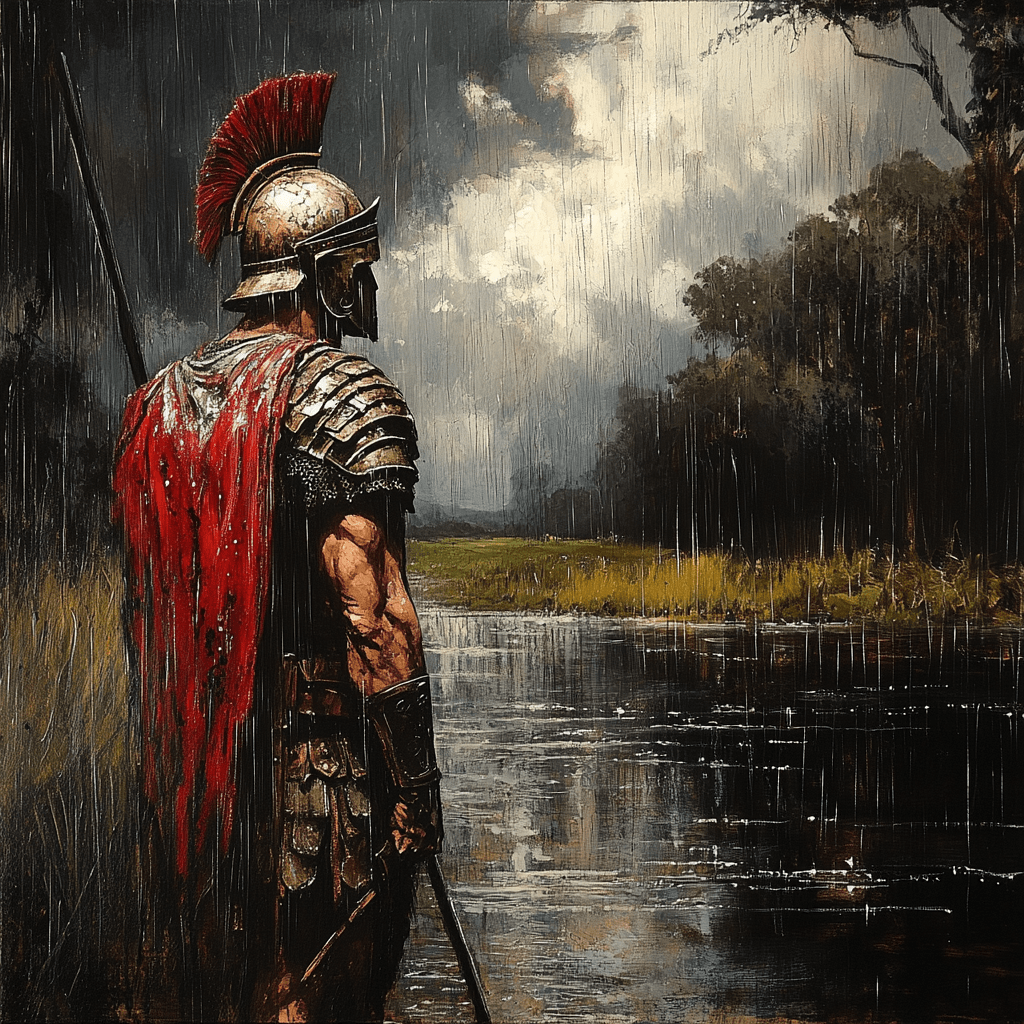
Rain poured from a leaden sky onto twenty thousand miserable, shivering soldiers of the Roman Empire.  To add to the misery, a cold northwind swept around them, finding the holes in their cloaks and the chinks in their armor, chilling them to the bone.  The forest around and above them did nothing to shield them from either wind or rain.

Two men, a junior officer and what later generations might have called a
“regimental sergeant major,” stood in the rain, trying their best to look unworried.  The five or six thousand men with them might collapse if they saw fear on the faces of their remaining leadership.

“What was the name of that town, Top?” asked the officer.  “The one on the Lupia River, about a week’s march east of the castrum at Vetera?  I think it was two days’ march before we went into summer camp on the Visurgis.  I’d been thinking I’d liked to have retired there, after my time with the legions was up and Lower Germany pacified and brought into the Empire.”

Military Tribune Gaius Pompeius Proculus’ face was ashen, though the centurion to whom the question had been addressed thought the boy was doing a commendable job of keeping the panic out of his voice and fear from his dark brown eyes.  Which was good because, with the senior tribune butchered by the Germans, early on, the legate, if he was still somehow alive, stuck somewhere out there with Varus, and that newly worthless turd, Camp Prefect Ceionius, looking ready to bolt, command would like as not fall on the young tribune’s shoulders before nightfall.

Proculus was young, in his early twenties, and swarthy, like many Romans from the city, proper.  And, though he now carried a shield courtesy of a dead or badly wounded legionary, he wore a very high-end gilded muscle cuirass, partially concealed by a fine quality, red-dyed sagum, or cloak.  Repelled by the lanolin which had been left saturated in the wool, rainwater ran off in rivulets, gathering at the bottom seam to drip onto the ground in a heavy stream. 

In his right hand Proculus carried an equally high-end short sword, ivory-gripped and from steel forged in Toledo, Spain, much like the blade of the one carried by the senior centurion he had addressed as “Top.”  Atop and around his own head the tribune wore a crested officer’s helmet, below the muscle cuirass hung a kind of skirt made of strips of white-washed leather, reinforced with small metal plates.   

“Forget that town, sir; it doesn’t exist,” answered the first spear centurion, the centurion in charge of the first century, of the first cohort, of the legion, removing his transverse-crested helmet from his reddish blond head to let the sweat evaporate.  At over fifty-three years of age, his hair was shot with gray and had gray at the temples.  “All that exists is that idiot Varus, dying back there with most of the Seventeenth and Nineteenth, and our own commander.  And the impedimenta with the bulk of our tents and rations, of course.  Oh, and the twenty-five or thirty thousand hairy, smelly barbarians in the process of killing them; they apparently exist, too.”

Primus Pilus Marcus Caelius Lemonius pointed with his chin to the east, whence came the sounds of battle – the clash of stone and iron on bronze and steel, the terrified neighing of horses and lowing of oxen, the screams and shrieks of wounded and dying men and men gone mad – clearly, even through the thick, confusing fog.  Even at this range and even with the trees, the fog, and the sound-absorbing mud of the ground, it wasn’t hard to tell Latin from German.  Nor, from the rising inflection and volume of the Germanic war chant, the barritus, to grasp that the Romans in the main group were losing.  Badly.

But they haven’t given up the fight yet, thought Caelius.  That would be a whole different sound.

Caelius scorned anything resembling a muscle cuirass.  Instead, he wore a lorica hamata, a chainmail hauberk, as did most of the legionaries of the Eighteenth.  A few of the newer men, those in the Second and Seventh cohorts, had those new-fangled things, the loricae made from face-hardened steel bands around the abdomen and over the shoulders, the whole assembly being held together by leather straps to which the bands were riveted. 

The men who wore them never ceased their complaints about how beastly uncomfortable they were. 

Caelius also wore a single greave, on his left, or forward, shin, adding a measure of protection where needed beyond what the scutum could provide.  He’d bought a pair, but had found he didn’t need the one for his right leg and that using that one slowed him down more than he liked.  He still kept it, for use on parade and such.

“Be our turn, too, soon enough.”  Caelius looked around, outwardly sneering at the futile efforts of the men of the Eighteenth, along with the few hundred cavalry, two of the auxiliary cohorts – archers and slingers they were, in one case, and simple light troops, Germans who had taken the oath to the Emperor seriously and unto death, in the other.  Flavus, the brother of the arch-traitor, Arminius, kept the cohort of German light troops well in hand, aided by an old sub-chieftain of his tribe, Agilulf.

On his own initiative, Marcus Caelius had pulled in the perimeter to form a camp for about six thousand men, which Legio XIIX might have  chance to build and defend, from the initial one planned, for twenty thousand men and no small number of brats, tarts, and suttlers.  Even so, progress, amidst all these trees with their tough and entangling roots, was slow and inadequate.

Not even the legion’s own small wagon train, the impedimenta, could add much to the defense, though it helped to strengthen the vulnerable corners a bit.  And Marcus Caelius was pretty sure he didn’t entirely trust the German auxiliaries, Flavus and Agilulf or no. 

“Even if we get so much as a half-assed camp built,” Caelius continued, “we’ve got maybe enough food for a week or ten days, on the men’s backs and in the wagons.  So we’ll still have to try to break out.  And there are too many of those shitty-assed Germans to have a hope of that.  And, no, sir, there aren’t any legions close enough to march to our aid.”

“But,” countered the tribune, “Surely these barbarians will starve before we do.  They’ve no logistic skill or foresight; barbarians never do.”

“I’m not so sure of that, sir,” replied Caelius.  “In the fourth place, they’ve been learning from us.  In the third place, they’ve been here for some days.  Couldn’t have built that wall to the south that’s given us so much trouble all that quickly.  Probably started stockpiling food here when Varus sent that treacherous bastard Arminius to prepare matters for our arrival on the Visurgis.  And didn’t that son of a pitch prepare matters for our arrival?  Maybe even before that.  Maybe for the last couple of years; this ambush was planned.  But in the second place, they couldn’t have known when we’d show up so, for something this important, probably brought enough for several weeks, at least. But in the first place…”

“Yes?” the tribune prodded. 

“In the first place, they’re likely going to have captured all – most at least – of our food.”

“Fuck,” said the tribune.

“Fucked,” corrected the centurion.

While, outwardly Caelius might have sneered at the men’s efforts at building a camp, inwardly he was deeply proud that the men of his beloved Legio XIIX were still trying, hadn’t given in to the panic clutching at their vitals.

“Is there any—” Gaius’ words were cut off by the cry, picked up at one or two points of their irregular perimeter and echoed across the lines: “Here they come again!”

Men who had been digging in their armor dropped their picks, mattocks, and shovels, on the spot, retrieving their red-painted shields from where they’d been placed, stripping off the leather covers that protected them from the wet.  Still others had gone forward to retrieve previously cast pila.  These last now scampered back to their own lines, some with four or five heavy javelins in their hands and arms, some with as many as a dozen, and some with only one or two, the one or two shanks still stuck in German shields.  Those men had also spent some of their time out in front of the lines usefully finishing off any wounded Germans who hadn’t been able to do a convincing job of playing dead.  And some who had; this was called “making sure.”

The men who had retrieved the javelins hadn’t bothered taking back any that looked broken or bent; no time for that.  They passed around what they’d brought back to their comrades.  Some of those struggled to extract the still functional pila from the shields they’d pierced.  Even with the encumbered ones, once freed, there wasn’t quite one pilum for each man.

“What was that, sir?” asked Caelius, putting his helmet back on and tying the chin cord.

“Nothing, Top.” 

“Right.  Sir, why don’t you stay here?  I’m going to walk the perimeter.  I also want to have a chat with the chiefs of the auxiliary cohorts and the senior centurions trying to organize the escapees and advanced parties  from Seventeenth and Nineteenth into something like military formations.”

“Sure, thing, Top,” the tribune replied, though he was loathe to lose the first spear’s steadying company.  Moreover, he always tried to be honest with himself; “Know thyself, that’s what Menandros, his tutor in philosophy, had tried to drum into his head.  So Gaius Pompeius understood perfectly well that he lacked the first spear’s presence, charisma, and way with the men.  To say nothing of battlefield insight.  It’s one thing to have read about Nero Claudius Drusus’s campaigns in Germania, quite another to have been a part of them.

Gaius wasn’t stupid, he was pretty sure, so figured he’d learn these things eventually.  But for now?  Let the experienced non-com handle matters and take his advice when a decision was called for that required an officer.

Well, I would have learned those things, eventually, he thought.  But I’m going to die here in an unmarked grave.  Wait, who am I kidding?  The Germans aren’t going to bury us; they’ll just leave us for the wolves and crows. 

As Caelius turned to go, one of his freedmen, Thiaminus, also called Caelius, ran up and tugged at the sleeve of his tunic.  “Sir, the Camp Prefect would like a word with you.”

“Where is the wretch, Thiaminus?”

The freedman – Caelius had freed both Thiaminus and his other servant, Privatus, largely because he didn’t think you could hope to trust an outright slave when the going got tough – made a subtle little gesture with his head, adding for emphasis, “He’s hiding in that thicket over there.  Next to the legion’s eagle.”

“Of course he is,” Caelius agreed, genially. “What else would he be doing?  Lead the way, Thiaminus; I may need a witness.”

Even as Caelius turned, a chorus of centurions ordered their men to “loose,” which led to a strong volley of pila, and a good deal of most satisfying and exemplary Germanic screaming. This was followed by the sounds, much closer than where the men with Varus were dying hard, of clashing metal and stone. 

The way led past the legion’s small battery of scorpions, small torsion driven artillery, capable, under ideal conditions, of throwing a heavy bolt with quite respectable accuracy a distance of four hundred and fifty or so yards.  Sadly, in Germany’s miserably wet climate, accuracy and range both fell off dramatically.

Even as Caelius arrived at the battery several twangs sounded as the scorpions shot their bolts.  To the first spear, the sounds seemed off. 

“Not that it makes much difference, Top, the endless rain,” said the chief of the scorpions, a senior centurion named Quintus Junius Fulvius, from Caelius’ own cohort.  “Beyond that this damp has the skeins all floppy and as loose as an old whore’s vagina, I’m just about out of ammunition.  I’ve got some of the boys out cutting some wood but, you know, without a metal head and fletching, it’s probably not worth the effort.  And even with the skeins in poor shape, we still shoot further than I’d care to send any men to retrieve the bolts.”

Suppressing a sigh, Caelius answered, “Just do the best you can, Quintus.  Nobody can ask more.”

Silently, Fulvius nodded then tramped off to see to the tightening of the skeins on one of the further scorpions.  He felt the skein with his fingers, then flicked his forefinger at it, several times in different places.  As he did, he muttered under his breath various curses aimed at certain gods and goddesses, and especially Tempestas, which Caelius feigned not to hear.

The first spear, led by Thiaminus, suppressed a smirk and continued on to the thicket within which cowered the camp prefect, Ceionius.

Without stopping Caelius saluted the legion’s eagle, with its plate underneath reading “XIIX.”  Even as he did, he wondered, Should I have a fire built so that we can at least keep it and the imperial images out of the barbarians’ hands?  Or at least get one ready we can torch off at need and toss the eagle into?  Well, first things first.

With an audible sigh, Marcus entered the thicket.  He noticed immediately how old Ceionius had gotten.

“Sir?” Marcus asked of the camp prefect, the praefectus castrorum, inside the thicket.  He kept his voice carefully neutral, lest his contempt for the man shine through.  This was made slightly easier by the sight of Ceionius’ ears, sticking preposterously far out from the sides of his helmet.

“We’ve got to surrender,” said Ceionius.  The terror in the man’s voice was palpable.  “We haven’t got a chance, not a chance, Caelius.  We don’t even have enough food to march to a river.”

“Are you out of your fucking mind?” asked the first spear, heatedly.  “Don’t you remember what the Germans did to Legio Five when they destroyed it twenty-five years ago?  They crucified the survivors, the lot of them.  We’re not surrendering shit.”

The words seemed to go in one of Ceionius’ ears and out the other.  In any case, he acted as if he hadn’t heard.  “Yes, that’s our only chance.  Surrender.  Then the emperor can ransom us.  That’s it!  That’s the only way!”

“The fucking Germans don’t care a fig for gold or silver, you idiot.  There’s nothing much to buy with them, except what our merchants sell…and I don’t imagine they’ll survive the month.  And the emperor is not going to give them what they do want, arms and armor.  No, it would be a bad death or slavery for the lot of us if we were stupid enough to surrender.”

Now those words, Ceionius did hear.  And didn’t like. “I outrank you, you pissant centurion and you will do as I order.”

“I will not, you overaged and overpromoted coward.  We’ll stand here and fight.  This is the bloody Eighteenth Legion; not a man will obey you.”

“They’ll obey or they all will find themselves decorating a cross, and you, too, you insubordinate son of a whore.”  At this, the camp prefect drew his gladius, not so much with intent to do harm as a form of punctuation. 

No matter, thought Marcus Caelius.  He gave Thiaminus a quick glance.  The former slave shrugged, You know what’s best, boss.  And, at least, since I’m not a slave anymore, they won’t torture me for testimony.

This is hard, hard, thought the first spear.  I can remember better days with Ceionius.  Sharing wine.  Telling stories, some of them pretty tall ones.  What happened to turn a former first spear centurion into such a…such a…well, frankly, such a girl?  If I let this, this girl out to start giving orders to the troops some will obey.  Others won’t know what to do.  We’ll be weakened and then destroyed without even a decent fight.  So…

Caelius’ hand leapt to his gladius.  In a single, seamless motion the sword then leapt from the scabbard to Ceionius throat.  A quick and deft pull to the prefect’s left completed the destruction, slicing neatly through both a carotid and a jugular.  Blood gushed to fall to the muck below, the softness of the ground dulling the sound.  Ceionius fell equally silent, only the clattering of his armor and the phalerae adorning it making any sound.  And the wood of the thicket and the mud below absorbed that.

Gently, Caelius took one knee beside the body. He wiped his gladius on Ceionius’ tunic, where it showed past his right shoulder, then re-sheathed the blade.  Gently, almost reverently, Caelius used the same hand to close the prefect’s eyes.

“He was a fine soldier once.  Let’s see if we can’t make sure that’s the part people remember.”

“I saw it all, Centurion,” said Thiaminus.  “He was clearly out of his mind, lunging at you like that. Why, you couldn’t help yourself.”

Caelius smiled and said, “You’re a shitty liar, Thiaminus, but I appreciate the thought.  No, if it comes to it, I’ll just tell the truth, that he had to be killed to put an end to pusillanimous conduct in the face of the enemy.  But I hope the question will never come up.  I’d prefer he be remembered for the soldier he was, once upon a time.”   

“Now come on, we’ve got a line to troop.”

Stepping lightly from the thicket, Caelius told the aquilifer, “The camp prefect is indisposed.”  Which is, come to think of it, as true a statement as has ever been.  “Come with me.  Let’s see if we can’t find some opportunity for you to earn your four hundred and fifty denarii.”

It was said lightly, with a grin, which prompted the aquilifer, one Gratianus Claudius Taurinus, to likewise grin and answer back, “But however will you earn your thirty times as much, Top?”

Marcus looked about, then seemed seriously to consider the problem.  Rubbing his chin, thoughtfully, he answered,“Well, let’s see; thirty thousand Germans, give or take…at a denarius apiece, butchered, skinned and cleaned…that’s thirteen thousand, five hundred for me to kill and butcher.  Meh, all in a day’s work.  Let’s call it another sixteen thousand for the legion and auxiliaries, two and a half each…and so you’re going to have to murder nearly five hundred of the bastards, yourself.  You up to it, Claudius?  I’d hate to have to have your pay docked.”

“Fuck, yes, Centurion!”  The aquilifer grinned even more broadly under the lion’s head draping his helmet; the creature’s skin cascading over his shoulders and down his back. 

“Good lad; knew you were.”  With a hearty clap to the aquilifer’s shoulder, Caelius said, “Well, come on then, let’s go see to the troops!”

Marcus deliberately steered his little party away from the tribune and towards as assemblage of refugees and the advanced party from the Seventeenth, resting their leather-covered shields while standing in ranks and being harangued by a senior centurion of their own. 

Earthy, bragging, and to the point; that’s what they need to hear.  Caelius headed over to listen for a bit…

“…You pussies are not going to embarrass me and the rest of the legion in front of the Eighteenth, d’ya hear?  Yeah, we took it in the shorts for a bit, and, sure, you need a moment or two to catch your breath, but we’re going to take a piece of the line and give some of the boys from the eighteenth a little break.  We going to get organized.  We going to scout, and, soon as we can, we’re going back to get our comrades and our eagle.  Oh, and our tents and our whores.  Any fucking questions?”

The centurion from the Seventeenth caught a glimpse of Caelius and the eagle.  He ordered a more junior centurion up, then trotted over and reported in: “First Order Centurion Quintus Silvanus, Seventeenth Legion.”

“I don’t think we’re going to be able to go back and save the Seventeenth,” said Marcus, leaning in and whispering.  “Wish to Hades we could.”

Silvanus’ voice was full of grief.  “I know that.  You know that.  But the troops don’t know that, and they need some kind of hope to hang onto.  Hell, we’re all going to die but we can at least keep fighting until the Germans finish us off.  Now where do you want us?”

Before Caelius could answer, Silvanus pointed and said, “By Vulcan’s blue balls, that’s some of our men.  Those are our white shields.”

Caelius’ gaze followed the other centurion’s pointing finger.  He saw, staggering out of the woods to the east, several hundred, at least, of the legionaries of the Seventeenth, some likewise with white-painted scuta,  beset on all sides by Germans content to throw their primitive javelins and whatever rocks they could find, plus the occasional flint axe. More Germans beset the front ranks of the cohorts of the Eighteenth, with the Germans’ backs to the new refugees.

Before Silvanus could ask for permission, Caelius said, “They’re yours; go get them, as many as you can. Don’t get massacred in the getting, though.”

“Yes, Top!  Thank you, Top!”

To Thiaminus, Caelius said, “Go get a couple of the medical types here to do triage when Silvanus brings his lost sheep home.”

“Yes, sir,” answered the freedman, who then ran off for the field hospital.

Meanwhile, turning to his ad hoc cohort from the Seventeenth, Silvanus bellowed, “All right, you pussies, you see it yourselves.  Those are our men.  Forward…march….At the double, follow meeee!”

Meanwhile, Caelius and Claudius bolted ahead of Silvanus for the cohorts that stood between the new refugees and the more organized refugees under Silvanus.  When they arrived, Marcus knew there was no time to follow the niceties of the chain of command.  Ordinarily, he’d have given the order to the senior centurions of those cohorts to let Silvanus’ men pass,  But, since there was no time, he just shouted out, “You men know my voice.  When I give the order, I want you to shift right, those who are uncovered, to cover down by files.  Yeah it’s tough with the Germans on you like a stud on a bitch, but…no more explanation; Cover….DOWN.”

Automatically, the men of two cohorts shifted right, leaving about half the Germans facing them a little nonplussed.  Almost instantly, a wave from the Seventeenth surged through the gaps, bowling over Germans and not even bothering to finish them off.  That didn’t matter, though, as the red-shielded men of the Eighteenth were more than happy to stab and slice as much as needed to finish off the discombobulated barbarians.

Caelius took careful note of Silvanus’ approach to unruly Germans.  He attacked with maybe three overstrength centuries, line abreast, and six ranks deep.  They all struck to the right side of the approaching mob of fugitives from the Seventeenth. 

The Germans were a brave people; Marcus hated their guts, for the most part, but still could concede the truth of that.  But they weren’t idiots; absent some signal advantage they had less than no interest in standing up to a metal wave sporting razor sharp teeth coming on at the double.  Casting whatever javelins and axes they may have had left and to spare, unencumbered by armor, they took to their heels to await a better opportunity. 

Silvanus continued driving the Germans back and to the flanks until he reached the rear of the mob.  He continued then another fifty paces to make sure the Germans were continuing to run, then had his group execute a smart about face, to charge down on the barbarians besetting the other side of the mob.  These took off, too, and perhaps that much faster for having seen their fellows on the other side routed.  With the mob now free of harassment by the Germans, Silvanus formed his men on line, in a loose order to allow the mob to pass through.  This they did, some running, some limping, and some being helped by their fellows.  As the last of them passed, the centurion began giving orders for the centuries to leapfrog back to the safety of the Eighteenth, but moving slowly enough for the mob to keep that one critical step ahead. 

The Germans began to cluster and come on, then, but tentatively, as if expecting the legionaries still in good order to charge them or even to hurl some of those frightful heavy javelins they usually carried.

While Silvanus kept his little command in hand, Marcus met the refugees as they filtered through the lines of his own cohorts.  He wasn’t especially bothered by their wounds, their blood, and the occasional legionary trying to hold his guts in with both hands.  No, what he found shocking was how few of them still carried their scuta, and how every last one of them had lost their furcae and sarcinae, their packs and the poles to which those packs and other necessary gear was affixed. 

Bad sign.  Very bad sign.

“Sit down, boys,” Marcus ordered, “but over there where the medics can see to you.”  He gestured in the general direction of a cloth standard attached to a pole, the standard showing the medical symbol, the caduceus.  Marcus also noticed that the legionary haruspex, Appius Calvus, what a much later generation would have called a “Chaplain,” of sorts, was standing by with the medicos, presumably to lend a hand.

This one isn’t bad, thought the first spear.  I’ve seen some that were just lazy shitheads, but he’s willing to pitch in where he can.  And the troops are pretty sure he’s really got the sight, to boot.  After all, he did warn the legate about Arminius, even though he probably got the idea from Segestes.

Turning back toward Silvanus, he saw the men of that makeshift cohort filtering back through the lines of the Eighteenth.

“You saw,” said Silvanus, obviously meaning the wretched, demoralized state of the refugees. 

“I saw,” agreed Marcus Caelius. 

“A day of rest,” said Silvanus, “and some re-equipping, and they should be fine.”

“I agree but…”  A murmur from the lines distracted both men.  They looked generally eastward, to where Varus and the bulk of the army lay, entrapped, and saw smoke, thick, dense smoke, rising upward and billowing to the south.  The setting sun illuminated the smoke in a way that, under the circumstances, was positively creepy.

“Fuck,” said Silvanus, “that’s not some random bit or arson from the Germans, not in this weather.  They’re burning the baggage to keep it out of the Germans hands.”

“Fucked,” corrected Marcus Caelius.

A German, one-eyed and bright blonde, strode up to Caelius and Silvanus.  He carried his crested helmet under one arm, letting the rain run down his golden locks.  He towered over the two Romans.  The German wore Roman armor that hadn’t been looted, carried a Roman sword, was clean shaven in the Roman manner, and wore his hair close-cropped like other Romans. 

“Hail, Flavus,” said Caelius and Silvanus, together. 

“Ave, Primus Pilus,” answered the German.  “Ave, Centurion.”  His Latin was flawless and without accent, except that of the upper crust of Rome, the city.

Cutting to the chase, Caelius asked, “Can you tell us what happened?”

The German nodded and sneered, then said, “Well…it all began when my father knocked up my mother and then neglected to strangle my bastard treacherous brother in the crib.  Or it could be that he acquired his lust for power from you, when Rome was educating us, as boys.  But you mean more recently, yes?”

“Yes.”

“I don’t know how long my brother’s been planning this; years, I think.  Maybe ever since he saw how poorly the legions fared in dense woods down in Pannonia.  Maybe longer still.  He always kept his own counsel. 

“In any case, he somehow managed, under the guise of diplomacy on behalf of Varus, to form an alliance of tribes most of which hate each others’ guts but apparently hate Rome and civilization more.”

At the mention of Varus’ name, both Caelius and Silvanus spit.

“Don’t hold the governor too much to account,” Flavus said.  “If Arminius could fool his own brother, how much chance did a near stranger have to understand him?”

“No, excuses,” said Caelius.  “It wasn’t your job to ferret out Arminius’ intentions, even if – maybe especially because – he was your brother.  It was his.”

 “Maybe,” Flavus conceded.  He then laughed.  “They’ll be fighting amongst themselves ten minutes after they finish us off, you know.  That’s a good deal of why half of my tribe supported Rome from the beginning.  The carnage we Germans inflict on each other is just appalling.”

Caelius found himself a little warmed by the German’s use of “us.”

“Maybe not,” said Silvanus. “not this time.  Maybe they’ll all march west and then south, as the Teutons and Cimbri did in the time of Marius.”

“True,” said Flavus, bitterly.  He had learned truly to love Rome during the time when he, like Arminius, had been what amounted to student hostages, since early boyhood.  “Hades, that is true.  What the hell are we going to do; the forces on the frontier must be warned!”

“How reliable is your deputy,” asked Marcus Caelius, “the big bruiser in the bear skins under his lorica?”

“Agilulf?  I wouldn’t trust him to fight Cherusci, men of our own tribe, but he’d happily gut any other Germans.  Buuut…he doesn’t speak all that much Latin and doesn’t know much besides line up and poke the man in front of you. On the plus side he keeps good discipline.  Which gets into what you asked me originally; what happened?”

“I didn’t see it myself, mind” the Romanized Cherusci said.  “Got it from some stragglers and runaways.  But my brother had command of the German auxiliaries nearest to Varus, a whole cohort of them.  Big cohort, too, eight hundred men, maybe.  At a signal from him – no, I don’t know what the signal was – my countrymen came pouring out of the woods in their thousands.  Right after he gave the signal, he gave some orders and, instead of forming up to face north and south, that cohort faced east and west and drove into the legionaries that had been ahead of and behind them.  Instant chaos.  Instant break in the line.  Instant inability for Varus to give any commands to Nineteenth Legion, too.  Varus did manage to escape to the Seventeenth, but they were so distorted by the attack he can’t have lasted too very long.”

A sudden thought came to the German.  “Centurion, have you talked to any of those men from the Seventeenth you saved yet?”

“No, not yet,” Silvanus answered. 

“Talk to them.  I’ll bet you that they aren’t just some stragglers and runaways, but that they’re just about every man that’s still free and alive from the Seventeenth.”

“Shit!” the centurion cursed, seeing the truth of what Flavus had said.  “My legion is gone, that smoke from the baggage from some fires set by the last survivors.”

“Cool men, then,” Marcus Caelius said, consolingly.  “Brave ones, too, to keep their heads about them and try to help us as much as they could.”   

“Hmmm,” Caelius continued, “if the Nineteenth had already gone under the Germans would be on us like flies on shit.  They aren’t, not yet, so the Nineteenth still stands.”

“That seems likely,” both Flavus and Silvanus agreed.  “So what?”

“So maybe in the morning we can fight our way up over that hill, flank the Germans, and bring the Nineteenth out to us.  Silvanus, if I leave you three cohorts, both the auxiliary cohorts, and your own men plus the hundred or so from the Nineteenth who were with us, do you think you can hold this…you should pardon the expression, camp?”

Without hesitation, the centurion answered, “No.  The perimeter is too long, the woods too much in and around, and the camp itself is much too weak.  Leave me five cohorts, plus the others, and I can.  But that won’t leave you much, not enough to get through those Germans behind their wall.  Especially when the ones further east join them.”

“Well,” mused Flavus, “what if I disguise myself as one of the tribesman?  There’s plenty of bodies here.  Some skins.  A round shield.  A little war paint.  I do speak the language, too, after all.  So we disguise me up and I make my way to the Nineteenth, tonight.  I tell them to strike southwest, across that hill, to link up with you.  Then, somewhere near the summit, you link up and march back to here.  I can probably scout out the best place for them to attack, though I doubt I’ll get back in time to do much to help you.” 

“Fuck it,” said Caelius, suddenly. “Fuck the camp, too.  It’ll be all of us going over that hill.  Yeah, the trees will break us up some, but at least we won’t be strong out in a file of twos and threes.  I saw it when you went out to bring your men in, Silvanus; the Germans don’t like facing legionaries in good order for beans.”

“The wounded?” asked Silvanus.

Marcus Caelius was a hard man but even he balked for a moment at the prospect of leaving their wounded to the tender mercies of the barbarians who would flood the camp once the legions and its attachments marched off.  But then…

“Few hundred wounded.  Okay, maybe closer to a thousand, but half of those are walking wounded and can still fight.  On the other hand, five to eight thousand legionaries and auxiliaries to be saved.  The five to eight thousand have it.  We strike at first light.  We’ll load the non-walking wounded into whatever wagons we have and the walking wounded can guard them.  Best I can do.”

“Sun will be in our eyes,” Silvanus objected.

“Leaving aside that the trees will shield us from the sun, Flavus, will this rain keep up?”

“This time of year?  This part of Germania?  Nearly certain to.”

“All right, then.  Flavus, you disguise yourself and slip out after the sun goes down.  Find the Nineteenth and ask for Lucius Eggius; he’s a good man.  Explain what we’re going to try, from our end, and tell them where and when to attack.  Silvanus, you go get as many of your men as can be used, including the ones you just rescued.  I want you to put on a good show, that’s all, not to slug it out with the Germans.”

“Before you leave, Flavus, get your Agilulf and make him understand to follow Silvanus.  Silvanus, I want you to stretch out in as solid a line as you can make it from the swamp to just west of the edge of the Germans’ wall, to guard our flank, as it were.  Meanwhile, I’m going to go explain to the tribune what his orders will be – oh, he’s a good lad, and willing enough, but new – and then see that he gives those orders to the other senior centurions.  Finally, Flavus, if this doesn’t work steal a horse and get to Aliso.  When you get there warn the commander there –  I think it was Lucius Caedicius – about what’s coming.  It will be up to him to decide whether to hold the fort or pull back behind the Rhine.  If this works, we’ll strike for the open agricultural country in the middle of Cherusci land, resupply ourselves by any means necessary, then to the Lupia River.”

If there was anything Flavus wanted in like beyond the glory of Rome, it was that the legions should stay far far from Cherusci lands.  What he hadn’t mentioned to Marcus or Silvanus was that his and Arminius’ father, Segimerus, was also arrayed against the Romans.  If they found that out, and they might, and they found their was to the land of the Cherusci, even these woods might not provide enough wood for all the crosses. 

Flavus thought and he thought quickly, then said, “No, the bulk of the enemy are to the east.  There is probably another ambush site prepared there, too.  Morevoer –  give my treacherous brother his due – I’d be bloody amazed is there were not more than one, and a like number to the west.”

“So what do you suggest?” asked Caelius.

South,” answered the Roman Cherusci. “South for sixty miles.  Yes, you may go hungry going that way, but once you reach the river you can cross it, to put it between you and my brother’s army.  Wait, you do have engineers with the legion, still, right?”

“We do,” Caelius answered.  “For that matter, the advanced parties from both the other two legions were about a third engineers.”

“Right,” Flavus enthused.  “You can bridge it, burn the bridge after you cross, and then be supplied by water as you march to the Rhine.”

“I think he’s right,” said Silvanus.

Thank you, Odin and Jupiter, thought Flavus.

“Makes enough sense,” agreed Caelius.  “We’ll do that.  But first we need to extract the Nineteenth.”

From the other side of the camp came the cry, “Here they come again!”

*Tom has his own substack at: https://yourrightwingdeathsquad.substack.com/ SAH*

On Being An Example

Lately and for various reasons I’ve been thinking a lot about Europe.

I’m not here to rag on Europe — mostly because I’ve been told that’s just plain mean — but rather to reflect how very fundamentally different they are from us. Mostly because they are. And the differences infuriate them and worry their “leadership” while we mostly aren’t aware there are any differences, take everything Europe says at face value and sometimes think there’s a lot we should learn from them.

Or believe their opinions of us…

Way back, when the US formed, Europeans were both astonished at the appearance of something that was supposedly formed on the lines that Rome had been founded, and the fact we didn’t implode immediately. They waited for the implosion a long time. Then settled back tow ait for us to become an empire instead. Just.Like.The.Romans.

Partly this was based on USSR propaganda, and their telling people we were decadent just like Rome and would fall just like Rome, and because that was the only form of republic that Europe knew of that lasted more than a minute, give or take. So, of course we were the same.

We are not the same as Rome. Mostly our software in the head is very different. Rome was amazing for its time, but the structures our funding fathers copied were the idealized form of Rome. In practice Rome had more in common with the Soviet Union than with us: a heavily militaristic and rapacious entity that actively sent out colonizing forces and which stripped occupied territories of wealth to reward the populace at home.

We’re far more of a trading people, far less interested in colonizing (Americans are terrible imperialists. All they want to do is go home.) We also innovate and grow enough that we can feed ourselves (and a few other people.)

Stop expecting the US to go Imperial. The problems with Rome before the Empire were not even vaguely correlated to our issues.

Like Rome, we tend to assume Europe is just the same as here. After all, a number of us came from there. Sometimes only a few decades ago.

And apparently even those people who acculturated, never reflect on how very different it is.

Part of what makes visiting Europe so difficult for me — besides the fact that my immune system is apparently made of kleenex and air planes are my mortal enemy; and the fact I live in fear that someone over there is going to read what I wrote here and I’ll run afoul of their anti-free-speech laws — is that it’s like having my face sand papered with the differences on the regular.

Deep conversations on TV over whether more homes should be built with the strong implication this is somehow the government’s business, either through direct financing or regulation. This while I sit there scratching my head, going “If people want the house built and have money to build it–” A Sunday morning panel on whether the nation needs more “kindergarten slots”. (I THINK that was while running through Holland? Maybe? That or Spain. Maybe France. The airports all have TVs) And me going “Or, hear me out, people who want their kid in kindergarten when there are no slots, if the need is that great, get together in a group and finance their own kindergarten.”

And always, always, the pervasive appeal to authority, to an extent that makes even our TV talking heads positively “don’t tread on me.”

You see, it’s not, like here, “We brought in this celebrity we tell you it’s an expert” it’s the underlying current of being sure there is an ultimate expert on something, someone who could tell you, off the top of his head and with absolute certainty that the country needs precisely 234 kindergarten slots, and be RIGHT.

There is a vast space in European programing that’s marked “ruler by divine right” goes here. These days they call that person “expert” or “genius” or a million other words, but what they really mean is “ruler by divine right.”

Sure, we have had more deference to experts than we should for the last 100 years, here on this side of the Atlantic, but if you looked beyond the glossy barrage of coordinated, all pervading media, Americans were never 100% on board with it. Tons of reasons, including the fact that our country is so vast and fractured we’re very deeply aware that local conditions might not at all match what … coff rich men north of Richmond see or think they see. But also the experience of colonizing and taming the continent set a certain skeptical “You and whose team of mules” base character to the country. And frankly a lot of us late imports came here because we like that character.

We are — as the meme goes — not the same. We always think it would be best if we could do it locally. We chafe and grumble under the necessity for any vast centralized mandate. And frankly, the market for such mandates, including the spicy mostly peaceful fire setting and murder might have been financed by the government issuing those mandates, once we track where all the dark federal money was going.

Europe? Europe has a hole where a king should be. They resent us, because they blame us for their having got rid of their kings.

Is it true? Well, kind of, kind of. Except the French revolution, while claiming to imitate us was in fact its very own crazy cakes European thing. And they never got the point of the revolution over here, which was LIMITED government. Instead, they try to stick bigger and bigger centers in their concoctions, and call them “republic” like it’s a magic word.

But the hole remains. Europe crawled up from the mire on the idea of strong tribal leaders and tribal affiliations. The Romans destroyed that, but the Romans passed. And strong tribal leaders (even if countries had to be imagined as being all related) persisted, and came back stronger than ever.

Now even the European countries that are technically monarchies aren’t, really. Instead, they’re supposed to be governed by these slick, fast talking people that even they know are bullshitters.

And they keep falling behind.

There is a “king” shaped hole at the heart of their malaise. To sooth themselves into uneasy sleep they convince themselves that someone somewhere is a secret king. “The best authorities.” “This genius” “This person who knows everything.”

What they get, of course, is more of the slick fast talking people. And they keep getting more and more weasel-like.

It’s not holding very well, mind. Better than here, but not very well. However the poor bastages have no first amendment, and the lights keep going out… And the crowds get more restive.

Yes, it’s going to end in tears over there. Would already have ended in tears if they hadn’t exported everyone with a smidge of initiative, and if they hadn’t stopped reproducing under socialism.

But even the wormiest of worms eventually turns.

However ending in tears is exactly what it will do. In all these centuries, they’ve tried to subvert us, forecast our demised, envied us, and hated our guts when we rescued them and financed their socialist dreams.

What they’ve never done, not even a little bit, is understand why we are who we are, and how we tick. They’d never for a second consider our constitution and our bill of rights.

So, it will end in tears.

Unless we can somehow demonstrate once and for all that we are better and beyond their dreams. Unless we can take a step so obvious, so immense they can’t deny it.

Planting the American flag on Mars would just about do it. Planting the American flag on Mars while, once more, performing a revolutionary cleaning of our government, taking us back to our principles? Outstanding. Planting the American flag on Mars, cleaning our government back to our own principles, and creating excellent culture that explains why our way is better and will always be, and how to follow? Perfect.

How fast do you think we can do that? Because it should be fast.

When being an example to the world you have to go big or go home. Or, in this case, go big AND go to Mars.

Let’s go.

The Green Man of Greypec — reading the future of the past

And in my reading myself back through my own origins in science fiction, we now come to number two in the Coleccao Argonauta that formed my childhood reading: The Green Man of Greypec.

Before I go any further let me point out that the next book up is City At World’s End by Edmond Hamilton. Tuesday or Wednesday next week, depending on the state of revision, snot, etc.

So, now we’re to the Green Man. When i revised it in 2016 I was profoundly upset by a bit in the book about eugenics and socialism. This time it didn’t bother me at all. See, before I read (re-read, though i only had the haziest memory) it I read the author’s biography and found he was an enormous fan of H. G. Wells, so of course he would pervaded by early 20th century socialism.

To get past the intro: the book was first serialized in 1936 (and bears the marks of it) but revised in 1950 for book publication. I’d say still being in print almost 100 years later, and people (not just me) still talking about it is a good run.

The book was written by a British police clerk. Festus Pragnell, the author, actually wrong under his father’s name, as I guess he thought Festurs was more distinctive than Frank William Pragnell. And he’d be right. Though weirdly, he went by it in real life also.

From this site:

Working name of Frank William Pragnell (1905-1977), UK police constable, clerk and author who was known all his life by his father’s first name, Festus (even in the 1911 census, his wedding banns and his own will: “Frank William, known as Festus”).

So, you know, science fiction writers have always been weird, one way or another.

Anyway, the fact that he was from the UK is germane for the very weird things he does to the character, who is of course — for coolness (I thought it was mandatory when I was young, to be fair) an American — and they’re the sort of weird things someone from Britain who didn’t know a heck of a lot about America would do. For instance, his character’s name is Learoy Spofforth and he goes by Lea. This doesn’t seem to be an attempt to mock the character, just what he thought was a good, convincing American name.

Now, I will grant you all I know about the America of the thirties is from reading biographies, but even so that struck me as a fairly bizarre name to give anyone. Add to it that this man’s profession, and the reason he’s “well known in America” is that he’s a “lawn tennis champion” and I’ll give you a minute to roll on the floor laughing or at least scratch your head and wonder how big tennis was in the America in the thirties. And again, I’m right there, scratching my head along with you, but in all the books written in America at that time, I hear them talking about baseball, occasionally football, but mostly baseball. I don’t know if there was enough of a golf fandom. But I can honestly say never have I heard of tennis as a sport that fascinated people or made someone nation-famous. Eh. Perhaps he just assigned this guy the first sport he could think of.

Anyway, the book opens with a bang. Poor Lea is waiting trial for having bashed his brother, Charles’, head in.

He tells us he’s 28 but lived 80 years. And then he talks about his brother being a scientist and discovering worlds in atoms. From there we go to his brother saying he’s found life in one of these worlds, human like life. And his machine should be able to send a mind into the mind of one of the humans in the atom.

After various alarums and excursions poor Lea finds himself in the head of a green man. Now if you’re thinking green men after a lifetime of the culture talking of little green men. This green man is not little but a sort of massive green primitive ape, living in a green primitive culture that has caves lit by electricity speaking either of a greater culture or a decayed one.

The green ape, Kastrove, is in the middle of a raid to capture a woman who has landed in a flying machine, and who has yellow hair and looks fairly elfin. The minute Kastrove, or Lea perhaps, sees her he’s taken with a great desire to have her.

He does in fact capture her, which leads to various things including fights in his tribe, but he takes her for a mate and keeps her.

Now, since we know we’re going to be going through sixty two years, I hope you don’t expect a carefully introspective romantic relationship. We are in fact told that she comes to love him because he’s so kind to her, and they have a baby who looks — he tells us — as a normal human.

She comes from an elfin culture that lives in the ruins of an ancient, decayed civilization and no longer knows how to use any of it.

When a supervisor/agent of the larbies — the overlords over both apes and her people — comes to greypec, Kastrove’s village, for reasons of primitive politics, he takes Kastrove and Issa his mate with them to be trained as soldiers. They also take Kastrove’s and Issa’s son to train as a village leader as he grows. That’s the last we hear of them.

Throughout there are mentions of Gorlems, the enemy.

The training of Kastrove makes it obvious most of what’s happening is the Larbies mind controlling the apes and the elfin creature by hypnosis and mind control.

After several adventures, Kastrove helps a Gorlem prisoner (they’re sort of a wizened humanoid) escape.a The escapee dies in the escape, but Kastrove ends up working with the Gorlems to help them win the war against the Larbies.

The Larbies btw are intelligent molluscs and utterly ruthless.

Kastrove’s mind — Lea’s — retains all the science subconsciously, and when the Gorlems extract it, it allows them to win.

Anyway, Kastrove gets Issa back and they have a passel of kids, and then he gets back to his own time and world. I can’t say that is a spoiler, since of course the book starts with him back in Britain.

I won’t tell you the resolution which at any rate I really didn’t like as it falls under “strange psychobabble nonsense.”

So, it’s less outdated than the Adrift in the Stratosphere book. I wonder if I did read it as a kid, because I remember thinking of the atoms having worlds, and of a universe being born every time I struck a match, then dying when I blew it out. But of course there have been other book with those ideas. Curiously, his view of the atom is more current than what I was taught in middle school, but never mind that.

Most of the science fiction in the book is… well, space opera intensive. The guns fire both pellets and green gas; the cars are interesting and of different kinds; there are ruins of a greater civilization; the Grolems are what you’d expect of an “advanced civilization” as seen in the 30s.

There is the bit about how their civilization got in this trouble, because they didn’t have socialism and racial hygiene, but those were just the ideas in the air at that time.

One of the more curious ideas I found that strikes me as a distortion of the concept of evolution was his belief that given time all animals in a world would evolve sentience and intelligence to some degree.

Another point that amused me is that I might have found the “Women don’t do anything” book that allt he feminists go on about. And even here it’s not true. Yes, Issa serves as a prize of sorts in a bunch of sections of the book, but she also gets trained as and serves as a soldier (even if indoctrinated) and she chooses Kastrove, in the most unlikely romance.

The advice given about women is so quaint it’s almost hilarious. We get a bit of funny early 20th century advice from Kastrove’s father who says you shouldn’t count on getting good at relationships until your fourth. And then the end punch is kind of highly complimentary and silly about how women work.

Meanwhile really I do understand why this would upset feminists nowadays. Because most of the action is in a man’s world, so to put it, with women as accessories of sorts. But part of this reflected the world the author lived in. I figure police work at that time was mostly a male thing, with some women but not enough to impinge too much on the consciousness. Even married men lived in more separate spheres from women than men today. This is something we underestimate now, how sex differentiated society was back then.

And they were writing for men, mostly. Not that women didn’t read, but then (as frankly now, except for some side sub-genres) they didn’t read much science fiction. So to an extent it was written and read by men who lived in very male spheres.

They had women in as prizes, as unattainable goddesses, and when they were in they were often brave and valorous. But they were peripheral to the main action.

However to not see the difference between that and the current fiction, which is almost obsessively female centered and keep harping for more and more is sort of like winning lottery and keeping whining that you need more money for a cup of coffee.

The story itself is a rollicking adventure of the sort you might find in any pulp magazine, not deep thought and not pretty words, but entertaining nonetheless. And again, he must have done something right as there were at least four foreign language translations that are easily found, and he’s still read today.

To the extent it is unsatisfying is that it reads, to modern eyes, almost like an outline. There is no exploration of anything, including the setting (actually characters are relatively well fleshed compared to the settings) or the various social pressures. I mean, things are there, but they come at you at such breakneck speed that things kind of fall off, and often you find out what is happening as you’re in the middle of it, and not in a good way. Like you find out they were starving not while they’re looking for food, but after they find it.

I think this is more than anything the result of movies and TV being all prevalent. At the time it was enough — more than enough — to have a movie in your head and for it to move fast and be really interesting.

Nowadays books are a different experience from movies, and we expect more emotion, even if the emotion is suspense and fear in action sequences.

Yet and again, though it might not set the twenty first century apart, Festus Pregnell’s Green Man of Greypec is an eminently enjoyable, or enjoyable enough book. I still read it without getting a need to throw it across the room, and it is still being talked about.

May I be so lucky.