The Latest on the Double-Dynamo Solar Model, and Dr. Zharkova’s Predictions of a Grand Minimum By Stephanie Osborn
http://www.stephanie-osborn.com/
A couple of weeks back, Michael Z. Williamson tagged me on Facebook with a link to a poorly-explained article (http://electroverse.net/professor-valentina-zharkova-breaks-her-silence-and-confirms-super-grand-solar-minimum/?fbclid=IwAR17eDkqZclMhetyoIZFrfgryD2tV4uxzpxbzq2-VWNVZEuU9Wi4PpDL13w ) discussing Dr. Valentina Zharkova’s latest presentation for the Global Warming Policy Foundation, a more balanced climate-discussion group. Unfortunately, there were many misconceptions in the original report, and it was confusing and frightening a great many people (e.g. the report claimed that she said the next extended minimum would run 400 years instead of about 30). So here’s a link to JUST her presentation: https://www.thegwpf.org/professor-valentina-zharkova-the-solar-magnetic-field-and-the-terrestrial-climate/ As a consequence of all the confusion, however, I made an offer to dig through her most recent work and try to properly explain what Zharkova was proposing. This is essentially that explanation.
Dr. Zharkova et al. are responsible for the new double-dynamo model of solar activity that came out in 2015. That basic model alone was excellently done, replicating some 97% of what was seen in the actual solar cycle data. Unfortunately, it failed at that remaining 3%, and that included a good many of the extended minima in recorded solar history. In the intervening couple of years, it seems she has been hard at work expanding on the model. Here’s one of the intervening papers, where her team adds onto the original model (which I’d said at the time needed doing, to more adequately pick up on the extended minima): https://www.researchgate.net/publication/316950696_On_a_role_of_quadruple_component_of_magnetic_field_in_defining_solar_activity_in_grand_cycles?fbclid=IwAR0ny1-gtT78Y8tZXEUdXU7HiiKyoNTT3_NgvIiar4Ud1VkQ_T3ft64jL5s
Now Dr. Zharkova has come out with more information and an enhanced solar dynamo model. Her team proposed the aforementioned double-dynamo solar model back in 2015, a model which contained one dynamo in the upper layers of the Sun, and another in the deeper layers. Each one of these was a basic magnetic dipole, but we knew at the time it was not a perfect fit to observations, and I remember discussions in which I said it was good, but there would be more components needed before the model would adequately ‘predict’ all the known extended solar minima. Zharkova has now done so, by incorporating an additional quadrupole magnetic component, likely arising out of the Coriolis-affected convection currents within the Sun, which would generate a kind of toroidal (doughnut-shaped) structure in the convection zone. This updated model now predicts extended minima rather well, and it is becoming obvious that there are several periodicities of variability, which sometimes ‘interfere’ constructively, and sometimes destructively, generating ‘beat’ modes. It is during the destructive interference that the extended minima occur.
There have been many periodicities suggested over the years, but Zharkova’s research confirms what appear to be three principal periods. They are as follows:
- The standard magnetic cycle = ~22 yrs;
- The Gleissberg cycle = ~90-110 yrs, avg. 100 yrs;
- The ‘Grand’ cycle = ~350-400 yrs.
(NOTE: the typical 11-year sunspot cycle is actually only half of the full cycle; sunspots are magnetic and usually dipolar in nature. They often occur in pairs, with one spot the north pole, the other the south; even when only a single spot occurs, one side will be N, the other S. The polarity is reversed in the southern hemisphere relative to the northern, and at the end of a single sunspot cycle, the sunspot polarity – as well as that of the whole Sun – flips, often in a very convoluted fashion. It therefore takes two full sunspot cycles before the magnetic field is back in the same orientation, and thus the true period is 22 years.)
As for a quick explanation of quadrupoles, it’s a hard concept to grasp for anybody, even people trained in the subject. But FWIW, let’s try this, by way of building an image for you:
The Earth’s magnetic field is a dipole — two poles, N/S. This is because Earth is largely a rigid body. You got a semi-solid nickel-iron core that’s already magnetized and rotating, so you get a dipole, and that’s just sorta the way it falls out — hard and fast and simple. Big bar magnet.
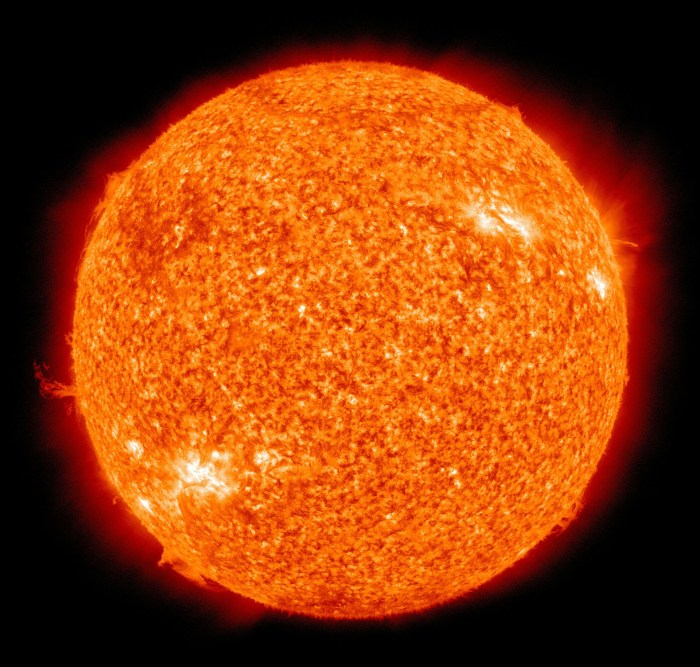
The Sun, on the other hand, is a big ball of plasma, rotating on its axis. Now ‘plasma’ is just a fancy way of saying ‘ionized gas.’ Which means that it is effectively a current, since it’s rotating. And currents generate magnetic fields.
BUT, because it’s NOT a rigid body, each one of those gas particles follows Kepler’s Laws of orbital motion independently of all the other gas particles, resulting in something scientists call “differential rotation.” This means that the particles deep inside don’t rotate at the same speed as those near the “surface,” and the particles near the poles don’t rotate at the same speed as those near the equator.
This in turn means that those magnetic fields get all hosed up pretty quick. In fact, a simple way of explaining a sunspot is that they’re “snarls” in the magnetic field lines that have gradually worked their way to the surface.
So if you think of all those snarled lines of magnetic force, and realize that one end of each line is a N pole and the other end of each line is a S pole, then you can have a lotta ends, and a lotta poles.
Anyway, here’s a link to the Wikipedia article, which has some relatively easy-to-grasp images: https://en.wikipedia.org/wiki/Quadrupole#Magnetic_quadrupole
So. Back to the overall solar model. Two dipole dynamos, and a quadrupole toroidal component.
This means that we have two slightly out-of-phase dipole dynamos, with periods around 22 years (but they do not have the SAME periods, which means that they slowly move in and out of phase over time, like windshield wiper blades that are out of synch), PLUS a quadrupole wave arising from the inner dipole dynamo (and the Coriolis’ed convection current gyres coming from it) generating a roughly 100-year periodicity. Combining the beat effect from these three results in the ‘Grand’ period of ~350-400 yrs.
Zharkova’s model is supported not only by sunspot numbers and solar activity, but by other solar-studies fields: magnetohydrodynamics and helioseismology. In fact, the resulting data plots from these fields are so close to Zharkova’s model predictions, that the model could as well be based on either of those. So this model is not functioning in isolation from related science, but is in fact harmonizing quite well with it.
The Dalton extended minimum (1790-1830) is evidently an example of a Gleissberg minimum, while the deep and protracted Maunder minimum (1645-1715) was the previous ‘Grand’ minimum. It has been roughly 350 years since the onset of the Maunder minimum, and a bit over 200 years since the Dalton minimum began. Zharkova et al. also noted a moderate Gleissberg minimum in the earliest part of the 20th century, as well, so the periodicity for that cycle seems to be holding.
The gist of the matter is that all three main cycles are entering minimum phase, beginning with the end of this current solar cycle (Cycle 24). Cycle 25 will be even lower than 24, with 26 being very nearly flat-lined. Cycle 27 will begin to show a few signs of life, then there will be a gradual rise to full activity over several more solar cycles, even as the last three cycles have slowly decreased in levels. This means that the bottom of the extended, or ‘Grand’ minimum (to use Zharkova’s terminology), should run from ~2020 to ~2053. (NO, it will NOT last 400 years like some are reporting – that is the overall length of the Grand cycle, not the predicted length of the minimum.)
In terms of atmospheric interaction, certainly the majority of the solar radiation peaks in the visible range, and that changes little, and the atmosphere is largely transparent to it. Once it strikes a solid object, however, the photon’s energy is absorbed, and later re-radiated as infrared (IR), which the atmosphere largely blocks (at least in certain frequency windows), so it does not all radiate off into space at night. This is why things like rocks and masonry tend to feel warmer at night, and what helps drive the trade winds along shorelines – the temperature differential arising from the differing light absorption/IR re-radiation of water versus land.
But it turns out that, unlike visible light, higher-energy photons have a fairly strong correlation with the solar cycle; this includes ultraviolet (UV) and X-ray, most notably extreme UV or EUV, which borders the X-ray regime. Much of this photonic radiation is generated in the inner solar corona, because the corona’s activity strongly follows overall solar activity; much of the rest is produced during solar flares – which are PART OF solar activity. More, unlike visible light, this frequency regime is ENTIRELY absorbed in the upper atmosphere (exosphere, thermosphere, ionosphere). So during high solar activity, the EUV and X-ray radiation hitting Earth has 100% of its energy injected into the atmosphere. During low solar activity, there is considerably less energy from this high-frequency regime being injected into the atmosphere – according to NASA research I dug up in the course of researching her papers and presentation, it may completely bottom out – as in, essentially zero energy from EUV etc.
But that isn’t the only way this might affect Earth’s atmosphere. It turns out that the solar wind/corona effects shield the inner solar system from cosmic rays, which are very high energy particles coming in from cosmological sources, such as supernovae, quasars, pulsars, etc. As solar activity diminishes, the solar wind decreases in effect, and the cosmic ray flux (‘flux’ is a measure of number of units per square area, e.g. number of cosmic ray particles per square meter) increases. BUT we know that cosmic rays tend to hit atmosphere and ‘cascade’ – generate a shower of particles, rather like a branching domino effect – and this, in turn, tends to create condensation nuclei around which clouds can form. (In fact, our first cosmic ray detectors were so-called ‘cloud chambers’ where the formation of condensation clouds depicts the track of the particle.) As a result, increasing cosmic ray fluxes are apt to generate increased cloud cover; increased cloud cover will then block visible light from reaching Earth’s surface and adding energy to the overall system. And cosmic ray flux can vary by as much as 50% with solar variation.
Well, then. So. What effects are being seen as a result of these two items?
Well, the undeniable INCREASE in cosmic ray flux has been followed for some years. And it’s pretty much worldwide. (http://spaceweather.com/archive.php?view=1&day=28&month=01&year=2016)
And the outer layers of the atmosphere have already cooled, according to researchers at NASA’s Langley Research Center. (http://spaceweather.com/archive.php?view=1&day=28&month=09&year=2018&fbclid=IwAR2reJ3fcqgouxL5Fp82hf2u_LpcDEEC99vqQisuumYik_MCZC8SAGO18Og) (Original journal article: https://www.researchgate.net/publication/324366650_Thermosphere_climate_indexes_Percentile_ranges_and_adjectival_descriptors?fbclid=IwAR3S_u10rOWfPqvAms-Ikf8zKJUECYn1je06Kg_7iXQi9HGiVpI5QNmYQ7o) According to Langley researchers, we are on the verge of seeing “a Space Age record” for a cold thermosphere (though possibly they don’t expect it to be connected to the rest of the atmosphere, according to some reports?).
So far, Zharkova appears to be batting 1.000.
According to her research of the correlation with the Maunder minimum (the previous Grand minimum), temperatures dropped by about 0.1%, or about 1.3°C, or some 2.34°F. Granted, the Maunder minimum lasted about 70-80 years, as opposed to the estimated 30-some-odd that Zharkova is predicting, so it might not be THAT deep a delta. But if it really drops a significant amount (and remember, we’ve had that annoying ‘warming plateau’ going on through the last couple of solar cycles, which cycles have been steadily decreasing in activity; certain groups want really bad for THAT to go away), then it WILL still be noticeable. And possibly unpleasant.
There’s one other factor that she looks at in her presentation, that isn’t related to the dynamos inside the Sun but DOES affect the solar irradiance (power per unit area coming from the Sun). The irradiance is following the Zharkova team’s curves, regardless of what the human civilization does – it’s falling out completely separately. And it is varying.
NOTE: solar irradiance used to be called the ‘solar constant.’ But astronomers discovered it was NOT constant, and stopped using the term. Climate models often still use it, however, and do not take into account the variability of the solar irradiance, which is small, but distinct and measurable. Instead, they use a fixed value – a true constant. So of course their models do not have any effects of solar variability.
That ‘other factor’ which affects solar irradiance is what might be termed ‘barycentric wobble,’ and appears to be one of the things confusing many of the reporters, who are interpreting it as a change in orbit of either the Earth or the Sun…when it is neither.
See, one of the ways we look for exoplanets in other stellar systems is to look for the very small wobble in proper motion (aka movement through the galaxy) of the star, which is caused by the gravitational tug of the orbiting planet(s). And our planets do the same thing to the Sun. (The barycenter is the effective center of mass of two co-orbiting objects – a binary system – and it is the point about which those objects orbit, no matter how big the objects. The barycenter itself remains essentially stationary relative to the objects, however; in the case of a translating system, the barycenter travels in a straight line, with the objects orbiting around it.) In the case of most of the inner planets, the barycenter lies deep inside the Sun. But Jupiter is massive enough that the barycenter lies roughly 50,000km (~31,000mi) above the photosphere, and the other gas giant planets would have barycenters with the Sun that are substantially displaced from the center of the Sun, too. So the Sun has a reasonably-sized ‘wobble,’ and this movement can bring it marginally closer to Earth at certain points in the orbit.
As a consequence, if in orbiting the barycenter, the Sun moves closer to Earth’s perihelion (closest approach to the Sun in our elliptical orbit), then we would expect to be ever so slightly warmer near perihelion, and cooler near aphelion (farthest distance from the Sun in orbit). It so happens that the perihelion occurs about 2 weeks after the Northern Hemisphere winter solstice, and aphelion occurs about 2 weeks after the Northern Hemisphere summer solstice. This would mean that the Northern Hemisphere’s summers would be marginally warmer than ‘normal,’ and likewise the Southern Hemisphere’s winters would be marginally less cold. Six months later, the Northern Hemisphere’s winters would be slightly cooler, and the Southern Hemisphere’s summers would also be slightly less hot. Then, as the wobble finishes its cycle, the Sun would move away from the perihelion region and closer to the aphelion region, and the opposite would occur. And this is all a function of orbital mechanics, and has nothing to do at all with anything humanity may or may not do. It is not a large factor, and it is vastly outweighed by the overall magnetic cycle variability (it’s something like only 0.05 times the magnetic cycle variability effects), but it is there, and it is apparently showing up in the irradiance data.
This is NOT, let me reiterate, a change in Earth’s orbit, nor is it a change in the Sun’s motion – this has been going on ever since the solar system has been here. But we are only now getting good enough with our observations and modeling to observe its effects and take them into account.
Zharkova indicates she is not done with the dynamo model; she intends to continue refining it, adding terms to the mathematical model as needed as she and her team explore additional non-visible light regimes (notably X-ray, gamma ray, infrared, microwave, and radio). This will likely result in an excellent solar activity predictive tool. It all makes a great deal of sense to me, and it is the first time that a model has ever accurately predicted such long-range activity. I plan on catching up on her publications to this point, and keeping an eye out for future papers updating the model; I fully expect that she is onto something very important. I’m looking forward to seeing what she comes up with next.
(For background information on solar activity and its variability, which is the basis of this little guest blog, let me recommend an ebook I wrote a couple of years ago, called The Weather Out There Is Frightful: https://www.amazon.com/gp/product/B008JA00D0/ref=dbs_a_def_rwt_bibl_vppi_i0 )
~ Stephanie Osborn
http://www.stephanie-osborn.com/