Third Acts

stage-1248769_1920

Because of a post on FB yesterday (not mine) I remembered that almost forty years ago, when I was an exchange student in Ohio, the history books said something like “the American dream is dead, if in fact it even ever existed.”  Not those words, but that was the general thought.

Even back then this annoyed me no end. I saw things like my thoroughly middle class host family going out and buying a TV for the kitchen, so mom could watch TV while cooking.  They did this on the spur of the moment, one day.  In Portugal at the time (now I swear mom has a TV in every room, and being the woman who listens to audio books while doing household chores, I’m out of stones to throw) such a purchase would take weeks if not months of planning and preparing.

But meanwhile people were moaning and bitching the American dream was dead, and if you weren’t born elite, you’d never become elite.

It’s all in how you talk about it. All in what you consider elite and the American dream and a good life, I guess.  And yes, the time I was in the US as an exchange student was… depressing.  We had Carter and Malaise. There was a feeling of the closing of opportunity mostly because the “environmentalists”had convinced us all that we were about to run out of oil.  Or at least they’d convinced those of us who were young enough.

Then there was Reagan.

In the eighties we knew America was becoming haves and have nots, the early version of the one percenters, and media preached how you know, a few would be riding private jets while the rest of us watched from our thatched cottages, if we were so lucky,or our mud holes, otherwise.

Science fiction magazines were filled with dystopian stories about how the decline of America had started under Reagan and now it was all feudal techno overlords and the struggling, starving peasants.

This continued into the Clinton years.  Sometimes I wonder if it’s still the mental picture of our “elites” who are struggling so hard to stay on top, because you know…

But anyway, my point here was that we’ve been packed full of idiocy in American schools, probably forever. Mostly because academics like theories, and therefore tend to jump on the theory bandwagon.

And yet America continues to succeed.  And the scales continue falling from people’s eyes.

Years ago my son’s then 11th grade class attacked my blog at the command of the English teacher who took offense at my not “respecting” her by making fun of an assignment that confused culture and race.

What was notable about that was how incoherent and agrammatical these people were (who were getting As, mind you. Son was getting Bs because he used PRONOUNS. The idiot teacher apparently didn’t know the difference between that and adverbs. I finally got the attack to stop by telling her that if one more of the idiots came to my blog I was going to post my son’s “corrected” assignments, after scanning them in.  It stopped, cold.)

People from abroad were horrified and said “but how can America succeed if this is how they educate their children” (in an elite program, mind.)

My reaction was “It don’t make no nevermind. They’ll learn.”

F. Scott Fitzgerald was always wrong when he said “there are no second acts in American life.” (He meant there was no time for appreciating the fruits of your labor before the inevitable decline of old age. And no, I also don’t know what he was drinking. I’d guess turpentine, but I’m mean.)  He is particularly wrong today.

We are such a wealthy country we can afford to fill our kids heads full of shiite and the economy and society don’t collapse.  They don’t collapse because there are second and third, and sometimes fourth acts in American life.  We live longer and more healthy than (the mostly socialized medicine) rest of the world. At sixty or so, when our grandparents wound down to elderly we’re often starting our second (or third) career.

But more importantly we can learn, and never more than now when online learning for whatever fascinates you is available.

I used to be amazed that every American had a hobby, but even more amazed with people well past thirty (and fifty, and sixty) going out and taking classes and trying to learn things.

By human standards, we’re more neurotic than shaved monkeys, that’s true. Compared to the rest of humanity, we seem to value not at all sitting back and chewing our gums by the fireside while pondering where we’ve been and what we’ve done. We value looking forward and doing and creating more.

Well, a portion of us do. The rest like talking about how they’ve been hard done by and sitting back and enjoying being victims.

But they’re not a majority.  And in the end they’re not important.

What gives America its tempo, its abilities, is the going forward and doing other things.

Yeah, my generation (all over the world, really) was spectacularly maleducated, but not as much as our children.  But we got better.  And they will too. Unless we coddle them and are afraid to tell them the hard truths.

Don’t do that.  Growing up hurts. But it leads to spectacular third acts.

And keeps America playing at the center of the world, as the engine of civilization.

Let’s get on that.

Kamala Harris’ The Truths We Hold: More Smoke and Mirrors – by Amanda S. Green

Kamala Harris’ The Truths We Hold: More Smoke and Mirrors  – by Amanda S. Green

I’m baaaaack.

Whether that means you should run and hide or I should fear for my liver, I’m not sure. Probably both. But maybe not. After all, we’ve already discussed books by Clinton, Sanders and Lenin. Surely, I couldn’t find something to drive me to drink even more than those or you to worry about my sanity. Well, I’ve never been one to back away from a challenge and I think I’ve met it.

I give you The Truths We Hold: An American Journey by Kamala Harris.

Yes, that Kamala Harris. The current sitting senator from California who is making every impression that she’s going to run for president but who refuses to actually say so.

Oh the things I do to help Sarah keep your guys entertained. VBEG

On the surface, Harris should be the picture of the American Dream. The daughter of immigrants—her mother immigrated from India in 1960 and her father from Jamaica in 1961. Until her parents divorced when she was seven, Harris grew up in Berkley. And that is where, if you really look closely, the “dream” diverges from the path. Her mother, a breast cancer scientist, received custody of Harris and her younger sister. She then accepted a job in Canada and Harris grew up there. She graduated from a Montreal high school. That is when she returned to the US to attend college.

Not that you’d know that by reading the description of the book on Amazon:

From one of America’s most inspiring political leaders, a book about the core truths that unite us, and the long struggle to discern what those truths are and how best to act upon them, in her own life and across the life of our country.

Senator Kamala Harris’s commitment to speaking truth is informed by her upbringing. The daughter of immigrants, she was raised in an Oakland, California community that cared deeply about social justice; her parents–an esteemed economist from Jamaica and an admired cancer researcher from India–met as activists in the civil rights movement when they were graduate students at Berkeley. Growing up, Harris herself never hid her passion for justice, and when she became a prosecutor out of law school, a deputy district attorney, she quickly established herself as one of the most innovative change agents in American law enforcement. . . .

So what does she mean by the title of her book? Will we know—and will we be able to stomach it—by the time we finish the book? Only time will tell.

The book opens with Harris recalling election night 2016. She talks about her husband and how he makes certain noises when he reads the paper that warn her he’s seen something she’s not going to like. So you can just imagine the noises he made as they wound their way toward the election night watch party as the media began showing her dear Hillary Clinton wasn’t going to win.

It quickly becomes clear where Harris stands when it comes to the current president—as if any of us needed any clarification. She even manages to throw in a reference to her children’s book as she relates the events of Election Night 2016.

Like any “good” politician, Harris had everything in place for her victory party. The venue had been secured. Decorations in place, including balloons ready to drop from the ceiling. Food and drink and who knows what else (it is the People’s Republic of California, after all). Everything was perfect, especially since the polls had her winning without any real problem.

Except for this one little blight on her evening. Her pal Hillary wasn’t doing so good.

Yet even as we prepared for that hard-earned celebration, all eyes were on our screens as state after state came back with numbers that told a troubling story. (The Truths We Hold, Kindle Edition, loc. 84)

I guess “troubling” is one way to put it. The majority of people outside of certain Democratic enclaves like San Francisco and NYC felt otherwise.

And I’m still trying to figure out which “truths” she refers to in the book’s title and who this “we” is. While I might not always agree with what Trump does, I still prefer him to Hillary or Bernie.

But, as you’ll see as we move further into the book, Harris knows how to manipulate her audience. Instead of describing why the results were so “troubling” to her, she pulls her 9-year-old godson into the story. According to her, this young boy came up to her table, tears in his eyes. Being the good godmother that she is, she wanted to make sure none of the other kids had been picking on him. Oh no, it hadn’t been anything like this. It was far worse (yes, irony is high in that statement).

Alexander looked up and locked eyes with mine. His voice was trembling. “Auntie Kamala, that man can’t win. He’s not going to win, is he?” Alexander’s worry broke my heart. I didn’t want anyone making a child feel that way. Eight years earlier, many of us had cried tears of joy when Barack Obama was elected president. And now, to see Alexander’s fear. .. (The Truths We Hold, location 88).

My first question: why was he afraid? Your average 9-year-old doesn’t know diddly about politics and certainly doesn’t follow what candidates say. So what had his loving godmother and the other adults in his life been telling him? [DEAR G-D it’s another woke 9 year old. Points for not being 6 or 8, but other than that, if the kid exists at all he’s being made a puppet of his older relatives, and the left’s need to believe the hoary legend that children speak with the voice of G-d. Of course, it helps that so few of them have or spend any time with their kids when they chance not to have aborted them. They really have no clue what the real little blighters are.  I award Kamala Harris no points and may G-d have mercy on her soul. -SAH]

More importantly, why?

Then there’s the follow up of why hadn’t they explained to him about the checks and balances of Congress and the courts? Oh, because he’s nine and that doesn’t fit the narrative maybe? You can’t do anything to take away from the boogeyman image of Trump they’ve been doing their best to build not only for the media but for everyone who will listen.

So how did “Auntie Kamala” respond?

She and the boy’s father took him outside to talk about what was happening.

“Alexander, you know how sometimes superheroes are facing a big challenge because a villain is coming for them? What do they do when that happens?”

“They fight back,” he whimpered.

“That’s right. And they fight back with emotion, because all the best superheroes have big emotions just like you. But they always fight back, right? So that’s what we’re going to do.” (The Truths We Hold, location 92)

And that, my friends, is our first indication of how Harris and others of her ilk think and plot and plan. They don’t fight with facts and figures. They fight with emotions. They appeal to the emotions of their constituents, often without regard to the facts or the cost or the consequences of what they propose. It’s all about the feelz and has little, if anything, to do with reality.

Oh, by the way, that was also a none-too-subtle plug for her children’s book. I won’t link to it. If you’re interested, just look her up on Amazon.

But consider her comment to Alexander. Superheroes fight back with emotion. Now exchange “superhero” with Democrat and you have what is happening now. We saw it in Texas with Beto O’Rourke, we’re seeing it on the Hill over the shutdown, we see it every time the ACA or iterations of it are put forth by the Dems. It is all emotion—no, it is all emotional manipulation—and not what will happen if we let emotion rule.

Consequences? There won’t be any consequences, at least that’s what they’d have us believe.

After “reassuring” her godson, Harris had something else to do. It was time to give her victory speech. Of course, boo-hoo, it couldn’t be the speech she wanted to give. After all, her beloved Hillary had lost and her speech had been written with the idea that the opposite would have been true. So she winged it (if you believe that, I have some property I want to discuss with you).

I told the crowd we had a task in front of us. I said the stakes were high. We had to be committed to bringing our country together, to doing what was required to protect our fundamental values and ideals. (The Truths We Hold, location 110)

Once again, I find myself asking who she’s referring to. Her liberal California supporters? What about the rest of the nation? Then there’s the very important question of what these so-called “fundamental values and ideals” happen to be. I can take a pretty damned good guess and so can you. Just as we know who will pay for it all, not that Harris or her cronies will admit it. They will happily appeal to our emotions and tell us the government will pay for it, praying as they do that we forget that we are the ones paying for the government.

Bastards.

What we have to remember is that Harris sees this as a battle for “the soul of our nation.” (TTWH, location 118). She probably sees herself fighting on the side of angels. I don’t know about you, but I have her on another side. But that’s just me.

Just in case there’s any doubt about how she feels, she makes it clear here:

[Referring to President Trump] we’ve seen an administration align itself with white supremacists at home and cozy up to dictators abroad; rip babies from their mothers’ arms in grotesque violation of their human rights; give corporations and the wealthy huge tax cuts while ignoring the middle class; derail our fight against climate change; sabotage health care and imperil a woman’s right to control her own body; all while lashing out at seemingly everything and everyone, including the very idea of a free and independent press. (TTWH, location 119)

Say what? It would take more time than I have this morning to note all the times her beloved Obama aligned himself with anti-white activists, anti-American or anti-Jewish dictators. Oh, and let’s not forget about how ICE under Obama did exactly what the Democrats are so upset with now. Where was the outrage then? I could keep going but won’t.

Oh, to hell with that. I will at least for a bit longer, at least where it comes to the idea of Trump trying to do away with a “free and independent press”. In one way, she’s right. He has been on the attack where the media is concerned. But he isn’t trying to shut down honest reporting. What he has been railing again, as we all should be, is the biased reporting in the media. I’m not saying the media hasn’t always had bias. It has. But never has it been so apparent as it is now. Never has the media been so intent on making and creating the news than it is now. That isn’t reporting. That is propaganda and I, for one, and tired of it.

I believe there is no more important and consequential antidote for these times than a reciprocal relationship of trust. You give and you receive trust. And one of the most important ingredients in a relationship of trust is that we speak truth. It matters what we say. What we mean. . . We need to speak truth: that racism, sexism, homophobia, transphobia, and anti-Semitism are real in this country, and we need to confront those forces. . . We must speak truth about our mass incarceration crisis—that we put more people in prison than any country on earth, for no good reason. We must speak truth about police brutality, about racial bias, about the killing of unarmed black men. (TTWH, locations 129-140)

Yep, she’s doing it again. She’s appealing to emotion without supporting fact. She’s hitting all the talking points of the Democratic platform. Note, if you will, who the common “bad guy” happens to be. The white guy (or gal) who isn’t getting on the bandwagon with her. Apparently only “unarmed” black men are being killed by cops. No discussion about the number of cops being targeted by the community-at-large. Racial bias only flows against blacks and no one else. At least that’s the implication.

It is, as with so much from the dems, all smoke and mirrors without substance.

Does that mean everything she says is wrong? No. We do have problems in this country that need to be addressed. But the ploy of playing to emotions to drive a further wedge between different segments of society isn’t going to do anything except make things worse.

In other words, she is doing exactly what she claims Trump does.

What sort of superhero does that make her?

This book is not meant to be a policy platform, much less a fifty-point plan. (TTWH, location 144)

Really? We aren’t through the preface and we’ve already gotten the basis for her future presidential run. If this really was merely a “collection of ideas and viewpoints and stories” from Harris and others, would it have begun with such a clear attack on Trump and conservatives across the nation? If it wasn’t her launching platform for a presidential bid, would it have come out just this month, at a time when she is visiting Iowa and other key states?

I think it’s obvious the book is meant to help drum up interest and support for her in 2020. The liberals can’t have their beloved Obama back in the Oval Office as president. Many are looking to Harris as the next best thing. Of course, there are those who want Michelle Obama. Others who love them some Bernie or Fauxcahantus.

Of them all, Harris is potentially the most dangerous. She knows how to manipulate a crowd. As she said, her “superheroes” are emotional and fight with big emotions. It is up to us to figure out how best to combat her and those like her.

Now to find something to take the bad taste out of my mouth. I’ll continue the running commentary on the book next week.

(Help Amanda drink enough to keep snarking the unbelievable twaddle that passes for deep political thought these days.  We’ll collect for her liver transplant later. Hit her Pourboir jar now! – SAH)


Hope and Change a Blast From The Past From August 2016

board-1273117_1920

*I finally slept (so well I didn’t move till 5 am or so, when a cat jumped on my stomach) and I need to finish a novel, so it can come out this month. So excuse not writing a new post.  And in case you wonder, this post is mostly a sermon to myself today, yes.  I must take my own medicine at last – SAH.*

Hope and Change a Blast From The Past From August 2016

I was very confused, back in 08 to hear the mindless chants of “hope, change.”  They sounded so gleeful.  Also hope and change are not two things you normally put together.

Yes, yes, I KNOW what they thought they meant.  In the media narrative, the GWB times were hopeless and with no jobs and (and we hadn’t seen anything yet!) so change would bring us hope.

They were out of their rocking minds, obviously.

Look, I’m a libertarian. That means, compared to our current system of having the government play helicopter parent to you from cradle to grave, I advocate change.  DRASTIC change.

To get where I want to be, there would be massive dislocation of money and human resources.  Think of the unemployment crisis as bureaucrats without number got run off their jobs. (Okay, now wipe that grin off your face.)  Think of all the genuine scientific research that would have to find a new way to fund itself.  Think of the children.  No, really, think of the children.

I think what we have for a department of Children Services is inefficient, stupid and possibly harmful, but we’d still need to retool and find another way to perform the job of making sure most kids are mostly safe, without giving it all to the government.  That means some truly horrible things would happen on the way there.  (Whether they’d be better or worse than the horrible things happening now is something else again.)

Ditto when it comes to schooling.  Most of our schools are rather inefficient day cares, but without even that, some kids would fall through the cracks, until local government steps up.

(Yes, for those following along at home, libertarians aren’t necessarily AGAINST government, they just believe on keeping most things small, local, and as close to individual as possible.  The guys who want no government?  That’s Anarchists.  And no, Somalia is not a Libertarian society.  Or an anarchist one.  Somalia is a tribal war with borders.  Its dysfunction has much to do with where and what it is, not with the system of its government, which is “totalitarians trained in left wing politics in western universities trying to speak insanity to tribes who are trying to stay alive.” I swear to fricken bob the next idiot who tells me “Libertarianism would cause Somalia” gets hit on the head with the nearest object.  Do these people swallow whole whatever some progressive twit says, without the slightest effort at verification? Without a modicum of thought?)

The point I’m trying to make is that change hurts.  It always hurts, whether it’s an individual or a society; whether it’s ULTIMATELY change for better or for worse.  Whom it hurts and how much is directly proportional to what systems are being changed and how many people they involve.

Truly massive technological change that affects the whole human race takes millenia to process through.  Some anthropologists, seriously, think we’re not through processing all the consequences of the switch between hunting-gathering and agriculture.  It’s undeniable (no, seriously) that it was good for the species as a whole, over time.  I mean, our sheer numbers and populations prove that.  But it was neither painless nor cost free, and right when it happened it was wrenching, the wrench being recorded in our oldest legends and racial memories.  War between those who had settled and those who hadn’t, changes in ways of life (this idea of working every day, instead of when the meat runs out is still painful and still hasn’t worked itself into the way the species as a whole works.)

There is considerable and plausible evidence we’re still too close to the industrial revolution and the French revolution to process it.

At the rate we’re accelerating the changes to our own environment, it is quite possible we won’t (as a whole) be done processing the change to mass production before small-run individual production becomes the norm.

Which brings us to: the most normal result of change is the opposite of hope: it is destruction, blood, often the burning of a generation’s patrimony, as what they learned and what they’ve spent a lifetime becoming no longer has any application to the new reality.

Take the twentieth century.  (Please.  Almost as bad as the fourteenth.)  It was a time of massive, unrelenting change.  And we have the piles of corpses to prove it.

But as an individual — even as president of the US — you really don’t get to “create change.”  Every time I hear “be the change you want to see” or its equivalent, I want to beat someone over the head with a wet sock until I brain them.  (It’s slow and satisfying.)

I think I know what they’re trying to say, but that is not what they’re saying.  I think what they’re trying to say is that you can only change yourself.  And that’s correct.  What they’re actually saying is something on a par with “be a thought leader.”  I.e. be someone who changes society around you by just being a certain way.

Does that ever happen.  Oh, sure.  Most founders of major religions, some kings and rulers, a few other powerful men and women changed society at least for a time (mostly for the bad, taken in whole, though of course there are exceptions.)

But for most human beings, modeling the change you want to see in society can get you either marginalized or killed, depending on how severe that change is. (Major religious figures aren’t exempt on either, btw.)

Is it worth it to buck society?  Sometimes.  It also sometimes — if you judge the moment right — joins with a lot of other people to create a preference cascade.  If I didn’t believe in that, I’d not be writing this.

On the other hand, that’s in matters of principle, and urgent matters.  If the change you want to see is being allowed to wear white after labor day, is it really worth it getting strange stares, or having to continually clean your white clothes that got muddy and dirty in winter?  Or if the matter you’re bucking, if you fail will destroy you and if you win will… make no big difference to most people?

This is when the “change” needed is mostly internal, in yourself.

It still hurts.  It hurts like hell.  But without changing yourself, you’ll never achieve anything.

Look, I remember — and I found while unpacking, a sheaf of these — when I sent out for magazines, ranging from fanzines to Analog, and read them to know what I should be aiming for.  My most immediate reaction was “OMG, these are nothing like what I write.”  And by that I don’t mean political bend.  I mean I hadn’t figured out writing in scenes, yet, so what I wrote bore a strange resemblance to “disembodied ramblings from a world you never saw.”

You’d think changing that wouldn’t hurt, right?

Bah.  You’d be wrong.  Changing that involved changing my habits of mind, the way of working I’d gotten used to, “breaking” the way I thought of story, and endless hours of practicing the new way, till it stopped “hurting.”  It felt a little like going insane.

And what’s more, everytime I “tool up” I go through this again.  Having identified something I do wrong in writing, I have to “break my head” and then fall into a new pattern.

This involves a lot of work (A LOT OF WORK) and forcing myself to do things I don’t want to do.  90% of the people who approach me as fledgelings (or as colleagues seeking help for stalled careers) and to whom I tell stuff like “Okay, so you need to write in a different world, or come up with three new worlds, then write proposals and–”  OR “You need to write four  books a year” or “You need to learn to plot” or “you need to learn characters” go away saying “BUT I CAN’T DO THAT.”  Some of my favorite people in the world do that rather than try it.  I remember a friend telling me she couldn’t possibly write four new proposals in a year, when I’d just written 17 over summer.  (2003, career stopped, and a bitch of a year all around.)

It’s not fun, it’s not comfortable, it’s a lot of work, but if where you want to go is worth it, you do it.

And almost always, unless you were born to a comfortable fortune and your life is pottering ONLY with what pleases you, you need to change to get ANYWHERE, much less where you want to go.  You need to get out of your comfort zone and force yourself to do things that feel unnatural or that you despise.

This is whether or not the world is “right”.  A lot of the way I had to learn to write wasn’t “right” for selling.  It was the more literary way that shorts had been going.  In fact, I later had to unlearn some of it, to sell more in novels.  BUT it was the way it was and if I wanted to publish in shorts (heaven knows why) I had to learn it.

And because we’re extra special lucky, we do live in interesting times.  Times of intense change.  That means we need to work hard as hell to stay standing in the changing maelstrom, and to hopefully achieve something, anything, in the time we’re given.

A lot of this involves changing ourselves: the way we work, and mostly the way we think.

My entire field is turning upside down and inside out, and I NEED to figure out new ways of working, new ways of thinking.

I’m not alone in my field.  Some of you might not have noticed the change in your profession but I guarantee it’s coming for you.

Those new ways of thinking, those clever tricks to stay afloat, are nasty.  They break your comfortable idea of how things ought to work and be.

But no one asked our opinion.  And internal change is our only chance at hope.


The Crazy is Infectious

biohazard-37775_1280.png

For various reasons, mostly because of something that caused a loud continuous noise all night and we couldn’t fix till yesterday, I’ve been sleeping like heck.

Yesterday was spent in solving the situation so I can maybe finally write. (Seriously, not sleeping gives me terminal ADHD. I was forgetting what I was doing in the middle of doing it, and just wandering off aimlessly.  Of course, we then had a lousy night because of two amber alerts in the middle of the night. I get the need for amber alerts, but why do they think sending it to everyone who owns that phone at 1 am and then 1:30 will do anything but rouse half the population in an area code? Never mind.)

So come dinner time I was in that enviable position between too sleepy to eat and too hungry to sleep.  As in such situations, we went out to eat before it got worse. (Once, after a flight that sent me all over for 24 hours and didn’t give me a chance to leave the embarkation lounge to EAT I was so bad off I literally told the poor husband who picked me up and wanted to take me to dinner (I’d been away almost a month) “Never mind. Just stop by a convenience store and get me milk. I can drink, but I don’t think I can chew.”  I then drank the milk in the car, got to the hotel room (I told him if he drove me home an hour and a half away he’d have to carry me in from the car) fell on the bed unwashed and dressed, and was asleep before head touched pillow. I slept six hours, got up, showered, put on a nighty, had some food and went back to bed for 12.)

We went to a rather cheap Mexican restaurant (very good too) because it’s closer to us, via the highway than Pete’s (or at least is not in an area of such high traffic, so it’s shorter getting to.  They’re actually not far from each other.)  Also it’s cheaper than Pete’s (Pete’s Kitchen, on Colfax.)

And I came across a bit of crazy I’ve seen elsewhere, with other things.  And it never stops shocking me.

Keep in mind that this is a CHEAP restaurant. Mostly working families. Staffed by people who still have accents.  But as she brought us our drinks, the waitress looked guilty and said, “Do you… do you want straws?” like she was offering us drugs in a back alley.

This is not the first time we’ve come across this, though the other instances have been in at least semi-trendy places like cafes and “natural” restaurants.

Here’s the thing: two years ago, they gave you the straws, no questions, no idiocy.

And there’s nothing wrong with straws, whatever California thinks. There’s nothing wrong with plastic bags either.  First, if there really are vast rafts of plastics in the sea, why are there no PICTURES (yes, there are pictures of little ones, and they’re mostly in ponds and such, and also, no. That’s not what they’re claiming.) Second most of the plastics in the actual sea causing actual pollution come from places like China and India.  Banning them in the US where the bags are made to be degradable, the straws are mostly disposed of properly, is nothing but a piece of crazy cakes virtue-signaling.  It makes life unsanitary and inconvenient to many, including the disabled, but hey, you gots to virtue signal.

What always shocks me is how this bit of crazy then transmits to society and everyone becomes afraid they’re doing something wrong by using the perfectly legal, no issues until the left got crazy product.

The last time I saw this bit of crazy was over the pill.

NO ONE EVER WANTED TO BAN THE PILL. (Maybe the Vatican, but I think their business is more telling women it’s a sin, not telling us that laws should forbid it in countries they have no control over like the US.) The only fight about it was whether employers would have to pay for it, or whether it should be subsidized. ONLY FIGHT.

And because the pill is not that expensive — no, really, the basic one is like $9 per month — people had to bring up crazy cake situations to make not paying for it the equivalent of banning.

So you got stuff like “Some women can’t have that expense, or their husbands will see!”

Now keep in mind I know a LOT of women. I know exactly zero who are on the pill without their husband’s or boyfriend’s or casual hook up’s enthusiastic consent. Are there some? There is some of everything in a country of 300 million. There are probably some few thousand people who subsist entirely on clay sandwiches.  Doesn’t mean it’s a common or likely situation. (Or that there aren’t organizations and people, including friends, who’ll help people in those situations, by paying for the meds.)

To make this plausible, the left and the media (BIRM) had to make it sound like all men run around wanting to impregnate every woman.  I know nothing less likely in the current world. In fact most women are the ones want kids in a relationship. There are exceptions. My husband kept us going through extremely expensive infertility because he REALLY wanted kids, while I mostly wanted them (it bothered me more that I was failing.)  Both of us love them to death, but his drive to parenthood was stronger than mine.  And yet, he’d have stopped if I told him I REALLY didn’t want it. Because his drive was to have awesome kids with this woman he loved, not to run around impregnating people against their will.  (Who really wants to do that, unless they’re touched? Sounds like a weird fetish.)

Now, I’ve been on the pill as a young woman (serious cycle deregulation) and as a perimenopausal (and probably bad for me to get pregnant. Also my hormones were so screwed up my doctor joked I might be more likely to get pregnant while on the pill from about 40 on. Not joking and in fact it happened) woman.  Both times medically indicated and needed.

In a Latin country (and in the US when newlywed before we started going through active trying because, yeah. It’s really that bad) where the pill was frowned upon for religious reasons, the prescription was treated matter of factly.  I was told “here is your prescription for the pill”.  Same as perimenopausal.  Same in the pharmacy when they gave me the dang packages.

But after the crazy campaign of “all men will abuse all women for being on the pill” suddenly my doctor was dropping her voice to a whisper when saying “this is a prescription for the pill” and the pharmacy was acting like they were giving me contraband.  Of course being me, I usually answered in autistic-levels shout “Thank you for my prescription for the pill.”

What worries me about this mechanic is that there seems to be some mechanism whereby the media could invent something like “people with green eyes are afraid of being killed” and suddenly people with green eyes WOULD be afraid of being killed, everywhere.

Nothing else explains the crazy representative who wore tampons as earrings because the media decided that the right was going to ban them or something (I don’t even.)

This horrifies the hell out of me.  No matter how crazy the lie — say that one in five women in college get raped, or that our straws are killing fish — people seem to run with it and it propagates through society as UNQUESTIONED fact.

This would all be easier if it weren’t for the fact that there are organizations if not devoted to at least willing to make up the most outrageous and crazy shit.  Like apparently PETA is now making people afraid/ashamed to wear wool because the complete idiots have decided you SKIN THE LAMB to get the wool.

Of course this is not even vaguely true as those of us with rural upbringing know. You give the lamb (or sheep)a haircut to get the wool.  In fact, not doing it is animal abuse, as they will die, or get tangled in bushes trying to get the wool off themselves.

I wonder if it’s purposeful mendacity or stupidity that started this. It reminds me of the first incarnation of minecraft where you killed the chickens to get the eggs.

BUT it’s impossible to ignore that soon there will be a substantial portion of society maybe not even sure why “knowing” that wool is bad and kills animals.

How do you treat this crazy?  I don’t know.  I treat it by being loud and responding to it as to a dog that just went on the floor.  “What the heck is wrong with you? There was never any problem with this.”

Maybe it’s not the most effective thing. But I don’t know anything else that can be done.  Sometimes the only way to treat infection is blunt measures.  And those are the only one I know.


Legacies

boy-2025099

Sometimes I think our time is drunk on perfection, high on it, or perhaps demanding it, like a two year old in the candy isle at the grocery store.  Which is weird because perfection is a myth. It is in fact impossible.

At one time I had a friend who is in real life involved in editing scientific publications (real ones, the ones people involved in research have to read, not the popular stuff.) edit my first set of reverted books.

These books had already been gone over (twice) by me, and then sent out to my regular chain of editors and proofers.  And yet, he found at least one mistake per page.

I was mortally embarrassed until he pointed out to me once he was in charge of a proofreading department with (I think) 15 proofreaders.  Because he’s a hard task master, he had each person initial each line, just to make sure they at least attempted not to skip any.  (Because a lot of it was numbers and data that must be absolutely right.)  He then told me when the pages landed on his desk, they had still the average of errors he found on my work.  And he was sure, despite his immense effort, some errors escaped him.

I’ve seen this over and over with processes that are supposed to yield perfect results.  Perfection just isn’t in us. No matter how hard we try.  Even the best whatever has a moment of distraction, a day their head hurts, a moment of confusion.  And an error, great or small slips through.

Human systems like societies and cultures are even more fallible and every dunghill cock who yells that we should excuse the massive death tolls of communism and the silent death toll and death of hope and interest in the future of socialism because “capitalism kills through” and people slip through the cracks should be hanged by the neck till dead and then buried in his dunghill.  If there were a way to make him suffer for eternity whatever the ghosts of those killed by the arranged children of Marx wanted to inflict on him (or her. It’s so often a her) I’d vote for that too.

There is a difference between not being able to guarantee perfect outcomes for everyone in a system that nonetheless has lifted most of the world out of poverty, a system that is not even a system but what humans will do when allowed (and even when not allowed. Look at the black markets that prevented people starving to death in communist “paradises”) and a system that promises perfection and from each according to his ability and to each according to his need (spits) and which then proceeds to treat people as widgets, most of them having the same need to live in squalor and misery so the chosen “enlightened” (Dare we say woke) few at the top get to have all of the best and a dacha too.

And hell and thank be to anyone who is cranking, communist systems weren’t “perfect” too.  Had they been their already stupendous death toll would have been multiplied ten times.

Trying to tear down the pretty good in the name of the perfect is delusional.  It is delusional because Marxism’s central conceit has been proven wrong over and over and over again.

What was the central conceit? That freed from the Rousseaunian fall from grace constituted by commerce, work and hierarchical society, humans would be perfected into something lacking individual needs or individual defects. That Homos Sovieticus would emerge, infused only of the need to work for the whole and — of course — perfect.

It’s not just that this didn’t happen (can’t happen) but that humans subjected to the system that was supposed to give it birth became more corrupt, more venal, more willing to die or kill for their own benefit (and that own benefit often no more than a sausage stuffed with sawdust.)

This should surprise no one that hasn’t lived a life of perfect ease and comfort (which I suspect is why most communist adherents come from the ranks of the very comfortable.  Most of its shock troops, meanwhile, come from the ranks of the deranged who long ago traded in their humanity for a hunk of burning hatred and don’t even care if it consumes and hurts them more than the objects of it. And no, their hatred is not proof of injustice. The hateful shall always be with us. It’s an all-too-human failing.)  Humans who are reduced to living like animals and struggling for everything become feral and lose all contact with a higher ideal of humanity.  The only “perfect” thing at the bottom of the communist program for perfection is hatred and blindness.

Which brings us to feral humans.  Yeah, I know, it only took me 800 words to get to the point. You must surely deal. I’m also not perfect, and had an awful night for various reasons mostly not internal.

I was thinking — I’ve been thinking of stuff like this a lot, as I try to chart a course for the future, partly because 2018 scoured my attachments as clean as possible (except for my marriage and family. I’m not giving 2019 ideas.)  Even my friends are, for various reasons, very busy and while I still love them and I presume they love me, no one has any time. Last time this happened was 2002 — about legacies. About what I want to do and say with this megaphone I accidentally picked up, and of which the biggest part MIGHT well be the fiction.  What do you say? What do you do?

And then I thought of Terry Pratchett.  Terry Pratchett could be said to have brought me to fantasy.  I read fantasy before him.  Fantasy was just never a favored mode of story for me.  Partly because when I first encountered it in Portugal I had no place to put it.  Parts of it were just “how life is” (i.e. a lot of the old legends are assumed to be true) and part of it was “do they really believe that cr*p.”  Also by virtue of being where I was D & D passed me entirely by (I have a strong feeling if someone had shipped me a manual, my little friends and I would have carved our own D20s from potatoes and played like fiends.  Sometimes I think much of what we did was struggle blindly towards D & D but we never got there.) so the whole trolls, elves, etc. was more than a little bewildering. At times still is, I’ll be honest.

But Pratchett, found in 92 because SOMEONE in Colorado Springs bought all the English editions and then sold them used (I swear it must have been in trips to England, as I had to spawncamp at the used bookstore to grab them when they — irregularly — came in.) made me like fantasy and sold me on his world.

He’ll never be one of my formative writers. One doesn’t meet formative writers in our thirties.

But part of the reason he appealed to me was the long buried British strain of my upbringing.  As Foxfier noted, I often SOUND like Agatha Christie. Which is nothing short of amazing since I was i my late twenties by the time I read her in English.  But I read her in Portuguese before my teens. And before her, I read Enid Blyton who went a long way to forming who and what I am (more on that later.)

Before I met Heinlein, (in books. I never met him in real life) that substratum was there.

What I never thought — never occurred to me — was that Pratchett would have the same influence on my kids (or at least one of them. The engineer embryo prefers hard sf which he found on his own, thank you so much.) that Heinlein had on me.

Older son lives and breathes Pratchett.  Like me with Heinlein, it’s where he retreats when too wounded to face the real world.

When Pratchett died it blew his world apart as much as Heinlein’s death blew mine.  And because he’s his mother’s son, he wrote an elegy to him. Because we deal with unbearable grief by leaking out words like a broken vessel.  Until the cracks plug.  And heal. Or at least scar over.

I happen to think this is one of the most beautiful pieces of writing I’ve ever read, and possibly the most beautiful send off ever.

But the pixels were barely dry before the *ssholes came out to say Pratchett didn’t deserve a send off because he’d believed in suicide for his incurable early onset Alzheimers. And that his stand encouraged others to do this awful thing, and blah blah blah.

Let’s suppose that what Pratchett had was not a defect of the thinking meat.  And lets please, since we are perfect, stand in judgement of a man facing a predicament none of us has faced (or pardon me, I don’t know who’s reading this:few of us have faced) and facing it AS HIM, with his upbringing and background.

And then, yeah, because we’re perfect and shiny and chrome, let’s condemn a man whose books for all their flaws (mostly flaws of viewing systems through late twentieth century European eyes) managed often to distill a scintilla of truth and more — far more — than an ounce of beauty, and managed to make his characters human and admirable.

You mean he wasn’t perfect? And he believed things we don’t? Into the ash heap of history with him, the damnable blot on the face of humanity.

It occurred to me this piece of crazy from the right was exactly the same as the crazy from the left.

“You have to be perfect according to our standards, or we’ll make it as though you’d never been.”

At least the right hasn’t tried to do that to living people yet.  While the left screams “shut up, she explained” the right says “Sweet mind, speak thyself.” Though that might be because it’s the most cruel thing we can do.

But they often do the same “he’s not perfect, I won’t listen” that the left does to living people too.  Eh. It’s a free world.  You’re not forced to enjoy someone.

I’ve read a lot of people who were far from perfect, and derived what I could from each of them.  In a discussion with friends, recently, on the writer whose wife makes poems to suicide bombers, I said I don’t read them because his thoughts “taste wrong” to me, and often make me want to shower inside my skin.  Not as badly as others. But still.  I don’t read him because “it tastes bad” to me, personally.  I know it’s a personal thing.  Heck, there are authors with whom I agree in almost every respect that I can’t read because something about their writing puts me off.  And sometimes that’s only in a portion of my life, and I get over it as I age. I certainly would never deny this writer’s talent (he’s stuffed with it) or say people shouldn’t read him.  De gustibus dictates that he’s not for me. BUT as much as some of his public posturing annoys me, I’m sure people find valuable things in his writing. Or he wouldn’t be as successful as he is.

I certainly don’t demand writers be perfect in their personal lives, or their personal beliefs. I particularly don’t demand they be perfectly congruent with mine.

I was in my thirties — mostly because Portugal is in many ways a remote place where bio and critical writing don’t arrive except by mule, smuggled under a load of fish (or at least the Portugal of my childhood) — before I encountered a screed calling Enid Blyton elitist and racist and pointing out she hated gypsies.

Frankly, I’ve never tracked the racist and gypsy thing down. I never cared enough to, because it doesn’t matter. If anything from her books (Circus of Adventure) I’d think she loved gypsies, even if what she did with them was fairly stereotypical (but then it’s a YA) and I don’t actually remember anyone of other races, in books mostly written about British children in the early 20th century FOR British children in the early 20th century.

Oh, she was elitist. But in a way that our self-proclaimed elites can’t decode. Something that’s impossible for them to comprehend, as though it were written in Martian.  She was elitist from the other side.  Not “My status gives me the right to” but noblesse oblige “we don’t do that because people like us don’t do that.”

And since what she communicated we wouldn’t do included things like be mean to those weaker than us, or make fun of the impaired, she was an amazingly good influence on me.

So I don’t care what flaws she had in her personal life, or her beliefs. Why should I?  I treasure the legacy she gave me, and move on.

Agatha Christie, too, was in many ways a conventional thinker of the early 20th century, and sometimes it comes through her work. But what I loved about it was the profoundly human characters (even the communists) and the fact that she set her face resolutely against the evil of envy and greed and murder.  Oh, and the whole “We weren’t put on this Earth to be safe/comfortable/merely happy” which fit in very well with what I’d got from Blyton.

And as for Heinlein… well, he did believe a lot of things I don’t. Particularly about relationships between humans. Understandable for someone of his place and time who believed the “scientific” papers of the time.  And?

He taught me competence. He taught me to not kowtow to evil. And mostly, he taught me the importance of the human spirit and not squashing that.

I should hate him because I disagree with him on some things? Because he wasn’t perfect?

WHY?

We take from the past that made us the best of their legacy, and we let the evil (or merely the things we disagree with) that men do be interred with their bones. That’s the way to destroy civilization.

Demanding of the past a perfection that no human ever achieved; demanding the past be perfectly in tune with future prejudices and illusions or even new found truths (those are often indistinguishable in the rear view mirror); demanding that people only be remembered if they were flawless does not in fact build a better future. It doesn’t build any future. It tears down civilization to its roots by removing the one thing that makes humans better than animals: the ability to learn from the experiences, heroism, and yes, errors and horrors of the past.

For all we know, after all, the man who invented fire was a slaver who killed little children, hated the next tribe over and beat his wives every night and twice on the not-yet invented Sunday.

But if we extinguish his legacy all we’ll achieve is perfect darkness.


Growth Scars

skeleton-1243818_1920

There are voices in my head.  This is a good thing.  It’s a good thing in two ways:

First, as I found out when I became a grownup writer and got to meet others of my species, I’m very lucky the voices are in my head and not outside, as full on, vivid hallucinations.  The number of my colleagues who get that or outright visions is perhaps the most disturbing thing I’ve learned about this profession.  Sure, it sounds cool like something out of movies or stories, but if you’ve ever lived so close inside your own head (like when I was a teen. More on that later) that something a character says startles you, and you send a tray of beverages flying all over several people at the pool, you are grateful you’re not also dodging people who are invisible to other people, and/or having their arguments interfere with your enjoyment of music.

After a con in which he listened to some of my colleagues older son was convinced this type of writing that we call “gateway writing” where you get the characters and much of the story for free was a form of schizophrenia.  He was relieved when I told him no, it’s just a seductive narrative strain of thoughts in my head, I’m fairly sure it’s part of being ADHD and my brain trying to entertain me.  So he says clinically speaking my case of writing isn’t as bad as many of my colleagues cases. I’m still — he says — a graphomaniac. You can’t get away from that. He’s young. I have so many ways of getting away from that.

Second: It’s much easier to remember who you are, to remain grounded in reality, to know which voices aren’t yours when they don’t also show you things or shout at you.

All of which is important because — I don’t know if this is a temptation to everyone else or just writer larvae — it was really easy to go inside and live in the stories in my head as a kid.

Does everyone do this? Or is it something that only hits those of us who are story-creative (there are other forms of creative) AND peculiarly broken?

I don’t know.  I know from age oh, five or six till eighteen I lived inside my head in a series of stories.  Sure, I also went to school and did the things that humans do. But the amazing thing is that I learned anything and did anything, since maybe 75% of my attention was inside.

At almost eighteen I made a conscious decision to give it up and start living in the world outside.  It was difficult. It hurt like hell.  It broke me places.  And then it healed and made me stronger.  I also started to actually grow and understand things, because I was no longer beguiled by the world within and using the world without only as a sort of inspiration mine.

Sure, I know, people who aren’t tempted by the words find other means of escape.  A lot of compulsive behavior, like counting or washing seems to be dulling the contact with the real world. So are other things which is why we have an “opiate crisis.”

Now it’s possible some of us are peculiarly more in danger of this. When we had younger son IQ tested (for reasons having nothing to do with wanting to brag, or whatever, but because he had sensory issues which apparently are organically linked to IQ one of two ways, either very high or very low and each of them calls for different handling) the psychologist surprised me by telling me some of us FEEL more than others.  I.e. some kids feel things that happen to them more strongly than others, which in turn means … they’re probably more susceptible to find ways to escape it.

But the thing is our society provides so many ways to escape it.  Sure, I probably had ancestors and ancestresses who had the same temptation I did (I suspect story telling runs in dad’s family) and some of them might even have managed to be as involved with the inner narrative as I was as a kid, but the truth is, probably not many.  It would require a certain level of comfort and “not having to handle dangerous things” that would probably be impossible until my generation unless of course very wealthy.

What do I mean? Well, when you cook mostly with wood or charcoal or — argh — spirit lamps, or you have to use sharp implements in your work, or wash clothes in a place where you can fall in and die and furthermore when your day is packed with hard work, it’s hard to go fully inside.  Or if you manage it, you’ll probably die. And if you don’t die you won’t get everything accomplished you need to and you and your family might die.

For instance yesterday as I was ripping up carpet in the dining room and killzeeing the floor, a task both grosser and more violent than you can imagine, my mind kept trying to tempt me away with a really strong narrative voice that goes to a story that’s been waiting maybe 30 years.

Which is why I listen to audio books while doing that stuff.  Particularly audio books I’ve listened to before. They’re just enough distraction not to allow the inner voice to take hold, and not to bring me to a stand still in the middle of the room, daydreaming and not doing what needed to be done.

It’s worse, of course, for other forms of addiction and escape.  I understand in many countries its always been normal, as far as we know to go through the world half-stoned.  Leaves and hashish and stuff.  And most of those parts of the world pay the price of such addiction and dulling in that they’ve stagnated for a long time. (Yeah, I am for drug legalization. Doesn’t mean I approve of drug use, particularly society wide.)

It is fashionable right now to talk about the opiate crisis, and also how it’s the result of several societal ills.

That’s Marxism talking.

No, seriously. I don’t care who you are, that’s Marxism talking.  The belief that some “societal ills” cause you to mitigate it with drugs, the belief that the “opiate of the masses” be it physical or mental is necessary to deal with the inequities of the capitalist system is a Marxist thought.

It is no such thing. Drugs or escape fantasies (I don’t think religion has anything to do with it, not for seriously religious people, though it’s possible that people of a narrative frame of mind who don’t have the concept of being storytellers might use religion as a framework for their escape.) or the myriad ways humans find to escape real life aren’t a result of the capitalist system (which is a way of saying Free Market which is a way of saying a byproduct of being human.)  They are a result of being human.

As the movie says: “Life is pain highness, anyone telling you different is trying to sell you something”

Even those people who are coddled and surrounded by everything they need — perhaps particularly those — live in pain.  Because to the extent that the world is not inside our heads and we don’t order it, things don’t always go according to what we want.  And weirdly for those who never have been denied being told no on very minor things is as much pain as oh, actual physical torture.  Which, yes, is why a particular brand of largely very privileged and coddled human beings think that you disagreeing with them is “actual aggression. Like violence.” And we need to stop disagreeing with them, or they’ll make us.  With physical attacks.

There is hope though. If instead of going inside, or taking drugs or trying to silence those whose thoughts/words/denial hurts you and feels like violence, you come out and engage with it, think about it, analyze it, eventually it gets better.

Oh, it hurts like hell, don’t get me wrong. In a way you have to die.  You have to move out of your current, comfortable state and break, and then rebuild again.

Imagine you had an exoskeleton (go with it.)  It keeps you safe. It’s comfortable inside. But what you don’t know is that it inhibits your growth and if you stay inside you will die early and unformed.  If you choose to break it, to grow past its limits, it hurts like hell. I mean, it’s part of you. But then it heals on the fractures and is stronger than before. And you’re bigger.

Does life stop being pain?  Oh, hell no. Life is pain. Big pain, small pain, or just the pain of sheer boredom.

And the temptations will always be there.  Opiates, coddling ideologies or even just vivid dreams.  And sometimes you can indulge, if you can control it. (No clue about the opiates. I don’t even like taking ibuprofen. But the day dreams? Well… I channel them into writing which is not the same at all as the vivid dream immersion, but sort of is. Or at least hits a bit of that spark.) But you always have to fight to control it.

And life is going to throw things that you that make you want to run and hide.

Don’t.

The escape is sweet and nice and easy. But outside in the harsh world of reality is the only way to grow and change and to truly experience life.  Accept no substitutes.

Oh, and that strong narrative voice that attacked me while cleaning? I probably should get the first two pages in so it doesn’t escape again. So I can finally write that novel that’s been waiting.

And then the house needs cleaning (the carpet thing took much longer than I expected so THAT didn’t happen) and … and I need to give another coat of KILLZ to the dining room floor (it’s not even our cats. It’s the people who lived here before and their cats.)  And then…. and then I can indulge in some narrative and writing.

Go forth. Live in the real world. It’s the breaking and the scars that lead to… bigger breaking and scars.  But without them you won’t actually live. You’ll leave no mark in the world.  It will be as though you’d never existed.

And what’s the point of that?


Sunday Book Promo and Vignettes by Luke, Mary Catelli and ‘Nother Mike

Sunday Book Promo

FROM AMIE GIBBONS:  Psychic Eclipse (of the Heart) (The SDF Paranormal Mysteries Book 6)

41kRIDfloiL

Love your enemies…

Ariana Ryder’s a free agent now, and her psychic PI business is taking off. She even put together a huge conference for those involved in paranormal investigations and treatments.

She’s a success!

When Ariana’s conference is taken hostage by a desperate Fae who needs her help, how can she say no? But when the job requires fetching a fugitive from Fairy, she’ll have to work with her ex boss and crush Grant to have any hope of survival.

And when it comes to the Fae, things are never as they seem.

Vignettes by Luke, Mary Catelli and ‘Nother Mike

So what’s a vignette? You might know them as flash fiction, or even just sketches. We will provide a prompt each Sunday that you can use directly (including it in your work) or just as an inspiration. You, in turn, will write about 50 words (yes, we are going for short shorts! Not even a Drabble 100 words, just half that!). Then post it! For an additional challenge, you can aim to make it exactly 50 words, if you like.

We recommend that if you have an original vignette, you post that as a new reply. If you are commenting on someone’s vignette, then post that as a reply to the vignette. Comments — this is writing practice, so comments should be aimed at helping someone be a better writer, not at crushing them. And since these are likely to be drafts, don’t jump up and down too hard on typos and grammar.

If you have questions, feel free to ask.

Your writing prompt this week is: horn

The Perfect Enemy

wf19

Weirdly, this is not a political post, though seriously, we need to stop asking Him to make our enemies ridiculous. Enough is enough and we’re approaching dumpster fire in a sewer with a clown car driving through.  Past that lies something unimaginable and arcane, and I’d rather not find out what it is.  Possibly like a glimpse of Cthulhu it renders you mad.  Not worth risking…

Okay, so one thing the stupendous paper book sale did (yeah, I have a couple to send out on Monday, money having arrived at last) is make me realize how bad my early covers were.

Now, let’s be honest here, they weren’t bad-bad.  Not for indie books without dedicated artists and an art designer.

Seven (almost) years ago, I was doing my art on paper, and probably stuck “two years from cover-worthy” which is what my then teacher classified me as.  BUT she was assuming of two years of concentrated practice (I’m probably a bit worse right now) which I couldn’t give it, because ce n’est pas mon metier.  Or not my main one.

So I was doing things with photoshop and stock photos.  Which is difficult for any historical since finding people in costume that is actually accurate, let alone where people (guys are particularly prone to this, particularly when holding a sword.  It’s like the brain snaps and they go “I have a sword”) aren’t grinning like idiots, or ugly as sin is a problem.  Do yourself a favor and do not EVER look for handsome man in stock photos.  Obviously my standards of “handsome” which include “must not look like a rat” or “Must not weigh more than triggly puff” are too demanding.

Now the original cover of Witchfinder (still up on Amazon.  I need to do the paper cover for this, then I will go in and do it all at one swoop.  This is part of my new, revised, stupendous way of spending my weekends and doing something useful with them) was NOT the best that could be achieved even under those circumstances.

I tried hiring an artist, in fact, and paid more than the proverbial “$400 cover” (but not by much) but what was delivered was actually worse than what I could do at the time.  So I fell into the stock photos and filter forge and achieved something that was not utterly disgraceful, even if not wonderful.  Say it was about 15% of what a decent midlist cover should be.   Probably 90% of what I could ACTUALLY have achieved. But 90% was all the time and attention I had to give it.  Beyond that lay the land of spending days tinkering with shadows and it might bring it to 98% of what I could achieve, and about 15% of one to perfect.

I’m not going to claim to be perfect now. All I’m looking for is “midlist by most big houses.” Which I think I’m probably 98% on. Beyond that lies either genius, inspiration, or greatly diminishing returns. MIND YOU if I keep doing this and getting better, they will eventually all so far outclass this that I’ll have the same reaction to this I had to those earlier covers.

Which is part of what I wanted to say: this is what life is.  Not just art.  Not just writing. Not just your profession or your job, or whatever. Life.

We start out pretty sucky at it.  Heck, I remember one of my persistent fears in early childhood (probably under five) was of forgetting to chew something and actually choking to death.  It came close enough a couple of times that it lent this fear credence.  But if I had that fear as an adult, it would be outright crazy.  I mean, what kind of idiot is afraid of FORGETTING TO CHEW?

An idiot pretty new to her body.  I have obviously practiced having this body for ten times longer now, and while I can still choke (usually when my sons make me laugh or something equally stupid) putting chewy food in my mouth is no longer an occasion for neurotic terror (yay!)

In the same way until I was about fourteen, my knees were permanently scarred from falling.  I couldn’t seem to figure out how to stop doing it. I was extremely clumsy, yes. This phase lasted long enough to interfere with my wish to look sexy in nylons. I don’t know how much of it was due to the fact I spent a vast portion of the year in bed with various illnesses till I was 12. But obviously a lot of it came from that.  I simply had only about half (or less) the practice at walking of a 14 year old.  Yes, I also had — and have — a tendency to get lost in my own head and forget I’m walking.  When I lived in downtown Colorado Springs, in the North end, with its plethora of cracked and root-uplifted sidewalks, I tripped a lot.  But note I never fell.  (Well, once, but that involved a patch of black ice and my wearing my clogs outside. Because I’m an idiot.)  I never fell because I had a ton more practice.  I hadn’t suddenly become way more acrobatic, or better at balancing (snort, giggle) or for that matter started paying more attention to where my feet were and what they were up to.  No. It’s just that I’d been walking for 30 years longer, and could now catch myself before I face planted or knee planted, for that matter.

Now at 14 wishing to walk without scarring my knees, seemed impossible and I had no clue how to get there.  If I’d aimed for perfect I’d have stayed in bed, waiting for the perfect to come.

I guess it’s kind of like my realization that what I was doing wrong with Alien Curse was … trying to make it The One Book. The Perfect Book. (Not even the perfect book of its kind, just the perfect book.  Which is impossible. But even the perfect book of its kind is fairly unlikely.)  The best thing to do is to “make it as perfect as you can, given who you are and the tools you have RIGHT NOW.”

Because if you do that; if you start where you are and with what you can do right now, instead of wishing for perfection, and do it a lot, you’ll get better.

And like me (I’m sure) in five years, looking at this (I have bought courses on lighting, on backgrounds, on…  That’s also for the weekends this year.  Yes, that and floor installing.  That’s life. Yes, the year is going to purely suck in terms of workload.) in five years of doing the best you can with what you have right then, you’ll look at today’s work and go “Oh, dear Lord, what WAS I THINKING?”  But what you were thinking is that you were doing the best you can, right now.

We don’t have magical abilities, to reach into the future and make us as good as we can be.  And yeah, study (see I bought a load of courses) and thinking and learning from our betters (in covers I have a lot of betters) helps.  BUT in the end? Practice. Practice makes the biggest difference. Practice will allow you to do what right now seems impossible.

Yes, that means you’ll produce a lot of imperfect stuff.  Humans are imperfect. A lot of it will probably be good enough, be it in art, or life, or whatever.

And honestly, even when you’re really really good you might choose to be at 98% of achievable, unless you’re getting paid in the millions.  Most people don’t notice the top 2% of perfection.  And the effort is another 50% at least.  You’re better off producing more, practicing more.  And then your next ten pieces will get you to the 100% of what you can achieve now anyway.  And they too will sell.  And you’ll get better at things you didn’t even realize needed improvement.

Go and practice. Because that way lies “as good as it can get.”

The constant discovering of flaws in what you thought was great before, the constant dissatisfaction with yourself is just the price you pay.

It’s worth it.

To be satisfied is to stop improving.

Happy New Year! Sort-of, ish. – by Alma Boykin

new-years-eve-3899977_1920

Happy New Year! Sort-of, ish. – by Alma Boykin

The sun is shifting farther and farther south, shortening the days and lengthening the nights. The geese are flocking south, with a few Sandhill cranes following. Athena T. Cat has moved from the front couch to the master bedroom and now reposes on my bed, toasting her toes in the afternoon sun that spills under the deep eves. The year turns, the sun moves, plants and animals respond, and time passes.

Happy New Year! Right?

When does the year end, anyway? When does it start? What defines a season?

If you use the Western Christian liturgical calendar, New Year’s Day fell on December 2 this year. The previous Sunday was Christ the King Sunday, when the church looks to the time when Jesus will return as king of the world, to judge the quick and the dead, or as a different part of the liturgy says, “When Christ shall come in final victory and we feast at His heavenly banquet table.” Except we don’t throw wild parties or wear lampshades on our heads to all those things people are alleged to do on New Year’s Eve. Instead we sigh about “where has time gone” and wonder if this year the music director will make good on her threats that Christmas carols will only be sung during Christmastide, that being the period between December 24 and January 6. And everyone grumbles about how long HallowThanksMas lasts.

How many calendars do we live by? There’s the January 1 to December 31 cycle that most of the world uses, or at least adds to their own particular calendar when needed. There are religious calendars, some of which impinge or overflow onto the secular world (Easter, Christmas, Ramadan, Passover and Yom Kippur, the legal holiday of Corpus Christi*.) Personal calendars with anniversaries, birthdays, death days, years in remission, years sober or clean. Academic calendars that count down the days until breaks and summer, often watched more closely by teachers than by students and their parents. Tax calendars that go by quarter or by year and that culminate on April 15, or the first or last days of the fiscal quarters, and that bump into the federal fiscal year.

There are also ghosts of calendars past, like the Thermadorian Reaction, April Fools Day, and the October Revolution that happened in what is now November. Halloween, once Samhain, the end of the year for pagan Irish and others, when the hard times of the year began to draw near as the sun disappeared and took heat and light with it.

Usaians have High Holy Days centering on July Fourth.

For me, the year starts in autumn because the days grow short, planting has started along with planning for the next farming year, and school is in session. This is my favorite time of year, with cooler days, longer nights that give me more time to be out and about, winter music, and the mystery of Christmas. DadRed really dreads autumn and winter, for equally good reasons. I don’t care for spring and summer. The world slows down from the heat, I’m trapped indoors or forced to be up by 0500 in order to do outdoor things before the sun rises, and it’s when storms roll through.

Humans mark the year through different ways and with different start and end points. Some calendars work better than others, at least in the world as it currently is. Some have been adapted to the dominate sun-based fixed calendar that dominates the western world, others remain free-floating and lunar and proudly refuse to adapt. Into the 20th Century (and probably still in some pockets and hollers), some Western Christians maintained that Christmas was not December 25 but January 6, the “Old Christmas” from before the Gregorian to Julian switch. Some calendars are deeply personal, based on when a family came into being, or when life began again after chemo or another life-shattering and rebuilding event. “Only 245 and a quarter days to LibertyCon, not that anyone’s counting.” “Summer doesn’t begin until we reach the lake-house.” “I don’t care what the calendar says, it is winter already.”

Regency London had “the Season.” A lot of Europe still does, focusing on the wild weeks between New Year and Ash Wednesday, the time when the rules are a little looser and satire a little fiercer, when the Fools point out the emperor’s nakedness and people attend the great society balls and parties to see and be seen.

I suspect that deep down, there are as many ways of marking time’s passing as there are people. Wet and dry seasons. Times of flowers and the moon of falling leaves. Religious feasts and secular feasts, the fasting and weeping and wailing leading up to April 15. We watch for migrations and the succession of plants as the sun moves north and south. People in Canada giggle at Santa on water-skies in Australia, while Australians snort at declarations of “Hurricane Season is upon us” from the ‘States. “Hottest year on record,” pronouncements while crops droop under snow in South Africa or South America generate more than chuckles. My new year is somewhen in August, because my life is tied to the academic calendar, then the liturgical one, and the secular one. Half the world’s population marks the new year by the moon, but doesn’t object to parties on December 31 (unless their government is cracking down that year.)

I suspect humans will take our various calendars into space with us, and layer them onto newer systems. In the background to part of Fountains of Mercy, rabbis are (once more) trying to decide how to calculate the High Holy Days and other things for Jews living away from Earth. And people trying to adapt Earth systems to planets with different year lengths. The characters on Shikhari focus on the dry and the wet, and base their social year on those seasons, while trying to sort out what the government on Home meant by “four weeks after receiving this memo, the local Commander is enjoined to…” Whose week?

*I giggled a little too much when the government of France announced that it would cut back on the number of paid federal holidays, and the Communists and trades unions vehemently insisted that Corpus Christi remain on the list.

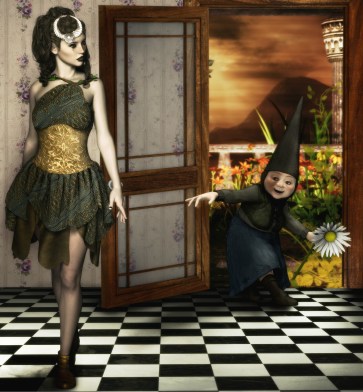
Living In Elfland

fae-1363779_1920

Recently here, one of those times that the comments get more interesting than the post itself, we came up with the idea that we are in fact elves.  That either time traveling or some weird time-glitch bring us — or our descendants a few hundred years hence — in contact with people in the past and allows them a glimpse into our world.

There isn’t a story there — at least not for me — though there might be a throw away side character or three in future novels.

But, you know, when you think about it we match a lot of the stories about elves.  We are almost impossibly long-lived, obviously supernaturally healthy.  We can turn on light or cook or do any of the things that were near impossible if not impossible even a hundred, much less five hundred years ago, with the flick of a button.  We see at a distance through magic devices (no? explain it to a medieval man. Use small words) and talk at a distance to each other.  We can fly to the air to visit each other, and if we don’t mention details, I’ll bet you good money that a medieval person would imagine us tucking in arms and flying, perhaps in a spangle of sparkles.

Fairy horses? I’ve got nothing, though it wouldn’t surprise me if in another 100 years or so we didn’t have some kind of super horses, bio-engineered for performance and more carnivorous than not.  Perhaps even, too, unearthly beautiful, because why not?

We can even heal bizarrely and startlingly for someone in the middle ages.  I mean, if we come across a guy lost in the middle of nowhere, running a fever and we’re doctors or otherwise equipped for the emergency, a salve, an ointment, or even a shot can bring him back from the brink through the magic an anti-biotics.

Elf shot? Forget the whole thing about stone arrow heads.  We can kill at a distance with startling accuracy.

The fairy midwife stories? Well, if these things are either isolated colonists into the past (something like Simak’s world where they’re running from certain extinction in the future) or sometimes the times contact at random and it’s a farmhouse (or something) that finds itself isolated in the past?  Well!  You know, I’d prefer modern delivery services, too, but if those aren’t available, I bet you those medieval-village midwives (once you disinfect them from head to toe twice) were pretty good at what they did, because they faced — with no modern knowledge or last-minute saves — the problems of childbirth, which are complex and varied.  And enough kids survived that we’re here now.

Then there’s the whole “elves have few children.”  Compared to the historical average, you guys might not even realize how little time a modern woman spends pregnant.  Sure, they might end up rearing only two or three children at most, but rare was the pre-modern woman who didn’t have seven to ten children.  And a lot of them died in childbirth, because the more you walk in the rain, the more you get wet.

This idea has been with me a long time, long before the discussion here.  There was a germ of it last year when we went to the Denver botanic gardens illumination and I thought someone of Shakespeare’s England tripping through a time portal into this fairly mundane Holiday display would be dazzled.  Hell, I always channel my inner 6 year old, who thought the church being illuminated for Christmas (white lights outlining the building and the turret) was an amazing miracle.  And she thinks that the illuminated botanic gardens (or zoo) are a miracle.

Imagine the wonder.  We’re profligate with light and getting more so, as it becomes cheaper and cheaper to illuminate the outside of our houses with twinkling fairy lights.  (I’ve had no luck with solar.  I think Colorado is too dusty. But they work places.)

Some of my neighbors illuminate with lights summer and winter, as do a lot of commercial areas.  The colors are just different.

When this arose in the comments, Margaret Ball said “What about being unearthly beautiful?”

And though I know how beautiful we are — yes, all of us — in terms of not being deformed of pockmarked or even — and that was so common even 25 years ago — acne scarred, I confess that made me laugh a little.

And then over new years Dan and I went to the Rembrandt exhibition.  We were looking through the prints and again and again came across drawings of people who were supposed to be young.  Like sixteen to eighteen.  They all looked forty.  And then there were people who were supposed to be forty… I’d take them for eighty.

Sure there are renaissance paintings, say, the Venus on the half-shell, who look young and heart-breakingly beautiful.  And probably were, even if the painter might have idealized her a bit.  But the age thing keeps hitting us in the face.  The men and women of the renaissance were far more in tune than us with the idea that the virgin was supposed to be 14 — by church legend — and the audience of paintings would know that.  Aware of that go look at medieval and renaissance nativity paintings.  Oh, keep in mind Joseph is supposed to be in his thirties.

Now by the time you get to the 18th or 19th century and are looking at the paintings of the upper class, you don’t see that effect much.  They were halfway to being elves.  They still aged faster and harder than us, and do not ask about their dentistry if you prize untroubled sleep.

But if you looked at the people on the street in those days, or if you find paintings of the common folk, you’ll know exactly how we’re “unearthly beautiful” throughout our blessed long lives.

I remember reading, and now I don’t remember which painter or where, though I have an idea it was in the quattrocento (note that wordpress spell checker doesn’t know quattrocento and tries to make it afrocentric. Measure by that our mental decline compared to our material improvement) saying that he’d picked a model because she was so “beautiful” with unscarred skin and straight limbs.

Now do I really believe we’re time travelers?  Um…. no.  I always find it funny when someone comes here to argue with me and tries to claim my reasoning is faulty because “you write fantasy. You don’t know the difference between reality and imagination.”  (Rolls eyes.)  Sure, if you’re a psychotic locked up in a rubber padded room, that might be true.  But I’ll argue you’re then not writing much fiction, and certainly not much that’s commercial enough to be enjoyed by others.

People tend to underestimate the amount of conscious work that goes into crafting a story, particularly something the size of a novel.  They want to imagine it’s all a flash of passion and suddenly the story is all there.

Sure, that can happen, after you’ve written twenty novels or so, but that’s because your subconscious has been trained to do the heavy pulling by then.  Even then you’ll recraft scenes or recast characters, because your subconscious knows what you like but not what other people will buy (your conscious doesn’t know that either, but it can make better guesses.)

Anyway, to write saleable fiction you need to be fully in control.  Sometimes you let the imagination out to play, and then you pull it back in.  And when you let it to play you know d*mn well you’re confabulating.

Sure. It’s possible that some time phenomenon makes us into literal elves sometime in the next few hundred years.  I.e. that we’ll go back in time and meet our ancestors and give them their legends.  Not that I can think of any mechanism right now, but then time is still very much a mystery in many ways.

What is more possible is that these things that were attributed to elves are the long-time dreams of mankind.  Light.  Living with minimal effort. Health. Long life. Not consuming your life in endless pregnancy.

Do we still aspire to a lot of other things, including longer life? Of course we do.

But to our ancestors? We live in an age of magic and miracles, and we live long and blessedly healthy lives.

Shakespeare made his mark on the world by living 2 years more than I’ve lived by now.  And Kit Marlowe was cut down at 29.

We have so much more time.  What are we doing with it?  How much of it do we spend moaning and bitching that it’s all going down the drain and we can’t stop it?

Sure, we have challenges (I’m not sure humans could survive without them) and sure there are some pretty awful people trying to put their boots on our neck. (The wars in fairyland were always terrible.)

BUT we have all this time, all this health, all this light, all this ease.

Let’s be worthy of them and do something, even if the something is fight for freedom and pass the torch one more generation.

There might come a time to be curled up in the fetal position on the floor.  That time is not now.

Up and doing.

In the end, we win, they lose.

Be not afraid.