Or — they pointed WHAT at the alien?
No, you’ll wait for that. Chill. First we’ll get to the real stuff.
On what I’m doing with this attempt to reading myself back through the one Portuguese science fiction imprint available when I was a kid, and therefore responsible for catapulting me into reading then writing this crazy stuff, you can read my inaugural post.
The Voyage of the Spaceship Beagle is what I think D. Jason Flemming calls a “Fix up” (?) ie a stitching together of four stories. Which, on the whole are pretty good star trek episodes. Which we later find it was one of the inspirations for.
Actually in reading it, I could see the series of a lot of other, later science fiction.
Anyway, these are the voyages of the Spaceship Beagle, its five year mission….
The spaceship is staffed by scientists and
In each of the stories, it meets an entity. Each entity is hard to defeat, in each entity the Nexialist on board comes through brilliantly.
The book is by A. E. Van Vogt, and while discussing the book with a friend afterwards, I found out that A.E. Van Vogt was not in fact a Dutch national translated into English, something I had in my head probably from the first time I came across his writing, and which was so deeply lodged I never questioned it.
In fact, having grown up reading him (the people who did the Portuguese imprint I’m following, the only official Portuguese imprint of science fiction had a weird fascination with Van Vogt) when I first read him in English I was disappointed and — wait for it — attributed it to his translating better into Portuguese than English.
I honestly have no idea where this came from. It’s not like there were science fiction conventions in Portugal or that science fiction, that weird sub-field of fiction that most people didn’t even know existed, had biographies of its writers aired or printed anywhere. So, where did this strange idea come from? I’m going to assume it was, like a lot of other strange ideas — such as Heinlein having three sons — the result of hearing people talk while waiting in line when there was a new and popular book release. Because Portugal didn’t have organized fandom — honestly, Portugal pretends a lot but it doesn’t have organized anything unless the culture itself has changed a lot since I lived there — but it had vibrant fan gossip network. And the only thing both faster and more inaccurate than fandom gossip is…. I don’t know. I’m fairly sure it’s faster than the speed of light. And more inaccurate than…. science fiction predictions.
Anyway, it’s entirely possible the fact he was raised Mennonite and that’s close enough to Pennsylvania Dutch for Portuguese to agglutinate it all. Or it’s entirely possibly it’s a misunderstanding I came up with all on my own. Who knows?
So, here’s a linked bio of Van Vogt — Alfred Elton? REALLY? — in case you need it, or want to review it. Not Dutch. Definitely not Dutch.
I will point out that I have a very firm idea of Van Vogt as a writer acquired when I was very young — under twenty — and that is that he throws off more interesting ideas per hundred words than any other writer in science fiction, and mostly doesn’t carry them off to their conclusion because it would be impossible.
In that sense, this novel was a disappointment. And, btw, I figured out almost as soon as I started reading it, that I had in fact read it before, but did not in any way associate it with Van Vogt.
The reasons for this are sane but also unfair. Sane because by the time I read it Star Trek was running on TV, as well as stuff like Space 1999 (yes, I do know it was lame, but I felt obligated to support it, because it was science fiction, and we weirdos had to support weirdness.) And the novel sounds like a science fiction exploration series with four episodes-of-the-week. Unfair, because this was the seventies, and of course the stuff was based on this work (and others like it.) On yet the third hand — shuddup, iz science fiction — the truth is these stories, except for the outlandishness of the extra terrestrials encountered, each of which has the potential for destroying the expedition, and all but the first having the ability to destroy humanity if not stopped, read as “generic space exploration” and even the title of the book in Portuguese — interplanetary mission — conditioned me to expect that.
Anyway, so other than that how did I like the play? It was interesting enough to qualify as a “Darn good yarn” and painless to read. The ETs are imaginative and well set out and it works well as see-problem, solve-problem science fiction.
There was a fly in the ointment. Nexialism. Grosvenor, the wonder kid, the go-to-guy for solving everything is a Nexialist, the only Nexialist on board, and his “science” is so much better than all the old traditional sciences at solving these problems.
The problem, of course, is that his science is a dessert and a floor wax. It sings, it dances and it diapers the baby. Nexialism! Is there anything it can’t do? Apparently not.
The ideas I walked away with of this very weird “science” are — Weird. Like, it is a form of what Heinlein said Friday or her boss were “general specialists” — people who could take the other sciences and integrate them — this is okay as the quirks of overachieving and not quite wired correctly geniuses, but I had trouble thinking of it as a science. To justify it he had some form of trick learning, like Heinlein’s Renshawing but more so combined with learning in your sleep. The conceit being that Nexialists could mainline all of human knowledge in a few short years and integrate the whole thing, but guys, seriously? If that were possible, why would it be a specialty? Why not do that to every human? The explanation left me baffled.
I will confess that all this “learning while you sleep” which was in vogue at the time has been “discredited” but I wonder if it really was, or which one is a lie, the learning while you sleep or the thing that assures us that just makes you tired. At some point I’ll do a deep dive into this. Today is not the day.
Anyway, Nexialism bothered me, not just at the level of making no sense whatsoever, because if it was so good why wasn’t everyone trained in it, but at the level where the man used an awful lot of hypnotism, mind control and various other things that disturb me at a gut-level, not just against the various ETs but to adjust his fellow crew of the Beagle. And while it is presented as the only way to save the ship, it made me squirm.
I also disliked the classifications of civilizations that the archeologist onboard relied on. I don’t even like that whole “hard times makes hard men” BS. I think any such view of history is severely reductive to the same point as saying “there are only two plots in science fiction” or something equally zany
Of course, in a way this was a disease of the time: both the belief that the soft disciplines like semantics and history and psychology could be made diamond hard, perfectly predictive and completely useable to control and manipulate men into a perfect SCIENTIFIC society devoid of human problems.
This whole “next stage of evolution” where we will be like gods knowing good from evil was brought home to me by stumbling, yesterday, on this episode of the Why Files. If you don’t want to watch a video, even on 2x the speed as I usually do it, it is the case of Paul Amadeus Dienach. And while I fully believe he hallucinated that while in a comma (though there are doubts the person ever existed) it is more a stew of ideas that were already in the air at the time, and which informed a lot of early science fiction. (Not believable. Among other things the world is supposed to be overpopulated.)
Now, I don’t want to make that sound like I hated the book, because I didn’t. I rolled my eyes at some of the ideas because they are very much ideas of their time. But the book is still a “good yarn” and enjoyable enough to read.
I will point out this is one of the reasons for writing a “darn good yarn” and enjoyable first and worrying about whatever the ideas are later. Because the ideas will age and shift and annoy some of the readers. But the good yarn will carry it through even if people are personally opposed to one of your tricks, like, say, mind control. The story still carries the reader through.
Now, of course, it’s entirely possible that if your ideas are super dooper humdingers you will convert the reader too. But that shouldn’t be your main purpose for writing. Your main purpose should be to tell stories. If you convert anyone, that’s secondary. And it’s more likely that whatever you did will cause them to think and change their ideas but not necessarily to what you’re selling….
If you want to sell a philosophy write pamphlets. Or blogs. If you write novels, write them for enjoyment.
And Voyage of the Spaceship Beagle was pretty enjoyable.
Now, remember They pointed WHAT? at the alien?
I want to say I am absolutely, totally against (with spikes on) changing the original words of a book because they offend the sensibilities of later readers.
HOWEVER–
The good men of the Spaship Beagle carry weapons that emit vibrations. Guess what they call them. Com’on, guess!
In a way this was illuminating, because I wasn’t aware of hallucinating VIVIDLY while reading books. No, not like a movie. It’s more like an immersive hollograph. I’m there, in the middle of the action, and hearing the thoughts of the character in whose mind I am, and–
And when they pull out their vibrators and point them at the alien…
The whole scene dissolves, and I’m laughing hard enough for Dan to be alarmed. Particularly since I was reading this at night, in bed.
I think, since this is a recent ebook edition, it would be sane and well…. it would be sane for the people editing it to call them something like vibro-pistols and footnote they’d changed it from “vibrators” which has a new widespread meaning. Because now I have that image in my head. And I’ll never, ever, ever get it out. Sigh.
The book I’m reading for next week is The Man Who Sold The Moon by Robert A. Heinlein. I haven’t read it in some time, due to having been sick and stuff, so I’m looking forward to it.
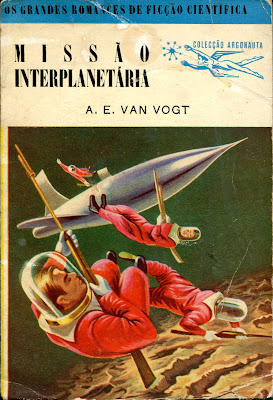
The cover and title in the Portuguese collection is this:

So they somehow refrained from translating it as something like “SCAM IN THE HEAVENS”, though to be fair those wild titles are later in the series and I suspect under quite different management. They also SOMEHOW refrained from giving it a cover pulled from a psychadelic dream. Heck, to my eye, they seem to have made the guy resemble RAH and the woman has a look of Ginny. (Though perhaps that’s coincidence.)
I incidentally found out that the people doing these covers were full on (many of them surrealist) painters. I hate one of them with a burning passion and have opinions which will probably be aired tomorrow at MGC. (I like some of the others, but unfortunately they don’t work for covers in the US now. However they reveal much about what the publishers thought of science fiction readers.)
While on that, incidentally, I’ve revised my position on “I don’t want these books in paper even if you guys want to give them to me.” Look, I’d prefer to borrow them and return them to you when I’m done because we’ve been seriously cutting down on paper books (except for those I think still hypothetical grandchildren might treasure). But there are too many I’m running across that are just too expensive for me to buy for this quixotic project, and too many books that are British or weird, and I simply can’t find in ebook. This will change as we get to more recent books, but not for the early ones.
The ones I’m missing so far, some of which I suppose have no English translation:
L’univers vivant by Jimmy Guieu
Tomorrow Sometimes Comes by F. G. Rayer
David Starr : Space Ranger Paul French, a.k.a. Isaac Asimov.
Antro The Life Giver – Jon J. Deegan
From What Far Star by Brian Berry
The Metal Eater by Roy Sheldon
World at Bay E. C. Tubb
Again, please don’t go and buy these to send to me. But if you have them collecting dust in some backroom, email me at bookpimping at outlook dot com, and I’ll make arrangements for you to mail them to the Vegas address, from which in the fullness of time it will make it to me, and I can return it to you when I’m done with it.
Anyway, onward and upward! We’ll continue the reading project!
These are the Voyages of Reader Sarah, her five year mission to revisit all the reads that pulled her into the science fiction circus and have got her performing with the high wire elephants!
Stay tuned.




























































































 According To Hoyt