We’ve Got Trouble, Right Here In Ebook City

Okay, so – as a commenter told me yesterday – why do writers still need publishers? What is the point? Why can’t writers self-publish on the web and be done with it?

Let’s dispose of the silly stuff, first. I have had people tell me they could never self-publish because they need “editors” by which they invariably mean copy-editors, btw; or because they need a cover; or even because they need to format it.

These are ridiculous objections because there are free-lance copy-editors. If you can’t afford that, find a friend who will do it for a dinner. If what you need is a REAL editor, you can hire those too. Ask friends or look through the adds in writers’ publications. Ditto for covers. Believe it or not most artists are not that expensive when it comes to using their illustration for a cover. Look over at deviant art or another place where artists post their work, hoping to be noticed. As for formatting, you can usually find instructions on line. (It has occurred to me that if I were unemployed right now and were marginally more tech inclined than I am, I’d start a business formatting books for writers, and arranging them to fit the various publishers/services.)

Now, the real objections – the first one, forgive me, I’m going to sound like a curmudgeon and I’m not. There is a point in any artistic pursuit when you think you are much better than you actually are. It’s in the nature of the beast. You have managed to put something of the picture that’s in your head on paper, in some format. When you look at it, you see what your original idea was.

I’m currently going through this with my drawing/painting. This is why writers groups are so important. A good one, will tell you about the stuff you left in your head. (I’m just not sure I want to take the trouble to get an artists group, since it’s a only something I use to focus the writing and for some publicity. Of course, if I got much better, I could possibly eventually maybe do covers. Um.) But even writers groups can get used to your flaws and blind to them.

I’m not going to say the current publication-process is flawless. I know for a fact that many, many people who are publishable and perhaps even marketable (not the same thing) are simply not getting in. For one, must publishers these days don’t have a reading/slush department and it goes through agents. Which means overworked agents have to find the time to read. I could write several posts on the flaws in that process, alone. Things that slip through, things that the system isn’t designed to do, etc. I won’t. There’s very little point. Suffice it to say it is difficult to get published and while there is an element of meritocracy in it, it’s not absolute.

However, what the element of meritocracy does do is weed out 99.9% of the absolutely unreadable dreck. Even more importantly it weeds out 75% or so of the “nearly there, but not able to keep anyone’s attention but the author’s” which is a subtler distinction. If you don’t know what I’m talking about, you are the VERY fortunate avoider of slush piles. Anyone who has struggled through a slush pile knows how absolutely horrible the dreck can be and also that a lot of what should be technically perfect keeps “popping the reader out” every two paragraphs. (I’ve learned, if I actually analyze those I find fairly large technical mistakes, like bouncing around between the heads of characters in one paragraph. Or contradicting your scene setting in two sentences, or… But on the grammatical and superficial level these stories look passable. Only, they’re not. They simply wouldn’t hold up.)

Now it is a perverse thing I’ve noted that at that stage of near-publishable most writers are more confident than publishable writers. It could be because people are funny… Or it could be because that too is part of the stage of learning any art or craft. When you’re at near the top, you see fewer flaws than after you study a bit and become even more proficient. Also, some people are naturally hard on themselves, which doesn’t mean they’re bad, and some people are naturally brimful of self confidence, which doesn’t mean they’re good.

I’ve found that amid self-published writers, confidence often outstrips the ability. Not always, mind you, but often enough that even though self-published is no longer a bad word, I like to read a bit of the book before I buy it – even at 1.99 on Amazon. When I disregard this rule, I often get into trouble. And I don’t think I’m the only one. Because self-published is anyone from the raw newby (and I’ve for my sins bought a couple of books that turned out to be just that) who hasn’t read a novel, but by gum hasn’t written one, to the near-readable writer who is often more frustrating, and who has decided he’s “good enough.” Yes, there are also pros bringing out long-lost books. There are people bringing out the one-off book the publisher rejected. And there are first time writers who are flawless.

The problem is distinguishing the gems from the muck. When – to quote Pratchett – gold and muck come out of the same shaft, how do you tell one from the other? Surely you know you’re not going to read EVERYTHING that’s self published.

This is not a problem for bestsellers. I’ll be painted purple if I understand why bestseller authors don’t just go “I’ll publish myself, now.” Unless it is because they want the advance in regular, scheduled payments. Or because a substantial number of their sales are paper. (Yes, you can contract with POD services, but I don’t think those are quite where the price makes them viable for small or one off print runs.)

Even for established mid-listers, the choice is fairly easy. Oh, you’re not going to get as many sales electronic as you would on paper. Yet. But that ratio is changing every month – perhaps every week. And for the occasional extra book or odd novellette, it’s fine. And people know what they’re getting with you.

For a relatively-recent, low-name-recognition mid-lister like myself, things are a little more dicey. If I started JUST publishing myself regularly, I probably could, in time, build an audience. Mind you, it MIGHT take me five to ten years, but I could probably make it. At any rate, it’s worth it enough that I’m starting to dip my toe in that particular ocean.

But what about beginners? How can a beginner writer start off the gate and establish himself? Someone earlier said that perhaps people couldn’t live form writing anymore. I don’t think this is true. Writing, like any craft, will always have a much larger number of hobbyists than professionals, but there will always be money for the exceptionally good. A writer – even I – can only write so much, and if you want him/her to continue writing, you’ll pay. Judging by the near-threatening letters I get (Mostly for the Musketeers Mysteries, but also the Shifter Series) demanding MORE books, I think there are at least some people willing to pay to ensure I continue writing.

The problem as I see it is some sort of imprimatur – some sort of label that distinguishes books that have gone through SOME form of gatekeeping, not nearly like what we have today (couldn’t be anyway, to the extent that it will be a lot harder to control distribution.) Just something that assures the public that someone other than the author has read this book and thought it marketable.

It could range from basically a publisher (I am in fact working with a micro-e-publisher right now, or perhaps I should say involved with it, since it’s in the nature of a cabal of friends) who does the proof reading/editing/cover/coding and at least a modicum of publicizing and who, for its pains takes, say 50% of the profit (which is far more equitable than what we get from established publishers, royalties running around 8%) to simply some form of “certification system” – the literary equivalent of the labels on port wine bottles that say “purveyor of Port to her majesty the Queen since…”

I have some ideas on how this could be accomplished, which I will write about tomorrow.

The Still, Small Voice Of Writers

Continuing my view of the coming of ebooks, I’d like to go into the good things brought by ebooks first.

This is important. There’s a feeling of doom and gloom in the air. Publishers tell us daily they’re on the verge of collapse *because* of ebooks. (This is not exactly true, in my opinion. Look both at yesterday’s post here and at my Mad Genius Club Post on 1/5 for reasons that are pushing the collapse of publishing, reasons that are ushering in ebooks.)

This makes both readers and writers feel odd and insecure. We have people vowing never to read in electronic format, never, never, never, and others reading in electronic format only. We have strange movements in the used-book-sales field. We have people debating anew concepts of copyright and fair use.

For writers it is still more anxiety-making. Our publishers are convinced ebooks are bankrupting them, which has turned their publishing routines upside down and made our careers very precarious.

So, it’s good to remind oneself the coming change has many good features. Perhaps the most important is letting an author take charge of his/her career.

Here, I’d like to talk about Lloyd Biggle Jr’s book, The Still Small Voice of Trumpets. Why would I like to talk about it? You’ll see.

Biggle’s book was one of my favorites as a teen. It is a standard adventure science fiction with a shadowy “federation of planets” type setup. For a new world to be admitted to this federation, it must have a democratic government. However, Earth’s agents are forbidden from imposing democracy from outside. (In the seventies, I was greatly impressed by the motto “democracy imposed from the outside is the greatest of tyrannies.” This runs counter the history of Japan, for instance, but at the same age, I was also impressed by the sudden realization that we’re all naked under our clothes. There are miles and miles of twerpitude on the way to being a grown up – as Pratchett might say.)

The world that our main character – a member of Earth’s secret service, trying to bring about a revolution in this newly discovered planet – is sent to infiltrate is inhabited by a human breed that is absolutely enamored of beauty. In fact, the book starts with a peasant woman risking her life to keep something beautiful.

The mission goes wrong from the beginning, in ways I won’t detail. This post requires me to give away the ending, but even if you know that, the book is a pretty good read, full of fun and resonance.

The main problem the character faces is how to bring about a revolution from within – how to spur the natives, themselves, to revolution. Though the world is ruled by an absolute king, the public is pretty satisfied with his rule. He finally finds the way to make people aware of how tyrannical the king is.

You see, the king can – and does – send anyone who displeases him (or just happens to be in his vicinity when he has a toothache or whatever) to a village of the exiles. This is done by cutting off one of their arms, first. Now, most people sent to these villages are unknowns – the king’s chefs, physicians, servants and probably the occasional minister.

But one category sent there are musicians. The main instrument in this world is a sort of harp. (IIRC) You need both hands to play it. The king, as passionate about beauty as his subjects, loves art and has musicians play before him often. Which means, he has one of their arms cut off fairly often too.

These musicians are known and revered and have followings. But once their arm is cut off, they can no longer play, they go to these villages – they disappear. Their public forgets them.

The main character hits upon the idea of creating trumpets that the exiled ones can play, then has the musicians parade back into civilization playing their trumpets, reclaiming their public – thereby fomenting a coup.

Now, I’m not suggesting that the current state of affairs in publishing has anything to do with tyrannical anything. I mean, bookstores and distributors often seem tyrannical to readers, but I’m sure it’s simply because we don’t understand the imperatives of THEIR business.

We are, however, in the middle of a revolution, and one of the things the e-book tech revolution is doing (amid all the confusion and fear) is giving those writers who were consigned to exile through no fault of their own an instrument they can play, and a road back into civilization.

Writers whose fans forgot they existed; writers who spent years honing their craft only to disappear from view forever, will now be publishing again.

Even better, the books have the potential to be available forever, at no cost to the publisher and/or the writer. This means there is a chance for books that went relatively unnoticed but which deserve notice, to acquire it.

This is – to me, perhaps because I am a writer – the best part of this “revolution”. It gives us instruments we can play. It allows us to come down the road, our capes fluttering, playing our trumpets, allowing people to look at us.

There are many other points pro and con what is happening – many shoals on our way to a happy ending we might or might not read. The most important of these is how the reader will find us – and I do have ideas on how to do that. I’ll be covering those in daily posts probably for a week. But for now, think of the series that were interrupted that you’d like to see finished. Right off the top of my head, I can tell you I WANT to read more of the Lord Meren Egyptian Mysteries (written by Lynda Robinson.) I’m sure you can think of some yourself.

Stop and think – won’t it be lovely to hear again the still, small voice of vanished writers?

Crossposted at Classical Values. Related post at Mad Genius Club

There’s No Business Like Book Business Like Any Business…

I promised sometime ago to do a series on my views on ebooks – where I think all this is going, and what it means for the future.

First, though, I need to set up the stage – as it were – and explain what, from my perspective, is wrong with the current system of publishing and distributing books. Not my point of view as a writer, so much, though some of the “features” of the current system make any writer except the lucky top 1% want to scream with rage at times.

The thing about being a writer is that you can’t evaluate your own work. You just can’t. It’s entirely possible my work – for instance – gets kicked around by the current model because in some way – quality, thrust, execution – it deserves it. I’m not going to – cannot – dispute that. It is what it is.

However, as a reader, I can complain about the deficiencies I see in connecting with the books I would love, if only I knew they existed. As a consumer, I can complain about the inefficiency of the supply system.

And, because I’m a writer, and know some of the processes behind the scenes, I can hazard some guesses as to why the system is falling short.

Now, like a foot soldier in a corner of the battle field, it’s unlikely I’ll see everything. It’s also likely much of what I see will be inaccurate. I’m not averse to being told I’m full of it. I can only be sure of the results and guess at the causes.

Before I start I want to stress something very strongly: First, this is not the fault of any INDIVIDUAL in this system. The system itself has grown dysfunctional through a series of incremental changes that just piled error on error.

What we hear is that there is no money in publishing, which makes me want to go all LOLcat and say “Capitalism, u iz doing it wrong.”

What I know is that there is plenty of frustration of publishing and it hits at every level. As much as I sometimes want to SCREAM at the system, I’m sure so do my publishers, my agent, and even bookstore managers, regional managers, and possibly – I know very little about those – distributors and publicists.

So, first, from my POV as a consumer – if you count YAs read in elementary school (well, Enid Blyton. It’s like an illness. You’re born in Europe, you cut your teeth on Enid Blyton.) – I’ve been reading as my primary form of entertainment for about forty years.

For much of this time – except when the kids were really young – I read four or five books a day. While the kids were young, I cut back to one a week or so, and I’m now getting up speed again and not counting research read maybe two/three a day. I read while cooking. I read while cleaning. I listen to books on audio while exercising. If someone makes books to read in the shower, I’m sold.

I do not play computer games, save Mah Jong when I’m ill. I do not watch television. I watch maybe a movie a month. Reading is what I do.

When you read at the volume I do and are not very wealthy, you don’t buy every book new. In fact, you either borrow from the library or you buy them in thrift shops, used book stores and – when you’re young and really broke – grab them from the free bins in front of used bookstores.

For many years, I read in bulk, from various sources, used. BUT when I found an author I liked, I ran out and bought him new. Usually his whole work at a fell swop. And from then on, I bought them as they came out. It was worth it. Discovering that one author in ten or twenty that really was memorable and I linked to, was a guarantee of a life-long relationship. I’d anticipate their books coming out. I’d look forward to the next one as to a visit from an old friend.

About… fifteen years ago, I started noticing a funny pattern. I’d find two/three books by an author I REALLY liked that had been published maybe two/three years ago. I’d get excited and try to find his/her other books. And there would be nothing. Just a long silence. I thought “odd. People now a days don’t have stamina. They just want to write one or two books. I guess it’s more of an hobbyist’s world. Maybe Alvin Toffler was right about prosumers.”

I confess after a while this meant my ratio of re-reading increased and my rate of trying to find new authors decreased. You see, it was like a series of first dates, where the other person never called back. You get emotionally tired. What’s the point of finding someone really great, you really, really click with, only to never hear from them again?

It wasn’t till I was a writer myself that I realized what was happening. Those writers hadn’t stopped writing. Or at least, most of them hadn’t intended to stop writing. Any number of them continued publishing under other names. It’s just that the way the system was rigged they could no longer publish under their own names.

From my perspective as a reader, this is a huge, massive problem. If a writer I already know I’ll love is still out there, still publishing, I want to know about it.

Then I noticed another problem. Fifteen or so years ago, when the kids were little, we used to have these “movie date” nights. You know how it goes, you ABSOLUTELY have to get out of the house and away from the kids for an evening.

So, after we put the kids to bed, our friend Charles would come over and watch TV or read to keep an eye on things, and my husband and I would go off to the movies. Because we went to the cheap movie theater, sometimes we had to wait an hour or two for the movie to begin. And sometimes I forgot to take a book with me. So we’d go to the Barnes and Noble across the street from the theater and grab paperbacks.
Only… I started not finding anything I even remotely wanted to buy.

Look, I’m not hard to amuse. Yeah, the books that hit me just so and are memorable and change my life are few and far between. BUT the books I will read serially, as popcorn, are a vast amount. I read science fiction, fantasy and mystery and – though only in the last couple years – even romance. I read history and nonfiction. In a pinch and when absolutely deprived, I’ll read poetry. Heck, I’ve read old textbooks.

That said, there has to be something to the book that seems interesting or amusing – either because it’s new, or because it’s a perfect example of its kind.

Now, publishing has always been a cyclical field of sorts. A way to think about it is that if something hits big, everyone wants some of it. So there were always distinct trends. Like, say quest fantasy (sigh) in the eighties. Or dystopian-end-of-world-sf in the seventies. Or cozies in the early nineties.

However, for all that, there would be variation within the trends and also outside the trends. Yeah, in the eighties (I actually think late seventies. Some of my memory of timing is distorted, because for some of that period I was in Portugal, where trends were different) quests were king. But there were some very nice coming-of-age fantasies and even the beginning of urban fantasy. So, if I didn’t care for or was burned out on the current trend, I could grab one of the also-rans.

Then, sometime in the mid nineties, all of a sudden it was “bookstore of the clones.” All you could find was one kind of book. To me this was incredibly frustrating and it was the reason – as a consumer – I embraced Amazon the minute it started. (Okay, within the month.)

I know brick and mortars think Amazon ate/is eating their lunch because of lower prices. Trust me, that’s not it. I like bookstores. I like browsing in a bookstore and walking home with a bag of books, anticipating the joy of reading them. And because I treat books like candy bars (guilty!) I like finding a book and consuming it that day. The book fits the mood. So, for me to switch to delayed gratification (in the early days Amazon could take a week to get the book to me) was a huge step. But worth it, because I had access to books that never made it to my local bookstore.

The reason for this, I THINK – it’s hard to know, since I’ve never been a bookstore manager – is bulk-buying and treating books like cans of beans. Not, mostly, by bookstore managers, but by regional managers for chains.

It’s like this. It used to be that books were sold by people who loved books. But the advent of chain bookstores and efficiencies and… all that stuff, means that books are stocked for a chain by a tri-state-manager. Those regional managers are very busy people and not necessarily readers. They look at numbers on their computers and predict how the book will sell in three states and what books to stock. Part of this is how much push the publisher puts behind it. Part of it is how much that author has sold in the past. And part is whether the subject appeals to the regional manager – which can depend on whether he read a comic in the same vein, or just saw a movie about it.

Some of the problems with this approach are that three states (which is the normal territory) is a heck of a broad territory. Heck, here in Colorado alone I’d bet the markets for books in Colorado Springs, in Boulder and in Denver is completely different – to the point of being three different markets. Let alone, say, Kansas, Colorado and New Mexico. Look, when I go to the same grocery chain I shop at, across town, they’ll stock slightly different stuff. In a well-to-do-suburb, the store will stock more organic produce for instance than in a neighborhood with a bunch of retirees, where it will stock more otc medicines. If that’s true for groceries, how can the book market be the same, uniformly, in a whole state, or three states. (The demise of the independent bookstores is something else again, that I don’t have room for in this space. Though a lot of it has to do with competitive pricing. Not all. But I don’t have room to even hazard guesses on those.)

Then there is the fact that not every book is alike, even if they are by the same author. For instance, I LOVE Heinlein. This is not a secret. But there are at least three books of his I can take or leave and it don’t make much nevermind to me. Books that, frankly, if I had read the first five pages in the bookstore and weren’t a completist collector, I probably wouldn’t have bought. This does not predict the next book. Or the next. It just predicts THAT book. His name has not stopped being a good brand. I just don’t care for THAT book.

This is even worse if the writer writes in more than one field. For instance, suppose a writer is primarily a romance writer, but writes a one-off science fiction. Romance has a lay down (number of books that go on shelves in stores) tens of times the numbers for Science Fiction. So, using the same name for both, even though it makes the reader find you more easily, makes the manager consulting his computer decide you’re not viable in romance.

And then, finally, there’s the fact that readers like me – which they now say, in reference to ebooks form the core of the book business – don’t want to read all one kind of book or the same book over and over again. It would be like a glutton forced to eat only cream-center chocolates. Even the most devoted cream-center lover would give up on them. So, we appreciate that casual-readers can be much struck by the latest TV series and want to have a lot of books like that in their store. And these will sell to the casual-readers. Occasionally one or two will sell spectacularly to casual readers. But the hard-core readers like me will read five of them and – unless the trend hits our particular hobby horse, and of course, most won’t – we’ll go “yeah, that was good. Now, for something completely different.”

So, right about now you’re saying “but that’s the bookstores, Sarah. You’ve already said you buy from Amazon. So, you can get more books you love, right?”

Right. To some extent. Except now you hit the other side of the issue. Publishers.

Some say this all started with the ability of stores to return books with no penalty back during WWII, which effectively means any book on the bookstore shelves is a unit on consignment and therefore the risk is COMPLETELY on the publisher. I don’t know. I think that’s part of the trouble, but not all.

Some say the problem were all the publishing house mergers of the eighties, that ended with most publishers under “mega publishers” which are in turn part of giant media conglomerates and often – we suspect – the tax-deduction part of it.

Some say that it was the federal law about inventory being counted like tools (I’m sorry, I’ve heard it referenced, but don’t remember the number) which means any books in warehouses on the first of the year are considered stock publishers have to pay tax on and treated exactly like a warehouse full of widgets or tools.

I know for a fact that print-on-demand, which is the system most publishers now use (with just-in-time delivery) has worsened the problem.

But the problem ultimately is that the publishing houses, themselves, are not invested in 90% of the authors/books they publish. In fact, most of the books being published today, even by major publishers, don’t get a fighting chance. Or any chance. They never make it to the shelves in the stores and any sales they have are word of mouth or Amazon. And even those happen only for a very short period of time because they are put out on micro-print-runs.

The publishing process, simplified to the point of inanity, goes something like this.

Ms. Thistlewhile, the editor, finds a book she wishes to publish. (These days this is done mostly through agents, which is a whole other matter.) She takes it to “meeting” with the other departments of the publishing house.

To “sell” it to the other departments, she must come up with numbers of projected sales, from which she’ll deduce the advance to minimize risks of massive losses, etc. These numbers are based on the type of book it is/how it’s sold in the past; the author’s other numbers; the publicity-push the house will put behind it and, finally, a hunch.

Let’s say this is a first book and Ms. T. offers the standard first book advance – somewhere between 3k and 5k. This dictates the “push” the book gets – i.e. how much pressure the publisher will put on bookstores to actually put it on the shelves. With an advance like that, unless the writer went to school with Ms. T and/or becomes a celebrity between selling the book and having it published, that book will earn exactly that advance. Which means, the book will have a print run of maybe 2.5k. Which means if it gets on the shelves at all it will be less than a book per bookstore in the US.

Now, visualize your normal chain bookstore. Visualize ONE book in that store. Keep in mind the book might be lost/misshelved/never unpacked. (Whenever I do drive by signings, I find half of my books mishelved, not always by the store staff, but by customers who pick them up, carry them around and abandon them somewhere else. Or put them elsewhere, because they intend to return and buy them.)

The manager in his tri-state command room then looks at the figures for that book and decides that for book 2 of the series, they’ll stock only half that amount… You see, shelf space is precious, and that author didn’t sel that well. Which in turn means the publisher puts even less effort into that book. Round and round it goes. Most authors’ names are “dead” to publishing after two/three books. If the author wants to publish again, he or she must use a pen name. Which means any fans that he/she acquired, despite everything, will now be lost and – except in rare instances – never be able to find the author. Who will start again, as a new author. At 3 to 5k advance. Most books have only one printing and that’s it. Even when the used books are being sold at insane prices, the chances of being able to get them on bookstore shelves again are almost nothing and it doesn’t pay for the house to reprint. Unless the writer becomes a celebrity in some other way.

Now, it’s entirely possible if you write a great book, a book SO spectacular everyone can see how great it is, that the house will push despite themselves and that everyone will buy it. I don’t know. Again, I’m a writer – I can’t judge my own work. It seems to me I can’t possibly write only 0.000000001% as well as J. K. Rowling. But perhaps I do.

I do know, though, as a reader, that I can’t buy a book I don’t know exists. And I know, as a reader, that I often find series I would have loved – even now that I buy a lot of books new – too late. By the time I find book one, a year or two after publication, the series has died never to return.

I also know, from listening in when old hands in the field talk, that a 50k print run used to be considered too small to sustain a career, in the great, wonderful days of … the seventies. Nowadays this would be enough to make you a bestseller in most genres. The AVERAGE lay down nowadays is less than five thousand books.

And yeah, there’s lots of “reasons” why – like TV, movies, video games. But the thing about entertainment is that it doesn’t really supersede other entertainment. Radio is still around. Movies are still around. TV is still around. Heck, point and click computer games are still around.

People who prefer reading will still read and look for books. And I’m sure there’s more than fifty thousand people out there who would like to read any given book. If they knew it existed. If it were on shelves. If they could find it.

So – what I’m saying is that the book publishing and distributing business has got in a horrible mess through a lot of factors. And if it seems like I’m dissing the free market… sort of. The free market is a terrible system for linking suppliers and consumers – except for every other system.

There are many factors contributing to make this a mess, and some of them are imposed from outside. Others, simply relate to the fact that society has changed at such a galloping pace in the last fifty years, say. Which means that the system misadapted and moved too-fast/too-slow in ways that made it sclerotic.

The one thing we cannot question is that at this point the system is less than ideal. In fact, it might be so much less than ideal that it’s reached that point when it’s so inefficient that almost anything else would do better.

When this happens in politics, revolutions occur. When this happens in commerce, new ways of fulfilling the consumers’ needs appear. Amazon was one of these. But Amazon was not enough and therefore the development of a radically new way to read – ebook readers – became practical, possible and profitable.

And so we stand, in the dawn after the revolution, blinking into the grey light of morn, wondering where all this is going to lead, and what it will look like when it settles down. And will we have to go through Terror and the guillotine to get to another form of stability?

*Crossposted at Classical Values*

It’s Only Words

It is one of the er… interesting aspects of a writing career that moments of heartbreak and the most fallow, dark years are inextricably linked to the moments when something clicks.

Perhaps it’s true of life, anyway. Human beings are creatures of habit. If everything is going along fine – or even tolerably – nothing changes. This in terms of society explains why wars and revolutions tend to change the world in scientific and innovation terms as well as in political and social. Because once everything is made “wrong” or “uncomfortable” and a mass of humans are broken out of their routine, then you can reestablish your quotidian life using new information/science.

In 1997/8 I’d come to the conclusion I’d never sell, not at the professional level. This required I rearrange my entire life, which had been geared towards my learning the craft and trying to get published for over a decade and strongly geared that way for at least six years.

I realized early on that I couldn’t actually give up writing. It’s an ingrained habit that long predates any dreams of publishing for pay. I make up stories and I write them down to get them out of my head. I finished my first “novel” (Okay, so it was forty pages) at ten AND wrote it during finals week in fourth grade (which actually determined what kind of secondary school I would attend, so it wasn’t as unimportant as it sounds.)

So, in 98, first I tried to write just for myself, but that didn’t work. When you’re writing for yourself, there’s no reason to make sure you are understood or understandable. There’s no reason to affix the details to paper. What you write ends up sounding like memories of dreams – things that come out of the subconscious and submerge again. After a while it feels pointless.

I needed to write FOR someone, but I had no audience. These days I might have written for online. How that would have turned out is anyone’s guess, and I truly have no clue. Perhaps I’d have attracted no readers, studied, and ended up about where I am. Or perhaps I’d have attracted a couple hundred, just enough to keep writing at the level I was.

As it turned out, though, self-publication at the time was – at best – silly. So I thought I’d keep writing just as a hobby and to get readers, I’d write for fandom. Finding a fandom was something else again. My dad used to introduce me to people with “this is my daughter, she doesn’t like television” – making sure people knew my handicap up front.

I’m not going to be high and mighty here and say I picked the one fandom that was out of copyright on purpose. If Anne McCaffrey hadn’t stomped so hard on all fanfic related to her work, I’d probably have fallen into dragonworld fanfic. Hard. As it was all the traces of those that I could find were long since shut down.

Other than that, my tastes verge on the fuddy-duddy. I wasn’t going to attempt Heinlein fanfic, (I’m not that crazy) or the rest of the genre. Dumas fanfic is the ONLY fanfic that runs to foursomes. Er… same gender foursomes. And I didn’t want to write erotica, anyway. I wanted to write stories.

So I fell into Austen fanfic at Derbyshire Writers Guild and The Republic of Pemberley. I got myself kicked out of the Republic of Pemberley in short order. No, I didn’t want to write erotica, but I reserve the right to make stupid jokes. Apparently, that wasn’t allowed at RoP.

This left me with DWG. And because I had learned to write for publication – even if I hadn’t been published – I studied the market first. What I found was so surprising that it took almost a year for it to penetrate.

You see, partly because I am foreign born and an ESL speaker, I paid a lot of attention to words, always. I think I’ve shared that my idea of how my work was received at publishers when I first started writing – I thought people sat around laughing at my misuse of idiom and wondering where I was from.

Because of this, I obsessed on words for many, many years. In fact, when I went to the Oregon writers workshop, Dean Smith STILL had to order me to not think about the words. (For which I can never thank him enough.)

But DWG taught me how truly unimportant words are. If you start writing a story that puts Darcy and Elizabeth in a perilous situation, you can have malapropisms in every line and grammar mistakes in more than half the text, and you’ll still have a lot of comments and a large following.

I’m not saying that people don’t care about entries, and I’m not going to say that most fanfic authors are illiterate – both would be false. At DWG though there are writers from all over the world and from all avocations. People write in their spare time and don’t spend hours polishing for the best word.

Most of them are still easilly on a par with published work. One or two are startlingly bad with words. And there is one who, for a while, had a “fandom” of this author’s own, devoted to analyzing and making fun of the tortured sentences.

And yet, even this language-slaying author had a real fandom, that followed the posted serials with bated breath and gave the author much love in comments.

Why? Well, because the plot of these series were almost unbearably tortured. There were kidnappings and murders and mad wives in towers, and men pining away for love, and women who were despoiled and… Yeah, I know, you’re laughing “all the elements of cheap melodrama.”

I will remind you that this melodrama sold more than any of our more plausible and restrained novels sell. I’ll also say that while the lack of internal logic annoys me – personally – a lot of people LIKE these extreme situations. Why? Because the extreme situations bring forth extreme emotions.

And in the end, people read to follow the emotions, to fee what characters they care about are feeling.

What I found at DWG is that the words mattered far less than characters people could love and situations that enthralled them or made them empathize.

What do you think? Should an author shamelessly play with the audience’s feelings? Do you read for the feeling of it? What makes you return again and again to an author?

Hopeful beginnings

A lot of my daydreams — probably a sign I’m getting old — involve “if I went back in time I would do this or I wouldn’t do that.” For almost every beginning, even those that have brought their share of happiness, as most of my novels have there are regrets and qualifications. Even at a more mundane level, if I could go back, I’d keep most of our cats, but I’d probably have given Randy a pass — not being sure we were the best for him, or he for us.

Life is like that, though, you make the best decision you can at the time and then you stand by your commitments and you life with the consequences.

Two things I wouldn’t change if I could go back. One is the kids. In fact, if some mad scientist or supernatural being offered tomorrow to send my mind back to the past, they’d have to promise me I still would have the same kids at about the same time, and they’d be about the same. OTHER kids optional, but I like the ones I have.

The other would be the event on December 28, 1985. The only thing I can say is if I knew how nice it is to be married, I’d have married Dan four years earlier, instead of going back to Portugal and college. :) But then I might have other kinds of regrets.

As is, twenty five years in, I’m pretty happy. Will report back in another twenty five.

As we’re about to begin a new year, may all our new beginnings be as good.

Three Matches

*This is set in the world of Draw One In The Dark and Gentleman Takes A Chance.*

Three Matches

You shouldn’t cry when it’s snowing. Besides, crying wasn’t going to do me a bit of good. Not on New Year’s Night with a blizzard blowing in low and tight over the city of Goldport, Colorado and turning everything further than two inches from my nose into vague shapes that I no more than suspected might exist.

I abandoned my car on Fairfax Avenue. People say Fairfax is the longest straight street in the western states. Perhaps it is, since it runs from one end of Goldport to the other and clean out of town on the other side. Which makes it a very easy street to follow, even in pitch dark night and under the snow. But not when your car was low on gas and the street was coated in ice.

As I got out of the car, pulling my gloves on and wishing I were wearing my snowboots and not the tennis shoes, I thought mom might have been right at that, when she said dad hadn’t left her so much as he’d left Colorado. You see, my father was a meteorologist, and mom said the Colorado weather had driven him insane being completely unpredictable. You could start the day with eighty degrees and bright sunshine and end up at noon in a hard frost and subzero temperatures. I’d always suspected dad had other reasons for leaving, but now I wasn’t so sure.

I’d left Denver, three hours ago, in eighty degree weather and bright sunshine and look at me now.

Blinking, because it felt like my eyes would be frozen in their sockets, I walked carefully along the street, heading for the sidewalk. There should be a space near the buildings where it was relatively warmer and perhaps not quite so icy. Also there was a chance – okay, a chance in Hades – that a coffee shop or restaurant or something had left its door unlocked. And that would be good, even if no one where there, because then there was the chance I wouldn’t die.

The thought surprised me, because I had been thinking of it in terms of stupidity and annoyance. Stupid, stupid Rya had left home without her snow boots, or her emergency kit in the car. Stupid, stupid Rya had blown past the small towns on the way here without thinking to get her tank filled up. Now the thought came, stark and naked. Stupid, stupid Rya is going to die.

Which stopped my mind from spinning on the track it had been playing since I’d left Denver – how to tell one’s mom and step dad about one’s little embarrassing problem. Particularly when said embarrassing problem is of a bizarre enough nature they’ll consider having one committed?

In the sudden blankness of thought, I patted my pockets, suddenly wondering if I had what it took to survive this, if perhaps there would be a reprieve from my fatal idiocy. This was when I realized my stupidity was greater than it seemed. I’d brought my mom’s jacket instead of my own. Which meant I didn’t have my cell phone, or my lip balm – so I’d die with cracked lips – or the mini candy bar I’d put there after grandma’s holiday party. On the other hand, I had a matchbook, that mom must have picked up somewhere and put in there. I brought the matchbook out, wondering why people even gave them out considering that there was no smoking in bars or restaurants in Colorado anymore. It was black, with a name and address printed on it.

I blinked. The George. On Fairfax Avenue. In Goldport. That didn’t even make any sense. I’d come to Goldport to University, but I didn’t think my mom had even bothered to visit since the first weekend of my freshman year. It was all “Rya, won’t you come home.” And “Rya, darling, grandma is having a party.”

Grandma wasn’t really. She was my stepdad’s mom. Not that there was anything wrong with her. Or with Mark, my stepdad, except I always got the impression that they were more interested in having me there so they could show what a great family we were than in me, as such.

How long had mom been carting this around? On the one hand the matchbook looked barely creased. On the other hand, there were only three matches in it. Right. Three matches.

I found the edge of the sidewalk next to the buildings. I was right there was less ice there, except for little patches there the water had melted and run or perhaps run before it froze. I could watch for those, as I moved along, looking at the numbers. From the numbers, the George was about eighteen blocks that way which, of course, gave me plenty of time to freeze to death.

But hey, I had three matches. I flashed on my favorite holiday story as a kid, The Little Match Girl. My dad had read it to me on Christmas every year, with a bunch of others – which was kind of odd since The Little Match Girl takes place on New Years. Even odder since – as far as I knew – my dad didn’t have anything against little girls, and a holiday story where the happy ending is that she froze to death while dreaming of her grandma seemed kind of strange.

I patted the pocket of my jeans, on the off chance I had anything useful there. This was Colorado. We read about people who survived blizzards on three cough drops and snow melt all the time. Not that my big issue was hunger – even if I hadn’t eaten since breakfast – but more cold. And that… well… I’d just have to keep walking.

I stomped my feet, to make sure I could still feel my toes.

As though in answer to my stomping, there was a weird sound to the right, like a muffled hiss/growl.

“Who? Who– ” I said, sounding exactly like a very enthusiastic owl. The hiss/growl came again. All I could think was that someone’s dog must have got out of their yard, but if that was a dog, then it had laryngitis problems. Scare it away with something flashed through my mind which, unfortunately neglected to tell me what I should scare it away with? My keys? The way my lanky brown hair must be all messy and now getting crusted with snow? The matches?

As the hiss/growl came again, I figured what the heck I might as well try, right? I mean, what was the worst that could happen? I’d use up the match and that would seriously cut down my possibilities of smoking three cigarette…which I didn’t have. Right.

And besides, maybe if I lit a match I would see angels or get a great dinner. Right now an hallucinatory dinner seemed preferable to dying out here knowing how cold and how alone I was. I lit the match as the hiss/growl, followed by a slithery noise, dragged closer. And there, in the middle of the snow stood… I blinked. Okay, I was hallucinating, but this was no angel known to man. It was an alligator. A very old alligator, its hide scarred and marked by past fights.

The thing is that, though it was walking through the snow, straight at me – and were alligators supposed to even be alive in the snow? Weren’t they cold-blooded? Shouldn’t it be comatose or dead or something – clacking its teeth, it didn’t look dangerous. It looked like a happy alligator, out for a jaunt. Like… something out of a live animation movie about animals who move to the city, or perhaps what happens to discarded pets.
I blinked, but he didn’t suddenly sport a little jacket or a jaunty bowler hat, so I was at least not that far gone. Or perhaps he – for some reason I was sure it was a he – was real.

The idea had me backing up, feeling tentatively with my feet, till my back hit a street lamp and I stopped. “Please don’t hurt me,” I said, as the match burned down towards my fingers. “Please don’t… I’m not… I’m only out here because I couldn’t explain to mom I was a shape shifter. I kept trying to tell her, and she kept asking me if I was gay.” My fingers burned, and I dropped the match, and it was all dark again, except for the snow swirling around. I snorted, a snort half laughter-half panic. “As if that would be such a big deal today. But how do you say Dear mom, I thought I was dreaming of turning into a fox, but my roommate told me she’d seen a fox, and dear Lord, it was running in the gardens, where I’d dreamed of being. And then I started following footprints in the snow, and I think I am a were fox. My mom would have me committed.” From the darkness came a clack-clack that could be the alligator’s mouth opening and closing. “And then I had to storm out, with nothing and without filling the gas tank. Because I didn’t know how to talk to my mom. I am so stupid.”

The clacking of teeth somehow seemed like someone saying tut-tut, and then the alligator’s nose was so near I could see it, despite the darkness and the snow. He… sniffed delicately at my jeans and my shoes, and then looked up, his eyes contriving to look very amused and strangely human. Right. Now I was going nuts.

Fine if it was going to bite me, it could bite me as I was walking towards the more populated areas of town. I thought around that address on the matchbox there were apartments. Someone was bound to find me, right?

The alligator didn’t try to follow me, as I walked on, which was good but also, inexplicably, felt really lonely. Yeah, because you know, a girl and her gator was infinitely better than being alone.

I walked another three blocks, and it felt like my head was going to freeze solid by then, when I heard a weird flapping ahead and a little to the left of me. It sounded like someone was flapping sheets in a really high wind. And while the wind was there all right, the only thing blowing around in it were snow flakes. I tried to see ahead and could see nothing, and reached for my matchbox, because maybe these were magic matches, since they could scare away gators. if I hadn’t dreamed up the whole thing.

I paused, and tried to light my match, then realized there was a parking lot to my left – leaving a space without buildings, but somewhat sheltered, since the parking lot was bordered in warehouse walls on all three sides. I lit my match, then looked up.

The snow was less thick here, and the match did give a good amount of light.

None of which explained what I saw. I’d almost have preferred angels.

Right in front of me, looking like it had just alighted on the parking lot was a dragon. Not just any dragon, no. It was a red Chinese dragon, cute lion face and all.

Okay, I thought as I blinked at it in the light of my match. I’ve gone completely around a bend.

I registered that it was holding something in its right paw. And then it started coughing. I couldn’t move if I wanted to. The match burned towards my fingers, as it coughed and spasmed. it looked like what it felt like when I transformed into the fox. But… a dragon? Dragons didn’t exist, did they?

Of course, neither did shape shifters.

As I dropped the match, I could barely see the naked young man in front of me. Which was probably good, as he seemed to be trying – simultaneously – to cover his privates and put his clothes on.

I had glimpsed enough to see he looked Chinese and about my age. He had a red dragon tattoo on his arm.

“I’m sorry,” he said, his voice an unexpected surprise as not only did he lack any foreign accent, but he had a southern drawl thick as corn bread and slow and molasses. “Did I scare you? I didn’t mean to. Only old Joe called and said you were one of us and you were lost in the snow.”

“One of… one of … us?”

“Yeah, a shape shifter,” he said.

“I’m not a dragon!”

He smiled. He was now dressed and very close, and he had a sweet smile. “No,” he said. “Dragons rarely get caught like this in storms. We fly. But Old Joe said you needed help. Where do you need to go? I’ll shift again and give you a ride.” The smile again. It was impossible not to trust him when he smiled like that.

I thought about it. My dorm would be good, but it was in the middle of campus, and someone would see me arrive on dragon back. I took the matchbox out, “I wonder,” I said, speaking as much to myself as to him, “If the George has a parking lot where no one would see you land.”

He blinked. “The… Why the George?”

“I don’t know. My mom had this matchbook with the address. I just found it in her jacket pocket.”

He gave me a half-evaluating half-puzzled look, then smiled. “The George it is, then. If you’ll just let me change…”

Modestly, he stepped just far enough away from me that he could shape shift without my seeing him naked, which was reassuring. Then the coughing started, and the sort of odd sound that suggested flesh being compressed and twisted and… a red dragon walked through the snow towards me. When it scrunched its face and let down its wing, it looked exactly like the young man’s expression when he smiled. I climbed the wing, carefully, hoping not to hurt him, and sat astride him then, because he seemed to be waiting for something, and because dragons – apparently – don’t come equipped with seatbelts, I leaned forward and wrapped my arms around his neck.

It was oddly intimate, but also very warm. Blessedly warm. I had to fight to keep awake, it was so… cozy and also because the relief of being rescued hit me.

In almost no time, we were flying over a diner. I could see even through the snow, a neon dragon flipping pancakes, and neon letters proclaiming The George.

My dragon friend flew over the dragon, to a parking lot at the back and let me down. I went around the front door which – surprisingly – was open. And the George was lighted and filled with groups of people. A young man with long dark hair, tied back, was at the grill. He turned and gave me a curious look as I came in, but I didn’t care. I was so exhausted. Of course, I didn’t have any money, but perhaps they’d just let me sit down and make a phone call.

I collapsed into a seat and closed my eyes and next thing I knew, I heard the southern drawn, “Kyrie this is the young woman that Old Joe called about.” I opened my eyes to look into the familiar face. “I’m sorry,” he said. “I never even asked your name.”

“Rya Stevens,” I said.

“Ah. I’m Conan Lung,” and then as though he feared I’d laugh, “My parents used comic books to study English. They thought it was a good American name.”

“Sounds like a lovely name. And you were a hero. I mean, you rescued me.”

I swear he blushed bright red. “Oh, it was nothing.”

The young woman he had introduced me to – Kyrie – grinned at me. “You poor thing must be frozen. Relax and I’ll get you coffee. Do you want a clam chowder?”

“I don’t have any money on me. I–”

“Oh, never mind that, we’ll just get you warmed up. You can pay some other time.”

She bustled away and Conan said, “that’s Kyrie. She and her boyfriend Tom own the diner.” I felt ridiculously relieved she wasn’t Conan’s girlfriend. Like I had some claim on him, or something.

“You said Old Joe told you about me?” I said.

“Yeah.” And at my look. “Alligator shifter. He said you were nice.” The blush came again. It was fascinating. I’d never met a man who blushed like that.

To stop staring at him, I looked around the diner. So many people, and none of them seemed very interested in us. In the next table over, there was a man scribbling in a notebook. He was probably fifty and he had… I stopped. He had hair exactly the color of mine. And I knew him. Oh, I hadn’t seen him since I was five, but a girl knows her own father.

“Dad,” I said.

He turned around, and he was dad. His mouth dropped open. “Rya!”

“Dad.”

“You… did your mom tell you where to find me?”

I shook my head. “My mom knew where to find you?” She’d told me he’d left the state. She’d told me he never wrote.

He nodded and frowned at me a little, then squinted. “Are you… the one they called about?”

I nodded.

“So you’re one of us?”

“Us?” That again.

“Most people who come to the diner, and all here today are shape shifters. This is our safe place. The owners are shape shifters too. You… shift?”

I nodded.

“Fox?” he asked.

I nodded.

“Your mom was afraid… she wanted me to leave. She made me leave and she told me never to contact you or she would… She has pictures. I didn’t…”

“Oh, dad,” I said.

Later on I said a lot more, as we talked over the sixteen years of my life he’d missed. He’d been living in Goldport all along, but mom hadn’t told him I’d gone to college there. Now I understood why she’d tried to convince me to go to UC Boulder – because Dad was living in Goldport, retired and writing a novel. She’d been trying to convince him to move. She’d met him at the George just last week.

“Well,” I said. “She won’t want to ruin me and herself by implication. I mean, she’s my mother.” Though she might cut me off completely now she knew I too was a shape shifter. But I didn’t care. It wasn’t like I’d be left without any family now.

When the chowder came, I noticed there was an unlit candle on the table, and I struck my last match and lit the candle from it.

This time, the story of the little match girl did have a happy ending.

This blog will resume

I have not abandoned this blog. I am, however, taking time off from writing, which means blogging will be semi-regular, every few days until the first week of 011. (012 as I put it in originally was the result of my not knowing what the year is. Which will tell you how awake and well I am.)

Mostly because, having got my head off writing, I’ve started noticing stuff around the house that has been waiting for a good day to get done. Like… my bathroom. For seven years we’ve been living with LARGE floral wallpaper in a very small master bathroom. For three years, we’ve been living with very large floral PEELING wallpaper — see thing about small bathroom used for showers, sometimes morning and nighttime. Yeah. I’ve been meaning to paint it. Every morning when I get up, I look around and go “Oh, heavens, must strip this wallpaper and paint it.”

Also, since the people who did up the house for selling used the cheapest possible workarounds we had a pedestal sink and almost no storage. In a bathroom that, being the master bathroom, stores all the stuff anyone in the family might need in the middle of the night — cough medicine, antacid, as well as our stock of shampoo and soap (look, if we give it to the kids they lose it. No, seriously.) For three or four years we’ve made do with two very small bookcases, which also take whichever books I’m reading at the time. But I’ve dreamed of mounting glass shelves on the wall and had bought one large and long enough to serve as a counter.

Well, on Friday I started cleaning the bathroom and looked up at the peeling wallpaper and something snapped. So… I spent the next three days painting it — weirdly? Cantelope. No, that’s the color’s name. Should be overwhelming, but it’s very pretty and “sunny” — and doing two griffin stencils, one on each facing wall. Yeah, it would only have been two days, only having virtually no visual reasoning, I did one of the griffins face down. (I know, I know.) Then we got three more glass shelves, smaller, and I mounted them under the other one. Other than the fact I had to buy another hamper, it worked out fine. I’m glad it’s done.

When I have time, I’ll do the other upstairs bathroom. The downstairs one is our steampunk bathroom. (You don’t want to ask, right?) Meanwhile there are things that MUST be done. Like, we REALLY should put the basement back together, now that the freezer is in place. And I must do something about my craft corner. And I must re-cover the sofa in the movie room. All of these things have been waiting for years, and it’s time they were done.

And sometime in there I want to write a couple of very not commercial (at least not under my own name!) things.

Oh, yeah, and our anniversary is on the 28th. Silver anniversary, so I’d like to kidnap my husband and go somewhere. And we always make a big deal of New Year’s with the kids.

So, blogging will be irregular. But I have a story for you guys for — probably — New Year’s. And other stuff. I will be back intermittently. So, check this channel now and then. Back full time and for sure around the 3rd.

It was a dark and stormy night

Also unfortunately he had drunk a bit more than he meant to and, as he stumbled again in the blinding white fog of snow, he kept getting the feeling that he’d left the normal world behind.

Which was strange.

He’d been to a restaurant with a few friends, in Denver, and he was still in Denver. At least, the street was one of those broad, offensively straight streets of the American west, the red brick facades of shops and restaurants looked familiar.

And the blizzard looked all too familiar too. And yet, none of this looked right. He was fairly sure that Denver didn’t have a castle right in the middle of Colfax, but he could see the outline of a castle against the snow. Not much of a castle, granted, more of a valley of Loire thing, but still like nothing in Denver. He was sure of it. He’d lived in town for over ten years.

And then in front of him, obscured by blowing gales of snow, he saw the outline of a a neon dragon flipping neon pancakes. Underneath, fat neon letters spelled The George. Only it was more Th Georg as two of the lights were too covered with snow to show properly.

He blinked. He’d heard of diner with that name, but it only existed in books. Or perhaps, also when you were a little drunk and a lot confused.

He approached it, slowly, hesitantly. If he opened the door, would it all vanish?
(To be continued.)

Ein Kleines Fort(Nacht)break

Sometimes you get caught in a certain pattern and don’t realize you’ve got trapped.

I’ve been working too much and getting just about nothing accomplished. Part of this is that I tend to do this when there are to many demands from disparate locations coming at me. I want to do everything and end up doing nothing.

In this case, it’s trying to get things setup for the holiday and my official (we have two anniversaries. Long story) Silver Anniversary coming up while trying to finish a book. Nothing is set up and the book was just not progressing at all. But worse of all, I felt like all joy had gone out of my life.

So I called my editor – I’ve worked for her for eleven years, she knows the book will come – and asked her if I can send it in in January, on the tenth. She said sure.

I hate doing this, but I don’t think I would survive this next week otherwise, and I suspect the book would still be not done.

So I’m taking a vacation for two weeks. It is the first vacation I’ve taken for a long time. Mind you, the next two days will be cleaning and setting up so the house is ready when the guys come home for the holidays that start on Friday for them. BUT it’s a change of pace. I’m going to sleep late, and then clean tomorrow and then maybe go visit my friend Charles at the bookstore and get a bunch of truly trashy books (Yay!).

What are you guys doing in the next two weeks? Do you try to write when you have vacation? Or is it free time? And do you ever get in the frame of mind that you’re trying to do everything and don’t realize you’re killing yourself?

Crossposted @ Mad Genius Club

Those Whom the Cat Gods Love

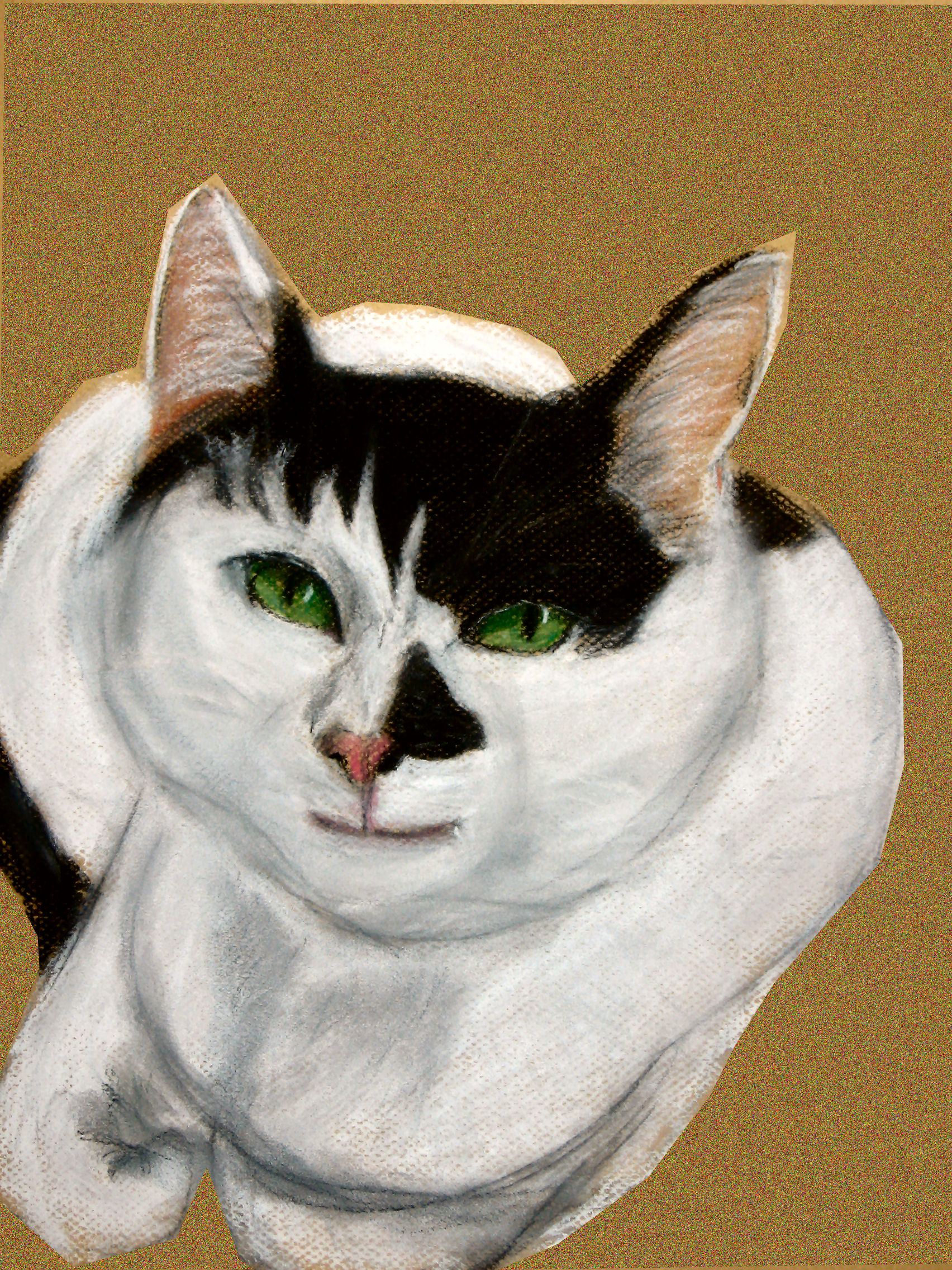
D'Artagnan in pastels, by Sarah
Cats. I think twice in our whole lives as cat owners (though there is some doubt as to who owns whom) we went out of our way to get a cat. First, when we bought our first house. We finally could have pets (before that we had a remote controlled jeep we called Fido and took for walks. Freaked out the neighbors) and I held out for a marmelade cat. We heard of a friend whose daughter, living in a college dorm, had unwittingly given refuge to a female marmelade (it’s so rare, she assumed cat was male) in what the victorians called an interesting condition. This girl cat, Tiffany, had delivered herself of four bouncing baby kittens and the dorm didn’t even allow pets, much less five cats in one room.

So we went out and fell in love at first sight with this bouncy little ball of fat and fluffy orange fur whom they called Garfield – and we called Pixel. Problem was Pixel was still nursing, at eight weeks, and eating no solid food. Also, he was very attached to his identical, somewhat thinner, twin whose original name I can’t remember but whom we named Randy.

My husband who had never had a cat in his life told me “you know, they’ll need company while we’re away at work. If we take the twins it will be better.” So, we promised to pick them up when Pixie started eating solids and we went home.

This is when the cat-gods intervened. You see, cat gods are… well… cats. They hear your willingness to host one of their minions, and they … see an opening. In the next week, my husband went for a drive and rescued a scrap of a black kitten, whom he named Petronius the Arbiter before we ever met him. (Pete earned the nickname “Cat from Hell” on his own.)

Suddenly and through no fault of our own we found ourselves with three alpha males. (Pixie did start eating solid food. At sixteen weeks. No, I’m not joking. For the longest time he’d run away if there were more than three pieces of dry food on his dish. I have NO idea why. I think he thought they were preparing for revolution? We had to feed him three bits at a time. But he grew into a lovely and headstrong cat who “spoke” the closest to human I’ve ever heard including starts of freaky internet talking cat videos. The other cats used to have him talk to us when there was a problem, (like lack of food or water) earning him the family title of Speaker to The Humans.)

But the cat gods weren’t done with us – oh, no. Over the next year we rescued a couple of twin orphans, DT and Zebbie.

And then it stopped raining kittens – or at least being at maximum capacity, (though we lost Zebbie a year in) we were more careful about you know… attracting the critters – for about twelve years. At which point, I thought “all our cats are going to get old. We should get a new kitten to cheer us up.”

My husband said if we got any more cats, we’d have to get a Cornish Rex. I THINK he thought this would stand in the way of the mad feline divinities. Lo and behold, there was a litter for sale half an hour from our house. We acquired Miranda with part of the advance for my first book. (She rules the household with an iron paw.)

The problem is – apparently – we’d attracted the attention of the cat gods. The next year, when Pete died, through a combination of factors too weird to explain, we rescued Euclid (aka Pythagoras in the mysteries, aka, the world’s most neurotic cat.) A year after that we lost Randy and two years later, D’Artagnan waltzed into our kitchen in the middle of a snow storm. He was a little 8 week cat all fluff and meows. We couldn’t find anyone who admitted to knowing him (though we found out whose he was eventually. Yes, we did. They threw him out. During a snow storm.) What could we do? He’s been with us ever since.

And I thought that was it, even though we lost Pixie. Turned out I was wrong. You see – sigh – I thought it was perfectly safe to go minigolfing on a warm summer night. Only, there was this incredibly fuzzy white and grey cat (other than the patches being grey, he looks EXACTLY like a Turkish Van. Same personality, too) starved and covered in grease and with a broken tail. He came to my younger son and… yeah. His name is Havelock Vetinari, Havey for short or – appropriately – Absurd. He was a great comfort to DT in her last year of life. She’d lost all her friends and none of the three new cats were friendly, but Havelock liked to cuddle and groom her.

And that’s it, right? We’re safe now, right?

Only Robert says when he goes to med school he’ll probably take D’Artagnan. And Marshall says if he gets into the college he wants to – away from town – he’s taking Miranda. (They’re inseparable.) And we’re thinking… is the cat gods attention activated by our wanting cats, or by a cat family being a few cats below par? Maybe we should get a dog instead? Is there such a thing as a dog god?