It Is I Who Have Gotten Small

As never fails when I make a push to finish a novel, my younger son brought something weird home. (And recovered from it in 12 hours, the little so and so.) The something weird is making my mouth taste like I swallowed a dragon and it’s burping somewhere at the back of my throat. My head hurts and I just want to sleep.

So, even though I tried to get some work done, the progress yesterday and today wasn’t exactly marked. I took a nap, shoveled the walk (I had to get out of the house or go nuts) and spent a considerable amount of time reading The Horse, The Wheel, and Language. No, I don’t know why. I have a strong feeling it relates, somehow, to this long-shelved project called Mirrorplay.

Also – and this has a tendency to happen whenever I run a mild fever – I found myself in the middle of a weird search. In this case it was for pictures/google Earth, etc. of my place of birth.

First of all, and weirdly, apparently I’m the most famous person to come out of the region in the 21st century. (Poor region.) I.e. if you google the village/ubervillage/city you get… me. This alone almost spooked me into giving the whole thing up.

But of course, I had a fever, so I didn’t. I went on to find a map of the place with pictures people have taken integrated in it. There’s pictures from the place I grew up in and the parish church, and the cemetery which is all white marble, by regulation, and so vast it takes up several blocks on the map. Which was kind of interesting, if a little scary.

And then I got completely lost. I mean, I know the way from the cemetery to my parent’s house on foot. Or I used to. I walked it fairly often. (No, not morbid. The town hall is across from the cemetery.)

So I tried following the roads I would follow and got turned around and completely confused. This in itself is not that strange. I mean, seriously – do you know the name of your childhood streets? Well, maybe you do. And nowadays in Portugal they’re very well marked, but when I was little, I knew streets in other ways “Go by the alley where She of The Little Doggies lives. Turn at the Lighted (private part) ’s house. Then go up to where that pig escaped last year.”

On top of that, in the twenty five years since I’ve been gone, they’ve built countless stack a prole apartment buildings and tore open a lot of new streets. This contributes to my having no clue where I am at any given moment. On top of that, manipulating google-maps with my mouse was… uh… curious. So suddenly I would spin out in an unexpected direction and find myself some place only dimly remembered from adults’ conversations in youth: Paranhos; Sao Mamede Infesta (which I remember because my mom would pronounce it sambamed and my dad would add infesta like it was a joke, which I suppose it can be, because it can mean ‘infestates’);Alfena (from which, for some reason, my younger self was convinced mad people came. No, I have no idea why.)

And in the middle of all this, it hit me. The entire map of my childhood, including the places that sounded distant and far away and that built my concept of “foreign” – as in, they do things differently there – is probably no more than fifty square miles, if that. Put it another way, the place names I associated with wonder and distance; the “foreign parts” I dreamed of seeing (not that type of part. Stop it. Those were lighted.); the things I associate with vaguely strange customs and mysterious ways… that entire area would fit in the space between my home and downtown Denver. Possibly with room to spare.

Oh, and the place I always thought of as a “region” – not the village, which was much smaller, but the bigger entity, with the townhall and the church and the cemetery – is described as a village, relegating my childhood world to a hamlet, I suppose.

Weirder, though, was seeing the woods — called “Lightening Rays”, though, from reading the book I’ve been reading, it could also be a cognate of the word for “things that turn” in proto-Latin. Who knows? — and how small they are in reality. Now, mind you, I’d guess they’ve been halved since I was born, but to me those woods are THE WOODS. I like to think of them as a remnant of some old and primeval forest, but they can’t be because when we trekked in them, dad and I would find ruined homesteads and bits of Roman inscriptions. Still, it backed up almost to my grandmother’s backyard. Okay, there was the backyard wall, about maybe five feet, stone. On the other side was the neighbor’s field, stretching to the line of trees. I know sometimes we went around to the gate up the road and took that route, but most of the time, on Saturday afternoon, when dad needed to get me out of mom’s hair, so she could clean the house without me underfoot, (how’s that for mixed metaphors?) dad and I would just jump the backyard wall, walk across the fields and to the forest.

In the forest there were rabbits and birds, and lizards. And there was some pond where reeds grew. Dad used to make me flutes from them, with his pocket knife. And there were massive dragon flies. And ants. For some reason I was deeply into ants. Down the street to the train stop (it’s now almost a station with coverings, but before it was just a stop. Some trains stopped, some didn’t — and it didn’t always mean they weren’t supposed to) there were three or four anthills (that street was dirty.) We used to take them bread crumbs on Saturday and sit around watching them carry it in…

But now looking at it on the map… I think some of my friends have bigger backyards. My entire world of adventure and wonder, where every day something new happened or something unexpected revealed itself – my world of surprises and enchantment turns out to be just a little corner all too easy to fly over on Google maps.

And yet I’d trade dominium over continents and power over countries for the joy I found in my grandmother’s backyard and for the dreams with which my imagination peopled the narrow band of trees beyond it.

Tingly Tribadism And Other Twisted Tales

I figure I’ve lived a blameless life these last few weeks. The death threats and exclamations about my moral depravity and lack of social caring (read ability to toe the line) have slowed down to an almost imperceptible trickle. In other words – I iz doing it wrong.

The start of this post was something Dave put up. It’s not that far away, it’s not that inconceivable, and it’s not at all unlikely one way or another that at some point humans will find a way to do the reproduction thing without one of the genders. I grant you this is more likely to occur with women first since babies need a leasehold in a human body while growing. However, that too might not be insurmountable with a bit more biological research. Bio-wombs of some sort might do the trick.

So, we come to… Planets where the entire population is one gender. Yes, Bujold did it, and she did it, arguably, in the difficult way. But she was published by Baen.

Unless I missed something, the flood of these stories is mostly one way – mostly we’re in some idyllic future where men have been disposed of. All is peace, love and harmony. And that figure retching while reading is me.

Why? Because it’s stupid. And while a lot of science fiction is stupid – really? In the world of Star Trek no one gets paid? People just work because they want to? Behold homus novis! – this particular trope is something that drives me up the wall until I cling to the ceiling by my frayed nails.

So, why does it have this effect on me? Two reasons.

One is that it’s the suck-up’s route. (I don’t like suck ups. I used to wait for them behind the metaphorical bike sheds and beat seven kinds of… never mind. Like Pratchett’s character, I only ever managed to get six anyway.) These stories are easy to publish, they make you feel good and “progressive” with an added side of “speaking truth to power” WHILE at the same time the power – which for these purposes is the person publishing you – is cooing and billing over how wonderful you are for doing this. You want to impress me with an all-woman-peaceful world? Make it good enough that it will sell to Baen despite the publisher not being enamored of the idea. Then I’ll take my hat off to you.

Two is that it is such a gross violation of reality we know – with no explanation. And it gives people who have never experienced the unique female form of war and evil the mistaken impression that we born without a penis are some sort of angels. (It used to be most of the people who believed this were men, and that didn’t disturb me much, since deceiving them is just the nature of our game. However these days there seem to be a lot of young women raised on the fictions and neurosis of older women, who actually believe this. Unfortunately thinking they’re like onto angels, means they feel empowered to do ANYTHING: abuse, attack and attempt to destroy any victims of their collective wrath, for instance. The “mean girl” thing. Having seen this pulled on my son, I can neither endure nor countenance it.)

And if you’re wondering why I say it’s a gross violation of reality with no explanation, you’ve spent too much time in these books. And you might even believe in the original, primeval, matriarchal, all peaceful civilization…

Oh, boy. Get a chair. This is going to be a long one. I’m not going to pronounce on the original matriarchal civilization. It might or might not have existed. I suspect in some places it existed to an extent, in the dim future when the men traveled to “hunting camps” and women kept the fixed home-base. To the extent that women kept the place with its “memory” and ways of doing things, and raised the next generation of both males and females it’s quite possible they had the power in the society. But–

Peaceful?

I bring a tale of woe, my friends. Long ago and far away, I attended an all girl school. A terrible place, where I got to see the behavior of an all-girl society. One on one and woman on woman, women are less likely to pound and pummel. Too bad. Bruises heal and the friend you pounded last week becomes your friend again.

Women… sneak and betray. They tell tales. They build networks. They strive, continuously for dominance.

Pardon me if I sound mysogenistic. I’m not. This is the result of evolution too. Women gathered while men hunted. Our survival depended on manipulating the other women in the band so our children got priority and were watched very closely while we were busy with the berry bush. Bitch queens – bless their hearts – had a LOT of descendants. And their daughters did equally well if they bred true. Men, on the other hand, hunted. Yeah, they were more violent. On the other hand, a man who was unswervingly loyal to his mates knew a spear would rescue him form the mammoth’s tusk. Because he’d saved someone else last week.

(Yes, the patriarchal societies MIGHT have whooped the behind of the matriarchal ones, but my guess is the patriarchal ones were nomads, moving their whole tribe, and they waited till just the women were in the camp. It’s also possible the women didn’t have horses or the wheel. There are other explanations than women-good, men-evil. Not ALL losers were the good guys. In fact, in history… oh, never mind.)

So, are all males loyal, etc. ? Oh, please. There’s a spectrum. Just as there is for women. They are just differently VILLAINOUS. And differently violent. We know for a fact that most mass murderers who kill strangers are men. Most of the mass murderers who kill their nearest and dearest – particularly children in their care – are women. And it might be oppression making them do it, but I doubt it. The behaviors seem to hold true in every society.

So if we did away with me, what would we have? As it happens I have a novel plotted called Starsong, in which women are the dominant gender (there are reasons. It’s alternate history.) What would happen would be the Borgias writ large. At least that’s my opinion. Perhaps no armies in the fields – maybe – but a lot of inexplicable mass poisonings.

Given that, you see why the peaceful all-fem planet makes me ill. But, as announcers say, there’s more: to a vast segment of the male public (most of them in positions of power in publishing) this meme is even more of a win-win. Because not only do they get to don a feminist mantle and completely betray truth, but – even better – they get to have scenes of girl on girl sex. (Which at least one male editor [who, surprisingly, went on to buy me afterwards, for which he has me respect, considering the response I gave to this,] assured me “even girls like”. My response had to do with “only a small percentage.”)

And that ANNOYS the living daylights out of me. I have nothing against lesbians. Some of my best friends are lesbian. I wouldn’t mind if my (adopted) sister married one. BUT I do mind this sort of thing being used to scratch an itch and not even acting like honest porn but instead disguising itself behind high-minded nonsense.

If you don’t find this glorification of women at the expense of males, if you don’t think it infects society to a ridiculous degree, do me a favor. Next time you’re watching TV, take one of the commercials featuring a family. Change the roles of husband and wife. Now, are you offended? Should women be portrayed like that, as total dunces and men as all knowing?

If you tell me current commercials are more realistic, then you’re too far gone…

What memes seem to you to violate reality as we know it? What do you think has caused them to become entrenched? Which of them are just silly and which of them potentially reality-distorting in their ubiquity? And what do you think can be done about it?

*Crossposted at Classical Values and Mad Genius Club*

Finally — Your Ultrabowl report


by Robert A. Hoyt

It’s that time again. Streaming live to you from the Entertainment and Sports Brain Network, this is your only source for real fantasy football, the annual Ultra Bowl game highlights. This year’s matchup is one of the starkest contrasts in playing style in Ultra Bowl history, with the New York Ninjas versus the Alaska Yetis. This year the game was held in the brand new Tesla Memorial Stadium in Colorado (Interestingly, the stadium was not built specifically for the Colorado C’thulus, who will be moving instead to a new home stadium in Ryleh. The project is due for completion sometime in mid to late 2011.). After some of the temporal and spacial problems caused by the malfunction of a local inter-dimensional transporter unit, it was thought that the field would be unusable. However, thanks to deft, and according to some, slightly illegal, deals with local safety officials, the field was cleared for use right on schedule. Fans marveled at the shiny weather-proof force field and luxurious ultra-modern anti-gravity seating, with most figuring out how to use said seating after sustaining only minor injuries.

· The Yetis, in characteristic fashion, arrived on the field loudly. The din from the arrival of the team was clearly taken as a challenge by the Yeti cheerleaders, who responded by jumping up and down and yelling back even louder. The sight of an angry, strategically shaved female yeti cheerleader is indescribable, but even if we could, for legal reasons, we wouldn’t. No one is entirely certain when the Ninjas arrived. The referees eventually had to ask where they were, whereupon they materialized from various hiding places around the field, including one player who was disguised,ironically, as a referee.

· The coin toss went to the Ninjas, who communicated their desire to receive through secret pieces of microfilm hidden in various places on each of the referees. One of the referees petitioned to have the Ninjas barred from the game on the grounds that “a man’s underwear is private”, but the writers of the Ultra Bowl rulebook (now revised twice a year, to be on the safe side), apparently hadn’t thought of that one yet. One of the Yetis, upset by the coin flip, thoroughly smashed the coin with a fist before plodding off to their end of the field.

· The Yetis offered a magnificent kickoff, which made it the 70 yard mark. Ninja receiver Arnold Itsimoru caught the kickoff with a magnificent triple somersault and began to run up-field. In an unanticipated move, with Yeti defenders closing in, Itsimoru threw a smoke pellet into the ground, and continued running as the bewildered Yetis collided behind him. The confusion allowed Itsimoru to get an unheard-of touchdown on the return.

· The Yetis bounced back quickly, unmercifully using their aptitude for snow and ice spells to literally freeze the Ninjas in their tracks. At this point it became clear that even a Ninja is not especially agile when suffering from severe frostbite. Counteracted by strategic and agile defense by the Ninjas, the Yetis made a hard-won struggle for dominance of the field, scoring a goal but failing the conversion thanks to a deftly handled Katana by Ninja defender Jordan Faraday. The teams were stalemated for the remainder of the first quarter.

· In the second quarter, Snowfang, quarterback for the Yetis, threw a high arc long bomb just out of the reach of the Ninjas to Windchill, a young yeti whose relatively small size (standing just seven feet, four inches), and uncharacteristic agility have made him a favorite for the MVP spot three years running. Although the ball was intercepted by Daniel Lee of the Ninjas, the speed lost in intercepting the ball allowed Windchill to catch him. A personal foul was called on Windchill, however, for proceeding to hold Lee upside-down and shake him until smoke pellets and throwing stars dropped from his uniform like confetti.

· The Ninjas managed to wrest control of the ball back from Yetis soon after, scoring a touchdown in quarter two. The Yeti line did not realize until it was too late that they had one additional player, Ninja tight-end Barry Wader, who had cleverly disguised himself as one of the Yetis, and who, upon catching a thrown bomb, proceeded to run the opposite direction at speed. The Yetis made a point of counting their players before each play from this point on.

· The Ninjas also scored via the brilliant tactic of using the imposing yetis as ladders before they could cast spells. Though not always successful, it was enough to put severe pressure on the Yeti linebackers and seriously disrupt their play style. Complemented by a variety of fascinating pyrotechnic abilities which counteracted the Yetis’ snow casts, the ninjas began to reclaim dominance of the field. Experts near the field began to pass comment about the effects of the spells on the fabric of reality, and asked that measuring equipment be brought in.

· Preservering, the yetis also scored a goal when Snowfang grabbed the ball, wrapped it tightly in his arms, and charged directly though the line of much-smaller ninjas. To the disappointment of Yeti fans, additional points were not counted for the three Ninjas and one Yeti Lineman kicked through the uprights by Pinecrusher on his mighty conversion kick, which ended the first half.

· The halftime show was provided by Pterodactylysis , a symphonic electronica band with strong big-band influences. The crowd thrilled to “Trilobyte Rhythm” which has enjoyed a three week run in the top ten on the pop charts. A brand-new, undebuted cover of the song “Ode to a Martian Girl” also made an appearance, the cool, thin harmonics striking a haunting and nostalgic feel in the air. But the mood quickly picked back up with “Towerfall” and finished with a spectacular rendition of “Heart of Krakatoa”, including taking advantage of recently perfected virtual reality technology in Tesla stadium, which finished the halftime show with a fully immersive simulation of a volcanic eruption. To say that the audience was surprised would be something of an understatement. Paramedics were called to deal with the results of the stampede.

· In an ironic note, therefore, the second half began with an opening play by the Yetis designed to even the field, wherein Snowfang cast a spell that deep-chilled the entire stadium, turning the supercooled grass into thousands of tiny spikes. The Ninja’s kicker nevertheless made an almost impossible leap off the goalpost to deliver a very respectable kick which was intercepted by the Yetis via throwing Windchill into the air. Fans scrambled to get out of the way as he tumbled from thirty feet in the air and plowed to earth, knocking over the goalpost and leaving a swathe of destruction through the stands, scoring a definitive return touchdown and moral victory for the Yetis.

· A t this point, officials in the stands started to pick up some worrying signals as the increasing levels of magic usage weakened the already damaged fabric of reality in the immediate vicinity of the stadium. After the goalpost was put back, the Ninjas took possession. Responding to the aggressive Yeti tactics, they summoning a full-sized dragon made of fire, which burnt craters into the ground and set yeti defender Winterbranch’s hair on fire. The fire dragon is a perfectly normal cast by the Ninjas in the late game, but in the circumstances it also mysteriously turned all the seats in the stadium into giant rubber ducks. It was generally agreed, however, that this made them far more useable.

· Not to be outdone, the Yetis called on the favorite Ultra Bowl tactic of tampering with the weather, encouraging a storm of freezing rain so aggressive that it shorted the weather-proof paneling on the forcefields (giving semi-serious electrical shocks to some of the fans), and seriously cooled off the dragon that had assisted the Ninjas in fighting their way up-field. Their ace lost, the Ninjas nevertheless scored an additional touchdown while they had the advantage of field position, Ninja Quarterback Francis Pretori spinning deftly down the field while touching the spiky turf only with a pair of knives. Two would-be tacklers on the Yeti side withstained superficial wounds while attempting to stop his advance up the field. In a related event, several of the vendors found that their wares had turned into horrible tentacled creatures with far too many eyes. Through a twist of good fortune, however, it was discovered that the creatures were delicious when wrapped in bacon or when dipped in chocolate. A major ice-cream company has since expressed interest in using them to expand their product line.

· The Ninjas began to move from their more defense-oriented stance, traditional for ninjitsu, to a more magic-heavy stance, casting an impenetrable haze of black smoke over the field to give themselves cover to maneuver. The Yetis, however, adapted to a very harsh environment often prone to conditions of limited visibility, soon proved that they were perfectly capable of detecting the ninjas through other means, swatting them away with suprising ease. The attack was finally ended entirely by a well-aimed freezing tornado that sucked up the smoke, four Ninja linemen, two jumboscreens and a chocolate-covered-otherworldly-creature-on-a-stick vending cart.

· To gain the upper hand, the Yetis strategically adjusted their weather spell into a thick downpour of snow. The Yetis managed to wail on the Ninjas through the tactic of magically packing on thick layers of snow and ice that both protected them against blows and increased their size and strength (an innate ability that gained yetis the name “abominable snowman”). Opposed only by the occasional well placed bomb, which would blow a lineman apart in an avalanche of snow, the Yetis proceeded to recoup two touchdowns with more relative ease than any team that has yet gone against the Ninjas, evening the score by the end of the third quarter. Key structural supports in parts of the stadium turned variously into glass, cookie dough, and a giant llama, but fans were evacuated quickly and no fatalities occurred. The llama, however, is still at large.

· As the fourth quarter opened, with everything still to play for, the Ninjas opted for a spell that caused giant, red-hot steel blades to pop suddenly out of the field without any apparent pattern. This is a rarely used spell for the Ninjas, but their superior training gives them an advantage that their opponents do not have, and it showed. The spell made the oversized, snow-packed Yetis too encumbered and slow to react sufficiently in their environment, and the Ninjas pressed forward for all they were worth, battling the Yetis to within ten yards of their goal line. In an unorthodox move, the Yetis used a desperate last minute spell to bury everyone, including themselves, in seven feet of snow. With their massive snowshoe-esque feet allowing them to tread over the top of the buried blades, the halfback, Iceclaw, pushed the ball back 40 yards, before dropping into a crevasse that had been melted in the snow by a blade. After a short consultation with the doctors, then with a necromancer, Iceclaw returned to play with only a slight lingering craving for brains.

. At this point, due to the ongoing magic usage, the traditional rules of gravity began to wear a little thin. Dense balls of snow and huge sections of ground hovered around the stadium according to local gravitational effects. Fans continued to cheer from the stands, some sitting on any available comfortable spot on the ceiling or wall, some having fastened themselves somehow to their rubber ducks, and in a few unsettling cases, some having used the seat-belts that the ducks appeared with in the first place. A confusing scrum started on the bottom of one of the larger snowballs which drifted slowly towards the Ninja side as the players fought for control of the ball. Most plays, however, involved the player in possession of the ball leaping from patch to patch, occasionally lurching sideways and falling into the bleachers or experiencing the dreaded fall-into-the-sky (at least until they left the vicinity of the stadium, whereupon they generally would fall back down). This allowed for some interesting ambush plays by Ninjas, who would often sneak up on Yetis from underneath to steal the ball (often to have a yeti smash the entire globe they were standing on a moment later). At one memorable point, a chase encircled one of the larger globes of snow four times before the whistle was blown. Despite the confusion caused by the fifty yard line drifting to roughly twenty yards from the Yetis and the thirty yard line for the Ninjas getting lost entirely, the teams appeared dead even.

· With one minute left on the clock, Snowfang fell back to regroup. In a final all-or-nothing move, he arranged the pieces of snow into a larger version of the individual snow-packing spell used earlier by the team. The resulting snow-golem, resisting the conflicting gravitational forces, began to trudge toward the ninja end zone with Snowfang on its shoulder. In response, a contingent of Ninjas quickly erected an enormous yin-yang patterned shield to block the advancing giant. But, taking advantage of an upward gravitational current, Snowfang jumped off the golem and high into the air above the stadium, shooting back down again at terminal velocity and puncturing the roof as he fell into the Ninja endzone, thus scoring the final touchdown of the game. Due to the combined duress of the golem spell and the impact of the falling Yeti, the entire outer shell of the stadium turned into Swedish to Venusian Dictionaries and blue peanuts and exploded.

So it looks like, though both teams fought hard for it, the Yetis will be the ones taking home an Ultra Bowl trophy this year. There will be a lot of very happy yetis out there tonight, especially in the cities along the Alaskan interior. In the meantime, Tesla Memorial stadium has been shut down, pending major repairs and an overhaul of local spacetime. Despite warnings, many fans are taking home their rubber ducks as souvenirs. Some investors are predicting a serious uptick in sales of jumbo bathtubs as a result of the event. A couple of Ninjas felt an unfortunate necessity to commit hari-kari after the match, but the good news is that many of the undead teams, such as the Baton-Rouge Bonedolls and Washington Zombies, have expressed interest in recruiting them. Thankfully, not all of them took it that badly. At least one is believed to have left the stadium disguised as a rubber duck. That’s all for this year. Thank you for tuning in, and goodnight.

Sorry to Be So Late Posting

I’m now deep in the throes of finishing the mystery. It looks like it should be done tomorrow at the latest (fingers crossed.) Unfortunately, I’ve reached that stage where I can’t really think of any other type of writing until this book is done.

This will happen periodically, usually in my last week of a book. I hope you guys can survive without my sparkling musings :).

I suppose I should have posted yesterday, but we went to a superbowl party at the home of an old friend. This is always pleasant, as we get to see friends we hadn’t seen in a long time. (Though this year we seem to be running into Rebecca and Alan Lickiss a lot more than usual — and that’s a good thing.) Anyway, they keep their house much colder than we keep ours — look, children, I grew up in a coastal Mediterranean climate. The air should be about seventy year round. That’s all — so by the time I got home and warmed up to Sarah-normal, I got sleepy, as one does.

So, today I’m going to sit here, with D’Artagnan the cat draped across lap and finish A Fatal Stain. If I have brain left by tonight, I’ll write something fun for you guys.

Coming soon from Naked Reader Press

Here is an excerpt from Death of a Musketeer, coming out later this month from Naked Reader Press. This will be the first time the novel has been available in digital format. If it does well enough for NRP, I will resume the series with number six, The Musketeer’s Confessor, probably early next year. Enjoy!

***

Prologue

Or

How I came by the other Diaries Of Monsieur D’Artagnan

My first encounter with the gentlemen known to all the world as Athos, Porthos, Aramis–and, of course, D’Artagnan–came at a young age when, searching through the shelves of my grandfather’s library, I was called by several leather-bound volumes bearing the name Dumas on the spine.

I hardly need tell anyone who had the good fortune of reading Monsieur Dumas’s works at an early age with what rapt attention I followed the actions of the brash young man from Gascony and his three daring companions.

Over the years, I’ve returned to the same book — and its companions Twenty Years After, and Viscount de Bragelone — every winter, when the snow first fell. I re-read the adventures of the four charming rogues, again and again, by my cozy fireside. But I knew I’d never encounter them in any other writing.

I was wrong. This winter, when snowflakes first danced on the thin mountain air of Colorado and while my slippers and my hot chocolate waited with a leather-bound book by my comfortable chair, a delivery service dropped an unpromising battered cardboard box on my front porch.

Inside it was a brief note from my father-in-law, some of whose ancestors immigrated to the New World at the end of the seventeenth century.

Not a French speaker, he said he thought it best if I were given these papers, found in the estate of an elderly relation.

I confess I perused them, at first, with some distaste. The pages had mildewed to an unappetizing shade of greyish yellow and I had to turn them with the greatest care to prevent their falling apart. I picked a word here and a word there, amid decay and mildew. The spelling was quite the oddest I’d ever encountered.

However, on page two I found the name D’Artagnan, on page five the name Athos and on page ten the names Porthos and Aramis together. By page fifteen I realized these diaries referred to murders investigated, solved and often avenged by the three musketeers plus one. I was hooked.

After that, I devoured the twenty mildewed diaries with the eagerness of one too long separated from a childhood friend. Woven around the events that Dumas told the world of in his books, the diaries started with the fateful duel at the Barefoot Carmelites. However, they very quickly turned into a series of murder mysteries often involving the highest nobility of France.

The bulk of it was written in ink that had faded to brown, and in an angular hand that marched across the pages with the certainty of a military officer on campaign.

However, over it all, there were notes in other hands, squeezed in the margins and scribbled between the lines. I soon learned to identify the small, sharp, inclined hand with Athos, the round, well formed ecclesiastical one — still with a hint of violet to its tints — with Aramis and the laborious printing with Porthos. The notes gave details that the writer of the main diaries — certainly D’Artagnan — couldn’t have known at the time he wrote them.

I do not know how his friends came to editorialize D’Artagnan’s diaries. And I have no idea how or by what crooked lines of descent and inheritance or happenstance and luck those diaries passed into the hands of my family.

The only thing certain is that those diaries, which I edited for coherence and adapted to our modern storytelling mode, reveal murders as intricate and fiendish as any writer could dream, and that these crimes could only be solved by Athos, Porthos, Aramis and D’Artagnan.

To whose spirit, nobility and courage I hope my retelling will do justice.

Sarah D’Almeida
January 2004
Colorado Springs

The Duel that Wasn’t;
Where the Cardinal’s Guards are Taught a Lesson;
A Handy Guide to the Taverns of Paris

D’Artagnan knew he was going to die.

It was April 1625 and the spring sun, fierce and blazing, shone like an unblinking eye over the bustling city of Paris. Henri D’Artagnan, aged seventeen, a slim, muscular young man with olive skin, dark hair and piercing black eyes, had arrived in town just the day before.

Now, under the noon sun, he stood outside the convent of the Barefoot Carmelites, a religious house situated in a conveniently deserted spot on the outskirts of town.

Around him spread fields of green wheat. The wind being still and no breeze stirring the sheaves, the only sound was the drowsy droning of insects, drunk with midday languor and heat.

And D’Artagnan thought this was the last day of his life.

If he weren’t himself, if he were not the only son of nobleman Francois D’Artagnan, a hardened veteran soldier, D’Artagnan could have turned and taken off running through those fields, relying on his young, agile legs to get him away from death.

His mind cringed at such an unworthy thought.

His opponent, with whom his sword was crossed, scraped the sword lightly along the length of D’Artagnan’s. Just enough to gain the young man’s attention.

And D’Artagnan turned towards him, at the same time that his opponent’s second, who served as their judge in this case, dropped the white handkerchief signaling the beginning of combat.

His opponent came at D’Artagnan like a tiger, his sword pressing D’Artagnan close and demanding all of the young man’s concentration.

The man was called Athos, and he fought like a veteran duelist. Which he was, being one of the older and more experienced and — as far as D’Artagnan could determine — one of the most feared members of his majesty Louis XIII’s corps of musketeers. Other things D’Artagnan had heard, once he’d given himself the trouble of checking: That the man had the personal friendship of Monsieur de Treville. That he was of noble birth. That Athos was a nom-de-guerre, picked up to hide disgrace or guilt.

Athos attacked, driving the young man back and back and back, till D’Artagnan’s shoulders were solidly against the white-washed wall of the convent and only his quick wit and quicker reflexes permitted him to step sideways and avoid being skewered.

D’Artagnan flitted and skipped, danced away from trouble and contorted away from tight spots, but his mind became oddly detached.

His body moved and seemed to think with a reasoning of its own, while it parried and thrust, and made Athos back away. Meanwhile D’Artagnan’s mind — what his mother used to call his quick and lively mind — had gone away, to some place at the back of himself. Some place away from the battlefield, where it could do its thinking.

When Henri D’Artagnan had left the paternal abode, his father had given him only one substantive piece of advice. And that was that he fight often, that he fight well and that he never tolerate any insult from anyone but the king or the Cardinal who was, truth be told, as powerful as any king.

Henri had tried to follow his father’s advice and, on the road to Paris, in the small town of Meung, had challenged a nobleman who laughed at his attire and horse. This had cost him dearly, as his opponent had his servants hit Henri from behind. While Henri was unconscious, the stranger had stolen Henri’s letter of recommendation to Monsieur de Treville. The letter that would have got him into the musketeers this very day.

But I don’t learn, do I? D’Artagnan thought to himself, as he pushed hard with his sword arm, forcing Athos’s sword away, shoving the musketeer back at the same time.

Athos fell away and tripped and bent down upon his knee.

I had to challenge three musketeers for a duel today. Three. Musketeers. Today, D’Artagnan thought, as he jumped nimbly back, ready to parry Athos’s next thrust.

No, he didn’t learn. He’d continued following his father’s advice, until he’d managed to challenge the three men that the rest of the corps called the three inseparables: Athos, Porthos and Aramis. One of whom would kill him today.

D’Artagnan’s mind was so preoccupied with its gloomy thoughts that he didn’t at first realize that Athos hadn’t got up from his position, half-bent over his knee.

“Monsieur,” he said, when he did notice it. “Monsieur, if it would suit you to adjourn our appointment to another time….”

He noticed Athos’s hand pressed hard at his right side, and he remembered the scene, that very morning, in Monsieur de Treville’s office, where an obviously wounded and ill Athos had come in to present himself to his captain and to deflect Monsieur de Treville’s anger at all of the three musketeers who’d been bested in a skirmish with the Cardinal’s guards.

“Monsieur, if you are in too great a pain…,” D’Artagnan said. He’d got in this duel with Athos by careening against the musketeer and making him bleed. And failing to apologize sufficiently for the injury he’d caused.

But Athos only shook his head. He took a deep breath, audible in the midday stillness, and he rose slowly from his knee. “It’s nothing,” he said, his face ashen. “It is nothing. I didn’t want to distress you with the sight of blood you haven’t drawn.” A red stain showed on the side of his doublet. He changed his sword to his left hand. “If you don’t mind, I will fight with my left hand, though. It will not put me at a disadvantage, as I can use either hand to equal effect. But it might be harder for you to defend yourself.”

D’Artagnan nodded. He knew he would die anyway. And if he was going to die, perhaps it would be best if it was at Athos’s hands. Of his three potential opponents, he liked and admired Athos more than the other two. It was no dishonor to be killed by such a man.

Athos straightened and pulled back a stray lock of pitch black hair, which contrasted glaringly with his alabaster-pale complexion.

D’Artagnan had heard that Athos was considered handsome by many men and even more women in Paris. This opinion baffled D’Artagnan.

Athos’s face was spare, with high cheekbones and intense, eyes burning with zeal. The rest of his features, precisely drawn and finely sculpted, made the man look less like a living being and more like those caryatides of Greece and Rome — columns given human form and forever holding aloft the white marble roof of a temple or palace.

Athos’s character, like his appearance, seemed as spare, as certain, as controlled as those columns. Rightly or not, he gave the impression of a man who served a cause greater than his own whims, purer than his own advancement.

And this, D’Artagnan thought as Athos raised his sword, was what D’Artagnan would have liked to be — if he ever got to live beyond his present seventeen years.

Aramis, Athos’s second and D’Artagnan’s next arranged opponent, stepped up. He was a blonde man, so dainty-looking that one might fail to notice he was almost as tall as Athos and as muscular. Accounted a gallant by all who knew him, he was said to be popular with the ladies and rumored to be entertaining duchesses and princesses by the score.

D’Artagnan, who had challenged him to a duel over an argument started on a point of honor, had at first thought him just a dandy and nothing more. But Aramis’s bright green eyes showed such a keen appreciation for the irony of D’Artagnan’s situation, that perhaps there was more to him.

As he stepped up, picking up his white handkerchief from the ground where it had lain, he said, “You must restart the duel.”

D’Artagnan noticed that Athos was very pale still, his skin tinged with the grey of a man fighting extreme pain, and realized that Athos’s old fashioned Spanish-style doublet was laced tightly over his musketeer’s tunic. “I would not object if you undo the ties on your doublet, since the sun is so devilishly hot.”

But Athos shook his head. “I thank you for your courtesy,” he said, “but really, I’m afraid if I do it will restart the bleeding. The wound is bothering me.”

“Do not misunderstand me; I am eager to cross swords with you,” D’Artagnan said. “But if you wish to wait and perhaps drink something for your present comfort…”

Athos smiled, a flash of genuine amusement. “Your sentiment does you credit, but I believe in collecting my debts promptly and drinking afterwards. And then, it is not the first time I’ve fought while wounded.” He shifted his feet and tilted the upper half of his body forward, baring his teeth slightly, as if allowing the animal to peer out of his noble features.

“Come, come,” Porthos spoke, from where he stood by the white wall of the convent, hands the size of hams folded over the guard of a very substantial sword. A redheaded giant, he dwarfed other men with the size of his lean, muscular body. Each of his arms looked to be the size of D’Artagnan’s thigh, each of his legs like an oak tree trunk. And yet he gave the impression of suppleness, of not a wasted ounce on his huge frame. “You are all talk. Less talk and more fighting. Remember, Athos, he owes me satisfaction after you and Aramis have your turns. He offended me most horribly on a matter of fashion.”

Did D’Artagnan fancy that a smile crossed Aramis’s and Athos’s lips, when Porthos spoke?

Aramis raised his eyebrows and, still holding his handkerchief aloft, turned towards Porthos. “When you wish to be so rude, you should speak for yourself only, Porthos. I have no objection to the noble and proper sentiments these gentlemen express. Indeed, I will gladly listen to them for as long as necessary, before they feel it fit to cross swords.”

And now another flinch of remorse came to join D’Artagnan’s regret that he would die so early, leaving so much untasted of life’s joys: that he would never get to know these men better. There was such an easy camaraderie between the three of them, so devoid of the formality of most friendships, that he imagined they could have been his friends.

“Only,” Porthos said, pulling a large red handkerchief from his sleeve and mopping at his forehead with it, “it’s too blazing hot.”

“It doesn’t matter,” Athos said, and leaned forward, displaying his teeth, again, in that expression that was more animal threat than human smile, “for we are ready.” He pushed his sword against D’Artagnan’s and said, “En garde,” between clenched teeth.

Aramis dropped the scarf.

A throat was cleared, nearby, neither by Aramis nor by Porthos.

Their swords still crossed, D’Artagnan and Athos turned to look. Five men stood near them — so near that they could only have approached unnoticed while the musketeers and D’Artagnan were distracted with talk and worry for Athos’s wound. All of them wore uniforms similar to those of the musketeers, but where the musketeers wore blue, their knee breeches, tunics and plumed hats were bright red, like freshly spilled blood.

They were guards of the Cardinal, sworn rivals of the Musketeers, their enemies in a thousand brawls, a million street skirmishes.

“Well, well,” said the leading guard, who had a suntanned face and a Roman nose. “What have we here? Dueling Musketeers? What? In open and defiant contravention of all the edicts against dueling?” He smiled unpleasantly, revealing a wealth of very large, yellowed teeth. “I’m afraid we’ll have to arrest the lot of you.”

“Leave us alone, Jussac,” Athos said, without turning to look, his sword still crossed with D’Artagnan’s. “I promise you if we found you in the like amusement we’d sit back and let you proceed. Enjoy and amuse yourselves, have the profit of our injuries with none of the pain.”

Jussac smiled wider. “That’s as it may be, Monsieur Athos. But the thing is there is an edict against dueling and our master, the Cardinal, wants laws obeyed.”

Athos lowered his sword. He turned to Jussac and, with an air of strained patience, said, “Nothing would please me more than to oblige you. But, you see, our captain, Monsieur de Treville, has forbidden us from being arrested.”

Jussac sighed, in turn. He lifted his hat and scratched under it at his sweat-soaked hair. “Think about it,” he said. “There are only three of you, one of you wounded. Three of you and a child who was dueling you. If you force us to fight you, they will say it’s murder.”

The three musketeers formed a circle, from within which their worried voices reached D’Artagnan’s ears.

“I’m afraid he’s right, you know,” Aramis said. “There are only three of us, one of us wounded. And there are five of them: Jussac, Brisac and Cahusac, the three fiercest fighters in the Guards, and two of their companions. They will slaughter us.”

Athos paled yet further and glared, his zealous blue eyes seeming to flame. His features hardened into a harsher pose of dignity. “I would rather die than appear before Monsieur de Treville defeated again.”

“Me too,” Porthos said.

D’Artagnan remembered the scorching reproach that Monsieur de Treville had inflicted on the three musketeers that morning. Everyone waiting in the captain’s antechamber had heard it. He didn’t blame the three for not wishing to face such humiliation again.

“Very well, then,” Aramis said. He straightened a little and squared his shoulders. “We’ll die here.”

“You, the child,” Jussac said, pointing at D’Artagnan. “Save yourself. We’ll allow you to go.”

D’Artagnan looked at the three musketeers who were so calm, so resigned, gallantly preparing themselves for death rather than facing dishonor. He looked over at Jussac, who smiled benevolently at him, showing long yellow teeth.

He pushed himself into the musketeers’ circle, shoving his sweaty face between Aramis’s and Porthos’s shoulders. “You are wrong,” he said. “When you say there are only three of you. I count four of us.”

They looked back at him, and for a moment it looked as though Porthos were on the verge of asking who the fourth one might be. But, before he could, Athos smiled. “You’re a child,” he said. “And someday you’ll be a man I’d be proud to call a friend. But right now you’re a boy. And this is suicide. Our chosen death. Save yourself.”

“No,” D’Artagnan said, his certainty growing with the rebuff. “No. I’ll stay and fight by your side.”

“But, you’re not a musketeer,” Aramis said. “Why would you want to die with us?”

“Though I don’t wear a musketeer uniform,” D’Artagnan said. “In my heart I am a musketeer. And though I might only be able to give you very little help, if I leave and save my life, I’ll never be able to live with myself.”

For a moment Aramis stared at him, Porthos frowned at him, and Athos furrowed his brow as if in deep thought.

And then Athos smiled. “You’re right,” he said. “There are indeed four of us. Athos, Porthos, Aramis and–your name, my friend?”

“D’Artagnan,” D’Artagnan answered, as his heart hammered faster and faster in his chest, and once more he was sure he was going to die.

This time he knew he was going to die at the end of the guards’ swords. But he would die next to musketeers. He would die almost a musketeer. His father would be proud.

“Well, then, Athos, Porthos, Aramis and D’Artagnan. One for all and all for one. If death is to come for us, let us not keep her waiting. Let us go out and meet her halfway, like gallants, and receive her kiss proudly.”

“We grow impatient,” Jussac thundered, outside their circle. “Will you save yourself or not, boy? Because if not, we’re coming to get you.”

The circle broke apart as though they had rehearsed, and the four of them faced the five guards.

“We’ve made a decision,” Athos said, his voice steady and calm.

“Oh,” Jussac said. “I hope it’s a sensible decision.”

“Very,” Athos said, and removed his hat, and bowed with a deep flourish. “We’re going to have the pleasure of charging you.”

Before the guard could snap shut the mouth that he’d let drop open in his astonishment, Athos’s hat was back on his head, and Porthos and Aramis had unsheathed their swords.

“One for all and all for one,” they shouted, as they fell on the guards.

By the rational odds of combat and war, they should have lost. There were but four of them, one of whom was severely wounded, and the other little more than a child.

D’Artagnan’s only experience of dueling had been his mock duels with his father, in the field behind their house, in the calm Gascon countryside.

If that duel had been decided on body count, or on experience, or even on the relative size of the opponents, surely the guards of the Cardinal would have won.

But wars and duels are fought with the mind, the heart, and that other thing – that thing that is neither loyalty nor camaraderie, but which has hints of both.

That thing allowed D’Artagnan to know and come to the rescue when Athos’s breathing grew too labored. That thing allowed him to go away when Athos had recovered enough to resume his own battle.

And duels are also fought with pride and fear. The three musketeers were too proud to surrender, too fearful of Monsieur de Treville’s wrath to allow themselves to be arrested. They fought like fury unleashed.

Porthos fought and defeated two enemies at once.

And so, fifteen minutes later, the only one left standing of the small army of Cardinal Guards was de Brissac – like D’Artagnan, a Gascon, and like D’Artagnan, ill-suited to surrender. Surrounded by all the musketeers, he broke his own sword upon his knee to avoid losing it.

But then he gave up. He helped the musketeers and D’Artagnan take the wounded and dead to the convent’s door. And stayed behind with them, while the musketeers and D’Artagnan rang the bell and walked away.

Years later, D’Artagnan would try to recall the rest of the afternoon. All he would remember was Athos’s promising that he would show D’Artagnan the best taverns in Paris.

And then they’d gone to the Louis, where there were ten musketeers and where, when Porthos had told their story, people had rushed to buy them strong, sweet, fiery liquor. From there, they’d walked a block to The Maiden’s Head, where the seven musketeers present had listened to their story with awe. And then to The Head and Bucket, where, at the telling of their tale, musketeers and sympathizers had bought them a sparkling white wine.

D’Artagnan remembered there had been a pause between The Grinning Corpse and The Coup de Grace, while he leaned against a wall in an alley and lost most of the wine he’d drunk in the preceding hours.

But then they’d taken him to the Drinking Fish for a few mugs of house special, and from there to The Drunken Lord for something that tasted like liquid fire.

Night had fallen when D’Artagnan found himself stumbling along the back alleys and narrow staircases of the working-class neighborhoods of Paris, one arm thrown over Aramis’s shoulder, Porthos’s huge hand on his other shoulder, singing softly a song about the queen, the king and the musketeers that would surely be treason if they weren’t all drunk and all so loyal that they’d just risked their lives to ensure the king’s own musketeers suffered no defeat.

“We should take the boy home first,” Athos said. He had to be drunk. He’d drunk more of all the various liquors than all of them combined. He had to be dead drunk. But he walked steadily and his voice sounded, if anything, a little slower and calmer and more controlled.

Porthos giggled. “‘s right,” he said. “It is past the time schoolboys should be asleep.”

“Where do you live, D’Artagnan?” Aramis asked.

“Rue des Fossoyers,” D’Artagnan said, glad he’d rented lodgings before going in search of his fate outside the Barefoot Carmelites. Looking back it had been presumptuous to think he’d survive three duels. But, at least, he’d have a place to sleep tonight.

“Good,” Athos said. “That’s just around–”

He turned, as if to get his bearings, and as he turned, and they with him, they all saw a figure in the uniform of a musketeer cross the alley right in front of them.

“Oh, I say, wait,” Athos said. “Wait, friend. King’s Musketeer, hold. Have you heard that we defeated Jussac outside the Barefoot–”

The musketeer jumped, as if touched with hot iron, and took off running, the sound of his steps echoing and reverberating through the maze of narrow streets.

The musketeers stopped and frowned at the space where the unknown musketeer had been.

“That’s abominably rude,” Aramis said.

“Musketeer or no, someone should teach him some manners,” Porthos said.

“He should buy us a drink to make up for it,” Athos said. “After all, there must be a place still open.”

As one man, they ran, pursuing the fugitive. D’Artagnan followed the sound of their steps.

They ran down so many blind alleys, careened precipitously down so many worn staircases, that D’Artagnan was sure they’d never find the runaway musketeer. He’d be lucky if he didn’t get separated from his friends.

But at last, they all surged into an alley. And there, on the ground, the musketeer lay.

The three musketeers had been calling and jeering and laughing, but now all their noises stopped.

It was suddenly very quiet, in that alley. Far away, an owl hooted, chasing prey in some attic. D’Artagnan drew a deep breath that sounded too loud in the silence.

“It can’t be,” Aramis said, under his breath.

But though D’Artagnan had never seen a dead body, he knew the musketeer lying on the muddy, smelly ground of the alley was dead.

If asked, he could have given no more justification than a certain angle of the arm protruding from under the body and the stillness, the eerie stillness of whole body.

“He’s dead,” he said.

Aramis crossed himself and Athos stepped forward, towards the corpse.

*Crossposted at Classical Values.*

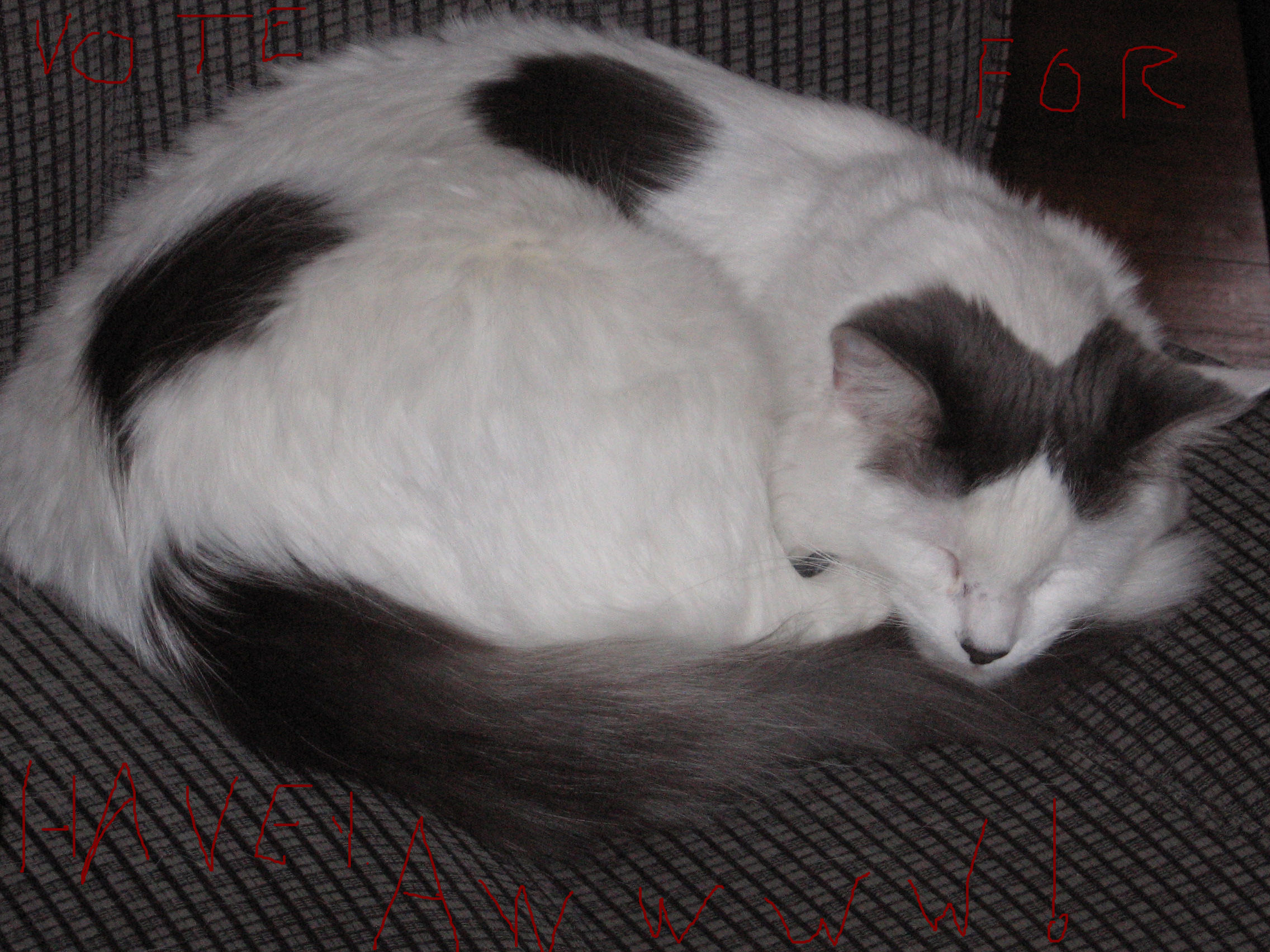
Vote For ME!

Hi everyone. My name is Havelock Vetinari D’Almeida Hoyt, though mommy calls me Havey cat.

I asked her what she was doing for her blog today and she told me to go away, because she was writing something called “Dyce.” I don’t know what this means but it must be terrible, because she keeps pulling her hair and saying it just isn’t funny enough.

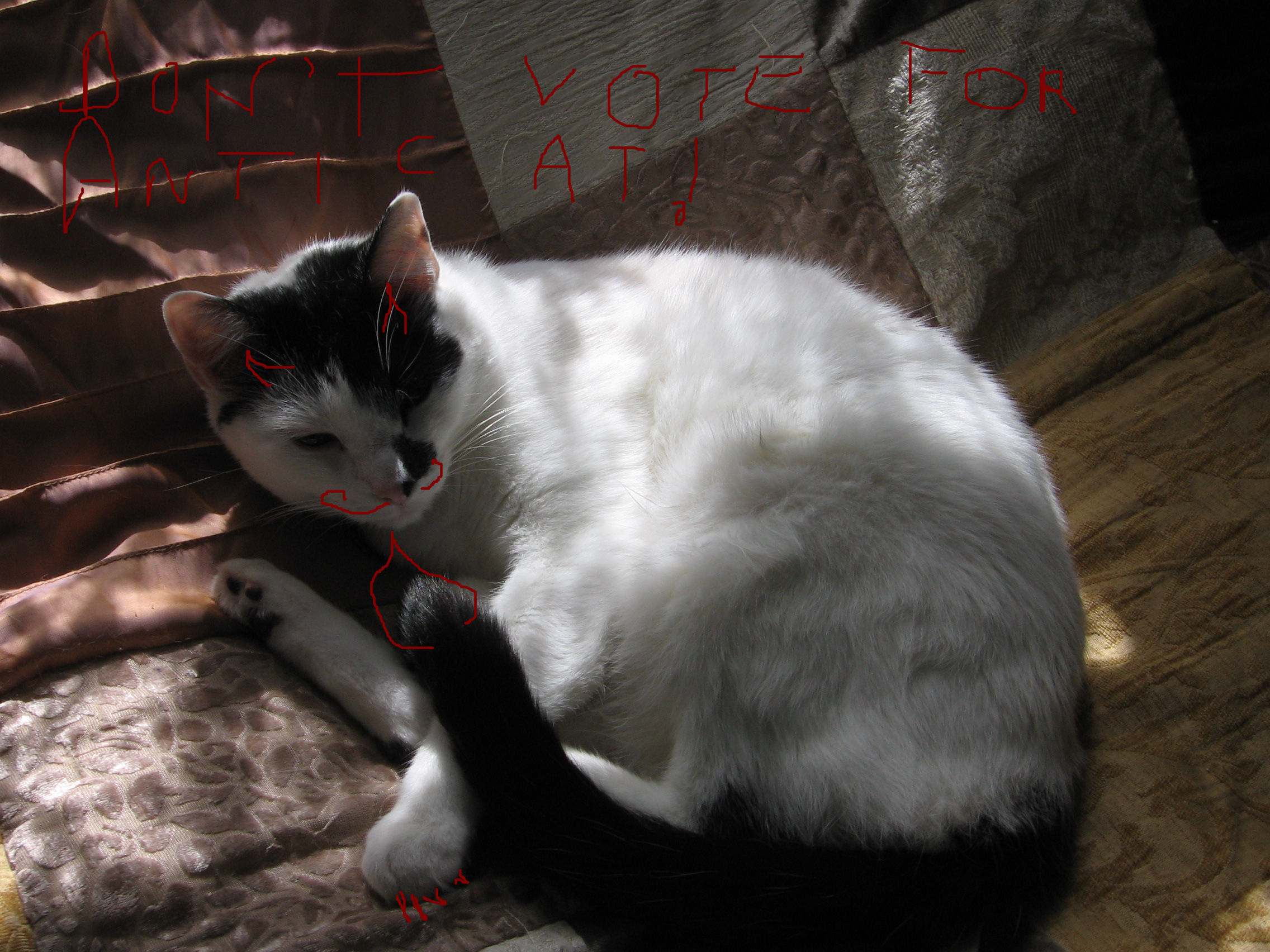
I offered to help her with that, but she told me that, no, thank you, cats have no sense of humor. So I offered to do this blog. First I want to apologize for not knowing LOLcat grammar. I’ve been so busy fighting to establish my territory over D’Artagnan (the anti-cat) that I haven’t had any time to learn to speak like a cat. (I mean, all the drinking and running downstairs to pee on the sofas takes time. The sofas ain’t gonna p*ss themselves.)

Second, I want to point out that as the most tragically beautiful cat, ever, I have a very difficult life. No, seriously. Do you know how hard it is to lie down in all these poses, to make the humans go “aw”?

But enough about me. Let’s talk about me. The thing is that mom is thinking of adding another cat to the mystery because she says that would be funnier. I want to request that you make sure you request me and not D’Artagnan (who IS the anti-cat.)

Who would you rather have? Cute, cuddly, soft-as-cashmere me?


Or the anti-cat?

It’s Revolting!

In the art museum, in Denver, in the portrait section, there is a painting of a Spanish grandee, ambassador to some court or other, Lord High This and That, Keeper Of The Royal Watchmacallit. (Give me a break, I barely remember names for people who are alive!)

I like to linger in front of that portrait – very well executed as far as that goes, with a sort of photo-realism that’s more real than mere photographs – because it is an example of rebellion; of speaking truth to power, to repeat a very old phrase.

Because I’m that sort of mother and they’re that sort of kids, I asked my sons why this portrait is highly subversive. It took them a while. Well, it would. I mean, there’s the miles and miles of satin, the lace, the sparkly noblesse-oblige bling.

But the shocking part of the portrait is in the face of the gentleman painted. It’s nothing overt, of course. True rocking of social conventions rarely is – think about it. But if you look in the man’s eyes, you catch a glimpse of fear, a suggestion of cringing, the certainty that the man trapped within the satin, the lace and the diamonds feels less than equal to his positions, and perhaps dwarfed by his resounding titles. You expect his tongue to come out and lick his lips. You expect him to duck his head.

Did the artist capture that on purpose? Almost certainly. Given his skill with portraiture, I have trouble believing he could have done it by accident. Now, it might be a matter of his beliefs leaking onto the paper without his conscious knowledge – that’s part of creating art. But at some point he had to realize what he was doing. Did it take courage? Almost for sure, given the time. I mean, killing artists might be a terrible social faux-pas at the time for all I know, but the imbalance of power was such that it could probably be managed quietly and behind the scenes. Or perhaps the artist could just be quietly ruined till he died of hunger in some garret.

So, why am I concerned with portraiture at five am on this lovely Thursday morning when temperatures are projected to go into the positive side of the Fahrenheit scale for the first time in days? (Oooh. Twenties. T-shirt weather.)

Because an exchange of emails with a friend late last night made me realize we live in very odd times. Drive by the local highschool sometime at school’s end, and look at the kids. If you squint and tilt your head sideways, it’s like being in a time machine. Faded Jeans, tie-dyed t-shirts. At most you’ll think you’re back in the seventies without the ’fros. (Hey, I had one.)

And if you are the thinking kind you’ll realize our entire picture of society is wrong. Tilted to one side. Or perhaps like one of those snow globes, but one which some joker filled with the resin they used to make bartops from in the seventies (remember? With coins in them? Perfectly transparent?) so that the flakes are frozen mid-fall and won’t move no matter how much you shake the globe.

This might be a little harder for you, if you are of the generation that first wore faded jeans to school, who first let your hair grow (if you are male) or your skirts climb (if you’re female.) You’ll look at that highschool picture and see… rebellion. And you’ll shrug and tell me “Kids rebel, so what, big deal.”

But no. As Terry Pratchett says, “open your eyes. Then open your eyes again.”

Remember wearing those clothes to school? Remember the look of disappointment in your parents’ eyes when you refused to wear nice pants? Remember the rulers measuring skirts? The girls sent home for being indecently clad? REMEMBER?

Do you think that will happen to any of these kids? Oh, look, there’s a teacher going in, dressed in exactly the same way.

Now look at that picture again and realize what you’re looking at is NOT rebellion. Oh, it looks like your rebellious years all right – preserved in amber.

What you are looking at in fact – with the exception of some goth kids and others who do get treated like pariahs – are not the rebels but the good kids. They are doing what mommy and daddy want. They are dressing as their teachers expect them to. They are repeating the opinions and thoughts that are approved of.

Of course, realizing this requires awareness on the part of the older generation. It requires realizing you’ve grown older. You’re the parents now. And both of these are hampered by the fact that the generation that came of age in the sixties was such a massive demographic lump it distorted everyone’s perception and also by the fact we’re a commercial society (not that there is anything wrong with that. No, really.) Catering to such a large demographic group changed the culture as all the advertisers tried to appeal to it, at each of its milestones. (I swear if I see one more add for a retirement program of some sort starting with ‘we’re the most important generation’, I’m going to be violently sick.)

This means the culture froze several concepts, like “behaving like the young people of the sixties is what being young means”, like “speaking truth to power”, like “not selling out to the man.”

Only, to quote the cell phone commercial – at some point you have to realize you ARE the man. And that everyone you think is speaking truth to power is – in fact – appeasing you and catering to your need to feel young and relevant. (Oh, don’t feel bad. It is a perfectly normal reaction to growing older. Fifty is getting close enough for me to eyeball – only two years away – and it’s forcing me to realize that not only am I not going to live forever, but that I’m the grown up, now.)

Of course most of your kids are going to do what you want. Most kids are good kids and well behaved. Outliers are called so because they are. It was arguably easier for the boomers to rebel because their demographic was so vast. And because – I’ve been listening to Heinlein from the time – everyone expected the demographic explosion to continue, so the older people were trying to position themselves on the “winning” side. This is no longer true and the smaller generations that followed yours (starting with mine. No, we’re not boomers, sorry. Not in experience, not in behavior, not in thought. Half of us – most of those in public life – are second generation flower children. We’re YOUR children. The others… The others have spent most of their lives being mildly annoyed at the fact we didn’t exist. We were in our early twenties when the hot series on TV was Thirty Something. ’nough said.)

More importantly, commercial and demographic pressures have enshrined your values as part of the mainstream culture – parroting your values and aping your style is the way to be and the way to climb in the world. Yes, even your bad ideas.

So, what is this other than boomer bashing? (Oh, come on, man, speaking truth to power!) And not even that, since they are what the size of their generation and the nature of society made them?

Just pointing out we live in a crazy time. With the rebels in power and rebellion the safely institutionalized – not to say fossilized – attitude, the artistic expression hailed as speaking truth to power, the pieces acclaimed as “daring”, the ideas bruited as “revolutionary” are the ones that the old revolutionaries – now the establishment – approve of. They are the ones that all the critics will hail as amazing, that college professors will promote. The ones that will make the artist rich.

They are, if you will, the satin folds, the exquisitely rendered lace.

Your tell for this is the fact that these pieces are critically acclaimed and PUSHED and that they make the artist rich. Artists have to live after all. And for centuries artists have made a living by reflecting back at those in power what those in power wanted to see. In a way, we are all high-priced whores. (And those who get governmental subsides are, as Heinlein taught us, incompetent whores.)

But those artists who are real artists, those who are driven by something more than the desire to feed their families (of course that too, but look, guys, I could make more money sewing barbie doll clothes. With less headache. And I’m not saying I don’t consider this twice a day) will still feel a need to put something of themselves in. The thing is, artists, the driven kind, are rarely conventional people.

The thing is, you have to look at the details. You have to examine the things that the artist is hoping will go unnoticed by the Grandee who is paying him. The interstitial spaces where truth is allowed to peep out.

Look carefully at the conventional work, the portrait of a rebellion frozen under resin fifty years ago now. Then look the establishment in the eyes and see the squint, the insecurity. You know the tongue is going to moisten the lips and there’s going to be the smallest of cringes.

There you’ll find the real art, the real revolt. There, you’ll find truth.

Look at the truth and shake that snow globe.

*crossposted at Classical Values*

Teaching and Learning

Lately I’ve been thinking a lot about education, something that is eventually going to find its way to my blog, though probably not at Mad Genius.

I was thinking how for the first time I disagreed with Terry Pratchett’s “overt nudge” at the end of I Shall Wear Midnight. Oh, not on the idea that the formation of schools is a good thing – in general, assuming schools that actually function – but the idea that the important thing is to “teach people to think.”

Over the last few years I’ve become convinced this doesn’t work. I don’t know if it’s possible to teach people to think. It is an unpleasant activity that most humans would prefer not to engage. In fact, most humans are far more willing to die than to engage their brains. (Examples would stray into demagoguery, because to support all of them would take months of posts. But if you look around you, you’ll find examples aplenty.) Because no one knows how to teach it, it quickly becomes “teaching how to think” which we do know how to do. It’s called indoctrination.

So what can you do, instead? Isn’t it essential to have a citizenry who can think? And, to get to the main point of this post, isn’t it essential to have writers who can write and engage the reading public – at least if we want to continue the writing of fiction as a viable career?

Yeah. Both of those are essential. So, what do you do?

Well, when I posted a general rumble of dissatisfaction in a comment one of my co-bloggers at Classical Values said he’d been collecting McGuffey (for those not in the US those were the prevalent readers a hundred years ago) readers and that he favored educating kids for the nineteenth century. I got to thinking about it in that light. What those readers taught was skills with which to acquire knowledge: reading, writing, solid vocabulary, and maybe a few generally immutable facts around the world (if giraffes stop being quadrupedes or Antarctic moves, then we have a problem.) And then it left the procuring of information to the pupil that is armed that way. Because you can’t teach or force thinking, you can only give someone the tools with which to do it, then leave them alone to find their own way.

(Instead, in the US at least, we’re making our kids into Tantalus – amid a river of information from which their lack of preparedness or worse their indoctrination [not at Mad Genius, but I’ll provide links to this in later articles at my blog and CV] prevents them from slaking their thirst.)

I think the same issue pertains to teaching writing. You can’t teach writing – no one can – but you can learn it.

First let me start from where I started. I started with the idea of “immanent writing”. There was this thing called “talent” and either you had it or you didn’t. If you didn’t, you might struggle your whole life and never, ever, ever be a good writer.

I find this idea is not unusual and it is best reflected in the raw beginner who comes to me clutching a few pages and hoping I can tell him if he’s “got” it.

An agent who shall remain nameless sent me a rejection slip… fifteen years ago saying the problem was that I lacked a sense of timing and unfortunately timing was something that couldn’t be taught or learned, but inherent to the person. So it was his sad duty to tell me I’d never be published.

The truly odd thing is that looking back at that particular novel, it had problems out the wazoo (a place in OZ, Kate assures me.) Timing problems, though, it didn’t have. My first published set of books arguably had it – partly because I was trying to fix a problem that didn’t exist – but that one, no way.

The bad news is that I can’t tell you talent doesn’t exist. It does. Though in all my years of teaching writing I’ve only found one person who had almost all the skills needed to write a novel “for free” without practicing for years. Note the *almost*. That person hasn’t finished his first novel – which is not unusual. In fact, I’ve found over time that the closer you are to having it all given to you for free, the most likely you’ll never acquire the rest. And it’s not a matter of being a slacker, either, or lacking drive. It’s because, never having had to work for it, you don’t know how to do it.

(And please, trust me, I know of what I speak. Take me for instance, I got characters for free. I can engage you with a character in three lines. The problem is that after that I just had my characters meander around aimlessly because I had clue zero how to plot – or how to learn to plot. As near as three years ago, a professional colleague and friend mistook the discrepancy between my character creation skill and my plotting skill as a lack of interest in what I was writing. And he made it clear it wasn’t that anything was, by itself, bad, but that one was so much better than the other. And I think I’m now at more than average plotting skill – I hope, I worked hard enough for it – but there’s still a gulf between it and character creation ability.)

The GOOD news is that you don’t need talent – not a drop, smidgen or particle of it – to learn to write. How good your final product is might depend on how talented you are, but that is highly subjective. What I consider literary ambrosia is another person’s dog’s meat. What hits the bestseller’s list is often neither but that vast mushy middle that just happens to have a hook that attracts the – mostly non-reading – public.

The bad news again is that no one can teach you to write. Those who try end up doing what those who try to teach you to think do – they end up trying to teach you WHAT to write. (We’ve all heard of writing workshops that range from consciousness-raising sessions that make you feel your opinions are unacceptable to those that teach the one correct way to write, and do I TRULY need to recount all the internet gurus who have forbidden whole classes of grammatical parts: adjectives, adverbs and, in one mind-blowing instance, articles?)

The one set of workshops I attended (I’m going to blow the name, I usually do – Oregon Professional Writers Workshop? – taught by Kris Rusch and Dean Wesley Smith concentrated on process, which is as close as you can get to teaching writing. What do I mean by that? Well, they concentrated on making you write and write again, under various kinds of pressure, and what you wrote MOSTLY got critiqued on “it grabs” or “it doesn’t.”

They kept telling us to trust the process and, of course, I had no idea how to, because I THOUGHT that everything was set in this mysterious “talent.” But reading, writing, looking at things others had written in a critical light, did turn out to be a process that allowed me to learn to write without being taught. Not that I’m done yet, not by miles.

I’ve since tried to teach many people, some more overtly than others. (Some people are very resistant to being taught and you have to go around their defenses for them to learn anything.) Results are mixed. Three components seem to be essential to be able to learn to write.

One – you must be willing to read other works, and not just with a reader’s eye, but with a critical eye as well. Absent that and absent a solid habit of reading (or listening, or otherwise absorbing story) for pleasure, chances are you can’t teach yourself to write.

Two – you must be willing to write and write and write again. Not the same piece, but many pieces. Depending on how far you have to go, more or less concentrated effort might be needed.

Three – you must be able to both critique yourself and understand how others will perceive your work. A good way of putting this is “you must learn to play chess with yourself.” You must never lose touch of either what you’re trying to convey or how other people will perceive it. (Take that novel above. It did NOT have timing issues, but it was set in a proto-Greek civilization and the main character was the body-slave of the home owner who was Not portrayed unsympathetically. I was so far up my own historical feed tube that I didn’t realize other people would go “pedophilia, ick,” until a couple of years ago – this despite my having run into the same issue with my short story Thirst. And no, it’s no use at all arguing that maturity rates of the ancient world were different and that a fourteen year old then might have the mental maturity of a thirty year old today. I’d already hit the “pedophilia, ick” switch and lost the reader.)

Number three is the one most often lacking, (number two the next most likely, and number one exists too, yes.) It is a difficult skill. When you read your own work, you see all sorts of emotions and nuances that you forgot to put down. Also, the reverse – you’ll miss how a turn of phrase or a scene you threw in because it sounded cool, will be interpreted by a reader who doesn’t know that world/place/people as you do. (In the novel above, again, I described the home-owner and domain-holder as brutal looking, because in my head, he was. He was also a gentle and nurturing personality. SURELY you’ve met people like that? I have. But I started by describing his features. And by page eight I got back critiques saying “why is the villain being so nice?” Yeah, there are ways of doing this and I know them now, but back then I didn’t even know there WAS an issue.) The tendency of most writers, when told there is something lacking or something misleading is to circle the wagons and go into “they called my baby ugly and said I dressed it funny.” Yes, most writers. Though some of us have learned to be almost too far the other way because we’re afraid of dismissing valid criticism out of hand. Learning to evaluate criticism is part of learning to play chess with yourself.

For most people taking a break from the story will do. For me, it comes in two modes. Either I’m hyper aware of the story every second I’m writing OR if it’s something so close to my blind spots (but it’s historical! Being probably my main one) that it’s completely invisible, letting SEVERAL YEARS pass. As you can tell, it’s better to have the first than the last, but again I don’t know how to teach it – As with thinking, you only have to learn it. And as with thinking, it IS a painful process most people would rather avoid altogether.

So, what ways have you devised to learn to play chess with yourself? Did you ever believe that talent was all? Do you know of anyone who is successful on “talent alone”?

*crossposted at Mad Genius Club (Writers’ Division) and Classical Values*

Perfect Writing Weather

Years ago I read something about Isaac Asimov where they said he loved cold, dready days because there was nothing to do but writing.  If so, tomorrow should be very good for me.

You know the thing about the cold day you know where? I think this is it. Right now it’s somewhere around negative twenty out there. As of yet, the kid’s school remains open for tomorrow. This seems misguided to me, but I’m probably the only parent who thinks it’s less trouble to have the kids at home than at school.

Today (I’m writing this on Monday just before midnight) I walked my normal three miles – in my leather winter jacket, padded and hooded, with another hat and a sweater underneath. It went fine until I turned around to come back home. Then the wind was full on my face. I swear my nose just about froze before I made it home. Then I made coffee and drank three cups before I felt human.

So, why didn’t I blog today?

Well, my internet connection has been weird, leading to my not being able to blog in time, and then there didn’t seem to be much point. I don’t know if the modem is going, or if it’s just the weather being so exceptionally cold.

I’m trying to finish A Fatal Stain, the third Elise Hyatt mystery, and somewhat annoyed at keeping popping out of “voice.” This is probably due to the fact that Athena – Darkship Thieves – is ready to be written and trying to push through. I’m reading about Italian city states, to figure out what is happening in Eden around the story that involves Thena and Kit. And then there is Earth, and the people back on Earth. Turns out one of the good men had “discarded” an older “son” who ended up in Never Never (for good and sufficient reason.) He breaks out when Kit was rescued and… Well… let’s say the odd thing is that he isn’t an anti-hero. Deeply flawed, but clawing his way towards sanity.

So, wish me luck finishing A Fatal Stain by Wednesday (I don’t think I can get ALL the work done tomorrow but Wednesday is doable.) As a book, it is lots of fun (if I can stay in voice.) E has discovered how to pick locks, Ben and Nick are arguing about where to live, All-ex is actually trying to keep E beyond his allotted time and Ben is “helping” Dyce buy her wedding dress (let’s just say they have wildly different ideas. For a man who dresses so somberly, he suffers from the pretty-princess syndrome when it comes to Dyce.) Dyce’s father is sure she’s going to be murdered at her wedding and someone is torching vacant homes in Goldport, a case that makes Cas… er… burn the midnight oil. Oh, and then there’s a disappearance. Or is it a murder? Or is it an elopement? Or….

And Peegrass who is now into body modification JUST might get a play friend…

If you’re up early, think of me. I’ll be running on the treadmill in the morning (I owe it to my nose) and then sitting down to polish this novel so other people can see it without wondering when Dyce joined schizophrenia to her other issues. Wish me luck.