In The Future We’re All Ducks

When I woke up this morning, I realized two things. One, I hadn’t written a blogpost last night to go up today. I was supposed to, but I’ve been away two weeks, so I had a whole lot of house and postponed “stuff” to catch up on. Two, the blogpost was supposed to be at Mad Genius Club as well.

This last immediately sent me into a tail spin, because what I post on my own blog can be whatever, including bits of novel. But Mad Genius Club is a grown up blog for grown up writers and mostly deals with the business. Which means… I was staring into an abyss of lack of ideas and – yes, thank you for reminding me, darlings – I was already late.

And then, because my life is a constant game of “I can top that” I got a title for the post in my mind, and it wouldn’t go away. AND it was In the Future We’re All Ducks.

At which point I started running around in circles, metaphorically speaking. VERY metaphorically, because I was still lying in bed doing that catalog of body parts every science fiction writer does in the morning. “Item, two arms. Item, two legs. No tail. No tentacles. So far so good.” (What do you mean other sf writers don’t do that? Really? Odd of them.)

And then I thought: Duck, Donald. And suddenly I realized what this post was all about. However, the fact it came to me this way is a level of bad news I can’t begin to talk about. You see, until now my stories come to me this way, but my non-fiction came from the rational side. “Today, I’m going to write about…” Well, apparently those alcyon days are gone. From now on, non-fic will do what fic does and ambush me in the nook between the pantry and the basement door, prepared to jump out at me when I’m not thinking of anything in particular. Mark my words, no good will come of this.

But other than the fact articles have joined the viciously aggressive fiction ideas, what the heck do I mean about Donald Duck. Do I mean in the future we all stop wearing pants? I don’t know about you, my friend, but at 48, with fifty staring me in the face, you can have my jeans when you pry them off my cold, dead legs. So, no, that’s not what I’m talking about.

No. What I’m talking about here are Disney comics. (Which are subtly different from the other Disney productions in that they are sort of like sf stands to literary fic. There’s no money in them – they say – the houses are constantly changing, and finding them can be a little difficult, since even most comic bookstores don’t carry them. However, for some of us they’re an acquired taste.) I first started reading Disney comics when I first started reading. Or rather, they taught me to read. See, they had images to help me remember the words, and people read them to me over and over (stories about Atlantis and such. FAR more interesting than See Spot Run or even Dr. Seuss) and eventually the words and letters started making sense, and I figured out which letter went with which sound. I was very bored. Also, I didn’t have tv.)

What I’m talking about is this: In Disney comics, people don’t really have real jobs. Occupations are something that come and go, flit in and out of their lives. Donald will become a master beautician in one strip. In the next he’s working as a janitor for Uncle Scrooge. And they never really seem to worry unless the strip is about money.

For some time now I’ve been following Susannah Breslin’s blog Pink Slipped over at Forbes blogs. From her work and others, an image is sort of emerging.

First a little retrospective. In my father’s day, even when it wasn’t, we tended to view employment as a life-time thing. Heck, my brother – because Portugal is 20 years behind this stuff, though, for their sins, catching up fast – worked for only one company his entire lifetime.

When my generation came of age, we found a different world. For one, a lot of us only found work as contractors or (for the liberal arts majors) as “temps” with no security and no promise of anything beyond the two months or whatever the contract lasted.

Mind you, there are arguments pro and con that sort of thing, and this change was not only in response to tech, but in response to regulations. Absent the regulations, the employment market would have been more stable. But if you have figured out a way to make governments understand that economics is a SCIENCE and stop trying to play witch doctors with a chaotic system that even the best practitioners don’t fully understand, all I can say is “Use your powers for good.” Oh, yeah, and “Can you make pigs fly? It would be so cute.

However, the more mobile and adaptable work force did improve business efficiency and adapt us to a technology where computers replaced typewriters and office messengers and, oh, yeah, tons of other things and jobs.

Now the tech is different yet again, partly because of the internet, partly because of easier manufacturing, partly because of new ways of delivering information (so long, paper.) Government responded as government often does, in this case more or less explicitely surrendering to fantasies of being back in time, before WWII. Do what, right? We don’t elect futurists. We elect mostly lawyers, which means people who think the world is not only made of words (writers run into this, too) but that if you change the words the world will change. Yeah. They also think that laws do what you want them to, instead of unleashing a storm of unintended consequences along with the intended or sometimes instead. Never mind.

So we have an employment crisis and people who are finding employment (a minority) are finding it pays less and often lasts only a few months. Or days.

The same is true for writers. Most of us are either getting run out of contracts with publishing houses (not yours truly, yes, but I can read print when it’s twelve feet long and on fire. I might have employment for another decade, or forever, but it won’t be as much or as secure as I had before.) And those of us lucky enough to still work for the major players are getting nickle and dimed. Meanwhile there’s a new world of indie publishing and some people are getting rich at it, while others are making… nickels and dimes. And their relative positioning in the market before this doesn’t seem to mean much.

So… What is the future?

From reading Susan Breslin, and Kris Rusch, and a ton of others both in the industry and out, who are blogging these changes because they’re either going through them or because they too can read print, I have a few tentative conclusions:

1- In the future we’re all ducks.

It used to be, even for writing freelancers, that we had something close to “employment.” If you did well for your house, they kept “hiring” you and eventually you became a “solid sell” for them, and if you were lucky made a living wage. This was, with the exception of a couple of houses, before my time, when you – largely – got treated as a disposable temp. Now, you’re not even that, because the houses are desperate and bookstores are imploding. Even if your title did very, very well and they’d consider pushing your second title, do you know that particular imprint will be there in six months? Or that they won’t decide to canibalize your potential promo money to back a “sure thing” bestseller? (Who nine times out of ten isn’t, but never mind that either.) So… Take the money and run. And don’t sign anything that ties you to that house forever. And:

2- Learn to be flexible

While I don’t envision a future where you learn a skill like beautician but are just as happy sweeping sidewalks the next week (except as a stop-gap measure) you MIGHT have to learn to be more flexible in your own field. Say you have a beauty salon… Learn to do nails as well as hair. Consider learning braiding if it’s not regulated in your state (really! Yep, dangerous skill and all. GAH.) Look into makeup as well. You might not have the same slate of dedicated permers or whatever, but you can make the same money from different sources.

For me – because I was so hidebound <G> – this is meaning more and more learning non fiction as well. For others it might mean learning to write shorts and releasing those indie, because the nickles and dimes it provides will fill in the cracks between novels. Also, it might help publicity. Look at other opportunities in your area. Be creative.

3- My husband tells me there is a concept in business called, Nibbling. This is when businesses bid on projects as contractors. Instead of bidding on the whole job, you claim a little insignificant corner of it, and then “nibble in” i.e. find more and more ways to be useful in the project, until you’re doing a considerable chunk of it. Consider this. That house which is still treating you well does sf and mystery, say? You got in with mystery? Do a side novel and ask the editor to consider it. Make it sf. (See the be flexible thing.) Your short story is a runaway seller on Amazon (#1 son, I’m looking at you!) consider a novel in the same world. Or just increase your effort at shorts.

4- Freelance as a way of life

No, I don’t think EVERY occupation will be freelancers. Some have obvious limitations. But I think where writers are now, others will be soon, where more and more they’re freelancers loosely attached to various companies and projects. And where looking for work is just a normal part of life, so that the freelancing can continue. This has some serious drawbacks: Security is a big one, and some of us have serious issues with lack thereof, which means we’ll have to find a way to live with that. The other is the constant job search, which can make even sane people a little odd, particularly in a world where everyone lives in the limelight. But hey, it has side benefits too. Breslin says she now makes more money out of freelancing than she did out of her regular job. But she has more fun. And that’s part of this. The few times I’ve had honest work type of jobs (TM) I found that 80% of it was rote and boredom. Whatever the freelance lifestyle might be, it ain’t boring. It gives you a chance to learn and grow. In fact, it’s learn and grow OR die. And if you do exceptionally well one month, you can relax a little the next and to an extent your time is your own – or at least you have more control over it.

And to me that’s the ultimate reward. No, I’m still not sure how to make a living in the new world, but I guarantee I’ll figure it out. Yeah, times might get scary between, but look… I don’t know how to give up, so I’ll figure it out. And when I do, I’ll be my own woman. Win or lose, it will be under my control, and not at the mercy of someone else’s whims or perceptions.

I rather like that.

Quack.
Writers On The Storm

*No, this is not another post about writing in the middle of change and professional turmoil — that one is tomorrow <G> — but it refers to a more personal type of turmoil.  As I write this an hour before flying home from TX (well, before I have to be at the airport, at least) and had to make an effort to think coherently (as coherently as happens around here, wise guy!)  while trying to remember if I charged/packed everything and making sure I have  a ride home from the airport at the other end.*

At the workshop, one of the participants asked how I managed to do the social media, a blog a day and still finish books.  Of course the way I do it is by not being human.  It really helps when you’re undead and don’t need to sleep, eat or…  Oh, okay fine – grumble – it’s not that good a joke.  It’s early in the morning and I’ve only had a cup of coffee.

The truth is that – though I’ve since found most writers who are also mothers tend to wait till the kids are out of the house to start trying to write seriously – I had to learn to write around interruptions, so they slow me but don’t stop me.

When I first started writing my writing time segments were around 5 to 10 minutes, because #1 son was never that good at naps.  This expanded when the boys entered kindergarten because I had four to five hours, suddenly.  That is when I found how conditioned I was to writing in segments because I kept popping up every few minutes, feeling like I was forgetting something.

Now, of course, I often have the whole “school day” to myself.  Sort of.  Kind of.  There’s the days the phone rings ever ten minutes for some household admnistrivia “we’ll be replacing power lines in your area” or “this is the pharmacy and your order is ready” or “We wonder if #2 son means to take x y z test, because the payment is due today.”  The interruption ranges from “make a note, get back to them later” to “Oh, shoot, see if we have a receipt for this, or if it is something that must be done.”  There are days the kids are home for some reason and I always end up involved in whatever they’re doing if they’re home.  There are days when my husband needs me to find a document in our labyrinthine files and/or we find enough time to take a lunch break together.  There are days none of these happen, but I want to go to the museum so badly that it’s all I can think about.  And days when I play hooky and take off to go look at art, or to go paint in the art nook downstairs.

But most days – regular work days – those aren’t too bad.  It’s more that my routine, since I write but also do most of the housekeeping and keeping the house running, incorporates both.  Something like this – wake up.  Get presentable.  Make sure everyone is on their way to their appointments/work/school with all the needed materials.  Have coffee.  Feed cats.  Have more coffee.  (I normally wake up between five thirty and six thirty.)  Go for a walk.  Clean kitchen and/or straighten around us, including but not limited to cat boxes.  At around 9 am sit down to write blog.  Post blog.  Have cofee and throw laundry in or whatever needs to be done that is an “episodic task” for the day.  Sit down again at around ten thirty to eleven (depending on how long the blog post takes) and start writing.  Twelve thirty to one break for lunch.  This can take a longer time if one of the kids is home for lunch (college schedules are weird.)  Check FB, post, etc.  Answer blog comments.  Read news (I already read some in the morning.)  If I’m alone for lunch, I read during lunch and also during housework breaks.  Put more laundry in and start considering dinner and/or bring stuff out to defrost.  Go back up and write till 2:30 to 3.  Younger kid comes home pretty regularly at 3.  Spend some time with him.  If there are no appointments or something I must do, sit down again at three thirty to four, work till five.  Go make dinner.  Sit back down at seven thirty or so.  Work till ten.  Collapse.  Rinse.  Repeat.

Now if you’re going to tell me this is not an efficient schedule – yeah, I know that.  I’d like to start writing all my blog posts in the afternoon on Sunday and just scheduling them, partly because it’s not the best service I can do for you to write these in the stark light of uncafeinated morning.  For one, the grouch comes out.  For another I’d like to develop a daily theme, which I’ve outlined here, sort of, and the last minute postings stop it.

This is also the reason I’ve considered an office, and the reason I often go to office-ish.  It cuts out all those distractions.  It’s also the reason I often escape to another city, flights permitting, or hole up in a hotel in town to finish a book.  (This escape didn’t work that well as far as writing VOLUME.  I’m starting to think a week hemmed in by Fencon and a workshop is never going to be productive. [No, Sarah, astonish me!] But I DID get past the “difficult” chapters so now the rest should get done faster.)

The problem of course is that if I go to an office five days a week, then I have to catch up with all the other stuff.

Yes, an assistant, particularly a trusted one, and/or a housekeeper would be great.  They’re right up there on my list of wishes.  But barring winning the lottery or having a runaway bestseller (Indie, to be quick enough) I will not be able to afford that for another two/three years, when, the creek not rising, the boys will be out of the house, which I think will mean fewer interruptions and possibly less work.  (There’s a type of mess adults don’t make.  And no, it’s not what you’d expect.  It’s more “why is the milk carton under the dresser” type of mess, for which the answer usually ends up being “Well, we were playing soccer with it in the hallway and…”) I have vague (and fond!) memories of being just me and Dan in the house, and the house would stay clean, except for dusting/vaccuuming.  Even with cats there.

Of course, I PLAN to win the lottery, but they keep picking the wrong numbers.  I think it’s a conspiracy.  So, for now, I’m stuck writing around life.  It’s, like everything else, an habit.  I suspect when my circumstances change, I’ll write less for a few weeks, as my subconscious tries to figure out how to settle for longer periods of time.

Yeah, I’d like it to be different, but until a miracle occurs, I must do what I can with what I have.  I’ve found that like waiting to have your life completely stable to have kids, waiting to have your life completely stable to write is a fool’s game.  Life will change when you least expect it.  But you’re a writer, so you must write.  And years later you’ll read something you wrote and go “Interesting.  I remember how I wrote this.  But no one could tell from the book what a mess my life was at that time.”  Just like you read Heinlein’s bio and you go “He was writing those hope-filled books while, basically, living in personal hell.”

And that, in retrospect is the greatest achievement of all.  That you created an oasis of calm in the middle of insanity and that you shared it with others whose life might be even crazier.  And you didn’t let circumstances stop you.  Which is the best any of us can do, sometimes.

Who Edits The Editors

Kris Rusch said that some editors are now claiming that if you go indie they won’t get good editing and never develop into the writers they could be.  This is what is technically known as “poppycock” because most midlisters have got nothing but (hopefully) copyediting for ten years at least, and maybe more.  (Except from Baen which has a “light touch” philosophy and which I mention below.)

The thing is, most writers need editors.  And most writers need GOOD editors.  And there are very few of them, and they’re hard to find, and I don’t know how to solve that.

No, I don’t mean for myself.  I have a very good editor who has a real daytime job but who does this for me when I need it, and does it cheaply enough for me to afford because he’s a friend and a nice person.  I’m not giving his name (he knows who he is and he does periodically read this blog) because I don’t know if he’s interested in making this a full blown side line, considering he already works too much at his day job.  OTOH I must say, at the risk of your finding him through the blush-glow, that this will bring on: he is the best editor I’ve worked with, including professional fiction editors (He worked as an editor for a while, and perhaps still works as one – I haven’t asked exactly what his day job entails, lately :) ).  Yeah, okay, he does have a tendency to snark my turn of phrase and wax sarcastic about my characters.  But he does it GENTLY.  Or at least amusingly.

Part of the reason he works for me is that he’s a man given to wide reading (sorry, my mind is so in Austen I want to say “a mind improved by extensive reading.”  Yes, he also speaks several languages and has a certain something in his air… [rolls eyes.] and those of you who have no idea what I’m talking about must watch the Pride & Prejudice mini series from A & E.)

The other part of the reason is that he at least has some idea what I’m trying to do and he doesn’t have a dog in the fight other than to make my book the best it can be and secondarily make it more marketable.

In this he has an advantage over editors for houses that have bought my books.

An advantage, you say?  Yes, I say.  Because see, houses have styles and guidelines and things they want.  So sometimes an editor has to ask me to change the book, not because it’s best for the book, but so it best fits their line.  And that’s okay – they’re the ones paying.

The “me” in that paragraph is largely rethorical.  This has never happened to ME personally.  Mostly because I don’t write for romance lines.  There you often have to move sex scenes around, have the characters meet earlier or whatever.  It’s just the way it works.  To “fit the line” you make concessions.

Now, I’m not saying either that I’m worried indie writers won’t get good editing as opposed to traditionaly published writing.  I’ve been worried about NO ONE getting any good editing anywhere for some years now.

Okay, this is where I tell you that I’ve had exactly two books extensively edited: one by an agent, who actually made me rewrite completely so he’d send it out.  Another by an editor who made me make a lot of changes which changed (to an extent) the character of the book.  I’ll note both the books that were EXTENSIVELY edited were parts of series and the ones that sold worst of that series.

I’ve had other books edited as well just not EXTENSIVELY edited.  As far as editing goes, Toni Weisskopf at Baen is my favorite book editor.  Oh, she plays with my mind (I THINK not on purpose) by saying “I’m going to call you to discuss some issues.  And every time, my heart about stops, because I think it’s going to be “She wakes up naked and strapped to a bed in the hospital, and minutes later she’s leaving and the hospital is on fire.  What were you thinking?”  It never is.  Instead, it’s something sensible and sometimes essential like “You dropped this plot thread halfway through, was that intentional for next book or do you need to tie it up?” or “you never tell you if he survives” or… that sort of thing.  But Baen’s editorial philosophy is to keep the book as much the writers’ as possible and “let the writer’s style shine through, so it’s almost like your own hired editor, except of course, they’re paying you and if they DID ask for major changes you’d have to do it.

And as far as short stories go, the best editor I ever had was Denise Little formerly at Tekno, who used to be able to make the story wonderful so subtly that you had to look to see what she changed.

However most of my traditionally published books simply get copyedited which is not the same as edited.  And mostly I think “well, maybe they didn’t need anything more.”

But then I read about Campbell and how he helped Heinlein become the author he eventually was.  There are no editors working at that level today.  These are market forces.  I mean, Campbell had three magazines and he had to fill them, and he didn’t have enough writers to fill them.  It was worth his time to mold new authors.  These days there are too few editors with too little time, and a lot of would-be writers to fill the slots.  It’s easier to publish what you get, unless your vision is diametrically opposite the writer’s.

So how will it work for indie?  I don’t know.  Here is what I hope will happen: I hope that writers, in a free market place, will realize they need good editors, and that those who find a good editor will publicize/thank him/her in the beginning of the books, and that this will create a marketplace where something like this happens “Jane’s book did really well, and I notice she’s improving both her sales and her writing every book.  I hear she contracts Joe Blow as her editor.  I wonder if he’ll take me on.”  Then Joe Blow will get a lot of business and be able to charge good prices and live from this, and maybe EVENTUALLY there’ll be the “blow prize for new authors.”  (Stop giggling, you.)  And the reader will get better and easier to read and more fun books.

The worst case scenario is that nothing will happen.  Authors will publish themselves as is.  A few of them will be painfully bad.  Most of them will be so so and a few will be exceptional.  Some will get rich.  A lot will make a living.  A few will give up.

In other words, the worst case scenario looks a lot like what we have, except that due to economies of process more writers will be able to make a living, (I think) which right now very few of us can.
Will there be a lot of writers who could be great and never are for lack of good, inspired editing?  Sure there will.  But there are now, too.

This will not be a disadvantage of going indie.  But I do wish we had more good editors and a better process for writers to match with editors who are right for them.  But other than a lot of writers recommending what works for them, or thanking the editors in their books, I don’t know what else to do for indie authors.  Or for traditionally published ones either.

We should all hope for good editors.  And maybe we’ll get lucky.  And, hey, I think the market forces are arraying themselves in such a way, that for the first time in years there’s a chance it will be worth someone’s while to develop good editing skills and selling well.  Fingers crossed.

Belated (VERY) Prometheus speech video

I am a bit out of my mind, having just taught a very intensive three day writing workshop.  And I remembered I haven’t yet inflicted the Prometheus’ speech video on you (have I?)

I forgot to point out in the video that what I meant as equality being bad as legislated equality — as opposed to equality before the laws.  You do realize those are different, right?  Yeah, I do too.  But…

I had a much longer speech.  And then the bus between the hotels was an hour and change late, and I ran the whole way from the stop and got to the room 15m late.  And… well…

Anyway, there I am in my formal dress pour epater les bourgeois, and my pearls, so you know I’m not a slut, and my high heel crocs (yes, those ARE crocs, because my pumps were shredding my feet and that’s all I could buy) and… anyway… there it is:

Just remember, I’m wearing pearls, so I’m you know, grown up and a lady!

Hold This, I Feel A Chapter Coming On

or the perils and upsides of writing in public.

Normally writing is a solitary thing.  Well, for lucky other people it is, I’ve heard.  Being the mommy at my own particular digs has always meant some amount – large or small – of intrusion upon my writing time.  More when the kids were little, of course.  My first published short story was written with Robert in a snuggli attached to my front.  (He was only a week and change.)  My first published novel was written with Marshall playing with legos at my feet and during the hours Robert was in school.

Now I have less intrusion, but more unexpected, sporadic and downright weird intrusion.  You see, I made a mistake.  I gave them the AIM handle only my husband and the two friends who only contact me if something just caught fire know.  It seemed like SUCH a good idea.  That way they could tell me stuff without coming into my office.  Not that this stops them coming to my office, too.  And since one of them is a writer, and the other is a writer-in-denial, the interruptions can be downright odd.  “Mom, can pterodactyls be canonized?”  Or “I have this character in my head and it won’t shut up.”  Or “Did you and Robert misplace a story?  Because I feel like writing this one, where…”   As you can guess all the above don’t merit more than a glance and a “write it” but still I’m not exactly in a state of solitude.

But it is solitary in one sense.  No one is in my head.  Well, no one who exists in this world.

My first attempt at getting a novel critiqued involved taking a chapter at a time to a writers’ group.  It was a huge mistake.  That very first novel ended up being something like 600k words, most of them useless, because people kept saying “but I don’t understand this” and – like a sap – I explained.  Since I was “performing” in front of a non-spec fic group, I had to explain a ton of things, like how someone got healed magically how power was transferred – in DETAIL.  I also had to explain butter-lamp.  (Look, ya’ll, oil lamp, butter lamp… It’s all grease to me.)

I didn’t get from that what I SHOULD have which was that the main reason it doesn’t work is that people forget, from one week to the next, some detail, that they’re then asking you to explain, though it’s already in the novel.  I didn’t get that, because that particular novel and that particular group had a lot of other things for people to stumble over.  (This was the group where someone AFTER the meeting and in private – always a sign of trouble, btw – told me I’d never be published.  Ah, ah.  Good thing she doesn’t write science fiction, uh?)

I got that effect with Darkship Thieves, where I workshoped the first half of the first draft and effectively killed it, which led to the rule that we would not give novels out a chapter at a time.

But I don’t learn quickly or easily.  It could be argued I never learn at all.  So, when I was writing my first Austen fanfic, shortly after, I started listening to comments.

Okay, part of this was predictable.  I started writing Austen fanfic because I needed the feeling someone, somewhere was reading my stuff.  I’d had a rough year with tons of rejections (though I sold two shorts) and was starting to feel no one would ever buy my novels.  The enticement to go to Austen and write for free was that I got comments.  I’m not even joking that during some of the darkest times in my career I lived for those “I love this.”  Which I realize is very sad, but there it is.

Unfortunately on my very first work, I was trying to please everyone.  So if someone came in and said “I hope that they meet in the next chapter” I did that.  And when people questioned my history, I tried to explain it in the next chapter.  And… yeah, I ended up with soup.  Not good soup, either.  Kind of what you get when you throw in everything you can get your hands on in the kitchen, including the dishrag and the dish soap.  NOT a coherent narrative at all.

So, you’ll ask, why on Earth am I doing a novel in the public eye?

Well, it goes something like this:

1 – Although the comments will not make me change the story as I write it – and it is already plotted, though undeniably it will twist in my head as I write it. – they will give me clues to when I’m “hitting the right notes.”  Like, if you tell me you laughed at a line, or cried at one…  It will help me get a feel for “that works” and “that doesn’t.”  This will eventually not only communicate itself to the rewrite/edit before it comes out as a cogent book, but it will also teach me “how to do it better” for the next book and the next.  This is invaluable.  Writing is after all a way of communicating and most of us work in too much isolation from the reader.  I’ve told you in the past that writing a successful story is like playing both sides of the chess match.  You have to tell a story you know from the inside in a way an outsider gets it.  This helps me understand how it’s coming across.

1a) Supposing I get a wide enough audience – I don’t know, and I suspect I’ll need ten or so chapters up, to start “hooking” (I will put links forward and back in each, of course) – I can also start to learn “How to sell to the public.”  As I’ve explained before, us pros used to have to sell to editors before the public got it, so we have no clue WHAT the public wants.  And the public has no clue what we can do if not pulled about by publishers.  This is a first attempt at starting to fix that, where I’m concerned.

2- Moral support.  Or immoral, as the case may be, since Kate Paulk might drop by now and then (and truly, what is the com com at Capclave on?  They put this woman as moderator on a panel entitled Paranormal Romance, innies vs. outies.  Are they suicidal?  Or criminally insane?  Someone who is near it, please go watch and take pictures.  PLEASE?)  Again, writing is a solitary endeavor, but meant as communication.  It gets lonely in that office sometimes, St. Pterodactyl not withstanding.  Just knowing someone is waiting for the next chapter can cheer one up.  As do the “blank” type of comments that have no content beyond “love it, give me more.”  Knowing other people DO love it, really help.

And stop staring at me and going, “But Sarah, you’ve sold 21 books.  Why don’t you read your Amazon reviews for that?”  Because I always believe the p*ssy “this sucks” review.  Even if it’s the only one and written with metaphorical crayon on butcher paper. In words four letters long.  So, am I begging for “I love this” comments?  Not exactly, but I’m hoping I get some, because they’re always a major boost.

3 – Battle space preparation.  In politics this usually involves smearing your opponent before they can smear you or preferably before they’re announced.
One of the things I’ve noticed is that in the “new writing marketplace” tm it helps to have some people who’ve already read the book and can post reviews.  It also helps to start word of mouth early.  I’m hoping this does both and starts, as it were, an advance team, so that when the book hits Amazon and smashwords, there are a few hundred people who’ve read it (and hopefully enjoyed it.)  I know that when I post snippets in the diner at Baen’s bar it helps (and someone remind me to start DSR and A Few Good Men going there next week, ‘mkay?)

4 – This is something you’ve asked for.  (Okay, not you in particular, there in the back row… are you braiding your hair?  Oh.  Tentacles?  Never mind.)  I.e. some of my readers have at various times asked for more insight into how I work.  What does a first draft look like?  What do edits look like?  Etc.  Well, I’m not going to give you blow-by-blow edits, but you get to see what first draft looks like and if you get the final version, you also get to see what happened in between.  Part of me goes “but why do they want that?” On the other hand, I’d buy Terry Pratchett’s laundry list and Heinlein’s grocery list, or vice versa, if offered, so who am I to say anything?  Let someone else cast the first fireball, I am not without sin.

And that, dear sirs, ma’ams and Sainted Pterodactyls is a faithful accounting of my intentions in running this experiment.

Witchfinder — Free novel — One

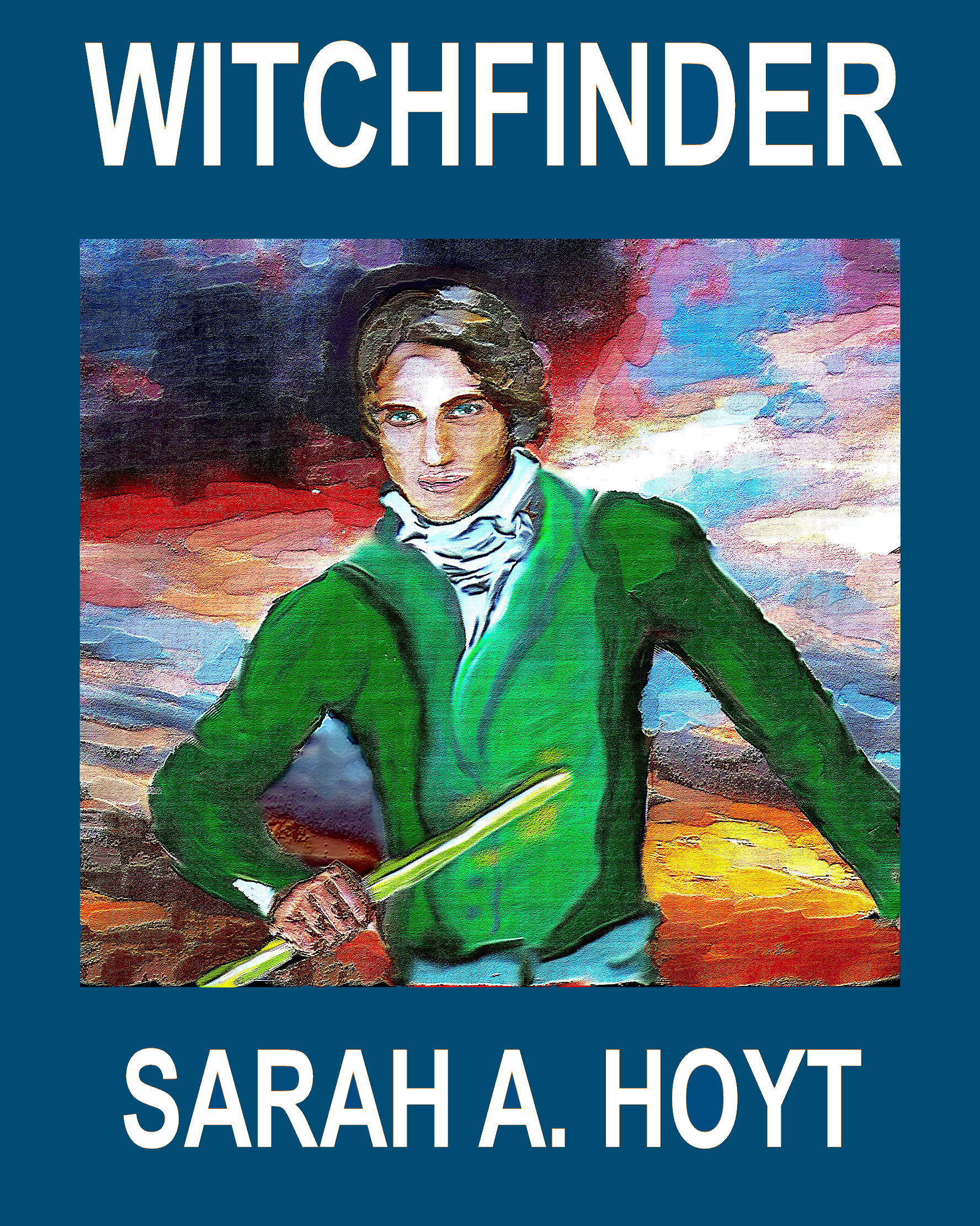
Witchfinder cover

UPDATE:  A SLIGHTLY EDITED AND PRETTIED UP COMPILATION OF ALL CHAPTERS UP TO A WEEK OLD IS HERE

*I’m going to start posting a novel here, a chapter a week. This is being posted as I write it, so it’s in pre-earc (for those from Baen) or in close-to (but not quite) -first draft state. Once it’s finished it will undergo editing and then it will be published in some form. I’m going to put this up with its own category so you can find it. And yes,there is a donate button on the side of the blog, to your right– those who donate $6  WILL get this, revised, when it comes out. I’m also going to have another cover for this soonish. Until then, bear with me. Yes, those of you who are in Baen Diner have seen two chapters of this before. The difference is, this time I finish it “in public” which is a bit of a window to you on how things work out. Oh, yeah, this is a fantasy set in the same universe as the Magical British Empire, but not in the same world (at least to begin with.) And it uses a Scarlet Pimpernel archetype, which I ALWAYS wanted to do.*

UPDATE: Welcome Instapundit readers.  Yes, this is a serialized novel.  No, it’s not quite final and depending on the day you will find a few typos.  If you wish to come back, I’ll post a chapter every day on Friday (except this week when I thought Thursday was Friday.  I was in Writer Time or something.  Two things before I get out of your way and let you read 1)Yes, the cover is horrible.  It’s a place holder while I find or draw a better one.  2)donations aren’t necessary, I’ll continue the story whether or not the writer’s bowl is full, but they are (needless to say) appreciated, since baby needs med school books.  (And shoes.  Size 16 shoes!)  Oh, a third thing (Nobody expects the writer inquisition) the novel is sort of what would happen if Heyer fell into Diana Wynne Jones at meteoric impact force.

Witchfinder

Sarah A. Hoyt

Flash And Fire

Seraphim knew it had all gone wrong as soon as he emerged from the mage-portal.

He hadn’t been sure where the alarm had sent him, but he knew it had indicated several children in distress. And that meant there had to be a world on the other end.

There was no world. Only the grey, empty nothingness that mages called Betweener.

For a moment, in a panic, he wondered if he’d done something wrong, if perhaps his casting and his spelling had gone wrong, if he’d lost himself through his own stupidity.

His heart beating painfully in his chest, his throat dry, he tried to go over in his mind the coordinates the alarm had shown, the coordinates of his spells and his foreseeing and casting of parameters.

Three children. In danger of death. And it was supposed to be 185 by 240 by… No, he’d done that.

His lungs were going to burst. The Betweener looked like a foggy morning, the fog so dense and white you saw nothing behind it. But it didn’t contain much that you could breathe. Stay there many minutes and you died.

As his brain grew cloudy, he tried to reach for his coordinates again and cast his spell. 185 by 240, by…

There was nothing there he could grasp at to open the gate forward. But the gate back was not completely closed. He’d go home and regroup.

He reached back and tried to open the mostly closed portal that had brought him here. Magic was never two-way, and going back was harder than coming here.

He had to use his whole will-power, his whole concentration, and his head was starting to pound with a headache that told him he didn’t have enough oxygen.

By the powers he thought. This was a trap. It was always a trap. Those coordinates were never reachable.

And then the portal behind sprang open.

At that moment, as though called by that magic, a dagger appeared out of the blind fog. Seraphim spun. It should have hit his heart, but instead, it buried itself in his shoulder. As he struggled to keep the portal open and dispel the dagger, it cut a vicious path down his body.

He shoved through the portal, then commanded the dagger to drop.

Standing in his dressing room, his grace Seraphim Ainsling, Duke of Darkwater, realized that his suit was not only torn, so was his body. Blood was seeping through the superfine cloth, dripping from his hand onto the floor.

And he was late for his own engagement party.
His Grace

Chapter One

If anyone were looking closely at the gentleman as he approached the double doors of the ballroom, they would have noticed he held himself somewhat stiffly. Not as though he were injured or embarrassed, but more as though he were excessively careful of all his movements.

The two uniformed footmen exchanged a look before opening the doors. His grace, the look said, had clearly been out drinking. Which explained his being so late to the ball.

Neither of them would have dared say it was just like His Grace, and – if it came to that – a lot like His Grace’s deceased father, but it was plain that they both thought it.

As his Grace, Seraphim Ainsling, Duke of Darkwater paused in the doorway, in the full glare of the brilliant magelights positioned all around the walls, all eyes turned his way.

This was not because of the exquisite tailoring of his green evening attire, that showed off his muscular body to great advantage, or his commanding height and stately bearing. That he was possibly the handsomest man in the room, with his thick, raven black hair, aquiline features, and dazzling emerald eyes, was a part of it, as well as the fact that he was His Grace, Seraphim Ainsling, Duke of Darkwater, one of the oldest and most prestigious magical houses in the kingdom, not to say in the world.

No. The real reason his entrance gained the attention of all in the room was because this party was being held in his honour, and he was unfashionably late. His mother had almost given up all hope of his appearance, as had his betrothed, Lady Honoria Blythe.

The betrothal had as yet to be formalized but everyone present expected the announcement to be made sometime approaching midnight. Whispers that he planned to cry off had already traversed the room.

After a pause that was so silent it was almost as if the orchestra had stopped playing – which it certainly hadn’t — the conversation and dancing resumed.

Darkwater walked into the room, still moving with exaggerated care, reached for a glass from a tray held high by a passing footman, and tossed the champagne back in one swift move.

From across the room, his mother saw it and flinched. The Dowager Duchess of Darkwater was a petite woman. Her mother had been French, and Lady Barbara showed it in her small oval face, her dark eyes, her clearly marked, arched eyebrows, and in a certain air which showed a quick temper, quickly tamped down.

She approached her errant son, maintaining every appearance of outward calm, even if her gaze couldn’t help but reproach his lateness and his state.

“Really Seraphim!” she said as soon as she could be sure of not being heard by other people. “After I have gone to such trouble putting on this ball for you, the least you could do is arrive in a timely manner. Dearest Honoria has withstood it all without a crack in her perfect demeanour, but I have been ready to faint from anxiety.”

Darkwater glanced across the room to where Lady Honoria stood, the picture of poise and elegance. She smiled at him, a calm smile that showed no emotion at all, neither anger nor relief, neither disdain nor caring. He sent her a stilted bow and a smile that gave as little away as her own. “She is to be commended for her good sense,” he replied. “And you, Mama, are to be commended for not fainting. That would have set the tabbies’ tongues wagging.”

His mother clutched his arm and he winced and reeled a little, as though the force of her small hand clasping his sleeve were enough to unsettle his carefully guarded poise. “Seraphim – tell me you are happy with this match. If you are not, you should not go through with it. There is time to back out now, without injuring Honoria or the Darkwater pride.”

“Back out?” he asked as he stepped away from her. “Why should I want to do that?”

“Because you are not in love with her. I have always wanted a love match for you, not to see you give yourself up to increase the family fortune. Our magic is still strong, and with your brother’s new inventions, our fortunes will rally.”

“Father expected otherwise,” said Darkwater curtly. “An alliance between Ainsling’s Arcana and Blythe Blessings was the old Duke’s greatest dream.” He reached for a sparkling crystal glass from another passing tray. “Love is a fairy story, at any rate.”

“So instead you drink yourself blind?” asked his mother. “You are making a good job of hiding it, but I can see you are unsteady on your feet.”

“Hardly, Mother. Please do not fret.” Almost reeling, he managed to visibly exert utmost control upon his rebellious body, bowed politely to his mother, and turned to cross the room. “If you will excuse me, I believe Honoria is entitled to at least one dance with me.”

Seeing him bow to Honoria and offer his hand to be enveloped in her cool, gloved little one, his mother could but clench her two hands together. What she had endured from her husband – his careless disregard for her and her position – only she knew. She had exerted her discretion, her pride, the very last shreds of the love that had once drawn her into an unadvisable marriage, to keep her husband’s missteps secret.

His debts at the gaming tables, she’d covered without a word, his frequent inebriation, she’d hid by talking of his “complaint”, his mistresses he’d paid off, his byblows, she’d taken care to set in the way of good positions, his children she’d borne without complaint.

And all that time, her one consolation had been that neither Seraphim, nor his ten-year younger brother, Michael, nor even her single surviving daughter, Caroline, Michael’s twin, showed the slightest tendency to imitate their father. Michael was perhaps the steadiest of them all – his mind given very early over to the perfecting of magic and the creation of magical engines to improve daily life.

But Seraphim, though a rather more spirited boy, forever climbing trees and riding out on horses that were too impetuous for any other rider, had shown early enough a tendency to assume responsibility for the family, and to respect the worth and importance of his title and position.

Only in the last ten years, it had all fallen apart. Rumors of his wild gaming and wenching, his uphazard living, his pride in his riding and shooting prowess – a prowess no one else could see a shred of – had reached even the ears of his mother.

No one had asked her to settle his debts. Yet. No one had laughed openly about his mistaken pride in his physical abilities. Yet. No light skirt or edge born baby had sought her protection. Yet.

But in that ballroom, watching her son hold himself too stiffly and carefully, Lady Barbara Ainsling, Dowager Duchess of Darkwater felt much like syssiphus, who, having pushed the rock up the slope sees it rolling back again.

Seraphim, his early character not withstanding, was turning into a copy of his father.

For the next chapter look here

Because you can’t POSSIBLY be riveted

by my disjointed bits of memory. And because I’ve been looking for a place to post this. If you aren’t reading Ninja Nun, my older son’s effort, consider it. And, oh, hey, he has a donation button. I’ll eventually put one up, when he teaches me how but until then well, anything you feel inclined to give him will be used to defray the expenses of his attending pre-med. We’re hoping it will eventually add up to books. (Unless you’ve had to buy them, you really won’t believe what college books cost.)

http://www.robertahoyt.com/comics.html

And if you think you might enjoy Jane Austen Fanfic — with the caveat that when Sofie and I wrote this we did play up the sentimental bit a little, particularly up front because… well, we were having fun — Sofie Skaspki’s and my A Touch Of Night is free on Amazon right now. Pride, Prejudice, Dragons and werewolves (oh, my.) http://www.amazon.com/A-Touch-of-Night-ebook/dp/B003Y5H664/ref=sr_1_1?ie=UTF8&qid=1317313084&sr=8-1

Yes, I did that cover. Yes, it was early days cover design. No, don’t tell me how bad it is. I’m better now. Actually that font is too small, the blue too blue and… never mind. The book itself is a fun romp with Mr. Collins as a were… well, I won’t tell you, just that he doesn’t know he’s one and most people don’t notice. Oh, and Wickham is a were weasel.

Anyway, go forth and amuse yourselves. I’m writing. :) Tomorrow I’ll post the beginning of a novel, which will be posted here in its entirety, (a chapter a week) then eventually put up for sale.

A sackful of disjointed recollection

So, now that I’ve set my hair on fire and ran around screaming on the same day that Amazon did the same for books and ebooks… metaphorically speaking, I’ll go back to trying to explain the things I love about Portugal, or at least about the Portugal I grew up in.

Mind you, the things I love, the things that bring tears to my eyes, the things I remember so vividly that if I close my eyes, I can imagine myself back there, are not only highly personal (meaning I don’t think anyone else, even born in the same general time and place would share them) but also highly time/place bound (meaning Portugal nowadays would not be any more likely to bring these experiences to someone, than any other place in the world would. And probably less.)

I was reminded of what’s really important, what’s really part and parcel of who I am, the things I really miss, when someone posted a video of the area I was born and raised in on Facebook. It doesn’t appear to be on youtube, so I can’t link it here. The still shot before the video starts is of two rows of houses flanking the camera – tall houses, flat against the street. By coincidence, the house only half shown on the right was my grandmother’s house, where I was born and lived till I was six. In fact, the door – now a garage door, because the house has been sold to strangers and modernized and completely changed – on the lower right hand corner was the door to the part of the house where I was born.

The rest of the movie goes on to show mostly apartment buildings – btw, part of the interesting point in this is that the person narrating it, from outside the area and from a heavily populated part of Porto, considered this walk bucolic and relaxing, even though most of the area is high rises and there are now no green areas except the parks. (It also shows tons of palm trees, which didn’t exist when I was growing up. Oh, okay, maybe one specialized type of palms, but they didn’t look like any of the palm trees in tropical postcards, which a lot of the new imports do. The type of palms that grew in the area before was more straggly, less sightly and mostly viewed as a sort of binding material for sheaves or produce and such. Fiteiras – bind trees, roughly – is what we called them. Lest you get the idea I was born in a tropical resort, that area is subject to arctic fronts and has the charmingly drizzly, dismal weather England is famed for.)

But it was that still shot, before you click on play, that captured me. It felt as though I could somehow go into the frame, go around the right hand of the house, before it showed in the picture, enter the metal gates into the wash-tank area that was shared by my family’s household and the tenants, past the wooden gate my grandfather built, and around my grandfather’s workshop to the back door. In across the patio, and the kitchen door would be open – of course, it always was – and then I’d go into the kitchen, with its noisy clock on the wall, and call my grandmother – now gone nineteen years – and she’d come from somewhere within and bring out the good cookies (since now that I don’t live there, I’d qualify as company) and make tea.

The point is that this is the place I go when I dream. It’s the place my mind goes when I think of “home” – and it is always the place as it was when I was very young, with my grandmother and my grandfather still alive. (And my grandfather died when I was fourteen.) With the dogs and cats I knew when I was young too.

Was it such a special place, then? I don’t know. To me it was the whole world. At a very fundamental level, it still is.

First remove from your mind all ideas of the landscape as you would imagine it. There is a fundamental divide between Southern and Northern Europe, and the US gets its landscape traditions and imaginings from the North. At the most basic level, that means that what you think would be wooden fences are actually stone walls. Usually very tall – about eight feet tall – stone walls often topped by broken glass to discourage robbers. These were grey because the rock in the region is mostly granite. They were often covered in greyish green moss and in spring might grow with little scraggly flowers in every barely visible crack. After that, you have to give up the idea of open lawns, or open anything. Even in the village of my childhood, where you’d think there was plenty of room, (there was, but taken up with pastures, fields — some lying fallow a year or three — and woods) houses tended to be closer together and if they had a yard in front, it was like urban yards, in the US – handkerchief sized at best, the size you could mow with a weed whacker. Not that most people did have lawns. Usually they had a profusion of flowers.

But only the newest houses had these “gardens” up front, and shorter (about five feet) walls that allowed you to glimpse the gardens. The older houses, by and large, came right up to the street. The doors opened from the narrowest of sidewalks. Yards, as such, were in the back, and they were often mini farms.

My grandmother’s house was one of these, and it had two front doors, opening RIGHT into the main street of the village, at what I suppose was a prime location, across from the store which sold everything from tobacco to codfish to clogs to notebooks. I don’t know if it had two front doors all along, or if the second front door – with its different house number – was pierced through the wall when my parents got married and my grandmother converted what had been – from what I understand – some sort of storage rooms into a shotgun type apartment for them. This is the place I was born – it consisted of a long, narrow kitchen where my mother worked, most of the time, the kitchen table doubling as her work table, a hallway the same breadth as the kitchen, from which my parents’ bedroom had been carved out with interior walls. It didn’t have a door, just a yellow curtain with black checks. In the hallway, before the bedroom, was my brother’s bed – really just a cot, to which an improvised new end had been added as he grew taller than expected – and his bookcase. Mostly he did his homework in the kitchen, or the living room if he needed privacy. Then at the front was a living room where my mother saw clients. We had the dining room furniture crammed there, most of my conscious memories. My mind also wants to add a sofa bed to it, but I honestly can’t remember if that’s true or my memory just thinks there ought to be one there. Note that natural light came in at two ends of the “home” only, through the almost always open back door (unless it was very cold) and through the glass insets at the front door. My grandmother’s house, next door, had windows.

Most of the time I slept at my grandmother’s or in my mother’s room – my dad worked out of town all week, which means I could sleep in their bed. And I always did if I was ill. I had asthma and bronchitis and –briefly, apparently – TB, so I guess my mom found it vital to monitor my breathing.

If you’re imagining a childhood of hard privation, well… sort of? I mean, my mother was very careful with expenses, and yeah, they had one more child – me – than fit into the house. On the other hand, this was largely self-inflicted. You see, my parents have a horror of debt and being in debt. So while they wanted to build their own house, they didn’t want to have a mortgage, so they were saving everything to build the house. This house was under construction for most of my early childhood (building in stone takes time) and we moved into it when I was six. I still returned to my grandmother’s house every day, usually to hang out and do homework. (It was just ten minutes walk up the main road.) So my grandmother’s house remained “home”. And it still is, even though it doesn’t exist in any real way anymore.

At some point – I suspect when my great grandmother was widowed early? Though my uncle seemed to imply at least once that this happened in his life time, i.e. when my grandparents inherited the house – rental houses were built next to the main house and attached to it. Well, one rental house, with each floor rented to a different family. It must have been at this time that their part of the yard – which comprised the water pump, as well as their two washing tanks and our large one (very large. Stone, and probably six by six and three feet deep) – were partitioned off. The tenants’ kids were supposed to stay in that area (it included a cement patio) unless specifically invited. But other than that, the area got used by us as well (we had one of the wheel water pumps. Great arm exercise for most of us, grandkids, as teens.)

It filled the “Water cistern” on the roof of the bathroom. And the tenants were allowed to hang their clothes in the depths of the backyard. And most people came in through those gates.

The backyard… in my mind it’s huge. Very deep. I’m not sure how much of this is true, and how much it’s a three-year old’s view. My play area started outside my grandmother’s (and ours) back doors. There was a broad flagstoned patio. From it, straight down, was a garden path right to the back. To the other side was a path around my grandfather’s workshop (he was a cabinet maker) into the little area from which the tenants area was subdivided. There was another path there, to the depth of the yard, and a path across. (Actually two.) You could circumnavigate the entire yard on those paths and I often did, either running or on my little red tricycle. I used to dream of doors opening in those areas that led to other worlds, which just tells you I was born to write spec fic.

The center of the yard had fruit trees and vegetables. The edges were ringed with grapevines, which in the manner of the region were trained up columns and across wires, so that they grew overhead, as a sort of roof. Under the grapevines (which were really only in full foliage summer and fall) we grew more vegetables, cabbage and I suspect potatoes. I don’t remember very clearly.

The back wall looked out onto what was to me then a complete wilderness. Fields belonging to the neighbors, and at the back of that a forest called Coriscos (lightning bolts) which I thought was untouched and virginal. Mostly pine trees, with some oaks, the occasional creek and small lake. The funny thing – my dad took me for walks in the forest most Saturdays, weather permitting, mostly to get me out from under mom’s feet, so she could clean house – is that though I remember clear as day us coming across toppled stones (some of them with inscriptions in Latin) and bits of wall (birds and lizards nested there) and even what was clearly bits of houses, until about a year ago I still thought of this as “the forest” and assumed it had never been anything but. This was dispelled last year by one of the earth view programs. From the air, you can see the entire area still covered in trees (about half what it was in my childhood. Perhaps less) is crisscrossed in the scars of vanished foundations and roads. Makes sense, of course, since the area was populated since before the Romans, so the idea that no one ever built there is a little nuts. But from the look of the ruins, from the foot print, I got the impression that the village extended there (or another village was there) more recently than the Romans, though not all that recently. Gut feeling I’d say that those areas were abandoned shortly after the Great Plague dramatically reduced the population of the area. I could be wrong, of course. It might have got burned and abandoned in the Napoleonic wars, which was not only time enough for the forest to grow over it, but time enough for enough people who didn’t remember it to immigrate to the area and for local memory of it to be forgotten.

To me, when you say “forest” that’s the area I think of – the dark green shadows, birdsong and running water. Curiously, in my mind, it’s always fall. The wild blackberry bushes that grow anywhere left untended in that area are always heavy with fruit (which, yes, we picked and ate, sometimes after rubbing it on our sleeve to…. I don’t know, add more germs? It seemed like a nod to appease the demons of dirt, though.)

It’s always fall in the house, too, and my grandmother is splitting wood to feed the Franklin stove, in her kitchen. There are cats around that stove, of course: Tareco (rags) patriarch of all he surveyed; Black, my first cat (yes, I was imaginative. Yes, he was black.); Vadia, (stray) the mother of the large and incestuous cat tribe; Moshe Dayan, the grey tabby who had lost an eye as a kitten and who, for reasons known only to my mom was her favorite. I’m told before these there was Matateu, the tom (I don’t remember him, though I’m told I lamented him for days) and Vadia the dog (I also don’t remember her.) I do remember Lord, the dog, who looked like an oversized cocker spaniel, mostly white with brown spots. He was my dad’s dog when he was single, and he’s what’s in my mind when you say “dog”. I remember sharing my bread with him – he licked off the butter, and I ate the bread. Until my mom caught us, that is.

Up till we moved away, the youngest and often solitary child (my brother is almost ten years older and my cousin, who was raised by my grandparents is fourteen years older than I) I played mostly with the cats (I must have tried their patience horribly) and though I was a cat, or perhaps that they were my siblings and would grow up to be children.

I spent most of my day reading comics (first by looking at the pictures, and remembering what people had read to me) or building cities out of several large boxes of inherited legos. If bored, I attached myself to my grandmother, who was always doing something interesting. I remember going with her to one of the nearby fields that led to the woods (my dad and I jumped the back wall, but grandma insisted on going in the land route. I vaguely remember the neighbors hated us jumping the back wall onto their cabbage patch, en route to the woods.) to “gather grass for the rabbits.” I had my own little apron and scythe.

Actually if there’s one thing in which these reminiscences are in any way relevant, those few of you still awake, might note two things. The first is that I was left largely to my own devices, unless I attached myself to an adult. There were no play dates and no one really put themselves out for my entertainment. The adults were mostly around (except my dad who worked outside the village) but they had their own work, and their own business. I was presumed, being a kid, to know my own business which was playing and learning. If I attached myself to an adult too long or too intrusively, the adult felt perfectly free to tell me to find something else to do. (When this failed, if it was warm, they filled the old hip bath, threw a pair of my brother’s old bathing trunks on me, and flung me into it with all my toys. This was guaranteed to keep me quiet for several hours.) There were no play dates, no extra lessons, no feeling that life was rushed or scheduled. Once I was up and had been fed breakfast, it was presumed I could amuse myself. By and large I did, though it sometimes involved annoying the living daylights out of my brother and (female) cousin. Not that this was difficult, since they were teens. We had no TV and though I sometimes listened to radio programs (mom favored shows on mythology or history) it was usually while doing other things. I’m not saying the adult graced with my presence (snort) didn’t often try to include me in whatever he or she was doing to an extent – I had the apron and scythe when I went out with grandma. My grandfather gave me a small hammer, brads and scraps of wood and would, if he had time, provide instruction on building doll furniture. My mom tried – with varying degrees of lack of success – to teach me to sew. I remember an ill-fated attempt at painting the hen house, though it’s QUITE likely I came up with that on my very own, with no adult encouragement. I remember it ended badly.

I believe this is now called “quantity time” as opposed to quality time. It’s also known as benign neglect and people with phd after their names say it’s the best way to raise a child. I don’t know. I have some pretty wonderful childhood memories. It taught me to amuse myself and develop my imagination. And I have, of necessity, brought up my kids in a similar manner.

The other thing you might note is that provided I wasn’t destroying something or running around the street (this was more a class thing than anything else. The street was not that busy. My mom was of course afraid I’d get run over – lack of clue about reality and luck being what they are, I might have – but mostly they didn’t want me associating with the children of the very poor, who roamed the street in a large band. There were reasons for this other than snobbery. The first time I was brought in contact with them, in school, I caught lice, which had to be gotten rid of without ruining my hip-length hair. Not an easy feat) I wasn’t watched over that closely. I remember as young as four and five spending entire days playing at my friends’ houses or their coming over to play. And I was allowed to have implements no one NOW would give their three year old: scythes, knives, chisels, hammers. Note that other than the incident with my brother’s transistor radio and the mallet (I’m sorry. OTOH he HAD painted fangs on my favorite pull toy — a smiling sheep) I never broke anything nor stabbed anyone.

Anyway, I suspect most of these reminiscences aren’t interesting to anyone but me. I will (hey, saving it for Halloween) speak later of more specific cultural things, many of them (as such things are) surrounding death and dying (all primeval stories are ultimately about either sex or death.)

You see what I mean about what I remember of Portugal and what I really love back there being so intensely personal as to be almost universal? There is a house back there in time that will always be home. And if there really is anything after death, and if there’s fairness in the universe, outside the minds of those who dreamed up the concept, I’ll eventually find my way back to that primeval garden filled with cats and dogs, with a conveniently circular path that a small kid can traverse in her tricycle, but with neither apple nor serpent. And this time, growing up will not expel me.

Unringing The Bell

Those of you who haven’t read Kristine Kathryn Rusch’s Writing Like It’s 1999, do so.

For those of you who read my blog this might seem like I’m harping on a theme, or like I’m getting repetitive.  Well I’d think so too, truly.  Except…  Except…whenever I’m at a con, someone – usually someone much less published than I am – comes back with a variant of “I’m going to keep my eyes shut tight and in the morning, this will all go away.”

Disruptive change is very scary and most people would rather pretend it will all go away, and we’ll be back to the familiar landscape and the familiar certainties.  Even if those are horrible.  Freed lions will often pace as though in the confines of the cage.  Those few of us who are awake and exploring every possibility, looking in every corner, searching for the way things will be are a small minority.

At cons, I still run into authors who look down on self-published authors.   I still run into authors who parrot the line about how much the publisher is investing in them: when it is patently obvious they’re lost in mid-list hell; I still run into authors who say “if you want to make a living at this, you have to publish with the big six.”

I had the dubious privilege of hearing a mid-press published author telling a self-published author whom I happen to know makes more in a month on one book than the mid-press published author has made for any two or three of his books that “most of what’s self published is crap and no one would buy it.  The future is finding a publisher and convincing them to accept you.  In two years, all this e-book stuff will be gone.”

It was breathtakingly bizarre.  Kind of like, in a fantasy novel, standing next to the hidden prince and watching the false king parade down the street looking down on everyone.  Like Saturnalia, with the fools reigning.

And then I catch myself – occasionally – thinking the old thoughts, too: “Well, what does he/she know.  He/she is small press published.”  Or perhaps thinking that some of my fledgelings will of course, eventually, follow the route I have.  And then I stop.  Because there are few things I know, but I do have some certainties.

These are the things I know:

Even if e-books all went away tomorrow, it wouldn’t go back to the way it was
Not the way it was in the early nineties, or even the way it was in the late nineties when I came in.  No way, no how, never.  Because there’s this thing called Amazon.  The publishers no longer control what’s on the shelves and what gets seen.  And even if Amazon died tomorrow, there would be other e-tailers.  Trying to control shelf space is not a winning strategy.  That bell has rung.

E-books aren’t going away
You can’t put the e-book genii back in the bottle.  I’m reading on kindle.  My kids are reading more on kindle than on paper.  So is my husband.  So are most of my friends. Barring some planet killing type of event, this is not going to go away.  No, the economic crisis won’t kill it.  Kindle books published by indies are cheaper.  The tighter life gets, the more likely we’ll buy those instead of the agency-modeled-to-death.

The hierarchies of prestige are gone
Because the big six no longer control access to shelf space (except in Barnes and Noble, and it no longer has the influence it once had) the safe hierarchy of self-published, small press, medium press, big press is gone.  We used to assume someone who self-published hadn’t even been able to get a small press to accept him/her.  We approached their work expecting it to be awful.  It often was.  That certainty is done.  A savvy author with time on his hands can decide he has a better chance going it alone.  Be careful how you talk to other authors.  That person with a single indie book out might have a larger readership than you could dream of.

Most authors have had a taste of freedom
I’m one of them.  Look, I’ve done next to nothing Indie.  A Touch of Night and a few short stories through Naked Reader Press. Interesting results but inconclusive.  However, just knowing I can write whatever and if it doesn’t sell I can put it up on Amazon and it will sell a minimum of x – plus be in print forever – has given me massive freedom.  I no longer feel like I’m blindfolded in the cattle car of a train over whose destination I have no control.  Even if indie proves to be less than half of my income, the ability to put out there what I think should be out there is slowly molding me into a different person: a much less fretful and worried one.  It’s likely to lengthen my life.  It will certainly make me easier to live with.  I don’t know how it’s taking other authors, but I don’t think it’s that bad.

We’re scared, but we’re not stupid
I know, I know, Dean says we’re stupid.  And he’s right in a way, but we’re a very specialized kind of stupid.  Also, he’s not seeing the pressures on my generation – those who came in after 2000 when the publishing houses looked at things ONLY through agents, and the publishing houses’ decisions could make or break your career, regardless of how good your book was.  We had to learn to shut up, no matter how stupid we felt what was happening was.  Not anymore.  And we’re losing the habit of silence – slowly.  The chances of a mass exodus back to publishers on the old terms because we don’t want to do everything ourselves is about … oh, look, do you see that flying pig?  Yeah.  Some of us will go back, of course – most of us who have made our name and can dictate terms, or the really small ones who couldn’t make it on their own.

And I’m not saying publishers are going away
Of course they’re not.  Though a few of the houses will vanish and almost certainly a few of the imprints will vanish.  What I’m saying is that the majority of the writers are NOT going to go back on the old terms.  You want us back, you’re going to have to do things for us that we can’t do for ourselves or hire someone to do for us.  I’m thinking this is the true “demise of the midlist” and not in the fake way you tried to do it before, where you simply announced the midlist was gone and kept changing midlisters’ names and paying them as beginners and not allowing them to build a following.  No.  I think the “midlister” the “shelf filler” the “person we print but don’t do anything else for” is gone.  You’ll have to treat every author as if he/she matters.  You have to make it better for them than they can do by throwing it up on Amazon.  I’m thinking good covers, publicity, limited contracts.

Make it worth my while
Or at least, don’t use aversion therapy on me.  You can’t keep me in the dark and feed me on shit anymore.  If the book is not selling, sure, I need to know, but don’t tell me it’s because it’s not a good book, when I know you did nothing to market it, not even get it on shelves.  And don’t, then, treat me as if it’s all my fault.  Because if you make things unpleasant enough and treat me like a serf, I’m going to think “well, I don’t need to work for you anymore” and I’m going to go Indie.

Give me a public
I’m thinking more publishers should look at Baen books, instead of turning up their noses.  Baen commands loyalty among its writers and gets dedicated readers who look for the brand.  Some of this is (good) marketing gimmicks: buttons saying “I read baened books”, book bags given out at cons, a slide show where upcoming releases are announced, a forum where fans can meet and geek out on their favs.  Part of it, though, the most important thing, is what none of the rest in sf/f or mystery has (I don’t know enough of Romance): a brand.  A unified taste.  For the big houses with multiple editors, this is difficult, of course.  But you can no longer be all things to all people.  Baen chose and does plot.  It does plot really well – whether it’s in sf/f or any of the variations.  “Things happen in Baen Books” would be a great tag line.  Mind you, if it’s one of my books (or Dave Freer’s, too, or a half dozen others) the books also have characters and feelings – but the “things happen” and “adventure” aspect MUST be there for it to be a Baen book.  When I started being published by Baen I immediately “slotted” into a pre-made public.  This, as a newby, gave me something to put my back against, as I grow the rest.  So, what can the big houses do.  I don’t know.  I don’t know under what constraints they operate.  BUT if I owned one, I’d give each editor an “imprint” and then give them the resources to publicize that imprint.  “Okay, Jane likes craft mysteries.  She can specialize in that.  We’ll call it Golden Brush books, and…”  Have them appeal to a segment of public, but appeal to them very powerfully.  It’s better to command 50k loyal readers and grow them slowly than to have most of your books bomb, except for a mega ultra blockbuster a year – which these days might not materialize.  (No power to push, remember?)  And meanwhile tell the editors that the house does… oh, pick one.  Beautiful, doomed adolescents.  Or perhaps more generally “character” or “angst” or “Beautiful language.” and unify that across your “imprints” which will maximize the chance of people reading the brand, not just the imprint.

Will there be a new equilibrium?  Of course there will.  And I think it’s about two years out, too.  But will things be the way they were?

E-books.  E-tailing.  Soon, the book printing machines in every bookstore.  Writers who’ve taken the bit between their teeth.  Will all that vanish?

No way.  You can’t put humpty dumpty together again.  And you can’t unring a bell.  So publishers and writers both will have to stay alert and change to survive.

UPDATE:  Ask not for whom that bell won’t unring…  I think what you’re hearing today, loud and clear, are funeral bells.  Or perhaps the woosh of the meteor falling to Earth.  The dinosaurs will never be the same:  http://www.thepassivevoice.com/09/2011/amazon-launches-79-kindle-and-99-kindle-touch-ereaders/

Looking Back

When I asked on Facebook for suggestions on what to blog about (what can I say?  A daily blog which by necessity stays away from most politics and current events is a challenge) a couple of people suggested I blog about what my upbringing made me or perhaps it was (the wording was ambiguous) how the writer is made by his/her past.  A friend interpreted this to mean what I liked/missed about Portugal.

The last is understandable, as I suspect I often give the impression of “I’ve shaken the dust off my sandals, and I wouldn’t go back for a million dollars.”  Well, this is actually true, in a way, but it’s not intended to reflect badly on Portugal.  It’s more a matter of post-divorce feelings, when one member of the couple says “it just wasn’t right” or perhaps “It wasn’t so and so, it was me.”

This doesn’t mean there weren’t things about Portugal and my upbringing that I loved, things that made me uniquely what I am.  I have, in fact, had a couple of misguided people (one of them a colleague – eh, in a sense) who have got upset now and then at how much I talk about my past in Portugal, as though, they think, it were some sort of universal experience.  And I am, let me add, forever afraid I talk too much about Portugal – an experience most of you can’t really share, which puts me in the position of the old traveler and/or soldier describing experiences that can never be brought successfully forward, except through fiction.  (And I know I write very few things set in Portugal, but that’s something else.)

The reason I talk about it, particularly in non-fiction is to explain why I have what might strike some as a weird set of opinions/beliefs.  Life experience doesn’t explain what I believe, any more than it explains why some of us have a compulsion to write but it might allow some people to either count it in or discount it.  Say, I had a rabid dislike of dogs (let me assure you this isn’t true, although I am afraid of loose dogs, while I’m walking because of a past experience in which one tried to attack my kid in his carriage.)  If you knew that as a child I’d been attacked by a vicious dog (I wasn’t) you’d be more likely to discount that opinion one way or another.  So if I blogged that all dogs should be shot (again I don’t think this.  I like dogs as much as I like cats) you could go “Oh, it’s just because she never got over that incident in her past.”  Which is why I tend to give, perhaps, too much background on how I feel about things.  Well, that and because I often feel as though history classes in the US are ruled by “Speak no evil about foreigners” which has allowed at least two generations to grow up thinking the US is uniquely evil (rolls eyes.)

Anyway, that is one reason I tend not to talk about Portugal, unless I’m using it to justify some belief/idea/experience.

The other two reasons are more…  Complicated.

The first is that, unlike the divorce analogy above, I did not choose Portugal and I don’t think we were particularly compatible, culture to human type of thing.  This is hard to judge, of course.  I mean, I grew up there; the language was the first I learned; the “how things are done” the first I embedded.  So, it’s difficult to separate “this is me” from “this is me who was born and raised in Portugal.”  But if it can be established that some people feel like they were born the wrong gender, I felt, as far back as I can remember, slightly uneasy about who I was and where I lived.  This eventually – when I had experience of other countries – gathered into “I’m an American trapped in a Portuguese body.”  (Before that, I just thought I was crazy.)

This is no reflection on Portugal, anymore than someone feeling like a woman trapped in a man’s body is not saying being a man is bad.  OTOH that person might be the last one who can propound on men’s issues.  And I am probably the least likely to speak both dispassionately and competently on Portugal.

Not that there weren’t parts of Portugal I loved – specifically the little village (hamlet, really) I was raised in, and, in varying levels of attachment, the slightly larger town we were attached to, up to and including the city of Porto, or at least parts of it.  For a long time, trying to explain my feelings about my origins I said “I’m not really Portuguese, but I AM from Porto.”

Note the tense of the verbs above.  Does this mean I’ve fallen out of love with those regions?  Not… exactly.  The thing is those regions no longer exist as I remember and if I spoke of them now, I would have no clue what I’m talking about.  Not only have I gone on an unavailing photo safari to try to record things I remember from childhood, but I got lost THREE TIMES in the village where I spent 22 years.  No, honestly.  The roads are all different.  Some alleys have turned into roads.  Some roads have disappeared.  The village in which the ONE building over two stories was built when I was 14 – and at five stories got called “the skyscraper” or “the apartments” – is now mostly stack-a-prol cement buildings.  The school I attended has been replaced with a much larger cement box.  The little “the train stops here if it feels like it” train stop is now a station with announcements over PA, electronic schedules and ticketing machines.  This in 25 years.

I’m more likely to find my way around Stow Ohio, where I was an exchange student for my senior year of highschool – mumble – years ago than to find my way around my native village.  The changes are unimaginable.  And while I’m conscious they needed to happen – we were the “well off” people, if not the most well off, and we didn’t have running hot water.  A lot of the people in the village had no water at all and needed to go to the public fountain, Roman style.  The public laundry facilities PROBABLY dated back to the Romans with some changes.  Etc.  The country needed to be pulled kicking, screaming and biting to the Century of The Fruitbat, or at least The Milenium of the Constipated Weasel.

The way it’s been done, with a whole lot of top-down and “your betters know what’s best for you” which has not only depopulated the interior and led to all the stack a prol buildings, but also led to a collapsed birth rate (people can’t afford to have kids) annoys the living daylights out of me.  However, it must be said it doesn’t seem to annoy the living daylights out of the natives, and how they choose to live is ultimately none of my business.

Yes, I do get rather upset that they choose not preserve the village in amber to match my earliest memories and put brass plaques all over saying “Sarah A. Hoyt made a mudpie here.”  “Sarah Hoyt got in a fight here.”  Mostly because it’s a waste since you know and I know in a hundred years they’ll be doing that, and recreating my childhood home in every detail, but what can I do?  People are like that. [Ed. Note – I AM JOKING.  I AM VERY MUCH JOKING.  I CAN’T MUSTER EVEN SELF CONFIDENCE, MUCH LESS NARCISSISM.  But it is true the only reason for my annoyance is that it inconveniences me.  And that’s not a real reason, and I know that, since I’m NOT the belly button of the universe.]

And having spent all this time whining about why I don’t blog about Portugal more, I’ll have to leave what I loved about growing up in Portugal till tomorrow.  And hopefully my reminiscences won’t bore you to death.