I was going to blog about the people who don’t want to celebrate the 250th. But it’s difficult because there’s this lump of different feelings in the way.
A lot of it is related to the death of Henry Nowak, in England, and I’ll got into that first. No, Great Britain is not us. Though, let’s face it, we got a heck of a way down that path before the election in 24. And it doesn’t mean anything, necessarily about the people of Great Britain but more of the boot on their necks. Except they’ve tolerated the boot a lot longer, and let themselves get disarmed, which…. never mind. Europe.
But that’s probably why this hit me harder than it should have. Look Great Britain was a beacon of freedom compared to late seventies Portugal (and we won’t even mention before, okay?) and I grew up reading British authors. There’s a reason Skip in No Man’s Land is from Britannia on High, a series of colonies established to mimic the “impression” of Victorian England of pro-British novelists. There was an early romantic attachment to the idea of England, warts and all.
More importantly, that poor kid, Henry Nowak was a first year college student. I was once a college student doing an absurd route of walk, train, walk, bus, walk to get to college in town and then across town. Of necessity this took me through some pretty iffy parts of the big city I had to cross, though thank heavens that was “pre-diversity” Europe and the worst thing that happened to me (multiple times) was having a crazy person follow me yelling either threats or obscenities. And there were the inevitable late nights, both for study and to hang out with friends, mostly Swedish-language-club friends, for various reasons. I can imagine being in his position all too easily.
And then there’s the police reaction. how do you even? I mean, I’m sorry. The fact that this is in accordance with the instructions, not to say the indoctrination of the police in England is evil, bizarre, but most of all red-veil inducing. I’m a berserker. I try not to let myself get riled up to the point I have to depress myself to stop going off. But it is too late in this case, and worse there is no one to go off on. Not anyone I can reach anyway.
Then there is the idiot in Congress (the House, I think) who thinks it is very suspicious the ICE detention centers contains mostly non-white people. The composition of the people coming in, apparently, doesn’t matter. They should just and only arrest white people. Apparently.
And all this, like the blatant male-hatred that was being pushed down every channel by the autopen’s administration, is based on the Marxist’s restricted and dual vision.
Because Marxism divides the world into oppressed and oppressors, with the groups shifting according to the time and the subject, but still maintaining that duality, they can’t conceive of say ending racism without shifting to anti-white racism. And they view wanting to stop mistreatment of white people as “racism” because they are incapable of imagining a system in which there is no oppressed group.
It is inherent in their view that someone must be oppressed. You simply have to pick who is oppressed.
So, of course, for women to be free, men have to be oppressed. For black people to be free, white people have to be oppressed.
They are incapable to break free of this completely wrong duality in their heads. And in the name of this duality they are dragging us straight to hell.
To stop the cultural suicide of the west, and, frankly, of civilization and ultimately of the human race, we must break this wrong duality.
People are people. Shoving them into arbitrary groups does nothing to solve any problems. And then arbitrarily deciding which of those groups is “bad” and which is “good” and acting accordingly is outright evil.
Their idea of anti-racism is being racist against whites. Their idea of feminism is being prejudiced against men. Their idea of balancing the scales is to put stones on one side.
And it does nothing, absolutely nothing, except leave an innocent boy bleeding out on an English street, while the police who should be helping him wax sarcastic at him.
A horror they’re trying to export here, and have succeeded in many places.
Mind your teaching of your children, and more importantly mind what others are teaching them. Marxism must be eradicated root and branch and sent back to the hell it came from.
I don’t like writing posts about my disagreements with Trump. This is neither because I feel muzzled, or am afraid of my commenters, or idolize the man.
In fact, far from idolizing him, what I like best about Trump is that I’m fairly sure he can handle the country without tilting us into a ditch and so I don’t feel I have to keep an eye on him 24/7. I do a round of my usual sites early morning, in the same spirit I used to read the newspaper, often just skimming headlines, and then I’m free to run off and play with fiction or clean the house, or clean the house then play with fiction. All fine by me. Note the “fairly sure”. The TDS afflicted will say I think he’s a god, but their inability to understand simple English is legendary. It just means I don’t think he has an active animus against the country. Which from the other presidents in the last 20 years, is getting to be a rare quality.
No, the reason I don’t like to protest something he’s doing on this blog, is that he has a way to outflank me in mere hours or days after I complain about something. Note, not saying he plays 3-D chess either. I’m saying that he has access to information I don’t have (DUH) and his decisions are hard to predict. Also that what I think is going on based on even the best reporting I can find, is often so wrong as not to be in the same universe. So it has lead me to adopt a policy of “let the man cook”.
I’m about to break that policy. And what’s more, I don’t even have any constructive solutions. But I have to get this off my chest. The last time I did this was with his enabling (even if he didn’t do it himself) the Covidiocy. I had a feeling he was listening to the wrong people. The feeling is back.
First I want to make clear I don’t oppose the war in Iran. Like most people my generation, “I’ve been waiting for this moment for all my whole life, oh, Lord.” Or close enough. I’ve wanted us to go beat the mad mullahs into a prayer rug since the “hostage crisis”. Because, seriously, who takes diplomatic personnel hostage? And gets away with it? We should have gone in guns blazing THEN. Or right after they were released. We didn’t make it clear “don’t touch our diplomats” and then Benghazi happened, and this is going to keep getting worse till we teach savages the lesson that you don’t touch our diplomats.
When I was an exchange student in Ohio in 80, my comparative political systems teacher, a Marine, hung the Ayatollah in effigy every morning before starting class. I loved that man. I fully agreed with him.
So, no, I’m not upset we finally went in and bombed the living daylights out of the Mullahs. Because you know, it had to be done.
It particularly had to be done since, after Obama had pelted them with pallets of cash, they’d gotten froggy. Not just with financing/helping the neolithic barbarity unleashed on Israel in 10/7, but with their nukes. They’d gotten ambitious.
And the problem of them getting ambitious is not that they’d have a nuke. The USSR (allegedly) had nukes for decades and we’re still here. It’s that they’re crazy-cakes religious fanatics with a nuke. Their religion explicitly enjoins them to bring about the end of the world. And boy, oh, boy, would they love to.
So I cheered the bombing. But then–
Why did we stop? And why are we trying to make a deal with people whose main drive is to BRING ABOUT THE END OF THE WORLD?
Yeah, yeah, I do get it. Trump is notoriously averse to putting American military lives at risk. Frankly it’s refreshing. Yeah, maybe he avoided the draft, but so did Clinton and that never stopped Clinton spending American lives like water, particularly when there was no real benefit to America from doing it. He was perverse that way.
But–
There is a but there, ain’t it? But– Mr. President, sometimes it’s necessary. And yeah, I do understand the imperatives pinning you: the midterms are breathing down all our necks, and we can’t let the precious little LIVs (Low Information Voters) saddle us with outright communists and jihadists, because we’re trying to clean out Iran. Yeah, yeah, you don’t want to bomb their oil infrastructure to kingdom come because you don’t want to hamper the possibility of world development, and a civilized world runs on energy. Yeah, yeah, you’re taking on heavy winds from the loyal opposition in your own party.
All that is a given. However: if you’d sent boots in two months ago to clean out the IRG, it would be done and gone, and now we could settle back into taking care of other things.
So why didn’t we? My guess is polling and public opinion not allowing it.
The problem with all that? We’re not going to be able to fix the problem of Iran and are going to have to keep doing pretend peace talks until after the midterms.
And the problem with that is that a) Trump is sounding like Obama “This is my line, and if you don’t like it, I’ll draw another one.” b) Iran apparently was and is much closer to a nuke than we thought.
Given that it’s an old technique in the US for the president to allow or incite an attack on us as a chance to turn the public opinion to a war like footing (we’re notoriously reluctant to go to full America on someone. And when we got full America we’re fully deadly.) yet what are we willing to lose to an Iranian nuke to do that?
Look, it would be one thing if we were sure they’d hit Seattle, but even so, I have friends there, and some people who read here are there. Same for NYC. Same for the ivy leagues, same for Los Angeles and San Francisco. Because even hives of scum and villainy have decent Americans in them.
But you know, I know, and even my cat Havey who doesn’t remember his own name or that he’s a cat knows that the most likely target is Israel. Are we going to lose our most reliable ally in the Middle East to this? Well… And the second most likely target is DC. Which, yes, where do we send the thank you note, but guys? Right now the most likely result of a decapitation strike like that is that our cold civil war goes hot at a speed.
So– are we really going to risk this?
Mind you, if we sent boots in, my idea would be, go in, break everything, come home and tell them not to make us come out again. The era of “nation building” should be not only dead, but buried so deep that it will be forgotten. BUT–
But if we’re going to shy away from it because elections, and votes and–
Is the risk we’re running acceptable? And who is the president listening to? Because whoever it is, they don’t have the world’s best interests at heart.
I don’t like criticizing the president, because he usually proves me deep at sea within days of a post doing that.
I can’t tell you how desperately I hope that’s the case now.
and the idea that “Data Centers are poisoning our communities.”
Water is just about the most common resource on the planet. Just about the most easily accessible and manipulable, and one of the cheapest resources to refine.
That doesn’t mean it’s easy, cheap in absolute terms, or unimportant.
Most public policy issues with water come down to the water being pure enough to healthily drink, or to discharge into the natural environment. As I put it yesterday, “as part of the ‘drank from the garden hose’ generation, I have a lot of disdain for the hype about water pollution in this context.” The difference between potable water and drinkable water is definitional.
One thing I don’t think gets enough acknowledgement: a building produces “waste water” by existing. I recently had reason to calculate the roof run-off of my house, garage and barn, at about 275 thousand gallons per year. That is “OVER A QUARTER MILLION GALLONS OF NON-POTABLE WASTE WATER OMG!!!11!1!”. This is a small family farm.
I covered a lot of this yesterday from the angle of “pollutants”; but to recap: The water in your sink is contaminated. The water in your toilet is contaminated. The water from your roof, and in your garde hose are contaminated. They’re NOT “polluted”. They’re perfectly acceptable to discharge into the ground (via a septic tank) or a municipal sewer. Storm water run-off doesn’t generally get discharged into the same sewer system in cities, but ONLY because it isn’t septic (doesn’t have humans defecating directly into it- unless you’re in Portland or another big left-wing city) and MOSTLY because the sheer volume of it is impractical to treat in the municipal sewage treatment facilities. In fact, a big problem in Portland (as an example reasonably near me) is when heavy rains overcome the stormwater drain capacity and the septic sewers and storm sewer overflow with sewage sludge into the Willamette River. This is an example of a problem of scale and design at big city levels. But the storm runoff of any big building and its surrounding infrastructure like parking lots is naturally going to have literal tons of bird feces washing away at any given time. Sorry folks, the world is not sterile.
This water is not consumed and forever beyond re-use. It isn’t removed from the natural environment; it is BARELY diverted from where it would have gone anyway. But the devil is in the details. Concentration and channeling of runoff is a significant problem because once in place, a building’s runoff always goes to the same place. Over time, that matters a lot, erosion and concentration both being compounding problems.
But for at least a century, we have had some form of stormwater and wastewater planning and permitting process, that has been incrementally improved over that time. It’s NEVER going to be PERFECT. But at some point, the line plotting safety and the line plotting expense cross somewhere deemed to be “good enough” based on data and professional estimation.
Just keep in mind, that at the end of ALL of these water management processes, there are 3 and only 3 places the water can go.
1. Into the air
2. Into the ground
3. Into the ocean (generally via a river)
It doesn’t disappear, and it isn’t ‘consumed’ in the sense of not existing any more. It isn’t ruined. It is far easier to remove contaminants from water than almost anything else. You just distill it. It may not be fit for drinking without processing, but in modern risk management mindsets and legal definitions, no water is “safe for drinking” that hasn’t been processed and tested and monitored. It’s a definitional thing.
Industrial buildings have several options for cooling.
Purely passive air convection is the most basic. Doesn’t work well if there is a big source of excessive heat in the building. But there are some surprising effective low-tech passive cooling designs out there where the whole structure is designed around cooling, rather than other functions.
Open loop systems expose the coolant (for pure open systems, generally water) to the source of heat. This doesn’t mean they flow water over and in contact with the hot thing. It usually means they have a cooling loop, like a radiator in reverse, exposed to the radiant heat of the object needing cooling. The coolant flows through the loop, picks up heat, and is discharged along with the extra energy. Like spraying water from the garden hose on your hot roof during the summer, the water picks up heat and runs off, leaving the surface somewhat cooler than it was.
This is not very efficient, and there is the effluent to manage. It doesn’t scale, and in most cases is not a permitted use of water (you can’t get a building or use permit to do this.)
More commonly, there is a hybrid system. There is a closed loop, and an open loop working together. The closed loop is designed to be efficient at picking up heat, and the open loop is designed to be cheap at discharging it. This is where we get cooling towers and evaporative cooling.
Most of the time, the municipal supply is used by default because it’s a convenient source of relatively clean water to start with. Sometimes it still has to be filtered again prior to use. Some industrial processes use de-ionized water. It can’t even have the normal mineral content that humans NEED in our water (trace minerals) and cannot tolerate the additives like chlorine and fluoride used for sterilization and tooth support, respectively.
Both loops COULD be water. Usually, the closed loop is a liquid with a better ‘coefficient of thermal conductivity’ than water. A material which transfers heat faster, more efficiently, at lower or higher temps without boiling. Water is a great heat conductor, but glycol is better. You can expose glycol to a heat source, then expose the open loop evaporator to the glycol, and the water takes up energy by evaporating into the air. Evaporating water takes almost no other trace elements with it. It’s essentially distilled water at that point. It leaves any mineral content behind. In general, it takes more area to dissipate heat than to collect it. This disparity drives the ‘heat engine”. Taking advantage of area dispersal and gross temperature differences is an old technique and can be pretty cost effective, depending on the cost of water and space (area) to discharge heat. You use fairly cheap fans and liquid pumps, at relatively low pressures, so all the machinery is easy to make and cheaper.
The “cooling chemical”, more properly referred to as coolant or refrigerant, stays in the closed loop. It’s the expensive part, and the part that has potential to affect the environment negatively. We use coolants in ALL KINDS of applications. Refrigeration of food, automobile air conditioners, automobile radiators for cooling the engine, building HVAC systems, and specialized industrial processes. Over the years we have determined some coolants are more problematic than others for disposal or leaks, and standards have evolved in regards to allowable uses and types. The refrigerant used in car AC and home heat pumps has changed a lot in recent decades.
The evaporated water (a small part of the overall water used) becomes rain. The remnant water that is not evaporated (we’re talking large flow for efficiency) has slightly more concentrated levels of whatever mineral content that already existed in it coming from the source. Not high enough to require specialized treatment. This water is not “used up”, or eliminated. It simply isn’t ready to drink without being verified. It does tend to have a higher than ambient temperature, which is the biggest reason not to discharge it into natural bodies of water, as stream temps affect aquatic life and they are adapted to the existing temps. Sometimes the solution is as simple as a settling pond on the premise.
Evaporative systems and most forced heat pumping systems for that matter, have ranges (min/max ambient temperature and humidity) where they are most efficient, and they work best when the differential is significant within that range. If you want to cool a hot space, it’s best if you’re pumping hot coolant to a quite cold place to exchange heat. Evaporative cooling towers work best when the air isn’t already saturated with moisture (high humidity), where the ambient temp is not slow it causes the evaporated water to condense back into the tower or so high the closed loop can’t ‘lose’ heat to it. Altitude and partial pressure of the atmosphere at your location can also matter (see Boyle’s law discussion below).
Inside the cooling equipment there IS a potential to pick up contaminants that affect health. If the cooling equipment is built with substandard materials, solder that isn’t rated for drinking water, etc, some unhealthful metals could leech into the effluent. This doesn’t mean the water is fore ever poisoned or unusable. Building codes require cooling system discharge to be within tolerance before going into municipal sewers, where the water gets treated anyway.
Depending on the municipal water supply’s mineral content (varies wildly across the USA, as long as it is within EPA tolerances), cost, and delivery availability, a closed loop system might find they don’t want the municipality involved. They might have water trucked in, or tap a natural supply from roof run-off or natural water source, and filter it themselves. In that case, the water they discharge could potentially be “cleaner” than what they take in. Again, they have to have permits that have been through the planning and approval process for all of this. The water isn’t being diverted to Mars.
There are also entirely closed-loop systems. These generally do not use water at all. Your kitchen refrigerator is a ubiquitous example. It has two stages, and uses a compressor and Boyle’s law to move heat. When you compress a gas, it gets hotter. When you decompress it (allow it into a larger volume) it gets colder. When you hook up two big BBQ grills to a single propane tank and turn on all the burners, you may let the gas out so fast it freezes the gas in the valve. That kind of thing.
All systems have less than perfect efficiency. A closed loop system still needs top-ups due to leaks, maintenance, etc. But closed loop systems aren’t deliberately discharging coolant at all. They’re just pumping it from one pressure vessel to a different containment to benefit from the changes in ambient heat and pressure. Glycol and other thermally-efficient coolant liquids are expensive. You don’t discharge “cooling chemicals” and refrigerant, you keep it in closed loop systems. Data centers are hardly the only, or even primary user of this tech. Most office buildings use it too. Home (window units, heat pumps and mini-splits all) and automotive air conditioning is all closed-loop.
Closed loop systems are more energy intensive than open loops systems with evaporative towers. You’re forcing higher and lower temps through pressure changes, more than simple heat exchange through exposure and conduction. That requires higher pressure piping, pumps, and more powerful fans. When you do maintenance, you have to pump out the refrigerant/coolant into safe temporary storage and replace it when maintenance is done. Leaks are a bigger risk of contamination (modern refrigerants are less problematic than the past but not without impact.)
Closed loop systems for building HVAC mostly don’t use water as part of the process. People seem to be (deliberately?) conflating power plant (hybrid system) cooling towers with building HVAC. They are not even close to the same thing. Water just isn’t efficient enough at heat transfer to make closed loop systems work well. But even if it uses water for the cool side, and has a REALLY BIG reservoir to do so, that water is maintained in the system, minus only leaks, maintenance, and unavoidable losses of efficiency. It isn’t being “used up”, it’s being used “over and over”.
The word “millions” gets thrown about a lot. It’s a big number. But context matters. A million leaves on the trees in the park only sounds like a lot until you think about it. A million gallons of water is less than two Olympic size swimming pools. It’s a lot of water for an individual, it is not very much for a process or facility that serves thousands of people daily. I pointed out above that my home and barn combined have “over a quarter million gallons” of rain runoff per year. Your home probably has at least half that if you live a rainy place like I do. If you’re an office worker, the building you work in probably doubles it. If you work in a smaller commercial building with a parking lot, probably quadruples it. The data center you’re bitching about almost certainly generates more stormwater runoff than it uses in cooling. These things matter, but they’re generally accounted for in the building planning and permitting process already. It all adds up, but it isn’t a catastrophe, and certainly not a unique, new problem.
The water isn’t gone, and it isn’t ruined forever. Data center cooling systems are not going to turn your home into a desert. If you already live in the desert, you won’t notice a difference.
Data centers are ALL AROUND YOU. You don’t even know they’re there. They are just another ugly industrial/commercial building and you have no idea what is happening inside. Many of them are in one or two floors. Or the basement of an office building. A bigger national chain bank building almost certainly has a datacenter in it. I’m not saying there is no negative impact to them. Lots of reasons to not want a big industrial building next to you. But plenty of reasons to want them to exist: without datacenters, you would have no electricity at your house to read this, no Internet to read it from, and you’d be using metal coins and paper folding cash to pay for everything.
It’s quite likely that the AI Hype is causing over-speculation into data center investment. But since a data center can be housed in nearly any modern commercial building shell, that construction will be largely fungible. Right now, a great deal of the discussion is on how much heat this dense computing will generate, but efficiencies in that aspect of computing have been a target for a long time, and it keeps improving. Crypto-mining has largely jumped the shark, so super dense GPU card (a very hot tech, literally) manufacturers are probably loving this hype right now, and salivating over anticipated sales to replace the waning enthusiasm for crypto-mining as electricity prices have risen… but here is a prediction. Over the next 24 months, this market segment will cool off significantly.
As more big tech companies (and some of them are already backing away) fail to find the expected benefits and savings in LLM implementations because it doesn’t live up to the ‘intelligence’ part of AI, and more space and efficiencies are found in existing datacenters and spare capacity on existing cloud infrastructure is found for additional workloads, many of the projects now on the drawing board for discussion will be cancelled or scaled down.
Some form of this tech is going to be with us for the long haul, but we are not currently on the path to machine consciousness, and the appeal of a digital sycophant designed for addictive levels of engagement rather than useful computing rigor, is already wearing thin. The base of this tech is too heavily entwined with social media algorithms to be a great base for helping us live a better life. It is a useful but flawed tool, and it is designed for things most of us don’t actually want while being marketed to us as something it isn’t.
If I’m wrong about it*, in 2 years you have my permission to throw pumpkin pie at my face, as long as some lands in my mouth.
*Y’er wrong about it, Larry. It’s just right now few people have any idea how to use it, but those are massively more productive than they ever were, and that is going to redound in marked benefits as we go on. Also we’ll all find uses (better uses than now) for them as we go on. It takes time. What you’re saying is the equivalent of “Computers are a fad. They’re not useful for most of us.” This is said without prejudice, because at least you’re arguing in good faith, instead of trying to panic us with water or something. I won’t throw pie, but I will reserve the right to say “I was right!” – SAH
This is going to be a two-part talk. First I’m going to address “AI Datacenter Water Pollution” and because that will already be long enough, I’ll do a second talk on water consumption. I may have to do a third on electricity consumption and the planning processes for “Large Load” consumers and their effect on grid infrastructure. That’s another area where I am not the definitive expert, but I’ve picked up more insight than the average person, merely by being in the industry and in a risk management capacity, looking at future impacts and technical planning needs.
For background: I work in Information Technology, and most of my career has now been in large infrastructure. Internet banking, large public-school districts, telecommunications, DoD support (including 5 years forward deployed to combat zones) and for the last 13 years, supporting the bulk electric system (‘the grid’) at a large utility.
I don’t work in AI datacenters specifically, but I’ve been doing data center operations, planning, engineering, and cybersecurity support for quite a few years. Running this big chunk of the national bulk electric system grid literally cannot be done effectively and efficiently without computers. From the physical plant perspective, it doesn’t matter what purpose the computing resources are being used for. I’ve done a lot of capacity planning for physical space, HVAC, and continuous & backup power requirements for IT installations. I’m not a civil engineer, but I’ve had to interface and collaborate with many over the years, and for budgeting and resourcing purposes I have picked up a general knowledge of the necessary infrastructure considerations as it pertains to large, multi-year, multi-million-dollar projects.
Currently, the public zeitgeist is all atwitter with panic over the water supply being sucked up into the ‘AI Datacenter infrastructure that will enslave us for 1000 years, and poison the earth forever’. Look, I’m not a huge fan of AI but let’s not be luddites, either.
And as part of the “drank from the garden hose” generation, I have a lot of disdain for the hype about water pollution in this context. It’s (mostly) bullshit.
Singling out this ONE type of commercial/industrial application simply isn’t rational. A large part of it is (as so many things on the Internet currently are, especially with AI making it easier and faster) nation-state and other organized propaganda farms generating FUD for their own purposes. Like those other nation states “winning the AI race”. That’s my cyber-security/critical infrastructure protection specialist hat I’m talking through there.
Yes, data centers in general use more cooling *on the data center floor* than the average office building (per floor, at least. Many office complexes are WAY bigger than most datacenter facilities), but less than the average industrial plant. We have a more concentrated electric usage on floors with server racks (than cubicles), but we don’t have nearly the personnel usage of environmental controls, water fountains, flushing toilets, and inefficient heating/cooling/lighting needs for human comfort and large open spaces. This difference in water usage is significant. Office cubicle farms really require a lot of juice too, with all the individual machines, monitors, peripherals, lights etc. Human density on the data center floor is tiny compared to cubicle farms in office buildings. Traffic is low, with all kinds of knock-on effects like we don’t need janitors vacuuming carpeted floors daily. We don’t need lights on all the time.
Yes, the water flowing through the cooling system is technically industrial wastewater. As one supremely over-confident person told me: “once it leaves the distribution system, it isn’t drinking water anymore.” True: water that has been used in a cooling system is *deemed* non-potable by standard building codes and conservative safety practice, not by tested mineral content.
It is non-potable water. Which does not mean you would be poisoned by drinking it directly from an effluent pipe. It’s a definitional thing. If your kid is homeschooled at the age when your neighbors’ kid is in kindergarten, the neighbor kid is a kindergartner and yours is not. By definition.
Water in your toilet tank (not talking about the bowl- not yet) is the same water coming out of your kitchen tap. Is that water in the toilet tank drinkable? Would you go scoop a glass of water out to drink? Would you drink it confidently in an emergency? (I would). Water coming out of your kitchen tap into your kitchen sink; would you scoop a glass of water out of your filled sink and drink it? What about using your bathtub for storing water in advance of a predicted storm or natural disaster? Would you drink that? I think for most people it depends on need, and they can acknowledge that the reaction of disgust is not rational, it’s emotional and could be overcome by a risk-based evaluation of cost/benefit.
What about water in a freshly-cleaned and sanitized toilet BOWL, that hasn’t been excreted into. Is that water “*polluted*? I wouldn’t want to drink it. But I would have no problem putting it on my garden.
All of these scenarios provide a risk/reward calculation that a person has to figure for themselves, and all deal with less than perfect water quality, but none of them are absolute, and none of this water is “polluted”. But here’s another thing- your municipal tap water isn’t perfect either. You just accept that it is “good enough” and never think about it unless it hits the headlines with a “boil water” advisory. We don’t even know what the perfect mix and amount of minerals in water truly is, or even that there is a perfect mix for all populations under all conditions. Although I’m sure the makers of Brawndo would tell you their sportsball drink is the perfect mix: because it has electrolytes (sodium chloride, iron, magnesium, calcium, etc.).
But yes, industrial/commercial buildings generate water that is not recommended for drinking directly.
Water in cooling towers evaporates. It doesn’t get treated by industrial process. It just rains down. The remnant may have some higher levels of metal & minerals in it than the treated inputs from the municipal supply. So does the water going INTO the municipal supply before it is treated. The municipal supply typically ADDS some other chemicals- chlorine, fluorine. By code, the remnant water from g evaporative towers can be discharged into normal sanitary drains, even if the mineral content is slightly more concentrated. That means decades of engineering and testing has deemed it safe. It is by any rational standard, MUCH less dangerous than your toilet water which gets discharged into the same sort of drain.
Most of the time, the municipal water supply is used by default because it’s a convenient source of relatively clean water to start with. It may even be REQUIRED by local ordinance and city/county planners. Sometimes it still has to be filtered again at the industrial site prior to use. Some industrial processes use de-ionized water. It can’t even have the normal mineral content that humans NEED in our water (trace minerals) and cannot tolerate the additives like chlorine and fluoride used for sterilization and tooth treatment.
Depending on the municipal supply’s mineral content (varies wildly across the USA, as long as it is within EPA tolerances), cost, and delivery availability, a closed loop system might find they don’t want the municipality involved at all. They might have water trucked in, or tap a natural supply from roof run-off or natural water source, and filter it themselves. In that case, the water they discharge could potentially be “cleaner” than what they take in.
In no case are they going to get permitting to release contaminated water that is a risk to the public. And EVERY building must go through a building permit process, and EVERY commercial building gets even more scrutiny for water usage, runoff, even plans for stormwater management. Alexandria Ocasio Cortez was in the news lately: her jars of brown water stunt were supposedly taken from a site where a datacenter was *under construction*, not *in operation*.
“Rep. Alexandria Ocasio-Cortez displayed two bottles of dirty water that she claimed came from Morgan County, GA, where a Meta data center is being built.”
AOC didn’t have *data center effluent*. If what she had even came from a municipal water supply (doubtful), she had evidence of local government corruption and incompetence (common), not capitalist exploitation.
Some cooling systems might (not definitely, but may) use piping that may not be certified for drinking water. Perhaps it has soldered connections that aren’t rated for consumption. But closed loop systems aren’t just discharging it. And glycol is expensive. You don’t discharge “cooling chemicals” and refrigerant, you KEEP IT in closed loop systems. Data centers are hardly the only, or even primary user of this tech. EVERY OFFICE BUILDING constructed in the last century, every movie theater, every grocery store, feed store, department store and government building uses it too.
‘Contaminants’ are not necessarily persistent poisonous toxins, but may be anything not necessary for human health in drinking water. Could be irrelevant to human health. Or too much of something you do need: too much salt, too much calcium or iron, and BTW there are actually allowable levels even for arsenic coming into your drinking water from primary sources like aquifers. Parts of the USA have always had arsenic levels. Right now, there is a democrat effort underway to block testing for birth control hormones and abortifacients in municipal water supplies, because they say “it’s a witch hunt to demonize and ban birth control, and couldn’t possibly be at a level that is harmful.” (Weaponizing Water: How the Campaign Against Medication Abortion Co-opts Environmental Policy | Guttmacher Institute)
Industrial standards already exist for what level of contaminant are allowed to be discharged back into the municipal sewers, and the municipal sewage system then treats before discharging into natural bodies of water or returning to the drinking water distribution system. When it exceeds these levels, it must be treated on site first. These standards even extend to *water temperature* before being discharged into natural bodies of water- but such discharge is almost never allowed in the permitting process anyway.
In the cases where water is contaminated at an industrial building, it simply gets piped across to the building where they process it, and piped back into the cooling loop. Doubly so for silicon fabs. Most industrial processes and any chemical plants do this all day, every day, with far more dangerous “pollutants” than will ever leach out of a modern air conditioner’s guts.
If you wish to send us books for next week’s promo,please email to bookpimping at outlook dot com. If you feel a need to re-promo the same book do so no more than once every six months(unless you’re me or my relative. Deal.) One book per author per week. Amazon links only. Oh, yeah, as an Amazon Associate, I earn from qualifying purchases. By clicking through and buying (anything book-related, actually) through one of the links below, you will at no cost to you be giving a portion of your purchase to support ATH through our associates number. A COMMISSION IS EARNED FROM EACH PURCHASE.*Note that I haven’t read most of these books (my reading is eclectic and “craving led”,) and apply the usual cautions to buying. I reserve the right not to run any submission, if cover, blurb or anything else made me decide not to, at my sole discretion. Remember though all of these submissions are from people willing to be associated with this blog. So if you’re trying to buy from people who don’t hate you, this is a good place to start.– SAH
Fresh from the cursed hollows of Possum Creek, Special Agent Amaya Lombard is yanked back to the one place she swore she’d never return: Nesika House, the coastal coven that once cost her everything. When the high priestess who nearly destroyed her demands help recovering a stolen ritual chalice, Amaya has no choice but to walk through those familiar, poisonous wards — this time with a badge, a partner, and fourteen years of hard-won scars.
What she finds inside is far more dangerous than any illusion.
In a far-flung corner of the worlds-spanning Empire, Ser Kellan tor Iaestus is a Highwayman, sworn to keep the peace in the rugged Outlands. Armed with a revolver from a forgotten war and a hidden Talent to see truth, he is an agent of justice and peace in a wild land… so long as he keeps his talent hidden, lest he be pressed into the service of the Empire.
When Prospero, an Imperial Magus, arrives in the Outlands hunting for a magical truth-teller, Kellan is assigned as his guide. Certain he can keep his Talent concealed and maintain his freedom, Kellan escorts the magus on his journey. All goes well until a string of seemingly unrelated murders exposes demons, dark powers, and a warlock weaving cruel designs in the shadows. As Kellan and Prospero investigate, they follow a thread that leads from the Outlands to the city of Victar de Reya, links whores and politicians, and takes them from fine restaurants to piratical celebrations.
Saddled with a suspicious young seer and facing demons clawing at them from the Unreal, the two must work together to unravel the warlock’s conspiracy before he kills again. But can Kellan locate the killer without exposing his own power, and surrendering the independence he’s fought so hard to protect?
Duty demands truth. Survival demands secrecy. Kellan can’t have it both ways… and time is running out.
FROM B. K. GIBSON: Freedom’s Vow: Shepherd Trilogy: Book 1
Stand tall, Citizens. Shields up. Spears out. Hold to the Passion of Courage!
In the world of the Three Seas, two city states stand at the brink of war. The city of Helemar faces destruction as hoplite armies prepare for battle. Within the city, Arete, knowing only a life of slavery, vows to seek freedom at any cost. She is thrown into the conflict when she and her master discover she is a Shepherd, one who has the mystic talent to kindle passions in the hearts of people. Passions of rage, joy, fear and courage… all rise and fall at her will.
Fifteen years ago Arete’s soldier friend Philon witnessed a single Shepherd destroy his army and take his people captive. Seeking not to control, but to understand the ability behind the destruction, he joins Arete on her quest to repay a debt, venturing where not even the creatures of myth dare to tread.
As Arete and Philon seek answers, the city-states clash, each exploiting the talents of their own Shepherds, and a greater unknown threat is growing. A power may yet rise that will lead to the destruction of all, one brought about by the war and the talent itself.
An epic tale set in a Hellenistic world that is both familiar and yet fantastical, in place that just may very well be real … somewhere and somewhen.
A world out of time. A young man with no direction. A battle that uncovers a century-old secret.
For a century, the colony world of Pomoxis has been a ghost in the stars, its interstellar network links severed since the fall of the Terran Confederation. While his friends head off to university to build their futures, eighteen-year-old Ian McCracken is idling—the directionless son of a wealthy family, content to drift.
But when he is tapped to take part in a high-stakes auxiliary mission to blast through an enemy blockade, a daring parasail escape over active no-man’s land reveals a structural anomaly hidden in the dirt. Buried beneath the grass is something made of an impervious and unfamiliar metal: a functional shuttle to a starship that has sat silent in orbit for a hundred years.
What starts as a reckless gamble to restore a lost network link quickly pulls Ian out of his aimless youth and into a sprawling galactic theater. From the frustrating apathy of a forgotten Earth to the treacherous underworld of Leonis, Ian and a raw crew must navigate a shifting landscape of political betrayal, a two-year tour in an elite interstellar navy, and a desperate race to stop a totalitarian cabal from weaponizing his find back home.
Across the water-world of Oceana and the savage ruins of dead colonies, Ian must face the heavy cost of personal loss and the steep price of a life with a purpose. The long climb of humanity has been interrupted—and the boy who had no future may be the catalyst to restart it.
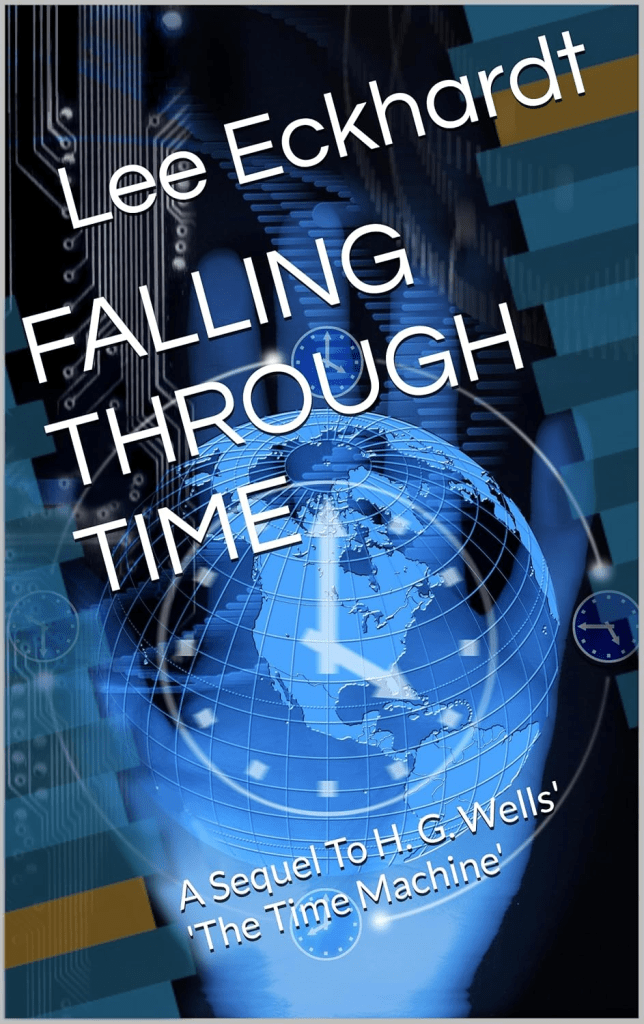
It is the year 188 of the Modern State Era. Raymond Lange, a rebellious citizen of the Modern State, makes an unauthorize visit to the ruins of London, a city destroyed during the wars that brought the old world to an end. There he makes an amazing discovery, a machine created by a 19th Century inventor – a machine that can travel through time. Raymond also finds the inventor’s journal, which describes an incredible journey to the world of 802,701 AD, where the human race has split into two separate species – the decadent Eloi, who live on the Earth’s surface, and the cannibalistic Morlocks, who dwell below ground. When Raymond is accused of treason he has no choice but to use the Time Machine to flee into the future. Once in 802,701 AD he faces not only the threat of the Morlocks but the vengeance of the Modern State, which is willing to send a team of agents – a team led by Raymond’s worst enemy – 800,000 years through time to apprehend him…
Some letters come from the living. Some come from the dead. This one comes with a formula that turns a rowboat into a miracle.
Seventeen-year-old Lord Michael Ainsling — youngest brother of the Duke of Darkwater, builder of mechanical marvels, survivor of fairyland — receives a letter from a man sixteen years dead. The inventor Tristram Blakley has not perished; he has been imprisoned by his own genius and begs the one mind in all of Avalon brilliant enough to understand his work to set him free. All Michael has to do is find seven missing brothers first and walk a magical path..
Fifteen-year-old Albinia Blakley has spent her whole life under her mother’s iron thumb — and her mother is a witch. The day Al finally escapes down a rope of knotted sheets, she lands in a world she doesn’t recognize, with no money, no magic kit, and no idea that the stranger who catches her is about to become her greatest ally.
Together, a girl with more secrets than she knows and a boy who builds machines that try to murder him must outwit a sorceress, navigate the treacherous courts of Fairyland, and unravel an enchantment years in the making — before a family is lost for good.
Witch’s Daughter is a gaslamp fantasy brimming with wit, warmth, and wonder, for readers who love their magic wrapped in velvet and their adventures served with morning tea.
FROM MAX COSSAK: White Money (The Wilder Bunch Book 11)
When his friend shares half his fabulous silver claim, a smalltown storekeeper must battle claim jumpers, a corrupt judge and ruthless killers.
Most people are at least dimly aware of the Great Depression of 1929. But how many have heard about the Panic of 1873, which was nearly as devastating? In White Money (a wonderful throw-back to old-timey Western novels like Shane and True Grit), Civil War veteran Morris Goldwater, like millions of his fellow Americans, has been caught up in the financial disaster of the Panic.
With his business collapsing, and desperate to support his wife and children, Goldwater leaps at the promise of half interest in an Arizona silver mine claimed by his old Union Army comrade and mentor. Riding the rails, camping with hoboes, encountering the best and worst of humanity, he makes his way southwest.
Dangers and disappointments abound, not least of which is finding that the Arizona desert in winter is not the paradise Goldwater hoped for. Claim jumpers, a corrupt judge, bigots and brigands conspire to thwart his dreams. Will evil be a match for the ingenuity and the basic goodness of the average American? Never count a war veteran out, even against formidable odds.
Plans are bound to go awry with bandits and robbers on the loose. Anyone can become a victim if precautions aren’t taken. These stories tell of epic quick-draw duels, fights for justice, and survival of the fittest.
Featuring 18 stories by the following authors: Barend Nieuwstraten III, Robert Walton, Rod A. White, Charles Kyffhausen, Marc Sorondo, Zachary Vincent, J. Benjamin Sanders, B.F. Vega, Nicholas Samuel Stember, Daividh Eideard Mitchell, Bruce H. Markuson, George Zamalea, Nicholas Arkison, Steve Loiaconi, David J. Vowell, Zsaffryn Terra, Sarah Cline, and James T. Siburt.
FROM DALE COZORT: The Best of Space Bats & Butterflies – Book Two
Space Bats & Butterflies Book Two is another eclectic collection of the best alternate history or time-travel stories, book excerpts, essays and world-building exercises from the ninety-plus issues of a long-running Alternate History zine.
Part Two of a two-part book-length alternate World War II scenario-The Moscow Option-1942.
The Interrupted Trajectory: Indians without the Old World.
Could you save the Incas from Spanish conquest?
American Revolution: Britain Keeps the Deep South
D-Day Landings Fail. Fiction stories and excerpts:
World War II Germany invades a divided alternate history US that still uses black powder muskets.
Bootleggers from the 1920s invade a far-future sanctuary for massacre victims.
Modern US collides with an alternate reality full of deadly animals.
Tasmanian Wolves are supposed to be extinct. What is one doing in a Illinois cornfield?
An ageless, vastly intelligent dog holds the secrets to immortality. Can he survive long enough to give it to humanity?
They called him a war hero. The savior of the Islands. The greatest weather mage the Islands ever knew. But once, he was a lonely, misfit youth with some impossible dreams.
Esavas Daruvias wants two things in life – to become a weather mage and to marry the girl of his dreams. But, bookish and awkward, his magical power stunted since childhood, he’s a failure at everything a highborn mage is supposed to be, and life as a scholar at the remote, secluded Tower is his only hope of refuge from a society where he doesn’t belong.
Then his father offers him the impossible, an arranged marriage to the beautiful Pirazina, the girl he’s always loved – who barely knows he exists. To win her heart and admiration, Esavas takes desperate measures to become the mage and man he longs to be, determined to make his dreams a reality even at the risk of losing his power, his freedom, and his future.
Start your magical adventure through the Islands with Dreams of Magic, the prequel to the epic romantic fantasy series Mage of Storm and Sea. From an austere scholars’ tower to sun-soaked beaches, from desperate hillside battles to seas full of danger, come discover a new world of wonder, danger, and magic.
Contains strong language and mature subject matter, including drug and alcohol use and sexual references.
FROM MEL DUNAY: “Skynet” As Your Secretary: AI Tools For The Indie Author
That’s the premise behind For Want of a Rivet, an anthology of eleven alternate history military stories that asks one deceptively simple question: what if a single invention, tactical choice, or quiet act of courage had gone differently?The stories span a century of conflict and a dozen theaters of war. A Royal Navy pilot spots the German fleet and changes the shape of World War One. Air privateers carrying Letters of Marque dogfight over the Western Front while a brash young balloon-buster rewrites the record books. A Japanese naval officer quietly suppresses a breakthrough antenna technology that will shape the Pacific war. German engineers develop a submarine that makes the Atlantic a killing ground. British scientists discover how to bend the enemy’s own guidance beams back against them, and a stage magician helps make the resulting deception invisible. An all-Black paratrooper battalion that was supposed to be fighting wildfires instead drops into the Battle of the Bulge. A French Foreign Legion scout finds a Roman tunnel under the most heavily defended line in Italy. A Polish tank crew fights to hold the cork in the bottle as Operation Unthinkable opens. A SOE agent moves through occupied France on a prosthetic leg — and the rivet that keeps it silent may decide the war. Britain and Germany forge an uneasy alliance against Soviet France. Japan defends the Imperial Palace to the last man.
These are stories about the human cost of invention, the weight of small advantages, and the soldiers, spies, and engineers who never made the official record.
Eleven contributors. One question. For want of a rivet, the war was lost — or won.
Stories include: ”Wings over Jutland” (William Meinert) · “Ace of Aces” (Karl K. Gallagher) · “Radio Waves” (Joe Salem) · “The Danzig Ghosts” (Michael Patrick Coady) · “The War They Could Not Print” (Ross Hathaway) · “Little Groups of Paratroopers” (Bart Kemper) · “Callis Caecus” (Nick Aalderink) · “Operation Unthinkable” (Samuel A. Mayo) · “Cuthbert’s Silence” (D. S. Ligon) · “Axis of Alliance” (G. Scott Huggins) · “The Last Kamikaze” (Robert Miller)
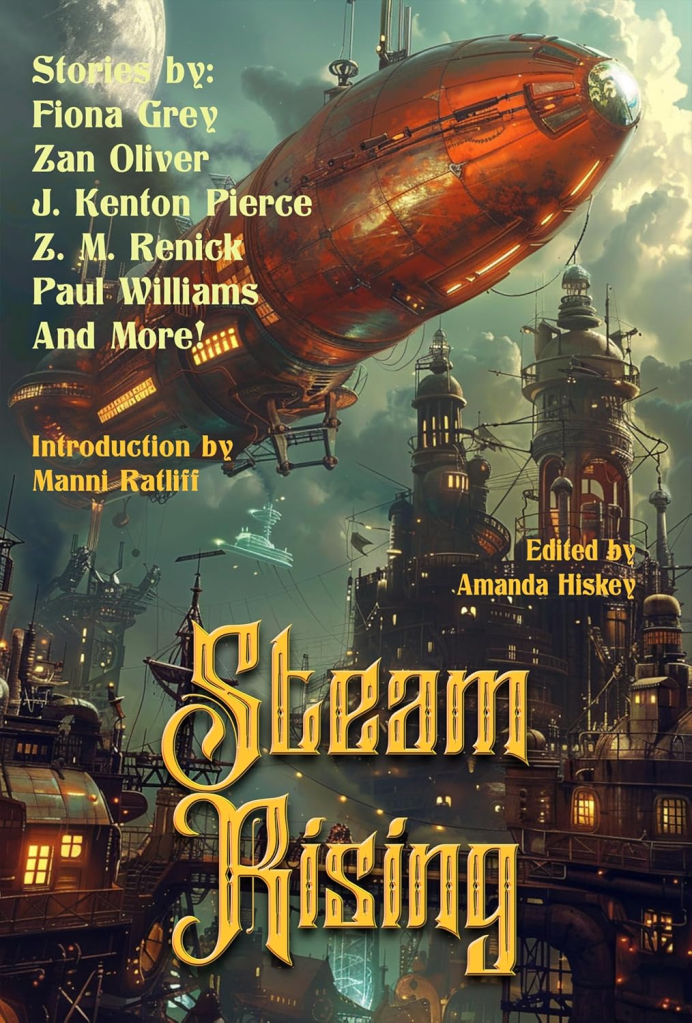
Steampunk. It’s not just a genre, it is science fiction in its purest form. In this collection, you will read of the ways that technology could both help and harm mankind. Steam power took a special kind of bravery to use and master, and the people who live in a steam-powered world adjust to that need: engineers, inventors, tinkerers and experimentalists of every kind and every manner imaginable.
Within, you will meet clockmakers and war-widows, steamship captains and airship pilots; you will see wailing engines race and clanking automata strut. Hurry on! The engineer is feeding the coal, and says she’s raring to go.
See that red lever over there? Grip ‘er tight, and heave forward the throttle…
Magical doors and other mischief mix badly with tales about murder, as young scholars return to Graytowers.
Kenneth, as prefect, thought he had his hands filled with the beginning of the new session, but when one magical door takes him and another scholar far past the bounds of a prank, they barely escape with their lives, and their escape means only that they are in graver danger. They must hide, leaving the school, and casting all their spells in secret.
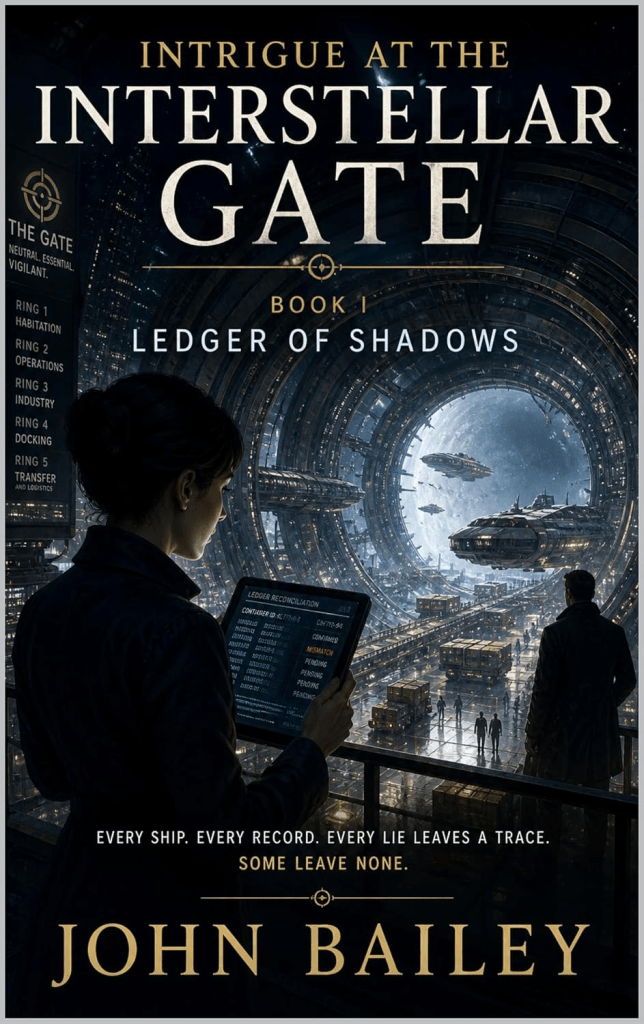
At the Interstellar Gate — humanity’s largest transit hub for interstellar freight — every container, every cargo class, and every timestamp is logged across three independent ledgers. The system was built to be foolproof.
It isn’t.
Elara Venn is a mid-level auditor who notices what the system is designed to overlook: a single mismatched checksum during a peak traffic surge. The automated protocols flag it yellow and move on. Elara doesn’t.
What she uncovers — with the unlikely help of customs linguist Tomas Iri — is not a glitch but an architecture. Ghost containers. Shadow bandwidth. A distributed conspiracy that exploits the Gate’s own optimization logic to move cargo invisibly through the most surveilled facility in the known systems.
Vignettes by Luke, Mary Catelli and ‘Nother Mike.
So what’s a vignette? You might know them as flash fiction, or even just sketches. We will provide a prompt each Sunday that you can use directly (including it in your work) or just as an inspiration. You, in turn, will write about 50 words (yes, we are going for short shorts! Not even a Drabble 100 words, just half that!). Then post it! For an additional challenge, you can aim to make it exactly 50 words, if you like.
We recommend that if you have an original vignette, you post that as a new reply. If you are commenting on someone’s vignette, then post that as a reply to the vignette. Comments — this is writing practice, so comments should be aimed at helping someone be a better writer, not at crushing them. And since these are likely to be drafts, don’t jump up and down too hard on typos and grammar.
Now that there are more songs, I am redoing this list. If you’re up on the sound track, just page down to “New this week”. Because I’m putting up a song a day, I will just do this once a week, okay? If you don’t want me to do this, tell me.
First thank you to Michael Hooten for the meme. It made me LOL. You people are nuts. What has the Secretary of State done to deserve Indy crawling on him and yelling? (The yell means “Put on a British Mystery, hold my paw and rub my belly, but how would Marco know that? And incidentally, Happy Belated Birthday (Yesterday) to the Secretary of State.) Also that sampler on the wall is the most me thing ever. (Though for the record it’s five people, since I like the boys and the Pickles. And honestly it should include all of you, but “I like coffee and maybe 300 people” doesn’t have the same punch.) As for the mug, I’m going to have to have one made, as soon as I have time to order it.
Okay, first to set your mind at rest: I’m much, much better. This is not LIKELY the permanent solution, there is a CT scan and other stuff planned for July and until then I’ll be on a “low dose maintenance antibiotic”. BUT I’ve definitely turned the corner on this bout of “Dear Lord, what is happening to my right kidney?” And my mind has largely unfogged. (Not fully. I think I still need a few dozen hours of sleep to be fully me, but–)
So what is the almighty rush and why am I putting up a not-post?
Because we have an appointment (move related — and it’s a long story, and no, I’m not explaining, at least not yet. For one we don’t know it really is happening yet. We will in a couple of weeks, give or take. It’s not a forced move like the last one, but a “Oh, this would be so good for us, at our time of life and given how we actually live.” ) non-medical, which we thought was at three pm and is actually at twelve thirty. Fortunately they called us to make sure we brought all needed stuff and … well. Part of the reason I need more sleep is that I was all curled up and getting some Zs when Dan hauled me up and strongly suggested I get in the shower and dressed, because we’d screwed up the times. (He didn’t write it down as when we made the appointment the move was even more of a blue sky thing, so we didn’t think we’d need it.) IF there is a move, the plan is to outsource almost all of it, and not interfere with my writing. We’ll see how that works. SHOULD work. There’s reasons it didn’t last time. They don’t apply now.
Anyway, so. Here we are.
So I have like less than half an hour to get this post up, which even at the rate I type is not enough for the post I had planned which is about how the sides view each other, about the cringe stuff occasionally on our own side (Hey, desperate people sound weird. I know. I’ve been there) and the outright terrifying stuff the other side says. And not fringe figures, but their candidates.
I have been meaning to do that post for a while, but now I have the brain and don’t have the time. So, if we’re back sort of on time (it could take an hour or three, depending on how likely the move looks. It could even take more. Sigh.) I’ll do another post today. If not, I’m going to ask you to just consider this a wasted week, because really. Between one thing and another probably my worst blogging week in years.
If you subscribe to my substack, if I can manage not to get sick again for a couple of weeks, I’ll start snippetage again, not just Orphans, but also Winter Prince, which I THINK I figured how to disembugger. I could give you Rhodes to Hell, too, which is in the process of almost-finished, but well, I’ll ask the substackers.
I really should update them more often, but I get tired of putting in “Welp, sick again.” Hopefully the scan, etc, will figure out what’s going on, because I figure everything else is weakened by recurring infections and who knows what. (But we hopefully will mid-July.) “Of course my autoimmune is just nuts” is a possible answer, but the doctors don’t think so. So, here we are. And yet, the memento mori reminds me that I have some 40 books to write (and the Elly 6 are MASSIVE) before I’m done. So, don’t worry too much, because I have miles to go and promises to keep, and I won’t let the stupid body get in the way of that.
Meanwhile, there’s yesterday’s clanker song (yes, there will be one today, too. I have to finish the video.)
I tried anime style for this video, and I can’t say I’m in love with it, so I’ll probably go back to more painterly, and try to figure out how to make the images coherent another way. And yes, lyrics videos are coming, they just take time. (Again hopefully the low level maintenance antibiotic keeps me functional until we figure out what’s going on, and keeps my Little Pickle from threatening to pick me up bodily (hint, she probably can’t, but I wouldn’t like to try it) and throwing me in the back of the car to take to ER, when she comes over and I’m not functional. Look, this sounds a lot more dire than it is. I’m okay, really. It’s just a bothersome thing.)
And this is the previous one, if you missed it yesterday.
Yes, another experiment with graphics. Reactions are mixed, so there.
Will I make songs for other books? I don’t know. I suspect I need to finish this sound track before the next one has room to even arrive. Maybe I’ll give Witch’s Daughter a spin. Who knows? Maybe Witchfinderr.
Anyway, please forgive me for running, but it’s one of those days. I don’t even know whether to wish I’m back shortly or not, since that would mean things.
Hold the fort while I’m gone. Don’t talk to strangers (or truthfully to pollsters). And don’t do anything I wouldn’t do. (Yes, that does indeed give you a wide latitude. Still.)
*Before I start the post, a small update: Yes, I completely forgot I was supposed to do promo yesterday. This thing — between the infection and the anti-biotic, has given me a preview of being ninety. Which I don’t like. I give it no stars and am trying to send it back. Mostly it does so by being too tired to think. That said, today I woke up better. We’ll see if that survives the antibiotic dosage I just took. But hopefully it will.
OT and separately, the clanker song of the day: I’m insufferably proud of the style of the video, which I came up with to circumvent the whole “birth” thing which otherwise would get weird. OTOH I could just be crazy. It’s a choice. Anyway A Night Of Years, first song of the third book of No Man’s Land.
And that’s it. Today, in fact very shortly I have to leave for an appointment with a specialist. So I guess Promo Post will be on Sunday. I promise I’m trying to get over this thing as fast as humanly possible. – SAH.*
When did you start suspecting there was an anti-AI psy ops going on?
For me it’s the “Water that goes into data centers just evaporates on contact” thing going on in Twitter.
Do data centers use disproportionate amounts of water? I don’t know. And neither do you. What we do know is that any number of people on X (and other places) assure us the water use is apocalyptic.
It’s hard to figure out how this can be. I know what the water is used for — cooling — and a lot of industrial processes use it the same way.
When I pointed out that the water doesn’t simply vanish, someone on X assured me that it’s then not in a state to be returned to reservoirs. To which my answer is “Why not?” And in the same way, why would they be using a lot of “new” water. I believe the normal way of using water as coolant is to run it through a closed system, where it’s run somewhere to lose the heat (usually underground) and then back up to cool. Am I wrong in this? I know a lot of you are far more knowledgeable on this stuff than I am.
The problem is that this isn’t being treated as a “new process that might have these problems, we need to make sure the plants don’t use too much water”. It’s being treated as the beast of the apocalypse and we’re enjoined to banish it to the outer darkness.
And I can tell you when things like that are done, and uniformly pushed, particularly by a band of foreigners and bots or foreign bots, I get mulish and go “No.” And fix my little hooves on the path and can’t be moved. Because the psy-ops are never in your best interests.
I don’t care if psy-ops are telling you that going outside once a day and eating an apple is good for you. You’ll find they want you to to run outside starkers or to eat radioactive apples. Because it is never in your best interests.
Now I think a lot of the psy-ops is being run by places like China and people who wish us ill. And I think part of that is that they have an inflated idea of what AI can do for our country and therefore, of course, would like to defang us.
Inflated? Oh, come on. A lot of you will tell me that no, really, AI is all that and a jar of peanut butter. And maybe it is, but right now I think most of what it does is be a force multiplier for the highly competent.
I’m not deriding this as an advantage, particularly in the short term. As I have said before, we are facing a massive crisis of competence, so allowing our competent people to do more is a bridge to getting out of this bind. Provided, of course at some point we train MORE competent people. (The path to that is… well, the indications are mixed though I’m immensely chuffed by the rise in homeschooling.)
However I suspect most of the reason the psy-ops was unleashed was the overestimation of what AI can do and how amazing it is.
It is amazing mind you, but we’re going to try to use it for all sorts of things it can’t do. How do I know that? Because we’ve done that with every single technology when it’s new. Who can forget putting radioactive buttons in kids’ clothing so you could follow them with a geiger counter? Okay, so that’s a Disney comic, but at the time it was clearly viewed as a completely sane thing to do. Not to mention doing x-rays of your feet to fit shoes. Or a dozen others highly inappropriate uses of radiation.
And this happened for every single technology. So why not for AI. And it’s happening to the extent that corporate managers are telling people they have to use AI even when it makes no sense.
Now, I’ll admit since I’m not a programmer my use case for AI is much more reduced. I mostly can get it to do things like bring me up to speed on the setup of series I’m trying to finish after years of lying dormant. So if I hit a wall I can go “What does Kyrie’s earring look like?” And it spits it out. Very handy. (Yes, I do have to verify. it can be wrong very confidently. But it’s much easier to look for “feather” than to look for earring, which might not be called that at that particular point, say.)
But I know it’s more useful to a ton of other people.
I think it is being overestimated, particularly in its defense/war capacities, and that is causing the psy-ops.
Or maybe it’s not.
At any rate we shouldn’t let it be decided for us by allowing foreigners or bots, or foreign bots to stomp us into unreasoning fear.
Water and energy use? Well, those have known solutions. (Including nuclear.)
We should also, of course, try to curb unreasoning blue-sky uses.
The key though is unreasoning. Go back up there where I said AI is most useful for leveraging the competency of highly competent people.
The best we can do is create a lot of very competent people by teaching the new generations as thoroughly as we can.
Since that’s the same recommendation as for “merely surviving as a species” it’s a no brainer.
Ignore the psy-ops and move on, using your reason and abilities, and passing those on as well as you can.
*First, and OT, the next Clanker Song “Blood On Ice” has dropped. Again, not happy with the video, but I have ideas for improving it. (Likely easier when the antibiotic isn’t trying to kill me, yes?) Anyway, here’s the new song:
Note that it helps immensely if you like and comment on the videos. It tricks the algorithm into showing it to more people. And the comments can be just “I like this” or whatever. If you have no idea what this is all aoubt, the rest of it is here. Now for the real post. -SAH)
Some days ago I got — of all things — in an argument on libertarianism on X.
I said pure libertarianism is a utopian ideal that — because it is utopian — can never be achieved. Someone got very upset at me and told me that someone whose name I don’t know (or if I know, I don’t remember, because my mind is made of taffy right now) said that libertarianism is not utopian. So, I was wrong. Which I have to tell you is the most libertarian argument yet. Because libertarians are people of philosophy and often argue in screamed quotations.
So, am I abjuring libertarianism? Oh, please! I retain a high value for the philosophy. It is important for any number of reasons, but mostly because it stands in direct contradiction to most other philosophies of government. Even if it were completely insane, (it’s not) it would be desperately needed in today’s world.
First, let’s make it absolutely clear that EVERY political position, taken to its ideal is absolutely impossible. Yes, even monarchism at the twitter-monarchists view it, where the King is appointed by G-d and either very good or supposed to be a scourge the people deserve. In fact monarchy with rare intervals ends up like any given family business where the guy who takes over does so by nepotism and not competence: slowly grinding downfall, but taking an entire country along for the ride. And it’s peculiarly brittle around rapid change, be it social or technological.
In the same way I don’t need to outline the failure of communism to anyone. Marxism is a theory built on air, with no connection to real economics. (Any theory that misunderstands distribution as waste has serious issues.) It appeals to minds broken by envy, but anyone else can see what it does it cut off the economic signals of individual consumption from the producers, leaving people to decide what’s needed by fiat from above, from people who — by the nature of it — are misinformed or not informed at all. The result is a rapid devolution into “rule by a king” by any other name. And, stripped of upbringing meant to make them think they owe the people something, the ruler tends to rapidly fall into the “mad king” category. (Looks North-Korea, or for that matter Cuba-ward.) What it doesn’t do is become a utopian stateless society where everyone automagically gets what he/she needs.
Socialism is Communism on the installment plan, having surrendered the idea that they’ll eventually get to that magical state withering away and instead believing it’s possible to stay suspended in that place where everyone gets what he needs and everyone contributes what she can. Like communism, in its most functional form, it is an oligarchy, nepotistic and brittle in the face of any new technology. For its failure mode, see the sh*tshow of Europe these days. Or the way we were headed two years ago. Eventually the nepo oligarchy becomes an open kakistocracy that can stay in power only by brutal repression. Next verse, same as the first, welcome to the end stage of various dictatorships as the velvet glove comes off and the steel clad boot comes down.
And then there is us. Are we a libertarian country? Meh. Somewhat. It scares the pee out of the rest of the world, to the extent we are, actually.
What we are is the result of founders who had the foresight to say “Government should be as small as possible, and central government smaller than local government, and the individual should have the most power of all.” Did it work? Are humans involved?
As someone pointed out in some comment, we started betraying our own constitution when the ink was barely dry.
And yet– And yet, what remains and our absolute certainty that this is how things are SUPPOSED to work is enough to make us the powerhouse of civilization and prosperity for the world.
But is constitutionalism and an unwavering devotion to minarchism (not the i not o) libertarianism.
I don’t know. Do you?
Part of what we’ve run into is “who defines Libertarianism?” or if you prefer “The individualists are still arguing over it.”
As I first encountered Libertarianism, I’m no longer a libertarian. Why? Open borders. Open borders are absolutely an utopian idea, predicated on the idea that cultures somehow stopped existing, or that people won’t have greater loyalty to their cousins than to complete strangers. For a soft failure, look at the H1B visas and various companies being wholly taken over by foreign ethnic groups for whom nepotism is a POSITIVE value, much more important than competence. For the hard failure, the open borders under autopen and oh, Venezuelan gangs. (Though the Mexican gangs are enough to do for us, honestly.)
I hate to say this, but humans aren’t interchangeable, and even without a welfare state open borders would be dangerous. Because if you dilute the culture to the point that people don’t understand their neighbors social signals, the failure mode isn’t “we fall apart” it’s “multiple warring ethnic and cultural groups.”
What I don’t understand is how I came to forget that in the nineties, when I’d seen it among exchange students, with people clinging to their nationality, the next closest nationality, and vaguely related cultures after that. Except me, because I’m broken or something. BUT all the same. It’s a human thing that makes open borders suicidal.
And I’m not sure about legalized drugs. Look, I’m divided on this. Because the war on drugs has caused enough trouble. BUT on the other hand, there are foreign cartels who view pushing drugs everywhere, including on those too young to know better, as an excellent business opportunity. And a lot of the newest stuff are “take it once and destroy yourself” (Okay, it’s a Russian roulette, but). And also I saw the results of legalization in places like Portugal.
It’s hard to know what part is the drugs, and what part the reaction to the drugs, and what part well, fraud around, under and between all the drug dealing. For instance, how much of the mess in Portugal is just “Portugal.” And how much of the fact that legalizing pot destroyed Colorado is real? How much of it was JUST fraud masquerading under the new influx?
How much, in fact, of the havoc I’ve seen legalization wreak is the drugs, and how much of it is stuff like no enforcing laws against petty theft, camping in public spaces, homelessness, etc. etc. etc.?
I don’t know. Hence “I’m not sure” and not a hard coming-out against it. Because I don’t have all the data and can’t therefore decide. What I’m sure about is that legalization destroys neo-liberal states in which letting drugs eating your mind is proof you’re a victim and need to be given everything.
Other things: still sure you should be able to do whatever you want sexually, provided no force or coercion (or inability to consent) is involved, and you don’t do it on my front lawn and scare my cats.
Still think taxation is theft. (No, hear me out, how about a lottery to finance the few functions that are actually constitutional to the Federal government. Because we don’t need the rampant theft and grift going on at all levels of government. Less money would make it less attractive.)
Still sure “public education” is an oxymoron, and we would be better off with “charity schools.”
I still think the Libertarian Party as an entity is over its skis and has been for a long time. Their last chance at redemption was the election in 16 when they decided to nominate… a democrat.
I still think that the socialist libertarians are as L. Neil Smith put it “something smelly clinging to our shoes.” And to prove it, I’m going to quote Ayn Rand, because of course I am.
And I guess that makes me a libertarian, since I’m arguing in loud quotations. :D
On the serious side, I’m exactly what I’ve always been, the same person who wrote A Few Good Men. I believe in our Constitution. I believe the government should wear it as a girdle cinched tight enough that it can’t escape. I believe in the quotient of individual versus government the individual should now and always have primacy.
To my view that’s libertarian enough, without accruing the utopian and evangelistic view of open borders that requires libertarianism all over the WORLD. The world is not our concern. Let’s start here and make this a shiny city on the hill.
I am in truth an OWL — Older, Wiser Libertarian — who has learned some things sound great in the abstract but are in fact impossible in this our fallen world.
And in the end, I think that’s the greatest value of Libertarian, small government and individualistic philosophy. A grand implementation of it is at its complete best, absent small colonies away from Earth (eh) is utopian and impossible.
But just by existing, by being loud (and sometimes shouty in quotations (eh)), by keeping emphasizing that power always comes from the individual in ultimate instance, we provide much needed leavening to a world that is sure of the opposite, and in which the solution of all problems is assume to be “get a man” (Or these days often woman) “with a bigger stick.”
In that sense, I’m perfectly happy to be lumped in with the liberty lovers, the trouble makers, the goats refusing to be herded, the rebels who refuse to fall into line.
Because we’re the ones who keep humanity from rushing forward, as one…. and fall off the cliff.















































































 According To Hoyt